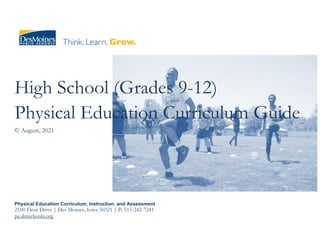
High School (Grades 9-12)
Physical Education Curriculum Guide
© August, 2021
Physical Education Curriculum, Instruction, and Assessment
2100 Fleur Drive | Des Moines, Iowa 50321 | P: 515-242-7241
pe.dmschools.org
Physical Education Department
2
Secondary Curriculum Lead Team Editors – High School
Lisa Klein, North High School
Amy Barsness, Virtual Campus High School
Brianne Burns, Virtual Campus High School
Sandy Trogdon, Lincoln High School
Superintendent
Thomas Ahart, Ed.D
Secondary Director of Teaching & Learning
Sarah Dougherty
Physical Education Curriculum Coordinator
Carlye Satterwhite
Elementary Curriculum Lead Team Editors
Haley Manning, Hanawalt Elementary
Jessica Shwery, Garton Elementary
Megan Iverson, Edmunds Elementary
Michael Southmayd, Phillips Elementary
Nick Quinlan, Phillips Elementary
Tara Frohwein, Capitol View Elementary
Secondary Curriculum Lead Team Editors – Middle School
Scott Anderson, Weeks Middle School
Diana Repp, Brody Middle School
Tara Stemsrud, Meredith Middle School
Meredith Wilson, Hoyt Middle School
Physical Education Department
3
Physical Education Department
4
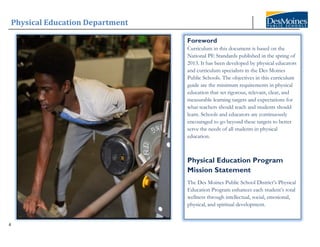
Foreword
Curriculum in this document is based on the
National PE Standards published in the spring of
2013. It has been developed by physical educators
and curriculum specialists in the Des Moines
Public Schools. The objectives in this curriculum
guide are the minimum requirements in physical
education that set rigorous, relevant, clear, and
measurable learning targets and expectations for
what teachers should teach and students should
learn. Schools and educators are continuously
encouraged to go beyond these targets to better
serve the needs of all students in physical
education.
Physical Education Program
Mission Statement
The Des Moines Public School District’s Physical
Education Program enhances each student’s total
wellness through intellectual, social, emotional,
physical, and spiritual development.
Physical Education Department
5
Table of Contents
How to use this document…………………………………………………..
DMPS PE Learning Objectives…………………………………………….
Document Structures…………………………………..…………..………..
Learning Topics……..…………………………………………………..…..
Skills and Knowledge..………….……………………………….……...
Engagement………………..….…………….………….……….……...
Fitness………………………………………………………………….
Personal and Social Behavior...……………………………..…….….....
Grade Level Goals……………………………………………………….......
Grade Level Scales…………………………………………………………..
Common Vocabulary…………………………………………..…………....
Glossary Terms……………………………………………………………...
Physical Education Department
6
How to use this document:
This curriculum guide is not…
• A lock-step instructional guide detailing exactly when and how you teach.
• Meant to restrict your creativity as a teacher.
• A ceiling of what your students can learn, nor a set of unattainable goals.
Instead, the curriculum guide is meant to be a common vision for student learning and a set of
standards by which to measure and report student progress and provide meaningful feedback.
The curriculum guide outlines which learning goals are most essential for student learning; it is our district’s guaranteed and viable
curriculum. The expectation is that every student in our district, regardless of school or classroom, will know and understand these
learning goals. As the classroom teacher, you should use the curriculum guide to help you to decide how to scaffold up to the learning
goals, and extend your students’ learning beyond them.
The curriculum guide is a planning tool; assessed learning topics are provided, but as the instructional leader of your classroom, you
determine the scope and sequence in which you will introduce the prioritized learning goals. You are encouraged to create your
own sub-units of study within each topic as a starting point. Within this document you will find a foundational structure for planning
instruction in the physical education classroom which can be supplemented with unlimited materials from any number of sources,
including but not limited to district texts.
Please consider this guide a living and dynamic document, subject to change and a part of a continuous feedback loop. As part of this
logic model.
Physical Education Department
7
• Des Moines Public Schools K-12 Student Learning Objectives in Physical Education
o Measurable, long-term academic growth targets
o Developmentally appropriate activities which assess learning growth for all students
o Pre- and Post-assessment growth of learning
o Year-long learning goals using grade level targets to work towards the learning goal
• Effective Components of a well-designed Physical Education Classroom
o Meets the needs of all students
o Keeps students active for most of physical education class time (minimum 50 instruction/50 movement)
o Teaches self-management
o Emphasizes knowledge and skills for a lifetime of physical activity
o Enjoyable experience for all students
• The Essential Components of Physical Education (Figure 5)
o Policy and Environment
o Curriculum
o Appropriate Instruction
o Student Assessment
Physical Education Department
8
Standards-Referenced Grading Basics
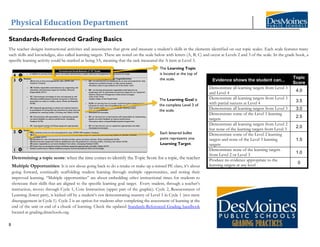
The teacher designs instructional activities and assessments that grow and measure a student’s skills in the elements identified on our topic scales. Each scale features many
such skills and knowledges, also called learning targets. These are noted on the scale below with letters (A, B, C) and occur at Levels 2 and 3 of the scale. In the grade book, a
specific learning activity could be marked as being 3A, meaning that the task measured the A item at Level 3.
Evidence shows the student can...
Topic
Score
Demonstrate all learning targets from Level 3
and Level 4
4.0
Demonstrate all learning targets from Level 3
with partial success at Level 4 3.5
Demonstrate all learning targets from Level 3 3.0
Demonstrate some of the Level 3 learning
targets 2.5
Demonstrate all learning targets from Level 2
but none of the learning targets from Level 3 2.0
Demonstrate some of the Level 2 learning
targets and none of the Level 3 learning
targets
1.5
Demonstrate none of the learning targets
from Level 2 or Level 3 1.0
Produce no evidence appropriate to the
learning targets at any level 0
The Learning Topic
is located at the top of
the scale.
The Learning Goal is
the complete Level 3 of
the scale.
Each lettered bullet
point represents one
Learning Target.
Determining a topic score: when the time comes to identify the Topic Score for a topic, the teacher
looks at all the pieces of the Body of Evidence for that topic. The table to the right describes what
Topic Score a student receives based on what the Body of Evidence shows. The scores listed on this
table are the only valid scores that may be entered into the Topic Score assignment in a grade book.
Multiple Opportunities: It is not about going back to do a retake or make-up a missed PE class, it’s about
going forward, continually scaffolding student learning through multiple opportunities, and noting their
improved learning. “Multiple opportunities” are about embedding other instructional times for students to
showcase their skills that are aligned to the specific learning goal target. Every student, through a teacher’s
instruction, moves through Cycle 1, Core Instruction (upper part of the graphic). Cycle 2, Reassessment of
Learning (lower part), is kicked off by a student’s not demonstrating mastery of Level 3 in Cycle 1 (not mere
disengagement in Cycle 1). Cycle 2 is an option for students after completing the assessment of learning at the
end of the unit or end of a chunk of learning. Check the updated Standards-Referenced Grading handbook
located at grading.dmschools.org.
Physical Education Department
9
Standards Referenced Grading Basics
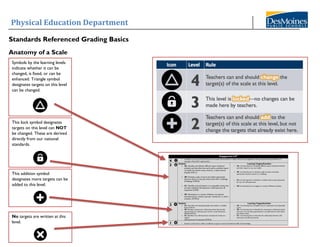
Anatomy of a Scale
Symbols by the learning levels
indicate whether it can be
changed, is fixed, or can be
enhanced. Triangle symbol
designates targets on this level
can be changed.
This lock symbol designates
targets on this level can NOT
be changed. These are derived
directly from our national
standards.
This addition symbol
designates more targets can be
added to this level.
No targets are written at this
level.
learners.
For more information: grading.dmschools.org
Physical Education Department
10
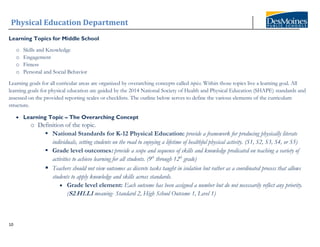
Learning Topics for Middle School
o Skills and Knowledge
o Engagement
o Fitness
o Personal and Social Behavior
Learning goals for all curricular areas are organized by overarching concepts called topics. Within those topics live a learning goal. All
learning goals for physical education are guided by the 2014 National Society of Health and Physical Education (SHAPE) standards and
assessed on the provided reporting scales or checklists. The outline below serves to define the various elements of the curriculum
structure.
• Learning Topic – The Overarching Concept
o Definition of the topic.
▪ National Standards for K-12 Physical Education: provide a framework for producing physically literate
individuals, setting students on the road to enjoying a lifetime of healthful physical activity. (S1, S2, S3, S4, or S5)
▪ Grade level outcomes: provide a scope and sequence of skills and knowledge predicated on teaching a variety of
activities to achieve learning for all students. (9th
through 12th
grade)
▪ Teachers should not view outcomes as discrete tasks taught in isolation but rather as a coordinated process that allows
students to apply knowledge and skills across standards.
• Grade level element: Each outcome has been assigned a number but do not necessarily reflect any priority.
(S2.H1.L1 meaning- Standard 2, High School Outcome 1, Level 1)
Physical Education Department
11
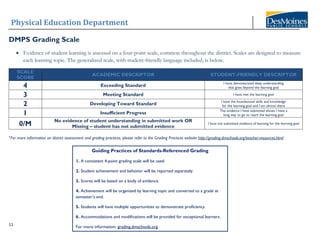
DMPS Grading Scale
• Evidence of student learning is assessed on a four-point scale, common throughout the district. Scales are designed to measure
each learning topic. The generalized scale, with student-friendly language included, is below.
SCALE
SCORE
ACADEMIC DESCRIPTOR STUDENT-FRIENDLY DESCRIPTOR
4 Exceeding Standard
I have demonstrated deep understanding
that goes beyond the learning goal
3 Meeting Standard I have met the learning goal
2 Developing Toward Standard
I have the foundational skills and knowledge
for the learning goal and I am almost there
1 Insufficient Progress
The evidence I have submitted shows I have a
long way to go to reach the learning goal
0/M
No evidence of student understanding in submitted work OR
Missing – student has not submitted evidence
I have not submitted evidence of learning for the learning goal
*For more information on district assessment and grading practices, please refer to the Grading Practices website http://grading.dmschools.org/teacher-resources.html
Guiding Practices of Standards-Referenced Grading
1. A consistent 4-point grading scale will be used.
2. Student achievement and behavior will be reported separately.
3. Scores will be based on a body of evidence.
4. Achievement will be organized by learning topic and converted to a grade at
semester’s end.
5. Students will have multiple opportunities to demonstrate proficiency.
6. Accommodations and modifications will be provided for exceptional learners.
For more information: grading.dmschools.org
Physical Education Department
12
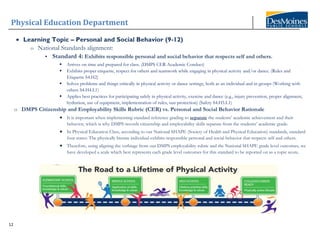
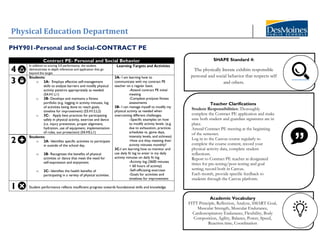
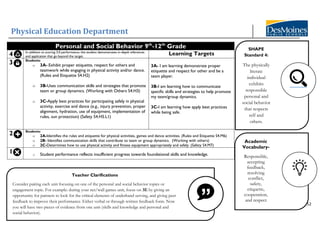
• Learning Topic – Personal and Social Behavior (9-12)
o National Standards alignment:
▪ Standard 4: Exhibits responsible personal and social behavior that respects self and others.
o DMPS Citizenship and Employability Skills Rubric (CER) vs. Personal and Social Behavior Rationale
• It is important when implementing standard reference grading to separate the students’ academic achievement and their
behavior, which is why DMPS records citizenship and employability skills separate from the students’ academic grade.
• In Physical Education Class, according to our National SHAPE (Society of Health and Physical Education) standards, standard
four states: The physically literate individual exhibits responsible personal and social behavior that respects self and others.
• Therefore, using aligning the verbiage from our DMPS employability rubric and the National SHAPE grade level outcomes, we
have developed a scale which best represents each grade level outcomes for this standard to be reported on as a topic score.
▪ Arrives on time and prepared for class. (DMPS CER Academic Conduct)
▪ Exhibits proper etiquette, respect for others and teamwork while engaging in physical activity and/or dance. (Rules and
Etiquette S4.H2)
▪ Solves problems and things critically in physical activity or dance settings, both as an individual and in groups (Working with
others S4.H4.L1)
▪ Applies best practices for participating safely in physical activity, exercise and dance (e.g., injury prevention, proper alignment,
hydration, use of equipment, implementation of rules, sun protection) (Safety S4.H5.L1)
Physical Education Department
13
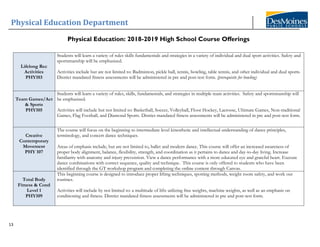
Physical Education: 2018-2019 High School Course Offerings
Lifelong Rec
Activities
PHY103
Students will learn a variety of rules skills fundamentals and strategies in a variety of individual and dual sport activities. Safety and
sportsmanship will be emphasized.
Activities include but are not limited to: Badminton, pickle ball, tennis, bowling, table tennis, and other individual and dual sports.
District mandated fitness assessments will be administered in pre and post-test form. (prerequisite for bowling)
Team Games/Act
& Sports
PHY105
Students will learn a variety of rules, skills, fundamentals, and strategies in multiple team activities. Safety and sportsmanship will
be emphasized.
Activities will include but not limited to: Basketball, Soccer, Volleyball, Floor Hockey, Lacrosse, Ultimate Games, Non-traditional
Games, Flag Football, and Diamond Sports. District mandated fitness assessments will be administered in pre and post-test form.
Creative
Contemporary
Movement
PHY 107
The course will focus on the beginning to intermediate level kinesthetic and intellectual understanding of dance principles,
terminology, and concert dance techniques.
Areas of emphasis include, but are not limited to, ballet and modern dance. This course will offer an increased awareness of
proper body alignment, balance, flexibility, strength, and coordination as it pertains to dance and day-to-day living. Increase
familiarity with anatomy and injury prevention. View a dance performance with a more educated eye and grateful heart. Execute
dance combinations with correct sequence, quality and technique. This course is only offered to students who have been
identified through the GT workshop program and completing the online content through Canvas.
Total Body
Fitness & Cond
Level 1
PHY109
This beginning course is designed to introduce proper lifting techniques, spotting methods, weight room safety, and work out
routines.
Activities will include by not limited to: a multitude of lifts utilizing free weights, machine weights, as well as an emphasis on
conditioning and fitness. District mandated fitness assessments will be administered in pre and post-test form.
Physical Education Department
14
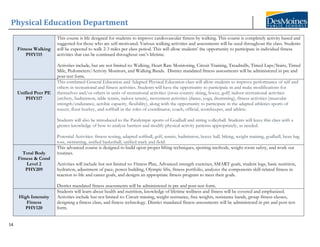
Fitness Walking
PHY115
This course is life designed for students to improve cardiovascular fitness by walking. This course is completely activity based and
suggested for those who are self-motivated. Various walking activities and assessments will be used throughout the class. Students
will be expected to walk 2-3 miles per class period. This will allow students’ the opportunity to participate in individual fitness
activities that can be continued throughout one’s lifetime.
Activities include, but are not limited to: Walking, Heart Rate Monitoring, Circuit Training, Treadmills, Timed Laps/Stairs, Timed
Mile, Pedometers/Activity Monitors, and Walking Bands. District mandated fitness assessments will be administered in pre and
post-test form.
Unified Peer PE
PHY117
This combined General Education and Adapted Physical Education class will allow students to improve performance of self and
others in recreational and fitness activities. Students will have the opportunity to participate in and make modifications for
themselves and/or others in units of recreational activities (cross country skiing, bocce, golf) indoor recreational activities
(archery, badminton, table tennis, indoor tennis), movement activities (dance, yoga, drumming), fitness activities (muscular
strength/endurance, aerobic capacity, flexibility), along with the opportunity to participate in the adapted athletics sports of
soccer, floor hockey, and softball in the roles of coordinator, coach, official, scorekeeper, and athlete.
Students will also be introduced to the Paralympic sports of Goalball and sitting volleyball. Students will leave this class with a
greater knowledge of how to analyze barriers and modify physical activity patterns appropriately, as needed.
Potential Activities: fitness testing, adapted softball, golf, tennis, badminton, bocce ball, biking, weight training, goalball, bean bag
toss, swimming, unified basketball, unified track and field.
Total Body
Fitness & Cond
Level 2
PHY209
This advanced course is designed to build upon proper lifting techniques, spotting methods, weight room safety, and work out
routines.
Activities will include but not limited to: Fitness Plan, Advanced strength exercises, SMART goals, student logs, basic nutrition,
hydration, adjustment of pace, power building, Olympic lifts, fitness portfolio, analyzes the components skill-related fitness in
reaction to life and career goals, and designs an appropriate fitness program to meet their goals.
District mandated fitness assessments will be administered in pre and post-test form.
High Intensity
Fitness
PHY120
Students will learn about health and nutrition, knowledge of lifetime wellness and fitness will be covered and emphasized.
Activities include but not limited to: Circuit training, weight resistance, free weights, resistance bands, group fitness classes,
designing a fitness class, and fitness technology. District mandated fitness assessments will be administered in pre and post-test
form.
Physical Education Department
15
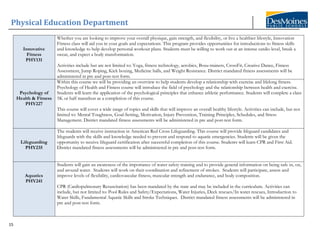
Innovative
Fitness
PHY131
Whether you are looking to improve your overall physique, gain strength, and flexibility, or live a healthier lifestyle, Innovation
Fitness class will aid you in your goals and expectations. This program provides opportunities for introductions to fitness skills
and knowledge to help develop personal workout plans. Students must be willing to work out at an intense cardio level, break a
sweat, and expect a body transformation.
Activities include but are not limited to: Yoga, fitness technology, aerobics, Bosu-trainers, CrossFit, Creative Dance, Fitness
Assessment, Jump Roping, Kick boxing, Medicine balls, and Weight Resistance. District mandated fitness assessments will be
administered in pre and post-test form.
Psychology of
Health & Fitness
PHY227
Within this course we will be providing an overview to help students develop a relationship with exercise and lifelong fitness.
Psychology of Health and Fitness course will introduce the field of psychology and the relationship between health and exercise.
Students will learn the application of the psychological principles that enhance athletic performance. Students will complete a class
5K or half marathon as a completion of this course.
This course will cover a wide range of topics and skills that will improve an overall healthy lifestyle. Activities can include, but not
limited to: Mental Toughness, Goal-Setting, Motivation, Injury Prevention, Training Principles, Schedules, and Stress
Management. District mandated fitness assessments will be administered in pre and post-test form.
Lifeguarding
PHY235
The students will receive instruction in American Red Cross Lifeguarding. This course will provide lifeguard candidates and
lifeguards with the skills and knowledge needed to prevent and respond to aquatic emergencies. Students will be given the
opportunity to receive lifeguard certification after successful completion of this course. Students will learn CPR and First Aid.
District mandated fitness assessments will be administered in pre and post-test form.
Aquatics
PHY241
Students will gain an awareness of the importance of water safety training and to provide general information on being safe in, on,
and around water. Students will work on their coordination and refinement of strokes. Students will participate, assess and
improve levels of flexibility, cardiovascular fitness, muscular strength and endurance, and body composition.
CPR (Cardiopulmonary Resuscitation) has been mandated by the state and may be included in the curriculum. Activities can
include, but not limited to: Pool Rules and Safety/Expectations, Water Injuries, Deck rescues/In water rescues, Introduction to
Water Skills, Fundamental Aquatic Skills and Stroke Techniques. District mandated fitness assessments will be administered in
pre and post-test form.
Physical Education Department
16
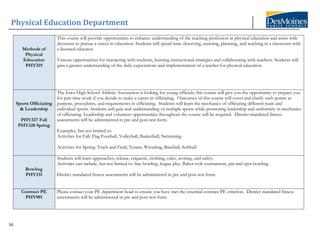
Methods of
Physical
Education
PHY319
This course will provide opportunities to enhance understanding of the teaching profession in physical education and assist with
decisions to pursue a career in education. Students will spend time observing, assisting, planning, and teaching in a classroom with
a licensed educator.
Various opportunities for interacting with students, learning instructional strategies and collaborating with teachers. Students will
gain a greater understanding of the daily expectations and implementation of a teacher for physical education.
Sports Officiating
& Leadership
PHY327 Fall
PHY328 Spring
The Iowa High School Athletic Association is looking for young officials; this course will give you the opportunity to prepare you
for part time work if you decide to make a career in officiating. Outcomes of this course will cover and clarify such points as
purpose, procedures, and requirements in officiating. Students will learn the mechanics of officiating different team and
individual sports. Students will gain and understanding of multiple sports while promoting leadership and uniformity in mechanics
of officiating. Leadership and volunteer opportunities throughout the course will be required. District mandated fitness
assessments will be administered in pre and post-test form.
Examples, but not limited to:
Activities for Fall: Flag Football, Volleyball, Basketball, Swimming
Activities for Spring: Track and Field, Tennis, Wrestling, Baseball, Softball
Bowling
PHY331
Students will learn approaches, release, etiquette, clothing, rules, scoring, and safety.
Activities can include, but not limited to: line bowling, league play, Baker style tournament, pin and spot bowling.
District mandated fitness assessments will be administered in pre and post-test form.
Contract PE
PHY901
Please contact your PE department head to ensure you have met the essential contract PE criterion. District mandated fitness
assessments will be administered in pre and post-test form.
Physical Education Department
17
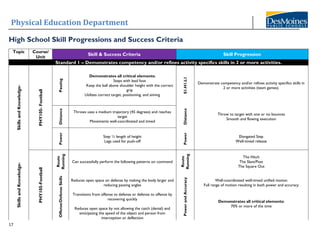
High School Skill Progressions and Success Criteria
Topic Course/
Unit
Skill & Success Criteria Skill Progression
Standard 1 – Demonstrates competency and/or refines activity specifics skills in 2 or more activities.
Skills
and
Knowledge-
PHY105-
Football
Passing
Demonstrates all critical elements:
Steps with lead foot
Keep the ball above shoulder height with the correct
grip
Utilizes correct target, positioning, and aiming
S1.H1.L1
Demonstrate competency and/or refines activity specifics skills in
2 or more activities (team games).
Distance
Throws uses a medium trajectory (45 degrees) and reaches
target
Movements well-coordinated and timed
Distance
Throw to target with one or no bounces
Smooth and flowing execution
Power
Step ½ length of height
Legs used for push-off
Power
Elongated Step
Well-timed release
Skills
and
Knowledge-
PHY105-Football
Route
Running
Can successfully perform the following patterns on command
Route
Running
The Hitch
The Slant/Post
The Square Out
Offense/Defense
Skills
Reduces open space on defense by making the body larger and
reducing passing angles Power
and
Accuracy
Well-coordinated well-timed unified motion
Full range of motion resulting in both power and accuracy
Transitions from offense to defense or defense to offense by
recovering quickly
Reduces open space by not allowing the catch (denial) and
anticipating the speed of the object and person from
interception or deflection
Demonstrates all critical elements:
70% or more of the time
Physical Education Department
18
Skills
and
Knowledge-
PHY103
&105-
Offensive
Skills
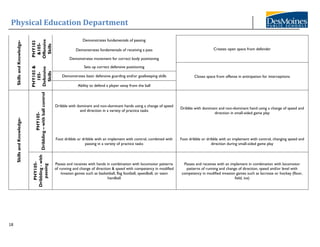
Demonstrates fundamentals of passing
Creates open space from defender
Demonstrates fundamentals of receiving a pass
Demonstrates movement for correct body positioning
PHY103
&
105-
Defensive
Skills
Sets up correct defensive positioning
Closes space from offense in anticipation for interceptions
Demonstrates basic defensive guarding and/or goalkeeping skills
Ability to defend a player away from the ball
Skills
and
Knowledge-
PHY105-
Dribbling
–
with
ball
control
Dribble with dominant and non-dominant hands using a change of speed
and direction in a variety of practice tasks
Dribble with dominant and non-dominant hand using a change of speed and
direction in small-sided game play
Foot dribble or dribble with an implement with control, combined with
passing in a variety of practice tasks
Foot dribble or dribble with an implement with control, changing speed and
direction during small-sided game play
PHY105-
Dribbling
-
with
passing
Passes and receives with hands in combination with locomotor patterns
of running and change of direction & speed with competency in modified
invasion games such as basketball, flag football, speedball, or team
handball
Passes and receives with an implement in combination with locomotor
patterns of running and change of direction, speed and/or level with
competency in modified invasion games such as lacrosse or hockey (floor,
field, ice)
Physical Education Department
19
Skills
and
Knowledge-
PHY105-
Volleyball
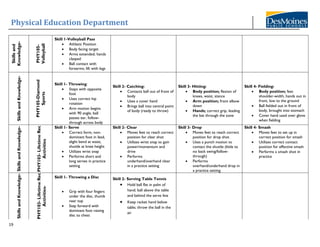
Skill 1-Volleyball Pass
• Athletic Position
• Body facing target
• Arms extended; hands
clasped
• Ball contact with
forearms; lift with legs
Skills
and
Knowledge-
PHY105-Diamond
Sports
Skill 1- Throwing:
• Steps with opposite
foot
• Uses correct hip
rotation
• Arm motion begins
with 90 angle, ball
passes ear, follow-
through across body
Skill 2- Catching:
• Contacts ball out of front of
body
• Uses a cover hand
• Brings ball into central point
of body (ready to throw)
Skill 3- Hitting:
• Body position; flexion of
knees, waist, stance
• Arm position; front elbow
down
• Hands; correct grip, leading
the bat through the zone
Skill 4- Fielding:
• Body position; feet
shoulder-width, hands out in
front, low to the ground
• Ball fielded out in front of
body, brought into stomach
• Cover hand used over glove
when fielding
Skills
and
Knowledge-
PHY103-
Lifetime
Rec
Activities
Skill 1- Serve
• Correct form, non-
dominant foot in lead,
slight bend at waist,
shuttle at knee height
• Utilizes wrist snap
• Performs short and
long serves in practice
setting
Skill 2- Clear
• Moves feet to reach correct
position for clear shot
• Utilizes wrist snap to gain
power/momentum and
drive
• Performs
underhand/overhand clear
in a practice setting
Skill 3- Drop
• Moves feet to reach correct
position for drop shot
• Uses a punch motion to
contact the shuttle (little to
no back swing/follow-
through)
• Performs
overhand/underhand drop in
a practice setting
Skill 4- Smash
• Moves feet to set up in
correct position for smash
• Utilizes correct contact
position for effective smash
• Performs a smash shot in
practice
Skills
and
Knowledge-
PHY103-
Lifetime
Rec
Activities-
Skill 1- Throwing a Disc
• Grip with four fingers
under the disc, thumb
near top
• Step forward with
dominant foot raising
disc to chest
Skill 2- Serving Table Tennis
• Hold ball flat in palm of
hand; ball above the table
and behind the serve line
• Keep racket hand below
table; throw the ball in the
air
Physical Education Department
20
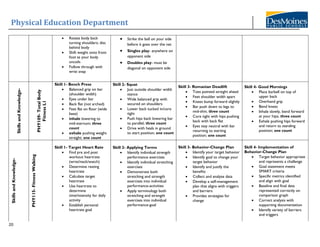
• Rotate body back
turning shoulders; disc
behind body
• Shift weight onto front
foot as your body
uncoils
• Follow through with
wrist snap
• Strike the ball on your side
before it goes over the net
• Singles play- anywhere on
opponent side
• Doubles play- must be
diagonal on opponent side
Skills
and
Knowledge-
PHY109-
Total
Body
Fitness
L1
Skill 1- Bench Press
• Balanced grip on bar
(shoulder width)
• Eyes under bar
• Back flat (not arched)
• Feet flat on floor (wide
base)
• inhale lowering to
mid-sternum; three
count
• exhale pushing weight
straight; one count
Skill 2- Squat
• Just outside shoulder width
stance
• Wide balanced grip with
secured on shoulders
• Lower back tucked in/core
tight
• Push hips back lowering bar
to parallel; three count
• Drive with heals in ground
to start position; one count
Skill 3- Romanian Deadlift
• Toes pointed straight ahead
• Feet shoulder width apart
• Knees bump forward slightly
• Bar push down to legs to
mid-shin; three count
• Core tight with hips pushing
back with back flat
• Eyes stay neutral with bar
returning to starting
position; one count
Skill 4- Good Mornings
• Place barbell on top of
upper back
• Overhand grip
• Bend knees
• Inhale slowly, bend forward
at your hips; three count
• Exhale pushing hips forward
and return to standing
position; one count
Skills
and
Knowledge-
PHY115-
Fitness
Walking
Skill 1- Target Heart Rate
• Find pre and post
workout heartrate
(wrist/neck/watch)
• Determine resting
heartrate
• Calculate target
heartrate
• Use heartrate to
determine
time/intensity for daily
activity
• Establish personal
heartrate goal
Skill 2- Applying Terms
• Identify individual strength
performance exercises
• Identify individual stretching
exercises
• Demonstrate both
stretching and strength
exercises into individual
performance-activities
• Apply terminology both
stretching and strength
exercises into individual
performance-goal
Skill 3- Behavior-Change Plan
• Identify your target behavior
• Identify goal to change your
target behavior
• Identify and justify the
benefits
• Collect and analyze data
• Develop a self-management
plan that aligns with triggers
and barriers
• Provides strategies for
change
Skill 4- Implementation of
Behavior-Change Plan
• Target behavior appropriate
and represents a challenge
• Goal statement meets
SMART criteria
• Specific metrics identified
and align with goal
• Baseline and final data
represented correctly on
comparison graph
• Correct analysis with
supporting documentation
• Identify variety of barriers
and triggers
Physical Education Department
21
• Develop a self-management
plan that aligns with triggers
or barriers
• Provided specific strategies
for each trigger or barrier
Skills
and
Knowledge-
PHY103-Lifetime
Rec
Activities/
Outdoor
Recreation
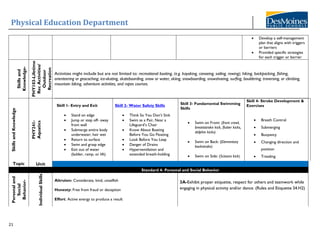
Activities might include but are not limited to: recreational boating, (e.g. kayaking, canoeing, sailing, rowing); hiking, backpacking, fishing,
orienteering or geocaching; ice-skating, skateboarding, snow or water, skiing, snowboarding, snowshoeing, surfing, bouldering, traversing, or climbing,
mountain biking, adventure activities, and ropes courses.
Skills
and
Knowledge
PHY241-
Aquatics
Skill 1- Entry and Exit
• Stand on edge
• Jump or step off- away
from wall
• Submerge entire body
underwater; hair wet
• Return to surface
• Swim and grasp edge
• Exit out of water
(ladder, ramp, or lift)
Skill 2- Water Safety Skills
• Think So You Don’t Sink
• Swim as a Pair, Near a
Lifeguard’s Chair
• Know About Boating
Before You Go Floating
• Look Before You Leap
• Danger of Drains
• Hyperventilation and
extended breath-holding
Skill 3- Fundamental Swimming
Skills
• Swim on Front: (front crawl,
breaststroke kick, flutter kicks,
dolphin kicks)
• Swim on Back: (Elementary
backstroke)
• Swim on Side: (Scissors kick)
Skill 4- Stroke Development &
Exercises
• Breath Control
• Submerging
• Buoyancy
• Changing direction and
position
• Treading
Topic Unit
Standard 4- Personal and Social Behavior
Personal
and
Social
Behavior-
Individual
Skills
Altruism: Considerate, kind, unselfish
Honesty: Free from fraud or deception
Effort: Active energy to produce a result
3A-Exhibit proper etiquette, respect for others and teamwork while
engaging in physical activity and/or dance. (Rules and Etiquette S4.H2)
Physical Education Department
22
Group
Skills
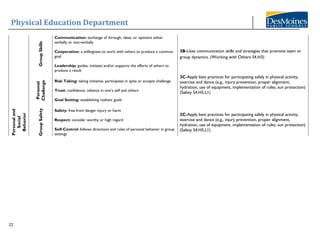
Communication: exchange of through, ideas, or opinions either
verbally or non-verbally
Cooperation: a willingness to work with others to produce a common
goal
Leadership: guides, initiates and/or supports the efforts of others to
produce a result
3B-Uses communication skills and strategies that promote team or
group dynamics. (Working with Others S4.H3)
3C-Apply best practices for participating safely in physical activity,
exercise and dance (e.g., injury prevention, proper alignment,
hydration, use of equipment, implementation of rules, sun protection)
(Safety S4.H5.L1)
Personal
Challenge
Risk Taking: taking initiative, participates in spite or accepts challenge
Trust: confidence, reliance in one’s self and others
Goal Setting: establishing realistic goals
Personal
and
Social
Behavior
Group
Safety
Safety: free from danger injury or harm
Respect: consider worthy or high regard
Self-Control: follows directions and rules of personal behavior in group
settings
3C-Apply best practices for participating safely in physical activity,
exercise and dance (e.g., injury prevention, proper alignment,
hydration, use of equipment, implementation of rules, sun protection)
(Safety S4.H5.L1)
Physical Education Department
23
Physical Education Department
24
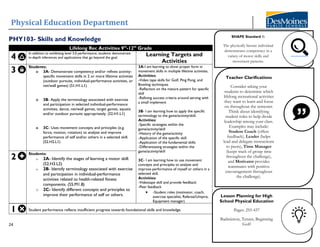
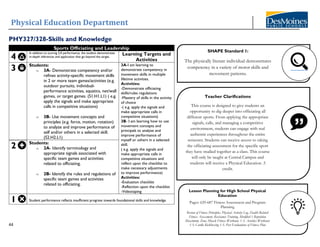
PHY103- Skills and Knowledge
Lifelong Rec Activities 9th
-12th
Grade
4
In addition to exhibiting level 3.0 performance, students demonstrate
in-depth inferences and applications that go beyond the goal.
Learning Targets and
Activities
3
Students:
o 3A- Demonstrate competency and/or refines activity-
specific movement skills in 2 or more lifetime activities
(outdoor pursuits, individual-performance activities, or
net/wall games) (S1.H1.L1)
o 3B- Apply the terminology associated with exercise
and participation in selected individual-performance
activities, dance, net/wall games, target games, aquatic
and/or outdoor pursuits appropriately. (S2.H1.L1)
o 3C- Uses movement concepts and principles (e.g.
force, motion, rotation) to analyze and improve
performance of self and/or others in a selected skill.
(S2.H2.L1)
3A-I am learning to show proper form in
movement skills in multiple lifetime activities.
Activities:
-Video tape skills for Golf, Ping Pong, and
Bowling techniques
-Reflection on the mature pattern for specific
skill
-Refining success criteria around serving with
a small implement
3B- I am learning how to apply the specific
terminology to the game/activity/skill.
Activities:
-Specific strategies within the
game/activity/skill
-History of the game/activity
-Application of the specific skill
-Application of the fundamental skills
-Differentiating strategies within the
game/activity/skill
3C- I am learning how to use movement
concepts and principles to analyze and
improve performance of myself or others in a
selected skill.
Activities:
-Videotape skill and provide feedback
-Peer feedback
• -Student roles (motivator, coach,
exercise specialist, Referee/Umpire,
Equipment manager)
2
Students:
o 2A- Identify the stages of learning a motor skill.
(S2.H3.L2)
o 2B- Identify terminology associated with exercise
and participation in individual-performance
activities related to health-related fitness
components. (S5.M1.8)
o 2C- Identify different concepts and principles to
improve their performance of self or others.
1 Student performance reflects insufficient progress towards foundational skills and knowledge.
Lesson Planning for High
School Physical Education
Pages: 255-437
Badminton, Tennis, Beginning
Golf
Teacher Clarifications
Consider asking your
students to determine which
lifelong recreational activities
they want to learn and focus
on throughout the semester.
Think about identifying
student roles to help divide
leadership among your class.
Examples may include:
Student Coach (offers
feedback), Leader (helps
lead and delegate instructions
to peers), Time Manager
(keeps track of group time
throughout the challenge),
and Motivator provides
teammates with positive
encouragement throughout
the challenge).
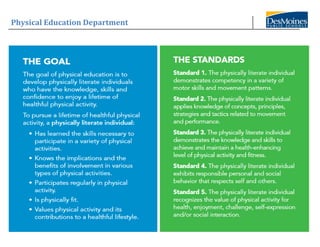
SHAPE Standard 1:
The physically literate individual
demonstrates competency in a
variety of motor skills and
movement patterns.
Physical Education Department
25
Physical Education Department
26
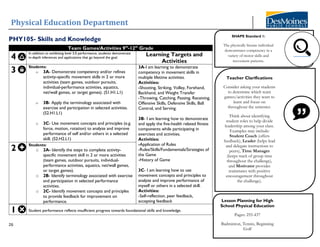
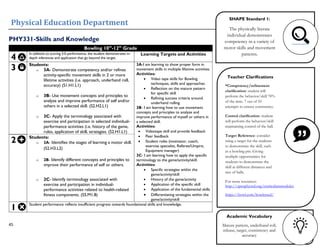
PHY105- Skills and Knowledge
Team Games/Activities 9th
-12th
Grade
4
In addition to exhibiting level 3.0 performance, students demonstrate
in-depth inferences and applications that go beyond the goal.
Learning Targets and
Activities
3
Students:
o 3A- Demonstrate competency and/or refines
activity-specific movement skills in 2 or more
activities (team games, outdoor pursuits,
individual-performance activities, aquatics,
net/wall games, or target games). (S1.H1.L1)
o 3B- Apply the terminology associated with
exercise and participation in selected activities.
(S2.H1.L1)
o 3C- Use movement concepts and principles (e.g.
force, motion, rotation) to analyze and improve
performance of self and/or others in a selected
skill. (S2.H2.L1)
3A-I am learning to demonstrate
competency in movement skills in
multiple lifetime activities.
Activities:
-Shooting, Striking, Volley, Forehand,
Backhand, and Weight Transfer
-Throwing, Catching, Passing, Receiving,
Offensive Skills, Defensive Skills, Ball
Control, and Serving.
3B- I am learning how to demonstrate
and apply the five-health related fitness
components while participating in
exercises and activities.
Activities:
-Application of Rules
-Rules/Skills/Fundamentals/Strategies of
the Game
-History of Game
3C- I am learning how to use
movement concepts and principles to
analyze and improve performance of
myself or others in a selected skill.
Activities:
-Self-reflection, peer feedback,
accepting feedback
2
Students:
o 2A- Identify the steps to complete activity-
specific movement skill in 2 or more activities
(team games, outdoor pursuits, individual-
performance activities, aquatics, net/wall games,
or target games).
o 2B- Identify terminology associated with exercise
and participation in selected performance
activities.
o 2C- Identify movement concepts and principles
to provide feedback for improvement on
performance.
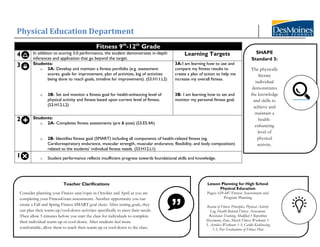
1 Student performance reflects insufficient progress towards foundational skills and knowledge.
Lesson Planning for High
School Physical Education
Pages: 255-437
Badminton, Tennis, Beginning
Golf
Teacher Clarifications
Consider asking your students
to determine which team
games/activities they want to
learn and focus on
throughout the semester.
Think about identifying
student roles to help divide
leadership among your class.
Examples may include:
Student Coach (offers
feedback), Leader (helps lead
and delegate instructions to
peers), Time Manager
(keeps track of group time
throughout the challenge),
and Motivator provides
teammates with positive
encouragement throughout
the challenge).
SHAPE Standard 1:
The physically literate individual
demonstrates competency in a
variety of motor skills and
movement patterns.
Physical Education Department
27
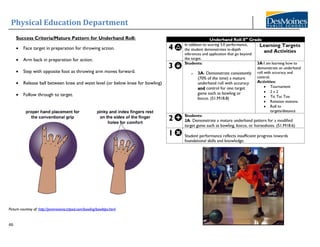
Success Criteria for Mature Patterns for Skills in Lifelong Rec/Activities and Team Games
Success Criteria/Critical Elements for Striking:
Implements Long Handled Short Handled
Long Implements
Floor Hockey
Golf
Tennis Racket
• Long-handled implement
up and back in preparation
for striking action
• Step forward on opposite
foot as contact is made
• Racket back in preparation for
striking
• Step with opposite foot as contact is
made
• Swing racket paddle from low to high
Whiffle Ball Bat
Small Implements
Tennis Racket
Badminton Racket
Pickleball Racket
• Coil and uncoil trunk for
preparation and execution
of the striking action
• Swing the implement on a
horizontal plane
• Coil and uncoil the trunk in
preparation for and execution of the
striking action
• Follow through for completion of
the striking action
• Wrist uncocks on follow-
through for completion of
the striking action
Success Criteria/Critical Elements for Underhand throw:
o Face target in preparation for throwing action
o Arm back in preparation for action
o Step with opposite foot as throwing arm moves forward
o Release ball between knee and waist level
o Follow through to target
Success Criteria/Critical Elements for Dribbling with Hands/Ball Control:
• Athletic stance
• Use finger pads to contact the ball
• Keep eyes and head up
• Control the ball below the waist
Success Criteria/Critical Elements for Dribbling Ball Control:
• Contact with the inside or outside of my foot
• Keep the ball close to my body
• Keep my head and eyes up
Physical Education Department
28
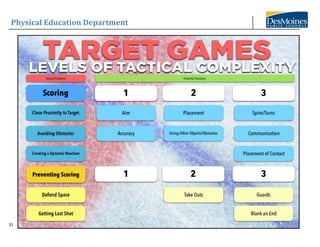
Download courtesy of: https://www.iphys-ed.com/game-design/
Physical Education Department
29
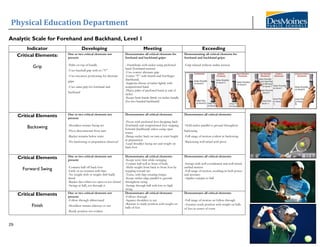
Analytic Scale for Forehand and Backhand, Level 1
Indicator Developing Meeting Exceeding
Critical Elements:
Grip
One or two critical elements not
present:
-Palm on top of handle
-Uses baseball grip with no “V”
-Uses incorrect positioning for alternate
grips
-Uses same grip for forehand and
backhand
Demonstrates all critical elements for
forehand and backhand grips:
- Handshake with racket using preferred
hand (forehand-eastern)
-Uses correct alternate grip
-Forms “V” with thumb and forefinger
(backhand)
-Supports throat of racket lightly with
nonpreferred hand
-Places palm of preferred hand at end of
racket
-Keeps both hands firmly on racket handle
(for two-handed backhand)
Demonstrating all critical elements for
forehand and backhand grips:
-Grip relaxed without undue tension
Critical Elements
Backswing
One or two critical elements not
present:
-Shoulders remain facing net
-Pivot disconnected from turn
-Racket remains below waist
-No backswing or preparation observed
Demonstrates all critical elements:
-Pivots with preferred foot dropping back
(forehand) and nonpreferred foot stepping
forward (backhand) unless using open
stance
-Brings racket back on turn at waist height
in preparation
-Lead shoulder facing net and weight on
back foot
Demonstrates all critical elements:
-Hold racket parallel to ground throughout
backswing
-Full range of motion evident in backswing
-Backswing well-timed with pivot
Critical Elements
Forward Swing
One or two critical elements not
present:
-Contacts ball off back foot
-Little or no rotation with hips
-No weight shift or weight shift badly
timed
-Racket face either too open or too closed
-Swings at ball, not through it
Demonstrates all critical elements:
-Keeps wrist firm while swinging
-Contact ball well in front of body
-Shifts weight from back to front foot by
stepping toward net
-Turns, with hips creating torque
-Keeps racket edge parallel to ground
throughout swing
-Swings through ball with low-to-high
swing
Demonstrates all critical elements:
-Swings with well-coordinated and well-timed,
unified motion
-Full range of motion, resulting in both power
and accuracy
-Applies topspin to ball
Critical Elements
Finish
One or two critical elements not
present:
-Follow-through abbreviated
-Shoulders remain sideways to net
-Ready position not evident
Demonstrates all critical elements:
-Follows through
-Squares shoulders to net
-Returns to ready position with weight on
balls of feet
Demonstrates all critical elements:
-Full range of motion on follow-through
-Assumes ready position with weight on balls
of feet in center of court
Physical Education Department
30
Physical Education Department
31
Physical Education Department
32
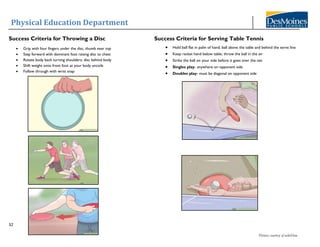
Success Criteria for Throwing a Disc Success Criteria for Serving Table Tennis
• Grip with four fingers under the disc, thumb near top
• Step forward with dominant foot raising disc to chest
• Rotate body back turning shoulders; disc behind body
• Shift weight onto front foot as your body uncoils
• Follow through with wrist snap
• Hold ball flat in palm of hand; ball above the table and behind the serve line
• Keep racket hand below table; throw the ball in the air
• Strike the ball on your side before it goes over the net
• Singles play- anywhere on opponent side
• Doubles play- must be diagonal on opponent side
Pictures courtesy of wikiHow
Physical Education Department
33
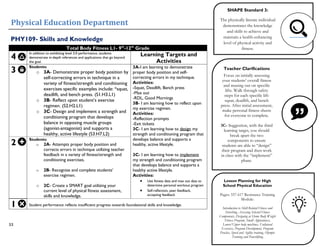
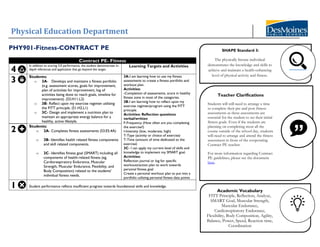
PHY109- Skills and Knowledge
Total Body Fitness L1- 9th
-12th
Grade
4
In addition to exhibiting level 3.0 performance, students
demonstrate in-depth inferences and applications that go beyond
the goal.
Learning Targets and
Activities
3
Students:
o 3A- Demonstrate proper body position by
self-correcting errors in technique in a
variety of fitness/strength and conditioning
exercises specific examples include: *squat,
deadlift, and bench press. (S1.H3.L1)
o 3B- Reflect upon student’s exercise
regimen. (S2.H2.L1)
o 3C- Design and implement a strength and
conditioning program that develops
balance in opposing muscle groups
(agonist-antagonist) and supports a
healthy, active lifestyle (S3.H7.L2)
3A-I am learning to demonstrate
proper body position and self-
correcting errors in my technique.
Activities:
-Squat, Deadlift, Bench press
-Max out
-RDL, Good Mornings
3B- I am learning how to reflect upon
my exercise regimen.
Activities:
-Reflection prompts
-Exit tickets
3C- I am learning how to design my
strength and conditioning program that
develops balance and supports a
healthy, active lifestyle.
3C- I am learning how to implement
my strength and conditioning program
that develops balance and supports a
healthy active lifestyle.
Activities:
• Use fitness data and max out data to
determine personal workout program
• Self-reflection, peer feedback,
accepting feedback
2
Students:
o 2A- Attempts proper body position and
corrects errors in technique utilizing teacher
feedback in a variety of fitness/strength and
conditioning exercises.
o 2B- Recognize and complete students’
exercise regimen.
o 2C- Create a SMART goal utilizing your
current level of physical fitness assessment,
skills and knowledge.
1 Student performance reflects insufficient progress towards foundational skills and knowledge.
SHAPE Standard 3:
The physically literate individual
demonstrates the knowledge
and skills to achieve and
maintain a health-enhancing
level of physical activity and
fitness.
Lesson Planning for High
School Physical Education
Pages: 557-617 Resistance Training
Module:
Introduction to Skill-Related Fitness and
Stretching, Assessing Selected Fitness
Components, Designing at Home Body Weight
Fitness Program, Small Apparatuses,
Lower/Upper body machines, Unilateral
Exercises, Program Development, Program
Practice, Speed and Agility training, Olympic
Training and Powerlifting
Teacher Clarifications
Focus on initially assessing
your students’ overall fitness
and maxing out on specific
lifts. Walk through safety
steps for each specific lift:
squat, deadlift, and bench
press. After initial assessment,
make personal fitness sheets
for everyone to complete.
3C- Suggestion, with the third
learning target, you should
break apart the two
components to ensure
students are able to “design”
their program and then work
in class with the “implement”
phase.
Physical Education Department
34
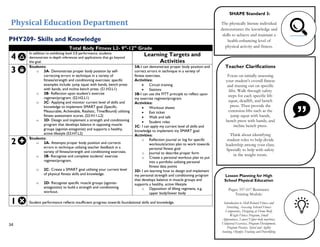
PHY209- Skills and Knowledge
Total Body Fitness L2- 9th
-12th
Grade
4
In addition to exhibiting level 3.0 performance, students
demonstrate in-depth inferences and applications that go beyond
the goal.
Learning Targets and
Activities
3
Students:
o 3A- Demonstrate proper body position by self-
correcting errors in technique in a variety of
fitness/strength and conditioning exercises: specific
examples include: jump squat with bands, bench press
with bands, and incline bench press. (S1.H3.L1)
o 3B- Reflection upon student’s exercise
regimen/program. (S2.H2.L1)
o 3C- Applying and monitor current level of skills and
knowledge to implement SMART goal (Specific,
Measurable, Achievable, Realistic, Time/Bound) utilizing
fitness assessment scores. (S3.H11.L2)
o 3D- Design and implement a strength and conditioning
program that develops balance in opposing muscle
groups (agonist-antagonist) and supports a healthy,
active lifestyle (S3.H7.L2)
3A-I can demonstrate proper body position and
correct errors in technique in a variety of
fitness exercises.
Activities:
• Circuit training
• Stations
3B-I can use the FITT principle to reflect upon
my exercise regimen/program.
Activities:
• Workout sheets
• Exit ticket
• Walk and talk
• Student roles
3C- I can apply my current level of skills and
knowledge to implement my SMART goal.
Activities:
o Reflection journal or log for specific
workouts/action plan to work towards
personal fitness goal
o Journal to describe proper form
o Create a personal workout plan to put
into a portfolio utilizing personal
fitness data points
3D- I am learning how to design and implement
my personal strength and conditioning program
that develops balance in muscle groups and
supports a healthy, active lifestyle.
o Opposition of lifting regimens, e.g.
upper body/lower body
2
Students:
o 2A- Attempts proper body position and corrects
errors in technique utilizing teacher feedback in a
variety of fitness/strength and conditioning exercises.
o 2B- Recognize and complete students’ exercise
regimen/program.
o 2C- Create a SMART goal utilizing your current level
of physical fitness skills and knowledge.
o 2D- Recognize specific muscle groups (agonist-
antagonists) to build a strength and conditioning
workout.
1 Student performance reflects insufficient progress towards foundational skills and knowledge.
Lesson Planning for High
School Physical Education
Pages: 557-617 Resistance
Training Module:
Introduction to Skill-Related Fitness and
Stretching, Assessing Selected Fitness
Components, Designing at Home Body
Weight Fitness Program, Small
Apparatuses, Lower/Upper body machines,
Unilateral Exercises, Program Development,
Program Practice, Speed and Agility
training, Olympic Training and Powerlifting
Teacher Clarifications
Focus on initially assessing
your student’s overall fitness
and maxing out on specific
lifts. Walk through safety
steps for each specific lift:
squat, deadlift, and bench
press. Then provide the
extension lifts such as the
jump squat with bands,
bench press with bands, and
incline bench press.
Think about identifying
student roles to help divide
leadership among your class.
Specially to help with safety
in the weight room.
SHAPE Standard 3:
The physically literate individual
demonstrates the knowledge and
skills to achieve and maintain a
health-enhancing level of
physical activity and fitness.
Physical Education Department
35
PHY115- Skills and Knowledge
Fitness Walking- 9th
-12th
Grade
4
In addition to exhibiting level 3.0 performance, students demonstrate
in-depth inferences and applications that go beyond the goal.
Learning Targets and Activities
3
Students:
o 3A- Calculate target heart rate and applies
that information to personal fitness plan.
(S3.H9.L1)
o 3B- Apply terminology associated with
exercise and participation in selected
individual-performance activities. (S3.H7.L1)
o 3C- Create and implement a behavior-
modification plan that enhances a healthy,
active lifestyle in college or career settings.
(S3.H11.L1)
3A-I am learning to calculate my own
target heart rate and apply my learning
to my personal workout plan.
Activities:
-THR Worksheet
-Activity Trackers
-Personal Workout sheet
-Fitness Assessments
3B- I am learning how to apply specific
vocabulary associated with my exercise
during class.
Activities:
-Compare and Contrast health-related
and skill related fitness components
3C- I am learning how to create and
implement a plan that enhances a
healthy, active lifestyle.
Activities:
-Fitness Workout Plan
-Goal Setting Sheet
-Exit tickets
-FitnessGram
2
Students:
o 2A- Identify terminology associated with
exercise and participation in individual-
performance activities related to health-
related fitness components. (S5.M1.8)
o 2B- Identifies types of strength exercises and
stretching exercises for personal fitness
development (e.g. strength, endurance, range
of motion). (S3.H9.L1)
o 2C-Creates a practice plan to improve
performance for a self-selected skill in fitness
walking. (S2.H3.L1)
1 Student performance reflects insufficient progress towards foundational skills and knowledge.
Lesson Planning for High
School Physical
Education
Pages: 689-751 Fitness Walking
Introduction to Fitness Walking,
Walking Pace, Walking and Heart
Rate, Lane Lap Comparisons, Lane
Lap Comparisons, Goal Setting, Step
Count, Directions Challenge 1-2, Team
Challenge Walk, Parcourse 1-2,
Comparing Step Totals, Walking Test
and Reflection
Teacher Clarifications
Students should track their
MVPA and target heart rate
daily throughout this class.
(MVPA) Moderate to Vigorous
Physical Activity can be tracked
through physical activity
trackers/pedometers.
Students should walk at least a
minimum of 2 or 3 miles
throughout the class period.
Circuit training and including
different exercises in between
walking distances can help
increase students overall
muscular strength and
cardiorespiratory endurance.
SHAPE Standard 3:
The physically literate individual
demonstrates the knowledge and
skills to achieve and maintain a
health-enhancing level of physical
activity and fitness.
Physical Education Department
36
PHY117- Skills and Knowledge
Unified Peer PE “Peers”
4
In addition to exhibiting level 3.0 performance, students demonstrate
in-depth inferences and applications that go beyond the goal.
Learning Targets and Activities
3
Students:
o 3A- Apply terminology associated with
exercise and participation in selected
individual-performance activities. (S3.H7.L1)
o 3B- Creates a practice plan to improve
performance for a self-selected skill.
(S2.H3.L1)
3A- I am learning how to apply specific
vocabulary associated with my exercise
during class.
Activities:
-Compare and Contrast health-related
and skill related fitness components
3B- I am learning how to create and
implement a plan to improve individual
performance.
Activities:
-Fitness Workout Plan
-Goal Setting Sheet
-Exit tickets
-FitnessGram
2
Students:
o 2A- Identify terminology associated with
exercise and participation in individual-
performance activities related to health-
related fitness components. (S5.M1.8)
o 2B- Identifies types of strength exercises and
stretching exercises for personal fitness
development (e.g. strength, endurance, range
of motion). (S3.H9.L1)
1 Student performance reflects insufficient progress towards foundational skills and knowledge.
Teacher Clarifications
Check out our Unified Physical
Education guide for specific
support on skill progressions
for student athletes. This will
help provide specific clarity
around skill progressions and
scores.
Students should have the
opportunity to collaborate with
an inclusive environment within
this course. A community
partnership that is essential for
success in the course is the
Special Olympics of Iowa.
Allow your peers to set up
stations’ lifelong recreation
themes for the course making
sure students are making
adaptations with equipment and
accommodations for students to
feel successful.
SHAPE Standard 3:
The physically literate individual
demonstrates the knowledge and
skills to achieve and maintain a
health-enhancing level of physical
activity and fitness.
Lesson Planning for High
School Physical Education
Pages: 255-437
Badminton, Tennis, Beginning Golf
Physical Education Department
37
PHY120- Skills and Knowledge
PHY131- Skills and
Knowledge
High Intensity Fitness- 9th
-12th
Grade
4
In addition to exhibiting level 3.0 performance, students demonstrate in-
depth inferences and applications that go beyond the goal.
Learning Targets and
Activities
3 Students:
o 3A- Choose an appropriate level of challenge to
experience success and desire to participate in a self-
selected physical activity. (S1.H3.L1)
o 3B- Use movement concepts and principles to analyze
and improve performance of self and/or others in a
selected skill. Reflection upon student’s exercise
regimen/program. (S2.H2.L1)
o 3C- Design and implement a strength and conditioning
program that develops balance in opposing muscle
groups (agonist-antagonist) and supports a healthy, active
lifestyle (S3.H7.L2)
3A-I am learning how to choose the
appropriate level of intensity for myself to
experience success.
Activities:
• Give opportunities for student to
determine their level of intensity
while entering the classroom
• Give students a variation of the
activity to offer different levels of
challenges
3B-I am learning how to use the FITT
principal to reflect upon my exercise
regimen/program.
Activities:
o Reflection journal or log for specific
workouts/action plan to work
towards personal fitness goal
o Journal to describe proper form
3C- I am learning how to design and
implement a strength and conditioning
program to balances muscle groups and
supports a healthy, active lifestyle.
Activities:
o Create a personal workout plan to
put into a portfolio utilizing
personal fitness data points
o Exit tickets
o Compare/Contrast Health-related
fitness and skill related components
with opposing muscle groups e.g.
upper body vs. lower body
2 Students:
o 2A- Identify terminology associated with exercise and
participation in individual-performance activities related
to health-related fitness components. (S5.M1.8)
o 2B- Identifies types of strength exercises and stretching
exercises for personal fitness development (e.g. strength,
endurance, range of motion). (S3.H9.L1)
o 2C-Creates a practice plan to improve performance for
a self-selected skill in fitness walking. (S2.H3.L1)
1 Student performance reflects insufficient progress towards foundational skills and knowledge.
Lesson Planning for High
School Physical Education
Pages: 629-687 Fitness
Assessment and Program Planning
Review of Fitness Principles, Physical
Activity Log, Health-Related Fitness
Assessment, Resistance Training,
Modified 1 Repetition Maximum, Zone,
Muscle Fitness Workouts 1-3, Aerobics
Workouts 1-3, Cardio Kickboxing 1-3,
Peer Evaluations of Fitness Plan
Teacher Clarifications
Consider allowing students the
opportunity to choose their
intensity level at which they
would like to perform. This
gives an opportunity for student
buy in with their individual
workout.
This course is to also provide an
opportunity to increase the level
students’ fitness knowledge and
overall fitness. Think about
providing challenges for
students to perform that would
increase the overall intensity for
a specific skill, for example:
spinning on the stationary bike,
increase the resistance for the
next 30-60 seconds.
SHAPE Standard 3:
The physically literate individual
demonstrates the knowledge and
skills to achieve and maintain a
health-enhancing level of physical
activity and fitness.
Physical Education Department
38
PHY131- Skills and Knowledge
Innovative Fitness- 9th
-12th
Grade
4
In addition to exhibiting level 3.0 performance, students demonstrate
in-depth inferences and applications that go beyond the goal.
Learning Targets and
Activities
3 Students:
o 3A- Choose an appropriate level of challenge to
experience success and desire to participate in a
self-selected physical activity. (S1.H3.L1)
o 3B- Use movement concepts and principles to
analyze and improve performance of self and/or
others in a selected skill. (S2.H2.L1)
o 3C- Apply stress-management strategies (e.g.
mental imagery, relaxation techniques, deep
breathing, aerobic exercise, meditation) to reduce
stress. (S3.H14.L2)
3A-I am learning how to choose the
appropriate level of intensity for myself to
experience success.
Activities:
-Give opportunities for student to determine
their level of intensity while entering the
classroom
-Give students a variation of the activity to
offer different levels of challenges
-Color designation to determine levels of
intensity
3B-I am learning how to use movement
concepts and principles to analyze and
improve my own or others’ performance
Activities:
o Reflection journal or log for
specific workouts/action plan to
work towards personal fitness goal
o Video tape specific skill and offer
feedback to others regarding
mature pattern/technique
3C- I am learning how to apply stress
management strategies to reduce my overall
stress.
Activities:
o Journal to describe
stressors/imagery
o Create an action plan to help with
stressors
o Daily Fit Log
o Yoga Unit/Tai Chi
2 Students:
o 2A- Identifies different levels of intensity to
challenge participation in a self-selected physical
activity.
o 2B- Recognize and complete students’ exercise
regimen.
o 2C- Identifies stress-management strategies (e.g.
mental imagery, relaxation techniques, deep
breathing, aerobic exercise, meditation) to reduce
stress. (S3.H14.L2)
1 Student performance reflects insufficient progress towards foundational skills and knowledge.
Teacher Clarifications
This course provides students
with a variety of different
work-outs with innovative
ideas. Consider allowing your
students to create their own
innovative work-out to teach
to the class or have them
video tape a work-out for the
class to complete and
allowing others to provide
feedback from their work-
out. This class has a learning
target that is focused on
stress –management. Think
about adding in different
units to help students with
relaxation techniques, such as
yoga and meditation.
SHAPE Standard 3:
The physically literate individual
demonstrates the knowledge and skills to
achieve and maintain a health-enhancing
level of physical activity and fitness.
Lesson Planning for High
School Physical Education
Pages: 505-556- Yoga and Stress
Management
Principles of Yoga, Asanas, Standing
Practice, Supine Postures, Transitions,
Lower Back, Balance, Relaxation,
Vinyasa, Shoulders, Student Yoga
Sequences, Student Self-Evaluation
Physical Education Department
39
PHY227- Skills and Knowledge
Psychology of Health & Fitness- 9th
-12th
Grade
4
In addition to exhibiting level 3.0 performance, students
demonstrate in-depth inferences and applications that go beyond the
goal.
Learning Targets and Activities
3 Students:
o 3A- Create a plan, train for and participate in a
community event with a focus on physical
activity (e.g., 5K, triathlon, tournament, dance
performance, cycling event.) (S3.H6.L2)
o 3B- Develop and maintain a fitness portfolio.
(e.g., assessment scores, goals for improvement,
plan of activities for improvement, log of
activities being done to reach goals, timeline for
improvement). (S3.H11.L2)
o 3C- Analyze the impact of life choices,
motivation, and accessibility on exercise
adherence and participation in physical activity.
(S3.H5.L2)
3A-I am learning how to create a plan to help
me train for my 5K event.
Activities:
o Reflection journal or log for specific
workouts/action plan to work
towards personal fitness goal
o Compare and contrast of health-
related and skill-related components
with exercises.
3B-I am learning how to create my fitness
portfolio to help guide my workouts and meet
my overall goals.
Activities:
o Reflection journal or log for specific
workouts/action plan to work
towards personal fitness goal
o Daily fit log
o Goals with incentives
3C- I can apply my current level of skills and
knowledge to monitor and change my
behavior-modification plan.
Activities:
o Create a personal workout plan to
put into a portfolio utilizing personal
fitness data points
o Analyze the impact of personal
motivation by reflection and level of
intensity.
o Analyze impact of different
barriers/accessibility in participating
in physical activity.
o Identify and analyze different choices
that impact participation in physical
activity throughout life.
2 Students:
o 2A- Recognize and complete students’ workout
regimen
o 2B- Create a SMART goal utilizing your current
level of physical fitness skills and knowledge
(S3.M8.6)
o 2C- Recognize and monitor a behavior-
modification plan which aligns to overall
workout plan.
1 Student performance reflects insufficient progress towards foundational skills and knowledge.
Teacher Clarifications
Students will need to find a race or
a 5K course they would like to
compete in as a group. Since most
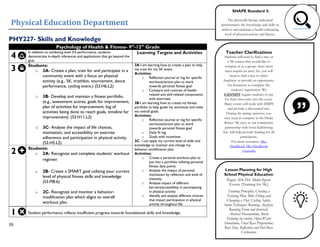
races require an entry fee, you will
need to find a way to either
fundraise or provide an opportunity
for donations to complete the
students’ registration. We
CANNOT require students to pay
for their own entry into the event.
Many events will work with DMPS
and provide a discounted rate.
During the spring semester, you
may want to compete in the Drake
Relays’ 5K race, as our community
partnership with Iowa KidsStrong
Inc. will help provide funding for all
participants.
For more resources: 5Ks
Handbook 5Ks Handbook
Appendix
Lesson Planning for High
School Physical Education
Pages: 204-254- Multi-Sport
Events (Training for 5K)
Training Principles, Creating a
Training Plan, Bike Fitting and
Changing a Flat, Cycling Safety,
Swim Technique, Running Analysis,
Running Form and Intervals,
Abstract Presentations, Brick
Training (w/swim), Open-Water
Simulation, Final Race Preparation,
Race Day, Reflection and Post-Race
Celebration
SHAPE Standard 3:
The physically literate individual
demonstrates the knowledge and skills to
achieve and maintain a health-enhancing
level of physical activity and fitness.
Physical Education Department
40
PHY235- Skills and Knowledge
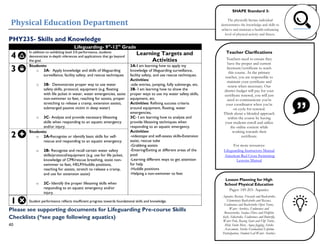
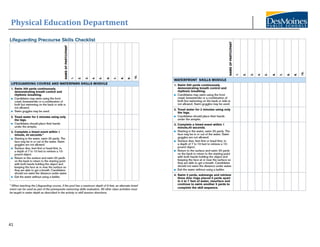
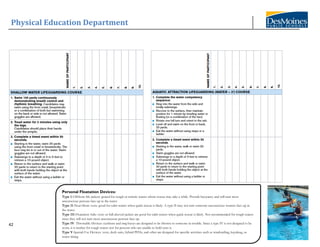
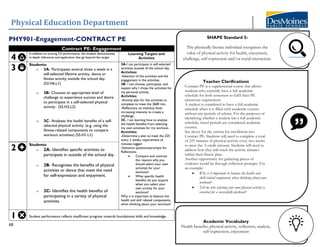
Please see supporting documents for Lifeguarding Pre-course Skills
Checklists (*see page following aquatics)
Lifeguarding- 9th
-12th
Grade
4
In addition to exhibiting level 3.0 performance, students
demonstrate in-depth inferences and applications that go beyond
the goal.
Learning Targets and
Activities
3
Students:
o 3A- Apply knowledge and skills of lifeguarding
surveillance, facility safety, and rescue techniques
o 3B- Demonstrate proper way to use water
safety skills, protocol, equipment (e.g. floating
with life jacket in water, water emergencies, assist
non-swimmer to feet, reaching for assists, proper
stretching to release a cramp, extension assists,
submerged passive victim in deep water)
o 3C- Analyze and provide necessary lifesaving
skills when responding to an aquatic emergency
and/or injury.
3A-I am learning how to apply my
knowledge of lifeguarding surveillance,
facility safety, and use rescue techniques.
Activities:
-side entries, jumping, fully submerge, etc.
3B- I am learning how to show the
proper ways to use my water safety skills,
equipment, etc.
Activities: Refining success criteria
around equipment, floating, water
emergencies,
3C- I am learning how to analyze and
provide lifesaving techniques when
responding to an aquatic emergency.
Activities:
-videotape and self-assess skills-Extension
assist, rescue tube
-Grabbing assists
-Entering/Exiting at different areas of the
pool
-Learning different ways to get attention
for help
-Huddle positions
-Helping a non-swimmer to feet
2
Students:
o 2A-Recognize or identify basic skills for self-
rescue and responding to an aquatic emergency.
o 2B- Recognize and recall certain water safety
skills/protocol/equipment (e.g. use for life jacket,
knowledge of CPR/rescue breathing, assist non-
swimmer to feet, HELP/Huddle positions,
reaching for assists, stretch to release a cramp,
and use for extension assist)
o 2C- Identify the proper lifesaving skills when
responding to an aquatic emergency and/or
injury.
1 Student performance reflects insufficient progress towards foundational skills and knowledge.
Teacher Clarifications
Teachers need to ensure they
have the proper and current
licensure/certificate to teach
this course. As the primary
teacher, you are responsible to
maintain your certificate and
renew when necessary. Our
district budget will pay for your
certificate renewal, you will just
need to communicate you’re
your coordinator when you’re
on cycle for renewal.
Think about a blended approach
within the course by having
your students enroll and utilize
the online content while
working towards their
certificate.
For more resources:
Lifeguarding Instructors Manual
American Red Cross Swimming
Lessons Manual
SHAPE Standard 3:
The physically literate individual
demonstrates the knowledge and skills to
achieve and maintain a health-enhancing
level of physical activity and fitness.
Lesson Planning for High
School Physical Education
Pages: 149-203- Aquatics
Aquatics Review, Freestyle and Backstroke,
Elementary Backstroke and Rescues,
Endurance and Backstroke Open Turns,
Water Aerobics, Endurance and
Breaststroke, Surface Dives and Dolphin
kick, Sidestroke, Endurance and Butterfly,
Water Polo, Racing Start and Flip Turns,
Mini Swim Meet, Aqua Jogging, Stroke
Assessment, Stroke Evaluation/Lifetime
Participation, Student-Led Water Aerobics
Physical Education Department
41
Physical Education Department
42
Personal Floatation Devices:
Type 1-Offshore life jackets: geared for rough or remote waters where rescue may take a while. Provide buoyancy and will turn most
unconscious persons face up in the water.
Type 11-Near-Shore vests: good for calm waters when quick rescue is likely. A type II may not turn someone unconscious wearers face up in
the water.
Type 111-Floatation Aids: vests or full-sleeved jackets are good for calm waters when quick rescue is likely. Not recommended for rough waters
since they will not turn most unconscious persons face up.
Type IV- Throwable Devices: cushions and ring buoys are designed to be thrown to someone in trouble. Since a type IV is not designed to be
worn, it is neither for rough waters nor for persons who are unable to hold onto it.
Type V-Special-Use Devices: vests, deck suits, hybrid PFDs, and other are designed for specific activities such as windsurfing, kayaking, or
water-skiing.
Physical Education Department
43
PHY241-Skills and Knowledge
Aquatics-9th
-12th
Grade
4
In addition to exhibiting level 3.0 performance, students demonstrate in-depth
inferences and applications that go beyond the goal.
Learning Targets and
Activities
3 Students:
o 3A- Enter water by stepping or jumping in from the
side, fully submerge, then recover to the surface and
return to the side.
o 3B- Demonstrate proper way to use water safety
skills, protocol, equipment (e.g. floating with life jacket
in water, water emergencies, assist non-swimmer to
feet, reaching for assists, proper stretching to release a
cramp, extension assists)
o 3C- Develop a plan of action and makes appropriate
decisions based on that plan when faced with an
individual or groups challenges regarding aquatic
emergencies (i.e. classify and identify next
steps/procedures for self-rescues and aquatic
emergencies.)
3A-I am learning the proper way of
entering/exiting the water.
Activities:
-side entries, jumping, fully
submerge, etc.
3B- I am learning how to show the
proper ways to use my water safety
skills, equipment, etc.
Activities: Refining success criteria
around equipment, floating, water
emergencies,
3C- I am learning how to develop a
plan of action and make appropriate
decisions based on the plan, when
facing an individual or group
challenges regarding aquatic
emergencies.
Activities:
-videotape and self-assess skills-
Extension assist, rescue tube
-Grabbing assists
-Entering/Exiting at different areas of
the pool
-Learning different ways to get
attention for help
-Huddle positions
-Helping a non-swimmer to feet
3B-I am learning how to assess and
respond to certain behaviors that
2 Students:
o 2A- Recognize basic skills for self-rescue and
responding to an aquatic emergency.
o 2B- Recognize and recall certain water safety
skills/protocol/equipment (e.g. use for life jacket,
knowledge of CPR/rescue breathing, assist non-
swimmer to feet, HELP/Huddle positions, reaching for
assists, stretch to release a cramp, and use for
extension assist)
o 2C- Identifies next steps/procedures for self-rescues
and aquatic emergencies (i.e. personal floatation
devices)
1 Student performance reflects insufficient progress towards foundational skills and knowledge.
Teacher Clarifications
Teachers need to ensure they
have the proper and current
licensure/certificate to teach this
course. As the primary teacher,
you are responsible to maintain
your certificate and renew when
necessary. Our district budget
will pay for your certificate
renewal, you will just need to
communicate with your
coordinator when you’re on cycle
for renewal.
www.instructorscorner.com
SHAPE Standard 1:
The physically literate individual
demonstrates competency in a variety of
motor skills and movement patterns.
Lesson Planning for High
School Physical Education
Pages: 149-203- Aquatics
Aquatics Review, Freestyle and Backstroke,
Elementary Backstroke and Rescues,
Endurance and Backstroke Open Turns,
Water Aerobics, Endurance and
Breaststroke, Surface Dives and Dolphin
kick, Sidestroke, Endurance and Butterfly,
Water Polo, Racing Start and Flip Turns,
Mini Swim Meet, Aqua Jogging, Stroke
Assessment, Stroke Evaluation/Lifetime
Participation, Student-Led Water Aerobics
Physical Education Department
44
PHY327/328-Skills and Knowledge
Sports Officiating and Leadership
4
In addition to scoring 3.0 performance, the student demonstrates
in-depth inferences and application that go beyond the target.
Learning Targets and
Activities
3 Students:
o 3A- Demonstrate competency and/or
refines activity-specific movement skills
in 2 or more team games/activities (e.g.
outdoor pursuits, individual-
performance activities, aquatics, net/wall
games, or target games. (S1.H1.L1) ( e.g.
apply the signals and make appropriate
calls in competitive situations)
o 3B- Use movement concepts and
principles (e.g. force, motion, rotation)
to analyze and improve performance of
self and/or others in a selected skill.
(S2.H2.L1)
3A-I am learning to
demonstrate competency in
movement skills in multiple
lifetime activities.
Activities:
-Demonstrate officiating
skills/rules regulations
-Mastery of skills in the activity
of choice
-( e.g. apply the signals and
make appropriate calls in
competitive situations)
3B- I am learning how to use
movement concepts and
principals to analyze and
improve performance of
myself or others in a selected
skill.
( e.g. apply the signals and
make appropriate calls in
competitive situations and
reflect upon the checklist to
make necessary adjustments
to improve performance)
Activities:
-Evaluation checklist
-Reflection upon the checklist
-Videotaping
2 Students:
o 2A- Identify terminology and
appropriate signals associated with
specific team games and activities
related to officiating.
o 2B- Identify the rules and regulations of
specific team games and activities
related to officiating.
1 Student performance reflects insufficient progress towards foundational skills and knowledge.
SHAPE Standard 1:
The physically literate individual demonstrates
competency in a variety of motor skills and
movement patterns.
Teacher Clarifications
This course is designed to give students an
opportunity to dig deeper into officiating all
different sports. From applying the appropriate
signals, calls, and managing a competitive
environment, students can engage with real
authentic experiences throughout the entire
semester. Students can receive access to taking
the officiating assessment for the specific sport
they have studied together as a class. This course
will only be taught at Central Campus and
students will receive a Physical Education .5
credit.
Lesson Planning for High School Physical
Education
Pages: 629-687 Fitness Assessment and Program
Planning
Review of Fitness Principles, Physical Activity Log, Health-Related
Fitness Assessment, Resistance Training, Modified 1 Repetition
Maximum, Zone, Muscle Fitness Workouts 1-3, Aerobics Workouts
1-3, Cardio Kickboxing 1-3, Peer Evaluations of Fitness Plan
Physical Education Department
45
PHY331-Skills and Knowledge
Bowling 10th
-12th
Grade
4
In addition to scoring 3.0 performance, the student demonstrates in-
depth inferences and application that go beyond the target.
Learning Targets and Activities
3 Students:
o 3A- Demonstrate competency and/or refines
activity-specific movement skills in 2 or more
lifetime activities (i.e. approach, underhand roll,
accuracy) (S1.H1.L1)
o 3B- Use movement concepts and principles to
analyze and improve performance of self and/or
others in a selected skill. (S2.H2.L1)
o 3C- Apply the terminology associated with
exercise and participation in selected individual-
performance activities (i.e. history of the game,
rules, application of skill, strategies. (S2.H1.L1)
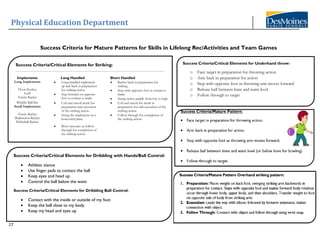
3A-I am learning to show proper form in
movement skills in multiple lifetime activities.
Activities:
• Video tape skills for Bowling
techniques, skills and approaches
• Reflection on the mature pattern
for specific skill
• Refining success criteria around
underhand rolling
3B- I am learning how to use movement
concepts and principles to analyze and
improve performance of myself or others in
a selected skill.
Activities:
• Videotape skill and provide feedback
• Peer feedback
• Student roles (motivator, coach,
exercise specialist, Referee/Umpire,
Equipment manager)
3C- I am learning how to apply the specific
terminology to the game/activity/skill.
Activities:
• Specific strategies within the
game/activity/skill
• History of the game/activity
• Application of the specific skill
• Application of the fundamental skills
• Differentiating strategies within the
game/activity/skill
2 Students:
o 2A- Identifies the stages of learning a motor skill.
(S2.H3.L2)
o 2B- Identify different concepts and principles to
improve their performance of self or others.
o 2C- Identify terminology associated with
exercise and participation in individual-
performance activities related to health-related
fitness components. (S5.M1.8)
1
Student performance reflects insufficient progress towards foundational skills and knowledge.
SHAPE Standard 1:
The physically literate
individual demonstrates
competency in a variety of
motor skills and movement
patterns.
Teacher Clarifications
*Competency/refinement
clarification: student will
perform the behavior/skill 70%
of the time. 7 out of 10
attempts to ensure consistency.
Control clarification: student
will perform the behavior/skill
maintaining control of the ball.
Target Reference: consider
using a target for the students
to demonstrate the skill, such
as a bowling pin. Giving
multiple opportunities for
students to demonstrate the
skill at different distances and
size of balls.
For more resources:
http://openphysed.org/curriculummodules
https://bowl.com/bowlersed/
Academic Vocabulary
Mature pattern, underhand roll,
release, target, consistency and
accuracy
Physical Education Department
46
Success Criteria/Mature Pattern for Underhand Roll:
• Face target in preparation for throwing action.
• Arm back in preparation for action.
• Step with opposite foot as throwing arm moves forward.
• Release ball between knee and waist level (or below knee for bowling)
• Follow through to target.
Picture courtesy of: http://jeremeamia.tripod.com/bowling/bowltips.html
Physical Education Department
47
PHY901-Skills and Knowledge-CONTRACT PE
Contract PE
4
In addition to scoring 3.0 performance, the student demonstrates
in-depth inferences and application that go beyond the target.
Learning Targets and
Activities
3
Students:
o 3A- Demonstrates competency in 1 or
more specialized skills in health-related
fitness activities. (S1.H3.L1)
o 3B- Develops and maintains a fitness
portfolio (e.g. assessment scores, goals for
improvement, plan of activities for
improvement, log of activities being done to
reach goals, timeline for improvement,
monthly reflections) (S3.H11.L2)
o 3C- Creates a practice plan to improve
performance for a self-selected skill.
(S2.H3.L1)
3A-I am learning how to
demonstrate fitness exercises.
Activities: (any activity that
would be placed underneath the
five fitness components)
-compare the amount of exercise
and activity in fitness related
component categories
-Walking
-Running
-Curl-ups
-Push-ups
3B-I can use daily fit log platform
to log my goals and activities.
3C- I am learning how to create a
plan to improve my overall
workout regimen.
Activities:
o Reflection journal or log
for specific
workouts/action plan to
work towards personal
fitness goal on daily fit
log
o Monthly reflection
forms
o SMART goal setting
o Journal to describe
proper form
Create a personal workout plan
to put into a portfolio utilizing
personal fitness data points
2
Students:
o 2A- Identifies 1 or more specialized skills in
health-related fitness activities.
o 2B- Determine a SMART goal in response
to your individual fitness assessments.
o 2C- Identify activities to include in overall
workout plan.
1 Student performance reflects insufficient progress towards foundational skills and knowledge.
SHAPE Standard 1:
The physically literate individual demonstrates
competency in a variety of motor skills and
movement patterns.
Teacher Clarifications
Students and staff will use the Canvas course to teach this
course online. Eligibility has not changed. 12th Grade students
are eligible to enroll in Contract PE for 1 semester of their
senior year provided they meet at least one of the following
criteria:
• Student is involved in a work study or other
educational program that requires the students’
absence from school.
• Student is carrying a full academic schedule for the
current semester.
• Student is involved in a school-sponsored athletic
program or activity supervised by a staff member
with a coaching endorsement.
All other high school students are eligible to enroll in
Contract PE provided they meet all the following criteria:
• Student is carrying a full academic schedule for the
current semester.
• Student has no physical education failures to make
up from previous years.
• Student is involved in a school-sponsored athletic
or activity supervised by a staff member with a
coaching endorsement.
Lesson Planning for High School Physical
Education
Pages: 629-687 Fitness Assessment and Program
Planning
Review of Fitness Principles, Physical Activity Log, Health-Related
Fitness Assessment, Resistance Training, Modified 1 Repetition
Maximum, Zone, Muscle Fitness Workouts 1-3, Aerobics Workouts
1-3, Cardio Kickboxing 1-3, Peer Evaluations of Fitness Plan
Physical Education Department
48
PHY901-Engagement-CONTRACT PE
Contract PE- Engagement
4
In addition to scoring 3.0 performance, the student demonstrates
in-depth inferences and application that go beyond the target.
Learning Targets and
Activities
3
Students:
o 3A- Participates several times a week in a
self-selected lifetime activity, dance or
fitness activity outside the school day.
(S3.H6.L1)
o 3B- Chooses an appropriate level of
challenge to experience success and desire
to participate in a self-selected physical
activity. (S5.H2.L2)
o 3C- Analyzes the health benefits of a self-
selected physical activity. (e.g. using the
fitness-related components to compare
workout activities) (S5.H1.L1)
3A-I can participate in self-selected
activities outside of the school day.
Activities:
-Selection of the activities and the
engagement in the activities
3B- I can choose, participate, and
explain why I chose the activities for
my personal activity.
Activities:
-Activity plan for the activities to
complete to meet the 3600 min.
-Reflections on intensity level,
increasing intensity to create a
challenge.
3C- I am learning how to analyze
the health benefits from selecting
my own activities for my workout.
Activities:
-Determine a plan to meet the 225
every 2 weeks requirement of
minutes logged
-Sentence questions/prompts for
Reflections
• Compare and contrast
the reasons why you
should select your own
activities for your
workout?
• What specific health
benefits do you acquire
when you select your
own activity for your
workout?
Why it is important to balance the
health and skill related components
when thinking about your workout?
2
Students:
o 2A- Identifies specific activities to
participate in outside of the school day.
o 2B- Recognizes the benefits of physical
activities or dance that meet the need
for self-expression and enjoyment.
o 2C- Identifies the health benefits of
participating in a variety of physical
activities.
1 Student performance reflects insufficient progress towards foundational skills and knowledge.
SHAPE Standard 5:
The physically literate individual recognizes the
value of physical activity for health, enjoyment,
challenge, self-expression and/or social interaction.
Teacher Clarifications
Contract PE is a supplemental course that allows
students who currently have a full academic
schedule for both semesters to fulfil their PE
classroom requirement.
A student is considered to have a full academic
schedule when it is filled with academic courses
without any periods of release. For the purposes of
identifying whether a student has a full academic
schedule, travel periods are considered academic
courses.
See above for the criteria for enrollment into
Contract PE. Students will need to complete a total
of 225 minutes of physical activity every two weeks
to meet the .5 credit amount. Students will need to
address how they will reach the activity minutes
within their fitness plan.
Another opportunity for gathering pieces of
evidence would be through reflection prompts. For
an example:
• Why is it important to balance the health and
skill related components when thinking about your
workout?
• Tell me why selecting your own physical activity is
essential for a successfully workout?
Academic Vocabulary
Health benefits, physical activity, reflection, analyze,
self-expression, enjoyment
Physical Education Department
49
PHY901-Personal and Social-CONTRACT PE
Contract PE- Personal and Social Behavior
4
In addition to scoring 3.0 performance, the student
demonstrates in-depth inferences and application that go
beyond the target.
Learning Targets and Activities
3
Students:
o 3A- Employs effective self-management
skills to analyze barriers and modify physical
activity patterns appropriately as needed.
(S4.H1.L1)
o 3B- Develops and maintains a fitness
portfolio (e.g. logging in activity minutes, log
of activities being done to reach goals,
timeline for improvement) (S3.H12.L2)
o 3C- Apply best practices for participating
safely in physical activity, exercise and dance
(i.e. injury prevention, proper alignment,
hydration, use of equipment, implementation
of rules, sun protection) (S4.H5.L1)
3A- I am learning how to
communicate with my contract PE
teacher on a regular basis.
-Attend contract PE initial
meeting
-Complete pre/post fitness
assessments
3B- I can manage myself to modify my
physical activity as needed when
overcoming different challenges.
–Specific examples on how
to modify activity levels. (e.g.
due to exhaustion, practices
schedules vs. game days,
intensity levels, and sickness)
-How are they meeting their
activity minutes monthly?
3C-I am learning how to monitor and
use daily fit log to enter in my daily
activity minutes on daily fit log.
-Activity log (3600 minutes
= 60 hours of activity)
-Self-officiating exercises
-Goals for activities and
timelines for improvement
2
Students:
o 2A- Identifies specific activities to participate
in outside of the school day.
o 2B- Recognizes the benefits of physical
activities or dance that meet the need for
self-expression and enjoyment.
o 2C- Identifies the health benefits of
participating in a variety of physical activities.
1 Student performance reflects insufficient progress towards foundational skills and knowledge.
SHAPE Standard 4:
The physically literate exhibits responsible
personal and social behavior that respects self
and others.
Teacher Clarifications
Student Responsibilities: Thoroughly
complete the Contract PE application and make
sure both student and guardian signatures are in
place.
Attend Contract PE meeting at the beginning
of the semester.
Log in to the Canvas course regularly to
complete the course content, record your
physical activity data, complete student
reflections.
Report to Contract PE teacher at designated
times for pre-testing/post-testing and goal
setting; record both in Canvas.
Each month, provide specific feedback to
students through the Canvas platform.
Academic Vocabulary
FITT Principle, Reflection, Analyze, SMART Goal,
Muscular Strength, Muscular Endurance,
Cardiorespiratory Endurance, Flexibility, Body
Composition, Agility, Balance, Power, Speed,
Reaction time, Coordination
Physical Education Department
50
PHY901-Fitness-CONTRACT PE
Contract PE- Fitness
4
In addition to scoring 3.0 performance, the student demonstrates in-
depth inferences and application that go beyond the target.
Learning Targets and Activities
3
Students:
o 3A- Develops and maintains a fitness portfolio
(e.g. assessment scores, goals for improvement,
plan of activities for improvement, log of
activities being done to reach goals, timeline for
improvement). (S3.H11.L2)
o 3B- Reflect upon my exercise regimen utilizing
the FITT principle. (S1.H2.L1)
o 3C- Design and implement a nutrition plan to
maintain an appropriate energy balance for a
healthy, active lifestyle.
3A-I am learning how to use my fitness
assessments to create a fitness portfolio and
workout plan.
Activities:
-Completion of assessments, score in healthy
fitness zone in most of the categories.
3B-I am learning how to reflect upon my
exercise regimen/program using the FITT
principle.
Activities: Reflection questions
verbal/written
F-Frequency (How often are you completing
the exercise?)
I-Intensity (low, moderate, high)
T-Type (activity or choice of exercise)
T-Time (amount of time dedicated to the
exercise)
3C- I can apply my current level of skills and
knowledge to implement my SMART goal.
Activities:
Reflection journal or log for specific
workouts/action plan to work towards
personal fitness goal
Create a personal workout plan to put into a
portfolio utilizing personal fitness data points
2
Students:
o 2A- Completes fitness assessments (S3.E5.4A)
o 2B- Identifies health related fitness components
and skill related components.
o 2C- Identifies fitness goal (SMART) including all
components of health-related fitness (eg.
Cardiorespiratory Endurance, Muscular
Strength, Muscular Endurance, Flexibility, and
Body Composition) related to the students’
individual fitness needs.
1 Student performance reflects insufficient progress towards foundational skills and knowledge.
Teacher Clarifications
Students will still need to arrange a time
to complete their pre and post fitness
assessments as these assessments are
essential for the student to set their initial
fitness goals. Even if the students are
planning on completing most all the
course outside of the school day, students
will need to arrange and attend the fitness
assessment in front of the cooperating
Contract PE teacher.
For more information regarding Contract
PE guidelines, please see the document
here.
Academic Vocabulary
FITT Principle, Reflection, Analyze,
SMART Goal, Muscular Strength,
Muscular Endurance,
Cardiorespiratory Endurance,
Flexibility, Body Composition, Agility,
Balance, Power, Speed, Reaction time,
Coordination
SHAPE Standard 3:
The physically literate individual
demonstrates the knowledge and skills to
achieve and maintain a health-enhancing
level of physical activity and fitness.
Physical Education Department
51
Year Long Topic Proficiency Scales
Engagement 9th
-12th
Grade
4 In addition to scoring 3.0 performance, the student
demonstrates in-depth inferences and application that go
beyond the target.
Learning Targets
3 Students:
o 3A- Participate in moderate to vigorous
muscle- and bone-strengthening physical
activity. (Fitness Knowledge S3.M6)
o 3B- Adjust pacing to keep heart rate in the
target zone, using available technology (e.g.
heart rate monitor), to self-monitor aerobic
intensity. (S3.H10.L2)
o 3C- Identify positive mental and emotional
aspects of participating in a variety of physical
activities. (Health S5.M2)
o 3A- I am participating in moderate
to vigorous physical activity.
o 3B- I am learning how to
continually adjust my physical
activity based on my overall fitness
goal.
o 3C-I am learning how to identify
activities that prompt enjoyment
for my own self-expression.
2 Students:
o 2A- Participate in low to moderate muscle- and bone- strengthening physical activity.
o 2B- Set a self-selected SMART physical activity goal for aerobic and/or muscle- and bone-
strengthening activity based on current fitness level.
o 2C- Identify aspects of participating in a variety of physical activities.
1
Student performance reflects insufficient progress towards foundational skills and knowledge.
SHAPE Standard 3:
The physically literate
individual demonstrates the
knowledge and skills to
achieve and maintain a
health-enhancing level of
physical activity and fitness.
Teacher Clarifications
Consider having reflection
questions for students to
answer following the unit.
After each unit, ask the same
question prompt: What part of
the unit was most enjoyable? Would
you have changed any of the
activities?
-Describe how this unit was able to
make a positive impact on your
overall health.
Academic Vocabulary
Self-expression, enjoyment
Physically active, health
Physical Education Department
52
Personal and Social Behavior 9th
-12th
Grade
4 In addition to scoring 3.0 performance, the student demonstrates in-depth inferences
and application that go beyond the target.
Learning Targets
3 Students:
o 3A- Exhibit proper etiquette, respect for others and
teamwork while engaging in physical activity and/or dance.
(Rules and Etiquette S4.H2)
o 3B-Uses communication skills and strategies that promote
team or group dynamics. (Working with Others S4.H3)
o 3C-Apply best practices for participating safely in physical
activity, exercise and dance (e.g., injury prevention, proper
alignment, hydration, use of equipment, implementation of
rules, sun protection) (Safety S4.H5.L1)
3A- I am learning demonstrate proper
etiquette and respect for other and be a
team player.
3B-I am learning how to communicate
specific skills and strategies to help promote
my team/group dynamics.
3C-I am learning how apply best practices
while being safe.
2 Students:
o 2A-Identifies the rules and etiquette for physical activities, games and dance activities. (Rules and Etiquette S4.M6)
o 2B- Identifies communication skills that contribute to team or group dynamics. (Working with others)
o 2C-Determines how to use physical activity and fitness equipment appropriately and safely. (Safety S4.M7)
1 o Student performance reflects insufficient progress towards foundational skills and knowledge.
SHAPE
Standard 4:
The physically
literate
individual
exhibits
responsible
personal and
social behavior
that respects
self and
others.
Teacher Clarifications
Consider pairing each unit focusing on one of the personal and social behavior topics or
engagement topic. For example: during your net/wall games unit, focus on 3E by giving an
opportunity for partners to look for the critical elements of underhand serving, and giving peer
feedback to improve their performance. Either verbal or through written feedback form. Now
you will have two pieces of evidence from one unit (skills and knowledge and personal and
social behavior).
Academic
Vocabulary-
Responsible,
accepting
feedback,
resolving
conflict,
safety,
etiquette,
cooperation,
and respect
Physical Education Department
53
Fitness 9th
-12th
Grade
4 In addition to scoring 3.0 performance, the student demonstrates in-depth
inferences and application that go beyond the target.
Learning Targets
3 Students:
o 3A- Develop and maintain a fitness portfolio (e.g. assessment
scores, goals for improvement, plan of activities, log of activities
being done to reach goals, timeline for improvement). (S3.H11.L2)
o 3B- Set and monitor a fitness goal for health-enhancing level of
physical activity and fitness based upon current level of fitness.
(S3.H12.L2)
3A-I am learning how to use and
compare my fitness results to
create a plan of action to help me
increase my overall fitness.
3B- I am learning how to set and
monitor my personal fitness goal.
2 Students:
o 2A- Completes fitness assessments (pre & post) (S3.E5.4A)
o 2B- Identifies fitness goal (SMART) including all components of health-related fitness (eg.
Cardiorespiratory endurance, muscular strength, muscular endurance, flexibility, and body composition)
related to the students’ individual fitness needs. (S3.H12.L1)
1 o Student performance reflects insufficient progress towards foundational skills and knowledge.
SHAPE
Standard 3:
The physically
literate
individual
demonstrates
the knowledge
and skills to
achieve and
maintain a
health-
enhancing
level of
physical
activity.
Teacher Clarifications
Consider planning your Fitness unit/topic in October and April as you are
completing your FitnessGram assessments. Another opportunity you can
create a Fall and Spring Fitness SMART goal sheet. After setting goals, they
can plan their warm-up/cool-down activities specifically to meet their needs.
Then allow 5 minutes before you start the class for individuals to complete
their individual warm-up or cool-down. After students feel more
comfortable, allow them to teach their warm-up or cool-down to the class.
Lesson Planning for High School
Physical Education
Pages: 629-687 Fitness Assessment and
Program Planning
Review of Fitness Principles, Physical Activity
Log, Health-Related Fitness Assessment,
Resistance Training, Modified 1 Repetition
Maximum, Zone, Muscle Fitness Workouts 1-
3, Aerobics Workouts 1-3, Cardio Kickboxing
1-3, Peer Evaluations of Fitness Plan
Physical Education Department
54
Physical Education Department
55
Physical Education Department
56
Physical Education Department
57
Glossary Terms
Critical Elements- The key components of a motor skills that can be observed, the sum of which result in movement efficiency
Dynamic environment (open skills) - Skills performed in an environment that is dynamic, unpredictable and in motion. The goal for
performers is to adapt movements in response to the dynamic and ever-changing environment. Examples include: invasion games, such as ultimate
and soccer and net/wall games such as volleyball and tennis.
Fitness Activities- Activities with a focus on improving or maintaining fitness that might include yoga, Pilates, resistance training, spinning,
running, fitness walking, fitness swimming, kickboxing, cardio-kick, Zumba, and exergaming.
Mature Pattern-executing with efficiency the critical elements of the motor skills pattern in authentic environments.
Non-dynamic environment (closed skills) - Constant, predictable or stationary. Goal for the performer is to produce movements or skills
that are consistent and accurate because the environmental context is non-dynamic, stable and unchanging.
Small-sided practice tasks- deliberate tasks designed to practice skills or tasks.
Success Criteria- these are specific techniques that you are “looking for” your students to demonstrate or complete.
Volley-To strike or give impetus (the force or energy in which a body a moves) to an object by using a variety of body parts.
Physical Education Department
58
Mature Patterns for Skills:
1. Mature Pattern for Throwing Underhand 2. Mature Pattern for Throwing Overhand
Five Critical Elements: Five Critical Elements:
-Face target in preparation for throwing action. -Side to target in preparation for throwing action.
-Arm back in preparation for action. -Arm back and extended, and elbow at shoulder height
or slightly above preparation for action; elbow leads.
-Step with opposite foot as throwing arm moves forward. -Step with opposite foot as throwing arm moves forward.
-Release ball between knee and waist. -Hip and spine rotate as throwing action is executed.
-Follow through to target. -Follow through towards target and across body.
3. Mature Pattern for Catching 4. Mature Pattern for Volleying Underhand
Five Critical Elements: Five Critical Elements:
-Extend arms outward to reach for ball. -Face the target in preparation for the volley.
-Thumbs in for catch above waist. -Opposite foot forward.
-Thumbs out for catch at or below the waist. -Flat surface with hand for contact of the ball or volleybird.
-Watch the ball all the way into the hands. -Contact with ball or volleybird between knee and waist level.
-Catch with hands only; no cradling against the body. -Follow through upward and to the target.
-Pull the ball into the body as the catch is made.
-Curl the body slightly around the ball.
Physical Education Department
59
5. Mature Pattern for Kicking 6. Mature Pattern for Dribbling
Five Critical Elements: Five Critical Elements:
-Arms extend forward in preparation for kicking action. -Knees slightly bent, opposite foot forward when dribbling in self-space.
-Contact with ball is made directly below center of ball. -Contact ball with finger pads.
(Travel in air); contact with ball is made directly behind -Firm contact with top of ball, slightly behind the ball for travel.
Center of ball (travel on the ground). -Ball to side and in front of body for travel.
-Trunk leans back slightly in preparation for kicking action. -Eyes looking “over,” not down at, the ball.
-Follow through with kicking leg extending forward and upward toward target.
7. Mature Pattern for Volleying Overhead 8. Mature Pattern for Striking with Short Implement
Five Critical Elements: Five Critical Elements:
-Body aligned and positioned under the ball. -Racket back in preparation for striking.
-Knees, arms, and ankles bent in preparation for the volley. -Step on opposite foot as contact is made.
-Hands rounded; thumbs and first fingers make triangle -Swing racket or paddle low to high.
(Without touching) in preparation -Coil and uncoil the trunk for preparation and execution of the striking action.
-Ball contacts only the finger pads; wrists stay firm. -Follow through for completion of the striking action.
-Arms extended upward on contact; follow through slightly towards target.
Physical Education Department
60
9. Mature Pattern for Striking with Long Implement
Five Critical Elements:
-Bat up and back in preparation for the striking action.
-Step forward on opposite foot as contact is made.
-Coil and uncoil the trunk for preparation and execution of the striking action.
-Swing the bat on a horizontal plane.
-Wrist uncocks on follow-through for completion of the striking action.
Physical Education Department
61
Resources:
“American Red Cross.” Instructorscorner.com, www.instructorscorner.com/.
“Welcome to OPEN – the Online Physical Education Network.” OPEN Physical Education Curriculum, www.openphysed.com/.
Couturier, Lynn, et al. National Standards & Grade-Level Outcomes for K-12 Physical Education. Human Kinetics, 2014.
Doan, Robert John. Lesson Planning for Middle School Physical Education. Human Kinetics, 2017.
Feith, Joey. ThePhysicalEducator.com.
Physical Education with Purpose. Iphys-Ed.com
In School Bowling, www.inschoolbowling.com/.
SHAPE America, www.shapeamerica.org/.
Physical Education Department
62
Physical Education Curriculum, Instruction, and Assessment
2100 Fleur Drive | Des Moines, Iowa 50321 | P: 515-242-8170
pe.dmschools.org

21-22_high_school_curriculum_guide_pe.pdf

  • 1.
    High School (Grades9-12) Physical Education Curriculum Guide © August, 2021 Physical Education Curriculum, Instruction, and Assessment 2100 Fleur Drive | Des Moines, Iowa 50321 | P: 515-242-7241 pe.dmschools.org
  • 2.
    Physical Education Department 2 SecondaryCurriculum Lead Team Editors – High School Lisa Klein, North High School Amy Barsness, Virtual Campus High School Brianne Burns, Virtual Campus High School Sandy Trogdon, Lincoln High School Superintendent Thomas Ahart, Ed.D Secondary Director of Teaching & Learning Sarah Dougherty Physical Education Curriculum Coordinator Carlye Satterwhite Elementary Curriculum Lead Team Editors Haley Manning, Hanawalt Elementary Jessica Shwery, Garton Elementary Megan Iverson, Edmunds Elementary Michael Southmayd, Phillips Elementary Nick Quinlan, Phillips Elementary Tara Frohwein, Capitol View Elementary Secondary Curriculum Lead Team Editors – Middle School Scott Anderson, Weeks Middle School Diana Repp, Brody Middle School Tara Stemsrud, Meredith Middle School Meredith Wilson, Hoyt Middle School
  • 3.
  • 4.
    Physical Education Department 4 Foreword Curriculumin this document is based on the National PE Standards published in the spring of 2013. It has been developed by physical educators and curriculum specialists in the Des Moines Public Schools. The objectives in this curriculum guide are the minimum requirements in physical education that set rigorous, relevant, clear, and measurable learning targets and expectations for what teachers should teach and students should learn. Schools and educators are continuously encouraged to go beyond these targets to better serve the needs of all students in physical education. Physical Education Program Mission Statement The Des Moines Public School District’s Physical Education Program enhances each student’s total wellness through intellectual, social, emotional, physical, and spiritual development.
  • 5.
    Physical Education Department 5 Tableof Contents How to use this document………………………………………………….. DMPS PE Learning Objectives……………………………………………. Document Structures…………………………………..…………..……….. Learning Topics……..…………………………………………………..….. Skills and Knowledge..………….……………………………….……... Engagement………………..….…………….………….……….……... Fitness…………………………………………………………………. Personal and Social Behavior...……………………………..…….…..... Grade Level Goals………………………………………………………....... Grade Level Scales………………………………………………………….. Common Vocabulary…………………………………………..………….... Glossary Terms……………………………………………………………...
  • 6.
    Physical Education Department 6 Howto use this document: This curriculum guide is not… • A lock-step instructional guide detailing exactly when and how you teach. • Meant to restrict your creativity as a teacher. • A ceiling of what your students can learn, nor a set of unattainable goals. Instead, the curriculum guide is meant to be a common vision for student learning and a set of standards by which to measure and report student progress and provide meaningful feedback. The curriculum guide outlines which learning goals are most essential for student learning; it is our district’s guaranteed and viable curriculum. The expectation is that every student in our district, regardless of school or classroom, will know and understand these learning goals. As the classroom teacher, you should use the curriculum guide to help you to decide how to scaffold up to the learning goals, and extend your students’ learning beyond them. The curriculum guide is a planning tool; assessed learning topics are provided, but as the instructional leader of your classroom, you determine the scope and sequence in which you will introduce the prioritized learning goals. You are encouraged to create your own sub-units of study within each topic as a starting point. Within this document you will find a foundational structure for planning instruction in the physical education classroom which can be supplemented with unlimited materials from any number of sources, including but not limited to district texts. Please consider this guide a living and dynamic document, subject to change and a part of a continuous feedback loop. As part of this logic model.
  • 7.
    Physical Education Department 7 •Des Moines Public Schools K-12 Student Learning Objectives in Physical Education o Measurable, long-term academic growth targets o Developmentally appropriate activities which assess learning growth for all students o Pre- and Post-assessment growth of learning o Year-long learning goals using grade level targets to work towards the learning goal • Effective Components of a well-designed Physical Education Classroom o Meets the needs of all students o Keeps students active for most of physical education class time (minimum 50 instruction/50 movement) o Teaches self-management o Emphasizes knowledge and skills for a lifetime of physical activity o Enjoyable experience for all students • The Essential Components of Physical Education (Figure 5) o Policy and Environment o Curriculum o Appropriate Instruction o Student Assessment
  • 8.
    Physical Education Department 8 Standards-ReferencedGrading Basics The teacher designs instructional activities and assessments that grow and measure a student’s skills in the elements identified on our topic scales. Each scale features many such skills and knowledges, also called learning targets. These are noted on the scale below with letters (A, B, C) and occur at Levels 2 and 3 of the scale. In the grade book, a specific learning activity could be marked as being 3A, meaning that the task measured the A item at Level 3. Evidence shows the student can... Topic Score Demonstrate all learning targets from Level 3 and Level 4 4.0 Demonstrate all learning targets from Level 3 with partial success at Level 4 3.5 Demonstrate all learning targets from Level 3 3.0 Demonstrate some of the Level 3 learning targets 2.5 Demonstrate all learning targets from Level 2 but none of the learning targets from Level 3 2.0 Demonstrate some of the Level 2 learning targets and none of the Level 3 learning targets 1.5 Demonstrate none of the learning targets from Level 2 or Level 3 1.0 Produce no evidence appropriate to the learning targets at any level 0 The Learning Topic is located at the top of the scale. The Learning Goal is the complete Level 3 of the scale. Each lettered bullet point represents one Learning Target. Determining a topic score: when the time comes to identify the Topic Score for a topic, the teacher looks at all the pieces of the Body of Evidence for that topic. The table to the right describes what Topic Score a student receives based on what the Body of Evidence shows. The scores listed on this table are the only valid scores that may be entered into the Topic Score assignment in a grade book. Multiple Opportunities: It is not about going back to do a retake or make-up a missed PE class, it’s about going forward, continually scaffolding student learning through multiple opportunities, and noting their improved learning. “Multiple opportunities” are about embedding other instructional times for students to showcase their skills that are aligned to the specific learning goal target. Every student, through a teacher’s instruction, moves through Cycle 1, Core Instruction (upper part of the graphic). Cycle 2, Reassessment of Learning (lower part), is kicked off by a student’s not demonstrating mastery of Level 3 in Cycle 1 (not mere disengagement in Cycle 1). Cycle 2 is an option for students after completing the assessment of learning at the end of the unit or end of a chunk of learning. Check the updated Standards-Referenced Grading handbook located at grading.dmschools.org.
  • 9.
    Physical Education Department 9 StandardsReferenced Grading Basics Anatomy of a Scale Symbols by the learning levels indicate whether it can be changed, is fixed, or can be enhanced. Triangle symbol designates targets on this level can be changed. This lock symbol designates targets on this level can NOT be changed. These are derived directly from our national standards. This addition symbol designates more targets can be added to this level. No targets are written at this level. learners. For more information: grading.dmschools.org
  • 10.
    Physical Education Department 10 LearningTopics for Middle School o Skills and Knowledge o Engagement o Fitness o Personal and Social Behavior Learning goals for all curricular areas are organized by overarching concepts called topics. Within those topics live a learning goal. All learning goals for physical education are guided by the 2014 National Society of Health and Physical Education (SHAPE) standards and assessed on the provided reporting scales or checklists. The outline below serves to define the various elements of the curriculum structure. • Learning Topic – The Overarching Concept o Definition of the topic. ▪ National Standards for K-12 Physical Education: provide a framework for producing physically literate individuals, setting students on the road to enjoying a lifetime of healthful physical activity. (S1, S2, S3, S4, or S5) ▪ Grade level outcomes: provide a scope and sequence of skills and knowledge predicated on teaching a variety of activities to achieve learning for all students. (9th through 12th grade) ▪ Teachers should not view outcomes as discrete tasks taught in isolation but rather as a coordinated process that allows students to apply knowledge and skills across standards. • Grade level element: Each outcome has been assigned a number but do not necessarily reflect any priority. (S2.H1.L1 meaning- Standard 2, High School Outcome 1, Level 1)
  • 11.
    Physical Education Department 11 DMPSGrading Scale • Evidence of student learning is assessed on a four-point scale, common throughout the district. Scales are designed to measure each learning topic. The generalized scale, with student-friendly language included, is below. SCALE SCORE ACADEMIC DESCRIPTOR STUDENT-FRIENDLY DESCRIPTOR 4 Exceeding Standard I have demonstrated deep understanding that goes beyond the learning goal 3 Meeting Standard I have met the learning goal 2 Developing Toward Standard I have the foundational skills and knowledge for the learning goal and I am almost there 1 Insufficient Progress The evidence I have submitted shows I have a long way to go to reach the learning goal 0/M No evidence of student understanding in submitted work OR Missing – student has not submitted evidence I have not submitted evidence of learning for the learning goal *For more information on district assessment and grading practices, please refer to the Grading Practices website http://grading.dmschools.org/teacher-resources.html Guiding Practices of Standards-Referenced Grading 1. A consistent 4-point grading scale will be used. 2. Student achievement and behavior will be reported separately. 3. Scores will be based on a body of evidence. 4. Achievement will be organized by learning topic and converted to a grade at semester’s end. 5. Students will have multiple opportunities to demonstrate proficiency. 6. Accommodations and modifications will be provided for exceptional learners. For more information: grading.dmschools.org
  • 12.
    Physical Education Department 12 •Learning Topic – Personal and Social Behavior (9-12) o National Standards alignment: ▪ Standard 4: Exhibits responsible personal and social behavior that respects self and others. o DMPS Citizenship and Employability Skills Rubric (CER) vs. Personal and Social Behavior Rationale • It is important when implementing standard reference grading to separate the students’ academic achievement and their behavior, which is why DMPS records citizenship and employability skills separate from the students’ academic grade. • In Physical Education Class, according to our National SHAPE (Society of Health and Physical Education) standards, standard four states: The physically literate individual exhibits responsible personal and social behavior that respects self and others. • Therefore, using aligning the verbiage from our DMPS employability rubric and the National SHAPE grade level outcomes, we have developed a scale which best represents each grade level outcomes for this standard to be reported on as a topic score. ▪ Arrives on time and prepared for class. (DMPS CER Academic Conduct) ▪ Exhibits proper etiquette, respect for others and teamwork while engaging in physical activity and/or dance. (Rules and Etiquette S4.H2) ▪ Solves problems and things critically in physical activity or dance settings, both as an individual and in groups (Working with others S4.H4.L1) ▪ Applies best practices for participating safely in physical activity, exercise and dance (e.g., injury prevention, proper alignment, hydration, use of equipment, implementation of rules, sun protection) (Safety S4.H5.L1)
  • 13.
    Physical Education Department 13 PhysicalEducation: 2018-2019 High School Course Offerings Lifelong Rec Activities PHY103 Students will learn a variety of rules skills fundamentals and strategies in a variety of individual and dual sport activities. Safety and sportsmanship will be emphasized. Activities include but are not limited to: Badminton, pickle ball, tennis, bowling, table tennis, and other individual and dual sports. District mandated fitness assessments will be administered in pre and post-test form. (prerequisite for bowling) Team Games/Act & Sports PHY105 Students will learn a variety of rules, skills, fundamentals, and strategies in multiple team activities. Safety and sportsmanship will be emphasized. Activities will include but not limited to: Basketball, Soccer, Volleyball, Floor Hockey, Lacrosse, Ultimate Games, Non-traditional Games, Flag Football, and Diamond Sports. District mandated fitness assessments will be administered in pre and post-test form. Creative Contemporary Movement PHY 107 The course will focus on the beginning to intermediate level kinesthetic and intellectual understanding of dance principles, terminology, and concert dance techniques. Areas of emphasis include, but are not limited to, ballet and modern dance. This course will offer an increased awareness of proper body alignment, balance, flexibility, strength, and coordination as it pertains to dance and day-to-day living. Increase familiarity with anatomy and injury prevention. View a dance performance with a more educated eye and grateful heart. Execute dance combinations with correct sequence, quality and technique. This course is only offered to students who have been identified through the GT workshop program and completing the online content through Canvas. Total Body Fitness & Cond Level 1 PHY109 This beginning course is designed to introduce proper lifting techniques, spotting methods, weight room safety, and work out routines. Activities will include by not limited to: a multitude of lifts utilizing free weights, machine weights, as well as an emphasis on conditioning and fitness. District mandated fitness assessments will be administered in pre and post-test form.
  • 14.
    Physical Education Department 14 FitnessWalking PHY115 This course is life designed for students to improve cardiovascular fitness by walking. This course is completely activity based and suggested for those who are self-motivated. Various walking activities and assessments will be used throughout the class. Students will be expected to walk 2-3 miles per class period. This will allow students’ the opportunity to participate in individual fitness activities that can be continued throughout one’s lifetime. Activities include, but are not limited to: Walking, Heart Rate Monitoring, Circuit Training, Treadmills, Timed Laps/Stairs, Timed Mile, Pedometers/Activity Monitors, and Walking Bands. District mandated fitness assessments will be administered in pre and post-test form. Unified Peer PE PHY117 This combined General Education and Adapted Physical Education class will allow students to improve performance of self and others in recreational and fitness activities. Students will have the opportunity to participate in and make modifications for themselves and/or others in units of recreational activities (cross country skiing, bocce, golf) indoor recreational activities (archery, badminton, table tennis, indoor tennis), movement activities (dance, yoga, drumming), fitness activities (muscular strength/endurance, aerobic capacity, flexibility), along with the opportunity to participate in the adapted athletics sports of soccer, floor hockey, and softball in the roles of coordinator, coach, official, scorekeeper, and athlete. Students will also be introduced to the Paralympic sports of Goalball and sitting volleyball. Students will leave this class with a greater knowledge of how to analyze barriers and modify physical activity patterns appropriately, as needed. Potential Activities: fitness testing, adapted softball, golf, tennis, badminton, bocce ball, biking, weight training, goalball, bean bag toss, swimming, unified basketball, unified track and field. Total Body Fitness & Cond Level 2 PHY209 This advanced course is designed to build upon proper lifting techniques, spotting methods, weight room safety, and work out routines. Activities will include but not limited to: Fitness Plan, Advanced strength exercises, SMART goals, student logs, basic nutrition, hydration, adjustment of pace, power building, Olympic lifts, fitness portfolio, analyzes the components skill-related fitness in reaction to life and career goals, and designs an appropriate fitness program to meet their goals. District mandated fitness assessments will be administered in pre and post-test form. High Intensity Fitness PHY120 Students will learn about health and nutrition, knowledge of lifetime wellness and fitness will be covered and emphasized. Activities include but not limited to: Circuit training, weight resistance, free weights, resistance bands, group fitness classes, designing a fitness class, and fitness technology. District mandated fitness assessments will be administered in pre and post-test form.
  • 15.
    Physical Education Department 15 Innovative Fitness PHY131 Whetheryou are looking to improve your overall physique, gain strength, and flexibility, or live a healthier lifestyle, Innovation Fitness class will aid you in your goals and expectations. This program provides opportunities for introductions to fitness skills and knowledge to help develop personal workout plans. Students must be willing to work out at an intense cardio level, break a sweat, and expect a body transformation. Activities include but are not limited to: Yoga, fitness technology, aerobics, Bosu-trainers, CrossFit, Creative Dance, Fitness Assessment, Jump Roping, Kick boxing, Medicine balls, and Weight Resistance. District mandated fitness assessments will be administered in pre and post-test form. Psychology of Health & Fitness PHY227 Within this course we will be providing an overview to help students develop a relationship with exercise and lifelong fitness. Psychology of Health and Fitness course will introduce the field of psychology and the relationship between health and exercise. Students will learn the application of the psychological principles that enhance athletic performance. Students will complete a class 5K or half marathon as a completion of this course. This course will cover a wide range of topics and skills that will improve an overall healthy lifestyle. Activities can include, but not limited to: Mental Toughness, Goal-Setting, Motivation, Injury Prevention, Training Principles, Schedules, and Stress Management. District mandated fitness assessments will be administered in pre and post-test form. Lifeguarding PHY235 The students will receive instruction in American Red Cross Lifeguarding. This course will provide lifeguard candidates and lifeguards with the skills and knowledge needed to prevent and respond to aquatic emergencies. Students will be given the opportunity to receive lifeguard certification after successful completion of this course. Students will learn CPR and First Aid. District mandated fitness assessments will be administered in pre and post-test form. Aquatics PHY241 Students will gain an awareness of the importance of water safety training and to provide general information on being safe in, on, and around water. Students will work on their coordination and refinement of strokes. Students will participate, assess and improve levels of flexibility, cardiovascular fitness, muscular strength and endurance, and body composition. CPR (Cardiopulmonary Resuscitation) has been mandated by the state and may be included in the curriculum. Activities can include, but not limited to: Pool Rules and Safety/Expectations, Water Injuries, Deck rescues/In water rescues, Introduction to Water Skills, Fundamental Aquatic Skills and Stroke Techniques. District mandated fitness assessments will be administered in pre and post-test form.
  • 16.
    Physical Education Department 16 Methodsof Physical Education PHY319 This course will provide opportunities to enhance understanding of the teaching profession in physical education and assist with decisions to pursue a career in education. Students will spend time observing, assisting, planning, and teaching in a classroom with a licensed educator. Various opportunities for interacting with students, learning instructional strategies and collaborating with teachers. Students will gain a greater understanding of the daily expectations and implementation of a teacher for physical education. Sports Officiating & Leadership PHY327 Fall PHY328 Spring The Iowa High School Athletic Association is looking for young officials; this course will give you the opportunity to prepare you for part time work if you decide to make a career in officiating. Outcomes of this course will cover and clarify such points as purpose, procedures, and requirements in officiating. Students will learn the mechanics of officiating different team and individual sports. Students will gain and understanding of multiple sports while promoting leadership and uniformity in mechanics of officiating. Leadership and volunteer opportunities throughout the course will be required. District mandated fitness assessments will be administered in pre and post-test form. Examples, but not limited to: Activities for Fall: Flag Football, Volleyball, Basketball, Swimming Activities for Spring: Track and Field, Tennis, Wrestling, Baseball, Softball Bowling PHY331 Students will learn approaches, release, etiquette, clothing, rules, scoring, and safety. Activities can include, but not limited to: line bowling, league play, Baker style tournament, pin and spot bowling. District mandated fitness assessments will be administered in pre and post-test form. Contract PE PHY901 Please contact your PE department head to ensure you have met the essential contract PE criterion. District mandated fitness assessments will be administered in pre and post-test form.
  • 17.
    Physical Education Department 17 HighSchool Skill Progressions and Success Criteria Topic Course/ Unit Skill & Success Criteria Skill Progression Standard 1 – Demonstrates competency and/or refines activity specifics skills in 2 or more activities. Skills and Knowledge- PHY105- Football Passing Demonstrates all critical elements: Steps with lead foot Keep the ball above shoulder height with the correct grip Utilizes correct target, positioning, and aiming S1.H1.L1 Demonstrate competency and/or refines activity specifics skills in 2 or more activities (team games). Distance Throws uses a medium trajectory (45 degrees) and reaches target Movements well-coordinated and timed Distance Throw to target with one or no bounces Smooth and flowing execution Power Step ½ length of height Legs used for push-off Power Elongated Step Well-timed release Skills and Knowledge- PHY105-Football Route Running Can successfully perform the following patterns on command Route Running The Hitch The Slant/Post The Square Out Offense/Defense Skills Reduces open space on defense by making the body larger and reducing passing angles Power and Accuracy Well-coordinated well-timed unified motion Full range of motion resulting in both power and accuracy Transitions from offense to defense or defense to offense by recovering quickly Reduces open space by not allowing the catch (denial) and anticipating the speed of the object and person from interception or deflection Demonstrates all critical elements: 70% or more of the time
  • 18.
    Physical Education Department 18 Skills and Knowledge- PHY103 &105- Offensive Skills Demonstratesfundamentals of passing Creates open space from defender Demonstrates fundamentals of receiving a pass Demonstrates movement for correct body positioning PHY103 & 105- Defensive Skills Sets up correct defensive positioning Closes space from offense in anticipation for interceptions Demonstrates basic defensive guarding and/or goalkeeping skills Ability to defend a player away from the ball Skills and Knowledge- PHY105- Dribbling – with ball control Dribble with dominant and non-dominant hands using a change of speed and direction in a variety of practice tasks Dribble with dominant and non-dominant hand using a change of speed and direction in small-sided game play Foot dribble or dribble with an implement with control, combined with passing in a variety of practice tasks Foot dribble or dribble with an implement with control, changing speed and direction during small-sided game play PHY105- Dribbling - with passing Passes and receives with hands in combination with locomotor patterns of running and change of direction & speed with competency in modified invasion games such as basketball, flag football, speedball, or team handball Passes and receives with an implement in combination with locomotor patterns of running and change of direction, speed and/or level with competency in modified invasion games such as lacrosse or hockey (floor, field, ice)
  • 19.
    Physical Education Department 19 Skills and Knowledge- PHY105- Volleyball Skill1-Volleyball Pass • Athletic Position • Body facing target • Arms extended; hands clasped • Ball contact with forearms; lift with legs Skills and Knowledge- PHY105-Diamond Sports Skill 1- Throwing: • Steps with opposite foot • Uses correct hip rotation • Arm motion begins with 90 angle, ball passes ear, follow- through across body Skill 2- Catching: • Contacts ball out of front of body • Uses a cover hand • Brings ball into central point of body (ready to throw) Skill 3- Hitting: • Body position; flexion of knees, waist, stance • Arm position; front elbow down • Hands; correct grip, leading the bat through the zone Skill 4- Fielding: • Body position; feet shoulder-width, hands out in front, low to the ground • Ball fielded out in front of body, brought into stomach • Cover hand used over glove when fielding Skills and Knowledge- PHY103- Lifetime Rec Activities Skill 1- Serve • Correct form, non- dominant foot in lead, slight bend at waist, shuttle at knee height • Utilizes wrist snap • Performs short and long serves in practice setting Skill 2- Clear • Moves feet to reach correct position for clear shot • Utilizes wrist snap to gain power/momentum and drive • Performs underhand/overhand clear in a practice setting Skill 3- Drop • Moves feet to reach correct position for drop shot • Uses a punch motion to contact the shuttle (little to no back swing/follow- through) • Performs overhand/underhand drop in a practice setting Skill 4- Smash • Moves feet to set up in correct position for smash • Utilizes correct contact position for effective smash • Performs a smash shot in practice Skills and Knowledge- PHY103- Lifetime Rec Activities- Skill 1- Throwing a Disc • Grip with four fingers under the disc, thumb near top • Step forward with dominant foot raising disc to chest Skill 2- Serving Table Tennis • Hold ball flat in palm of hand; ball above the table and behind the serve line • Keep racket hand below table; throw the ball in the air
  • 20.
    Physical Education Department 20 •Rotate body back turning shoulders; disc behind body • Shift weight onto front foot as your body uncoils • Follow through with wrist snap • Strike the ball on your side before it goes over the net • Singles play- anywhere on opponent side • Doubles play- must be diagonal on opponent side Skills and Knowledge- PHY109- Total Body Fitness L1 Skill 1- Bench Press • Balanced grip on bar (shoulder width) • Eyes under bar • Back flat (not arched) • Feet flat on floor (wide base) • inhale lowering to mid-sternum; three count • exhale pushing weight straight; one count Skill 2- Squat • Just outside shoulder width stance • Wide balanced grip with secured on shoulders • Lower back tucked in/core tight • Push hips back lowering bar to parallel; three count • Drive with heals in ground to start position; one count Skill 3- Romanian Deadlift • Toes pointed straight ahead • Feet shoulder width apart • Knees bump forward slightly • Bar push down to legs to mid-shin; three count • Core tight with hips pushing back with back flat • Eyes stay neutral with bar returning to starting position; one count Skill 4- Good Mornings • Place barbell on top of upper back • Overhand grip • Bend knees • Inhale slowly, bend forward at your hips; three count • Exhale pushing hips forward and return to standing position; one count Skills and Knowledge- PHY115- Fitness Walking Skill 1- Target Heart Rate • Find pre and post workout heartrate (wrist/neck/watch) • Determine resting heartrate • Calculate target heartrate • Use heartrate to determine time/intensity for daily activity • Establish personal heartrate goal Skill 2- Applying Terms • Identify individual strength performance exercises • Identify individual stretching exercises • Demonstrate both stretching and strength exercises into individual performance-activities • Apply terminology both stretching and strength exercises into individual performance-goal Skill 3- Behavior-Change Plan • Identify your target behavior • Identify goal to change your target behavior • Identify and justify the benefits • Collect and analyze data • Develop a self-management plan that aligns with triggers and barriers • Provides strategies for change Skill 4- Implementation of Behavior-Change Plan • Target behavior appropriate and represents a challenge • Goal statement meets SMART criteria • Specific metrics identified and align with goal • Baseline and final data represented correctly on comparison graph • Correct analysis with supporting documentation • Identify variety of barriers and triggers
  • 21.
    Physical Education Department 21 •Develop a self-management plan that aligns with triggers or barriers • Provided specific strategies for each trigger or barrier Skills and Knowledge- PHY103-Lifetime Rec Activities/ Outdoor Recreation Activities might include but are not limited to: recreational boating, (e.g. kayaking, canoeing, sailing, rowing); hiking, backpacking, fishing, orienteering or geocaching; ice-skating, skateboarding, snow or water, skiing, snowboarding, snowshoeing, surfing, bouldering, traversing, or climbing, mountain biking, adventure activities, and ropes courses. Skills and Knowledge PHY241- Aquatics Skill 1- Entry and Exit • Stand on edge • Jump or step off- away from wall • Submerge entire body underwater; hair wet • Return to surface • Swim and grasp edge • Exit out of water (ladder, ramp, or lift) Skill 2- Water Safety Skills • Think So You Don’t Sink • Swim as a Pair, Near a Lifeguard’s Chair • Know About Boating Before You Go Floating • Look Before You Leap • Danger of Drains • Hyperventilation and extended breath-holding Skill 3- Fundamental Swimming Skills • Swim on Front: (front crawl, breaststroke kick, flutter kicks, dolphin kicks) • Swim on Back: (Elementary backstroke) • Swim on Side: (Scissors kick) Skill 4- Stroke Development & Exercises • Breath Control • Submerging • Buoyancy • Changing direction and position • Treading Topic Unit Standard 4- Personal and Social Behavior Personal and Social Behavior- Individual Skills Altruism: Considerate, kind, unselfish Honesty: Free from fraud or deception Effort: Active energy to produce a result 3A-Exhibit proper etiquette, respect for others and teamwork while engaging in physical activity and/or dance. (Rules and Etiquette S4.H2)
  • 22.
    Physical Education Department 22 Group Skills Communication:exchange of through, ideas, or opinions either verbally or non-verbally Cooperation: a willingness to work with others to produce a common goal Leadership: guides, initiates and/or supports the efforts of others to produce a result 3B-Uses communication skills and strategies that promote team or group dynamics. (Working with Others S4.H3) 3C-Apply best practices for participating safely in physical activity, exercise and dance (e.g., injury prevention, proper alignment, hydration, use of equipment, implementation of rules, sun protection) (Safety S4.H5.L1) Personal Challenge Risk Taking: taking initiative, participates in spite or accepts challenge Trust: confidence, reliance in one’s self and others Goal Setting: establishing realistic goals Personal and Social Behavior Group Safety Safety: free from danger injury or harm Respect: consider worthy or high regard Self-Control: follows directions and rules of personal behavior in group settings 3C-Apply best practices for participating safely in physical activity, exercise and dance (e.g., injury prevention, proper alignment, hydration, use of equipment, implementation of rules, sun protection) (Safety S4.H5.L1)
  • 23.
  • 24.
    Physical Education Department 24 PHY103-Skills and Knowledge Lifelong Rec Activities 9th -12th Grade 4 In addition to exhibiting level 3.0 performance, students demonstrate in-depth inferences and applications that go beyond the goal. Learning Targets and Activities 3 Students: o 3A- Demonstrate competency and/or refines activity- specific movement skills in 2 or more lifetime activities (outdoor pursuits, individual-performance activities, or net/wall games) (S1.H1.L1) o 3B- Apply the terminology associated with exercise and participation in selected individual-performance activities, dance, net/wall games, target games, aquatic and/or outdoor pursuits appropriately. (S2.H1.L1) o 3C- Uses movement concepts and principles (e.g. force, motion, rotation) to analyze and improve performance of self and/or others in a selected skill. (S2.H2.L1) 3A-I am learning to show proper form in movement skills in multiple lifetime activities. Activities: -Video tape skills for Golf, Ping Pong, and Bowling techniques -Reflection on the mature pattern for specific skill -Refining success criteria around serving with a small implement 3B- I am learning how to apply the specific terminology to the game/activity/skill. Activities: -Specific strategies within the game/activity/skill -History of the game/activity -Application of the specific skill -Application of the fundamental skills -Differentiating strategies within the game/activity/skill 3C- I am learning how to use movement concepts and principles to analyze and improve performance of myself or others in a selected skill. Activities: -Videotape skill and provide feedback -Peer feedback • -Student roles (motivator, coach, exercise specialist, Referee/Umpire, Equipment manager) 2 Students: o 2A- Identify the stages of learning a motor skill. (S2.H3.L2) o 2B- Identify terminology associated with exercise and participation in individual-performance activities related to health-related fitness components. (S5.M1.8) o 2C- Identify different concepts and principles to improve their performance of self or others. 1 Student performance reflects insufficient progress towards foundational skills and knowledge. Lesson Planning for High School Physical Education Pages: 255-437 Badminton, Tennis, Beginning Golf Teacher Clarifications Consider asking your students to determine which lifelong recreational activities they want to learn and focus on throughout the semester. Think about identifying student roles to help divide leadership among your class. Examples may include: Student Coach (offers feedback), Leader (helps lead and delegate instructions to peers), Time Manager (keeps track of group time throughout the challenge), and Motivator provides teammates with positive encouragement throughout the challenge). SHAPE Standard 1: The physically literate individual demonstrates competency in a variety of motor skills and movement patterns.
  • 25.
  • 26.
    Physical Education Department 26 PHY105-Skills and Knowledge Team Games/Activities 9th -12th Grade 4 In addition to exhibiting level 3.0 performance, students demonstrate in-depth inferences and applications that go beyond the goal. Learning Targets and Activities 3 Students: o 3A- Demonstrate competency and/or refines activity-specific movement skills in 2 or more activities (team games, outdoor pursuits, individual-performance activities, aquatics, net/wall games, or target games). (S1.H1.L1) o 3B- Apply the terminology associated with exercise and participation in selected activities. (S2.H1.L1) o 3C- Use movement concepts and principles (e.g. force, motion, rotation) to analyze and improve performance of self and/or others in a selected skill. (S2.H2.L1) 3A-I am learning to demonstrate competency in movement skills in multiple lifetime activities. Activities: -Shooting, Striking, Volley, Forehand, Backhand, and Weight Transfer -Throwing, Catching, Passing, Receiving, Offensive Skills, Defensive Skills, Ball Control, and Serving. 3B- I am learning how to demonstrate and apply the five-health related fitness components while participating in exercises and activities. Activities: -Application of Rules -Rules/Skills/Fundamentals/Strategies of the Game -History of Game 3C- I am learning how to use movement concepts and principles to analyze and improve performance of myself or others in a selected skill. Activities: -Self-reflection, peer feedback, accepting feedback 2 Students: o 2A- Identify the steps to complete activity- specific movement skill in 2 or more activities (team games, outdoor pursuits, individual- performance activities, aquatics, net/wall games, or target games). o 2B- Identify terminology associated with exercise and participation in selected performance activities. o 2C- Identify movement concepts and principles to provide feedback for improvement on performance. 1 Student performance reflects insufficient progress towards foundational skills and knowledge. Lesson Planning for High School Physical Education Pages: 255-437 Badminton, Tennis, Beginning Golf Teacher Clarifications Consider asking your students to determine which team games/activities they want to learn and focus on throughout the semester. Think about identifying student roles to help divide leadership among your class. Examples may include: Student Coach (offers feedback), Leader (helps lead and delegate instructions to peers), Time Manager (keeps track of group time throughout the challenge), and Motivator provides teammates with positive encouragement throughout the challenge). SHAPE Standard 1: The physically literate individual demonstrates competency in a variety of motor skills and movement patterns.
  • 27.
    Physical Education Department 27 SuccessCriteria for Mature Patterns for Skills in Lifelong Rec/Activities and Team Games Success Criteria/Critical Elements for Striking: Implements Long Handled Short Handled Long Implements Floor Hockey Golf Tennis Racket • Long-handled implement up and back in preparation for striking action • Step forward on opposite foot as contact is made • Racket back in preparation for striking • Step with opposite foot as contact is made • Swing racket paddle from low to high Whiffle Ball Bat Small Implements Tennis Racket Badminton Racket Pickleball Racket • Coil and uncoil trunk for preparation and execution of the striking action • Swing the implement on a horizontal plane • Coil and uncoil the trunk in preparation for and execution of the striking action • Follow through for completion of the striking action • Wrist uncocks on follow- through for completion of the striking action Success Criteria/Critical Elements for Underhand throw: o Face target in preparation for throwing action o Arm back in preparation for action o Step with opposite foot as throwing arm moves forward o Release ball between knee and waist level o Follow through to target Success Criteria/Critical Elements for Dribbling with Hands/Ball Control: • Athletic stance • Use finger pads to contact the ball • Keep eyes and head up • Control the ball below the waist Success Criteria/Critical Elements for Dribbling Ball Control: • Contact with the inside or outside of my foot • Keep the ball close to my body • Keep my head and eyes up
  • 28.
    Physical Education Department 28 Downloadcourtesy of: https://www.iphys-ed.com/game-design/
  • 29.
    Physical Education Department 29 AnalyticScale for Forehand and Backhand, Level 1 Indicator Developing Meeting Exceeding Critical Elements: Grip One or two critical elements not present: -Palm on top of handle -Uses baseball grip with no “V” -Uses incorrect positioning for alternate grips -Uses same grip for forehand and backhand Demonstrates all critical elements for forehand and backhand grips: - Handshake with racket using preferred hand (forehand-eastern) -Uses correct alternate grip -Forms “V” with thumb and forefinger (backhand) -Supports throat of racket lightly with nonpreferred hand -Places palm of preferred hand at end of racket -Keeps both hands firmly on racket handle (for two-handed backhand) Demonstrating all critical elements for forehand and backhand grips: -Grip relaxed without undue tension Critical Elements Backswing One or two critical elements not present: -Shoulders remain facing net -Pivot disconnected from turn -Racket remains below waist -No backswing or preparation observed Demonstrates all critical elements: -Pivots with preferred foot dropping back (forehand) and nonpreferred foot stepping forward (backhand) unless using open stance -Brings racket back on turn at waist height in preparation -Lead shoulder facing net and weight on back foot Demonstrates all critical elements: -Hold racket parallel to ground throughout backswing -Full range of motion evident in backswing -Backswing well-timed with pivot Critical Elements Forward Swing One or two critical elements not present: -Contacts ball off back foot -Little or no rotation with hips -No weight shift or weight shift badly timed -Racket face either too open or too closed -Swings at ball, not through it Demonstrates all critical elements: -Keeps wrist firm while swinging -Contact ball well in front of body -Shifts weight from back to front foot by stepping toward net -Turns, with hips creating torque -Keeps racket edge parallel to ground throughout swing -Swings through ball with low-to-high swing Demonstrates all critical elements: -Swings with well-coordinated and well-timed, unified motion -Full range of motion, resulting in both power and accuracy -Applies topspin to ball Critical Elements Finish One or two critical elements not present: -Follow-through abbreviated -Shoulders remain sideways to net -Ready position not evident Demonstrates all critical elements: -Follows through -Squares shoulders to net -Returns to ready position with weight on balls of feet Demonstrates all critical elements: -Full range of motion on follow-through -Assumes ready position with weight on balls of feet in center of court
  • 30.
  • 31.
  • 32.
    Physical Education Department 32 SuccessCriteria for Throwing a Disc Success Criteria for Serving Table Tennis • Grip with four fingers under the disc, thumb near top • Step forward with dominant foot raising disc to chest • Rotate body back turning shoulders; disc behind body • Shift weight onto front foot as your body uncoils • Follow through with wrist snap • Hold ball flat in palm of hand; ball above the table and behind the serve line • Keep racket hand below table; throw the ball in the air • Strike the ball on your side before it goes over the net • Singles play- anywhere on opponent side • Doubles play- must be diagonal on opponent side Pictures courtesy of wikiHow
  • 33.
    Physical Education Department 33 PHY109-Skills and Knowledge Total Body Fitness L1- 9th -12th Grade 4 In addition to exhibiting level 3.0 performance, students demonstrate in-depth inferences and applications that go beyond the goal. Learning Targets and Activities 3 Students: o 3A- Demonstrate proper body position by self-correcting errors in technique in a variety of fitness/strength and conditioning exercises specific examples include: *squat, deadlift, and bench press. (S1.H3.L1) o 3B- Reflect upon student’s exercise regimen. (S2.H2.L1) o 3C- Design and implement a strength and conditioning program that develops balance in opposing muscle groups (agonist-antagonist) and supports a healthy, active lifestyle (S3.H7.L2) 3A-I am learning to demonstrate proper body position and self- correcting errors in my technique. Activities: -Squat, Deadlift, Bench press -Max out -RDL, Good Mornings 3B- I am learning how to reflect upon my exercise regimen. Activities: -Reflection prompts -Exit tickets 3C- I am learning how to design my strength and conditioning program that develops balance and supports a healthy, active lifestyle. 3C- I am learning how to implement my strength and conditioning program that develops balance and supports a healthy active lifestyle. Activities: • Use fitness data and max out data to determine personal workout program • Self-reflection, peer feedback, accepting feedback 2 Students: o 2A- Attempts proper body position and corrects errors in technique utilizing teacher feedback in a variety of fitness/strength and conditioning exercises. o 2B- Recognize and complete students’ exercise regimen. o 2C- Create a SMART goal utilizing your current level of physical fitness assessment, skills and knowledge. 1 Student performance reflects insufficient progress towards foundational skills and knowledge. SHAPE Standard 3: The physically literate individual demonstrates the knowledge and skills to achieve and maintain a health-enhancing level of physical activity and fitness. Lesson Planning for High School Physical Education Pages: 557-617 Resistance Training Module: Introduction to Skill-Related Fitness and Stretching, Assessing Selected Fitness Components, Designing at Home Body Weight Fitness Program, Small Apparatuses, Lower/Upper body machines, Unilateral Exercises, Program Development, Program Practice, Speed and Agility training, Olympic Training and Powerlifting Teacher Clarifications Focus on initially assessing your students’ overall fitness and maxing out on specific lifts. Walk through safety steps for each specific lift: squat, deadlift, and bench press. After initial assessment, make personal fitness sheets for everyone to complete. 3C- Suggestion, with the third learning target, you should break apart the two components to ensure students are able to “design” their program and then work in class with the “implement” phase.
  • 34.
    Physical Education Department 34 PHY209-Skills and Knowledge Total Body Fitness L2- 9th -12th Grade 4 In addition to exhibiting level 3.0 performance, students demonstrate in-depth inferences and applications that go beyond the goal. Learning Targets and Activities 3 Students: o 3A- Demonstrate proper body position by self- correcting errors in technique in a variety of fitness/strength and conditioning exercises: specific examples include: jump squat with bands, bench press with bands, and incline bench press. (S1.H3.L1) o 3B- Reflection upon student’s exercise regimen/program. (S2.H2.L1) o 3C- Applying and monitor current level of skills and knowledge to implement SMART goal (Specific, Measurable, Achievable, Realistic, Time/Bound) utilizing fitness assessment scores. (S3.H11.L2) o 3D- Design and implement a strength and conditioning program that develops balance in opposing muscle groups (agonist-antagonist) and supports a healthy, active lifestyle (S3.H7.L2) 3A-I can demonstrate proper body position and correct errors in technique in a variety of fitness exercises. Activities: • Circuit training • Stations 3B-I can use the FITT principle to reflect upon my exercise regimen/program. Activities: • Workout sheets • Exit ticket • Walk and talk • Student roles 3C- I can apply my current level of skills and knowledge to implement my SMART goal. Activities: o Reflection journal or log for specific workouts/action plan to work towards personal fitness goal o Journal to describe proper form o Create a personal workout plan to put into a portfolio utilizing personal fitness data points 3D- I am learning how to design and implement my personal strength and conditioning program that develops balance in muscle groups and supports a healthy, active lifestyle. o Opposition of lifting regimens, e.g. upper body/lower body 2 Students: o 2A- Attempts proper body position and corrects errors in technique utilizing teacher feedback in a variety of fitness/strength and conditioning exercises. o 2B- Recognize and complete students’ exercise regimen/program. o 2C- Create a SMART goal utilizing your current level of physical fitness skills and knowledge. o 2D- Recognize specific muscle groups (agonist- antagonists) to build a strength and conditioning workout. 1 Student performance reflects insufficient progress towards foundational skills and knowledge. Lesson Planning for High School Physical Education Pages: 557-617 Resistance Training Module: Introduction to Skill-Related Fitness and Stretching, Assessing Selected Fitness Components, Designing at Home Body Weight Fitness Program, Small Apparatuses, Lower/Upper body machines, Unilateral Exercises, Program Development, Program Practice, Speed and Agility training, Olympic Training and Powerlifting Teacher Clarifications Focus on initially assessing your student’s overall fitness and maxing out on specific lifts. Walk through safety steps for each specific lift: squat, deadlift, and bench press. Then provide the extension lifts such as the jump squat with bands, bench press with bands, and incline bench press. Think about identifying student roles to help divide leadership among your class. Specially to help with safety in the weight room. SHAPE Standard 3: The physically literate individual demonstrates the knowledge and skills to achieve and maintain a health-enhancing level of physical activity and fitness.
  • 35.
    Physical Education Department 35 PHY115-Skills and Knowledge Fitness Walking- 9th -12th Grade 4 In addition to exhibiting level 3.0 performance, students demonstrate in-depth inferences and applications that go beyond the goal. Learning Targets and Activities 3 Students: o 3A- Calculate target heart rate and applies that information to personal fitness plan. (S3.H9.L1) o 3B- Apply terminology associated with exercise and participation in selected individual-performance activities. (S3.H7.L1) o 3C- Create and implement a behavior- modification plan that enhances a healthy, active lifestyle in college or career settings. (S3.H11.L1) 3A-I am learning to calculate my own target heart rate and apply my learning to my personal workout plan. Activities: -THR Worksheet -Activity Trackers -Personal Workout sheet -Fitness Assessments 3B- I am learning how to apply specific vocabulary associated with my exercise during class. Activities: -Compare and Contrast health-related and skill related fitness components 3C- I am learning how to create and implement a plan that enhances a healthy, active lifestyle. Activities: -Fitness Workout Plan -Goal Setting Sheet -Exit tickets -FitnessGram 2 Students: o 2A- Identify terminology associated with exercise and participation in individual- performance activities related to health- related fitness components. (S5.M1.8) o 2B- Identifies types of strength exercises and stretching exercises for personal fitness development (e.g. strength, endurance, range of motion). (S3.H9.L1) o 2C-Creates a practice plan to improve performance for a self-selected skill in fitness walking. (S2.H3.L1) 1 Student performance reflects insufficient progress towards foundational skills and knowledge. Lesson Planning for High School Physical Education Pages: 689-751 Fitness Walking Introduction to Fitness Walking, Walking Pace, Walking and Heart Rate, Lane Lap Comparisons, Lane Lap Comparisons, Goal Setting, Step Count, Directions Challenge 1-2, Team Challenge Walk, Parcourse 1-2, Comparing Step Totals, Walking Test and Reflection Teacher Clarifications Students should track their MVPA and target heart rate daily throughout this class. (MVPA) Moderate to Vigorous Physical Activity can be tracked through physical activity trackers/pedometers. Students should walk at least a minimum of 2 or 3 miles throughout the class period. Circuit training and including different exercises in between walking distances can help increase students overall muscular strength and cardiorespiratory endurance. SHAPE Standard 3: The physically literate individual demonstrates the knowledge and skills to achieve and maintain a health-enhancing level of physical activity and fitness.
  • 36.
    Physical Education Department 36 PHY117-Skills and Knowledge Unified Peer PE “Peers” 4 In addition to exhibiting level 3.0 performance, students demonstrate in-depth inferences and applications that go beyond the goal. Learning Targets and Activities 3 Students: o 3A- Apply terminology associated with exercise and participation in selected individual-performance activities. (S3.H7.L1) o 3B- Creates a practice plan to improve performance for a self-selected skill. (S2.H3.L1) 3A- I am learning how to apply specific vocabulary associated with my exercise during class. Activities: -Compare and Contrast health-related and skill related fitness components 3B- I am learning how to create and implement a plan to improve individual performance. Activities: -Fitness Workout Plan -Goal Setting Sheet -Exit tickets -FitnessGram 2 Students: o 2A- Identify terminology associated with exercise and participation in individual- performance activities related to health- related fitness components. (S5.M1.8) o 2B- Identifies types of strength exercises and stretching exercises for personal fitness development (e.g. strength, endurance, range of motion). (S3.H9.L1) 1 Student performance reflects insufficient progress towards foundational skills and knowledge. Teacher Clarifications Check out our Unified Physical Education guide for specific support on skill progressions for student athletes. This will help provide specific clarity around skill progressions and scores. Students should have the opportunity to collaborate with an inclusive environment within this course. A community partnership that is essential for success in the course is the Special Olympics of Iowa. Allow your peers to set up stations’ lifelong recreation themes for the course making sure students are making adaptations with equipment and accommodations for students to feel successful. SHAPE Standard 3: The physically literate individual demonstrates the knowledge and skills to achieve and maintain a health-enhancing level of physical activity and fitness. Lesson Planning for High School Physical Education Pages: 255-437 Badminton, Tennis, Beginning Golf
  • 37.
    Physical Education Department 37 PHY120-Skills and Knowledge PHY131- Skills and Knowledge High Intensity Fitness- 9th -12th Grade 4 In addition to exhibiting level 3.0 performance, students demonstrate in- depth inferences and applications that go beyond the goal. Learning Targets and Activities 3 Students: o 3A- Choose an appropriate level of challenge to experience success and desire to participate in a self- selected physical activity. (S1.H3.L1) o 3B- Use movement concepts and principles to analyze and improve performance of self and/or others in a selected skill. Reflection upon student’s exercise regimen/program. (S2.H2.L1) o 3C- Design and implement a strength and conditioning program that develops balance in opposing muscle groups (agonist-antagonist) and supports a healthy, active lifestyle (S3.H7.L2) 3A-I am learning how to choose the appropriate level of intensity for myself to experience success. Activities: • Give opportunities for student to determine their level of intensity while entering the classroom • Give students a variation of the activity to offer different levels of challenges 3B-I am learning how to use the FITT principal to reflect upon my exercise regimen/program. Activities: o Reflection journal or log for specific workouts/action plan to work towards personal fitness goal o Journal to describe proper form 3C- I am learning how to design and implement a strength and conditioning program to balances muscle groups and supports a healthy, active lifestyle. Activities: o Create a personal workout plan to put into a portfolio utilizing personal fitness data points o Exit tickets o Compare/Contrast Health-related fitness and skill related components with opposing muscle groups e.g. upper body vs. lower body 2 Students: o 2A- Identify terminology associated with exercise and participation in individual-performance activities related to health-related fitness components. (S5.M1.8) o 2B- Identifies types of strength exercises and stretching exercises for personal fitness development (e.g. strength, endurance, range of motion). (S3.H9.L1) o 2C-Creates a practice plan to improve performance for a self-selected skill in fitness walking. (S2.H3.L1) 1 Student performance reflects insufficient progress towards foundational skills and knowledge. Lesson Planning for High School Physical Education Pages: 629-687 Fitness Assessment and Program Planning Review of Fitness Principles, Physical Activity Log, Health-Related Fitness Assessment, Resistance Training, Modified 1 Repetition Maximum, Zone, Muscle Fitness Workouts 1-3, Aerobics Workouts 1-3, Cardio Kickboxing 1-3, Peer Evaluations of Fitness Plan Teacher Clarifications Consider allowing students the opportunity to choose their intensity level at which they would like to perform. This gives an opportunity for student buy in with their individual workout. This course is to also provide an opportunity to increase the level students’ fitness knowledge and overall fitness. Think about providing challenges for students to perform that would increase the overall intensity for a specific skill, for example: spinning on the stationary bike, increase the resistance for the next 30-60 seconds. SHAPE Standard 3: The physically literate individual demonstrates the knowledge and skills to achieve and maintain a health-enhancing level of physical activity and fitness.
  • 38.
    Physical Education Department 38 PHY131-Skills and Knowledge Innovative Fitness- 9th -12th Grade 4 In addition to exhibiting level 3.0 performance, students demonstrate in-depth inferences and applications that go beyond the goal. Learning Targets and Activities 3 Students: o 3A- Choose an appropriate level of challenge to experience success and desire to participate in a self-selected physical activity. (S1.H3.L1) o 3B- Use movement concepts and principles to analyze and improve performance of self and/or others in a selected skill. (S2.H2.L1) o 3C- Apply stress-management strategies (e.g. mental imagery, relaxation techniques, deep breathing, aerobic exercise, meditation) to reduce stress. (S3.H14.L2) 3A-I am learning how to choose the appropriate level of intensity for myself to experience success. Activities: -Give opportunities for student to determine their level of intensity while entering the classroom -Give students a variation of the activity to offer different levels of challenges -Color designation to determine levels of intensity 3B-I am learning how to use movement concepts and principles to analyze and improve my own or others’ performance Activities: o Reflection journal or log for specific workouts/action plan to work towards personal fitness goal o Video tape specific skill and offer feedback to others regarding mature pattern/technique 3C- I am learning how to apply stress management strategies to reduce my overall stress. Activities: o Journal to describe stressors/imagery o Create an action plan to help with stressors o Daily Fit Log o Yoga Unit/Tai Chi 2 Students: o 2A- Identifies different levels of intensity to challenge participation in a self-selected physical activity. o 2B- Recognize and complete students’ exercise regimen. o 2C- Identifies stress-management strategies (e.g. mental imagery, relaxation techniques, deep breathing, aerobic exercise, meditation) to reduce stress. (S3.H14.L2) 1 Student performance reflects insufficient progress towards foundational skills and knowledge. Teacher Clarifications This course provides students with a variety of different work-outs with innovative ideas. Consider allowing your students to create their own innovative work-out to teach to the class or have them video tape a work-out for the class to complete and allowing others to provide feedback from their work- out. This class has a learning target that is focused on stress –management. Think about adding in different units to help students with relaxation techniques, such as yoga and meditation. SHAPE Standard 3: The physically literate individual demonstrates the knowledge and skills to achieve and maintain a health-enhancing level of physical activity and fitness. Lesson Planning for High School Physical Education Pages: 505-556- Yoga and Stress Management Principles of Yoga, Asanas, Standing Practice, Supine Postures, Transitions, Lower Back, Balance, Relaxation, Vinyasa, Shoulders, Student Yoga Sequences, Student Self-Evaluation
  • 39.
    Physical Education Department 39 PHY227-Skills and Knowledge Psychology of Health & Fitness- 9th -12th Grade 4 In addition to exhibiting level 3.0 performance, students demonstrate in-depth inferences and applications that go beyond the goal. Learning Targets and Activities 3 Students: o 3A- Create a plan, train for and participate in a community event with a focus on physical activity (e.g., 5K, triathlon, tournament, dance performance, cycling event.) (S3.H6.L2) o 3B- Develop and maintain a fitness portfolio. (e.g., assessment scores, goals for improvement, plan of activities for improvement, log of activities being done to reach goals, timeline for improvement). (S3.H11.L2) o 3C- Analyze the impact of life choices, motivation, and accessibility on exercise adherence and participation in physical activity. (S3.H5.L2) 3A-I am learning how to create a plan to help me train for my 5K event. Activities: o Reflection journal or log for specific workouts/action plan to work towards personal fitness goal o Compare and contrast of health- related and skill-related components with exercises. 3B-I am learning how to create my fitness portfolio to help guide my workouts and meet my overall goals. Activities: o Reflection journal or log for specific workouts/action plan to work towards personal fitness goal o Daily fit log o Goals with incentives 3C- I can apply my current level of skills and knowledge to monitor and change my behavior-modification plan. Activities: o Create a personal workout plan to put into a portfolio utilizing personal fitness data points o Analyze the impact of personal motivation by reflection and level of intensity. o Analyze impact of different barriers/accessibility in participating in physical activity. o Identify and analyze different choices that impact participation in physical activity throughout life. 2 Students: o 2A- Recognize and complete students’ workout regimen o 2B- Create a SMART goal utilizing your current level of physical fitness skills and knowledge (S3.M8.6) o 2C- Recognize and monitor a behavior- modification plan which aligns to overall workout plan. 1 Student performance reflects insufficient progress towards foundational skills and knowledge. Teacher Clarifications Students will need to find a race or a 5K course they would like to compete in as a group. Since most races require an entry fee, you will need to find a way to either fundraise or provide an opportunity for donations to complete the students’ registration. We CANNOT require students to pay for their own entry into the event. Many events will work with DMPS and provide a discounted rate. During the spring semester, you may want to compete in the Drake Relays’ 5K race, as our community partnership with Iowa KidsStrong Inc. will help provide funding for all participants. For more resources: 5Ks Handbook 5Ks Handbook Appendix Lesson Planning for High School Physical Education Pages: 204-254- Multi-Sport Events (Training for 5K) Training Principles, Creating a Training Plan, Bike Fitting and Changing a Flat, Cycling Safety, Swim Technique, Running Analysis, Running Form and Intervals, Abstract Presentations, Brick Training (w/swim), Open-Water Simulation, Final Race Preparation, Race Day, Reflection and Post-Race Celebration SHAPE Standard 3: The physically literate individual demonstrates the knowledge and skills to achieve and maintain a health-enhancing level of physical activity and fitness.
  • 40.
    Physical Education Department 40 PHY235-Skills and Knowledge Please see supporting documents for Lifeguarding Pre-course Skills Checklists (*see page following aquatics) Lifeguarding- 9th -12th Grade 4 In addition to exhibiting level 3.0 performance, students demonstrate in-depth inferences and applications that go beyond the goal. Learning Targets and Activities 3 Students: o 3A- Apply knowledge and skills of lifeguarding surveillance, facility safety, and rescue techniques o 3B- Demonstrate proper way to use water safety skills, protocol, equipment (e.g. floating with life jacket in water, water emergencies, assist non-swimmer to feet, reaching for assists, proper stretching to release a cramp, extension assists, submerged passive victim in deep water) o 3C- Analyze and provide necessary lifesaving skills when responding to an aquatic emergency and/or injury. 3A-I am learning how to apply my knowledge of lifeguarding surveillance, facility safety, and use rescue techniques. Activities: -side entries, jumping, fully submerge, etc. 3B- I am learning how to show the proper ways to use my water safety skills, equipment, etc. Activities: Refining success criteria around equipment, floating, water emergencies, 3C- I am learning how to analyze and provide lifesaving techniques when responding to an aquatic emergency. Activities: -videotape and self-assess skills-Extension assist, rescue tube -Grabbing assists -Entering/Exiting at different areas of the pool -Learning different ways to get attention for help -Huddle positions -Helping a non-swimmer to feet 2 Students: o 2A-Recognize or identify basic skills for self- rescue and responding to an aquatic emergency. o 2B- Recognize and recall certain water safety skills/protocol/equipment (e.g. use for life jacket, knowledge of CPR/rescue breathing, assist non- swimmer to feet, HELP/Huddle positions, reaching for assists, stretch to release a cramp, and use for extension assist) o 2C- Identify the proper lifesaving skills when responding to an aquatic emergency and/or injury. 1 Student performance reflects insufficient progress towards foundational skills and knowledge. Teacher Clarifications Teachers need to ensure they have the proper and current licensure/certificate to teach this course. As the primary teacher, you are responsible to maintain your certificate and renew when necessary. Our district budget will pay for your certificate renewal, you will just need to communicate you’re your coordinator when you’re on cycle for renewal. Think about a blended approach within the course by having your students enroll and utilize the online content while working towards their certificate. For more resources: Lifeguarding Instructors Manual American Red Cross Swimming Lessons Manual SHAPE Standard 3: The physically literate individual demonstrates the knowledge and skills to achieve and maintain a health-enhancing level of physical activity and fitness. Lesson Planning for High School Physical Education Pages: 149-203- Aquatics Aquatics Review, Freestyle and Backstroke, Elementary Backstroke and Rescues, Endurance and Backstroke Open Turns, Water Aerobics, Endurance and Breaststroke, Surface Dives and Dolphin kick, Sidestroke, Endurance and Butterfly, Water Polo, Racing Start and Flip Turns, Mini Swim Meet, Aqua Jogging, Stroke Assessment, Stroke Evaluation/Lifetime Participation, Student-Led Water Aerobics
  • 41.
  • 42.
    Physical Education Department 42 PersonalFloatation Devices: Type 1-Offshore life jackets: geared for rough or remote waters where rescue may take a while. Provide buoyancy and will turn most unconscious persons face up in the water. Type 11-Near-Shore vests: good for calm waters when quick rescue is likely. A type II may not turn someone unconscious wearers face up in the water. Type 111-Floatation Aids: vests or full-sleeved jackets are good for calm waters when quick rescue is likely. Not recommended for rough waters since they will not turn most unconscious persons face up. Type IV- Throwable Devices: cushions and ring buoys are designed to be thrown to someone in trouble. Since a type IV is not designed to be worn, it is neither for rough waters nor for persons who are unable to hold onto it. Type V-Special-Use Devices: vests, deck suits, hybrid PFDs, and other are designed for specific activities such as windsurfing, kayaking, or water-skiing.
  • 43.
    Physical Education Department 43 PHY241-Skillsand Knowledge Aquatics-9th -12th Grade 4 In addition to exhibiting level 3.0 performance, students demonstrate in-depth inferences and applications that go beyond the goal. Learning Targets and Activities 3 Students: o 3A- Enter water by stepping or jumping in from the side, fully submerge, then recover to the surface and return to the side. o 3B- Demonstrate proper way to use water safety skills, protocol, equipment (e.g. floating with life jacket in water, water emergencies, assist non-swimmer to feet, reaching for assists, proper stretching to release a cramp, extension assists) o 3C- Develop a plan of action and makes appropriate decisions based on that plan when faced with an individual or groups challenges regarding aquatic emergencies (i.e. classify and identify next steps/procedures for self-rescues and aquatic emergencies.) 3A-I am learning the proper way of entering/exiting the water. Activities: -side entries, jumping, fully submerge, etc. 3B- I am learning how to show the proper ways to use my water safety skills, equipment, etc. Activities: Refining success criteria around equipment, floating, water emergencies, 3C- I am learning how to develop a plan of action and make appropriate decisions based on the plan, when facing an individual or group challenges regarding aquatic emergencies. Activities: -videotape and self-assess skills- Extension assist, rescue tube -Grabbing assists -Entering/Exiting at different areas of the pool -Learning different ways to get attention for help -Huddle positions -Helping a non-swimmer to feet 3B-I am learning how to assess and respond to certain behaviors that 2 Students: o 2A- Recognize basic skills for self-rescue and responding to an aquatic emergency. o 2B- Recognize and recall certain water safety skills/protocol/equipment (e.g. use for life jacket, knowledge of CPR/rescue breathing, assist non- swimmer to feet, HELP/Huddle positions, reaching for assists, stretch to release a cramp, and use for extension assist) o 2C- Identifies next steps/procedures for self-rescues and aquatic emergencies (i.e. personal floatation devices) 1 Student performance reflects insufficient progress towards foundational skills and knowledge. Teacher Clarifications Teachers need to ensure they have the proper and current licensure/certificate to teach this course. As the primary teacher, you are responsible to maintain your certificate and renew when necessary. Our district budget will pay for your certificate renewal, you will just need to communicate with your coordinator when you’re on cycle for renewal. www.instructorscorner.com SHAPE Standard 1: The physically literate individual demonstrates competency in a variety of motor skills and movement patterns. Lesson Planning for High School Physical Education Pages: 149-203- Aquatics Aquatics Review, Freestyle and Backstroke, Elementary Backstroke and Rescues, Endurance and Backstroke Open Turns, Water Aerobics, Endurance and Breaststroke, Surface Dives and Dolphin kick, Sidestroke, Endurance and Butterfly, Water Polo, Racing Start and Flip Turns, Mini Swim Meet, Aqua Jogging, Stroke Assessment, Stroke Evaluation/Lifetime Participation, Student-Led Water Aerobics
  • 44.
    Physical Education Department 44 PHY327/328-Skillsand Knowledge Sports Officiating and Leadership 4 In addition to scoring 3.0 performance, the student demonstrates in-depth inferences and application that go beyond the target. Learning Targets and Activities 3 Students: o 3A- Demonstrate competency and/or refines activity-specific movement skills in 2 or more team games/activities (e.g. outdoor pursuits, individual- performance activities, aquatics, net/wall games, or target games. (S1.H1.L1) ( e.g. apply the signals and make appropriate calls in competitive situations) o 3B- Use movement concepts and principles (e.g. force, motion, rotation) to analyze and improve performance of self and/or others in a selected skill. (S2.H2.L1) 3A-I am learning to demonstrate competency in movement skills in multiple lifetime activities. Activities: -Demonstrate officiating skills/rules regulations -Mastery of skills in the activity of choice -( e.g. apply the signals and make appropriate calls in competitive situations) 3B- I am learning how to use movement concepts and principals to analyze and improve performance of myself or others in a selected skill. ( e.g. apply the signals and make appropriate calls in competitive situations and reflect upon the checklist to make necessary adjustments to improve performance) Activities: -Evaluation checklist -Reflection upon the checklist -Videotaping 2 Students: o 2A- Identify terminology and appropriate signals associated with specific team games and activities related to officiating. o 2B- Identify the rules and regulations of specific team games and activities related to officiating. 1 Student performance reflects insufficient progress towards foundational skills and knowledge. SHAPE Standard 1: The physically literate individual demonstrates competency in a variety of motor skills and movement patterns. Teacher Clarifications This course is designed to give students an opportunity to dig deeper into officiating all different sports. From applying the appropriate signals, calls, and managing a competitive environment, students can engage with real authentic experiences throughout the entire semester. Students can receive access to taking the officiating assessment for the specific sport they have studied together as a class. This course will only be taught at Central Campus and students will receive a Physical Education .5 credit. Lesson Planning for High School Physical Education Pages: 629-687 Fitness Assessment and Program Planning Review of Fitness Principles, Physical Activity Log, Health-Related Fitness Assessment, Resistance Training, Modified 1 Repetition Maximum, Zone, Muscle Fitness Workouts 1-3, Aerobics Workouts 1-3, Cardio Kickboxing 1-3, Peer Evaluations of Fitness Plan
  • 45.
    Physical Education Department 45 PHY331-Skillsand Knowledge Bowling 10th -12th Grade 4 In addition to scoring 3.0 performance, the student demonstrates in- depth inferences and application that go beyond the target. Learning Targets and Activities 3 Students: o 3A- Demonstrate competency and/or refines activity-specific movement skills in 2 or more lifetime activities (i.e. approach, underhand roll, accuracy) (S1.H1.L1) o 3B- Use movement concepts and principles to analyze and improve performance of self and/or others in a selected skill. (S2.H2.L1) o 3C- Apply the terminology associated with exercise and participation in selected individual- performance activities (i.e. history of the game, rules, application of skill, strategies. (S2.H1.L1) 3A-I am learning to show proper form in movement skills in multiple lifetime activities. Activities: • Video tape skills for Bowling techniques, skills and approaches • Reflection on the mature pattern for specific skill • Refining success criteria around underhand rolling 3B- I am learning how to use movement concepts and principles to analyze and improve performance of myself or others in a selected skill. Activities: • Videotape skill and provide feedback • Peer feedback • Student roles (motivator, coach, exercise specialist, Referee/Umpire, Equipment manager) 3C- I am learning how to apply the specific terminology to the game/activity/skill. Activities: • Specific strategies within the game/activity/skill • History of the game/activity • Application of the specific skill • Application of the fundamental skills • Differentiating strategies within the game/activity/skill 2 Students: o 2A- Identifies the stages of learning a motor skill. (S2.H3.L2) o 2B- Identify different concepts and principles to improve their performance of self or others. o 2C- Identify terminology associated with exercise and participation in individual- performance activities related to health-related fitness components. (S5.M1.8) 1 Student performance reflects insufficient progress towards foundational skills and knowledge. SHAPE Standard 1: The physically literate individual demonstrates competency in a variety of motor skills and movement patterns. Teacher Clarifications *Competency/refinement clarification: student will perform the behavior/skill 70% of the time. 7 out of 10 attempts to ensure consistency. Control clarification: student will perform the behavior/skill maintaining control of the ball. Target Reference: consider using a target for the students to demonstrate the skill, such as a bowling pin. Giving multiple opportunities for students to demonstrate the skill at different distances and size of balls. For more resources: http://openphysed.org/curriculummodules https://bowl.com/bowlersed/ Academic Vocabulary Mature pattern, underhand roll, release, target, consistency and accuracy
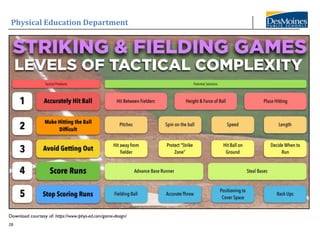
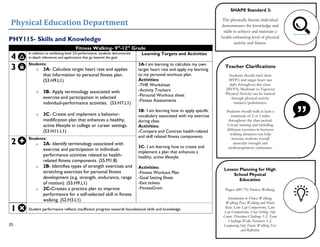
  • 46.
    Physical Education Department 46 SuccessCriteria/Mature Pattern for Underhand Roll: • Face target in preparation for throwing action. • Arm back in preparation for action. • Step with opposite foot as throwing arm moves forward. • Release ball between knee and waist level (or below knee for bowling) • Follow through to target. Picture courtesy of: http://jeremeamia.tripod.com/bowling/bowltips.html
  • 47.
    Physical Education Department 47 PHY901-Skillsand Knowledge-CONTRACT PE Contract PE 4 In addition to scoring 3.0 performance, the student demonstrates in-depth inferences and application that go beyond the target. Learning Targets and Activities 3 Students: o 3A- Demonstrates competency in 1 or more specialized skills in health-related fitness activities. (S1.H3.L1) o 3B- Develops and maintains a fitness portfolio (e.g. assessment scores, goals for improvement, plan of activities for improvement, log of activities being done to reach goals, timeline for improvement, monthly reflections) (S3.H11.L2) o 3C- Creates a practice plan to improve performance for a self-selected skill. (S2.H3.L1) 3A-I am learning how to demonstrate fitness exercises. Activities: (any activity that would be placed underneath the five fitness components) -compare the amount of exercise and activity in fitness related component categories -Walking -Running -Curl-ups -Push-ups 3B-I can use daily fit log platform to log my goals and activities. 3C- I am learning how to create a plan to improve my overall workout regimen. Activities: o Reflection journal or log for specific workouts/action plan to work towards personal fitness goal on daily fit log o Monthly reflection forms o SMART goal setting o Journal to describe proper form Create a personal workout plan to put into a portfolio utilizing personal fitness data points 2 Students: o 2A- Identifies 1 or more specialized skills in health-related fitness activities. o 2B- Determine a SMART goal in response to your individual fitness assessments. o 2C- Identify activities to include in overall workout plan. 1 Student performance reflects insufficient progress towards foundational skills and knowledge. SHAPE Standard 1: The physically literate individual demonstrates competency in a variety of motor skills and movement patterns. Teacher Clarifications Students and staff will use the Canvas course to teach this course online. Eligibility has not changed. 12th Grade students are eligible to enroll in Contract PE for 1 semester of their senior year provided they meet at least one of the following criteria: • Student is involved in a work study or other educational program that requires the students’ absence from school. • Student is carrying a full academic schedule for the current semester. • Student is involved in a school-sponsored athletic program or activity supervised by a staff member with a coaching endorsement. All other high school students are eligible to enroll in Contract PE provided they meet all the following criteria: • Student is carrying a full academic schedule for the current semester. • Student has no physical education failures to make up from previous years. • Student is involved in a school-sponsored athletic or activity supervised by a staff member with a coaching endorsement. Lesson Planning for High School Physical Education Pages: 629-687 Fitness Assessment and Program Planning Review of Fitness Principles, Physical Activity Log, Health-Related Fitness Assessment, Resistance Training, Modified 1 Repetition Maximum, Zone, Muscle Fitness Workouts 1-3, Aerobics Workouts 1-3, Cardio Kickboxing 1-3, Peer Evaluations of Fitness Plan
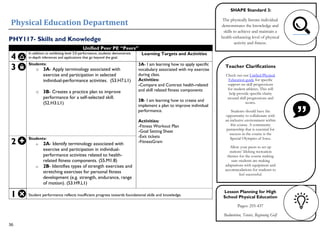
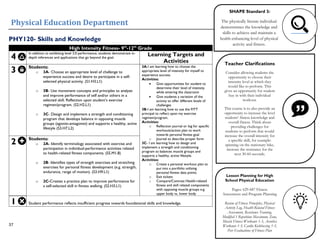
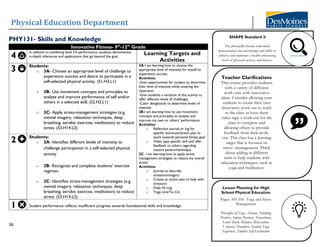
  • 48.
    Physical Education Department 48 PHY901-Engagement-CONTRACTPE Contract PE- Engagement 4 In addition to scoring 3.0 performance, the student demonstrates in-depth inferences and application that go beyond the target. Learning Targets and Activities 3 Students: o 3A- Participates several times a week in a self-selected lifetime activity, dance or fitness activity outside the school day. (S3.H6.L1) o 3B- Chooses an appropriate level of challenge to experience success and desire to participate in a self-selected physical activity. (S5.H2.L2) o 3C- Analyzes the health benefits of a self- selected physical activity. (e.g. using the fitness-related components to compare workout activities) (S5.H1.L1) 3A-I can participate in self-selected activities outside of the school day. Activities: -Selection of the activities and the engagement in the activities 3B- I can choose, participate, and explain why I chose the activities for my personal activity. Activities: -Activity plan for the activities to complete to meet the 3600 min. -Reflections on intensity level, increasing intensity to create a challenge. 3C- I am learning how to analyze the health benefits from selecting my own activities for my workout. Activities: -Determine a plan to meet the 225 every 2 weeks requirement of minutes logged -Sentence questions/prompts for Reflections • Compare and contrast the reasons why you should select your own activities for your workout? • What specific health benefits do you acquire when you select your own activity for your workout? Why it is important to balance the health and skill related components when thinking about your workout? 2 Students: o 2A- Identifies specific activities to participate in outside of the school day. o 2B- Recognizes the benefits of physical activities or dance that meet the need for self-expression and enjoyment. o 2C- Identifies the health benefits of participating in a variety of physical activities. 1 Student performance reflects insufficient progress towards foundational skills and knowledge. SHAPE Standard 5: The physically literate individual recognizes the value of physical activity for health, enjoyment, challenge, self-expression and/or social interaction. Teacher Clarifications Contract PE is a supplemental course that allows students who currently have a full academic schedule for both semesters to fulfil their PE classroom requirement. A student is considered to have a full academic schedule when it is filled with academic courses without any periods of release. For the purposes of identifying whether a student has a full academic schedule, travel periods are considered academic courses. See above for the criteria for enrollment into Contract PE. Students will need to complete a total of 225 minutes of physical activity every two weeks to meet the .5 credit amount. Students will need to address how they will reach the activity minutes within their fitness plan. Another opportunity for gathering pieces of evidence would be through reflection prompts. For an example: • Why is it important to balance the health and skill related components when thinking about your workout? • Tell me why selecting your own physical activity is essential for a successfully workout? Academic Vocabulary Health benefits, physical activity, reflection, analyze, self-expression, enjoyment
  • 49.
    Physical Education Department 49 PHY901-Personaland Social-CONTRACT PE Contract PE- Personal and Social Behavior 4 In addition to scoring 3.0 performance, the student demonstrates in-depth inferences and application that go beyond the target. Learning Targets and Activities 3 Students: o 3A- Employs effective self-management skills to analyze barriers and modify physical activity patterns appropriately as needed. (S4.H1.L1) o 3B- Develops and maintains a fitness portfolio (e.g. logging in activity minutes, log of activities being done to reach goals, timeline for improvement) (S3.H12.L2) o 3C- Apply best practices for participating safely in physical activity, exercise and dance (i.e. injury prevention, proper alignment, hydration, use of equipment, implementation of rules, sun protection) (S4.H5.L1) 3A- I am learning how to communicate with my contract PE teacher on a regular basis. -Attend contract PE initial meeting -Complete pre/post fitness assessments 3B- I can manage myself to modify my physical activity as needed when overcoming different challenges. –Specific examples on how to modify activity levels. (e.g. due to exhaustion, practices schedules vs. game days, intensity levels, and sickness) -How are they meeting their activity minutes monthly? 3C-I am learning how to monitor and use daily fit log to enter in my daily activity minutes on daily fit log. -Activity log (3600 minutes = 60 hours of activity) -Self-officiating exercises -Goals for activities and timelines for improvement 2 Students: o 2A- Identifies specific activities to participate in outside of the school day. o 2B- Recognizes the benefits of physical activities or dance that meet the need for self-expression and enjoyment. o 2C- Identifies the health benefits of participating in a variety of physical activities. 1 Student performance reflects insufficient progress towards foundational skills and knowledge. SHAPE Standard 4: The physically literate exhibits responsible personal and social behavior that respects self and others. Teacher Clarifications Student Responsibilities: Thoroughly complete the Contract PE application and make sure both student and guardian signatures are in place. Attend Contract PE meeting at the beginning of the semester. Log in to the Canvas course regularly to complete the course content, record your physical activity data, complete student reflections. Report to Contract PE teacher at designated times for pre-testing/post-testing and goal setting; record both in Canvas. Each month, provide specific feedback to students through the Canvas platform. Academic Vocabulary FITT Principle, Reflection, Analyze, SMART Goal, Muscular Strength, Muscular Endurance, Cardiorespiratory Endurance, Flexibility, Body Composition, Agility, Balance, Power, Speed, Reaction time, Coordination
  • 50.
    Physical Education Department 50 PHY901-Fitness-CONTRACTPE Contract PE- Fitness 4 In addition to scoring 3.0 performance, the student demonstrates in- depth inferences and application that go beyond the target. Learning Targets and Activities 3 Students: o 3A- Develops and maintains a fitness portfolio (e.g. assessment scores, goals for improvement, plan of activities for improvement, log of activities being done to reach goals, timeline for improvement). (S3.H11.L2) o 3B- Reflect upon my exercise regimen utilizing the FITT principle. (S1.H2.L1) o 3C- Design and implement a nutrition plan to maintain an appropriate energy balance for a healthy, active lifestyle. 3A-I am learning how to use my fitness assessments to create a fitness portfolio and workout plan. Activities: -Completion of assessments, score in healthy fitness zone in most of the categories. 3B-I am learning how to reflect upon my exercise regimen/program using the FITT principle. Activities: Reflection questions verbal/written F-Frequency (How often are you completing the exercise?) I-Intensity (low, moderate, high) T-Type (activity or choice of exercise) T-Time (amount of time dedicated to the exercise) 3C- I can apply my current level of skills and knowledge to implement my SMART goal. Activities: Reflection journal or log for specific workouts/action plan to work towards personal fitness goal Create a personal workout plan to put into a portfolio utilizing personal fitness data points 2 Students: o 2A- Completes fitness assessments (S3.E5.4A) o 2B- Identifies health related fitness components and skill related components. o 2C- Identifies fitness goal (SMART) including all components of health-related fitness (eg. Cardiorespiratory Endurance, Muscular Strength, Muscular Endurance, Flexibility, and Body Composition) related to the students’ individual fitness needs. 1 Student performance reflects insufficient progress towards foundational skills and knowledge. Teacher Clarifications Students will still need to arrange a time to complete their pre and post fitness assessments as these assessments are essential for the student to set their initial fitness goals. Even if the students are planning on completing most all the course outside of the school day, students will need to arrange and attend the fitness assessment in front of the cooperating Contract PE teacher. For more information regarding Contract PE guidelines, please see the document here. Academic Vocabulary FITT Principle, Reflection, Analyze, SMART Goal, Muscular Strength, Muscular Endurance, Cardiorespiratory Endurance, Flexibility, Body Composition, Agility, Balance, Power, Speed, Reaction time, Coordination SHAPE Standard 3: The physically literate individual demonstrates the knowledge and skills to achieve and maintain a health-enhancing level of physical activity and fitness.
  • 51.
    Physical Education Department 51 YearLong Topic Proficiency Scales Engagement 9th -12th Grade 4 In addition to scoring 3.0 performance, the student demonstrates in-depth inferences and application that go beyond the target. Learning Targets 3 Students: o 3A- Participate in moderate to vigorous muscle- and bone-strengthening physical activity. (Fitness Knowledge S3.M6) o 3B- Adjust pacing to keep heart rate in the target zone, using available technology (e.g. heart rate monitor), to self-monitor aerobic intensity. (S3.H10.L2) o 3C- Identify positive mental and emotional aspects of participating in a variety of physical activities. (Health S5.M2) o 3A- I am participating in moderate to vigorous physical activity. o 3B- I am learning how to continually adjust my physical activity based on my overall fitness goal. o 3C-I am learning how to identify activities that prompt enjoyment for my own self-expression. 2 Students: o 2A- Participate in low to moderate muscle- and bone- strengthening physical activity. o 2B- Set a self-selected SMART physical activity goal for aerobic and/or muscle- and bone- strengthening activity based on current fitness level. o 2C- Identify aspects of participating in a variety of physical activities. 1 Student performance reflects insufficient progress towards foundational skills and knowledge. SHAPE Standard 3: The physically literate individual demonstrates the knowledge and skills to achieve and maintain a health-enhancing level of physical activity and fitness. Teacher Clarifications Consider having reflection questions for students to answer following the unit. After each unit, ask the same question prompt: What part of the unit was most enjoyable? Would you have changed any of the activities? -Describe how this unit was able to make a positive impact on your overall health. Academic Vocabulary Self-expression, enjoyment Physically active, health
  • 52.
    Physical Education Department 52 Personaland Social Behavior 9th -12th Grade 4 In addition to scoring 3.0 performance, the student demonstrates in-depth inferences and application that go beyond the target. Learning Targets 3 Students: o 3A- Exhibit proper etiquette, respect for others and teamwork while engaging in physical activity and/or dance. (Rules and Etiquette S4.H2) o 3B-Uses communication skills and strategies that promote team or group dynamics. (Working with Others S4.H3) o 3C-Apply best practices for participating safely in physical activity, exercise and dance (e.g., injury prevention, proper alignment, hydration, use of equipment, implementation of rules, sun protection) (Safety S4.H5.L1) 3A- I am learning demonstrate proper etiquette and respect for other and be a team player. 3B-I am learning how to communicate specific skills and strategies to help promote my team/group dynamics. 3C-I am learning how apply best practices while being safe. 2 Students: o 2A-Identifies the rules and etiquette for physical activities, games and dance activities. (Rules and Etiquette S4.M6) o 2B- Identifies communication skills that contribute to team or group dynamics. (Working with others) o 2C-Determines how to use physical activity and fitness equipment appropriately and safely. (Safety S4.M7) 1 o Student performance reflects insufficient progress towards foundational skills and knowledge. SHAPE Standard 4: The physically literate individual exhibits responsible personal and social behavior that respects self and others. Teacher Clarifications Consider pairing each unit focusing on one of the personal and social behavior topics or engagement topic. For example: during your net/wall games unit, focus on 3E by giving an opportunity for partners to look for the critical elements of underhand serving, and giving peer feedback to improve their performance. Either verbal or through written feedback form. Now you will have two pieces of evidence from one unit (skills and knowledge and personal and social behavior). Academic Vocabulary- Responsible, accepting feedback, resolving conflict, safety, etiquette, cooperation, and respect
  • 53.
    Physical Education Department 53 Fitness9th -12th Grade 4 In addition to scoring 3.0 performance, the student demonstrates in-depth inferences and application that go beyond the target. Learning Targets 3 Students: o 3A- Develop and maintain a fitness portfolio (e.g. assessment scores, goals for improvement, plan of activities, log of activities being done to reach goals, timeline for improvement). (S3.H11.L2) o 3B- Set and monitor a fitness goal for health-enhancing level of physical activity and fitness based upon current level of fitness. (S3.H12.L2) 3A-I am learning how to use and compare my fitness results to create a plan of action to help me increase my overall fitness. 3B- I am learning how to set and monitor my personal fitness goal. 2 Students: o 2A- Completes fitness assessments (pre & post) (S3.E5.4A) o 2B- Identifies fitness goal (SMART) including all components of health-related fitness (eg. Cardiorespiratory endurance, muscular strength, muscular endurance, flexibility, and body composition) related to the students’ individual fitness needs. (S3.H12.L1) 1 o Student performance reflects insufficient progress towards foundational skills and knowledge. SHAPE Standard 3: The physically literate individual demonstrates the knowledge and skills to achieve and maintain a health- enhancing level of physical activity. Teacher Clarifications Consider planning your Fitness unit/topic in October and April as you are completing your FitnessGram assessments. Another opportunity you can create a Fall and Spring Fitness SMART goal sheet. After setting goals, they can plan their warm-up/cool-down activities specifically to meet their needs. Then allow 5 minutes before you start the class for individuals to complete their individual warm-up or cool-down. After students feel more comfortable, allow them to teach their warm-up or cool-down to the class. Lesson Planning for High School Physical Education Pages: 629-687 Fitness Assessment and Program Planning Review of Fitness Principles, Physical Activity Log, Health-Related Fitness Assessment, Resistance Training, Modified 1 Repetition Maximum, Zone, Muscle Fitness Workouts 1- 3, Aerobics Workouts 1-3, Cardio Kickboxing 1-3, Peer Evaluations of Fitness Plan
  • 54.
  • 55.
  • 56.
  • 57.
    Physical Education Department 57 GlossaryTerms Critical Elements- The key components of a motor skills that can be observed, the sum of which result in movement efficiency Dynamic environment (open skills) - Skills performed in an environment that is dynamic, unpredictable and in motion. The goal for performers is to adapt movements in response to the dynamic and ever-changing environment. Examples include: invasion games, such as ultimate and soccer and net/wall games such as volleyball and tennis. Fitness Activities- Activities with a focus on improving or maintaining fitness that might include yoga, Pilates, resistance training, spinning, running, fitness walking, fitness swimming, kickboxing, cardio-kick, Zumba, and exergaming. Mature Pattern-executing with efficiency the critical elements of the motor skills pattern in authentic environments. Non-dynamic environment (closed skills) - Constant, predictable or stationary. Goal for the performer is to produce movements or skills that are consistent and accurate because the environmental context is non-dynamic, stable and unchanging. Small-sided practice tasks- deliberate tasks designed to practice skills or tasks. Success Criteria- these are specific techniques that you are “looking for” your students to demonstrate or complete. Volley-To strike or give impetus (the force or energy in which a body a moves) to an object by using a variety of body parts.
  • 58.
    Physical Education Department 58 MaturePatterns for Skills: 1. Mature Pattern for Throwing Underhand 2. Mature Pattern for Throwing Overhand Five Critical Elements: Five Critical Elements: -Face target in preparation for throwing action. -Side to target in preparation for throwing action. -Arm back in preparation for action. -Arm back and extended, and elbow at shoulder height or slightly above preparation for action; elbow leads. -Step with opposite foot as throwing arm moves forward. -Step with opposite foot as throwing arm moves forward. -Release ball between knee and waist. -Hip and spine rotate as throwing action is executed. -Follow through to target. -Follow through towards target and across body. 3. Mature Pattern for Catching 4. Mature Pattern for Volleying Underhand Five Critical Elements: Five Critical Elements: -Extend arms outward to reach for ball. -Face the target in preparation for the volley. -Thumbs in for catch above waist. -Opposite foot forward. -Thumbs out for catch at or below the waist. -Flat surface with hand for contact of the ball or volleybird. -Watch the ball all the way into the hands. -Contact with ball or volleybird between knee and waist level. -Catch with hands only; no cradling against the body. -Follow through upward and to the target. -Pull the ball into the body as the catch is made. -Curl the body slightly around the ball.
  • 59.
    Physical Education Department 59 5.Mature Pattern for Kicking 6. Mature Pattern for Dribbling Five Critical Elements: Five Critical Elements: -Arms extend forward in preparation for kicking action. -Knees slightly bent, opposite foot forward when dribbling in self-space. -Contact with ball is made directly below center of ball. -Contact ball with finger pads. (Travel in air); contact with ball is made directly behind -Firm contact with top of ball, slightly behind the ball for travel. Center of ball (travel on the ground). -Ball to side and in front of body for travel. -Trunk leans back slightly in preparation for kicking action. -Eyes looking “over,” not down at, the ball. -Follow through with kicking leg extending forward and upward toward target. 7. Mature Pattern for Volleying Overhead 8. Mature Pattern for Striking with Short Implement Five Critical Elements: Five Critical Elements: -Body aligned and positioned under the ball. -Racket back in preparation for striking. -Knees, arms, and ankles bent in preparation for the volley. -Step on opposite foot as contact is made. -Hands rounded; thumbs and first fingers make triangle -Swing racket or paddle low to high. (Without touching) in preparation -Coil and uncoil the trunk for preparation and execution of the striking action. -Ball contacts only the finger pads; wrists stay firm. -Follow through for completion of the striking action. -Arms extended upward on contact; follow through slightly towards target.
  • 60.
    Physical Education Department 60 9.Mature Pattern for Striking with Long Implement Five Critical Elements: -Bat up and back in preparation for the striking action. -Step forward on opposite foot as contact is made. -Coil and uncoil the trunk for preparation and execution of the striking action. -Swing the bat on a horizontal plane. -Wrist uncocks on follow-through for completion of the striking action.
  • 61.
    Physical Education Department 61 Resources: “AmericanRed Cross.” Instructorscorner.com, www.instructorscorner.com/. “Welcome to OPEN – the Online Physical Education Network.” OPEN Physical Education Curriculum, www.openphysed.com/. Couturier, Lynn, et al. National Standards & Grade-Level Outcomes for K-12 Physical Education. Human Kinetics, 2014. Doan, Robert John. Lesson Planning for Middle School Physical Education. Human Kinetics, 2017. Feith, Joey. ThePhysicalEducator.com. Physical Education with Purpose. Iphys-Ed.com In School Bowling, www.inschoolbowling.com/. SHAPE America, www.shapeamerica.org/.
  • 62.
    Physical Education Department 62 PhysicalEducation Curriculum, Instruction, and Assessment 2100 Fleur Drive | Des Moines, Iowa 50321 | P: 515-242-8170 pe.dmschools.org