PRINCIPLES OF
EXERCISE
PATHFIT 2
WHAT IS
EXERCISE?
EXERCIS
E
• The training of the body to
improve its function and enhance
its fitness and overall health
• is a component of physical
activity
• It is a structured activity
specifically planned to develop
and maintain physical fitness.
(Blaire, et.al.,2024)
PRINCIPLES OF
EXERCISE
1.
SPECIFICITY
Sample
Footer
Text
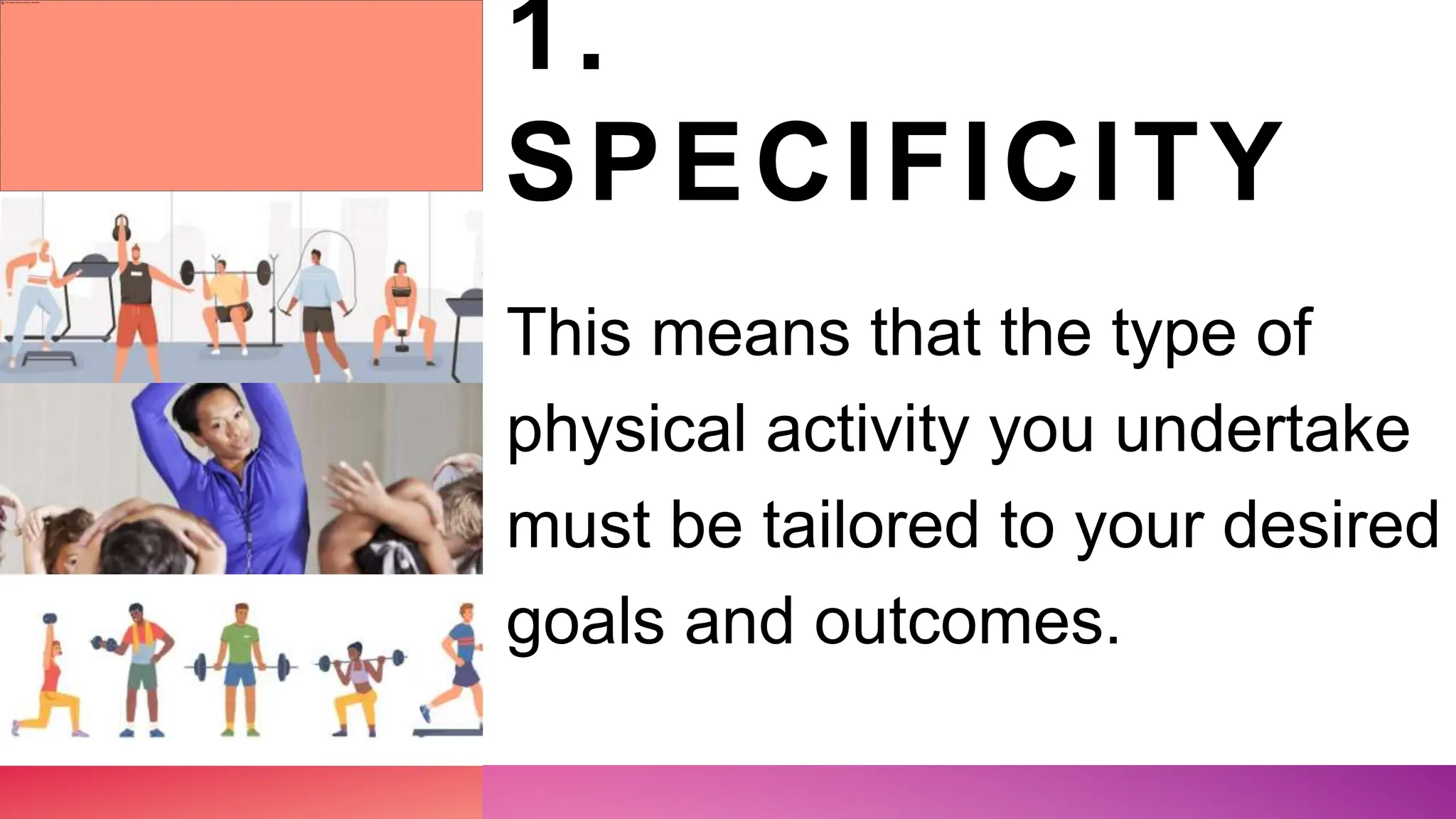
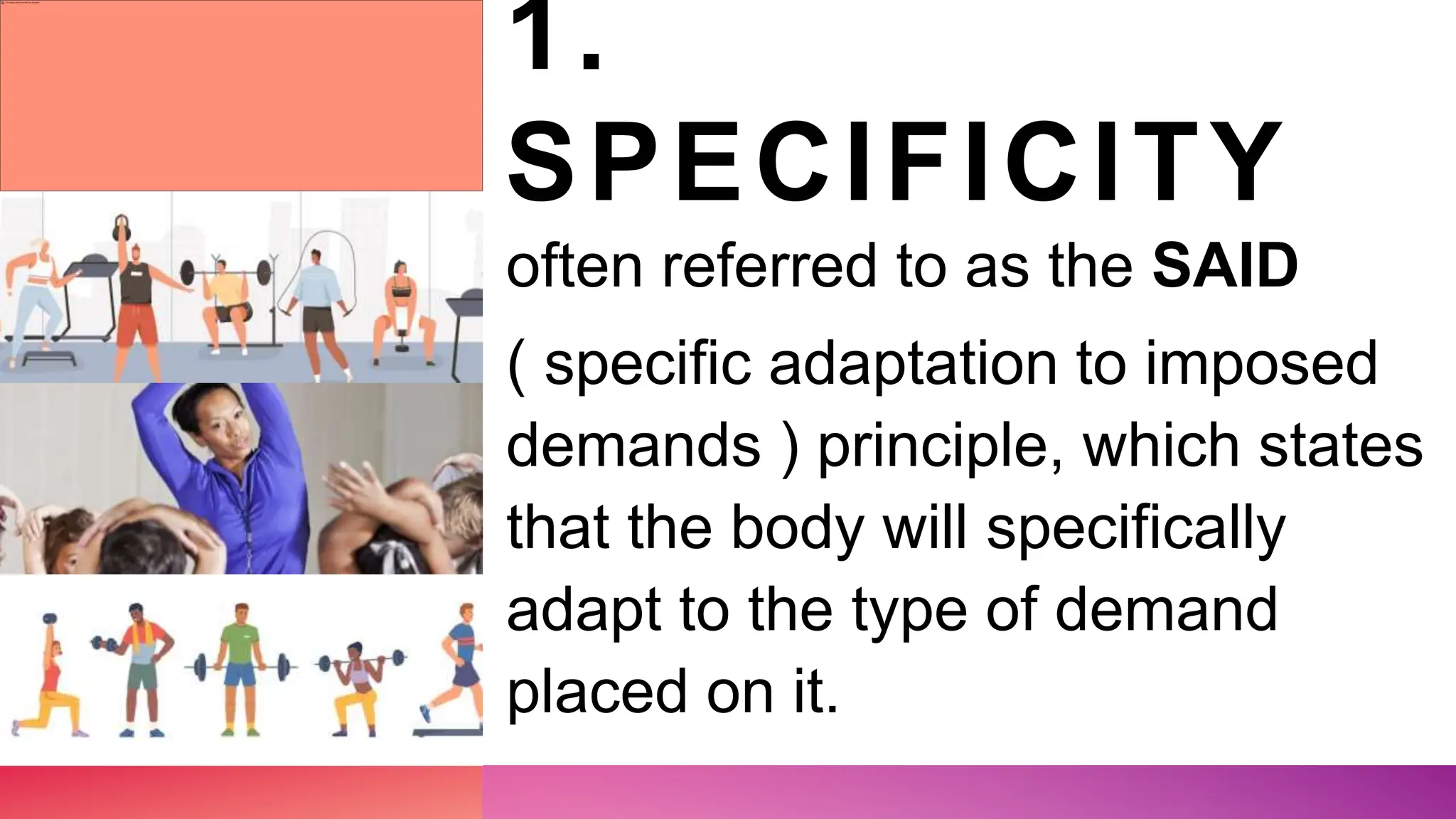
This means that the type of
physical activity you undertake
must be tailored to your desired
goals and outcomes.
1.
SPECIFICITY
Sample
Footer
Text
often referred to as the SAID
( specific adaptation to imposed
demands ) principle, which states
that the body will specifically
adapt to the type of demand
placed on it.
2. OVERLOAD
Sample
Footer
Text
For the body to adapt it needs
to be overloaded. This means it
needs to be placed under
greater stress than it is
accustomed to.
3. FITT
Sample
Footer
Text
F = Frequency of training
I= Intensity of training
T = Type of training
T = Time of training (duration)
Sample
Footer
Text
4. PROGRESSION
Sample
Footer
Text
It is the concept of gradually
increasing the intensity of a
workout, allowing your body time
to adapt and become more
accustomed to it.
4. PROGRESSION
Sample
Footer
Text
Progression can also be achieved by
changing the type of exercises you
do or incorporating new exercises
into your routine; this will help keep
your workouts fresh and challenging.
5.
REGRESSION
Sample
Footer
Text
simply an approach to
decrease the demand of an
exercise or movement.
6.
INDIVIDUALIZATION
Sample
Footer
Text
Exercise should be specific to
the individual completing the
training.
6.
INDIVIDUALIZATION
Sample
Footer
Text
can help create a plan that is
realistic for each individual. When
creating a plan, it is important to
understand the individual's
abilities and adjust the plan
accordingly.
7. RECOVERY
Sample
Footer
Text
It’s important to give your body
the time it needs to rest and
repair after a workout.
7. RECOVERY
Sample
Footer
Text
Nutrition also plays an
important role in the recovery
process and getting enough
restful sleep.
8. ADAPTATION
Sample
Footer
Text
how the body ‘programs’
muscles to remember
particular activities,
movements, or skills.
8. ADAPTATION
Sample
Footer
Text
This explains why beginning
exercisers are often sore after
starting a new routine, but after
doing the same exercise for
weeks and months the athlete
has little, if any, muscle soreness.
9.VARIATION
Sample
Footer
Text
Variation is an important part of
any fitness training program. It is
essential for continued progress
and to reduce the risk of injury.
9.VARIATION
Sample
Footer
Text
Variation prevents your body
from adapting to any specific
workout, allowing you to
progress further in your
training.
10.
PERIODIZATION
Sample
Footer
Text
Systematic variation of training
specificity, intensity, and volume
organized into planned periods or
cycles within an overall program.
10.
PERIODIZATION
Sample
Footer
Text
Periodization Cycles Description
MACROCYCLE Complete training period:
1 year
MESOCYCLE
(Phase)
Singular training cycle or
block: 3-4 weeks
MICROCYCLE The structural unit of
mesocycle: 1 week
Workouts The structural unit of a
microcycle:
hours/minutes
M O N D A Y , F E B R U A R Y 1 , 2 0 X X
Sample
Footer
Text
23

PRINCIPLES-OF-EXERCISE-2 and some definition