Jocson College, Inc. Angeles City MR. RODEL E. SINAMBAN MAPEH Teacher RECREATIONAL ACTIVITIES
Jocson College, Inc. Angeles City MR. RODEL E. SINAMBAN MAPEH Teacher
 
Recreation  is the expenditure of time with an intent to gain some refreshment. It is a break from monotony and a diversion from the daily routine. It is a positive change from the stereotypical lifestyle and involves an active participation in some entertaining activity.  Recreation  is anything that is stimulating and rejuvenating for an individual. Some people enjoy nature hikes; others enjoy skiing (or both). The idea behind these activities is to expand the mind and body in a positive, healthy way.
Leisure Education is an assistive tool to enable the individual to : 1) gain a broader understanding of where, why, how, and with whom he can pursue his leisure interests and experiences and  2) unlearn non-adaptive and learn more functional responses, i.e. to develop different modes of leisure behavior which will enable the individual to adapt to the environment to meet his free time needs . Values derived from Recreation: 1.  Mental Health 2.  Physical Health and Growth 3.  Emotional Stability 4.  Social Fitness 5.  Psychological Awareness
Everyone needs to plan and best utilize daily free time for recreation.  If leisure time is used correctly and to the fullest, it will: Recreate the body, mind, and spirit    through and through Bring forth renewed vigor, spirit, and    creative effort  Why is it important for a student to enjoy positive leisure or recreational activities daily?
Recreational activities gives you opportunity to be creative, to express your basic needs, and to be your real self. All work and no play makes a person not only dull but a sick, unbalanced, and unhappy individual according to medical authorities. Students who correctly balance work and play are more productive and tend to be in better physical, mental, social, and emotional health. Students who are disciplined, well-organized, and have life goals well in mind will have better chances of being successful. These will help them build a lifelong habit.
Recreational activities like sports will develop muscular strength, agility, power, flexibility, and improve one’s health. Engaging in group activities develops social skills that will lead to the development of proper conduct and behavior and social graces. Worthwhile recreational activities give students or youth opportunities  to be busy with meaningful activities instead of roaming around and doing harmful vices like abusing dangerous drugs. Other Values that you can derive from engaging in worthwhile recreational activities.
Physical Social Cultural Intellectual Types of Recreational Activities
Minor Sports Group Games Camping Outing Physical
Social Social dancing Attending parties Joining Parlor Games and the likes
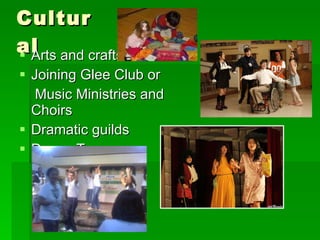
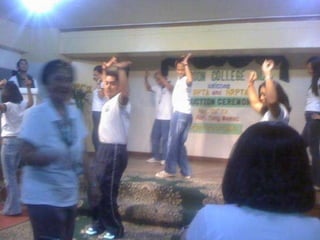
Cultural Arts and crafts Joining Glee Club or  Music Ministries and Choirs Dramatic guilds Dance Troupes
Intellectual Song Poetry Jingle Short Story Writing Internet Surfing Answering Puzzle Playing Scrabble, Bowling, Chess, Dart, etc.
Joining Social activities will help you: Increase your contact with people Release tensions Satisfy your basic needs to belong Gain recognition Provide self-expression Develop leadership Have democratic experience in group activities
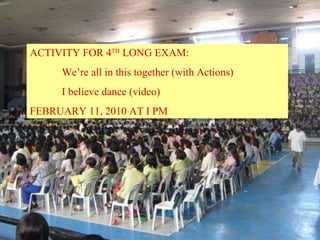
ACTIVITY FOR 4 TH  LONG EXAM: We’re all in this together (with Actions) I believe dance (video) FEBRUARY 11, 2010 AT I PM


THANK YOU!

Recreational Activities

  • 1.
    Jocson College, Inc.Angeles City MR. RODEL E. SINAMBAN MAPEH Teacher RECREATIONAL ACTIVITIES
  • 2.
    Jocson College, Inc.Angeles City MR. RODEL E. SINAMBAN MAPEH Teacher
  • 3.
  • 4.
    Recreation isthe expenditure of time with an intent to gain some refreshment. It is a break from monotony and a diversion from the daily routine. It is a positive change from the stereotypical lifestyle and involves an active participation in some entertaining activity. Recreation is anything that is stimulating and rejuvenating for an individual. Some people enjoy nature hikes; others enjoy skiing (or both). The idea behind these activities is to expand the mind and body in a positive, healthy way.
  • 5.
    Leisure Education isan assistive tool to enable the individual to : 1) gain a broader understanding of where, why, how, and with whom he can pursue his leisure interests and experiences and 2) unlearn non-adaptive and learn more functional responses, i.e. to develop different modes of leisure behavior which will enable the individual to adapt to the environment to meet his free time needs . Values derived from Recreation: 1. Mental Health 2. Physical Health and Growth 3. Emotional Stability 4. Social Fitness 5. Psychological Awareness
  • 6.
    Everyone needs toplan and best utilize daily free time for recreation. If leisure time is used correctly and to the fullest, it will: Recreate the body, mind, and spirit through and through Bring forth renewed vigor, spirit, and creative effort Why is it important for a student to enjoy positive leisure or recreational activities daily?
  • 7.
    Recreational activities givesyou opportunity to be creative, to express your basic needs, and to be your real self. All work and no play makes a person not only dull but a sick, unbalanced, and unhappy individual according to medical authorities. Students who correctly balance work and play are more productive and tend to be in better physical, mental, social, and emotional health. Students who are disciplined, well-organized, and have life goals well in mind will have better chances of being successful. These will help them build a lifelong habit.
  • 8.
    Recreational activities likesports will develop muscular strength, agility, power, flexibility, and improve one’s health. Engaging in group activities develops social skills that will lead to the development of proper conduct and behavior and social graces. Worthwhile recreational activities give students or youth opportunities to be busy with meaningful activities instead of roaming around and doing harmful vices like abusing dangerous drugs. Other Values that you can derive from engaging in worthwhile recreational activities.
  • 9.
    Physical Social CulturalIntellectual Types of Recreational Activities
  • 10.
    Minor Sports GroupGames Camping Outing Physical
  • 11.
    Social Social dancingAttending parties Joining Parlor Games and the likes
  • 12.
    Cultural Arts andcrafts Joining Glee Club or Music Ministries and Choirs Dramatic guilds Dance Troupes
  • 13.
    Intellectual Song PoetryJingle Short Story Writing Internet Surfing Answering Puzzle Playing Scrabble, Bowling, Chess, Dart, etc.
  • 14.
    Joining Social activitieswill help you: Increase your contact with people Release tensions Satisfy your basic needs to belong Gain recognition Provide self-expression Develop leadership Have democratic experience in group activities
  • 15.
    ACTIVITY FOR 4TH LONG EXAM: We’re all in this together (with Actions) I believe dance (video) FEBRUARY 11, 2010 AT I PM
  • 16.
  • 17.
  • 18.
  • 19.
  • 20.
  • 21.
  • 22.
  • 23.
  • 24.
  • 25.
  • 26.
  • 27.
  • 28.
  • 29.
  • 30.
  • 31.
  • 32.
  • 33.
  • 34.
  • 35.
  • 36.
  • 37.
  • 38.
  • 39.
  • 40.
  • 41.

Editor's Notes

  • #3 There are 5 hyperlinks in this presentation. They concern description of the drugs in more detail and are indicated by an underlined word in white. Occasionally the link may be 2 or 3 pages and this is indicated by a (next) at the end of the page. The return link is in the last page if there is more than one to the given subject. The last link goes from page 25 to 30 (which is The End page, avoiding going a second time over the same material).
  • #7 4) That is why people thinks Ritalin does not work in adults, i,e it does not have a paradoxical effect in adults. NOT TRUE.
  • #10 Genetic disorder except in some very rare cases of Von Economo’s encephalitis. The disorder starts at birth and frequently in utero. These children move and kick a lot while in utero. Because of that, complications at birth are not uncommon, cords around the neck, wrong presentation etc
  • #12 Some. if untreated beyond evolving to Oppositional Defiant Disorders and later Conduct Disorders find their way to jail where they are highly represented and generally untreated. Sometimes is very clear since birth. In those cases these babies are colicky, irritable, have crying spells, sleep problems, are difficult to comfort etc.
  • #14 The degree to which each one of the components of the syndrome manifest itself is very variable as is the proportions in which they combine themselves i e some are only distractable while others more hyper than distractable etc. Short attention span except for computers, Nintendo type of games, etc. If he can pay attention to computer games why not at school?