Produsing resources for
 coaching and teaching
        #SCP13: Week 7
Produsing

In collaborative communities the creation of shared content
takes place in a networked, participatory environment
which breaks down the boundaries between producers and
consumers and instead enables all participants to be users
as well as producers of information and knowledge –
frequently in a hybrid role of produser where usage is
necessarily also productive.


                                                  Link
13.2

27.1

49.7

64
Young people born in the early- to
mid-1990s will make up 13.2 per cent of
Australia's population by 2015
27.1 per cent of young adults are involved in
volunteer work. Yet while they spend their working
days helping others, they're less trusting than the
rest of us - 49.7 per cent think people can be
trusted, compared to 54.1 per cent of the general
population.
The number of young people receiving
financial assistance from their parents went
up from 57 per cent to 64 per cent in the
four years to 2010
13.2

27.1

49.7

64
Link
Link
Link
Link
Link
http://www.vivoom.co/
http://www.techsmith.com/camtasia.html
Link
Link
Link
Link
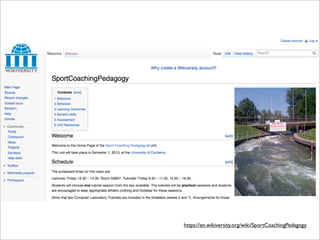
https://en.wikiversity.org/wiki/SportCoachingPedagogy
Not all the value produced by a community or a
network is immediately realized. Activities and
interactions can produce “knowledge capital” whose
value lies in its potential to be realized later. Note that
this potential can be useful even if it is never realized.


                                   Etienne Wenger, Beverly Trayner and Maarten de Laat’s (2011)
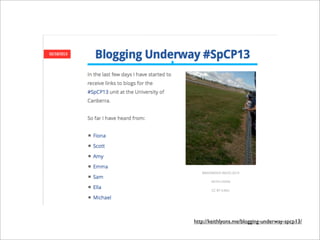
http://keithlyons.me/blogging-underway-spcp13/
we're about to career into a Great Collision — people
bumping up against the self-imposed perimeter of their own
carefully constructed lives; human potential crashing
headlong against choices that make the least of it. It's a
collision of values against value. It's a collision of
preferences against expectations; the lives we want versus the
choices we're willing to make; what we give versus why we
take; what we find in each other versus what we seek from
each other. It's a collision that's going to happen inside each
of us — and then, maybe, result in a collision that happens
outside each of us.

                                                     Umair Haque (2012)
If our ultimate goal is to educate human beings,
then we must focus not only on knowledge and
information, discipline and surveillance as
measured by tests, but also on non-academic
pleasures, motivations, skills, and the full array
of human engagement that sustains attention
and meaning.

                                         Susan Bloom, 2013
                                            Huffington Post
Link

#SpCP13 Week 7: Produsing Resources

  • 1.
    Produsing resources for coaching and teaching #SCP13: Week 7
  • 2.
    Produsing In collaborative communitiesthe creation of shared content takes place in a networked, participatory environment which breaks down the boundaries between producers and consumers and instead enables all participants to be users as well as producers of information and knowledge – frequently in a hybrid role of produser where usage is necessarily also productive. Link
  • 3.
  • 4.
    Young people bornin the early- to mid-1990s will make up 13.2 per cent of Australia's population by 2015
  • 5.
    27.1 per centof young adults are involved in volunteer work. Yet while they spend their working days helping others, they're less trusting than the rest of us - 49.7 per cent think people can be trusted, compared to 54.1 per cent of the general population.
  • 6.
    The number ofyoung people receiving financial assistance from their parents went up from 57 per cent to 64 per cent in the four years to 2010
  • 7.
  • 8.
  • 9.
  • 10.
  • 14.
  • 15.
  • 16.
  • 17.
  • 18.
  • 19.
  • 20.
  • 22.
  • 24.
  • 26.
    Not all thevalue produced by a community or a network is immediately realized. Activities and interactions can produce “knowledge capital” whose value lies in its potential to be realized later. Note that this potential can be useful even if it is never realized. Etienne Wenger, Beverly Trayner and Maarten de Laat’s (2011)
  • 27.
  • 28.
    we're about tocareer into a Great Collision — people bumping up against the self-imposed perimeter of their own carefully constructed lives; human potential crashing headlong against choices that make the least of it. It's a collision of values against value. It's a collision of preferences against expectations; the lives we want versus the choices we're willing to make; what we give versus why we take; what we find in each other versus what we seek from each other. It's a collision that's going to happen inside each of us — and then, maybe, result in a collision that happens outside each of us. Umair Haque (2012)
  • 29.
    If our ultimategoal is to educate human beings, then we must focus not only on knowledge and information, discipline and surveillance as measured by tests, but also on non-academic pleasures, motivations, skills, and the full array of human engagement that sustains attention and meaning. Susan Bloom, 2013 Huffington Post
  • 30.