Mentoring 2
#SpCP13: 26 April 2013
Link
With
Developing ideas presented in Mentoring 1 (Week 6)
By mentorship we mean a “helping
relationship” centred around an
experienced professional’s transfer of
knowledge and know how to a trainee in
order to advance the junior professional’s
understanding and eventual achievement

                        Charlesworth, Knudson and Seeman (2013)
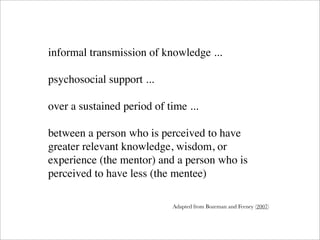
informal transmission of knowledge ...

psychosocial support ...

over a sustained period of time ...

between a person who is perceived to have
greater relevant knowledge, wisdom, or
experience (the mentor) and a person who is
perceived to have less (the mentee)

                            Adapted from Bozeman and Feeney (2007)
... it would seem logical for coach education to
harness the obvious power and influence of
experience, and other influential coaches, to work
toward sound coach development objectives.


                                Cushion, Armour and Jones (2003)
Link
the mentors received an educational benefit through
critical reflection and observation and, because the
mentor had a helping role rather than an
evaluative one, program effectiveness was enhanced.


                                Cushion, Armour and Jones (2003)
It would seem imperative for mentors to have
established the appropriate position in the
sporting and coaching hierarchy. They would have
to have the necessary amount and mix of social,
cultural, and symbolic capital. The mentor
would also have to hold expert power, which is
based not only on the knowledge of the mentor, but
upon the perceptions of the coaches regarding
that knowledge.
                                Cushion, Armour and Jones (2003)
By opening up our professional practices to scrutiny, by
ourselves and our peers, we create the possibility of
turning these areas of practice into “sites of contestation”
where we can begin to address, practically and specifically,
issues and problems.

                     (Kirk and Tinning, 1990, p. 9 quoted in Cushion, Armour and Jones (2003))
You + (+)
Biography

Accreditation

The magic of (+)
Connecting

Personalising

Feeding Forward
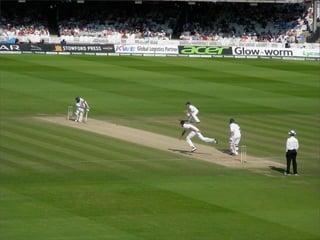
England came into the World T20 as the best
women's team around. They've barely lost a T20 in
a year. They have the best batsmen in the world,
the best bowling attack, field very well and are
lead by an experienced World Cup and World
T20 winning captain. They breezed past Australia
at Galle only a few days ago, scoring their last 100 runs
in approximately 10 overs to win by seven wickets and
11 balls. They're the most professional women's
cricket side history...


                                              Jarrod Kimber
... and Australia beat them.
Director’s Core capabilities

  Creates a shared sense of purpose.
  Engages others in a strategic direction
  Encourages their contribution
  Communicates expected outcomes.
Achieves results, monitors progress, identifies risks. 
Responds flexibly to changing demands.
Builds teams with complementary skills.
Supports productive working relationships.
Builds and sustains relationships with a network of key people.
Anticipates and is responsive to internal and external client needs.
Displays personal drive and integrity.

    Challenges important issues constructively.
 
    Communicates with influence.
Applied Technical Advancement Coach
To provide applied technical coaching
leadership, expertise and direction by
enhancing the current standards of
coaches to achieve continuing
international success.
• Enhance Head/Assistant Coaches’ effectiveness in the
 delivery of individual/group technical training sessions.

• Facilitate current best practice models for improvement
 of coaches.

• Provide leadership and direction to coaches in planning,
 monitoring and evaluation.

• Provide leadership, advice and direction to Head
 Coaches to enhance consistent, professional and
 effective working relationships with Assistant Coaches.
• Design, lead, and provide applied technical professional development
 coaching experiences for coaches promoting the exchange of current
 technical knowledge, coaching concepts and techniques.

• Investigate and adapt international coaching models and
 benchmarks.

• Provide leadership and guidance to coaches regarding developing
 and maintaining a consistent, effective and professional working
 relationship with their national and international networks.
(+)
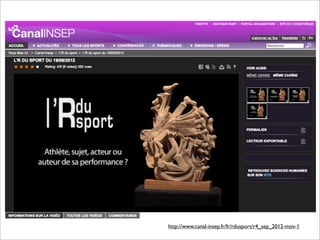
http://www.canal-insep.fr/fr/rdusport/r4_sep_2012-mov-1
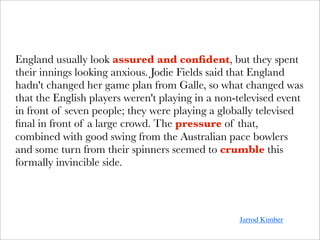
England usually look assured and confident, but they spent
their innings looking anxious. Jodie Fields said that England
hadn't changed her game plan from Galle, so what changed was
that the English players weren't playing in a non-televised event
in front of seven people; they were playing a globally televised
final in front of a large crowd. The pressure of that,
combined with good swing from the Australian pace bowlers
and some turn from their spinners seemed to crumble this
formally invincible side.


                                                  Jarrod Kimber
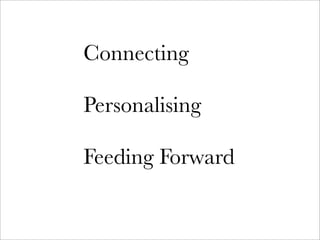
Connecting

Personalising

Feeding Forward
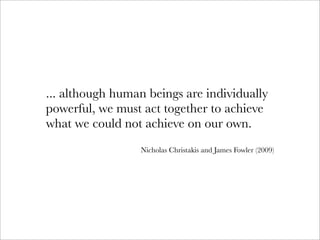
... although human beings are individually
powerful, we must act together to achieve
what we could not achieve on our own.
                 Nicholas Christakis and James Fowler (2009)
Isabel walked forward and stood before the
painting. She felt as she always did when she
stood in front of a great work of art; a sense
of marvel that she was so close to an artefact
that was once worked upon by an artist of
such stature as Poussin. He did this, she
mused: he thought this painting, he touched
this canvas.
       Alexander McCall Smith, The Uncommon Appeal of Clouds (2012)
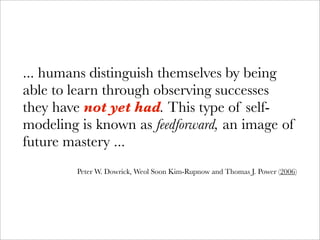
... humans distinguish themselves by being
able to learn through observing successes
they have not yet had. This type of self-
modeling is known as feedforward, an image of
future mastery ...
         Peter W. Dowrick, Weol Soon Kim-Rupnow and Thomas J. Power (2006)
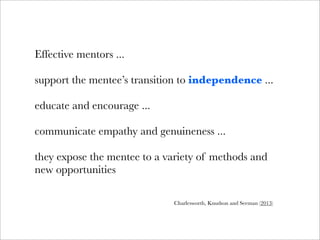
Effective mentors ...

support the mentee’s transition to independence ...

educate and encourage ...

communicate empathy and genuineness ...

they expose the mentee to a variety of methods and
new opportunities

                             Charlesworth, Knudson and Seeman (2013)
Images Used
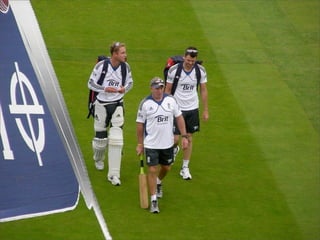
Broad and Anderson fresh from the nets (Graham Hartland)

Cultured drive (Tony Roberts)

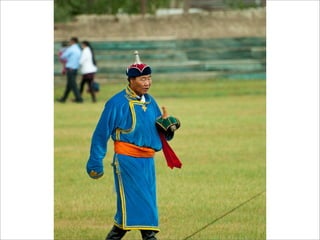
Coach with the wrestler’s hat (Michael Heiniger)

Finn to Duminy (Graham Hartland)

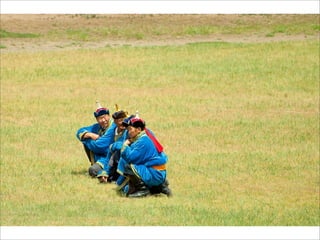
Coaches watching the fight (Michael Heiniger)

DSC03606 (Tom Green)

Rapeseed and the Tree (Aspheric Lens)

Mentoring 2

  • 1.
  • 2.
  • 3.
  • 4.
    Developing ideas presentedin Mentoring 1 (Week 6)
  • 5.
    By mentorship wemean a “helping relationship” centred around an experienced professional’s transfer of knowledge and know how to a trainee in order to advance the junior professional’s understanding and eventual achievement Charlesworth, Knudson and Seeman (2013)
  • 6.
    informal transmission ofknowledge ... psychosocial support ... over a sustained period of time ... between a person who is perceived to have greater relevant knowledge, wisdom, or experience (the mentor) and a person who is perceived to have less (the mentee) Adapted from Bozeman and Feeney (2007)
  • 7.
    ... it wouldseem logical for coach education to harness the obvious power and influence of experience, and other influential coaches, to work toward sound coach development objectives. Cushion, Armour and Jones (2003)
  • 8.
  • 9.
    the mentors receivedan educational benefit through critical reflection and observation and, because the mentor had a helping role rather than an evaluative one, program effectiveness was enhanced. Cushion, Armour and Jones (2003)
  • 10.
    It would seemimperative for mentors to have established the appropriate position in the sporting and coaching hierarchy. They would have to have the necessary amount and mix of social, cultural, and symbolic capital. The mentor would also have to hold expert power, which is based not only on the knowledge of the mentor, but upon the perceptions of the coaches regarding that knowledge. Cushion, Armour and Jones (2003)
  • 11.
    By opening upour professional practices to scrutiny, by ourselves and our peers, we create the possibility of turning these areas of practice into “sites of contestation” where we can begin to address, practically and specifically, issues and problems. (Kirk and Tinning, 1990, p. 9 quoted in Cushion, Armour and Jones (2003))
  • 12.
  • 14.
  • 16.
  • 18.
    England came intothe World T20 as the best women's team around. They've barely lost a T20 in a year. They have the best batsmen in the world, the best bowling attack, field very well and are lead by an experienced World Cup and World T20 winning captain. They breezed past Australia at Galle only a few days ago, scoring their last 100 runs in approximately 10 overs to win by seven wickets and 11 balls. They're the most professional women's cricket side history... Jarrod Kimber
  • 19.
  • 21.
    Director’s Core capabilities Creates a shared sense of purpose. Engages others in a strategic direction Encourages their contribution Communicates expected outcomes.
  • 22.
    Achieves results, monitorsprogress, identifies risks.  Responds flexibly to changing demands. Builds teams with complementary skills. Supports productive working relationships. Builds and sustains relationships with a network of key people. Anticipates and is responsive to internal and external client needs.
  • 23.
    Displays personal driveand integrity. Challenges important issues constructively.   Communicates with influence.
  • 25.
  • 27.
    To provide appliedtechnical coaching leadership, expertise and direction by enhancing the current standards of coaches to achieve continuing international success.
  • 28.
    • Enhance Head/AssistantCoaches’ effectiveness in the delivery of individual/group technical training sessions. • Facilitate current best practice models for improvement of coaches. • Provide leadership and direction to coaches in planning, monitoring and evaluation. • Provide leadership, advice and direction to Head Coaches to enhance consistent, professional and effective working relationships with Assistant Coaches.
  • 29.
    • Design, lead,and provide applied technical professional development coaching experiences for coaches promoting the exchange of current technical knowledge, coaching concepts and techniques. • Investigate and adapt international coaching models and benchmarks. • Provide leadership and guidance to coaches regarding developing and maintaining a consistent, effective and professional working relationship with their national and international networks.
  • 31.
  • 32.
  • 33.
    England usually lookassured and confident, but they spent their innings looking anxious. Jodie Fields said that England hadn't changed her game plan from Galle, so what changed was that the English players weren't playing in a non-televised event in front of seven people; they were playing a globally televised final in front of a large crowd. The pressure of that, combined with good swing from the Australian pace bowlers and some turn from their spinners seemed to crumble this formally invincible side. Jarrod Kimber
  • 34.
  • 35.
    ... although humanbeings are individually powerful, we must act together to achieve what we could not achieve on our own. Nicholas Christakis and James Fowler (2009)
  • 36.
    Isabel walked forwardand stood before the painting. She felt as she always did when she stood in front of a great work of art; a sense of marvel that she was so close to an artefact that was once worked upon by an artist of such stature as Poussin. He did this, she mused: he thought this painting, he touched this canvas. Alexander McCall Smith, The Uncommon Appeal of Clouds (2012)
  • 37.
    ... humans distinguishthemselves by being able to learn through observing successes they have not yet had. This type of self- modeling is known as feedforward, an image of future mastery ... Peter W. Dowrick, Weol Soon Kim-Rupnow and Thomas J. Power (2006)
  • 38.
    Effective mentors ... supportthe mentee’s transition to independence ... educate and encourage ... communicate empathy and genuineness ... they expose the mentee to a variety of methods and new opportunities Charlesworth, Knudson and Seeman (2013)
  • 40.
    Images Used Broad andAnderson fresh from the nets (Graham Hartland) Cultured drive (Tony Roberts) Coach with the wrestler’s hat (Michael Heiniger) Finn to Duminy (Graham Hartland) Coaches watching the fight (Michael Heiniger) DSC03606 (Tom Green) Rapeseed and the Tree (Aspheric Lens)