.
.
.
.
.
.
.
.
.
.
.
.
.
.
.
.
.
.
.
.
.
.
.
.
.
.
.
.
.
.
.
.
.
.
.
.
.
.
.
.
Regularized Principal Component Analysis for
Spatial Data
Wen-Ting Wang
Institute of Statistics, National Chiao Tung University
January 25, 2017
Joint work with Hsin-Cheng Huang, Academia Sinica
1
.
.
.
.
.
.
.
.
.
.
.
.
.
.
.
.
.
.
.
.
.
.
.
.
.
.
.
.
.
.
.
.
.
.
.
.
.
.
.
.
Background Regularized Principal Component Analysis Computation algorithm Numerical Example Summary
Outline
1 Background
2 Regularized Principal Component Analysis
3 Computation algorithm
4 Numerical Example
5 Summary
2
.
.
.
.
.
.
.
.
.
.
.
.
.
.
.
.
.
.
.
.
.
.
.
.
.
.
.
.
.
.
.
.
.
.
.
.
.
.
.
.
Background Regularized Principal Component Analysis Computation algorithm Numerical Example Summary
Outline
1 Background
2 Regularized Principal Component Analysis
3 Computation algorithm
4 Numerical Example
5 Summary
3
.
.
.
.
.
.
.
.
.
.
.
.
.
.
.
.
.
.
.
.
.
.
.
.
.
.
.
.
.
.
.
.
.
.
.
.
.
.
.
.
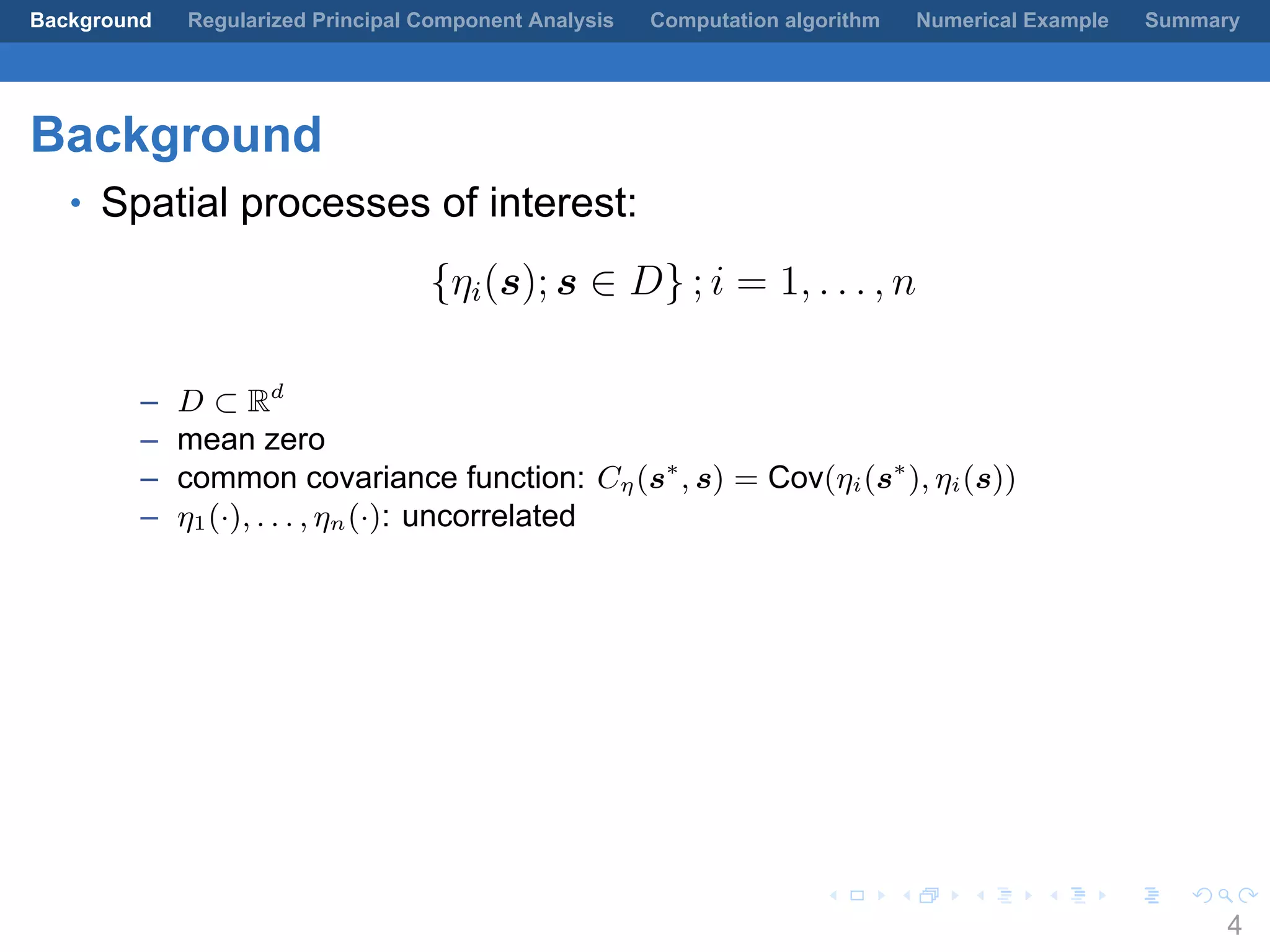
Background Regularized Principal Component Analysis Computation algorithm Numerical Example Summary
Background
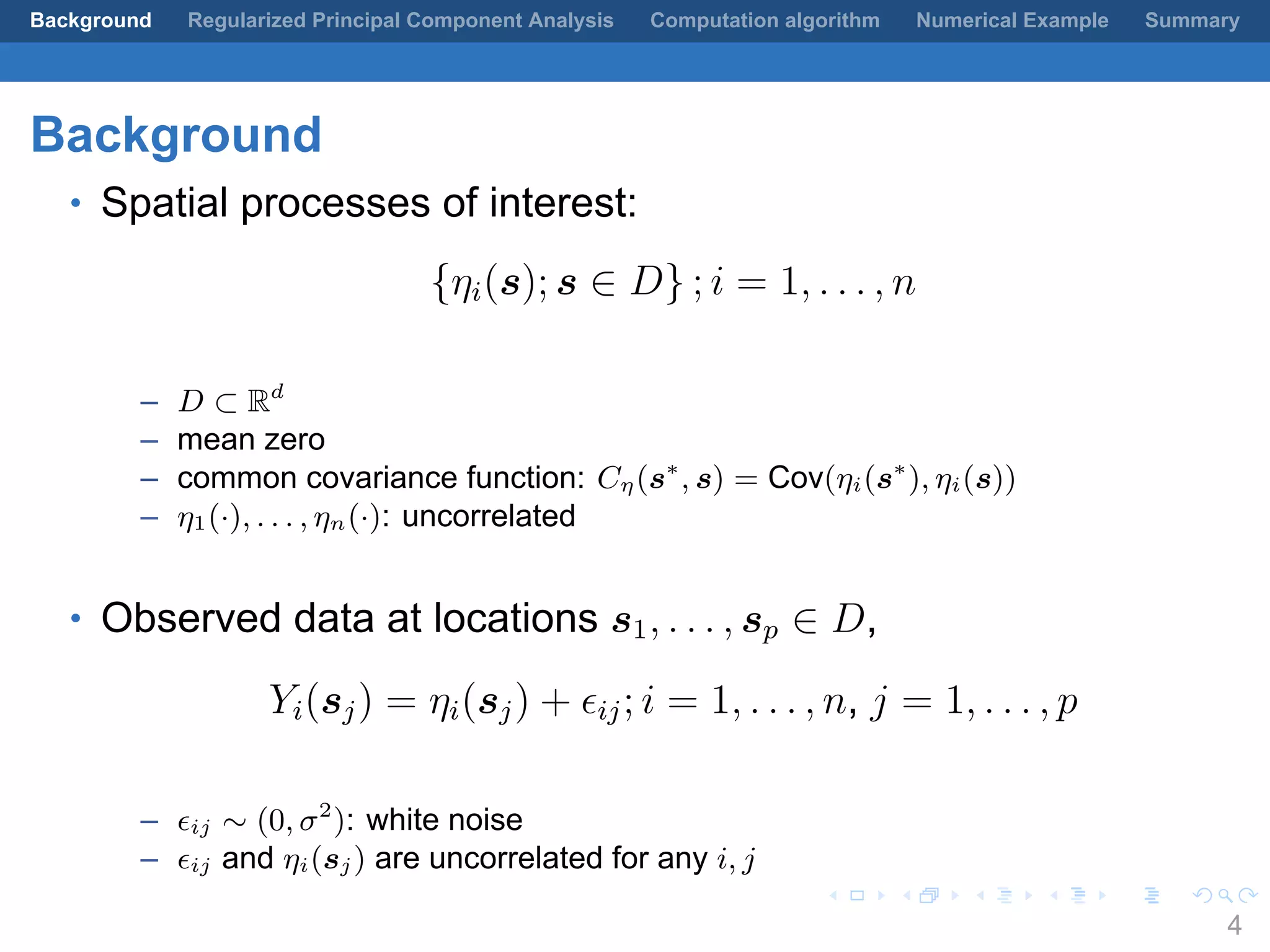
• Spatial processes of interest:
{ηi(s); s ∈ D} ; i = 1, . . . , n
– D ⊂ Rd
– mean zero
– common covariance function: Cη(s∗
, s) = Cov(ηi(s∗
), ηi(s))
– η1(·), . . . , ηn(·): uncorrelated
4
.
.
.
.
.
.
.
.
.
.
.
.
.
.
.
.
.
.
.
.
.
.
.
.
.
.
.
.
.
.
.
.
.
.
.
.
.
.
.
.
Background Regularized Principal Component Analysis Computation algorithm Numerical Example Summary
Background
• Spatial processes of interest:
{ηi(s); s ∈ D} ; i = 1, . . . , n
– D ⊂ Rd
– mean zero
– common covariance function: Cη(s∗
, s) = Cov(ηi(s∗
), ηi(s))
– η1(·), . . . , ηn(·): uncorrelated
• Observed data at locations s1, . . . , sp ∈ D,
Yi(sj) = ηi(sj) + ϵij; i = 1, . . . , n, j = 1, . . . , p
– ϵij ∼ (0, σ2
): white noise
– ϵij and ηi(sj) are uncorrelated for any i, j
4
.
.
.
.
.
.
.
.
.
.
.
.
.
.
.
.
.
.
.
.
.
.
.
.
.
.
.
.
.
.
.
.
.
.
.
.
.
.
.
.
Background Regularized Principal Component Analysis Computation algorithm Numerical Example Summary
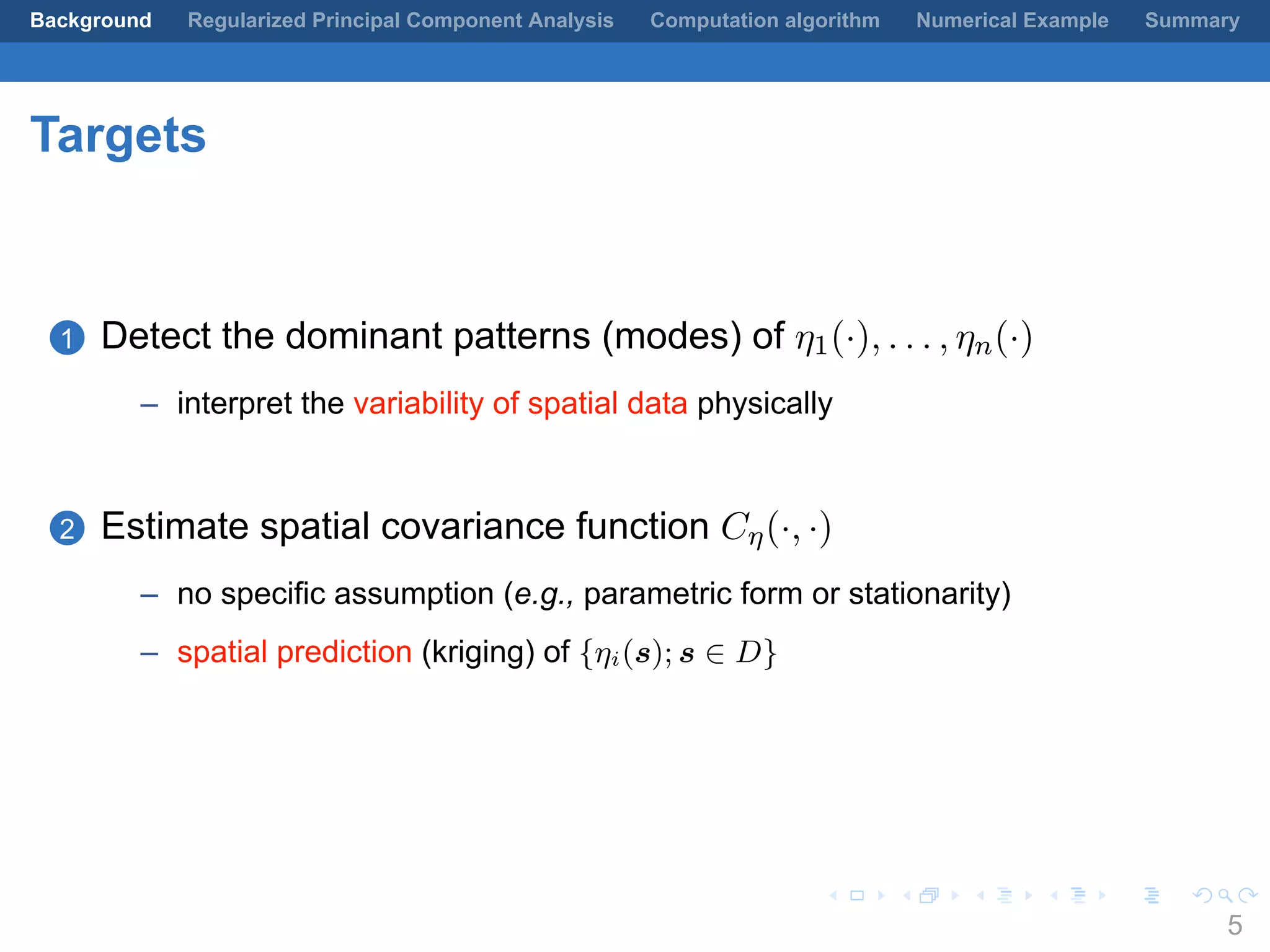
Targets
1 Detect the dominant patterns (modes) of η1(·), . . . , ηn(·)
– interpret the variability of spatial data physically
2 Estimate spatial covariance function Cη(·, ·)
– no specific assumption (e.g., parametric form or stationarity)
– spatial prediction (kriging) of {ηi(s); s ∈ D}
5
.
.
.
.
.
.
.
.
.
.
.
.
.
.
.
.
.
.
.
.
.
.
.
.
.
.
.
.
.
.
.
.
.
.
.
.
.
.
.
.
Background Regularized Principal Component Analysis Computation algorithm Numerical Example Summary
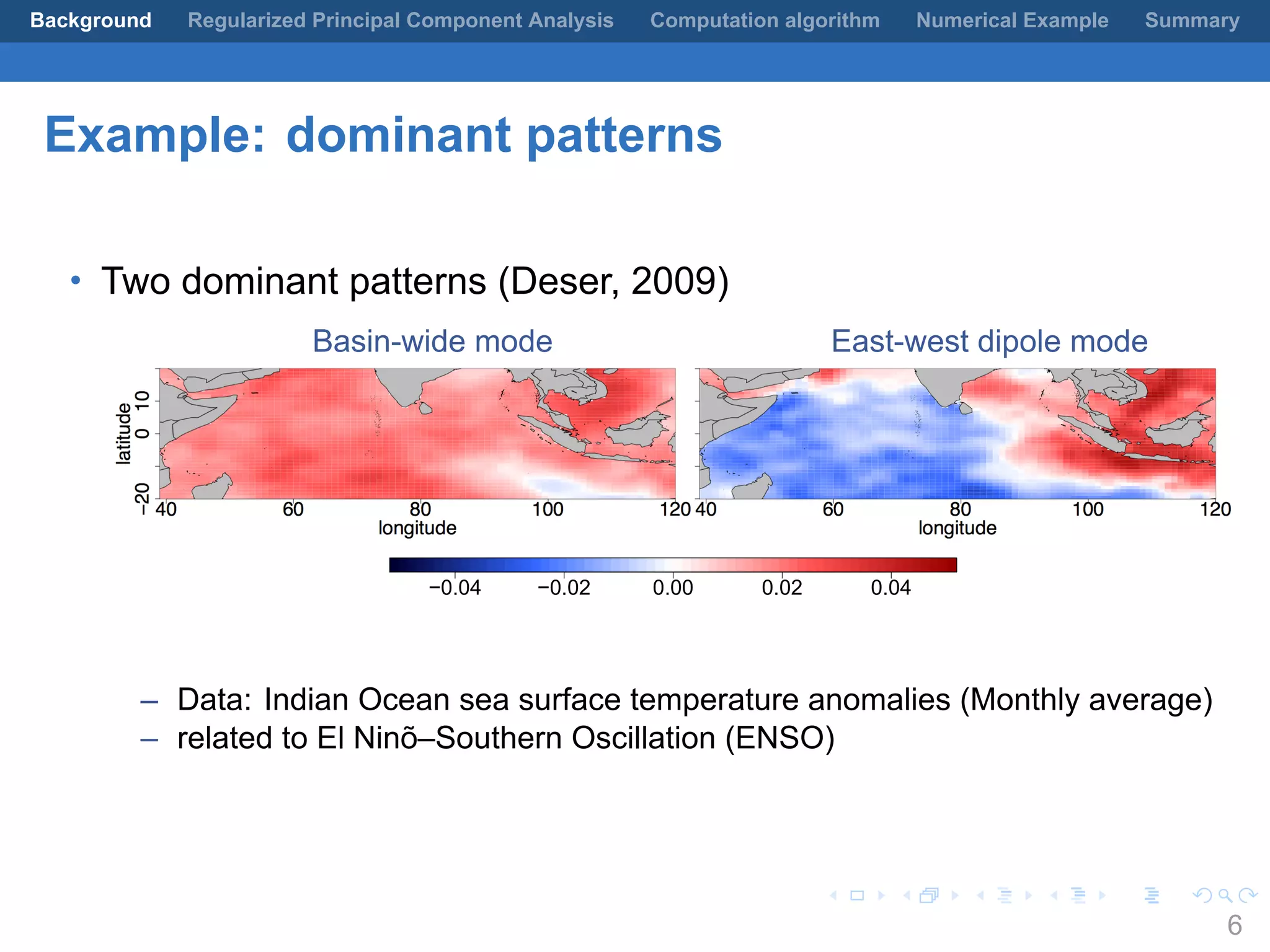
Example: dominant patterns
• Two dominant patterns (Deser, 2009)
Basin-wide mode East-west dipole mode
−0.04 −0.02 0.00 0.02 0.04
– Data: Indian Ocean sea surface temperature anomalies (Monthly average)
– related to El Ninõ–Southern Oscillation (ENSO)
6
.
.
.
.
.
.
.
.
.
.
.
.
.
.
.
.
.
.
.
.
.
.
.
.
.
.
.
.
.
.
.
.
.
.
.
.
.
.
.
.
Background Regularized Principal Component Analysis Computation algorithm Numerical Example Summary
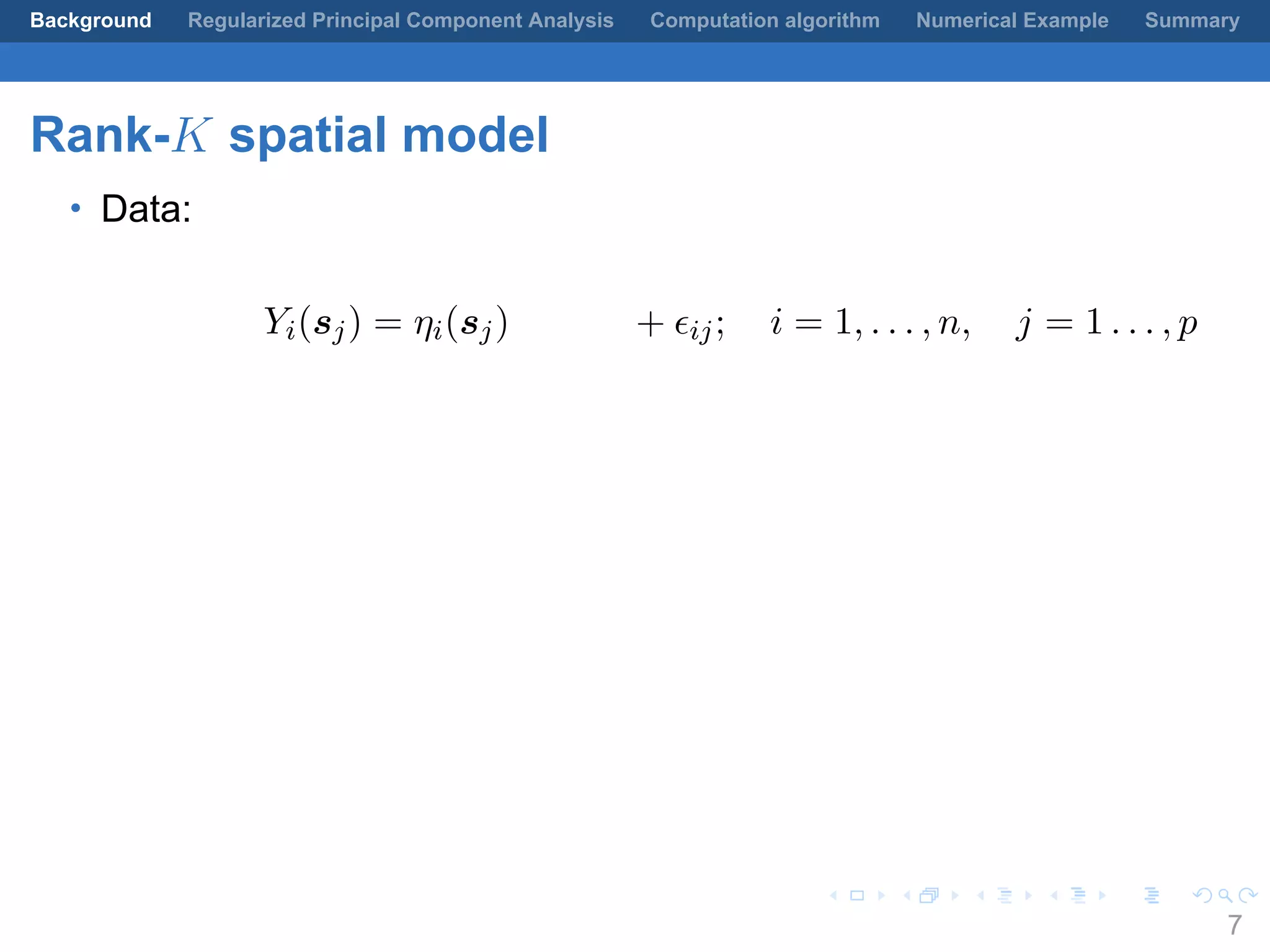
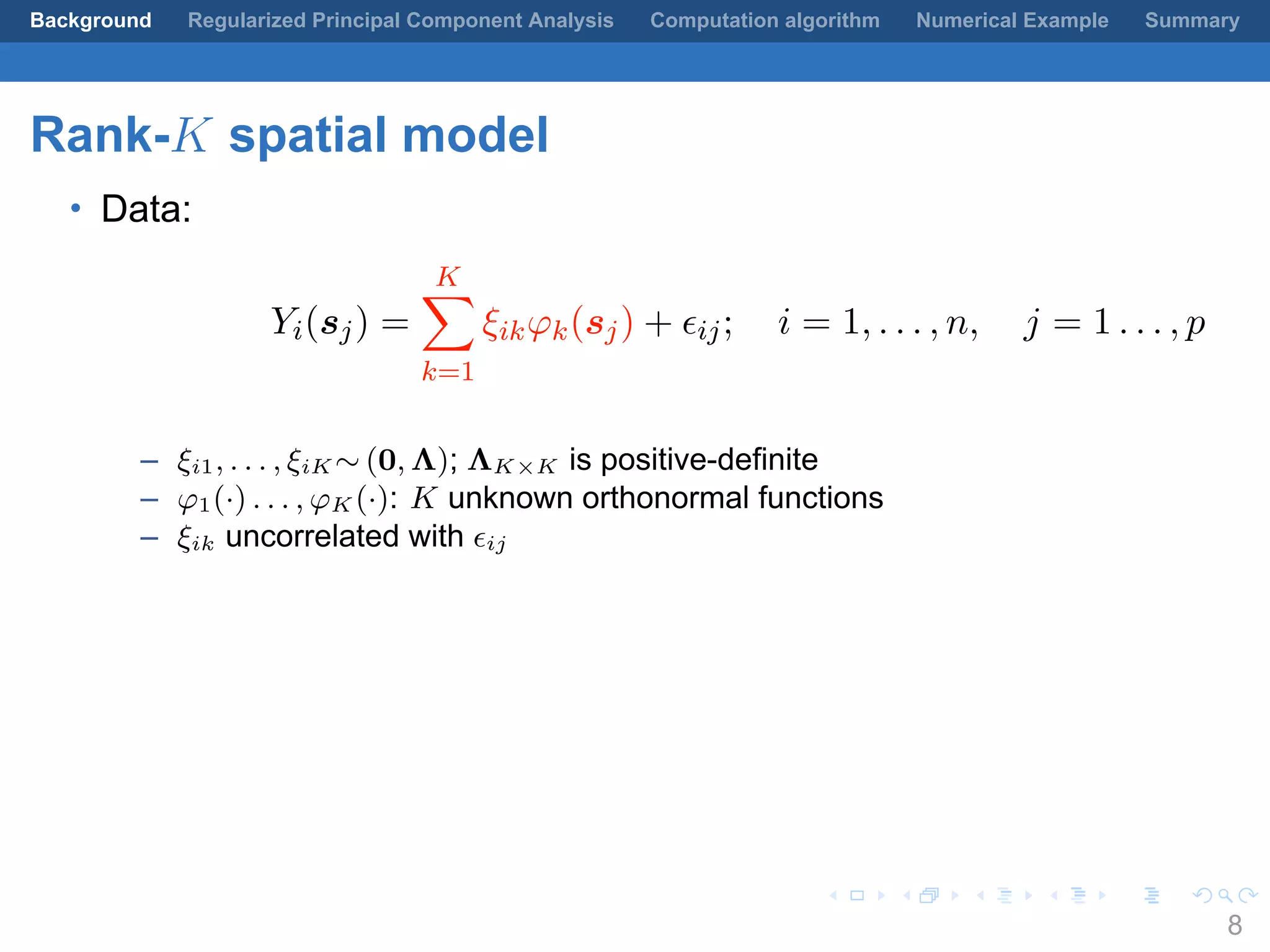
Rank-K spatial model
• Data:
Yi(sj) = ηi(sj) + ϵij; i = 1, . . . , n, j = 1 . . . , p
7
.
.
.
.
.
.
.
.
.
.
.
.
.
.
.
.
.
.
.
.
.
.
.
.
.
.
.
.
.
.
.
.
.
.
.
.
.
.
.
.
Background Regularized Principal Component Analysis Computation algorithm Numerical Example Summary
Rank-K spatial model
• Data:
Yi(sj) =
K∑
k=1
ξikφk(sj) + ϵij; i = 1, . . . , n, j = 1 . . . , p
– ξi1, . . . , ξiK ∼ (0, Λ); ΛK×K is positive-definite
– φ1(·) . . . , φK (·): K unknown orthonormal functions
– ξik uncorrelated with ϵij
8
.
.
.
.
.
.
.
.
.
.
.
.
.
.
.
.
.
.
.
.
.
.
.
.
.
.
.
.
.
.
.
.
.
.
.
.
.
.
.
.
Background Regularized Principal Component Analysis Computation algorithm Numerical Example Summary
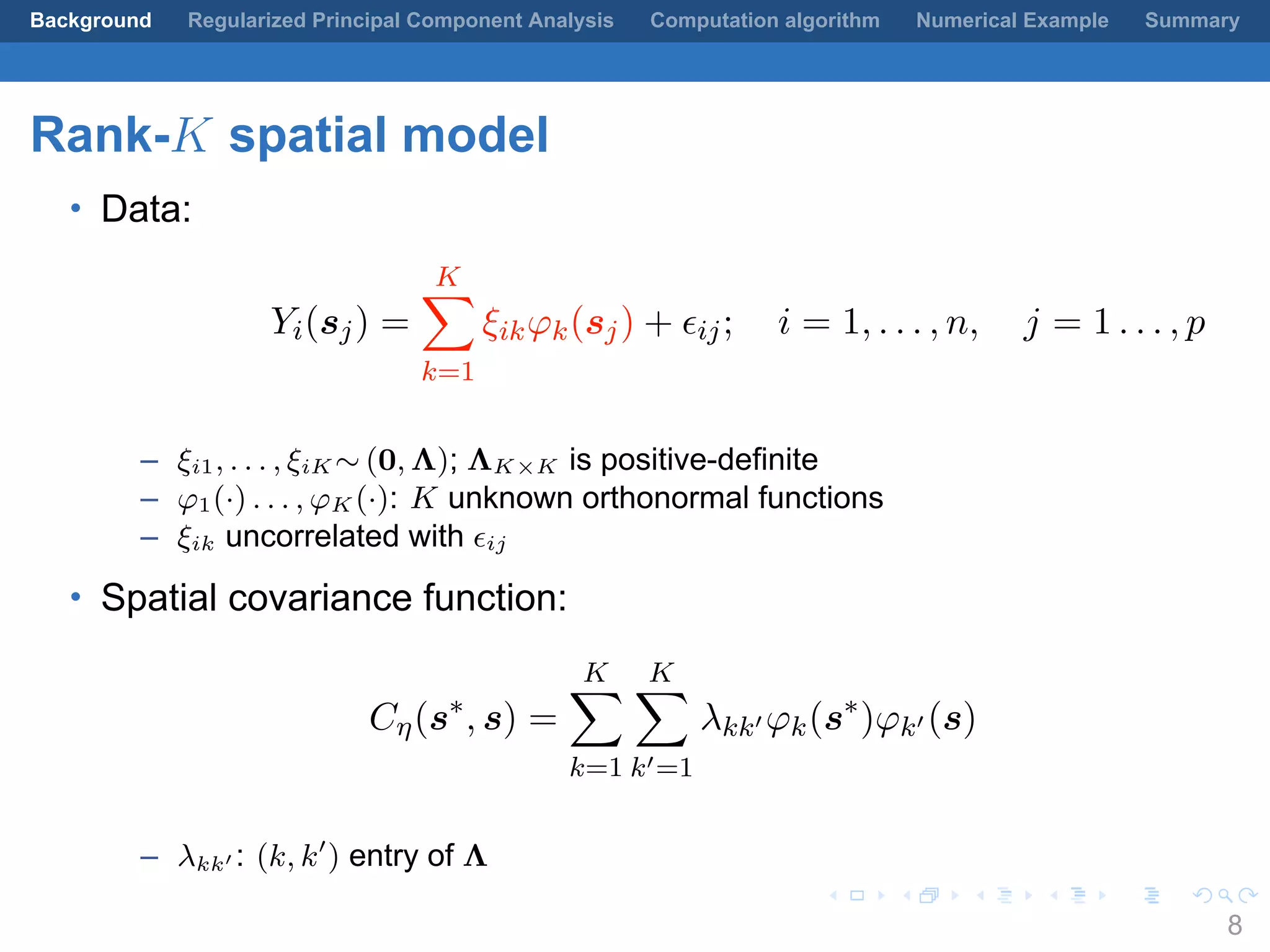
Rank-K spatial model
• Data:
Yi(sj) =
K∑
k=1
ξikφk(sj) + ϵij; i = 1, . . . , n, j = 1 . . . , p
– ξi1, . . . , ξiK ∼ (0, Λ); ΛK×K is positive-definite
– φ1(·) . . . , φK (·): K unknown orthonormal functions
– ξik uncorrelated with ϵij
• Spatial covariance function:
Cη(s∗
, s) =
K∑
k=1
K∑
k′=1
λkk′ φk(s∗
)φk′ (s)
– λkk′ : (k, k′
) entry of Λ
8
.
.
.
.
.
.
.
.
.
.
.
.
.
.
.
.
.
.
.
.
.
.
.
.
.
.
.
.
.
.
.
.
.
.
.
.
.
.
.
.
Background Regularized Principal Component Analysis Computation algorithm Numerical Example Summary
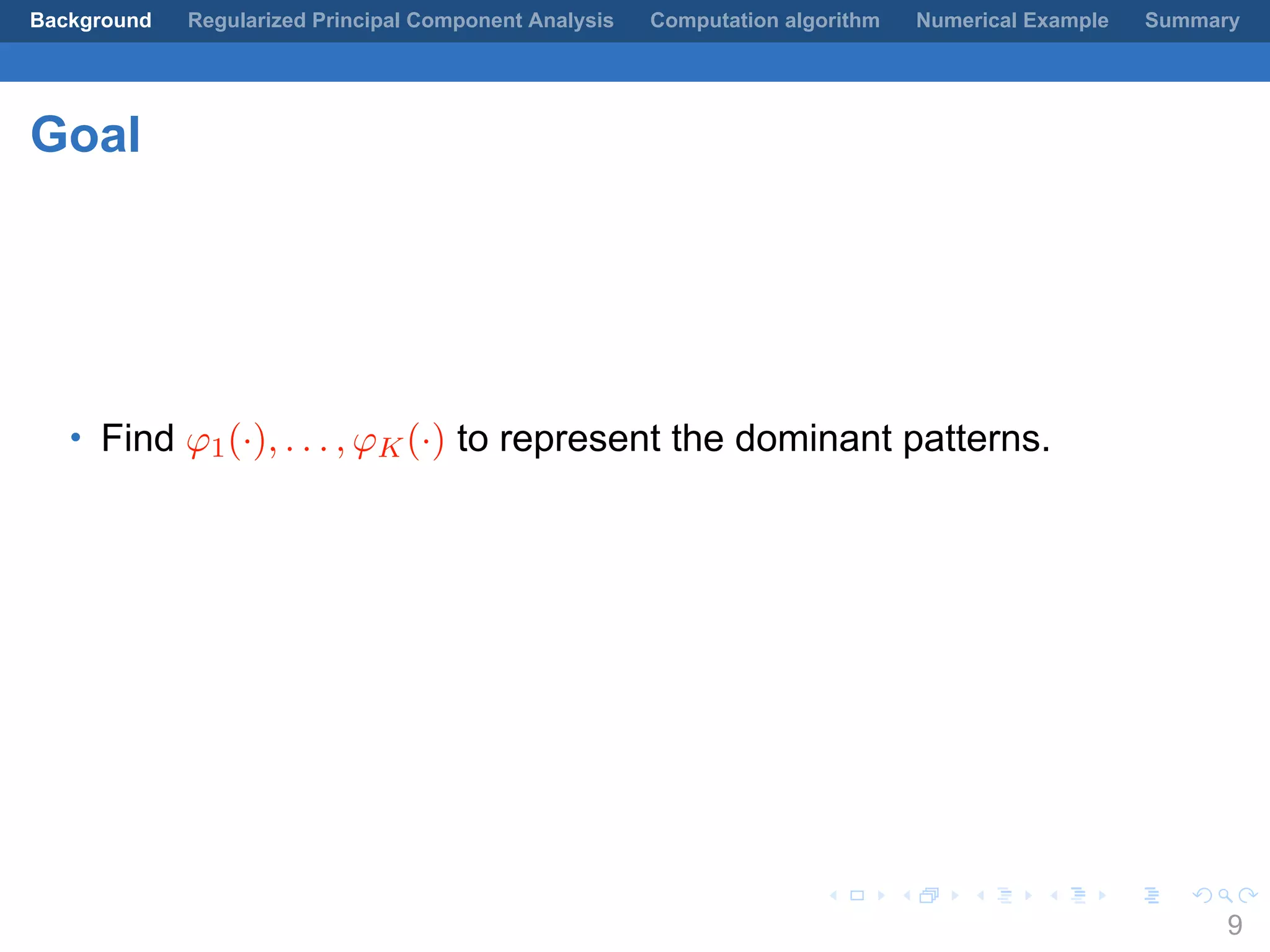
Goal
• Find φ1(·), . . . , φK(·) to represent the dominant patterns.
9
.
.
.
.
.
.
.
.
.
.
.
.
.
.
.
.
.
.
.
.
.
.
.
.
.
.
.
.
.
.
.
.
.
.
.
.
.
.
.
.
Background Regularized Principal Component Analysis Computation algorithm Numerical Example Summary
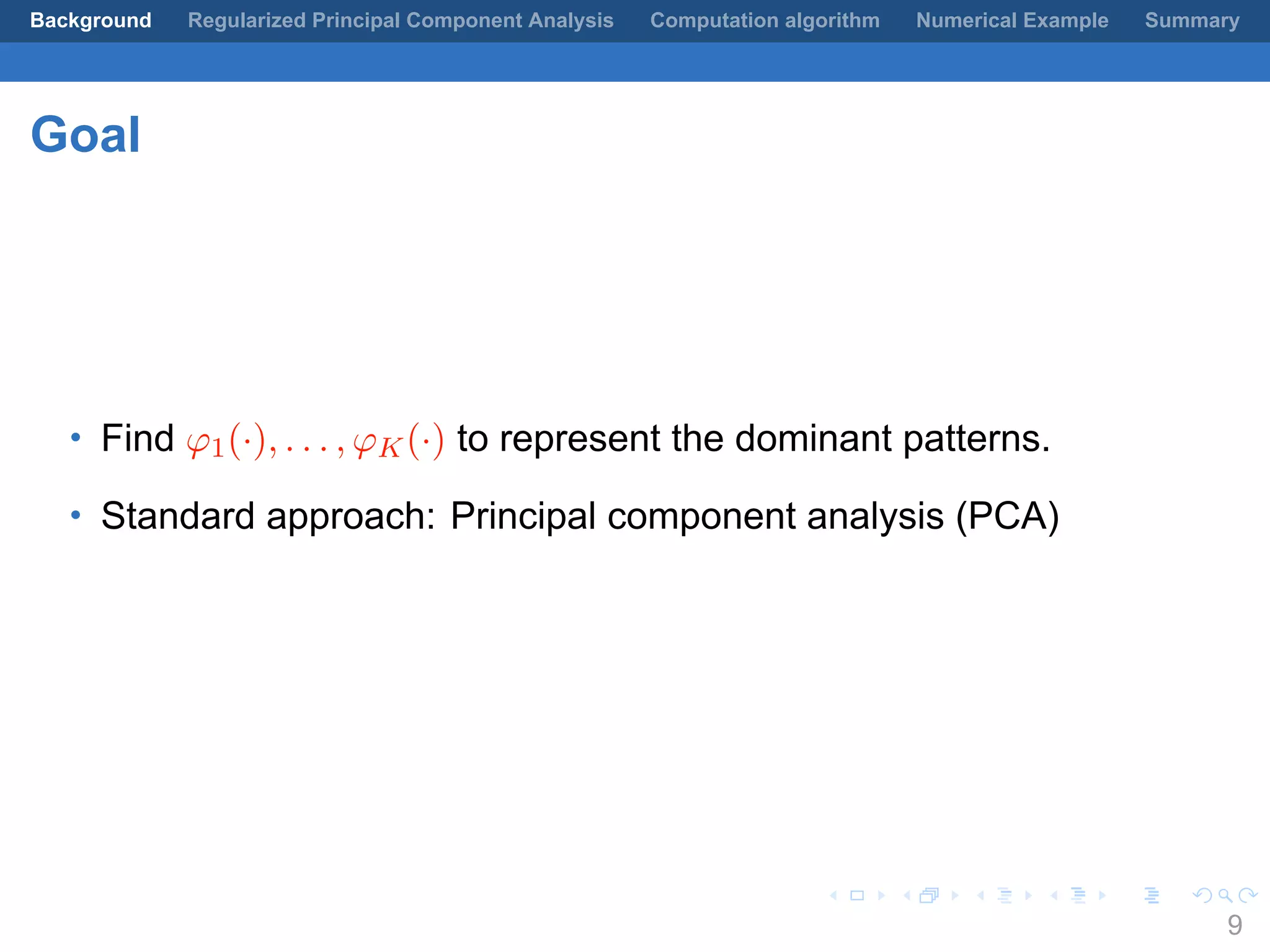
Goal
• Find φ1(·), . . . , φK(·) to represent the dominant patterns.
• Standard approach: Principal component analysis (PCA)
9
.
.
.
.
.
.
.
.
.
.
.
.
.
.
.
.
.
.
.
.
.
.
.
.
.
.
.
.
.
.
.
.
.
.
.
.
.
.
.
.
Background Regularized Principal Component Analysis Computation algorithm Numerical Example Summary
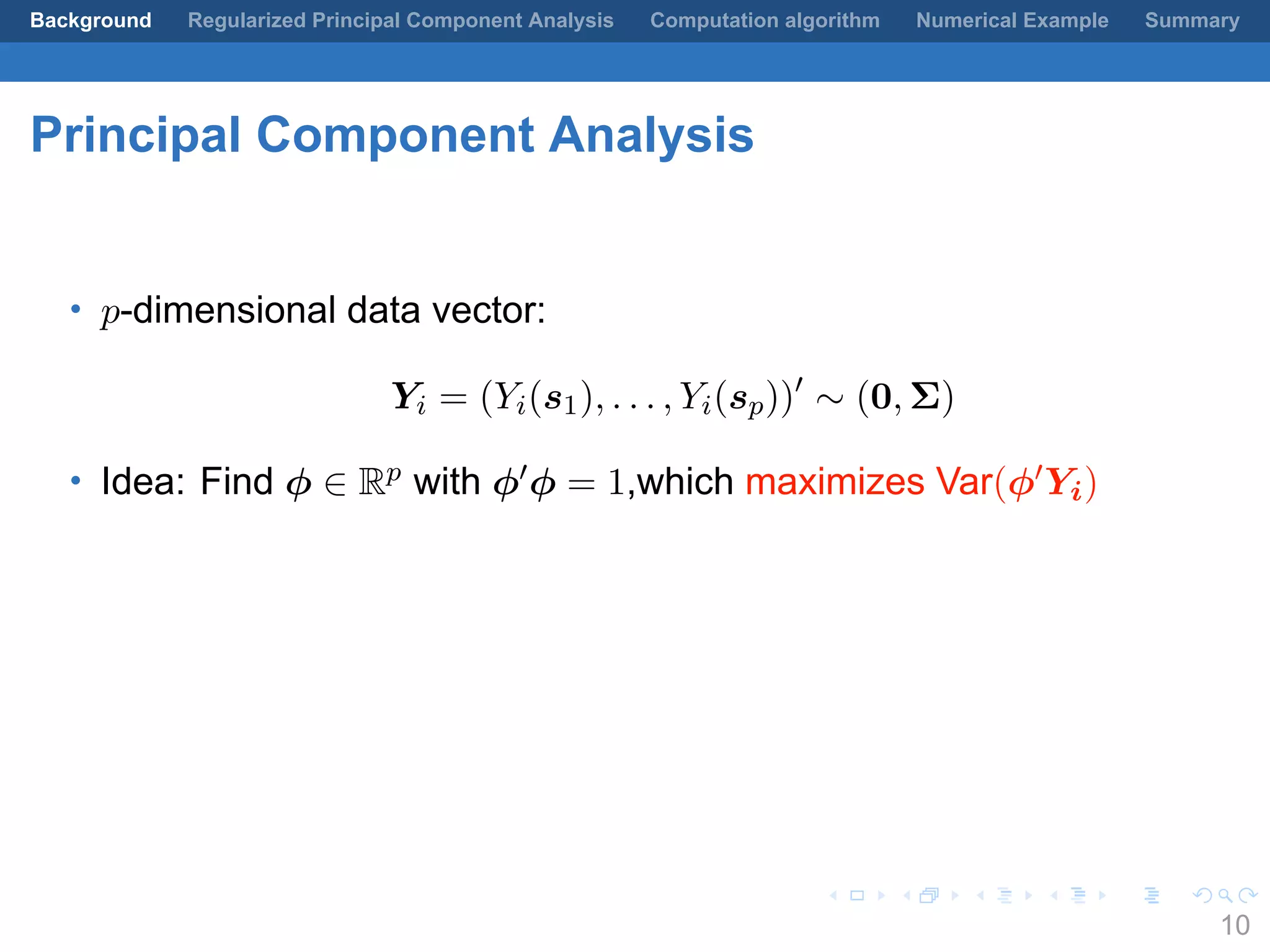
Principal Component Analysis
• p-dimensional data vector:
Yi = (Yi(s1), . . . , Yi(sp))′
∼ (0, Σ)
• Idea: Find ϕ ∈ Rp with ϕ′ϕ = 1,which maximizes Var(ϕ′Yi)
10
.
.
.
.
.
.
.
.
.
.
.
.
.
.
.
.
.
.
.
.
.
.
.
.
.
.
.
.
.
.
.
.
.
.
.
.
.
.
.
.
Background Regularized Principal Component Analysis Computation algorithm Numerical Example Summary
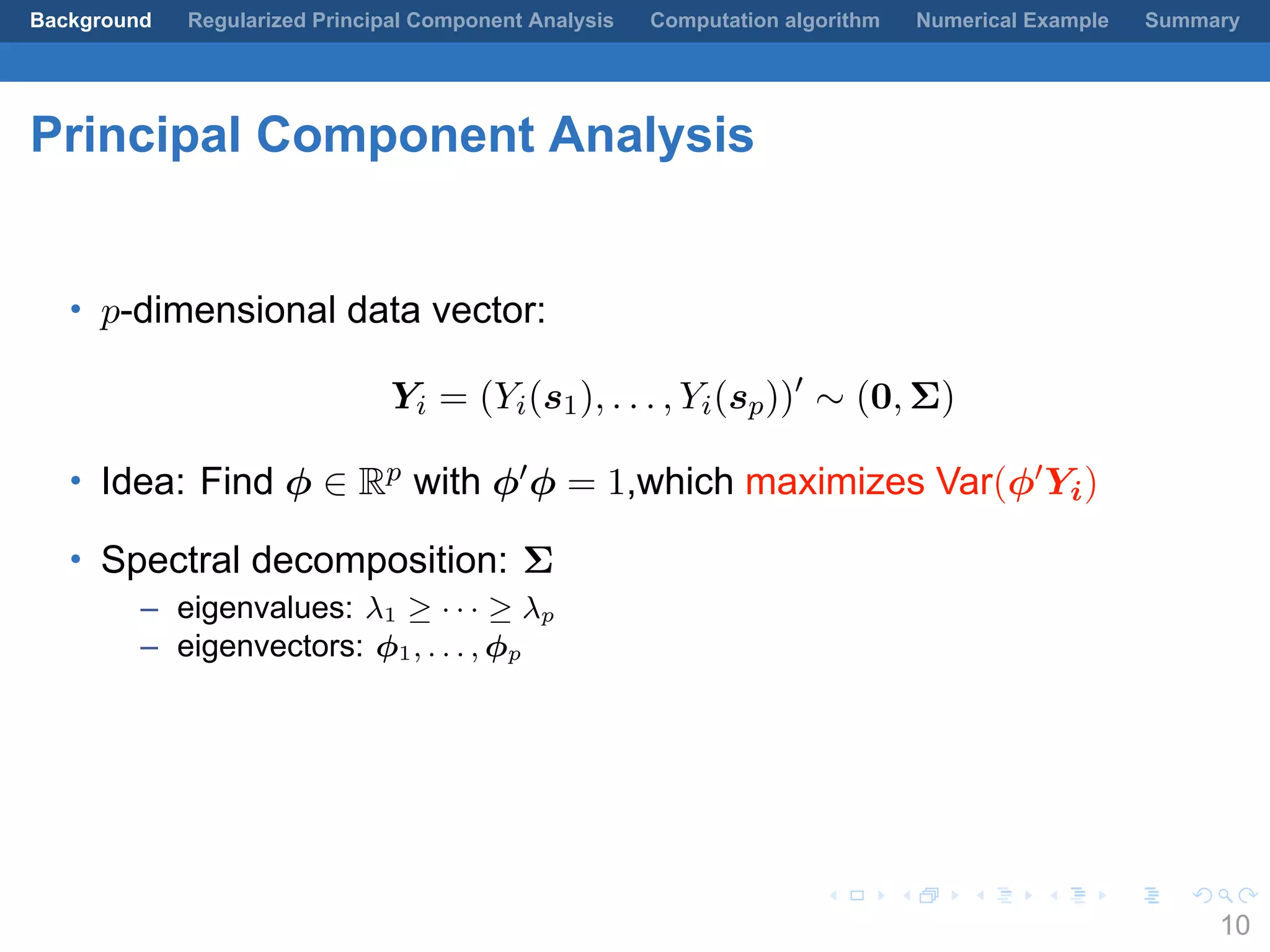
Principal Component Analysis
• p-dimensional data vector:
Yi = (Yi(s1), . . . , Yi(sp))′
∼ (0, Σ)
• Idea: Find ϕ ∈ Rp with ϕ′ϕ = 1,which maximizes Var(ϕ′Yi)
• Spectral decomposition: Σ
– eigenvalues: λ1 ≥ · · · ≥ λp
– eigenvectors: ϕ1, . . . , ϕp
10
.
.
.
.
.
.
.
.
.
.
.
.
.
.
.
.
.
.
.
.
.
.
.
.
.
.
.
.
.
.
.
.
.
.
.
.
.
.
.
.
Background Regularized Principal Component Analysis Computation algorithm Numerical Example Summary
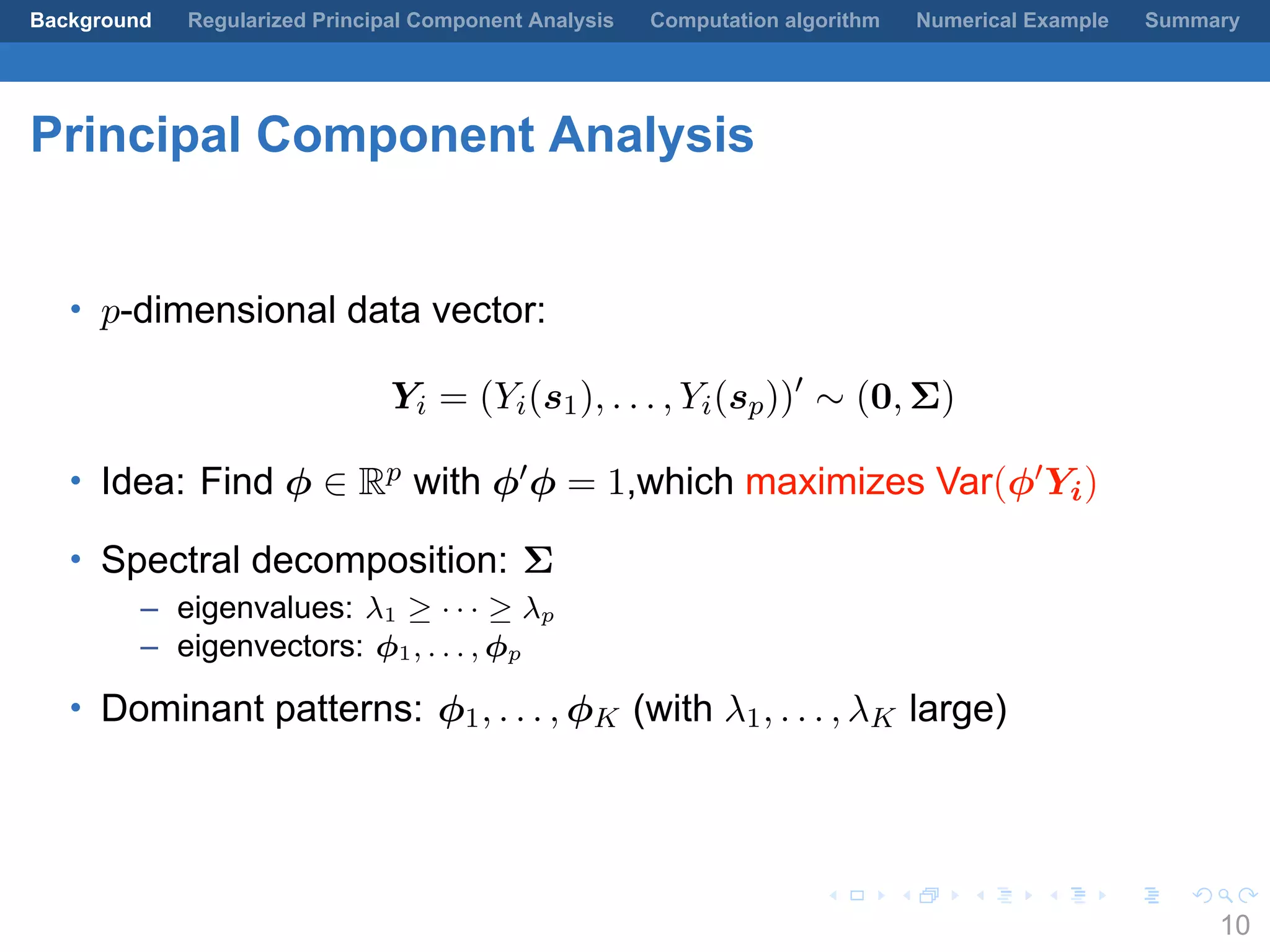
Principal Component Analysis
• p-dimensional data vector:
Yi = (Yi(s1), . . . , Yi(sp))′
∼ (0, Σ)
• Idea: Find ϕ ∈ Rp with ϕ′ϕ = 1,which maximizes Var(ϕ′Yi)
• Spectral decomposition: Σ
– eigenvalues: λ1 ≥ · · · ≥ λp
– eigenvectors: ϕ1, . . . , ϕp
• Dominant patterns: ϕ1, . . . , ϕK (with λ1, . . . , λK large)
10
.
.
.
.
.
.
.
.
.
.
.
.
.
.
.
.
.
.
.
.
.
.
.
.
.
.
.
.
.
.
.
.
.
.
.
.
.
.
.
.
Background Regularized Principal Component Analysis Computation algorithm Numerical Example Summary
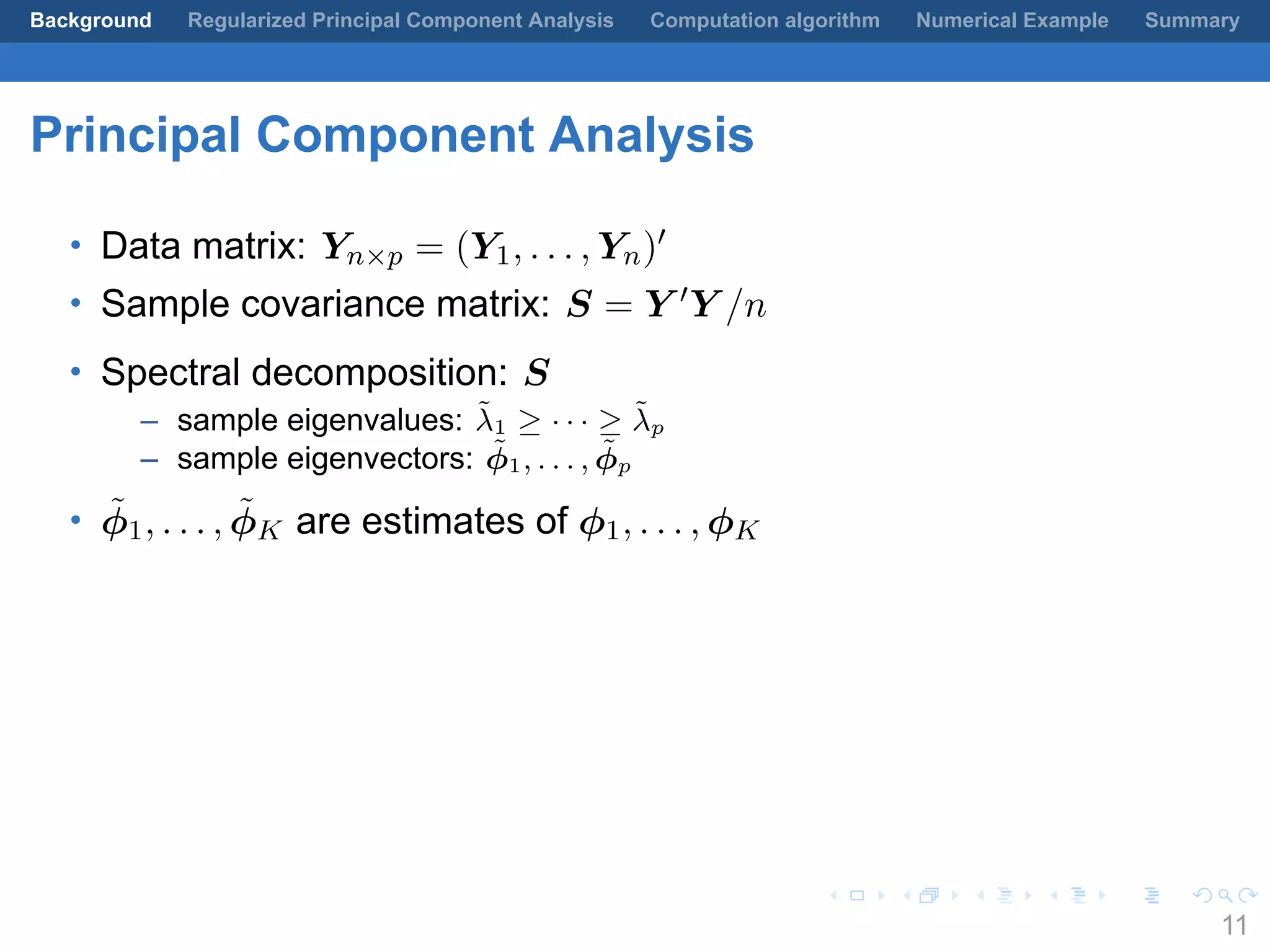
Principal Component Analysis
• Data matrix: Yn×p = (Y1, . . . , Yn)′
• Sample covariance matrix: S = Y ′Y /n
• Spectral decomposition: S
– sample eigenvalues: ˜λ1 ≥ · · · ≥ ˜λp
– sample eigenvectors: ˜ϕ1, . . . , ˜ϕp
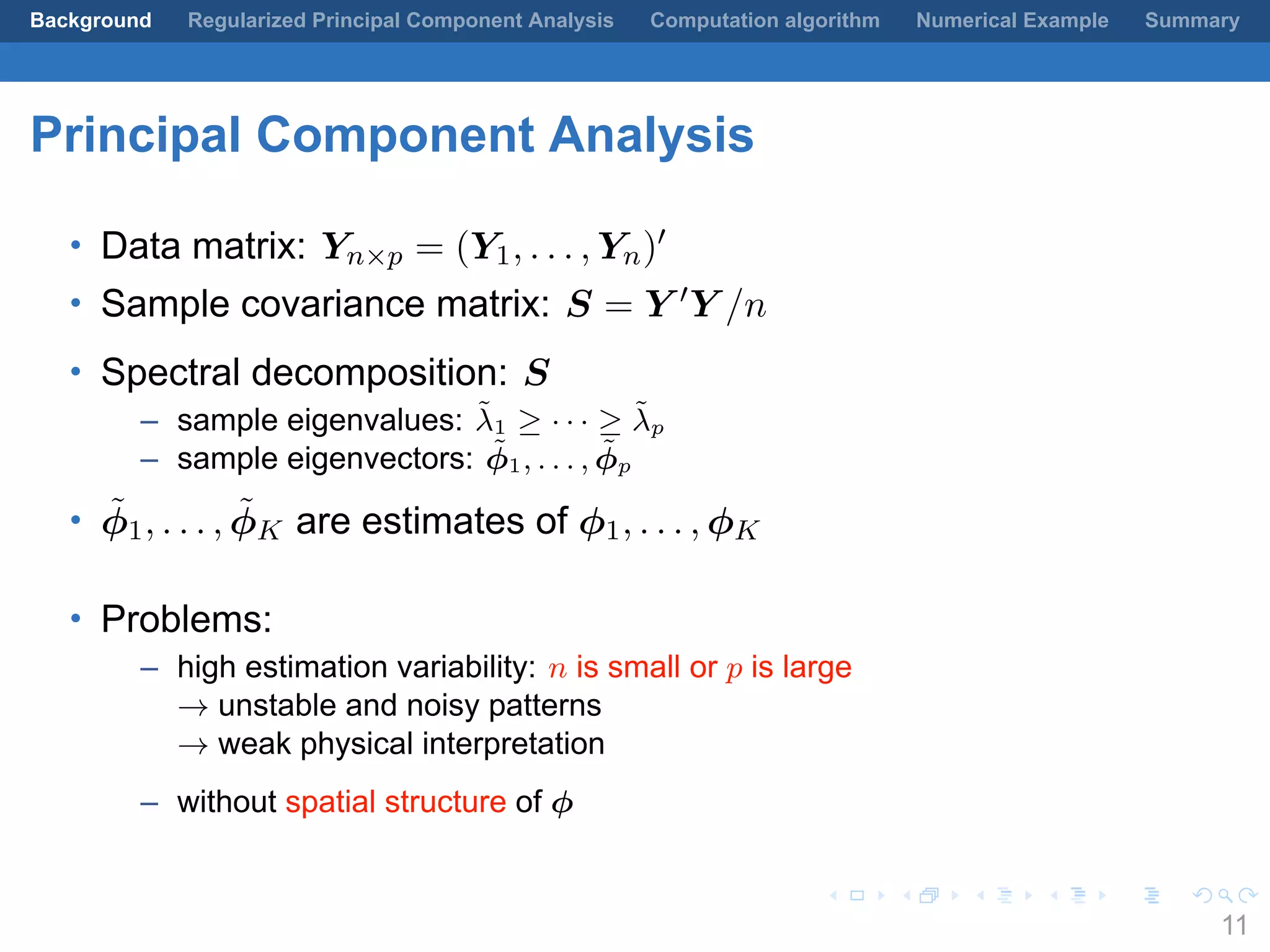
• ˜ϕ1, . . . , ˜ϕK are estimates of ϕ1, . . . , ϕK
11
.
.
.
.
.
.
.
.
.
.
.
.
.
.
.
.
.
.
.
.
.
.
.
.
.
.
.
.
.
.
.
.
.
.
.
.
.
.
.
.
Background Regularized Principal Component Analysis Computation algorithm Numerical Example Summary
Principal Component Analysis
• Data matrix: Yn×p = (Y1, . . . , Yn)′
• Sample covariance matrix: S = Y ′Y /n
• Spectral decomposition: S
– sample eigenvalues: ˜λ1 ≥ · · · ≥ ˜λp
– sample eigenvectors: ˜ϕ1, . . . , ˜ϕp
• ˜ϕ1, . . . , ˜ϕK are estimates of ϕ1, . . . , ϕK
• Problems:
– high estimation variability: n is small or p is large
→ unstable and noisy patterns
→ weak physical interpretation
– without spatial structure of ϕ
11
.
.
.
.
.
.
.
.
.
.
.
.
.
.
.
.
.
.
.
.
.
.
.
.
.
.
.
.
.
.
.
.
.
.
.
.
.
.
.
.
Background Regularized Principal Component Analysis Computation algorithm Numerical Example Summary
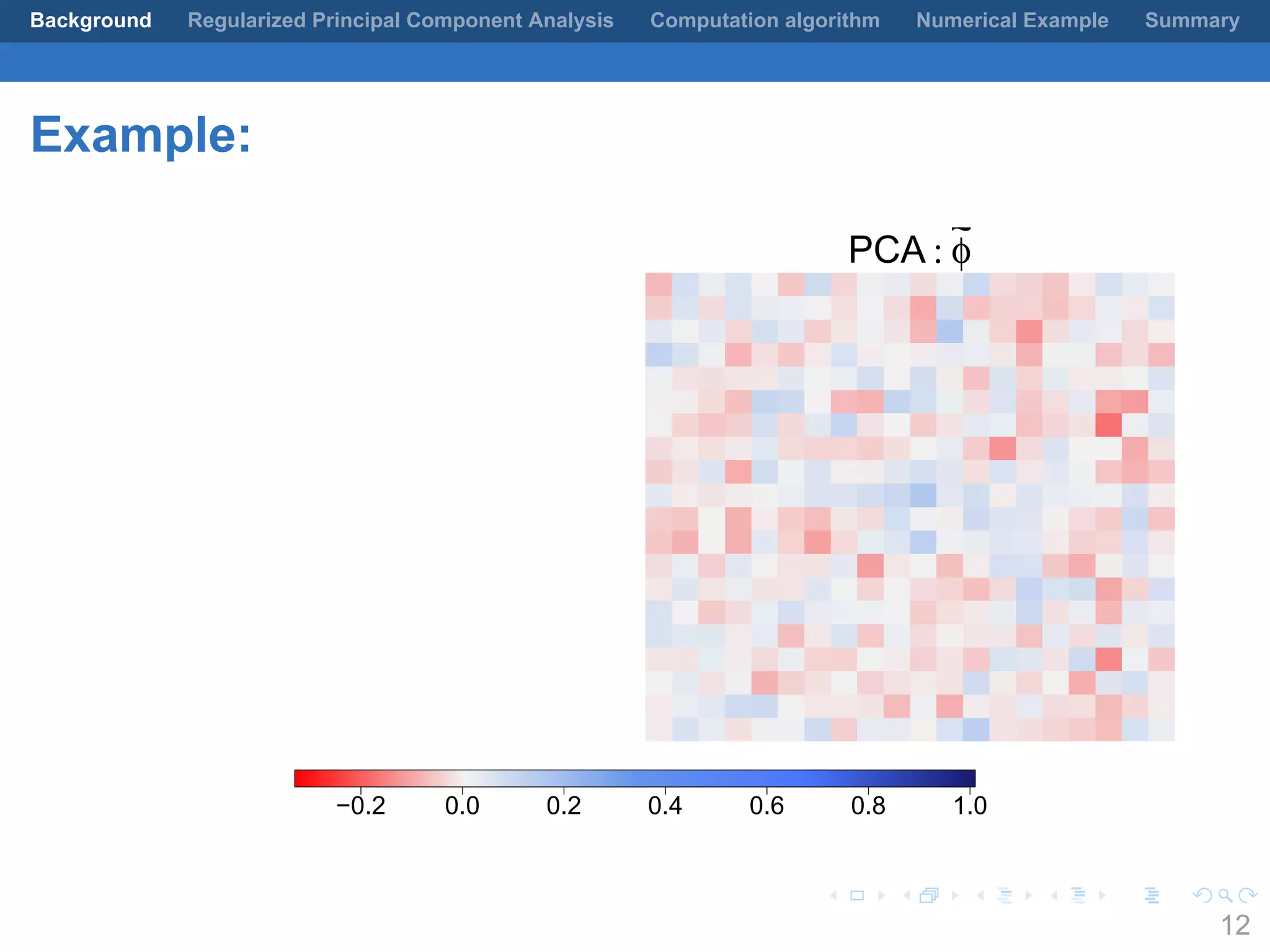
Example:
PCA : φ
~
−0.2 0.0 0.2 0.4 0.6 0.8 1.0
12
.
.
.
.
.
.
.
.
.
.
.
.
.
.
.
.
.
.
.
.
.
.
.
.
.
.
.
.
.
.
.
.
.
.
.
.
.
.
.
.
Background Regularized Principal Component Analysis Computation algorithm Numerical Example Summary
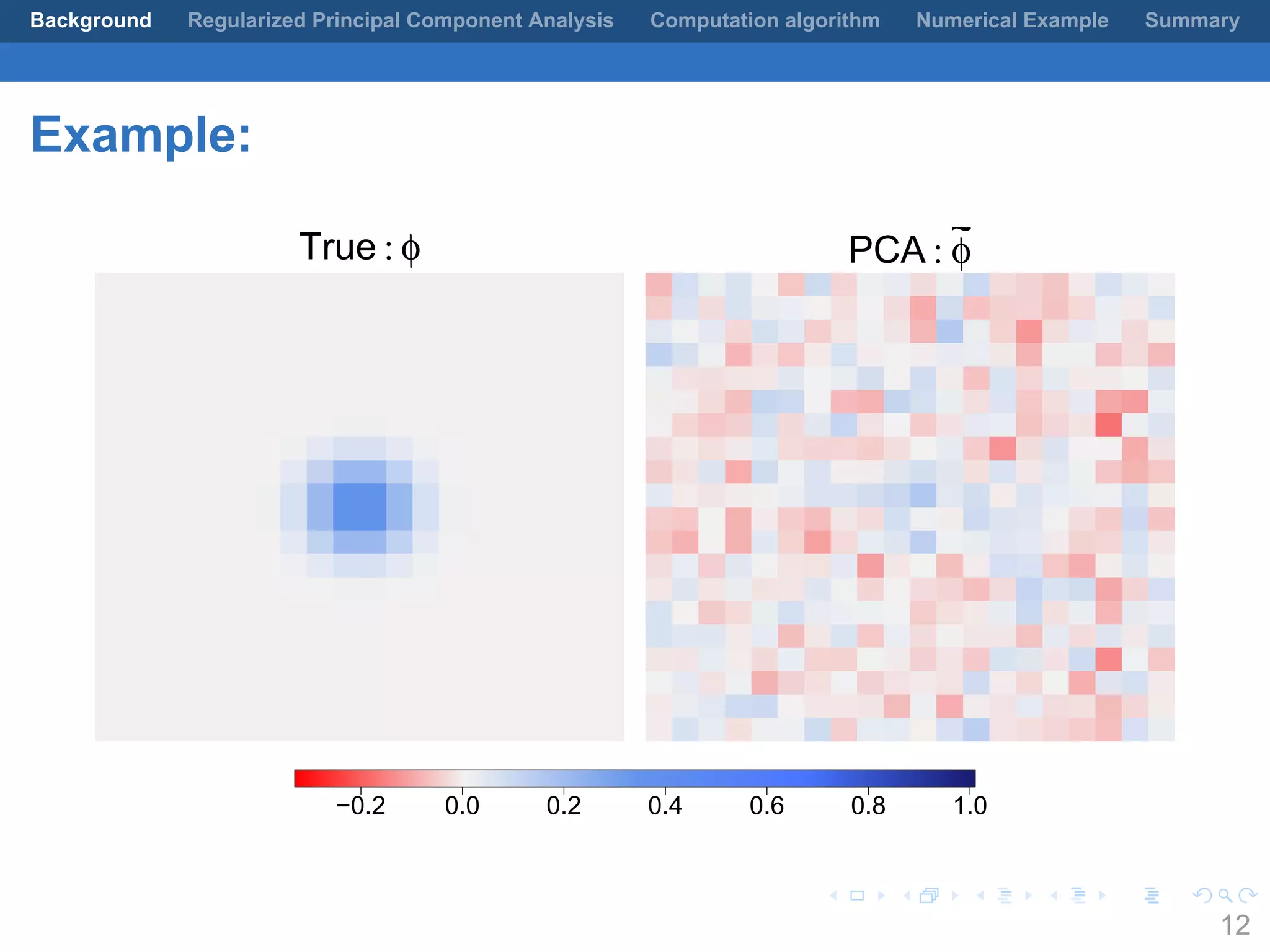
Example:
True : φ PCA : φ
~
−0.2 0.0 0.2 0.4 0.6 0.8 1.0
12
.
.
.
.
.
.
.
.
.
.
.
.
.
.
.
.
.
.
.
.
.
.
.
.
.
.
.
.
.
.
.
.
.
.
.
.
.
.
.
.
Background Regularized Principal Component Analysis Computation algorithm Numerical Example Summary
Motivation
To enhance the interpretablity, we implement PCA by incorporating
13
.
.
.
.
.
.
.
.
.
.
.
.
.
.
.
.
.
.
.
.
.
.
.
.
.
.
.
.
.
.
.
.
.
.
.
.
.
.
.
.
Background Regularized Principal Component Analysis Computation algorithm Numerical Example Summary
Motivation
To enhance the interpretablity, we implement PCA by incorporating
1 spatial structure of eigenvectors
13
.
.
.
.
.
.
.
.
.
.
.
.
.
.
.
.
.
.
.
.
.
.
.
.
.
.
.
.
.
.
.
.
.
.
.
.
.
.
.
.
Background Regularized Principal Component Analysis Computation algorithm Numerical Example Summary
Motivation
To enhance the interpretablity, we implement PCA by incorporating
1 spatial structure of eigenvectors
2 sparsity of eigenvectors
13
.
.
.
.
.
.
.
.
.
.
.
.
.
.
.
.
.
.
.
.
.
.
.
.
.
.
.
.
.
.
.
.
.
.
.
.
.
.
.
.
Background Regularized Principal Component Analysis Computation algorithm Numerical Example Summary
Motivation
To enhance the interpretablity, we implement PCA by incorporating
1 spatial structure of eigenvectors
2 sparsity of eigenvectors
3 orthogonality of eigenvectors
13
.
.
.
.
.
.
.
.
.
.
.
.
.
.
.
.
.
.
.
.
.
.
.
.
.
.
.
.
.
.
.
.
.
.
.
.
.
.
.
.
Background Regularized Principal Component Analysis Computation algorithm Numerical Example Summary
Outline
1 Background
2 Regularized Principal Component Analysis
3 Computation algorithm
4 Numerical Example
5 Summary
14
.
.
.
.
.
.
.
.
.
.
.
.
.
.
.
.
.
.
.
.
.
.
.
.
.
.
.
.
.
.
.
.
.
.
.
.
.
.
.
.
Background Regularized Principal Component Analysis Computation algorithm Numerical Example Summary
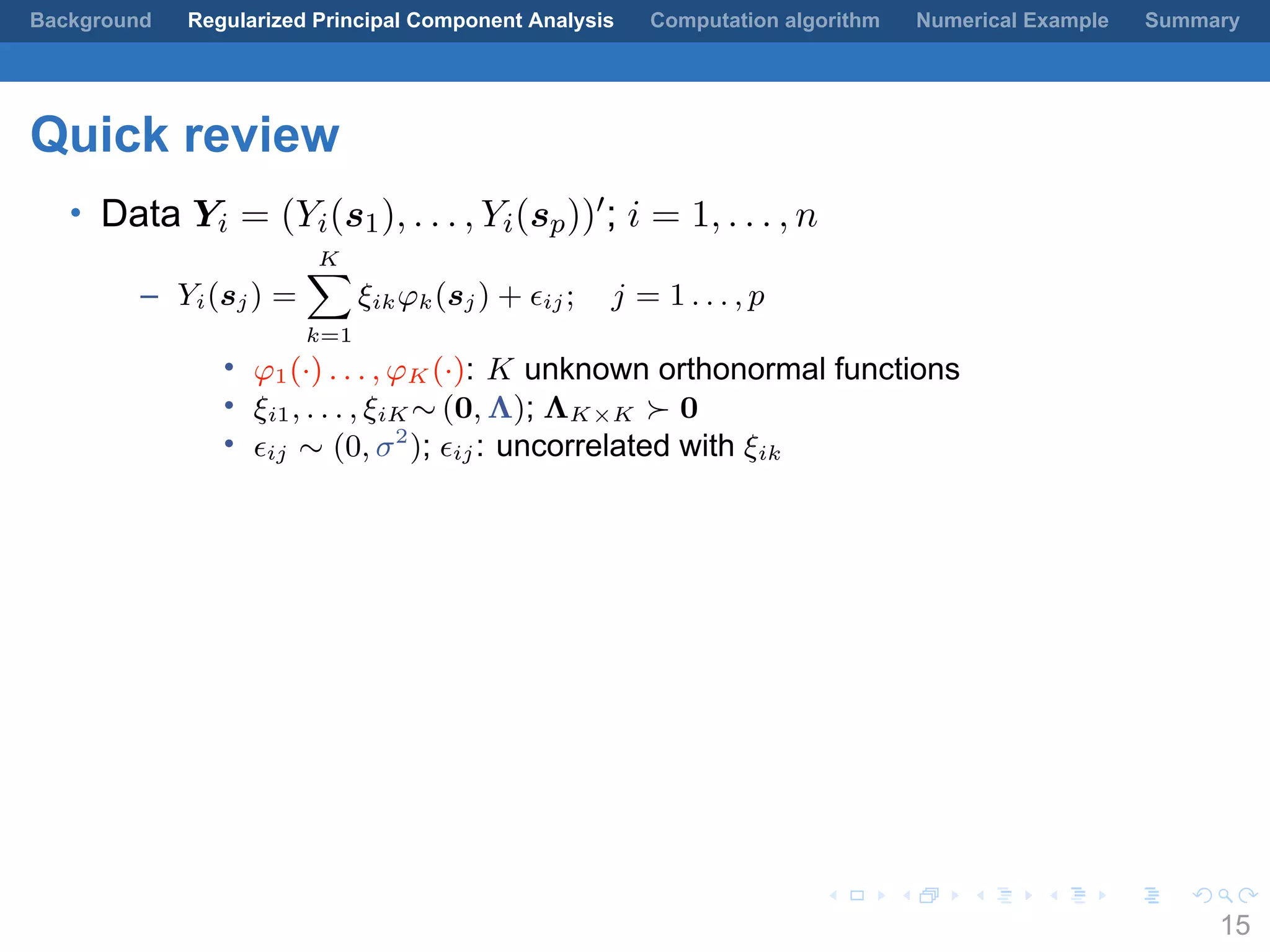
Quick review
• Data Yi = (Yi(s1), . . . , Yi(sp))′; i = 1, . . . , n
– Yi(sj) =
K∑
k=1
ξikφk(sj) + ϵij; j = 1 . . . , p
• φ1(·) . . . , φK (·): K unknown orthonormal functions
• ξi1, . . . , ξiK ∼ (0, Λ); ΛK×K ≻ 0
• ϵij ∼ (0, σ2
); ϵij: uncorrelated with ξik
15
.
.
.
.
.
.
.
.
.
.
.
.
.
.
.
.
.
.
.
.
.
.
.
.
.
.
.
.
.
.
.
.
.
.
.
.
.
.
.
.
Background Regularized Principal Component Analysis Computation algorithm Numerical Example Summary
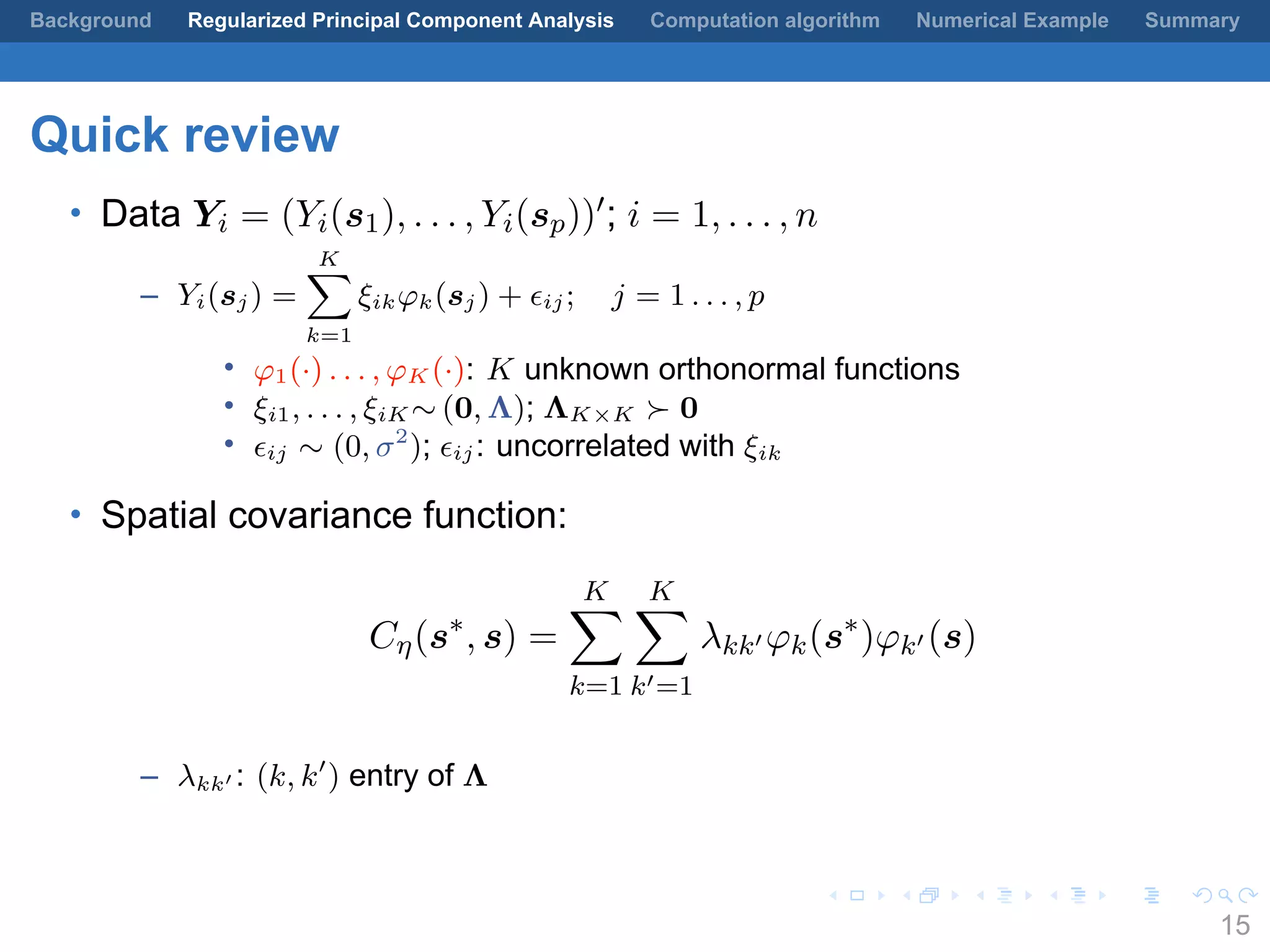
Quick review
• Data Yi = (Yi(s1), . . . , Yi(sp))′; i = 1, . . . , n
– Yi(sj) =
K∑
k=1
ξikφk(sj) + ϵij; j = 1 . . . , p
• φ1(·) . . . , φK (·): K unknown orthonormal functions
• ξi1, . . . , ξiK ∼ (0, Λ); ΛK×K ≻ 0
• ϵij ∼ (0, σ2
); ϵij: uncorrelated with ξik
• Spatial covariance function:
Cη(s∗
, s) =
K∑
k=1
K∑
k′=1
λkk′ φk(s∗
)φk′ (s)
– λkk′ : (k, k′
) entry of Λ
15
.
.
.
.
.
.
.
.
.
.
.
.
.
.
.
.
.
.
.
.
.
.
.
.
.
.
.
.
.
.
.
.
.
.
.
.
.
.
.
.
Background Regularized Principal Component Analysis Computation algorithm Numerical Example Summary
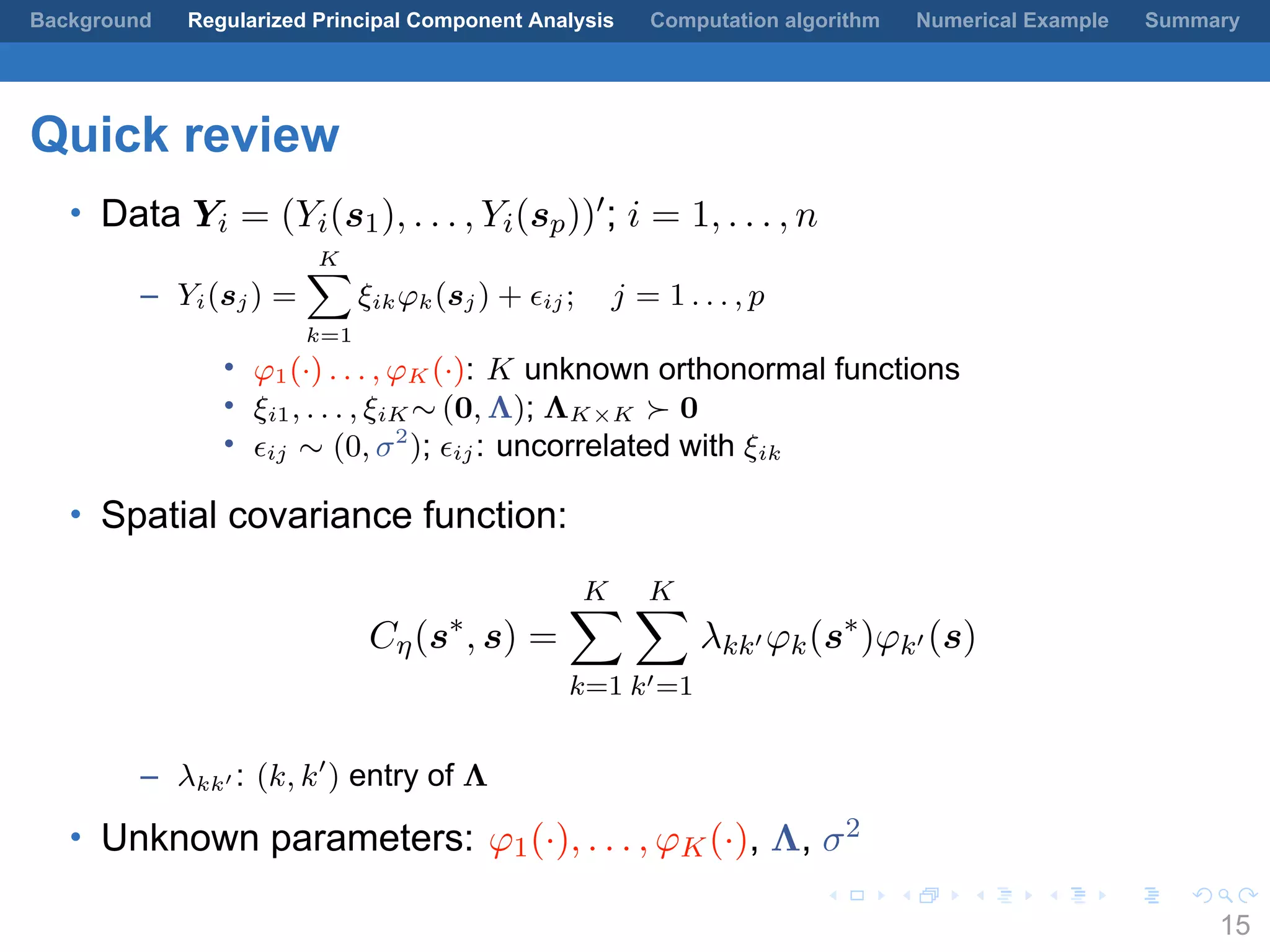
Quick review
• Data Yi = (Yi(s1), . . . , Yi(sp))′; i = 1, . . . , n
– Yi(sj) =
K∑
k=1
ξikφk(sj) + ϵij; j = 1 . . . , p
• φ1(·) . . . , φK (·): K unknown orthonormal functions
• ξi1, . . . , ξiK ∼ (0, Λ); ΛK×K ≻ 0
• ϵij ∼ (0, σ2
); ϵij: uncorrelated with ξik
• Spatial covariance function:
Cη(s∗
, s) =
K∑
k=1
K∑
k′=1
λkk′ φk(s∗
)φk′ (s)
– λkk′ : (k, k′
) entry of Λ
• Unknown parameters: φ1(·), . . . , φK(·), Λ, σ2
15
.
.
.
.
.
.
.
.
.
.
.
.
.
.
.
.
.
.
.
.
.
.
.
.
.
.
.
.
.
.
.
.
.
.
.
.
.
.
.
.
Background Regularized Principal Component Analysis Computation algorithm Numerical Example Summary
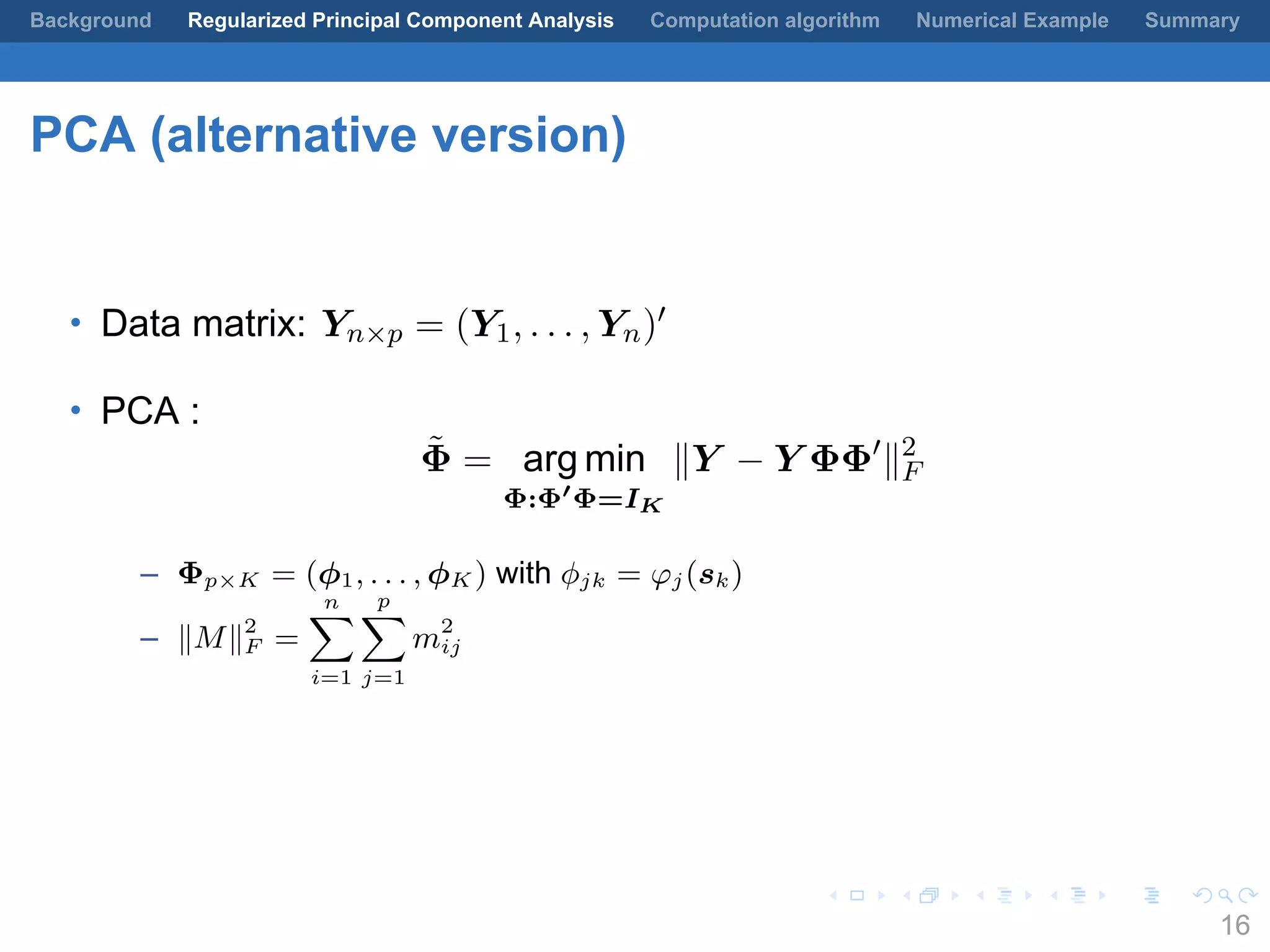
PCA (alternative version)
• Data matrix: Yn×p = (Y1, . . . , Yn)′
• PCA :
˜Φ = arg min
Φ:Φ′
Φ=IK
∥Y − Y ΦΦ′
∥2
F
– Φp×K = (ϕ1, . . . , ϕK ) with ϕjk = φj(sk)
– ∥M∥2
F =
n∑
i=1
p
∑
j=1
m2
ij
16
.
.
.
.
.
.
.
.
.
.
.
.
.
.
.
.
.
.
.
.
.
.
.
.
.
.
.
.
.
.
.
.
.
.
.
.
.
.
.
.
Background Regularized Principal Component Analysis Computation algorithm Numerical Example Summary
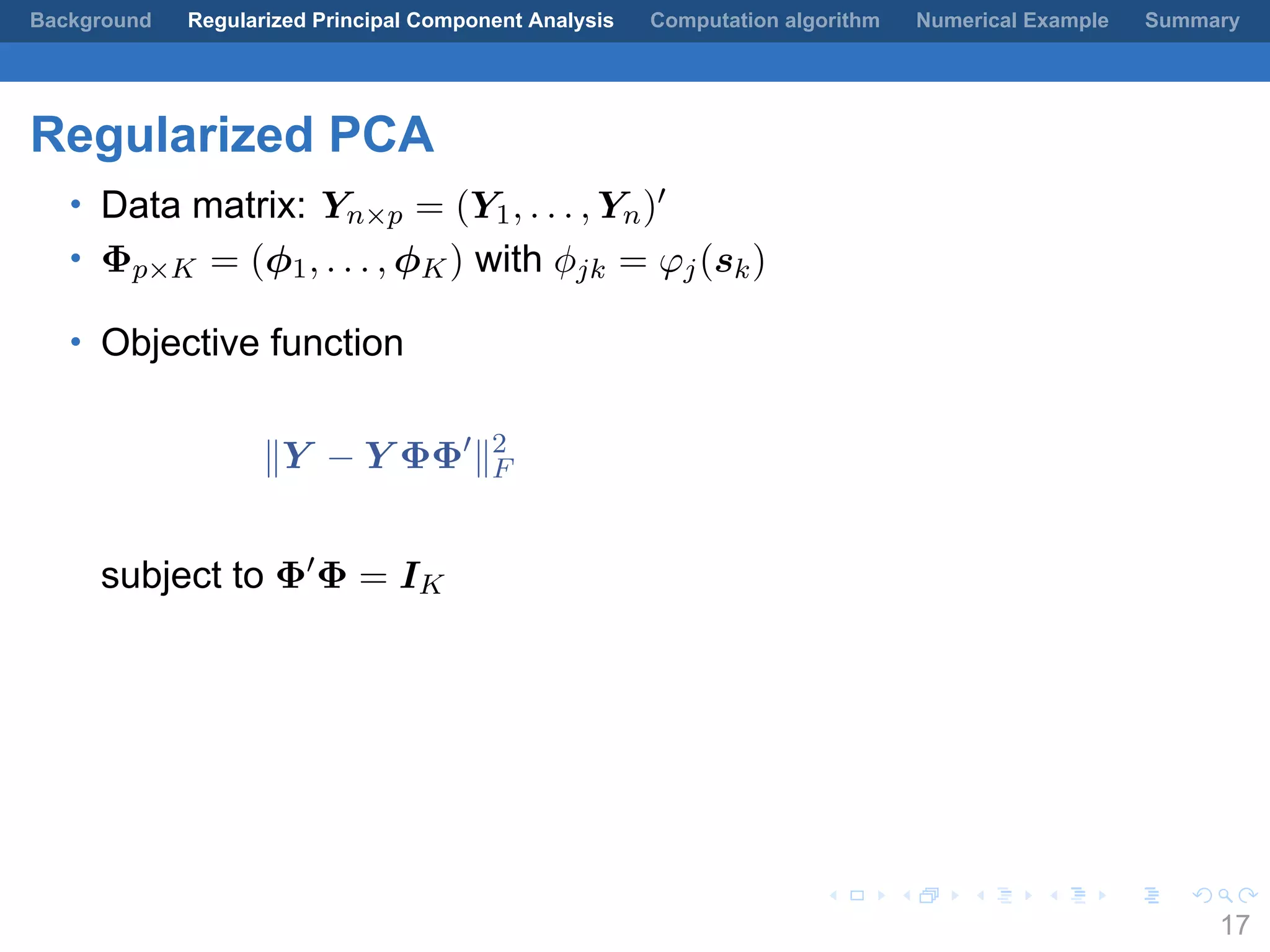
Regularized PCA
• Data matrix: Yn×p = (Y1, . . . , Yn)′
• Φp×K = (ϕ1, . . . , ϕK) with ϕjk = φj(sk)
• Objective function
∥Y − Y ΦΦ′
∥2
F
subject to Φ′
Φ = IK
17
.
.
.
.
.
.
.
.
.
.
.
.
.
.
.
.
.
.
.
.
.
.
.
.
.
.
.
.
.
.
.
.
.
.
.
.
.
.
.
.
Background Regularized Principal Component Analysis Computation algorithm Numerical Example Summary
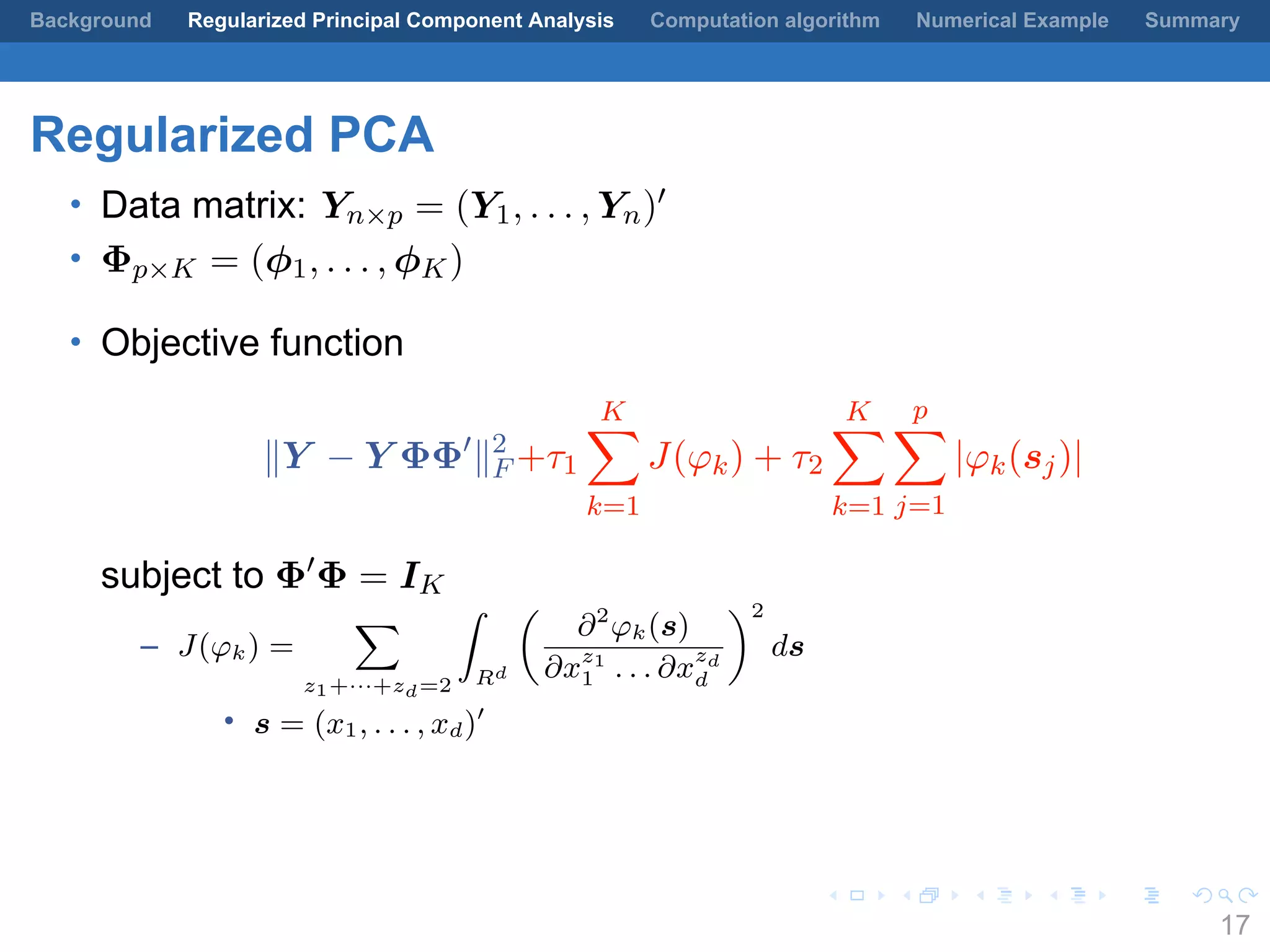
Regularized PCA
• Data matrix: Yn×p = (Y1, . . . , Yn)′
• Φp×K = (ϕ1, . . . , ϕK)
• Objective function
∥Y − Y ΦΦ′
∥2
F +τ1
K∑
k=1
J(φk) + τ2
K∑
k=1
p∑
j=1
|φk(sj)|
subject to Φ′
Φ = IK
– J(φk) =
∑
z1+···+zd=2
∫
Rd
(
∂2
φk(s)
∂xz1
1 . . . ∂x
zd
d
)2
ds
• s = (x1, . . . , xd)′
17
.
.
.
.
.
.
.
.
.
.
.
.
.
.
.
.
.
.
.
.
.
.
.
.
.
.
.
.
.
.
.
.
.
.
.
.
.
.
.
.
Background Regularized Principal Component Analysis Computation algorithm Numerical Example Summary
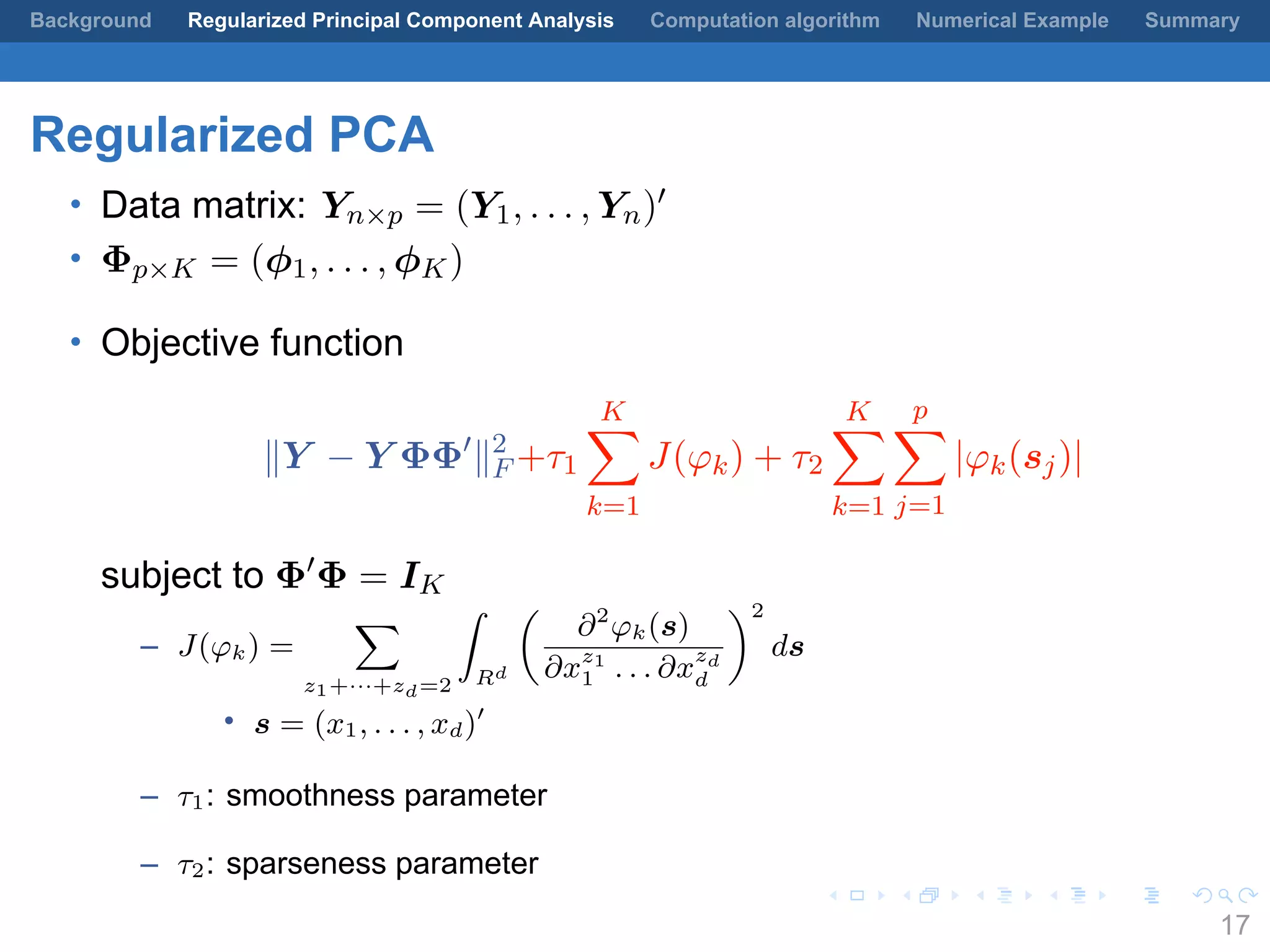
Regularized PCA
• Data matrix: Yn×p = (Y1, . . . , Yn)′
• Φp×K = (ϕ1, . . . , ϕK)
• Objective function
∥Y − Y ΦΦ′
∥2
F +τ1
K∑
k=1
J(φk) + τ2
K∑
k=1
p∑
j=1
|φk(sj)|
subject to Φ′
Φ = IK
– J(φk) =
∑
z1+···+zd=2
∫
Rd
(
∂2
φk(s)
∂xz1
1 . . . ∂x
zd
d
)2
ds
• s = (x1, . . . , xd)′
– τ1: smoothness parameter
– τ2: sparseness parameter
17
.
.
.
.
.
.
.
.
.
.
.
.
.
.
.
.
.
.
.
.
.
.
.
.
.
.
.
.
.
.
.
.
.
.
.
.
.
.
.
.
Background Regularized Principal Component Analysis Computation algorithm Numerical Example Summary
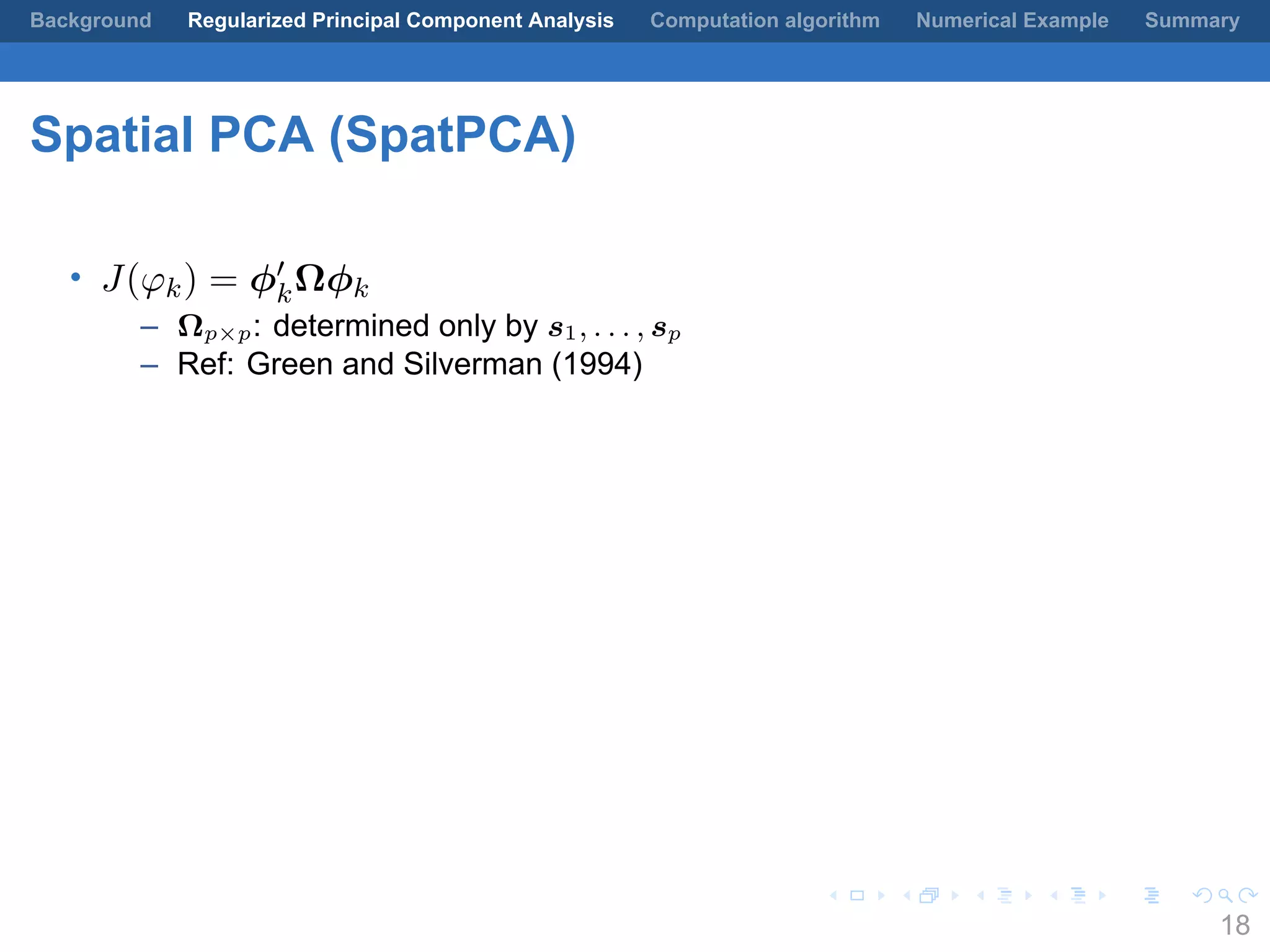
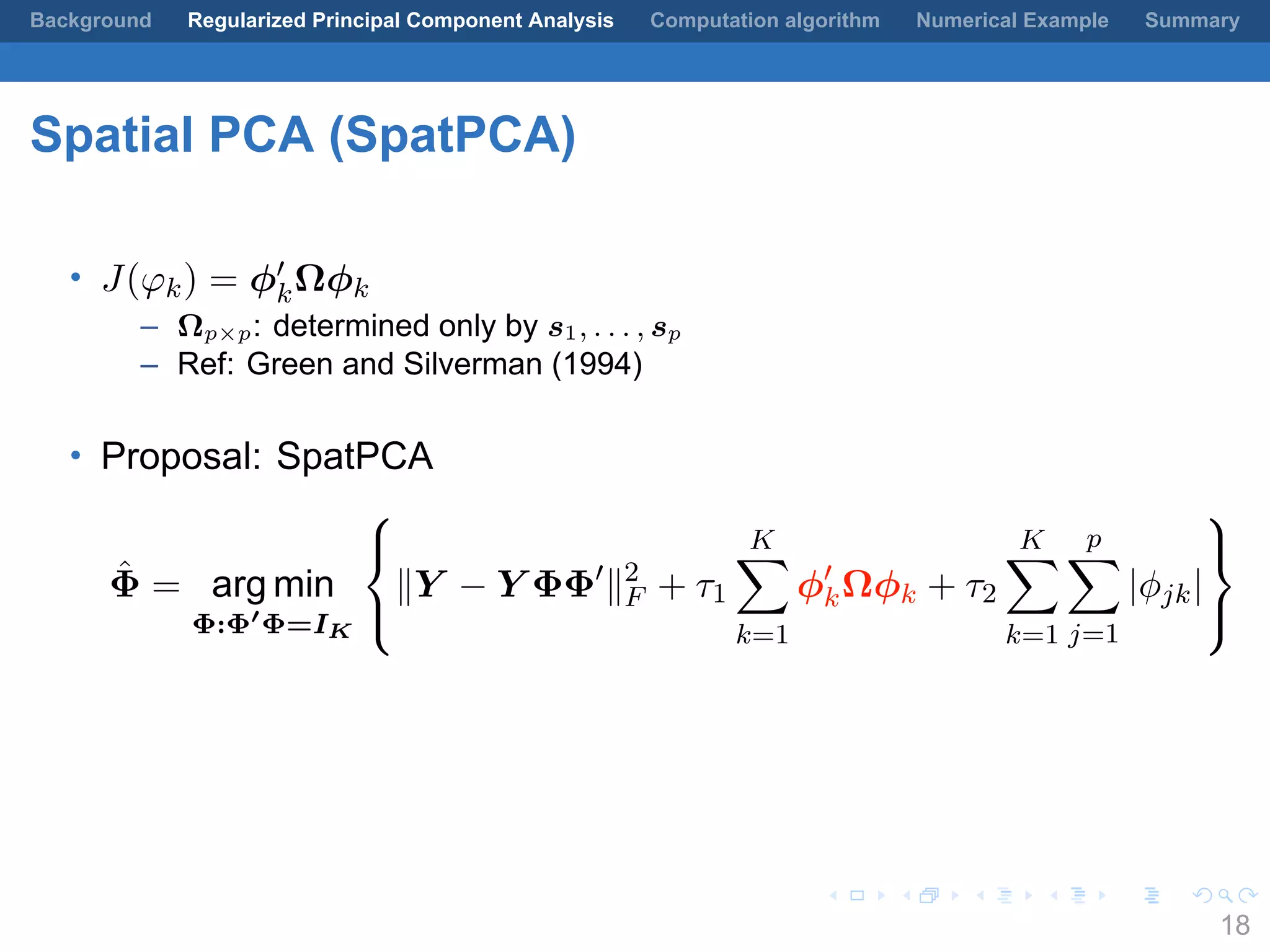
Spatial PCA (SpatPCA)
• J(φk) = ϕ′
kΩϕk
– Ωp×p: determined only by s1, . . . , sp
– Ref: Green and Silverman (1994)
18
.
.
.
.
.
.
.
.
.
.
.
.
.
.
.
.
.
.
.
.
.
.
.
.
.
.
.
.
.
.
.
.
.
.
.
.
.
.
.
.
Background Regularized Principal Component Analysis Computation algorithm Numerical Example Summary
Spatial PCA (SpatPCA)
• J(φk) = ϕ′
kΩϕk
– Ωp×p: determined only by s1, . . . , sp
– Ref: Green and Silverman (1994)
• Proposal: SpatPCA
ˆΦ = arg min
Φ:Φ′
Φ=IK



∥Y − Y ΦΦ′
∥2
F + τ1
K∑
k=1
ϕ′
kΩϕk + τ2
K∑
k=1
p∑
j=1
|ϕjk|



18
.
.
.
.
.
.
.
.
.
.
.
.
.
.
.
.
.
.
.
.
.
.
.
.
.
.
.
.
.
.
.
.
.
.
.
.
.
.
.
.
Background Regularized Principal Component Analysis Computation algorithm Numerical Example Summary
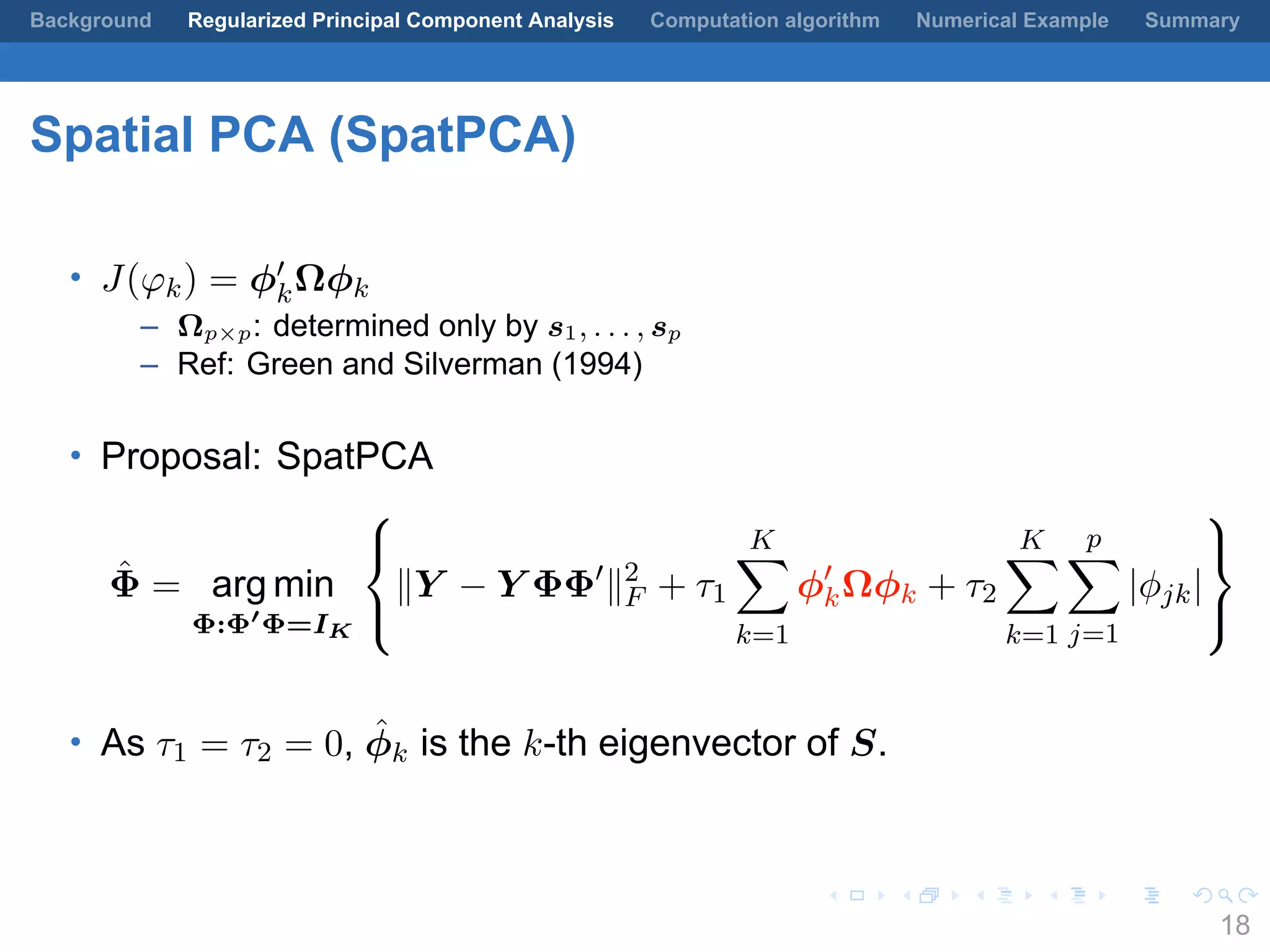
Spatial PCA (SpatPCA)
• J(φk) = ϕ′
kΩϕk
– Ωp×p: determined only by s1, . . . , sp
– Ref: Green and Silverman (1994)
• Proposal: SpatPCA
ˆΦ = arg min
Φ:Φ′
Φ=IK



∥Y − Y ΦΦ′
∥2
F + τ1
K∑
k=1
ϕ′
kΩϕk + τ2
K∑
k=1
p∑
j=1
|ϕjk|



• As τ1 = τ2 = 0, ˆϕk is the k-th eigenvector of S.
18
.
.
.
.
.
.
.
.
.
.
.
.
.
.
.
.
.
.
.
.
.
.
.
.
.
.
.
.
.
.
.
.
.
.
.
.
.
.
.
.
Background Regularized Principal Component Analysis Computation algorithm Numerical Example Summary
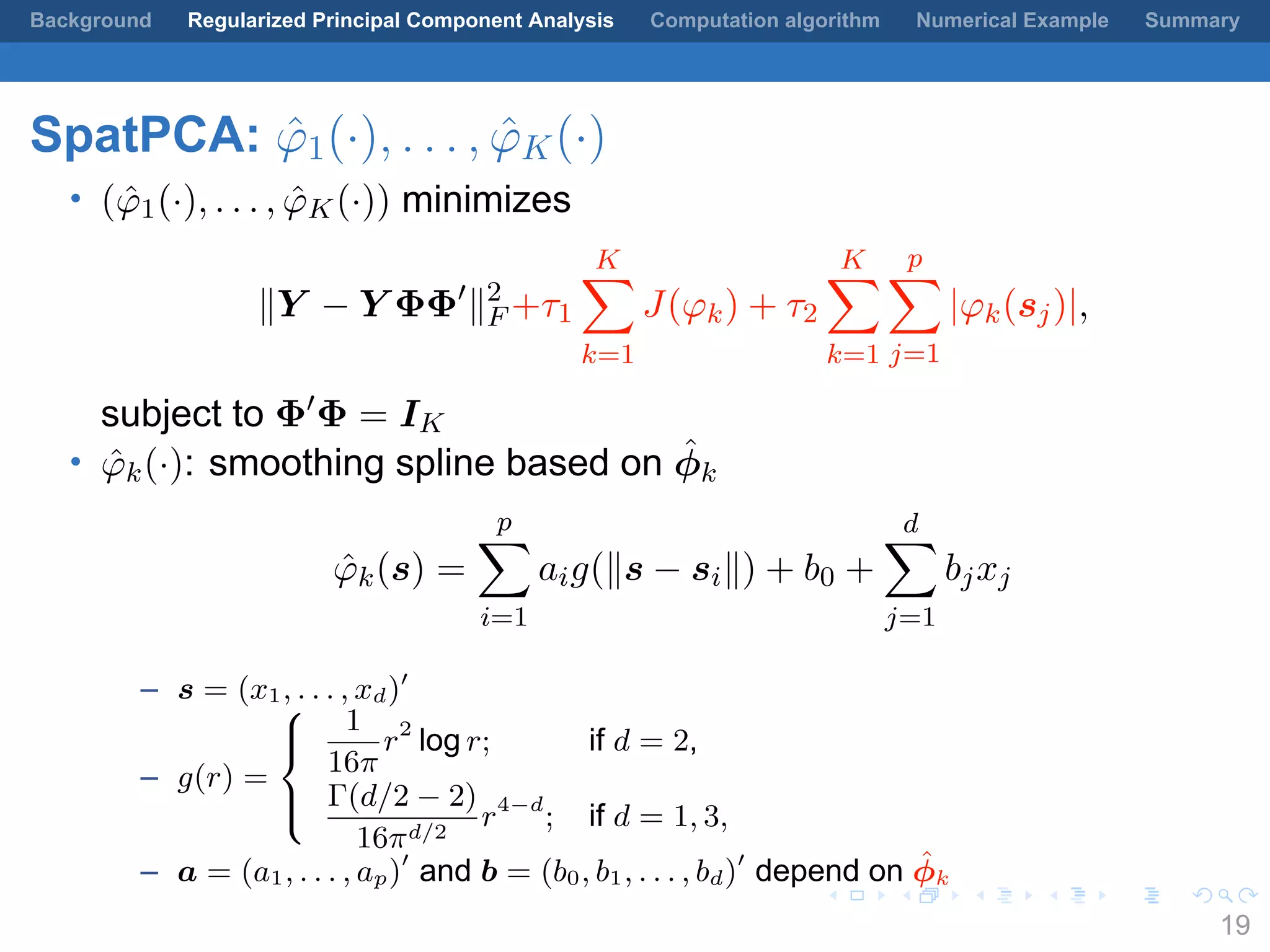
SpatPCA: ˆφ1(·), . . . , ˆφK(·)
• ( ˆφ1(·), . . . , ˆφK(·)) minimizes
∥Y − Y ΦΦ′
∥2
F +τ1
K∑
k=1
J(φk) + τ2
K∑
k=1
p∑
j=1
|φk(sj)|,
subject to Φ′
Φ = IK
• ˆφk(·): smoothing spline based on ˆϕk
ˆφk(s) =
p∑
i=1
aig(∥s − si∥) + b0 +
d∑
j=1
bjxj
– s = (x1, . . . , xd)′
– g(r) =



1
16π
r2
log r; if d = 2,
Γ(d/2 − 2)
16πd/2
r4−d
; if d = 1, 3,
– a = (a1, . . . , ap)′
and b = (b0, b1, . . . , bd)′
depend on ˆϕk
19
.
.
.
.
.
.
.
.
.
.
.
.
.
.
.
.
.
.
.
.
.
.
.
.
.
.
.
.
.
.
.
.
.
.
.
.
.
.
.
.
Background Regularized Principal Component Analysis Computation algorithm Numerical Example Summary
Why considering two penalties?
20
.
.
.
.
.
.
.
.
.
.
.
.
.
.
.
.
.
.
.
.
.
.
.
.
.
.
.
.
.
.
.
.
.
.
.
.
.
.
.
.
Background Regularized Principal Component Analysis Computation algorithm Numerical Example Summary
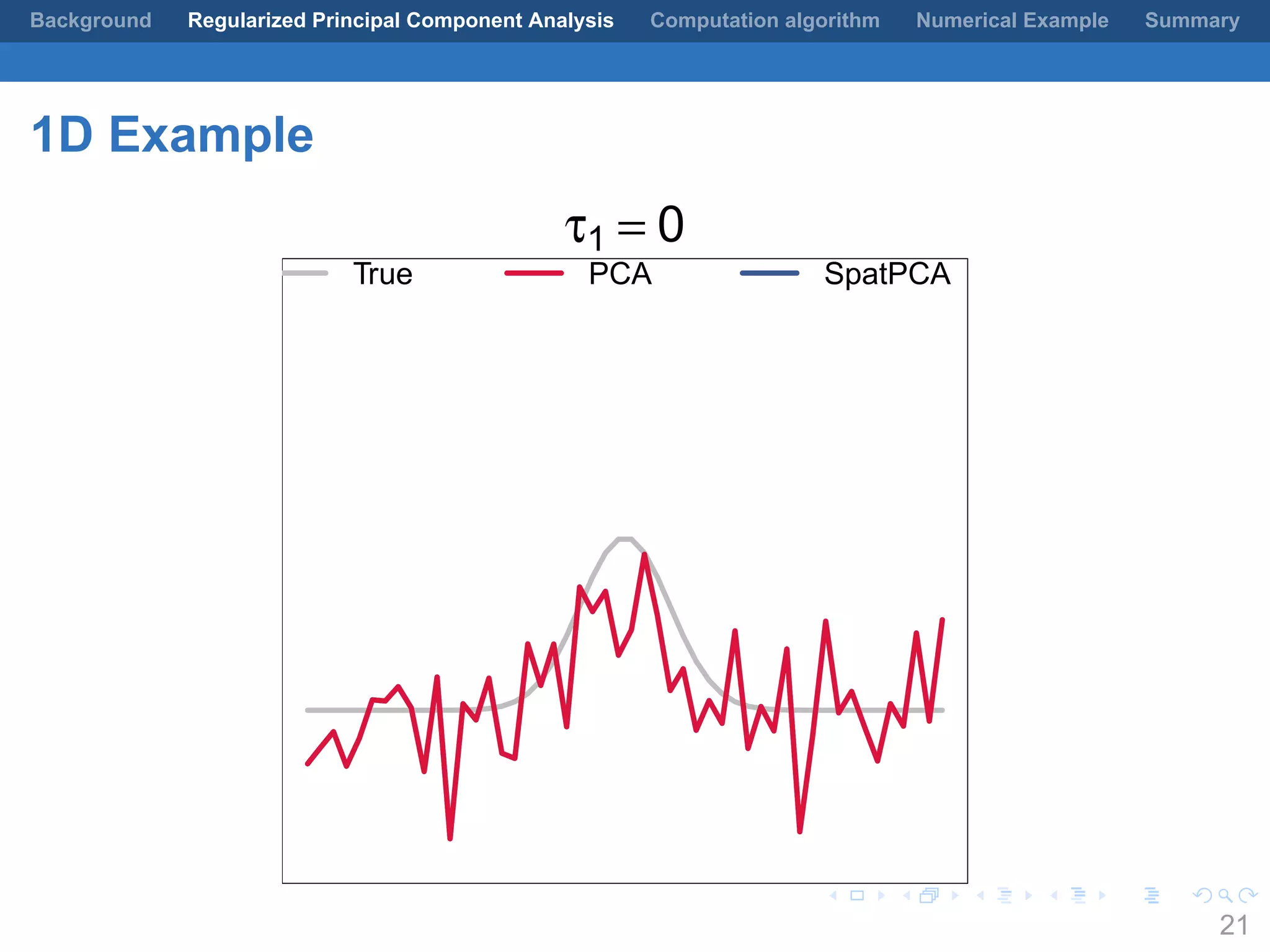
1D Example
τ1 = 0
True PCA SpatPCA
21
.
.
.
.
.
.
.
.
.
.
.
.
.
.
.
.
.
.
.
.
.
.
.
.
.
.
.
.
.
.
.
.
.
.
.
.
.
.
.
.
Background Regularized Principal Component Analysis Computation algorithm Numerical Example Summary
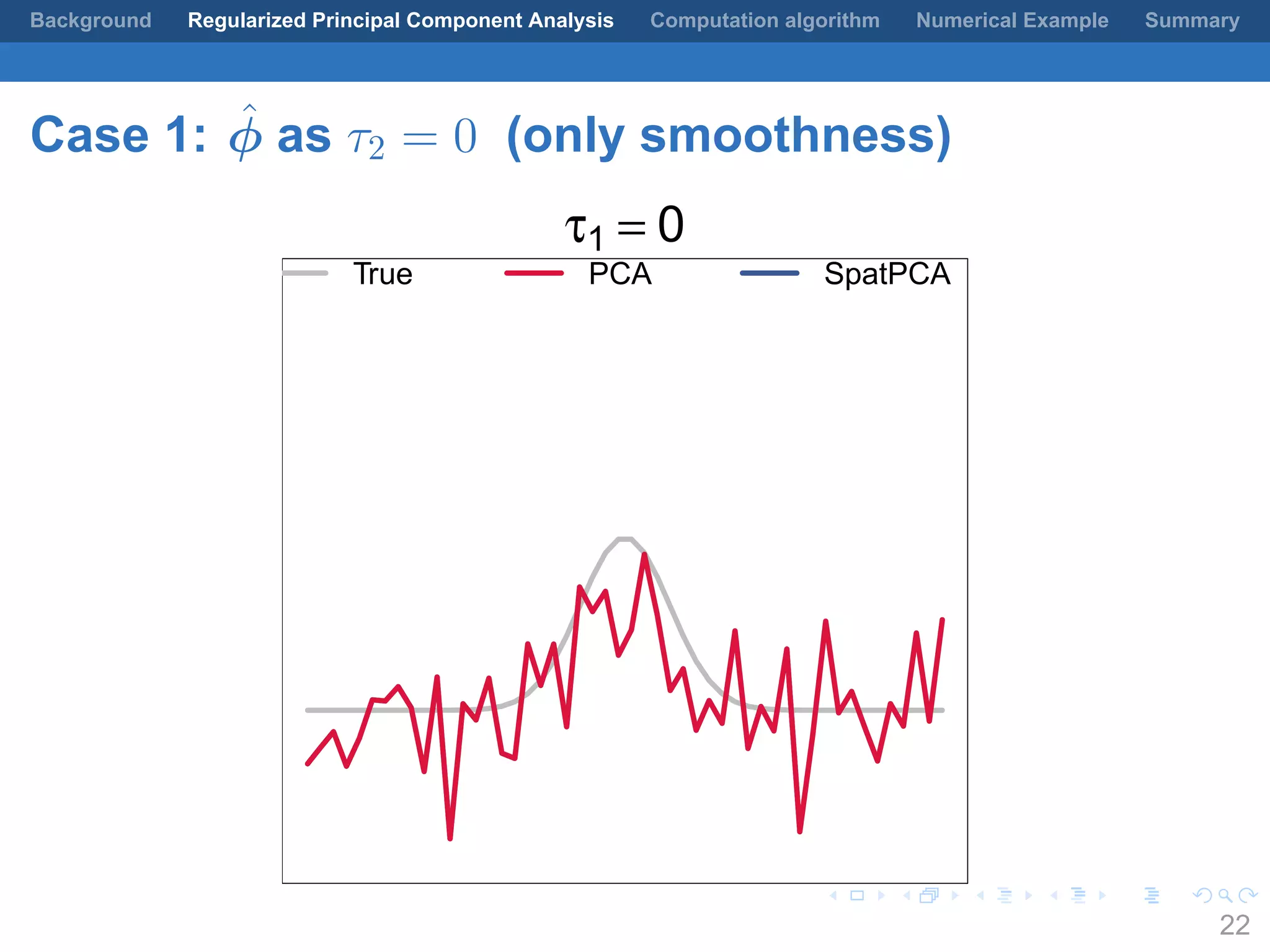
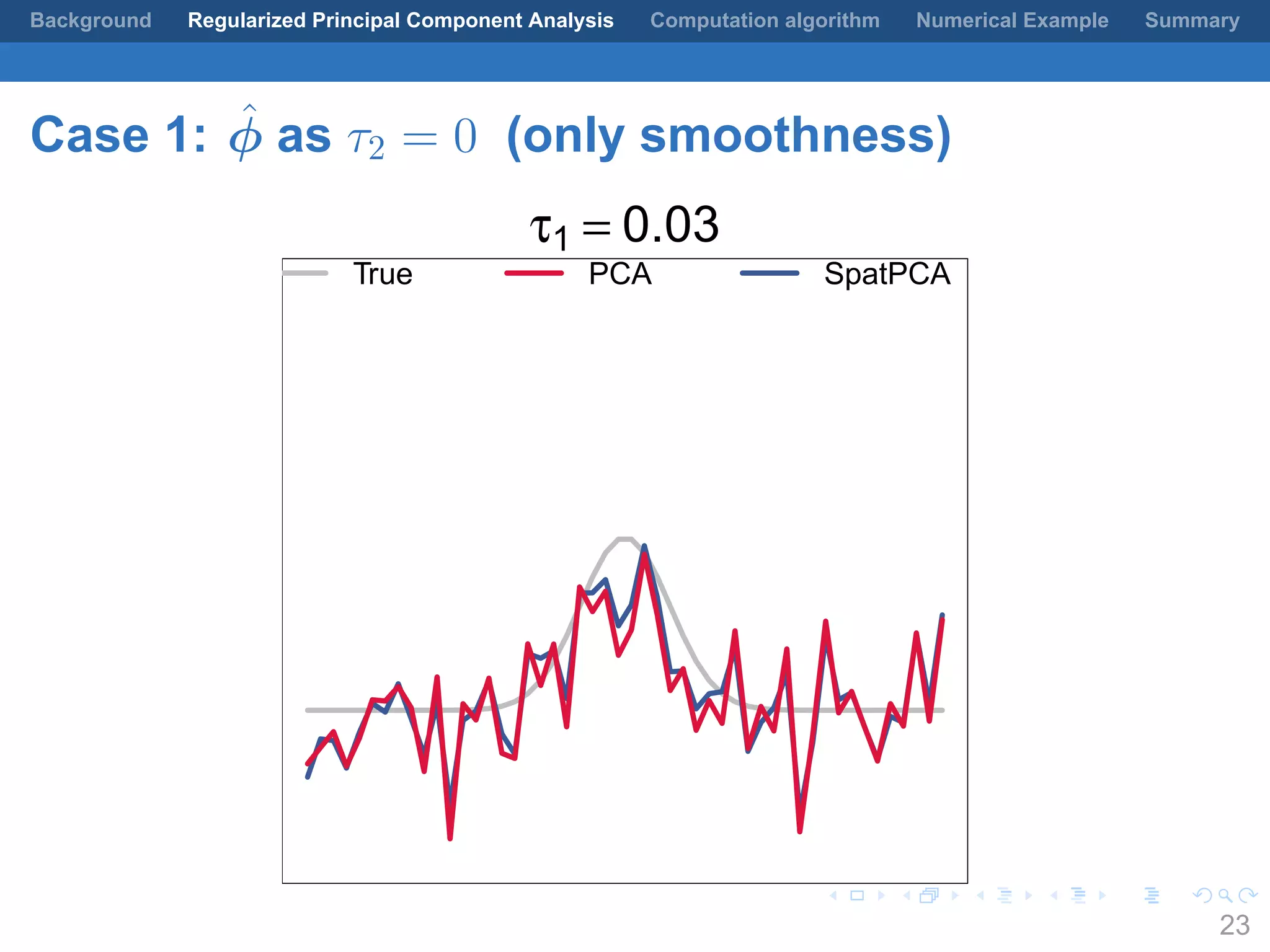
Case 1: ˆϕ as τ2 = 0 (only smoothness)
τ1 = 0
True PCA SpatPCA
22
.
.
.
.
.
.
.
.
.
.
.
.
.
.
.
.
.
.
.
.
.
.
.
.
.
.
.
.
.
.
.
.
.
.
.
.
.
.
.
.
Background Regularized Principal Component Analysis Computation algorithm Numerical Example Summary
Case 1: ˆϕ as τ2 = 0 (only smoothness)
τ1 = 0.03
True PCA SpatPCA
23
.
.
.
.
.
.
.
.
.
.
.
.
.
.
.
.
.
.
.
.
.
.
.
.
.
.
.
.
.
.
.
.
.
.
.
.
.
.
.
.
Background Regularized Principal Component Analysis Computation algorithm Numerical Example Summary
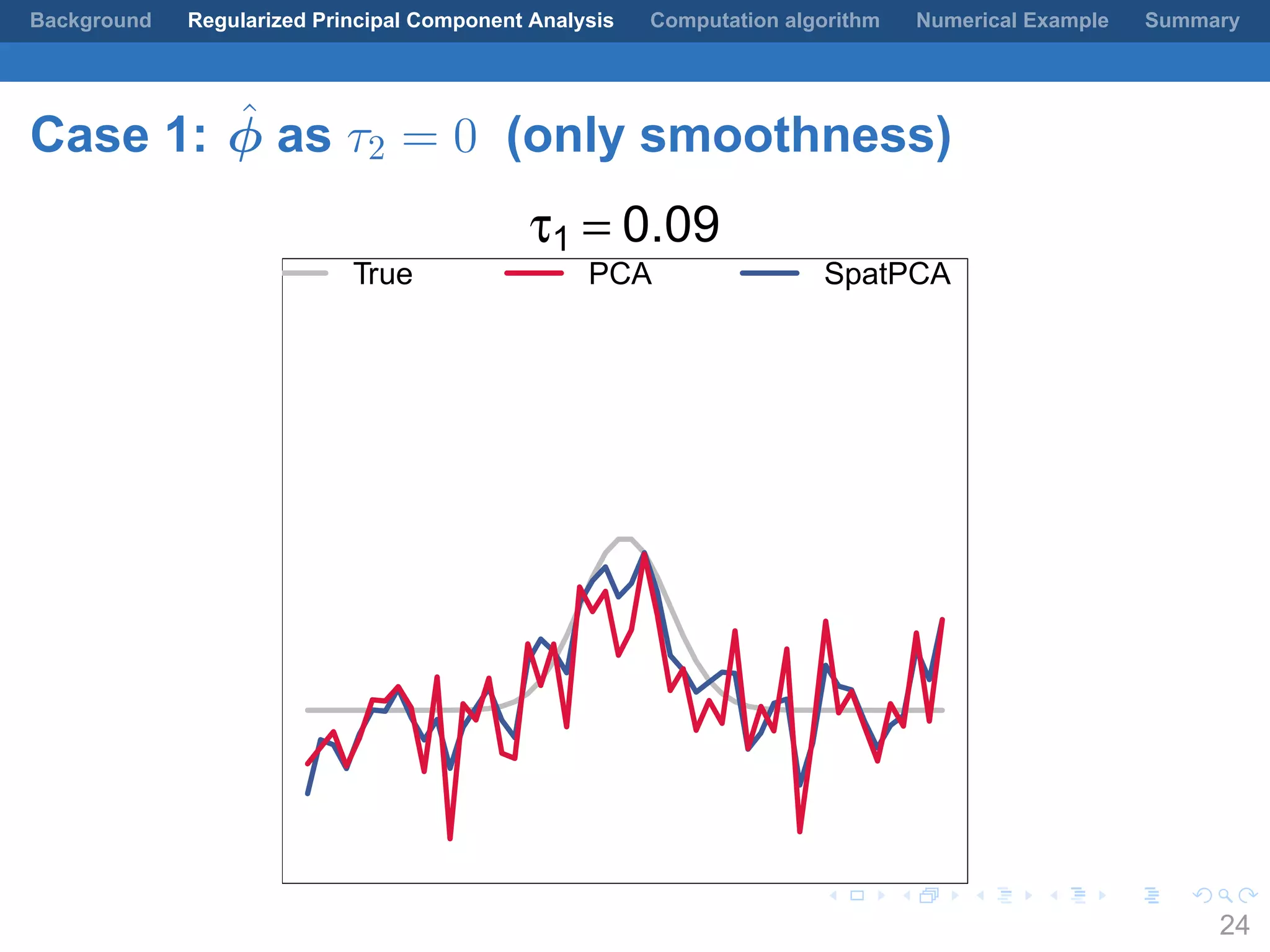
Case 1: ˆϕ as τ2 = 0 (only smoothness)
τ1 = 0.09
True PCA SpatPCA
24
.
.
.
.
.
.
.
.
.
.
.
.
.
.
.
.
.
.
.
.
.
.
.
.
.
.
.
.
.
.
.
.
.
.
.
.
.
.
.
.
Background Regularized Principal Component Analysis Computation algorithm Numerical Example Summary
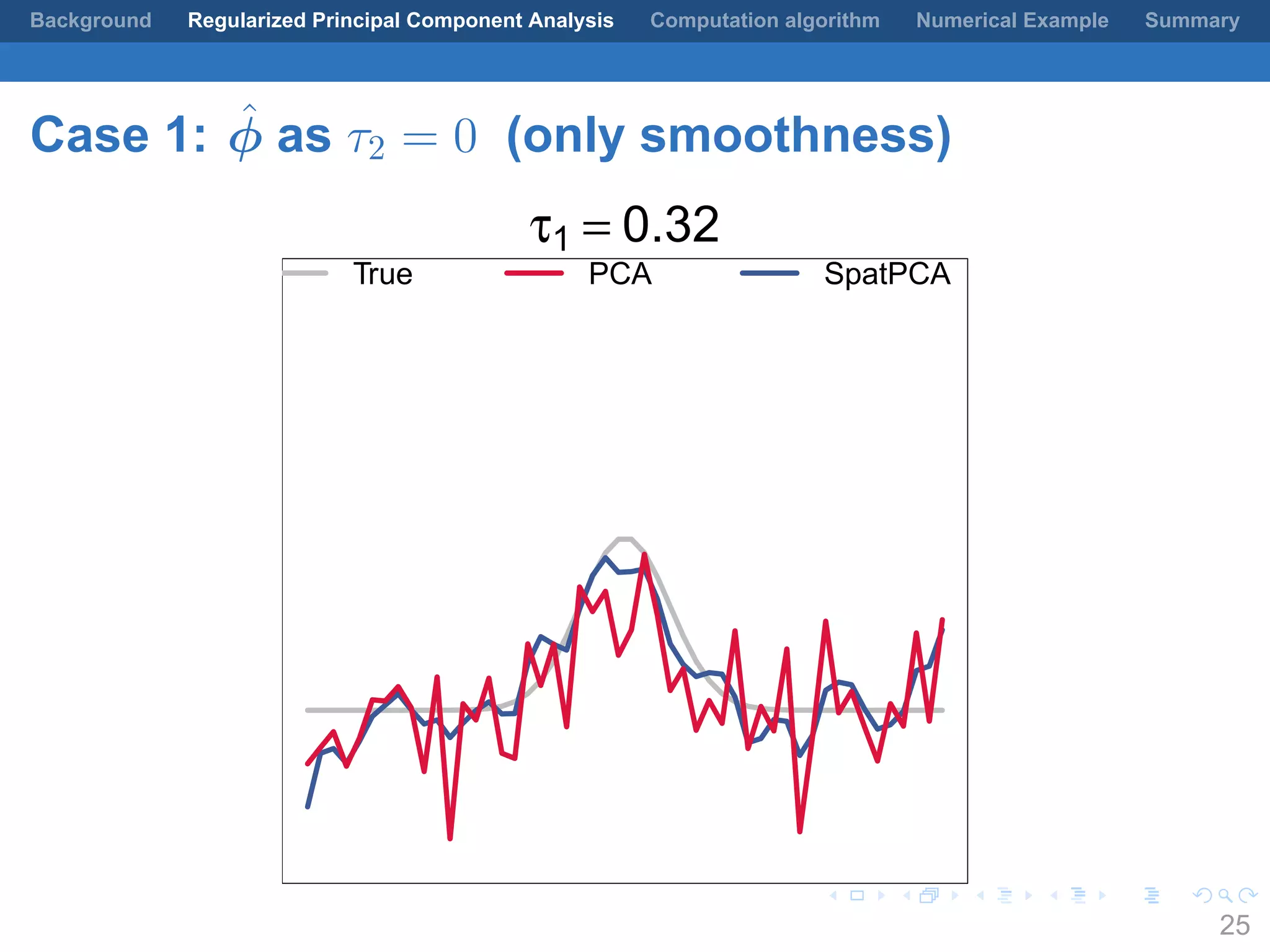
Case 1: ˆϕ as τ2 = 0 (only smoothness)
τ1 = 0.32
True PCA SpatPCA
25
.
.
.
.
.
.
.
.
.
.
.
.
.
.
.
.
.
.
.
.
.
.
.
.
.
.
.
.
.
.
.
.
.
.
.
.
.
.
.
.
Background Regularized Principal Component Analysis Computation algorithm Numerical Example Summary
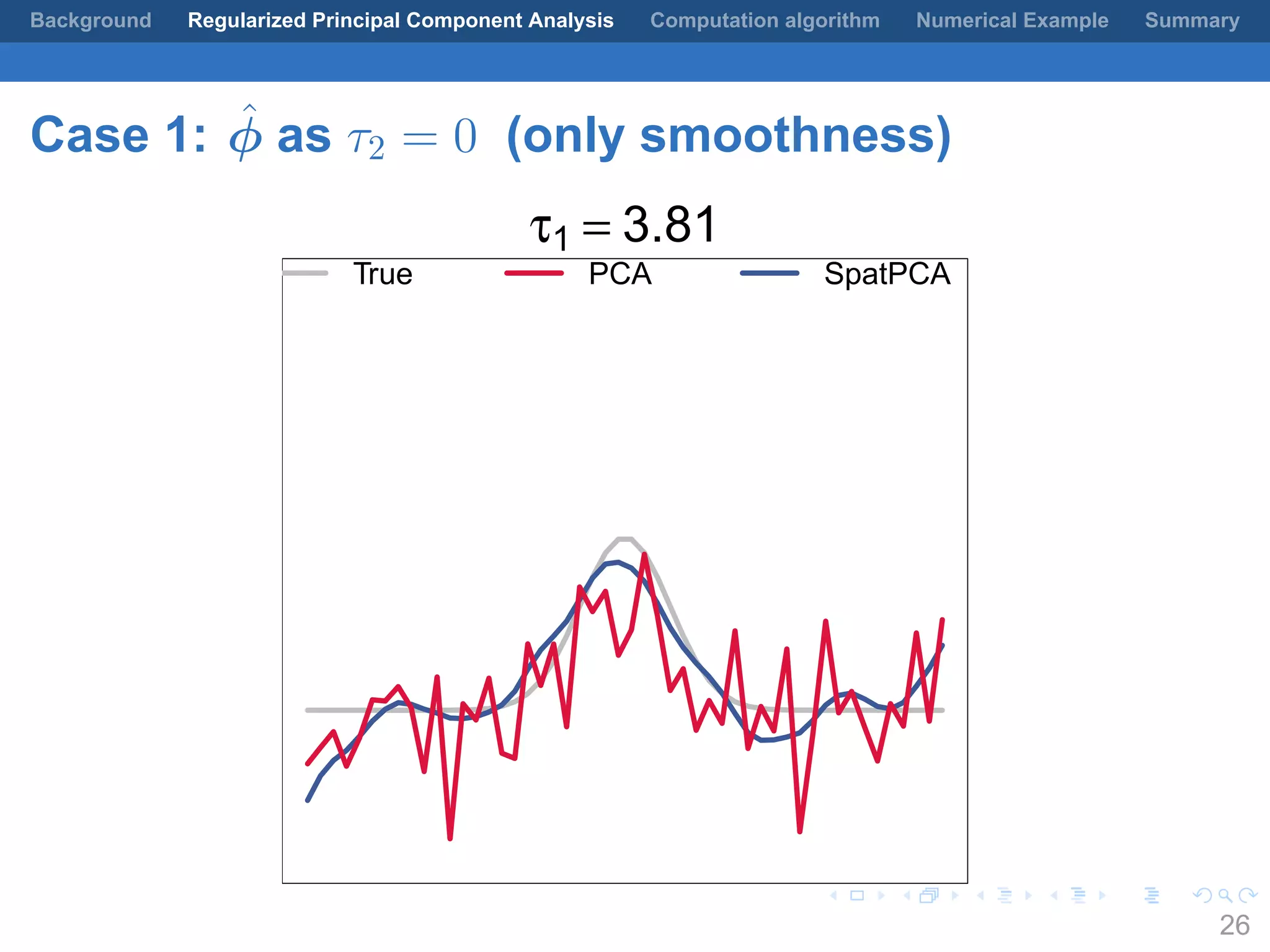
Case 1: ˆϕ as τ2 = 0 (only smoothness)
τ1 = 3.81
True PCA SpatPCA
26
.
.
.
.
.
.
.
.
.
.
.
.
.
.
.
.
.
.
.
.
.
.
.
.
.
.
.
.
.
.
.
.
.
.
.
.
.
.
.
.
Background Regularized Principal Component Analysis Computation algorithm Numerical Example Summary
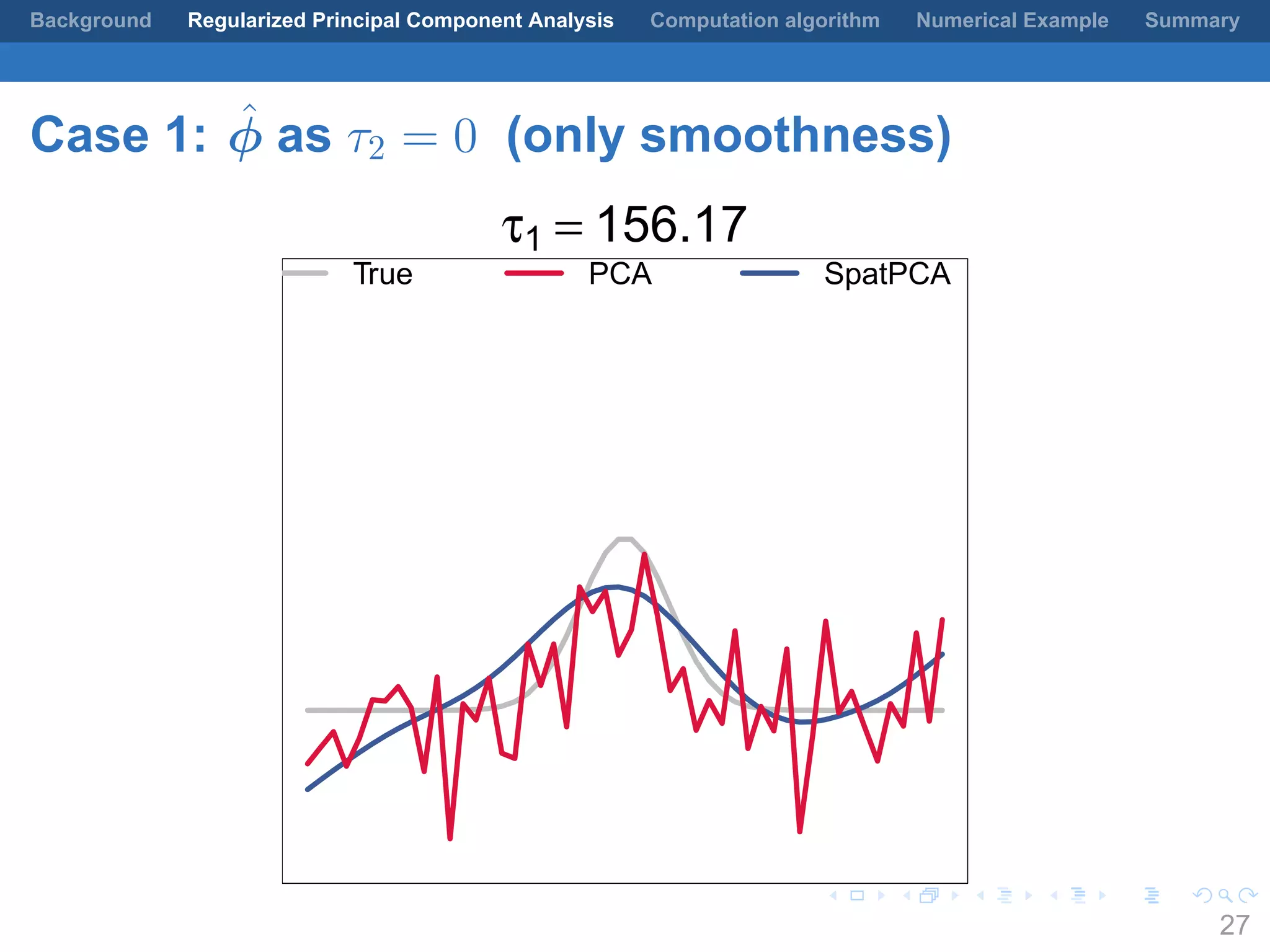
Case 1: ˆϕ as τ2 = 0 (only smoothness)
τ1 = 156.17
True PCA SpatPCA
27
.
.
.
.
.
.
.
.
.
.
.
.
.
.
.
.
.
.
.
.
.
.
.
.
.
.
.
.
.
.
.
.
.
.
.
.
.
.
.
.
Background Regularized Principal Component Analysis Computation algorithm Numerical Example Summary
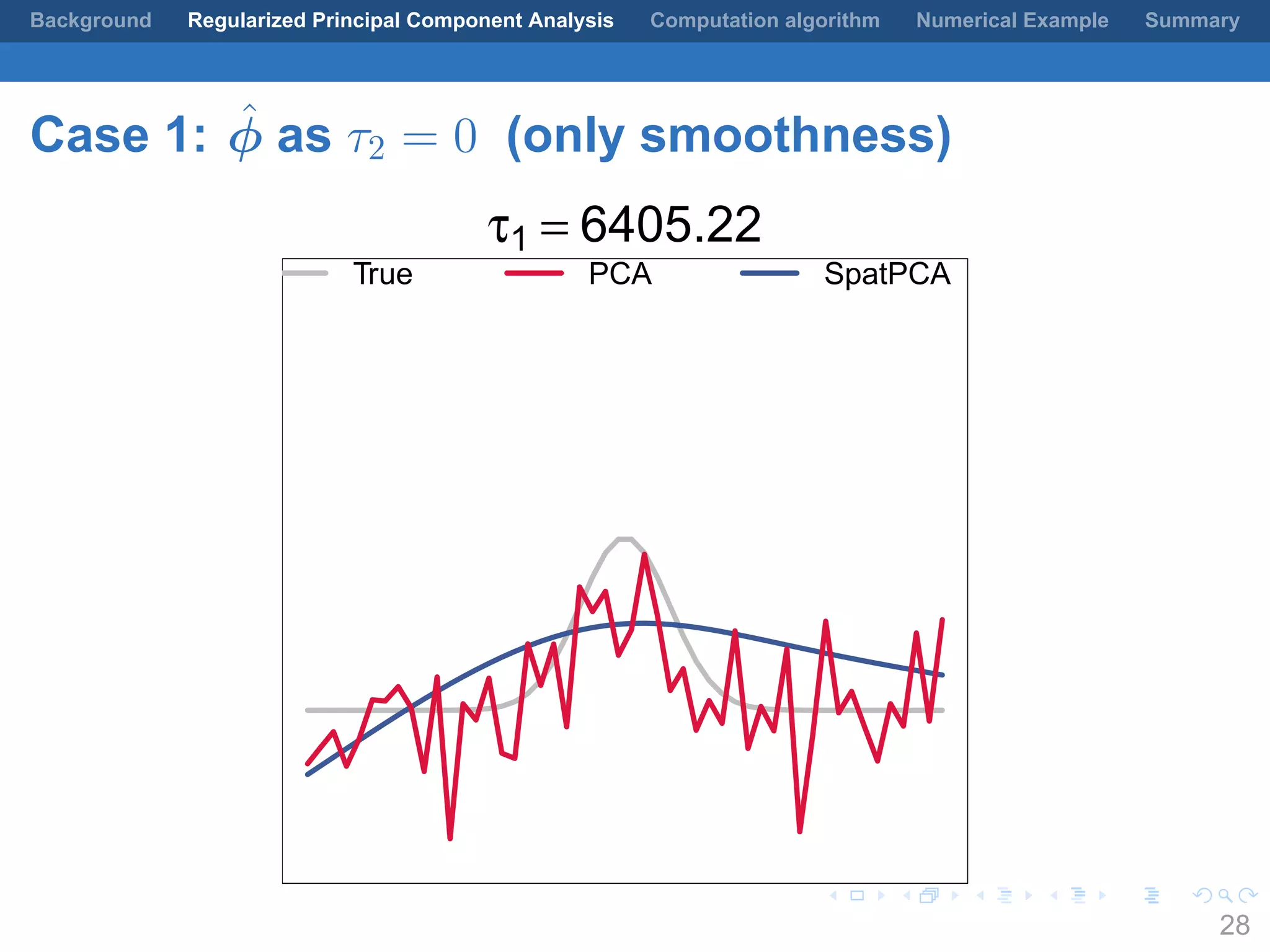
Case 1: ˆϕ as τ2 = 0 (only smoothness)
τ1 = 6405.22
True PCA SpatPCA
28
.
.
.
.
.
.
.
.
.
.
.
.
.
.
.
.
.
.
.
.
.
.
.
.
.
.
.
.
.
.
.
.
.
.
.
.
.
.
.
.
Background Regularized Principal Component Analysis Computation algorithm Numerical Example Summary
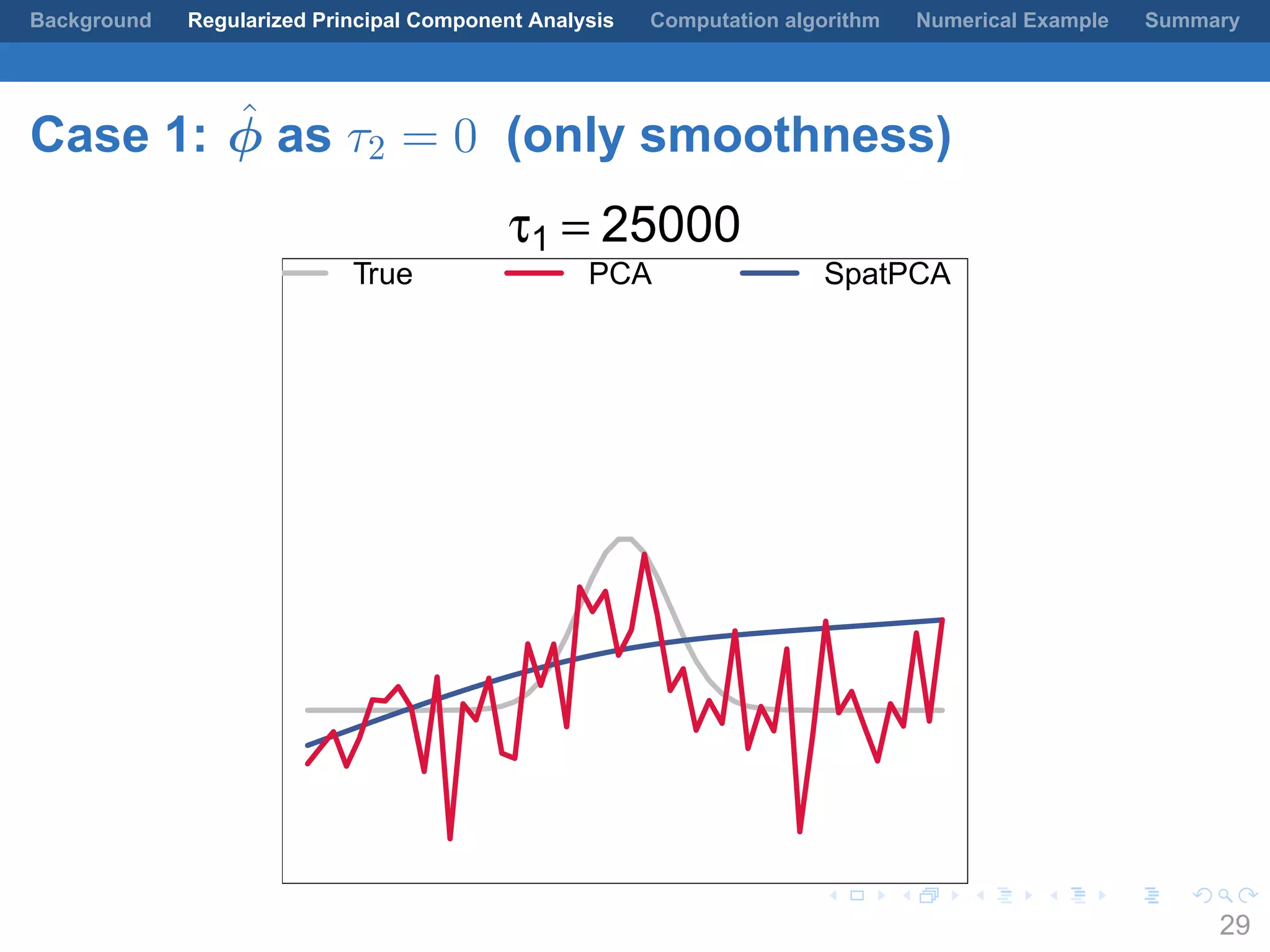
Case 1: ˆϕ as τ2 = 0 (only smoothness)
τ1 = 25000
True PCA SpatPCA
29
.
.
.
.
.
.
.
.
.
.
.
.
.
.
.
.
.
.
.
.
.
.
.
.
.
.
.
.
.
.
.
.
.
.
.
.
.
.
.
.
Background Regularized Principal Component Analysis Computation algorithm Numerical Example Summary
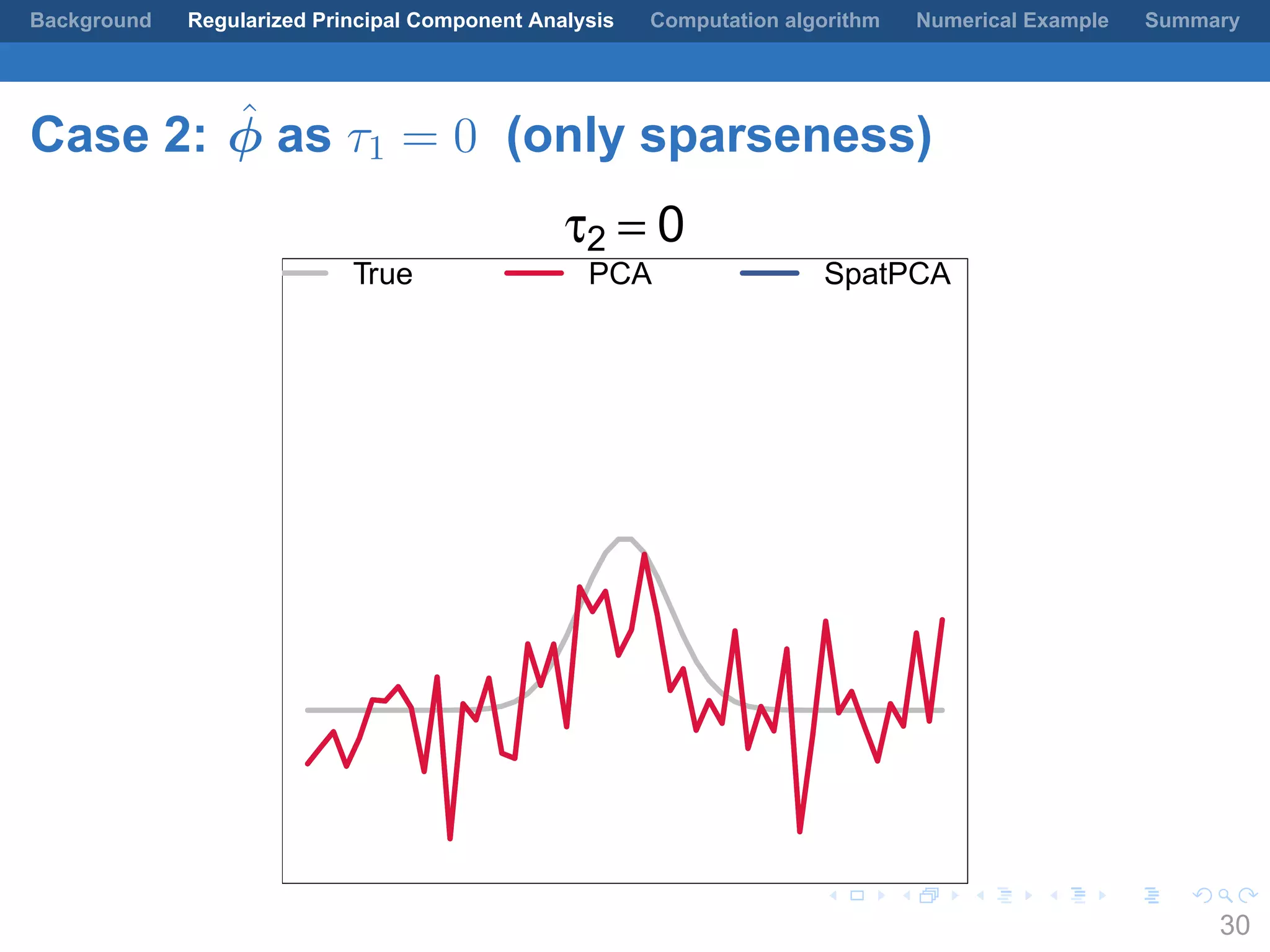
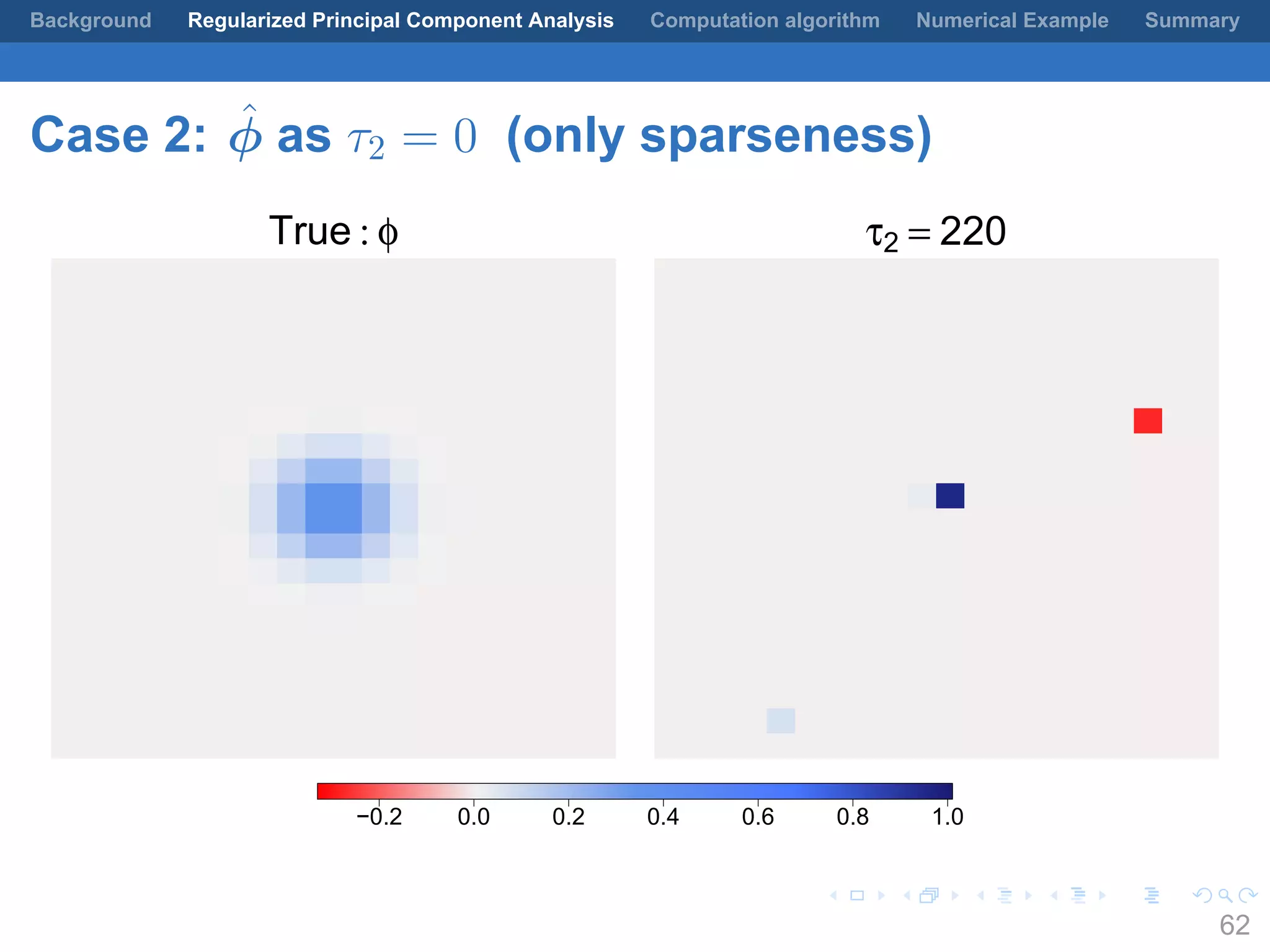
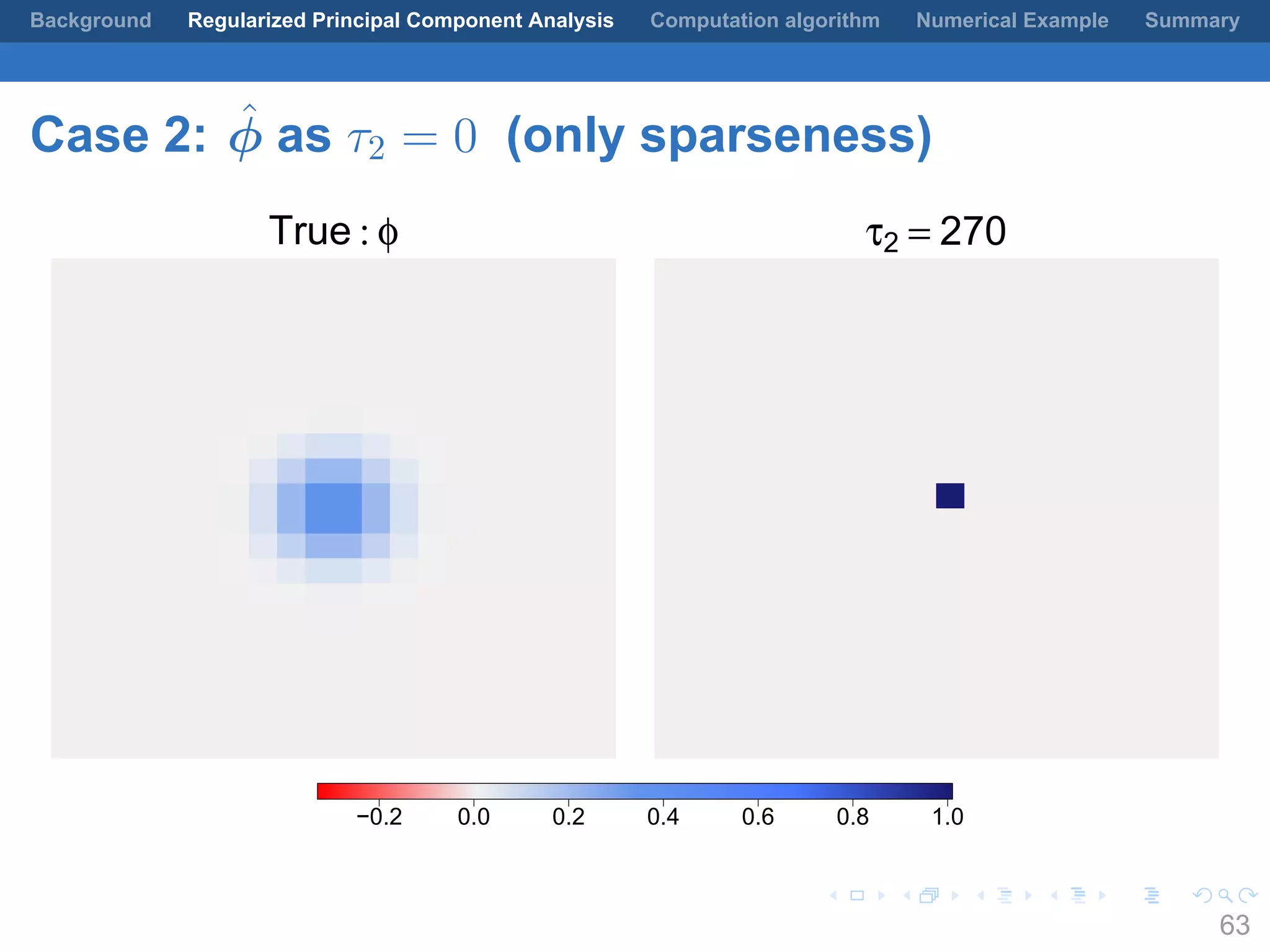
Case 2: ˆϕ as τ1 = 0 (only sparseness)
τ2 = 0
True PCA SpatPCA
30
.
.
.
.
.
.
.
.
.
.
.
.
.
.
.
.
.
.
.
.
.
.
.
.
.
.
.
.
.
.
.
.
.
.
.
.
.
.
.
.
Background Regularized Principal Component Analysis Computation algorithm Numerical Example Summary
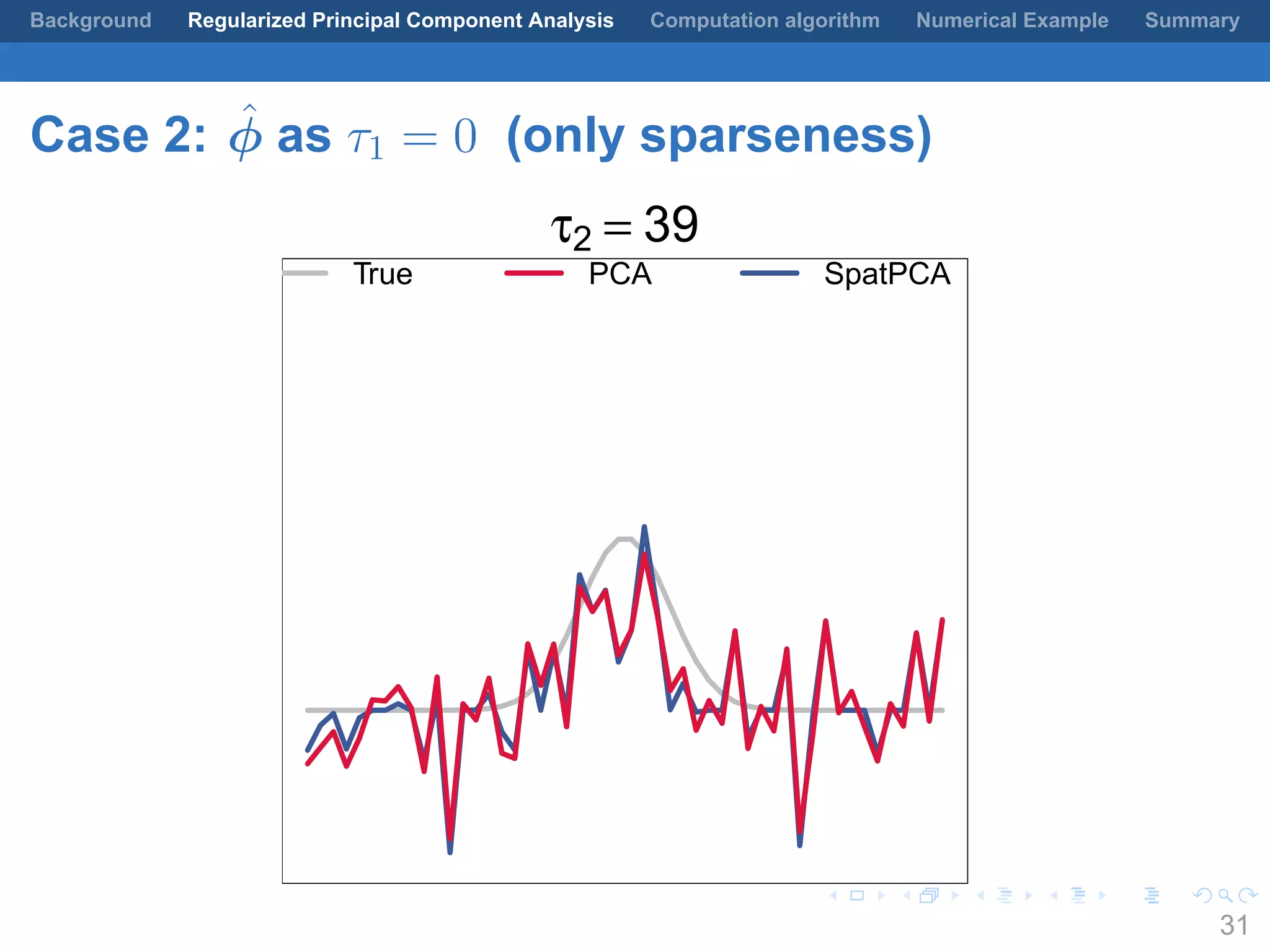
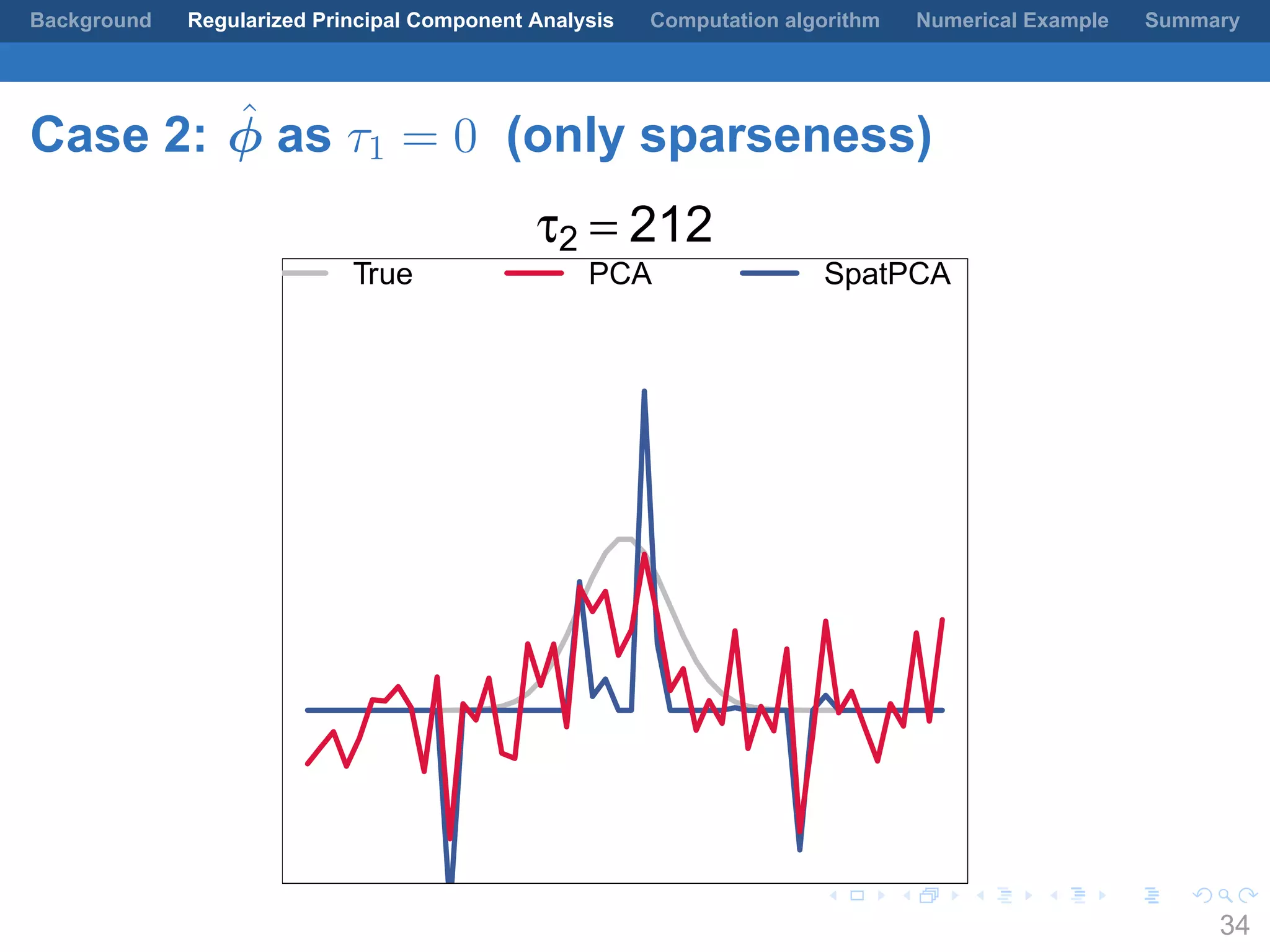
Case 2: ˆϕ as τ1 = 0 (only sparseness)
τ2 = 39
True PCA SpatPCA
31
.
.
.
.
.
.
.
.
.
.
.
.
.
.
.
.
.
.
.
.
.
.
.
.
.
.
.
.
.
.
.
.
.
.
.
.
.
.
.
.
Background Regularized Principal Component Analysis Computation algorithm Numerical Example Summary
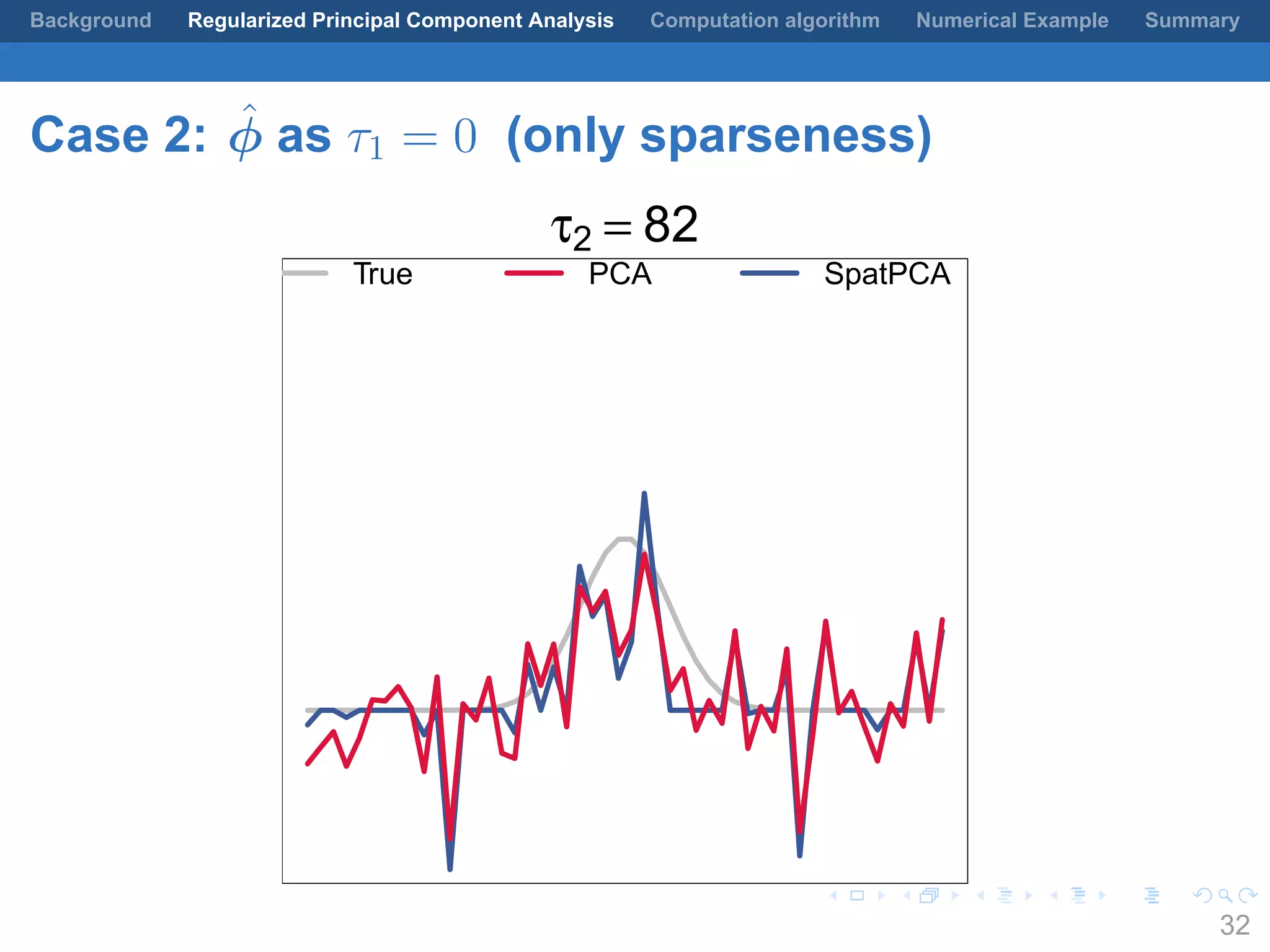
Case 2: ˆϕ as τ1 = 0 (only sparseness)
τ2 = 82
True PCA SpatPCA
32
.
.
.
.
.
.
.
.
.
.
.
.
.
.
.
.
.
.
.
.
.
.
.
.
.
.
.
.
.
.
.
.
.
.
.
.
.
.
.
.
Background Regularized Principal Component Analysis Computation algorithm Numerical Example Summary
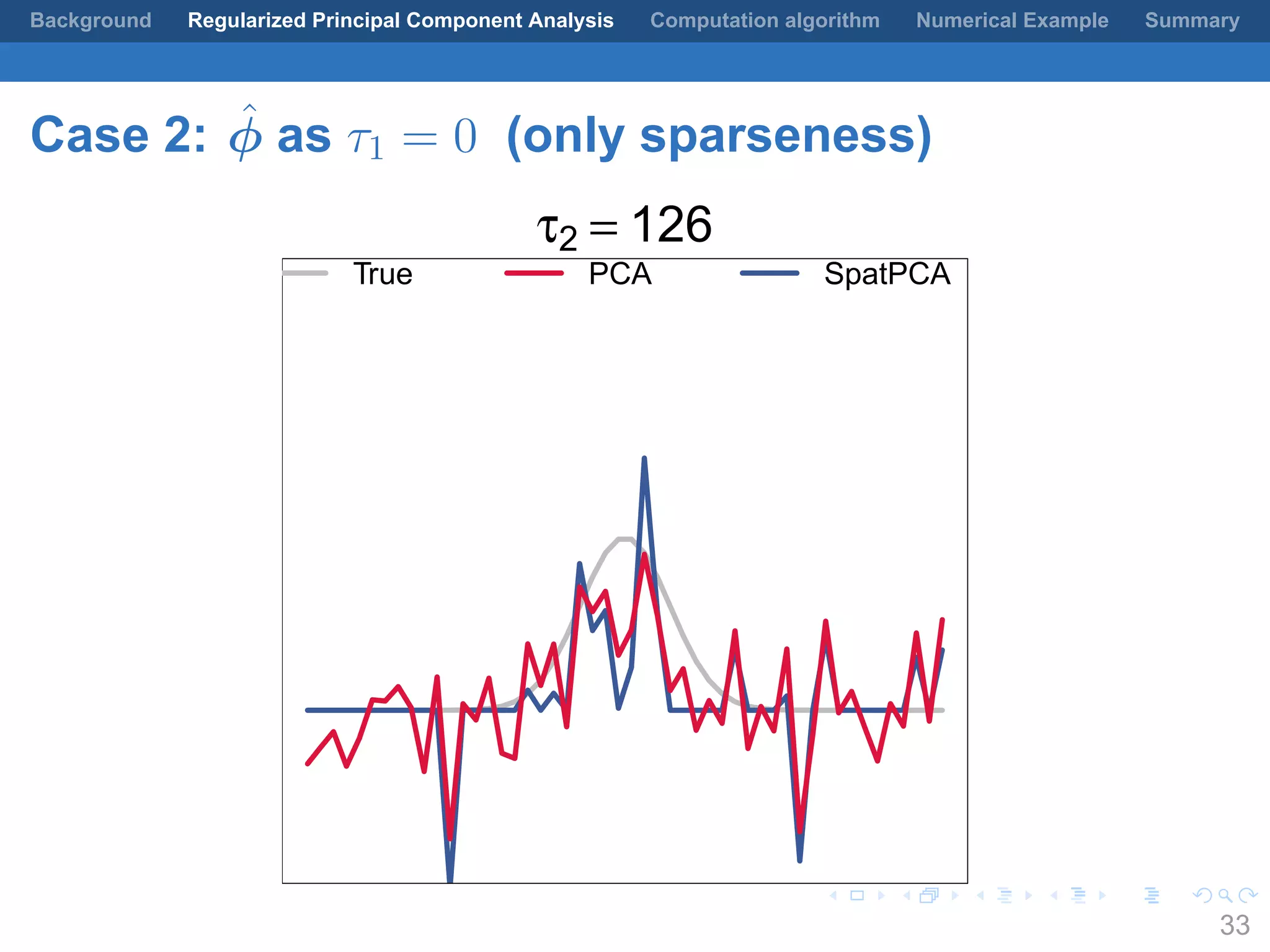
Case 2: ˆϕ as τ1 = 0 (only sparseness)
τ2 = 126
True PCA SpatPCA
33
.
.
.
.
.
.
.
.
.
.
.
.
.
.
.
.
.
.
.
.
.
.
.
.
.
.
.
.
.
.
.
.
.
.
.
.
.
.
.
.
Background Regularized Principal Component Analysis Computation algorithm Numerical Example Summary
Case 2: ˆϕ as τ1 = 0 (only sparseness)
τ2 = 212
True PCA SpatPCA
34
.
.
.
.
.
.
.
.
.
.
.
.
.
.
.
.
.
.
.
.
.
.
.
.
.
.
.
.
.
.
.
.
.
.
.
.
.
.
.
.
Background Regularized Principal Component Analysis Computation algorithm Numerical Example Summary
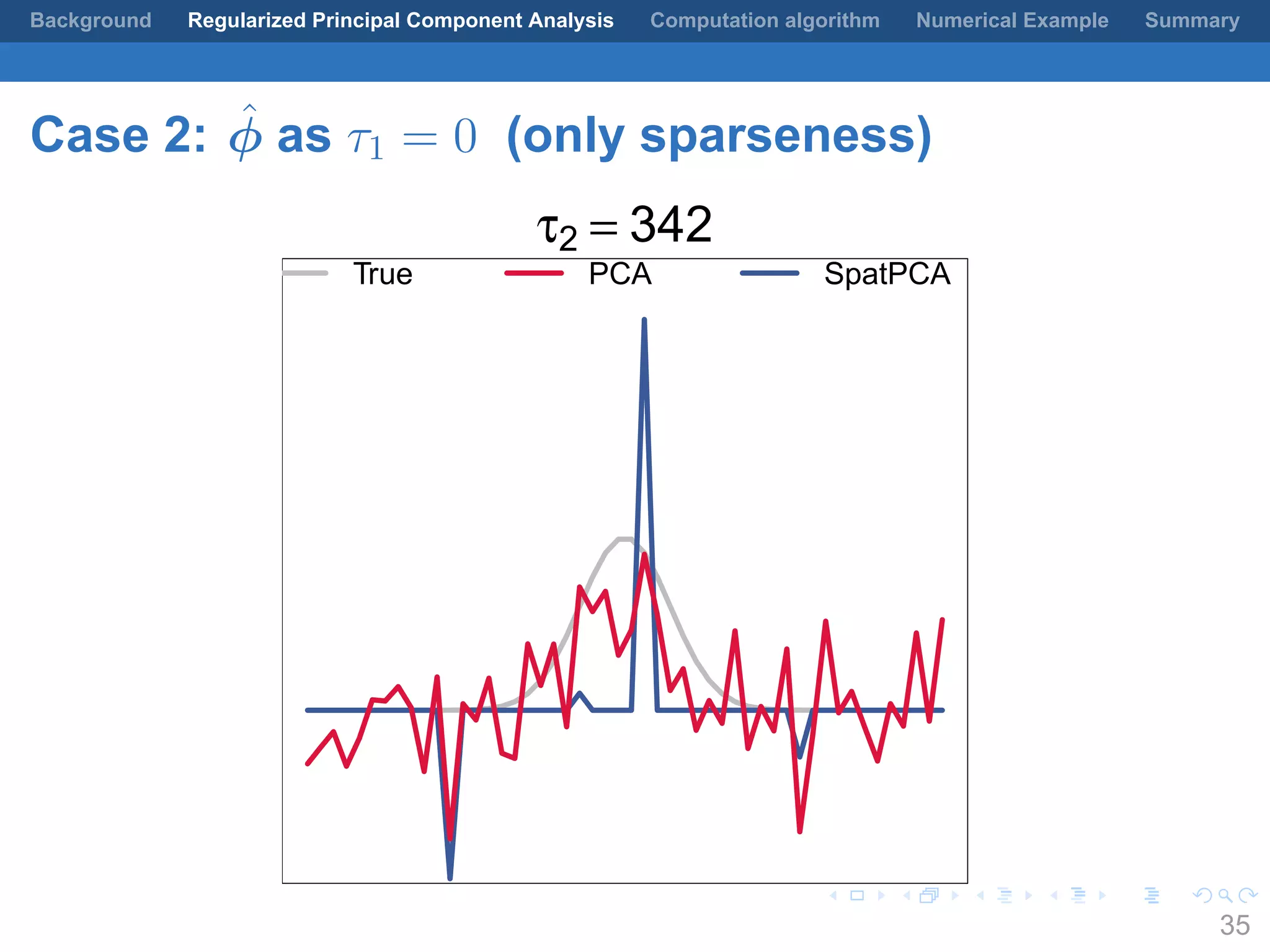
Case 2: ˆϕ as τ1 = 0 (only sparseness)
τ2 = 342
True PCA SpatPCA
35
.
.
.
.
.
.
.
.
.
.
.
.
.
.
.
.
.
.
.
.
.
.
.
.
.
.
.
.
.
.
.
.
.
.
.
.
.
.
.
.
Background Regularized Principal Component Analysis Computation algorithm Numerical Example Summary
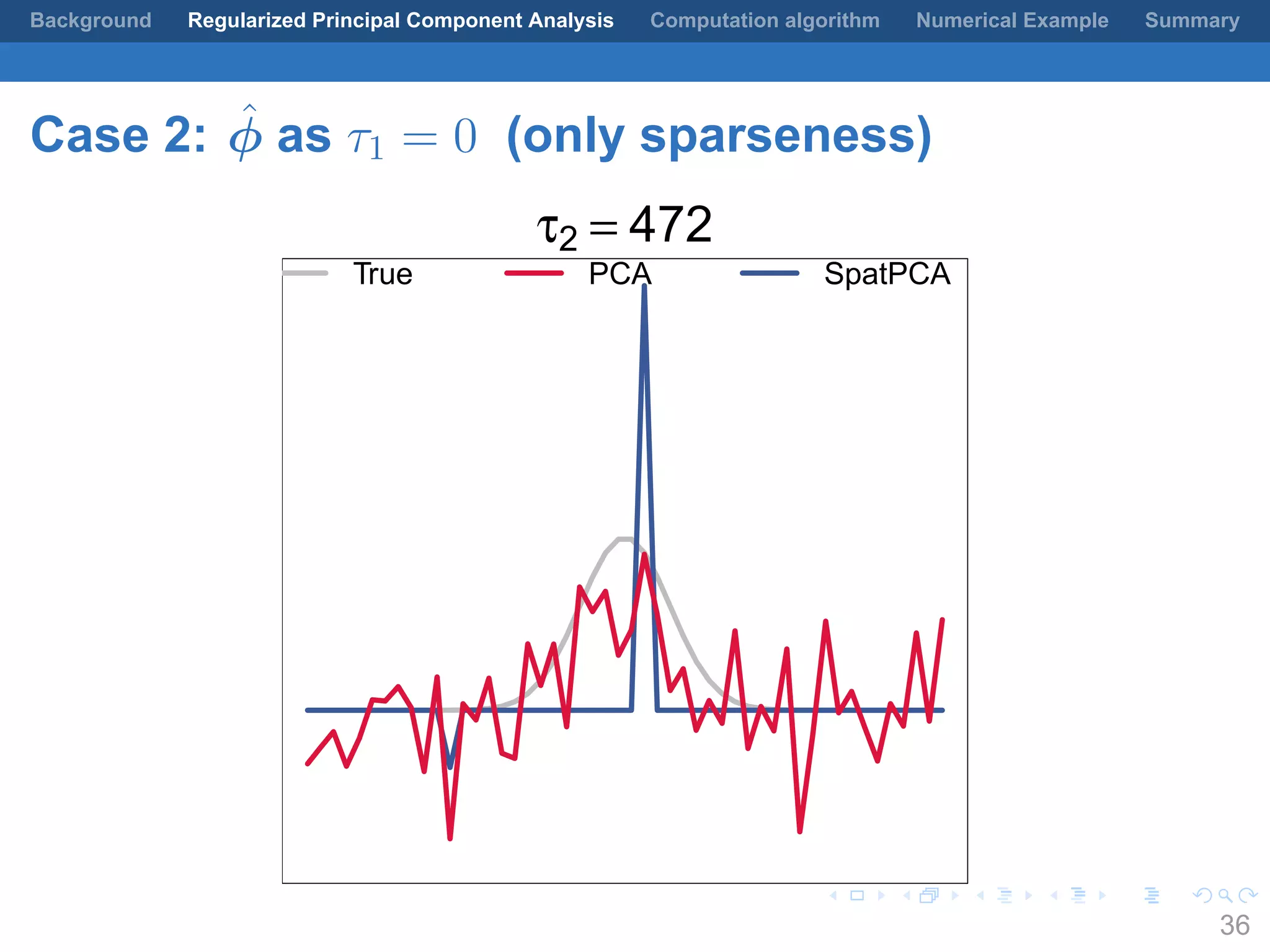
Case 2: ˆϕ as τ1 = 0 (only sparseness)
τ2 = 472
True PCA SpatPCA
36
.
.
.
.
.
.
.
.
.
.
.
.
.
.
.
.
.
.
.
.
.
.
.
.
.
.
.
.
.
.
.
.
.
.
.
.
.
.
.
.
Background Regularized Principal Component Analysis Computation algorithm Numerical Example Summary
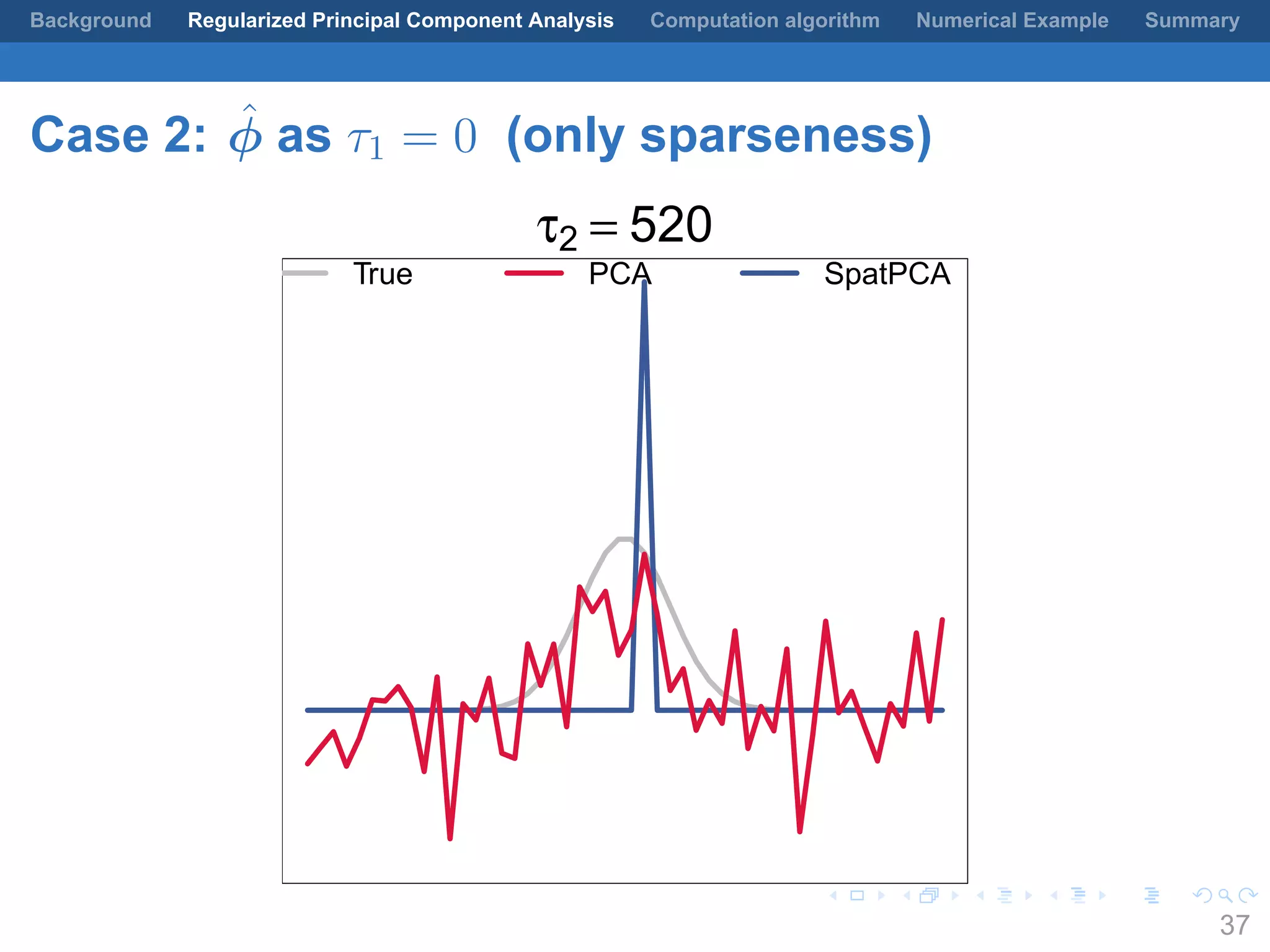
Case 2: ˆϕ as τ1 = 0 (only sparseness)
τ2 = 520
True PCA SpatPCA
37
.
.
.
.
.
.
.
.
.
.
.
.
.
.
.
.
.
.
.
.
.
.
.
.
.
.
.
.
.
.
.
.
.
.
.
.
.
.
.
.
Background Regularized Principal Component Analysis Computation algorithm Numerical Example Summary
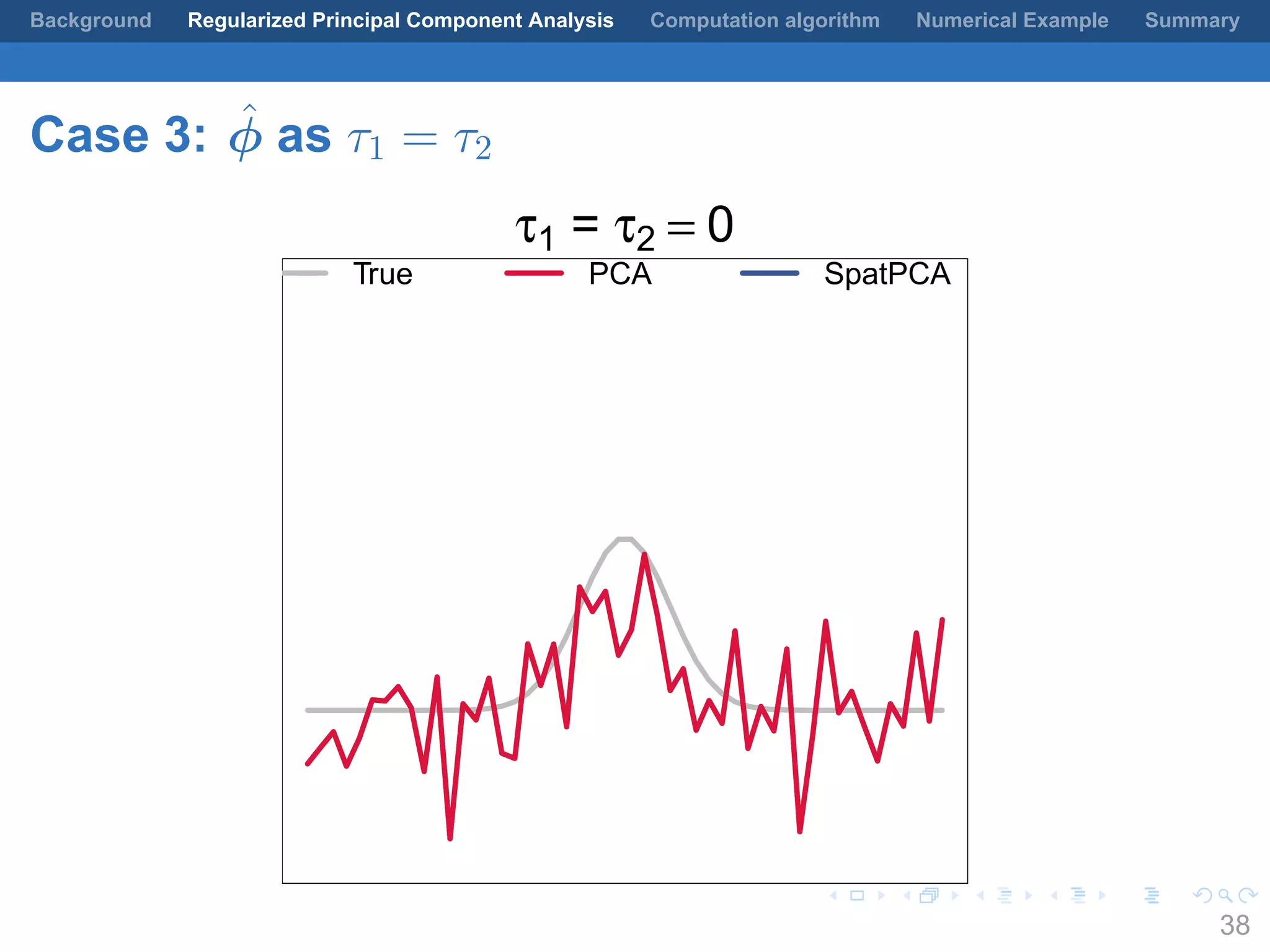
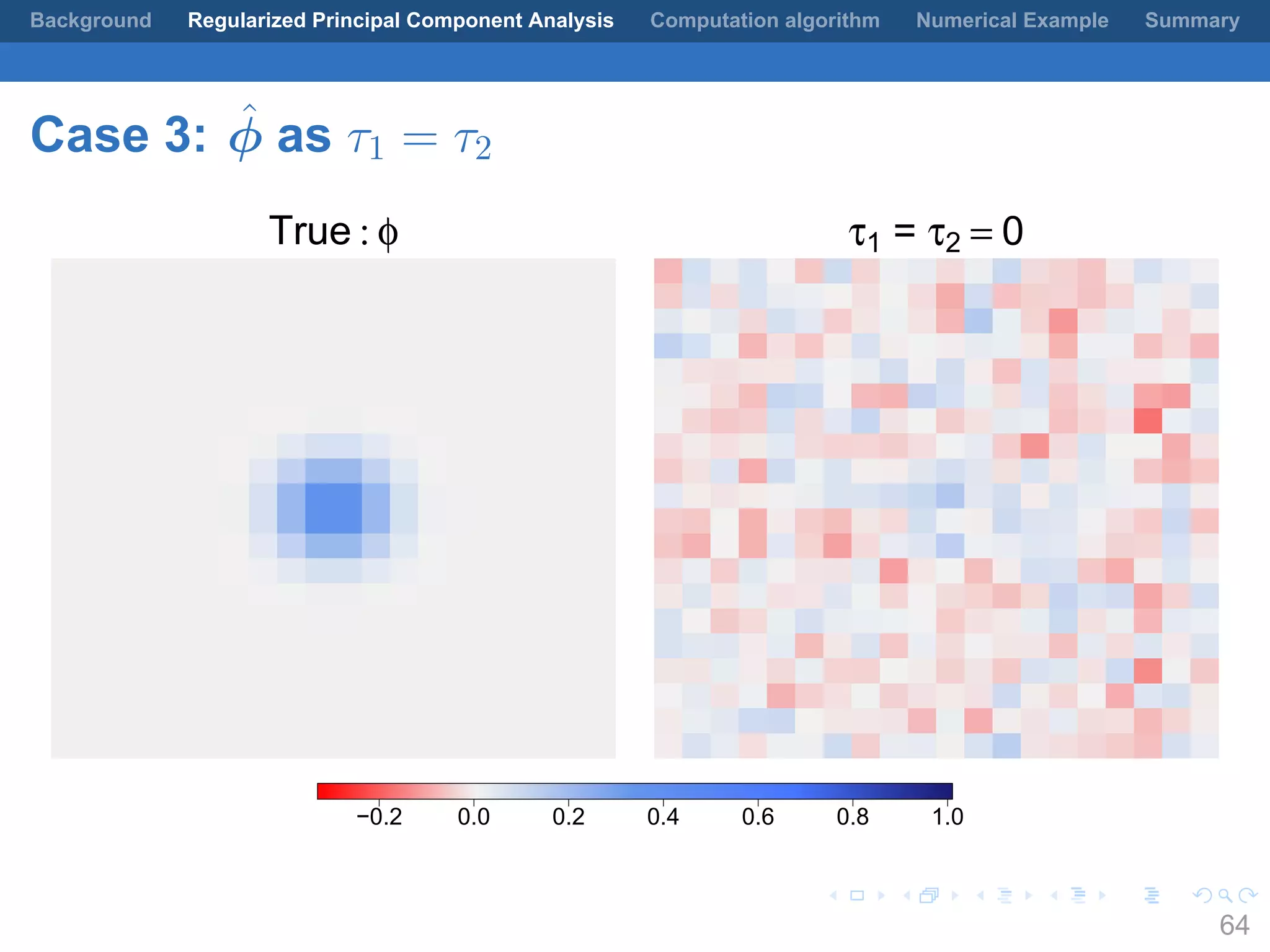
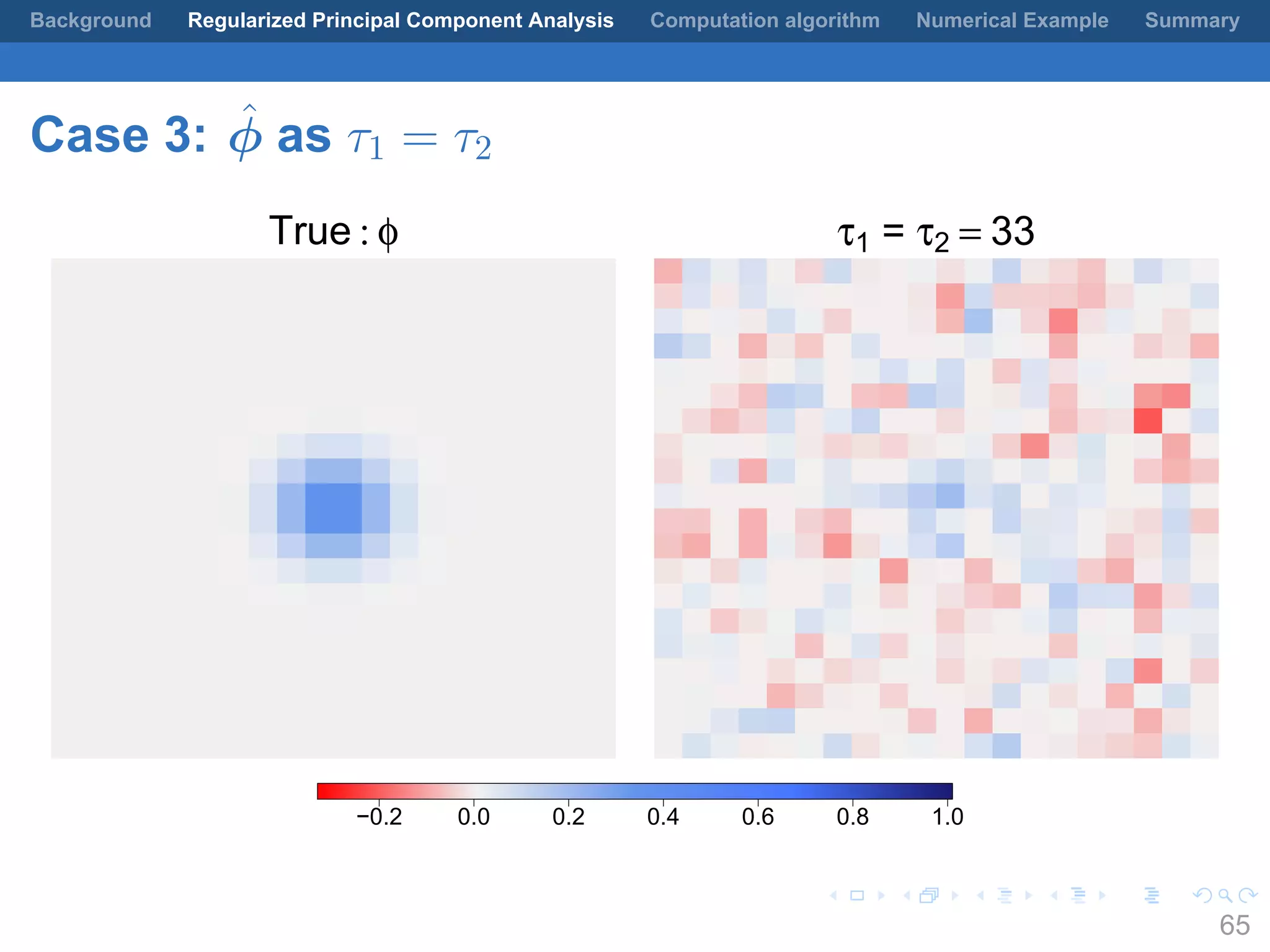
Case 3: ˆϕ as τ1 = τ2
τ1 = τ2 = 0
True PCA SpatPCA
38
.
.
.
.
.
.
.
.
.
.
.
.
.
.
.
.
.
.
.
.
.
.
.
.
.
.
.
.
.
.
.
.
.
.
.
.
.
.
.
.
Background Regularized Principal Component Analysis Computation algorithm Numerical Example Summary
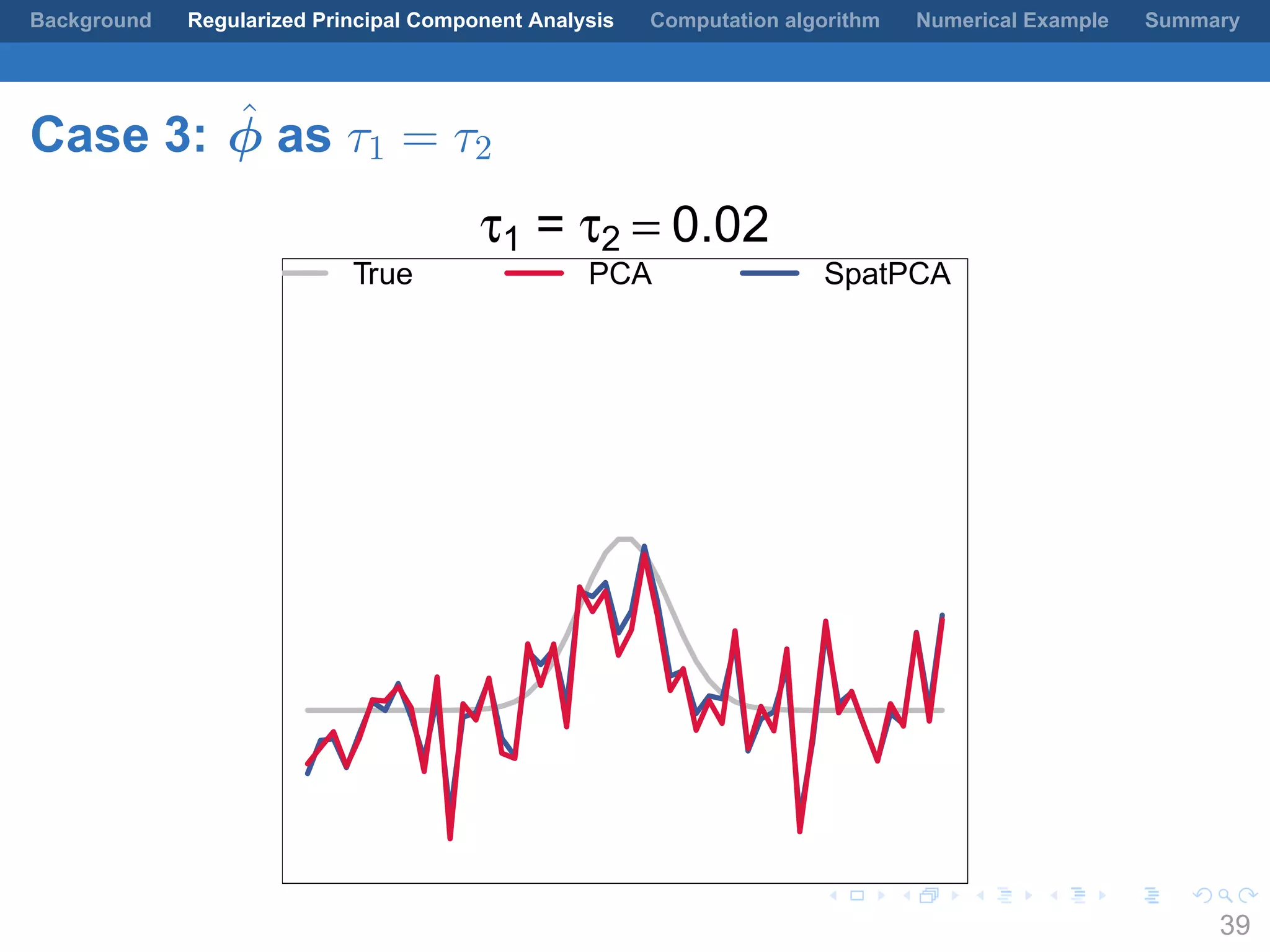
Case 3: ˆϕ as τ1 = τ2
τ1 = τ2 = 0.02
True PCA SpatPCA
39
.
.
.
.
.
.
.
.
.
.
.
.
.
.
.
.
.
.
.
.
.
.
.
.
.
.
.
.
.
.
.
.
.
.
.
.
.
.
.
.
Background Regularized Principal Component Analysis Computation algorithm Numerical Example Summary
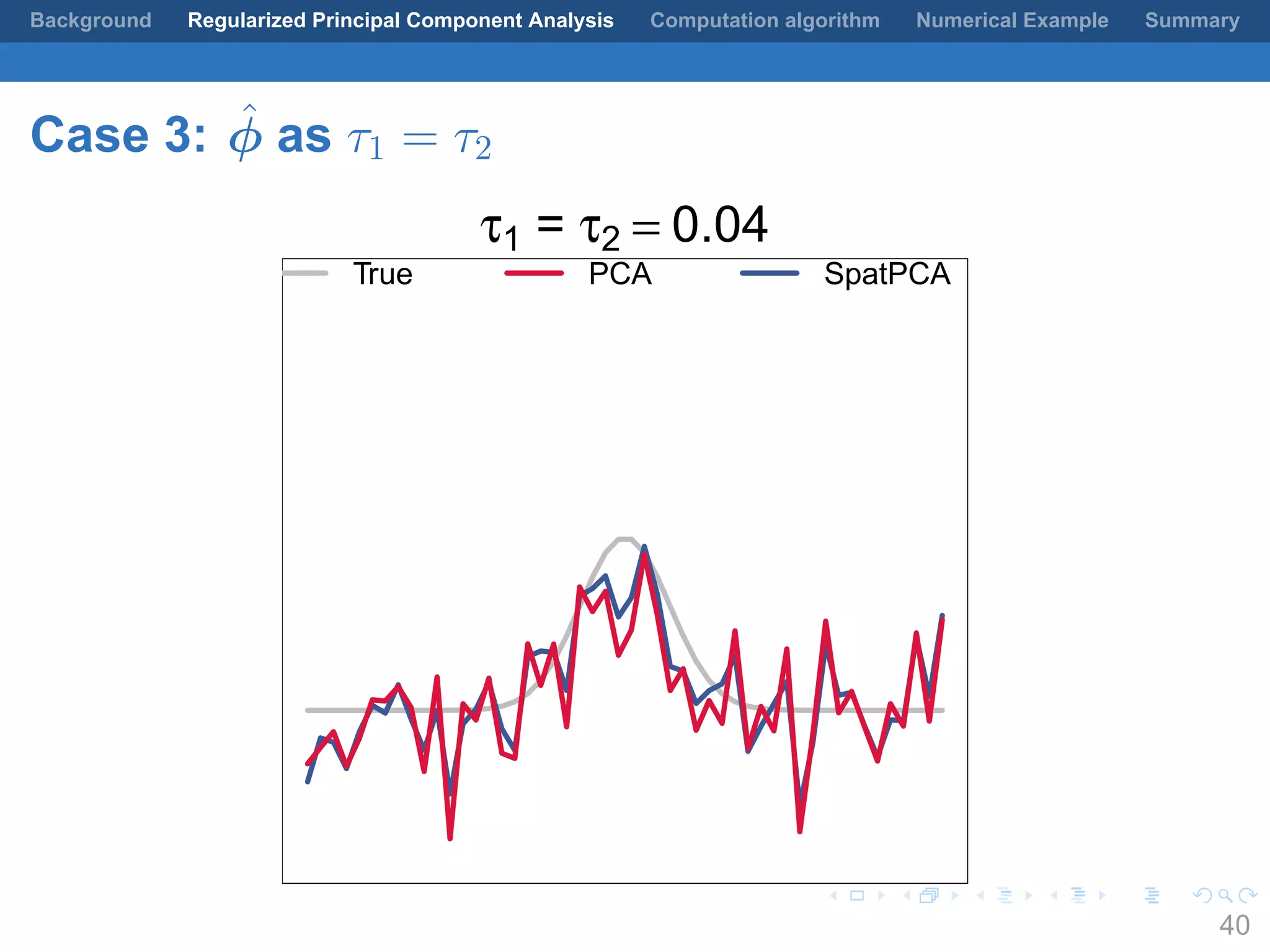
Case 3: ˆϕ as τ1 = τ2
τ1 = τ2 = 0.04
True PCA SpatPCA
40
.
.
.
.
.
.
.
.
.
.
.
.
.
.
.
.
.
.
.
.
.
.
.
.
.
.
.
.
.
.
.
.
.
.
.
.
.
.
.
.
Background Regularized Principal Component Analysis Computation algorithm Numerical Example Summary
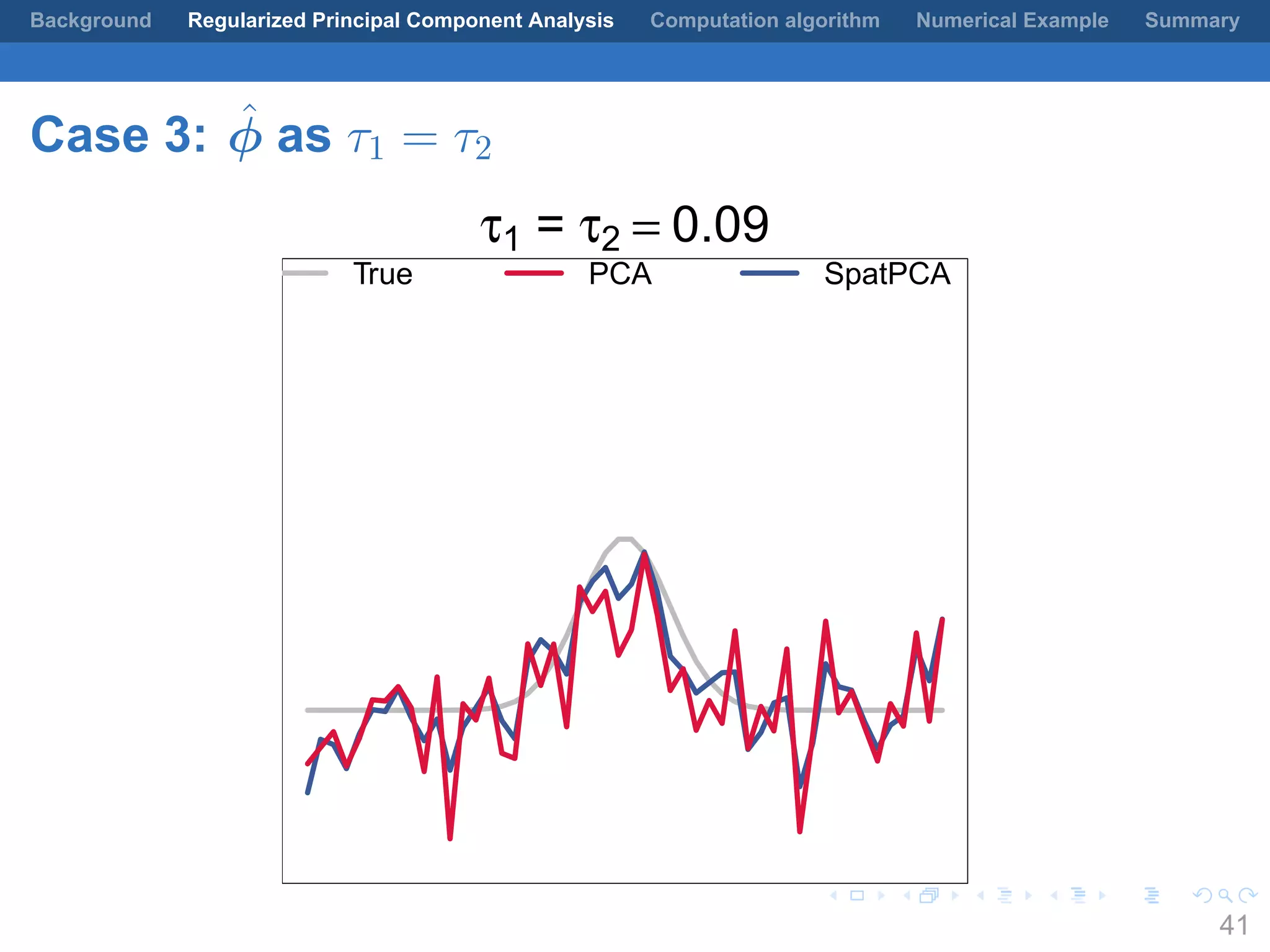
Case 3: ˆϕ as τ1 = τ2
τ1 = τ2 = 0.09
True PCA SpatPCA
41
.
.
.
.
.
.
.
.
.
.
.
.
.
.
.
.
.
.
.
.
.
.
.
.
.
.
.
.
.
.
.
.
.
.
.
.
.
.
.
.
Background Regularized Principal Component Analysis Computation algorithm Numerical Example Summary
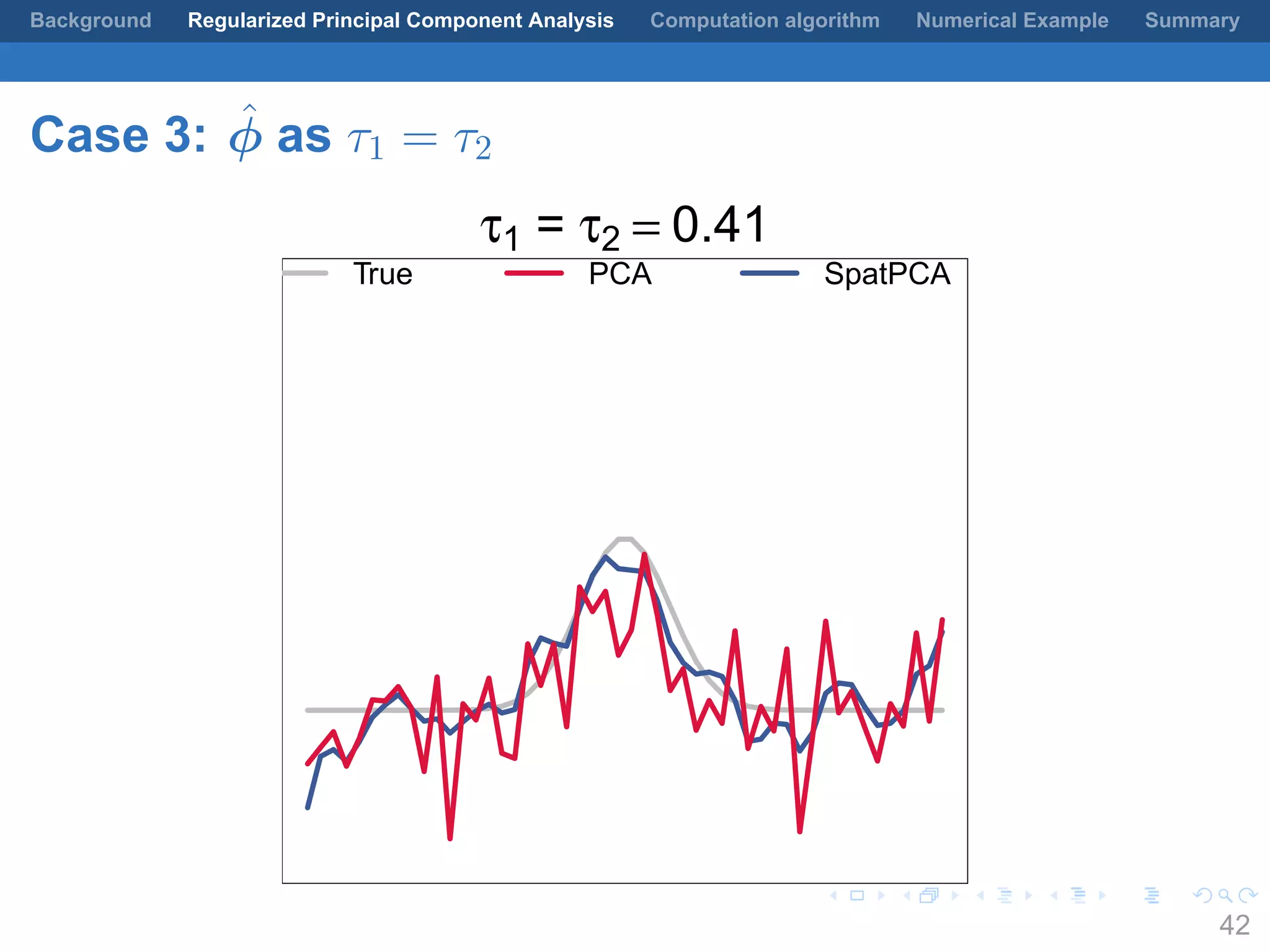
Case 3: ˆϕ as τ1 = τ2
τ1 = τ2 = 0.41
True PCA SpatPCA
42
.
.
.
.
.
.
.
.
.
.
.
.
.
.
.
.
.
.
.
.
.
.
.
.
.
.
.
.
.
.
.
.
.
.
.
.
.
.
.
.
Background Regularized Principal Component Analysis Computation algorithm Numerical Example Summary
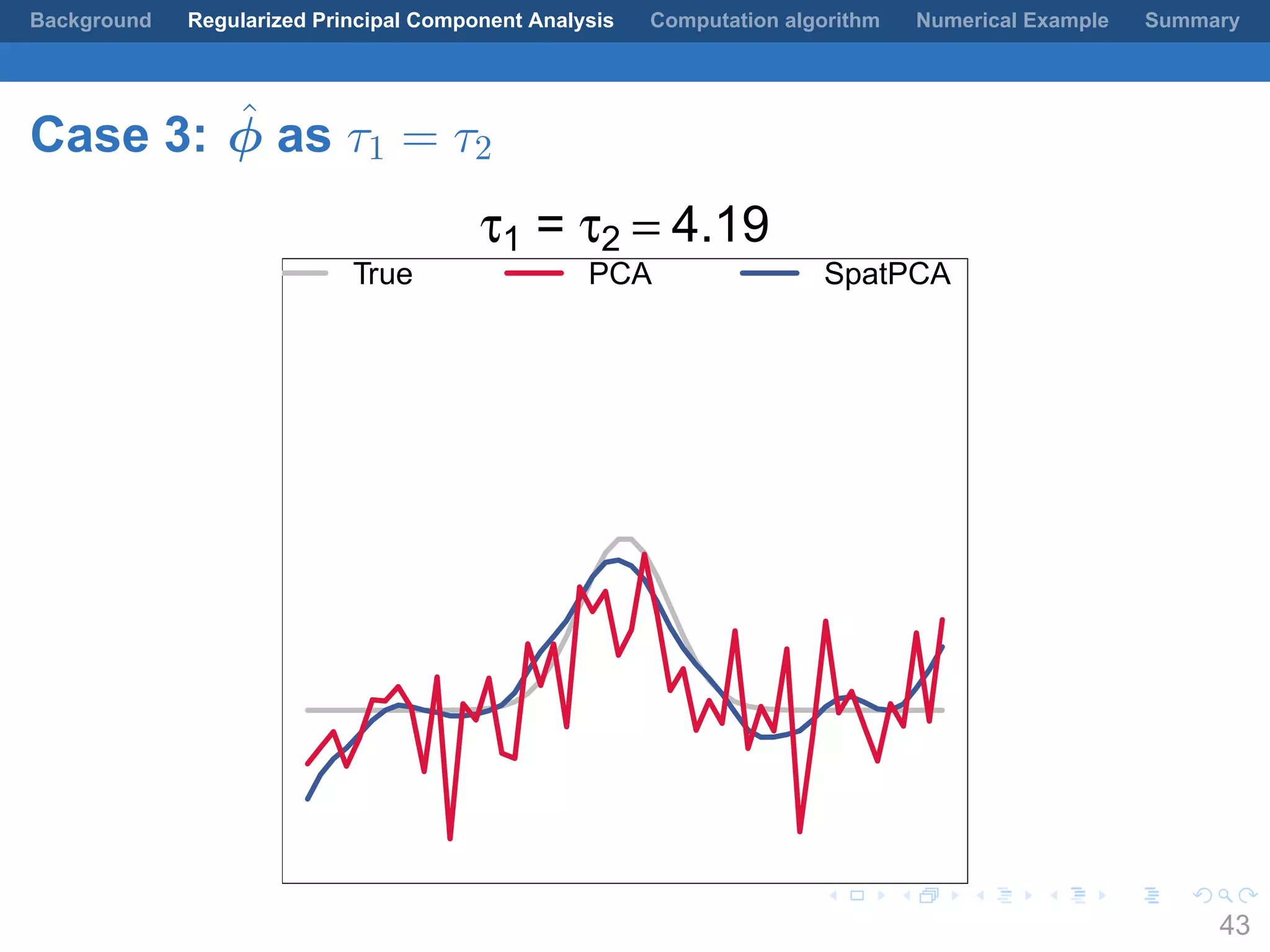
Case 3: ˆϕ as τ1 = τ2
τ1 = τ2 = 4.19
True PCA SpatPCA
43
.
.
.
.
.
.
.
.
.
.
.
.
.
.
.
.
.
.
.
.
.
.
.
.
.
.
.
.
.
.
.
.
.
.
.
.
.
.
.
.
Background Regularized Principal Component Analysis Computation algorithm Numerical Example Summary
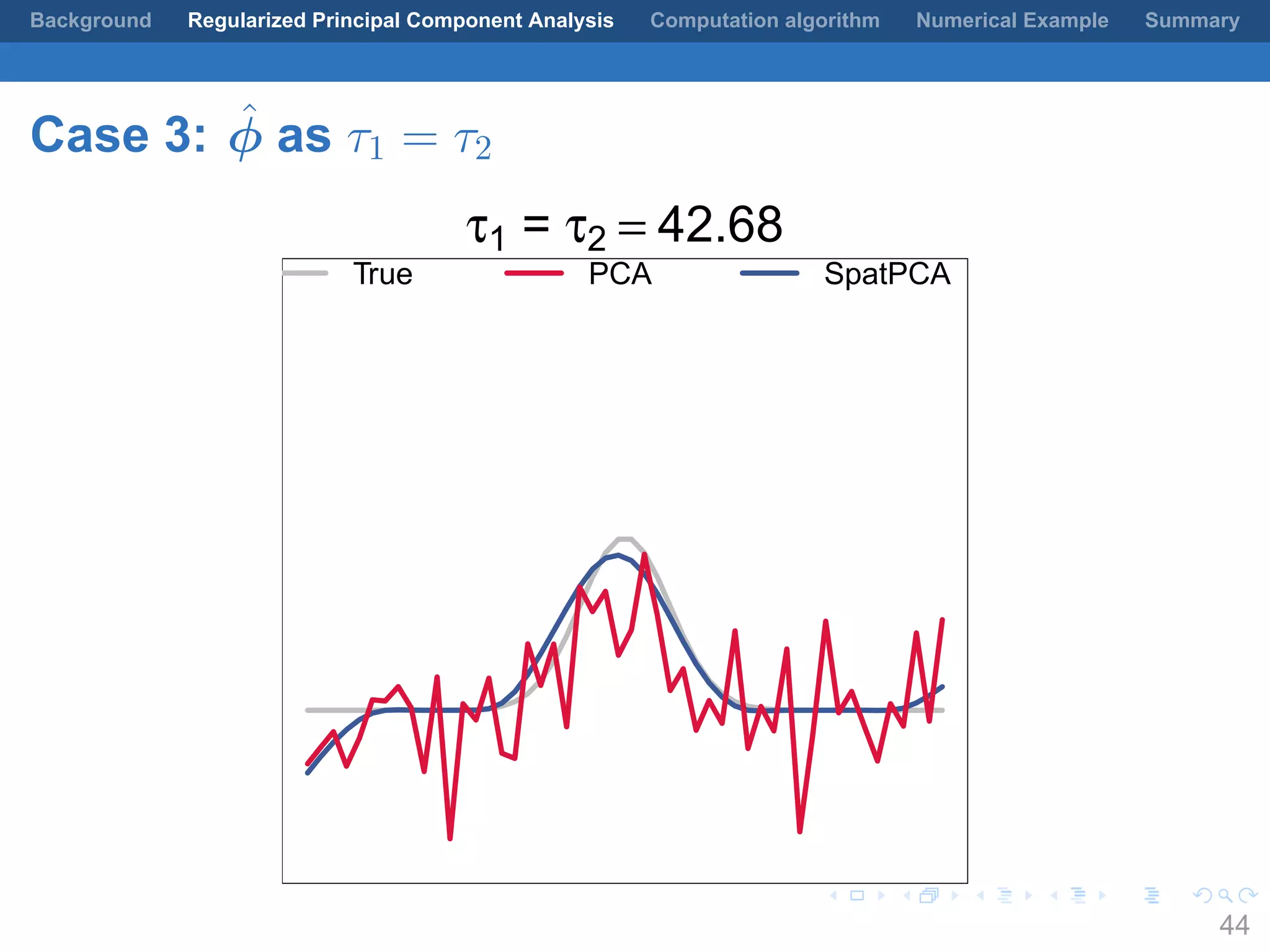
Case 3: ˆϕ as τ1 = τ2
τ1 = τ2 = 42.68
True PCA SpatPCA
44
.
.
.
.
.
.
.
.
.
.
.
.
.
.
.
.
.
.
.
.
.
.
.
.
.
.
.
.
.
.
.
.
.
.
.
.
.
.
.
.
Background Regularized Principal Component Analysis Computation algorithm Numerical Example Summary
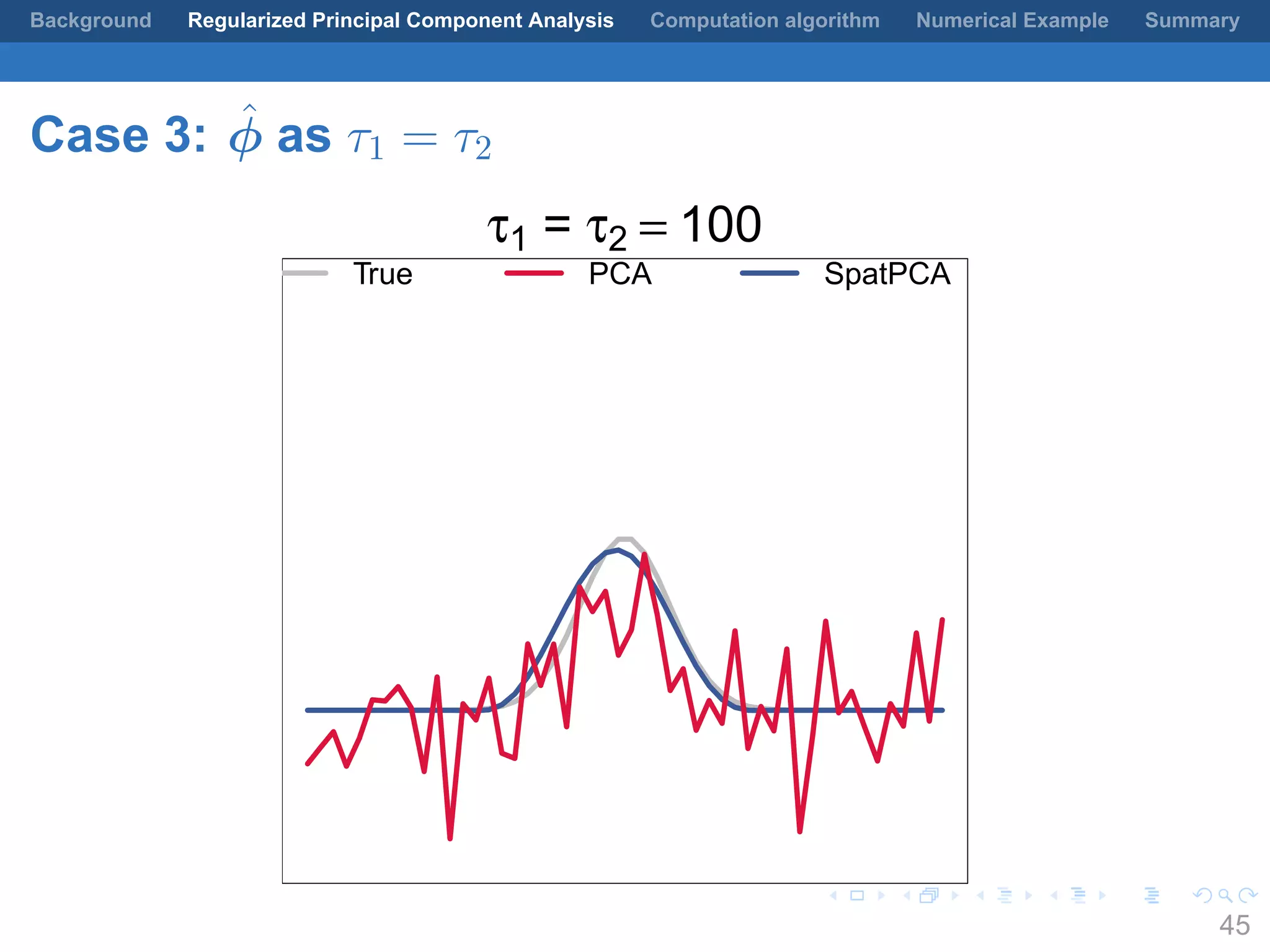
Case 3: ˆϕ as τ1 = τ2
τ1 = τ2 = 100
True PCA SpatPCA
45
.
.
.
.
.
.
.
.
.
.
.
.
.
.
.
.
.
.
.
.
.
.
.
.
.
.
.
.
.
.
.
.
.
.
.
.
.
.
.
.
Background Regularized Principal Component Analysis Computation algorithm Numerical Example Summary
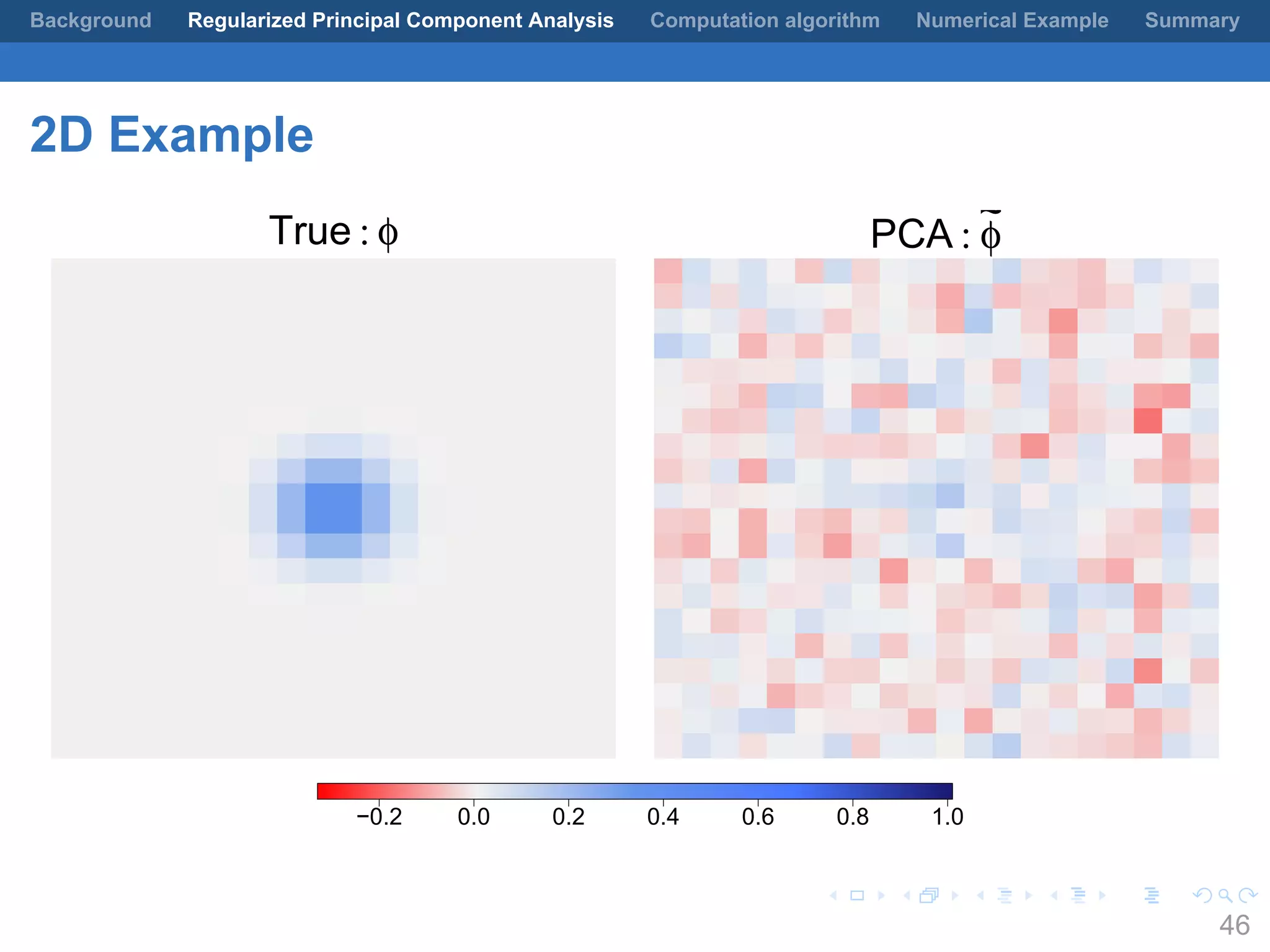
2D Example
True : φ PCA : φ
~
−0.2 0.0 0.2 0.4 0.6 0.8 1.0
46
.
.
.
.
.
.
.
.
.
.
.
.
.
.
.
.
.
.
.
.
.
.
.
.
.
.
.
.
.
.
.
.
.
.
.
.
.
.
.
.
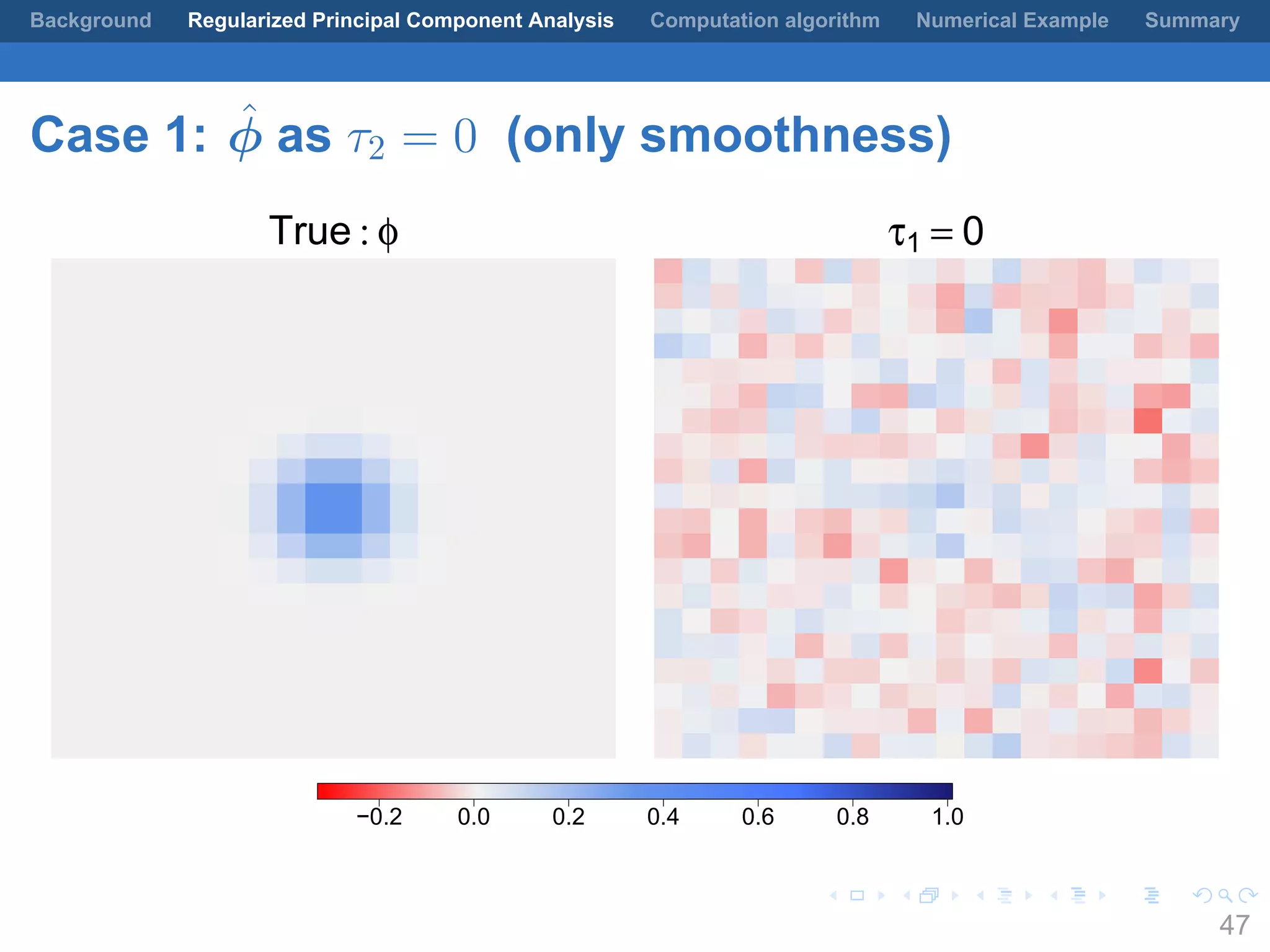
Background Regularized Principal Component Analysis Computation algorithm Numerical Example Summary
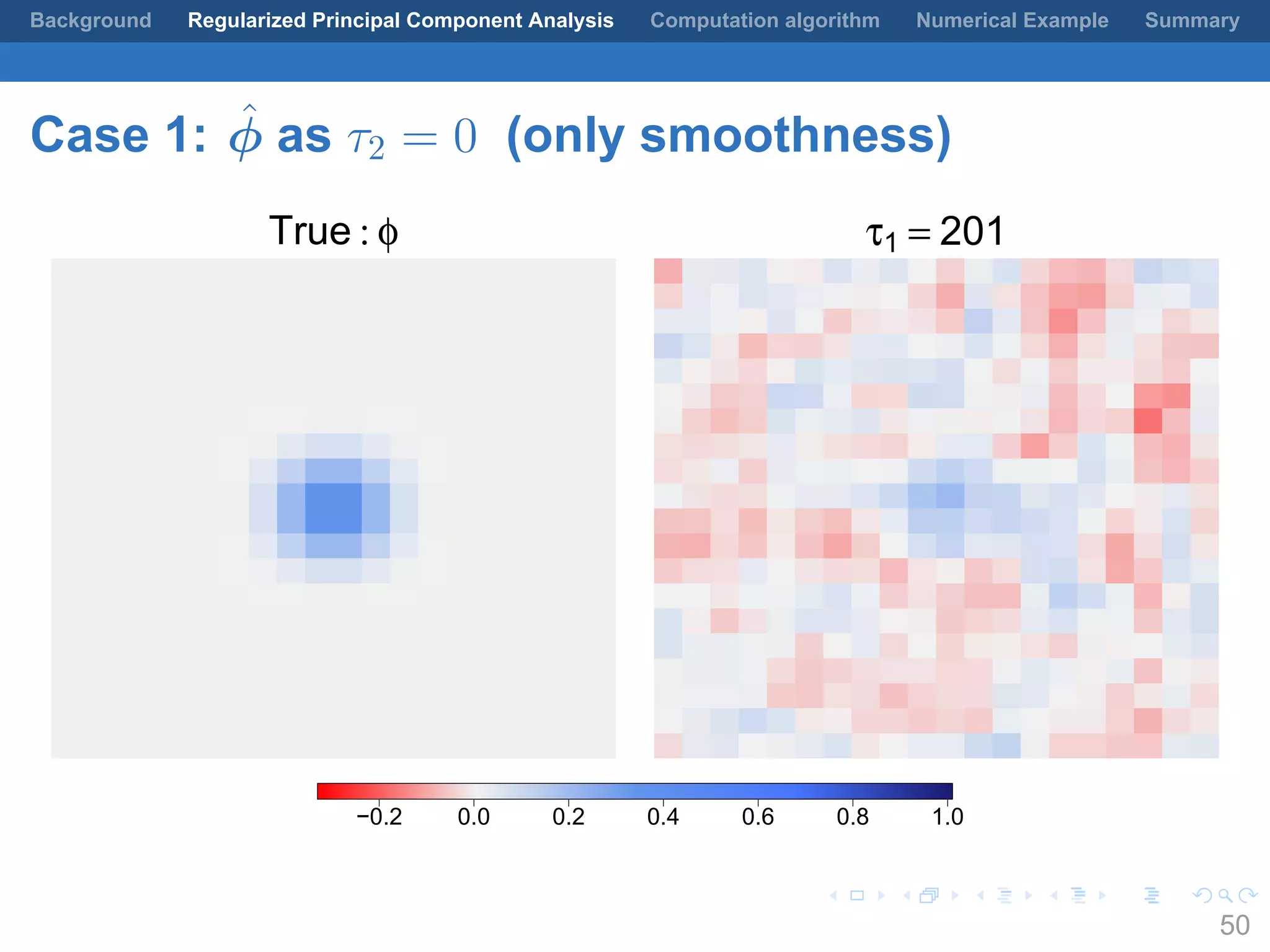
Case 1: ˆϕ as τ2 = 0 (only smoothness)
True : φ τ1 = 0
−0.2 0.0 0.2 0.4 0.6 0.8 1.0
47
.
.
.
.
.
.
.
.
.
.
.
.
.
.
.
.
.
.
.
.
.
.
.
.
.
.
.
.
.
.
.
.
.
.
.
.
.
.
.
.
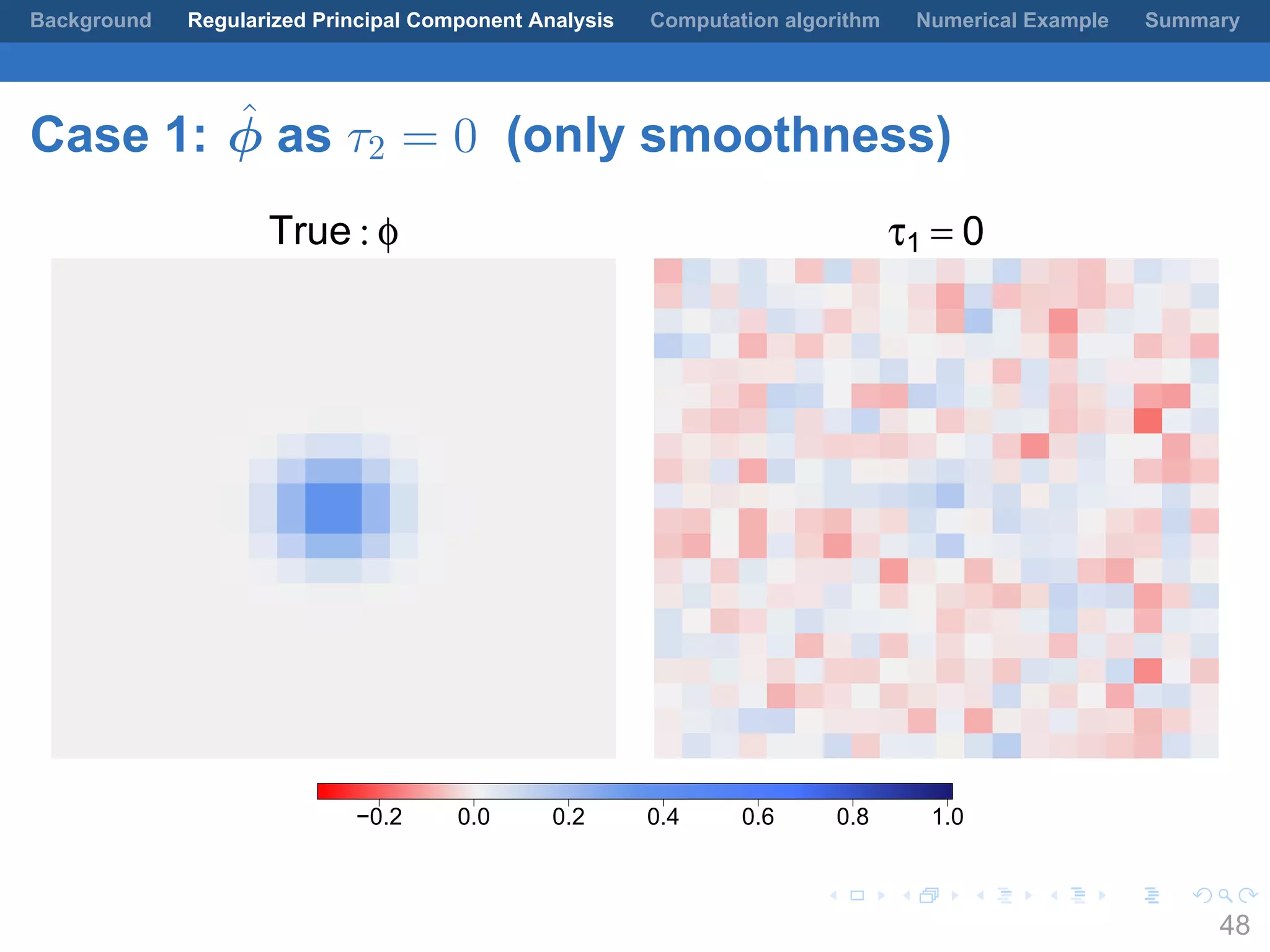
Background Regularized Principal Component Analysis Computation algorithm Numerical Example Summary
Case 1: ˆϕ as τ2 = 0 (only smoothness)
True : φ τ1 = 0
−0.2 0.0 0.2 0.4 0.6 0.8 1.0
48
.
.
.
.
.
.
.
.
.
.
.
.
.
.
.
.
.
.
.
.
.
.
.
.
.
.
.
.
.
.
.
.
.
.
.
.
.
.
.
.
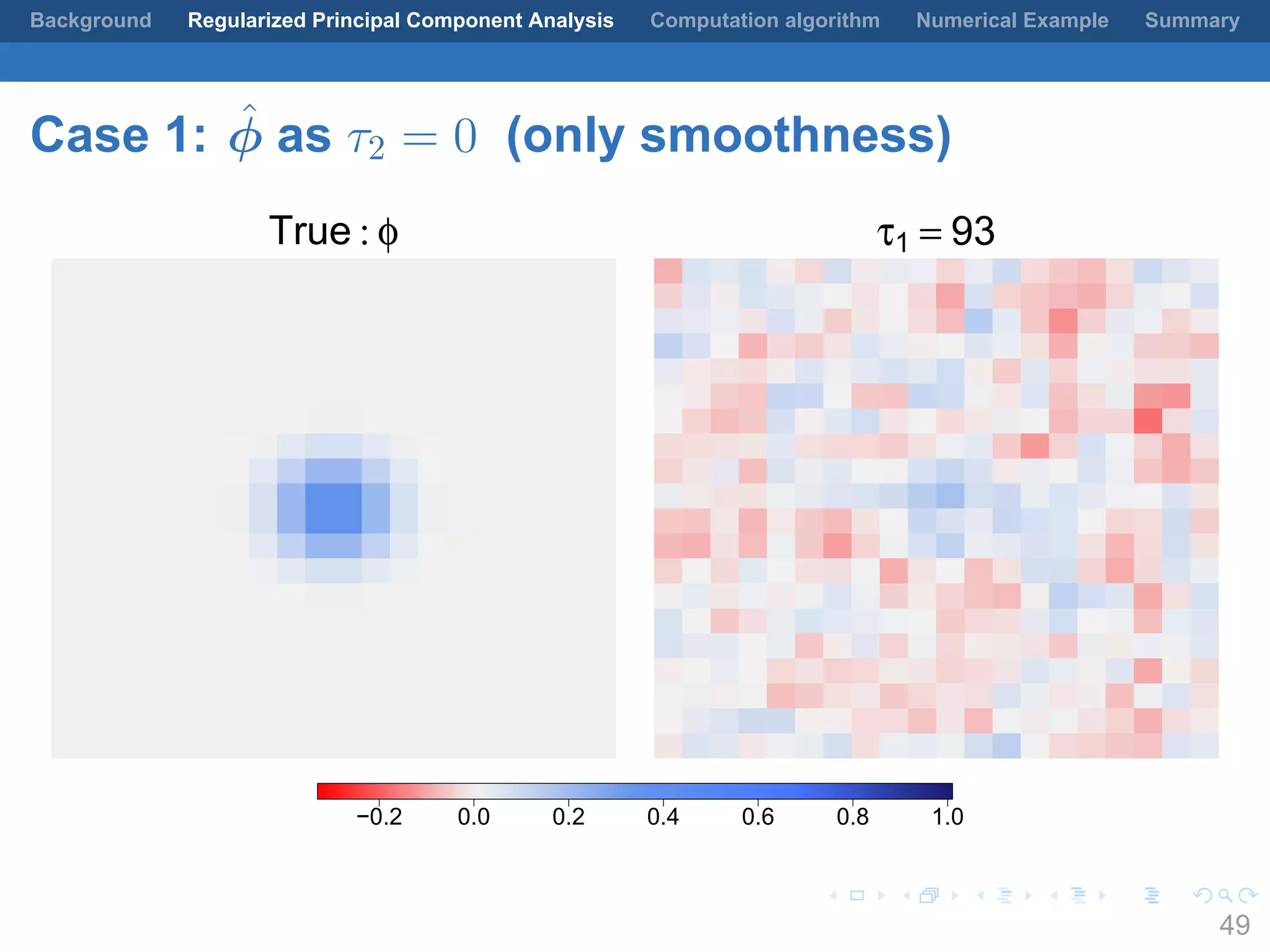
Background Regularized Principal Component Analysis Computation algorithm Numerical Example Summary
Case 1: ˆϕ as τ2 = 0 (only smoothness)
True : φ τ1 = 93
−0.2 0.0 0.2 0.4 0.6 0.8 1.0
49
.
.
.
.
.
.
.
.
.
.
.
.
.
.
.
.
.
.
.
.
.
.
.
.
.
.
.
.
.
.
.
.
.
.
.
.
.
.
.
.
Background Regularized Principal Component Analysis Computation algorithm Numerical Example Summary
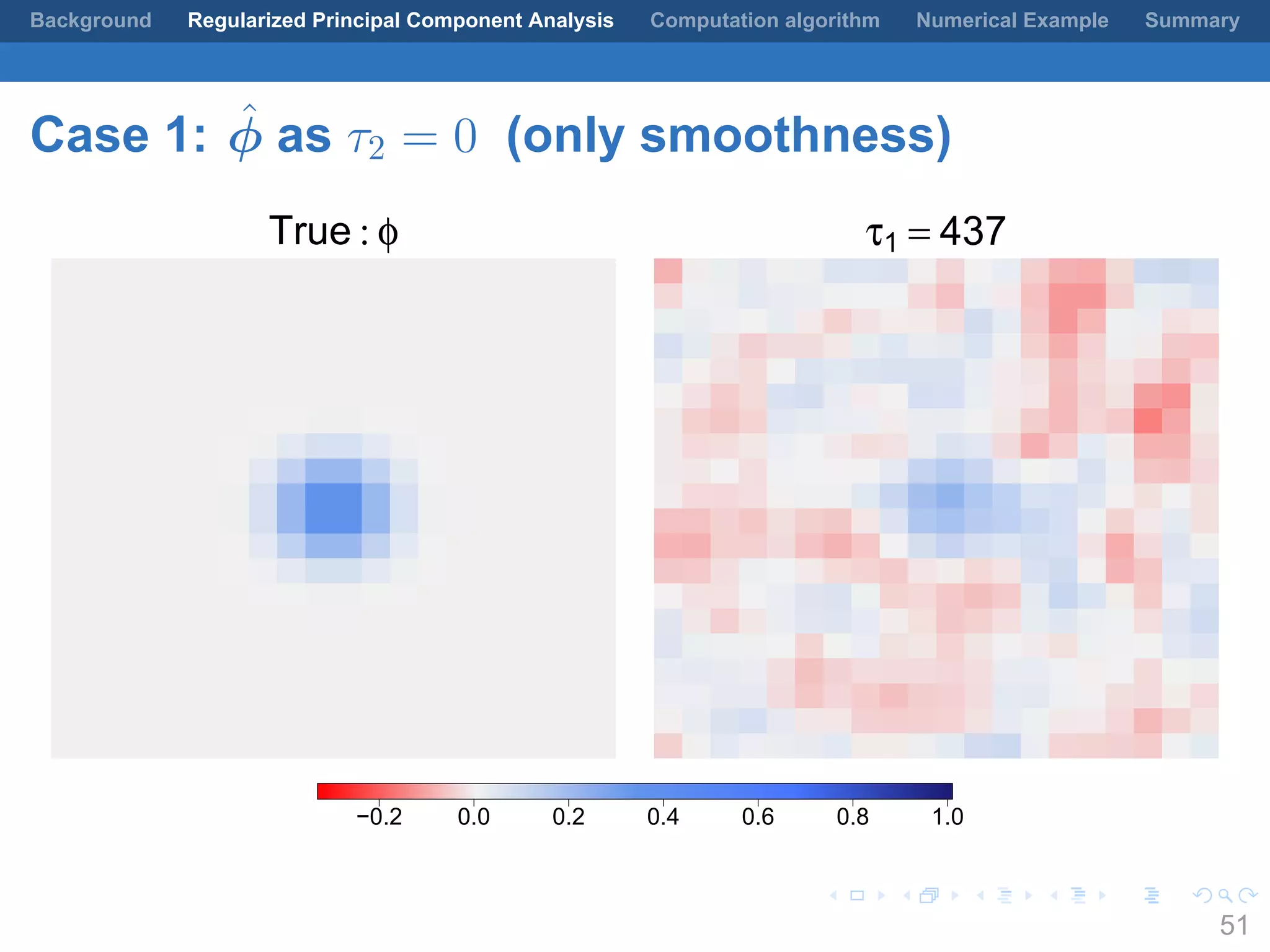
Case 1: ˆϕ as τ2 = 0 (only smoothness)
True : φ τ1 = 201
−0.2 0.0 0.2 0.4 0.6 0.8 1.0
50
.
.
.
.
.
.
.
.
.
.
.
.
.
.
.
.
.
.
.
.
.
.
.
.
.
.
.
.
.
.
.
.
.
.
.
.
.
.
.
.
Background Regularized Principal Component Analysis Computation algorithm Numerical Example Summary
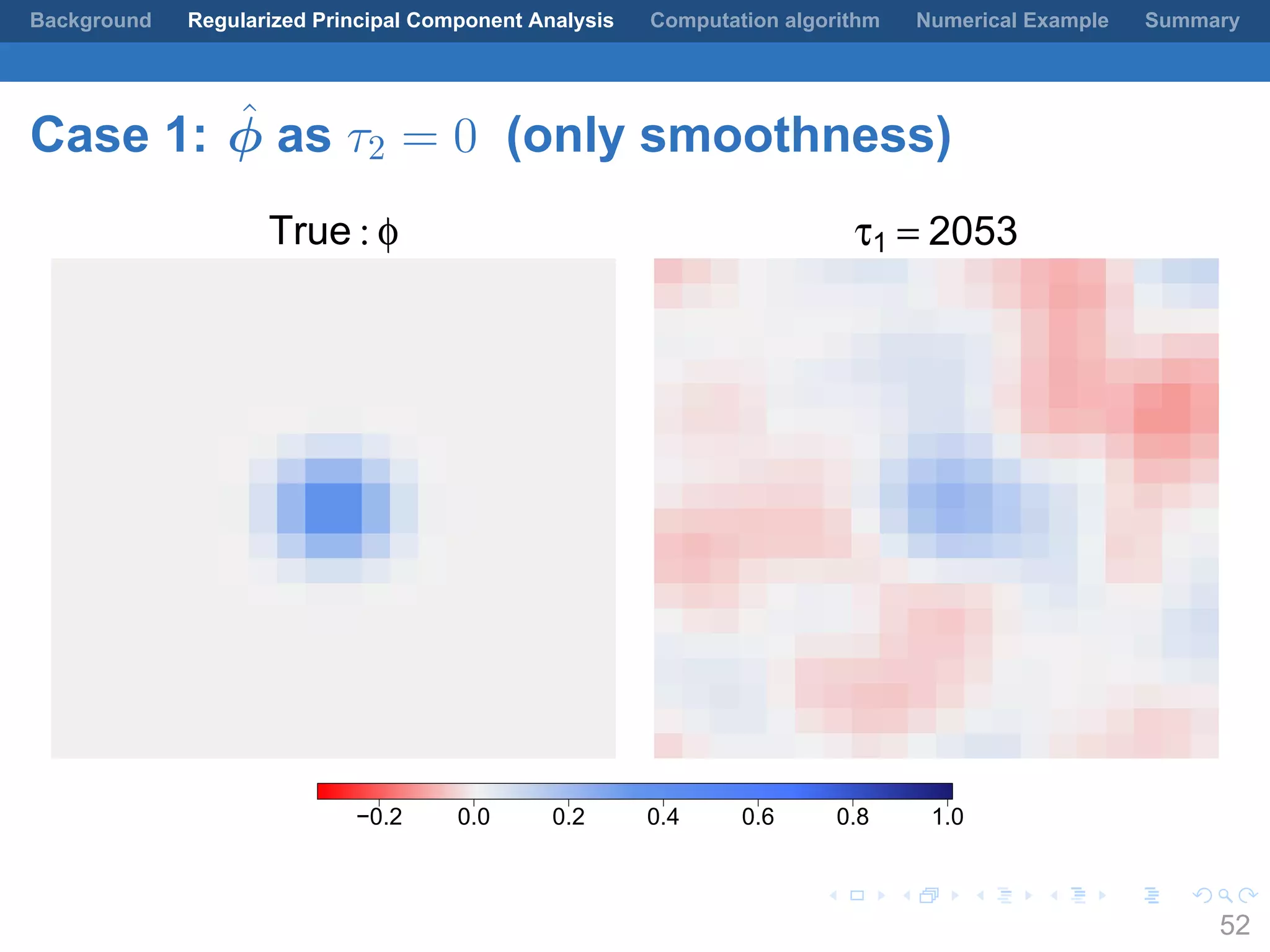
Case 1: ˆϕ as τ2 = 0 (only smoothness)
True : φ τ1 = 437
−0.2 0.0 0.2 0.4 0.6 0.8 1.0
51
.
.
.
.
.
.
.
.
.
.
.
.
.
.
.
.
.
.
.
.
.
.
.
.
.
.
.
.
.
.
.
.
.
.
.
.
.
.
.
.
Background Regularized Principal Component Analysis Computation algorithm Numerical Example Summary
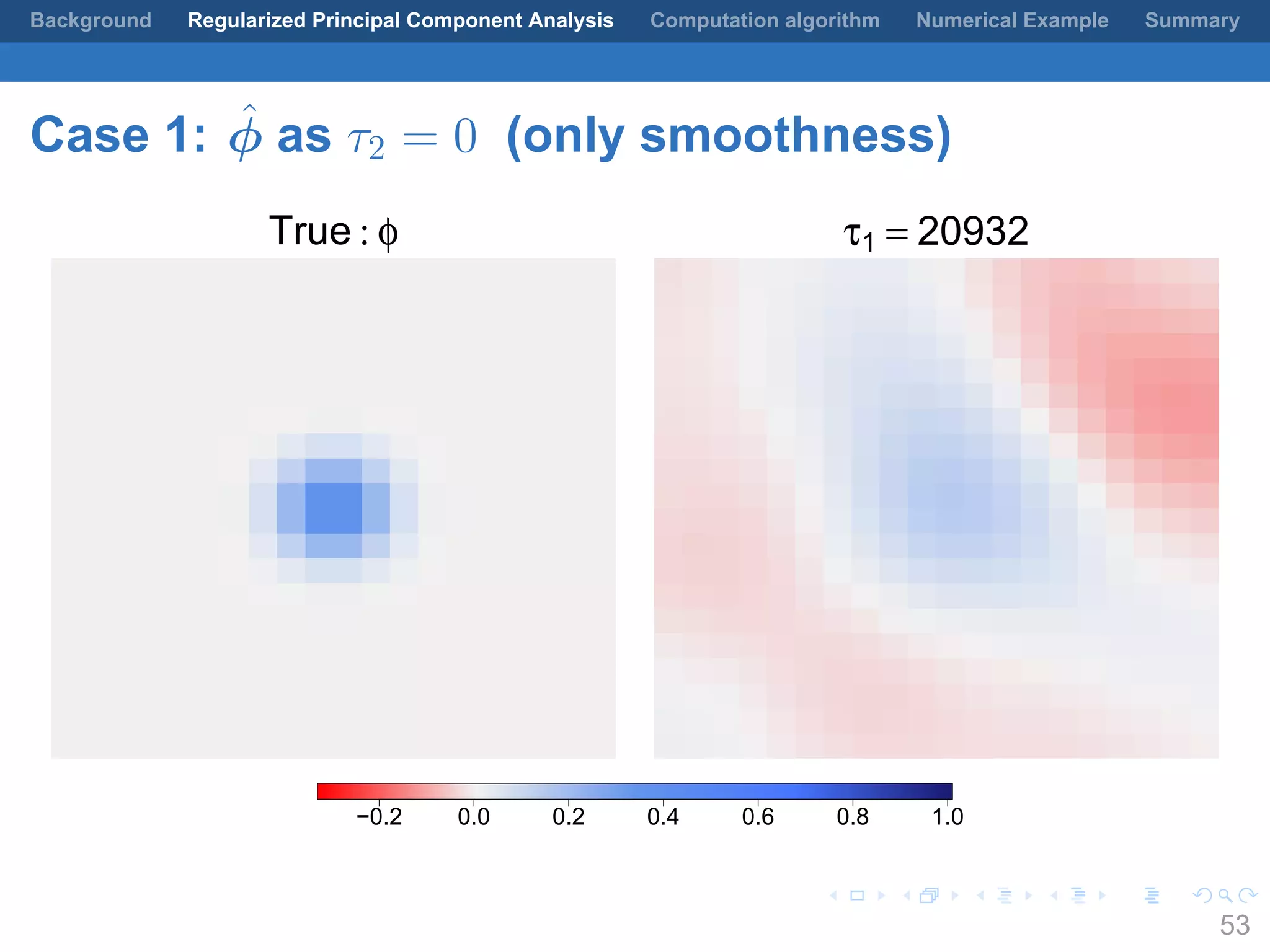
Case 1: ˆϕ as τ2 = 0 (only smoothness)
True : φ τ1 = 2053
−0.2 0.0 0.2 0.4 0.6 0.8 1.0
52
.
.
.
.
.
.
.
.
.
.
.
.
.
.
.
.
.
.
.
.
.
.
.
.
.
.
.
.
.
.
.
.
.
.
.
.
.
.
.
.
Background Regularized Principal Component Analysis Computation algorithm Numerical Example Summary
Case 1: ˆϕ as τ2 = 0 (only smoothness)
True : φ τ1 = 20932
−0.2 0.0 0.2 0.4 0.6 0.8 1.0
53
.
.
.
.
.
.
.
.
.
.
.
.
.
.
.
.
.
.
.
.
.
.
.
.
.
.
.
.
.
.
.
.
.
.
.
.
.
.
.
.
Background Regularized Principal Component Analysis Computation algorithm Numerical Example Summary
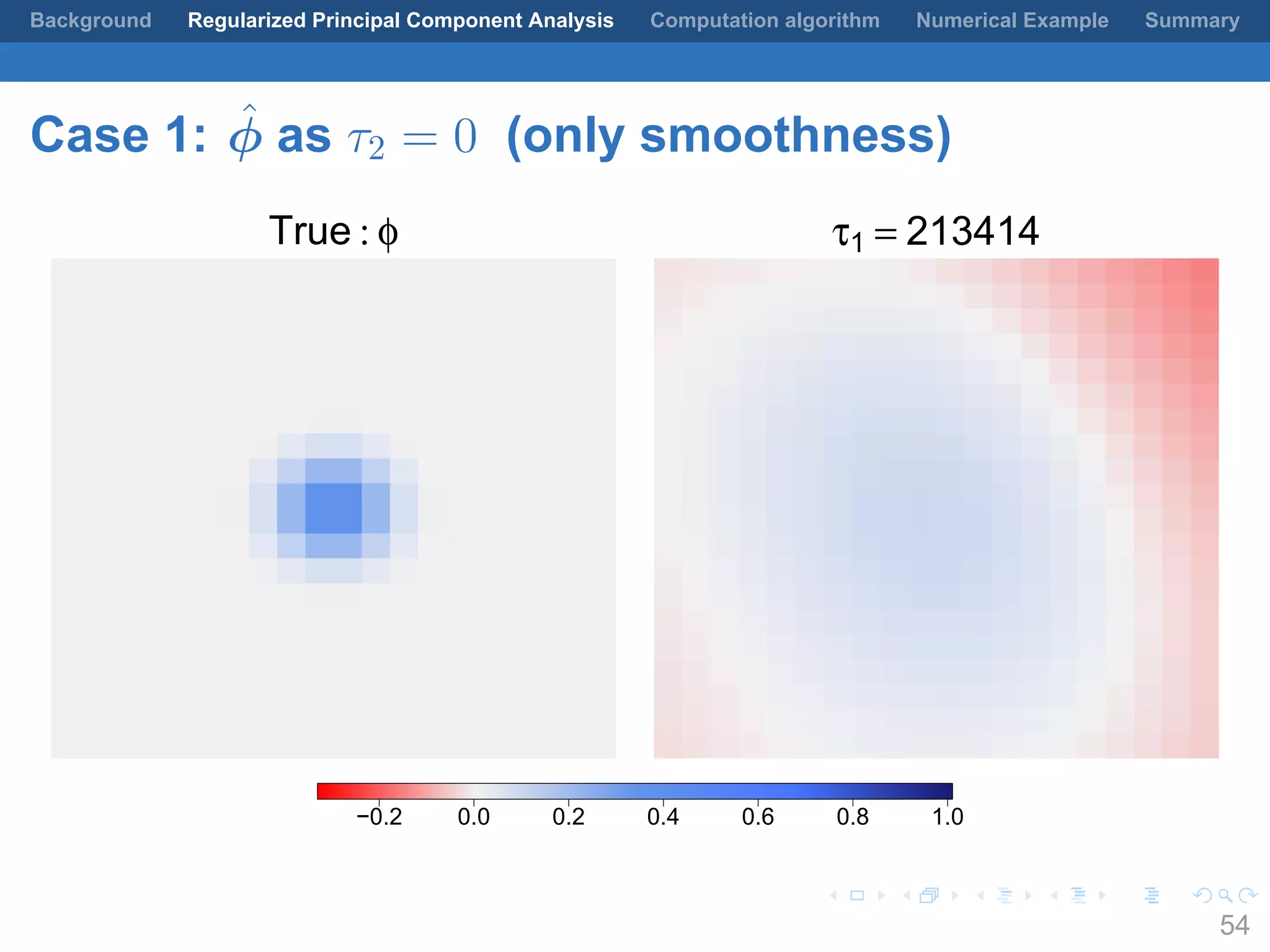
Case 1: ˆϕ as τ2 = 0 (only smoothness)
True : φ τ1 = 213414
−0.2 0.0 0.2 0.4 0.6 0.8 1.0
54
.
.
.
.
.
.
.
.
.
.
.
.
.
.
.
.
.
.
.
.
.
.
.
.
.
.
.
.
.
.
.
.
.
.
.
.
.
.
.
.
Background Regularized Principal Component Analysis Computation algorithm Numerical Example Summary
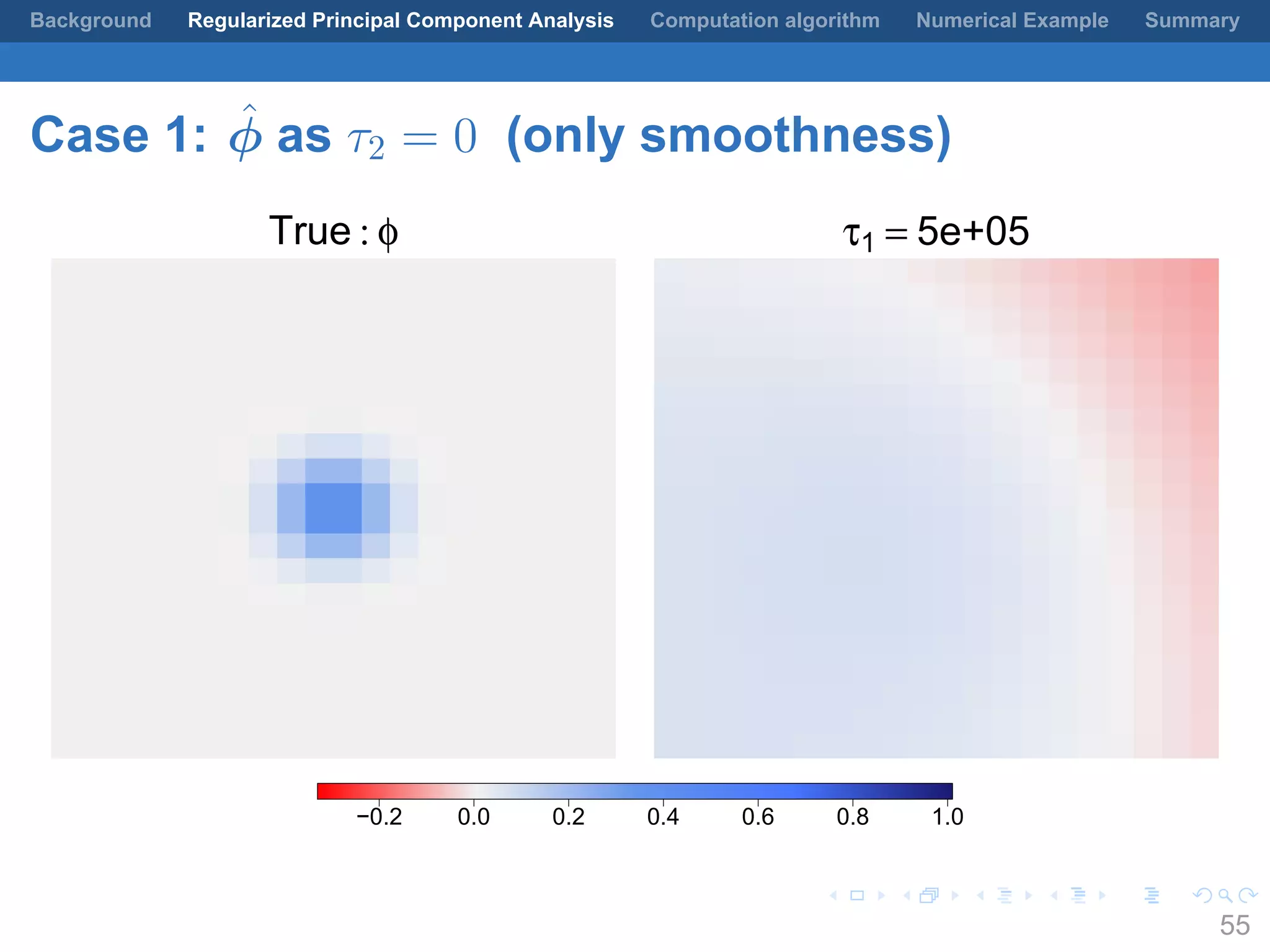
Case 1: ˆϕ as τ2 = 0 (only smoothness)
True : φ τ1 = 5e+05
−0.2 0.0 0.2 0.4 0.6 0.8 1.0
55
.
.
.
.
.
.
.
.
.
.
.
.
.
.
.
.
.
.
.
.
.
.
.
.
.
.
.
.
.
.
.
.
.
.
.
.
.
.
.
.
Background Regularized Principal Component Analysis Computation algorithm Numerical Example Summary
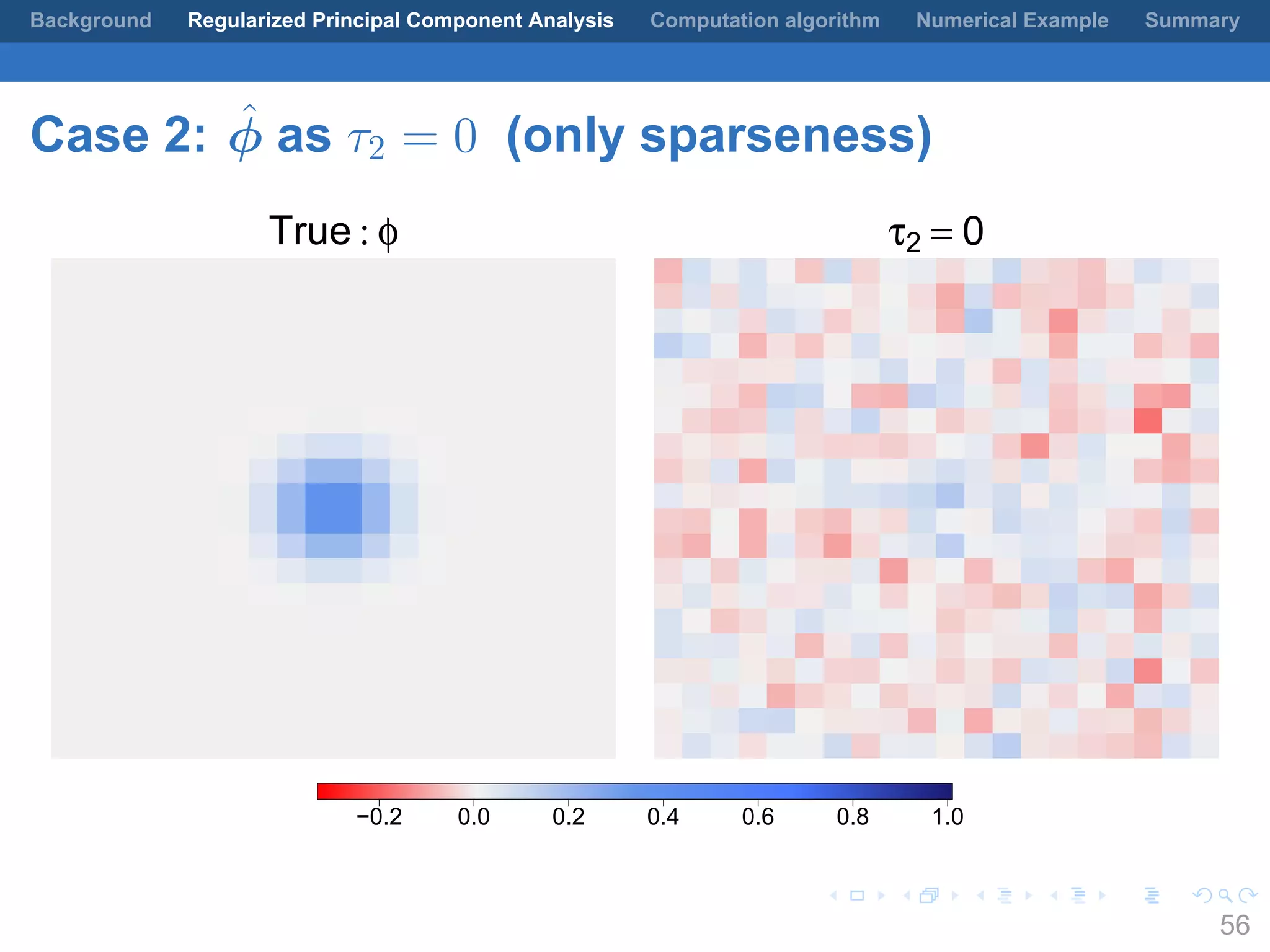
Case 2: ˆϕ as τ2 = 0 (only sparseness)
True : φ τ2 = 0
−0.2 0.0 0.2 0.4 0.6 0.8 1.0
56
.
.
.
.
.
.
.
.
.
.
.
.
.
.
.
.
.
.
.
.
.
.
.
.
.
.
.
.
.
.
.
.
.
.
.
.
.
.
.
.
Background Regularized Principal Component Analysis Computation algorithm Numerical Example Summary
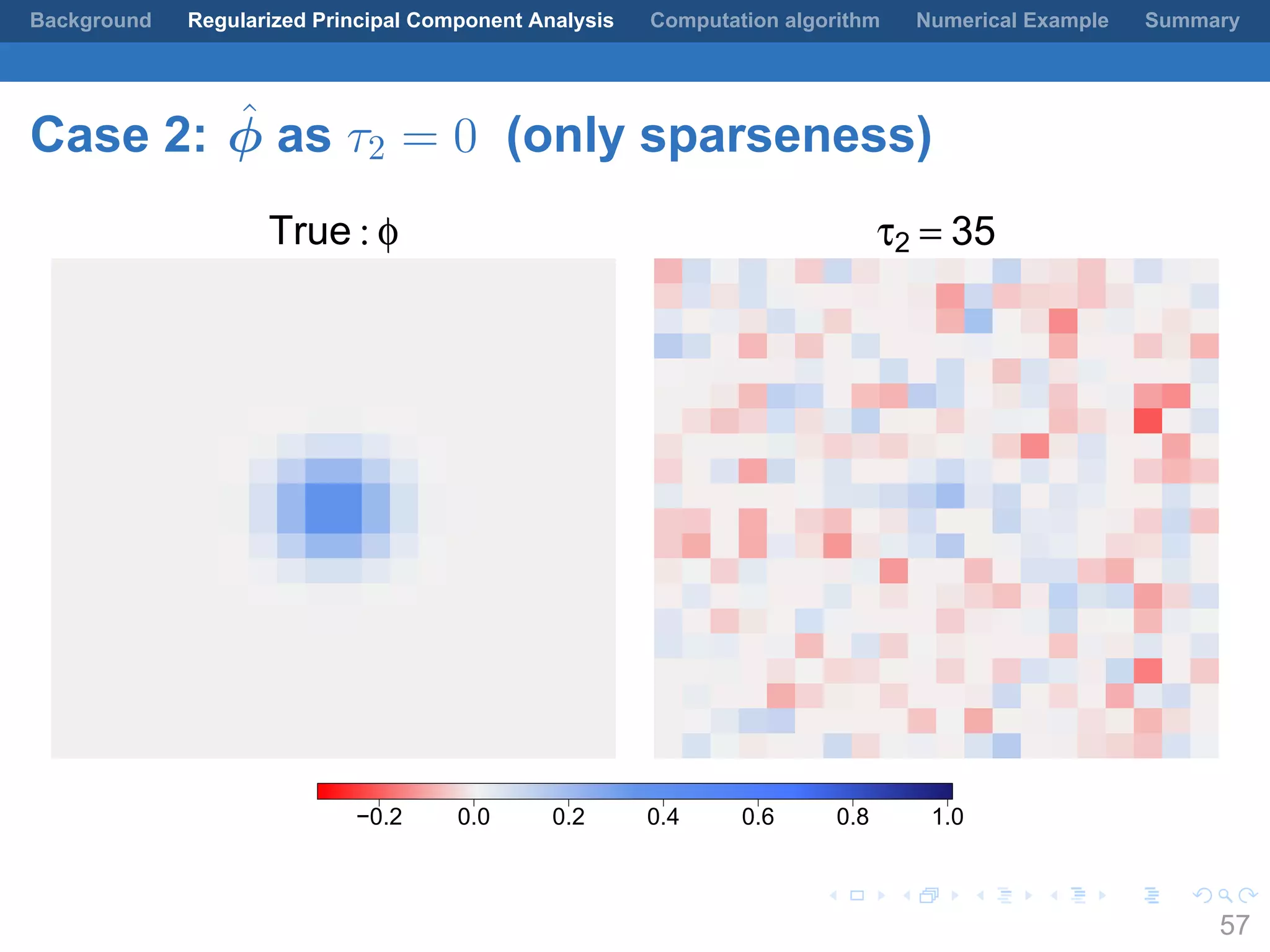
Case 2: ˆϕ as τ2 = 0 (only sparseness)
True : φ τ2 = 35
−0.2 0.0 0.2 0.4 0.6 0.8 1.0
57
.
.
.
.
.
.
.
.
.
.
.
.
.
.
.
.
.
.
.
.
.
.
.
.
.
.
.
.
.
.
.
.
.
.
.
.
.
.
.
.
Background Regularized Principal Component Analysis Computation algorithm Numerical Example Summary
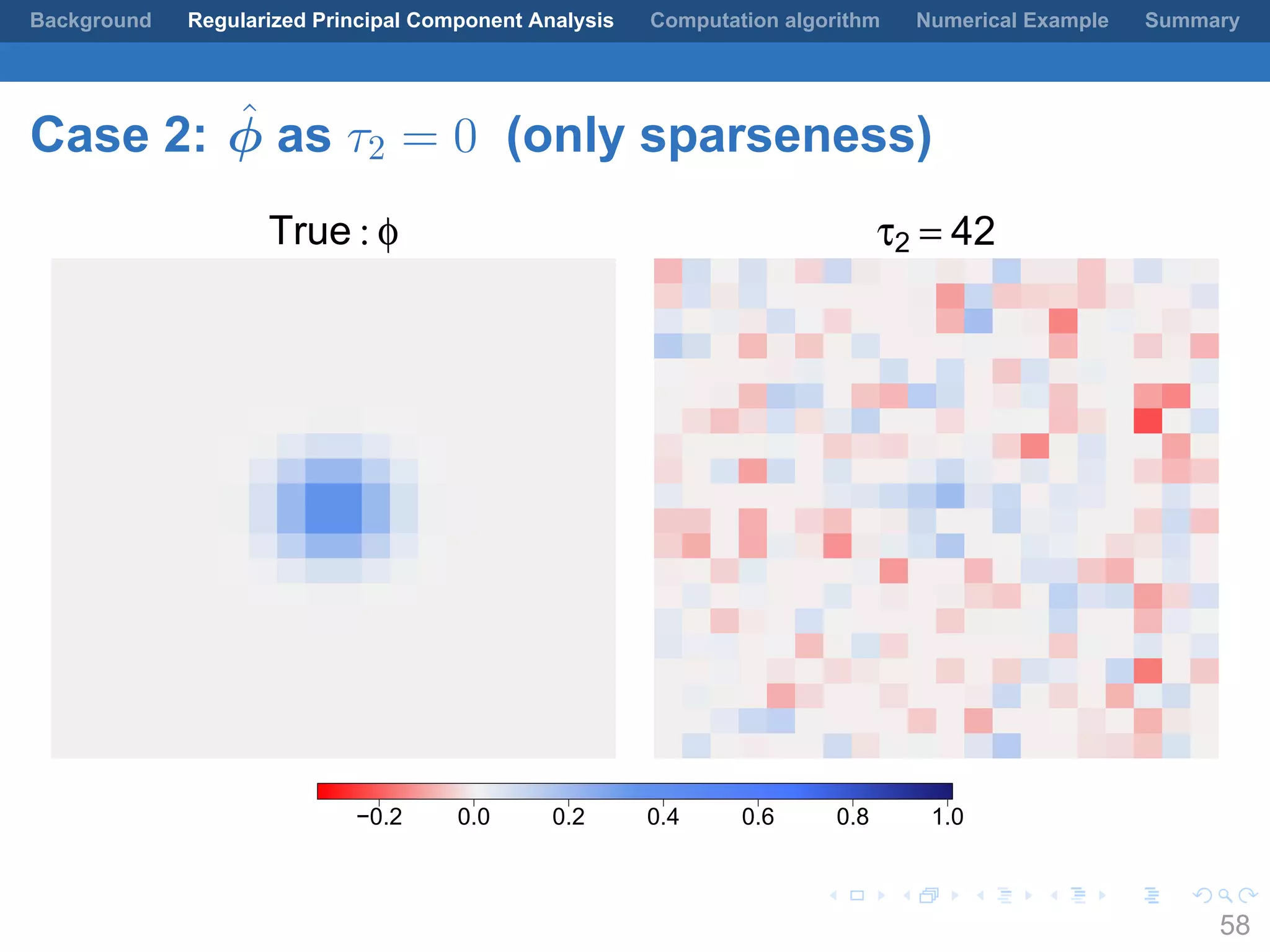
Case 2: ˆϕ as τ2 = 0 (only sparseness)
True : φ τ2 = 42
−0.2 0.0 0.2 0.4 0.6 0.8 1.0
58
.
.
.
.
.
.
.
.
.
.
.
.
.
.
.
.
.
.
.
.
.
.
.
.
.
.
.
.
.
.
.
.
.
.
.
.
.
.
.
.
Background Regularized Principal Component Analysis Computation algorithm Numerical Example Summary
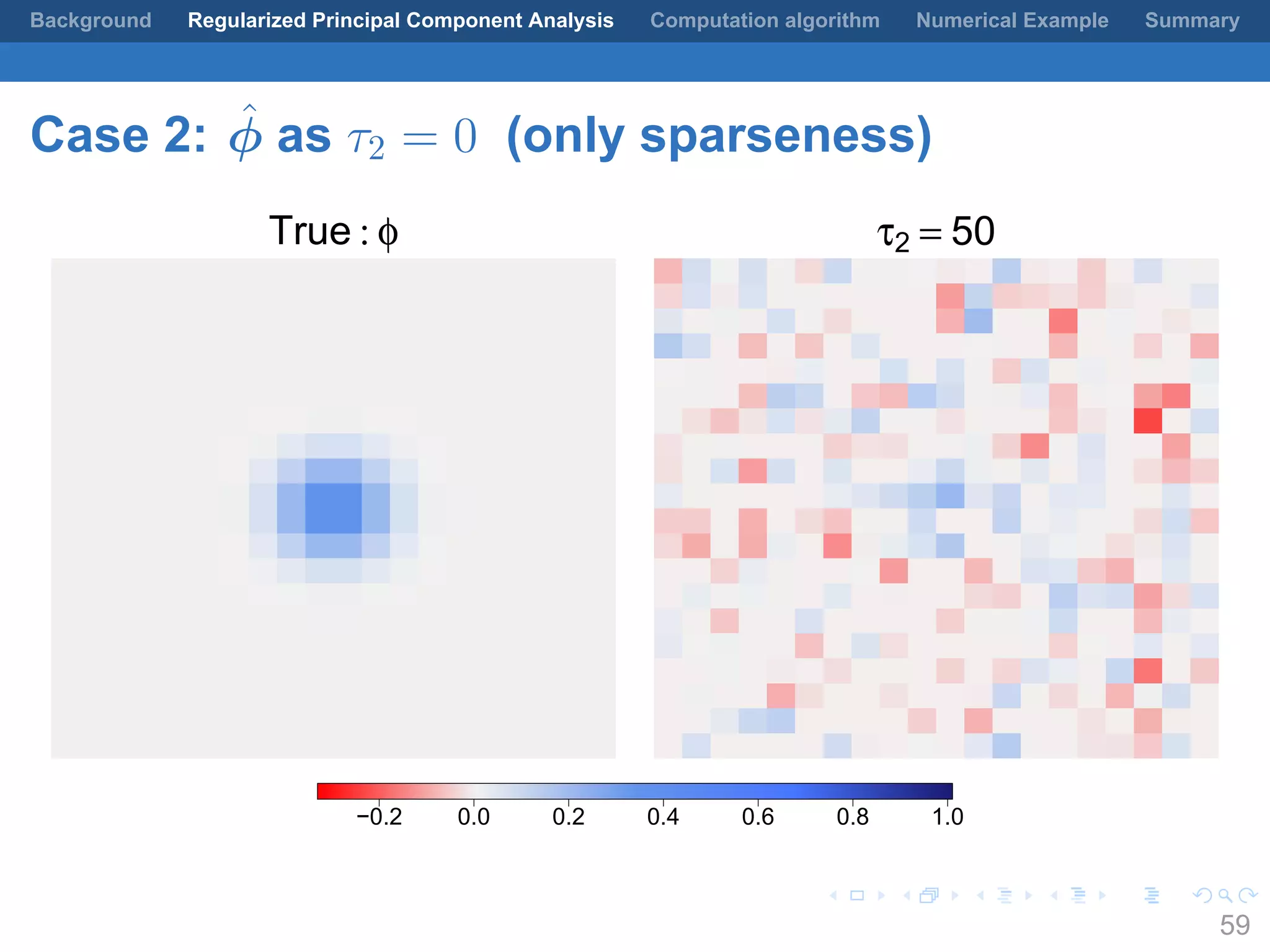
Case 2: ˆϕ as τ2 = 0 (only sparseness)
True : φ τ2 = 50
−0.2 0.0 0.2 0.4 0.6 0.8 1.0
59
.
.
.
.
.
.
.
.
.
.
.
.
.
.
.
.
.
.
.
.
.
.
.
.
.
.
.
.
.
.
.
.
.
.
.
.
.
.
.
.
Background Regularized Principal Component Analysis Computation algorithm Numerical Example Summary
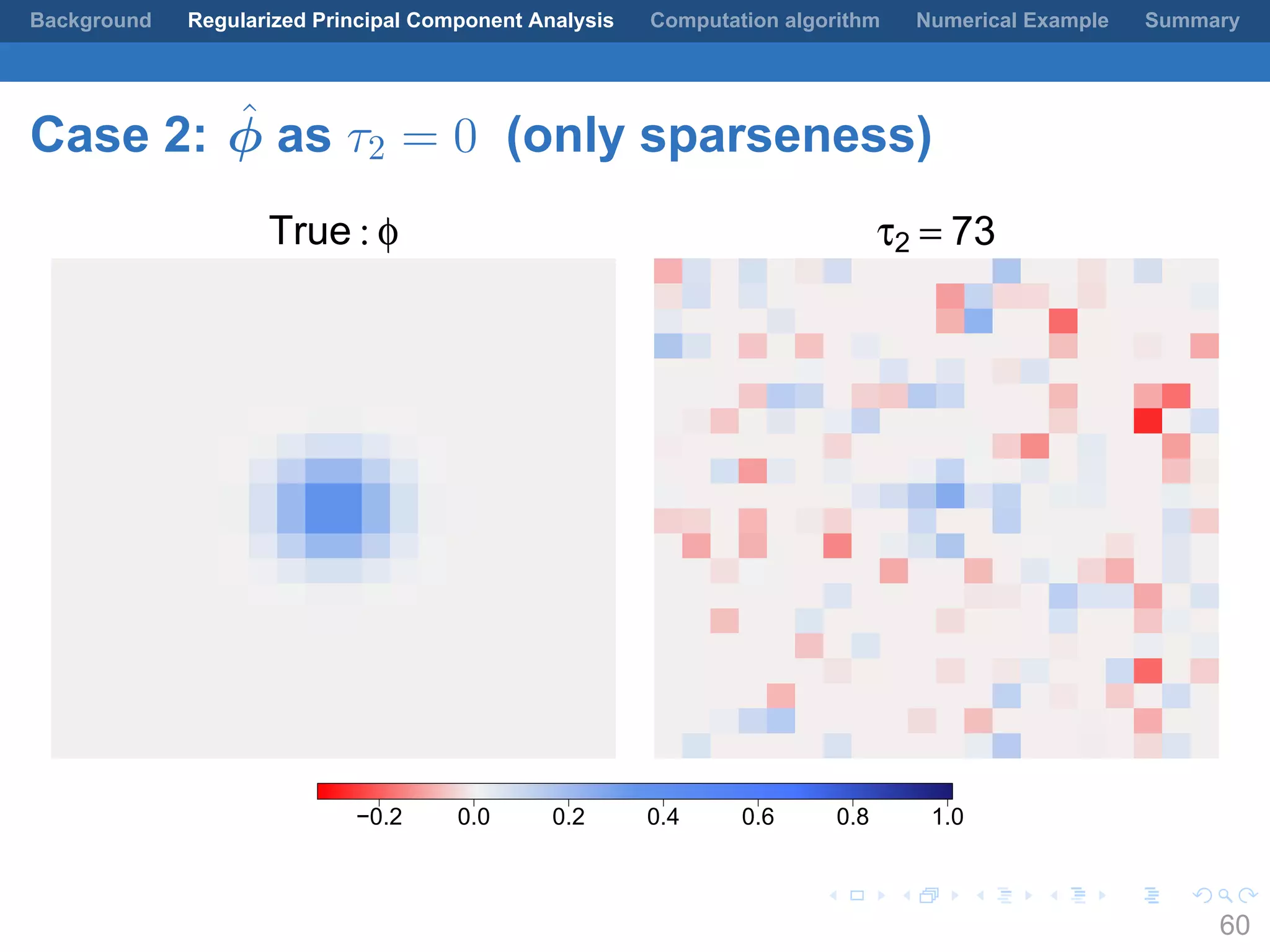
Case 2: ˆϕ as τ2 = 0 (only sparseness)
True : φ τ2 = 73
−0.2 0.0 0.2 0.4 0.6 0.8 1.0
60
.
.
.
.
.
.
.
.
.
.
.
.
.
.
.
.
.
.
.
.
.
.
.
.
.
.
.
.
.
.
.
.
.
.
.
.
.
.
.
.
Background Regularized Principal Component Analysis Computation algorithm Numerical Example Summary
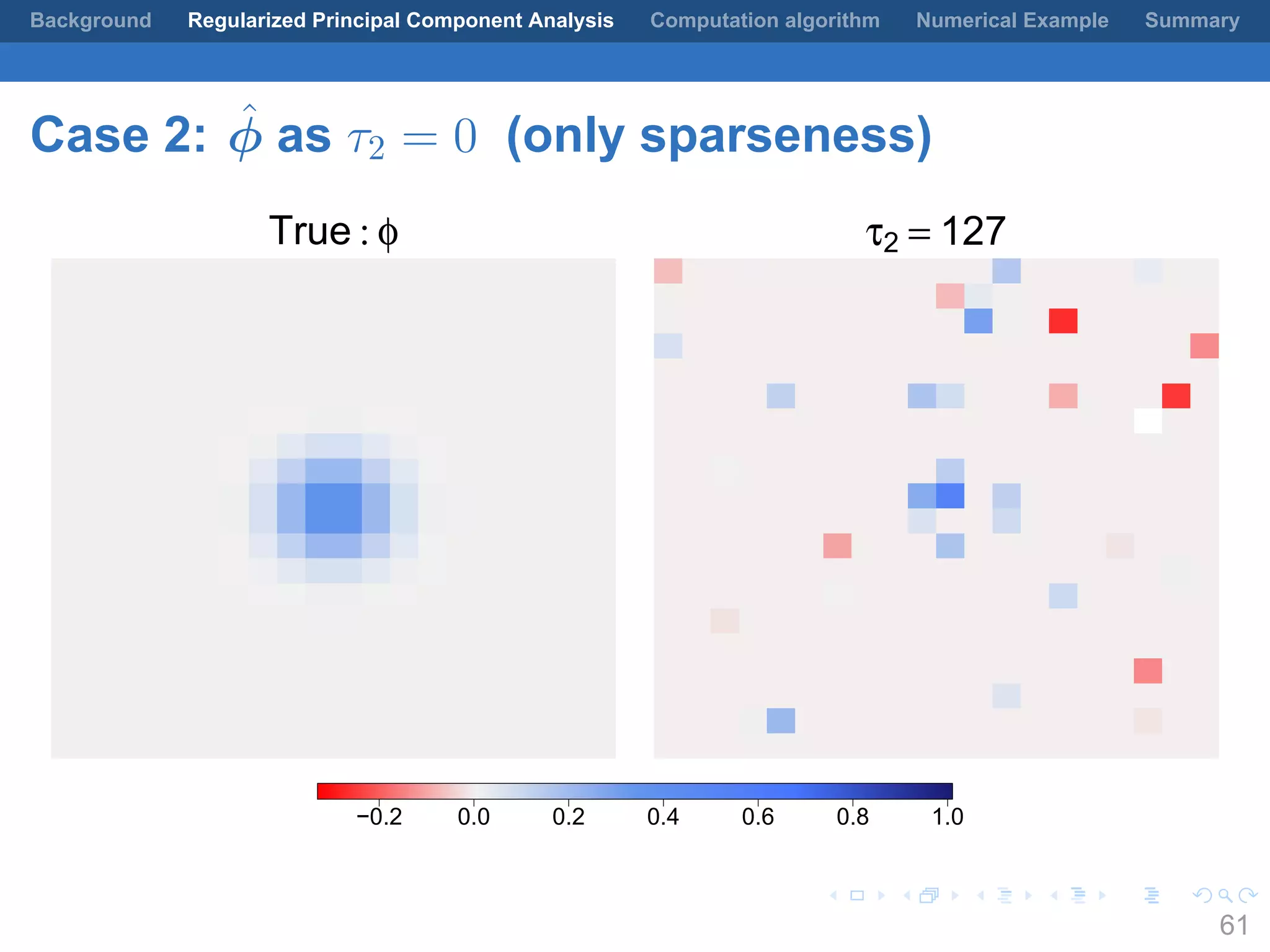
Case 2: ˆϕ as τ2 = 0 (only sparseness)
True : φ τ2 = 127
−0.2 0.0 0.2 0.4 0.6 0.8 1.0
61
.
.
.
.
.
.
.
.
.
.
.
.
.
.
.
.
.
.
.
.
.
.
.
.
.
.
.
.
.
.
.
.
.
.
.
.
.
.
.
.
Background Regularized Principal Component Analysis Computation algorithm Numerical Example Summary
Case 2: ˆϕ as τ2 = 0 (only sparseness)
True : φ τ2 = 220
−0.2 0.0 0.2 0.4 0.6 0.8 1.0
62
.
.
.
.
.
.
.
.
.
.
.
.
.
.
.
.
.
.
.
.
.
.
.
.
.
.
.
.
.
.
.
.
.
.
.
.
.
.
.
.
Background Regularized Principal Component Analysis Computation algorithm Numerical Example Summary
Case 2: ˆϕ as τ2 = 0 (only sparseness)
True : φ τ2 = 270
−0.2 0.0 0.2 0.4 0.6 0.8 1.0
63
.
.
.
.
.
.
.
.
.
.
.
.
.
.
.
.
.
.
.
.
.
.
.
.
.
.
.
.
.
.
.
.
.
.
.
.
.
.
.
.
Background Regularized Principal Component Analysis Computation algorithm Numerical Example Summary
Case 3: ˆϕ as τ1 = τ2
True : φ τ1 = τ2 = 0
−0.2 0.0 0.2 0.4 0.6 0.8 1.0
64
.
.
.
.
.
.
.
.
.
.
.
.
.
.
.
.
.
.
.
.
.
.
.
.
.
.
.
.
.
.
.
.
.
.
.
.
.
.
.
.
Background Regularized Principal Component Analysis Computation algorithm Numerical Example Summary
Case 3: ˆϕ as τ1 = τ2
True : φ τ1 = τ2 = 33
−0.2 0.0 0.2 0.4 0.6 0.8 1.0
65
.
.
.
.
.
.
.
.
.
.
.
.
.
.
.
.
.
.
.
.
.
.
.
.
.
.
.
.
.
.
.
.
.
.
.
.
.
.
.
.
Background Regularized Principal Component Analysis Computation algorithm Numerical Example Summary
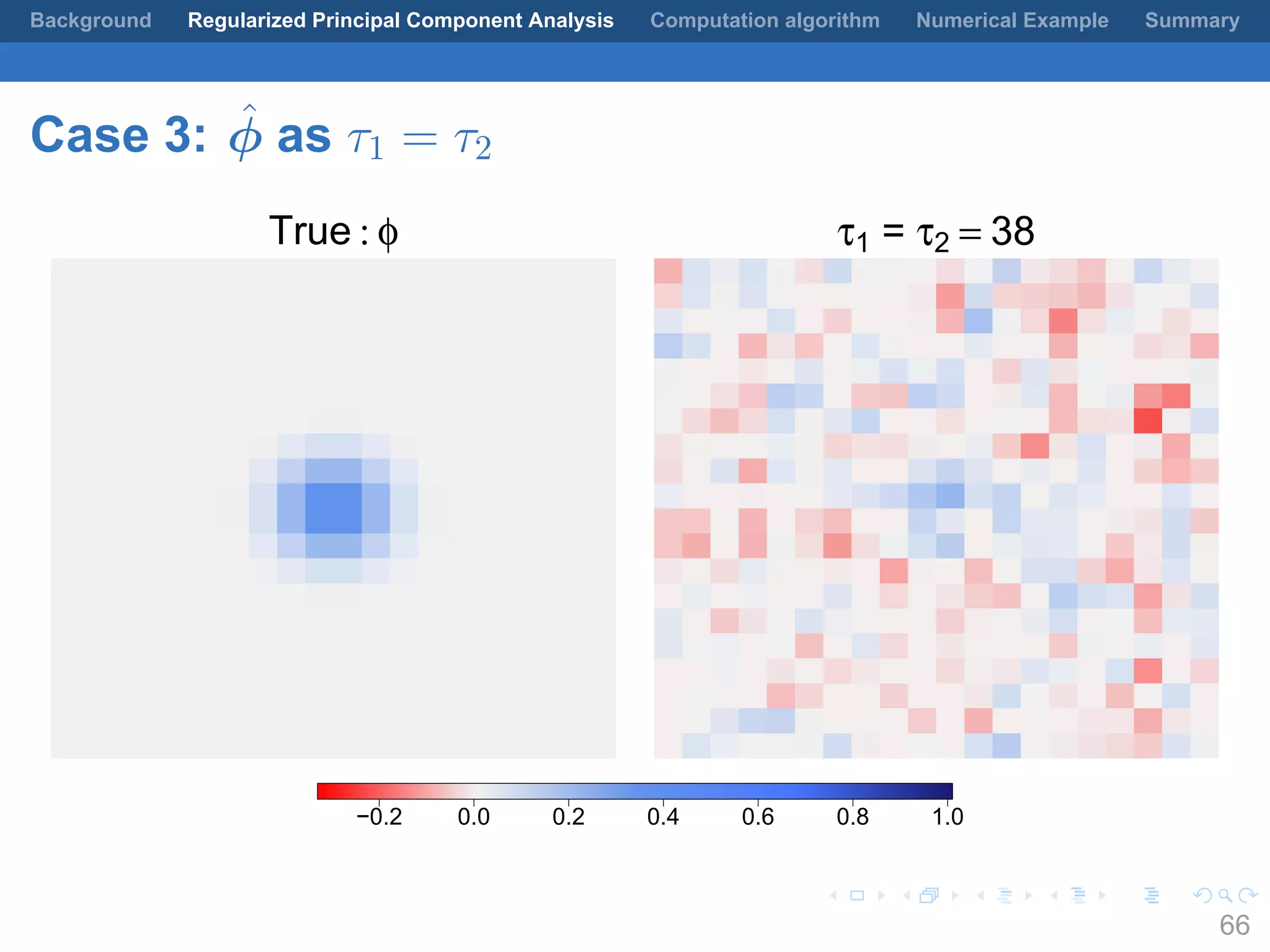
Case 3: ˆϕ as τ1 = τ2
True : φ τ1 = τ2 = 38
−0.2 0.0 0.2 0.4 0.6 0.8 1.0
66
.
.
.
.
.
.
.
.
.
.
.
.
.
.
.
.
.
.
.
.
.
.
.
.
.
.
.
.
.
.
.
.
.
.
.
.
.
.
.
.
Background Regularized Principal Component Analysis Computation algorithm Numerical Example Summary
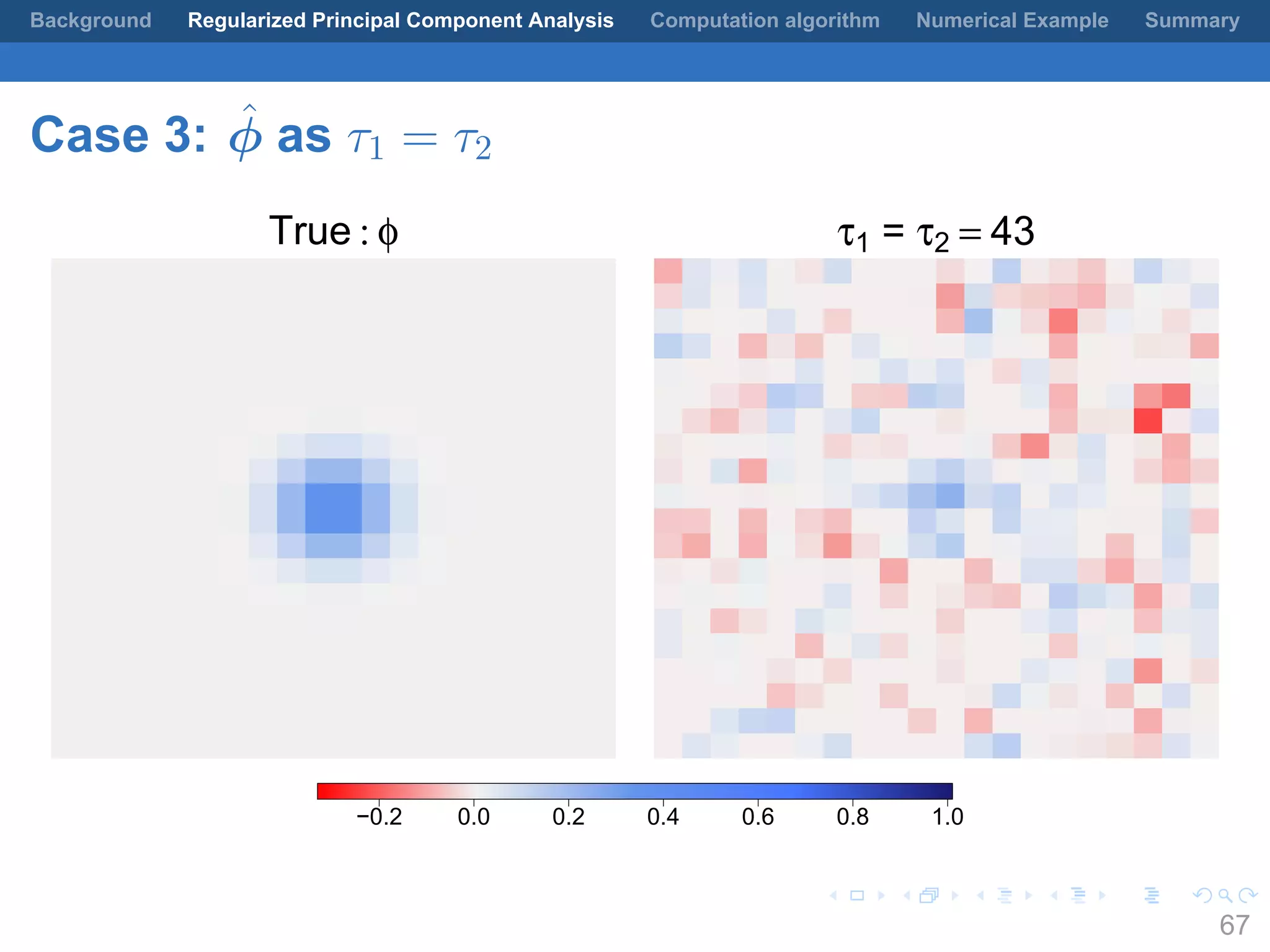
Case 3: ˆϕ as τ1 = τ2
True : φ τ1 = τ2 = 43
−0.2 0.0 0.2 0.4 0.6 0.8 1.0
67
.
.
.
.
.
.
.
.
.
.
.
.
.
.
.
.
.
.
.
.
.
.
.
.
.
.
.
.
.
.
.
.
.
.
.
.
.
.
.
.
Background Regularized Principal Component Analysis Computation algorithm Numerical Example Summary
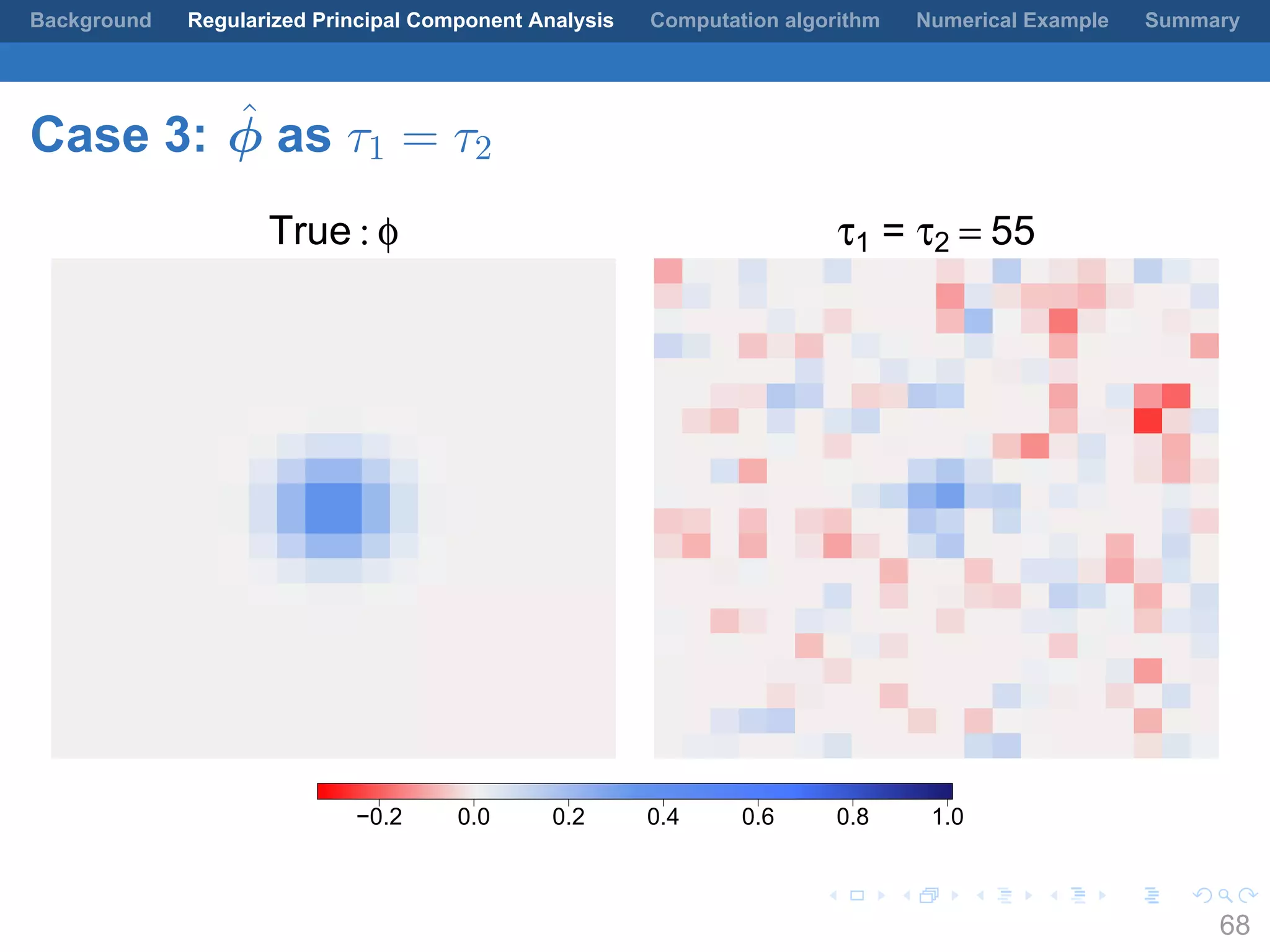
Case 3: ˆϕ as τ1 = τ2
True : φ τ1 = τ2 = 55
−0.2 0.0 0.2 0.4 0.6 0.8 1.0
68
.
.
.
.
.
.
.
.
.
.
.
.
.
.
.
.
.
.
.
.
.
.
.
.
.
.
.
.
.
.
.
.
.
.
.
.
.
.
.
.
Background Regularized Principal Component Analysis Computation algorithm Numerical Example Summary
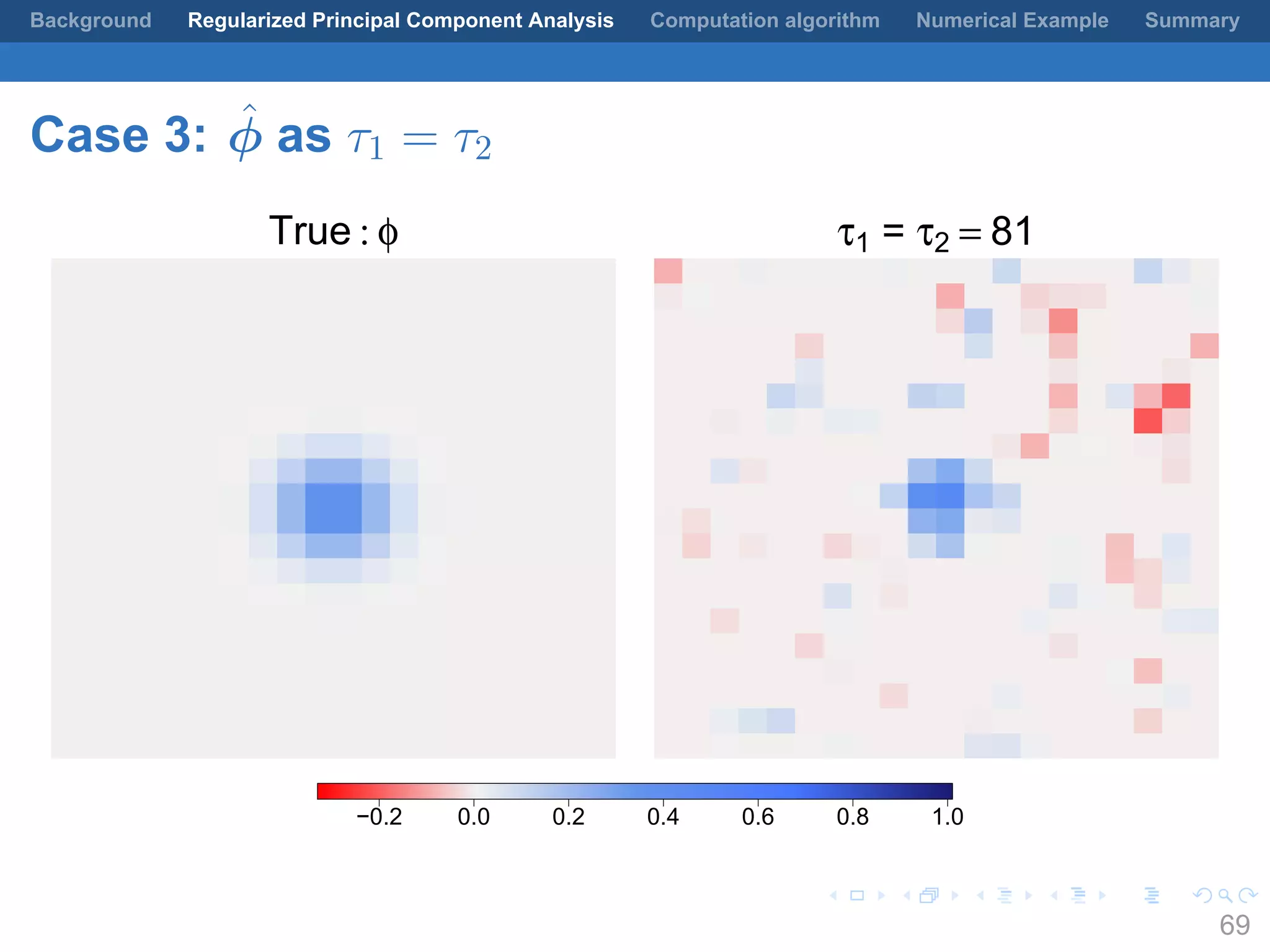
Case 3: ˆϕ as τ1 = τ2
True : φ τ1 = τ2 = 81
−0.2 0.0 0.2 0.4 0.6 0.8 1.0
69
.
.
.
.
.
.
.
.
.
.
.
.
.
.
.
.
.
.
.
.
.
.
.
.
.
.
.
.
.
.
.
.
.
.
.
.
.
.
.
.
Background Regularized Principal Component Analysis Computation algorithm Numerical Example Summary
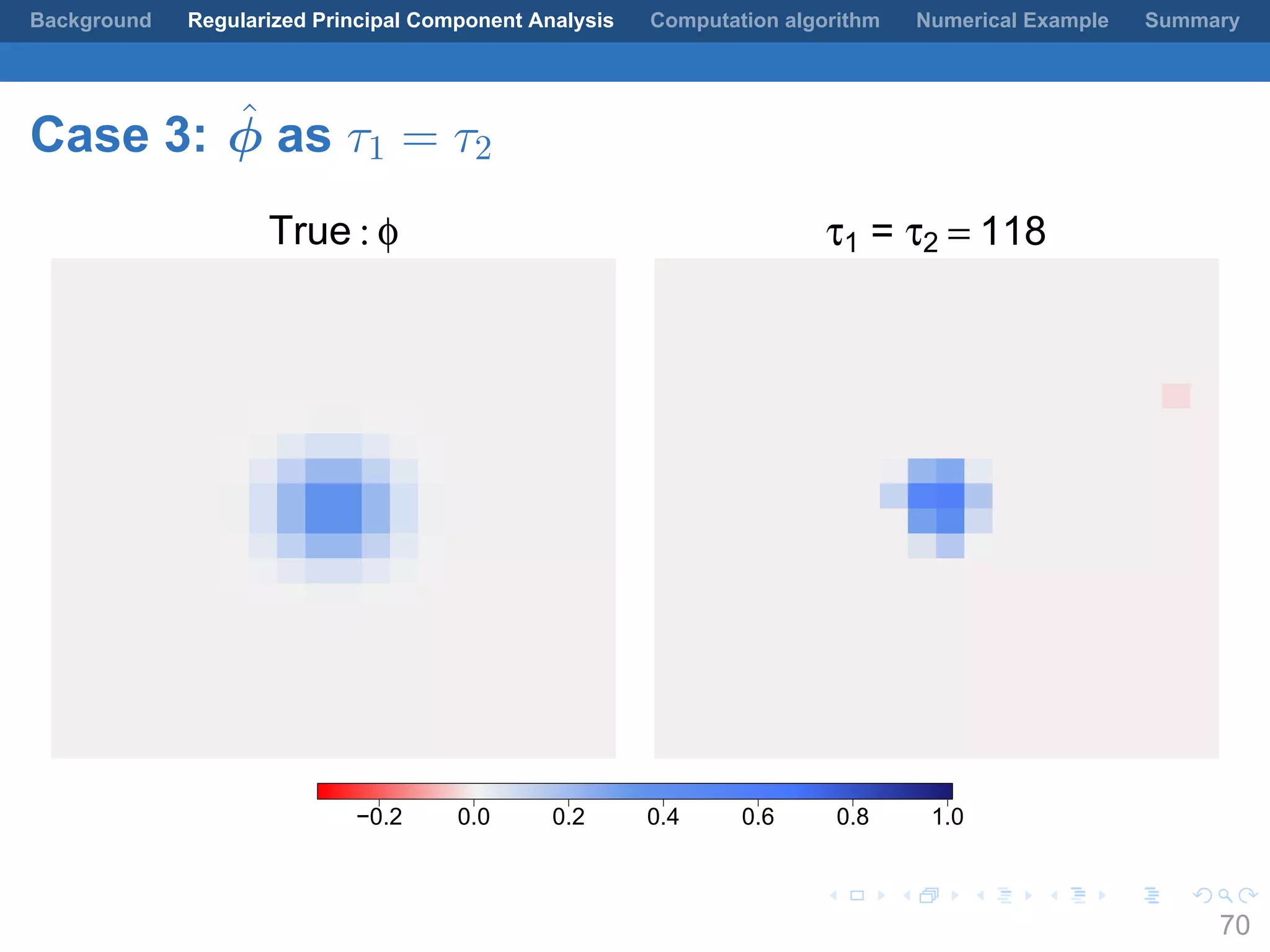
Case 3: ˆϕ as τ1 = τ2
True : φ τ1 = τ2 = 118
−0.2 0.0 0.2 0.4 0.6 0.8 1.0
70
.
.
.
.
.
.
.
.
.
.
.
.
.
.
.
.
.
.
.
.
.
.
.
.
.
.
.
.
.
.
.
.
.
.
.
.
.
.
.
.
Background Regularized Principal Component Analysis Computation algorithm Numerical Example Summary
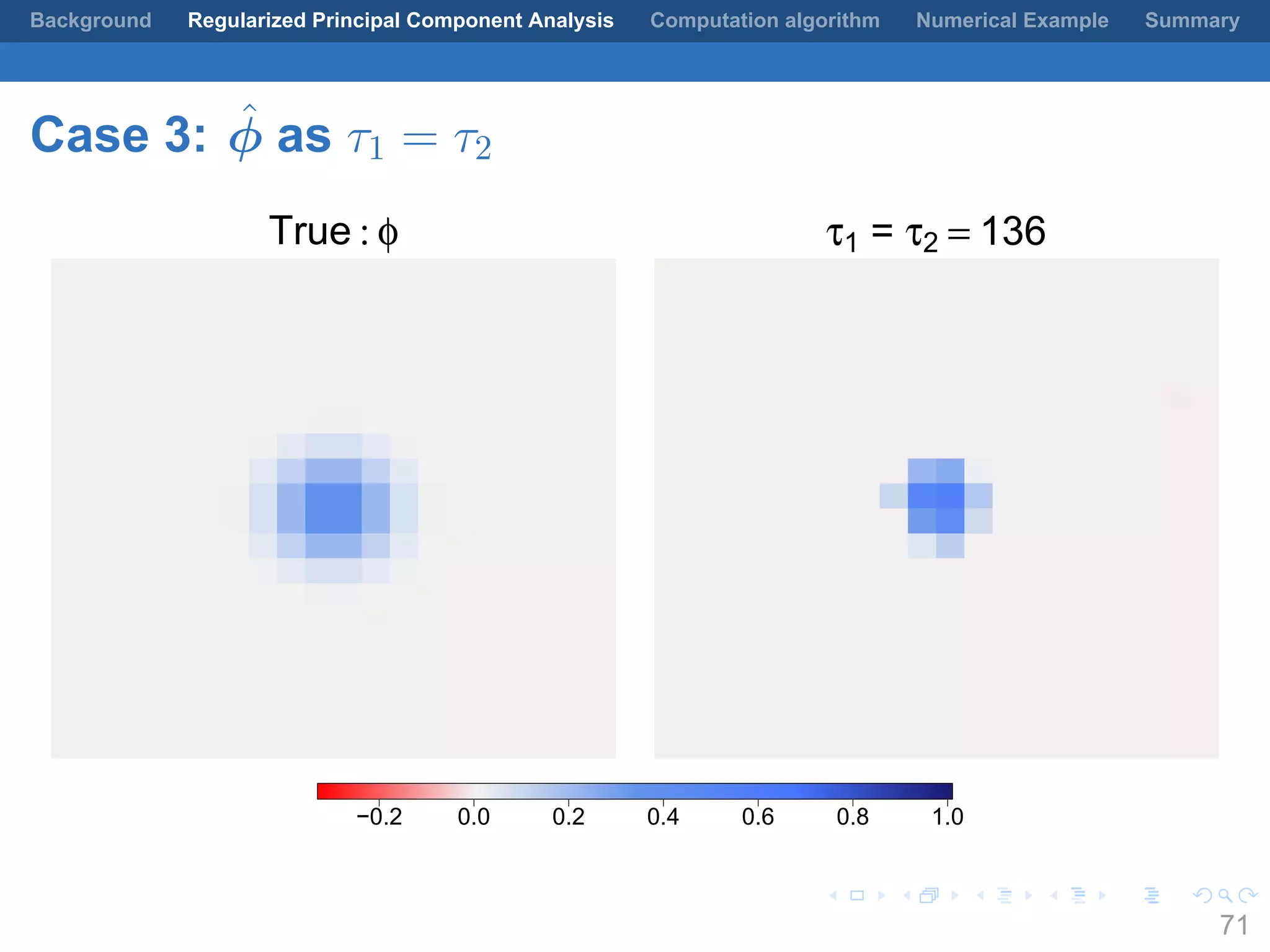
Case 3: ˆϕ as τ1 = τ2
True : φ τ1 = τ2 = 136
−0.2 0.0 0.2 0.4 0.6 0.8 1.0
71
.
.
.
.
.
.
.
.
.
.
.
.
.
.
.
.
.
.
.
.
.
.
.
.
.
.
.
.
.
.
.
.
.
.
.
.
.
.
.
.
Background Regularized Principal Component Analysis Computation algorithm Numerical Example Summary
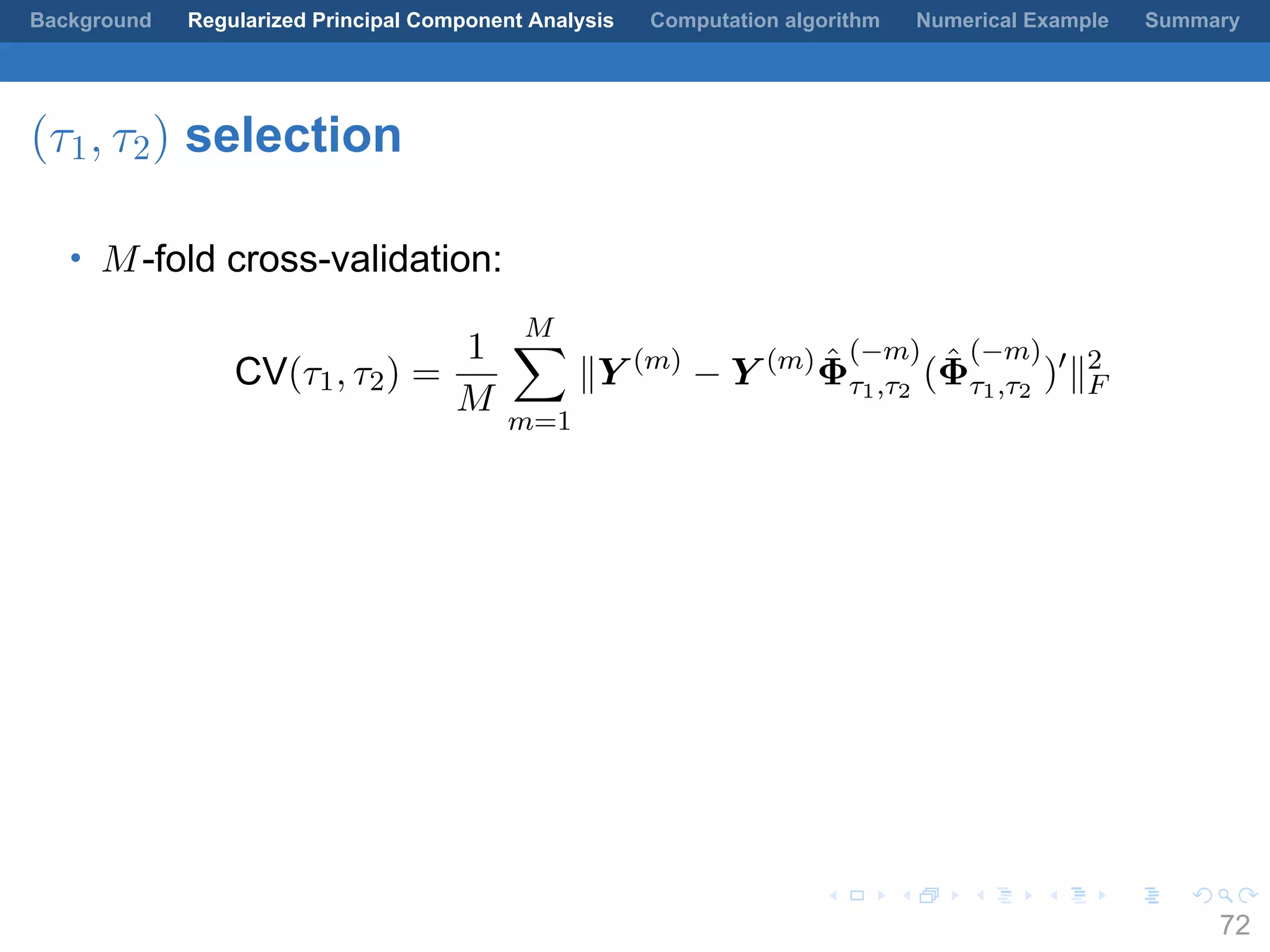
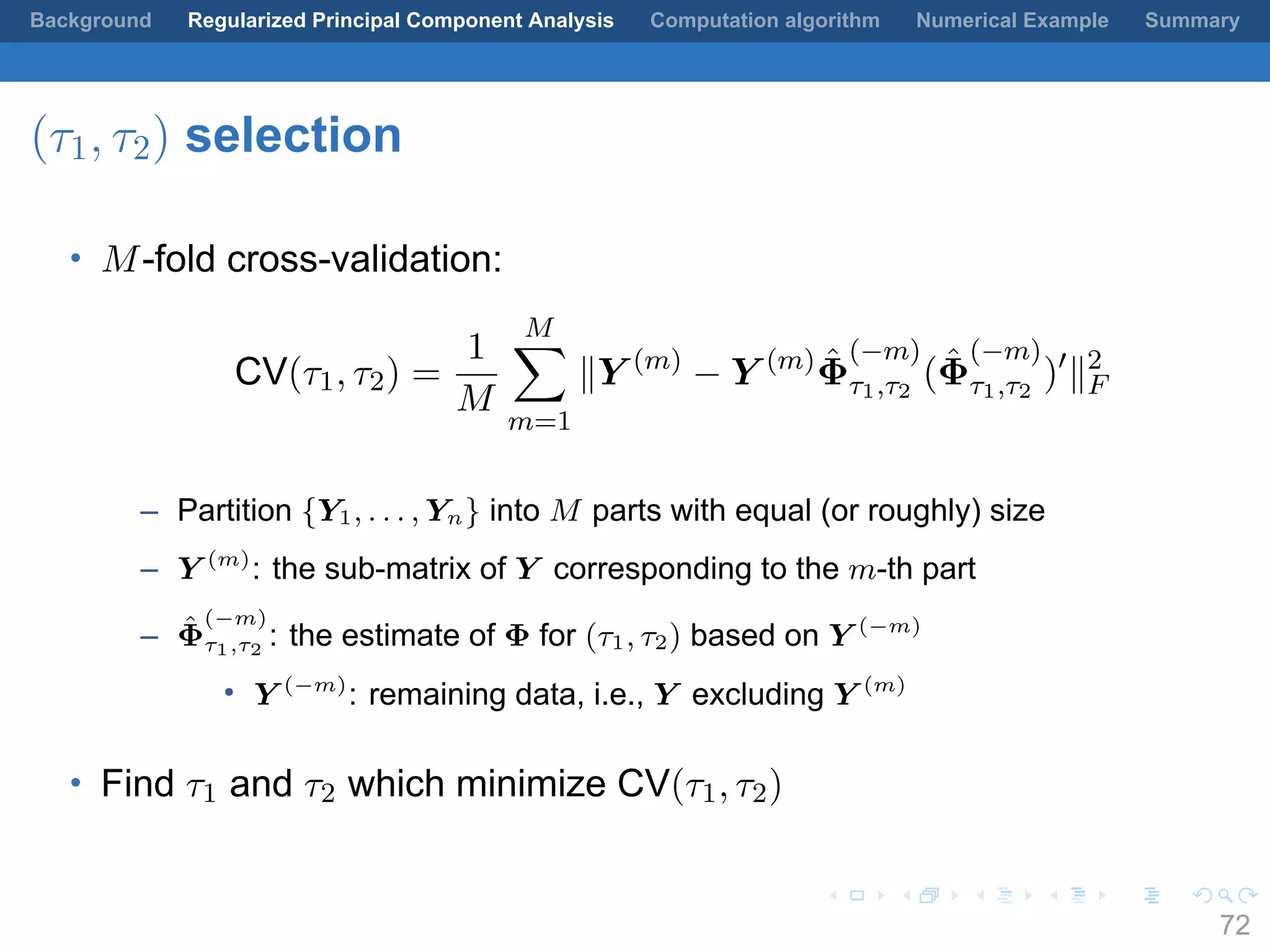
(τ1, τ2) selection
• M-fold cross-validation:
CV(τ1, τ2) =
1
M
M∑
m=1
∥Y (m)
− Y (m) ˆΦ
(−m)
τ1,τ2
( ˆΦ
(−m)
τ1,τ2
)′
∥2
F
72
.
.
.
.
.
.
.
.
.
.
.
.
.
.
.
.
.
.
.
.
.
.
.
.
.
.
.
.
.
.
.
.
.
.
.
.
.
.
.
.
Background Regularized Principal Component Analysis Computation algorithm Numerical Example Summary
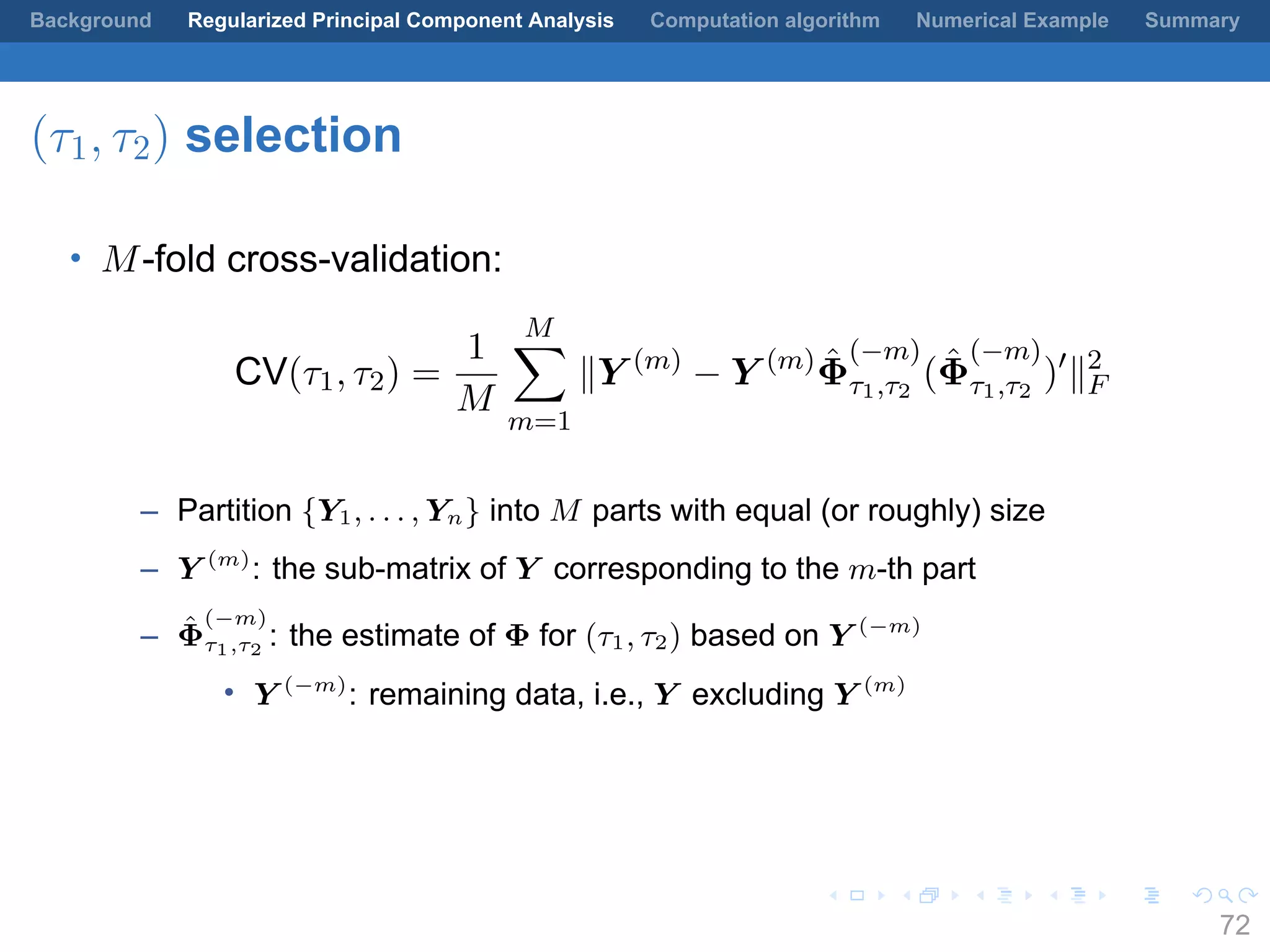
(τ1, τ2) selection
• M-fold cross-validation:
CV(τ1, τ2) =
1
M
M∑
m=1
∥Y (m)
− Y (m) ˆΦ
(−m)
τ1,τ2
( ˆΦ
(−m)
τ1,τ2
)′
∥2
F
– Partition {Y1, . . . , Yn} into M parts with equal (or roughly) size
– Y (m)
: the sub-matrix of Y corresponding to the m-th part
– ˆΦ
(−m)
τ1,τ2
: the estimate of Φ for (τ1, τ2) based on Y (−m)
• Y (−m)
: remaining data, i.e., Y excluding Y (m)
72
.
.
.
.
.
.
.
.
.
.
.
.
.
.
.
.
.
.
.
.
.
.
.
.
.
.
.
.
.
.
.
.
.
.
.
.
.
.
.
.
Background Regularized Principal Component Analysis Computation algorithm Numerical Example Summary
(τ1, τ2) selection
• M-fold cross-validation:
CV(τ1, τ2) =
1
M
M∑
m=1
∥Y (m)
− Y (m) ˆΦ
(−m)
τ1,τ2
( ˆΦ
(−m)
τ1,τ2
)′
∥2
F
– Partition {Y1, . . . , Yn} into M parts with equal (or roughly) size
– Y (m)
: the sub-matrix of Y corresponding to the m-th part
– ˆΦ
(−m)
τ1,τ2
: the estimate of Φ for (τ1, τ2) based on Y (−m)
• Y (−m)
: remaining data, i.e., Y excluding Y (m)
• Find τ1 and τ2 which minimize CV(τ1, τ2)
72
.
.
.
.
.
.
.
.
.
.
.
.
.
.
.
.
.
.
.
.
.
.
.
.
.
.
.
.
.
.
.
.
.
.
.
.
.
.
.
.
Background Regularized Principal Component Analysis Computation algorithm Numerical Example Summary
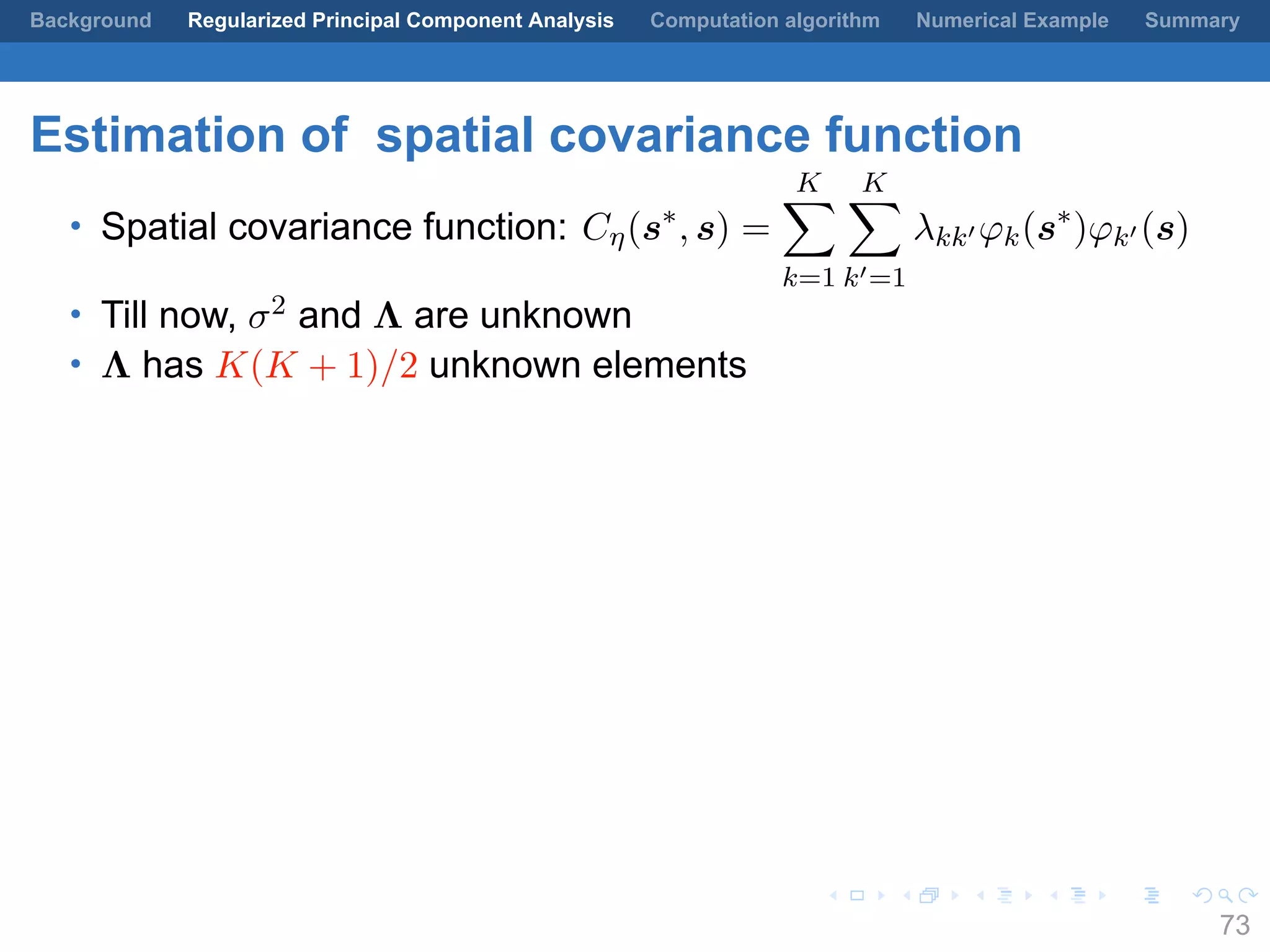
Estimation of spatial covariance function
• Spatial covariance function: Cη(s∗
, s) =
K∑
k=1
K∑
k′=1
λkk′ φk(s∗
)φk′ (s)
• Till now, σ2 and Λ are unknown
• Λ has K(K + 1)/2 unknown elements
73
.
.
.
.
.
.
.
.
.
.
.
.
.
.
.
.
.
.
.
.
.
.
.
.
.
.
.
.
.
.
.
.
.
.
.
.
.
.
.
.
Background Regularized Principal Component Analysis Computation algorithm Numerical Example Summary
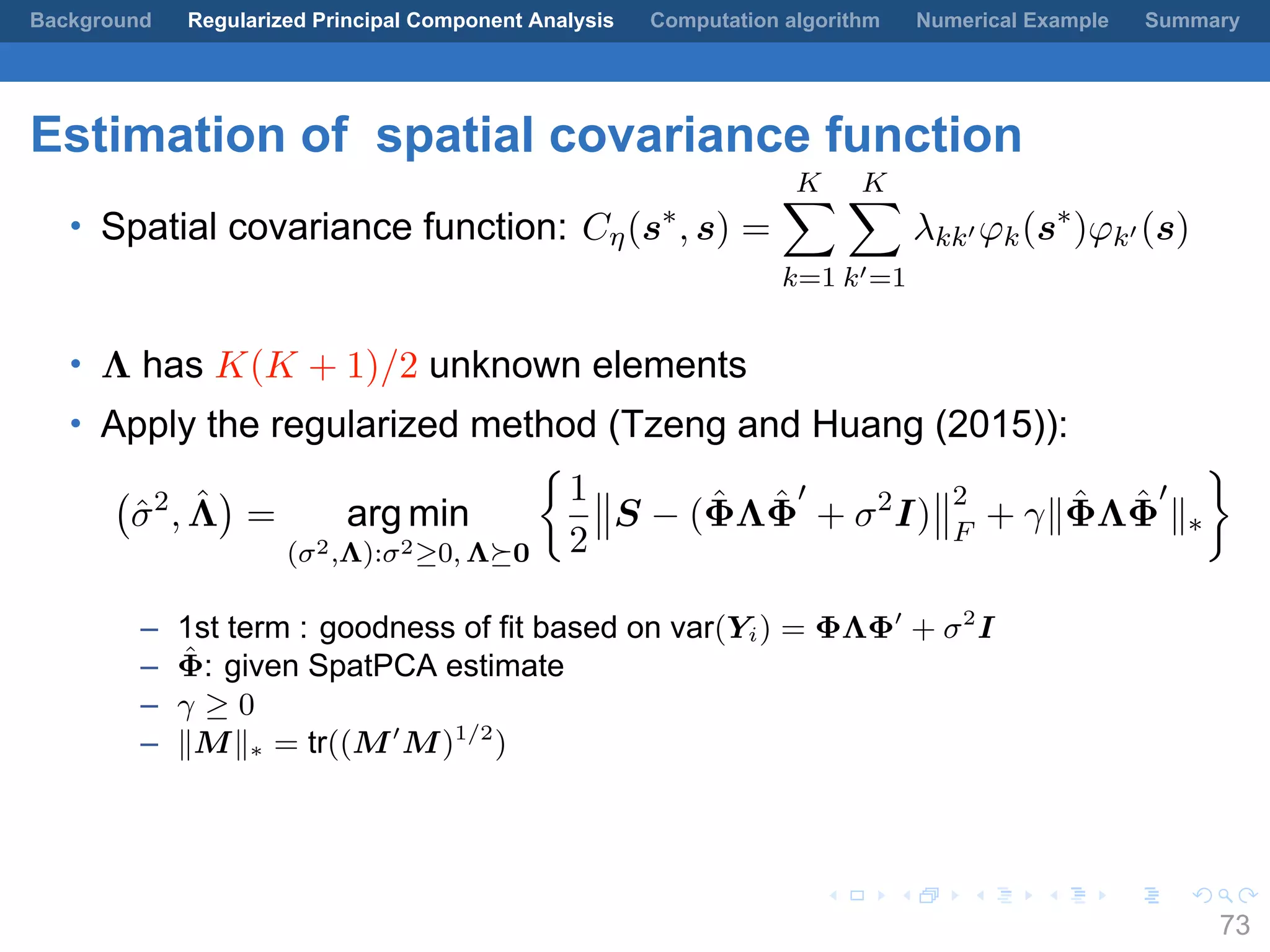
Estimation of spatial covariance function
• Spatial covariance function: Cη(s∗
, s) =
K∑
k=1
K∑
k′=1
λkk′ φk(s∗
)φk′ (s)
• Λ has K(K + 1)/2 unknown elements
• Apply the regularized method (Tzeng and Huang (2015)):
(
ˆσ2
, ˆΛ
)
= arg min
(σ2,Λ):σ2≥0, Λ⪰0
{
1
2
S − ( ˆΦΛ ˆΦ
′
+ σ2
I)
2
F
+ γ∥ ˆΦΛ ˆΦ
′
∥∗
}
– 1st term : goodness of fit based on var(Yi) = ΦΛΦ′
+ σ2
I
– ˆΦ: given SpatPCA estimate
– γ ≥ 0
– ∥M∥∗ = tr((M′
M)1/2
)
73
.
.
.
.
.
.
.
.
.
.
.
.
.
.
.
.
.
.
.
.
.
.
.
.
.
.
.
.
.
.
.
.
.
.
.
.
.
.
.
.
Background Regularized Principal Component Analysis Computation algorithm Numerical Example Summary
Estimation of spatial covariance function
• Spatial covariance function: Cη(s∗
, s) =
K∑
k=1
K∑
k′=1
λkk′ φk(s∗
)φk′ (s)
• Λ has K(K + 1)/2 unknown elements
• Apply the regularized method (Tzeng and Huang (2015)):
(
ˆσ2
, ˆΛ
)
= arg min
(σ2,Λ):σ2≥0, Λ⪰0
{
1
2
S − ( ˆΦΛ ˆΦ
′
+ σ2
I)
2
F
+ γ∥ ˆΦΛ ˆΦ
′
∥∗
}
– 1st term : goodness of fit based on var(Yi) = ΦΛΦ′
+ σ2
I
– ˆΦ: given SpatPCA estimate
– γ ≥ 0
– ∥M∥∗ = tr((M′
M)1/2
)
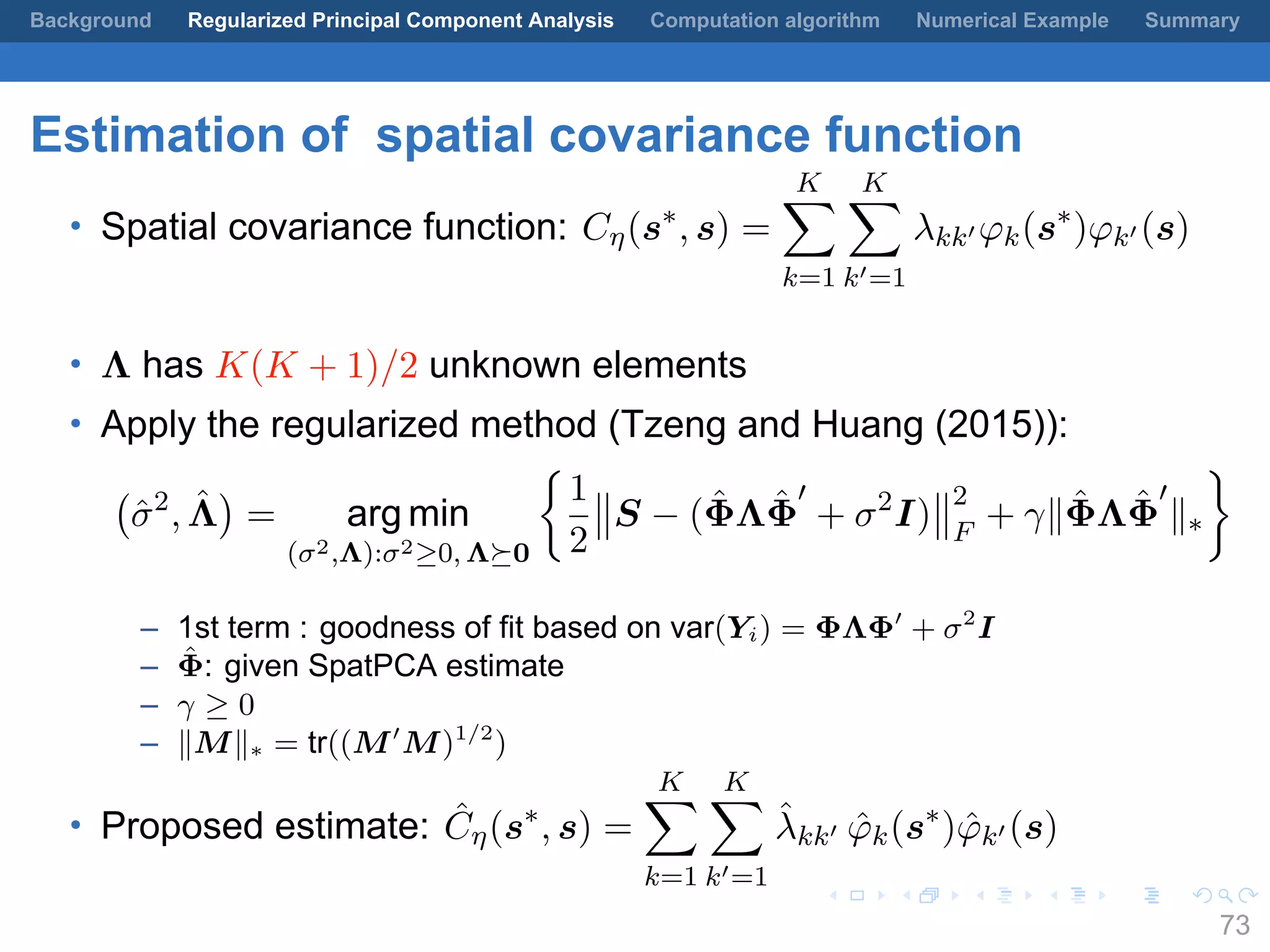
• Proposed estimate: ˆCη(s∗
, s) =
K∑
k=1
K∑
k′=1
ˆλkk′ ˆφk(s∗
) ˆφk′ (s)
73
.
.
.
.
.
.
.
.
.
.
.
.
.
.
.
.
.
.
.
.
.
.
.
.
.
.
.
.
.
.
.
.
.
.
.
.
.
.
.
.
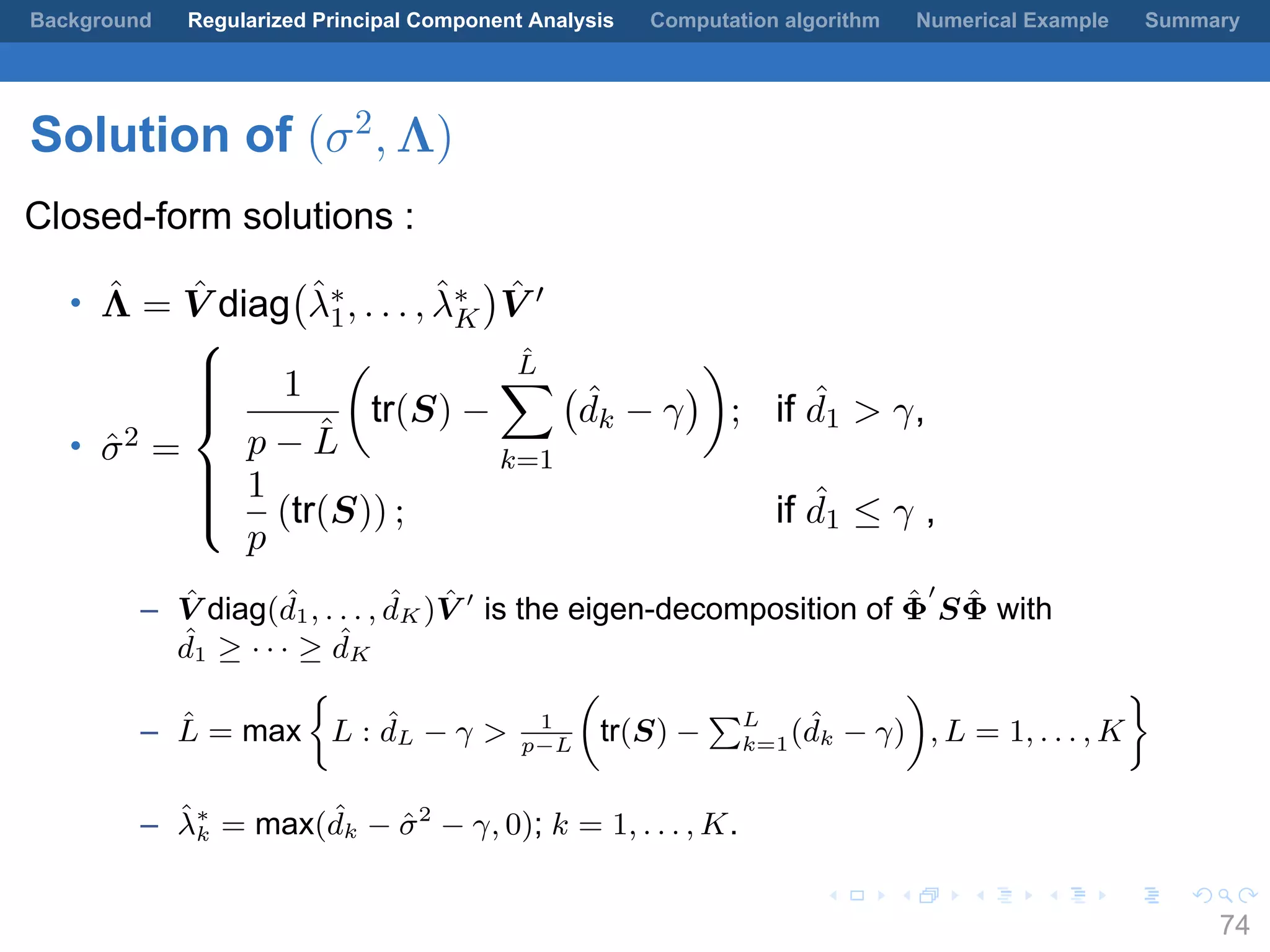
Background Regularized Principal Component Analysis Computation algorithm Numerical Example Summary
Solution of (σ2
, Λ)
Closed-form solutions :
• ˆΛ = ˆV diag
(
ˆλ∗
1, . . . , ˆλ∗
K
)
ˆV ′
• ˆσ2 =



1
p − ˆL
(
tr(S) −
ˆL∑
k=1
(
ˆdk − γ
)
)
; if ˆd1 > γ,
1
p
(tr(S)) ; if ˆd1 ≤ γ ,
– ˆV diag( ˆd1, . . . , ˆdK ) ˆV ′
is the eigen-decomposition of ˆΦ
′
S ˆΦ with
ˆd1 ≥ · · · ≥ ˆdK
– ˆL = max
{
L : ˆdL − γ > 1
p−L
(
tr(S) −
∑L
k=1( ˆdk − γ)
)
, L = 1, . . . , K
}
– ˆλ∗
k = max( ˆdk − ˆσ2
− γ, 0); k = 1, . . . , K.
74
.
.
.
.
.
.
.
.
.
.
.
.
.
.
.
.
.
.
.
.
.
.
.
.
.
.
.
.
.
.
.
.
.
.
.
.
.
.
.
.
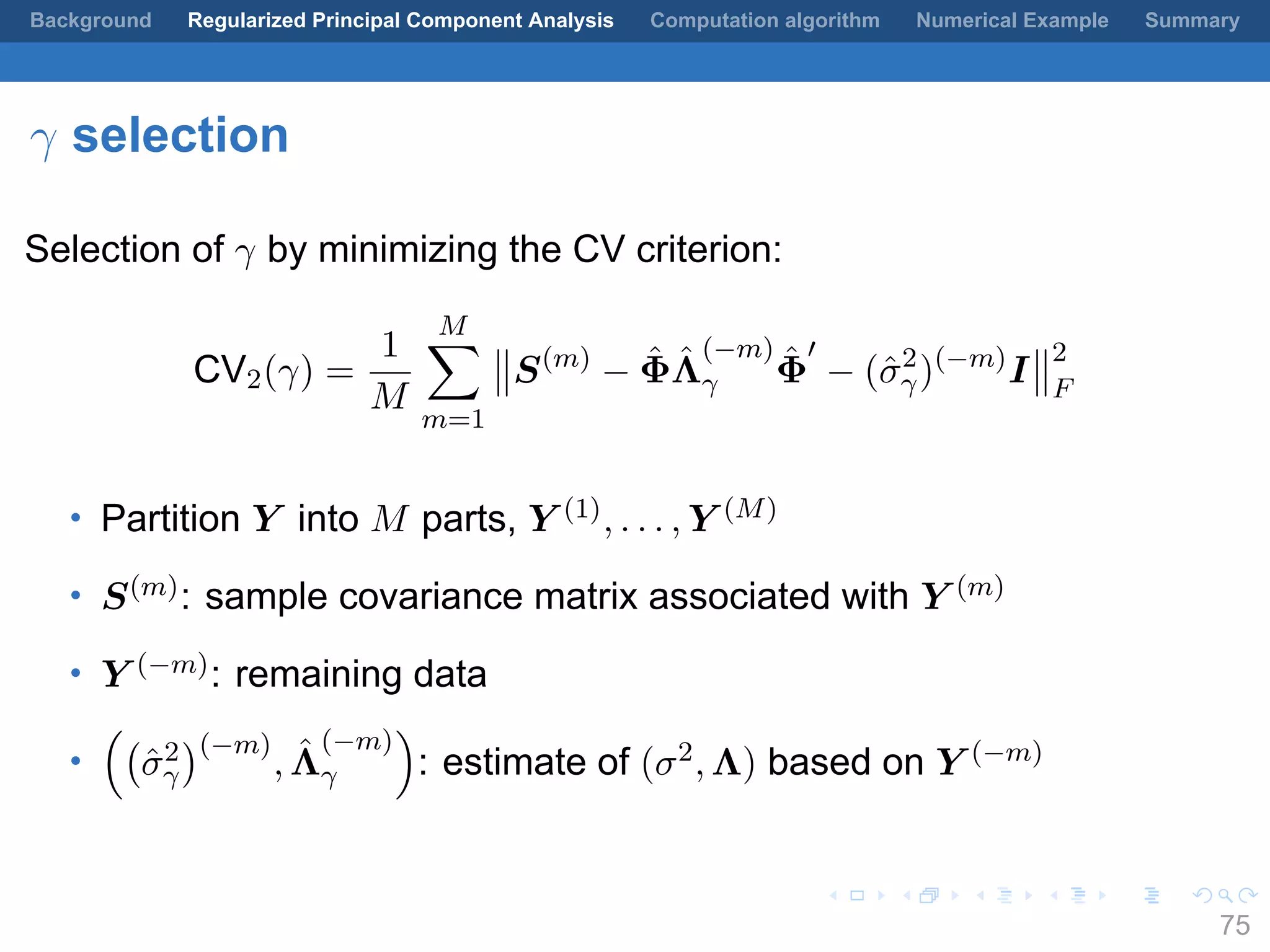
Background Regularized Principal Component Analysis Computation algorithm Numerical Example Summary
γ selection
Selection of γ by minimizing the CV criterion:
CV2(γ) =
1
M
M∑
m=1
S(m)
− ˆΦ ˆΛ
(−m)
γ
ˆΦ
′
− (ˆσ2
γ)(−m)
I
2
F
• Partition Y into M parts, Y (1), . . . , Y (M)
• S(m): sample covariance matrix associated with Y (m)
• Y (−m): remaining data
•
((
ˆσ2
γ
)(−m)
, ˆΛ
(−m)
γ
)
: estimate of (σ2, Λ) based on Y (−m)
75
.
.
.
.
.
.
.
.
.
.
.
.
.
.
.
.
.
.
.
.
.
.
.
.
.
.
.
.
.
.
.
.
.
.
.
.
.
.
.
.
Background Regularized Principal Component Analysis Computation algorithm Numerical Example Summary
Outline
1 Background
2 Regularized Principal Component Analysis
3 Computation algorithm
4 Numerical Example
5 Summary
76
.
.
.
.
.
.
.
.
.
.
.
.
.
.
.
.
.
.
.
.
.
.
.
.
.
.
.
.
.
.
.
.
.
.
.
.
.
.
.
.
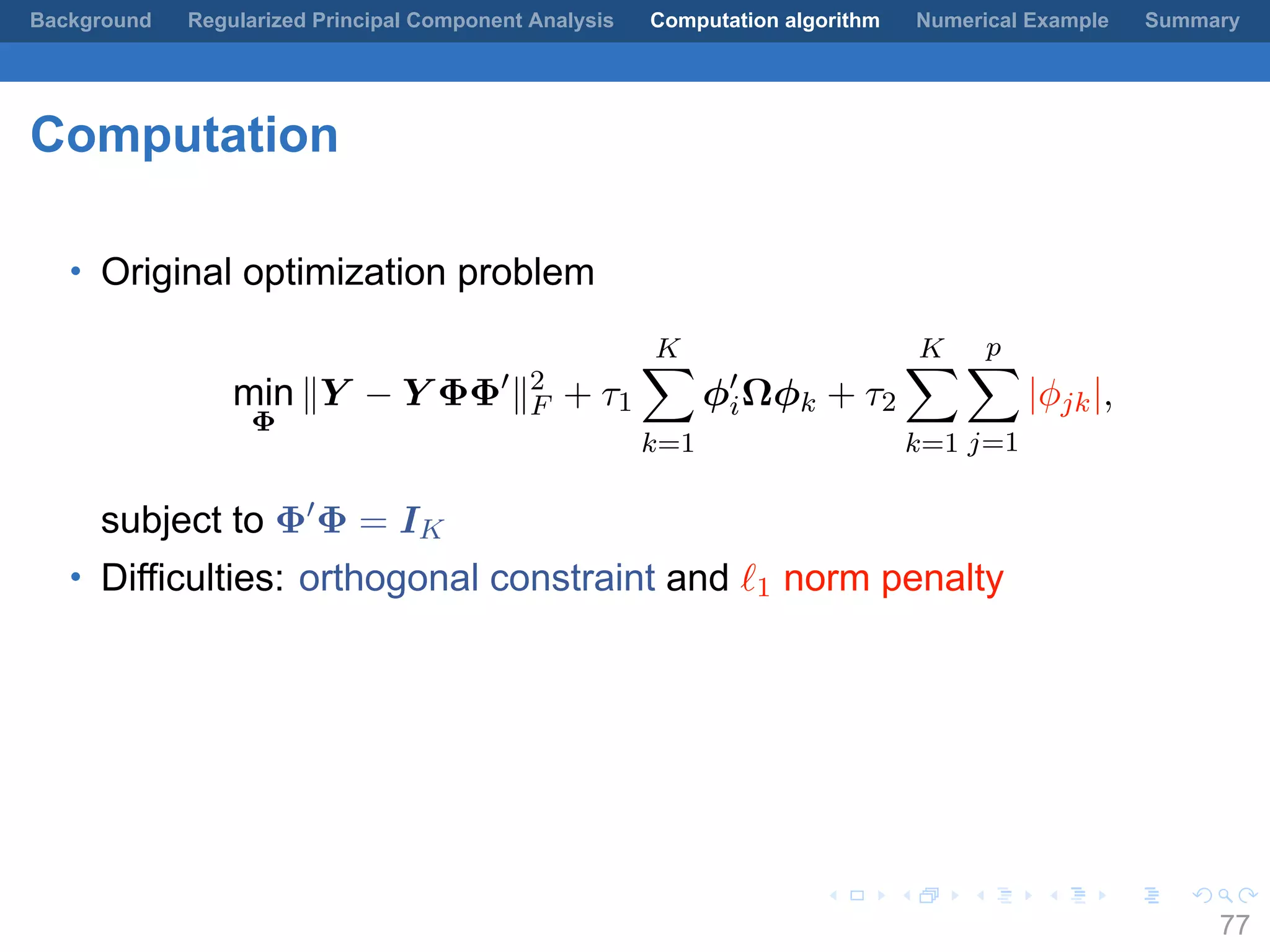
Background Regularized Principal Component Analysis Computation algorithm Numerical Example Summary
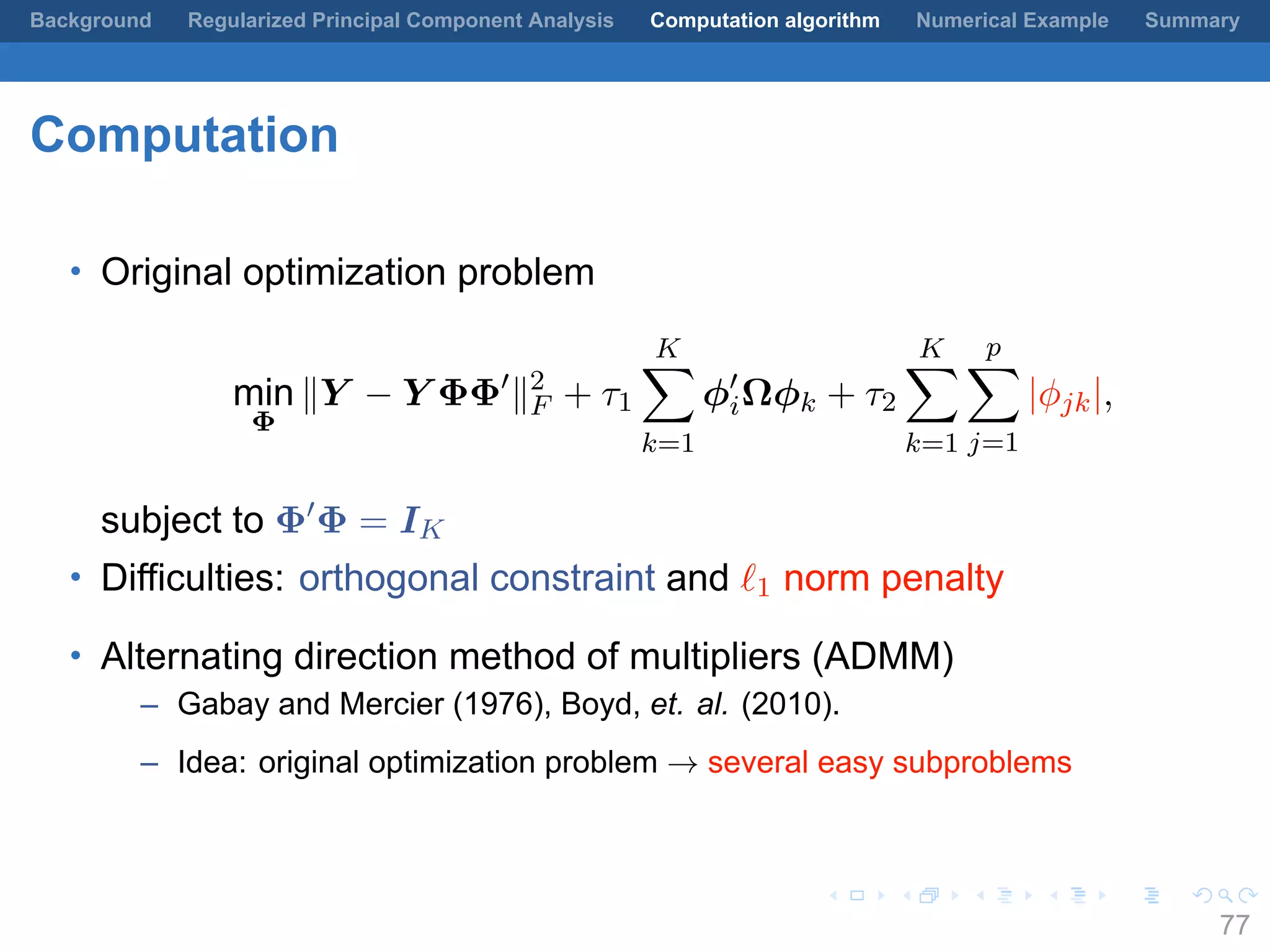
Computation
• Original optimization problem
min
Φ
∥Y − Y ΦΦ′
∥2
F + τ1
K∑
k=1
ϕ′
iΩϕk + τ2
K∑
k=1
p∑
j=1
|ϕjk|,
subject to Φ′
Φ = IK
• Difficulties: orthogonal constraint and ℓ1 norm penalty
77
.
.
.
.
.
.
.
.
.
.
.
.
.
.
.
.
.
.
.
.
.
.
.
.
.
.
.
.
.
.
.
.
.
.
.
.
.
.
.
.
Background Regularized Principal Component Analysis Computation algorithm Numerical Example Summary
Computation
• Original optimization problem
min
Φ
∥Y − Y ΦΦ′
∥2
F + τ1
K∑
k=1
ϕ′
iΩϕk + τ2
K∑
k=1
p∑
j=1
|ϕjk|,
subject to Φ′
Φ = IK
• Difficulties: orthogonal constraint and ℓ1 norm penalty
• Alternating direction method of multipliers (ADMM)
– Gabay and Mercier (1976), Boyd, et. al. (2010).
– Idea: original optimization problem → several easy subproblems
77
.
.
.
.
.
.
.
.
.
.
.
.
.
.
.
.
.
.
.
.
.
.
.
.
.
.
.
.
.
.
.
.
.
.
.
.
.
.
.
.
Background Regularized Principal Component Analysis Computation algorithm Numerical Example Summary
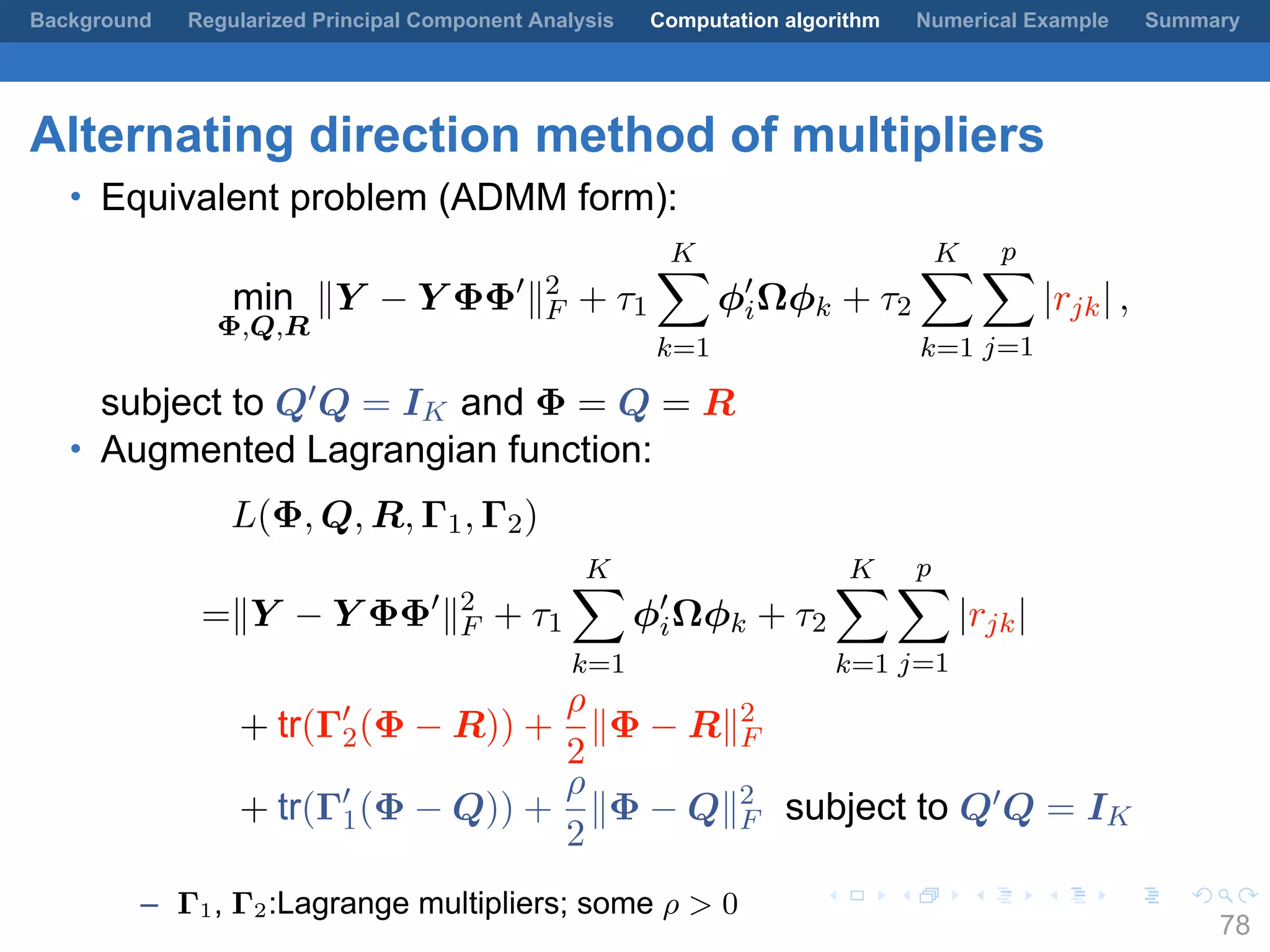
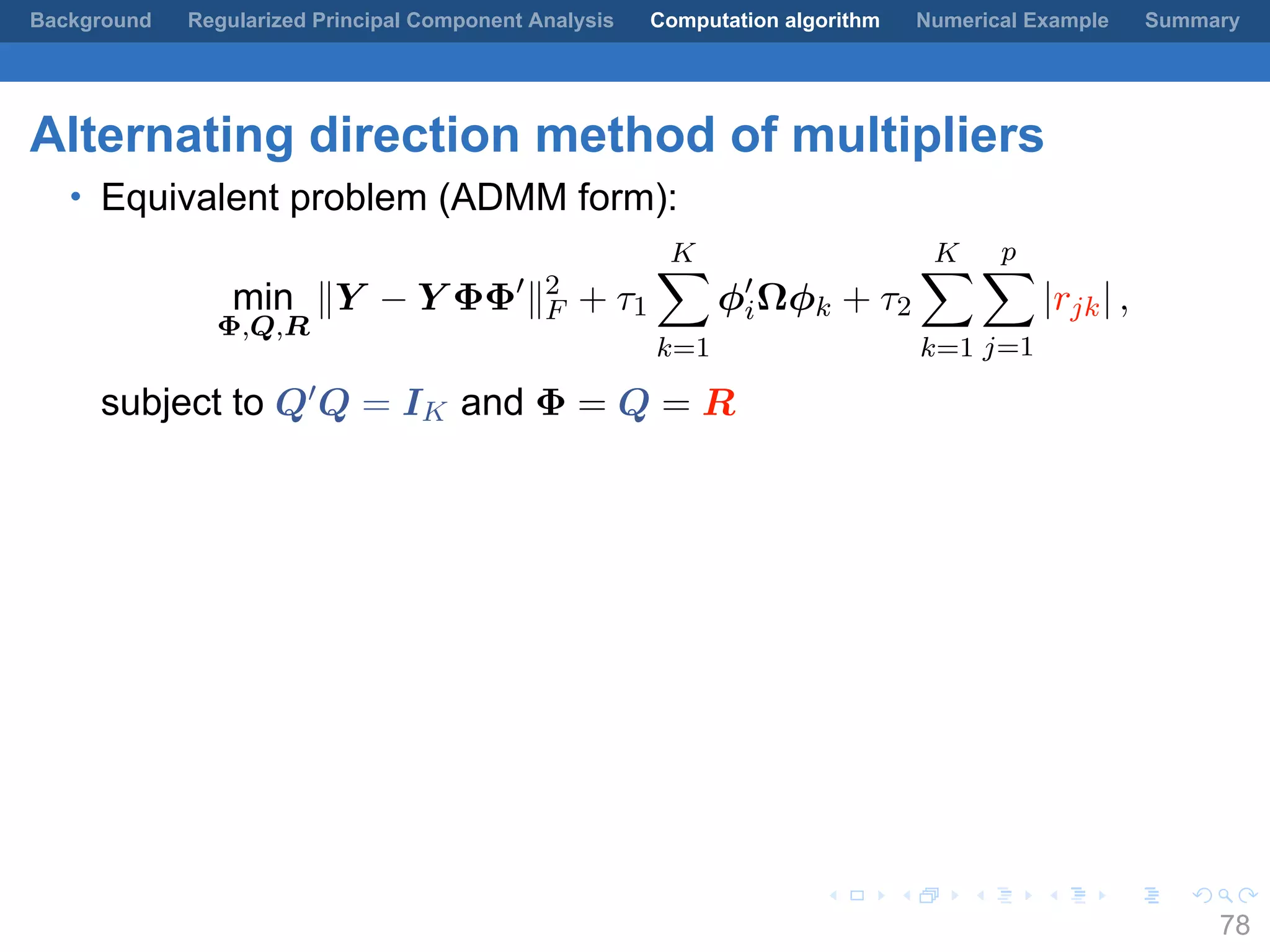
Alternating direction method of multipliers
• Equivalent problem (ADMM form):
min
Φ,Q,R
∥Y − Y ΦΦ′
∥2
F + τ1
K∑
k=1
ϕ′
iΩϕk + τ2
K∑
k=1
p∑
j=1
|rjk| ,
subject to Q′Q = IK and Φ = Q = R
78
.
.
.
.
.
.
.
.
.
.
.
.
.
.
.
.
.
.
.
.
.
.
.
.
.
.
.
.
.
.
.
.
.
.
.
.
.
.
.
.
Background Regularized Principal Component Analysis Computation algorithm Numerical Example Summary
Alternating direction method of multipliers
• Equivalent problem (ADMM form):
min
Φ,Q,R
∥Y − Y ΦΦ′
∥2
F + τ1
K∑
k=1
ϕ′
iΩϕk + τ2
K∑
k=1
p∑
j=1
|rjk| ,
subject to Q′Q = IK and Φ = Q = R
• Augmented Lagrangian function:
L(Φ, Q, R, Γ1, Γ2)
=∥Y − Y ΦΦ′
∥2
F + τ1
K∑
k=1
ϕ′
iΩϕk + τ2
K∑
k=1
p∑
j=1
|rjk|
+ tr(Γ′
2(Φ − R)) +
ρ
2
∥Φ − R∥2
F
+ tr(Γ′
1(Φ − Q)) +
ρ
2
∥Φ − Q∥2
F subject to Q′Q = IK
– Γ1, Γ2:Lagrange multipliers; some ρ > 0
78
.
.
.
.
.
.
.
.
.
.
.
.
.
.
.
.
.
.
.
.
.
.
.
.
.
.
.
.
.
.
.
.
.
.
.
.
.
.
.
.
Background Regularized Principal Component Analysis Computation algorithm Numerical Example Summary
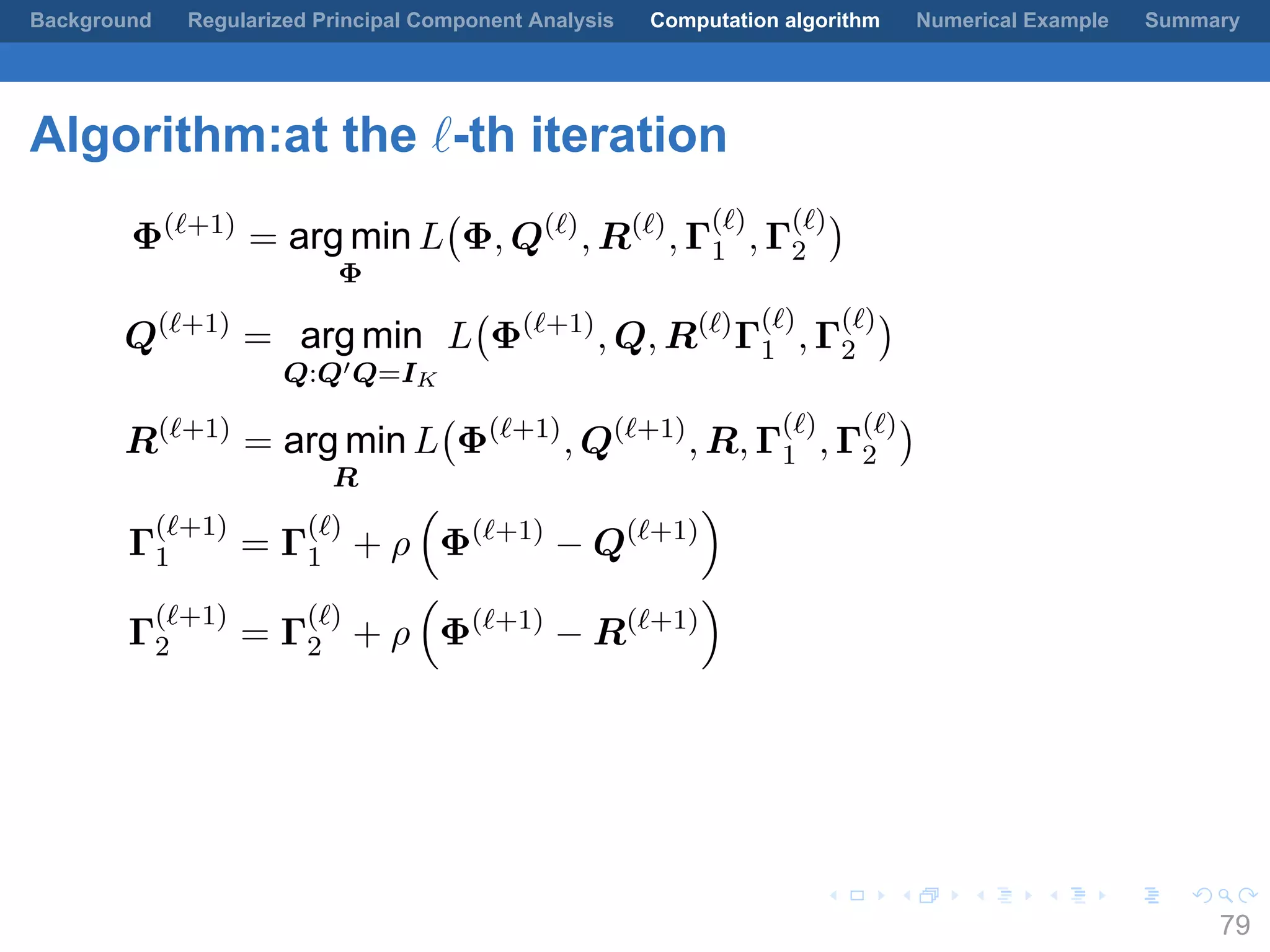
Algorithm:at the ℓ-th iteration
Φ(ℓ+1)
= arg min
Φ
L
(
Φ, Q(ℓ)
, R(ℓ)
, Γ
(ℓ)
1 , Γ
(ℓ)
2
)
Q(ℓ+1)
= arg min
Q:Q′Q=IK
L
(
Φ(ℓ+1)
, Q, R(ℓ)
Γ
(ℓ)
1 , Γ
(ℓ)
2
)
R(ℓ+1)
= arg min
R
L
(
Φ(ℓ+1)
, Q(ℓ+1)
, R, Γ
(ℓ)
1 , Γ
(ℓ)
2
)
Γ
(ℓ+1)
1 = Γ
(ℓ)
1 + ρ
(
Φ(ℓ+1)
− Q(ℓ+1)
)
Γ
(ℓ+1)
2 = Γ
(ℓ)
2 + ρ
(
Φ(ℓ+1)
− R(ℓ+1)
)
79
.
.
.
.
.
.
.
.
.
.
.
.
.
.
.
.
.
.
.
.
.
.
.
.
.
.
.
.
.
.
.
.
.
.
.
.
.
.
.
.
Background Regularized Principal Component Analysis Computation algorithm Numerical Example Summary
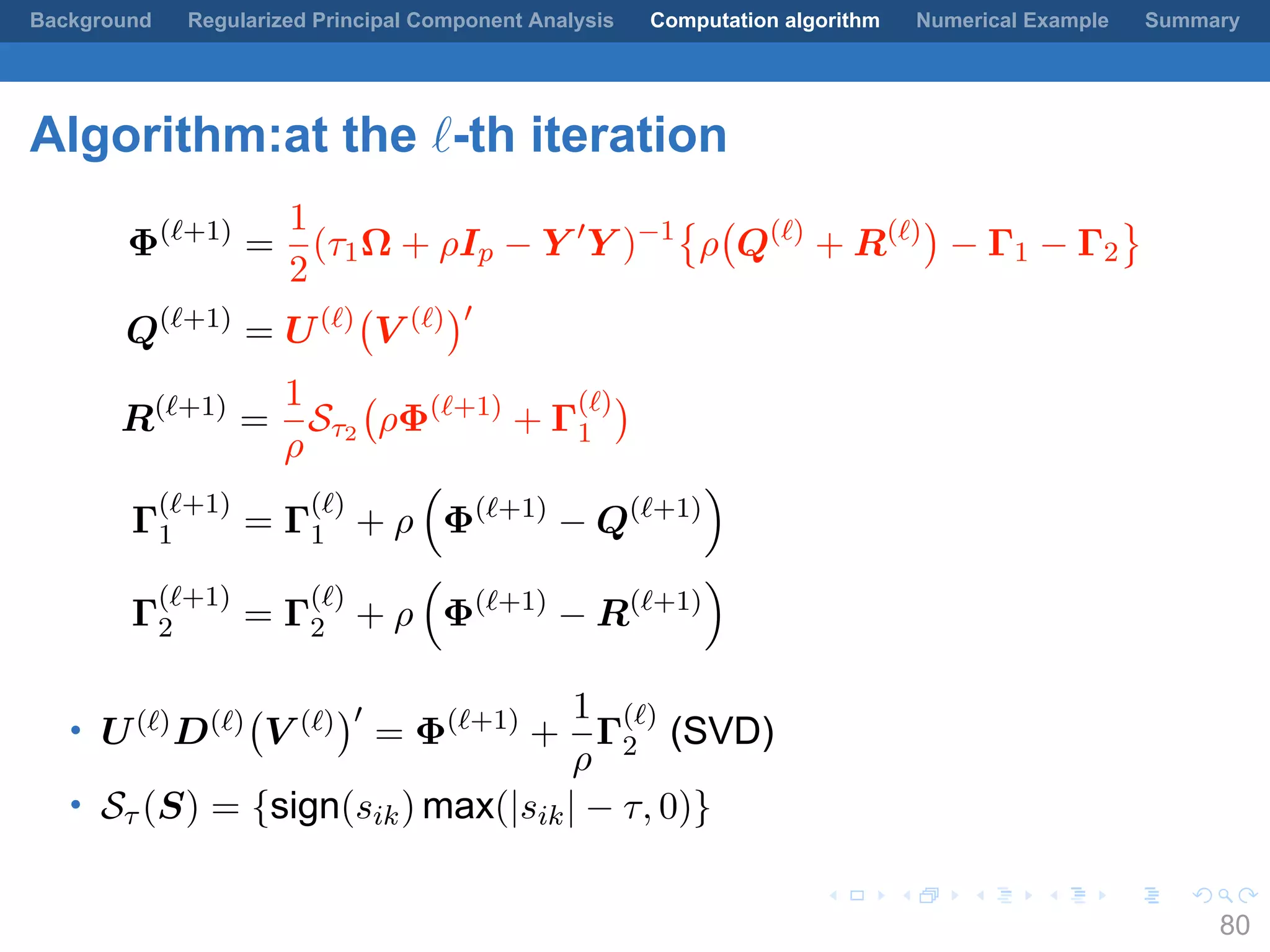
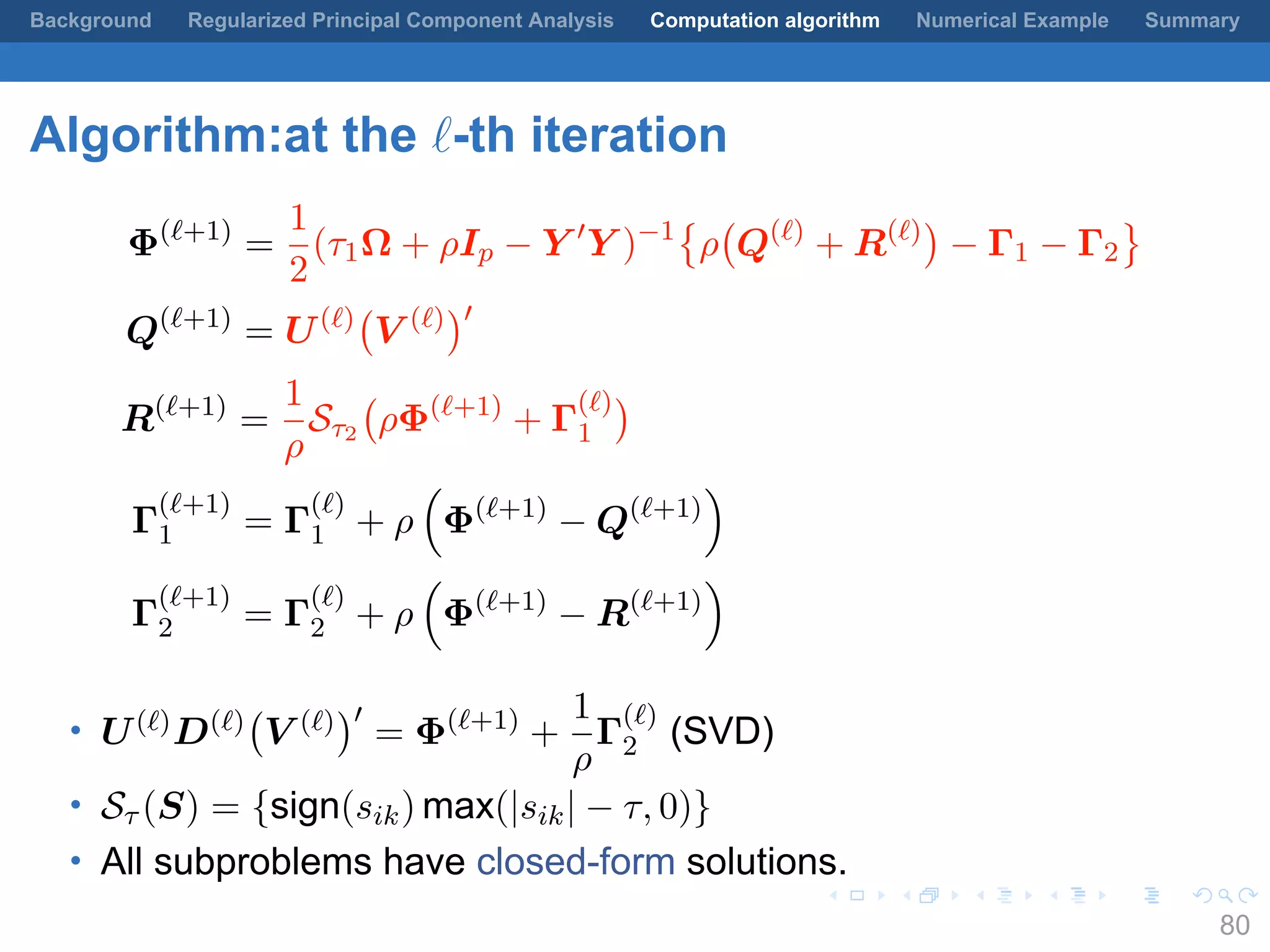
Algorithm:at the ℓ-th iteration
Φ(ℓ+1)
=
1
2
(τ1Ω + ρIp − Y ′
Y )−1
{
ρ
(
Q(ℓ)
+ R(ℓ)
)
− Γ1 − Γ2
}
Q(ℓ+1)
= U(ℓ)
(
V (ℓ)
)′
R(ℓ+1)
=
1
ρ
Sτ2
(
ρΦ(ℓ+1)
+ Γ
(ℓ)
1
)
Γ
(ℓ+1)
1 = Γ
(ℓ)
1 + ρ
(
Φ(ℓ+1)
− Q(ℓ+1)
)
Γ
(ℓ+1)
2 = Γ
(ℓ)
2 + ρ
(
Φ(ℓ+1)
− R(ℓ+1)
)
• U(ℓ)D(ℓ)
(
V (ℓ)
)′
= Φ(ℓ+1)
+
1
ρ
Γ
(ℓ)
2 (SVD)
• Sτ (S) = {sign(sik) max(|sik| − τ, 0)}
80
.
.
.
.
.
.
.
.
.
.
.
.
.
.
.
.
.
.
.
.
.
.
.
.
.
.
.
.
.
.
.
.
.
.
.
.
.
.
.
.
Background Regularized Principal Component Analysis Computation algorithm Numerical Example Summary
Algorithm:at the ℓ-th iteration
Φ(ℓ+1)
=
1
2
(τ1Ω + ρIp − Y ′
Y )−1
{
ρ
(
Q(ℓ)
+ R(ℓ)
)
− Γ1 − Γ2
}
Q(ℓ+1)
= U(ℓ)
(
V (ℓ)
)′
R(ℓ+1)
=
1
ρ
Sτ2
(
ρΦ(ℓ+1)
+ Γ
(ℓ)
1
)
Γ
(ℓ+1)
1 = Γ
(ℓ)
1 + ρ
(
Φ(ℓ+1)
− Q(ℓ+1)
)
Γ
(ℓ+1)
2 = Γ
(ℓ)
2 + ρ
(
Φ(ℓ+1)
− R(ℓ+1)
)
• U(ℓ)D(ℓ)
(
V (ℓ)
)′
= Φ(ℓ+1)
+
1
ρ
Γ
(ℓ)
2 (SVD)
• Sτ (S) = {sign(sik) max(|sik| − τ, 0)}
• All subproblems have closed-form solutions.
80
.
.
.
.
.
.
.
.
.
.
.
.
.
.
.
.
.
.
.
.
.
.
.
.
.
.
.
.
.
.
.
.
.
.
.
.
.
.
.
.
Background Regularized Principal Component Analysis Computation algorithm Numerical Example Summary
Outline
1 Background
2 Regularized Principal Component Analysis
3 Computation algorithm
4 Numerical Example
5 Summary
81
.
.
.
.
.
.
.
.
.
.
.
.
.
.
.
.
.
.
.
.
.
.
.
.
.
.
.
.
.
.
.
.
.
.
.
.
.
.
.
.
Background Regularized Principal Component Analysis Computation algorithm Numerical Example Summary
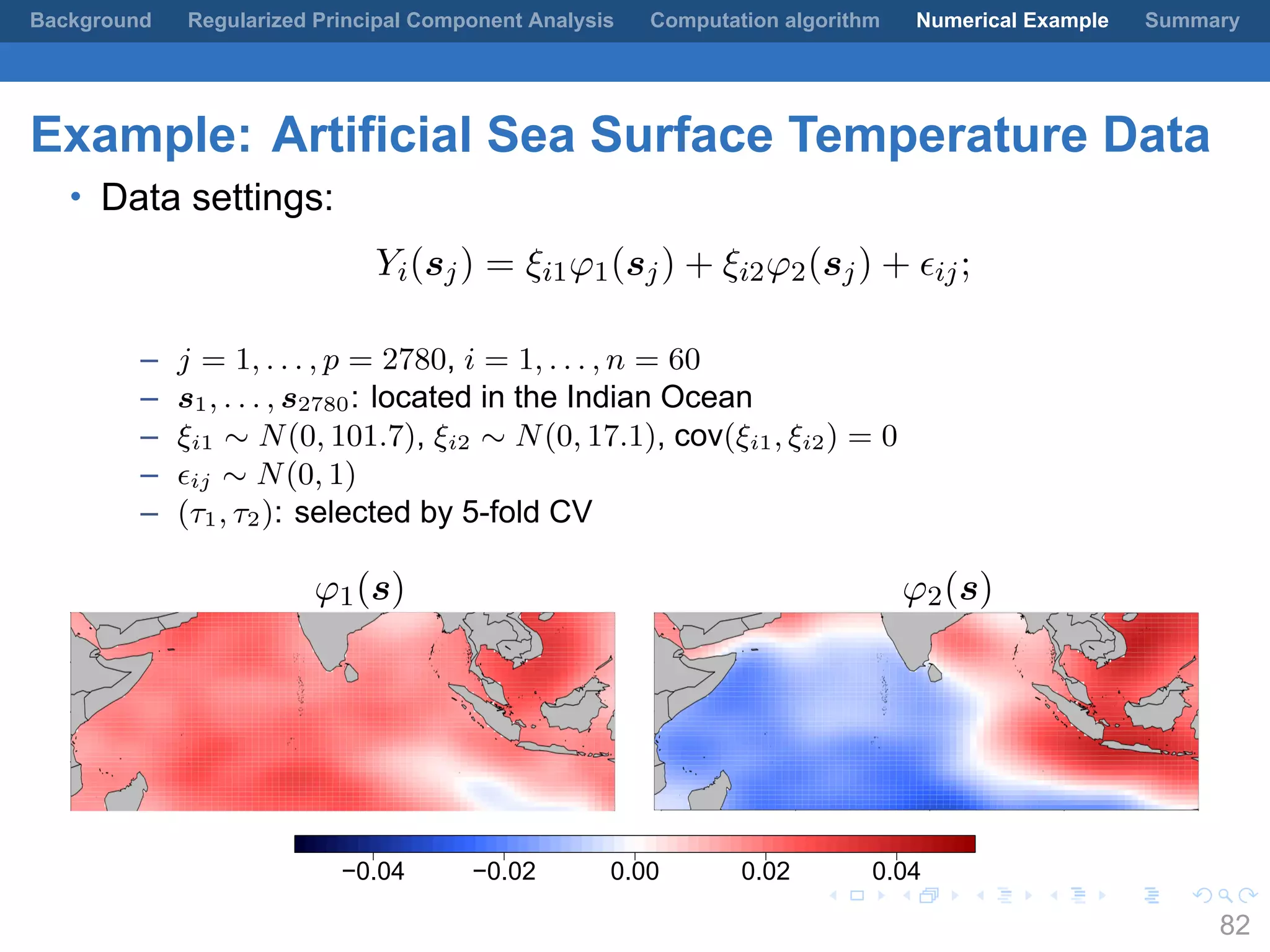
Example: Artificial Sea Surface Temperature Data
• Data settings:
Yi(sj) = ξi1φ1(sj) + ξi2φ2(sj) + ϵij;
– j = 1, . . . , p = 2780, i = 1, . . . , n = 60
– s1, . . . , s2780: located in the Indian Ocean
– ξi1 ∼ N(0, 101.7), ξi2 ∼ N(0, 17.1), cov(ξi1, ξi2) = 0
– ϵij ∼ N(0, 1)
– (τ1, τ2): selected by 5-fold CV
φ1(s) φ2(s)
−0.04 −0.02 0.00 0.02 0.04
82
.
.
.
.
.
.
.
.
.
.
.
.
.
.
.
.
.
.
.
.
.
.
.
.
.
.
.
.
.
.
.
.
.
.
.
.
.
.
.
.
Background Regularized Principal Component Analysis Computation algorithm Numerical Example Summary
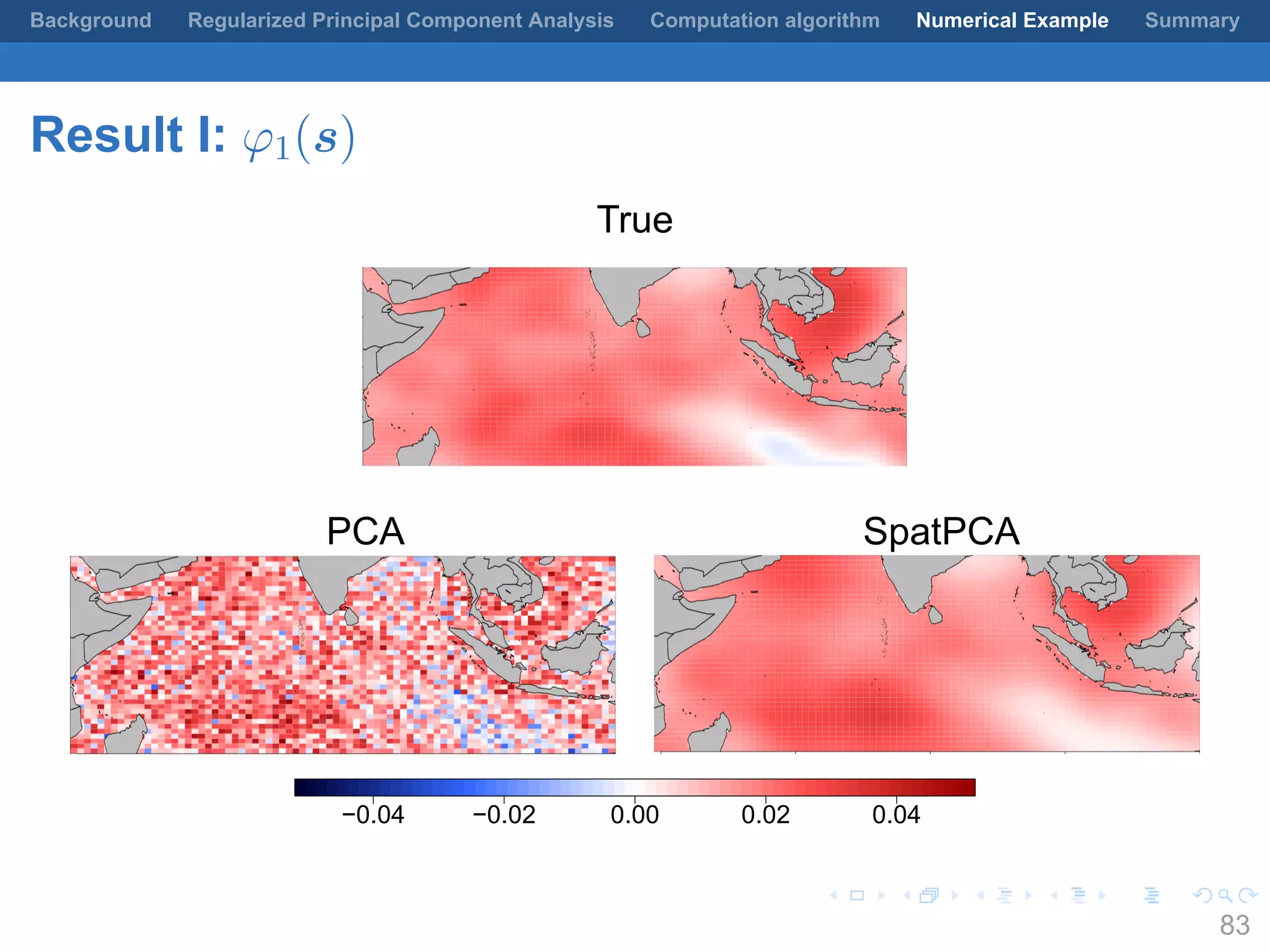
Result I: φ1(s)
True
PCA SpatPCA
−0.04 −0.02 0.00 0.02 0.04
83
.
.
.
.
.
.
.
.
.
.
.
.
.
.
.
.
.
.
.
.
.
.
.
.
.
.
.
.
.
.
.
.
.
.
.
.
.
.
.
.
Background Regularized Principal Component Analysis Computation algorithm Numerical Example Summary
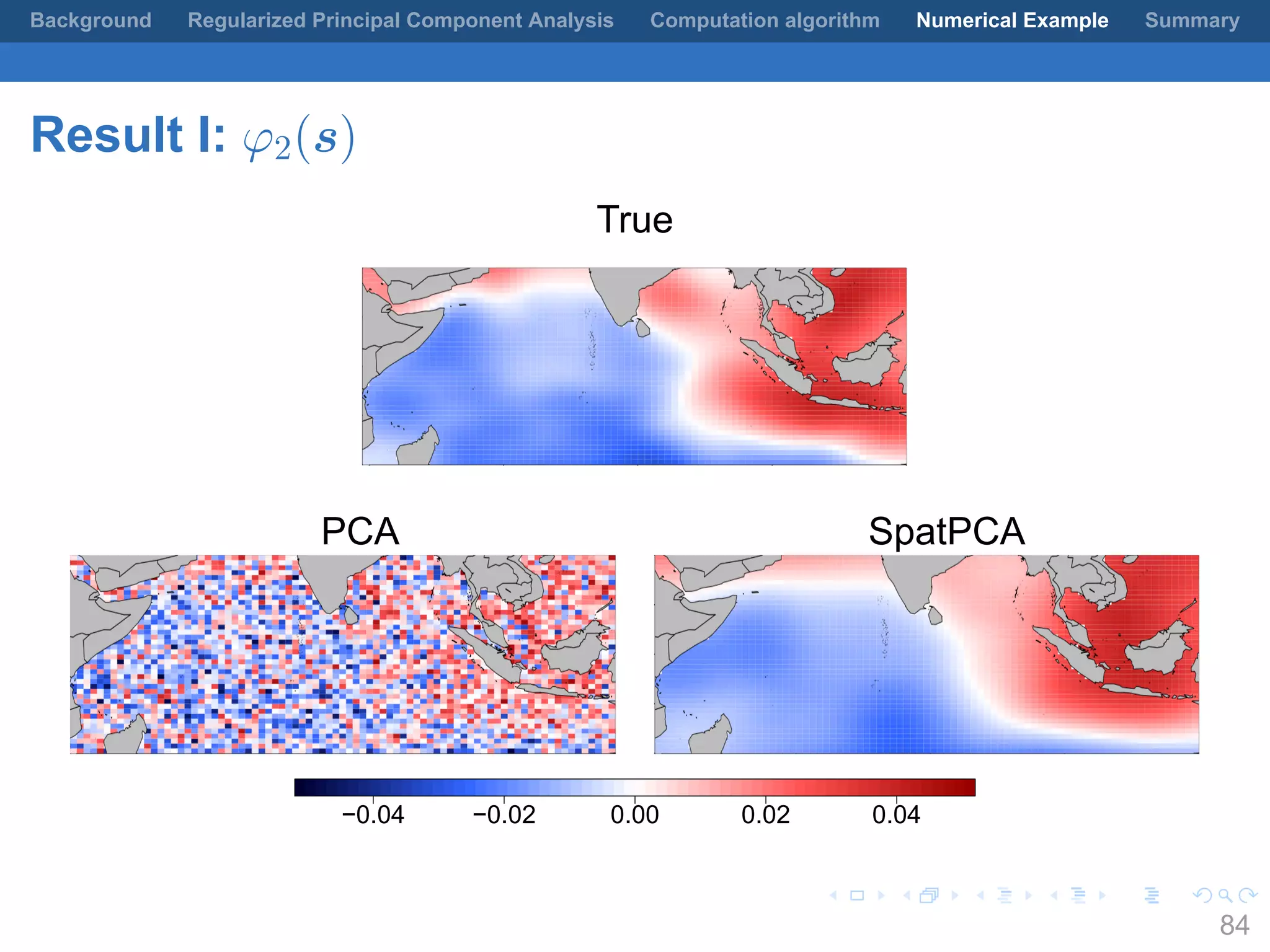
Result I: φ2(s)
True
PCA SpatPCA
−0.04 −0.02 0.00 0.02 0.04
84
.
.
.
.
.
.
.
.
.
.
.
.
.
.
.
.
.
.
.
.
.
.
.
.
.
.
.
.
.
.
.
.
.
.
.
.
.
.
.
.
Background Regularized Principal Component Analysis Computation algorithm Numerical Example Summary
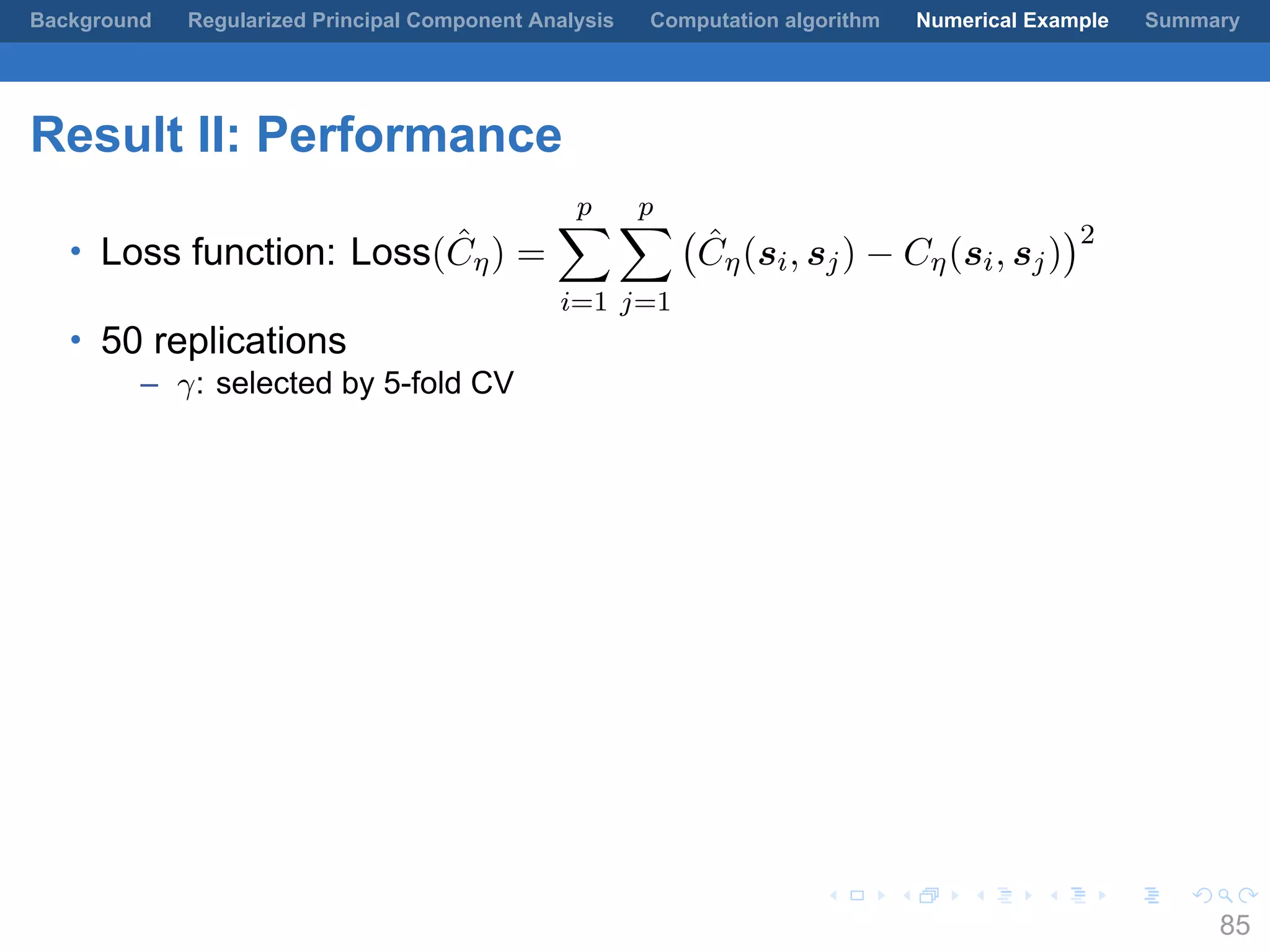
Result II: Performance
• Loss function: Loss( ˆCη) =
p∑
i=1
p∑
j=1
(
ˆCη(si, sj) − Cη(si, sj)
)2
• 50 replications
– γ: selected by 5-fold CV
85
.
.
.
.
.
.
.
.
.
.
.
.
.
.
.
.
.
.
.
.
.
.
.
.
.
.
.
.
.
.
.
.
.
.
.
.
.
.
.
.
Background Regularized Principal Component Analysis Computation algorithm Numerical Example Summary
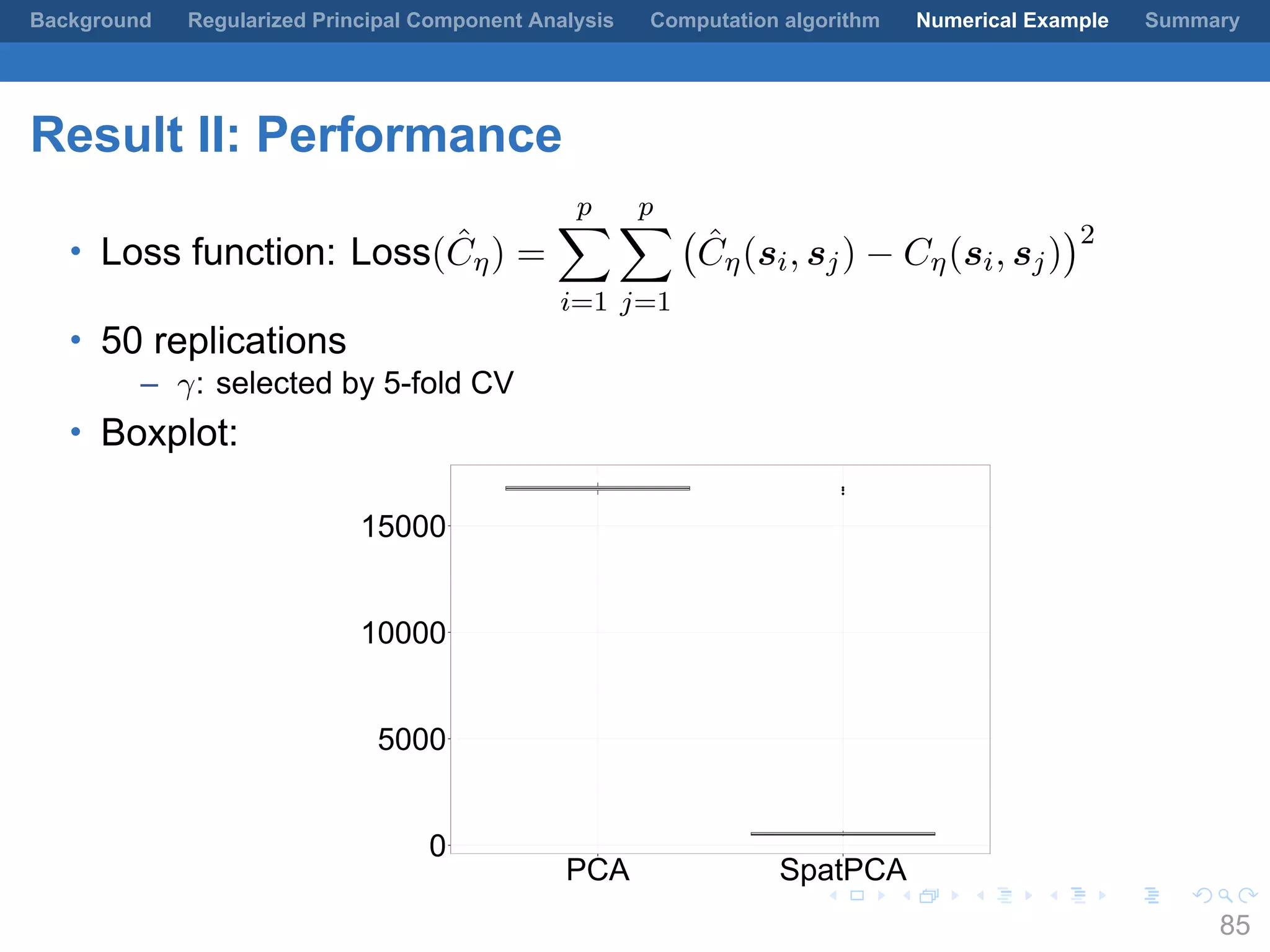
Result II: Performance
• Loss function: Loss( ˆCη) =
p∑
i=1
p∑
j=1
(
ˆCη(si, sj) − Cη(si, sj)
)2
• 50 replications
– γ: selected by 5-fold CV
• Boxplot:
q
q
q
0
5000
10000
15000
PCA SpatPCA
85
.
.
.
.
.
.
.
.
.
.
.
.
.
.
.
.
.
.
.
.
.
.
.
.
.
.
.
.
.
.
.
.
.
.
.
.
.
.
.
.
Background Regularized Principal Component Analysis Computation algorithm Numerical Example Summary
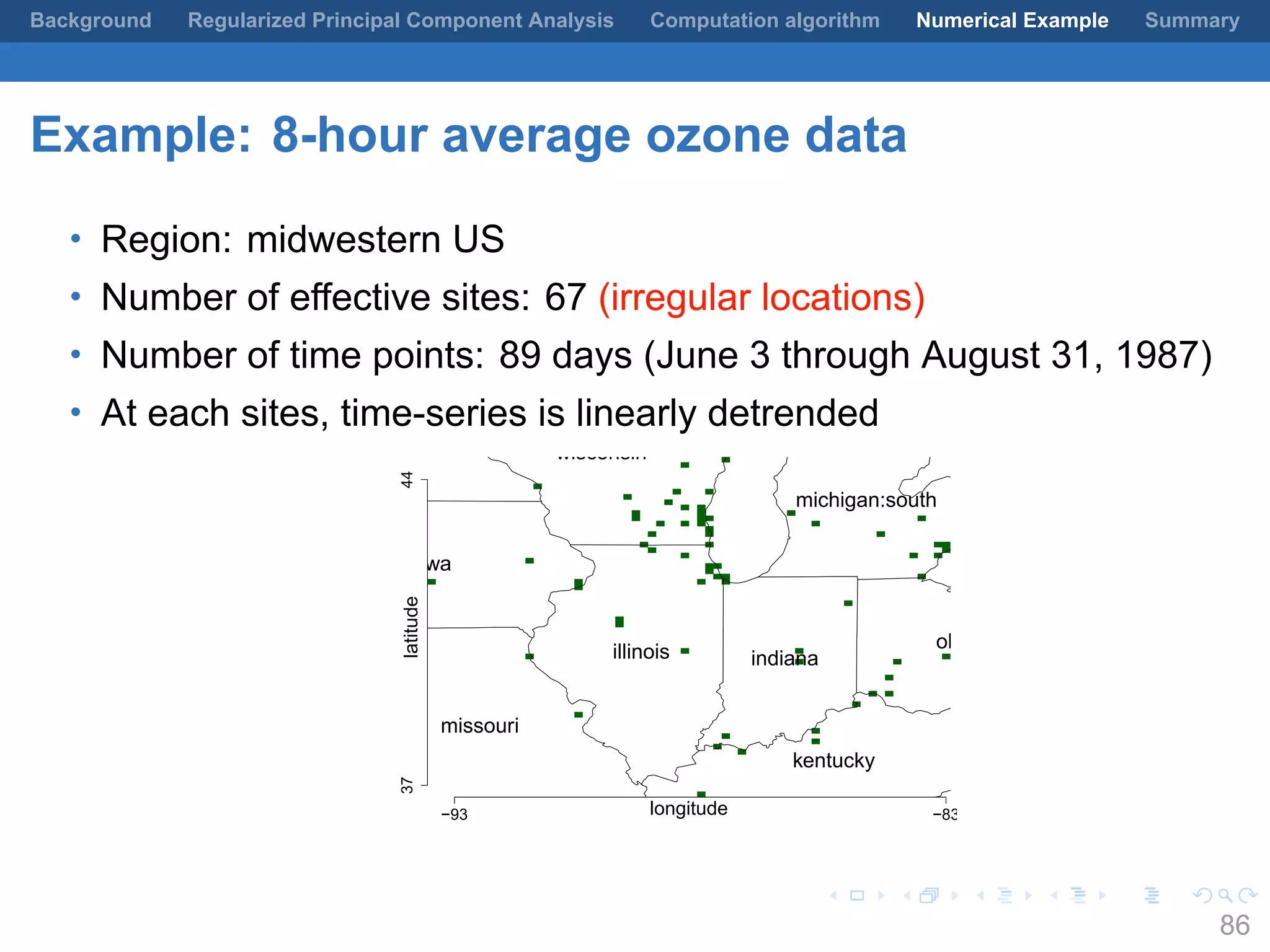
Example: 8-hour average ozone data
• Region: midwestern US
• Number of effective sites: 67 (irregular locations)
• Number of time points: 89 days (June 3 through August 31, 1987)
• At each sites, time-series is linearly detrended
−93 −83
3744
longitude
latitude
illinois indiana
iowa
kentucky
michigan:south
missouri
ohio
wisconsin
86
.
.
.
.
.
.
.
.
.
.
.
.
.
.
.
.
.
.
.
.
.
.
.
.
.
.
.
.
.
.
.
.
.
.
.
.
.
.
.
.
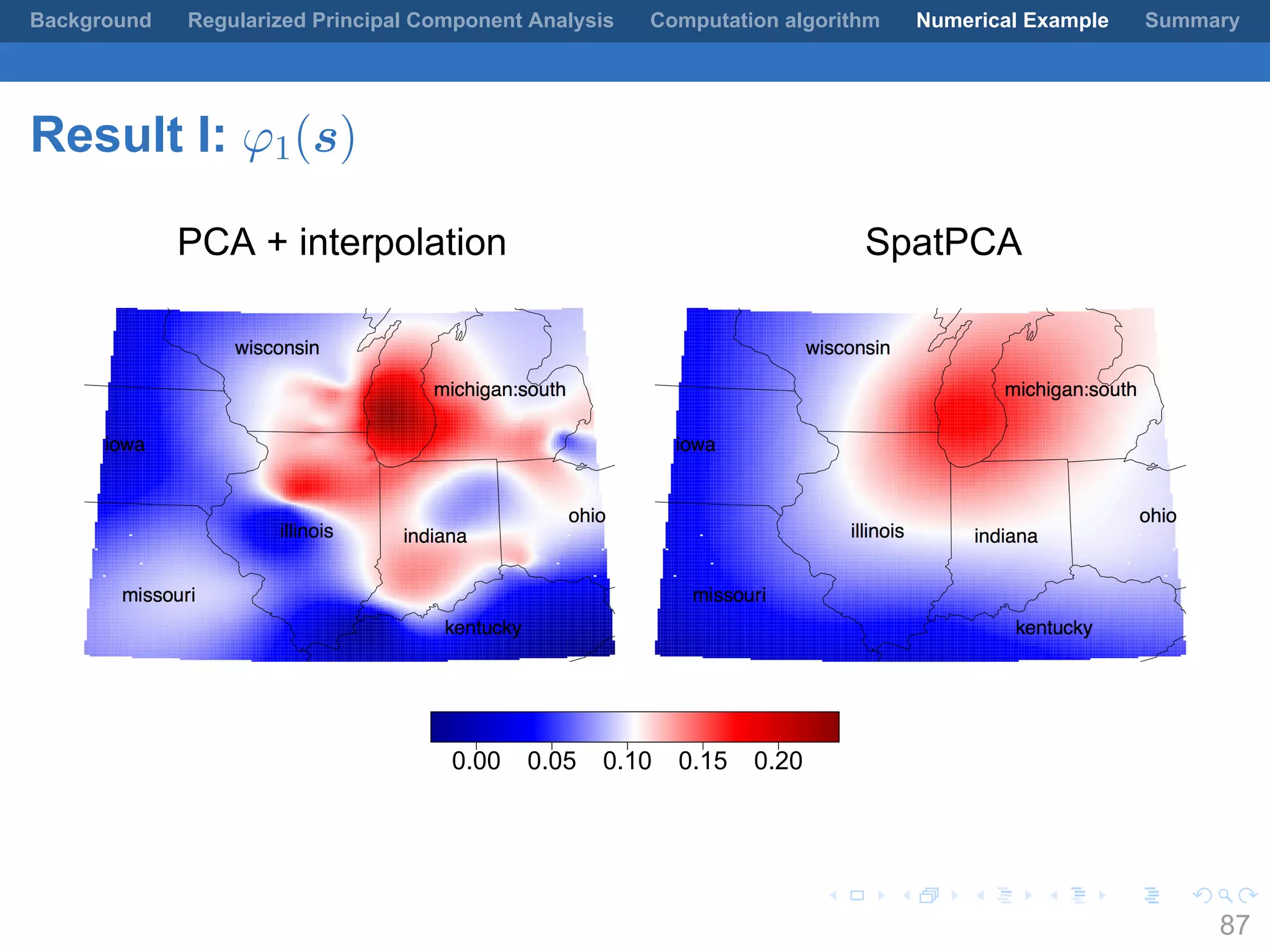
Background Regularized Principal Component Analysis Computation algorithm Numerical Example Summary
Result I: φ1(s)
PCA + interpolation SpatPCA
0.00 0.05 0.10 0.15 0.20
87
.
.
.
.
.
.
.
.
.
.
.
.
.
.
.
.
.
.
.
.
.
.
.
.
.
.
.
.
.
.
.
.
.
.
.
.
.
.
.
.
Background Regularized Principal Component Analysis Computation algorithm Numerical Example Summary
Outline
1 Background
2 Regularized Principal Component Analysis
3 Computation algorithm
4 Numerical Example
5 Summary
88
.
.
.
.
.
.
.
.
.
.
.
.
.
.
.
.
.
.
.
.
.
.
.
.
.
.
.
.
.
.
.
.
.
.
.
.
.
.
.
.
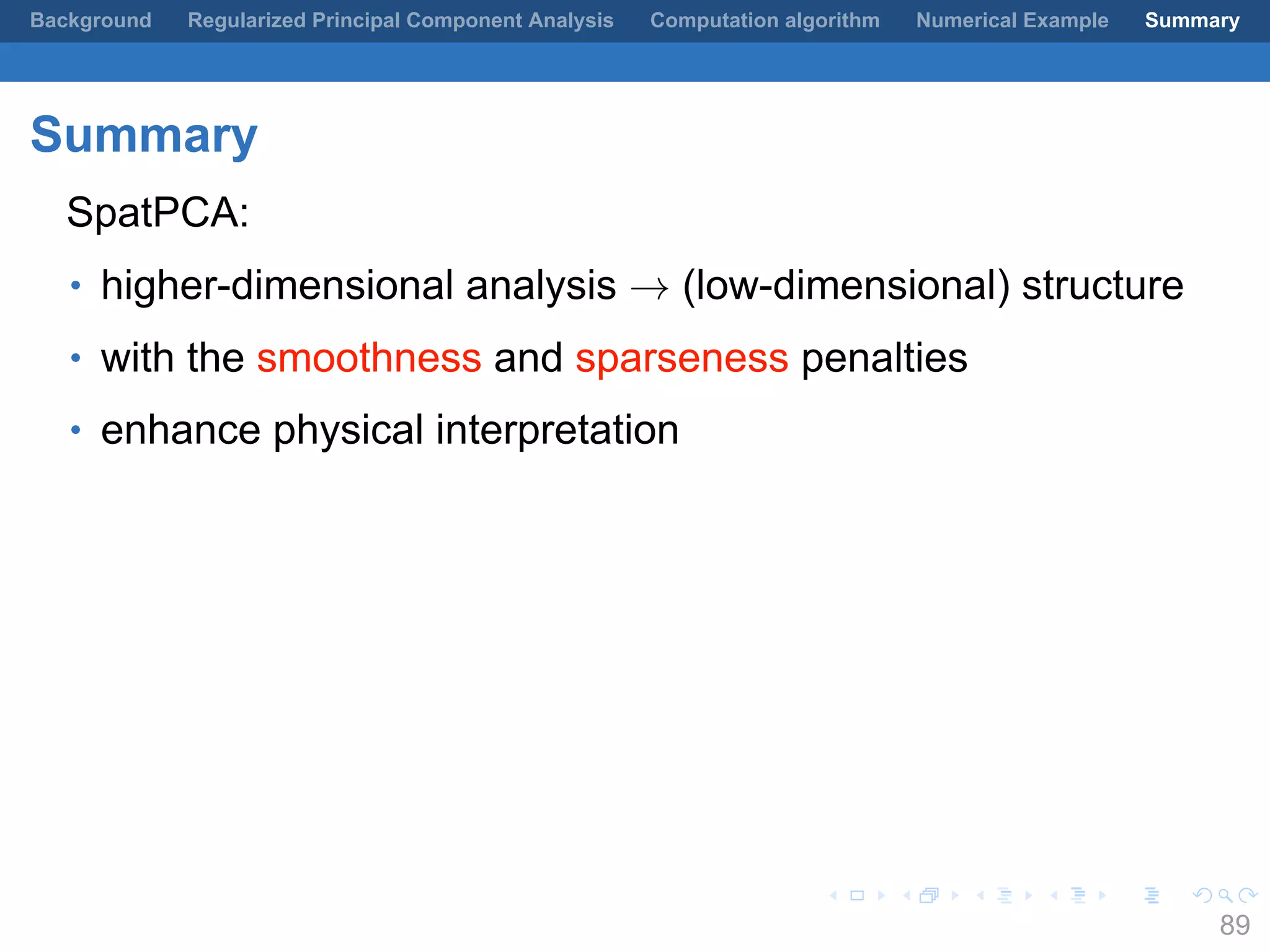
Background Regularized Principal Component Analysis Computation algorithm Numerical Example Summary
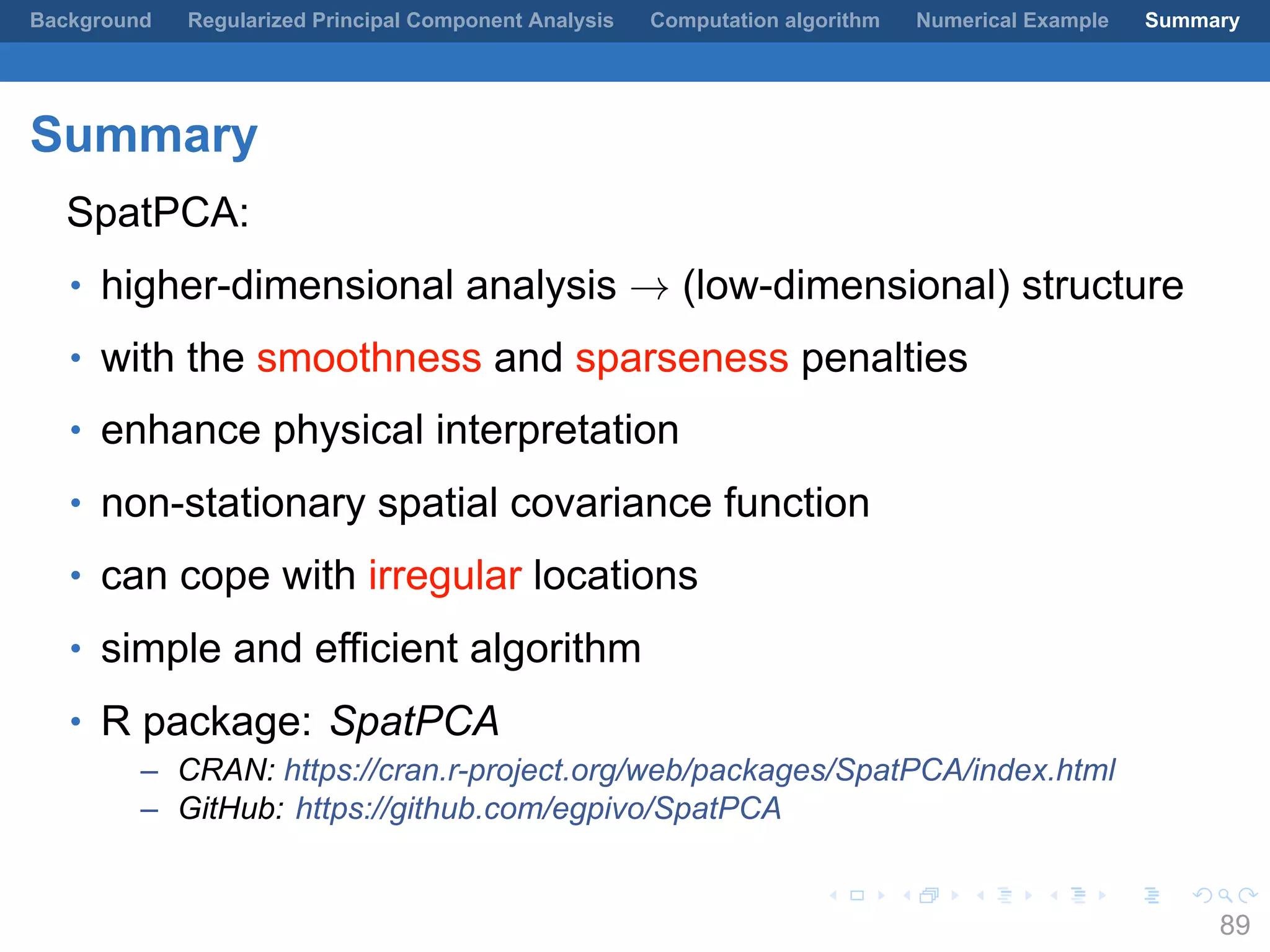
Summary
SpatPCA:
• higher-dimensional analysis → (low-dimensional) structure
• with the smoothness and sparseness penalties
• enhance physical interpretation
89
.
.
.
.
.
.
.
.
.
.
.
.
.
.
.
.
.
.
.
.
.
.
.
.
.
.
.
.
.
.
.
.
.
.
.
.
.
.
.
.
Background Regularized Principal Component Analysis Computation algorithm Numerical Example Summary
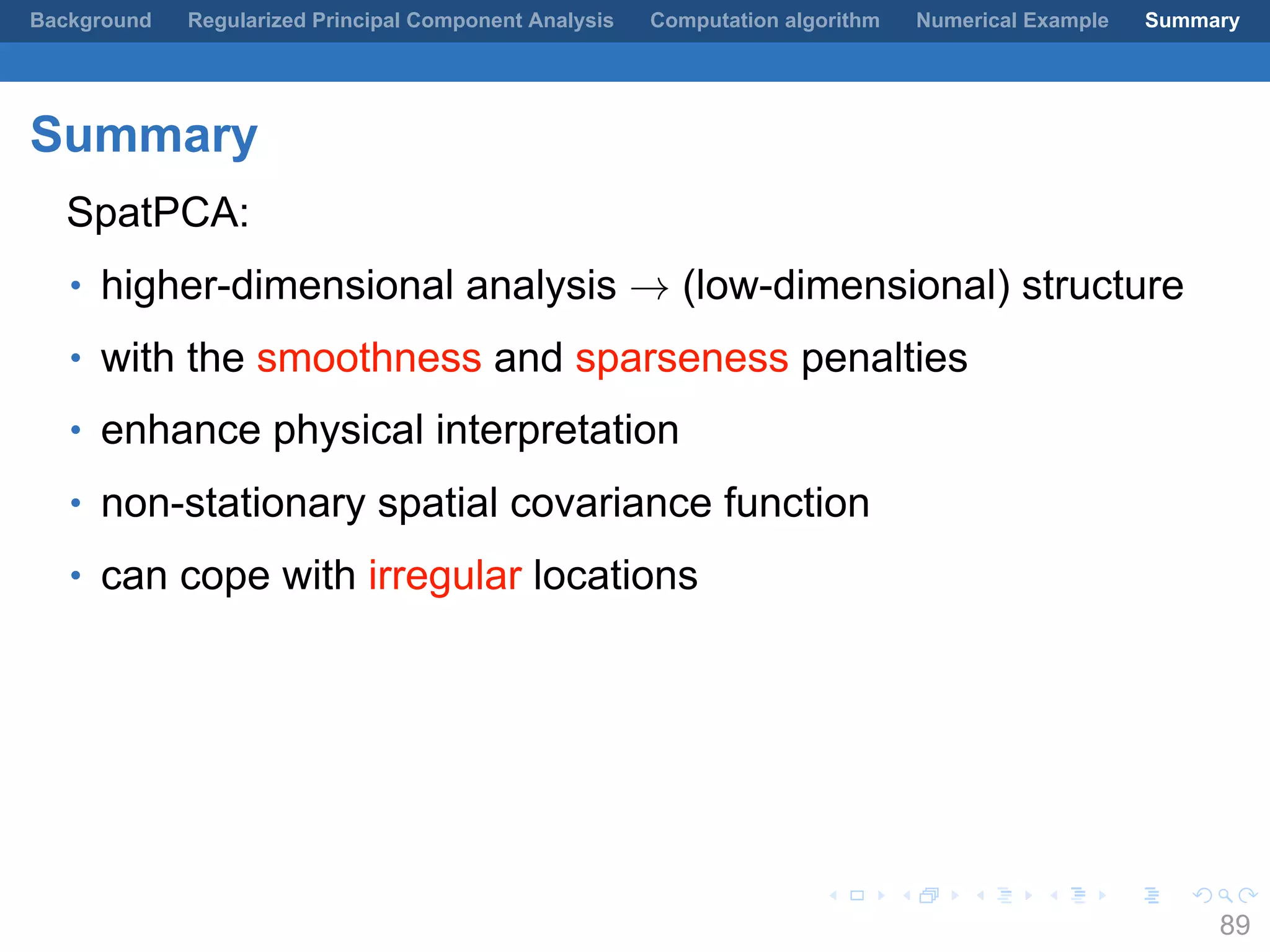
Summary
SpatPCA:
• higher-dimensional analysis → (low-dimensional) structure
• with the smoothness and sparseness penalties
• enhance physical interpretation
• non-stationary spatial covariance function
• can cope with irregular locations
89
.
.
.
.
.
.
.
.
.
.
.
.
.
.
.
.
.
.
.
.
.
.
.
.
.
.
.
.
.
.
.
.
.
.
.
.
.
.
.
.
Background Regularized Principal Component Analysis Computation algorithm Numerical Example Summary
Summary
SpatPCA:
• higher-dimensional analysis → (low-dimensional) structure
• with the smoothness and sparseness penalties
• enhance physical interpretation
• non-stationary spatial covariance function
• can cope with irregular locations
• simple and efficient algorithm
• R package: SpatPCA
– CRAN: https://cran.r-project.org/web/packages/SpatPCA/index.html
– GitHub: https://github.com/egpivo/SpatPCA
89
.
.
.
.
.
.
.
.
.
.
.
.
.
.
.
.
.
.
.
.
.
.
.
.
.
.
.
.
.
.
.
.
.
.
.
.
.
.
.
.
Background Regularized Principal Component Analysis Computation algorithm Numerical Example Summary
Thanks for your attention!
90

Regularized Principal Component Analysis for Spatial Data