OpenFOAM
Spatial
Interpolation
Fumiya Nozaki
Last Updated: 16 June 2014
English
2
FVM discretization
𝛻𝜓 𝑑𝑉
𝑉
= 𝑑𝑺 ∙ 𝜓
𝑆
= 𝑺 𝑓 ∙ 𝜓 𝑓
𝑓
Values at
face centers
 Most spatial derivative terms are first integrated over a cell volume 𝑉
and then converted to integrals over the cell surface bounding the
volume using Gauss’s theorem
Gauss’s theorem
Spatial
discretization
3
Interpolation from cells to faces
Owner cell
center
Neighbour cell
center
Face
center
𝜓 𝑃 𝜓 𝑁
𝜓 𝑓
 What we need is some algebraic relational expressions
𝜓 𝑓 = 𝑓 𝜓 𝑃, 𝜓 𝑁
 Typical interpolation schemes in OpenFOAM
 upwind
 linearUpwind
 linear
 limitedLinear
etc.
Many other schemes are available for use
in the spatial interpolation [1].
4
Available interpolation schemes in OpenFOAM
𝜓 𝑓 = 𝑓 𝜓 𝑃, 𝜓 𝑁
5
Specification of interpolation schemes
gradSchemes
{
default Gauss linear;
}
divSchemes
{
default none;
div(phi,U) bounded Gauss linearUpwind grad(U);
div((nuEff*(T(grad(U))))) Gauss linear;
}
laplacianSchemes
{
default Gauss linear corrected;
}
interpolationSchemes
{
default linear;
}
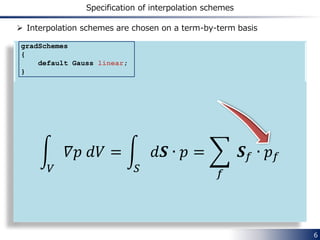
 Interpolation schemes are chosen on a term-by-term basis
gradSchemes
{
default Gauss linear;
}
divSchemes
{
default none;
div(phi,U) bounded Gauss linearUpwind grad(U);
div((nuEff*dev(T(grad(U))))) Gauss linear;
}
laplacianSchemes
{
default Gauss linear corrected;
}
interpolationSchemes
{
default linear;
}
6
Specification of interpolation schemes
 Interpolation schemes are chosen on a term-by-term basis
𝛻𝑝 𝑑𝑉
𝑉
= 𝑑𝑺 ∙ 𝑝
𝑆
= 𝑺 𝑓 ∙ 𝑝 𝑓
𝑓
7
Specification of interpolation schemes
gradSchemes
{
default Gauss linear;
}
divSchemes
{
default none;
div(phi,U) bounded Gauss linearUpwind grad(U);
div((nuEff*(T(grad(U))))) Gauss linear;
}
laplacianSchemes
{
default Gauss linear corrected;
}
interpolationSchemes
{
default linear;
}
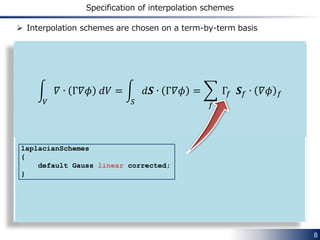
 Interpolation schemes are chosen on a term-by-term basis
𝛻 ∙ 𝜈 𝛻𝒖 𝑇
𝑑𝑉
𝑉
= 𝑑𝑺 ∙ 𝜈 𝛻𝒖 𝑇
𝑆
= 𝑺 𝑓 ∙ 𝜈 𝛻𝒖 𝑇
𝑓
𝑓
𝛻 ∙ 𝑼𝑼 𝑑𝑉
𝑉
= 𝑑𝑺 ∙ 𝑼𝑼
𝑆
= 𝑺 𝑓 ∙ 𝑼 𝑓 𝑼 𝑓
𝑓
= 𝐹𝑼 𝑓
𝑓
8
Specification of interpolation schemes
gradSchemes
{
default Gauss linear;
}
divSchemes
{
default none;
div(phi,U) bounded Gauss linearUpwind grad(U);
div((nuEff*dev(T(grad(U))))) Gauss linear;
}
laplacianSchemes
{
default Gauss linear corrected;
}
interpolationSchemes
{
default linear;
}
 Interpolation schemes are chosen on a term-by-term basis
𝛻 ∙ Γ𝛻𝜙 𝑑𝑉
𝑉
= 𝑑𝑺 ∙ Γ𝛻𝜙
𝑆
= Γ𝑓 𝑺 𝑓 ∙ 𝛻𝜙 𝑓
𝑓
9
Let’s look into
the code!
10
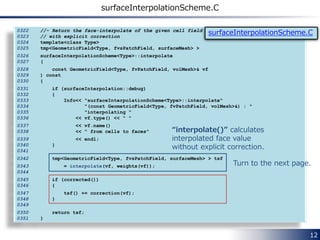
surfaceInterpolationScheme.C
0322 //- Return the face-interpolate of the given cell field
0323 // with explicit correction
0324 template<class Type>
0325 tmp<GeometricField<Type, fvsPatchField, surfaceMesh> >
0326 surfaceInterpolationScheme<Type>::interpolate
0327 (
0328 const GeometricField<Type, fvPatchField, volMesh>& vf
0329 ) const
0330 {
0331 if (surfaceInterpolation::debug)
0332 {
0333 Info<< "surfaceInterpolationScheme<Type>::interpolate"
0334 "(const GeometricField<Type, fvPatchField, volMesh>&) : "
0335 "interpolating "
0336 << vf.type() << " "
0337 << vf.name()
0338 << " from cells to faces"
0339 << endl;
0340 }
0341
0342 tmp<GeometricField<Type, fvsPatchField, surfaceMesh> > tsf
0343 = interpolate(vf, weights(vf));
0344
0345 if (corrected())
0346 {
0347 tsf() += correction(vf);
0348 }
0349
0350 return tsf;
0351 }
surfaceInterpolationScheme.C
Without explicit correction
Addition of explicit correction
11
surfaceInterpolationScheme.C
0322 //- Return the face-interpolate of the given cell field
0323 // with explicit correction
0324 template<class Type>
0325 tmp<GeometricField<Type, fvsPatchField, surfaceMesh> >
0326 surfaceInterpolationScheme<Type>::interpolate
0327 (
0328 const GeometricField<Type, fvPatchField, volMesh>& vf
0329 ) const
0330 {
0331 if (surfaceInterpolation::debug)
0332 {
0333 Info<< "surfaceInterpolationScheme<Type>::interpolate"
0334 "(const GeometricField<Type, fvPatchField, volMesh>&) : "
0335 "interpolating "
0336 << vf.type() << " "
0337 << vf.name()
0338 << " from cells to faces"
0339 << endl;
0340 }
0341
0342 tmp<GeometricField<Type, fvsPatchField, surfaceMesh> > tsf
0343 = interpolate(vf, weights(vf));
0344
0345 if (corrected())
0346 {
0347 tsf() += correction(vf);
0348 }
0349
0350 return tsf;
0351 }
surfaceInterpolationScheme.C
“weights()” are different
depending on the
interpolation scheme.
12
surfaceInterpolationScheme.C
0322 //- Return the face-interpolate of the given cell field
0323 // with explicit correction
0324 template<class Type>
0325 tmp<GeometricField<Type, fvsPatchField, surfaceMesh> >
0326 surfaceInterpolationScheme<Type>::interpolate
0327 (
0328 const GeometricField<Type, fvPatchField, volMesh>& vf
0329 ) const
0330 {
0331 if (surfaceInterpolation::debug)
0332 {
0333 Info<< "surfaceInterpolationScheme<Type>::interpolate"
0334 "(const GeometricField<Type, fvPatchField, volMesh>&) : "
0335 "interpolating "
0336 << vf.type() << " "
0337 << vf.name()
0338 << " from cells to faces"
0339 << endl;
0340 }
0341
0342 tmp<GeometricField<Type, fvsPatchField, surfaceMesh> > tsf
0343 = interpolate(vf, weights(vf));
0344
0345 if (corrected())
0346 {
0347 tsf() += correction(vf);
0348 }
0349
0350 return tsf;
0351 }
surfaceInterpolationScheme.C
“interpolate()” calculates
interpolated face value
without explicit correction.
Turn to the next page.
13
surfaceInterpolationScheme.C
0266 const surfaceScalarField& lambdas = tlambdas();
0267
0268 const Field<Type>& vfi = vf.internalField();
0269 const scalarField& lambda = lambdas.internalField();
0270
0271 const fvMesh& mesh = vf.mesh();
0272 const labelUList& P = mesh.owner();
0273 const labelUList& N = mesh.neighbour();
0274
0275 tmp<GeometricField<Type, fvsPatchField, surfaceMesh> > tsf
0276 (
0277 new GeometricField<Type, fvsPatchField, surfaceMesh>
0278 (
0279 IOobject
0280 (
0281 "interpolate("+vf.name()+')',
0282 vf.instance(),
0283 vf.db()
0284 ),
0285 mesh,
0286 vf.dimensions()
0287 )
0288 );
0289 GeometricField<Type, fvsPatchField, surfaceMesh>& sf = tsf();
0290
0291 Field<Type>& sfi = sf.internalField();
0292
0293 for (register label fi=0; fi<P.size(); fi++)
0294 {
0295 sfi[fi] = lambda[fi]*(vfi[P[fi]] - vfi[N[fi]]) + vfi[N[fi]];
0296 }
surfaceInterpolationScheme.C
sfi[fi] represents the
interpolated value at
the fi-th face center.
14
First look into “upwind” scheme
Table 4.6: Interpolation schemes [1]
upwind
Flow directions are considered.
15
Calculation of weights
0128 //- Return the interpolation weighting factors
0129 tmp<surfaceScalarField> weights() const
0130 {
0131 return pos(this->faceFlux_);
0132 }
0133
0134 //- Return the interpolation weighting factors
0135 virtual tmp<surfaceScalarField> weights
0136 (
0137 const GeometricField<Type, fvPatchField, volMesh>&
0138 ) const
0139 {
0140 return weights();
0141 }
upwind.H
 l. 0131
𝑤𝑒𝑖𝑔ℎ𝑡𝑠() facei =
1
0
if 𝑓𝑎𝑐𝑒𝐹𝑙𝑢𝑥 facei > 0
if 𝑓𝑎𝑐𝑒𝐹𝑙𝑢𝑥 facei ≤ 0
upwind
16
Explicit correction
0175 //- Return true if this scheme uses an explicit correction
0176 virtual bool corrected() const
0177 {
0178 return false;
0179 }
surfaceInterpolationScheme.H
 For “upwind” scheme, corrected() returns “false”
So, “upwind” interpolation has no explicit correction.
 Evaluation of the interpolated value
• If phi[facei] > 0
sfi[fi] = lambda[fi]*(vfi[P[fi]] - vfi[N[fi]]) + vfi[N[fi]]
= weights()[fi]*(vfi[P[fi]] - vfi[N[fi]]) + vfi[N[fi]]
= 1*(vfi[P[fi]] - vfi[N[fi]]) + vfi[N[fi]]
= vfi[P[fi]] = owner cell value
• If phi[facei] ≦ 0
sfi[fi] = lambda[fi]*(vfi[P[fi]] - vfi[N[fi]]) + vfi[N[fi]]
= 0*(vfi[P[fi]] - vfi[N[fi]]) + vfi[N[fi]]
= vfi[N[fi]] = neighbour cell value
upwind
17
Interpolated valueupwind
phi[facei] > 0 phi[facei] ≦ 0
owner neighbour owner neighbour
owner is the upstream cell neighbour is the upstream cell
𝝍 𝒇 𝐟𝐚𝐜𝐞𝐢
= 𝝍 𝒐𝒘𝒏𝒆𝒓 𝒄𝒆𝒍𝒍 𝒐𝒇 𝐟𝐚𝐜𝐞𝐢
𝝍 𝒇 𝐟𝐚𝐜𝐞𝐢
= 𝝍 𝒏𝒆𝒊𝒈𝒉𝒃𝒐𝒖𝒓 𝒄𝒆𝒍𝒍 𝒐𝒇 𝐟𝐚𝐜𝐞𝐢
18
Linear upwind differencing
Table 4.6: Interpolation schemes [1]
linearUpwind
Flow directions are considered.
19
Explicit correctionlinearUpwind
 “weights” are same as that of “upwind” scheme
 For “linearUpwind” scheme, corrected() returns “true”
 Calculation of explicit correction term
0139 //- Return true if this scheme uses an explicit correction
0140 virtual bool corrected() const
0141 {
0142 return true;
0143 }
linearUpwind.H
0085 forAll(faceFlux, facei)
0086 {
0087 label celli = (faceFlux[facei] > 0) ? owner[facei] : neighbour[facei];
0088 sfCorr[facei] = (Cf[facei] - C[celli]) & gradVf[celli];
0089 }
linearUpwind.C
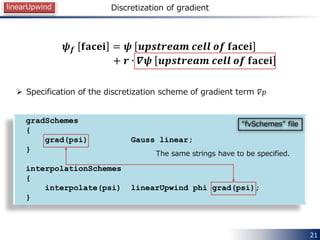
𝒓 ∙ 𝛻𝜓 𝑢𝑝𝑠𝑡𝑟𝑒𝑎𝑚 𝑐𝑒𝑙𝑙
label of an upstream cell
• Upstream cell is judged by the
sign of the face flux field “phi”
(faceFlux means phi in the
above code)
20
Interpolated value
phi[facei] > 0 phi[facei] ≦ 0
owner neighbour owner neighbour
upstream cell
𝝍 𝒇 𝐟𝐚𝐜𝐞𝐢 = 𝝍 𝒖𝒑𝒔𝒕𝒓𝒆𝒂𝒎 𝒄𝒆𝒍𝒍 𝒐𝒇 𝐟𝐚𝐜𝐞𝐢
+ 𝒓 ∙ 𝜵𝝍 𝒖𝒑𝒔𝒕𝒓𝒆𝒂𝒎 𝒄𝒆𝒍𝒍 𝒐𝒇 𝐟𝐚𝐜𝐞𝐢
linearUpwind
Center of
upstream cell
Face
center
𝒓
𝝍 𝒇 𝐟𝐚𝐜𝐞𝐢 = 𝝍 𝒖𝒑𝒔𝒕𝒓𝒆𝒂𝒎 𝒄𝒆𝒍𝒍 𝒐𝒇 𝐟𝐚𝐜𝐞𝐢
+ 𝒓 ∙ 𝜵𝝍 𝒖𝒑𝒔𝒕𝒓𝒆𝒂𝒎 𝒄𝒆𝒍𝒍 𝒐𝒇 𝐟𝐚𝐜𝐞𝐢
21
Discretization of gradient
gradSchemes
{
grad(psi) Gauss linear;
}
interpolationSchemes
{
interpolate(psi) linearUpwind phi grad(psi);
}
 Specification of the discretization scheme of gradient term 𝛻𝑝
The same strings have to be specified.
“fvSchemes” file
linearUpwind
22
Linear interpolation with symmetric weighting
Table 4.6: Interpolation schemes [1]
midPoint
Flow directions are not considered.
23
Calculation of weightsmidPoint
0095 //- Return the interpolation weighting factors
0096 tmp<surfaceScalarField> weights
0097 (
0098 const GeometricField<Type, fvPatchField, volMesh>&
0099 ) const
0100 {
0101 tmp<surfaceScalarField> taw
0102 (
0103 new surfaceScalarField
0104 (
0105 IOobject
0106 (
0107 "midPointWeights",
0108 this->mesh().time().timeName(),
0109 this->mesh()
0110 ),
0111 this->mesh(),
0112 dimensionedScalar("0.5", dimless, 0.5)
0113 )
0114 );
0115
0116 surfaceScalarField::GeometricBoundaryField& awbf =
0117 taw().boundaryField();
0118
0119 forAll(awbf, patchi)
0120 {
0121 if (!awbf[patchi].coupled())
0122 {
0123 awbf[patchi] = 1.0;
0124 }
0125 }
0126
0127 return taw;
0128 }
midPoint.H
weights on the
internal faces are 0.5
24
Explicit correction
 For “midPoint” scheme, corrected() returns “false”
So, “midPoint” interpolation has no explicit correction.
 Evaluation of the interpolated value
sfi[fi] = lambda[fi]*(vfi[P[fi]] - vfi[N[fi]]) + vfi[N[fi]]
= weights()[fi]*(vfi[P[fi]] - vfi[N[fi]]) + vfi[N[fi]]
= 0.5*(vfi[P[fi]] - vfi[N[fi]]) + vfi[N[fi]]
= 0.5*(vfi[P[fi]] + vfi[N[fi]])
= 0.5*(owner cell value + neighbour cell value)
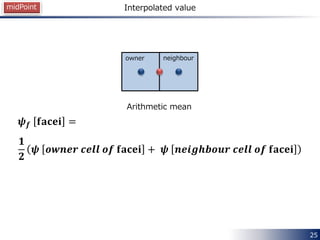
Arithmetic mean
midPoint
0175 //- Return true if this scheme uses an explicit correction
0176 virtual bool corrected() const
0177 {
0178 return false;
0179 }
surfaceInterpolationScheme.H
25
Interpolated valuemidPoint
owner neighbour
𝟏
𝟐
𝝍 𝒐𝒘𝒏𝒆𝒓 𝒄𝒆𝒍𝒍 𝒐𝒇 𝐟𝐚𝐜𝐞𝐢 + 𝝍 𝒏𝒆𝒊𝒈𝒉𝒃𝒐𝒖𝒓 𝒄𝒆𝒍𝒍 𝒐𝒇 𝐟𝐚𝐜𝐞𝐢
𝝍 𝒇 𝐟𝐚𝐜𝐞𝐢 =
Arithmetic mean
26
References
[1] User Guide http://foam.sourceforge.net/docs/Guides-a4/UserGuide.pdf
(accessed 06/15/2014)
27
Thank
You!

Spatial Interpolation Schemes in OpenFOAM

  • 1.
  • 2.
    2 FVM discretization 𝛻𝜓 𝑑𝑉 𝑉 =𝑑𝑺 ∙ 𝜓 𝑆 = 𝑺 𝑓 ∙ 𝜓 𝑓 𝑓 Values at face centers  Most spatial derivative terms are first integrated over a cell volume 𝑉 and then converted to integrals over the cell surface bounding the volume using Gauss’s theorem Gauss’s theorem Spatial discretization
  • 3.
    3 Interpolation from cellsto faces Owner cell center Neighbour cell center Face center 𝜓 𝑃 𝜓 𝑁 𝜓 𝑓  What we need is some algebraic relational expressions 𝜓 𝑓 = 𝑓 𝜓 𝑃, 𝜓 𝑁
  • 4.
     Typical interpolationschemes in OpenFOAM  upwind  linearUpwind  linear  limitedLinear etc. Many other schemes are available for use in the spatial interpolation [1]. 4 Available interpolation schemes in OpenFOAM 𝜓 𝑓 = 𝑓 𝜓 𝑃, 𝜓 𝑁
  • 5.
    5 Specification of interpolationschemes gradSchemes { default Gauss linear; } divSchemes { default none; div(phi,U) bounded Gauss linearUpwind grad(U); div((nuEff*(T(grad(U))))) Gauss linear; } laplacianSchemes { default Gauss linear corrected; } interpolationSchemes { default linear; }  Interpolation schemes are chosen on a term-by-term basis
  • 6.
    gradSchemes { default Gauss linear; } divSchemes { defaultnone; div(phi,U) bounded Gauss linearUpwind grad(U); div((nuEff*dev(T(grad(U))))) Gauss linear; } laplacianSchemes { default Gauss linear corrected; } interpolationSchemes { default linear; } 6 Specification of interpolation schemes  Interpolation schemes are chosen on a term-by-term basis 𝛻𝑝 𝑑𝑉 𝑉 = 𝑑𝑺 ∙ 𝑝 𝑆 = 𝑺 𝑓 ∙ 𝑝 𝑓 𝑓
  • 7.
    7 Specification of interpolationschemes gradSchemes { default Gauss linear; } divSchemes { default none; div(phi,U) bounded Gauss linearUpwind grad(U); div((nuEff*(T(grad(U))))) Gauss linear; } laplacianSchemes { default Gauss linear corrected; } interpolationSchemes { default linear; }  Interpolation schemes are chosen on a term-by-term basis 𝛻 ∙ 𝜈 𝛻𝒖 𝑇 𝑑𝑉 𝑉 = 𝑑𝑺 ∙ 𝜈 𝛻𝒖 𝑇 𝑆 = 𝑺 𝑓 ∙ 𝜈 𝛻𝒖 𝑇 𝑓 𝑓 𝛻 ∙ 𝑼𝑼 𝑑𝑉 𝑉 = 𝑑𝑺 ∙ 𝑼𝑼 𝑆 = 𝑺 𝑓 ∙ 𝑼 𝑓 𝑼 𝑓 𝑓 = 𝐹𝑼 𝑓 𝑓
  • 8.
    8 Specification of interpolationschemes gradSchemes { default Gauss linear; } divSchemes { default none; div(phi,U) bounded Gauss linearUpwind grad(U); div((nuEff*dev(T(grad(U))))) Gauss linear; } laplacianSchemes { default Gauss linear corrected; } interpolationSchemes { default linear; }  Interpolation schemes are chosen on a term-by-term basis 𝛻 ∙ Γ𝛻𝜙 𝑑𝑉 𝑉 = 𝑑𝑺 ∙ Γ𝛻𝜙 𝑆 = Γ𝑓 𝑺 𝑓 ∙ 𝛻𝜙 𝑓 𝑓
  • 9.
  • 10.
    10 surfaceInterpolationScheme.C 0322 //- Returnthe face-interpolate of the given cell field 0323 // with explicit correction 0324 template<class Type> 0325 tmp<GeometricField<Type, fvsPatchField, surfaceMesh> > 0326 surfaceInterpolationScheme<Type>::interpolate 0327 ( 0328 const GeometricField<Type, fvPatchField, volMesh>& vf 0329 ) const 0330 { 0331 if (surfaceInterpolation::debug) 0332 { 0333 Info<< "surfaceInterpolationScheme<Type>::interpolate" 0334 "(const GeometricField<Type, fvPatchField, volMesh>&) : " 0335 "interpolating " 0336 << vf.type() << " " 0337 << vf.name() 0338 << " from cells to faces" 0339 << endl; 0340 } 0341 0342 tmp<GeometricField<Type, fvsPatchField, surfaceMesh> > tsf 0343 = interpolate(vf, weights(vf)); 0344 0345 if (corrected()) 0346 { 0347 tsf() += correction(vf); 0348 } 0349 0350 return tsf; 0351 } surfaceInterpolationScheme.C Without explicit correction Addition of explicit correction
  • 11.
    11 surfaceInterpolationScheme.C 0322 //- Returnthe face-interpolate of the given cell field 0323 // with explicit correction 0324 template<class Type> 0325 tmp<GeometricField<Type, fvsPatchField, surfaceMesh> > 0326 surfaceInterpolationScheme<Type>::interpolate 0327 ( 0328 const GeometricField<Type, fvPatchField, volMesh>& vf 0329 ) const 0330 { 0331 if (surfaceInterpolation::debug) 0332 { 0333 Info<< "surfaceInterpolationScheme<Type>::interpolate" 0334 "(const GeometricField<Type, fvPatchField, volMesh>&) : " 0335 "interpolating " 0336 << vf.type() << " " 0337 << vf.name() 0338 << " from cells to faces" 0339 << endl; 0340 } 0341 0342 tmp<GeometricField<Type, fvsPatchField, surfaceMesh> > tsf 0343 = interpolate(vf, weights(vf)); 0344 0345 if (corrected()) 0346 { 0347 tsf() += correction(vf); 0348 } 0349 0350 return tsf; 0351 } surfaceInterpolationScheme.C “weights()” are different depending on the interpolation scheme.
  • 12.
    12 surfaceInterpolationScheme.C 0322 //- Returnthe face-interpolate of the given cell field 0323 // with explicit correction 0324 template<class Type> 0325 tmp<GeometricField<Type, fvsPatchField, surfaceMesh> > 0326 surfaceInterpolationScheme<Type>::interpolate 0327 ( 0328 const GeometricField<Type, fvPatchField, volMesh>& vf 0329 ) const 0330 { 0331 if (surfaceInterpolation::debug) 0332 { 0333 Info<< "surfaceInterpolationScheme<Type>::interpolate" 0334 "(const GeometricField<Type, fvPatchField, volMesh>&) : " 0335 "interpolating " 0336 << vf.type() << " " 0337 << vf.name() 0338 << " from cells to faces" 0339 << endl; 0340 } 0341 0342 tmp<GeometricField<Type, fvsPatchField, surfaceMesh> > tsf 0343 = interpolate(vf, weights(vf)); 0344 0345 if (corrected()) 0346 { 0347 tsf() += correction(vf); 0348 } 0349 0350 return tsf; 0351 } surfaceInterpolationScheme.C “interpolate()” calculates interpolated face value without explicit correction. Turn to the next page.
  • 13.
    13 surfaceInterpolationScheme.C 0266 const surfaceScalarField&lambdas = tlambdas(); 0267 0268 const Field<Type>& vfi = vf.internalField(); 0269 const scalarField& lambda = lambdas.internalField(); 0270 0271 const fvMesh& mesh = vf.mesh(); 0272 const labelUList& P = mesh.owner(); 0273 const labelUList& N = mesh.neighbour(); 0274 0275 tmp<GeometricField<Type, fvsPatchField, surfaceMesh> > tsf 0276 ( 0277 new GeometricField<Type, fvsPatchField, surfaceMesh> 0278 ( 0279 IOobject 0280 ( 0281 "interpolate("+vf.name()+')', 0282 vf.instance(), 0283 vf.db() 0284 ), 0285 mesh, 0286 vf.dimensions() 0287 ) 0288 ); 0289 GeometricField<Type, fvsPatchField, surfaceMesh>& sf = tsf(); 0290 0291 Field<Type>& sfi = sf.internalField(); 0292 0293 for (register label fi=0; fi<P.size(); fi++) 0294 { 0295 sfi[fi] = lambda[fi]*(vfi[P[fi]] - vfi[N[fi]]) + vfi[N[fi]]; 0296 } surfaceInterpolationScheme.C sfi[fi] represents the interpolated value at the fi-th face center.
  • 14.
    14 First look into“upwind” scheme Table 4.6: Interpolation schemes [1] upwind Flow directions are considered.
  • 15.
    15 Calculation of weights 0128//- Return the interpolation weighting factors 0129 tmp<surfaceScalarField> weights() const 0130 { 0131 return pos(this->faceFlux_); 0132 } 0133 0134 //- Return the interpolation weighting factors 0135 virtual tmp<surfaceScalarField> weights 0136 ( 0137 const GeometricField<Type, fvPatchField, volMesh>& 0138 ) const 0139 { 0140 return weights(); 0141 } upwind.H  l. 0131 𝑤𝑒𝑖𝑔ℎ𝑡𝑠() facei = 1 0 if 𝑓𝑎𝑐𝑒𝐹𝑙𝑢𝑥 facei > 0 if 𝑓𝑎𝑐𝑒𝐹𝑙𝑢𝑥 facei ≤ 0 upwind
  • 16.
    16 Explicit correction 0175 //-Return true if this scheme uses an explicit correction 0176 virtual bool corrected() const 0177 { 0178 return false; 0179 } surfaceInterpolationScheme.H  For “upwind” scheme, corrected() returns “false” So, “upwind” interpolation has no explicit correction.  Evaluation of the interpolated value • If phi[facei] > 0 sfi[fi] = lambda[fi]*(vfi[P[fi]] - vfi[N[fi]]) + vfi[N[fi]] = weights()[fi]*(vfi[P[fi]] - vfi[N[fi]]) + vfi[N[fi]] = 1*(vfi[P[fi]] - vfi[N[fi]]) + vfi[N[fi]] = vfi[P[fi]] = owner cell value • If phi[facei] ≦ 0 sfi[fi] = lambda[fi]*(vfi[P[fi]] - vfi[N[fi]]) + vfi[N[fi]] = 0*(vfi[P[fi]] - vfi[N[fi]]) + vfi[N[fi]] = vfi[N[fi]] = neighbour cell value upwind
  • 17.
    17 Interpolated valueupwind phi[facei] >0 phi[facei] ≦ 0 owner neighbour owner neighbour owner is the upstream cell neighbour is the upstream cell 𝝍 𝒇 𝐟𝐚𝐜𝐞𝐢 = 𝝍 𝒐𝒘𝒏𝒆𝒓 𝒄𝒆𝒍𝒍 𝒐𝒇 𝐟𝐚𝐜𝐞𝐢 𝝍 𝒇 𝐟𝐚𝐜𝐞𝐢 = 𝝍 𝒏𝒆𝒊𝒈𝒉𝒃𝒐𝒖𝒓 𝒄𝒆𝒍𝒍 𝒐𝒇 𝐟𝐚𝐜𝐞𝐢
  • 18.
    18 Linear upwind differencing Table4.6: Interpolation schemes [1] linearUpwind Flow directions are considered.
  • 19.
    19 Explicit correctionlinearUpwind  “weights”are same as that of “upwind” scheme  For “linearUpwind” scheme, corrected() returns “true”  Calculation of explicit correction term 0139 //- Return true if this scheme uses an explicit correction 0140 virtual bool corrected() const 0141 { 0142 return true; 0143 } linearUpwind.H 0085 forAll(faceFlux, facei) 0086 { 0087 label celli = (faceFlux[facei] > 0) ? owner[facei] : neighbour[facei]; 0088 sfCorr[facei] = (Cf[facei] - C[celli]) & gradVf[celli]; 0089 } linearUpwind.C 𝒓 ∙ 𝛻𝜓 𝑢𝑝𝑠𝑡𝑟𝑒𝑎𝑚 𝑐𝑒𝑙𝑙 label of an upstream cell • Upstream cell is judged by the sign of the face flux field “phi” (faceFlux means phi in the above code)
  • 20.
    20 Interpolated value phi[facei] >0 phi[facei] ≦ 0 owner neighbour owner neighbour upstream cell 𝝍 𝒇 𝐟𝐚𝐜𝐞𝐢 = 𝝍 𝒖𝒑𝒔𝒕𝒓𝒆𝒂𝒎 𝒄𝒆𝒍𝒍 𝒐𝒇 𝐟𝐚𝐜𝐞𝐢 + 𝒓 ∙ 𝜵𝝍 𝒖𝒑𝒔𝒕𝒓𝒆𝒂𝒎 𝒄𝒆𝒍𝒍 𝒐𝒇 𝐟𝐚𝐜𝐞𝐢 linearUpwind Center of upstream cell Face center 𝒓
  • 21.
    𝝍 𝒇 𝐟𝐚𝐜𝐞𝐢= 𝝍 𝒖𝒑𝒔𝒕𝒓𝒆𝒂𝒎 𝒄𝒆𝒍𝒍 𝒐𝒇 𝐟𝐚𝐜𝐞𝐢 + 𝒓 ∙ 𝜵𝝍 𝒖𝒑𝒔𝒕𝒓𝒆𝒂𝒎 𝒄𝒆𝒍𝒍 𝒐𝒇 𝐟𝐚𝐜𝐞𝐢 21 Discretization of gradient gradSchemes { grad(psi) Gauss linear; } interpolationSchemes { interpolate(psi) linearUpwind phi grad(psi); }  Specification of the discretization scheme of gradient term 𝛻𝑝 The same strings have to be specified. “fvSchemes” file linearUpwind
  • 22.
    22 Linear interpolation withsymmetric weighting Table 4.6: Interpolation schemes [1] midPoint Flow directions are not considered.
  • 23.
    23 Calculation of weightsmidPoint 0095//- Return the interpolation weighting factors 0096 tmp<surfaceScalarField> weights 0097 ( 0098 const GeometricField<Type, fvPatchField, volMesh>& 0099 ) const 0100 { 0101 tmp<surfaceScalarField> taw 0102 ( 0103 new surfaceScalarField 0104 ( 0105 IOobject 0106 ( 0107 "midPointWeights", 0108 this->mesh().time().timeName(), 0109 this->mesh() 0110 ), 0111 this->mesh(), 0112 dimensionedScalar("0.5", dimless, 0.5) 0113 ) 0114 ); 0115 0116 surfaceScalarField::GeometricBoundaryField& awbf = 0117 taw().boundaryField(); 0118 0119 forAll(awbf, patchi) 0120 { 0121 if (!awbf[patchi].coupled()) 0122 { 0123 awbf[patchi] = 1.0; 0124 } 0125 } 0126 0127 return taw; 0128 } midPoint.H weights on the internal faces are 0.5
  • 24.
    24 Explicit correction  For“midPoint” scheme, corrected() returns “false” So, “midPoint” interpolation has no explicit correction.  Evaluation of the interpolated value sfi[fi] = lambda[fi]*(vfi[P[fi]] - vfi[N[fi]]) + vfi[N[fi]] = weights()[fi]*(vfi[P[fi]] - vfi[N[fi]]) + vfi[N[fi]] = 0.5*(vfi[P[fi]] - vfi[N[fi]]) + vfi[N[fi]] = 0.5*(vfi[P[fi]] + vfi[N[fi]]) = 0.5*(owner cell value + neighbour cell value) Arithmetic mean midPoint 0175 //- Return true if this scheme uses an explicit correction 0176 virtual bool corrected() const 0177 { 0178 return false; 0179 } surfaceInterpolationScheme.H
  • 25.
    25 Interpolated valuemidPoint owner neighbour 𝟏 𝟐 𝝍𝒐𝒘𝒏𝒆𝒓 𝒄𝒆𝒍𝒍 𝒐𝒇 𝐟𝐚𝐜𝐞𝐢 + 𝝍 𝒏𝒆𝒊𝒈𝒉𝒃𝒐𝒖𝒓 𝒄𝒆𝒍𝒍 𝒐𝒇 𝐟𝐚𝐜𝐞𝐢 𝝍 𝒇 𝐟𝐚𝐜𝐞𝐢 = Arithmetic mean
  • 26.
    26 References [1] User Guidehttp://foam.sourceforge.net/docs/Guides-a4/UserGuide.pdf (accessed 06/15/2014)
  • 27.