Apache Spark:
What’s New, What’s Coming
Patrick Wendell - @pwendell
May 2015 – Strata London
About Me
Founding committer of Spark at Berkeley AMPLab
Co-founder of Databricks, now manage Spark roadmap
and community
Release manager for Spark 1.3 and 1.4
Set Footer from Insert Dropdown Menu 2
About Databricks
Founded by Apache Spark creators
Largest contributor to Spark project, committed to
keeping Spark 100% open source
End-to-End hosted platform, Databricks Cloud
Show of Hands
A.  New to Spark
B.  Played around with Spark API in training or examples
C.  Have written a full application on Spark (POC or
production)
Set Footer from Insert Dropdown Menu 4
5
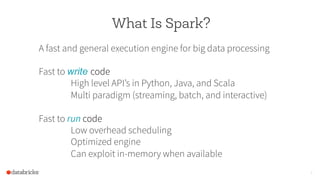
What Is Spark?
A fast and general execution engine for big data processing
Fast to write code
High level API’s in Python, Java, and Scala
Multi paradigm (streaming, batch, and interactive)
Fast to run code
Low overhead scheduling
Optimized engine
Can exploit in-memory when available
6
7
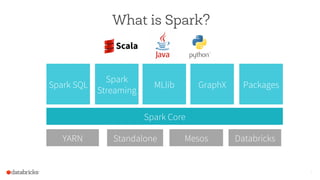
Spark Core
Spark
Streaming
Spark SQL MLlib GraphX
What is Spark?
YARN Mesos DatabricksStandalone
Packages
8
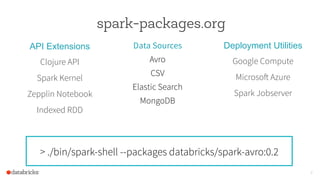
spark-packages.org
API Extensions
Clojure API
Spark Kernel
Zepplin Notebook
Indexed RDD
Deployment Utilities
Google Compute
Microsoft Azure
Spark Jobserver
Data Sources
Avro
CSV
Elastic Search
MongoDB
> ./bin/spark-shell --packages databricks/spark-avro:0.2
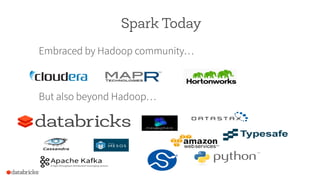
Spark Today
Embraced by Hadoop community…
But also beyond Hadoop…
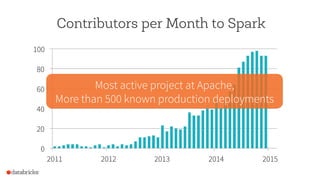
Contributors per Month to Spark
0
20
40
60
80
100
2011 2012 2013 2014 2015
Most active project at Apache,
More than 500 known production deployments
Set Footer from Insert Dropdown Menu 11
What’s New In Spark?
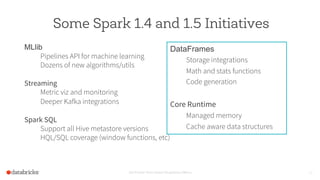
Some Spark 1.4 and 1.5 Initiatives
MLlib
Pipelines API for machine learning
Dozens of new algorithms/utils
Streaming
Metric viz and monitoring
Deeper Kafka integrations
Spark SQL
Support all Hive metastore versions
HQL/SQL coverage (window functions, etc)
Set Footer from Insert Dropdown Menu 12
DataFrames
Storage integrations
Math and stats functions
Code generation
Core Runtime
Managed memory
Cache aware data structures
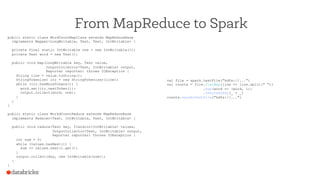
From MapReduce to Spark
public static class WordCountMapClass extends MapReduceBase
implements Mapper<LongWritable, Text, Text, IntWritable> {
private final static IntWritable one = new IntWritable(1);
private Text word = new Text();
public void map(LongWritable key, Text value,
OutputCollector<Text, IntWritable> output,
Reporter reporter) throws IOException {
String line = value.toString();
StringTokenizer itr = new StringTokenizer(line);
while (itr.hasMoreTokens()) {
word.set(itr.nextToken());
output.collect(word, one);
}
}
}
public static class WorkdCountReduce extends MapReduceBase
implements Reducer<Text, IntWritable, Text, IntWritable> {
public void reduce(Text key, Iterator<IntWritable> values,
OutputCollector<Text, IntWritable> output,
Reporter reporter) throws IOException {
int sum = 0;
while (values.hasNext()) {
sum += values.next().get();
}
output.collect(key, new IntWritable(sum));
}
}
val file = spark.textFile("hdfs://...")
val counts = file.flatMap(line => line.split(" "))
.map(word => (word, 1))
.reduceByKey(_ + _)
counts.saveAsTextFile("hdfs://...")
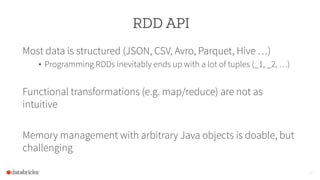
RDD API
Most data is structured (JSON, CSV, Avro, Parquet, Hive …)
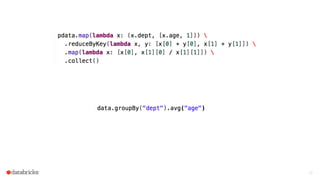
•  Programming RDDs inevitably ends up with a lot of tuples (_1, _2, …)
Functional transformations (e.g. map/reduce) are not as
intuitive
Memory management with arbitrary Java objects is doable, but
challenging
14
15
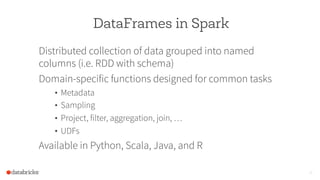
DataFrames in Spark
Distributed collection of data grouped into named
columns (i.e. RDD with schema)
Domain-specific functions designed for common tasks
•  Metadata
•  Sampling
•  Project, filter, aggregation, join, …
•  UDFs
Available in Python, Scala, Java, and R
16
Demo (Time Permitting)
Set Footer from Insert Dropdown Menu 17
From DataFrames Spring…
1.  A DataFrame model for expressive and concise
programs
2.  A pluggable Datasource API API for reading and
writing data frames while minimizing IO
3.  The Catalyst logical optimizer for speeding up data
frame operations
4.  Project Tungsten – optimized physical execution
throughout Spark
18
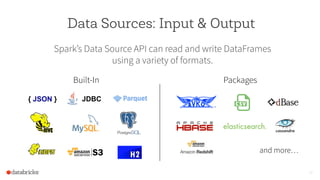
Data Sources: Input & Output
Spark’s Data Source API can read and write DataFrames
using a variety of formats.
19
{ JSON }
Built-In Packages
JDBC
and more…
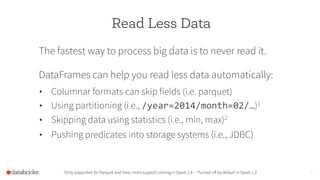
Read Less Data
The fastest way to process big data is to never read it.
DataFrames can help you read less data automatically:
1Only supported for Parquet and Hive, more support coming in Spark 1.4 - 2Turned off by default in Spark 1.3 20
•  Columnar formats can skip fields (i.e. parquet)
•  Using partitioning (i.e., /year=2014/month=02/…)1
•  Skipping data using statistics (i.e., min, max)2
•  Pushing predicates into storage systems (i.e., JDBC)
	
  
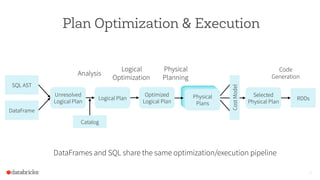
Plan Optimization & Execution
21
SQL AST
DataFrame
Unresolved
Logical Plan
Logical Plan
Optimized
Logical Plan
RDDs
Selected
Physical Plan
Analysis
Logical
Optimization
Physical
Planning
CostModel
Physical
Plans
Code
Generation
Catalog
DataFrames and SQL share the same optimization/execution pipeline
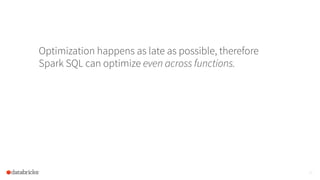
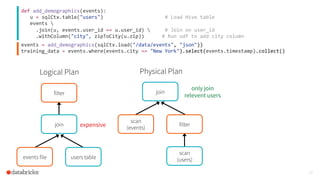
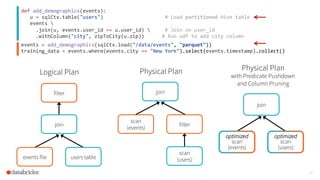
Optimization happens as late as possible, therefore
Spark SQL can optimize even across functions.
22
23
def	
  add_demographics(events):	


  u	
  =	
  sqlCtx.table("users")	


  #	
  Load	
  Hive	
  table	


  events	


  .join(u,	
  events.user_id	
  ==	
  u.user_id)	


  #	
  Join	
  on	
  user_id	


  .withColumn("city",	
  zipToCity(u.zip))	


  #	
  Run	
  udf	
  to	
  add	
  city	
  column	
  
	
  events	
  =	
  add_demographics(sqlCtx.load("/data/events",	
  "json"))	
  	
  
training_data	
  =	
  events.where(events.city	
  ==	
  "New	
  York").select(events.timestamp).collect()	
  	
  
Logical Plan
filter
join
events file users table
expensive
only join
relevent users
Physical Plan
join
scan
(events)
filter
scan
(users)
24
def	
  add_demographics(events):	


  u	
  =	
  sqlCtx.table("users")	


  #	
  Load	
  partitioned	
  Hive	
  table	


  events	


  .join(u,	
  events.user_id	
  ==	
  u.user_id)	


  #	
  Join	
  on	
  user_id	


  .withColumn("city",	
  zipToCity(u.zip))	


  #	
  Run	
  udf	
  to	
  add	
  city	
  column	


Physical Plan
with Predicate Pushdown
and Column Pruning
join
optimized
scan
(events)
optimized
scan
(users)
events	
  =	
  add_demographics(sqlCtx.load("/data/events",	
  "parquet"))	
  	
  
training_data	
  =	
  events.where(events.city	
  ==	
  "New	
  York").select(events.timestamp).collect()	
  	
  
Logical Plan
filter
join
events file users table
Physical Plan
join
scan
(events)
filter
scan
(users)
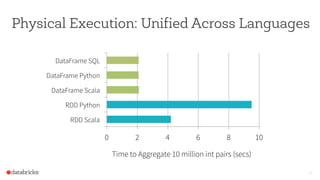
Physical Execution: Unified Across Languages
25
0 2 4 6 8 10
RDD Scala
RDD Python
DataFrame Scala
DataFrame Python
DataFrame SQL
Time to Aggregate 10 million int pairs (secs)
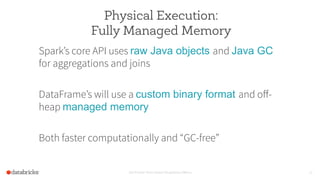
Physical Execution:
Fully Managed Memory
Spark’s core API uses raw Java objects and Java GC
for aggregations and joins
DataFrame’s will use a custom binary format and off-
heap managed memory
Both faster computationally and “GC-free”
Set Footer from Insert Dropdown Menu 26
Set Footer from Insert Dropdown Menu 27
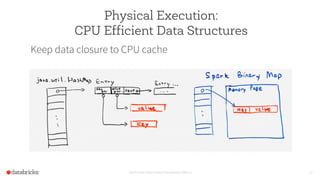
Physical Execution:
CPU Efficient Data Structures
Keep data closure to CPU cache
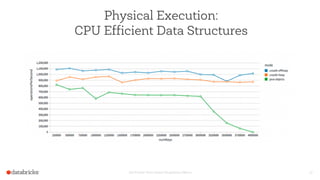
Physical Execution:
CPU Efficient Data Structures
Set Footer from Insert Dropdown Menu 28
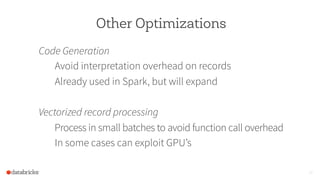
Other Optimizations
Code Generation
Avoid interpretation overhead on records
Already used in Spark, but will expand
Vectorized record processing
Process in small batches to avoid function call overhead
In some cases can exploit GPU’s
29
30
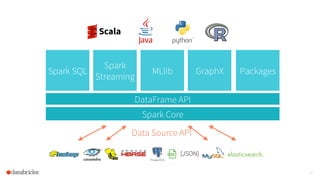
{JSON}
Data Source API
Spark Core
Spark
Streaming
Spark SQL MLlib GraphX
DataFrame API
Packages
31
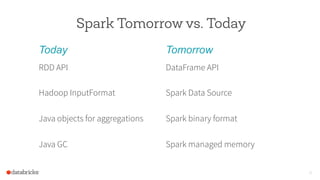
Spark Tomorrow vs. Today
Today
RDD API
Hadoop InputFormat
Java objects for aggregations
Java GC
Tomorrow
DataFrame API
Spark Data Source
Spark binary format
Spark managed memory
Set Footer from Insert Dropdown Menu 32
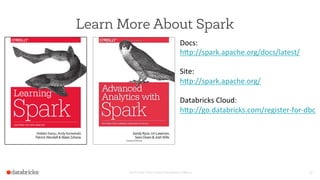
Learn More About Spark
Docs:	
  
h(p://spark.apache.org/docs/latest/	


Site:	
  
h(p://spark.apache.org/	


Databricks	
  Cloud:	
  
h(p://go.databricks.com/register-­‐for-­‐dbc	


Thank You!
Questions?

Spark what's new what's coming

  • 1.
    Apache Spark: What’s New,What’s Coming Patrick Wendell - @pwendell May 2015 – Strata London
  • 2.
    About Me Founding committerof Spark at Berkeley AMPLab Co-founder of Databricks, now manage Spark roadmap and community Release manager for Spark 1.3 and 1.4 Set Footer from Insert Dropdown Menu 2
  • 3.
    About Databricks Founded byApache Spark creators Largest contributor to Spark project, committed to keeping Spark 100% open source End-to-End hosted platform, Databricks Cloud
  • 4.
    Show of Hands A. New to Spark B.  Played around with Spark API in training or examples C.  Have written a full application on Spark (POC or production) Set Footer from Insert Dropdown Menu 4
  • 5.
  • 6.
    What Is Spark? Afast and general execution engine for big data processing Fast to write code High level API’s in Python, Java, and Scala Multi paradigm (streaming, batch, and interactive) Fast to run code Low overhead scheduling Optimized engine Can exploit in-memory when available 6
  • 7.
    7 Spark Core Spark Streaming Spark SQLMLlib GraphX What is Spark? YARN Mesos DatabricksStandalone Packages
  • 8.
    8 spark-packages.org API Extensions Clojure API SparkKernel Zepplin Notebook Indexed RDD Deployment Utilities Google Compute Microsoft Azure Spark Jobserver Data Sources Avro CSV Elastic Search MongoDB > ./bin/spark-shell --packages databricks/spark-avro:0.2
  • 9.
    Spark Today Embraced byHadoop community… But also beyond Hadoop…
  • 10.
    Contributors per Monthto Spark 0 20 40 60 80 100 2011 2012 2013 2014 2015 Most active project at Apache, More than 500 known production deployments
  • 11.
    Set Footer fromInsert Dropdown Menu 11 What’s New In Spark?
  • 12.
    Some Spark 1.4and 1.5 Initiatives MLlib Pipelines API for machine learning Dozens of new algorithms/utils Streaming Metric viz and monitoring Deeper Kafka integrations Spark SQL Support all Hive metastore versions HQL/SQL coverage (window functions, etc) Set Footer from Insert Dropdown Menu 12 DataFrames Storage integrations Math and stats functions Code generation Core Runtime Managed memory Cache aware data structures
  • 13.
    From MapReduce toSpark public static class WordCountMapClass extends MapReduceBase implements Mapper<LongWritable, Text, Text, IntWritable> { private final static IntWritable one = new IntWritable(1); private Text word = new Text(); public void map(LongWritable key, Text value, OutputCollector<Text, IntWritable> output, Reporter reporter) throws IOException { String line = value.toString(); StringTokenizer itr = new StringTokenizer(line); while (itr.hasMoreTokens()) { word.set(itr.nextToken()); output.collect(word, one); } } } public static class WorkdCountReduce extends MapReduceBase implements Reducer<Text, IntWritable, Text, IntWritable> { public void reduce(Text key, Iterator<IntWritable> values, OutputCollector<Text, IntWritable> output, Reporter reporter) throws IOException { int sum = 0; while (values.hasNext()) { sum += values.next().get(); } output.collect(key, new IntWritable(sum)); } } val file = spark.textFile("hdfs://...") val counts = file.flatMap(line => line.split(" ")) .map(word => (word, 1)) .reduceByKey(_ + _) counts.saveAsTextFile("hdfs://...")
  • 14.
    RDD API Most datais structured (JSON, CSV, Avro, Parquet, Hive …) •  Programming RDDs inevitably ends up with a lot of tuples (_1, _2, …) Functional transformations (e.g. map/reduce) are not as intuitive Memory management with arbitrary Java objects is doable, but challenging 14
  • 15.
  • 16.
    DataFrames in Spark Distributedcollection of data grouped into named columns (i.e. RDD with schema) Domain-specific functions designed for common tasks •  Metadata •  Sampling •  Project, filter, aggregation, join, … •  UDFs Available in Python, Scala, Java, and R 16
  • 17.
    Demo (Time Permitting) SetFooter from Insert Dropdown Menu 17
  • 18.
    From DataFrames Spring… 1. A DataFrame model for expressive and concise programs 2.  A pluggable Datasource API API for reading and writing data frames while minimizing IO 3.  The Catalyst logical optimizer for speeding up data frame operations 4.  Project Tungsten – optimized physical execution throughout Spark 18
  • 19.
    Data Sources: Input& Output Spark’s Data Source API can read and write DataFrames using a variety of formats. 19 { JSON } Built-In Packages JDBC and more…
  • 20.
    Read Less Data Thefastest way to process big data is to never read it. DataFrames can help you read less data automatically: 1Only supported for Parquet and Hive, more support coming in Spark 1.4 - 2Turned off by default in Spark 1.3 20 •  Columnar formats can skip fields (i.e. parquet) •  Using partitioning (i.e., /year=2014/month=02/…)1 •  Skipping data using statistics (i.e., min, max)2 •  Pushing predicates into storage systems (i.e., JDBC)  
  • 21.
    Plan Optimization &Execution 21 SQL AST DataFrame Unresolved Logical Plan Logical Plan Optimized Logical Plan RDDs Selected Physical Plan Analysis Logical Optimization Physical Planning CostModel Physical Plans Code Generation Catalog DataFrames and SQL share the same optimization/execution pipeline
  • 22.
    Optimization happens aslate as possible, therefore Spark SQL can optimize even across functions. 22
  • 23.
    23 def  add_demographics(events):        u  =  sqlCtx.table("users")                                          #  Load  Hive  table        events              .join(u,  events.user_id  ==  u.user_id)            #  Join  on  user_id                      .withColumn("city",  zipToCity(u.zip))            #  Run  udf  to  add  city  column    events  =  add_demographics(sqlCtx.load("/data/events",  "json"))     training_data  =  events.where(events.city  ==  "New  York").select(events.timestamp).collect()     Logical Plan filter join events file users table expensive only join relevent users Physical Plan join scan (events) filter scan (users)
  • 24.
    24 def  add_demographics(events):        u  =  sqlCtx.table("users")                                          #  Load  partitioned  Hive  table        events              .join(u,  events.user_id  ==  u.user_id)            #  Join  on  user_id                      .withColumn("city",  zipToCity(u.zip))            #  Run  udf  to  add  city  column     Physical Plan with Predicate Pushdown and Column Pruning join optimized scan (events) optimized scan (users) events  =  add_demographics(sqlCtx.load("/data/events",  "parquet"))     training_data  =  events.where(events.city  ==  "New  York").select(events.timestamp).collect()     Logical Plan filter join events file users table Physical Plan join scan (events) filter scan (users)
  • 25.
    Physical Execution: UnifiedAcross Languages 25 0 2 4 6 8 10 RDD Scala RDD Python DataFrame Scala DataFrame Python DataFrame SQL Time to Aggregate 10 million int pairs (secs)
  • 26.
    Physical Execution: Fully ManagedMemory Spark’s core API uses raw Java objects and Java GC for aggregations and joins DataFrame’s will use a custom binary format and off- heap managed memory Both faster computationally and “GC-free” Set Footer from Insert Dropdown Menu 26
  • 27.
    Set Footer fromInsert Dropdown Menu 27 Physical Execution: CPU Efficient Data Structures Keep data closure to CPU cache
  • 28.
    Physical Execution: CPU EfficientData Structures Set Footer from Insert Dropdown Menu 28
  • 29.
    Other Optimizations Code Generation Avoidinterpretation overhead on records Already used in Spark, but will expand Vectorized record processing Process in small batches to avoid function call overhead In some cases can exploit GPU’s 29
  • 30.
    30 {JSON} Data Source API SparkCore Spark Streaming Spark SQL MLlib GraphX DataFrame API Packages
  • 31.
    31 Spark Tomorrow vs.Today Today RDD API Hadoop InputFormat Java objects for aggregations Java GC Tomorrow DataFrame API Spark Data Source Spark binary format Spark managed memory
  • 32.
    Set Footer fromInsert Dropdown Menu 32 Learn More About Spark Docs:   h(p://spark.apache.org/docs/latest/     Site:   h(p://spark.apache.org/     Databricks  Cloud:   h(p://go.databricks.com/register-­‐for-­‐dbc        
  • 33.