Space Vacuum Epitaxy Center 
University of Houston 
NASA Commercial Space Center 
New Architecture for Space Solar Power Systems: 
Fabrication of Silicon Solar Cells Using In-Situ 
Resources 
A. Ignatiev and A. Freundlich 
Space Vacuum Epitaxy Center 
University of Houston 
M. Duke 
LPI/Colorado School of Mines 
S. Rosenberg 
In-Space Production, Ltd. 
NIAC 2nd Annual Meeting, June 6-7 2000
Space Vacuum Epitaxy Center 
University of Houston 
NASA Commercial Space Center 
Lunar Power Requirements 
• Initial : 100kW to 1 MW 
• Non-Nuclear/ Non-Mechanical 
• Solar Cells 
- Current technology: 300 W to 500 W/kg 
- From 300 to 3000kg to transport lightweight cells 
- High costs 
 Manufacture Solar Cells Directly on the Moon by Utilizing 
In Situ Resources
Production of Solar Cells on the Surface 
of the Moon from Lunar Regolith 
Past Interest in Lunar Resource Utilization: Extraction of Oxygen 
(waste by product Si, Al, Ca, Ti, Fe etc..) 
• Elements Required for Si-based 
Solar Cells are Present on the Moon 
- Silicon 
- Iron 
- Titanium Oxide 
- Calcium 
- Aluminum 
. Moon’s Surface is an Ultra-High Vacuum 
- ~ 10-10 Torr (day) 
- Use vacuum evaporation to make thin film solar cells
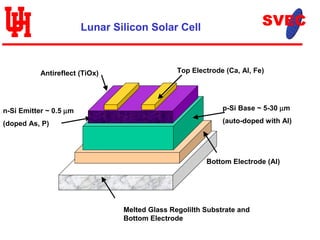
p-Si Base ~ 5-30 μm 
(auto-doped with Al) 
Lunar Silicon Solar Cell 
Melted Glass Regolilth Substrate and 
Bottom Electrode 
n-Si Emitter ~ 0.5 μm 
(doped As, P) 
Top Electrode (Ca, Al, Fe) 
Bottom Electrode (Al) 
Antireflect (TiOx)
Lunar vs Terrestrial Solar cell 
Materials 
Terrestrial Material Purpose Lunar Material 
Glass/Silicon Substrate Lunar Melted Glass 
Silicon Solar Cell 
Absorber 
Silicon 
Aluminum Back Contact Aluminum 
Silver Front Contact Aluminum or Calcium 
TiO2 Anti-Reflection 
Coating 
TiO2, Phosglass, or 
Geikeilites (TiMgO 
mineral) 
Boron P-Type Dopant Aluminum 
Phosphorous N-Type Dopant Phosphorous 
Copper Cell Interconnects Aluminum or Calcium
Space Vacuum Epitaxy Center 
University of Houston 
NASA Commercial Space Center 
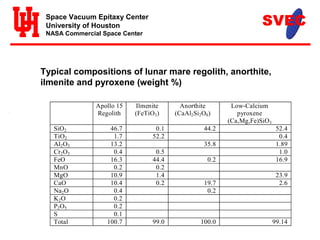
Typical compositions of lunar mare regolith, anorthite, 
ilmenite and pyroxene (weight %) 
Apollo 15 
Regolith 
Ilmenite 
(FeTiO3) 
Anorthite 
(CaAl2Si2O8) 
Low-Calcium 
pyroxene 
(Ca,Mg,Fe)SiO3 
SiO2 46.7 0.1 44.2 52.4 
TiO2 1.7 52.2 0.4 
Al2O3 13.2 35.8 1.89 
Cr2O3 0.4 0.5 1.0 
FeO 16.3 44.4 0.2 16.9 
MnO 0.2 0.2 
MgO 10.9 1.4 23.9 
CaO 10.4 0.2 19.7 2.6 
Na2O 0.4 0.2 
K2O 0.2 
P2O5 0.2 
S 0.1 
Total 100.7 99.0 100.0 99.14
Fabrication of Silicon Solar Cells 
- Use lunar materials (Si, Fe, TiO2, etc.) 
- Lunar ‘glass’ substrate - melt regolith by solar heat 
- Deposit polycrystalline silicon solar cells by solar evaporation 
- Interconnect solar cells serially for ~50-100V 
- Do cell fabrication robotically 
ARC 
Top electrode 
Bottom electrode 
N-type Si 
P-type Si 
Lunar Solar Cell Monolithic Interconnection
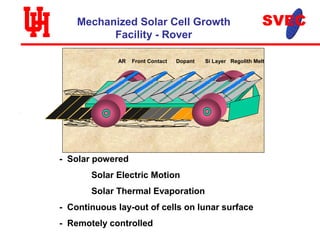
Mechanized Solar Cell Growth 
Facility - Rover 
AR Front Contact Dopant Si Layer Regolith Melt 
- Solar powered 
Solar Electric Motion 
Solar Thermal Evaporation 
- Continuous lay-out of cells on lunar surface 
- Remotely controlled
Mechanized Regolith Processing 
Rover/Crawler 
- Regolith scoop 
- Solar thermal/ electric heat 
- Regolith processing flow 
- Closed-cycle processing 
- Recycle volatiles 
- Feed solar cell production rover(s)
Phase I objectives 
1-Selection of typical locations for solar cell production on the Moon 
2-.Definition of available raw materials on the Moon and definition of 
processes for extraction of solar cell materials 
3-Definition of production process for solar cell arrays on the surface 
of the Moon 
4-Performance modeling for assessing cost/benefit ratio for the power 
system concept 
5-Evaluate extension of the concept beyond the Moon (e.g. Mars) 
6-Identification of key Tasks for Phase II of the program
Phase I tasks/objectives 
Task  Month 1st 2nd 3rd 4th 5th 6th 
Site selection 
Extraction Process Defn. 
Cell Fab Process Defn. 
Modeling Cost/ Benefit 
Other Application (Mars) 
Phase II Definition 
Final Report
Lunar Site selection 
Direct Fabrication on the Surface in Equatorial Regions 
- Front side of Moon 
. Lunar Base 
. He3 mining 
. Tourism 
- Back Side 
. Radio astronomy 
South Pole - Circumferentially Covered Mountain Peak 
- Continual sunlight 
. Earth view (power beaming) 
. Possible water mining 
Site Selection: Mineral composition and surface 
topography will impose a Solar cell design /Solar Cell Layout
Solar Cells on the Surface of the Moon 
from Lunar Regolith 
This image was prepared by J-L 
Margot, Cornell University, from 
Earth-based radar measurements 
of the Moon. The illuminated 
mountain at the bottom of the 
picture is located at 0o, 85oS. This 
is artificially illuminated, but 
approximates the illumination at 
noon on the Moon. The dark side 
never views the Earth and much 
of it is in permanent shadow. The 
scale of the picture is 50x70km. 
The illuminated peak is about 150 
km from the South Pole and is 
~6km above the plains to the 
north.
Solar Cell Material Extraction Process (1) 
e.g. Carbothermal Reduction of Anorthite 
1400oC 
Step 1. 4 CH4 --------- 4 C + 8 H2 
1650oC 
Step 2. CaAl2Si2O8 + 4 C --------- CaO + Al2O3 + 2 Si + 4 CO 
(anorthite) 
m.p. 1521oC 
Ni Catalyst 
250oC 
Step 3. 4 CO + 12 H2 ------------ 4 CH4 + 4 H2O 
75oC 
Step 4. 4 H2O + electrolysis ------ 4 H2 + 2 O2 
 Closed cyclic process yielding both OXYGEN and SILICON: 
CaAl2Si2O8 ------ CaO + Al2O3 + 2 Si + 2 O2
Solar Cell Material Extraction Process (2) 
Ilmentite Reduction (Hydrogen or Carbon) 
• FeTiO3 + H2 ---------- Fe + TiO2 + H2O 
• FeTiO3 + C ---------- Fe + TiO2 + CO 
• 3FeTiO3 + CH4 ---------- 3Fe + 3TiO2 + 2H2O + CO 
 Yields iron for interconnect and TiO2 for antireflect
Lunar Si Thin Film Evaporation 
- Extracted Silicon is much poorer than electronics-grade 
(doubtful for solar cell fabrication) 
Vacuum evaporation of 
lunar simulant-extracted 
silicon* 
- Lab test 
- 10-7 Torr 
- E-beam evaporation 
• Find Vacuum Purification 
Silicon obtained by electrolysis and solidification from a hyperutectic Si- Al alloy (R. Keller)
Vacuum Evaporation/ Purification 
Impurity Levels Measured in Starting Lunar-Si 
and Si Films Deposited on Al Foil 
Impurities 
Impurity levels in Si 
extracted from lunar 
regolith* 
Impurity measured by 
SIMS on regolith films 
deposited on 1 mil-thick 
Al-foil 
Aluminum (Al) 240 PPM Non conclusive due to 
(substrate) 
Calcium (Ca) 175 PPM  1 PPM 
Lithium (Li) 31 PPM  1 PPM 
Copper (Cu) 20 PPM  1 PPM 
Iron (Fe) 18 PPM  1 PPM 
(*) As measured by R. Keller from EMC Consultants.
Space Vacuum Epitaxy Center 
University of Houston 
NASA Commercial Space Center 
Si 
Volatile Impurities
Lunar Simulant Extracted Silicon Film 
Optical/structural Properties 
1.0 
0.5 
0.0 
Lunar Silicon Thin Film 
Substrate (Corning Glass) 
c-Si bandgap 
6000 8000 10000 12000 
Absorption (arb. units) 
Wavelength (Angstrom) 
• Bandgap ~ 1.1 eV 
• Index of Refraction ~ 3.5 
•Conductivity p-type (1018 cm-3) 
• X-ray Diffraction 
- Films on Glass 
are nano-crystalline 
Preliminary film properties suggests Si Solar cell efficiency ~6- 9%
Projected Cell production rate /unit 
• ~ 10-100 μm/hr evaporation rate (30- 300 m2 in 1 lunar 
day) 
• For 5-10% Efficiency Cells 
- ~ 5-50 kW/lunar day 
- ~ 50-500 kW/earth year 
• Continuous Cell Replacement 
- Assume limited cell lifetime 
. Radiation damage 
. Particle damage
Space Vacuum Epitaxy Center 
University of Houston 
NASA Commercial Space Center 
Summary 
• Investigation of a new architecture for the development of 
solar cells using planetary (lunar) resources is proposed 
• Ultra-high Vacuum on Lunar Surface Allows for Direct Thin 
Film Solar Cell Production 
- Less Mass to the Moon 
- Lunar Resources can be Utilized for Cell Production 
- Trade-off Cell Efficiency with Quantity 
- Multiple Facilities can be Utilized 
- Move to Industrial Scale Power Generation and Power 
Grid on the Moon
Space Vacuum Epitaxy Center 
University of Houston 
NASA Commercial Space Center 
Production of Solar Cells on the Surface of the 
Moon from Lunar Regolith 
• Solar Concentrator to Melted Regolith for ‘Glass’ Substrate 
- Low thermal conductivity 
- 1 m2 collector should yield ~ 1 - 2 mm 
thickness of melted regolith ’glass’ 
- Dope ilmenite w/Ca, Mg, Al for higher 
conductivity - bottom electrode? 
- Continuously form glass substrate/bottom 
electrode as robotic rover moves
Space Vacuum Epitaxy Center 
University of Houston 
NASA Commercial Space Center 
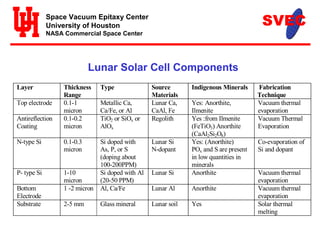
Layer Thickness 
Range 
Type Source 
Materials 
Indigenous Minerals Fabrication 
Technique 
Top electrode 0.1-1 
micron 
Metallic Ca, 
Ca/Fe, or Al 
Lunar Ca, 
CaAl, Fe 
Yes: Anorthite, 
Ilmenite 
Vacuum thermal 
evaporation 
Antireflection 
Coating 
0.1-0.2 
micron 
TiO2 or SiOx or 
AlOx 
Regolith Yes :from Ilmenite 
(FeTiO3) Anorthite 
(CaAl2Si2O8) 
Vacuum Thermal 
Evaporation 
N-type Si 0.1-0.3 
micron 
Si doped with 
As, P, or S 
(doping about 
100-200PPM) 
Lunar Si 
N-dopant 
Yes: (Anorthite) 
POx and S are present 
in low quantities in 
minerals 
Co-evaporation of 
Si and dopant 
P- type Si 1-10 
micron 
Si doped with Al 
(20-50 PPM) 
Lunar Si Anorthite Vacuum thermal 
evaporation 
Bottom 
Electrode 
1 -2 micron Al, Ca/Fe Lunar Al Anorthite Vacuum thermal 
evaporation 
Substrate 2-5 mm Glass mineral Lunar soil Yes Solar thermal 
melting 
Lunar Solar Cell Components
• Silicon p/n juncton ( solar evaporation) 
- ~10 to 40μm thick 
- p-doping with Al 
- n-doping with As or P (supplied terrestrially) 
•Metallization 
- Bottom Electrode (Al) 
- Top Electrode ( Ca /Al or Fe) 
- Evaporation through contact mask(grid pattern) 
• Anti-reflection Coating 
- TiO2 or SiO2

Space solarcells

  • 1.
    Space Vacuum EpitaxyCenter University of Houston NASA Commercial Space Center New Architecture for Space Solar Power Systems: Fabrication of Silicon Solar Cells Using In-Situ Resources A. Ignatiev and A. Freundlich Space Vacuum Epitaxy Center University of Houston M. Duke LPI/Colorado School of Mines S. Rosenberg In-Space Production, Ltd. NIAC 2nd Annual Meeting, June 6-7 2000
  • 2.
    Space Vacuum EpitaxyCenter University of Houston NASA Commercial Space Center Lunar Power Requirements • Initial : 100kW to 1 MW • Non-Nuclear/ Non-Mechanical • Solar Cells - Current technology: 300 W to 500 W/kg - From 300 to 3000kg to transport lightweight cells - High costs Manufacture Solar Cells Directly on the Moon by Utilizing In Situ Resources
  • 3.
    Production of SolarCells on the Surface of the Moon from Lunar Regolith Past Interest in Lunar Resource Utilization: Extraction of Oxygen (waste by product Si, Al, Ca, Ti, Fe etc..) • Elements Required for Si-based Solar Cells are Present on the Moon - Silicon - Iron - Titanium Oxide - Calcium - Aluminum . Moon’s Surface is an Ultra-High Vacuum - ~ 10-10 Torr (day) - Use vacuum evaporation to make thin film solar cells
  • 4.
    p-Si Base ~5-30 μm (auto-doped with Al) Lunar Silicon Solar Cell Melted Glass Regolilth Substrate and Bottom Electrode n-Si Emitter ~ 0.5 μm (doped As, P) Top Electrode (Ca, Al, Fe) Bottom Electrode (Al) Antireflect (TiOx)
  • 5.
    Lunar vs TerrestrialSolar cell Materials Terrestrial Material Purpose Lunar Material Glass/Silicon Substrate Lunar Melted Glass Silicon Solar Cell Absorber Silicon Aluminum Back Contact Aluminum Silver Front Contact Aluminum or Calcium TiO2 Anti-Reflection Coating TiO2, Phosglass, or Geikeilites (TiMgO mineral) Boron P-Type Dopant Aluminum Phosphorous N-Type Dopant Phosphorous Copper Cell Interconnects Aluminum or Calcium
  • 6.
    Space Vacuum EpitaxyCenter University of Houston NASA Commercial Space Center Typical compositions of lunar mare regolith, anorthite, ilmenite and pyroxene (weight %) Apollo 15 Regolith Ilmenite (FeTiO3) Anorthite (CaAl2Si2O8) Low-Calcium pyroxene (Ca,Mg,Fe)SiO3 SiO2 46.7 0.1 44.2 52.4 TiO2 1.7 52.2 0.4 Al2O3 13.2 35.8 1.89 Cr2O3 0.4 0.5 1.0 FeO 16.3 44.4 0.2 16.9 MnO 0.2 0.2 MgO 10.9 1.4 23.9 CaO 10.4 0.2 19.7 2.6 Na2O 0.4 0.2 K2O 0.2 P2O5 0.2 S 0.1 Total 100.7 99.0 100.0 99.14
  • 7.
    Fabrication of SiliconSolar Cells - Use lunar materials (Si, Fe, TiO2, etc.) - Lunar ‘glass’ substrate - melt regolith by solar heat - Deposit polycrystalline silicon solar cells by solar evaporation - Interconnect solar cells serially for ~50-100V - Do cell fabrication robotically ARC Top electrode Bottom electrode N-type Si P-type Si Lunar Solar Cell Monolithic Interconnection
  • 8.
    Mechanized Solar CellGrowth Facility - Rover AR Front Contact Dopant Si Layer Regolith Melt - Solar powered Solar Electric Motion Solar Thermal Evaporation - Continuous lay-out of cells on lunar surface - Remotely controlled
  • 9.
    Mechanized Regolith Processing Rover/Crawler - Regolith scoop - Solar thermal/ electric heat - Regolith processing flow - Closed-cycle processing - Recycle volatiles - Feed solar cell production rover(s)
  • 10.
    Phase I objectives 1-Selection of typical locations for solar cell production on the Moon 2-.Definition of available raw materials on the Moon and definition of processes for extraction of solar cell materials 3-Definition of production process for solar cell arrays on the surface of the Moon 4-Performance modeling for assessing cost/benefit ratio for the power system concept 5-Evaluate extension of the concept beyond the Moon (e.g. Mars) 6-Identification of key Tasks for Phase II of the program
  • 11.
    Phase I tasks/objectives Task Month 1st 2nd 3rd 4th 5th 6th Site selection Extraction Process Defn. Cell Fab Process Defn. Modeling Cost/ Benefit Other Application (Mars) Phase II Definition Final Report
  • 12.
    Lunar Site selection Direct Fabrication on the Surface in Equatorial Regions - Front side of Moon . Lunar Base . He3 mining . Tourism - Back Side . Radio astronomy South Pole - Circumferentially Covered Mountain Peak - Continual sunlight . Earth view (power beaming) . Possible water mining Site Selection: Mineral composition and surface topography will impose a Solar cell design /Solar Cell Layout
  • 13.
    Solar Cells onthe Surface of the Moon from Lunar Regolith This image was prepared by J-L Margot, Cornell University, from Earth-based radar measurements of the Moon. The illuminated mountain at the bottom of the picture is located at 0o, 85oS. This is artificially illuminated, but approximates the illumination at noon on the Moon. The dark side never views the Earth and much of it is in permanent shadow. The scale of the picture is 50x70km. The illuminated peak is about 150 km from the South Pole and is ~6km above the plains to the north.
  • 14.
    Solar Cell MaterialExtraction Process (1) e.g. Carbothermal Reduction of Anorthite 1400oC Step 1. 4 CH4 --------- 4 C + 8 H2 1650oC Step 2. CaAl2Si2O8 + 4 C --------- CaO + Al2O3 + 2 Si + 4 CO (anorthite) m.p. 1521oC Ni Catalyst 250oC Step 3. 4 CO + 12 H2 ------------ 4 CH4 + 4 H2O 75oC Step 4. 4 H2O + electrolysis ------ 4 H2 + 2 O2 Closed cyclic process yielding both OXYGEN and SILICON: CaAl2Si2O8 ------ CaO + Al2O3 + 2 Si + 2 O2
  • 15.
    Solar Cell MaterialExtraction Process (2) Ilmentite Reduction (Hydrogen or Carbon) • FeTiO3 + H2 ---------- Fe + TiO2 + H2O • FeTiO3 + C ---------- Fe + TiO2 + CO • 3FeTiO3 + CH4 ---------- 3Fe + 3TiO2 + 2H2O + CO Yields iron for interconnect and TiO2 for antireflect
  • 16.
    Lunar Si ThinFilm Evaporation - Extracted Silicon is much poorer than electronics-grade (doubtful for solar cell fabrication) Vacuum evaporation of lunar simulant-extracted silicon* - Lab test - 10-7 Torr - E-beam evaporation • Find Vacuum Purification Silicon obtained by electrolysis and solidification from a hyperutectic Si- Al alloy (R. Keller)
  • 17.
    Vacuum Evaporation/ Purification Impurity Levels Measured in Starting Lunar-Si and Si Films Deposited on Al Foil Impurities Impurity levels in Si extracted from lunar regolith* Impurity measured by SIMS on regolith films deposited on 1 mil-thick Al-foil Aluminum (Al) 240 PPM Non conclusive due to (substrate) Calcium (Ca) 175 PPM 1 PPM Lithium (Li) 31 PPM 1 PPM Copper (Cu) 20 PPM 1 PPM Iron (Fe) 18 PPM 1 PPM (*) As measured by R. Keller from EMC Consultants.
  • 18.
    Space Vacuum EpitaxyCenter University of Houston NASA Commercial Space Center Si Volatile Impurities
  • 19.
    Lunar Simulant ExtractedSilicon Film Optical/structural Properties 1.0 0.5 0.0 Lunar Silicon Thin Film Substrate (Corning Glass) c-Si bandgap 6000 8000 10000 12000 Absorption (arb. units) Wavelength (Angstrom) • Bandgap ~ 1.1 eV • Index of Refraction ~ 3.5 •Conductivity p-type (1018 cm-3) • X-ray Diffraction - Films on Glass are nano-crystalline Preliminary film properties suggests Si Solar cell efficiency ~6- 9%
  • 20.
    Projected Cell productionrate /unit • ~ 10-100 μm/hr evaporation rate (30- 300 m2 in 1 lunar day) • For 5-10% Efficiency Cells - ~ 5-50 kW/lunar day - ~ 50-500 kW/earth year • Continuous Cell Replacement - Assume limited cell lifetime . Radiation damage . Particle damage
  • 21.
    Space Vacuum EpitaxyCenter University of Houston NASA Commercial Space Center Summary • Investigation of a new architecture for the development of solar cells using planetary (lunar) resources is proposed • Ultra-high Vacuum on Lunar Surface Allows for Direct Thin Film Solar Cell Production - Less Mass to the Moon - Lunar Resources can be Utilized for Cell Production - Trade-off Cell Efficiency with Quantity - Multiple Facilities can be Utilized - Move to Industrial Scale Power Generation and Power Grid on the Moon
  • 22.
    Space Vacuum EpitaxyCenter University of Houston NASA Commercial Space Center Production of Solar Cells on the Surface of the Moon from Lunar Regolith • Solar Concentrator to Melted Regolith for ‘Glass’ Substrate - Low thermal conductivity - 1 m2 collector should yield ~ 1 - 2 mm thickness of melted regolith ’glass’ - Dope ilmenite w/Ca, Mg, Al for higher conductivity - bottom electrode? - Continuously form glass substrate/bottom electrode as robotic rover moves
  • 23.
    Space Vacuum EpitaxyCenter University of Houston NASA Commercial Space Center Layer Thickness Range Type Source Materials Indigenous Minerals Fabrication Technique Top electrode 0.1-1 micron Metallic Ca, Ca/Fe, or Al Lunar Ca, CaAl, Fe Yes: Anorthite, Ilmenite Vacuum thermal evaporation Antireflection Coating 0.1-0.2 micron TiO2 or SiOx or AlOx Regolith Yes :from Ilmenite (FeTiO3) Anorthite (CaAl2Si2O8) Vacuum Thermal Evaporation N-type Si 0.1-0.3 micron Si doped with As, P, or S (doping about 100-200PPM) Lunar Si N-dopant Yes: (Anorthite) POx and S are present in low quantities in minerals Co-evaporation of Si and dopant P- type Si 1-10 micron Si doped with Al (20-50 PPM) Lunar Si Anorthite Vacuum thermal evaporation Bottom Electrode 1 -2 micron Al, Ca/Fe Lunar Al Anorthite Vacuum thermal evaporation Substrate 2-5 mm Glass mineral Lunar soil Yes Solar thermal melting Lunar Solar Cell Components
  • 24.
    • Silicon p/njuncton ( solar evaporation) - ~10 to 40μm thick - p-doping with Al - n-doping with As or P (supplied terrestrially) •Metallization - Bottom Electrode (Al) - Top Electrode ( Ca /Al or Fe) - Evaporation through contact mask(grid pattern) • Anti-reflection Coating - TiO2 or SiO2