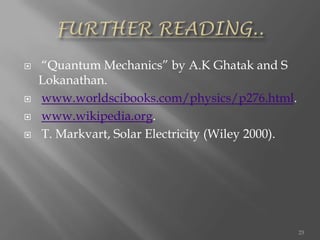
SOLAR CELL TECHNOLOGY
BY
RAJEEV SINGH
BISHAL DEY SARKAR
DEBOJYOTI ROY
AAMIR SIAF
 Introduction
 History
 Working Principle
 Types of Solar Cells
 Benefits
 Application
 Disadvantages
 Final Thought
 Bibliography
 Further Reading
2
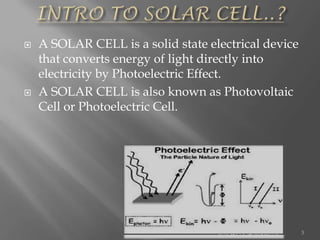
 A SOLAR CELL is a solid state electrical device
that converts energy of light directly into
electricity by Photoelectric Effect.
 A SOLAR CELL is also known as Photovoltaic
Cell or Photoelectric Cell.
3
 The term “Photo” comes from the Greek
meaning “light”, and “voltaic”, from the name
of the Italian physicist “Volta”.
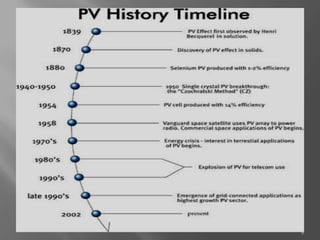
 The PHOTOELECTRIC EFEECT was first
recognized in 1839 by French physicist A.E.
BECQUEREL.
 ALBERT EINSTEIN explained the
photoelectric effect in 1905 for which he
received the Nobel prize in Physics in 1921.
4
 The modern photovoltaic cell was developed in
1954 at BELL LABORATORIES.
 The highly efficient solar cell was first
developed by DARYL CHAPIN, CALVIN
SOUTHER FULLER and GERALD PEARSON
in 1954 using a diffused silicon p-n junction.
 Solar Cells were first used in Vanguard I
satellite, launched in 1958.
5
6
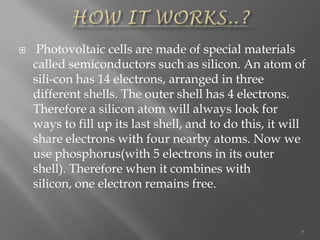
 Photovoltaic cells are made of special materials
called semiconductors such as silicon. An atom of
sili-con has 14 electrons, arranged in three
different shells. The outer shell has 4 electrons.
Therefore a silicon atom will always look for
ways to fill up its last shell, and to do this, it will
share electrons with four nearby atoms. Now we
use phosphorus(with 5 electrons in its outer
shell). Therefore when it combines with
silicon, one electron remains free.
7
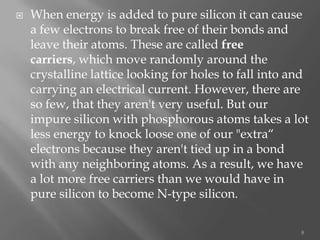
 When energy is added to pure silicon it can cause
a few electrons to break free of their bonds and
leave their atoms. These are called free
carriers, which move randomly around the
crystalline lattice looking for holes to fall into and
carrying an electrical current. However, there are
so few, that they aren't very useful. But our
impure silicon with phosphorous atoms takes a lot
less energy to knock loose one of our "extra“
electrons because they aren't tied up in a bond
with any neighboring atoms. As a result, we have
a lot more free carriers than we would have in
pure silicon to become N-type silicon.
8
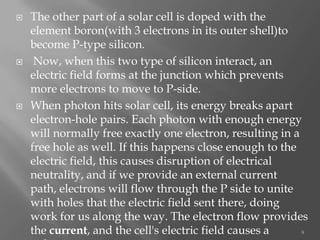
 The other part of a solar cell is doped with the
element boron(with 3 electrons in its outer shell)to
become P-type silicon.
 Now, when this two type of silicon interact, an
electric field forms at the junction which prevents
more electrons to move to P-side.
 When photon hits solar cell, its energy breaks apart
electron-hole pairs. Each photon with enough energy
will normally free exactly one electron, resulting in a
free hole as well. If this happens close enough to the
electric field, this causes disruption of electrical
neutrality, and if we provide an external current
path, electrons will flow through the P side to unite
with holes that the electric field sent there, doing
work for us along the way. The electron flow provides
the current, and the cell's electric field causes a 9
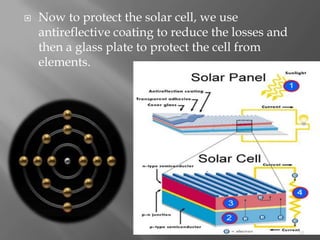
 Now to protect the solar cell, we use
antireflective coating to reduce the losses and
then a glass plate to protect the cell from
elements.
10
11
 There are basically 3 types of solar cell
technology:
Discrete Cell technology.
Integrated Thin Film technology.
Multi crystalline Silicon technology.
12
 The very first benefit of using this technology is
that solar energy is renewable.
 This is a 100% environment-friendly.
 Contrary to fossil fuels, this technology is not
going to release any greenhouse gases, harmful
agents, volatile material or carbon dioxide into
the environment.
 Solar panels are highly durable and reliable.
These systems don’t have any moving systems
and hence they don’t require any replacement.
13
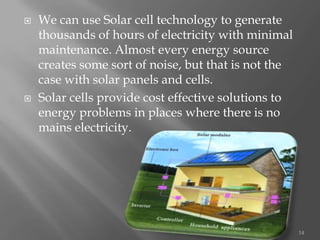
 We can use Solar cell technology to generate
thousands of hours of electricity with minimal
maintenance. Almost every energy source
creates some sort of noise, but that is not the
case with solar panels and cells.
 Solar cells provide cost effective solutions to
energy problems in places where there is no
mains electricity.
14
 Rural electrification: The provision of electricity
to rural areas derives important social and
economic benefits to remote communities
throughout the world like power supply to
remote houses, electrification of the health care
facilities, irrigation and water supply and
treatment.
 Ocean navigation aids: Many lighthouses are
now powered by solar cells.
 Telecommunication systems: radio transceivers
on mountain tops are often solar powered.
15
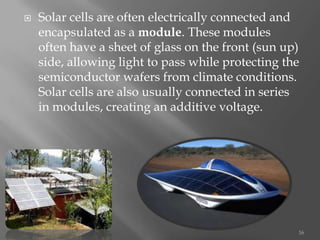
 Solar cells are often electrically connected and
encapsulated as a module. These modules
often have a sheet of glass on the front (sun up)
side, allowing light to pass while protecting the
semiconductor wafers from climate conditions.
Solar cells are also usually connected in series
in modules, creating an additive voltage.
16
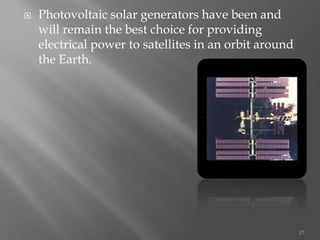
 Photovoltaic solar generators have been and
will remain the best choice for providing
electrical power to satellites in an orbit around
the Earth.
17
18
 The main disadvantage of solar cell is the initial
cost. Most types of solar cell require large areas
of land to achieve average efficiency.
 Air pollution and weather can also have a large
effect on the efficiency of the cells.
 The silicon used is also very expensive and the
solar cells can only ever generate electricity
during the daytime.
19
 Another con to Solar cell technology is that the
efficiency level of this technology is low.
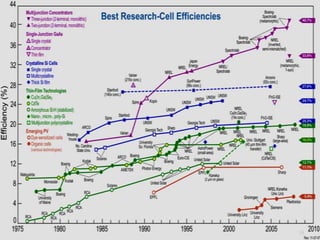
 The most efficient solar power system gives
you an efficiency of not more than 40%. This
means that the rest of the 60% power of
sunlight is not harnessed.
 The most important thing that is necessary is
the sky should be clear so that sunlight can fall
on the solar cell and we can get electricity.
20
 Argument that sun provides power only during
the day is countered by the fact that 70% of
energy demand is during daytime hours. At
night, traditional methods can be used to
generate the electricity.
 Goal is to decrease our dependence on fossil
fuels.
 Solar cell light absorbing materials can be
stacked to take advantage of different light
absorption and charge separation mechanisms.
21
 www.howstuffworks.com
 www.solarcell.net.in
 www.wikipedia.org
 www.google.com
22
 “Quantum Mechanics” by A.K Ghatak and S
Lokanathan.
 www.worldscibooks.com/physics/p276.html.
 www.wikipedia.org.
 T. Markvart, Solar Electricity (Wiley 2000).
23
24

SOLAR CELL 1.pdf project for class twelth

  • 1.
    SOLAR CELL TECHNOLOGY BY RAJEEVSINGH BISHAL DEY SARKAR DEBOJYOTI ROY AAMIR SIAF
  • 2.
     Introduction  History Working Principle  Types of Solar Cells  Benefits  Application  Disadvantages  Final Thought  Bibliography  Further Reading 2
  • 3.
     A SOLARCELL is a solid state electrical device that converts energy of light directly into electricity by Photoelectric Effect.  A SOLAR CELL is also known as Photovoltaic Cell or Photoelectric Cell. 3
  • 4.
     The term“Photo” comes from the Greek meaning “light”, and “voltaic”, from the name of the Italian physicist “Volta”.  The PHOTOELECTRIC EFEECT was first recognized in 1839 by French physicist A.E. BECQUEREL.  ALBERT EINSTEIN explained the photoelectric effect in 1905 for which he received the Nobel prize in Physics in 1921. 4
  • 5.
     The modernphotovoltaic cell was developed in 1954 at BELL LABORATORIES.  The highly efficient solar cell was first developed by DARYL CHAPIN, CALVIN SOUTHER FULLER and GERALD PEARSON in 1954 using a diffused silicon p-n junction.  Solar Cells were first used in Vanguard I satellite, launched in 1958. 5
  • 6.
  • 7.
     Photovoltaic cellsare made of special materials called semiconductors such as silicon. An atom of sili-con has 14 electrons, arranged in three different shells. The outer shell has 4 electrons. Therefore a silicon atom will always look for ways to fill up its last shell, and to do this, it will share electrons with four nearby atoms. Now we use phosphorus(with 5 electrons in its outer shell). Therefore when it combines with silicon, one electron remains free. 7
  • 8.
     When energyis added to pure silicon it can cause a few electrons to break free of their bonds and leave their atoms. These are called free carriers, which move randomly around the crystalline lattice looking for holes to fall into and carrying an electrical current. However, there are so few, that they aren't very useful. But our impure silicon with phosphorous atoms takes a lot less energy to knock loose one of our "extra“ electrons because they aren't tied up in a bond with any neighboring atoms. As a result, we have a lot more free carriers than we would have in pure silicon to become N-type silicon. 8
  • 9.
     The otherpart of a solar cell is doped with the element boron(with 3 electrons in its outer shell)to become P-type silicon.  Now, when this two type of silicon interact, an electric field forms at the junction which prevents more electrons to move to P-side.  When photon hits solar cell, its energy breaks apart electron-hole pairs. Each photon with enough energy will normally free exactly one electron, resulting in a free hole as well. If this happens close enough to the electric field, this causes disruption of electrical neutrality, and if we provide an external current path, electrons will flow through the P side to unite with holes that the electric field sent there, doing work for us along the way. The electron flow provides the current, and the cell's electric field causes a 9
  • 10.
     Now toprotect the solar cell, we use antireflective coating to reduce the losses and then a glass plate to protect the cell from elements. 10
  • 11.
  • 12.
     There arebasically 3 types of solar cell technology: Discrete Cell technology. Integrated Thin Film technology. Multi crystalline Silicon technology. 12
  • 13.
     The veryfirst benefit of using this technology is that solar energy is renewable.  This is a 100% environment-friendly.  Contrary to fossil fuels, this technology is not going to release any greenhouse gases, harmful agents, volatile material or carbon dioxide into the environment.  Solar panels are highly durable and reliable. These systems don’t have any moving systems and hence they don’t require any replacement. 13
  • 14.
     We canuse Solar cell technology to generate thousands of hours of electricity with minimal maintenance. Almost every energy source creates some sort of noise, but that is not the case with solar panels and cells.  Solar cells provide cost effective solutions to energy problems in places where there is no mains electricity. 14
  • 15.
     Rural electrification:The provision of electricity to rural areas derives important social and economic benefits to remote communities throughout the world like power supply to remote houses, electrification of the health care facilities, irrigation and water supply and treatment.  Ocean navigation aids: Many lighthouses are now powered by solar cells.  Telecommunication systems: radio transceivers on mountain tops are often solar powered. 15
  • 16.
     Solar cellsare often electrically connected and encapsulated as a module. These modules often have a sheet of glass on the front (sun up) side, allowing light to pass while protecting the semiconductor wafers from climate conditions. Solar cells are also usually connected in series in modules, creating an additive voltage. 16
  • 17.
     Photovoltaic solargenerators have been and will remain the best choice for providing electrical power to satellites in an orbit around the Earth. 17
  • 18.
  • 19.
     The maindisadvantage of solar cell is the initial cost. Most types of solar cell require large areas of land to achieve average efficiency.  Air pollution and weather can also have a large effect on the efficiency of the cells.  The silicon used is also very expensive and the solar cells can only ever generate electricity during the daytime. 19
  • 20.
     Another conto Solar cell technology is that the efficiency level of this technology is low.  The most efficient solar power system gives you an efficiency of not more than 40%. This means that the rest of the 60% power of sunlight is not harnessed.  The most important thing that is necessary is the sky should be clear so that sunlight can fall on the solar cell and we can get electricity. 20
  • 21.
     Argument thatsun provides power only during the day is countered by the fact that 70% of energy demand is during daytime hours. At night, traditional methods can be used to generate the electricity.  Goal is to decrease our dependence on fossil fuels.  Solar cell light absorbing materials can be stacked to take advantage of different light absorption and charge separation mechanisms. 21
  • 22.
     www.howstuffworks.com  www.solarcell.net.in www.wikipedia.org  www.google.com 22
  • 23.
     “Quantum Mechanics”by A.K Ghatak and S Lokanathan.  www.worldscibooks.com/physics/p276.html.  www.wikipedia.org.  T. Markvart, Solar Electricity (Wiley 2000). 23
  • 24.