9 May 2006


Using the Electromagnetic
        Spectrum
       Mark Webster


                                1
9 May 2006


                   Outline
•   The Electromagnetic Spectrum
•   Optical Instrument Design
•   Visible Light Applications
•   Infrared Observations
•   Ultraviolet
•   X-ray
•   Gamma Ray
•   Radio Frequency Applications
                                       2
9 May 2006

        The Electromagnetic Spectrum and its use in
                    Space Instruments


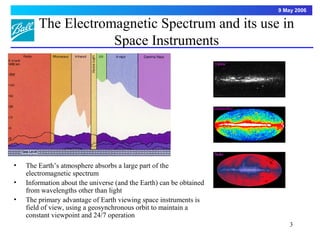
•   The Earth’s atmosphere absorbs a large part of the
    electromagnetic spectrum
•   Information about the universe (and the Earth) can be obtained
    from wavelengths other than light
•   The primary advantage of Earth viewing space instruments is
    field of view, using a geosynchronous orbit to maintain a
    constant viewpoint and 24/7 operation
                                                                         3
9 May 2006


                           Optical Instruments
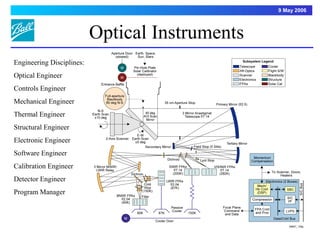
Engineering Disciplines:
Optical Engineer
Controls Engineer
Mechanical Engineer
Thermal Engineer
Structural Engineer
Electronic Engineer
Software Engineer
Calibration Engineer
Detector Engineer
Program Manager


                                                     4
9 May 2006


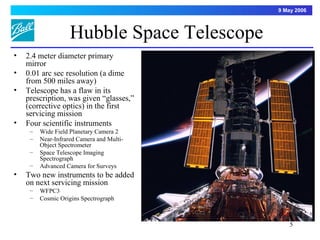
                    Hubble Space Telescope
•   2.4 meter diameter primary
    mirror
•   0.01 arc sec resolution (a dime
    from 500 miles away)
•   Telescope has a flaw in its
    prescription, was given “glasses,”
    (corrective optics) in the first
    servicing mission
•   Four scientific instruments
     –   Wide Field Planetary Camera 2
     –   Near-Infrared Camera and Multi-
         Object Spectrometer
     –   Space Telescope Imaging
         Spectrograph
     –   Advanced Camera for Surveys
•   Two new instruments to be added
    on next servicing mission
     –   WFPC3
     –   Cosmic Origins Spectrograph


                                                 5
9 May 2006


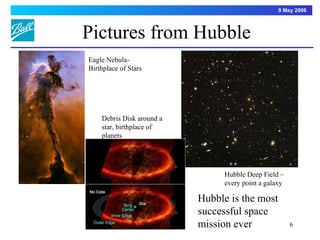
Pictures from Hubble
Eagle Nebula-
Birthplace of Stars


    Debris Disk around a
    star, birthplace of
    planets


                                Hubble Deep Field –
                                every point a galaxy

                           Hubble is the most
                           successful space
                           mission ever                6
9 May 2006


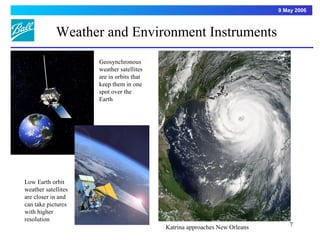
             Weather and Environment Instruments
                     Geosynchronous
                     weather satellites
                     are in orbits that
                     keep them in one
                     spot over the
                     Earth


Low Earth orbit
weather satellites
are closer in and
can take pictures
with higher
resolution
                                          Katrina approaches New Orleans       7
9 May 2006


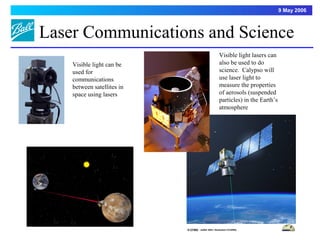
Laser Communications and Science
                            Visible light lasers can
    Visible light can be    also be used to do
    used for                science. Calypso will
    communications          use laser light to
    between satellites in   measure the properties
    space using lasers      of aerosols (suspended
                            particles) in the Earth’s
                            atmosphere


                                                            8
9 May 2006

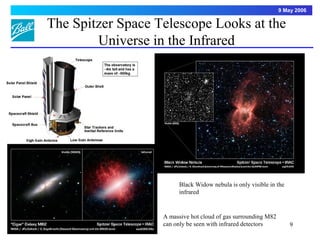
The Spitzer Space Telescope Looks at the
        Universe in the Infrared


                        Black Widow nebula is only visible in the
                        infrared


                   A massive hot cloud of gas surrounding M82
                   can only be seen with infrared detectors         9
9 May 2006


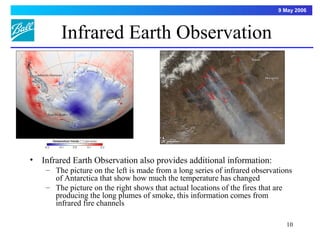
         Infrared Earth Observation


•   Infrared Earth Observation also provides additional information:
     – The picture on the left is made from a long series of infrared observations
       of Antarctica that show how much the temperature has changed
     – The picture on the right shows that actual locations of the fires that are
       producing the long plumes of smoke, this information comes from
       infrared fire channels

                                                                                10
9 May 2006


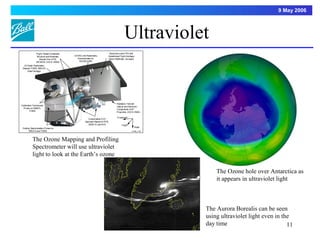
                                                                                         Ultraviolet
               Flight-Tested Composite                                    Electronics and CPU with
               Structure and Kinematic   UV/VIS Limb Radiometry          Established Flight Heritage
                  Mounts from STIS,         Demonstrated on              (Mars Pathfinder, Surveyor)
               NICMOS, UVCS, SWAS            SOLSE/LORE
  UV Nadir Radiometry
 Extends TOMS, SBUV/2
      Data Heritage


                                                                                 Radiation-Tolerant
Calibration Techniques                                                           Optical and Electronic
  Proven on SSBUV,                                                               Components (HST
         TOMS                                                                    Programs, UVCS, RME)

                                                                                 Crosstrack
                                                      Conservative CCD
                                                   Approach Based on STIS,
                                                      SAGE III, and ACS               Flight
 Grating Spectrometers Proven on                                                                       Nadir
       SBUV/2 and TOMS                                                                           A7785_T104


           The Ozone Mapping and Profiling
           Spectrometer will use ultraviolet
           light to look at the Earth’s ozone

                                                                                                                   The Ozone hole over Antarctica as
                                                                                                                   it appears in ultraviolet light


                                                                                                               The Aurora Borealis can be seen
                                                                                                               using ultraviolet light even in the
                                                                                                               day time                          11
9 May 2006


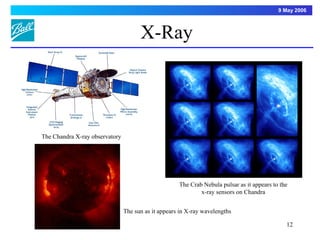
                                      X-Ray


The Chandra X-ray observatory


                                                     The Crab Nebula pulsar as it appears to the
                                                             x-ray sensors on Chandra


                                The sun as it appears in X-ray wavelengths

                                                                                               12
9 May 2006


           Gamma Ray Observations


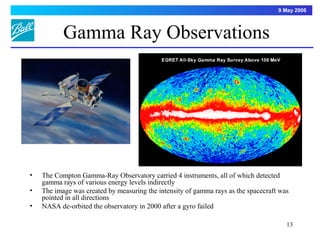
•   The Compton Gamma-Ray Observatory carried 4 instruments, all of which detected
    gamma rays of various energy levels indirectly
•   The image was created by measuring the intensity of gamma rays as the spacecraft was
    pointed in all directions
•   NASA de-orbited the observatory in 2000 after a gyro failed

                                                                                       13
9 May 2006


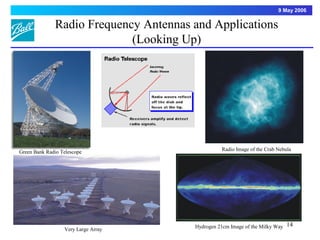
              Radio Frequency Antennas and Applications
                            (Looking Up)


                                                 Radio Image of the Crab Nebula
Green Bank Radio Telescope


                                       Hydrogen 21cm Image of the Milky Way 14
                  Very Large Array
9 May 2006


              Radio Frequency Antennas and Applications
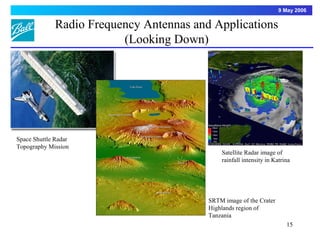
                          (Looking Down)


Space Shuttle Radar
Topography Mission
                                              Satellite Radar image of
                                              rainfall intensity in Katrina


                                          SRTM image of the Crater
                                          Highlands region of
                                          Tanzania
                                                                         15
9 May 2006


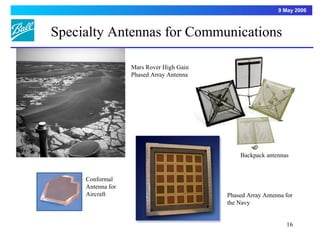
Specialty Antennas for Communications

                   Mars Rover High Gain
                   Phased Array Antenna


                                              Backpack antennas


     Conformal
     Antenna for
     Aircraft                             Phased Array Antenna for
                                          the Navy


                                                               16

Satel

  • 1.
    9 May 2006 Usingthe Electromagnetic Spectrum Mark Webster 1
  • 2.
    9 May 2006 Outline • The Electromagnetic Spectrum • Optical Instrument Design • Visible Light Applications • Infrared Observations • Ultraviolet • X-ray • Gamma Ray • Radio Frequency Applications 2
  • 3.
    9 May 2006 The Electromagnetic Spectrum and its use in Space Instruments • The Earth’s atmosphere absorbs a large part of the electromagnetic spectrum • Information about the universe (and the Earth) can be obtained from wavelengths other than light • The primary advantage of Earth viewing space instruments is field of view, using a geosynchronous orbit to maintain a constant viewpoint and 24/7 operation 3
  • 4.
    9 May 2006 Optical Instruments Engineering Disciplines: Optical Engineer Controls Engineer Mechanical Engineer Thermal Engineer Structural Engineer Electronic Engineer Software Engineer Calibration Engineer Detector Engineer Program Manager 4
  • 5.
    9 May 2006 Hubble Space Telescope • 2.4 meter diameter primary mirror • 0.01 arc sec resolution (a dime from 500 miles away) • Telescope has a flaw in its prescription, was given “glasses,” (corrective optics) in the first servicing mission • Four scientific instruments – Wide Field Planetary Camera 2 – Near-Infrared Camera and Multi- Object Spectrometer – Space Telescope Imaging Spectrograph – Advanced Camera for Surveys • Two new instruments to be added on next servicing mission – WFPC3 – Cosmic Origins Spectrograph 5
  • 6.
    9 May 2006 Picturesfrom Hubble Eagle Nebula- Birthplace of Stars Debris Disk around a star, birthplace of planets Hubble Deep Field – every point a galaxy Hubble is the most successful space mission ever 6
  • 7.
    9 May 2006 Weather and Environment Instruments Geosynchronous weather satellites are in orbits that keep them in one spot over the Earth Low Earth orbit weather satellites are closer in and can take pictures with higher resolution Katrina approaches New Orleans 7
  • 8.
    9 May 2006 LaserCommunications and Science Visible light lasers can Visible light can be also be used to do used for science. Calypso will communications use laser light to between satellites in measure the properties space using lasers of aerosols (suspended particles) in the Earth’s atmosphere 8
  • 9.
    9 May 2006 TheSpitzer Space Telescope Looks at the Universe in the Infrared Black Widow nebula is only visible in the infrared A massive hot cloud of gas surrounding M82 can only be seen with infrared detectors 9
  • 10.
    9 May 2006 Infrared Earth Observation • Infrared Earth Observation also provides additional information: – The picture on the left is made from a long series of infrared observations of Antarctica that show how much the temperature has changed – The picture on the right shows that actual locations of the fires that are producing the long plumes of smoke, this information comes from infrared fire channels 10
  • 11.
    9 May 2006 Ultraviolet Flight-Tested Composite Electronics and CPU with Structure and Kinematic UV/VIS Limb Radiometry Established Flight Heritage Mounts from STIS, Demonstrated on (Mars Pathfinder, Surveyor) NICMOS, UVCS, SWAS SOLSE/LORE UV Nadir Radiometry Extends TOMS, SBUV/2 Data Heritage Radiation-Tolerant Calibration Techniques Optical and Electronic Proven on SSBUV, Components (HST TOMS Programs, UVCS, RME) Crosstrack Conservative CCD Approach Based on STIS, SAGE III, and ACS Flight Grating Spectrometers Proven on Nadir SBUV/2 and TOMS A7785_T104 The Ozone Mapping and Profiling Spectrometer will use ultraviolet light to look at the Earth’s ozone The Ozone hole over Antarctica as it appears in ultraviolet light The Aurora Borealis can be seen using ultraviolet light even in the day time 11
  • 12.
    9 May 2006 X-Ray The Chandra X-ray observatory The Crab Nebula pulsar as it appears to the x-ray sensors on Chandra The sun as it appears in X-ray wavelengths 12
  • 13.
    9 May 2006 Gamma Ray Observations • The Compton Gamma-Ray Observatory carried 4 instruments, all of which detected gamma rays of various energy levels indirectly • The image was created by measuring the intensity of gamma rays as the spacecraft was pointed in all directions • NASA de-orbited the observatory in 2000 after a gyro failed 13
  • 14.
    9 May 2006 Radio Frequency Antennas and Applications (Looking Up) Radio Image of the Crab Nebula Green Bank Radio Telescope Hydrogen 21cm Image of the Milky Way 14 Very Large Array
  • 15.
    9 May 2006 Radio Frequency Antennas and Applications (Looking Down) Space Shuttle Radar Topography Mission Satellite Radar image of rainfall intensity in Katrina SRTM image of the Crater Highlands region of Tanzania 15
  • 16.
    9 May 2006 SpecialtyAntennas for Communications Mars Rover High Gain Phased Array Antenna Backpack antennas Conformal Antenna for Aircraft Phased Array Antenna for the Navy 16

Editor's Notes

  • #4 Lyman Sptitzer wrote a paper in 1946 about how advantageous having a telescope in space might be. Wavelengths reveal information about the composition of an object.