An Operational Analysis for Air Force 2025: 
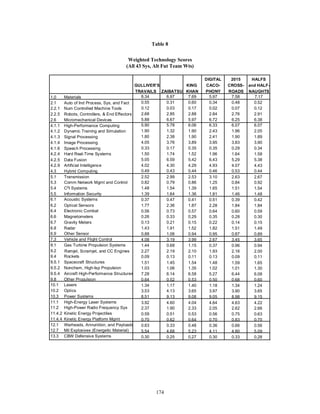
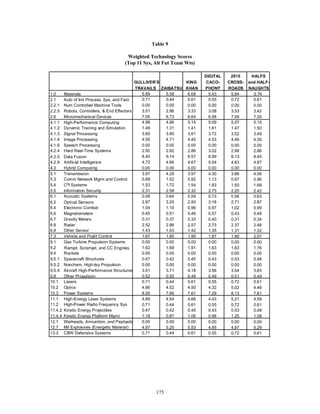
An Application of Value-Focused Thinking to Future 
Air and Space Capabilities 
A Research Paper 
Presented To 
Air Force 2025 
by 
Lt Col Jack A. Jackson, Jr., PhD, AFIT 
Lt Col Brian L. Jones, PhD, AFIT 
Maj Lee J. Lehmkuhl, DrSci, AFIT 
with major contributions from 
Col Gregory S. Parnell, USAF Ret., PhD, VCU 
Col Gerald A. Hasen, PhD, AFIT 
Lt Col Gregg H. Gunsch, PhD, AFIT 
Lt Col John M. Andrew, PhD, AWC 
Maj Thomas A. Buter, PhD, AFIT 
Maj Harry W. Conley, ACSC 
Maj Robert F. Mills, PhD, AFIT 
May 1996
Disclaimer 
2025 is a study designed to comply with a directive from the chief of staff of the Air Force to examine the 
concepts, capabilities, and technologies the United States will require to remain the dominant air and space 
force in the future. Presented on 17 June 1996, this report was produced in the Department of Defense school 
environment of academic freedom and in the interest of advancing concepts related to national defense. The 
views expressed in this report are those of the authors and do not reflect the official policy or position of the 
United States Air Force, Department of Defense, or the United States government. 
This report contains fictional representations of future situations/scenarios. Any similarities to real people or 
events, other than those specifically cited, are unintentional and are for purposes of illustration only. 
Mention of various programs or technologies throughout this paper does not imply Air Force or DOD 
endorsement of either the mission, the program, or adoption of the technology. 
This publication has been reviewed by security and policy review authorities, is unclassified, and is cleared 
for public release.
Contents 
Chapter Page 
Disclaimer..........................................................................................................................................ii 
Illustrations........................................................................................................................................vi 
Tables................................................................................................................................................. x 
Acknowledgments..............................................................................................................................xi 
Executive Summary ..........................................................................................................................xii 
1 Introduction.........................................................................................................................................1 
Meeting the Challenge...................................................................................................................1 
Overview of Report......................................................................................................................4 
2 Methodology .......................................................................................................................................6 
Challenges ....................................................................................................................................6 
The Air Force 2025 Operational Analysis....................................................................................7 
Selecting a Decision Analysis Tool..............................................................................................8 
Comparing Analysis Tools......................................................................................................8 
The Best Approach for Air Force 2025 ................................................................................10 
Value-Focused Thinking .......................................................................................................10 
Value.....................................................................................................................................11 
Objectives, Functions, Tasks, and Subtasks..........................................................................11 
Force Qualities .....................................................................................................................11 
Measures of Merit and Scoring Functions.............................................................................11 
Value Model .........................................................................................................................13 
Weights .................................................................................................................................14 
Applying the Value Model ....................................................................................................15 
The Search for the Air Force 2025 Value Model..................................................................16 
Developing the Air Force 2025 Value Model—Foundations 2025 .....................................21 
Objective ..............................................................................................................................21 
A Bottom-Up Approach ........................................................................................................21 
Tasks and Subtasks ...............................................................................................................21 
The Affinity Exercise............................................................................................................22 
Distinguishing Subtasks from Tasks......................................................................................25 
The Influence of the Medium on Certain Tasks .....................................................................25 
Functions...............................................................................................................................27 
Force Qualities .....................................................................................................................29 
Measures of Merit and Scoring Functions.............................................................................32 
System Identification...................................................................................................................33 
Alternate Futures.........................................................................................................................36 
Scoring the Systems ....................................................................................................................37 
Weighting the Foundations 2025 Value Model across Alternate Futures.............................38 
Technology Identification and Scoring........................................................................................38 
iii
Chapter Page 
3 Results ..............................................................................................................................................42 
Scoring the Technologies............................................................................................................53 
4 Conclusions.......................................................................................................................................66 
Major Implications of the Air Force 2025 OA ...........................................................................66 
OA Process Lessons Learned .....................................................................................................69 
Study Limitations ........................................................................................................................69 
Major Implications for the Future ...............................................................................................70 
Summary.....................................................................................................................................70 
Appendix Page 
A Foundations 2025 Value Model........................................................................................................71 
Value Model ...............................................................................................................................71 
Measures of Merit and Scoring Functions...................................................................................75 
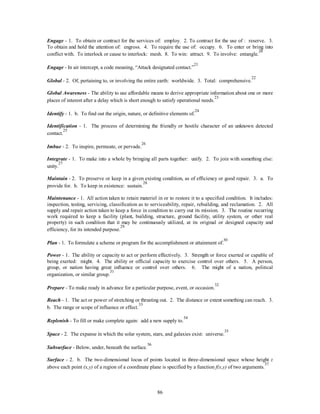
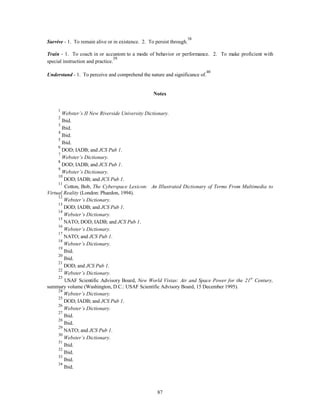
Operational Analysis Glossary...................................................................................................85 
B System Descriptions ..........................................................................................................................89 
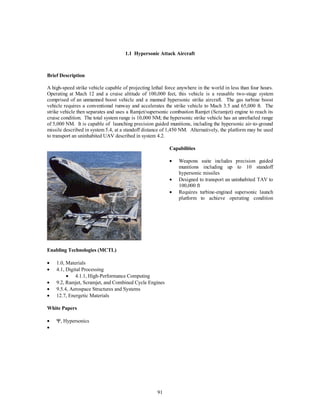
1.1 Hypersonic Attack Aircraft..................................................................................................91 
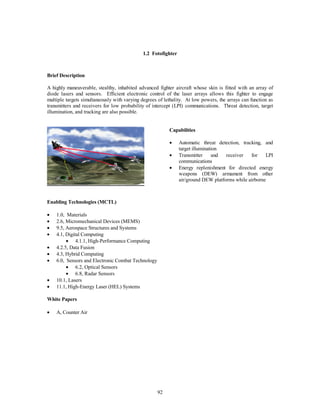
1.2 Fotofighter ...........................................................................................................................92 
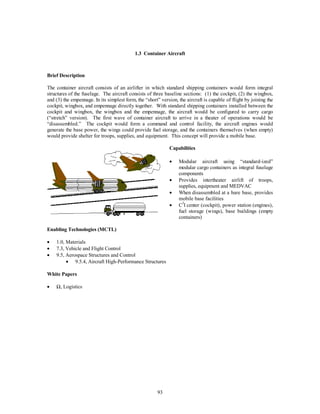
1.3 Container Aircraft................................................................................................................93 
1.4 Lighter-than-Air Airlifter.....................................................................................................94 
1.5 Supersonic Airlifter .............................................................................................................95 
1.6 Stealth Airlifter....................................................................................................................96 
1.7 Global Transport Aircraft....................................................................................................97 
2.1 Strike UAV ..........................................................................................................................98 
2.2 Reconnaissance UAV...........................................................................................................99 
2.3 Uninhabited Combat Air Vehicle.......................................................................................100 
2.4 Precision Delivery System.................................................................................................101 
2.5 UAV Mothership................................................................................................................102 
2.6 Exfiltration Rocket.............................................................................................................103 
3.1 Orbital Maneuvering Vehicle.............................................................................................104 
3.2 Orbital Combat Vehicle.....................................................................................................105 
3.3 Satellite Bodyguards..........................................................................................................106 
4.1 Piloted SSTO Transatmospheric Vehicle ..........................................................................107 
4.2 Uninhabited Air-Launched Transatmospheric Vehicle.......................................................108 
5.1 Adjustable Yield Munition ................................................................................................109 
5.2 Advanced Air-to-Air Missile ............................................................................................110 
5.3 Airborne High-Power Microwave Weapon.......................................................................111 
5.4 Standoff Hypersonic Missile .............................................................................................112 
5.5 Attack Microbots ...............................................................................................................113 
5.6 Airborne Holographic Projector........................................................................................114 
5.7 Hybrid High-Energy Laser System.....................................................................................115 
6.1 Global Area Strike System ................................................................................................116 
6.2 Space-Based Kinetic Energy Weapon ...............................................................................117 
6.3 Space-Based High-Power Microwave Weapon ................................................................118 
6.4 Space-Based High-Energy Laser System...........................................................................119 
6.5 Solar-Powered High-Energy Laser System........................................................................120 
6.6 Solar Energy Optical Weapon ...........................................................................................121 
6.7 Asteroid Mitigation System ...............................................................................................122 
7.1 Spoken Language Translator..............................................................................................123 
7.2 Personal Digital Assistant..................................................................................................124 
7.3 Virtual Interaction Center...................................................................................................125 
8.1 Global Information Management System............................................................................126 
iv
Appendix Page 
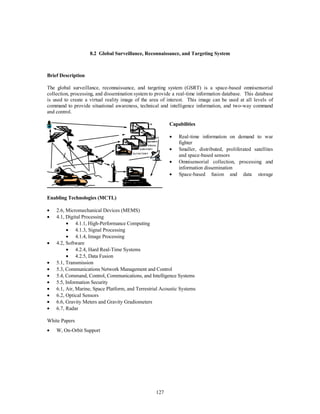
8.2 Global Surveillance, Reconnaissance, and Targeting System............................................127 
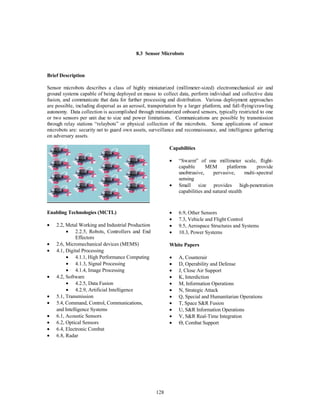
8.3 Sensor Microbots...............................................................................................................128 
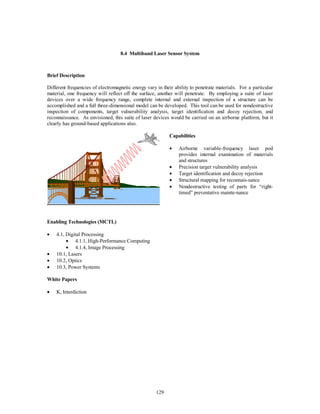
8.4 Multiband Laser Sensor System.........................................................................................129 
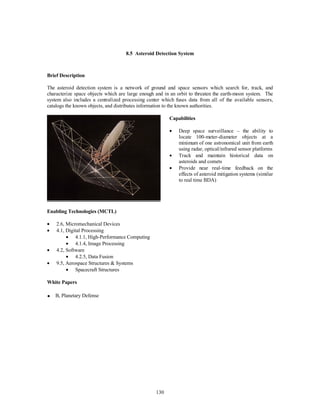
8.5 Asteroid Detection System.................................................................................................130 
9.1 Mobile Asset Repair Station..............................................................................................131 
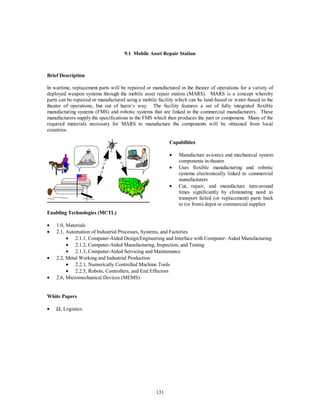
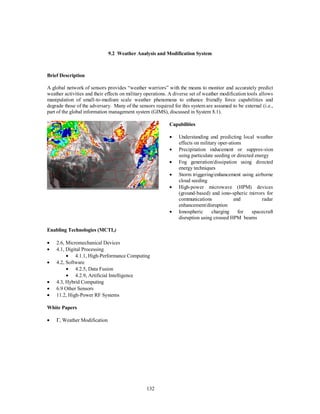
9.2 Weather Analysis and Modification System ......................................................................132 
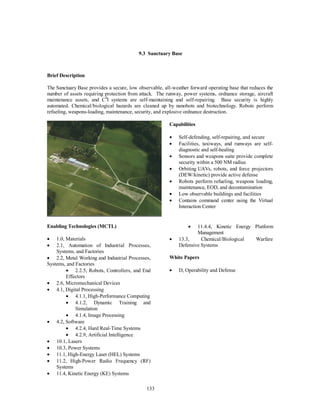
9.3 Sanctuary Base...................................................................................................................133 
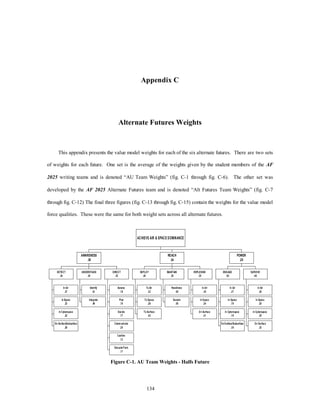
C Alternate Futures Weights ...............................................................................................................134 
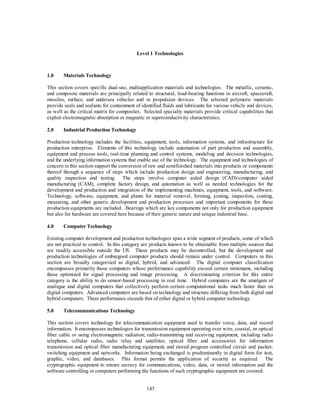
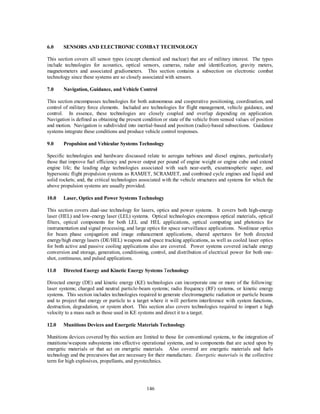
D Technology Model ..........................................................................................................................142 
Level 1 Technologies................................................................................................................145 
Level 2 Technologies................................................................................................................147 
Level 3 Technologies................................................................................................................155 
E System Scores..................................................................................................................................158 
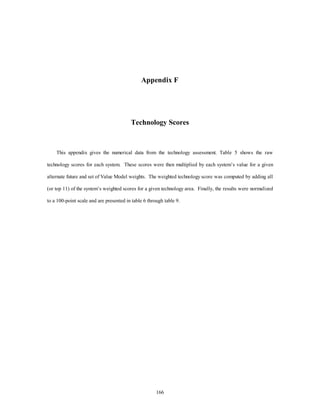
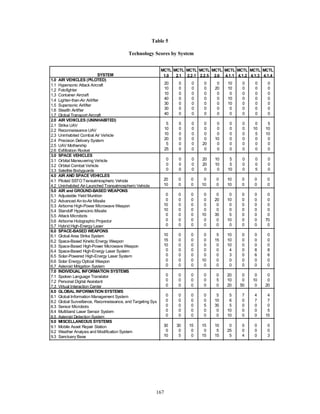
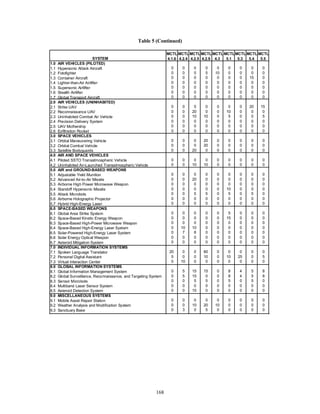
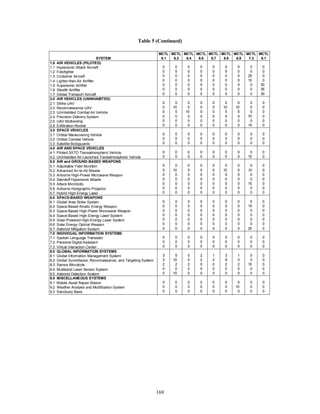
F Technology Scores...........................................................................................................................166 
Bibliography...................................................................................................................................176 
v
Illustrations 
Figure Page 
1-1. Air Force 2025 Study Process............................................................................................................2 
1-2. Operational Analysis Methodology ....................................................................................................4 
2-1. Air Force 2025 OA Process...............................................................................................................8 
2-2. Sample Scoring Functions ................................................................................................................12 
2-3. Notional Value Model ......................................................................................................................14 
2-4. Weights Applied to Notional Value Model ......................................................................................15 
2-5. Value Model Based on JROC/JWCA Categories.............................................................................17 
2-6. Value Model Based on AFDD-1 ......................................................................................................18 
2-7. Value Model Based on Joint Vision 2010........................................................................................19 
2-8. Value Model Based on Cornerstones...............................................................................................20 
2-9. Air Force 2025 Initial Task Compilation .........................................................................................23 
2-10. First Affinity Grouping of Tasks.......................................................................................................24 
2-11. Second Affinity Grouping of Tasks...................................................................................................25 
2-12. Inclusive Grouping of Tasks and Subtasks........................................................................................27 
2-13. Foundations 2025 Value Model.......................................................................................................29 
2-14. Awareness Tasks, Subtasks, and Force Qualities .............................................................................30 
2-15. Reach Tasks, Subtasks, and Force Qualities ....................................................................................31 
2-16. Power Tasks, Subtasks, and Force Qualities....................................................................................32 
2-17. System Functional Hierarchy............................................................................................................34 
2-18. Alternate Futures Planning Space .....................................................................................................36 
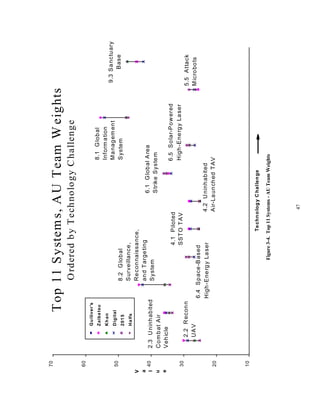
3-1. Representative Systems ....................................................................................................................43 
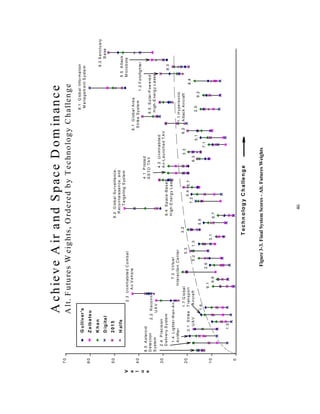
3-2. Final System Scores - AU Team Weights.........................................................................................45 
vi
Figure Page 
3-3. Final System Scores - Alt. Futures Weights......................................................................................46 
3-4. Top 11 Systems - AU Team Weights................................................................................................47 
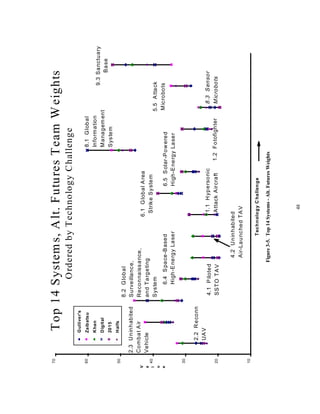
3-5. Top 14 Systems - Alt. Futures Weights.............................................................................................48 
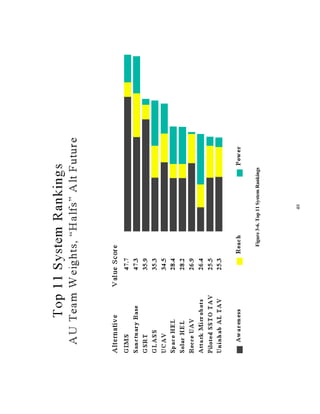
3-6. Top 11 System Rankings...................................................................................................................49 
3-7. Awareness Scores - AU Team Weights ............................................................................................50 
3-8. Deploy Scores - AU Team Weights, Halfs Future ............................................................................51 
3-9. Power Scores - AU Team Weights...................................................................................................52 
3-10. Technology Rankings (All 43 Sys, AU Students Wts) ......................................................................58 
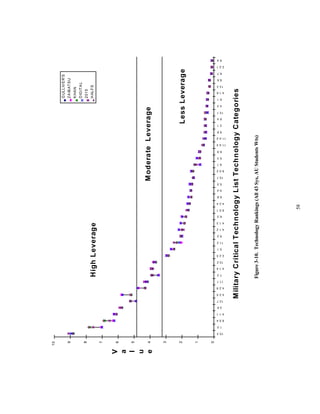
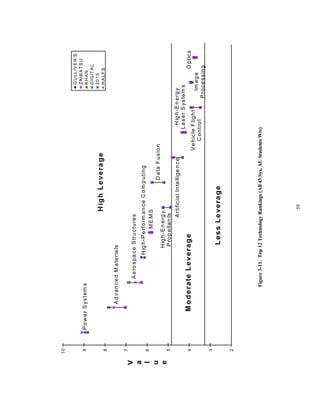
3-11. Top 12 Technology Rankings (All 43 Sys, AU Students Wts)..........................................................59 
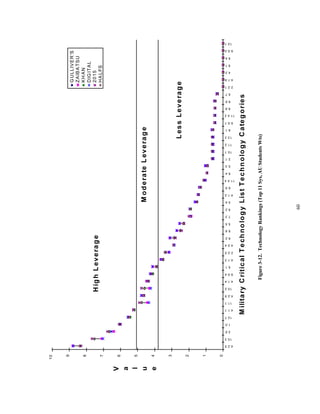
3-12. Technology Rankings (Top 11 Sys, AU Students Wts) .....................................................................60 
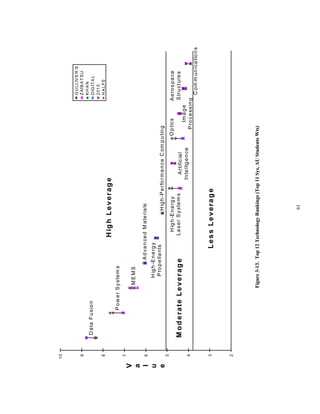
3-13. Top 12 Technology Rankings (Top 11 Sys, AU Students Wts).........................................................61 
3-14. Technology Rankings (All 43 Sys, Alt Fut Team Wts) .....................................................................62 
3-15. Top 12 Technology Rankings (All 43 Sys, Alt Fut Team Wts).........................................................63 
3-16. Technology Rankings (Top 11 Sys, Alt Fut Team Wts) ....................................................................64 
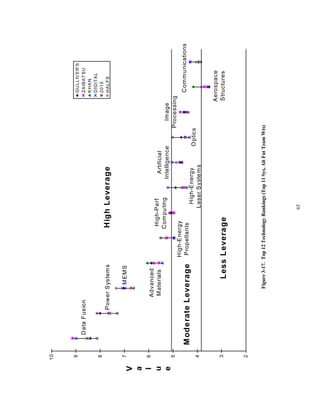
3-17. Top 12 Technology Rankings (Top 11 Sys, Alt Fut Team Wts)........................................................65 
A-1. Value Model - Top Level .................................................................................................................71 
A-2. Value Model - Awareness................................................................................................................72 
A-3. Value Model - Reach........................................................................................................................73 
A-4. Value Model - Power .......................................................................................................................74 
A-5. Detect in Air Scoring Functions .......................................................................................................75 
A-6. Detect in Space Scoring Functions...................................................................................................75 
A-7. Detect in Cyberspace Scoring Functions .........................................................................................76 
A-8. Detect on Surface/Subsurface Scoring Functions............................................................................76 
A-9. Identify Scoring Functions................................................................................................................76 
A-10. Integrate Scoring Functions .............................................................................................................77 
A-11. Educate/Train Scoring Functions.....................................................................................................77 
A-12. Assess Scoring Functions..................................................................................................................77 
vii
Figure Page 
A-13. Plan Scoring Functions.....................................................................................................................77 
A-14. Decide Scoring Functions.................................................................................................................78 
A-15. Communicate Scoring Functions......................................................................................................78 
A-16. Confirm Scoring Functions...............................................................................................................78 
A-17. Deploy to Air Scoring Functions ......................................................................................................79 
A-18. Deploy to Space Scoring Functions..................................................................................................79 
A-19. Deploy to Surface Scoring Functions...............................................................................................80 
A-20. Readiness Scoring Functions............................................................................................................80 
A-21. Sustain Scoring Functions ................................................................................................................80 
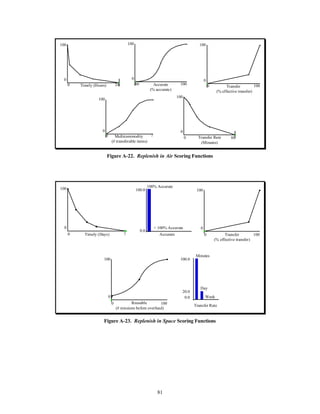
A-22. Replenish in Air Scoring Functions..................................................................................................81 
A-23. Replenish in Space Scoring Functions .............................................................................................81 
A-24. Replenish on Surface Scoring Functions..........................................................................................82 
A-25. Engage in Air Scoring Functions......................................................................................................82 
A-26. Engage in Space Scoring Functions .................................................................................................82 
A-27. Engage in Cyberspace Scoring Functions........................................................................................83 
A-28. Engage on Surface/Subsurface Scoring Functions ..........................................................................83 
A-29. Survive in Air Scoring Functions......................................................................................................84 
A-30. Survive in Space Scoring Functions .................................................................................................84 
A-31. Survive in Cyberspace Scoring Functions........................................................................................84 
A-32. Survive on Surface Scoring Functions..............................................................................................84 
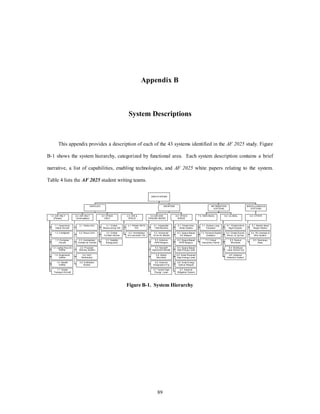
B-1. System Hierarchy..............................................................................................................................89 
C-1. AU Team Weights - Halfs Future....................................................................................................134 
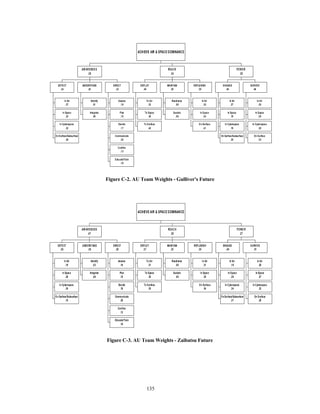
C-2. AU Team Weights - Gulliver's Future ............................................................................................135 
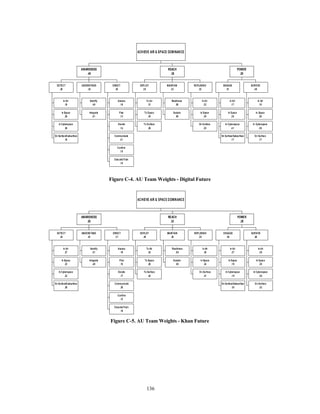
C-3. AU Team Weights - Zaibatsu Future...............................................................................................135 
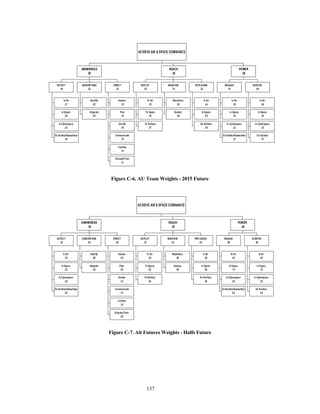
C-4. AU Team Weights - Digital Future .................................................................................................136 
C-5. AU Team Weights - Khan Future....................................................................................................136 
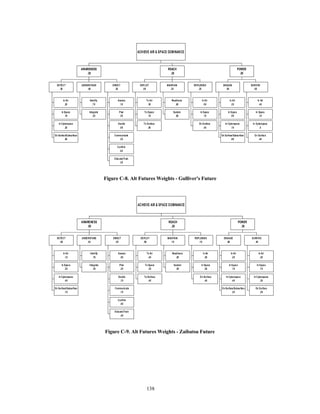
C-6. AU Team Weights - 2015 Future ....................................................................................................137 
viii
Figure Page 
C-7. Alt Futures Weights - Halfs Future .................................................................................................137 
C-8. Alt Futures Weights - Gulliver's Future..........................................................................................138 
C-9. Alt Futures Weights - Zaibatsu Future ............................................................................................138 
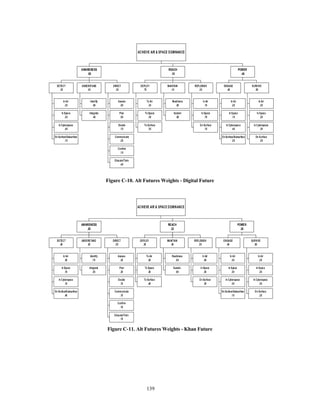
C-10. Alt Futures Weights - Digital Future...............................................................................................139 
C-11. Alt Futures Weights - Khan Future..................................................................................................139 
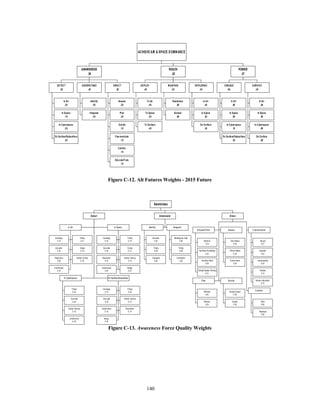
C-12. Alt Futures Weights - 2015 Future..................................................................................................140 
C-13. Awareness Force Quality Weights..................................................................................................140 
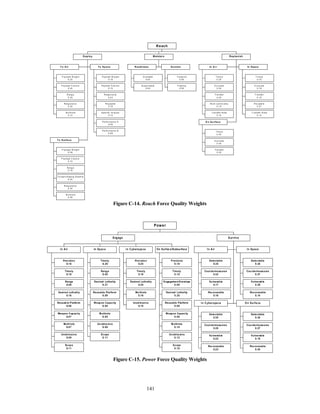
C-14. Reach Force Quality Weights.........................................................................................................141 
C-15. Power Force Quality Weights.........................................................................................................141 
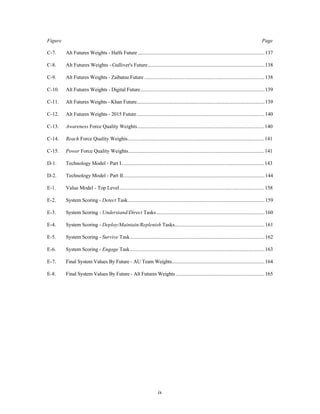
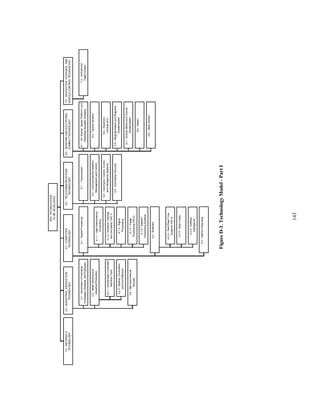
D-1. Technology Model - Part I..............................................................................................................143 
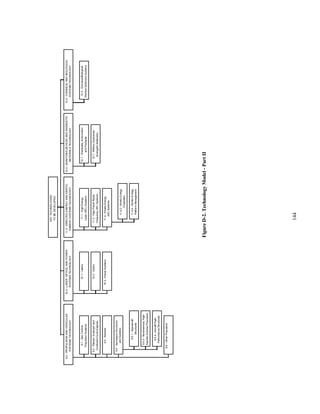
D-2. Technology Model - Part II.............................................................................................................144 
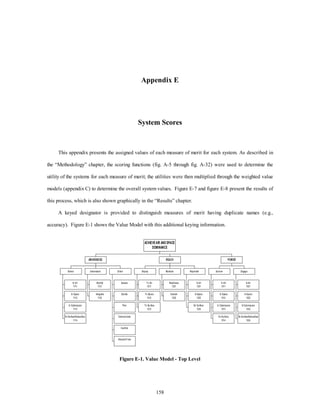
E-1. Value Model - Top Level ...............................................................................................................158 
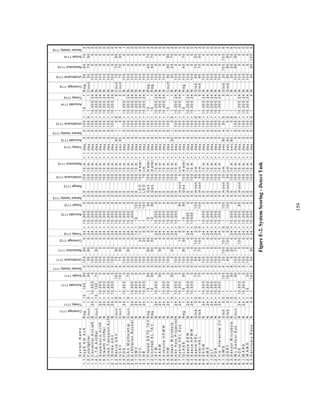
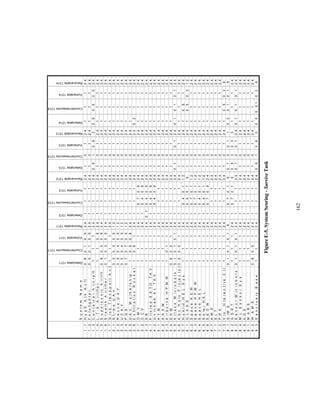
E-2. System Scoring - Detect Task.........................................................................................................159 
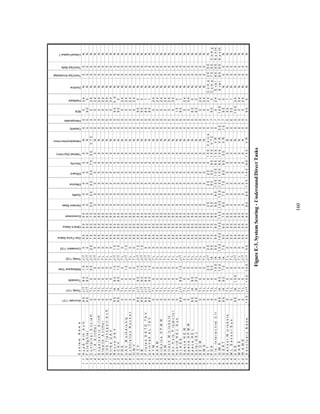
E-3. System Scoring - Understand/Direct Tasks...................................................................................160 
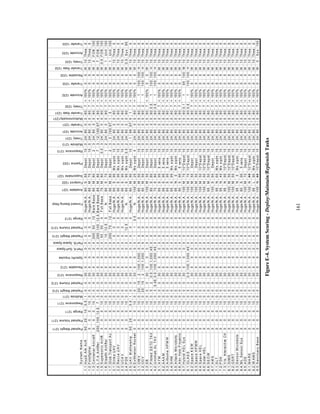
E-4. System Scoring - Deploy/Maintain/Replenish Tasks.....................................................................161 
E-5. System Scoring - Survive Task.......................................................................................................162 
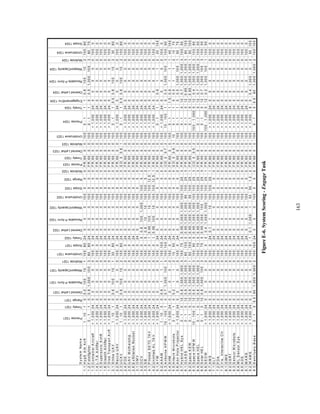
E-6. System Scoring - Engage Task.......................................................................................................163 
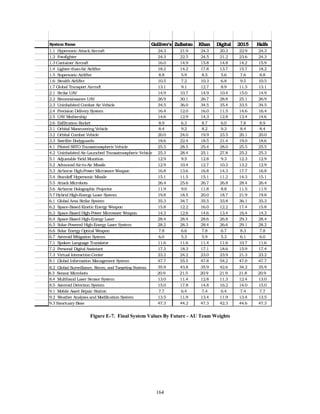
E-7. Final System Values By Future - AU Team Weights.......................................................................164 
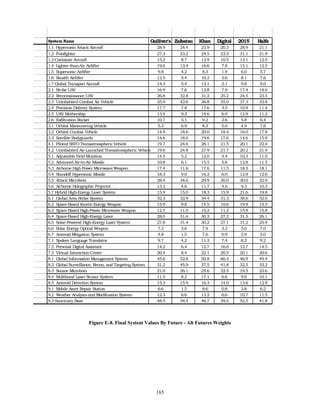
E-8. Final System Values By Future - Alt Futures Weights ....................................................................165 
ix
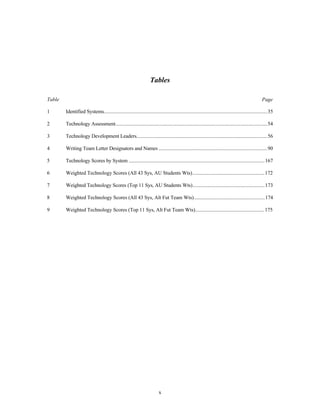
Tables 
Table Page 
1 Identified Systems.............................................................................................................................35 
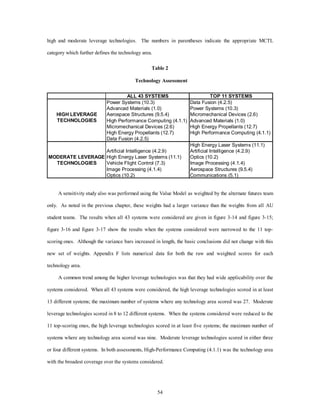
2 Technology Assessment....................................................................................................................54 
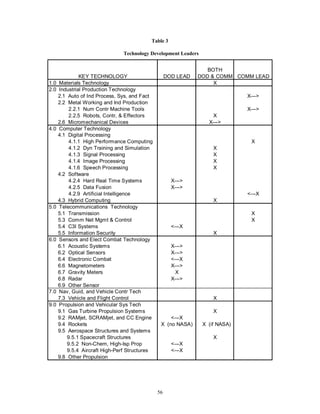
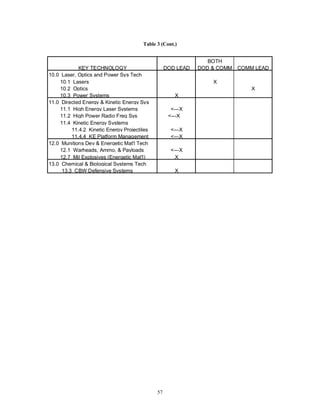
3 Technology Development Leaders....................................................................................................56 
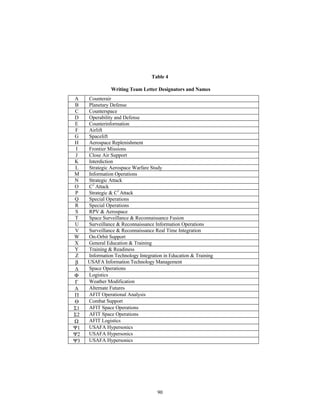
4 Writing Team Letter Designators and Names ...................................................................................90 
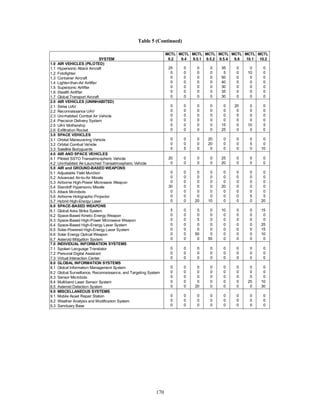
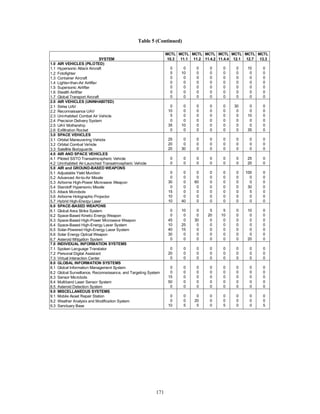
5 Technology Scores by System ........................................................................................................167 
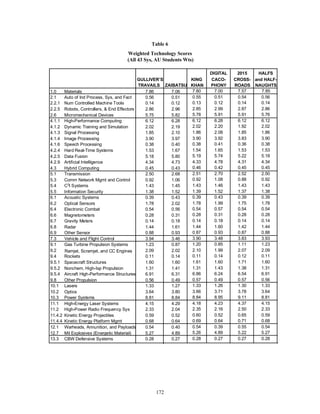
6 Weighted Technology Scores (All 43 Sys, AU Students Wts)........................................................172 
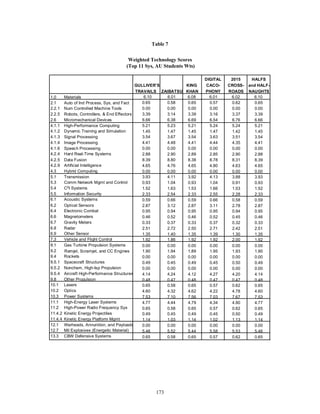
7 Weighted Technology Scores (Top 11 Sys, AU Students Wts).......................................................173 
8 Weighted Technology Scores (All 43 Sys, Alt Fut Team Wts).......................................................174 
9 Weighted Technology Scores (Top 11 Sys, Alt Fut Team Wts)......................................................175 
x
Acknowledgments 
We would like to thank Col George K. Haritos, the faculty of the Graduate School of Engineering, and 
the faculty of the Graduate School of Logistics and Acquisition at the Air Force Institute of Technology for 
their contribute to the Air Force 2025 study. Colonel Haritos formed a team of senior faculty who examined 
issues surrounding which sectors (DOD or commercial or both) might take the lead in future technology 
xi 
development. 
We also would like to recognize the contribution of Lt Col Glenn Bailey, Lt Col Jack K. Kloeber, Jr., Lt 
Col James T. Moore, and Capt Christopher Burke to the operational analysis process. They joined the 
Analysis team as expert evaluators of the futuristic systems considered by the Air Force 2025 study. They 
were chosen to participate because each had a unique career background that was deemed essential to any 
attempt at an objective assessment of the futuristic systems considered by Air Force 2025. Their 
contribution was immeasurable.
Executive Summary 
In the summer of 1995 the Air Force chief of staff tasked Air University to conduct a year-long study, 
Air Force 2025, to “generate ideas and concepts on the capabilities the United States will require to possess 
the dominant air and space forces in the future, detail … new or high-leverage concepts for employing air and 
space power, detail … the technologies required to enable the capabilities envisioned.” To support this goal 
an operational analysis was conducted to identify high-value system concepts and their enabling technologies 
in a way that was objective, traceable, and robust. This analysis determined which of the Air Force 2025 
system concepts showed the greatest potential for enhancing future air and space capabilities and which of 
their embedded technologies have the highest leverage in making the high-value system concepts a reality. 
A model, Foundations 2025, which reflected the overall values held by the Air Force 2025 
participants was developed to quantify and compare different system concepts’ contributions to future air and 
space capabilities. Foundations 2025 is distinguished by the large number of system concepts that can be 
analyzed, the 30-year focus into the future, and the fact it was developed through a bottoms-up approach. 
Foundations 2025 offers a potential new framework for future air and space doctrine and can be easily 
modified (broken into three separate models: awareness, reach, and power) by Air Force major commands 
for use in their mission area analysis process. Thus, the model presented is an aid to current and future 
senior decision makers concerned with the employment of air and space power. 
The Air Force 2025 study produced a number of excellent system concepts for employing air and space 
power in the future. Analysis of the highest value system concepts indicated that the effort to occupy the 
“high ground” of the future will require air and space forces to possess increased awareness and to control 
the medium of space. The five highest value system concepts were: 
·  Global information management system 
·  Sanctuary base 
·  Global surveillance, reconnaissance, and targeting system 
·  Global area strike system 
·  Uninhabited combat air vehicle 
xii
The following six system concepts scored below the top five but were clearly ahead of the others: 
xiii 
·  Space-based high energy laser 
·  Solar-powered high energy laser 
·  Reconnaissance UAV 
·  Attack microbots 
·  Piloted SSTO TAV 
·  Uninhabited air-launched TAV 
These conclusions regarding the rankings of the system concepts were not affected by any reasonable changes 
of the weighting scheme in the Value Model. 
The study also included an assessment of the enabling technologies on which the system concepts 
depend. The analysis explicitly took into account the number of system concepts each technology supported, 
the degree to which each system concept depended on it, and the importance of the system concept. Six high-leverage 
technologies stood out because they are important to a large number of high-value system concepts: 
·  Data fusion 
·  Power systems 
·  Micromechanical devices 
·  Advanced materials 
·  High energy propellants 
·  High performance computing 
The major surprise among these results was the importance of continued breakthroughs in the area of 
power systems. Other moderate-leverage technologies were also important but contributed to only three or 
four of the high-value system concepts: 
·  High energy laser systems 
·  Artificial intelligence 
·  Optics 
·  Aerospace structures 
·  Image processing 
·  Communications 
Advances in these areas show promise to open the way to air and space systems that would dramatically 
improve the effectiveness of air and space power employment to achieve the US military objectives.
Chapter 1 
Introduction 
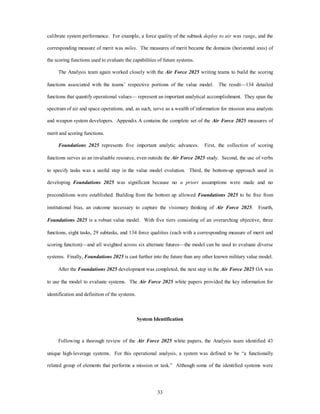
The long range planning process in our Air Force is broken. If we are 
going to be relevant in the future, we’ve got to somehow break free of the 
evolutionary nature of the planning process. 
1 
—Gen Ronald R. Fogleman 
With these few words, the chief of staff of the Air Force, Gen Ronald R. Fogleman, challenged the 
participants of the Air Force 2025 study to generate ideas and concepts on the capabilities the United States 
will require to dominate air and space forces in the future. When General Fogleman assigned the 
responsibility for Air Force 2025 to Air University, he directed that the final product be a collection of white 
papers detailing findings regarding air and space capabilities required for future warfare, new or high-leverage 
concepts for employing air and space power, and the technologies required to enable the required 
capabilities. 1 
Meeting the Challenge 
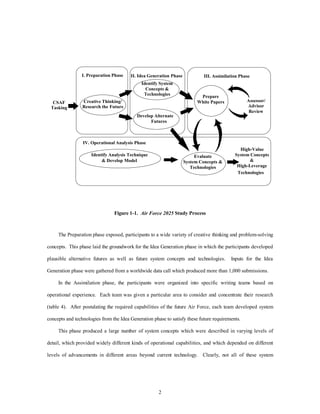
In response to General Fogleman’s tasking, Air University devised a four-phase study process to 
stimulate creativity, generate ideas, and evaluate figure 1-1.
I. Preparation Phase II. Idea Generation Phase III. Assimilation Phase 
2 
Creative Thinking/ 
Research the Future 
Identify System 
Concepts & 
Technologies 
Develop Alternate 
Futures 
Prepare 
White Papers 
CSAF 
Tasking 
IV. Operational Analysis Phase 
Assessor/ 
Advisor 
Review 
Technologies 
Evaluate 
System Concepts & 
Technologies 
High-Value 
System Concepts 
& 
High-Leverage 
Identify Analysis Technique 
& Develop Model 
Figure 1-1. Air Force 2025 Study Process 
The Preparation phase exposed, participants to a wide variety of creative thinking and problem-solving 
concepts. This phase laid the groundwork for the Idea Generation phase in which the participants developed 
plausible alternative futures as well as future system concepts and technologies. Inputs for the Idea 
Generation phase were gathered from a worldwide data call which produced more than 1,000 submissions. 
In the Assimilation phase, the participants were organized into specific writing teams based on 
operational experience. Each team was given a particular area to consider and concentrate their research 
(table 4). After postulating the required capabilities of the future Air Force, each team developed system 
concepts and technologies from the Idea Generation phase to satisfy these future requirements. 
This phase produced a large number of system concepts which were described in varying levels of 
detail, which provided widely different kinds of operational capabilities, and which depended on different 
levels of advancements in different areas beyond current technology. Clearly, not all of these system
concepts could be developed, nor could all of the technologies be aggressively pursued. The study needed to 
prioritize the relative importance of both future system concepts and their enabling technologies. 
An operational analysis was conducted with the other three phases to aid in this prioritization. Its 
purpose was to evaluate system concepts and technologies developed in the white papers; specifically, it had 
3 
three objectives: 
1. To assess the potential operational utility of future air and space system concepts. 
2. Identify the high leverage technologies required by those system concepts, and 
3. Provide an objective, traceable, and robust analysis. 
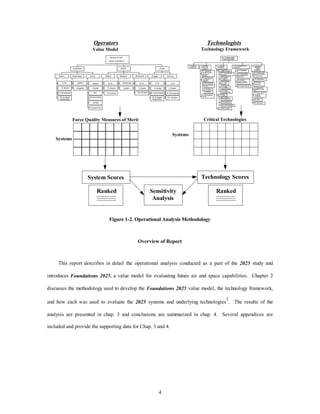
Figure 1-2 shows the methodology used for the operational analysis. The left side of the column 
reflects the evaluation of system concepts for operational utility, while the right column identifies and 
evaluates the underlying high-leverage technologies. 
For the system concept evaluation, this model used a hierarchy of objectives, functions, and tasks, 
which represented the objectives necessary to underwrite air and space power in the next 30 years. For the 
technology evaluation, the framework was a logical structuring of technology areas that were mutually 
exclusive and collectively exhaustive. These hierarchies provided the desired characteristics of objectivity 
and traceability. The desired robustness quality was assured by performing a sensitivity analysis at the 
conclusion of the system concept and technology scoring. Specifically, the sensitivity analysis was 
conducted across a number of plausible alternate futures (see “Alternate Futures section of chap. 2).
Value Model Technology Framework 
4 
Operators 
Understand 
Direct 
Deploy 
Main ta in 
Replenish 
Force Quality Measures of Merit 
System Scores 
Detect 
Systems 
Technologists 
Survive 
Systems 
2.0 - INDUSTRIAL 
PRODUCTION 
TECHNOLOGY 
2.2 - Metal Workin g 
and In dustr ia l 
Product ion 
4.0 - COMPUTER 
TECHNOLOGY 
4.1 - Digital Processing 
4.2 - Software 
5.0 - TELECOMMUNICATIONS 
TECHNOLOGY 
Critical Technologies 
Technology Scores 
Engage 
R a n k e d 
R a n k e d 
Sensitivity 
Analysis 
In Air 
In Space 
In Cyberspace 
On Surface/ 
Subsurface 
Identif y 
Integrate 
Assess 
Decide 
Plan 
Communicate 
Confirm 
Educate/Train 
Awareness 
To Air 
To Space 
To Surfa ce 
Readiness 
Sustain 
In Air 
In Space 
On Surface 
Reach 
In Air 
In Space 
In Cyberspace 
On Surface/ 
Subsurface 
In Air 
In Space 
In Cyberspace 
On Surface 
Power 
Achieve Air and 
Space Dominance 
1.0 - MATERIALS 
TECHNOLOGY 
2.1 - Automation of 
Indu strial Processes, 
Syst ems, and 
Facto ries 
2.2.1 - Numer ic ally 
Controlled Machine 
Too ls 
2.2.5 - Robot s, 
Controllers, and 
En d-Eff ector s 
2.6 - Micromechanical 
De vices 
4.1.1 - High Performance 
Comput ing 
4.1.2 - Dynamic 
Trai ning and 
Simulation (VR.1 ) 
4.1.3 - Signal 
Processing 
4.1.4 - Imag e 
Processing ( VR. 2) 
4.1.6 - Speech 
Processing Systems 
4.2.4 - Hard Real- 
Time Systems (VR.3) 
4.2.5 - Data Fusion 
4.2.9 - Artif icial I ntelligence 
4.3 - Hybrid Computing 
5.1 - Transmission 
5.3 - Commu nications 
Ne two rk Management 
and Cont rol 
5.4 - Command , 
Co ntr ol, Comm, and 
Intellige nce Systems 
5.5 - Inf ormat io n Secu rity 
6.0 - SENSORS AND 
EL ECTRONIC 
COMBAT 
TECHNOLOGY 
6.1 - Air, Mar ine, Space 
Plat form an d Ter restr ial 
Ac oustic Sys tems 
6.2 - Optical Sensors 
6.4 - Ele ctronic 
Gradiometers 
6.6 - Magne tometers 
and Magn etic Combat 
(EC) 
6.7 - Gravit y Met ers 
and Gra vity 
Gradiometers 
6.8 - Radar 
6.9 - Other Sensor 
KEY TECHNOLOGIES 
TO BE DEVELOPED 
Figure 1-2. Operational Analysis Methodology 
Overview of Report 
This report describes in detail the operational analysis conducted as a part of the 2025 study and 
introduces Foundations 2025, a value model for evaluating future air and space capabilities. Chapter 2 
discusses the methodology used to develop the Foundations 2025 value model, the technology framework, 
and how each was used to evaluate the 2025 systems and underlying technologies2. The results of the 
analysis are presented in chap. 3 and conclusions are summarized in chap. 4. Several appendices are 
included and provide the supporting data for Chap. 3 and 4.
1 Message from Gen Ronal R. Fogleman to Air University, 23 December 1994. 
2 From this point forward we will use the term system when referring to the system concepts. The 
authors recognize that system carries the connotation of existing hardware, but it is less cumbersome, and all 
of the systems scored here are futuristic. 
5
Chapter 2 
Methodology 
This chapter outlines the Air Force 2025 methods used to evaluate systems and technologies. It covers 
the development of the value model to score the systems, the system identification process, the system scoring 
procedures, the technology identification procedures, and the technology scoring procedures and ends with an 
evaluation of which sector (public or commercial) will develop the future technologies. 
Challenges 
A primary goal of the Air Force 2025 operational analysis (OA) was to identify the Air Force 2025 
systems that offer the greatest potential to support future air and space operations. To meet this goal, the 
Analysis team’s challenge was to develop a methodology that satisfied a diverse set of criteria. First, the Air 
Force 2025 OA needed to be compatible with the Air University academic calendar year. It also needed to 
be capable of quick implementation after the Air Command and Staff College and Air War College students 
completed their white papers, which contained conceptual descriptions of the systems. 
Second, because Air Force 2025 was a study about 30 years into the future, the system descriptions in 
the white papers lacked engineering detail. Therefore, the OA methodology had to use human judgment about 
6 
operational capability and key enabling technologies. 
Third, while the values of the current senior leadership of the Air Force are well documented in 
strategies, policies, and directives, it is far more difficult to predict what will be important to future leaders.
Fourth, to prevent one set of views or interests from unduly influencing the results, the evaluation 
methodology had to be free of institutional bias. The methodology should neither unfairly favor nor unduly 
7 
penalize any potential Air Force 2025 systems. 
Fifth, the results had to be traceable, since the Air Force 2025 system evaluation results would be 
subject to scrutiny. The Analysis team members would need to explain for any given system or technology 
how and why it was scored. The study participants and Air Force senior leadership would be far more likely 
to accept the results if they could understand clearly how the systems were evaluated. 
Sixth, the OA methodology had to be robust to apply across a wide range of potential future 
environments postulated by the Air Force 2025 Alternate Futures team. Each future described a different 
political, technological, and social environment (see the “Alternate Futures” section). The OA methodology 
had to be able to capture different priorities assigned to air and space functions and tasks in these alternate 
futures. 
The Air Force 2025 Operational Analysis 
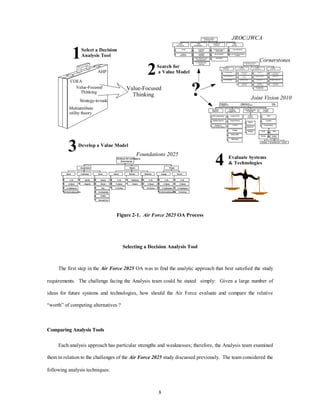
The Analysis team developed the four-step approach to satisfy the requirements previously described 
figure 2-1. This section contains a very brief overview of the Air Force 2025 OA process; the following 
sections describe each of the four steps of the process in detail. First, the Analysis team had to choose the 
most appropriate analysis methodology for the OA. After considering the advantages and disadvantages of 
many possibilities, the team selected an approach known as Value-Focused Thinking (VFT).1 Second, to 
implement VFT, the team had to find a value model to quantify and compare the contributions of the systems 
proposed by Air Force 2025; therefore, the next step was a comprehensive search for a suitable existing 
value model. Third, when no suitable alternative was found, the Analysis team developed a new value 
model, Foundations 2025. The fourth step used the value model to evaluate Air Force 2025 systems and 
then the technologies that will be required to develop these systems.
FORCE 
APPLI CATION 
Search for 
a Value Model 2 
Engage 
8 
Select a Decision 
1Analysis Tool 
AHP 
COEA 
Strategy-to-task 
Multiattribute 
utility theory 
Value-Focused 
Thinking 
3Develop a Value Model 
AEROSPACE 
CO NTROL 
AEROSPACE 
CO NTROL 
Dominant 
Maneuver 
FORCE 
SUPPORT 
Peacetime Deterrence & Fight 
Engagement Conflict Prevention & Win 
4 
Value-Focused 
Thinking 
JROC/JWCA 
FORCE 
APPLICATIO N 
FORCE 
ENHANCEMENT 
Precision 
Engagement 
Full-Dimensional 
Protection 
Protect 
(Free to) 
Focu sed 
Logi stics 
Transportation 
Evaluate Systems 
& Technologies 
Foundations 2025 
Cornerstones 
FORCE 
SUPPORT 
Joint Vision 2010 
FORCE 
ENHANCEMENT 
? 
AEROSPACE CONTROL 
CO UN TERAIR 
CO UN TERSPACE 
CO UN TERINFO 
STRATEGIC 
ATTACK 
C2 
ATTACK 
I NTERDICTI ON 
CLOSE AIR 
SUPPORT 
AIRLI FT 
AIR REFUEL ING 
SPACE L IFT 
SPECIAL 
O PERATIO NS 
I NFORMATION 
O PERATIO NS 
BASE OPERABILITY 
& DEFENSE 
L OGISTI CS 
COMBAT SUPPO RT 
ON-ORBIT 
SUPPORT 
& EXPLOITATION 
INFO (Awareness) 
Mobili ty (Deploy) 
Employ on 
Land/Sea/Air/Space 
Locate (ACQ) 
Target (Priority) 
C2 INFO 
Engage 
Assess BDA 
Reengage 
Deploy 
Maneuver 
Engage 
INFO 
Logi stics 
Track Shift 
Del iver 
Sustain 
(at Level) 
Strategic Operational Tactical 
WARFARE 
STRIKE 
G ROUND 
MANEUVER 
STRATEGIC 
MOBILITY 
O VERSEAS 
PRESENCE 
I NTEL, SURVEILLANCE 
& RECONNAISANCE 
C2 & INFORMATI ON 
STRATEGIC MOBILITY 
PROTECTION 
AIR SUPERIORITY 
DETER WMD 
JOINT READINESS 
CO UN TER PROLI FERATIO N 
OF WMD 
AEROSPACE CONTRO L 
& EXPLO ITATION 
Detect 
In Air 
In Space 
In Cyberspace 
On Sur face/Subsurface 
Understand 
Identify 
Integrate 
Direct 
Assess 
Decide 
Plan 
Communicate 
Confirm 
Educate/Train 
Awareness 
Deploy 
To Air 
To Space 
To Surface 
Maintain 
Readiness 
Sustain 
Replenish 
In Air 
In Space 
On Surface 
Reach 
In Air 
In Space 
In Cyberspace 
On Sur face/Subsurface 
Survive 
In Air 
In Space 
In Cyberspace 
On Surface 
Power 
Achieve Air and Space 
Dominance 
Figure 2-1. Air Force 2025 OA Process 
Selecting a Decision Analysis Tool 
The first step in the Air Force 2025 OA was to find the analytic approach that best satisfied the study 
requirements. The challenge facing the Analysis team could be stated simply: Given a large number of 
ideas for future systems and technologies, how should the Air Force evaluate and compare the relative 
“worth” of competing alternatives ? 
Comparing Analysis Tools 
Each analysis approach has particular strengths and weaknesses; therefore, the Analysis team examined 
them in relation to the challenges of the Air Force 2025 study discussed previously. The team considered the 
following analysis techniques:
·  “most-to-least dear” with no criteria 
·  qualitative comparison with criteria 
·  simple quantitative comparison matrix 
·  value-focused thinking 
·  analytical hierarchy process 
·  strategy-to-task 
·  futures-to-strategy-to-task 
·  common operational objectives of the armed forces 
·  cost and operational effectiveness analysis 
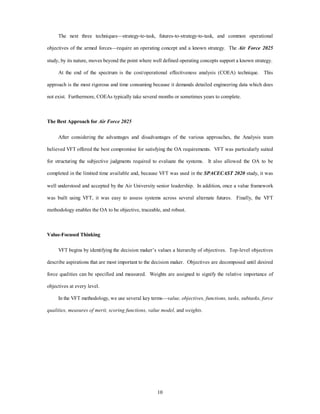
These choices are listed in order of increasing depth of the analysis. In selecting an analysis technique 
for this task, the most important tradeoff is between the level of engineering detail and the available time. 
The first few methodologies require the least amount of detail concerning the evaluated systems, while the 
last few demand considerable engineering detail. At one extreme (“most-to-least dear”), a group of experts 
can review the alternatives and can rank them subjectively. At the other extreme, a full cost and operational 
effectiveness analysis can be done, as is usually done before starting the development phase of any new 
9 
major weapon system acquisition. 
The first approach is “most-to-least dear” and has no criteria. This technique is sometimes referred to 
as the “bunch-of-smart-people-around-a-table” approach. This method can be accomplished quickly; 
however, it is difficult to replicate. This approach is not robust, and it lacks objectivity and traceability. 
The second approach, qualitative comparison with criteria, is slightly more rigorous, but the subjective 
rationale again lacks objectivity and traceability. The next approach, a simple quantitative comparison 
matrix, provides more rigor, but with the large number of systems across all air and space capabilities, the 
team felt a comparison matrix approach would not adequately distinguish between competing systems. 
The fourth approach, value-focused thinking, was the technique used in the Air University SPACECAST 
2020 1994.2 Instead of highly detailed system data, VFT employs user-defined scoring functions to compare 
the performance of alternate systems. Systems that perform well on these scoring functions receive high-value 
scores. The VFT process is traceable because system evaluations are based on defined scoring 
functions. This approach capitalizes on a strength of the Air Force 2025 process — lots of expert judgment. 
The fifth technique, the analytical hierarchy process (AHP), ranks alternatives, but its several 
drawbacks limited its usefulness for this study. AHP requires pairwise comparisons of systems between to 
each criterion, as well as among criteria. The large number of systems made such comparisons cumbersome.
The next three techniques—strategy-to-task, futures-to-strategy-to-task, and common operational 
objectives of the armed forces—require an operating concept and a known strategy. The Air Force 2025 
study, by its nature, moves beyond the point where well defined operating concepts support a known strategy. 
At the end of the spectrum is the cost/operational effectiveness analysis (COEA) technique. This 
approach is the most rigorous and time consuming because it demands detailed engineering data which does 
not exist. Furthermore, COEAs typically take several months or sometimes years to complete. 
10 
The Best Approach for Air Force 2025 
After considering the advantages and disadvantages of the various approaches, the Analysis team 
believed VFT offered the best compromise for satisfying the OA requirements. VFT was particularly suited 
for structuring the subjective judgments required to evaluate the systems. It also allowed the OA to be 
completed in the limited time available and, because VFT was used in the SPACECAST 2020 study, it was 
well understood and accepted by the Air University senior leadership. In addition, once a value framework 
was built using VFT, it was easy to assess systems across several alternate futures. Finally, the VFT 
methodology enables the OA to be objective, traceable, and robust. 
Value-Focused Thinking 
VFT begins by identifying the decision maker’s values a hierarchy of objectives. Top-level objectives 
describe aspirations that are most important to the decision maker. Objectives are decomposed until desired 
force qualities can be specified and measured. Weights are assigned to signify the relative importance of 
objectives at every level. 
In the VFT methodology, we use several key terms—value, objectives, functions, tasks, subtasks, force 
qualities, measures of merit, scoring functions, value model, and weights.
11 
Value 
The most important concept in VFT is value. Ralph L. Keeney says, “Values are what we care about. 
[Values] should be the driving force for our decision-making.”3 Instead, the fundamental precept of VFT is 
that values are principles used for evaluation.4 
Keeney asserts that thinking about values is constraint-free thinking.5 By not limiting oneself to pre-etermined 
alternatives in the search for solutions, innovative answers can be developed. This philosophy 
complemented the creative thinking exercises of Air Force 2025. 
Objectives, Functions, Tasks, and Subtasks 
In VFT, values are made explicit with objectives, and a hierarchy of objectives is constructed that 
supports the decision maker’s values.6 Specific, lower level objectives support the general, overarching 
objectives. The Analysis team used the terms objective, functions, tasks, and subtasks to designate the tiers 
in the hierarchy, from highest to lowest, respectively. 
Force Qualities 
In VFT terminology, a force quality defines a desired attribute of a system to achieve a subtask. For 
example, if the subtask is to “identify,” a corresponding force quality might be “accurate.” According to 
Keeney that “[force qualities] should be measurable, operational, and understandable.”7 
Measures of Merit and Scoring Functions 
Each force quality has a measure of merit that is the metric used to gauge system performance. Each 
measure of merit has a range of outcomes, from worst to best. To continue with the previous example, if the 
subtask is “identify” and the force quality is “accurate,” then a measure of merit could be “percent of correct 
identifications.” 
VFT scoring functions provide a quantitative means for measuring the relative system performance for 
each measure of merit. For example, if the measure of merit is percent of correct identifications, the
corresponding scoring function might convert a system performance of “83 percent correct identifications” 
12 
into a score of 92. 
Because scoring functions operationalize the measures of merit, they are the building blocks for 
assessing system performance. The domains (horizontal axes) of the scoring functions are the measures of 
merit; the ranges (vertical axes) are the corresponding value scores. A scoring function’s domain may be 
quantitative or qualitative, but its range must be quantitative. While domains are different, ranges must be the 
same. Typical ranges are [0,1], [0,10], or [0,100]. The development of these functions is a significant 
analytical task, since analysts must discern the decision makers’ values for the full range of the measure of 
merit for each force quality. 
Many types of scoring functions exist; the relationship between subtasks and force qualities dictates the 
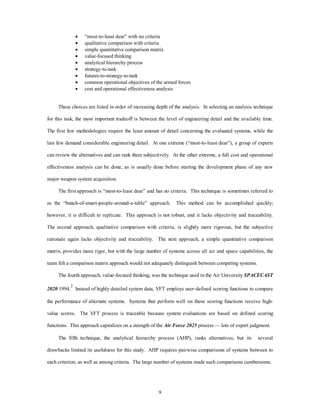
appropriate form. One of the simplest scoring functions is the linear scoring function figure 2-2.a. If a 
decision maker chooses a linear function, the underlying implication is that each incremental increase in 
performance is valued just as much as the preceding increment. 
S 
C 
O 
R 
E 
MEASURE OF MERIT 
S 
C 
O 
R 
E 
MEASURE OF MERIT 
S 
C 
O 
R 
E 
MEASURE OF MERIT 
S 
C 
O 
R 
E 
MEASURE OF MERIT 
Figure 2-2.a 
Linear Returns 
Figure 2-2.b 
Diminishing Returns 
Figure 2-2.c 
Increasing Returns 
Figure 2-2.d 
Increasing-then- 
Diminishing Returns 
Figure 2-2. Sample Scoring Functions 
The linear scoring function has the advantages of easy construction and computation; however, decision 
makers frequently do not assign value linearly. For example, the value placed on system performance often 
experiences diminishing marginal returns (fig. 2-2.b). In other words, each incremental increase in 
performance is valued less than the preceding increment. Another way of explaining diminishing returns is to 
say that some level of performance is “good enough.”
Another phenomenon is that of increasing marginal returns (fig. 2-2.c). Here each incremental increase 
in performance is worth more than the preceding increment. Under these circumstances, the decision maker 
admits there is a certain threshold of performance that must be met before the system has substantive value. 
Another popular scoring function is the S-curve, which initially reflects increasing returns, then 
switches to diminishing returns (fig. 2-2.d). The preceding four examples are the most common scoring 
functions; however, as long as the objective is to maximize value, any monotonically increasing (i.e., never 
decreasing) representation is possible. R. T. Clemen,8 Keeney,9 or Wayne Winston10 techniques for 
13 
deriving scoring functions. 
Value Model 
A value model is the hierarchical representation of objectives, functions, tasks, subtasks, force 
qualities, measures of merit, and scoring functions. Foundations 2025 was the value model developed for 
Air Force 2025. A value model, also called a value tree by some authors, is a branching structure, with the 
most fundamental decision maker objectives at the top. Keeney uses the term fundamental objectives 
hierarchy,11 and states, “The higher level objective is defined by the set of lower-level objectives directly 
under it in the hierarchy.”12 In other words, the lower level objectives completely specify their higher level 
objective. 
Clemen describes five specific characteristics of a value model: 
1. It should be complete, encompassing all important facets of the decision. 
2. It “should be as small as possible.”13 
3. The force qualities should allow straightforward measurement. 
4. Objectives should only appear once in the tree. 
5. The decision maker should be able to think about and treat the branches of the tree separately.14 
Combining the first, fourth, and fifth characteristics above yields two properties—the objectives must be 
mutually exclusive (only appear once and can be treated separately) and collectively exhaustive (encompass 
all that the decision maker values).
Analysts work with decision makers to develop value models. Sometimes candidate value models 
already exist, at least partially, within an organization. In other cases, a new value model must be 
constructed. Keeney provides further background and techniques for developing value models.15 
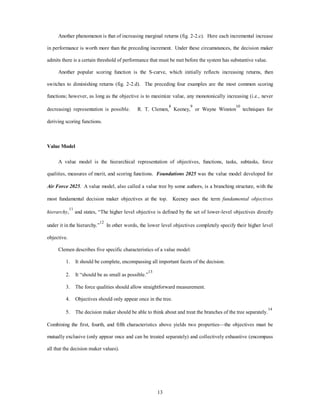
Figure 2-3 shows a notional value model. Under the objective, there are three functions (first level of 
subordinate objectives). Under functions are corresponding tasks (second level of subordinate objectives). 
In this example, function 2 has two tasks (A and B). Tasks can also have subtasks(not included in this 
example), and tasks and subtasks can have one or more force qualities that characterize success at this task. 
Task A has three force qualities and Task B has one force quality (fig. 2-3). For each force quality, one or 
more measures of merit must be identified, each of which has a corresponding scoring function. 
14 
Function 1 
Force Q uality A1 
Measure of Merit A1 
(Scoring Function A1) 
Force Q uality A2 
Measure of Merit A2 
(Scoring Function A2) 
Function 2 Function 3 
Force Q uality A3 
Measure of Merit A3 
(Scoring Function A3) 
Task A 
Task B 
Force Q uality B 
Measure of Merit B 
(Scoring Fu nction B ) 
Objective 
(Value) 
Figure 2-3. Notional Value Model 
Weights 
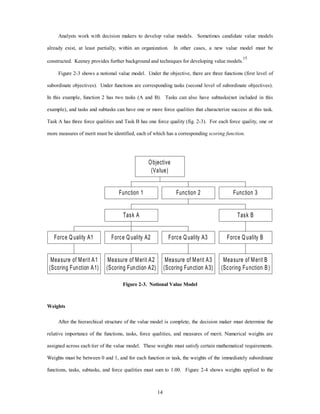
After the hierarchical structure of the value model is complete, the decision maker must determine the 
relative importance of the functions, tasks, force qualities, and measures of merit. Numerical weights are 
assigned across each tier of the value model. These weights must satisfy certain mathematical requirements. 
Weights must be between 0 and 1, and for each function or task, the weights of the immediately subordinate 
functions, tasks, subtasks, and force qualities must sum to 1.00. Figure 2-4 shows weights applied to the
earlier notional value model. Note that the weights of the three functions sum to 1.00, as do the weights of the 
two tasks under function 2 and the three force qualities under task A. Note also that when a subordinate level 
Force Quality A2 
15 
contains only one box, its weight is necessarily 1.00. 
Function 1 
.30 
Force Q uality A1 
.4 5 
Measure of Merit A1 
(Scoring Function A1) 
.35 
Measure of Merit A2 
(Scoring Function A2) 
Force Q uality A3 
.2 0 
Measure of Merit A3 
(Scoring Function A3) 
Task A 
.70 
Task B 
.30 
Force Quality B 
1 .0 0 
Measure of Merit B 
(Scoring Function B ) 
Function 2 
.5 0 
Function 3 
.20 
Objective 
(Value) 
Figure 2-4. Weights Applied to Notional Value Model 
Applying the Value Model 
After the value model is completed and weights has been assigned, the evaluation of systems can be 
accomplished. The computations are straightforward. First, for system, raw scores are initially computed by 
using the applicable scoring functions. If a particular measure of merit does not apply to a given system, the 
raw score is zero. Next, weighted scores are calculated by multiplying the raw scores by the product of all 
the weights in the branch that leads (bottom-up) from the measure of merit to the highest level objective. 
Finally, a total system score is found by summing the weighted scores. The system with the highest score is 
the “best”. 
Using the earlier notional example (fig. 2-4), assume system X has raw scores of 37, 62, 18, and 83 for 
measures of merit A1, A2, A3, and B, respectively. The resulting score for function 2, S(function 2), is 
S(function 2) = {[(37)(0.45)(0.7)(0.5) + (62)(0.35)(0.7)(0.5) + 
(18)(0.2)(0.7)(0.5)] + (83)(1.0)(0.3)(0.5)} 
= 5.82 + 7.59 + 1.26 + 12.45 
= 27.12
Similar operations are performed for every branch of the value model, then they are summed to compute the 
16 
total score for system X. 
The Search for the Air Force 2025 Value Model 
After the Analysis team selected VFT, the next step was to either select an existing value model or 
develop a new one. Identifying a current model proved to be a daunting task because of the scope of the 
study and the focus on the far future. The participants ranged across all of the military services and included 
allies, civilians, government officials, and industry. Any potential model also had to satisfy Clemen’s five 
criteria.16 
The Analysis team initially searched for a national level strategic document that identified priorities for 
future air and space forces. The following sources were investigated: 
·  A National Security Strategy of Engagement and Enlargement 
·  National Military Strategy of the United States of America 
·  Defense Planning Guidance 
·  Joint Requirements Oversight Council (JROC)/Joint Warfighting Capabilities Assessment 
(JWCA) categories 
·  Global Presence and Global Reach, Global Power 
·  Common operational objectives of the armed forces 
·  Draft AFDD-1 
·  Joint Vision 2010 
·  Cornerstones of Information Warfare 
A National Security Strategy of Engagement and Enlargement 17 represents the views of the President. 
It provides a high-level strategic view of the national defense policy but does not support or provide any 
definitive characteristics that could form the basis of a value model. The National Military Strategy of the 
United States of America (NMS), by the chairman Joint Chiefs of Staff (CJCS), also has a grand strategy 
perspective.18 The NMS contains a framework, but the task breakdowns have too much overlap. The 
Defense Planning Guidance 
19 is focused on the near- and midterm budget cycle; therefore, it does not 
support the visionary requirements of Air Force 2025.
AEROSPACE CONTROL 
& EXPLOITATION 
17 
FORCE APPLICATION 
STRIKE 
GROUND MANEUVER 
FORCE ENHANCEMENT 
STRATEGIC MOBILITY 
OVERSEAS PRESENCE 
INTEL, SURVEILLANCE, 
& RECONNAISANCE 
C2 & INFORMATION 
WARFARE 
AEROSPACE CONTROL 
STRATEGIC MOBILITY 
PROTECTION 
AIR SUPERIORITY 
DETER WMD 
FORCE SUPPORT 
JOINT READINESS 
COUNTERPROLIFERATION 
OF WMD 
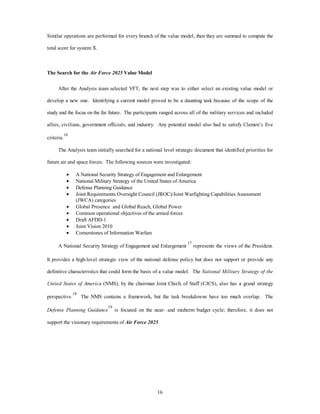
Figure 2-5. Value Model Based on JROC/JWCA Categories 
The former vice CJCS, Adm William A. Owens, produced a set of JROC/JWCA categories to support 
the planning and analysis integration of the service program objective memoranda (fig. 2-5). 
While the JROC/JWCA framework was designed to be visionary, it also has considerable overlap. For 
example, the tasks of to “deter weapons of mass destruction (WMD)” and “counter proliferation of WMD” 
are not mutually exclusive, nor are the tasks of “ground maneuver,” “strategic mobility,” and “strategic 
mobility protection.” 
The secretary of the Air Force published the Global Reach, Global Power 
20 and Global Presence 
21 
series of documents to promulgate the high-level vision of the Air Force of the future. But like the 
president’s national security strategy, these documents do not define key functions required to create a 
hierarchical value framework. 
Another interesting approach, common operational objectives of the armed forces, is based on the work 
of Lt Gen USAF, Glenn A. Kent (Retired).22 This document contains a strategy-to-task focus that could be 
suitable; however, like the defense planning guidance, it focuses on midterm planning years. This approach 
has two other qualities that made it unsuitable for Air Force 2025: it requires more engineering definition of 
the systems and concepts being evaluated than is available, and it assumes a working concept of operations. 
Moreover, it assumes a known future strategy.
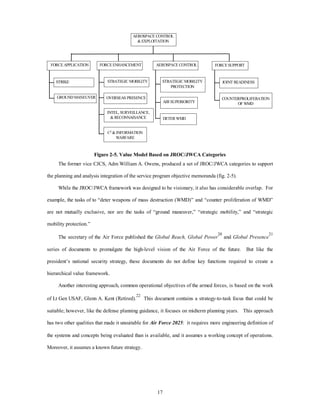
The Analysis team next looked to doctrinal publications as a potential source for a value model 
framework because doctrine is specifically written to provide guidance on how to think about air and space 
capabilities without being tied to a particular time period. The Air Force is currently writing a new doctrinal 
pamphlet, Air Force Doctrine Document: Air Force Basic Doctrine - 1 (AFDD-1).23 
Figure 2-6 shows a candidate value model based on the first draft of AFDD-1. This framework has 
several shortcomings. First, the tasks of “strategic attack,” “interdiction,” and “close air support” contain 
considerable overlap. Next, “information operations” is not integrated into the framework but rather is 
represented as a series of traditional functional tasks such as “C4”, “intelligence,” and “weather service.” 
The goal of the Air Force 2025 study was to propose and evaluate systems that are employed to dominate air 
and space; it was not concerned with how we are currently organized to perform traditional functions. 
GLOBAL 
AWARENESS 
18 
AEROSPACE 
CONTROL 
COUNTERAIR 
COUNTER 
SPACE 
COUNTERINFO 
AEROSPACE 
STRIKE 
STRATEGIC 
ATTACK 
INTERDICTION 
CLOSE AIR 
SUPPORT 
GLOBAL 
POWER 
GLOBAL 
REACH 
MOBILITY 
AIRLIFT 
SPACELIFT 
AEROSPACE 
REPLENISHMENT 
INFORMATION 
OPERATIONS 
C4 
INTELLIGENCE 
NAVIGATION & 
POSITIONING 
WEATHER 
SERVICE 
READINESS & 
SUSTAINMENT 
FORCE 
SUPPORT 
RECONNAISANCE 
SURVEILLANCE 
LOGISTICS 
OPERATIONS 
SUPPORT 
SPACE 
SUPPORT 
COMBAT 
SUPPORT & 
AIR RESCUE 
FORCE 
PREPARATION 
EDUCATION 
TRAINING 
EVALUATION & 
ASSESSMENT 
ALLIED 
PREPARATION 
AERO/CYBER/SPACE 
CONTROL & EXPLOITATION 
Figure 2-6. Value Model Based on AFDD-1
Peacetime Deterrence & Fight 
Engagement Conflict Prevention & Win 
Full-Dimensional 
Protection 
Protect 
(Free to) 
19 
Dominant 
Maneuver 
INFO (Awareness) 
Mobility (Deploy) 
Employ on 
Land/Sea/Air/Space 
Precision 
Engagement 
Locate (ACQ) 
Target (Priority) 
C2 INFO 
Engage 
Assess BDA 
Reengage 
Deploy 
Maneuver 
Engage 
Focused 
Logistics 
INFO 
Logistics 
Transportation 
Track Shift 
Deliver 
Sustain 
(at Level) 
Strategic Operational Tactical 
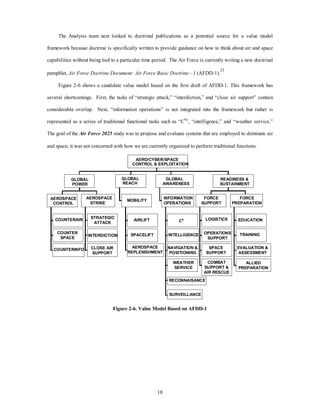
Figure 2-7. Value Model Based on Joint Vision 2010 
Another doctrinally based candidate for the Air Force 2025 value framework was based on a document 
from the Joint Staff, Joint Vision 2010 (fig. 2-7).24 As its title states, Joint Vision 2010 focuses on the future 
15 years hence, not 30 years. In many cases, the acquisition process for the systems of 2010 has started 
already, so this model is not sufficiently visionary. On the other hand, Joint Vision 2010 contains a number 
of interesting departures from current service doctrines, especially in the focus on precision engagement and 
the vision for information and maneuver dominance. However, the model contains significant overlap in the 
tasks of “mobility (deploy),” “deploy,” “maneuver,” and “transportation.” Because of the overlap, and since 
it did not look far enough into the future, the Analysis team rejected the Joint Vision 2010 model. 
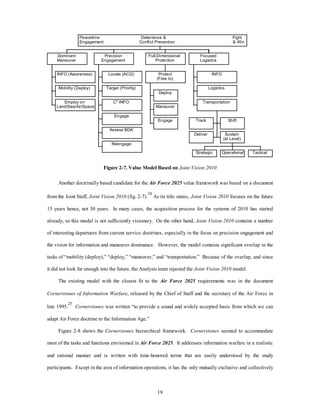
The existing model with the closest fit to the Air Force 2025 requirements was in the document 
Cornerstones of Information Warfare, released by the Chief of Staff and the secretary of the Air Force in 
late 1995.25 
Cornerstones was written “to provide a sound and widely accepted basis from which we can 
adapt Air Force doctrine to the Information Age.” 
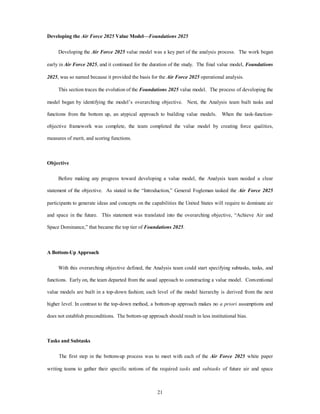
Figure 2-8 shows the Cornerstones hierarchical framework. Cornerstones seemed to accommodate 
most of the tasks and functions envisioned in Air Force 2025. It addresses information warfare in a realistic 
and rational manner and is written with time-honored terms that are easily understood by the study 
participants. Except in the area of information operations, it has the only mutually exclusive and collectively
exhaustive structure of any of the existing frameworks and, therefore, provides a sound mathematical basis 
for analysis. While an excellent document in many respects (its view of information warfare as another 
technique for mission accomplishment is noteworthy), Cornerstones continues to maintain a number of 
traditional “stovepipe” functions. As a result, the institutional biases inherent in the model could have stifled 
20 
the creative process of Air Force 2025. 
AEROSPACE 
CONTROL 
COUNTERAIR 
COUNTERSPACE 
COUNTERINFO 
FORCE 
APPLICATION 
STRATEGIC 
ATTACK 
C2 
ATTACK 
INTERDICTION 
CLOSE AIR 
SUPPORT 
FORCE 
ENHANCEMENT 
AIRLIFT 
AIR REFUELING 
SPACE LIFT 
SPECIAL 
OPERATIONS 
INFORMATION 
OPERATIONS 
FORCE 
SUPPORT 
BASE OPERABILITY 
& DEFENSE 
LOGISTICS 
COMBAT SUPPORT 
ON-ORBIT 
SUPPORT 
AEROSPACE CONTROL 
& EXPLOITATION 
Figure 2-8. Value Model Based on Cornerstones 
After reviewing the full range of potential value models, the senior leadership of Air Force 2025 
determined that none of the models met the requirements of Air Force 2025. Each model was grounded in 
near- or midterm thinking, and none seemed to think “outside of the box” about new ways to employ air and 
space forces in the far future. Furthermore, each contains traditional biases focusing on how the Air Force is 
organized, while Air Force 2025 addresses the dominant employment of air and space forces in the year 
2025 and beyond. The only solution was for the Analysis team to develop a new framework to capture the 
visionary thinking that took place during the study.
Developing the Air Force 2025 Value Model—Foundations 2025 
Developing the Air Force 2025 value model was a key part of the analysis process. The work began 
early in Air Force 2025, and it continued for the duration of the study. The final value model, Foundations 
2025, was so named because it provided the basis for the Air Force 2025 operational analysis. 
This section traces the evolution of the Foundations 2025 value model. The process of developing the 
model began by identifying the model’s overarching objective. Next, the Analysis team built tasks and 
functions from the bottom up, an atypical approach to building value models. When the task-function-objective 
framework was complete, the team completed the value model by creating force qualities, 
21 
measures of merit, and scoring functions. 
Objective 
Before making any progress toward developing a value model, the Analysis team needed a clear 
statement of the objective. As stated in the “Introduction,” General Fogleman tasked the Air Force 2025 
participants to generate ideas and concepts on the capabilities the United States will require to dominate air 
and space in the future. This statement was translated into the overarching objective, “Achieve Air and 
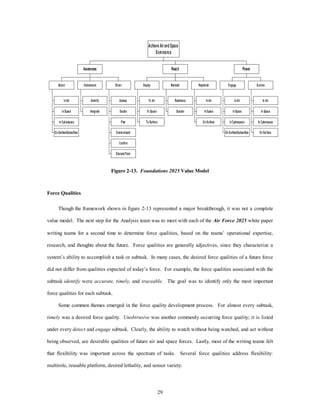
Space Dominance,” that became the top tier of Foundations 2025. 
A Bottom-Up Approach 
With this overarching objective defined, the Analysis team could start specifying subtasks, tasks, and 
functions. Early on, the team departed from the usual approach to constructing a value model. Conventional 
value models are built in a top-down fashion; each level of the model hierarchy is derived from the next 
higher level. In contrast to the top-down method, a bottom-up approach makes no a priori assumptions and 
does not establish preconditions. The bottom-up approach should result in less institutional bias. 
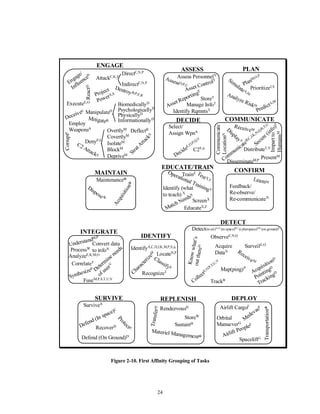
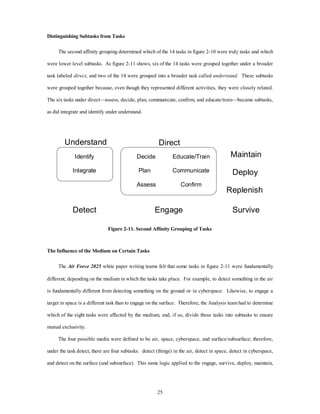
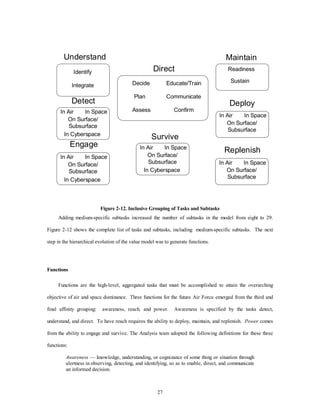
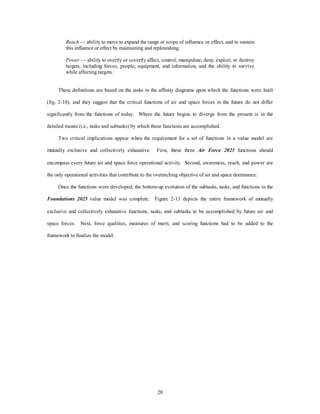
Tasks and Subtasks 
The first step in the bottom-up process was to meet with each of the Air Force 2025 white paper 
writing teams to gather their specific notions of the required tasks and subtasks of future air and space
forces. (At this stage, the terms interchangeable, so for now, both are called tasks.) The teams held diverse 
views on task specification, but the ideas could all be characterized as some form of action. As a result, 
action verbs were used to specify tasks required for the employment of air and space forces in the year 2025. 
Figure 2-9 shows the disparate tasks that resulted from brainstorming sessions with Air Force 2025 
teams. In this figure, the superscript after the task shows the letter designation of the team that identified the 
task (table 4). The final tally was 109 different tasks; the first step in the evolution of the Foundations 2025 
model was complete. The next challenge for the Analysis team was to reduce this collection into a mutually 
exclusive and collectively exhaustive set. The affinity exercise proved to be an ideal method for this task 
22 
aggregation. 
The Affinity Exercise 
An affinity exercise (also called an affinity diagram) is a method designed to allow a team of people to 
generate a topical list of ideas creatively and subsequently arrange those ideas into natural groupings. Once 
similar ideas are grouped together, the team assigns names or headers to each collection of ideas.26 The 
affinity exercise is a simple yet potentially fruitful process. Besides fostering creativity by each participant, 
it “encourages non-traditional connections among ideas.” Identifying these nontraditional connections among 
ideas, thus breaking free from contemporary biases, was the aim of the Analysis team. A final benefit of the 
affinity exercise is that it encourages mutual exclusivity because all similar tasks are grouped together and 
confined to a single location in the model. 
The Analysis team applied this technique by combining the 109 tasks in figure 2-9 into logical groups. 
The result of this first affinity exercise was a set of 14 mutually exclusive, collectively exhaustive tasks 
(Figure 2-10). These 14 task groupings were collectively exhaustive because every one of the 109 tasks in 
figure 2-9 was gathered into one of the 14 groups. The 14 tasks represented by these groups are mutually 
exclusive because each of the boxes in figure 2-10 represents a fundamentally different activity. The initial 
tasks grouped inside the boxes, of course, represent fundamentally similar tasks. 
Next, the Analysis team assigned a name to each of the groups. The group name came usually, but not 
always, from one of the initial tasks in the group. The Foundations 2025 glossary (appendix A) formally 
defines the group names.
Identify RqmntsY 
UnderstandM,P 
23 
Determine needs 
of userV 
IdentifyA,C,D,J,K,M,P,S,D 
ProtectE DeceiveE 
Detect(in air)A,J,S (in space)B,C (cybersphere)D,K (on ground)E 
ObserveE,N,Q 
CollectE,O,P,T,U,V,W 
SurveilE,O 
TrackB 
Map(ping)P 
Know what’s 
out thereN 
Acquire 
DataN 
ReceiveM 
AcquisitionD 
PointingD 
TrackingD 
Convert data 
to infoN 
TestX,Y 
SurviveA WeaponsA 
RecognizeT 
LocateN,P 
AnalyzeE,K,M,O 
AssessO,P,U 
SynthesizeP 
DecideE,O,P,Q,V 
Employ 
CommunicateB,C,J,K,N,Q,R,T,U,Q 
Select/ 
Assign WpnA 
C2H,S,W,D 
SimulateA,M 
PredictA,M 
PrioritizeJ,S 
FuseM,P,S,T,U,V 
CharacterizeM 
ClassifyS 
CorrelateT 
Manage InfoT,Q 
StoreT 
Secure (info)T 
PlanM,O,P 
DistributeT,V,W,Q 
Impart to 
HumansM 
PresentM 
Diss eminateM,P 
Communicate 
LocationN 
AttackC,K,E 
DirectC,N,P 
IndirectC,N,P 
ReactD 
MitigateB 
DeflectB 
DestroyB,P,E,R 
Project 
PowerS,D 
LearnM 
Engage/ 
InfluenceN 
DisplayV,Q 
Feedback/ 
Re-observe/ 
Re-communicateN 
Strat AttackD 
C2 AttackD 
Defend (In space)C 
Defend (On Ground)D 
DenyP,E 
Exploit/ 
ExtractP 
OvertlyM 
CovertlyM 
IsolateM 
BlockM 
DepriveM 
ManipulateD 
BiomedicallyD 
PsychologicallyD 
PhysicallyD 
InformationallyD 
ExecuteE,O 
DisruptE,P 
CorruptE 
EducateX,Z 
TrainZ 
Analyze RiskQ 
RendezvousH 
TransferH 
Airlift PeopleF 
Airlift CargoF 
MedevacF 
Assess PersonnelY 
Asset ReportingY 
Asset ControlY 
Operational TrainingY 
ScreenX 
Identify (what 
to teach) X 
Match NeedsX 
TransportationF 
AcquisitionF 
Materiel ManagementF 
SpaceliftG 
Orbital 
ManueverG 
ProcessW 
StoreW 
DisposeW 
MaintenanceF 
SustainQ 
RecoverD 
Figure 2-9. Air Force 2025 Initial Task Compilation
Detect(in air)A,J,S (in space)B,C (cyberspace)D,K (on ground)E 
CollectE,O,P,T,U,V 
LocateN,P 
ClassifyS 
REPLENISH 
24 
Assess PersonnelY 
AssessO,P,U 
Asset ControlY 
Asset ReportingY 
DECIDE 
Select/ 
Assign WpnA 
DecideE,O,P,Q,V 
StoreT 
C2S,D 
PLAN 
PlanM,O,P 
SimulateA,M 
PrioritizeJ,S 
Analyze RiskQ 
PredictA,M 
COMMUNICATE 
Secure (info)T 
ReceiveM 
DisplayV 
CONFIRM 
Lea rnM 
Feedback/ 
Re-observe/ 
Re-communicateN 
ASSESS 
Manage InfoT 
Identify RqmntsY 
CommunicateB,C,J,K,N,Q,R,T,U 
Impart to 
HumansM 
DistributeT,V 
PresentM 
Communicate 
LocationN 
DisseminateM,P 
EDUCATE/TRAIN 
Operational TrainZ 
Test X,TrainingY 
Y 
Identify (what 
to teach) X 
Match NeedsX 
ScreenX 
EducateX,Z 
ENGAGE 
Destroy B,P,E,R 
DeflectB 
ManipulateD 
Employ 
WeaponsA 
Project 
Power S,D 
Engage/ 
InfluenceN 
Strat AttackD 
DenyP,E 
C2 AttackD 
OvertlyM 
CovertlyM 
IsolateM 
BlockM 
DepriveM 
ExecuteE,O 
DeceiveE 
CorruptE 
AttackC,K,E 
DirectC,N,P 
IndirectC,N,P 
ReactD 
Mitigat eB 
BiomedicallyD 
PsychologicallyD 
PhysicallyD 
InformationallyD 
MAINTAIN 
MaintenanceF 
UnderstandM,P 
Determine needs 
of userV 
SURVIVE 
ProcessW 
SurviveA 
Defend (In space)C 
Defend (On Ground)D 
CharacterizeM 
ProtectE 
RecoverD 
TransferH 
RendezvousH 
StoreW 
SustainQ 
Materiel Manageme ntF 
Acquire 
DataN 
DEPLOY 
Airlift CargoF 
MedevacF 
Orbital 
ManueverG 
Air l ift People F 
TransportationF 
SpaceliftG 
Know what’s 
out thereN 
Map(ping)P 
TrackB 
SurveilE,O 
ObserveE,N,Q 
ReceiveM 
AcquisitionD 
PointingD 
TrackingD 
DETECT 
IDENTIFY 
IdentifyA,C,D,J,K,M,P,S,D 
RecognizeT 
INTEGRATE 
Convert data 
to infoN 
AnalyzeE,K,M,O 
CorrelateT 
Synthe sizeP 
FuseM,P,S,T,U,V 
AcquisitionF 
DisposeW 
Figure 2-10. First Affinity Grouping of Tasks
Direct 
25 
Distinguishing Subtasks from Tasks 
The second affinity grouping determined which of the 14 tasks in figure 2-10 were truly tasks and which 
were lower level subtasks. As figure 2-11 shows, six of the 14 tasks were grouped together under a broader 
task labeled direct, and two of the 14 were grouped into a broader task called understand. These subtasks 
were grouped together because, even though they represented different activities, they were closely related. 
The six tasks under direct—assess, decide, plan, communicate, confirm, and educate/train—became subtasks, 
as did integrate and identify under understand. 
Educate/Train Maintain 
Communicate 
Replenish 
Decide 
Plan 
Understand 
Detect Engage 
Deploy 
Survive 
Assess Confirm 
Identify 
Integrate 
Figure 2-11. Second Affinity Grouping of Tasks 
The Influence of the Medium on Certain Tasks 
The Air Force 2025 white paper writing teams felt that some tasks in figure 2-11 were fundamentally 
different, depending on the medium in which the tasks take place. For example, to detect something in the air 
is fundamentally different from detecting something on the ground or in cyberspace. Likewise, to engage a 
target in space is a different task than to engage on the surface. Therefore, the Analysis team had to determine 
which of the eight tasks were affected by the medium, and, if so, divide those tasks into subtasks to ensure 
mutual exclusivity. 
The four possible media were defined to be air, space, cyberspace, and surface/subsurface; therefore, 
under the task detect, there are four subtasks: detect (things) in the air, detect in space, detect in cyberspace, 
and detect on the surface (and subsurface). This same logic applied to the engage, survive, deploy, maintain,
and replenish tasks. Note that the medium where the target (the thing being detected or engaged) is located, 
not where the system doing the detecting or engaging is located. 
Three tasks in Foundations 2025 were determined not to be medium specific: understand, direct and 
maintain. To understand (integrate and identify) what was detected does not depend on where the integrating 
and identifying occurs. Imagine a fusion center receiving data from sensors in the air, in space, and on the 
ground. The process of understanding the data passed to the fusion center is not affected by the location of 
the center. Likewise, the commander’s ability to direct, including assess, plan, and decide is not affected by 
the medium in which these activities occur. Similarly, the ability to maintain is related to readiness and the 
26 
ability to sustain, but not specifically to a medium. 
Two points about the medium-specific subtasks warrant explanation. First, the notions of deploy to air 
and replenish in air seemed at first to be far-fetched or unnecessary. However, one of the proposed Air 
Force 2025 systems was an airship with the ability to loiter in the air for several days. Foundations 2025 
needed to be sufficiently robust to evaluate such systems and forward thinking in establishing the value of 
these futuristic tasks. 
Second, there were no subtasks in the cyberspace medium for the deploy, maintain, and replenish tasks. 
In this paper, cyberspace is defined as “the virtual [emphasis added] space of computer memory and 
networks, telecommunications, and digital media.”27 Because cyberspace is a virtual space, there is no need 
to move or deploy. The Internet is a good example; being on-line means being engaged. 
A medium-specific distinction does not imply that a particular system cannot perform in different media. 
By dividing some tasks into subtasks based on medium, distinct system capabilities were evaluated based on 
the phenomenology associated with the medium. In the Foundations 2025 value model, a satellite that can 
detect targets on the surface, in the air, and in space received credit for performing three distinct subtasks.
Understand 
Direct Identify 
Decide 
Assess Confirm 
On Surface/ 
Subsurface 
27 
On Surface/ 
Subsurface 
Engage 
Educate/Train 
Communicate 
Survive 
Plan 
Integrate 
Detect 
In Air In Space 
In Cyberspace 
Deploy 
In Air In Space 
On Surface/ 
Subsurface 
Replenish 
In Air In Space 
On Surface/ 
Subsurface 
In Air In Space 
On Surface/ 
Subsurface 
In Cyberspace 
In Air In Space 
In Cyberspace 
Maintain 
Readiness 
Sustain 
Figure 2-12. Inclusive Grouping of Tasks and Subtasks 
Adding medium-specific subtasks increased the number of subtasks in the model from eight to 29. 
Figure 2-12 shows the complete list of tasks and subtasks, including medium-specific subtasks. The next 
step in the hierarchical evolution of the value model was to generate functions. 
Functions 
Functions are the high-level, aggregated tasks that must be accomplished to attain the overarching 
objective of air and space dominance. Three functions for the future Air Force emerged from the third and 
final affinity grouping: awareness, reach, and power. Awareness is specified by the tasks detect, 
understand, and direct. To have reach requires the ability to deploy, maintain, and replenish. Power comes 
from the ability to engage and survive. The Analysis team adopted the following definitions for these three 
functions: 
Awareness — knowledge, understanding, or cognizance of some thing or situation through 
alertness in observing, detecting, and identifying, so as to enable, direct, and communicate 
an informed decision.
Reach — ability to move to expand the range or scope of influence or effect, and to sustain 
this influence or effect by maintaining and replenishing. 
Power — ability to overtly or covertly affect, control, manipulate, deny, exploit, or destroy 
targets, including forces, people, equipment, and information, and the ability to survive 
while affecting targets. 
These definitions are based on the tasks in the affinity diagrams upon which the functions were built 
(fig. 2-10), and they suggest that the critical functions of air and space forces in the future do not differ 
significantly from the functions of today. Where the future begins to diverge from the present is in the 
detailed means (i.e., tasks and subtasks) by which these functions are accomplished. 
Two critical implications appear when the requirement for a set of functions in a value model are 
mutually exclusive and collectively exhaustive. First, these three Air Force 2025 functions should 
encompass every future air and space force operational activity. Second, awareness, reach, and power are 
the only operational activities that contribute to the overarching objective of air and space dominance. 
Once the functions were developed, the bottom-up evolution of the subtasks, tasks, and functions in the 
Foundations 2025 value model was complete. Figure 2-13 depicts the entire framework of mutually 
exclusive and collectively exhaustive functions, tasks, and subtasks to be accomplished by future air and 
space forces. Next, force qualities, measures of merit, and scoring functions had to be added to the 
28 
framework to finalize the model.
29 
Detect 
In Air 
In Space 
In Cyb ersp ace 
O n Surface/Subsurface 
Und erstand 
Id entify 
Integrate 
Direct 
Assess 
Decid e 
Plan 
Comm unicate 
Confirm 
Educate/Train 
Awareness 
Deploy 
To Air 
To Sp ace 
To Surface 
Maintain 
Readiness 
Sustain 
Replenish 
In Air 
In Space 
On Surface 
Reach 
Engage 
In Air 
In Sp ace 
In Cyb erspace 
On Surface/Subsurface 
Survive 
In Air 
In Space 
In Cyberspace 
On Surface 
Power 
Achieve Air and Space 
Domina nc e 
Figure 2-13. Foundations 2025 Value Model 
Force Qualities 
Though the framework shown in figure 2-13 represented a major breakthrough, it was not a complete 
value model. The next step for the Analysis team was to meet with each of the Air Force 2025 white paper 
writing teams for a second time to determine force qualities, based on the teams’ operational expertise, 
research, and thoughts about the future. Force qualities are generally adjectives, since they characterize a 
system’s ability to accomplish a task or subtask. In many cases, the desired force qualities of a future force 
did not differ from qualities expected of today’s force. For example, the force qualities associated with the 
subtask identify were accurate, timely, and traceable. The goal was to identify only the most important 
force qualities for each subtask. 
Some common themes emerged in the force quality development process. For almost every subtask, 
timely was a desired force quality. Unobtrusive was another commonly occurring force quality; it is listed 
under every detect and engage subtask. Clearly, the ability to watch without being watched, and act without 
being observed, are desirable qualities of future air and space forces. Lastly, most of the writing teams felt 
that flexibility was important across the spectrum of tasks. Several force qualities address flexibility: 
multirole, reusable platform, desired lethality, and sensor variety.
These force qualities and measures of merit were continually refined during a succession of meetings. 
After working with each Air Force 2025 white paper writing team, the Analysis team was reduced the list of 
force qualities from the initial number of about 1,200 to the final number of 134. There are about five force 
qualities for each subtask. The largest number of subtask force qualities was nine, the fewest was two. 
Figure 2-14 through figure 2-16 show the final force qualities for Foundations 2025, organized under the 
functional categories of awareness, reach, and power. 
30 
In Air 
C ov erage 
Timely 
Acc urate 
Scope 
R es olution 
Sensor V ariety 
U nobtrusive 
In Space 
Coverage 
Timely 
Acc urate 
Scope 
Resolution 
S ens or V ariety 
Unobtrusive 
Range 
In Cyberspace 
C lassified 
Timely 
Acc urate 
Sensor V ariety 
U nobtrusive 
C lassified 
On Surface/Subsurface 
Coverage 
Timely 
Acc urate 
S ens or V ariety 
Unobtrusive 
Resolution 
Scope 
Detect 
Identify 
A ccurate 
Tim ely 
Trac eable 
Integrate 
Battlespace V iew 
Tim ely 
Correlation 
Understand 
Educate/Train 
D octrine 
Tech/Ops K now ledge 
Tech/O ps S kills 
C ritical/Creative Thinking 
Assess 
Own S tatus 
Others S tatus 
Environment 
Plan 
E ffectiv e 
E fficient 
Decide 
Decision B asis 
Q uality 
Communicate 
Secure 
Capacity 
Interoperable 
Tailored 
Human Interaction 
Confirm 
BDA 
Feedback 
Direct 
Awareness 
Figure 2-14. Awareness Tasks, Subtasks, and Force Qualities
Readiness 
31 
To Air 
Payload Weight 
Payload Volum e 
Ra nge 
Re spon siv e 
Multirole 
To Space 
Pa ylo ad W eight 
Pa ylo ad V olume 
Resp onsive 
Reus able 
Sp ecific Impulse 
Pe rfo rman ce 
To Surface 
Payload Weight 
Payload Volum e 
Ra nge 
Forward Basing Reqmts 
Re spon siv e 
Multirole 
Deploy 
Availab le 
Repa ra ble 
Sustain 
Pipeline 
Footp rint 
Maintain 
In Air 
T ime ly 
Accurate 
Transfe r 
Multi-commod ity 
Transfe r R ate 
In Space 
Timely 
Accurate 
Trans fer 
Re usable 
Trans fer R ate 
On Surface 
T ime ly 
Accurate 
Transfe r 
Replenish 
Reach 
Figure 2-15. Reach Tasks, Subtasks, and Force Qualities
Power 
On Surface/Subsurface 
Figure 2-16. Power Tasks, Subtasks, and Force Qualities 
32 
In Air 
Precision 
Tim ely 
Range 
Desired Lethality 
Reusable Platform 
Weapon Capacity 
Multirole 
Unobtrusive 
Scope 
In Space 
Selectivity 
Tim ely 
Range 
Engage 
Desired Lethality 
Reusable Platform 
Weapon Capacity 
Multirole 
Unobtrusive 
Scope 
In Cyberspace 
P recision 
Timely 
D esired Lethality 
M ultirole 
U nobtrusive 
Measures of Merit and Scoring Functions 
P recision 
Timely 
E ngagement Envelope 
D esired Lethality 
R eusable Platform 
W eapon Capacity 
M ultirole 
U nobtrusive 
S cope 
In Air 
D etectable 
C ountermeasures 
V ulnerable 
R ecoverable 
In Space 
D etectable 
C ountermeasures 
V ulnerable 
R ecoverable 
In Cyberspace 
D etectable 
C ountermeasures 
V ulnerable 
R ecoverable 
On Surface 
D etectable 
C ountermeasures 
V ulnerable 
R ecoverable 
Survive 
Corresponding measures of merit were developed at the same time the Analysis team met with the Air 
Force 2025 writing teams to determine force qualities. Each force quality had a measure of merit to
calibrate system performance. For example, a force quality of the subtask deploy to air was range, and the 
corresponding measure of merit was miles. The measures of merit became the domains (horizontal axis) of 
the scoring functions used to evaluate the capabilities of future systems. 
The Analysis team again worked closely with the Air Force 2025 writing teams to build the scoring 
functions associated with the teams’ respective portions of the value model. The result—134 detailed 
functions that quantify operational values— represent an important analytical accomplishment. They span the 
spectrum of air and space operations, and, as such, serve as a wealth of information for mission area analysts 
and weapon system developers. Appendix A contains the complete set of the Air Force 2025 measures of 
33 
merit and scoring functions. 
Foundations 2025 represents five important analytic advances. First, the collection of scoring 
functions serves as an invaluable resource, even outside the Air Force 2025 study. Second, the use of verbs 
to specify tasks was a useful step in the value model evolution. Third, the bottom-up approach used in 
developing Foundations 2025 was significant because no a priori assumptions were made and no 
preconditions were established. Building from the bottom up allowed Foundations 2025 to be free from 
institutional bias, an outcome necessary to capture the visionary thinking of Air Force 2025. Fourth, 
Foundations 2025 is a robust value model. With five tiers consisting of an overarching objective, three 
functions, eight tasks, 29 subtasks, and 134 force qualities (each with a corresponding measure of merit and 
scoring function)—and all weighted across six alternate futures—the model can be used to evaluate diverse 
systems. Finally, Foundations 2025 is cast further into the future than any other known military value model. 
After the Foundations 2025 development was completed, the next step in the Air Force 2025 OA was 
to use the model to evaluate systems. The Air Force 2025 white papers provided the key information for 
identification and definition of the systems. 
System Identification 
Following a thorough review of the Air Force 2025 white papers, the Analysis team identified 43 
unique high-leverage systems. For this operational analysis, a system was defined to be “a functionally 
related group of elements that performs a mission or task.” Although some of the identified systems were
extracted from a single white paper, many systems, particularly those involving the collection and 
management of information, were composites drawn from capabilities detailed in several of the papers. For 
example, the use of a “personal digital assistant” was a key element of 10 white papers on issues ranging 
from special operations to general education and training. In several of the papers, such as the one entitled 
“A Contrarian View of Strategic Aerospace Warfare,” no systems could be identified. In these cases, the 
papers contained a general framework for doing business in given mission areas without a level of detail 
34 
required for technology identification. 
VEHICLES 
1.0 AIR ONLY 
(Piloted) 
2.0 AIR ONLY 
(Uninhabited) 
3.0 SPACE 
ONLY 
4.0 AIR & 
SPACE 
WEAPONS 
5.0 AIR AND 
GROUND BASED 
6.0 SPACE-BASED 
INFORMATION 
SYSTEMS 
7.0 INDIVIDUAL 
8.0 GLOBAL 
MISCELLANEOUS 
SYSTEMS 
9.0 OTHER 
2025 SYSTEMS 
Figure 2-17. System Functional Hierarchy 
The 43 systems are listed in table 1, categorized by the major functional areas depicted in figure 2-17. 
The full descriptions of these systems are found in appendix B.
Table1 
Identified Systems 
35 
1. 0 Vehicles - Air Only (Piloted) 
1.1 Hypersonic Attack Aircraft 
1.2 Fotofighter 
1.3 Container Aircraft 
1.4 Lighter-than-Air Airlifter 
1.5 Supersonic Airlifter 
1.6 Stealth Airlifter 
1.7 Global Transport Aircraft 
2.0 Vehicles - Air Only (Uninhabited) 
2.1 Strike UAV 
2.2 Reconnaissance UAV 
2.3 Uninhabited Combat Air Vehicle 
2.4 Precision Delivery System 
2.5 UAV Mothership 
2.6 Exfiltration Rocket 
3.0 Vehicles - Space Only 
3.1 Orbital Maneuvering Vehicle 
3.2 Orbital Combat Vehicle 
3.3 Satellite Bodyguards 
4.0 Vehicles - Air and Space 
4.1 Piloted SSTO Transatmospheric Vehicle 
4.2 Uninhabited Air-Launched Transatmospheric Vehicle 
5.0 Weapons - Air and Ground-Based 
5.1 Adjustable Yield Munition 
5.2 Advanced Air-to-Air Missile 
5.3 Airborne High-Power Microwave Weapon 
5.4 Standoff Hypersonic Missile 
5.5 Attack Microbots 
5.6 Airborne Holographic Projector 
5.7 Hybrid High-Energy Laser System 
6.0 Weapons - Space-Based 
6.1 Global Area Strike System 
6.2 Space-Based Kinetic Energy Weapon 
6.3 Space-Based High-Power Microwave Weapon 
6.4 Space-Based High-Energy Laser 
6.5 Solar-Powered High-Energy Laser System 
6.6 Solar Energy Optical Weapon 
6.7 Asteroid Mitigation System 
7.0 Information Systems - Individual 
7.1 Spoken Language Translator 
7.2 Personal Digital Assistant 
7.3 Virtual Interaction Center 
8.0 Information Systems - Global 
8.1 Global Information Management System 
8.2 Global Surveillance, Reconnaissance, and Targeting System 
8.3 Sensor Microbots 
8.4 Multiband Laser Sensor System 
8.5 Asteroid Detection System 
9.0 Miscellaneous Systems 
9.1 Mobile Asset Repair Station 
9.2 Weather Analysis and Modification System 
9.3 Sanctuary Base
Alternate Futures 
The Air Force 2025 Alternate Futures team generated and then analyzed more than 100 candidate 
drivers deemed to be forces acting on the future. These drivers were then synthesized and consolidated into 
the three most important drivers to define a strategic planning space in which alternate futures could be cast 
(fig. 2-18). Functional definitions for each of these three drivers are provided below: 
2015 Crossroads 
Digital Cacophony 
36 
(Global) 
American 
Worldview 
(Domestic) 
Gulliver's Travails 
King Khan 
TeK World Power Grid (Dispersed) 
Zaibatsu 
Halfs and 
Half-Naughts 
(Constrained) 
(Exponentialn) 
(Concentrated) 
Figure 2-18. Alternate Futures Planning Space 
American Worldview. This driver is the US perspective of the world which determines 
the willingness and capability to interact with the rest of the world. American worldview 
captures the dominant US focus regarding international affairs. The US can be primarily 
internally focused, perhaps even isolationist, or the US can be actively engaged in 
activities around the world. The poles of American worldview are domestic and global. 
DTeK. This driver is the differential in the rate growth, proliferation, leverage, and 
vitality of scientific knowledge and technical applications and their consequences. DTeK 
describes the rate of change in both the proliferation and advancement of technology. The 
two poles of DTeK are constrained and exponential. Constrained DTeK implies 
technology is advancing at an evolutionary rate and its availability is limited to a relatively
few number of actors. Exponential DTeK occurs when there are revolutionary 
breakthroughs in technology that are rapidly proliferated throughout the world. 
World Power Grid. This driver describes the generation, transmission, distribution, and 
control of power throughout the world. This power is a combination of economic, 
political, and information sources of power as well as military strength. The two poles of 
this driver are concentrated and dispersed. A concentrated world power grid exists when 
few actors have the means or will to influence others. When a myriad of groups or 
individuals can change the future, the World Power Grid is dispersed. 
Six alternate futures were chosen from this planning space to provide a diverse set of future conditions 
against which to evaluate the proposed air and space systems. Four futures are extremes: Gulliver’s 
Travails, Zaibatsu, Digital Cacophony, and King Khan. The world of Halfs and Half-Naughts was chosen for 
its centrality. Finally, the 2015 Crossroads future provides a conservative bridge between today and 2025. 
In Gulliver’s Travails, the US is overwhelmed with worldwide commitments, counterterrorism and 
counterproliferation efforts, humanitarian operations, and peacekeeping operations. In Zaibatsu, 
multinational corporations dominate international affairs, loosely cooperating to create a relatively benign 
world. Digital Cacophony is the most technologically advanced world resulting in great power and 
independence for the individual but also creating a world of social isolation, fear, and anxiety. King Khan is 
a world where US dominance has waned due to domestic problems, an economic depression, and 
overshadowing by a rising Asian colossus. The world of Halfs and Half-Naughts is dominated by conflict 
between the “haves” and “have-nots” and dynamically changing social structures and security conditions. 
2015 Crossroads uses programmed forces from 1996–2001 to fight a major conflict; it presents the US with a 
strategic challenge in 2015 that could lead to any of other alternate futures by 2025. 
These six alternate futures provided the fulcrum against which the Air Force 2025 Operational Analysis 
was applied to determine which of the many systems proposed by the study participants had merit and, hence, 
should be pursued by the United States Air Force to ensure air and space dominance in the future. 
Scoring the Systems 
This section describes how Foundations 2025 was used to evaluate future air and space systems. The 
process had two steps the first step assign weights to the model hierarchy, and the second computes 
performance scores using scoring functions. The scoring in this section provides the reader with an example 
37
of the score computation process; the results of the actual Air Force 2025 systems evaluation are described 
38 
in chapter 3. 
Weighting the Foundations 2025 Value Model across Alternate Futures 
The first step in using the 2025 value model is for the decision maker to determine the relative 
importance of the functions, tasks, subtasks, and force qualities. As described in the previous section, the 
decision maker weights functions, tasks, subtasks and force qualities. Because different futures dictate a 
different set of required air and space capabilities, the Analysis team obtained value model weights from the 
Air Force 2025 participants for the range of potential future worlds postulated by the Air Force 2025 
Alternate Futures team. For each alternate future, the Analysis team used two sets of weights. The first, 
denoted “AU Team Weights,” is an average of the weights assigned by student members of the Air Force 
2025 white paper writing teams. The second, denoted “Alt Futures Weights,” is the weights provided solely 
by the Alternate Futures team. In general, the Alernatet Futures Weights exhibited greater variation across 
futures than did the AU Team Weights. Weights were held constant for the force qualities and measures of 
merit because they were not expected to vary much across possible futures. The weights for each future are 
contained in appendix C. 
Technology Identification and Scoring 
Once the 43 unique systems contained in the white papers were identified, the Analysis team 
qualitatively analyzed each system to identify which technology areas would be key to achieving the stated 
system capabilities. Only those technology areas needing development were considered. For example, if a 
specific technology area was critical to a given system’s capability, but no new advances were needed in this 
area for the system to achieve its full capability, then this technology area was not identified as high leverage 
for this particular system. 
The team felt that it was highly desirable to identify and group technologies according to a well-known 
“gold-standard.” Thus, the DOD document, The Militarily Critical Technologies List (MCTL), was used 
as the basis for key technology identification in each system. For the 43 systems evaluated, a total of 43 key
technology areas were identified. Full descriptions of each technology area, as paraphrased from the MCTL, 
39 
can be found in appendix D. 
To eventually rank technologies by their impact on future air and space capabilities, the team assigned a 
relative weight to each technology embedded in a particular system. The weights selected sum to 100 for 
each system and so can be thought of as percentages of the system’s dependence on each technology needing 
development. For example, the five piloted single-stage-to-orbit (SSTO) transatmospheric vehicle (TAV) 
technologies were weighted as follows: 
Technology Area Weight 
Aerospace Structures and Systems 25 
High-Energy Propellants 25 
RAMjet, SCRAMjet, Combined Cycle Engines 20 
Advanced Materials 20 
High-Performance Computing 10 
In this case, since the primary mission of the piloted SSTO TAV is to travel between the surface and 
low-earth orbit, the highest leverage technology areas were those of the vehicle’s primary propulsion and 
structural subsystems. Each of these areas were evaluated to be essentially equal in importance. The fifth 
technology area, high performance computing, was added not necessarily because of vehicle requirements, 
but because the design process for this type of vehicle will take some advances in computing power. Without 
advances in high-performance computing, the design process for a TAV with this capability would be 
impaired. This methodology makes it possible to score each of the systems. 
Once the system-versus-technology matrix is developed, the procedure for scoring the technologies is 
straightforward. The contribution of technology to each system is multiplied by the system value, and the 
resulting products are summed across all systems. The result is a set of technology scores (normalize to a 
maximum score of 100) that takes into account both the technologies’ degree of contribution to future air and 
space systems and the importance of those systems to air and space operations. This scoring was then 
repeated for each alternate future since the system values changed with each future. 
After each technology area had been identified, one additional question remained, “Who, the DOD or 
the commercial sector, is the key player in developing each of the 43 technology areas?” AFIT’s Graduate
School of Engineering assembled a committee from its senior staff to consider this question. This committee 
qualitatively evaluated each technology area to determined the appropriate key developer. They further 
ascertained the direction of each developmental effort, whether from the DOD to the commercial sector, from 
the commercial sector to the DOD, or remaining constant. 
Notes 
1 Ralph L. Keeney, Value-Focused Thinking: A Path to Creative Decisionmaking (Cambridge, Mass.: 
40 
Harvard University Press, 1992). 
2 SPACECAST 2020 Operational Analysis (Maxwell AFB, Ala: Air University Press, 1994). 
3 Keeney, 3. 
4 Ibid., 6. 
5 Ibid., 7. 
6 Ibid., 33. 
7 Ibid., 112. 
8 R. T. Clemen, Making Hard Decisions: An Introduction to Decision Analysis (Boston, Mass.: PWS-Kent, 
1991). 
9 Keeney. 
10 Wayne Winston, Operations Research: Applications and Algorithms, 3d ed. (Belmont, Calif.: 
Duxbury Press, 1993). 
11 Keeney, 78. 
12 Ibid. 
13 Clemen, 435. 
14 Ibid., 435–436. 
15 Keeney, 129-154. 
16 Clemen, 435–36. 
17 
A National Security Strategy of Engagement and Enlargement (Washington, D. C.: The White 
House, February 1995). 
18 
National Military Strategy of the United States of America, 1995 (Washington, D. C.: US 
Government Printing Office). 
19 
Defense Planning Guidance (Washington, D. C.: Office of the Secretary of Defense, 1995). 
20 
Global Reach, Global Power: A White Paper, Department of the Air Force, June 1990. 
21 
Global Presence, Department of the Air Force, 1995. 
22 Glenn A. Kent and William E. Simons, A Framework for Enhancing Operational Capabilities, R- 
4034-AF (Santa Monica, Calif.: RAND 1991). 
23 
Air Force Doctrine Document: Air Force Basic Doctrine, 15 August 1995, first draft (Washington, 
D. C.: US Air Force, 1995). 
24 
Joint Vision 2010, America’s Military: Shaping the Future (Washington, D. C.: Joint Chiefs of 
Staff, January 1996). 
25 
Cornerstones of Information Warfare (Washington, D. C.: US Air Force, 1995).
26 Michael Brassard and Diane Ritter, The Memory Jogger II: A Pocket Guide of Tools for 
Continuous Improvement and Effective Planning (Methuen, Mass.: Growth Opportunity Alliance of 
Lawerance/QPC, 1994), 13–14. 
27 Cotton, Bob, The Cyberspace Lexicon: An Illustrated Dictionary of Terms From Multimedia to 
41 
Virtual Reality (London: Phaedon, 1994).
Chapter 3 
Results 
A team of technical and operational experts, the Analysis team, scored all 43 systems against each 
metric in Foundations 2025. The team followed a consensus-seeking approach to obtain each score. The 
team was not permitted to know the shape of the scoring function and was tasked to place a score for each 
metric along the horizontal axis of each function shown in figures A-5 through A-32 for each system. The 
analysis was performed using Logical Decisions for Windows© software running on a Pentium-based PC. 
The results of the system scoring are summarized in figure 3-2 through figure 3-6. The vertical axis is 
the score from the system evaluation on a scale of 0 to 100, where a system score of zero equates to no score 
on any of the 134 scoring functions. The horizontal axis is a rank ordering of the systems according to the 
Analysis team’s assessment of the relative amount of technical challenge to develop each system. The system 
scores are shown for two separate sets of weights—the AU Team Weights and the Alternate Futures 
Weights—for all six of the alternate futures. (figure 3-2 and figure 3-3). 
Each system’s scores for the various futures are plotted and connected with a line to show the variation 
of that system’s score across the alternate futures. The resulting spread of scores for each system can be 
regarded as similar to error bars in the results of a statistical sampling technique. In other words, a system’s 
score can be said with high confidence to lie within the range of the points shown. The curved dashed line 
provides a further reference for comparing systems. In the Analysis team’s estimation, systems above the line 
may have sufficient value to offset the technical challenge of producing such a system. Thus, systems to the 
left of the charts need less value to be attractive options than systems to the right of the chart, because the 
difficulty of achieving the capability is much less. The exact location of the line is somewhat arbitrary. It 
42
was drawn fairly low, terminating on the right at a value of 20, to identify the most promising systems. (Note: 
43 
A score of 10-15 may be good for some tasks.) 
The highest value systems evaluated in this study are the Global Information Management System 
(GIMS), Sanctuary Base, Global Area Strike System (GLASS), Global Surveillance and Reconnaissance 
System (GSRT), and Uninhabited Combat Air Vehicle (UCAV). GIMS has the highest score but has high 
technical challenge, while GSRT performs some of the functions of GIMS but also with less technical 
challenge. Because of this, GSRT could be considered a “stepping stone” to GIMS. Both GLASS and 
UCAV score well because of a strong awareness component to complement their power contributions, and 
UCAV is the most feasible of all the high-value systems in the near term. Sanctuary base has high value but 
also the highest technical challenge. It may remain infeasible even beyond 2025. Appendix E contains tables 
of each system’s value score for each future and weight set. 
Dividing the figures above into quadrants provides a delineation of the systems into four categories 
based on value and technical challenge. Figure 3-1 shows representative systems for each quadrant. 
· Global Surveillance, 
Reconnaissance, and 
Targeting System 
· Uninhabited Combat Air 
Vehicle 
· Reconnaissance 
Unmanned Air Vehicle 
· Global Information 
Management System 
· Sanctuary Base 
· Global Area Strike 
System (Piloted TAV, 
GBL, KEW) 
· Attack Microbots 
· Global Transport A/C 
· Advanced Air-to-Air 
Missile 
· Orbital Maneuvering 
Vehicle 
· Exfiltration Rocket 
· Fotofighter 
· Sensor Microbots 
· Adjustable Yield 
Munition 
· Unmanned Air Vehicle 
Mothership 
Value 
Higher 
Lower 
Technology Challenge 
Higher 
Lower 
Figure 3-1. Representative Systems 
Figure 3-4 and figure 3-5 provide a closer look at the highest scoring systems. Limiting the systems 
displayed to the top 25 percent (11 systems) for the AU Team Weights yields figure 3-4. A comparison of
figure 3-4 and figure 3-5 reveals little difference between the overall scores and rankings for the AU Team 
Weights and the Alternate Futures Weights. The variation between futures is greater for the Alternate Futures 
Weights, reflecting both the more extreme views of a team immersed in the construction of the alternate 
futures and the centering effect of averaging the weights of the AU team members. However, the top 11 
systems for the AU Team Weights are contained in the top 14 systems for the Alternate Futures Weights, with 
the Hypersonic Attack Aircraft, Fotofighter, and Sensor Microbots rounding out the 14 systems. 
Figure 3-6 shows the relative contribution of the awareness, reach, and power sub-scores to the top 11 
systems’ scores using the AU Team Weights for the “Halfs and Half Naughts” alternate futures. 
It is interesting to note the relationship between the awareness, reach, and power contributions to a 
system’s score and the score variation between alternate futures. Systems that score similarly in awareness, 
reach, and power (e.g., GLASS in figure 3-6) tend to have the least variation; that is, the line connecting their 
scores for each future is short. This is because the weighted average of awareness, reach, and power (the 
overall score) is insensitive to changes in the weights when the awareness, reach, and power scores are of 
44 
the same magnitude. 
The scoring results highlight that a complex system (a system of systems) outscores any of its 
components. This is because of the additive nature of the scoring functions. The complex system scores 
more broadly since it contains the capabilities of its components, so it exceeds the score of any single 
component. Conversely, since component systems are unlikely to score in mutually exclusive areas of the 
value model, the complex system generally will score less than the simple sum of the component system 
scores. 
Finally, figure 3-7 through figure 3-9 contain graphs similar to those in figure 3-2 and figure3-3, but 
for the awareness function, the deploy task of reach, and the power function, respectively, using the AU Team 
Weights. These figures allow the reader to note the systems which score well for a particular function. For 
example, figure 3-7 highlights the best systems in terms of the awareness function. Such a level of detail may 
prove useful when conducting mission area analysis to determine required improvements for specific 
functional areas. In fact, the software used in this analysis can display the system scores at any level of the 
value model.
Achieve A ir and Space D ominance 
AU W eights, O rdered by Technology Cha llenge 
8 .5 A s tero id 
De tec tion 
S y s tem 1 .2 
45 
1 .4 Ligh ter- tha n-Ai r 
Ai rli fte r 
2 .1 S trike U AV 
2 .4 P rec is ion 
D e liv e ry S ys tem 
5 .5 Attack 
M ic rob ots 
6 .5 So lar-P ow er ed 
H ig h -Ene rgy La ser 
4 .1 P ilote d 
SST O TAV 
3 .2 Orbital 
Comb at 
Ve hicle 
7 .3 V ir tua l 
Inte rac tio n C enter 
6 .4 Sp ace -Ba se d 
H ig h -Ene rgy La ser 
6 .1 G lob al A re a 
S tr ike S y s tem 
9 .3 San ctu a ry 
Base 
8 .1 G lob a l In form a tio n 
Man ag emen t System 
2 .2 R econ n 
UAV 
2 .3 U ninh ab ite d C omb at 
A ir V e hic le 
8 .2 G lob al Su rve il lan ce , 
Re c on naiss an ce , and 
T arg eting S y stem 
4 .2 Uninh ab ite d 
Air-La un ch ed TAV 
1 .1 
3 .3 8 .3 
5 .7 
7 .2 
6 .3 
5 .1 
6 .2 
2 .5 
9 .2 8 .4 
7 .1 
5 .4 
5 .6 
6 .7 
3 .1 
5 .3 1 .3 
5 .2 
1 .5 
1 .6 
9 .1 
6 .6 
2 .6 
60 
50 
30 
20 
10 
0 
Valu 
e 
40 
Technology Cha llenge 
Gulliver's 
Zaiba tsu 
Khan 
Digital 
2015 
Halfs 
1 .7 G lob al Tra ns po rt 
A ircr aft 
Figure 3-2. Final System Scores - AU Team Weights
46 
V 
alue 
Ach ieve A ir and Space D ominance 
Alt. Futures W eights, O rdered by Technology C hallenge 
2 .4 P recision 
Delivery S ystem 
1 .4 L ighter-than-Air 
A irlifte r 
2 .1 S trike 
UAV 
8 .5 A steroid 
Detection 
System 
5 .5 A ttack 
Microbots 
1 .2 Fotofig h te r 
6 .5 S olar-Powe red 
High-Energy L a se r 
4 .1 P iloted 
SSTO TAV 
3 .2 
7 .3 V irtu a l 
Interaction Ce n ter 
6 .4 S pace -Based 
High-Energy L a se r 
6 .1 G lob a l Area 
Strike Sy s tem 
9 .3 S anctuary 
Base 
8 .1 G lob a l Informa tion 
Management S ystem 
2 .2 R econn 
UAV 
2 .3 Uninhabited C omb a t 
A ir V ehicle 
8 .2 G lob a l Su rveilla nce , 
R econna issance, a nd 
Targ e ting S ystem 
4 .2 Uninhabited 
Air-Launched TAV 
8 .3 
3 .3 
1 .1 H ypersonic 
A ttack Aircraft 
5 .7 
7 .2 6 .3 
5 .1 
6 .2 
2 .5 
9 .2 
8 .4 
7 .1 
5 .4 
5 .6 
6 .7 
3 .1 
5 .2 
5 .3 
1 .3 
1 .5 
1 .6 
9 .1 
6 .6 
2 .6 
70 
60 
50 
40 
30 
20 
10 
0 
T echn olog y C h alleng e 
1 .7 G loba l 
T ransport 
Aircra ft 
G ulliver 's 
Zaiba tsu 
Khan 
D igital 
2015 
H alfs 
Figure 3-3. Final System Scores - Alt. Futures Weights
6.1 G lobal A rea 
Strike System 
4.2 Uninhabited 
Air-Launched TAV 
47 
4.1 Piloted 
SSTO TAV 
6.4 Space-Based 
High-Energy Laser 
5.5 Attack 
Microbots 
6.5 Solar-Powered 
High-Energy Laser 
2.3 Uninhabited 
Combat Air 
Vehicle 
2.2 Reconn 
UAV 
8.2 G lobal 
Surveillance, 
Reconnaissance, 
and Targeting 
System 
8.1 G lobal 
Information 
Management 
System 
9.3 Sanctuary 
Base 
70 
60 
50 
40 
30 
20 
10 
Technology C hallenge 
V 
a 
l 
u 
e 
Top 11 Systems, AU Team W eights 
Ordered by Technology Challenge 
Gulliver 's 
Zaibatsu 
Khan 
Digital 
2015 
Halfs 
Figure 3-4. Top 11 Systems - AU Team Weights
48 
V 
a 
u 
e 
1.1 Hypersonic 
Attack Aircraft 
5.5 A ttack 
Microbots 
8.3 Sensor 
Microbots 
2.3 Uninhabited 
Combat A ir 
Vehicle 
2.2 Reconn 
UAV 
8.2 Global 
Surveillance, 
Reconnaissance, 
and Targeting 
System 
6.4 Space-Based 
High-Energy Laser 
8.1 Global 
In formation 
Management 
System 
9.3 Sanctuary 
Base 
1.2 Fotofighter 
6.1 Global A rea 
Strike System 
6.5 Solar-Powered 
High-Energy Laser 
4.1 Piloted 
SSTO TAV 
4.2 Uninhabited 
Air-Launched TAV 
70 
60 
50 
40 
30 
20 
10 
Technology Challenge 
l 
Top 14 Systems, Alt. Futures Team Weights 
Ordered by Technology Challenge 
Gulliver's 
Zaibatsu 
Khan 
Digital 
2015 
Halfs 
Figure 3-5. Top 14 Systems - Alt. Futures Weights
Figure 3-6. Top 11 System Rankings 
49
Awareness 
AU Weights, Ordered by Technology Challenge 
50 
Gulliver's 
Zaibatsu 
Khan 
Digital 
2015 
Halfs 
8.5 Asteroid 
Detection 
System 
1.4 Lighter-than-air 
2.1 
2.4 
Airlifter 
1.2 Fotofighter 
5.5 
6.5 Solar-Powered 
High-Energy Laser 
4.1 Piloted 
SSTO TAV 
3.2 Orbital 
Combat 
Vehicle 
7.3 Virtual 
Interaction Center 
6.4 Space-Based 
High-Energy Laser 
6.1 Global Area 
Str ike System 
9.3 Sanctuary 
Base 
8.1 Global Information 
Management S ystem 
2.2 Reconn 
UAV 
2.3 Uninhabited Combat 
Air Vehicle 
8.2 Global Surveillance, 
Reconnaissance, and 
Targeting S ystem 
4.2 Uninhabited 
Air-Launched TAV 
8.3 
3.3 Satellite 
Bodyguards 
1.1 Hypersonic 
Attack A ircraft 
7.2 Personal 
Digital 
Assistan t 
5.7 
6.3 5.1 6.2 
2.5 
9.2 
8.4 
7.1 
5.4 
5.6 6.7 
3.1 
5.2 
5.3 
1.3 
1.5 1.6 9.1 6.6 2.6 
100 
90 
80 
70 
60 
50 
40 
30 
20 
10 
0 
Technology Challenge 
Value 
1.7 
Figure 3-7. Awareness Scores - AU Team Weights
51 
Deploy 
(Only those w ith value greater than 0 are shown) 
AU W eights (Halfs) 
Systems O rdered b y T echnology Challenge 
1.4 Lighter-than-Air 
Airlifter 
2.4 Precision 
Delivery System 
1.5 Supersonic 
1.6 Stealth 
Airlifter 
Airlifter 1.7 G lobal 
Transport 
Aircra ft 
2.6 Exfiltration 
Rocket 
1.3 C on ta iner 
Aircra ft 
3.2 O rb ital 
Combat 
Vehicle 
3.1 O rb ital 
Maneuvering 
Vehicle 
4.2 U ninhabited 
Air-Launched TAV 
4.1 P iloted 
SSTO TAV 
6.1 G lobal A rea 
Strike S ystem 
1.1 H ypersonic 
Attac k A irc ra ft 
2.5 UAV 
Mothership 
50 
40 
30 
20 
10 
Technology Cha lleng e 
V 
a 
l 
u 
e 
Figure 3-8. Deploy Scores - AU Team Weights, Halfs Future
52 
9.3 Sanctuary 
Power 
AU W eights, O rdered by Technology Challenge 
Base 
6.1 G lobal Area 
Strike System 
6.5 Solar-Powered 
High-Energy Las er 
8.1 G lobal Information 
Management System 
1.2 Fotofighter 
6.4 Space-Based 
High-Energy Las er 
6.2 Space-Based 
Kinetic Energy Weapon 
6.3 Space-Based High Power 
Microwave W eapon 
5.7 Hybrid High- 
Energy Laser 
5.3 Airborne High Power 
Microwave W eapon 
2.3 Uninhabited 
Combat Air Vehicle 
2.1 Strike UAV 
6.6 Solar Energy 
Optical W eapon 
5.2 
5.6 
5.4 
3.2 8.2 4.1 4.2 
3.3 
5.1 
9.2 
1.6 1.3 
6.7 
2.2 7.3 2.6 
2.4 
1.5 
8.5 1.4 1.7 
9.1 3.1 7.2 7.1 2.5 8.4 
8.3 Sensor 
Microbots 
1.1 Hypersonic 
Attack A ircraft 
5.5 Attack 
Microbots 
50 
45 
40 
35 
30 
25 
20 
15 
10 
5 
0 
Technology Challenge 
V 
a 
l 
u 
e 
Gulliver's 
Zaibatsu 
Khan 
Digital 
2015 
Halfs 
Figure 3-9. Power Scores - AU Team Weights
Scoring the Technologies 
The baseline technology assessment is summarized in figure 3-10 for each of the alternate futures. This 
assessment considers all 43 systems scored and the Value Model was weighted by all AU white paper 
writing teams. The score for each technology area was calculated by multiplying the percentage dependence 
of each of the systems on that development technology by the score that system received in the Value Model. 
The scores were then summed across the all systems with the final result being normalized to a maximum 
score of 100. These scores are measures of the potential of each enabling technology to improve operational 
53 
effectiveness in air and space. 
Using the “Halfs and Half-Naughts” alternate future, which is placed in the center of the strategic 
planning space for this study, the technology areas clearly divide themselves into three groupings: the top 
seven technologies (high leverage), the next fivehnologies (moderate leverage), and the bottom 31 
technologies (lesser leverage). Figure 3-11 shows an expanded view of the top two technology groupings for 
each alternate future. 
As a verification of these results, the Analysis team decided to examine the analysis of the technologies 
by considering their interaction with only the 11 top-scoring systems. These results are shown in figure 3-12 
and figure 3-13. Figure 3-12 shows that the three technology groups generally remained, although the top two 
groupings contain six technology areas each rather than seven and five, respectively, as in the previous case. 
The six high-leverage technologies all appeared in the previous high-leverage grouping. Further, 11 of the 
top 12 technologies remained the same. Lastly, seven of the total 43 technology areas were not applicable 
when the systems considered were narrowed to the 11 top-scoring ones. 
Within technology groupings, the rank changed when going from considering all 43 systems to only 
considering the 11 top-scoring systems. However, with only three exceptions, technology areas did not 
change their respective groupings. These exceptions were Aerospace Structures (9.5.4) and Vehicle Flight 
Control (7.3), which both dropped to a lower technology grouping, from high and moderate leverage to 
moderate and less leverage, and Communications (5.1), which jumped to a higher technology grouping from 
lesser leverage to moderate leverage. The results of these two assessments are summarized in table 2 for the
high and moderate leverage technologies. The numbers in parentheses indicate the appropriate MCTL 
Table 2 
Technology Assessment 
ALL 43 SYSTEMS TOP 11 SYSTEMS 
Power Systems (10.3) Data Fusion (4.2.5) 
Advanced Materials (1.0) Power Systems (10.3) 
HIGH LEVERAGE Aerospace Structures (9.5.4) Micromechanical Devices (2.6) 
TECHNOLOGIES High Performance Computing (4.1.1) Advanced Materials (1.0) 
Micromechanical Devices (2.6) High Energy Propellants (12.7) 
High Energy Propellants (12.7) High Performance Computing (4.1.1) 
Data Fusion (4.2.5) 
54 
category which further defines the technology area. 
A sensitivity study also was performed using the Value Model as weighted by the alternate futures team 
only. As noted in the previous chapter, these weights had a larger variance than the weights from all AU 
student teams. The results when all 43 systems were considered are given in figure 3-14 and figure 3-15; 
figure 3-16 and figure 3-17 show the results when the systems considered were narrowed to the 11 top-scoring 
ones. Although the variance bars increased in length, the basic conclusions did not change with this 
new set of weights. Appendix F lists numerical data for both the raw and weighted scores for each 
technology area. 
A common trend among the higher leverage technologies was that they had wide applicability over the 
systems considered. When all 43 systems were considered, the high leverage technologies scored in at least 
13 different systems; the maximum number of systems where any technology area scored was 27. Moderate 
leverage technologies scored in 8 to 12 different systems. When the systems considered were reduced to the 
11 top-scoring ones, the high leverage technologies scored in at least five systems; the maximum number of 
systems where any technology area scored was nine. Moderate leverage technologies scored in either three 
or four different systems. In both assessments, High-Performance Computing (4.1.1) was the technology area 
with the broadest coverage over the systems considered. 
High Energy Laser Systems (11.1) 
Artificial Intelligence (4.2.9) Artificial Intelligence (4.2.9) 
MODERATE LEVERAGE High Energy Laser Systems (11.1) Optics (10.2) 
TECHNOLOGIES Vehicle Flight Control (7.3) Image Processing (4.1.4) 
Image Processing (4.1.4) Aerospace Structures (9.5.4) 
Optics (10.2) Communications (5.1)
After each technology area had been scored, AFIT’s Graduate School of Engineering assembled a 
committee from its senior staff to determined the key technology driver, the DOD or the commercial sector, 
for that particular area. They further ascertained the direction of each developmental effort, whether from the 
DOD to the commercial sector, from the commercial sector to the DOD, or remaining constant. Table 3 
summarizes the key technology development leaders; two technology areas, 6.9 Other Sensor and 9.8 Other 
Propulsion, were not considered in this assessment because of the extremely broad coverage of their 
55 
respective areas.
Table 3 
Technology Development Leaders 
KEY TECHNOLOGY DOD LEAD 
56 
BOTH 
DOD & COMM COMM LEAD 
1.0 Materials Technology X 
2.0 Industrial Production Technology 
2.1 Auto of Ind Process, Sys, and Fact X---> 
2.2 Metal Working and Ind Production 
2.2.1 Num Contr Machine Tools X---> 
2.2.5 Robots, Contr, & Effectors X 
2.6 Micromechanical Devices X---> 
4.0 Computer Technology 
4.1 Digital Processing 
4.1.1 High Performance Computing X 
4.1.2 Dyn Training and Simulation X 
4.1.3 Signal Processing X 
4.1.4 Image Processing X 
4.1.6 Speech Processing X 
4.2 Software 
4.2.4 Hard Real Time Systems X---> 
4.2.5 Data Fusion X---> 
4.2.9 Artificial Intelligence <---X 
4.3 Hybrid Computing X 
5.0 Telecommunications Technology 
5.1 Transmission X 
5.3 Comm Net Mgmt & Control X 
5.4 C3I Systems <---X 
5.5 Information Security X 
6.0 Sensors and Elect Combat Technology 
6.1 Acoustic Systems X---> 
6.2 Optical Sensors X---> 
6.4 Electronic Combat <---X 
6.6 Magnetometers X---> 
6.7 Gravity Meters X 
6.8 Radar X---> 
6.9 Other Sensor 
7.0 Nav, Guid, and Vehicle Contr Tech 
7.3 Vehicle and Flight Control X 
9.0 Propulsion and Vehicular Sys Tech 
9.1 Gas Turbine Propulsion Systems X 
9.2 RAMjet, SCRAMjet, and CC Engine <---X 
9.4 Rockets X (no NASA) X (if NASA) 
9.5 Aerospace Structures and Systems 
9.5.1 Spacecraft Structures X 
9.5.2 Non-Chem, High-Isp Prop <---X 
9.5.4 Aircraft High-Perf Structures <---X 
9.8 Other Propulsion
Table 3 (Cont.) 
KEY TECHNOLOGY DOD LEAD 
57 
BOTH 
DOD & COMM COMM LEAD 
10.0 Laser, Optics and Power Sys Tech 
10.1 Lasers X 
10.2 Optics X 
10.3 Power Systems X 
11.0 Directed Energy & Kinetic Energy Sys 
11.1 High Energy Laser Systems <---X 
11.2 High Power Radio Freq Sys <---X 
11.4 Kinetic Energy Systems 
11.4.2 Kinetic Energy Projectiles <---X 
11.4.4 KE Platform Management <---X 
12.0 Munitions Dev & Energetic Mat'l Tech 
12.1 Warheads, Ammo, & Payloads <---X 
12.7 Mil Explosives (Energetic Mat'l) X 
13.0 Chemical & Biological Systems Tech 
13.3 CBW Defensive Systems X
58 
10 
9 
8 
7 
6 
5 
4 
3 
2 
1 
0 
10.3 
1.0 
9.5.4 
4.1.1 
2.6 
12.7 
4.2.5 
4.2.9 
11.1 
7.3 
4.1.4 
10.2 
2.2.5 
5.1 
11.2 
9.2 
4.1.2 
4.1.3 
6.2 
9.5.1 
4.2.4 
6.8 
5.4 
5.5 
10.1 
9.5.2 
9.1 
5.3 
6.9 
11.4.4 
11.4.2 
9.8 
2.1 
6.4 
12.1 
4.3 
6.1 
4.1.6 
13.3 
6.6 
6.7 
2.2.1 
9.4 
Military Critical Technology List Technology Categories 
V 
a 
l 
u 
e 
GULLIVER'S 
ZAIBATSU 
KHAN 
DIGITAL 
2015 
High Leverage HALFS 
Moderate Leverage 
Less Leverage 
Figure 3-10. Technology Rankings (All 43 Sys, AU Students Wts)
59 
Power Systems 
Advanced M ateria ls 
Aerospace Structures 
High-Pe rformance C omputing 
MEMS 
High-Energy 
Propellants 
Data Fusio n 
Artificial In te llige n ce High-Energy 
Laser S ystems 
Vehicle F light 
Control Im ag e 
Optics 
Processing 
10 
9 
8 
7 
6 
5 
4 
3 
2 
Value 
GULLIVER'S 
ZAIBATSU 
KHAN 
DIGITAL 
2015 
HALFS High Leverage 
Moderate Leverage 
Less Leverage 
Figure 3-11. Top 12 Technology Rankings (All 43 Sys, AU Students Wts)
60 
10 
9 
8 
7 
6 
5 
4 
3 
2 
1 
0 
4.2.5 
10.3 
2.6 
1.0 
12.7 
4.1.1 
11.1 
4.2.9 
10.2 
4.1.4 
9.5.4 
5.1 
4.1.3 
2.2.5 
4.2.4 
6.2 
6.8 
5.5 
7.3 
9.2 
5.4 
4.1.2 
6.9 
11.4.4 
6.4 
5.3 
2.1 
10.1 
11.2 
13.3 
6.1 
9.5.1 
11.4.2 
9.8 
6.6 
6.7 
2.2.1 
GULLIVER'S 
ZAIBATSU 
KHAN 
DIGITAL 
2015 
HALFS 
4.1.6 
4.3 
9.1 
9.4 
9.5.2 
12.1 
Military C ritical T echnology List Technology C ategories 
V 
a 
l 
u 
e 
High Leverage 
Moderate Leverage 
Less Leverage 
Figure 3-12. Technology Rankings (Top 11 Sys, AU Students Wts)
61 
Data Fusion 
Power Systems 
MEMS 
Advanced M ateria ls 
High-Energy 
Propellants High-Performance C omputing 
High-Energy 
Laser Sy stems Artific ial 
Intelligence 
Optics 
Image 
Aerospace 
Structures 
Processing 
Commun ications 
10 
9 
8 
7 
6 
5 
4 
3 
2 
Value 
GULLIVER'S 
ZAIBATSU 
KHAN 
DIGITAL 
2015 
HALFS 
H ig h Leverage 
Moderate Leverage 
Less Leverage 
Figure 3-13. Top 12 Technology Rankings (Top 11 Sys, AU Students Wts)
62 
10 
9 
8 
7 
6 
5 
4 
3 
2 
1 
0 
10.3 
1.0 
9.5.4 
4.1.1 
2.6 
12.7 
4.2.5 
4.2.9 
11.1 
7.3 
4.1.4 
10.2 
2.2.5 
5.1 
11.2 
9.2 
4.1.2 
4.1.3 
6.2 
9.5.1 
4.2.4 
6.8 
5.4 
5.5 
10.1 
9.5.2 
9.1 
5.3 
6.9 
11.4.4 
11.4.2 
9.8 
2.1 
6.4 
12.1 
4.3 
6.1 
GULLIVER'S 
ZA IBA TSU 
KHAN 
D IGITAL 
2015 
HALFS 
4.1.6 
13.3 
6.6 
6.7 
2.2.1 
9.4 
Military C ritical T echnology L ist T echnology Categories 
V 
a 
l 
u 
e 
High Leverage 
Moderate Leverage 
Less Leverage 
Figure 3-14. Technology Rankings (All 43 Sys, Alt Fut Team Wts)
63 
Data Fusion 
Power Systems 
Advanced M aterials 
Aerospace 
Structures 
MEMS 
High-Perf 
Computing 
High-Energy 
Propellants 
Artificial 
Intelligence 
High-Energy 
Laser Systems 
Vehicle Flight 
Control 
Optics 
Im age 
Process ing 
10 
9 
8 
7 
6 
5 
4 
3 
2 
Value 
High Leverage 
Moderate Leverage 
Less Leverage 
GULLIVER'S 
ZAIBATSU 
KHAN 
DIGITAL 
2015 
HALFS 
Figure 3-15. Top 12 Technology Rankings (All 43 Sys, Alt Fut Team Wts)
64 
10 
9 
8 
7 
6 
5 
4 
3 
2 
1 
0 
4.2.5 
10.3 
2.6 
1.0 
12.7 
4.1.1 
11.1 
4.2.9 
10.2 
4.1.4 
9.5.4 
5.1 
4.1.3 
2.2.5 
4.2.4 
6.2 
6.8 
5.5 
7.3 
9.2 
5.4 
4.1.2 
6.9 
11.4.4 
6.4 
5.3 
2.1 
10.1 
11.2 
13.3 
6.1 
9.5.1 
11.4.2 
9.8 
6.6 
6.7 
2.2.1 
4.1.6 
4.3 
9.1 
9.4 
9.5.2 
12.1 
Military C ritical Technology L ist Technology Categories 
V 
a 
l 
u 
e 
High Leverage 
Moderate Leverage 
Less Leverage 
GULLIVER'S 
ZAIBATSU 
KHAN 
DIGITAL 
2015 
HALFS 
Figure 3-16. Technology Rankings (Top 11 Sys, Alt Fut Team Wts)
High-Perf 
Computing 
65 
Data Fusion 
Power Systems 
MEMS 
Advanced 
Materials 
High-Energy 
Propellants 
Artificial 
Intelligence 
High-Energy 
Laser Systems 
Optics 
Image 
Processing 
Communications 
Aerospace 
Structures 
10 
9 
8 
7 
6 
5 
4 
3 
2 
V 
a 
l 
u 
e 
High Leverage 
Moderate Leverage 
Less Leverage 
GULLIVER'S 
ZAIBATSU 
KHAN 
DIGITAL 
2015 
HALFS 
Figure 3-17. Top 12 Technology Rankings (Top 11 Sys, Alt Fut Team Wts)
Chapter 4 
Conclusions 
The Air Force 2025 Operational Analysis was a milestone in the Air Force 2025 process and provided 
a number of unique contributions. Most importantly, it met its fundamental purpose—the OA identified future 
air and space systems required to dominate combat and the key technologies that will make those systems 
possible. Further contributions will be covered in the following order: 
·  the major implications of the study results, 
·  the lessons learned during the Air Force 2025 OA process, 
·  the limitations of the study, 
·  and the major implications of the Air Force 2025 OA for the future. 
Major Implications of the Air Force 2025 OA 
This analysis contends that the high ground of improved awareness offers significant potential for 
achieving future air and space dominance. Typically, top-scoring systems possessed higher degrees of 
awareness and/or were predominantly space systems: 
·  Global Information Management System (GIMS) 
·  Sanctuary Base (SB) 
·  Global Surveillance, Reconnaissance, and Targeting System (GSRT) 
·  Global Area Strike System (GLASS) 
·  Uninhabited Combat Air Vehicle (UCAV) 
·  Space-Based Hig-Energy Laser (Space HEL) 
66
·  Solar High-Energy Laser (Solar HEL) 
·  Reconnaissance Unmanned Air Vehicle (Recon UAV) 
·  Attack Microbots 
·  Piloted Single Stage Transatmospheric Vehicle (TAV) 
·  Uninhabited Air-Launched TAV 
Seven of the top eight systems emphasized the awareness function. GSRT can be thought of as a first 
generation GIMS; it obtains most of the value of GIMS with much less technological challenge. Both systems 
scored high because the management of information tasks were assigned high weights by the Air Force 2025 
white paper writing teams. Such systems go beyond data fusion to knowledge fusion; they provide a global 
view that could revolutionize military operations. Improved awareness is critically important because it 
enables virtually all other air and space force capabilities. 
This analysis also suggests that control of the high ground of space will be important. Of the top 11 
systems, only three do not operate in space or use major space-based components. Space-based weapons are 
significant contributors to the operational effectiveness of future air and space operations. They provide key 
capabilities in space defense, ballistic missile defense, defense of terrestrial forces, and terrestrial power 
projection. Of the weapon systems evaluated, the Space-Based High-Energy Laser seems to hold the most 
promise, largely because its optical system could also be used for surveillance and imaging missions (an 
awareness function). Other systems that scored well were the Solar High-Energy Laser, the Space-Based 
Kinetic Energy Weapon, and the Space-Based High-Powered Microwave. Spacelift is another essential 
contributor to future space operations (i.e., reusable transatmospheric vehicles provide critical lift capability 
67 
to improve virtually all space force capabilities). 
This analysis also suggests that improved power will be best accomplished through improved speed, 
precision, and on-station time. The Air Force 2025 white paper writing teams viewed the reduction of the 
observe, orient, decide, act (OODA) loop to a OODA “point” as critical to future operations. All of the 
“shooter” systems that emphasized awareness scored high by reducing the time to identify, target, and kill 
threats. Among these systems are the GLASS, the Space-Based HEL, and the Solar HEL. The envisioned 
systems emphasized the increased need for precision over mass, especially with respect to avoiding excess 
collateral damage. For example, the only system with a weapon of mass destruction was the Asteroid 
Mitigation System, which incorporated a nuclear device.
The constant quick response requirement of future combat meant many of the systems either were global 
or used uninhabited air vehicles (UAV). It is important to note that while the UAV are uninhabited, none are 
envisioned as operating autonomously without a human in the loop. Such an improved on-station power 
capability is important because it provides a constant deterrent to enemy forces. 
Key to this analysis was the use of several possible alternate futures as the basis for the sensitivity 
analysis. Because the analysis was conducted across a number of alternate futures and the resulting 
conclusions remain basically the same across those futures for any reasonable set of weights a future decision 
maker might apply, these systems are an excellent initial set of systems to consider for future employment of 
68 
air and space power. 
The technology assessment portion of the study identified six high leverage technologies that were are 
important to a large number of high-scoring systems: 
·  Data Fusion 
·  Power Systems 
·  Micromechanical Devices 
·  Advanced Materials 
·  High-Energy Propellants 
·  High-Performance Computing 
Advances in these areas show promise to improve substantially a wide range of air and space 
operations. Among the technologies, the only surprise to the Analysis team was that Power Systems scored 
so highly. Other technologies were important also, but contributed to only three or four of the high-value 
systems. Among the top-scoring medium leverage technologies were: 
·  High-Energy Laser Systems 
·  Artificial Intelligence 
·  Optics 
·  Aerospace Structures 
·  Image Processing 
·  Communications 
Some of the high leverage technologies enabling Air Force 2025 systems, including high-performance 
computing, are being pursued aggressively in the commercial sector. Others, such as data fusion and power 
systems, have lower commercial value. An expanded analysis of the Air Force 2025 systems and their 
embedded technologies can help develop the most effective DOD investment strategy.
OA Process Lessons Learned 
Foremost among the Air Force 2025 OA lessons learned was that the VFT approach worked well. The 
Foundations 2025 value model has been used to evaluate systems that span the full range of future air and 
space combat operations. These systems are conceptual system ideas that will require significant R&D to 
design and evaluate. The OA provided a structure to incorporate the subjective judgments of operational and 
technical experts to produce objective, traceable, and robust results. 
The focus of the Value Model, Foundations 2025, was on the employment of air and space forces. 
This model does not consider the USAF functional areas required to organize, train, and equip. As it became 
apparent that none of the current doctrinal frameworks were free of these functional views, the Value Model 
was developed from the bottom-up. In taking this approach, the Analysis team reduced the institutional 
biases associated with the numerous stovepipes in the current USAF organizational structure. 
Study Limitations 
Remember that the analysis did not take into account the cost or risk of developing any of the system 
concepts. It looked only briefly at the technological challenge of each system concept. While this study 
indicates some systems and technologies that show promise for dramatically improving the effectiveness of 
air and space operations, other important factors need to be considered before making an investment 
69 
decision. 
A consequence of most value models is that a complex system (or system of systems) that performs 
many tasks generally outscores a similar system that performs only a few of the tasks. Also, for Foundations 
2025, a system’s sphere of influence is primarily measured by its range which is only one force quality. For 
example, the Sanctuary Base scores high because it has awareness, reach, and power capabilities. Yet, it has 
a 500-mile range limitation on most of those capabilities. Foundations 2025 would only show a small 
difference between the Sanctuary Base and a similar system with global range.
Major Implications for the Future 
A number of senior decision makers have viewed the model and commented that the best use of 
Foundations 2025 may be an analysis of systems within the distinct spheres of awareness, reach, and 
power. They envision separating and developing each function of the model further (refining the tasks, 
subtasks, force qualities, measures of merit, and scoring functions) and studying which awareness (or reach 
or power) systems are most promising. These three separate models could be effective mission area analysis 
70 
tools for the major commands. 
The completed Foundations 2025 value model is the starting point for real value-Focused 
Thinking. For any function, task, or subtask, the model can be used to evaluate current and projected systems. 
Next, the acquisition community can focus on how new concepts can be developed to significantly increase 
value. Many individual and various creativity techniques can be used to develop these new concepts. 
Another opportunity to capitalize on the Foundations 2025 model is to use it as a framework for future 
air and space doctrine. Because it identifies fundamental functions, tasks, and subtasks, it could be the 
foundation for joint doctrine for future air and space warriors. The Air Force 2025 analysis techniques 
could be used to develop an entirely new joint military doctrine free from current institutional bias. 
Summary 
The Air Force 2025 operational analysis is an important first step. It is offered as a starting point for 
further discussion and analysis. The Air Force 2025 process began with creative thinking. The OA 
completed the process by identifying the most promising systems and the enabling technologies required to 
provide dominant air and space power for the United States of America as we enter the twenty-first Century.
Appendix A 
Foundations 2025 Value Model 
This appendix shows the Foundations 2025 Value Model (fig. A-1 through fig. A-4) and the measures of merit and 
scoring functions for each of the 134 force qualities (fig. A-5 through fig. A-32), arranged by subtask. It concludes with 
a glossary of the terms used in the measures of merit and scoring functions. 
Value Model 
71 
Detect 
In Air 
In Sp ace 
In Cyb ersp ace 
On Surface/Sub surface 
Un derstan d 
Id entify 
In tegrat e 
Direct 
Assess 
Decid e 
Plan 
Comm unicat e 
Co nfirm 
Educate/Train 
Awareness 
Deploy 
To Air 
To Sp ace 
To Surface 
Maint ain 
R ead in ess 
Su st ain 
R eplen ish 
In A ir 
In Sp ace 
On Surf ace 
Reach 
Eng age 
In Air 
In Sp ace 
In Cyb ersp ace 
On Surface/Sub surface 
Survive 
In Air 
In Space 
In Cyb erspace 
On Su rface 
Power 
Achieve Air and Space 
Dominance 
Figure A-1. Value Model - Top Level
Integrate 
72 
In A ir 
Cov erage 
T imely 
Acc ur ate 
Scope 
Res ol ution 
Sensor V ariety 
Unobtrus ive 
In Space 
Coverage 
Timely 
A ccurate 
Scope 
Resolution 
S ens or V ariety 
Unobtrusiv e 
Range 
In C yberspace 
T imely 
Acc ur ate 
Sensor V ariety 
Unobtrus ive 
On Surface/Subsurface 
Coverage 
Timely 
A ccurate 
S ens or V ariety 
Unobtrusiv e 
Resolution 
Scope 
Detect 
Identify 
Acc ur ate 
T imely 
T rac eable 
B attl es pac e V iew 
T im el y 
C orrelation 
Understand 
Educate/Train 
Doctrine 
Tech/Ops Knowl edge 
Tech/O ps S k ills 
Critical/C reative Think ing 
Assess 
Ow n S tatus 
Other s S tatus 
E nv ironm ent 
Plan 
E ffective 
E ffici ent 
Decide 
D ecis ion B asis 
Q uality 
Communicate 
Secure 
C apacity 
Interoperable 
T ailored 
H um an Interac ti on 
Confirm 
BD A 
F eedback 
Direct 
Awareness 
Figure A-2. Value Model - Awareness
73 
To Air 
Payload Weight 
Payload Volume 
Range 
Responsiv e 
Multirole 
To Space 
Payload Weight 
Payload Volume 
Respons ive 
Reusable 
Spec ific Impluse 
Performance A 
Performance B 
To Surface 
Payload Weight 
Payload Volume 
Range 
Forward Basing R eqmts 
Responsiv e 
Multirole 
Deploy 
Readiness 
Available 
Supportable 
Sustain 
Footprint 
Pipeline 
Maintain 
In Air 
T imely 
Acc urate 
Transfer 
Multi-commodit y 
T ransfer R ate 
In Space 
Timely 
Accurate 
Trans fer 
Reusable 
Trans fer R ate 
On Surface 
T imely 
Acc urate 
Transfer 
Replenish 
Reach 
Figure A-3. Value Model - Reach
On Surface/Subsurface 
74 
In Air 
P re c is ion 
T im e ly 
R ang e 
D es ir ed Letha li ty 
R eus a ble P la tform 
W e a pon C apa c ity 
M ul tirol e 
U nobtrus iv e 
S c ope 
In Space 
T im ely 
Ran ge 
Des ir ed L e th ali ty 
Reu sa ble P la tfo rm 
W ea pon Cap ac ity 
M u ltir o le 
Unobtrusi ve 
Sc ope 
In Cyberspace 
P re cis io n 
T im el y 
De si re d L e thal ity 
M u ltir o le 
Unob trus ive 
P re cision 
Tim e ly 
E ngagement Envelope 
De s ire d L e th a lity 
Re us able Pl atfo rm 
W eapo n Capa ci ty 
M ultirole 
Un obtrus iv e 
S co pe 
Engage 
In A ir 
De tec tab le 
Co untermeas ure s 
V ulne ra ble 
Re c ove ra ble 
In Spac e 
De tec ta ble 
Co unterme as ures 
V ulne ra ble 
Re c ove ra ble 
In C ybe rspa ce 
De tec tab le 
Co untermeas ure s 
V ulne ra ble 
Re c ove ra ble 
On Surface 
De tec ta ble 
Co unterme as ures 
V ulne ra ble 
Re c ove ra ble 
Survive 
Power 
Figure A-4. Value Model - Power
Measures of Merit and Scoring Functions 
75 
Timely (Sensor revisit hour) 
100 
0 
Coverage 0 24 
100 
85 
50 
10 
Global 
Half Global 
Regional 
Country 
0 None 
Resolution 
(% tgt resolved) 
100 
0 
0 100 Scope 
(% all wx/all day) 
100 
0 
0 100 
Unobtrusive 
(% enemy knowledge) 
100 
0 
0 100 Sensor Variety 
(Spectral Completeness) 
100 
10 - 100 
> 10,000 
0 
0 5 Accurate (m) 
0 - 1 
100.0 
1 - 10 
60.0 
100 - 1,000 
40.0 
1,000 - 10,000 
20.0 
0.0 
Figure A-5. Detect in Air Scoring Functions 
Coverage 
(% steradian space) 
100 
0 
0 100 Sensor Variety 
(Spectral completeness) 
100 
70.0 100 - 1,000 
0 
0 7 Accurate (m) 
0 - 1 
100.0 
1 - 10 
95.0 
10 - 100 
35.0 
1,000 - 10,000 
15.0 
> 10,000 
0.0 
Scope 
(% all wx/all day) 
100 
0 
0 100 
Moon 
Range 
100.0 
Cislunar 
80.0 
40.0 Geo 
10.0 LEO 
0.0 0 
Timely 
(Revisit time hours) 
100 
0 
0 24 
Unobtrusive 
(% enemy knowledge) 
100 
mm 
100.0 
50.0 cm 
10.0 meter 
0.0 10 m 
0 
0 100 Resolution 
Figure A-6. Detect in Space Scoring Functions
0 
0 100 Timely 
76 
< 1 sec 
Timely 
100.0 
1 sec - 1 min 
50.0 
1 min - 1 hr 
25.0 
1 hr - 1 day 
10.0 
0.0 > 1 day 
Sensor Variety 
(# cyber media) 
100 
0 
0 5 Accurate 
(% accurate) 
100 
0 
0 100 Unobtrusive 
(% enemy knowledge) 
100 
0 
0 100 
Figure A-7. Detect in Cyberspace Scoring Functions 
Timely 
(revisit time hours) 
100 
0 - 1 
100.0 1 - 10 
90.0 
10 - 100 
30.0 
100 - 1,000 
15.0 1,000 - 10,000 
8.0 > 10,000 
0.0 
0 
0 24 Accurate 
Global 
100.0 
85.0 Half Global 
50.0 Regional 
10.0 Country 
0.0 None 
Coverage 
Unobtrusive 
(% enemy knowledge) 
100 
0 
0 100 
Sensor Variety 
(# of sensors) 
100 
0 
0 7 Scope 
(% all wx/all day) 
100 
0 
0 100 Resolution 
(% tgt completeness) 
100 
0 
0 100 
Figure A-8. Detect on Surface/Subsurface Scoring Functions 
Accurate 
(% correct IDs) 
100 
100 
0 
0 100 Traceable (% traceable) 
In advance 
100.0 
Just in time 
70.0 
Late 
20.0 
0.0 Too late 
Figure A-9. Identify Scoring Functions
Comprehension 
77 
In advance 
Timely 
100.0 
Just in time 
70.0 
Late 
15.0 
0.0 Too late 
Battlespace View 
(% relevant data) 
100 
0 
0 100 Correlation 
(with % of historical information) 
100 
0 
0 100 
Figure A-10. Integrate Scoring Functions 
Tech/Ops Knowledge 
(% Relevant knowledge) 
100 
Synthesis 
100.0 Evaluation 
9 4.0 Analysis 
8 7.0 
8 0.0 Application 
0 
0 100 Tech/Ops Skills 
(% Relevant skills) 
100 
0 
0 100 
Doctrine 
50.0 
Knowledge 
20.0 
0.0 None 
Synthesis 
100.0 Evaluation 
9 4.0 8 7.0 Analysis 
Application 8 0.0 
Comprehension 
Critical/ 
Creative Thinking 
50.0 
Knowledge 
20.0 
0.0 None 
Figure A-11. Educate/Train Scoring Functions 
Own Force Status 
(% forces known) 
100 
0 
50 100 Other's Status 
(% assets known) 
100 
0 
50 100 Environment 
(% known) 
100 
0 
50 100 
Figure A-12. Assess Scoring Functions 
Effective (% effective) 
100 
100 
0 
0 100 
0 
0 100 Efficient (% efficient) 
Figure A-13. Plan Scoring Functions
78 
Quality 
(% Best decision) 
100 
0 
Decision Basis 0 100 
(% accuracy) 
100 
0 
0 100 
Figure A-14. Decide Scoring Functions 
Interoperable 
(% relevant knowledge) 
100 
0 
0 100 Security 
(% data protected) 
100 
0 
0 100 
Tailored (System to Human) 
(% tailored) 
100 
0 
0 100 
Capacity 
(1,000 Gigabytes/sec) 
100 
Virtual Reality 
100.0 VTC 
85.0 
25.0 Voice 
20.0 Typing 
0.0 None 
0 
0 10 Interaction 
(Human to Human) 
Figure A-15. Communicate Scoring Functions 
BDA (% [BDA accurate]) 
100 
100 
0 
0 24 
0 
0 100 Feedback (time [hours]) 
Figure A-16. Confirm Scoring Functions
79 
Range 
(1000 Nautical miles) 
100 
0 
5 25 
Multirole 
(% missions supported) 
100 
0 
Responsive (Days) 0 100 
Payload Weight (1000 lbs) 
100 
0 
0 30 
100 
0 
0 250 Payload Volume 
(# of rocket booster) 
100 
0 
0 2 
Figure A-17. Deploy to Air Scoring Functions 
Payload Weight 
(1,000 lbs) 
100 
0 
0 20 Payload Volume 
(cubic feet) 
100 
0 
0 15,000 Responsive 
(Days) 
100 
0 
0 30 
Performance A, Surface-to-Space 
(Degrees, "delta I") 
100 
0 
0 45 
Specific Impulse 
(Seconds) 
100 
0 
Reusable 0 1,600 
(# missions before overhaul) 
100 
0 
0 100 
Perf.B, Space-to-Space 
(Degrees, "delta I") 
100 
0 
0 45 
Figure A-18. Deploy to Space Scoring Functions
80 
Range (1,000 nm) 
100 
0 
5 25 
None 
100.0 
Bare Base 
50.0 
Full-up Ops Base 
30.0 
0.0 Huge/N.A. 
Forward Basing Requirement 
Responsive (Days) 
100 
0 
0 30 Multirole 
(% missions supported) 
100 
0 
0 100 
Payload Volume 
(Rocket Boosters) 
100 
0 
Payload Weight (1,000 lbs) 0 2 
100 
0 
0 250 
Figure A-19. Deploy to Surface Scoring Functions 
Reparable 
(% fixed in on station) 
100 
0 
Available 0 100 
(% available) 
100 
0 
0 100 
Figure A-20. Readiness Scoring Functions 
1 Van 
Pipeline 
100.0 
5 Vans 
65.0 
Mx Sq 
30.0 
Depot 
10.0 10*depot 0.0 
None 
Footprint 
100.0 
Small 
65.0 
Medium 
30.0 
Large 
10.0 Huge 0.0 
Figure A-21. Sustain Scoring Functions
100% Accurate 
81 
Timely (Hours) 
100 
0 
0 24 Accurate 
(% accurate) 
100 
0 
80 100 
Transfer 
(% effective transfer) 
100 
0 
0 100 
Multicommodity 
(# transferable items) 
100 
0 
0 7 Transfer Rate 
(Minutes) 
100 
0 
0 60 
Figure A-22. Replenish in Air Scoring Functions 
Timely (Days) 
100 
100.0 
0 
0 7 Accurate 
< 100% Accurate 
0.0 
Transfer 
(% effective transfer) 
100 
0 
0 100 
Reusable 
(# missions before overhaul) 
100 
Minutes 
100.0 
Day 
20.0 
0.0 Week 
0 
0 100 Transfer Rate 
Figure A-23. Replenish in Space Scoring Functions
System 
100 
0 
0 12 Desired “Lethality” 
0 
0 24 Range (1,000 nm) 
82 
Timely (Days) 
100 
0 
0 28 
Accurate 
100.0 
Unit 
35.0 
FOB 
10.0 
0.0 Theater 
Transfer 
(% effective transfer) 
100 
0 
0 100 
Figure A-24. Replenish on Surface Scoring Functions 
Precise (m) 
0 - 1 
100.0 1 - 10 
90.0 
10 - 100 
20.0 
100 - 1,000 
10.0 
0.0 > 1,000 
Timely (Hours) 
100 
0 
0 24 Range (1,000 miles) 
(P[effect]) 
100 
0 
0 1 
1,000 
Reusable Platform 
100.0 
100 
80.0 
10 
50.0 
10.0 1 
0.0 0 
1,000 
Weapon Capacity 
(# “shots”) 
100.0 
100 
80.0 
10 
50.0 
1 
20.0 
0.0 0 
Multirole 
(# of effects) 
100 
0 
0 3 Unobtrusive 
(% enemy knowledge) 
100 
0 
0 100 Scope 
(% all wx/all day) 
100 
0 
0 100 
Figure A-25. Engage in Air Scoring Functions 
Selective 
(% disruption at time) 
100 
100 
0 
0 100 Timely (Hours) 
100 
0 
0 25 Desired “Lethality” 
(P[effect]) 
100 
0 
0 1 
1,000 
100.0 
100 
70.0 
40.0 10 
10.0 1 
0.0 0 
Reusable Platform 
1,000 
100.0 
100 
70.0 
10 
50.0 
10.0 1 0.0 0 
Weapon Capacity 
Multirole 
(# of effects) 
100 
0 
0 3 Scope 
(% all wx/all day) 
100 
0 
Unobtrusive 0 100 
(% enemy knowledge) 
100 
0 
0 100 
Figure A-26. Engage in Space Scoring Functions
10.0 1 
0.0 0 
83 
Only specified bytes 
Precise 
100.0 
Excessive damage 
40.0 
Collateral damage 
10.0 0.0 Fratricide 
Timely (minutes) 
100 
0 
0 60 Desired “Lethality” 
(P[effect]) 
100 
0 
0 1 
Multirole (# of effects) 
100 
0 
0 4 Unobtrusive 
(% enemy knowledge) 
100 
0 
0 100 
Figure A-27. Engage in Cyberspace Scoring Functions 
0 - 1 
100.0 1 - 10 
95.0 
10 - 100 
Precise (m) 
50.0 
10.0 100 - 1,000 
0.0 > 1,000 
Timely (Hours) 
100 
0 
0 24 Engagement Envelope 
(1,000 miles) 
100 
0 
0 12 
Desired “Lethality” 
(P[effect]) 
100 
100.0 1,000 
100 
80.0 
50.0 10 
0 
0 1 Reusable Platform 
100.0 1,000 
100 
Weapon Capacity 
85.0 
10 
50.0 
20.0 1 
0.0 0 
Multirole 
(# of effects) 
100 
0 
0 5 
Unobtrusive 
(% enemy knowledge) 
100 
0 
0 100 Scope 
(% all wx/all day) 
100 
0 
0 100 
Figure A-28. Engage on Surface/Subsurface Scoring Functions
84 
Detectable 
(P[detect]) 
100 
0 
0 1 Countermeasures 
(P[Hit | detection]) 
100 
0 
0 1 Vulnerable 
(P[msn kill | hit]) 
100 
0 
0 1 Recoverable 
(Hours) 
100 
0 
0 24 
Figure A-29. Survive in Air Scoring Functions 
Detectable 
(P[detected]) 
100 
0 
0 1 
Countermeasures 
(# spectra defended) 
100 
0 
0 5 Vulnerable 
(P[msn kill | hit]) 
100 
0 
0 1 Recoverable 
(Hours) 
100 
0 
0 24 
Figure A-30. Survive in Space Scoring Functions 
Detectable 
(P[detected]) 
100 
0 
0 1 Countermeasures 
(# threats handled) 
100 
0 
0 5 Vulnerable 
(P[manipulated | hit]) 
100 
100 
0 
0 24 
0 
0 1 Recoverable (Hours) 
Figure A-31. Survive in Cyberspace Scoring Functions 
Detectable 
(P[detected]) 
100 
0 
0 1 Countermeasures 
(P[Hit | detection]) 
100 
0 
0 1 Vulnerable 
(P[msn kill | hit]) 
100 
100 
0 
0 24 
0 
0 1 Recoverable (Hours) 
Figure A-32. Survive on Surface Scoring Functions
Operational Analysis Glossary 
Air - 1. b. This mixture with varying amounts of moisture, low-altitude pollutants, and particulate matter, 
enveloping the earth: atmosphere.1 
[Awareness] Aware - 1. Having knowledge or cognizance. 2. Vigilant: watchful.2 
Appreciate - 1. To recognize the quality, significance, or magnitude of.3 
Assess - 1. To estimate the value of 4. To appraise or evaluate.4 
Command - 1. To give orders to: direct. 2. To have authoritative control over: rule.5 
Command - 2. An order given by a commander; that is, the will of the commander expressed for the purpose 
of bringing about a particular action.6 
Communicate - 1. To have an interchange, as of ideas or information. 2. To express oneself effectively.7 
Communications - A method or means of conveying information of any kind from one person or place to 
another.8 
Control - 1. To exercise authority or influence over: direct.9 
Control - 1. Authority which may be less than full command exercised by a commander over part of the 
activities of subordinate or other organizations.10 
Cyberspace - The virtual space of computer memory and networks, telecommunications and digital media.11 
Decide - 1. To pronounce a judgment. 2. To make up one’s mind.12 
Decision - In an estimate of the situation, a clear and concise statement of the line of action intended to be 
followed by the commander as the one most favorable to the successful accomplishment of his mission.13 
Deploy - 1. To station (persons or forces) systematically over an area.14 
Deployment - 3. In a strategic sense, the relocation of forces to desired areas of operation.15 
Detect - 1. To discover or discern the existence, presence, or fact of.16 
Detection - The discovery by any means of the presence of a person, object, or phenomenon of potential 
military significance.17 
Educate - 1. a. To provide with training or knowledge, esp. via formal schooling: teach. b. To provide 
with training for a specific purpose, as a vocation. 2. To provide with information: inform. 3. To stimulate 
or develop the mental or moral growth of.18 
Employ - 1. To put to service or use. 2. To apply or devote (e.g., time) to an activity. 3. a. To put to 
work.19 
85
Engage - 1. To obtain or contract for the services of: employ. 2. To contract for the use of : reserve. 3. 
To obtain and hold the attention of: engross. 4. To require the use of: occupy. 6. To enter or bring into 
conflict with. To interlock or cause to interlock: mesh. 8. To win: attract. 9. To involve: entangle.20 
Engage - In air intercept, a code meaning, “Attack designated contact.”21 
Global - 2. Of, pertaining to, or involving the entire earth: worldwide. 3. Total: comprehensive.22 
Global Awareness - The ability to use affordable means to derive appropriate information about one or more 
places of interest after a delay which is short enough to satisfy operational needs.23 
Identify - 1. b. To find out the origin, nature, or definitive elements of.24 
Identification - 1. The process of determining the friendly or hostile character of an unknown detected 
contact.25 
86 
Imbue - 2. To inspire, permeate, or pervade.26 
Integrate - 1. To make into a whole by bringing all parts together: unify. 2. To join with something else: 
unity.27 
Maintain - 2. To preserve or keep in a given existing condition, as of efficiency or good repair. 3. a. To 
provide for. b. To keep in existence: sustain.28 
Maintenance - 1. All action taken to retain materiel in or to restore it to a specified condition. It includes: 
inspection, testing, servicing, classification as to serviceability, repair, rebuilding, and reclamation. 2. All 
supply and repair action taken to keep a force in condition to carry out its mission. 3. The routine recurring 
work required to keep a facility (plant, building, structure, ground facility, utility system, or other real 
property) in such condition that it may be continuously utilized, at its original or designed capacity and 
efficiency, for its intended purpose.29 
Plan - 1. To formulate a scheme or program for the accomplishment or attainment of.30 
Power - 1. The ability or capacity to act or perform effectively. 3. Strength or force exerted or capable of 
being exerted: might. 4. The ability or official capacity to exercise control over others. 5. A person, 
group, or nation having great influence or control over others. 6. The might of a nation, political 
organization, or similar group.31 
Prepare - To make ready in advance for a particular purpose, event, or occasion.32 
Reach - 1. The act or power of stretching or thrusting out. 2. The distance or extent something can reach. 3. 
b. The range or scope of influence or effect.33 
Replenish - To fill or make complete again: add a new supply to.34 
Space - 2. The expanse in which the solar system, stars, and galaxies exist: universe.35 
Subsurface - Below, under, beneath the surface.36 
Surface - 2. b. The two-dimensional locus of points located in three-dimensional space whose height z 
above each point (x,y) of a region of a coordinate plane is specified by a function f(x,y) of two arguments.37
Survive - 1. To remain alive or in existence. 2. To persist through.38 
Train - 1. To coach in or accustom to a mode of behavior or performance. 2. To make proficient with 
special instruction and practice.39 
Understand - 1. To perceive and comprehend the nature and significance of.40 
Notes 
1 
Webster’s II New Riverside University Dictionary. 
2 Ibid. 
3 Ibid. 
4 Ibid. 
5 Ibid. 
6 DOD; IADB; and JCS Pub 1. 
7 
Webster’s Dictionary. 
8 DOD; IADB; and JCS Pub 1. 
9 
Webster’s Dictionary. 
10 DOD; IADB; and JCS Pub 1. 
11 Cotton, Bob, The Cyberspace Lexicon: An Illustrated Dictionary of Terms From Multimedia to 
87 
Virtual Reality (London: Phaedon, 1994). 
12 
Webster’s Dictionary. 
13 DOD; IADB; and JCS Pub 1. 
14 
Webster’s Dictionary. 
15 NATO; DOD; IADB; and JCS Pub 1. 
16 
Webster’s Dictionary. 
17 NATO; and JCS Pub 1. 
18 
Webster’s Dictionary. 
19 Ibid. 
20 Ibid. 
21 DOD; and JCS Pub 1. 
22 
Webster’s Dictionary. 
23 USAF Scientific Advisory Board, New World Vistas: Air and Space Power for the 21st Century, 
summary volume (Washington, D.C.: USAF Scientific Advisory Board, 15 December 1995). 
24 
Webster’s Dictionary. 
25 DOD; IADB; and JCS Pub 1. 
26 
Webster’s Dictionary. 
27 Ibid. 
28 Ibid. 
29 NATO; and JCS Pub 1. 
30 
Webster’s Dictionary. 
31 Ibid. 
32 Ibid. 
33 Ibid. 
34 Ibid.
88 
35 Ibid. 
36 Ibid. 
37 Ibid. 
38 Ibid. 
39 Ibid. 
40 Ibid.
Appendix B 
System Descriptions 
This appendix provides a description of each of the 43 systems identified in the AF 2025 study. Figure 
B-1 shows the system hierarchy, categorized by functional area. Each system description contains a brief 
narrative, a list of capabilities, enabling technologies, and AF 2025 white papers relating to the system. 
5.0 AIR AND 
GROUND BASED 
89 
Table 4 lists the AF 2025 student writing teams. 
1.0 AIR ONLY 
(Piloted) 
1.1 Hypersonic 
Attack Aircraft 
1.2 Fotof ighter 
1.3 Container 
Airc raft 
1.4 Lighter-than-Air 
Airlifter 
1.5 Supersonic 
Airlifter 
1.6 Stealth 
Airlifter 
1.7 Global 
Transport Aircraf t 
2.0 AIR ONLY 
(Uninhabited) 
2.1 Strike UAV 
2.2 Recon UAV 
2.3 Uninhabited 
Combat Air Vehicle 
2.4 Precision 
Delivery System 
2.5 UAV 
Mothership 
2.6 Exf iltration 
Rocket 
3.0 SPACE 
ONLY 
3.1 Orbital 
Maneuvering Veh 
3.2 Orbital 
Combat Vehicle 
3.3 Satellite 
Bodyguards 
4.0 AIR & 
SPACE 
4.1 Piloted SSTO 
TAV 
4.2 Uninhabited 
Air-Launched TAV 
VEHICLES 
5.1 Adjustable 
Yield Munit ion 
5.2 Advanced 
Air-to-Air Missile 
5.3 Airborne 
HPM Weapon 
5.4 Standoff 
Hypersonic Missile 
5.5 Attack 
Microbots 
5.6 Airborne 
Holographic Proj 
5.7 Hybrid High- 
Energy Laser 
6.0 SPACE 
BASED 
6.1 Global Area 
Strike System 
6.2 Space-Based 
KE Weapon 
6.3 Space-Based 
HPM Weapon 
6.4 Space-Based 
High-Energy Laser 
6.5 Solar-Powered 
High-Energy Laser 
6.6 Solar Energy 
Opt ical Weapon 
6.7 Asteroid 
Mitigat ion System 
WEAPONS 
7.0 INDIVIDUAL 
7.1 Spoken Lang 
Translator 
7.2 Personal Digital 
Assistant 
7.3 Virtual 
Interaction Center 
8.0 GLOBAL 
8.1 Global Inform 
Mgmt System 
8.2 Global Surveil, 
Recon, & Tgt Sys 
8.3 Sensor 
Microbots 
8.4 Multiband 
Las er Sens or Sys 
8.5 Asteroid 
Detection System 
INFORMATION 
SYSTEMS 
MISCELLANEOUS 
SYSTEMS 
9.0 OTHER 
9.1 Mobile Asset 
Repair Station 
9.2 Wx Analysis & 
Mod System 
9.3 Sanctuary 
Base 
2025 SYSTEMS 
Figure B-1. System Hierarchy
Table 4 
Writing Team Letter Designators and Names 
A Counterair 
B Planetary Defense 
C Counterspace 
D Operability and Defense 
E Counterinformation 
F Airlift 
G Spacelift 
H Aerospace Replenishment 
I Frontier Missions 
J Close Air Support 
K Interdiction 
L Strategic Aerospace Warfare Study 
M Information Operations 
N Strategic Attack 
O C2 Attack 
P Strategic & C2 Attack 
Q Special Operations 
R Special Operations 
S RPV & Aerospace 
T Space Surveillance & Reconnaissance Fusion 
U Surveillance & Reconnaissance Information Operations 
V Surveillance & Reconnaissance Real Time Integration 
W On-Orbit Support 
X General Education & Training 
Y Training & Readiness 
Z Information Technology Integration in Education & Training 
b USAFA Information Technology Management 
D Space Operations 
F Logistics 
G Weather Modification 
L Alternate Futures 
P AFIT Operational Analysis 
Q Combat Support 
S1 AFIT Space Operations 
S2 AFIT Space Operations 
W AFIT Logistics 
Y1 USAFA Hypersonics 
Y2 USAFA Hypersonics 
Y3 USAFA Hypersonics 
90
1.1 Hypersonic Attack Aircraft 
91 
Brief Description 
A high-speed strike vehicle capable of projecting lethal force anywhere in the world in less than four hours. 
Operating at Mach 12 and a cruise altitude of 100,000 feet, this vehicle is a reusable two-stage system 
comprised of an unmanned boost vehicle and a manned hypersonic strike aircraft. The gas turbine boost 
vehicle requires a conventional runway and accelerates the strike vehicle to Mach 3.5 and 65,000 ft. The 
strike vehicle then separates and uses a Ramjet/supersonic combustion Ramjet (Scramjet) engine to reach its 
cruise condition. The total system range is 10,000 NM; the hypersonic strike vehicle has an unrefueled range 
of 5,000 NM. It is capable of launching precision guided munitions, including the hypersonic air-to-ground 
missile described in system 5.4, at a standoff distance of 1,450 NM. Alternatively, the platform may be used 
to transport an uninhabited UAV described in system 4.2. 
Capabilities 
·  Weapons suite includes precision guided 
munitions including up to 10 standoff 
hypersonic missiles 
·  Designed to transport an uninhabited TAV to 
100,000 ft 
·  Requires turbine-engined supersonic launch 
platform to achieve operating condition 
Enabling Technologies (MCTL) 
·  1.0, Materials 
·  4.1, Digital Processing 
·  4.1.1, High-Performance Computing 
·  9.2, Ramjet, Scramjet, and Combined Cycle Engines 
·  9.5.4, Aerospace Structures and Systems 
·  12.7, Energetic Materials 
White Papers 
· Y, Hypersonics 
·
1.2 Fotofighter 
92 
Brief Description 
A highly maneuverable, stealthy, inhabited advanced fighter aircraft whose skin is fitted with an array of 
diode lasers and sensors. Efficient electronic control of the laser arrays allows this fighter to engage 
multiple targets simultaneously with varying degrees of lethality. At low powers, the arrays can function as 
transmitters and receivers for low probability of intercept (LPI) communications. Threat detection, target 
illumination, and tracking are also possible. 
Capabilities 
·  Automatic threat detection, tracking, and 
target illumination 
·  Transmitter and receiver for LPI 
communications 
·  Energy replenishment for directed energy 
weapons (DEW) armament from other 
air/ground DEW platforms while airborne 
Enabling Technologies (MCTL) 
·  1.0, Materials 
·  2.6, Micromechanical Devices (MEMS) 
·  9.5, Aerospace Structures and Systems 
·  4.1, Digital Computing 
·  4.1.1, High-Performance Computing 
·  4.2.5, Data Fusion 
·  4.3, Hybrid Computing 
·  6.0, Sensors and Electronic Combat Technology 
·  6.2, Optical Sensors 
·  6.8, Radar Sensors 
·  10.1, Lasers 
·  11.1, High-Energy Laser (HEL) Systems 
White Papers 
  
·  A, Counter Air
1.3 Container Aircraft 
93 
Brief Description 
The container aircraft consists of an airlifter in which standard shipping containers would form integral 
structures of the fuselage. The aircraft consists of three baseline sections: (1) the cockpit, (2) the wingbox, 
and (3) the empennage. In its simplest form, the “short” version, the aircraft is capable of flight by joining the 
cockpit, wingbox, and empennage directly together. With standard shipping containers installed between the 
cockpit and wingbox, the wingbox and the empennage, the aircraft would be configured to carry cargo 
(“stretch” version). The first wave of container aircraft to arrive in a theater of operations would be 
“disassembled.” The cockpit would form a command and control facility, the aircraft engines would 
generate the base power, the wings could provide fuel storage, and the containers themselves (when empty) 
would provide shelter for troops, supplies, and equipment. This concept will provide a mobile base. 
Capabilities 
·  Modular aircraft using “standard-ized” 
modular cargo containers as integral fuselage 
components 
·  Provides intertheater airlift of troops, 
supplies, equipment and MEDVAC 
·  When disassembled at a bare base, provides 
mobile base facilities 
·  C3I center (cockpit), power station (engines), 
fuel storage (wings), base buildings (empty 
containers) 
Enabling Technologies (MCTL) 
·  1.0, Materials 
·  7.3, Vehicle and Flight Control 
·  9.5, Aerospace Structures and Control 
·  9.5.4, Aircraft High-Performance Structures 
White Papers 
· W, Logistics
1.4 Lighter-than-Air Airlifter 
94 
Brief Description 
A large capacity, rigid-frame, lighter-than-air vehicle that provides 1-million-pound airlift capability with a 
unrefueled range of 12,500 NM. This vehicle would also have the ability to deploy and recover powered 
UAVs while stationary or in-transit. Vehicle is able to house support materiel, personnel and MEDVAC 
modules depending upon mission requirements. 
Capabilities 
·  Global transport of 1 million pounds of materiel, equipment and personnel to/from bare bases in theater 
·  Deploy and recover UAVs while airborne 
·  Transport and house MEDEVAC modules 
Enabling Technologies (MCTL) 
·  1.0, Materials 
·  4.1, Digital Processing 
·  4.1.1, High-Performance Computing 
·  7.3, Vehicle and Flight Control 
·  9.5.4, Aircraft High-Performance Structures 
White Papers 
·  F, Airlift
1.5 Supersonic Airlifter 
95 
Brief Description 
A Mach 2.4 supersonic airlifter that provides 50,000-pound airlift capability with a unrefueled range of 
5,000 NM. This vehicle would provide the capability to deliver military personnel (roughly 150), advanced 
precision weapons, and appropriate resupply world wide within hours. 
Capabilities 
·  Rapid global transport of personnel and support materiel 
·  Mach 2.4 cruise speed with a payload of 50,000 pounds; unrefueled range of 5,000 NM 
Enabling Technologies (MCTL) 
·  1.0, Materials 
·  2.6, Micromechanical Devices (MEMS) 
·  9.5.4, Aircraft High-Performance Structures 
·  9.1, Gas Turbine Propulsion Systems 
·  4.1, Digital Processing 
·  4.1.1, High-Performance Computing 
White Papers 
·  F, Airlift
1.6 Stealth Airlifter 
96 
Brief Description 
The stealth airlifter (SA) is an all-weather, low observable, aircraft capable of low- supersonic cruise and 
dedicated to special operations forces (SOF). With an unrefueled range up to 4,000 NM, it would be used 
for insertion and extraction of SOF teams, as well as for extraction of high-value assets (HVA) and weapons 
of mass destruction. The SA would be connected to a global information management system(e,g., GIMS 
System 8.1), for all source intelligence, weather, navigation, and communications. 
Capabilities 
·  Capable of operating from in-theater 
operating bases; all-weather, low 
observable, supersonic cruise aircraft 
designed to support SOF missions 
·  Vertical/short take off and landing (V/STOL) 
capable 
·  Can transport 2,500 pounds up to 4,000 NM 
Enabling Technologies (MCTL) 
·  1.0, Materials 
·  9.1, Gas Turbine Propulsion Systems 
·  9.5.4, Aircraft High-Performance Structures 
White Papers 
·  R, Special Operations
1.7 Global Transport Aircraft 
97 
Brief Description 
A global reach transport airplane of less than 1 million pounds take-off gross weight, capable of carrying 
150,000-250,000 pounds 12,000 to 10,000 NM, respectively. This vehicle also would have the ability to 
deploy powered UAVs and parafoils. The GTA would be able to house support materiel, personnel, and 
MEDVAC modules depending upon mission requirements. This aircraft also could be modified for use as a 
tanker. 
CONUS-Based 
Resupply 
Capabilities 
·  Payload: 150,000-250,000 lbs 
·  Unrefueled Range: 10,000-12,000 NM 
·  Can deploy powered UAVs and parafoils for 
precision delivery 
·  Can be reconfigured for air refueling and 
MEDEVAC 
Enabling Technologies (MCTL) 
·  1.0, Materials 
·  9.1, Gas Turbine Propulsion Systems 
·  9.5, Aerospace Structures and Systems 
·  9.5.4, Aircraft High-Performance Structures 
White Papers 
·  F, Airlift
2.1 Strike UAV 
98 
Brief Description 
The Strike UAV is a low observable, uninhabited air vehicle that loiters subsonically over the region of 
interest for long periods of time(24+ hours) until directed to strike. Its primary mission is to engage ground 
targets with standoff precision munitions; however, it also has a limited air-to-air capability. It relies on off-board 
sensors to supply reconnaissance and targeting information as well as command and control, although 
it has sufficient on-board sensor capability to allow it to perform preprogrammed missions. 
Capabilities 
·  Subsonic, low observable, long-loiter time 
(24+ hour) strike capability 
·  Employs a suite of precision guided 
munitions 
·  Air to ground, limited air to air 
·  Uses primarily off-board sensors 
·  Capable of operating from in-theater 
operating bases 
Enabling Technologies (MCTL) 
·  1.0, Materials 
·  4.1, Digital Processing 
·  4.1.4, Image Processing 
·  4.2, Software 
·  4.2.5, Data Fusion 
·  5.4, Command, Control, Communications, and Intelligence Systems 
·  5.5, Information Security 
·  9.8, Other Propulsion 
·  12.1, Warheads, Ammunition, and Payloads 
White Papers 
·  A, Counter Air 
·  S, RPV and Aerospace
2.2 Reconnaissance UAV 
99 
Brief Description 
The uninhabited reconnaissance aerial vehicle (URAV) can be employed either as an independent system or 
in conjunction with other airborne, ground-based, and space-borne systems. The URAV is fitted with a 
variety of multispectral sensors, such as infrared, optical, and radar and laser, and collects images, SIGINT, 
ELINT, and other information. It loiters subsonically at high altitudes over the region of interest for extended 
periods of time without refueling. The URAV could also be used as part of a bistatic configuration, in which 
it illuminates the region of interest, while different sensors then receive and process the information. 
Capabilities 
·  High-altitude, long-loiter times (36+ hours) 
·  Gathers information from multi-spectral 
sensors, feeds into Global Information 
Management System 
Enabling Technologies (MCTL) 
·  1.0 Materials 
·  4.1 Digital Processing 
·  4.1.3 Signal Processing 
·  4.1.4 Image Processing 
·  4.2 Software 
·  4.2.5 Data Fusion 
·  5.1 Transmission 
·  6.2 Optical Sensors 
·  6.8 Radar 
·  6.9 Other Sensors 
·  10.3 Power Systems 
White Papers 
·  U, S&R Info Ops 
·  J, Close Air Support
2.3 Uninhabited Combat Air Vehicle 
100 
Brief Description 
The uninhabited combat air vehicle (UCAV) can be employed either as an independent system or in 
conjunction with other airborne, ground-based, and space-based systems. It carries a suite of multispectral 
sensors (optical, infrared, radar, and laser.) which supplies information to its suite of standoff precision 
guided munitions. It loiters at high altitude over the region of interest for long periods of time (24+ hours) 
until called upon to strike a target. While in its subsonic loiter mode, it can perform a surveillance and 
reconnaissance mission for the global information management system (System 8.1). It could be used as part 
of a bistatic configuration in which it illuminates a region of interest while a different sensor receives and 
processes the information. As a secondary mission, it can perform ECM and electronic counter-countermeasures 
(ECCM) roles. 
Capabilities 
·  Subsonic, low observable, long-loiter (24+ hour) reconnaissance and strike capability 
·  Uses multispectral sensors to employ a suite of precision guided munitions 
·  Sensors can also feed into the Global Information Management System 
·  Extensive air-to-ground and air-to-air capability 
·  Secondary role as ECM and ECCM platform 
Enabling Technologies (MCTL) 
·  1.0, Materials 
·  4.1, Digital Processing 
·  4.1.3, Signal Processing 
·  4.1.4, Image Processing 
·  4.2, Software 
·  4.2.5, Data Fusion 
·  4.2.9, Artificial Intelligence 
·  5.5, Information Security 
·  6.2, Optical Sensors 
·  6.8, Radar 
·  6.9, Other Sensors 
·  9.8, Other Propulsion 
·  10.3, Power Systems 
·  12.1, Warheads, Ammo, & Payloads 
White Papers 
·  A, Counter Air 
·  J, Close Air Support 
·  S, RPV and Aerospace
2.4 Precision Delivery System 
101 
Brief Description 
A suite of powered and parafoil UAVs capable of autonomous flight for the purpose of all-weather precision 
airdrop (within 1 meter). High-altitude (40,000 ft) precision airdrops can be achieved using GPS or INS-guided 
parafoil delivery systems. This technique would allow equipment/supplies to be delivered to 
forward deployed forces while transport aircraft remain hundreds of miles from the drop zone. Positions can 
be determined using LIDAR or a GPS instrumented radio drop sound. Powered UAVs would deliver 
smaller, high-value packages from greater standoff ranges. 
Capabilities 
·  Precision delivery of equipment or supplies 
to within one meter accuracy on the ground 
from 150 NM range 
·  Uses passive GPS/INS sensors to enhance 
survivability 
Enabling Technologies (MCTL) 
·  1.0, Materials Technology 
·  2.6, Micromechanical Devices (MEMS) 
·  7.3, Vehicle and Flight Control 
·  7.1, Inertial Navigation Systems and Related Components 
·  7.1.1, Inertial Navigation Systems 
·  7.1.10, Accelerometers 
White Papers 
·  F, Airlift 
·  Q, Specail and Humanitarian Operations 
·  R, Special Operations 
·  I, Frontier Missions
2.5 UAV Mothership 
102 
Brief Description 
A large-capacity, long-loiter time, uninhabited subsonic air vehicle used to deploy and recover smaller 
combat UAVs. It also can replenish them with weapons and propellant. This air vehicle would have the 
ability to collect, convert and store solar energy and then transfer energy through physical means or by way of 
beaming to other airborne vehicles, including the Fotofighter (System 1.2). 
Capabilities 
·  A long-loiter air vehicle used to deploy, 
recover and replenish UAVs 
·  Uses DEW to serve as a rearming platform 
for the “Fotofighter” 
Enabling Technologies(MCTL) 
·  1.0, Materials 
·  2.2, Metal Working and Industrial Production 
  2.2.5, Robots, Controllers, and End-Effectors 
·  9.5.4, Aircraft High-Performance Structures 
·  10.1, Lasers 
·  10.2, Optics 
·  10.3, Power systems 
·  11.1, High-Energy Laser (HEL) Systems 
White Papers 
·  H, Aerospace Replenishment
2.6 Exfiltration Rocket 
103 
Brief Description 
The exfiltration rocket (ER) allows a quick extraction of special operations forces teams from the mission 
area. This system would be brought in during the SOF insertion and assembled at the exfiltration launch site. 
After mission completion, the SOF team would load themselves and any other items, such as a high-value 
asset or weapon of mass destruction, into the ER and then take off. The payload and passengers would be 
recovered by the of an air-retrievable payload system or through a “soft” landing in a friendly area. 
Capabilities 
·  Fast extraction of SOF team from mission 
area 
·  1,000 pounds payload--carries two-four 
persons, WMD and/or captured high-value 
asset 
·  Recovery in air enroute or after soft surface 
touchdown on friendly ground 
·  Subsonic speed, 500 NM range, 100 feet 
CEP 
Enabling Technologies (MCTL) 
·  1.0, Materials 
·  7.3, Vehicle and Flight Control 
·  9.5.4, Aerospace Structures and Systems 
·  12.7, Energetic Materials 
White Papers 
·  R, Special Operations
3.1 Orbital Maneuvering Vehicle 
104 
Brief Description 
The orbital maneuvering vehicle (OMV) is an uninhabited orbital propulsion and docking system used to take 
payloads from an earth-to-orbit lift vehicle and place them in their final orbital plane or used to fetch and 
return orbiting payloads to a central repair and recovery location. The system also would be capable of 
carrying line replaceable units (LRU) to a damaged/degraded satellite and accomplishing on-site repair or 
replacement. It would be designed to allow refueling of civil, commercial, and military satellites as well as 
the rearming of military space weapons platforms. 
Capabilities 
  
·  Can maneuver payloads from one earth orbit 
to another 
·  Repair of space assets using LPUs 
·  Refueling of civil, commercial, and military 
satellites 
·  Supply/resupply of military space assets 
Enabling Technologies (MCTL) 
·  2.2, Metal Working and Industrial Production 
·  2.2.5, Robots, Controllers, and End Effectors 
·  2.6, Micromechanical Devices (MEMS) 
·  4.1, Digital Processing 
·  4.1.1, High-Performance Computing 
·  4.2, Software 
·  4.2.9, Artificial Intelligence 
·  9.5, Aerospace Structures and Systems 
·  9.5.2, Nonchemical, High-Specific Impulse Propulsion 
·  10.3, Power Systems 
White Papers 
·  G, Spacelift 
·  H, Aerospace Replenishment 
·  W, On-Orbit Support 
· D, Space Operations
3.2 Orbital Combat Vehicle 
105 
Brief Description 
The orbital combat vehicle (OCV) is an uninhabited orbital propulsion and docking system used to take 
payloads from an earth-to-orbit lift vehicle and place them in their final orbital plane or used to fetch and 
return orbiting payloads to a central repair and recovery location. The system also would be capable of 
carrying LRUs to a damaged/degraded satellite and accomplishing on-site repair or replacement. It is 
designed to allow refueling of civil, commercial, and military satellites as well as the rearming of military 
space weapons platforms. The OCV is fitted with a medium power high-energy laser system for limited 
defense and counter-space missions. 
Capabilities 
·  Refueling of civil, commercial, and military 
satellites 
·  Can maneuver payloads from one earth orbit 
to another 
·  Supply/resupply of military space assets 
·  Limited force application against space 
assets 
Enabling Technologies (MCTL) 
·  2.2, Metal Working and Industrial Production 
·  2.2.5, Robots, Controllers, and End Effectors 
·  2.6, Micromechanical Devices (MEMS) 
·  4.1, Digital Processing 
·  4.1.1, High-Performance Computing 
·  4.2, Software 
·  4.2.9, Artificial Intelligence 
·  9.5, Aerospace Structures and Systems 
·  9.5.2, Nonchemical, High-Specific Impulse Propulsion 
·  10.1, Lasers 
·  10.3, Power Systems 
White Papers 
·  W, On-Orbit Support 
· D, Space Operations
3.3 Satellite Bodyguards 
106 
Brief Description 
A small constellation of defensive satellites (e.g., five) placed in proximity to the protected asset. “Hunter 
killers” actively seek out threats and incapacitate them with directed energy weapons. Detection of threats 
from the surface or air would be done by an off-board sensor suite (e.g., systems 8.1 or 8.2) and supplied to 
the “hunter killer” satellites. Detection of space-based threats would be done by the hunter killer satellites 
themselves. Decoy satellites appear identical (both EM and visual) to the protected assets to confuse an 
aggressor; when approached, the decoy can impact and disable the enemy craft. 
Capabilities 
·  Defensive satellites provide protection for 
high-valued space-based assets 
·  Active defense hunter killer and decoy 
satellites seek out and destroy approaching 
threats 
Enabling Technologies (MCTL) 
·  4.1, Digital Processing 
·  4.1.1, High-Performance Computing 
·  4.1.3, Signal Processing 
·  4.2, Software 
·  4.2.5, Data Fusion 
·  9.4, Rockets 
·  10.2, Optics 
·  10.3, Power Systems 
·  11.1, High-Energy Laser Systems 
White Papers 
·  C, Counter space
4.1 Piloted SSTO Transatmospheric Vehicle 
107 
Brief Description 
This system provides space support and global reach from the earth’s surface to low-earth orbit (LEO) using 
a combination of rocket and hypersonic air-breathing technology. The transatmospheric vehicle (TAV) 
envisioned takes off vertically, is refuelable in either air or space, and can land on a conventional runway. It 
has a variable payload capacity (up to 10,000 lbs) and performs as both a sensor and a weapons platform. 
Alternate missions include satellite deployment and retrieval from LEO and deployment of an ASAT 
weapon. 
Capabilities 
·  Single-stage manned TAV capable of 
providing rapid support to space-based 
assets from the ground 
·  Repair or retrieval of satellites in LEO 
·  Surveillance and reconnaissance platform 
·  Payload capacity of 10,000lbs 
·  ASAT weapons platform 
Enabling Technologies (MCTL) 
·  1.0, Materials 
·  4.1, Digital Processing 
·  4.1.1, High-Performance Computing 
·  9.2, Ramjet, Scramjet, Combined Cycle Engines 
·  9.5, Aerospace Structures and Systems 
·  9.5.4, Aircraft High-Performance Structures 
·  12.7, Military Explosives (Energetic Materials) 
White Papers 
·  C, Counter space 
· D, Space Operations 
·  F, Airlift 
·  G, Spacelift 
·  N, Strategic Attack
4.2 Uninhabited Air-Launched Transatmospheric Vehicle 
108 
Brief Description 
This uninhabited vehicle is a multirole transatmospheric vehicle (TAV). Launched from an airborne platform 
(e.g., System 1.1), it is capable of rapid deployment (or retrieval) of satellites providing communication 
links, and intelligence information. It carries a suite of multi-spectral sensors (optical, infrared, radar, and 
laser.) for surveillance and reconnaissance missions. This TAV is a rocket-powered vehicle, approximately 
the size of an F-15 and is capable of carrying several small satellites (e.g., 6 ft by 6 ft by 6 ft, 1,000 lbs each) 
to low earth orbit (LEO). Further, it could perform an antisatellite (ASAT) role. This TAV can land on a 
conventional runway. 
TAV 
CONUS-Based 
Strikes 
Capabilities 
·  Rocket-powered “upper-stage” TAV 
·  Air-launched by hypersonic strike fighter 
·  Rapid deployment of multiple satellites to 
LEO 
·  Repair or retrieval of satellites in LEO 
·  Surveillance and reconnaissance platform 
·  Space-based ASAT 
Enabling Technologies (MCTL) 
·  1.0, Materials 
·  4.1, Digital Processing 
·  4.1.1, High-Performance Computing 
·  4.2, Software 
·  4.2.5, Data Fusion 
·  9.4, Rockets 
·  9.5, Aerospace Structures and Systems 
·  9.5.3, Aerospace Thermal Systems 
·  9.5.4, Aircraft High-Performance Structures 
·  12.7, Military Explosives (Energetic Materials) 
White Papers 
· S1, Space Operations 
· Y, Hypersonics
5.1 Adjustable Yield Munition 
109 
Brief Description 
The adjustable yield munition (AYM) is an approach to achieve precise matching of the weapon’s effect to 
the target’s characteristics. By manipulating the explosive yield of a weapon (i.e., “dial-a-yield”), collateral 
damage can be greatly reduced. This is particularly advantageous when flexibility and precision are both 
required: a platform on patrol, awaiting targets of opportunity, can utilize the same weapon for a hard kill 
with a large yield, or a surgical, mission-only kill with a tailored yield. One proposed approach to 
controlling the yield is to change the material composition of the explosive at the molecular level. 
Capabilities 
·  Precision tailoring of munitions yield to 
individual target characteristics 
·  Provides precision strike capability with 
minimal collateral damage 
Enabling Technologies (MCTL) 
·  12.7, Military Explosives (Energetic Materials) 
White Papers 
·  K, Interdiction
5.2 Advanced Air-to-Air Missile 
110 
Brief Description 
This long-range air-to-air missile receives real-time target information from off-board sensors and utilizes 
reactive jets and an on-board computer to acquire, pursue, and destroy enemy air assets including cruise 
missiles. Terminal tracking and guidance may employ a combination of LIDAR, infrared (IR), radio 
frequency (RF), magnetic anomaly detection (MAD), jet engine modulation (JEM), photographic and acoustic 
sensors. 
Capabilities 
·  100+ NM range air-to-air missile that can 
engage and destroy airborne targets with a 
high probability of kill (> .9) 
·  Counters low observable (LO) targets 
·  Counter countermeasures enable this system 
to target high-value enemy surveillance and 
control and jamming airborne platforms 
  
Enabling Technologies (MCTL) 
  
·  2.6, Micromechanical Devices 
·  4.1, Digital Processing 
·  4.1.1, High-Performance Computing 
·  4.2, Software 
·  4.2.5, Data Fusion 
·  6.1, Air, Marine, Space Platform and Terrestrial Acoustic Systems 
·  6.2, Optical Sensors 
·  6.4, Electronic Combat (EC) 
·  6.5, Magnetometers and Magnetic Gradiometers 
·  6.8, Radar 
·  6.9, Other Sensors 
·  7.3, Vehicle and Flight Control 
White Papers 
·  A, Counter air
5.3 Airborne High-Power Microwave Weapon 
111 
Brief Description 
A pulsed power airborne high-power microwave (HPM) system is proposed. This medium range weapons 
system would constitute the primary payload of the host escort defense aircraft. The system generates 
variable magnitude HPM fields that disrupt or destroy electrical components in the target region. The HPM 
weapon envisioned is capable of engaging both air and ground targets. 
Capabilities 
·  Aircraft defense against weapon systems and 
munitions having sensitive electrical 
components. 
·  The ability to strike against air and surface 
targets with variable lethality. 
Enabling Technologies (MCTL) 
·  1.0, Materials 
·  10.3, Power Systems 
·  11.2, High-Power Radio Frequency (RF) Systems 
White Papers 
·  K, Interdiction 
·  A, Counterair
5.4 Standoff Hypersonic Missile 
112 
Brief Description 
This hypersonic air-to-ground missile is launched from a hypersonic strike vehicle (System 1.1) and utilizes 
a Scramjet to propel itself at Mach 8 toward the intended high-value target. It then glides to target at Mach 4 
and its flight trajectory altered as needed by way of off-board control. Its high speed air-launched range is 
1,450 NM. 
Capabilities 
·  Hypersonic theater-range precision ground strike munition 
·  Launched at Mach 8, its range is 1450 NM 
·  Terminally guided to the target by way of off-board control 
Enabling Technologies (MCTL) 
·  1.2, Composite Materials 
·  5.1, Transmission 
·  9.2, Ramjet, Scramjet, and Combined Cycle Engines 
·  9.5.4, Aircraft High-Performance Structures 
·  12.7, Energetic Materials 
White Papers 
· Y, Hypersonics
5.5 Attack Microbots 
113 
Brief Description 
“Attack microbots” describes a class of highly miniaturized (one millimeter scale) electromechanical 
systems capable of being deployed en masse and performing individual or collective target attack. Various 
deployment approaches are possible, including dispersal as an aerosol, transportation by a larger platform, 
and full flying/crawling autonomy. Attack is accomplished by a variety of robotic effectors, electromagnetic 
measures, or energetic materials. Some “sensor microbot” capabilities are required for target acquisition and 
analysis. 
Capabilities 
·  “Swarm” of 1mm scale flight-capable MEM 
platforms provide unobtrusive, pervasive 
intervention into adversary environments and 
systems 
·  Extremely small size provides high-penetration 
capabilities and natural stealth 
Enabling Technologies (MCTL) 
·  2.2.5, Robots, Controllers and End-Effectors 
·  2.6, Micromechnical Devices (MEMS) 
·  4.1, Digital Processing 
·  4.1.1, High-Performance Computing 
·  4.2, Software 
·  4.2.5, Data Fusion 
·  5.1, Transmission 
·  5.4, C4I 
·  7.3, Vehicle and Flight Control 
·  10.3, Power Systems 
·  12.7, Energetic Materials 
White Papers 
·  A, Counterair 
·  C, Counterspace 
·  Q, Special and Humanitarian Operations
5.6 Airborne Holographic Projector 
114 
Brief Description 
The holographic projector displays a three-dimensional visual image in a desired location, removed from the 
display generator. The projector can be used for psychological operations and strategic perception 
management. It is also useful for optical deception and cloaking, providing a momentary distraction when 
engaging an unsophisticated adversary. 
Capabilities 
·  Precision projection of 3-D visual images 
into a selected area 
·  Supports PSYOP and strategic deception 
management 
·  Provides deception and cloaking against 
optical sensors 
Enabling Technologies (MCTL) 
·  4.1.4, Image Processing (holographic displays) 
·  10.1, Lasers 
·  10.2, Optics 
·  10.3, Power Systems 
White Papers 
·  Q, Special & Humanitarian Operations 
·  N, Strategic Attack
5.7 Hybrid High-Energy Laser System 
115 
Brief Description 
The hybrid high-energy laser system (HHELS) consists of several ground-based, multi-megawatt high-energy 
chemical lasers and a constellation of space-based mirrors. The HHELS can be used in several modes of 
operation. In its weapons mode with the laser at high power, it engages air, space and ground targets by 
reflecting a laser beam off one or more of the mirrors to the intended target. It also can be used for target 
tracking, limited space debris removal(1-10 centimeter objects), and replenishment of satellites. 
Capabilities 
·  Worldwide coverage provided by several 
ground laser sites and a constellation of 15- 
20 space-based mirrors 
·  Has counterspace, counterair, force 
application, and weather modifica-tion uses 
·  Replenishes some space-based assets 
·  Ground laser sites have a limited space 
surveillance capability 
Enabling Technologies (MCTL) 
·  9.5, Aerospace Structures and Systems 
·  9.5.1, Spacecraft Structures 
·  9.5.2, Nonchemical, High-Specific Impulse Propulsion 
·  10.2, Optics 
·  10.3, Power Systems 
·  11.1, High-Energy Laser Systems 
White Papers 
· D, Space Operations
6.1 Global Area Strike System 
116 
Brief Description 
The global area strike system (GLASS) consists of a high-energy laser (HEL) system, a kinetic energy 
weapon (KEW) system and a transatmospheric vehicle (TAV). The HEL system consists of ground-based 
lasers and space-based mirrors which direct energy to the intended target. The KEW system (System 6.2) 
consists of terminally guided projectiles, with and without explosive enhancers. The TAV (System 4.1) is a 
flexible platform capable of supporting maintenance and replenishment of the HEL and KEW space assets 
and also could be used for rapid deployment of special operations forces. Target definition and sequencing 
is managed externally (i.e., using GIMS (System 8.1)). 
Capabilities 
·  Uses a constellation of space-based KEWs 
and hybrid (ground-based) high-energy lasers 
to provide precision global engagement of 
ground, space and airborne targets, with 
variable lethality 
·  Provides extensive surveillance capability 
using TAVs and ground-based laser sites 
·  Rapid deployment from ground to LEO using 
TAV fleet 
·  Limited weather modification uses 
Enabling Technologies (MCTL) 
  
·  1.0, Materials 
·  2.6, Micromechanical Devices 
·  4.1, Digital Processing 
·  4.1.1, High-Performance Computing 
·  5.1, Transmission 
·  7.3, Vehicle and Flight Control 
·  9.2, Ramjet, Scramjet, Combined Cycle 
Engines 
·  9.5, Aerospace Structures & Systems 
·  9.5.1, Spacecraft Structures 
·  9.5.4, Aircraft High-Performance 
Structures 
·  10.2, Optics 
·  11.1, High-Energy Laser Systems 
·  11.4, Kinetic Energy Systems 
·  11.4.2, Kinetic Energy Projectiles 
·  11.4.4, Kinetic Energy Platform 
Management 
·  12.7, Energetic Materials 
White Papers 
· D, Space Operations
6.2 Space-Based Kinetic Energy Weapon 
117 
Brief Description 
The space-based KEW is a general class of LEO based weapons that include a variety of warhead types from 
flechettes and pellets to large and small high-density rods. The KEW may be directed at air, space, and 
ground targets and achieves its destructive effect by penetrating the target at hypervelocity. Sensor 
information is provided to the KEW by a main sensor suite off-board of the vehicle (such as GSRT [System 
8.2] or GIMS [System 8.1]). However, each armament has a minimal sensor capability (i.e., GPS receiver) 
and a simple flight control system for maneuver. 
Capabilities 
·  Precision global engagement of space, air, 
and ground targets using a constellation of 
space-based KEW platforms 
·  Micro and larger space-delivered kinetic 
energy munitions 
·  Provide concentrated or dispersed target 
coverage 
Enabling Technologies (MCTL) 
·  1.0, Materials 
·  2.6, Micromechanical Devices (MEMS) 
·  4.1, Digital Processing 
·  4.1.1, High-Performance Computing 
·  5.1, Transmission (Communications) 
·  7.3, Vehicle and Flight Control 
·  11.4, Kinetic Energy Systems 
·  11.4.2, Kinetic Energy Projectiles 
·  11.4.4, Kinetic Energy Platform Management 
White Papers 
·  C, Counterspace 
·  N, Strategic Attack 
· D, Space Operations
6.3 Space-Based High-Power Microwave Weapon 
118 
Brief Description 
The space-based high-power microwave (HPM) weapon system is capable of engaging ground, air and space 
targets with a varying degree of lethality. It consists of a constellation of satellites deployed in LEO (approx 
500 NM) that can direct an ultra wide-band (UWB) of microwave energy at ground, air, and space targets. 
Its effect is to generate high-electric fields over a target area tens to hundreds of meters in size, thereby 
disrupting or destroying any electronic components present. 
Capabilities 
·  Engage ground, space and airborne targets 
containing sensitive electrical components 
·  Variable lethality, from disrupt to destroy 
·  Provides limited weather modifica-tion 
capability 
Enabling Technologies (MCTL) 
·  1.0, Materials 
·  4.1, Digital Processing 
·  4.1.1, High-Performance Computing 
·  9.5, Aerospace Structures and Systems 
·  9.5.1, Spacecraft Structures 
·  10.3, Power Systems 
·  11.2, High-Power Radio Frequency Systems 
White Papers 
·  A, Counterair 
·  C, Counterspace 
·  Q, Special and Humanitarian Operations 
· G, Weather Modification 
· D, Space Operations
6.4 Space-Based High-Energy Laser System 
119 
Brief Description 
The space-based high energy laser system is a space-based, multimegawatt, high-energy chemical laser 
constellation that can be used in several modes of operation. In its weapons mode with the laser at high 
power, it can attack ground, air, and space targets. In its surveillance mode, it can operate using the laser at 
low-power levels for active illumination imaging or with the laser inoperative for passive imaging. 
Capabilities 
·  Worldwide coverage provided by 
constellation of 15-20 chemical HELs 
·  Provides optical surveillance of air, space, 
and ground objects using active or passive 
imaging 
·  Provides precision strike of air, space, and 
ground targets with variable lethality 
·  Provides limited weather modifica-tion 
capability 
Enabling Technologies (MCTL) 
·  4.1, Digital Processing 
·  4.1.1, High-Performance Computing 
·  4.1.3, Signal Processing 
·  4.1.4, Image Processing 
·  4.2, Software 
·  4.2.4, Hard Real-Time Systems 
·  4.2.5, Data Fusion 
·  10.2, Optics 
·  10.3, Power Systems 
·  11.1, High-Energy Laser Systems 
White Papers 
·  A, Counterair 
·  C, Counterspace
6.5 Solar-Powered High-Energy Laser System 
120 
Brief Description 
The solar-powered high-energy laser system is a space-based, multimegawatt, high energy solar-powered 
laser constellation that can be used in several modes of operation. In its weapons mode with the laser at high 
power, it can attack ground, air, and space targets. In its surveillance mode, it can operate using the laser at 
low-power levels for active illumination imaging, or with the laser inoperative for passive imaging. 
Capabilities 
·  Variable lethality, space-based solar-powered 
high-energy laser constel-lation 
·  Provides global optical surveillance by 
active or passive imaging 
·  Engages ground, space, and airborne targets 
·  Possible application in weather modification 
Enabling Technologies (MCTL) 
·  4.1, Digital Processing 
·  4.1.1, High-Performance Computing 
·  4.1.3, Signal Processing 
·  4.1.4, Image Processing 
·  4.2, Software 
·  4.2.4, Hard Real-Time Systems 
·  4.2.5, Data Fusion 
·  10.2, Optics 
·  10.3, Power Systems 
·  11.1, High-Energy Laser Systems 
White Papers 
·  C, Counterspace 
· D, Space Operations
6.6 Solar Energy Optical Weapon 
121 
Brief Description 
The solar energy optical weapon (SEOW) consists of a constellation of space-based mirrors which allow 
solar radiation to be focused on specific ground, air, or space targets. The lethality of this system is limited, 
due to optical diffusion; however, it may prove useful for disruption or perhaps weather control. 
Capabilities 
·  Space-based solar “flashlight” 
·  Illuminates air, ground, and space targets 
with focused solar radiation 
·  Engage space-based targets with variable 
lethality (heating caused by focused solar 
radiation) 
·  Focuses solar energy on ground-based 
collectors 
·  Could potentially be used for weather 
modification 
Enabling Technologies (MCTL) 
·  2.2, Metal Working and Industrial Production 
·  2.2.5, Robots, Controllers, and End Effectors 
·  9.5, Aerospace Structures and Systems 
·  9.5.1, Spacecraft Structures 
·  10.2, Optics 
·  10.3, Power Systems 
White Papers 
·  C, Counterspace 
· D, Space Operations
6.7 Asteroid Mitigation System 
122 
Brief Description 
The asteroid mitigation system protects the Earth/Moon system from earth-crossing objects (ECO) by either 
deflecting or fragmenting ECO they no longer pose a threat. Deflection could be accomplished using nuclear 
explosive devices. 
Capabilities 
·  Deflects or destroys objects in space having 
the size and trajectory to threaten the 
Earth/Moon system 
Enabling Technologies (MCTL) 
·  7.3, Vehicle and Flight Control 
·  9.5, Aerospace Structures and Systems 
·  9.5.2, Nonchemical, High “Specific Impulse” Propulsion 
·  12.7, Military Explosives (Energetic Materials) 
White Papers 
·  B, Planetary Defense
7.1 Spoken Language Translator 
123 
Brief Description 
This hand-held or worn device translates oral communications in near real time. It would enhance 
multinational operational effectiveness in all areas, including training, diplomacy, special operations, and 
conventional ground operations. It is capable of one-for-one word substitution in a wide variety of languages 
and provides two-way communications between the owner and another person. The system will have a 
limited ability to compensate for differences in sentence syntactic structures, cultures, dialects, and 
idioms/slang and a limited ability to select words according to context. Careful placement of both 
microphones and both speakers is required for deconfliction (not having to hear both languages 
simultaneously), limiting the scope of its operation; the system is best suited for much controlled two-way 
communications as telephone, radio, or computer. The system also would be useful for written text 
translation. 
“Delighted to make 
your acquaintance!” 
“Enchanté de vous 
connaître” 
Capabilities 
·  Near real time speech translation 
·  Bi-directional, multilingual 
Enabling Technologies (MCTL) 
·  4.1, Digital Processing 
·  4.1.1, High-Performance Computing 
·  4.1.6, Speech-Processing Systems 
·  4.2, Software 
·  4.2.9, Artificial Intelligence 
White Papers 
·  Q, Special and Humanitarian Operations
7.2 Personal Digital Assistant 
124 
Brief Description 
The personal digital assistant (PDA) connects an individual to the information systems of 2025. PDA is 
envisioned as a hand held or wrist-watch size unit. Possible input modes include both touch and voice. It is 
the warrior's secure, high-capacity connection to the distributed C4I system. The PDA maintains the owner's 
personal data such as medical and training records. It learns and remembers the owner's preferences and 
needs so that requests for information are properly tailored. It is self-securing: it recognizes the owner 
through a number of biometrics and ensures that it cannot be commandeered. In short, the PDA is a single 
device that can replace the cellular telephone, radio, personal computer, identification and banking cards, 
and any other personal information-management device of today. 
GLOBAL 
PLUG-IN 
Capabilities 
·  Warriors can attain situational awareness, act 
as a sensor (reconnaissance) node, and 
receive instructions/ commands. 
·  Commanders can monitor the status of their 
troops by woay of the physiological 
measures relayed by the PDA. 
·  It also contains an identification friend or foe 
(IFF) module. 
Enabling Technologies (MCTL) 
·  2.6, Micromechanical Devices 
·  4.1, Digital Processing 
·  4.1.1, High-Performance Computing 
·  4.1.3, Signal Processing 
·  4.1.6, Speech Processing 
·  4.2, Software 
·  4.2.9, Artificial Intelligence 
·  5.1, Transmission 
·  5.3, Communications Network Management 
and Control 
·  5.5, Information Security 
·  10.3, Power Systems 
White Papers 
·  J, Close Air Support 
·  K, Interdiction 
·  M, Information Operations 
·  Q, Special and Humanitarian Operations 
·  R, Special Operations 
·  T, Space S&R Fusion 
·  U, S&R Information Operations 
·  V, S&R Real Time Integration 
·  Z, Information Technology Integration in 
Education and Training 
· Q, Combat Support
7.3 Virtual Interaction Center 
125 
Brief Description 
The Virtual Interaction Center describes a virtual reality environment in which commanders can immerse 
themselves in a three-dimensional representation of the battlespace. Information from a global information 
system, including GIMS (System 8.1), is displayed in a virtual reality environment, giving the commander 
situational awareness. The center also has the capability to replay battles and engagements and to simulate 
“what if” scenarios. 
Capabilities 
·  Immersive virtual reality environ-ment to 
view and control battlespace 
·  Provides commanders with situa-tional 
awareness and C4 functions in a 
collaborative environment 
·  Simulation capability for “what if” exercises 
·  Simulation and virtual reality environment 
for education and training 
Enabling Technologies (MCTL) 
·  4.1, Digital Processing 
·  4.1.1, High-Performance Computing 
·  4.1.2, Dynamic Training and Simulation 
·  4.1.4, Image Processing 
·  4.2, Software 
·  4.2.4, Hard Real-Time Systems 
White Papers 
·  A, Counterair 
·  J, Close Air Support 
·  K, Interdiction 
·  M, Information Operations 
·  N, Strategic Attack 
·  Q, Special and Humanitarian Ops 
·  U, S&R Information Operations 
·  V, S&R Real-Time Integration 
·  W, On-Orbit Support 
·  X, General Education & Training 
·  Z, Information Technology Integra-tion in 
Education & Training 
· Q, Combat Support 
· S2, AFIT Space Operations
8.1 Global Information Management System 
126 
Brief Description 
The global information management system is a pervasive network of intelligent information-gathering, 
processing, analysis, and advisory nodes. It collects, stores, analyzes, fuses, and manages information from 
ground/air/space sensors and all source intelligence. All types of sensors (i.e., acoustic, optical, radio 
frequency, and olfactory) are used. However, the true power of this system is its use of neural processing to 
provide the right type of information based on the user’s personal requirements. 
Capabilities 
·  Provides situational and battle-space 
awareness, tailored to each user’s needs and 
interests 
·  Provides extensive information warfare 
capability 
·  Uses neural networks, artificial intelligence, 
and intelligent software agents to gather, 
synthesize, and format information 
·  Provides human interfaces through Personal 
Digital Assistants, Virtual Interaction 
Centers, and other systems 
Enabling Technologies (MCTL) 
·  2.6, Micromechanical Devices 
·  4.1, Digital Processing 
·  4.1.1, High-Performance Computing 
·  4.1.2, Dynamic, Training, and 
Simulation 
·  4.1.3, Signal Processing 
·  4.1.4, Image Processing 
·  4.2, Software 
·  4.2.4, Hard Real-Time Systems 
·  4.2.5, Data Fusion 
·  4.2.9, Artificial Intelligence 
·  5.1, Transmission 
·  5.3, Communications Network Management 
and Control 
·  5.4, Command, Control, Communications, 
and Intelligence Systems 
·  5.5, Information Security 
·  5.3, Communications Network Management 
and Control 
·  6.1, Air, Marine, Space Platform, and 
Terrestrial Acoustic Systems 
·  6.2, Optical Sensors 
·  6.6, Magnetometers and Magnetic 
Gradiometers 
·  6.7, Gravity Meters and Gravity 
Gradiometers 
·  6.8, Radar 
·  6.9, Other Sensors 
White Papers 
·  A, Counterair 
·  B, Planetary Defense 
·  C, Counterspace 
·  J, Close Air Support 
·  K, Interdiction 
·  M, Information Operations 
·  N, Strategic Attack 
·  T, Space S&R Fusion 
·  U, S&R Information Operations 
·  V, S&R Real-Time Integration 
·  W, On-Orbit Support 
· Q, Combat Support 
· S2, AFIT Space Operations 
· F, Logistics
8.2 Global Surveillance, Reconnaissance, and Targeting System 
SEISMIC 
VISUAL 
127 
Brief Description 
The global surveillance, reconnaissance, and targeting system (GSRT) is a space-based omnisensorial 
collection, processing, and dissemination system to provide a real-time information database. This database 
is used to create a virtual reality image of the area of interest. This image can be used at all levels of 
command to provide situational awareness, technical and intelligence information, and two-way command 
and control. 
IR 
UV 
AUDITORY 
OLFACTORY 
Capabilities 
·  Real-time information on demand to war 
fighter 
·  Smaller, distributed, proliferated satellites 
and space-based sensors 
·  Omnisensorial collection, processing and 
information dissemination 
·  Space-based fusion and data storage 
Enabling Technologies (MCTL) 
·  2.6, Micromechanical Devices (MEMS) 
·  4.1, Digital Processing 
·  4.1.1, High-Performance Computing 
·  4.1.3, Signal Processing 
·  4.1.4, Image Processing 
·  4.2, Software 
·  4.2.4, Hard Real-Time Systems 
·  4.2.5, Data Fusion 
·  5.1, Transmission 
·  5.3, Communications Network Management and Control 
·  5.4, Command, Control, Communications, and Intelligence Systems 
·  5.5, Information Security 
·  6.1, Air, Marine, Space Platform, and Terrestrial Acoustic Systems 
·  6.2, Optical Sensors 
·  6.6, Gravity Meters and Gravity Gradiometers 
·  6.7, Radar 
White Papers 
·  W, On-Orbit Support
8.3 Sensor Microbots 
128 
Brief Description 
Sensor microbots describes a class of highly miniaturized (millimeter-sized) electromechanical air and 
ground systems capable of being deployed en masse to collect data, perform individual and collective data 
fusion, and communicate that data for further processing and distribution. Various deployment approaches 
are possible, including dispersal as an aerosol, transportation by a larger platform, and full-flying/crawling 
autonomy. Data collection is accomplished through miniaturized onboard sensors, typically restricted to one 
or two sensors per unit due to size and power limitations. Communications are possible by transmission 
through relay stations “relaybots” or physical collection of the microbots. Some applications of sensor 
microbots are: security net to guard own assets, surveillance and reconnaissance, and intelligence gathering 
on adversary assets. 
Capabilities 
·  “Swarm” of one millimeter scale, flight-capable 
MEM platforms provide 
unobtrusive, pervasive, multi-spectral 
sensing 
·  Small size provides high-penetration 
capabilities and natural stealth 
Enabling Technologies (MCTL) 
·  2.2, Metal Working and Industrial Production 
·  2.2.5, Robots, Controllers and End 
Effectors 
·  2.6, Micromechanical devices (MEMS) 
·  4.1, Digital Processing 
·  4.1.1, High Performance Computing 
·  4.1.3, Signal Processing 
·  4.1.4, Image Processing 
·  4.2, Software 
·  4.2.5, Data Fusion 
·  4.2.9, Artificial Intelligence 
·  5.1, Transmission 
·  5.4, Command, Control, Communications, 
  and Intelligence Systems 
·  6.1, Acoustic Sensors 
·  6.2, Optical Sensors 
·  6.4, Electronic Combat 
·  6.8, Radar 
·  6.9, Other Sensors 
·  7.3, Vehicle and Flight Control 
·  9.5, Aerospace Structures and Systems 
·  10.3, Power Systems 
White Papers 
·  A, Counterair 
·  D, Operability and Defense 
·  J, Close Air Support 
·  K, Interdiction 
·  M, Information Operations 
·  N, Strategic Attack 
·  Q, Special and Humanitarian Operations 
·  T, Space S&R Fusion 
·  U, S&R Information Operations 
·  V, S&R Real-Time Integration 
· Q, Combat Support
8.4 Multiband Laser Sensor System 
129 
Brief Description 
Different frequencies of electromagnetic energy vary in their ability to penetrate materials. For a particular 
material, one frequency will reflect off the surface, another will penetrate. By employing a suite of laser 
devices over a wide frequency range, complete internal and external inspection of a structure can be 
accomplished and a full three-dimensional model can be developed. This tool can be used for nondestructive 
inspection of components, target vulnerability analysis, target identification and decoy rejection, and 
reconnaissance. As envisioned, this suite of laser devices would be carried on an airborne platform, but it 
clearly has ground-based applications also. 
Capabilities 
·  Airborne variable-frequency laser pod 
provides internal examination of materials 
and structures 
·  Precision target vulnerability analysis 
·  Target identification and decoy rejection 
·  Structural mapping for reconnais-sance 
·  Nondestructive testing of parts for “right-timed” 
preventative mainte-nance 
Enabling Technologies (MCTL) 
·  4.1, Digital Processing 
·  4.1.1, High-Performance Computing 
·  4.1.4, Image Processing 
·  10.1, Lasers 
·  10.2, Optics 
·  10.3, Power Systems 
White Papers 
·  K, Interdiction
8.5 Asteroid Detection System 
130 
Brief Description 
The asteroid detection system is a network of ground and space sensors which search for, track, and 
characterize space objects which are large enough and in an orbit to threaten the earth-moon system. The 
system also includes a centralized processing center which fuses data from all of the available sensors, 
catalogs the known objects, and distributes information to the known authorities. 
Capabilities 
·  Deep space surveillance – the ability to 
locate 100-meter-diameter objects at a 
minimum of one astronomical unit from earth 
using radar, optical/infrared sensor platforms 
·  Track and maintain historical data on 
asteroids and comets 
·  Provide near real-time feedback on the 
effects of asteroid mitigation systems (similar 
to real time BDA) 
Enabling Technologies (MCTL) 
·  2.6, Micromechanical Devices 
·  4.1, Digital Processing 
·  4.1.1, High-Performance Computing 
·  4.1.4, Image Processing 
·  4.2, Software 
·  4.2.5, Data Fusion 
·  9.5, Aerospace Structures & Systems 
·  Spacecraft Structures 
White Papers 
. B, Planetary Defense
9.1 Mobile Asset Repair Station 
131 
Brief Description 
In wartime, replacement parts will be repaired or manufactured in the theater of operations for a variety of 
deployed weapon systems through the mobile asset repair station (MARS). MARS is a concept whereby 
parts can be repaired or manufactured using a mobile facility which can be land-based or water-based in the 
theater of operations, but out of harm’s way. The facility features a set of fully integrated flexible 
manufacturing systems (FMS) and robotic systems that are linked to the commercial manufacturers. These 
manufacturers supply the specifications to the FMS which then produces the part or component. Many of the 
required materials necessary for MARS to manufacture the components will be obtained from local 
countries. 
Capabilities 
·  Manufacture avionics and mechanical system 
components in-theater 
·  Uses flexible manufacturing and robotic 
systems electronically linked to commercial 
manufacturers 
·  Cut, repair, and manufacture turn-around 
times significantly by eliminating need to 
transport failed (or replacement) parts back 
to (or from) depot or commercial supplier 
Enabling Technologies (MCTL) 
·  1.0, Materials 
·  2.1, Automation of Industrial Processes, Systems, and Factories 
·  2.1.1, Computer-Aided Design/Engineering and Interface with Computer- Aided Manufacturing 
·  2.1.2, Computer-Aided Manufacturing, Inspection, and Testing 
·  2.1.3, Computer-Aided Servicing and Maintenance 
·  2.2, Metal Working and Industrial Production 
·  2.2.1, Numerically Controlled Machine Tools 
·  2.2.5, Robots, Controllers, and End Effectors 
·  2.6, Micromechanical Devices (MEMS) 
White Papers 
· W, Logistics
9.2 Weather Analysis and Modification System 
132 
Brief Description 
A global network of sensors provides “weather warriors” with the means to monitor and accurately predict 
weather activities and their effects on military operations. A diverse set of weather modification tools allows 
manipulation of small-to-medium scale weather phenomena to enhance friendly force capabilities and 
degrade those of the adversary. Many of the sensors required for this system are assumed to be external (i.e., 
part of the global information management system (GIMS), discussed in System 8.1). 
Capabilities 
·  Understanding and predicting local weather 
effects on military oper-ations 
·  Precipitation inducement or suppres-sion 
using particulate seeding or directed energy 
·  Fog generation/dissipation using directed 
energy techniques 
·  Storm triggering/enhancement using airborne 
cloud seeding 
·  High-power microwave (HPM) devices 
(ground-based) and iono-spheric mirrors for 
communications and radar 
enhancement/disruption 
·  Ionospheric charging for spacecraft 
disruption using crossed HPM beams 
Enabling Technologies (MCTL) 
·  2.6, Micromechanical Devices 
·  4.1, Digital Processing 
·  4.1.1, High-Performance Computing 
·  4.2, Software 
·  4.2.5, Data Fusion 
·  4.2.9, Artificial Intelligence 
·  4.3, Hybrid Computing 
·  6.9 Other Sensors 
·  11.2, High-Power RF Systems 
White Papers 
· G, Weather Modification
9.3 Sanctuary Base 
133 
Brief Description 
The Sanctuary Base provides a secure, low observable, all-weather forward operating base that reduces the 
number of assets requiring protection from attack. The runway, power systems, ordnance storage, aircraft 
maintenance assets, and C4I systems are self-maintaining and self-repairing. Base security is highly 
automated. Chemical/biological hazards are cleaned up by nanobots and biotechnology. Robots perform 
refueling, weapons-loading, maintenance, security, and explosive ordnance destruction. 
Capabilities 
·  Self-defending, self-repairing, and secure 
·  Facilities, taxiways, and runways are self-diagnostic 
and self-healing 
·  Sensors and weapons suite provide complete 
security within a 500 NM radius 
·  Orbiting UAVs, robots, and force projectors 
(DEW/kinetic) provide active defense 
·  Robots perform refueling, weapons loading, 
maintenance, EOD, and decontamination 
·  Low observable buildings and facilities 
·  Contains command center using the Virtual 
Interaction Center 
Enabling Technologies (MCTL) 
·  1.0, Materials 
·  2.1, Automation of Industrial Processes, 
Systems, and Factories 
·  2.2, Metal Working and Industrial Processes, 
Systems, and Factories 
·  2.2.5, Robots, Controllers, and End 
Effectors 
·  2.6, Micromechanical Devices 
·  4.1, Digital Processing 
·  4.1.1, High-Performance Computing 
·  4.1.2, Dynamic Training and 
Simulation 
·  4.1.4, Image Processing 
·  4.2, Software 
·  4.2.4, Hard Real-Time Systems 
·  4.2.9, Artificial Intelligence 
·  10.1, Lasers 
·  10.3, Power Systems 
·  11.1, High-Energy Laser (HEL) Systems 
·  11.2, High-Power Radio Frequency (RF) 
Systems 
·  11.4, Kinetic Energy (KE) Systems 
·  11.4.4, Kinetic Energy Platform 
Management 
·  13.3, Chemical/Biological Warfare 
Defensive Systems 
White Papers 
·  D, Operability and Defense
Appendix C 
Alternate Futures Weights 
This appendix presents the value model weights for each of the six alternate futures. There are two sets 
of weights for each future. One set is the average of the weights given by the student members of the AF 
2025 writing teams and is denoted “AU Team Weights” (fig. C-1 through fig. C-6). The other set was 
developed by the AF 2025 Alternate Futures team and is denoted “Alt Futures Team Weights” (fig. C-7 
through fig. C-12) The final three figures (fig. C-13 through fig. C-15) contain the weights for the value model 
force qualities. These were the same for both weight sets across all alternate futures. 
DE PLO Y 
.40 
134 
DETECT 
.34 
In Air 
.27 
In Space 
.23 
In Cyberspace 
.22 
On Sur face/Subsur face 
.28 
UNDERSTAND 
.34 
Identify 
.51 
Integrate 
.49 
DIRECT 
.32 
Assess 
.18 
Plan 
.15 
Decide 
.17 
Communicate 
.20 
Confirm 
.13 
Educate/Train 
.17 
AWARENESS 
.38 
To Air 
.32 
To Space 
.26 
To Surface 
.42 
MAINTAIN 
.30 
Readiness 
.50 
Sustain 
.50 
REPLENISH 
In Air 
.35 
In S pace 
.24 
On Surface 
.41 
.30 
REACH 
.34 
ENG AGE 
.54 
In Air 
.27 
In Space 
.19 
In Cyberspace 
.19 
O n S urface/Subsurface 
.35 
SURVIVE 
.46 
In Air 
.28 
In Space 
.20 
In Cyberspace 
.20 
On Surface 
.32 
POWER 
.28 
ACHIEVE AIR & SPACE DOMINANCE 
Figure C-1. AU Team Weights - Halfs Future
DEPLOY 
.40 
DEPLOY 
.37 
135 
DETECT 
.3 4 
In Air 
.27 
In Space 
.23 
In Cyberspace 
.22 
O n S urface /Subsurface 
.28 
UNDERSTAND 
Identify 
.51 
.34 
Inte grate 
.49 
DIRECT 
.3 2 
Asse ss 
.1 9 
P lan 
.1 5 
Decide 
.1 7 
Communicate 
.2 0 
Confirm 
.1 3 
E duc ate/Tra in 
.1 6 
AW AR ENES S 
.38 
To Air 
.32 
To S pace 
.26 
To S ur face 
.42 
MAINTAIN 
.30 
Readiness 
.5 0 
Sus ta in 
.5 0 
REPLENISH 
In Air 
.3 5 
In S pac e 
.2 4 
On Surface 
.4 1 
.3 0 
REA CH 
.34 
ENGAGE 
.54 
In Air 
.27 
In Spa ce 
.19 
In Cybers pa ce 
.19 
On Surface /Subsurface 
.35 
SURVIVE 
.46 
In Air 
.2 8 
In S pa ce 
.2 0 
In Cyber space 
.2 0 
On S urface 
.3 3 
POW ER 
.28 
ACHIEVE AIR & SPACE DOMINANCE 
Figure C-2. AU Team Weights - Gulliver's Future 
DETECT 
.36 
In Air 
.19 
In Space 
.28 
In Cyberspace 
.35 
O n Surface/Subsurface 
.18 
UNDERSTAND 
.36 
Identify 
.53 
Integrate 
.48 
DIRECT 
.28 
Assess 
.18 
Plan 
.15 
Decide 
.16 
Communicate 
.20 
Confirm 
.13 
Educate/Train 
.19 
AW AR EN ESS 
.47 
To Air 
.31 
To S pace 
.39 
To S ur face 
.30 
MAINTAIN 
.33 
Readiness 
.50 
Sustain 
.50 
REPLENISH 
In Air 
.31 
In Space 
.35 
On Surface 
.34 
.30 
REA C H 
.26 
ENGAGE 
.49 
In Air 
.19 
In S pace 
.26 
In Cyberspace 
.34 
O n Surface/Subsurface 
.21 
SURVIVE 
.51 
In Air 
.20 
In Space 
.27 
In Cyberspace 
.33 
On S ur face 
.20 
POWE R 
.27 
ACHIEVE AIR & SPACE DOMINANCE 
Figure C-3. AU Team Weights - Zaibatsu Future
DEPLOY 
.3 5 
DEPLOY 
.40 
136 
DETECT 
.36 
In Air 
.18 
In Spa ce 
.26 
In Cyberspace 
.38 
On Sur fac e/S ubsurfa ce 
.18 
UNDERSTAND 
.34 
Identify 
.4 9 
Inte gra te 
.5 1 
DIRECT 
.30 
Assess 
.1 9 
P lan 
.1 3 
Decide 
.1 4 
Communicate 
.2 1 
Confirm 
.1 5 
E duc ate/Tr ain 
.1 8 
AWARENESS 
.45 
To Air 
.31 
To S pace 
.43 
To S urface 
.26 
MAINTAIN 
.3 3 
Re adine ss 
.50 
Sustain 
.50 
RE PLENISH 
In Air 
.3 2 
In S pa ce 
.3 8 
On S urface 
.3 0 
.32 
REACH 
.26 
ENGAGE 
.51 
In Air 
.1 7 
In S pac e 
.2 5 
In Cyberspace 
.4 1 
On Surface/Subsurface 
.1 7 
SURVIVE 
.4 9 
In Air 
.1 8 
In Spac e 
.2 6 
In Cy be rs pa ce 
.3 9 
On Surface 
.1 7 
POWER 
.29 
ACHIEVE AIR & SPACE DOMINANCE 
Figure C-4. AU Team Weights - Digital Future 
DETECT 
.34 
In Air 
.27 
In Spa ce 
.23 
In Cyber space 
.22 
On Surfa ce/S ubsurfa ce 
.28 
UNDERSTAND 
Identify 
.5 1 
.34 
Integra te 
.4 9 
DIRECT 
.3 1 
Assess 
.19 
P lan 
.15 
Decide 
.17 
Communicate 
.20 
Confirm 
.13 
Educate /Train 
.16 
AWARENESS 
.38 
To Air 
.32 
To Space 
.26 
To Surface 
.42 
MAINTAIN 
.30 
Readiness 
.5 0 
Sus ta in 
.5 0 
REPLENISH 
In Air 
.35 
In Space 
.24 
On Surface 
.41 
.3 0 
REACH 
.33 
ENGAGE 
.54 
In Air 
.2 7 
In S pa ce 
.1 9 
In Cyber space 
.1 9 
On Surfa ce/Subsurface 
.3 5 
SURVIVE 
.46 
In Air 
.2 8 
In S pac e 
.2 0 
In Cybe rs pa ce 
.2 0 
On Surface 
.3 2 
POWER 
.29 
ACHIEVE AIR & SPACE DOMINANCE 
Figure C-5. AU Team Weights - Khan Future
DEPLOY 
.3 5 
DEPLOY 
.33 
137 
DETECT 
.36 
In Air 
.2 7 
In S pac e 
.2 6 
In Cybe rs pa c e 
.2 2 
On Surface /Subsur fa ce 
.2 5 
UNDERSTAND 
Ide ntify 
.5 2 
.32 
Integr ate 
.4 8 
DIRECT 
.3 2 
Assess 
.19 
P lan 
.15 
Decide 
.16 
Communicate 
.19 
Confirm 
.14 
Educa te /Tra in 
.17 
AWARENESS 
.35 
To Air 
.33 
To Spac e 
.30 
To Surfac e 
.37 
MAINTAIN 
.3 3 
Readiness 
.5 0 
Sus ta in 
.5 0 
REPLENISH 
In Air 
.3 4 
In S pac e 
.2 8 
On Surface 
.3 8 
.32 
REACH 
.30 
ENGAG E 
.51 
In Air 
.2 8 
In Spa ce 
.2 3 
In Cyberspace 
.2 2 
O n S urfac e/S ubsurface 
.2 7 
SURVIVE 
.4 9 
In Air 
.28 
In Space 
.24 
In Cyber space 
.23 
On Sur face 
.27 
POWER 
.35 
ACHIEVE AIR & SPACE DOMINANCE 
Figure C-6. AU Team Weights - 2015 Future 
DETECT 
.35 
In Air 
.2 3 
In S pa c e 
.2 2 
In Cyberspace 
.3 5 
On Surface/Subsurface 
.2 0 
UNDERSTAND 
.3 0 
Identify 
.60 
Integrate 
.40 
DIRECT 
.3 5 
Assess 
.2 0 
P lan 
.2 0 
Decide 
.1 0 
Communicate 
.1 5 
Confirm 
.1 0 
E duc ate /Train 
.2 5 
AWARENESS 
.35 
To Air 
.3 5 
To Space 
.3 5 
To Surface 
.3 0 
MAINTAIN 
.3 3 
Readiness 
.50 
Susta in 
.50 
REPLENISH 
In Air 
.35 
In Space 
.35 
On Sur face 
.30 
.3 4 
REACH 
.25 
ENGAGE 
.50 
In Air 
.2 5 
In S pac e 
.1 5 
In Cybe rs pa c e 
.3 5 
O n Surface /Subsur fac e 
.2 5 
SURVIVE 
.50 
In Air 
.2 5 
In S pac e 
.1 0 
In Cyberspace 
.3 5 
On S urface 
.3 0 
POWER 
.40 
ACHIEVE AIR & SPACE DOMINANCE 
Figure C-7. Alt Futures Weights - Halfs Future
DEPLOY 
.5 0 
DEPLOY 
.80 
138 
DETECT 
.30 
In Air 
.20 
In Spa ce 
.10 
In Cyberspace 
.20 
On Sur fac e/S ubsurfa ce 
.50 
UNDERSTAND 
.40 
Identify 
.7 0 
Inte gra te 
.3 0 
DIRECT 
.30 
Assess 
.1 5 
P lan 
.2 5 
Decide 
.0 8 
Communicate 
.2 5 
Confirm 
.0 2 
E duc ate/Tr ain 
.2 5 
AWARENESS 
.35 
To Air 
.30 
To S pace 
.15 
To S urface 
.55 
MAINTAIN 
.2 5 
Re adine ss 
.50 
Sustain 
.50 
RE PLENISH 
In Air 
.5 0 
In S pa ce 
.1 0 
On S urface 
.4 0 
.25 
REACH 
.35 
ENGAGE 
.50 
In Air 
.2 5 
In S pac e 
.0 5 
In Cyberspace 
.1 0 
On Surface/Subsurface 
.6 0 
SURVIVE 
.5 0 
In Air 
.4 5 
In Spac e 
.1 0 
In Cy be rs pa ce 
.5 
On Surface 
.4 0 
POWER 
.30 
ACHIEVE AIR & SPACE DOMINANCE 
Figure C-8. Alt Futures Weights - Gulliver's Future 
DETECT 
.65 
In Air 
.1 5 
In S pa c e 
.2 5 
In Cyberspace 
.4 5 
On Surface/Subsurface 
.1 5 
UNDERSTAND 
.3 0 
Identify 
.70 
Integrate 
.30 
DIRECT 
.0 5 
Assess 
.0 5 
P lan 
.2 5 
Decide 
.1 0 
Communicate 
.1 0 
Confirm 
.0 5 
E duc ate /Train 
.4 5 
AWARENESS 
.50 
To Air 
.4 0 
To Space 
.2 0 
To Surface 
.4 0 
MAINTAIN 
.1 0 
Readiness 
.50 
Susta in 
.50 
REPLENISH 
In Air 
.55 
In Space 
.05 
On Sur face 
.40 
.1 0 
REACH 
.20 
ENGAGE 
.60 
In Air 
.2 0 
In S pac e 
.1 0 
In Cybe rs pa c e 
.4 5 
O n Surface /Subsur fac e 
.2 5 
SURVIVE 
.40 
In Air 
.2 6 
In S pac e 
.1 0 
In Cyberspace 
.3 8 
On S urface 
.2 6 
POWER 
.30 
ACHIEVE AIR & SPACE DOMINANCE 
Figure C-9. Alt Futures Weights - Zaibatsu Future
DEPLOY 
.70 
DEPLOY 
.30 
139 
DETECT 
.35 
In Air 
.25 
In S pace 
.25 
In Cyberspace 
.40 
On Surface/Subsurface 
.10 
UNDERSTAND 
.30 
Identify 
.60 
Integrate 
.40 
DIRECT 
.35 
Assess 
.05 
P lan 
.05 
Decide 
.10 
Communicate 
.25 
Confirm 
.15 
E ducate/Train 
.40 
AWARENESS 
.50 
To Air 
.35 
To Space 
.30 
To Surface 
.35 
MAINTAIN 
.10 
Readiness 
.50 
Sustain 
.50 
REPLENISH 
In Air 
.15 
In Space 
.70 
On Sur face 
.15 
.20 
REACH 
.10 
ENGAGE 
.45 
In Air 
.25 
In S pace 
.10 
In Cyberspace 
.40 
O n Surface/Subsur face 
.25 
SURVIVE 
.55 
In Air 
.25 
In S pace 
.20 
In Cyberspace 
.30 
On S urface 
.25 
POWER 
.40 
ACHIEVE AIR & SPACE DOMINANCE 
Figure C-10. Alt Futures Weights - Digital Future 
DETECT 
.40 
In Air 
.30 
In Space 
.15 
In Cyber space 
.15 
On Surface/S ubsurface 
.40 
UNDERSTAND 
Identify 
.70 
.30 
Integrate 
.30 
DIRECT 
.30 
Assess 
.25 
P lan 
.25 
Decide 
.10 
Communicate 
.15 
Confirm 
.10 
Educate/Train 
.15 
AWARENESS 
.38 
To Air 
.30 
To Space 
.30 
To Surface 
.40 
MAINTAIN 
.40 
Readiness 
.50 
Sustain 
.50 
REPLENISH 
In Air 
.40 
In Space 
.25 
On Surface 
.35 
.30 
REACH 
.32 
ENGAGE 
.45 
In Air 
.30 
In S pace 
.30 
In Cyber space 
.35 
On Surface/Subsurface 
.10 
SURVIVE 
.55 
In Air 
.25 
In S pace 
.25 
In Cyberspace 
.25 
On Surface 
.25 
POWER 
.30 
ACHIEVE AIR & SPACE DOMINANCE 
Figure C-11. Alt Futures Weights - Khan Future
DEPLOY 
.40 
Ide n tif y 
140 
DETECT 
.30 
In Air 
.3 0 
In S pac e 
.1 5 
In Cyberspace 
.2 5 
On Surface /Subs urfac e 
.3 0 
UNDERSTAND 
.40 
Identify 
.5 5 
Integra te 
.4 5 
DIRECT 
.30 
As se ss 
.2 5 
Plan 
.2 5 
Decide 
.1 0 
Communicate 
.1 5 
Confirm 
.1 0 
Educ ate/Tr ain 
.1 5 
AWARENESS 
.38 
To Air 
.4 0 
To Space 
.2 0 
To Surface 
.4 0 
MAINTAIN 
.2 0 
Readiness 
.50 
Sus ta in 
.50 
RE PLENISH 
In Air 
.45 
In S pa ce 
.20 
On Surface 
.35 
.4 0 
REACH 
.25 
ENGAGE 
.6 0 
In Air 
.50 
In S pa ce 
.05 
In Cyber space 
.10 
On Surfa ce/Subsurface 
.35 
SURVIVE 
.4 0 
In Air 
.40 
In Spa ce 
.05 
In Cyber space 
.05 
On S urface 
.50 
POWER 
.37 
ACHIEVE AIR & SPACE DOMINANCE 
Figure C-12. Alt Futures Weights - 2015 Future 
Coverage 
0.13 
Timely 
0.21 
Acc urate 
0.15 
Scope 
0.19 
Resolution 
0.05 
Sensor Variety 
0.10 
Unobtrusive 
0.15 
In A ir 
Cov erage 
0.14 
Timely 
0.18 
Acc ur ate 
0.18 
Scope 
0.14 
Res olution 
0.12 
Sensor Variety 
0.10 
Unobtrusiv e 
0.07 
Range 
0.07 
In S pa c e 
In C y be r s p a c e 
Timely 
0.25 
Accurate 
0.24 
Sensor Variety 
0.16 
Unobtrusive 
0.35 
O n Sur fa c e /S ubs urf a ce 
Cov erage 
0.13 
Timely 
0.20 
Acc ur ate 
0.18 
Sensor Variety 
0.10 
Unobtrusiv e 
0.14 
Resolution 
0.14 
Scope 
0.14 
Detect 
Acc urate 
0.42 
Timely 
0.38 
Traceable 
0.20 
Int e gr a t e 
Battlespace View 
0.40 
Timely 
0.38 
Cor relation 
0.22 
Understand 
E d uc a t e /Tr a in 
Doctrine 
0.18 
Tec h/Ops Knowledge 
0.22 
Tec h/Ops Skills 
0.29 
Critical/Creative Thinking 
0.31 
A s s e s s 
Own S tatus 
0.50 
Others Status 
0.30 
Environment 
0.20 
P la n 
Effective 
0.62 
Efficient 
0.38 
D e c i de 
Decision Bas is 
0.48 
Quality 
0.52 
C om m u nic a t e 
Secure 
0.27 
Capacity 
0.22 
Interoperable 
0.24 
Tailored 
0.12 
Human Interaction 
0.15 
C onf irm 
BDA 
0.50 
Feedbac k 
0.50 
Direct 
Awareness 
Figure C-13. Awareness Force Quality Weights
Readiness 
141 
To A ir 
P ay load W eig h t 
0 .23 
P ay load V olum e 
0 .20 
R ang e 
0 .23 
R es pons iv e 
0 .22 
M ul ti rol e 
0 .12 
To Sp ace 
Pay load W ei g h t 
0 .1 8 
Pay load V olu m e 
0 .1 0 
R e sp o n si ve 
0 .2 4 
R eusa ble 
0 .1 8 
Spec if ic Im p lus e 
0 .1 4 
Perf o rm anc e A 
0 .0 8 
Perf o rm anc e B 
0 .0 8 
To Surface 
P ay load W eig h t 
0 .09 
P ay load V olum e 
0 .10 
R ang e 
0 .18 
F or wa r d B as ing R eqm ts 
0 .24 
R es pons iv e 
0 .30 
M ul ti rol e 
0 .09 
Dep loy 
Av a il a b le 
0 .5 0 
Supp o rt a b le 
0 .5 0 
Sustain 
F o o tp r int 
0 .50 
P ip e l ine 
0 .50 
Maintain 
In A i r 
T im e ly 
0 .25 
A ccurate 
0 .25 
T ra nsfer 
0 .20 
M ult i -com m odity 
0 .15 
T ra n sf e r R a te 
0 .15 
In Space 
T im ely 
0 .33 
A ccur ate 
0 .19 
T r ans fe r 
0 .15 
R e usab le 
0 .21 
T r ans fe r R ate 
0 .12 
On Su rface 
T im e ly 
0 .40 
A ccurate 
0 .40 
T ra nsfer 
0 .20 
Rep leni sh 
Reach 
Figure C-14. Reach Force Quality Weights 
I n A ir 
Precisio n 
0.16 
Timely 
0.19 
Range 
0.09 
Desired Leth ality 
0.16 
Reusab le Platfo rm 
0.06 
Weapon C apacity 
0.07 
Multirole 
0.07 
Unobtrusive 
0.09 
Scop e 
0.11 
In Sp ac e 
Timely 
0.26 
Rang e 
0.05 
Desired Lethality 
0.27 
Reusable Platform 
0.09 
Weap on Capacity 
0.08 
Multirole 
0.05 
Unobtru sive 
0.09 
Scope 
0.11 
I n Cybers pa ce 
Precisio n 
0.25 
Timely 
0.19 
Desired Leth ality 
0.25 
Multirole 
0.16 
Unobtrusive 
0.15 
On Surfac e/Subsurface 
Precision 
0.18 
Timely 
0.15 
Engagement Envelope 
0.05 
Desired Lethality 
0.20 
Reusable Platform 
0.05 
Weap on Capacity 
0.05 
Multirole 
0.10 
Unobtru sive 
0.12 
Scope 
0.10 
Engage 
I n A ir 
Detectable 
0.35 
Countermeasures 
0.32 
Vulnerable 
0.17 
Recoverable 
0.16 
In Sp ace 
Detectable 
0.34 
Countermeasures 
0.27 
Vulnerable 
0.25 
Recoverable 
0.14 
I n Cyber spa ce 
Detectable 
0.35 
Countermeasures 
0.20 
Vulnerable 
0.22 
Recoverable 
0.23 
On Surfa ce 
Detectable 
0.34 
Countermeasures 
0.27 
Vulnerable 
0.15 
Recoverable 
0.24 
S urviv e 
Power 
Figure C-15. Power Force Quality Weights
Appendix D 
Technology Model 
This appendix contains a description of the leveraging technologies identified during the course of 
system analysis. The technology names, numbering convention, and descriptions contained in the Military 
Critical Technologies List (MCTL) served as the basis for the 2025 Technology Model. Descriptions of 
three technology areas not fully developed in the MCTL (artificial intelligence, other propulsion, and other 
sensors) were developed by the Analysis team and inserted into the 2025 Technology Model (fig D-1 and fig. 
142 
D-2).
4.0 - COMPUTER 
TECHNOLOGY 
4.1 - Digital Processing 
143 
1.0 - MATERIALS 
TECHNOLOGY 
2.0 - INDUSTRIAL PRODUCTION 
TECHNOLOGY 
2.1 - Automation of Industrial 
Processes, Systems, and Factories 
2.2 - Metal Working and 
Industrial Production 
2.2.1 - Numerically Controlled 
Machine Tools 
2.2.5 - Robots, Controllers, 
and End Effectors 
2.6 - Micromechanical 
Devices 
4.1.1 - High-Performance 
Computing 
4.1.2 - Dynamic Training 
and Simulation (VR.1) 
4.1.3 - Signal 
Processing 
4.1.4 - Image 
Processing (VR.2) 
4.1.6 - Speech- 
Processing Systems 
4.2 - Software 
4.2.4 - Hard Real-Time 
Systems (VR.3) 
4.2.5 - Data Fusion 
4.2.9 - Artificial 
Intelligence 
4.3 - Hybrid Computing 
5.0 - TELECOMMUNICATIONS 
TECHNOLOGY 
5.1 - Transmission 
5.3 - Communications Network 
Management and Control 
5.4 - Command, Control, Comm, 
and Intelligence Systems 
5.5 - Information Security 
6.0 - SENSORS AND ELECTRONIC 
COMBAT TECHNOLOGY 
7.0 - NAVIGATION, GUIDANCE, AND 
VEHICLE CONTROL TECHNOLOGY 
6.1 - Air, Marine, Space Platform, and 
Terrestrial Acoustic Systems 
6.2 - Optical Sensors 
6.4 - Electronic 
Combat (EC) 
6.6 - Magnetometers and Magnetic 
Gradiometers 
6.7 - Gravity Meters and Gravity 
Gradiometers 
6.8 - Radar 
6.9 - Other Sensor 
7.3 - Vehicle and 
Flight Control 
KEY TECHNOLOGIES 
TO BE DEVELOPED 
Figure D-1. Technology Model - Part I
11.0 - DIRECTED ENERGY AND KINETIC 
ENERGY SYSTEMS TECHNOLOGY 
11.4 - Kinetic Energy 
(KE) Systems 
144 
9.0 - PROPULSION AND VEHICULAR 
SYSTEMS TECHNOLOGY 
9.1 - Gas Turbine 
Propulsion Systems 
9.2 - Ramjet, Scramjet, and 
Combined Cycle Engines 
9.4 - Rockets 
9.5 - Aerospace Structures 
and Systems 
9.5.1 - Spacecraft 
Structures 
9.5.2 - Nonchemical, High- 
Specific Impulse Propulsion 
9.5.4 - Aircraft High- 
Performance Structures 
9.8 - Other Propulsion 
10.0 - LASER, OPTICS, AND POWER 
SYSTEMS TECHNOLOGY 
10.1 - Lasers 
10.2 - Optics 
10.3 - Power Systems 
11.1 - High-Energy 
Laser (HEL) Systems 
11.2 - High-Power Radio 
Frequency (RF) Systems 
11.4.2 - Kinetic Energy 
Projectiles 
11.4.4 - Kinetic Energy 
Platform Management 
12.0 - MUNITIONS DEVICES AND ENERGETIC 
MATERIALS TECHNOLOGY 
12.1 - Warheads, Ammunition 
and Payloads 
12.7 - Military Explosives 
(Energetic Materials) 
13.0 - CHEMICAL AND BIOLOGICAL 
SYSTEMS TECHNOLOGY 
13.3 - Chemical/Biological 
Warfare Defensive Systems 
KEY TECHNOLOGIES 
TO BE DEVELOPED 
Figure D-2. Technology Model - Part II
Level 1 Technologies 
145 
1.0 Materials Technology 
This section covers specific dual-use, multiapplication materials and technologies. The metallic, ceramic, 
and composite materials are principally related to structural, load-bearing functions in aircraft, spacecraft, 
missiles, surface, and undersea vehicles and in propulsion devices. The selected polymeric materials 
provide seals and sealants for containment of identified fluids and lubricants for various vehicle and devices, 
as well as the critical matrix for composites. Selected specialty materials provide critical capabilities that 
exploit electromagnetic absorption or magnetic or superconductivity characteristics. 
2.0 Industrial Production Technology 
Production technology includes the facilities, equipment, tools, information systems, and infrastructure for 
production enterprise. Elements of this technology include automation of part production and assembly, 
equipment and process tools, real-time planning and control systems, modeling and decision technologies, 
and the underlying information systems that enable use of the technology. The equipment and technologies of 
concern in this section support the conversion of raw and semifinished materials into products or components 
thereof through a sequence of steps which include production design and engineering, manufacturing, and 
quality inspection and testing. The steps involve computer aided design (CAD)/computer aided 
manufacturing (CAM), complete factory design, and automation as well as needed technologies for the 
development and production and integration of the implementing machines, equipment, tools, and software. 
Technology, software, equipment, and plants for material removal, forming, joining, inspection, coating, 
measuring, and other generic development and production processes and important components for these 
production equipments are included. Bearings which are key components not only for production equipment 
but also for hardware are covered here because of their generic nature and unique industrial base. 
4.0 Computer Technology 
Existing computer development and production technologies span a wide segment of products, some of which 
are not practical to control. In this category are products known to be obtainable from multiple sources that 
are readily accessible outside the US. These products may be decontrolled, but the development and 
production technologies of embargoed computer products should remain under control. Computers in this 
section are broadly categorized as digital, hybrid, and advanced. The digital computer classification 
encompasses primarily those computers whose performance capability exceed certain minimums, including 
those optimized for signal processing and image processing. A discriminating criterion for this entire 
category is the ability to do sensor-based processing in real time. Hybrid computers are the amalgam of 
analogue and digital computers that collectively perform certain computational tasks much faster than on 
digital computers. Advanced computers are based on technology and structure differing from both digital and 
hybrid computers. There performance exceeds that of either digital or hybrid computer technology. 
5.0 Telecommunications Technology 
This section covers technology for telecommunication equipment used to transfer voice, data, and record 
information. It encompasses technologies for transmission equipment operating over wire, coaxial, or optical 
fiber cable or using electromagnetic radiation; radio-transmitting and receiving equipment, including radio 
telephone, cellular radio, radio relay and satellites; optical fiber and accessories for information 
transmission and optical fiber manufacturing equipment; and stored program controlled circuit and packet-switching 
equipment and networks. Information being exchanged is predominantly in digital form for text, 
graphic, video, and databases. This format permits the application of security as required. The 
cryptographic equipment to ensure secrecy for communications, video, data, or stored information and the 
software controlling or computers performing the functions of such cryptographic equipment are covered.
6.0 SENSORS AND ELECTRONIC COMBAT TECHNOLOGY 
This section covers all sensor types (except chemical and nuclear) that are of military interest. The types 
include technologies for acoustics, optical sensors, cameras, radar and identification, gravity meters, 
magnetometers and associated gradiometers. This section contains a subsection on electronic combat 
technology since these systems are so closely associated with sensors. 
7.0 Navigation, Guidance, and Vehicle Control 
This section encompasses technologies for both autonomous and cooperative positioning, coordination, and 
control of military force elements. Included are technologies for flight management, vehicle guidance, and 
control. In essence, these technologies are closely coupled and overlap depending on application. 
Navigation is defined as obtaining the present condition or state of the vehicle from sensed values of position 
and motion. Navigation is subdivided into inertial-based and position (radio)-based subsections. Guidance 
systems integrate these conditions and produce vehicle control responses. 
9.0 Propulsion and Vehicular Systems Technology 
Specific technologies and hardware discussed relate to aerogas turbines and diesel engines, particularly 
those that improve fuel efficiency and power output per pound of engine weight or engine cube and extend 
engine life; the leading edge technologies associated with such near-earth, exoatmospheric super, and 
hypersonic flight propulsion systems as RAMJET, SCRAMJET, and combined cycle engines and liquid and 
solid rockets; and, the critical technologies associated with the vehicle structures and systems for which the 
above propulsion systems are usually provided. 
10.0 Laser, Optics and Power Systems Technology 
This section covers dual-use technology for lasers, optics and power systems. It covers both high-energy 
laser (HEL) and low-energy laser (LEL) systems. Optical technologies encompass optical materials, optical 
filters, optical components for both LEL and HEL applications, optical computing and photonics for 
instrumentation and signal processing, and large optics for space surveillance applications. Nonlinear optics 
for beam phase conjugation and image enhancement applications, shared apertures for both directed 
energy/high energy lasers (DE/HEL) weapons and space tracking applications, as well as cooled laser optics 
for both active and passive cooling applications also are covered. Power systems covered include energy 
conversion and storage, generation, conditioning, control, and distribution of electrical power for both one-shot, 
146 
continuous, and pulsed applications. 
11.0 Directed Energy and Kinetic Energy Systems Technology 
Directed energy (DE) and kinetic energy (KE) technologies can incorporate one or more of the following: 
laser systems; charged and neutral particle-beam systems; radio frequency (RF) systems, or kinetic energy 
systems. This section includes technologies required to generate electromagnetic radiation or particle beams 
and to project that energy or particle to a target where it will perform interference with system functions, 
destruction, degradation, or system abort. This section also covers technologies required to impart a high 
velocity to a mass such as those used in KE systems and direct it to a target. 
12.0 Munitions Devices and Energetic Materials Technology 
Munitions devices covered by this section are limited to those for conventional systems, to the integration of 
munitions/weapons subsystems into effective operational systems, and to components that are acted upon by 
energetic materials or that act on energetic materials. Also covered are energetic materials and fuels 
technology and the precursors that are necessary for their manufacture. Energetic materials is the collective 
term for high explosives, propellants, and pyrotechnics.
13.0 Chemical and Biological Systems Technology 
Chemical and biological technologies cover the following areas: (1) chemical and biological systems and 
technologies for developing toxic chemical, biological, and toxin agents and their dissemination and delivery; 
(2) items for detecting, warning, and countermeasuring and (3) a specific set of advanced biotechnologies 
that are of explicit military importance and embody critical or unique capabilities. 
147
Level 2 Technologies 
2.1 Automation of Industrial Processes, Systems and Factories 
Modern industrial facilities are applying automation technologies increasingly to achieve integrated factory 
control systems. The technologies of concern in this section support a distributed or hierarchical approach to 
factory automation consisting of the development, use, and production of key-technology elements and the 
integration and implementation of these elements to provide automated control of industrial systems. A 
primary vehicle for transfer of critical technology (know-how) addressed in these sections is access to 
extractable information in software. Such know-how includes engineering design and manufacturing process 
information embedded in software (e.g., control algorithms, models, and knowledge-based CAD/CAM 
products) embodying critical technologies. This information can take a variety of forms, including 
empirically validated engineering design databases or expert systems designed for CAD/CAM or industrial 
automation applications. 
2.2 Metal Working and Industrial Production 
This subsection covers the technology for the general category of machinery and equipment used for the 
production of systems and components. The equipment described are needed to produce other production 
equipment, as well. The individual pieces of machine tools, machinery, and process equipment provide the 
foundation for the manufacturing level of a plant. Most incorporate or are equipped with electronic 
controllers to assist in providing accuracy, flexibility, and speed to the production process. The individual 
machines may be integrated into work stations or cells to communicate and be integrated into higher level 
industrial automation systems. 
148 
2.6 Micromechanical Devices 
This subsection covers the production and technologies for the manufacture of micromechanical devices (also 
known as micromachines, microrobots, and microsensors) and their components. Focus is on scale and 
miniaturization of micromechanical technology for structural components using technologies characteristic of 
microelectronic production. The three major areas of concern include (1) manufacture and inspection of 
parts with nanometer range tolerances; (2) manufacture and inspection of integrated micromechanical and 
microelectronic systems with nano meter range tolerances; and (3) assemblies of these parts into 
subcomponents and systems which require submicrometer and finer tolerances. Current state-of-the-art 
machine tools can make/produce parts with tolerances (accuracies of 0.5 to 1 micron (1,000 nanometers). 
Specialized precision machine tools can produce parts in the 200-nanometer range. Special polishing 
processes can produce surface finishes of 10 nanometer surface roughness or better. Technology and 
equipment for producing such large parts as laser mirrors, other optics, molds for precision casting, 
suspension systems, hydraulic system components, accelerometer, gyro, missile guidance, and inertial 
navigation components which require nanometer tolerances for surface finish and form fall within the scope 
of this section. 
4.1 Digital Processing 
High-performance digital computing is an area of critical concern. The development, production, service, 
and operational use of high-performance digital computing are also of concern. In addition to addressing 
these functions, the section also focuses on specific designs, key storage equipment and, critical applications.
149 
4.2 Software 
The broad categories in this subsection address software directly applicable to military activities; software 
engineering used to support the development, operation, and maintenance of other software; and general-purpose 
software that has a dual role in supporting military data processing. 
4.3 Hybrid Computing 
Hybrid computing technology provides the functional integration of digital and analogue processing primarily 
for dynamic simulation of complex physical systems. Dynamic simulation (hardware in the loop) is an 
essential step in the development of virtually all tactical and strategic guided weapons. Dynamic scene 
generators that provide computer generated imagery for the testing and training of infrared seeking sensor 
systems are integral to the development of guided weapons employing such features. Hybrid technology 
realizes both the inherent speed of analogue processing and the programmability and accuracy of digital 
processing required for weapon design and testing. 
5.1 Transmission 
This subsection covers technology for telecommunications transmission equipment and components used for 
transfer of voice, data, record, and other information by electromagnetic means either through atmospheric, 
exoatmospheric, or subsurface (water) media or through metallic or fiber optic cable. Controllability is of 
concern since telecommunications technologies below the control level may suffice for transfer of the 
telemetering information. 
5.3 Communications Network Management and Control 
Communications technology covered in this item is highly dependent on the automation of the monitoring and 
controlling functions within the communications network. The monitoring and controlling functions are 
combined in separate systems capable of working over a widely dispersed geographical area with equipment 
using various transmission media and switches using common channel signalling. These systems provide a 
centralized control capability to configure transmission equipment to optimize networks for loading and 
failures; configure switches and routers to optimize the call distribution within a network; and alter network 
configurations and routing information to provide special network service features. The information 
transferred using transmission control protocol/internet protocol (TCP/IP) or similar protocols ranges from 
basic integrated services digital network (ISDN) and fractional multiplexers up to 45 Mbit/s and network 
access controllers operating at a digital transfer rate up to 33 Mbit/s with local area networks (LAN)/wide 
area networks (WAN). 
5.4 Command, Control, Communications, and Intelligence Systems 
Integrated C3I systems are fabricated combinations of platforms, sensors and weapons, software and data-processing 
equipment; related communications subsystems; and user-system interfaces specifically designed 
for the control of US armed forces and weapons systems. Command, control, communications, and 
intelligence systems are integrated combinations of military command information processing, 
communications network, and intelligence-gathering subsystems (including surveillance, warning, and 
identification subsystems) that make up the US C3I systems. These combined technologies support US 
authorities at all echelons with the integrated C3I systems that provide the timely and adequate data required 
to plan, direct, and control US military forces and operations in the accomplishment of their missions. 
5.5 Information Scurity 
Information security includes the means and functions controlling the accessibility or ensuring the 
confidentiality or integrity of information and communications, as well as the availability of resources, 
excluding the means and functions intended to safeguard against malfunctions.
6.1 Ar, Mrine, Sace Patform and Terrestrial Acoustic Systems 
Most marine-sensing systems use sonars which employ acoustic signals (sound waves) to locate underwater 
objects and features. Sonars are termed active when sound is generated by the system for the purpose of echo 
ranging on a target and passive when listening to the sound radiated by the target. Sonar systems are the 
principal sensors used for anti-submarine warfare (ASW), mine warfare, and deep-sea salvage for the 
purpose of detecting, classifying, identifying, locating, and tracking potential underwater targets. Additional 
uses are undersea mine and torpedo homing and activation, depth sounding and bottom mapping. Sonars are 
used commercially for locating fish and other objects in the ocean, for seismic exploration at sea, for 
petroleum and mineral exploitation, and for academic studies. Most terrestrial (land-based) seismic systems 
employ sound waves to locate features in the earth's crust for geophysical prospecting. All acoustic seismic 
systems are active. Acoustic vibrations are also a critical issue for space platform stability. Aircraft and 
space sensors and optical systems require stabilization from acoustic coupling due to propulsion and power 
generation equipment acoustic noise. 
150 
6.2 Optical Sensors 
This subsection covers equipment and components that are sensitive to emissions in the electro-optic (EO) 
portion of the electromagnetic spectrum, (ultra-violet, visible, and infrared in micrometers: UV 0.01-0.4, 
VIS 0.4-0.8; IR 0.8-30.0) and support equipment therefor. Applications include seeker heads, night vision 
imaging, intrusion detection, medical diagnosis, and earth resource analysis. 
6.4 Electronic Combat 
This subsection includes electronic support measures (ESM), electronic countermeasures (ECM) and 
electronic counter-countermeasures (ECCM), all of which are part of electronic combat. ESM involve 
actions taken to search for, intercept, identify, and locate radiated electromagnetic energy. ECM involves 
actions taken to prevent or reduce an enemy's effective use of the electromagnetic spectrum. And ECCM 
involves actions taken to ensure friendly effective use of the electromagnetic spectrum despite the enemy's 
use of ECM. 
6.6 Magnetometers and Magnetic Gradiometers 
Magnetic sensor systems detect and display the presence of a magnetic field and measure its magnitude 
and/or direction. Some magnetic sensors are sensitive to their orientation with respect to the vector 
components of the magnetic field in which they find themselves; others are not. Some are capable of 
measuring the absolute level of an ambient magnetic field; others can only measure variations. Magnetic 
sensor systems are often configured to detect the spatial variation of the magnetic field intensity, that is, the 
gradient of the magnetic field intensity. In this mode, they are called magnetic gradiometers. Magnetic 
gradiometers can consist of two magnetometers or consist of a single intrinsic sensor. Compensation for 
background noise and processing of the sensor data are required to obtain optimal performance in a given 
application. 
6.7 Gravity Meters and Gravity Gradiometers 
Gravity meters can be used in a static or moving base mode to measure gravity magnitude. The gravity 
gradiometer, used in the same modes as above, is used to measure gravity gradients. Gravity data is used to 
estimate vertical deflection and other gravity field components. An absolute gravimeter is usually operated 
at a fixed installation by the accurate (better than 10-8 
seconds) timing of a falling weight or of a swinging 
pendulum. Due to the improvement of timing devices and instrumentation, the freely falling body method is 
currently favored. Distance accuracy measurement of better (or less) than 0.5 micrometer is needed to obtain 
an accuracy of 1 m Gal with a fall of 1 or 2 m. Previously, a large number of oscillations of a pendulum was 
the preferred absolute gravity-measuring method. Astrolabes are used to measure astronomic positions 
which in conjunction with geodetic position are used to compute deflection of the vertical. Whereas gravity 
mapping is required over a significant area to calculate deflection of the vertical, the astrolabe allows
determination at a single point. These sensors can be used commercially to assist in the exploration for such 
natural resources as oil, gas, or minerals. Since gravity and spatial accelerations are not separable, inertial 
navigation and guidance systems require compensation based on knowledge of the gravity field. Gravity 
meter accuracy is essential for siting and initializing ballistic missiles and other long-range unaided inertial 
military system applications. 
151 
6.8 Radar 
This subsection covers RF and laser radars, including identification, recognition and classification 
technology. Radar has many military and civil/commercial uses. Applications of radar include surface and 
airborne surveillance, fire control, air traffic control, and meteorological analysis. Identification and 
classification technologies involving noncooperative targets are a matter of heavy development effort with 
some real promise of success as data-processing speeds and digital memory hardware ramifications allow 
massive processing in small packages. 
6.9 Other Sensor 
This subsection covers sensor types not specifically covered in other subsections. 
7.3 Vehicle and Flight Control 
This item covers the technologies that collect, integrate, and analyze data from multiple on-board aircraft 
sensors and instruments, through use of high-speed buses and data-processing units and provide military 
aircraft, space vehicles, and ground combat vehicles with flight movement control systems that optimize their 
performance for specific mission profiles. These guidance and control management systems convey the 
directions of the operator by providing the optimum control information to the vehicle for the situation at the 
time of operator input (avoiding over or under control). Since vehicle and flight control systems can only 
operate with the real-time collection, analysis, and feedback of data, the systems depend upon technologies 
associated with state-of-the-art sensors. 
9.1 Gas Turbine Propulsion Systems 
This subsection covers gas turbine development, production. and use technologies, particularly those related 
to extending engine life and performance. This section also includes advanced engine test facility 
technologies and hardware and full authority digital engine controls, diagnostic equipment, engine structures, 
and materials. Technologies of concern support higher thrust-to-weight ratios and higher internal operating 
temperatures and variable cycles, with increased fuel efficiency and longer operating life. 
9.2 RAMjet, SCRAMjet, Combined Cycle Engines 
Ramjet/Scramjet/combined cycle propulsion systems provide flight speed capability for air-breathing 
propulsion systems to Mach 25. Combustion can take place either subsonically (Ramjet), supersonically 
(Scramjet), or both (i.e., dual-mode subsonic/supersonic combustion). Two types of Ramjet engine 
configurations are the podded Ramjet and the integral rocket Ramjet (IRR). Many types of combined cycle 
engines are being studied, however, the most common types include the air-turborocket or air-turbojet, 
turboRamjet, liquid air cycle engine, dual-mode Ramjet/Scramjet engine, and turborocket Ramjet engines. 
Several operational Ramjets currently have been limited to military applications and flight speeds up to 
Mach 4. There are no currently operational combined cycle engine types in the United States. Future 
applications of the Ramjet and combined cycle engines include hypersonic missiles capable of flight speeds 
up to Mach 6 and hypersonic aircraft and advanced space launch vehicles for either military or commercial 
use capable of flight speeds up to Mach 25. Technologies of concern are those for the design and production 
of the Ramjet and technologies unique to the integral rocket Ramjet and combined cycle engines. This item 
covers both fixed- and variable-area inlets for Ramjet and combined cycle engines, including installed inlet 
performance analysis of relative mass flow/pressure recovery and internal flow field analysis; high-density 
fuels and fuel delivery systems used to permit Ramjet and Scramjet vehicles to operate up to Mach 6-10. It 
also includes the tank/vessel structure, insulation, valve/control devices for fuel metering, and the fuel
injection devices. Finally, this item includes flame-holder/combustion aids, insulation systems, igniter 
systems, transition devices (from rocket to Ramjet operation), and nozzle design. Combustor insulation 
includes both short-life ablator systems and longer life nonablating systems, as well as systems which include 
fuel or air cooling. 
152 
9.4 Rockets 
The technologies discussed here focus on the propulsion of rockets and missiles by either solid, liquid, or 
hybrid propulsion motors. The technologies of concern are those associated with providing more efficient 
propulsion through better propulsion control, more lightweight motor hardware, more efficient subsystems, 
and better development and production processes. 
9.5 Aerospace Structures and Systems 
Advances in structures technology are expected to improve aircraft and spacecraft performance significantly. 
Incorporation of new materials and design concepts in aircraft structure will expand aircraft operating 
envelopes, reduce observability, and improve survivability to ballistic and laser threats. Incorporation of 
new materials and structures concepts into spacecraft will significantly reduce weight, provide increased 
precision for greater mission performance, reduce cost, improve producibility, and contribute to improved 
survivability to natural and man-made threats. New materials offer high strength to weight, stiffness to 
weight, and greater resistance to fatigue and corrosion; high-temperature durability; and increased toughness, 
moisture resistance, and reformability. Structures-related technologies are vital to systems which play major 
roles in strategic and tactical warfare missions. Because many problems and technologies related to 
survivability apply to ground vehicles as well as to aerospace vehicles, survivability of both sets of vehicles 
is covered in this section. 
9.8 Other Propulsion 
This subsection covers propulsion types not specifically covered in other subsections 
10.1 Lasers 
Technologies applicable to the development and production of lasers and laser systems in the infrared (IR), 
visible, and ultraviolet (UV) regions of the electromagnetic (EM) spectrum (0.3-0.01 to 30 ÎĽm) capable of 
achieving significant levels of energy or power are covered. Lasers consist of the laser hardware (the 
device) and laser medium (host material), mirrors, and other optical components that form the laser oscillator 
cavity. Lasers may operate in a continuous, repetitive, repetitive burst, or single-pulsed mode depending on 
the application and requirements. Laser systems incorporate such components as amplifier stages, frequency 
conversion components, Raman cells, multiple wave mixing components, or other major elements in addition 
to the laser oscillator. 
10.2 Optics 
Optical technologies encompass optical materials, optical filters, optical components for both low-energy 
laser (LEL) and high-energy laser (HEL) applications, optical computing and photonics for instrumentation 
and signal processing, and large optics for space surveillance applications. Nonlinear optics for beam phase 
conjugation and image enhancement applications, shared apertures for both directed energy/high-energy 
lasers (DE/HEL) weapons and space-tracking applications, as well as cooled laser optics for both active and 
passive cooling applications also are covered. 
10.3 Power Systems 
This subsection covers technologies for nonnuclear energy conversion and electrical power generation, 
energy storage, and power conditioning and pulsed power systems and power control and distribution. 
Technologies related to devices and components and thermal management and system integration
technologies are also included. Well-regulated and high-power-density power supplies are a key supporting 
technology for reliable computing and in telecommunications and information systems. 
153 
11.1 High-Energy Laser Systems 
This subsection includes those technologies required to generate laser beams and project them to a target 
where they will perform destruction, degradation, or mission abort. Mission abort includes both temporary 
interference with the ability of the system to function as well as permanent degradation which prevents 
proper system function. This class of technology is called high-energy laser-directed energy. Included are 
those technologies required to generate, project, and couple the beam while tracking the target and aim point 
and propagating through the atmosphere or a space environment. This section also includes the technologies 
required to implement and integrate them into a DE system. HEL systems are capable of generating intense 
beams (20 kW or greater average power, 1 kJ or more energy per pulse) in the infrared, visible, and 
ultraviolet regions of the electromagnetic spectrum (0.3 to 30 ÎĽm). Depending upon the laser type, the system 
may operate in a continuous, repetitive burst, or single-pulsed mode. HEL systems consist of the laser 
device, mirrors and other optical components that form the laser cavity. HEL/DE systems consist of the laser 
plus a control subsystem for directing the beam to a target and other optical components used to stabilize or 
improve the laser beam quality. 
11.2 High-Power Radio Frequency Systems 
High-power RF systems project intense power in either pulsed or continuous waves. In some contexts, such 
technology and systems are known as high-power microwave (HPM). These systems consist of sources 
capable of generating sufficient RF power, components for modulating the power, and antenna arrays which 
can direct the energy to a target. Current frequencies of interest lie between 0.1 and 1,000 GHz. Power 
levels of interest include peak power of 100 megawatts or more, single-pulse energy of 100 J or more, and 
average power of more than 10 kW. Sources which can operate in the aforementioned regimes and are 
amenable to weaponization are critical to the development of RF weapons systems. The principal 
technologies related to HPM are pulsed power and those concerned with the protection of targets from RF 
radiation. 
11.4 Kinetic Energy Systems 
Kineticenergy technologies of interest are those required to propel projectiles to higher velocities (greater 
than 1.6 km/sec) than are typical of projectiles from conventional gun or rocket systems and to obtain an 
appropriate combination of properties including shape, size, density, and ductility at that velocity. 
Technologies for precision pointing, tracking, and launch and for management of launch platforms are also of 
concern. 
12.1 Warheads, Ammunition and Payloads 
This subsection covers the technology, materials, and equipment necessary to develop, produce, and integrate 
conventional, improved conventional, precision-guided, or smart munitions for air-, sea-, or ground-launched 
systems projectiles, mines (sea and land), bombs, fuel-air munitions, mortar rounds, torpedoes, and missile 
and rocket warheads. 
12.7 Military Explosives (Energetic Materials) 
This subsection covers technology to develop and produce the ingredients of high-explosive, propellant, and 
pyrotechnic formulations and to use the ingredients in the development and production of militarily useful 
formulations. Materials, equipment, and processing principles necessary for manufacturing facilities draw on 
developments within the commercial chemical processing industry, and some are widely available chemical 
products. However, the listed materials are primarily, if not uniquely, used for the manufacture of warheads, 
propulsion systems, and the guidance and control systems of munitions controlled under the US munitions list 
(USML), international munitions list (IML) and the missile technology control regime (MTCR). After the
materials (ingredients) have been produced in bulk, technology is required to develop, blend, and formulate 
compositions to give them the characteristics necessary for particular applications; to fabricate charges or to 
load them in selected munitions systems; and to test the charges or systems to assure that the performance 
objectives have been met. Coverage is limited to the listed substances and to other substances or 
compositions that meet specified performance criteria. It includes both theoretical (computational) and 
empirical methods of defining required compositions and properties and chemical and physical processes for 
incorporating these in military systems. Commercial application of the formulation, fabrication, and test 
technology is limited, but the principles and the equipment, facilities, and software also can be used to 
optimize and produce commercial explosive products. The development of formulations and the production 
of charges are also necessary for commercial devices that are used in blasting, oil exploration, and oil well 
stimulation; for explosive-forming of metals and compacts; and for space vehicles. 
13.3 Chemical/Biological Warfare Defensive Systems 
This subsection covers the technologies and materials relative to defend against chemical and biological 
warfare (CBW) and biopolymer-based detection and warning systems. Defense against CBW entails 
detection and warning, individual and collective protection systems, and countermeasures, including 
decontamination. 
154
Level 3 Technologies 
2.2.1 Numerically Controlled Machine Tools 
This item includes numerically controlled (NC) units, motion control boards, NC machine tools for turning, 
milling, and grinding, nontraditional machine tools, and components for material removal machines. NC 
machining provides the ability to produce repeatedly parts of accurate dimensions containing complex 
geometry, allowing designers to specify components closer to desired functional shape with fewer 
manufacturing concerns. Repeatability and accuracy of parts lead to the higher performance ratings and 
endurance of US equipment. 
2.2.5 Robots, Controllers and End Effectors 
This item covers industrial and military smart robots, controllers and end effectors capable of employing 
feedback information in real-time processing from one or more sensors to generate or modify programs or 
program data. These robots are multifunctional manipulation devices capable of positioning or orienting 
parts, tools, or other devices through variable movements in three-dimensional space and thus would have 
three or more closed or open-loop servo devices. They have user accessible programmability by means of 
teach/playback or off-line computer or programmable logic controllers. This technology is critical to the 
delivery of essential numbers of required quality systems to the battlefield. It applies in industrial processes 
and in the battlefield. Robotic technology is used in industry to provide the quality and quantity of goods 
needed while providing for personnel safety and industrial flexibility to meet changing needs. Radiation-hardened 
robots are used in nuclear reprocessing and nuclear production reactor activities. They may be 
used in nuclear facilities to reduce occupational radiation exposures. 
155 
4.1.1 High-Performance Computing 
The highest performance digital computers currently in use are composed of vector and scalar processors 
maximized for performance with some achieving clock cycles under five nanoseconds. Logic and memory 
device technology appears to limit individual processor clock cycle advances to approximately one 
nanosecond. Interconnecting a multiplicity of these units into coupled parallel combinations continues to 
yield performance gains with 16 vector processors being generally the maximum size envisioned. A 
significantly different parallel processing architecture involves the interconnection of conventional digital 
processing elements. Medium parallel combinations range from an interconnection of 16 to 100 processors 
using processors composed of work stations or low-end technology devices. Massively parallel computers 
range from 100 to 100,000 and beyond processor combinations that yield high theoretical performance but 
encounter difficult interconnection, programming, and use problems. Visualization is a presentation 
technique aiding in the extraction, analysis, and interpretation of voluminous data sets required for solutions 
of problems in such fields as astrophysics, geophysics, fluid dynamics, chemistry, structural analysis, and 
high-energy physics. For large data sets, visualization can only be achieved by a computational environment 
containing a super computer for modeling, simulation and analysis, a large main frame for data processing 
and file management, and a dedicated visualization computer with a high-resolution display, large buffers, 
and high-speed data paths linking components within the environment. Software support allows use of 
graphic techniques based upon, or in combination with, points, areas, volumes, geometric primitives, wire 
frames, and color at a frame rate greater than 20 frames per second. 
4.1.2 Dynamic Training and Simulation 
Techniques that allow operator feedback into real-time control functions that enhance realism by coordinated 
multisensor operator inputs. They incorporate real-time evaluation of operator/trainee performance and are 
being used extensively for operator training, maintenance, and repair of a wide variety of equipment.
156 
4.1.3 Signal Processing 
Digital computers or assemblies or software characterized by an architectural structure wherein the principal 
processing elements are optimized for the manipulation of data generally derived from external sensors and 
from which signals of interest can be obtained are considered to be signal processors. Information is 
extracted from the signals by employing equipment, algorithms, and software programs. The output of the 
signal extraction process is subjected to additional analysis and processing from which critical parameters 
and classifications are determined. The entire computational analysis must be done in real time to be of 
critical use. 
4.1.4 Image Processing 
Technology used for acquiring, transferring, analyzing, displaying and making tactical use of image data in 
real time or near real time. Of particular concern are those technologies related to: implementation of 
mobile sensors for real-time target acquisition and guidance, processing and displays of large complex data 
sets, archival storage of imagery data, real-time displays and three-dimensional (3-D) presentation, and data 
transmission and compression techniques. 
4.1.6 Speech Processing Systems 
Techniques for analyzing and synthesizing continuous (connected) speech exist in the form of algorithms and 
special semiconductor devices. Operating hardware is available and improved techniques are under 
development for synthesizing speech from a digital stream to provide an improved interface between 
computers and man. 
4.2.4 Hard Real-Time Systems 
Real-time processing is defined as the processing of data by a computer system to provide a required level of 
service, as a function of available resources, within a guaranteed response time, regardless of the load of the 
system, when stimulated by an external event. This definition also applies to hard real-time operating 
systems that provide a shared set of computer resource management services designed and optimized for 
supporting such time-critical computer software applications as process control systems, command and 
control, and flight control. Key functional attributes of real-time operating systems to protect and isolate 
application programs from the effects of errors in other programs sharing the resources and their ability to 
respond to stimuli in a guaranteed predetermined time. 
4.2.5 Data Fusion 
Data fusion is the technique whereby multivariate data from multiple sources are retrieved and processed as 
a single, unified, logical file. It is an integral part of command and control systems with distributed sensors. 
The range of fusion requirements increases as the need progresses from the missile seekers of an air-to-air 
missile to the avionics cockpit through various echelon levels to the command center. Intelligent processing 
is a major ingredient of all fusion requirements. A significant set of a priori databases are crucial to the 
effective functioning of the fusion process. 
4.2.9 Artificial Intelligence 
The field of computer science seeking to instill into machines the ability to solve problems through the 
careful use of knowledge in approaches such as expert reasoning, analysis, analogy (educated guessing), and 
learning. Vision, natural language understanding, expert systems, fuzzy logic, and neural networks are 
several subfields of artificial intelligence. 
9.5.1 Spacecraft Structures 
This item covers specifications for dimensionally stable structures for spacecraft which employ techniques 
for control of structural distortion, including materials designed for zero coefficient of thermal expansion 
designs to prevent structural outgassing in orbit and materials that provide high strength and high stiffness.
Analysis techniques are used to simulate the dynamic interaction of the structure with the spacecraft control 
system in lieu of full-scale testing and provide the means to define a design with the required stability 
characteristics for spacecraft with precision structures, including optical systems and antennas or such large 
flexible appendages as solar panels. 
9.5.2 Nonchemical, High Specific Impulse Propulsion 
This item covers low-thrust propulsion devices that can be used for spacecraft station keeping or orbit 
changes including electrostatic, electrothermal, or electromagnetic propulsion systems. These devices utilize 
electrical power to accelerate propellant gases to high-exit velocities. 
9.5.4 Aircraft High-Performance Structures 
This section covers dual-use technology that will improve (1) the performance of current, near-future, and 
advanced (including hypersonic) aircraft with structures exhibiting improved mechanical and thermal 
properties as well as lower weight and cost and (2) performance, durability, fatigue life, and acoustic 
damping of helicopters and other vertical take-off and landing (VTOL), short take-off/vertical landing 
(STOVL), and short take-off and landing (STOL) aircraft, whose designs involve exposure of aircraft 
structure to high levels of engine-generated heat and noise. This section covers dual-use technology that will 
increase structural safety and operational readiness and decrease maintenance and repair costs of aircraft 
structures. This section also covers military-use technology that will improve the efficiency of repairing 
battle-damaged composite structures and dual-use technology for repairing composite structures damaged in 
peacetime service or by maintenance mishap. 
157 
11.4.2 Kinetic Energy Projectiles 
This item covers technologies for kinetic energy projectiles which can destroy or damage targets through 
their own kinetic energy derived from their own nonchemical sources. 
11.4.4 Kinetic Energy Platform Management 
This item delineates technologies necessary to ensure efficient platform management systems for kinetic-energy 
weapons for both space and ground-based systems.
Appendix E 
System Scores 
This appendix presents the assigned values of each measure of merit for each system. As described in 
the “Methodology” chapter, the scoring functions (fig. A-5 through fig. A-32) were used to determine the 
utility of the systems for each measure of merit; the utilities were then multiplied through the weighted value 
models (appendix C) to determine the overall system values. Figure E-7 and figure E-8 present the results of 
this process, which is also shown graphically in the “Results” chapter. 
A keyed designator is provided to distinguish measures of merit having duplicate names (e.g., 
accuracy). Figure E-1 shows the Value Model with this additional keying information. 
158 
D e t e c t 
In A ir 
1 1 1 1 
In S pa c e 
1 1 1 2 
In C y be rs p a c e 
1 1 1 3 
O n Su rf a ce /S ubs urfa c e 
1 1 1 4 
U nd e rs tan d 
Id e nt ify 
1 1 2 1 
Int e g ra t e 
1 1 2 2 
D ire c t 
A s s e s s 
D e c ide 
P la n 
C om m un ic a te 
C on firm 
E duc a t e /T ra in 
AWARENESS 
D e p loy 
T o A ir 
1 2 1 1 
T o Sp a c e 
1 2 1 2 
T o Su rfa c e 
1 2 1 3 
M a int a in 
R e a d ine s s 
1 2 2 1 
S us t a in 
1 2 2 2 
R e p le nis h 
In A ir 
1 2 3 1 
In S pa c e 
1 2 3 2 
On S urfa c e 
1 2 3 3 
REACH 
S urv iv e 
In A ir 
1 3 1 1 
In S pa c e 
1 3 1 2 
In C y be rs p a c e 
1 3 1 3 
O n S u rf a c e 
1 3 1 4 
E nga g e 
In A ir 
1 3 2 1 
In S p a c e 
1 3 2 2 
In C y b e rs p a c e 
1 3 2 3 
On S urf ac e /Sub s urf a ce 
1 3 2 4 
POWER 
ACHIEVE AIR AND SPACE 
DOMINANCE 
Figure E-1. Value Model - Top Level
159 
S y s tem N am e 
Coverage 1111 
Timely 1111 
Accurate 1111 
Scope 1111 
Sensor Variety 1111 
Unobtrusive 1111 
Resolution 1111 
Coverage 1112 
Timely 1112 
Accurate 1112 
Scope 1112 
Sensor Variety 1112 
Range 1112 
Unobtrusive 1112 
Resolution 1112 
Timely 1113 
Accurate 1113 
Sensor Variety 1113 
Unobtrusive 1113 
Accurate 1114 
Timely 1114 
Coverage 1114 
Unobtrusive 1114 
Resolution 1114 
Scope 1114 
Sensor Variety 1114 
1 . 1 H y p S A tk A c ft R e g 1 1 0 - 1 0 0 9 0 2 1 0 0 6 0 0 2 4 > 1 0 ,0 0 0 0 0 0 1 0 0 1 0 m > 1 d a y 0 0 1 0 0 1 - 1 0 1 R e g 5 0 6 0 7 0 2 
1 . 2 F o to fig h t e r C o u n 1 0 - 1 9 5 3 5 0 9 0 0 2 4 > 1 0 ,0 0 0 0 0 0 1 0 0 1 0 m > 1 d a y 0 0 1 0 0 0 - 1 1 C o u n 5 0 7 0 9 0 2 
1 . 3 C o n ta in e r A irc ra ft N 2 4 > 1 0 ,0 0 0 0 0 1 0 0 0 0 2 4 > 1 0 ,0 0 0 0 0 0 1 0 0 1 0 m > 1 d a y 0 0 1 0 0 > 1 0 ,0 0 0 2 4 N 1 0 0 0 0 0 
1 . 4 L -T-A A irl ift e r C o u n 1 1 0 - 1 0 0 7 0 2 1 0 0 5 0 0 2 4 > 1 0 ,0 0 0 0 0 0 1 0 0 1 0 m > 1 d a y 0 0 1 0 0 > 1 0 ,0 0 0 2 4 N 1 0 0 0 0 0 
1 . 5 S u p e rs o n ic A ir l ift N 2 4 > 1 0 ,0 0 0 0 0 1 0 0 0 0 2 4 > 1 0 ,0 0 0 0 0 0 1 0 0 1 0 m > 1 d a y 0 0 1 0 0 > 1 0 ,0 0 0 2 4 N 1 0 0 0 0 0 
1 . 6 S te a lth A ir l ifte r N 2 4 > 1 0 ,0 0 0 0 0 1 0 0 0 0 2 4 > 1 0 ,0 0 0 0 0 0 1 0 0 1 0 m > 1 d a y 0 0 1 0 0 > 1 0 ,0 0 0 2 4 N 1 0 0 0 0 0 
1 . 7 G lo b T ra n s p o rt A c fN 2 4 > 1 0 ,0 0 0 0 0 1 0 0 0 0 2 4 > 1 0 ,0 0 0 0 0 0 1 0 0 1 0 m > 1 d a y 0 0 1 0 0 > 1 0 ,0 0 0 2 4 N 1 0 0 0 0 0 
2 . 1 S t r ik e U A V N 2 4 > 1 0 ,0 0 0 0 0 1 0 0 0 0 2 4 > 1 0 ,0 0 0 0 0 0 1 0 0 1 0 m > 1 d a y 0 0 1 0 0 > 1 0 ,0 0 0 2 4 N 1 0 0 0 0 0 
2 . 2 R e c c e U A V C o u n 0 0 - 1 1 0 0 4 7 5 9 0 0 2 4 > 1 0 ,0 0 0 0 0 0 1 0 0 1 0 m < 1 s e c 4 0 1 0 0 - 1 0 C o u n 7 5 7 0 9 5 4 
2 . 3 U C A V C o u n 0 0 - 1 1 0 0 4 7 5 9 0 0 2 4 > 1 0 ,0 0 0 0 0 0 1 0 0 1 0 m < 1 s e c 4 0 1 0 0 - 1 0 C o u n 7 5 7 0 9 5 4 
2 . 4 P D S N 2 4 > 1 0 ,0 0 0 0 0 1 0 0 0 0 2 4 > 1 0 ,0 0 0 0 0 0 1 0 0 1 0 m > 1 d a y 0 0 1 0 0 > 1 0 ,0 0 0 0 N 1 0 0 0 0 1 
2 . 5 U A V M o t h e rs h ip C o u n 1 0 - 1 7 0 2 1 0 0 6 0 0 2 4 > 1 0 ,0 0 0 0 0 0 1 0 0 1 0 m > 1 d a y 0 0 1 0 0 > 1 0 ,0 0 0 2 4 N 1 0 0 0 0 0 
2 . 6 E x fi lt ra t io n R o c k e t N 2 4 > 1 0 ,0 0 0 0 0 1 0 0 0 0 2 4 > 1 0 ,0 0 0 0 0 0 1 0 0 1 0 m > 1 d a y 0 0 1 0 0 > 1 0 ,0 0 0 2 4 N 1 0 0 0 0 0 
3 . 1 O M V N 2 4 > 1 0 ,0 0 0 0 0 1 0 0 0 0 1 2 1 - 1 0 1 0 0 2 0 1 0 0 1 0 m > 1 d a y 0 0 1 0 0 > 1 0 ,0 0 0 2 4 N 1 0 0 0 0 0 
3 . 2 O C V N 2 4 > 1 0 ,0 0 0 0 0 1 0 0 0 2 0 1 2 0 - 1 1 0 0 2 LE O 1 0 0 m e te r > 1 d a y 0 0 1 0 0 > 1 0 ,0 0 0 2 4 N 1 0 0 0 0 0 
3 . 3 S B N 2 4 > 1 0 ,0 0 0 0 0 1 0 0 0 2 0 0 0 - 1 1 0 0 2 LE O 7 5 cm > 1 d a y 0 0 1 0 0 > 1 0 ,0 0 0 2 4 N 1 0 0 0 0 0 
4 . 1 P i lo t e d S S TO TA V R e g 1 1 - 1 0 9 5 3 1 0 0 6 0 5 0 0 1 - 1 0 9 0 2 G e o 1 0 0 m e te r > 1 d a y 0 0 1 0 0 1 - 1 0 1 R e g 1 0 0 4 0 7 0 2 
4 . 2 U n in h a b A L TA V R e g 1 1 - 1 0 9 5 3 1 0 0 6 0 5 0 0 1 - 1 0 9 0 2 G e o 1 0 0 m e te r > 1 d a y 0 0 1 0 0 1 - 1 0 1 R e g 1 0 0 4 0 7 0 2 
5 . 1 A Y M N 2 4 > 1 0 ,0 0 0 0 0 1 0 0 0 0 2 4 > 1 0 ,0 0 0 0 0 0 1 0 0 1 0 m > 1 d a y 0 0 1 0 0 > 1 0 ,0 0 0 2 4 N 1 0 0 0 0 0 
5.2 A A A M N 24 0 - 1 90 5 10 0 90 0 24 > 10 ,00 0 0 0 0 10 0 10 m > 1 day 0 0 10 0 > 10 ,00 0 24 N 10 0 0 0 0 
5 . 3 A irb o rn e H P M W N 2 4 > 1 0 ,0 0 0 0 0 1 0 0 0 0 2 4 > 1 0 ,0 0 0 0 0 0 1 0 0 1 0 m > 1 d a y 0 0 1 0 0 > 1 0 ,0 0 0 2 4 N 1 0 0 0 0 0 
5 . 4 S H M N 2 4 > 1 0 ,0 0 0 0 0 1 0 0 0 0 2 4 > 1 0 ,0 0 0 0 0 0 1 0 0 1 0 m > 1 d a y 0 0 1 0 0 1 - 1 0 1 C o u n 5 0 4 0 9 0 2 
5 . 5 A t t a c k M ic ro b o ts N 1 0 - 1 5 0 2 0 2 0 0 2 4 > 1 0 ,0 0 0 0 0 0 1 0 0 1 0 m < 1 s e c 2 0 1 0 0 - 1 1 N 2 0 2 0 7 0 2 
5 . 6 A b n H o lo P r o je c to rN 2 4 > 1 0 ,0 0 0 0 0 1 0 0 0 0 2 4 > 1 0 ,0 0 0 0 0 0 1 0 0 1 0 m > 1 d a y 0 0 1 0 0 > 1 0 ,0 0 0 2 4 N 1 0 0 0 0 0 
5 . 7 H y b rid H E L S y s N 2 4 > 1 0 ,0 0 0 0 0 1 0 0 0 1 5 6 0 - 1 8 0 2 m o o n 0 cm > 1 d a y 0 0 1 0 0 > 1 0 ,0 0 0 2 4 N 1 0 0 0 0 0 
6.1 G L A S S R eg 1 1 - 1 0 95 3 10 0 80 50 0 1 - 1 0 90 2 G e o 10 0 m ete r > 1 day 0 0 10 0 1 - 1 0 1 R eg 10 0 40 70 2 
6 . 2 S p a c e K E W N 2 4 > 1 0 ,0 0 0 0 0 1 0 0 0 0 2 4 > 1 0 0 0 0 0 0 0 1 0 0 1 0 m > 1 d a y 0 0 1 0 0 > 1 0 ,0 0 0 2 4 N 1 0 0 0 0 0 
6 . 3 S p a c e H P M W N 2 4 > 1 0 ,0 0 0 0 0 1 0 0 0 0 2 4 > 1 0 0 0 0 0 0 0 1 0 0 1 0 m > 1 d a y 0 0 1 0 0 > 1 0 ,0 0 0 2 4 N 1 0 0 0 0 0 
6 . 4 S p a c e H E L G lo b 0 0 - 1 7 5 2 6 5 7 0 1 0 0 0 0 - 1 1 0 0 2 m o o n 6 5 cm > 1 d a y 0 0 1 0 0 0 - 1 0 G lo b 6 5 7 0 5 0 2 
6 . 5 S o la r H E L G lo b 0 0 - 1 7 5 2 6 5 7 0 1 0 0 0 0 - 1 1 0 0 2 m o o n 6 5 cm > 1 d a y 0 0 1 0 0 0 - 1 0 G lo b 6 5 7 0 5 0 2 
6 . 6 S E O W N 2 4 > 1 0 ,0 0 0 0 0 1 0 0 0 0 2 4 > 1 0 ,0 0 0 0 0 0 1 0 0 1 0 m > 1 d a y 0 0 1 0 0 > 1 0 ,0 0 0 2 4 N 1 0 0 0 0 0 
6 . 7 A M S N 2 4 > 1 0 ,0 0 0 0 0 1 0 0 0 0 2 4 > 1 0 ,0 0 0 0 0 0 1 0 0 1 0 m > 1 d a y 0 0 1 0 0 > 1 0 ,0 0 0 2 4 N 1 0 0 0 0 0 
7 . 1 S LT N 2 4 > 1 0 ,0 0 0 0 0 1 0 0 0 0 2 4 > 1 0 ,0 0 0 0 0 0 1 0 0 1 0 m > 1 d a y 0 0 1 0 0 > 1 0 ,0 0 0 2 4 N 1 0 0 0 0 0 
7 . 2 P D A N 2 4 > 1 0 ,0 0 0 0 0 1 0 0 0 0 2 4 > 1 0 ,0 0 0 0 0 0 1 0 0 1 0 m > 1 d a y 0 0 1 0 0 > 1 0 ,0 0 0 2 4 N 1 0 0 0 0 0 
7 . 3 V is . In t e ra c t ive C t r N 2 4 > 1 0 ,0 0 0 0 0 1 0 0 0 0 2 4 > 1 0 ,0 0 0 0 0 0 1 0 0 1 0 m > 1 d a y 0 0 1 0 0 > 1 0 ,0 0 0 2 4 N 1 0 0 0 0 0 
8 . 1 G IM S G lo b 0 0 - 1 1 0 0 6 2 0 1 0 0 1 0 0 0 0 - 1 1 0 0 4 m o o n 2 0 cm < 1 s e c 8 0 4 5 0 0 - 1 0 G lo b 2 0 1 0 0 1 0 0 6 
8 . 2 G S R T G lo b 0 0 - 1 1 0 0 4 6 5 8 0 1 0 0 0 0 - 1 1 0 0 4 m o o n 6 5 cm < 1 s e c 4 0 3 0 0 - 1 0 G lo b 6 5 8 0 8 0 4 
8 . 3 S e n s o r M ic ro b o ts N 1 0 - 1 5 0 6 0 2 0 0 2 4 > 1 0 ,0 0 0 0 0 0 1 0 0 1 0 m < 1 s e c 6 0 1 0 0 - 1 1 N 2 0 2 0 7 0 6 
8 . 4 M L S e n s o r S y s C o u n 1 0 - 1 9 0 3 1 0 0 7 0 0 2 4 > 1 0 ,0 0 0 0 0 0 1 0 0 1 0 m > 1 d a y 0 0 1 0 0 0 - 1 1 N 1 0 0 8 0 9 0 2 
8 . 5 A D S N 2 4 > 1 0 ,0 0 0 0 0 1 0 0 0 1 0 0 2 4 > 1 0 ,0 0 0 9 5 2 m o o n 1 0 0 1 0 m > 1 d a y 0 0 1 0 0 > 1 0 ,0 0 0 2 4 N 1 0 0 0 0 0 
9 . 1 M A R S N 2 4 > 1 0 ,0 0 0 0 0 1 0 0 0 0 2 4 > 1 0 ,0 0 0 0 0 0 1 0 0 1 0 m > 1 d a y 0 0 1 0 0 > 1 0 ,0 0 0 2 4 N 1 0 0 0 0 0 
9 . 2 W A M S N 6 1 - 1 0 3 0 1 1 0 0 0 0 2 4 > 1 0 ,0 0 0 0 0 0 1 0 0 1 0 m > 1 d a y 0 0 1 0 0 > 1 0 ,0 0 0 2 4 N 1 0 0 0 0 0 
9 . 3 S a n c tu a ry B a s e N 0 0 - 1 1 0 0 6 2 0 9 0 0 2 4 > 1 0 ,0 0 0 0 0 0 1 0 0 1 0 m > 1 d a y 0 0 1 0 0 0 - 1 0 N 2 0 9 0 1 0 0 6 
Figure E-2. System Scoring - Detect Task
160 
S y s t e m N a m e 
Accurate 1121 
Timely 1121 
Traceable 
Battlespace View 
Timely 1122 
Correlation 1122 
Own Force Status 
Other's Status 
Environment 
Decision Basis 
Quality 
Effective 
Efficient 
Security 
Tailored (Sys-Hmn) 
Interaction(Hmn-Hmn) 
Capacity 
Interoperable 
BDA 
Feedback 
Doctrine 
Tech/Ops Knowledge 
Tech/Ops Skills 
Critical/Creative T 
1.1 HypS A tk Acft 90 JIT 80 10 JIT 0 50 50 50 0 0 0 0 0 0 N 0 0 0 24 N 0 0 N 
1 . 2 F o t o fi g h t e r 9 0 J IT 8 0 1 0 J IT 0 5 0 5 0 5 0 0 0 0 0 0 0 N 0 0 9 0 0 N 0 0 N 
1 . 3 C o n t a i n e r A ir c ra ft 0 T L 0 5 0 J IT 2 5 7 5 6 0 7 5 5 0 5 0 5 0 5 0 7 0 5 0 V T C 2 4 0 2 4 N 0 0 N 
1 . 4 L -T - A A i r l ift e r 0 T L 0 5 J IT 0 5 0 5 0 5 0 0 0 0 0 0 0 N 0 0 0 2 4 N 0 0 N 
1 . 5 S u p e rs o n ic A i r l i ft 0 T L 0 0 T L 0 5 0 5 0 5 0 0 0 0 0 0 0 N 0 0 0 2 4 N 0 0 N 
1.6 Stealth Airlifter 0 TL 0 0 TL 0 50 50 50 0 0 0 0 0 0 N 0 0 0 24 N 0 0 N 
1 . 7 G lo b T ra n s p o rt A c ft 0 T L 0 0 T L 0 5 0 5 0 5 0 0 0 0 0 0 0 N 0 0 0 2 4 N 0 0 N 
2 . 1 S t r ik e U A V 0 T L 0 0 T L 0 5 0 5 0 5 0 0 0 0 0 0 0 N 0 0 0 2 4 N 0 0 N 
2 . 2 R e c c e U A V 9 5 IA 9 0 1 0 J IT 1 0 5 0 5 0 5 0 0 0 0 0 0 0 N 0 0 9 0 0 . 5 N 0 0 N 
2 . 3 U C A V 9 5 IA 9 0 1 0 J IT 1 0 5 0 5 0 5 0 0 0 0 0 0 0 N 0 0 9 0 0 N 0 0 N 
2 . 4 P D S 0 T L 0 0 T L 0 5 0 5 0 5 0 0 0 0 0 0 0 N 0 0 0 2 4 N 0 0 N 
2 . 5 U A V M o t h e rs h ip 0 T L 0 1 0 J IT 1 0 5 0 5 0 5 0 0 0 0 0 0 0 N 0 0 0 2 4 N 0 0 N 
2 . 6 E x fi lt r a t i o n R o c k e t 0 T L 0 0 T L 0 5 0 5 0 5 0 0 0 0 0 0 0 N 0 0 0 2 4 N 0 0 N 
3 . 1 O M V 0 T L 0 0 T L 0 5 0 5 0 5 0 0 0 0 0 0 0 N 0 0 0 2 4 N 0 0 N 
3 . 2 O C V 9 0 J IT 9 0 1 0 J IT 1 0 5 0 5 0 5 0 0 0 0 0 0 0 N 0 0 9 0 0 N 0 0 N 
3 . 3 S B 9 0 J IT 9 0 1 0 J IT 1 0 5 0 5 0 5 0 0 0 0 0 0 0 N 0 0 9 0 0 N 0 0 N 
4 . 1 P i lo t e d S S T O T A V 8 0 J IT 8 0 1 0 J IT 0 5 0 5 0 5 0 0 0 0 0 0 0 N 0 0 8 0 1 N 0 0 N 
4 . 2 U n in h a b A L T A V 8 0 J IT 9 0 1 0 J IT 0 5 0 5 0 5 0 0 0 0 0 0 0 N 0 0 8 0 1 N 0 0 N 
5 . 1 A Y M 0 T L 0 0 T L 0 5 0 5 0 5 0 0 0 0 0 0 0 N 0 0 0 2 4 N 0 0 N 
5 .2 A A A M 0 T L 0 0 T L 0 5 0 5 0 5 0 0 0 0 0 0 0 N 0 0 0 2 4 N 0 0 N 
5 . 3 A i rb o rn e H P M W 0 T L 0 0 T L 0 5 0 5 0 5 0 0 0 0 0 0 0 N 0 0 0 2 4 N 0 0 N 
5 . 4 S H M 0 T L 0 0 T L 0 5 0 5 0 5 0 0 0 0 0 0 0 N 0 0 0 2 4 N 0 0 N 
5 . 5 A t t a c k M ic ro b o t s 0 T L 0 0 T L 0 5 0 5 0 5 0 0 0 0 0 0 0 N 0 0 0 2 4 N 0 0 N 
5 . 6 A b n H o lo P r o je c t o r 0 T L 0 0 T L 0 5 0 5 0 5 0 0 0 0 0 0 0 N 0 0 0 2 4 N 0 0 N 
5 . 7 H y b r i d H E L S y s 0 T L 0 0 T L 0 5 0 5 0 5 0 0 0 0 0 0 0 N 0 0 1 5 0 N 0 0 N 
6 .1 G LASS 80 J IT 8 0 1 0 J IT 0 5 0 5 0 5 0 0 0 0 0 0 0 N 0 0 8 0 1 N 0 0 N 
6 . 2 S p a c e K E W 0 T L 0 0 T L 0 5 0 5 0 5 0 0 0 0 0 0 0 N 0 0 0 2 4 N 0 0 N 
6 . 3 S p a ce H P M W 0 T L 0 0 T L 0 5 0 5 0 5 0 0 0 0 0 0 0 N 0 0 0 2 4 N 0 0 N 
6 . 4 S p a c e H E L 9 0 IA 9 0 0 T L 0 5 0 5 0 5 0 0 0 0 0 0 0 N 0 0 6 0 0 N 0 0 N 
6 . 5 S o l a r H E L 9 0 IA 9 0 0 T L 0 5 0 5 0 5 0 0 0 0 0 0 0 N 0 0 6 0 0 N 0 0 N 
6.6 SEOW 0 TL 0 0 TL 0 50 50 50 0 0 0 0 0 0 N 0 0 0 24 N 0 0 N 
6 . 7 A M S 0 T L 0 0 T L 0 5 0 5 0 5 0 0 0 0 0 0 0 N 0 0 0 2 4 N 0 0 N 
7 . 1 S L T 0 T L 0 2 0 J IT 2 0 5 0 5 0 5 0 2 5 0 2 0 2 0 0 1 0 0 V o ic e 0 7 0 2 4 C o m p 2 0 5 0 N 
7 . 2 P D A 0 T L 0 5 0 IA 5 0 7 0 7 0 6 0 5 0 0 5 0 5 0 9 5 1 0 0 V T C 2 7 5 0 0 C o m p 7 0 9 0 C o m p 
7 . 3 V is . In t e r a c t ive C t r 0 T L 0 1 0 0 IA 5 0 9 5 9 0 9 0 9 0 8 0 1 0 0 1 0 0 9 5 1 0 0 V R 0 7 0 2 4 E va l 8 0 9 5 S y n t h 
8 . 1 G IM S 9 9 IA 9 0 1 0 0 IA 1 0 0 1 0 0 1 0 0 1 0 0 1 0 0 1 0 0 1 0 0 1 0 0 9 5 1 0 0 V R 2 0 7 1 0 0 0 E va l 8 0 9 5 S y n t h 
8.2 GSRT 95 IA 90 70 IA 70 90 80 70 80 70 70 80 90 50 VR 15 7 95 0 N 0 0 N 
8 . 3 S e n s o r M ic ro b o t s 0 T L 0 0 T L 0 5 0 5 0 5 0 0 0 0 0 0 0 N 0 0 5 0 1 N 0 0 N 
8 . 4 M L S e n s o r S y s 0 T L 0 0 T L 0 5 0 5 0 5 0 0 0 0 0 0 0 N 0 0 5 0 1 N 0 0 N 
8 . 5 A D S 9 5 IA 1 0 0 0 J IT 0 5 0 5 0 5 0 0 0 0 0 0 0 N 0 0 1 0 0 2 4 N 0 0 N 
9.1 MARS 0 TL 0 0 TL 0 50 50 50 0 0 0 0 0 0 N 0 0 0 24 N 0 0 N 
9 . 2 W A M S 0 T L 0 0 J IT 0 5 0 5 0 8 0 0 0 0 0 0 0 N 0 0 0 2 4 N 0 0 N 
9 . 3 S a n c t u a r y B a s e 1 0 0 J IT 1 0 0 1 0 0 J IT 5 0 5 0 5 0 9 0 9 0 8 0 1 0 0 1 0 0 9 5 1 0 0 V R 5 7 9 0 0 N 0 0 N 
Figure E-3. System Scoring - Understand/Direct Tasks
161 
S y s tem N ame 
Payload Weight 1211 
Payload Volume 1211 
Range 1211 
Responsive 1211 
Multirole 1211 
Payload Weight 1212 
Payload Volume 1212 
Responsive 1212 
Reusable 1212 
Specific Impulse 
Perf.A, Surf-Space 
Perf.B, Space-Space 
Payload Weight 1213 
Payload Volume 1213 
Range 1213 
Forward Basing Reqt 
Available 1221 
Footprint 1222 
Supportable 1221 
Pipeline 1222 
Responsive 1213 
Multirole 1213 
Timely 1231 
Accurate 1231 
Transfer 1231 
Multicommodity1231 
Transfer Rate 1231 
Timely 1232 
Accurate 1232 
Transfer 1232 
Reusable 1232 
Transfer Rate 1232 
Timely 1233 
Accurate 1233 
Transfer 1233 
1.1 Hy pS A tk A c ft 50 20 10 0.5 1 0 0 30 0 0 0 0 0 0 0 Huge/N.A. 80 S 80 Depot 10 0 24 80 0 0 60 7 < 100% 0 0 W 10 Thea 0 
1.2 Fotofighter 0 0 0 10 0 0 0 30 0 0 0 0 0 0 0 Huge/N.A. 80 M 70 Depot 10 0 24 80 0 0 60 7 < 100% 0 0 W 10 Thea 0 
1.3 Container A irc raft 0 0 0 10 0 0 0 30 0 0 0 0 200 50 10 Bare Bas e 80 M 80 Depot 2 3 24 80 0 0 60 7 < 100% 0 0 W 2 FOB 100 
1.4 L-T-A A irlifter 250 100 12.5 7 3 0 0 30 0 0 0 0 250 100 12.5 Bare Bas e 85 M 80 Depot 7 3 12 100 97 4 60 7 < 100% 0 0 W 7 FOB 100 
1.5 Supers onic A i rl ift 0 0 0 10 0 0 0 30 0 0 0 0 50 50 0 Full Bas e 75 M 80 Depot 0.5 3 24 80 0 0 60 7 < 100% 0 0 W 0.5 FOB 100 
1.6 St ealth A irli fter 0 0 0 10 0 0 0 30 0 0 0 0 10 12.5 5 N 80 S 70 Depot 1 2 24 80 0 0 60 7 < 100% 0 0 W 1 Unit 100 
1.7 Glob Trans port Ac f 0 0 0 10 0 0 0 30 0 0 0 0 250 75 12 Full Bas e 90 M 80 Depot 2 3 3 100 97 1 5 7 < 100% 0 0 W 1 Unit 100 
2.1 St rik e UAV 0 0 0 10 0 0 0 30 0 0 0 0 0 0 0 Huge/N.A. 90 S 90 Mx s qdn 10 0 24 80 0 0 60 7 < 100% 0 0 W 10 Thea 0 
2.2 Recc e UAV 0 0 0 10 0 0 0 30 0 0 0 0 0 0 0 Huge/N.A. 90 S 90 Mx s qdn 10 0 24 80 0 0 60 7 < 100% 0 0 W 10 Thea 0 
2.3 UCA V 0 0 0 10 0 0 0 30 0 0 0 0 0 0 0 Huge/N.A. 90 S 90 Mx s qdn 10 0 24 80 0 0 60 7 < 100% 0 0 W 10 Thea 0 
2.4 PDS 0 0 0 10 0 0 0 30 0 0 0 0 5 12.5 0 N 90 S 95 Mx s qdn 0.5 2 24 80 0 0 60 7 < 100% 0 0 W 0.5 Sy s 95 
2.5 UAV M others hip 50 25 5 0.5 1 0 0 30 0 0 0 0 0 0 0 Huge/N.A. 80 M 90 Depot 10 0 1 99 97 5 1 7 < 100% 0 0 W 10 Thea 0 
2.6 Ex fi lt rat ion Roc ket 0 0 0 10 0 0 0 30 0 0 0 0 1 1 0.5 N 100 M 25 Mx s qdn 0 1 24 80 0 0 60 7 < 100% 0 0 W 10 Thea 0 
3.1 OM V 0 0 0 10 0 20 15 2 100 1,000 0 5 0 0 0 Huge/N.A. 80 M 50 Depot 10 0 24 80 0 0 60 2 1 100 100 H 10 Thea 0 
3.2 OCV 0 0 0 10 0 20 15 2 100 1,000 0 5 0 0 0 Huge/N.A. 80 M 50 Depot 10 0 24 80 0 0 60 2 1 100 100 H 10 Thea 0 
3.3 SB 0 0 0 10 0 0 0 30 0 0 0 0 0 0 0 Huge/N.A. 100 M 50 Depot 10 0 24 80 0 0 60 7 < 100% 0 0 W 10 Thea 0 
4.1 Pi loted SSTO TAV 0 0 0 10 0 5 2 0.5 100 1,000 45 0 0 0 0 Huge/N.A. 80 S 80 Depot 10 0 24 80 0 0 60 0.5 1 100 100 H 10 Thea 0 
4.2 Uninhab AL TAV 0 0 0 10 0 3 0.65 0.5 100 1,000 45 0 0 0 0 Huge/N.A. 70 S 80 Depot 10 0 24 80 0 0 60 0.5 1 100 100 H 10 Thea 0 
5.1 AYM 0 0 0 10 0 0 0 30 0 0 0 0 0 0 0 Huge/N.A. 95 S 95 5 vans 10 0 24 80 0 0 60 7 < 100% 0 0 W 10 Thea 0 
5.2 AAA M 0 0 0 10 0 0 0 30 0 0 0 0 0 0 0 Huge/N.A. 95 S 95 5 vans 10 0 24 80 0 0 60 7 < 100% 0 0 W 10 Thea 0 
5.3 Ai rborne HPMW 0 0 0 10 0 0 0 30 0 0 0 0 0 0 0 Huge/N.A. 95 S 95 5 vans 10 0 24 80 0 0 60 7 < 100% 0 0 W 10 Thea 0 
5.4 SHM 0 0 0 10 0 0 0 30 0 0 0 0 0 0 0 Huge/N.A. 95 S 95 Mx s qdn 10 0 24 80 0 0 60 7 < 100% 0 0 W 10 Thea 0 
5.5 At tac k Mic robots 0 0 0 10 0 0 0 30 0 0 0 0 0 0 0 Huge/N.A. 95 N 0 Mx s qdn 10 0 24 80 0 0 60 7 < 100% 0 0 W 10 Thea 0 
5.6 Abn Holo P rojec tor 0 0 0 10 0 0 0 30 0 0 0 0 0 0 0 Huge/N.A. 90 S 90 5 vans 10 0 24 80 0 0 60 7 < 100% 0 0 W 10 Thea 0 
5.7 Hy brid H EL S y s 0 0 0 10 0 0 0 30 0 0 0 0 0 0 0 Huge/N.A. 100 M 70 10*Depot 10 0 24 80 0 0 60 0.1 1 95 100 M 10 Thea 0 
6.1 GLAS S 0 0 0 10 0 5 2 0.5 100 1,000 45 0 0 0 0 Huge/N.A. 100 M 70 10*Depot 10 0 24 80 0 0 60 0.5 1 100 100 H 10 Thea 0 
6.2 Spac e K EW 0 0 0 10 0 0 0 30 0 0 0 0 0 0 0 Huge/N.A. 100 M 50 Depot 10 0 24 80 0 0 60 7 < 100% 0 0 W 10 Thea 0 
6.3 Spac e H PMW 0 0 0 10 0 0 0 30 0 0 0 0 0 0 0 Huge/N.A. 100 M 50 Depot 10 0 24 80 0 0 60 7 < 100% 0 0 W 10 Thea 0 
6.4 Spac e H EL 0 0 0 10 0 0 0 30 0 0 0 0 0 0 0 Huge/N.A. 100 M 50 10*Depot 10 0 24 80 0 0 60 7 < 100% 0 0 W 10 Thea 0 
6.5 Solar H EL 0 0 0 10 0 0 0 30 0 0 0 0 0 0 0 Huge/N.A. 100 M 50 10*Depot 10 0 24 80 0 0 60 7 < 100% 0 0 W 10 Thea 0 
6.6 SEOW 0 0 0 10 0 0 0 30 0 0 0 0 0 0 0 Huge/N.A. 95 M 50 10*Depot 10 0 24 80 0 0 60 7 < 100% 0 0 W 10 Thea 0 
6.7 AM S 0 0 0 10 0 0 0 30 0 0 0 0 0 0 0 Huge/N.A. 100 S 60 Depot 10 0 24 80 0 0 60 7 < 100% 0 0 W 10 Thea 0 
7.1 SLT 0 0 0 10 0 0 0 30 0 0 0 0 0 0 0 Huge/N.A. 95 N 60 Mx s qdn 10 0 24 80 0 0 60 7 < 100% 0 0 W 10 Thea 0 
7.2 PDA 0 0 0 10 0 0 0 30 0 0 0 0 0 0 0 Huge/N.A. 95 N 40 Mx s qdn 10 0 24 80 0 0 60 7 < 100% 0 0 W 10 Thea 0 
7.3 Vis. Interac tive Ctr 0 0 0 10 0 0 0 30 0 0 0 0 0 0 0 Huge/N.A. 95 N 95 10*Depot 10 0 24 80 0 0 60 7 < 100% 0 0 W 10 Thea 0 
8.1 GIMS 0 0 0 10 0 0 0 30 0 0 0 0 0 0 0 Huge/N.A. 100 M 50 10*Depot 10 0 24 80 0 0 60 7 < 100% 0 0 W 10 Thea 0 
8.2 GSRT 0 0 0 10 0 0 0 30 0 0 0 0 0 0 0 Huge/N.A. 100 M 50 10*Depot 10 0 24 80 0 0 60 7 < 100% 0 0 W 10 Thea 0 
8.3 Sens or Mic robots 0 0 0 10 0 0 0 30 0 0 0 0 0 0 0 Huge/N.A. 95 N 0 Mx s qdn 10 0 24 80 0 0 60 7 < 100% 0 0 W 10 Thea 0 
8.4 ML S ens or S y s 0 0 0 10 0 0 0 30 0 0 0 0 0 0 0 Huge/N.A. 80 S 90 5 vans 10 0 24 80 0 0 60 7 < 100% 0 0 W 10 Thea 0 
8.5 ADS 0 0 0 10 0 0 0 30 0 0 0 0 0 0 0 Huge/N.A. 100 M 70 Depot 10 0 24 80 0 0 60 7 < 100% 0 0 W 10 Thea 0 
9.1 MA RS 0 0 0 10 0 0 0 30 0 0 0 0 0 0 0 Huge/N.A. 100 N ## 10*Depot 10 0 24 80 0 0 60 7 < 100% 0 0 W 10 Thea 0 
9.2 W AMS 0 0 0 10 0 0 0 30 0 0 0 0 0 0 0 Huge/N.A. 95 L 90 Mx s qdn 10 0 24 80 0 0 60 7 < 100% 0 0 W 10 Thea 0 
9.3 Sanc tuary Bas e 0 0 0 10 0 0 0 30 0 0 0 0 0 0 0 Huge/N.A. 100 N ## 10*Depot 10 0 24 80 0 0 60 7 < 100% 0 0 W 0 Sy s 100 
Figure E-4. System Scoring - Deploy/Maintain/Replenish Tasks
162 
S y s t e m N a m e 
Detectable 1311 
Countermeasures 1311 
Vulnerable 1311 
Recoverable 1311 
Detectable 1312 
Countermeasures 1312 
Vulnerable 1312 
Recoverable 1312 
Detectable 1313 
Countermeasures 1313 
Vulnerable 1313 
Recoverable 1313 
Detectable 1314 
Countermeasures 1314 
Vulnerable 1314 
Recoverable 1314 
1 . 1 H y p S A t k A c f t 0 . 8 0 . 1 0 . 5 2 4 1 1 1 2 4 1 0 1 2 4 1 1 1 2 4 
1 . 2 F o t o fi g h t e r 0 . 5 0 . 1 0 . 5 2 4 1 1 1 2 4 1 0 1 2 4 1 1 1 2 4 
1 . 3 C o n t a i n e r A i rc ra f t 1 1 1 2 4 1 1 1 2 4 0 . 8 1 0 . 6 3 0 . 9 0 . 5 0 . 5 2 4 
1 . 4 L - T - A A i r l i f t e r 1 1 0 . 6 2 4 1 1 1 2 4 1 0 1 2 4 1 1 1 2 4 
1 . 5 S u p e r s o n i c A i r l i f t 0 . 9 0 . 5 0 . 8 2 4 1 1 1 2 4 1 0 1 2 4 1 1 1 2 4 
1 . 6 S t e a lt h A i r l i f t e r 0 . 1 0 . 3 0 . 5 2 4 1 1 1 2 4 1 0 1 2 4 1 1 1 2 4 
1 . 7 G l o b T ra n s p o r t A c f 1 1 1 2 4 1 1 1 2 4 1 0 1 2 4 1 1 1 2 4 
2 . 1 S t r ik e U A V 0 . 3 0 . 3 0 . 5 1 2 1 1 1 2 4 1 0 1 2 4 1 1 1 2 4 
2 . 2 R e c c e U A V 0 . 5 0 . 4 0 . 5 1 2 1 1 1 2 4 1 0 1 2 4 1 1 1 2 4 
2 . 3 U C A V 0 . 5 0 . 4 0 . 5 1 2 1 1 1 2 4 1 0 1 2 4 1 1 1 2 4 
2 . 4 P D S 0 . 7 0 . 7 0 . 5 1 2 1 1 1 2 4 1 0 1 2 4 1 1 1 2 4 
2 . 5 U A V M o t h e r s h ip 1 0 . 9 0 . 6 2 4 1 1 1 2 4 1 0 1 2 4 1 1 1 2 4 
2 . 6 E x fi l t r a t i o n R o c k e t 1 0 . 8 1 2 4 1 1 1 2 4 1 0 1 2 4 0 . 2 1 1 2 4 
3 . 1 O M V 1 1 1 2 4 1 0 . 7 0 . 9 2 4 1 0 1 2 4 1 1 1 2 4 
3 . 2 O C V 1 1 1 2 4 1 0 . 4 0 . 9 2 4 1 0 1 2 4 1 1 1 2 4 
3 . 3 S B 1 1 1 2 4 0 . 7 0 . 4 0 . 5 2 4 1 0 1 2 4 1 1 1 2 4 
4 . 1 P i l o t e d S S T O T A V 1 1 1 2 4 1 0 . 4 0 . 9 2 4 1 0 1 2 4 1 1 1 2 4 
4 . 2 U n in h a b A L T A V 1 1 1 2 4 1 0 . 4 0 . 9 2 4 1 0 1 2 4 1 1 1 2 4 
5 . 1 A Y M 1 1 1 2 4 1 1 1 2 4 1 0 1 2 4 1 1 1 2 4 
5 . 2 A A A M 1 1 1 2 4 1 1 1 2 4 1 0 1 2 4 1 1 1 2 4 
5 . 3 A i r b o r n e H P M W 1 0 . 1 1 2 4 1 1 1 2 4 1 0 1 2 4 1 1 1 2 4 
5 . 4 S H M 0 . 6 0 . 2 1 2 4 1 1 1 2 4 1 0 1 2 4 1 1 1 2 4 
5 . 5 A t t a c k M i c r o b o t s 0 . 1 0 . 1 0 . 1 2 4 1 1 1 2 4 0 . 1 0 0 . 1 2 4 0 . 1 0 . 1 0 . 1 2 4 
5 . 6 A b n H o l o P r o j e c t o r 0 . 5 0 . 5 1 2 4 1 1 1 2 4 1 0 1 2 4 1 1 1 2 4 
5 . 7 H y b r id H E L S y s 1 1 1 2 4 1 0 . 4 0 . 1 1 2 1 0 1 2 4 1 0 . 5 1 2 4 
6 . 1 G LASS 1 1 1 2 4 1 0 . 4 0 . 1 6 1 0 1 2 4 1 0 . 5 0 . 3 1 2 
6 . 2 S p a c e K E W 1 1 1 2 4 1 0 . 7 0 . 1 1 2 1 0 1 2 4 1 1 1 2 4 
6 . 3 S p a c e H P M W 1 1 1 2 4 1 0 . 7 0 . 1 1 2 1 0 1 2 4 1 1 1 2 4 
6 . 4 S p a c e H E L 1 1 1 2 4 1 0 . 4 0 . 1 1 2 1 0 1 2 4 1 1 1 2 4 
6 . 5 S o la r H E L 1 1 1 2 4 1 0 . 4 0 . 1 1 2 1 0 1 2 4 1 1 1 2 4 
6 . 6 S E O W 1 1 1 2 4 1 0 . 7 0 . 9 2 4 1 0 1 2 4 1 1 1 2 4 
6 . 7 A M S 1 1 1 2 4 1 1 1 2 4 1 0 1 2 4 1 1 1 2 4 
7 . 1 S L T 1 1 1 2 4 1 1 1 2 4 1 0 1 2 4 1 1 1 2 4 
7 . 2 P D A 1 1 1 2 4 1 1 1 2 4 1 0 1 2 4 1 1 1 2 4 
7 . 3 V i s . In t e ra c t i ve C t r 1 1 1 2 4 1 1 1 2 4 1 0 1 2 4 1 0 . 5 0 . 3 6 
8 . 1 G IM S 0 . 1 0 . 1 0 . 1 6 1 0 . 7 0 . 1 6 0 . 1 5 0 . 1 1 0 . 2 0 . 1 0 . 1 6 
8 . 2 G S R T 1 1 1 2 4 1 0 . 7 0 . 1 6 0 . 5 3 0 . 3 3 1 1 1 2 4 
8 . 3 S e n s o r M i c r o b o t s 0 . 1 0 . 1 0 . 1 2 4 1 1 1 2 4 0 . 1 0 0 . 1 2 4 0 . 1 0 . 1 0 . 1 2 4 
8 . 4 M L S e n s o r S y s 1 1 1 2 4 1 1 1 2 4 1 0 1 2 4 1 1 1 2 4 
8 . 5 A D S 1 1 1 2 4 1 1 1 2 4 1 0 1 2 4 1 1 1 2 4 
9 . 1 M A R S 1 1 1 2 4 1 1 1 2 4 1 0 1 2 4 1 1 1 2 4 
9 . 2 W A M S 0 . 8 0 . 5 1 2 4 1 1 1 2 4 1 0 1 2 4 1 1 1 2 4 
9 . 3 S a n c t u a ry B a s e 1 1 1 2 4 1 1 1 2 4 0 . 8 1 0 . 6 3 0 . 5 0 . 0 1 0 . 2 6 
Figure E-5. System Scoring - Survive Task
163 
S y s tem Nam e 
Precise 1321 
Timely 1321 
Range 1321 
Desired Lethal 1321 
Reusable P-form 1321 
WeaponCapacity 1321 
Multirole 1321 
Unobtrusive 1321 
Scope 1321 
Timely 1322 
Desired Lethal 1322 
Reusable P-form 1322 
WeaponCapacity 1322 
Unobtrusive 1322 
Scope 1322 
Range 1322 
Multirole 1322 
Precise 1323 
Timely 1323 
Desired Lethal 1323 
Multirole 1323 
Unobtrusive 1323 
Precise 1324 
Timely 1324 
EngagementEnv 1324 
Desired Lethal 1324 
Reusable P-form 1324 
WeaponCapacity 1324 
Multirole 1324 
Unobtrusive 1324 
Scope 1324 
1.1 Hy pS A tk A c ft 1 - 10 1 0 0.2 10 0 10 1 10 0 80 24 0 0 0 10 0 0 0 0 F R 60 0 0 10 0 0 - 1 1 1 0.8 10 0 10 2 10 0 80 
1.2 F ot ofig ht er 0 - 1 1 0 0.9 1,00 0 10 0 3 80 80 24 0 0 0 10 0 0 0 0 F R 60 0 0 10 0 0 - 1 1 0 0.5 1,00 0 10 0 3 80 70 
1.3 Conta in er A ircraft > 1 ,0 00 24 0 0 0 0 0 10 0 0 24 0 0 0 10 0 0 0 0 FR 60 0 0 10 0 > 1 ,0 00 24 0 0 0 0 0 10 0 0 
1.4 L-T-A A irlifte r > 1 ,0 00 24 0 0 0 0 0 10 0 0 24 0 0 0 10 0 0 0 0 FR 60 0 0 10 0 > 1 ,0 00 24 0 0 0 0 0 10 0 0 
1.5 S upe rs on ic A i rl i ft > 1 ,0 00 24 0 0 0 0 0 10 0 0 24 0 0 0 10 0 0 0 0 F R 60 0 0 10 0 > 1 ,0 00 24 0 0 0 0 0 10 0 0 
1.6 S t ealt h Ai rli fte r > 1 ,0 00 24 0 0 0 0 0 10 0 0 24 0 0 0 10 0 0 0 0 F R 60 0 0 10 0 > 1 ,0 00 24 0 0 0 0 0 10 0 0 
1.7 Glob Tra ns p ort A c ft > 1 ,0 00 24 0 0 0 0 0 10 0 0 24 0 0 0 10 0 0 0 0 F R 60 0 0 10 0 > 1 ,0 00 24 0 0 0 0 0 10 0 0 
2.1 S t rik e UA V 1 - 10 1 0 0.6 10 0 10 1 30 80 24 0 0 0 10 0 0 0 0 F R 60 0 0 10 0 0 - 1 1 0.5 0.8 10 0 10 2 30 80 
2.2 Recc e UAV > 1 ,0 00 24 0 0 0 0 0 10 0 0 24 0 0 0 10 0 0 0 0 FR 60 0 0 10 0 > 1 ,0 00 24 0 0 0 0 0 10 0 0 
2.3 UCA V 1 - 10 1 0 0.6 10 0 10 2 10 0 80 24 0 0 0 10 0 0 0 0 E D 0 0.8 1 10 0 0 - 1 1 0.5 0.8 10 0 10 2 10 0 80 
2.4 P DS > 1 ,0 00 24 0 0 0 0 0 10 0 0 24 0 0 0 10 0 0 0 0 FR 60 0 0 10 0 > 1 ,0 00 24 0 0 0 0 0 10 0 0 
2.5 UAV M o th ers hip > 1 ,0 00 24 0 0 0 0 0 10 0 0 24 0 0 0 10 0 0 0 0 F R 60 0 0 10 0 > 1 ,0 00 24 0 0 0 0 0 10 0 0 
2.6 E xfilt ra tion Ro cke t > 1 ,0 00 24 0 0 0 0 0 10 0 0 24 0 0 0 10 0 0 0 0 FR 60 0 0 10 0 > 1 ,0 00 24 0 0 0 0 0 10 0 0 
3.1 OMV > 1 ,0 00 24 0 0 0 0 0 10 0 0 24 0 0 0 10 0 0 0 0 FR 60 0 0 10 0 > 1 ,0 00 24 0 0 0 0 0 10 0 0 
3.2 OCV > 1 ,0 00 24 0 0 0 0 0 10 0 0 0 0.8 10 0 1,00 0 10 0 10 0 5 2 F R 60 0 0 10 0 > 1 ,0 00 24 0 0 0 0 0 10 0 0 
3.3 S B > 1 ,0 00 24 0 0 0 0 0 10 0 0 0 0.8 10 10 10 0 10 0 5 2 F R 60 0 0 10 0 > 1 ,0 00 24 0 0 0 0 0 10 0 0 
4.1 P iloted SS TO TA V > 1 ,0 00 24 0 0 0 0 0 10 0 0 1 0.95 10 0 10 10 0 10 0 12 .5 1 F R 60 0 0 10 0 > 1 ,0 00 24 0 0 0 0 0 10 0 0 
4.2 Uninha b A L TA V > 1 ,0 00 24 0 0 0 0 0 10 0 0 1 0.95 10 0 10 10 0 10 0 12 .5 1 F R 60 0 0 10 0 > 1 ,0 00 24 0 0 0 0 0 10 0 0 
5.1 A YM > 1 ,0 00 24 0 0 0 0 0 10 0 0 24 0 0 0 10 0 0 0 0 FR 60 0 0 10 0 0 - 1 1 0 0.9 1 1 2 20 10 0 
5.2 A AA M 1 - 10 0 0 0.9 1 1 1 10 0 10 0 24 0 0 0 10 0 0 0 0 F R 60 0 0 10 0 > 1 ,0 00 24 0 0 0 0 0 10 0 0 
5.3 A irbo rne H P MW 10 - 10 0 1 0 0.7 1,00 0 10 0 3 10 0 10 0 24 0 0 0 10 0 0 0 0 CD 0 0.7 2 10 0 10 - 10 0 1 0 0.5 1,00 0 10 0 3 10 0 90 
5.4 S HM > 1 ,0 00 24 0 0 0 0 0 10 0 0 24 0 0 0 10 0 0 0 0 F R 60 0 0 10 0 0 - 1 1 1.5 0.9 1 1 1 40 10 0 
5.5 A t ta c k M ic rob ots 0 - 1 1 0 0. 2 1 1 2 10 50 24 0 0 0 10 0 0 0 0 E D 0 0. 9 3 10 0 - 1 1 0 0. 5 1 1 2 10 70 
5.6 A bn H olo P rojec tor > 1 ,0 00 24 0 0 0 0 0 10 0 0 24 0 0 0 10 0 0 0 0 F R 60 0 0 10 0 0 - 1 1 0 0.5 1,00 0 10 0 1 50 75 
5.7 Hy brid H EL S y s 0 - 1 0 12 0.8 1,00 0 1,00 0 3 10 0 75 0 0.95 1,00 0 1,00 0 10 0 10 0 25 3 F R 60 0 0 10 0 0 - 1 0 12 0.7 1,00 0 1,00 0 3 10 0 50 
6.1 GLA S S 0 - 1 0 12 0.9 1,000 1,000 3 80 100 0 0.95 1,000 1,000 80 100 25 3 FR 60 0 0 100 0 - 1 0 12 0.95 1,000 1,000 3 80 100 
6.2 S pac e K EW 0 - 1 0 12 0.9 1,00 0 1,00 0 1 50 10 0 0 0.95 1,00 0 1,00 0 50 10 0 25 1 F R 60 0 0 10 0 0 - 1 0 12 0.95 1,00 0 1,00 0 1 50 10 0 
6.3 S pac e H PM W 10 - 10 0 0 12 0.6 1,00 0 1,00 0 3 10 0 90 0 0.95 1,00 0 1,00 0 10 0 10 0 25 3 CD 0 0.5 2 10 0 10 0 - 1 ,000 0 12 0.4 1,00 0 1,00 0 3 10 0 80 
6.4 S pac e H EL 0 - 1 0 12 0.8 1,00 0 1,00 0 3 10 0 75 0 0.95 1,00 0 1,00 0 10 0 10 0 25 3 F R 60 0 0 10 0 0 - 1 0 12 0.7 1,00 0 1,00 0 3 10 0 50 
6.5 S olar HE L 0 - 1 0 12 0.8 1,00 0 10 0 3 10 0 75 0 0.95 1,00 0 10 0 10 0 10 0 25 3 F R 60 0 0 10 0 0 - 1 0 12 0.7 1,00 0 10 0 3 10 0 50 
6.6 S EOW > 1 ,0 00 24 0 0 0 0 0 10 0 0 0 0.4 1,00 0 1,00 0 10 0 10 0 25 1 F R 60 0 0 10 0 10 0 - 1 ,000 0 12 0.2 1,00 0 10 0 1 10 0 50 
6.7 A M S > 1 ,0 00 24 0 0 0 0 0 10 0 0 24 0.1 1 10 10 0 10 0 25 1 F R 60 0 0 10 0 > 1 ,0 00 24 0 0 0 0 0 10 0 0 
7.1 S LT > 1 ,0 00 24 0 0 0 0 0 10 0 0 24 0 0 0 10 0 0 0 0 FR 60 0 0 10 0 > 1 ,0 00 24 0 0 0 0 0 10 0 0 
7.2 P DA > 1 ,0 00 24 0 0 0 0 0 10 0 0 24 0 0 0 10 0 0 0 0 FR 60 0 0 10 0 > 1 ,0 00 24 0 0 0 0 0 10 0 0 
7.3 V is . Interac t ive C tr > 1 ,0 00 24 0 0 0 0 0 10 0 0 24 0 0 0 10 0 0 0 0 FR 60 0 0 10 0 > 1 ,0 00 24 0 0 0 0 0 10 0 0 
8.1 GIMS > 1 ,0 00 24 0 0 0 0 0 10 0 0 24 0 0 0 10 0 0 0 0 FR 60 0 0 10 0 > 1 ,0 00 24 0 0 0 0 0 10 0 0 
8.2 GS RT > 1 ,0 00 24 0 0 0 0 0 10 0 0 24 0 0 0 10 0 0 0 0 FR 60 0 0 10 0 > 1 ,0 00 24 0 0 0 0 0 10 0 0 
8.3 S ens or M ic robo ts > 1 ,0 00 24 0 0 0 0 0 10 0 0 24 0 0 0 10 0 0 0 0 F R 60 0 0 10 0 > 1 ,0 00 24 0 0 0 0 0 10 0 0 
8.4 ML S en sor S ys > 1 ,0 00 24 0 0 0 0 0 10 0 0 24 0 0 0 10 0 0 0 0 FR 60 0 0 10 0 > 1 ,0 00 24 0 0 0 0 0 10 0 0 
8.5 A DS > 1 ,0 00 24 0 0 0 0 0 10 0 0 24 0 0 0 10 0 0 0 0 FR 60 0 0 10 0 > 1 ,0 00 24 0 0 0 0 0 10 0 0 
9.1 MA RS > 1 ,0 00 24 0 0 0 0 0 10 0 0 24 0 0 0 10 0 0 0 0 FR 60 0 0 10 0 > 1 ,0 00 24 0 0 0 0 0 10 0 0 
9.2 W AM S > 1 ,0 00 24 0 0 0 0 0 10 0 0 1 0.1 1,00 0 1 50 50 1.2 2 F R 60 0 0 10 0 > 1 ,0 00 6 0 0.4 1,00 0 0 2 50 10 0 
9.3 S anc tuary B as e 0 - 1 0 0.5 90 1,00 0 1,00 0 2 10 0 10 0 24 0 0 0 10 0 0 0 0 F R 60 0 0 10 0 0 - 1 0 0.5 80 1,00 0 1,00 0 2 10 0 10 0 
Figure E-6. System Scoring - Engage Task
6VWHP1DPH *XOOLYHU
V =DLEDWVX .KDQ 'LJLWDO  +DOIV 
+SHUVRQLF$WWDFN$LUFUDIW       
)RWRILJKWHU       
RQWDLQHU$LUFUDIW       
/LJKWHUWKDQ$LU$LUOLIWHU       
6XSHUVRQLF$LUOLIWHU       
6WHDOWK$LUOLIWHU       
*OREDO7UDQVSRUW$LUFUDIW       
6WULNH8$9       
5HFRQQDLVVDQFH8$9       
8QLQKDELWHGRPEDW$LU9HKLFOH       
3UHFLVLRQ'HOLYHU6VWHP       
8$90RWKHUVKLS       
([ILOWUDWLRQ5RFNHW       
2UELWDO0DQHXYHULQJ9HKLFOH       
2UELWDORPEDW9HKLFOH       
6DWHOOLWH%RGJXDUGV       
3LORWHG66727UDQVDWPRVSKHULF9HKLFOH       
8QLQKDELWHG$LU/DXQFKHG7UDQVDWPRVSKHULF9HKLFOH       
$GMXVWDEOHLHOG0XQLWLRQ       
$GYDQFHG$LUWR$LU0LVVLOH       
$LUERUQH+LJK3RZHU0LFURZDYH:HDSRQ       
6WDQGRII+SHUVRQLF0LVVLOH       
$WWDFN0LFURERWV       
$LUERUQH+RORJUDSKLF3URMHFWRU       
+EULG+LJK(QHUJ/DVHU6VWHP       
*OREDO$UHD6WULNH6VWHP       
6SDFH%DVHG.LQHWLF(QHUJ:HDSRQ       
6SDFH%DVHG+LJK3RZHU0LFURZDYH:HDSRQ       
6SDFH%DVHG+LJK(QHUJ/DVHU       
6RODU3RZHUHG+LJK(QHUJ/DVHU6VWHP       
6RODU(QHUJ2SWLFDO:HDSRQ       
$VWHURLG0LWLJDWLRQ6VWHP       
6SRNHQ/DQJXDJH7UDQVODWRU       
3HUVRQDO'LJLWDO$VVLVWDQW       
9LUWXDO,QWHUDFWLRQHQWHU       
*OREDO,QIRUPDWLRQ0DQDJHPHQW6VWHP       
*OREDO6XUYHLOODQFH5HFRQDQG7DUJHWLQJ6VWHP       
6HQVRU0LFURERWV       
0XOWLEDQG/DVHU6HQVRU6VWHP       
$VWHURLG'HWHFWLRQ6VWHP       
0RELOH$VVHW5HSDLU6WDWLRQ       
:HDWKHU$QDOVLVDQG0RGLILFDWLRQ6VWHP       
6DQFWXDU%DVH       
Figure E-7. Final System Values By Future - AU Team Weights 
164
6VWHP1DPH *XOOLYHU
V =DLEDWVX .KDQ 'LJLWDO  +DOIV 
+SHUVRQLF$WWDFN$LUFUDIW       
)RWRILJKWHU       
RQWDLQHU$LUFUDIW       
/LJKWHUWKDQ$LU$LUOLIWHU       
6XSHUVRQLF$LUOLIWHU       
6WHDOWK$LUOLIWHU       
*OREDO7UDQVSRUW$LUFUDIW       
6WULNH8$9       
5HFRQQDLVVDQFH8$9       
8QLQKDELWHGRPEDW$LU9HKLFOH       
3UHFLVLRQ'HOLYHU6VWHP       
8$90RWKHUVKLS       
([ILOWUDWLRQ5RFNHW       
2UELWDO0DQHXYHULQJ9HKLFOH       
2UELWDORPEDW9HKLFOH       
6DWHOOLWH%RGJXDUGV       
3LORWHG66727UDQVDWPRVSKHULF9HKLFOH       
8QLQKDELWHG$LU/DXQFKHG7UDQVDWPRVSKHULF9HKLFOH       
$GMXVWDEOHLHOG0XQLWLRQ       
$GYDQFHG$LUWR$LU0LVVLOH       
$LUERUQH+LJK3RZHU0LFURZDYH:HDSRQ       
6WDQGRII+SHUVRQLF0LVVLOH       
$WWDFN0LFURERWV       
$LUERUQH+RORJUDSKLF3URMHFWRU       
+EULG+LJK(QHUJ/DVHU6VWHP       
*OREDO$UHD6WULNH6VWHP       
6SDFH%DVHG.LQHWLF(QHUJ:HDSRQ       
6SDFH%DVHG+LJK3RZHU0LFURZDYH:HDSRQ       
6SDFH%DVHG+LJK(QHUJ/DVHU       
6RODU3RZHUHG+LJK(QHUJ/DVHU6VWHP       
6RODU(QHUJ2SWLFDO:HDSRQ       
$VWHURLG0LWLJDWLRQ6VWHP       
6SRNHQ/DQJXDJH7UDQVODWRU       
3HUVRQDO'LJLWDO$VVLVWDQW       
9LUWXDO,QWHUDFWLRQHQWHU       
*OREDO,QIRUPDWLRQ0DQDJHPHQW6VWHP       
*OREDO6XUYHLOODQFH5HFRQDQG7DUJHWLQJ6VWHP       
6HQVRU0LFURERWV       
0XOWLEDQG/DVHU6HQVRU6VWHP       
$VWHURLG'HWHFWLRQ6VWHP       
0RELOH$VVHW5HSDLU6WDWLRQ       
:HDWKHU$QDOVLVDQG0RGLILFDWLRQ6VWHP       
6DQFWXDU%DVH       
Figure E-8. Final System Values By Future - Alt Futures Weights 
165
Appendix F 
Technology Scores 
This appendix gives the numerical data from the technology assessment. Table 5 shows the raw 
technology scores for each system. These scores were then multiplied by each system’s value for a given 
alternate future and set of Value Model weights. The weighted technology score was computed by adding all 
(or top 11) of the system’s weighted scores for a given technology area. Finally, the results were normalized 
to a 100-point scale and are presented in table 6 through table 9. 
166
Table 5 
Technology Scores by System 
167 
SYSTEM 
MCTL 
1.0 
MCTL 
2.1 
MCTL 
2.2.1 
MCTL 
2.2.5 
MCTL 
2.6 
MCTL 
4.1.1 
MCTL 
4.1.2 
MCTL 
4.1.3 
MCTL 
4.1.4 
1.0 AIR VEHICLES (PILOTED) 
1.1 Hypersonic Attack Aircraft 
1.2 Fotofighter 
1.3 Container Aircraft 
1.4 Lighter-than-Air Airlifter 
1.5 Supersonic Airlifter 
1.6 Stealth Airlifter 
1.7 Global Transport Aircraft 
20 0 0 0 0 10 0 0 0 
10 0 0 0 20 10 0 0 0 
10 0 0 0 0 0 0 0 0 
40 0 0 0 0 10 0 0 0 
30 0 0 0 0 10 0 0 0 
30 0 0 0 0 0 0 0 0 
40 0 0 0 0 0 0 0 0 
2.0 AIR VEHICLES (UNINHABITED) 
2.1 Strike UAV 
2.2 Reconnaissance UAV 
2.3 Uninhabited Combat Air Vehicle 
2.4 Precision Delivery System 
2.5 UAV Mothership 
2.6 Exfiltration Rocket 
5 0 0 0 0 0 0 0 5 
10 0 0 0 0 0 0 10 10 
10 0 0 0 0 0 0 5 10 
20 0 0 0 10 0 0 0 0 
5 0 0 20 0 0 0 0 0 
25 0 0 0 0 0 0 0 0 
3.0 SPACE VEHICLES 
3.1 Orbital Maneuvering Vehicle 
3.2 Orbital Combat Vehicle 
3.3 Satellite Bodyguards 
0 0 0 20 10 5 0 0 0 
0 0 0 20 10 5 0 0 0 
0 0 0 0 0 10 0 5 0 
4.0 AIR AND SPACE VEHICLES 
4.1 Piloted SSTO Transatmospheric Vehicle 
4.2 Uninhabited Air-Launched Transatmospheric Vehicle 
5.0 AIR and GROUND-BASED WEAPONS 
5.1 Adjustable Yield Munition 
5.2 Advanced Air-to-Air Missile 
5.3 Airborne High-Power Microwave Weapon 
5.4 Standoff Hypersonic Missile 
5.5 Attack Microbots 
5.6 Airborne Holographic Projector 
5.7 Hybrid High-Energy Laser 
6.0 SPACE-BASED WEAPONS 
6.1 Global Area Strike System 
6.2 Space-Based Kinetic Energy Weapon 
6.3 Space-Based High-Power Microwave Weapon 
6.4 Space-Based High-Energy Laser System 
6.5 Solar-Powered High-Energy Laser System 
6.6 Solar Energy Optical Weapon 
6.7 Asteroid Mitigation System 
7.0 INDIVIDUAL INFORMATION SYSTEMS 
7.1 Spoken Language Translator 
7.2 Personal Digital Assistant 
7.3 Virtual Interaction Center 
8.0 GLOBAL INFORMATION SYSTEMS 
8.1 Global Information Management System 
8.2 Global Surveillance, Reconnaissance, and Targeting Sys 
8.3 Sensor Microbots 
8.4 Multiband Laser Sensor System 
8.5 Asteroid Detection System 
9.0 MISCELLANEOUS SYSTEMS 
9.1 Mobile Asset Repair Station 
9.2 Weather Analysis and Modification System 
9.3 Sanctuary Base 
20 0 0 0 0 10 0 0 0 
10 0 0 10 0 10 0 0 0 
0 0 0 0 0 0 0 0 0 
0 0 0 0 20 10 0 0 0 
10 0 0 0 0 0 0 0 0 
10 0 0 0 0 0 0 0 0 
0 0 0 10 35 5 0 0 0 
0 0 0 0 0 10 0 0 70 
0 0 0 0 0 0 0 0 0 
10 0 0 0 5 10 0 0 0 
15 0 0 0 15 10 0 0 0 
10 0 0 0 0 10 0 0 0 
0 0 0 0 0 4 0 8 8 
0 0 0 0 0 3 0 6 6 
0 0 0 10 0 0 0 0 0 
0 0 0 0 0 0 0 0 0 
0 0 0 0 0 20 0 0 0 
0 0 0 0 5 10 0 10 0 
0 0 0 0 0 20 50 0 20 
0 0 0 0 5 5 7 4 4 
0 0 0 0 10 6 0 7 7 
0 0 0 5 35 5 0 0 0 
0 0 0 0 0 10 0 0 5 
0 0 0 0 0 10 0 0 15 
30 30 15 15 10 0 0 0 0 
0 0 0 0 5 25 0 0 0 
10 5 0 15 15 5 4 0 3
Table 5 (Continued) 
168 
SYSTEM 
1.0 AIR VEHICLES (PILOTED) 
1.1 Hypersonic Attack Aircraft 
1.2 Fotofighter 
1.3 Container Aircraft 
1.4 Lighter-than-Air Airlifter 
1.5 Supersonic Airlifter 
1.6 Stealth Airlifter 
1.7 Global Transport Aircraft 
2.0 AIR VEHICLES (UNINHABITED) 
2.1 Strike UAV 
2.2 Reconnaissance UAV 
2.3 Uninhabited Combat Air Vehicle 
2.4 Precision Delivery System 
2.5 UAV Mothership 
2.6 Exfiltration Rocket 
3.0 SPACE VEHICLES 
3.1 Orbital Maneuvering Vehicle 
3.2 Orbital Combat Vehicle 
3.3 Satellite Bodyguards 
4.0 AIR AND SPACE VEHICLES 
4.1 Piloted SSTO Transatmospheric Vehicle 
4.2 Uninhabited Air-Launched Transatmospheric Vehicle 
5.0 AIR and GROUND-BASED WEAPONS 
5.1 Adjustable Yield Munition 
5.2 Advanced Air-to-Air Missile 
5.3 Airborne High Power Microwave Weapon 
5.4 Standoff Hypersonic Missile 
5.5 Attack Microbots 
5.6 Airborne Holographic Projector 
5.7 Hybrid High-Energy Laser 
6.0 SPACE-BASED WEAPONS 
6.1 Global Area Strike System 
6.2 Space-Based Kinetic Energy Weapon 
6.3 Space-Based High-Power Microwave Weapon 
6.4 Space-Based High-Energy Laser System 
6.5 Solar-Powered High-Energy Laser System 
6.6 Solar Energy Optical Weapon 
6.7 Asteroid Mitigation System 
7.0 INDIVIDUAL INFORMATION SYSTEMS 
7.1 Spoken Language Translator 
7.2 Personal Digital Assistant 
7.3 Virtual Interaction Center 
8.0 GLOBAL INFORMATION SYSTEMS 
8.1 Global Information Management System 
8.2 Global Surveillance, Reconnaissance, and Targeting System 
8.3 Sensor Microbots 
8.4 Multiband Laser Sensor System 
8.5 Asteroid Detection System 
9.0 MISCELLANEOUS SYSTEMS 
9.1 Mobile Asset Repair Station 
9.2 Weather Analysis and Modification System 
9.3 Sanctuary Base 
MCTL 
4.1.6 
MCTL 
4.2.4 
MCTL 
4.2.5 
MCTL 
4.2.9 
MCTL 
4.3 
MCTL 
5.1 
MCTL 
5.3 
MCTL 
5.4 
MCTL 
5.5 
0 0 0 0 0 0 0 0 0 
0 0 5 5 10 0 0 0 0 
0 0 0 0 0 0 0 15 0 
0 0 0 0 0 0 0 0 0 
0 0 0 0 0 0 0 0 0 
0 0 0 0 0 0 0 0 0 
0 0 0 0 0 0 0 0 0 
0 0 5 0 0 0 0 20 15 
0 0 20 0 0 10 0 0 0 
0 0 10 10 0 5 0 0 5 
0 0 0 0 0 0 0 0 0 
0 0 0 0 0 0 0 0 0 
0 0 0 0 0 0 0 0 0 
0 0 0 20 0 0 0 0 0 
0 0 0 20 0 0 0 0 0 
0 0 20 0 0 0 0 0 0 
0 0 0 0 0 0 0 0 0 
0 0 10 10 0 0 0 0 0 
0 0 0 0 0 0 0 0 0 
0 0 20 0 0 0 0 0 0 
0 0 0 0 0 0 0 0 0 
0 0 0 0 0 10 0 0 0 
0 0 5 5 0 5 0 5 0 
0 0 0 0 0 0 0 0 0 
0 0 0 0 0 0 0 0 0 
0 0 0 0 0 5 0 0 0 
0 0 0 0 0 15 0 0 0 
0 0 0 0 0 0 0 0 0 
0 10 10 0 0 0 0 0 0 
0 7 8 0 0 0 0 0 0 
0 0 0 0 0 0 0 0 0 
0 0 0 0 0 0 0 0 0 
20 0 0 60 0 0 0 0 0 
5 0 0 10 0 10 25 0 5 
0 10 0 0 0 0 0 0 0 
0 5 15 15 0 8 4 5 8 
0 5 15 0 0 8 4 5 8 
0 0 5 5 0 5 0 5 0 
0 0 0 0 0 0 0 0 0 
0 0 15 0 0 0 0 0 0 
0 0 0 0 0 0 0 0 0 
0 0 10 20 10 0 0 0 0 
0 3 0 5 0 0 0 0 0
Table 5 (Continued) 
169 
SYSTEM 
MCTL 
6.1 
MCTL 
6.2 
MCTL 
6.4 
MCTL 
6.6 
MCTL 
6.7 
MCTL 
6.8 
MCTL 
6.9 
MCTL 
7.3 
MCTL 
9.1 
1.0 AIR VEHICLES (PILOTED) 
1.1 Hypersonic Attack Aircraft 
1.2 Fotofighter 
1.3 Container Aircraft 
1.4 Lighter-than-Air Airlifter 
1.5 Supersonic Airlifter 
1.6 Stealth Airlifter 
1.7 Global Transport Aircraft 
2.0 AIR VEHICLES (UNINHABITED) 
2.1 Strike UAV 
2.2 Reconnaissance UAV 
2.3 Uninhabited Combat Air Vehicle 
2.4 Precision Delivery System 
2.5 UAV Mothership 
2.6 Exfiltration Rocket 
3.0 SPACE VEHICLES 
3.1 Orbital Maneuvering Vehicle 
3.2 Orbital Combat Vehicle 
3.3 Satellite Bodyguards 
4.0 AIR AND SPACE VEHICLES 
4.1 Piloted SSTO Transatmospheric Vehicle 
4.2 Uninhabited Air-Launched Transatmospheric Vehicle 
5.0 AIR and GROUND-BASED WEAPONS 
5.1 Adjustable Yield Munition 
5.2 Advanced Air-to-Air Missile 
5.3 Airborne High-Power Microwave Weapon 
5.4 Standoff Hypersonic Missile 
5.5 Attack Microbots 
5.6 Airborne Holographic Projector 
5.7 Hybrid High-Energy Laser 
6.0 SPACE-BASED WEAPONS 
6.1 Global Area Strike System 
6.2 Space-Based Kinetic Energy Weapon 
6.3 Space-Based High-Power Microwave Weapon 
6.4 Space-Based High-Energy Laser System 
6.5 Solar-Powered High-Energy Laser System 
6.6 Solar Energy Optical Weapon 
6.7 Asteroid Mitigation System 
7.0 INDIVIDUAL INFORMATION SYSTEMS 
7.1 Spoken Language Translator 
7.2 Personal Digital Assistant 
7.3 Virtual Interaction Center 
8.0 GLOBAL INFORMATION SYSTEMS 
8.1 Global Information Management System 
8.2 Global Surveillance, Reconnaissance, and Targeting System 
8.3 Sensor Microbots 
8.4 Multiband Laser Sensor System 
8.5 Asteroid Detection System 
9.0 MISCELLANEOUS SYSTEMS 
9.1 Mobile Asset Repair Station 
9.2 Weather Analysis and Modification System 
9.3 Sanctuary Base 
0 0 0 0 0 0 0 0 0 
0 5 0 0 0 5 0 0 0 
0 0 0 0 0 0 0 25 0 
0 0 0 0 0 0 0 10 0 
0 0 0 0 0 0 0 0 30 
0 0 0 0 0 0 0 0 35 
0 0 0 0 0 0 0 0 30 
0 0 0 0 0 0 0 0 0 
0 10 0 0 0 10 10 0 0 
0 5 10 0 0 5 5 0 0 
0 0 0 0 0 0 0 70 0 
0 0 0 0 0 0 0 0 0 
0 0 0 0 0 0 0 15 0 
0 0 0 0 0 0 0 0 0 
0 0 0 0 0 0 0 0 0 
0 0 0 0 0 0 0 0 0 
0 0 0 0 0 0 0 0 0 
0 0 0 0 0 0 0 10 0 
0 0 0 0 0 0 0 0 0 
5 10 5 5 0 10 5 10 0 
0 0 0 0 0 0 0 0 0 
0 0 0 0 0 0 0 0 0 
0 0 0 0 0 0 0 10 0 
0 0 0 0 0 0 0 0 0 
0 0 0 0 0 0 0 0 0 
0 0 0 0 0 0 0 5 0 
0 0 0 0 0 0 0 15 0 
0 0 0 0 0 0 0 0 0 
0 0 0 0 0 0 0 0 0 
0 0 0 0 0 0 0 0 0 
0 0 0 0 0 0 0 0 0 
0 0 0 0 0 0 0 25 0 
0 0 0 0 0 0 0 0 0 
0 0 0 0 0 0 0 0 0 
0 0 0 0 0 0 0 0 0 
3 5 0 2 1 3 1 0 0 
2 10 0 2 2 9 0 0 0 
2 2 2 0 0 2 2 10 0 
0 0 0 0 0 0 0 0 0 
0 10 0 0 0 0 0 0 0 
0 0 0 0 0 0 0 0 0 
0 0 0 0 0 0 10 0 0 
0 0 0 0 0 0 0 0 0
Table 5 (Continued) 
170 
SYSTEM 
MCTL 
9.2 
MCTL 
9.4 
MCTL 
9.5.1 
MCTL 
9.5.2 
MCTL 
9.5.4 
MCTL 
9.8 
MCTL 
10.1 
MCTL 
10.2 
1.0 AIR VEHICLES (PILOTED) 
1.1 Hypersonic Attack Aircraft 
1.2 Fotofighter 
1.3 Container Aircraft 
1.4 Lighter-than-Air Airlifter 
1.5 Supersonic Airlifter 
1.6 Stealth Airlifter 
1.7 Global Transport Aircraft 
2.0 AIR VEHICLES (UNINHABITED) 
2.1 Strike UAV 
2.2 Reconnaissance UAV 
2.3 Uninhabited Combat Air Vehicle 
2.4 Precision Delivery System 
2.5 UAV Mothership 
2.6 Exfiltration Rocket 
3.0 SPACE VEHICLES 
3.1 Orbital Maneuvering Vehicle 
3.2 Orbital Combat Vehicle 
3.3 Satellite Bodyguards 
4.0 AIR AND SPACE VEHICLES 
4.1 Piloted SSTO Transatmospheric Vehicle 
4.2 Uninhabited Air-Launched Transatmospheric Vehicle 
5.0 AIR and GROUND-BASED WEAPONS 
5.1 Adjustable Yield Munition 
5.2 Advanced Air-to-Air Missile 
5.3 Airborne High-Power Microwave Weapon 
5.4 Standoff Hypersonic Missile 
5.5 Attack Microbots 
5.6 Airborne Holographic Projector 
5.7 Hybrid High-Energy Laser 
6.0 SPACE-BASED WEAPONS 
6.1 Global Area Strike System 
6.2 Space-Based Kinetic Energy Weapon 
6.3 Space-Based High-Power Microwave Weapon 
6.4 Space-Based High-Energy Laser System 
6.5 Solar-Powered High-Energy Laser System 
6.6 Solar Energy Optical Weapon 
6.7 Asteroid Mitigation System 
7.0 INDIVIDUAL INFORMATION SYSTEMS 
7.1 Spoken Language Translator 
7.2 Personal Digital Assistant 
7.3 Virtual Interaction Center 
8.0 GLOBAL INFORMATION SYSTEMS 
8.1 Global Information Management System 
8.2 Global Surveillance, Reconnaissance, and Targeting System 
8.3 Sensor Microbots 
8.4 Multiband Laser Sensor System 
8.5 Asteroid Detection System 
9.0 MISCELLANEOUS SYSTEMS 
9.1 Mobile Asset Repair Station 
9.2 Weather Analysis and Modification System 
9.3 Sanctuary Base 
25 0 0 0 35 0 0 0 
0 0 0 0 5 0 10 0 
0 0 0 0 50 0 0 0 
0 0 0 0 40 0 0 0 
0 0 0 0 30 0 0 0 
0 0 0 0 35 0 0 0 
0 0 0 0 30 0 0 0 
0 0 0 0 0 20 0 0 
0 0 0 0 0 0 0 0 
0 0 0 0 0 5 0 0 
0 0 0 0 0 0 0 0 
0 0 0 0 15 0 10 5 
0 0 0 0 25 0 0 0 
0 0 0 20 0 0 0 0 
0 0 0 20 0 0 5 0 
0 5 0 0 0 0 0 10 
20 0 0 0 25 0 0 0 
0 0 0 0 20 0 0 0 
0 0 0 0 0 0 0 0 
0 0 0 0 0 0 0 0 
0 0 0 0 0 0 0 0 
30 0 0 0 20 0 0 0 
0 0 0 0 0 0 0 0 
0 0 0 0 0 0 5 5 
0 0 20 10 0 0 0 20 
5 0 5 0 10 0 0 15 
0 0 0 0 0 0 0 0 
0 0 5 0 0 0 0 0 
0 0 0 0 0 0 0 25 
0 0 0 0 0 0 0 15 
0 0 50 0 0 0 0 10 
0 0 0 55 0 0 0 0 
0 0 0 0 0 0 0 0 
0 0 0 0 0 0 0 0 
0 0 0 0 0 0 0 0 
0 0 0 0 0 0 0 0 
0 0 0 0 0 0 0 0 
0 0 0 0 0 0 0 0 
0 0 0 0 0 0 25 10 
0 0 20 0 0 0 0 30 
0 0 0 0 0 0 0 0 
0 0 0 0 0 0 0 0 
0 0 0 0 0 0 5 0
Table 5 (Continued) 
171 
SYSTEM 
MCTL 
10.3 
MCTL 
11.1 
MCTL 
11.2 
MCTL 
11.4.2 
MCTL 
11.4.4 
MCTL 
12.1 
MCTL 
12.7 
MCTL 
13.3 
1.0 AIR VEHICLES (PILOTED) 
1.1 Hypersonic Attack Aircraft 
1.2 Fotofighter 
1.3 Container Aircraft 
1.4 Lighter-than-Air Airlifter 
1.5 Supersonic Airlifter 
1.6 Stealth Airlifter 
1.7 Global Transport Aircraft 
2.0 AIR VEHICLES (UNINHABITED) 
2.1 Strike UAV 
2.2 Reconnaissance UAV 
2.3 Uninhabited Combat Air Vehicle 
2.4 Precision Delivery System 
2.5 UAV Mothership 
2.6 Exfiltration Rocket 
3.0 SPACE VEHICLES 
3.1 Orbital Maneuvering Vehicle 
3.2 Orbital Combat Vehicle 
3.3 Satellite Bodyguards 
4.0 AIR AND SPACE VEHICLES 
4.1 Piloted SSTO Transatmospheric Vehicle 
4.2 Uninhabited Air-Launched Transatmospheric Vehicle 
5.0 AIR and GROUND-BASED WEAPONS 
5.1 Adjustable Yield Munition 
5.2 Advanced Air-to-Air Missile 
5.3 Airborne High-Power Microwave Weapon 
5.4 Standoff Hypersonic Missile 
5.5 Attack Microbots 
5.6 Airborne Holographic Projector 
5.7 Hybrid High-Energy Laser 
6.0 SPACE-BASED WEAPONS 
6.1 Global Area Strike System 
6.2 Space-Based Kinetic Energy Weapon 
6.3 Space-Based High-Power Microwave Weapon 
6.4 Space-Based High-Energy Laser System 
6.5 Solar-Powered High-Energy Laser System 
6.6 Solar Energy Optical Weapon 
6.7 Asteroid Mitigation System 
7.0 INDIVIDUAL INFORMATION SYSTEMS 
7.1 Spoken Language Translator 
7.2 Personal Digital Assistant 
7.3 Virtual Interaction Center 
8.0 GLOBAL INFORMATION SYSTEMS 
8.1 Global Information Management System 
8.2 Global Surveillance, Reconnaissance, and Targeting System 
8.3 Sensor Microbots 
8.4 Multiband Laser Sensor System 
8.5 Asteroid Detection System 
9.0 MISCELLANEOUS SYSTEMS 
9.1 Mobile Asset Repair Station 
9.2 Weather Analysis and Modification System 
9.3 Sanctuary Base 
0 0 0 0 0 0 10 0 
5 10 0 0 0 0 0 0 
0 0 0 0 0 0 0 0 
0 0 0 0 0 0 0 0 
0 0 0 0 0 0 0 0 
0 0 0 0 0 0 0 0 
0 0 0 0 0 0 0 0 
0 0 0 0 0 30 0 0 
10 0 0 0 0 0 0 0 
5 0 0 0 0 0 10 0 
0 0 0 0 0 0 0 0 
35 10 0 0 0 0 0 0 
0 0 0 0 0 0 35 0 
25 0 0 0 0 0 0 0 
20 0 0 0 0 0 0 0 
20 30 0 0 0 0 0 0 
0 0 0 0 0 0 25 0 
0 0 0 0 0 0 20 0 
0 0 0 0 0 0 100 0 
0 0 0 0 0 0 0 0 
30 0 60 0 0 0 0 0 
0 0 0 0 0 0 30 0 
15 0 0 0 0 0 5 0 
10 0 0 0 0 0 0 0 
10 40 0 0 0 0 0 0 
0 10 0 5 5 0 10 0 
0 0 0 20 10 0 0 0 
45 0 30 0 0 0 0 0 
10 25 0 0 0 0 0 0 
40 15 0 0 0 0 0 0 
30 0 0 0 0 0 0 0 
0 0 0 0 0 0 20 0 
0 0 0 0 0 0 0 0 
20 0 0 0 0 0 0 0 
0 0 0 0 0 0 0 0 
0 0 0 0 0 0 0 0 
0 0 0 0 0 0 0 0 
15 0 0 0 0 0 0 0 
50 0 0 0 0 0 0 0 
0 0 0 0 0 0 0 0 
0 0 0 0 0 0 0 0 
0 0 20 0 0 0 0 0 
10 5 5 0 5 0 0 5
Table 6 
Weighted Technology Scores 
(All 43 Sys, AU Students Wts) 
GULLIVER’S 
TRAVAILS 
172 
KING 
KHAN 
DIGITAL 
CACO-PHONY 
2015 
CROSS-ROADS 
HALFS 
and HALF-NAUGHTS 
1.0 Materials 
2.1 Auto of Ind Process, Sys, and Fact 
2.2.1 Num Controlled Machine Tools 
2.2.5 Robots, Controllers,  End Effectors 
2.6 Micromechanical Devices 
4.1.1 High-Performance Computing 
4.1.2 Dynamic Training and Simulation 
4.1.3 Signal Processing 
4.1.4 Image Processing 
4.1.6 Speech Processing 
4.2.4 Hard Real-Time Systems 
4.2.5 Data Fusion 
4.2.9 Artificial Intelligence 
4.3 Hybrid Computing 
5.1 Transmission 
5.3 Comm Network Mgmt and Control 
5.4 C3I Systems 
5.5 Information Security 
6.1 Acoustic Systems 
6.2 Optical Sensors 
6.4 Electronic Combat 
6.6 Magnetometers 
6.7 Gravity Meters 
6.8 Radar 
6.9 Other Sensor 
7.3 Vehicle and Flight Control 
9.1 Gas Turbine Propulsion Systems 
9.2 Ramjet, Scramjet, and CC Engines 
9.4 Rockets 
9.5.1 Spacecraft Structures 
9.5.2 Nonchem, High-Isp Propulsion 
9.5.4 Aircraft High-Performance Structures 
9.8 Other Propulsion 
10.1 Lasers 
10.2 Optics 
10.3 Power Systems 
11.1 High-Energy Laser Systems 
11.2 High-Power Radio Frequency Sys 
11.4.2 Kinetic Energy Projectiles 
11.4.4 Kinetic Energy Platform Mgmt 
12.1 Warheads, Annunition, and Payloads 
12.7 Mil Explosives (Energetic Material) 
13.3 CBW Defensive Systems 
7.86 
0.56 
0.14 
2.86 
5.75 
6.12 
2.02 
1.85 
3.90 
0.38 
1.53 
5.18 
4.34 
0.45 
2.50 
0.92 
1.43 
1.38 
0.39 
1.78 
0.54 
0.28 
0.14 
1.44 
0.88 
3.94 
1.23 
2.09 
0.11 
1.60 
1.31 
6.91 
0.56 
1.33 
3.64 
8.81 
4.15 
2.33 
0.59 
0.68 
0.54 
5.27 
0.28 
7.80 
0.55 
0.13 
2.85 
5.78 
6.12 
2.02 
1.86 
3.90 
0.38 
1.54 
5.19 
4.33 
0.46 
2.51 
0.92 
1.43 
1.39 
0.39 
1.78 
0.54 
0.28 
0.14 
1.44 
0.87 
3.90 
1.20 
2.10 
0.11 
1.61 
1.31 
6.86 
0.57 
1.33 
3.66 
8.84 
4.18 
2.35 
0.60 
0.69 
0.54 
5.26 
0.28 
7.00 7.57 7.85 
0.51 0.54 0.56 
0.12 0.14 0.14 
2.99 2.87 2.86 
5.91 5.91 5.76 
6.28 6.12 6.12 
2.20 1.92 2.02 
2.08 1.85 1.86 
3.92 3.83 3.90 
0.41 0.36 0.38 
1.65 1.53 1.53 
5.74 5.22 5.18 
4.78 4.31 4.34 
0.42 0.45 0.45 
2.70 2.52 2.50 
1.08 0.88 0.92 
1.46 1.43 1.43 
1.52 1.37 1.38 
0.43 0.39 0.39 
1.99 1.75 1.78 
0.57 0.54 0.54 
0.31 0.28 0.28 
0.18 0.14 0.14 
1.60 1.42 1.44 
0.93 0.87 0.88 
3.48 3.83 3.93 
0.85 1.11 1.23 
1.99 2.07 2.09 
0.14 0.12 0.11 
1.60 1.71 1.60 
1.43 1.38 1.31 
6.24 6.54 6.91 
0.49 0.57 0.56 
1.26 1.30 1.33 
3.71 3.78 3.64 
8.95 9.11 8.81 
4.23 4.37 4.15 
2.16 2.50 2.33 
0.52 0.65 0.59 
0.64 0.71 0.68 
0.39 0.55 0.54 
4.89 5.22 5.27 
0.27 0.27 0.28 
ZAIBATSU 
7.06 
0.51 
0.12 
2.96 
5.82 
6.28 
2.19 
2.10 
3.97 
0.40 
1.67 
5.80 
4.73 
0.43 
2.68 
1.06 
1.45 
1.52 
0.43 
2.02 
0.56 
0.31 
0.18 
1.61 
0.93 
3.46 
0.87 
2.02 
0.14 
1.60 
1.41 
6.31 
0.49 
1.27 
3.80 
8.84 
4.29 
2.04 
0.52 
0.64 
0.40 
4.89 
0.27
Table 7 
Weighted Technology Scores 
(Top 11 Sys, AU Students Wts) 
GULLIVER’S 
TRAVAILS 
173 
KING 
KHAN 
DIGITAL 
CACO-PHONY 
2015 
CROSS-ROADS 
HALFS 
and HALF-NAUGHTS 
1.0 Materials 
2.1 Auto of Ind Process, Sys, and Fact 
2.2.1 Num Controlled Machine Tools 
2.2.5 Robots, Controllers,  End Effectors 
2.6 Micromechanical Devices 
4.1.1 High-Performance Computing 
4.1.2 Dynamic Training and Simulation 
4.1.3 Signal Processing 
4.1.4 Image Processing 
4.1.6 Speech Processing 
4.2.4 Hard Real-Time Systems 
4.2.5 Data Fusion 
4.2.9 Artificial Intelligence 
4.3 Hybrid Computing 
5.1 Transmission 
5.3 Comm Network Mgmt and Control 
5.4 C3I Systems 
5.5 Information Security 
6.1 Acoustic Systems 
6.2 Optical Sensors 
6.4 Electronic Combat 
6.6 Magnetometers 
6.7 Gravity Meters 
6.8 Radar 
6.9 Other Sensor 
7.3 Vehicle and Flight Control 
9.1 Gas Turbine Propulsion Systems 
9.2 Ramjet, Scramjet, and CC Engines 
9.4 Rockets 
9.5.1 Spacecraft Structures 
9.5.2 Nonchem, High-Isp Propulsion 
9.5.4 Aircraft High-Performance Structures 
9.8 Other Propulsion 
10.1 Lasers 
10.2 Optics 
10.3 Power Systems 
11.1 High-Energy Laser Systems 
11.2 High-Power Radio Frequency Sys 
11.4.2 Kinetic Energy Projectiles 
11.4.4 Kinetic Energy Platform Mgmt 
12.1 Warheads, Annunition, and Payloads 
12.7 Mil Explosives (Energetic Material) 
13.3 CBW Defensive Systems 
ZAIBATSU 
6.10 
0.65 
0.00 
3.39 
6.66 
5.21 
1.45 
3.54 
4.41 
0.00 
2.88 
8.39 
4.65 
0.00 
3.93 
0.93 
1.52 
2.33 
0.59 
2.87 
0.95 
0.46 
0.33 
2.51 
1.35 
1.92 
0.00 
1.90 
0.00 
0.49 
0.00 
4.14 
0.48 
0.65 
4.60 
7.53 
4.77 
0.65 
0.49 
1.14 
0.00 
5.46 
0.65 
6.01 
0.58 
0.00 
3.14 
6.38 
5.23 
1.47 
3.67 
4.48 
0.00 
2.90 
8.80 
4.76 
0.00 
4.11 
1.04 
1.63 
2.54 
0.66 
3.12 
0.94 
0.52 
0.37 
2.72 
1.40 
1.86 
0.00 
1.94 
0.00 
0.45 
0.00 
4.24 
0.47 
0.58 
4.32 
7.10 
4.44 
0.58 
0.45 
1.03 
0.00 
5.52 
0.58 
6.08 
0.65 
0.00 
3.39 
6.69 
5.21 
1.45 
3.54 
4.41 
0.00 
2.89 
8.38 
4.65 
0.00 
3.92 
0.93 
1.53 
2.33 
0.59 
2.87 
0.95 
0.46 
0.33 
2.50 
1.35 
1.92 
0.00 
1.89 
0.00 
0.49 
0.00 
4.12 
0.48 
0.65 
4.62 
7.56 
4.79 
0.65 
0.49 
1.14 
0.00 
5.44 
0.65 
6.01 
0.57 
0.00 
3.16 
6.54 
5.24 
1.47 
3.63 
4.44 
0.00 
2.85 
8.78 
4.80 
0.00 
4.13 
1.04 
1.66 
2.55 
0.66 
3.11 
0.95 
0.52 
0.37 
2.71 
1.39 
1.92 
0.00 
1.95 
0.00 
0.45 
0.00 
4.27 
0.47 
0.57 
4.22 
7.03 
4.34 
0.57 
0.45 
1.02 
0.00 
5.58 
0.57 
6.02 
0.62 
0.00 
3.37 
6.76 
5.24 
1.42 
3.51 
4.35 
0.00 
2.90 
8.31 
4.63 
0.00 
3.88 
0.91 
1.53 
2.28 
0.58 
2.78 
0.94 
0.45 
0.32 
2.42 
1.30 
2.00 
0.00 
1.93 
0.00 
0.50 
0.00 
4.20 
0.47 
0.62 
4.78 
7.67 
4.90 
0.62 
0.50 
1.13 
0.00 
5.53 
0.62 
6.10 
0.65 
0.00 
3.39 
6.66 
5.21 
1.45 
3.54 
4.41 
0.00 
2.88 
8.39 
4.65 
0.00 
3.93 
0.93 
1.52 
2.33 
0.59 
2.87 
0.95 
0.46 
0.33 
2.51 
1.35 
1.92 
0.00 
1.90 
0.00 
0.49 
0.00 
4.14 
0.48 
0.65 
4.60 
7.53 
4.77 
0.65 
0.49 
1.14 
0.00 
5.46 
0.65
Table 8 
Weighted Technology Scores 
(All 43 Sys, Alt Fut Team Wts) 
GULLIVER’S 
TRAVAILS 
174 
KING 
KHAN 
DIGITAL 
CACO-PHONY 
2015 
CROSS-ROADS 
HALFS 
and HALF-NAUGHTS 
1.0 Materials 
2.1 Auto of Ind Process, Sys, and Fact 
2.2.1 Num Controlled Machine Tools 
2.2.5 Robots, Controllers,  End Effectors 
2.6 Micromechanical Devices 
4.1.1 High-Performance Computing 
4.1.2 Dynamic Training and Simulation 
4.1.3 Signal Processing 
4.1.4 Image Processing 
4.1.6 Speech Processing 
4.2.4 Hard Real-Time Systems 
4.2.5 Data Fusion 
4.2.9 Artificial Intelligence 
4.3 Hybrid Computing 
5.1 Transmission 
5.3 Comm Network Mgmt and Control 
5.4 C3I Systems 
5.5 Information Security 
6.1 Acoustic Systems 
6.2 Optical Sensors 
6.4 Electronic Combat 
6.6 Magnetometers 
6.7 Gravity Meters 
6.8 Radar 
6.9 Other Sensor 
7.3 Vehicle and Flight Control 
9.1 Gas Turbine Propulsion Systems 
9.2 Ramjet, Scramjet, and CC Engines 
9.4 Rockets 
9.5.1 Spacecraft Structures 
9.5.2 Nonchem, High-Isp Propulsion 
9.5.4 Aircraft High-Performance Structures 
9.8 Other Propulsion 
10.1 Lasers 
10.2 Optics 
10.3 Power Systems 
11.1 High-Energy Laser Systems 
11.2 High-Power Radio Frequency Sys 
11.4.2 Kinetic Energy Projectiles 
11.4.4 Kinetic Energy Platform Mgmt 
12.1 Warheads, Annunition, and Payloads 
12.7 Mil Explosives (Energetic Material) 
13.3 CBW Defensive Systems 
ZAIBATSU 
8.34 
0.55 
0.12 
2.68 
5.88 
5.90 
1.90 
1.80 
4.05 
0.33 
1.50 
5.05 
4.02 
0.49 
2.52 
0.82 
1.48 
1.39 
0.37 
1.77 
0.56 
0.26 
0.13 
1.43 
0.88 
4.08 
1.44 
2.27 
0.09 
1.51 
1.03 
7.28 
0.64 
1.34 
3.53 
8.51 
3.92 
2.37 
0.59 
0.70 
0.63 
5.54 
0.30 
6.97 
0.31 
0.03 
2.85 
6.67 
5.78 
1.32 
2.38 
3.76 
0.17 
1.74 
6.59 
4.30 
0.43 
2.99 
0.79 
1.54 
1.64 
0.47 
2.36 
0.73 
0.33 
0.21 
1.91 
1.06 
3.19 
0.68 
2.19 
0.13 
1.45 
1.06 
6.14 
0.52 
1.17 
4.13 
9.13 
4.60 
1.90 
0.51 
0.62 
0.33 
4.68 
0.25 
7.69 
0.60 
0.17 
2.88 
5.97 
6.06 
1.90 
1.90 
3.89 
0.35 
1.52 
5.42 
4.29 
0.44 
2.53 
0.86 
1.39 
1.36 
0.41 
1.87 
0.57 
0.29 
0.15 
1.52 
0.94 
3.99 
1.15 
2.10 
0.11 
1.54 
1.35 
6.58 
0.53 
1.40 
3.65 
9.08 
4.04 
2.33 
0.53 
0.64 
0.48 
5.23 
0.27 
5.97 
0.34 
0.02 
2.84 
6.72 
6.33 
2.43 
2.41 
3.95 
0.35 
1.96 
6.43 
4.93 
0.46 
3.10 
1.25 
1.65 
1.81 
0.51 
2.28 
0.64 
0.35 
0.22 
1.82 
0.95 
2.67 
0.37 
1.93 
0.13 
1.48 
1.02 
5.27 
0.50 
1.18 
3.97 
9.05 
4.64 
2.05 
0.56 
0.70 
0.36 
4.11 
0.30 
7.58 
0.48 
0.07 
2.76 
6.25 
6.07 
1.96 
1.90 
3.83 
0.29 
1.64 
5.29 
4.07 
0.53 
2.63 
0.84 
1.51 
1.46 
0.39 
1.84 
0.60 
0.28 
0.14 
1.51 
0.87 
3.45 
0.96 
2.16 
0.09 
1.59 
1.01 
6.44 
0.68 
1.34 
3.90 
8.98 
4.63 
2.62 
0.75 
0.83 
0.66 
4.80 
0.33 
7.17 
0.52 
0.12 
2.91 
6.38 
6.07 
2.05 
1.89 
3.90 
0.34 
1.58 
5.38 
4.43 
0.44 
2.67 
0.92 
1.54 
1.48 
0.42 
1.84 
0.59 
0.30 
0.15 
1.49 
0.89 
3.65 
0.94 
2.00 
0.11 
1.65 
1.30 
6.08 
0.60 
1.24 
3.65 
9.15 
4.22 
2.66 
0.63 
0.70 
0.56 
5.09 
0.28
Table 9 
Weighted Technology Scores 
(Top 11 Sys, Alt Fut Team Wts) 
GULLIVER’S 
TRAVAILS 
175 
KING 
KHAN 
DIGITAL 
CACO-PHONY 
2015 
CROSS-ROADS 
HALFS 
and HALF-NAUGHTS 
1.0 Materials 
2.1 Auto of Ind Process, Sys, and Fact 
2.2.1 Num Controlled Machine Tools 
2.2.5 Robots, Controllers,  End Effectors 
2.6 Micromechanical Devices 
4.1.1 High-Performance Computing 
4.1.2 Dynamic Training and Simulation 
4.1.3 Signal Processing 
4.1.4 Image Processing 
4.1.6 Speech Processing 
4.2.4 Hard Real-Time Systems 
4.2.5 Data Fusion 
4.2.9 Artificial Intelligence 
4.3 Hybrid Computing 
5.1 Transmission 
5.3 Comm Network Mgmt and Control 
5.4 C3I Systems 
5.5 Information Security 
6.1 Acoustic Systems 
6.2 Optical Sensors 
6.4 Electronic Combat 
6.6 Magnetometers 
6.7 Gravity Meters 
6.8 Radar 
6.9 Other Sensor 
7.3 Vehicle and Flight Control 
9.1 Gas Turbine Propulsion Systems 
9.2 Ramjet, Scramjet, and CC Engines 
9.4 Rockets 
9.5.1 Spacecraft Structures 
9.5.2 Nonchem, High-Isp Propulsion 
9.5.4 Aircraft High-Performance Structures 
9.8 Other Propulsion 
10.1 Lasers 
10.2 Optics 
10.3 Power Systems 
11.1 High-Energy Laser Systems 
11.2 High-Power Radio Frequency Sys 
11.4.2 Kinetic Energy Projectiles 
11.4.4 Kinetic Energy Platform Mgmt 
12.1 Warheads, Annunition, and Payloads 
12.7 Mil Explosives (Energetic Material) 
13.3 CBW Defensive Systems 
ZAIBATSU 
5.89 
0.71 
0.00 
3.51 
7.05 
4.98 
1.49 
3.60 
4.55 
0.00 
2.92 
8.40 
4.72 
0.00 
3.97 
0.89 
1.53 
2.31 
0.58 
2.87 
1.04 
0.45 
0.31 
2.52 
1.43 
1.87 
0.00 
1.62 
0.00 
0.47 
0.00 
3.51 
0.52 
0.71 
4.66 
8.00 
4.89 
0.71 
0.47 
1.18 
0.00 
4.97 
0.71 
5.58 
0.44 
0.00 
2.86 
6.73 
4.96 
1.31 
3.90 
4.71 
0.00 
2.92 
9.14 
4.66 
0.00 
4.29 
1.02 
1.72 
2.58 
0.64 
3.25 
1.10 
0.51 
0.37 
2.86 
1.53 
1.95 
0.00 
1.69 
0.00 
0.42 
0.00 
3.71 
0.55 
0.44 
4.52 
7.66 
4.54 
0.44 
0.42 
0.87 
0.00 
5.25 
0.44 
6.08 
0.61 
0.00 
3.33 
6.64 
5.15 
1.41 
3.61 
4.45 
0.00 
2.86 
8.57 
4.67 
0.00 
3.97 
0.92 
1.54 
2.32 
0.59 
2.93 
0.96 
0.46 
0.33 
2.57 
1.42 
1.95 
0.00 
1.91 
0.00 
0.45 
0.00 
4.18 
0.48 
0.61 
4.50 
7.61 
4.66 
0.61 
0.45 
1.06 
0.00 
5.53 
0.61 
5.43 
0.55 
0.00 
3.08 
6.98 
5.09 
1.61 
3.72 
4.53 
0.00 
3.02 
8.99 
5.04 
0.00 
4.30 
1.13 
1.83 
2.75 
0.73 
3.18 
0.97 
0.57 
0.40 
2.73 
1.35 
1.87 
0.00 
1.63 
0.00 
0.43 
0.00 
3.56 
0.49 
0.55 
4.32 
7.29 
4.43 
0.55 
0.43 
0.98 
0.00 
4.95 
0.55 
5.84 
0.72 
0.00 
3.53 
7.09 
5.07 
1.47 
3.52 
4.46 
0.00 
2.98 
8.13 
4.63 
0.00 
3.86 
0.87 
1.50 
2.25 
0.56 
2.71 
1.02 
0.43 
0.31 
2.37 
1.31 
1.90 
0.00 
1.63 
0.00 
0.53 
0.00 
3.54 
0.51 
0.72 
5.02 
8.13 
5.21 
0.72 
0.53 
1.25 
0.00 
4.97 
0.72 
5.76 
0.61 
0.00 
3.42 
7.35 
5.15 
1.50 
3.49 
4.35 
0.00 
2.86 
8.45 
4.87 
0.00 
4.06 
0.96 
1.68 
2.42 
0.63 
2.87 
0.99 
0.48 
0.34 
2.48 
1.32 
2.07 
0.00 
1.76 
0.00 
0.48 
0.00 
3.83 
0.49 
0.61 
4.46 
7.61 
4.59 
0.61 
0.48 
1.08 
0.00 
5.29 
0.61
Bibliography 
Air Force Doctrine Document: Air Force Basic Doctrine, First Draft. Washington, D. C.: Department of the 
176 
Air Force, 15 August 1995. 
Brassard, Michael, and Diane Ritter. The Memory Jogger II: A Pocket Guide of Tools for Continuous 
Improvement and Effective Planning. Methuen, Mass.: Growth Opportunity Alliance of 
Lawerance/QPC, 1994. 
Clemen, R.T. Making Hard Decisions: An Introduction to Decision Analysis. Boston, Mass.: PWS-Kent, 
1991. 
Cornerstones of Information Warfare. Washington, D. C.: Department of the Air Force, 1995. 
Cotton, Bob. The Cyberspace Lexicon: An Illustrated Dictionary of Terms From Multimedia to Virtual 
Reality. London: Phaedon, 1994. 
Defense Planning Guidance. Washington, D. C.: Office of the Secretary of Defense, 1995. 
Global Presence. Washington, D. C.: Department of the Air Force, 1995. 
Global Reach, Global Power: A White Paper. Washington, D. C.: Department of the Air Force, June 1990. 
Joint Pub 1-02, DOD Dictionary of Military and Associated Terms. Washington, D. C.: Joint Chiefs of Staff, 
23 March 1994. 
Joint Vision 2010, America’s Military: Shaping the Future. Washington, D. C.: Joint Chiefs of Staff, 
January 1996. 
Keeney, Ralph L. Value-Focused Thinking: A Path to Creative Decisionmaking. Cambridge, Mass.: 
Harvard University Press, 1992. 
Kent, Glenn A. and William E. Simons. A Framework for Enhancing Operational Capabilities. R-4034-AF, 
Santa Monica, Calif.: RAND Corporation, 1991. 
National Military Strategy of the United States of America. Washington, D. C.: US Government Printing 
Office, 1995. 
A National Security Strategy of Engagement and Enlargement. Washington, D. C.: The White House, 
February 1995. 
The Militarily Critical Technologies List. Washington, D. C.: Office of the Undersecretary of Defense for 
Acquisition, October 1992. 
Smith, Gary R. Logical Decisions for Windows©. Golden, Colo.: 1995. 
SPACECAST 2020 Operational Analysis. Maxwell AFB, Ala.: Air University, 1994. 
USAF Scientific Advisory Board. New World Vistas: Air and Space Power for the 21st Century, Summary 
Volume. Washington, D.C.: USAF Scientific Advisory Board, 15 December 1995. 
Webster’s II New Riverside University Dictionary. Boston, Ma.ss: Riverside Publishing Co., 1988. 
Winston, Wayne L. Operations Research: Applications and Algorithms, 3d ed. Belmont, Calif.: Duxbury 
Press, 1993.

Vol4ch03

  • 1.
    An Operational Analysisfor Air Force 2025: An Application of Value-Focused Thinking to Future Air and Space Capabilities A Research Paper Presented To Air Force 2025 by Lt Col Jack A. Jackson, Jr., PhD, AFIT Lt Col Brian L. Jones, PhD, AFIT Maj Lee J. Lehmkuhl, DrSci, AFIT with major contributions from Col Gregory S. Parnell, USAF Ret., PhD, VCU Col Gerald A. Hasen, PhD, AFIT Lt Col Gregg H. Gunsch, PhD, AFIT Lt Col John M. Andrew, PhD, AWC Maj Thomas A. Buter, PhD, AFIT Maj Harry W. Conley, ACSC Maj Robert F. Mills, PhD, AFIT May 1996
  • 2.
    Disclaimer 2025 isa study designed to comply with a directive from the chief of staff of the Air Force to examine the concepts, capabilities, and technologies the United States will require to remain the dominant air and space force in the future. Presented on 17 June 1996, this report was produced in the Department of Defense school environment of academic freedom and in the interest of advancing concepts related to national defense. The views expressed in this report are those of the authors and do not reflect the official policy or position of the United States Air Force, Department of Defense, or the United States government. This report contains fictional representations of future situations/scenarios. Any similarities to real people or events, other than those specifically cited, are unintentional and are for purposes of illustration only. Mention of various programs or technologies throughout this paper does not imply Air Force or DOD endorsement of either the mission, the program, or adoption of the technology. This publication has been reviewed by security and policy review authorities, is unclassified, and is cleared for public release.
  • 3.
    Contents Chapter Page Disclaimer..........................................................................................................................................ii Illustrations........................................................................................................................................vi Tables................................................................................................................................................. x Acknowledgments..............................................................................................................................xi Executive Summary ..........................................................................................................................xii 1 Introduction.........................................................................................................................................1 Meeting the Challenge...................................................................................................................1 Overview of Report......................................................................................................................4 2 Methodology .......................................................................................................................................6 Challenges ....................................................................................................................................6 The Air Force 2025 Operational Analysis....................................................................................7 Selecting a Decision Analysis Tool..............................................................................................8 Comparing Analysis Tools......................................................................................................8 The Best Approach for Air Force 2025 ................................................................................10 Value-Focused Thinking .......................................................................................................10 Value.....................................................................................................................................11 Objectives, Functions, Tasks, and Subtasks..........................................................................11 Force Qualities .....................................................................................................................11 Measures of Merit and Scoring Functions.............................................................................11 Value Model .........................................................................................................................13 Weights .................................................................................................................................14 Applying the Value Model ....................................................................................................15 The Search for the Air Force 2025 Value Model..................................................................16 Developing the Air Force 2025 Value Model—Foundations 2025 .....................................21 Objective ..............................................................................................................................21 A Bottom-Up Approach ........................................................................................................21 Tasks and Subtasks ...............................................................................................................21 The Affinity Exercise............................................................................................................22 Distinguishing Subtasks from Tasks......................................................................................25 The Influence of the Medium on Certain Tasks .....................................................................25 Functions...............................................................................................................................27 Force Qualities .....................................................................................................................29 Measures of Merit and Scoring Functions.............................................................................32 System Identification...................................................................................................................33 Alternate Futures.........................................................................................................................36 Scoring the Systems ....................................................................................................................37 Weighting the Foundations 2025 Value Model across Alternate Futures.............................38 Technology Identification and Scoring........................................................................................38 iii
  • 4.
    Chapter Page 3Results ..............................................................................................................................................42 Scoring the Technologies............................................................................................................53 4 Conclusions.......................................................................................................................................66 Major Implications of the Air Force 2025 OA ...........................................................................66 OA Process Lessons Learned .....................................................................................................69 Study Limitations ........................................................................................................................69 Major Implications for the Future ...............................................................................................70 Summary.....................................................................................................................................70 Appendix Page A Foundations 2025 Value Model........................................................................................................71 Value Model ...............................................................................................................................71 Measures of Merit and Scoring Functions...................................................................................75 Operational Analysis Glossary...................................................................................................85 B System Descriptions ..........................................................................................................................89 1.1 Hypersonic Attack Aircraft..................................................................................................91 1.2 Fotofighter ...........................................................................................................................92 1.3 Container Aircraft................................................................................................................93 1.4 Lighter-than-Air Airlifter.....................................................................................................94 1.5 Supersonic Airlifter .............................................................................................................95 1.6 Stealth Airlifter....................................................................................................................96 1.7 Global Transport Aircraft....................................................................................................97 2.1 Strike UAV ..........................................................................................................................98 2.2 Reconnaissance UAV...........................................................................................................99 2.3 Uninhabited Combat Air Vehicle.......................................................................................100 2.4 Precision Delivery System.................................................................................................101 2.5 UAV Mothership................................................................................................................102 2.6 Exfiltration Rocket.............................................................................................................103 3.1 Orbital Maneuvering Vehicle.............................................................................................104 3.2 Orbital Combat Vehicle.....................................................................................................105 3.3 Satellite Bodyguards..........................................................................................................106 4.1 Piloted SSTO Transatmospheric Vehicle ..........................................................................107 4.2 Uninhabited Air-Launched Transatmospheric Vehicle.......................................................108 5.1 Adjustable Yield Munition ................................................................................................109 5.2 Advanced Air-to-Air Missile ............................................................................................110 5.3 Airborne High-Power Microwave Weapon.......................................................................111 5.4 Standoff Hypersonic Missile .............................................................................................112 5.5 Attack Microbots ...............................................................................................................113 5.6 Airborne Holographic Projector........................................................................................114 5.7 Hybrid High-Energy Laser System.....................................................................................115 6.1 Global Area Strike System ................................................................................................116 6.2 Space-Based Kinetic Energy Weapon ...............................................................................117 6.3 Space-Based High-Power Microwave Weapon ................................................................118 6.4 Space-Based High-Energy Laser System...........................................................................119 6.5 Solar-Powered High-Energy Laser System........................................................................120 6.6 Solar Energy Optical Weapon ...........................................................................................121 6.7 Asteroid Mitigation System ...............................................................................................122 7.1 Spoken Language Translator..............................................................................................123 7.2 Personal Digital Assistant..................................................................................................124 7.3 Virtual Interaction Center...................................................................................................125 8.1 Global Information Management System............................................................................126 iv
  • 5.
    Appendix Page 8.2Global Surveillance, Reconnaissance, and Targeting System............................................127 8.3 Sensor Microbots...............................................................................................................128 8.4 Multiband Laser Sensor System.........................................................................................129 8.5 Asteroid Detection System.................................................................................................130 9.1 Mobile Asset Repair Station..............................................................................................131 9.2 Weather Analysis and Modification System ......................................................................132 9.3 Sanctuary Base...................................................................................................................133 C Alternate Futures Weights ...............................................................................................................134 D Technology Model ..........................................................................................................................142 Level 1 Technologies................................................................................................................145 Level 2 Technologies................................................................................................................147 Level 3 Technologies................................................................................................................155 E System Scores..................................................................................................................................158 F Technology Scores...........................................................................................................................166 Bibliography...................................................................................................................................176 v
  • 6.
    Illustrations Figure Page 1-1. Air Force 2025 Study Process............................................................................................................2 1-2. Operational Analysis Methodology ....................................................................................................4 2-1. Air Force 2025 OA Process...............................................................................................................8 2-2. Sample Scoring Functions ................................................................................................................12 2-3. Notional Value Model ......................................................................................................................14 2-4. Weights Applied to Notional Value Model ......................................................................................15 2-5. Value Model Based on JROC/JWCA Categories.............................................................................17 2-6. Value Model Based on AFDD-1 ......................................................................................................18 2-7. Value Model Based on Joint Vision 2010........................................................................................19 2-8. Value Model Based on Cornerstones...............................................................................................20 2-9. Air Force 2025 Initial Task Compilation .........................................................................................23 2-10. First Affinity Grouping of Tasks.......................................................................................................24 2-11. Second Affinity Grouping of Tasks...................................................................................................25 2-12. Inclusive Grouping of Tasks and Subtasks........................................................................................27 2-13. Foundations 2025 Value Model.......................................................................................................29 2-14. Awareness Tasks, Subtasks, and Force Qualities .............................................................................30 2-15. Reach Tasks, Subtasks, and Force Qualities ....................................................................................31 2-16. Power Tasks, Subtasks, and Force Qualities....................................................................................32 2-17. System Functional Hierarchy............................................................................................................34 2-18. Alternate Futures Planning Space .....................................................................................................36 3-1. Representative Systems ....................................................................................................................43 3-2. Final System Scores - AU Team Weights.........................................................................................45 vi
  • 7.
    Figure Page 3-3.Final System Scores - Alt. Futures Weights......................................................................................46 3-4. Top 11 Systems - AU Team Weights................................................................................................47 3-5. Top 14 Systems - Alt. Futures Weights.............................................................................................48 3-6. Top 11 System Rankings...................................................................................................................49 3-7. Awareness Scores - AU Team Weights ............................................................................................50 3-8. Deploy Scores - AU Team Weights, Halfs Future ............................................................................51 3-9. Power Scores - AU Team Weights...................................................................................................52 3-10. Technology Rankings (All 43 Sys, AU Students Wts) ......................................................................58 3-11. Top 12 Technology Rankings (All 43 Sys, AU Students Wts)..........................................................59 3-12. Technology Rankings (Top 11 Sys, AU Students Wts) .....................................................................60 3-13. Top 12 Technology Rankings (Top 11 Sys, AU Students Wts).........................................................61 3-14. Technology Rankings (All 43 Sys, Alt Fut Team Wts) .....................................................................62 3-15. Top 12 Technology Rankings (All 43 Sys, Alt Fut Team Wts).........................................................63 3-16. Technology Rankings (Top 11 Sys, Alt Fut Team Wts) ....................................................................64 3-17. Top 12 Technology Rankings (Top 11 Sys, Alt Fut Team Wts)........................................................65 A-1. Value Model - Top Level .................................................................................................................71 A-2. Value Model - Awareness................................................................................................................72 A-3. Value Model - Reach........................................................................................................................73 A-4. Value Model - Power .......................................................................................................................74 A-5. Detect in Air Scoring Functions .......................................................................................................75 A-6. Detect in Space Scoring Functions...................................................................................................75 A-7. Detect in Cyberspace Scoring Functions .........................................................................................76 A-8. Detect on Surface/Subsurface Scoring Functions............................................................................76 A-9. Identify Scoring Functions................................................................................................................76 A-10. Integrate Scoring Functions .............................................................................................................77 A-11. Educate/Train Scoring Functions.....................................................................................................77 A-12. Assess Scoring Functions..................................................................................................................77 vii
  • 8.
    Figure Page A-13.Plan Scoring Functions.....................................................................................................................77 A-14. Decide Scoring Functions.................................................................................................................78 A-15. Communicate Scoring Functions......................................................................................................78 A-16. Confirm Scoring Functions...............................................................................................................78 A-17. Deploy to Air Scoring Functions ......................................................................................................79 A-18. Deploy to Space Scoring Functions..................................................................................................79 A-19. Deploy to Surface Scoring Functions...............................................................................................80 A-20. Readiness Scoring Functions............................................................................................................80 A-21. Sustain Scoring Functions ................................................................................................................80 A-22. Replenish in Air Scoring Functions..................................................................................................81 A-23. Replenish in Space Scoring Functions .............................................................................................81 A-24. Replenish on Surface Scoring Functions..........................................................................................82 A-25. Engage in Air Scoring Functions......................................................................................................82 A-26. Engage in Space Scoring Functions .................................................................................................82 A-27. Engage in Cyberspace Scoring Functions........................................................................................83 A-28. Engage on Surface/Subsurface Scoring Functions ..........................................................................83 A-29. Survive in Air Scoring Functions......................................................................................................84 A-30. Survive in Space Scoring Functions .................................................................................................84 A-31. Survive in Cyberspace Scoring Functions........................................................................................84 A-32. Survive on Surface Scoring Functions..............................................................................................84 B-1. System Hierarchy..............................................................................................................................89 C-1. AU Team Weights - Halfs Future....................................................................................................134 C-2. AU Team Weights - Gulliver's Future ............................................................................................135 C-3. AU Team Weights - Zaibatsu Future...............................................................................................135 C-4. AU Team Weights - Digital Future .................................................................................................136 C-5. AU Team Weights - Khan Future....................................................................................................136 C-6. AU Team Weights - 2015 Future ....................................................................................................137 viii
  • 9.
    Figure Page C-7.Alt Futures Weights - Halfs Future .................................................................................................137 C-8. Alt Futures Weights - Gulliver's Future..........................................................................................138 C-9. Alt Futures Weights - Zaibatsu Future ............................................................................................138 C-10. Alt Futures Weights - Digital Future...............................................................................................139 C-11. Alt Futures Weights - Khan Future..................................................................................................139 C-12. Alt Futures Weights - 2015 Future..................................................................................................140 C-13. Awareness Force Quality Weights..................................................................................................140 C-14. Reach Force Quality Weights.........................................................................................................141 C-15. Power Force Quality Weights.........................................................................................................141 D-1. Technology Model - Part I..............................................................................................................143 D-2. Technology Model - Part II.............................................................................................................144 E-1. Value Model - Top Level ...............................................................................................................158 E-2. System Scoring - Detect Task.........................................................................................................159 E-3. System Scoring - Understand/Direct Tasks...................................................................................160 E-4. System Scoring - Deploy/Maintain/Replenish Tasks.....................................................................161 E-5. System Scoring - Survive Task.......................................................................................................162 E-6. System Scoring - Engage Task.......................................................................................................163 E-7. Final System Values By Future - AU Team Weights.......................................................................164 E-8. Final System Values By Future - Alt Futures Weights ....................................................................165 ix
  • 10.
    Tables Table Page 1 Identified Systems.............................................................................................................................35 2 Technology Assessment....................................................................................................................54 3 Technology Development Leaders....................................................................................................56 4 Writing Team Letter Designators and Names ...................................................................................90 5 Technology Scores by System ........................................................................................................167 6 Weighted Technology Scores (All 43 Sys, AU Students Wts)........................................................172 7 Weighted Technology Scores (Top 11 Sys, AU Students Wts).......................................................173 8 Weighted Technology Scores (All 43 Sys, Alt Fut Team Wts).......................................................174 9 Weighted Technology Scores (Top 11 Sys, Alt Fut Team Wts)......................................................175 x
  • 11.
    Acknowledgments We wouldlike to thank Col George K. Haritos, the faculty of the Graduate School of Engineering, and the faculty of the Graduate School of Logistics and Acquisition at the Air Force Institute of Technology for their contribute to the Air Force 2025 study. Colonel Haritos formed a team of senior faculty who examined issues surrounding which sectors (DOD or commercial or both) might take the lead in future technology xi development. We also would like to recognize the contribution of Lt Col Glenn Bailey, Lt Col Jack K. Kloeber, Jr., Lt Col James T. Moore, and Capt Christopher Burke to the operational analysis process. They joined the Analysis team as expert evaluators of the futuristic systems considered by the Air Force 2025 study. They were chosen to participate because each had a unique career background that was deemed essential to any attempt at an objective assessment of the futuristic systems considered by Air Force 2025. Their contribution was immeasurable.
  • 12.
    Executive Summary Inthe summer of 1995 the Air Force chief of staff tasked Air University to conduct a year-long study, Air Force 2025, to “generate ideas and concepts on the capabilities the United States will require to possess the dominant air and space forces in the future, detail … new or high-leverage concepts for employing air and space power, detail … the technologies required to enable the capabilities envisioned.” To support this goal an operational analysis was conducted to identify high-value system concepts and their enabling technologies in a way that was objective, traceable, and robust. This analysis determined which of the Air Force 2025 system concepts showed the greatest potential for enhancing future air and space capabilities and which of their embedded technologies have the highest leverage in making the high-value system concepts a reality. A model, Foundations 2025, which reflected the overall values held by the Air Force 2025 participants was developed to quantify and compare different system concepts’ contributions to future air and space capabilities. Foundations 2025 is distinguished by the large number of system concepts that can be analyzed, the 30-year focus into the future, and the fact it was developed through a bottoms-up approach. Foundations 2025 offers a potential new framework for future air and space doctrine and can be easily modified (broken into three separate models: awareness, reach, and power) by Air Force major commands for use in their mission area analysis process. Thus, the model presented is an aid to current and future senior decision makers concerned with the employment of air and space power. The Air Force 2025 study produced a number of excellent system concepts for employing air and space power in the future. Analysis of the highest value system concepts indicated that the effort to occupy the “high ground” of the future will require air and space forces to possess increased awareness and to control the medium of space. The five highest value system concepts were: · Global information management system · Sanctuary base · Global surveillance, reconnaissance, and targeting system · Global area strike system · Uninhabited combat air vehicle xii
  • 13.
    The following sixsystem concepts scored below the top five but were clearly ahead of the others: xiii · Space-based high energy laser · Solar-powered high energy laser · Reconnaissance UAV · Attack microbots · Piloted SSTO TAV · Uninhabited air-launched TAV These conclusions regarding the rankings of the system concepts were not affected by any reasonable changes of the weighting scheme in the Value Model. The study also included an assessment of the enabling technologies on which the system concepts depend. The analysis explicitly took into account the number of system concepts each technology supported, the degree to which each system concept depended on it, and the importance of the system concept. Six high-leverage technologies stood out because they are important to a large number of high-value system concepts: · Data fusion · Power systems · Micromechanical devices · Advanced materials · High energy propellants · High performance computing The major surprise among these results was the importance of continued breakthroughs in the area of power systems. Other moderate-leverage technologies were also important but contributed to only three or four of the high-value system concepts: · High energy laser systems · Artificial intelligence · Optics · Aerospace structures · Image processing · Communications Advances in these areas show promise to open the way to air and space systems that would dramatically improve the effectiveness of air and space power employment to achieve the US military objectives.
  • 14.
    Chapter 1 Introduction The long range planning process in our Air Force is broken. If we are going to be relevant in the future, we’ve got to somehow break free of the evolutionary nature of the planning process. 1 —Gen Ronald R. Fogleman With these few words, the chief of staff of the Air Force, Gen Ronald R. Fogleman, challenged the participants of the Air Force 2025 study to generate ideas and concepts on the capabilities the United States will require to dominate air and space forces in the future. When General Fogleman assigned the responsibility for Air Force 2025 to Air University, he directed that the final product be a collection of white papers detailing findings regarding air and space capabilities required for future warfare, new or high-leverage concepts for employing air and space power, and the technologies required to enable the required capabilities. 1 Meeting the Challenge In response to General Fogleman’s tasking, Air University devised a four-phase study process to stimulate creativity, generate ideas, and evaluate figure 1-1.
  • 15.
    I. Preparation PhaseII. Idea Generation Phase III. Assimilation Phase 2 Creative Thinking/ Research the Future Identify System Concepts & Technologies Develop Alternate Futures Prepare White Papers CSAF Tasking IV. Operational Analysis Phase Assessor/ Advisor Review Technologies Evaluate System Concepts & Technologies High-Value System Concepts & High-Leverage Identify Analysis Technique & Develop Model Figure 1-1. Air Force 2025 Study Process The Preparation phase exposed, participants to a wide variety of creative thinking and problem-solving concepts. This phase laid the groundwork for the Idea Generation phase in which the participants developed plausible alternative futures as well as future system concepts and technologies. Inputs for the Idea Generation phase were gathered from a worldwide data call which produced more than 1,000 submissions. In the Assimilation phase, the participants were organized into specific writing teams based on operational experience. Each team was given a particular area to consider and concentrate their research (table 4). After postulating the required capabilities of the future Air Force, each team developed system concepts and technologies from the Idea Generation phase to satisfy these future requirements. This phase produced a large number of system concepts which were described in varying levels of detail, which provided widely different kinds of operational capabilities, and which depended on different levels of advancements in different areas beyond current technology. Clearly, not all of these system
  • 16.
    concepts could bedeveloped, nor could all of the technologies be aggressively pursued. The study needed to prioritize the relative importance of both future system concepts and their enabling technologies. An operational analysis was conducted with the other three phases to aid in this prioritization. Its purpose was to evaluate system concepts and technologies developed in the white papers; specifically, it had 3 three objectives: 1. To assess the potential operational utility of future air and space system concepts. 2. Identify the high leverage technologies required by those system concepts, and 3. Provide an objective, traceable, and robust analysis. Figure 1-2 shows the methodology used for the operational analysis. The left side of the column reflects the evaluation of system concepts for operational utility, while the right column identifies and evaluates the underlying high-leverage technologies. For the system concept evaluation, this model used a hierarchy of objectives, functions, and tasks, which represented the objectives necessary to underwrite air and space power in the next 30 years. For the technology evaluation, the framework was a logical structuring of technology areas that were mutually exclusive and collectively exhaustive. These hierarchies provided the desired characteristics of objectivity and traceability. The desired robustness quality was assured by performing a sensitivity analysis at the conclusion of the system concept and technology scoring. Specifically, the sensitivity analysis was conducted across a number of plausible alternate futures (see “Alternate Futures section of chap. 2).
  • 17.
    Value Model TechnologyFramework 4 Operators Understand Direct Deploy Main ta in Replenish Force Quality Measures of Merit System Scores Detect Systems Technologists Survive Systems 2.0 - INDUSTRIAL PRODUCTION TECHNOLOGY 2.2 - Metal Workin g and In dustr ia l Product ion 4.0 - COMPUTER TECHNOLOGY 4.1 - Digital Processing 4.2 - Software 5.0 - TELECOMMUNICATIONS TECHNOLOGY Critical Technologies Technology Scores Engage R a n k e d R a n k e d Sensitivity Analysis In Air In Space In Cyberspace On Surface/ Subsurface Identif y Integrate Assess Decide Plan Communicate Confirm Educate/Train Awareness To Air To Space To Surfa ce Readiness Sustain In Air In Space On Surface Reach In Air In Space In Cyberspace On Surface/ Subsurface In Air In Space In Cyberspace On Surface Power Achieve Air and Space Dominance 1.0 - MATERIALS TECHNOLOGY 2.1 - Automation of Indu strial Processes, Syst ems, and Facto ries 2.2.1 - Numer ic ally Controlled Machine Too ls 2.2.5 - Robot s, Controllers, and En d-Eff ector s 2.6 - Micromechanical De vices 4.1.1 - High Performance Comput ing 4.1.2 - Dynamic Trai ning and Simulation (VR.1 ) 4.1.3 - Signal Processing 4.1.4 - Imag e Processing ( VR. 2) 4.1.6 - Speech Processing Systems 4.2.4 - Hard Real- Time Systems (VR.3) 4.2.5 - Data Fusion 4.2.9 - Artif icial I ntelligence 4.3 - Hybrid Computing 5.1 - Transmission 5.3 - Commu nications Ne two rk Management and Cont rol 5.4 - Command , Co ntr ol, Comm, and Intellige nce Systems 5.5 - Inf ormat io n Secu rity 6.0 - SENSORS AND EL ECTRONIC COMBAT TECHNOLOGY 6.1 - Air, Mar ine, Space Plat form an d Ter restr ial Ac oustic Sys tems 6.2 - Optical Sensors 6.4 - Ele ctronic Gradiometers 6.6 - Magne tometers and Magn etic Combat (EC) 6.7 - Gravit y Met ers and Gra vity Gradiometers 6.8 - Radar 6.9 - Other Sensor KEY TECHNOLOGIES TO BE DEVELOPED Figure 1-2. Operational Analysis Methodology Overview of Report This report describes in detail the operational analysis conducted as a part of the 2025 study and introduces Foundations 2025, a value model for evaluating future air and space capabilities. Chapter 2 discusses the methodology used to develop the Foundations 2025 value model, the technology framework, and how each was used to evaluate the 2025 systems and underlying technologies2. The results of the analysis are presented in chap. 3 and conclusions are summarized in chap. 4. Several appendices are included and provide the supporting data for Chap. 3 and 4.
  • 18.
    1 Message fromGen Ronal R. Fogleman to Air University, 23 December 1994. 2 From this point forward we will use the term system when referring to the system concepts. The authors recognize that system carries the connotation of existing hardware, but it is less cumbersome, and all of the systems scored here are futuristic. 5
  • 19.
    Chapter 2 Methodology This chapter outlines the Air Force 2025 methods used to evaluate systems and technologies. It covers the development of the value model to score the systems, the system identification process, the system scoring procedures, the technology identification procedures, and the technology scoring procedures and ends with an evaluation of which sector (public or commercial) will develop the future technologies. Challenges A primary goal of the Air Force 2025 operational analysis (OA) was to identify the Air Force 2025 systems that offer the greatest potential to support future air and space operations. To meet this goal, the Analysis team’s challenge was to develop a methodology that satisfied a diverse set of criteria. First, the Air Force 2025 OA needed to be compatible with the Air University academic calendar year. It also needed to be capable of quick implementation after the Air Command and Staff College and Air War College students completed their white papers, which contained conceptual descriptions of the systems. Second, because Air Force 2025 was a study about 30 years into the future, the system descriptions in the white papers lacked engineering detail. Therefore, the OA methodology had to use human judgment about 6 operational capability and key enabling technologies. Third, while the values of the current senior leadership of the Air Force are well documented in strategies, policies, and directives, it is far more difficult to predict what will be important to future leaders.
  • 20.
    Fourth, to preventone set of views or interests from unduly influencing the results, the evaluation methodology had to be free of institutional bias. The methodology should neither unfairly favor nor unduly 7 penalize any potential Air Force 2025 systems. Fifth, the results had to be traceable, since the Air Force 2025 system evaluation results would be subject to scrutiny. The Analysis team members would need to explain for any given system or technology how and why it was scored. The study participants and Air Force senior leadership would be far more likely to accept the results if they could understand clearly how the systems were evaluated. Sixth, the OA methodology had to be robust to apply across a wide range of potential future environments postulated by the Air Force 2025 Alternate Futures team. Each future described a different political, technological, and social environment (see the “Alternate Futures” section). The OA methodology had to be able to capture different priorities assigned to air and space functions and tasks in these alternate futures. The Air Force 2025 Operational Analysis The Analysis team developed the four-step approach to satisfy the requirements previously described figure 2-1. This section contains a very brief overview of the Air Force 2025 OA process; the following sections describe each of the four steps of the process in detail. First, the Analysis team had to choose the most appropriate analysis methodology for the OA. After considering the advantages and disadvantages of many possibilities, the team selected an approach known as Value-Focused Thinking (VFT).1 Second, to implement VFT, the team had to find a value model to quantify and compare the contributions of the systems proposed by Air Force 2025; therefore, the next step was a comprehensive search for a suitable existing value model. Third, when no suitable alternative was found, the Analysis team developed a new value model, Foundations 2025. The fourth step used the value model to evaluate Air Force 2025 systems and then the technologies that will be required to develop these systems.
  • 21.
    FORCE APPLI CATION Search for a Value Model 2 Engage 8 Select a Decision 1Analysis Tool AHP COEA Strategy-to-task Multiattribute utility theory Value-Focused Thinking 3Develop a Value Model AEROSPACE CO NTROL AEROSPACE CO NTROL Dominant Maneuver FORCE SUPPORT Peacetime Deterrence & Fight Engagement Conflict Prevention & Win 4 Value-Focused Thinking JROC/JWCA FORCE APPLICATIO N FORCE ENHANCEMENT Precision Engagement Full-Dimensional Protection Protect (Free to) Focu sed Logi stics Transportation Evaluate Systems & Technologies Foundations 2025 Cornerstones FORCE SUPPORT Joint Vision 2010 FORCE ENHANCEMENT ? AEROSPACE CONTROL CO UN TERAIR CO UN TERSPACE CO UN TERINFO STRATEGIC ATTACK C2 ATTACK I NTERDICTI ON CLOSE AIR SUPPORT AIRLI FT AIR REFUEL ING SPACE L IFT SPECIAL O PERATIO NS I NFORMATION O PERATIO NS BASE OPERABILITY & DEFENSE L OGISTI CS COMBAT SUPPO RT ON-ORBIT SUPPORT & EXPLOITATION INFO (Awareness) Mobili ty (Deploy) Employ on Land/Sea/Air/Space Locate (ACQ) Target (Priority) C2 INFO Engage Assess BDA Reengage Deploy Maneuver Engage INFO Logi stics Track Shift Del iver Sustain (at Level) Strategic Operational Tactical WARFARE STRIKE G ROUND MANEUVER STRATEGIC MOBILITY O VERSEAS PRESENCE I NTEL, SURVEILLANCE & RECONNAISANCE C2 & INFORMATI ON STRATEGIC MOBILITY PROTECTION AIR SUPERIORITY DETER WMD JOINT READINESS CO UN TER PROLI FERATIO N OF WMD AEROSPACE CONTRO L & EXPLO ITATION Detect In Air In Space In Cyberspace On Sur face/Subsurface Understand Identify Integrate Direct Assess Decide Plan Communicate Confirm Educate/Train Awareness Deploy To Air To Space To Surface Maintain Readiness Sustain Replenish In Air In Space On Surface Reach In Air In Space In Cyberspace On Sur face/Subsurface Survive In Air In Space In Cyberspace On Surface Power Achieve Air and Space Dominance Figure 2-1. Air Force 2025 OA Process Selecting a Decision Analysis Tool The first step in the Air Force 2025 OA was to find the analytic approach that best satisfied the study requirements. The challenge facing the Analysis team could be stated simply: Given a large number of ideas for future systems and technologies, how should the Air Force evaluate and compare the relative “worth” of competing alternatives ? Comparing Analysis Tools Each analysis approach has particular strengths and weaknesses; therefore, the Analysis team examined them in relation to the challenges of the Air Force 2025 study discussed previously. The team considered the following analysis techniques:
  • 22.
    · “most-to-leastdear” with no criteria · qualitative comparison with criteria · simple quantitative comparison matrix · value-focused thinking · analytical hierarchy process · strategy-to-task · futures-to-strategy-to-task · common operational objectives of the armed forces · cost and operational effectiveness analysis These choices are listed in order of increasing depth of the analysis. In selecting an analysis technique for this task, the most important tradeoff is between the level of engineering detail and the available time. The first few methodologies require the least amount of detail concerning the evaluated systems, while the last few demand considerable engineering detail. At one extreme (“most-to-least dear”), a group of experts can review the alternatives and can rank them subjectively. At the other extreme, a full cost and operational effectiveness analysis can be done, as is usually done before starting the development phase of any new 9 major weapon system acquisition. The first approach is “most-to-least dear” and has no criteria. This technique is sometimes referred to as the “bunch-of-smart-people-around-a-table” approach. This method can be accomplished quickly; however, it is difficult to replicate. This approach is not robust, and it lacks objectivity and traceability. The second approach, qualitative comparison with criteria, is slightly more rigorous, but the subjective rationale again lacks objectivity and traceability. The next approach, a simple quantitative comparison matrix, provides more rigor, but with the large number of systems across all air and space capabilities, the team felt a comparison matrix approach would not adequately distinguish between competing systems. The fourth approach, value-focused thinking, was the technique used in the Air University SPACECAST 2020 1994.2 Instead of highly detailed system data, VFT employs user-defined scoring functions to compare the performance of alternate systems. Systems that perform well on these scoring functions receive high-value scores. The VFT process is traceable because system evaluations are based on defined scoring functions. This approach capitalizes on a strength of the Air Force 2025 process — lots of expert judgment. The fifth technique, the analytical hierarchy process (AHP), ranks alternatives, but its several drawbacks limited its usefulness for this study. AHP requires pairwise comparisons of systems between to each criterion, as well as among criteria. The large number of systems made such comparisons cumbersome.
  • 23.
    The next threetechniques—strategy-to-task, futures-to-strategy-to-task, and common operational objectives of the armed forces—require an operating concept and a known strategy. The Air Force 2025 study, by its nature, moves beyond the point where well defined operating concepts support a known strategy. At the end of the spectrum is the cost/operational effectiveness analysis (COEA) technique. This approach is the most rigorous and time consuming because it demands detailed engineering data which does not exist. Furthermore, COEAs typically take several months or sometimes years to complete. 10 The Best Approach for Air Force 2025 After considering the advantages and disadvantages of the various approaches, the Analysis team believed VFT offered the best compromise for satisfying the OA requirements. VFT was particularly suited for structuring the subjective judgments required to evaluate the systems. It also allowed the OA to be completed in the limited time available and, because VFT was used in the SPACECAST 2020 study, it was well understood and accepted by the Air University senior leadership. In addition, once a value framework was built using VFT, it was easy to assess systems across several alternate futures. Finally, the VFT methodology enables the OA to be objective, traceable, and robust. Value-Focused Thinking VFT begins by identifying the decision maker’s values a hierarchy of objectives. Top-level objectives describe aspirations that are most important to the decision maker. Objectives are decomposed until desired force qualities can be specified and measured. Weights are assigned to signify the relative importance of objectives at every level. In the VFT methodology, we use several key terms—value, objectives, functions, tasks, subtasks, force qualities, measures of merit, scoring functions, value model, and weights.
  • 24.
    11 Value Themost important concept in VFT is value. Ralph L. Keeney says, “Values are what we care about. [Values] should be the driving force for our decision-making.”3 Instead, the fundamental precept of VFT is that values are principles used for evaluation.4 Keeney asserts that thinking about values is constraint-free thinking.5 By not limiting oneself to pre-etermined alternatives in the search for solutions, innovative answers can be developed. This philosophy complemented the creative thinking exercises of Air Force 2025. Objectives, Functions, Tasks, and Subtasks In VFT, values are made explicit with objectives, and a hierarchy of objectives is constructed that supports the decision maker’s values.6 Specific, lower level objectives support the general, overarching objectives. The Analysis team used the terms objective, functions, tasks, and subtasks to designate the tiers in the hierarchy, from highest to lowest, respectively. Force Qualities In VFT terminology, a force quality defines a desired attribute of a system to achieve a subtask. For example, if the subtask is to “identify,” a corresponding force quality might be “accurate.” According to Keeney that “[force qualities] should be measurable, operational, and understandable.”7 Measures of Merit and Scoring Functions Each force quality has a measure of merit that is the metric used to gauge system performance. Each measure of merit has a range of outcomes, from worst to best. To continue with the previous example, if the subtask is “identify” and the force quality is “accurate,” then a measure of merit could be “percent of correct identifications.” VFT scoring functions provide a quantitative means for measuring the relative system performance for each measure of merit. For example, if the measure of merit is percent of correct identifications, the
  • 25.
    corresponding scoring functionmight convert a system performance of “83 percent correct identifications” 12 into a score of 92. Because scoring functions operationalize the measures of merit, they are the building blocks for assessing system performance. The domains (horizontal axes) of the scoring functions are the measures of merit; the ranges (vertical axes) are the corresponding value scores. A scoring function’s domain may be quantitative or qualitative, but its range must be quantitative. While domains are different, ranges must be the same. Typical ranges are [0,1], [0,10], or [0,100]. The development of these functions is a significant analytical task, since analysts must discern the decision makers’ values for the full range of the measure of merit for each force quality. Many types of scoring functions exist; the relationship between subtasks and force qualities dictates the appropriate form. One of the simplest scoring functions is the linear scoring function figure 2-2.a. If a decision maker chooses a linear function, the underlying implication is that each incremental increase in performance is valued just as much as the preceding increment. S C O R E MEASURE OF MERIT S C O R E MEASURE OF MERIT S C O R E MEASURE OF MERIT S C O R E MEASURE OF MERIT Figure 2-2.a Linear Returns Figure 2-2.b Diminishing Returns Figure 2-2.c Increasing Returns Figure 2-2.d Increasing-then- Diminishing Returns Figure 2-2. Sample Scoring Functions The linear scoring function has the advantages of easy construction and computation; however, decision makers frequently do not assign value linearly. For example, the value placed on system performance often experiences diminishing marginal returns (fig. 2-2.b). In other words, each incremental increase in performance is valued less than the preceding increment. Another way of explaining diminishing returns is to say that some level of performance is “good enough.”
  • 26.
    Another phenomenon isthat of increasing marginal returns (fig. 2-2.c). Here each incremental increase in performance is worth more than the preceding increment. Under these circumstances, the decision maker admits there is a certain threshold of performance that must be met before the system has substantive value. Another popular scoring function is the S-curve, which initially reflects increasing returns, then switches to diminishing returns (fig. 2-2.d). The preceding four examples are the most common scoring functions; however, as long as the objective is to maximize value, any monotonically increasing (i.e., never decreasing) representation is possible. R. T. Clemen,8 Keeney,9 or Wayne Winston10 techniques for 13 deriving scoring functions. Value Model A value model is the hierarchical representation of objectives, functions, tasks, subtasks, force qualities, measures of merit, and scoring functions. Foundations 2025 was the value model developed for Air Force 2025. A value model, also called a value tree by some authors, is a branching structure, with the most fundamental decision maker objectives at the top. Keeney uses the term fundamental objectives hierarchy,11 and states, “The higher level objective is defined by the set of lower-level objectives directly under it in the hierarchy.”12 In other words, the lower level objectives completely specify their higher level objective. Clemen describes five specific characteristics of a value model: 1. It should be complete, encompassing all important facets of the decision. 2. It “should be as small as possible.”13 3. The force qualities should allow straightforward measurement. 4. Objectives should only appear once in the tree. 5. The decision maker should be able to think about and treat the branches of the tree separately.14 Combining the first, fourth, and fifth characteristics above yields two properties—the objectives must be mutually exclusive (only appear once and can be treated separately) and collectively exhaustive (encompass all that the decision maker values).
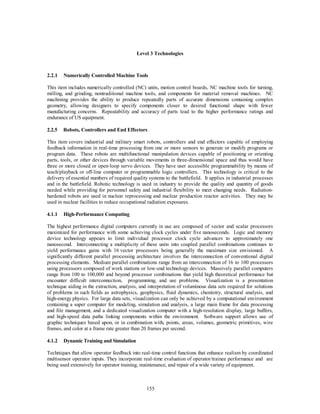
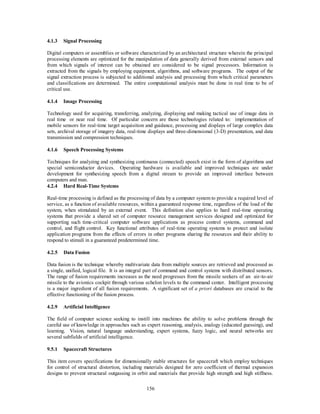
  • 27.
    Analysts work withdecision makers to develop value models. Sometimes candidate value models already exist, at least partially, within an organization. In other cases, a new value model must be constructed. Keeney provides further background and techniques for developing value models.15 Figure 2-3 shows a notional value model. Under the objective, there are three functions (first level of subordinate objectives). Under functions are corresponding tasks (second level of subordinate objectives). In this example, function 2 has two tasks (A and B). Tasks can also have subtasks(not included in this example), and tasks and subtasks can have one or more force qualities that characterize success at this task. Task A has three force qualities and Task B has one force quality (fig. 2-3). For each force quality, one or more measures of merit must be identified, each of which has a corresponding scoring function. 14 Function 1 Force Q uality A1 Measure of Merit A1 (Scoring Function A1) Force Q uality A2 Measure of Merit A2 (Scoring Function A2) Function 2 Function 3 Force Q uality A3 Measure of Merit A3 (Scoring Function A3) Task A Task B Force Q uality B Measure of Merit B (Scoring Fu nction B ) Objective (Value) Figure 2-3. Notional Value Model Weights After the hierarchical structure of the value model is complete, the decision maker must determine the relative importance of the functions, tasks, force qualities, and measures of merit. Numerical weights are assigned across each tier of the value model. These weights must satisfy certain mathematical requirements. Weights must be between 0 and 1, and for each function or task, the weights of the immediately subordinate functions, tasks, subtasks, and force qualities must sum to 1.00. Figure 2-4 shows weights applied to the
  • 28.
    earlier notional valuemodel. Note that the weights of the three functions sum to 1.00, as do the weights of the two tasks under function 2 and the three force qualities under task A. Note also that when a subordinate level Force Quality A2 15 contains only one box, its weight is necessarily 1.00. Function 1 .30 Force Q uality A1 .4 5 Measure of Merit A1 (Scoring Function A1) .35 Measure of Merit A2 (Scoring Function A2) Force Q uality A3 .2 0 Measure of Merit A3 (Scoring Function A3) Task A .70 Task B .30 Force Quality B 1 .0 0 Measure of Merit B (Scoring Function B ) Function 2 .5 0 Function 3 .20 Objective (Value) Figure 2-4. Weights Applied to Notional Value Model Applying the Value Model After the value model is completed and weights has been assigned, the evaluation of systems can be accomplished. The computations are straightforward. First, for system, raw scores are initially computed by using the applicable scoring functions. If a particular measure of merit does not apply to a given system, the raw score is zero. Next, weighted scores are calculated by multiplying the raw scores by the product of all the weights in the branch that leads (bottom-up) from the measure of merit to the highest level objective. Finally, a total system score is found by summing the weighted scores. The system with the highest score is the “best”. Using the earlier notional example (fig. 2-4), assume system X has raw scores of 37, 62, 18, and 83 for measures of merit A1, A2, A3, and B, respectively. The resulting score for function 2, S(function 2), is S(function 2) = {[(37)(0.45)(0.7)(0.5) + (62)(0.35)(0.7)(0.5) + (18)(0.2)(0.7)(0.5)] + (83)(1.0)(0.3)(0.5)} = 5.82 + 7.59 + 1.26 + 12.45 = 27.12
  • 29.
    Similar operations areperformed for every branch of the value model, then they are summed to compute the 16 total score for system X. The Search for the Air Force 2025 Value Model After the Analysis team selected VFT, the next step was to either select an existing value model or develop a new one. Identifying a current model proved to be a daunting task because of the scope of the study and the focus on the far future. The participants ranged across all of the military services and included allies, civilians, government officials, and industry. Any potential model also had to satisfy Clemen’s five criteria.16 The Analysis team initially searched for a national level strategic document that identified priorities for future air and space forces. The following sources were investigated: · A National Security Strategy of Engagement and Enlargement · National Military Strategy of the United States of America · Defense Planning Guidance · Joint Requirements Oversight Council (JROC)/Joint Warfighting Capabilities Assessment (JWCA) categories · Global Presence and Global Reach, Global Power · Common operational objectives of the armed forces · Draft AFDD-1 · Joint Vision 2010 · Cornerstones of Information Warfare A National Security Strategy of Engagement and Enlargement 17 represents the views of the President. It provides a high-level strategic view of the national defense policy but does not support or provide any definitive characteristics that could form the basis of a value model. The National Military Strategy of the United States of America (NMS), by the chairman Joint Chiefs of Staff (CJCS), also has a grand strategy perspective.18 The NMS contains a framework, but the task breakdowns have too much overlap. The Defense Planning Guidance 19 is focused on the near- and midterm budget cycle; therefore, it does not support the visionary requirements of Air Force 2025.
  • 30.
    AEROSPACE CONTROL &EXPLOITATION 17 FORCE APPLICATION STRIKE GROUND MANEUVER FORCE ENHANCEMENT STRATEGIC MOBILITY OVERSEAS PRESENCE INTEL, SURVEILLANCE, & RECONNAISANCE C2 & INFORMATION WARFARE AEROSPACE CONTROL STRATEGIC MOBILITY PROTECTION AIR SUPERIORITY DETER WMD FORCE SUPPORT JOINT READINESS COUNTERPROLIFERATION OF WMD Figure 2-5. Value Model Based on JROC/JWCA Categories The former vice CJCS, Adm William A. Owens, produced a set of JROC/JWCA categories to support the planning and analysis integration of the service program objective memoranda (fig. 2-5). While the JROC/JWCA framework was designed to be visionary, it also has considerable overlap. For example, the tasks of to “deter weapons of mass destruction (WMD)” and “counter proliferation of WMD” are not mutually exclusive, nor are the tasks of “ground maneuver,” “strategic mobility,” and “strategic mobility protection.” The secretary of the Air Force published the Global Reach, Global Power 20 and Global Presence 21 series of documents to promulgate the high-level vision of the Air Force of the future. But like the president’s national security strategy, these documents do not define key functions required to create a hierarchical value framework. Another interesting approach, common operational objectives of the armed forces, is based on the work of Lt Gen USAF, Glenn A. Kent (Retired).22 This document contains a strategy-to-task focus that could be suitable; however, like the defense planning guidance, it focuses on midterm planning years. This approach has two other qualities that made it unsuitable for Air Force 2025: it requires more engineering definition of the systems and concepts being evaluated than is available, and it assumes a working concept of operations. Moreover, it assumes a known future strategy.
  • 31.
    The Analysis teamnext looked to doctrinal publications as a potential source for a value model framework because doctrine is specifically written to provide guidance on how to think about air and space capabilities without being tied to a particular time period. The Air Force is currently writing a new doctrinal pamphlet, Air Force Doctrine Document: Air Force Basic Doctrine - 1 (AFDD-1).23 Figure 2-6 shows a candidate value model based on the first draft of AFDD-1. This framework has several shortcomings. First, the tasks of “strategic attack,” “interdiction,” and “close air support” contain considerable overlap. Next, “information operations” is not integrated into the framework but rather is represented as a series of traditional functional tasks such as “C4”, “intelligence,” and “weather service.” The goal of the Air Force 2025 study was to propose and evaluate systems that are employed to dominate air and space; it was not concerned with how we are currently organized to perform traditional functions. GLOBAL AWARENESS 18 AEROSPACE CONTROL COUNTERAIR COUNTER SPACE COUNTERINFO AEROSPACE STRIKE STRATEGIC ATTACK INTERDICTION CLOSE AIR SUPPORT GLOBAL POWER GLOBAL REACH MOBILITY AIRLIFT SPACELIFT AEROSPACE REPLENISHMENT INFORMATION OPERATIONS C4 INTELLIGENCE NAVIGATION & POSITIONING WEATHER SERVICE READINESS & SUSTAINMENT FORCE SUPPORT RECONNAISANCE SURVEILLANCE LOGISTICS OPERATIONS SUPPORT SPACE SUPPORT COMBAT SUPPORT & AIR RESCUE FORCE PREPARATION EDUCATION TRAINING EVALUATION & ASSESSMENT ALLIED PREPARATION AERO/CYBER/SPACE CONTROL & EXPLOITATION Figure 2-6. Value Model Based on AFDD-1
  • 32.
    Peacetime Deterrence &Fight Engagement Conflict Prevention & Win Full-Dimensional Protection Protect (Free to) 19 Dominant Maneuver INFO (Awareness) Mobility (Deploy) Employ on Land/Sea/Air/Space Precision Engagement Locate (ACQ) Target (Priority) C2 INFO Engage Assess BDA Reengage Deploy Maneuver Engage Focused Logistics INFO Logistics Transportation Track Shift Deliver Sustain (at Level) Strategic Operational Tactical Figure 2-7. Value Model Based on Joint Vision 2010 Another doctrinally based candidate for the Air Force 2025 value framework was based on a document from the Joint Staff, Joint Vision 2010 (fig. 2-7).24 As its title states, Joint Vision 2010 focuses on the future 15 years hence, not 30 years. In many cases, the acquisition process for the systems of 2010 has started already, so this model is not sufficiently visionary. On the other hand, Joint Vision 2010 contains a number of interesting departures from current service doctrines, especially in the focus on precision engagement and the vision for information and maneuver dominance. However, the model contains significant overlap in the tasks of “mobility (deploy),” “deploy,” “maneuver,” and “transportation.” Because of the overlap, and since it did not look far enough into the future, the Analysis team rejected the Joint Vision 2010 model. The existing model with the closest fit to the Air Force 2025 requirements was in the document Cornerstones of Information Warfare, released by the Chief of Staff and the secretary of the Air Force in late 1995.25 Cornerstones was written “to provide a sound and widely accepted basis from which we can adapt Air Force doctrine to the Information Age.” Figure 2-8 shows the Cornerstones hierarchical framework. Cornerstones seemed to accommodate most of the tasks and functions envisioned in Air Force 2025. It addresses information warfare in a realistic and rational manner and is written with time-honored terms that are easily understood by the study participants. Except in the area of information operations, it has the only mutually exclusive and collectively
  • 33.
    exhaustive structure ofany of the existing frameworks and, therefore, provides a sound mathematical basis for analysis. While an excellent document in many respects (its view of information warfare as another technique for mission accomplishment is noteworthy), Cornerstones continues to maintain a number of traditional “stovepipe” functions. As a result, the institutional biases inherent in the model could have stifled 20 the creative process of Air Force 2025. AEROSPACE CONTROL COUNTERAIR COUNTERSPACE COUNTERINFO FORCE APPLICATION STRATEGIC ATTACK C2 ATTACK INTERDICTION CLOSE AIR SUPPORT FORCE ENHANCEMENT AIRLIFT AIR REFUELING SPACE LIFT SPECIAL OPERATIONS INFORMATION OPERATIONS FORCE SUPPORT BASE OPERABILITY & DEFENSE LOGISTICS COMBAT SUPPORT ON-ORBIT SUPPORT AEROSPACE CONTROL & EXPLOITATION Figure 2-8. Value Model Based on Cornerstones After reviewing the full range of potential value models, the senior leadership of Air Force 2025 determined that none of the models met the requirements of Air Force 2025. Each model was grounded in near- or midterm thinking, and none seemed to think “outside of the box” about new ways to employ air and space forces in the far future. Furthermore, each contains traditional biases focusing on how the Air Force is organized, while Air Force 2025 addresses the dominant employment of air and space forces in the year 2025 and beyond. The only solution was for the Analysis team to develop a new framework to capture the visionary thinking that took place during the study.
  • 34.
    Developing the AirForce 2025 Value Model—Foundations 2025 Developing the Air Force 2025 value model was a key part of the analysis process. The work began early in Air Force 2025, and it continued for the duration of the study. The final value model, Foundations 2025, was so named because it provided the basis for the Air Force 2025 operational analysis. This section traces the evolution of the Foundations 2025 value model. The process of developing the model began by identifying the model’s overarching objective. Next, the Analysis team built tasks and functions from the bottom up, an atypical approach to building value models. When the task-function-objective framework was complete, the team completed the value model by creating force qualities, 21 measures of merit, and scoring functions. Objective Before making any progress toward developing a value model, the Analysis team needed a clear statement of the objective. As stated in the “Introduction,” General Fogleman tasked the Air Force 2025 participants to generate ideas and concepts on the capabilities the United States will require to dominate air and space in the future. This statement was translated into the overarching objective, “Achieve Air and Space Dominance,” that became the top tier of Foundations 2025. A Bottom-Up Approach With this overarching objective defined, the Analysis team could start specifying subtasks, tasks, and functions. Early on, the team departed from the usual approach to constructing a value model. Conventional value models are built in a top-down fashion; each level of the model hierarchy is derived from the next higher level. In contrast to the top-down method, a bottom-up approach makes no a priori assumptions and does not establish preconditions. The bottom-up approach should result in less institutional bias. Tasks and Subtasks The first step in the bottom-up process was to meet with each of the Air Force 2025 white paper writing teams to gather their specific notions of the required tasks and subtasks of future air and space
  • 35.
    forces. (At thisstage, the terms interchangeable, so for now, both are called tasks.) The teams held diverse views on task specification, but the ideas could all be characterized as some form of action. As a result, action verbs were used to specify tasks required for the employment of air and space forces in the year 2025. Figure 2-9 shows the disparate tasks that resulted from brainstorming sessions with Air Force 2025 teams. In this figure, the superscript after the task shows the letter designation of the team that identified the task (table 4). The final tally was 109 different tasks; the first step in the evolution of the Foundations 2025 model was complete. The next challenge for the Analysis team was to reduce this collection into a mutually exclusive and collectively exhaustive set. The affinity exercise proved to be an ideal method for this task 22 aggregation. The Affinity Exercise An affinity exercise (also called an affinity diagram) is a method designed to allow a team of people to generate a topical list of ideas creatively and subsequently arrange those ideas into natural groupings. Once similar ideas are grouped together, the team assigns names or headers to each collection of ideas.26 The affinity exercise is a simple yet potentially fruitful process. Besides fostering creativity by each participant, it “encourages non-traditional connections among ideas.” Identifying these nontraditional connections among ideas, thus breaking free from contemporary biases, was the aim of the Analysis team. A final benefit of the affinity exercise is that it encourages mutual exclusivity because all similar tasks are grouped together and confined to a single location in the model. The Analysis team applied this technique by combining the 109 tasks in figure 2-9 into logical groups. The result of this first affinity exercise was a set of 14 mutually exclusive, collectively exhaustive tasks (Figure 2-10). These 14 task groupings were collectively exhaustive because every one of the 109 tasks in figure 2-9 was gathered into one of the 14 groups. The 14 tasks represented by these groups are mutually exclusive because each of the boxes in figure 2-10 represents a fundamentally different activity. The initial tasks grouped inside the boxes, of course, represent fundamentally similar tasks. Next, the Analysis team assigned a name to each of the groups. The group name came usually, but not always, from one of the initial tasks in the group. The Foundations 2025 glossary (appendix A) formally defines the group names.
  • 36.
    Identify RqmntsY UnderstandM,P 23 Determine needs of userV IdentifyA,C,D,J,K,M,P,S,D ProtectE DeceiveE Detect(in air)A,J,S (in space)B,C (cybersphere)D,K (on ground)E ObserveE,N,Q CollectE,O,P,T,U,V,W SurveilE,O TrackB Map(ping)P Know what’s out thereN Acquire DataN ReceiveM AcquisitionD PointingD TrackingD Convert data to infoN TestX,Y SurviveA WeaponsA RecognizeT LocateN,P AnalyzeE,K,M,O AssessO,P,U SynthesizeP DecideE,O,P,Q,V Employ CommunicateB,C,J,K,N,Q,R,T,U,Q Select/ Assign WpnA C2H,S,W,D SimulateA,M PredictA,M PrioritizeJ,S FuseM,P,S,T,U,V CharacterizeM ClassifyS CorrelateT Manage InfoT,Q StoreT Secure (info)T PlanM,O,P DistributeT,V,W,Q Impart to HumansM PresentM Diss eminateM,P Communicate LocationN AttackC,K,E DirectC,N,P IndirectC,N,P ReactD MitigateB DeflectB DestroyB,P,E,R Project PowerS,D LearnM Engage/ InfluenceN DisplayV,Q Feedback/ Re-observe/ Re-communicateN Strat AttackD C2 AttackD Defend (In space)C Defend (On Ground)D DenyP,E Exploit/ ExtractP OvertlyM CovertlyM IsolateM BlockM DepriveM ManipulateD BiomedicallyD PsychologicallyD PhysicallyD InformationallyD ExecuteE,O DisruptE,P CorruptE EducateX,Z TrainZ Analyze RiskQ RendezvousH TransferH Airlift PeopleF Airlift CargoF MedevacF Assess PersonnelY Asset ReportingY Asset ControlY Operational TrainingY ScreenX Identify (what to teach) X Match NeedsX TransportationF AcquisitionF Materiel ManagementF SpaceliftG Orbital ManueverG ProcessW StoreW DisposeW MaintenanceF SustainQ RecoverD Figure 2-9. Air Force 2025 Initial Task Compilation
  • 37.
    Detect(in air)A,J,S (inspace)B,C (cyberspace)D,K (on ground)E CollectE,O,P,T,U,V LocateN,P ClassifyS REPLENISH 24 Assess PersonnelY AssessO,P,U Asset ControlY Asset ReportingY DECIDE Select/ Assign WpnA DecideE,O,P,Q,V StoreT C2S,D PLAN PlanM,O,P SimulateA,M PrioritizeJ,S Analyze RiskQ PredictA,M COMMUNICATE Secure (info)T ReceiveM DisplayV CONFIRM Lea rnM Feedback/ Re-observe/ Re-communicateN ASSESS Manage InfoT Identify RqmntsY CommunicateB,C,J,K,N,Q,R,T,U Impart to HumansM DistributeT,V PresentM Communicate LocationN DisseminateM,P EDUCATE/TRAIN Operational TrainZ Test X,TrainingY Y Identify (what to teach) X Match NeedsX ScreenX EducateX,Z ENGAGE Destroy B,P,E,R DeflectB ManipulateD Employ WeaponsA Project Power S,D Engage/ InfluenceN Strat AttackD DenyP,E C2 AttackD OvertlyM CovertlyM IsolateM BlockM DepriveM ExecuteE,O DeceiveE CorruptE AttackC,K,E DirectC,N,P IndirectC,N,P ReactD Mitigat eB BiomedicallyD PsychologicallyD PhysicallyD InformationallyD MAINTAIN MaintenanceF UnderstandM,P Determine needs of userV SURVIVE ProcessW SurviveA Defend (In space)C Defend (On Ground)D CharacterizeM ProtectE RecoverD TransferH RendezvousH StoreW SustainQ Materiel Manageme ntF Acquire DataN DEPLOY Airlift CargoF MedevacF Orbital ManueverG Air l ift People F TransportationF SpaceliftG Know what’s out thereN Map(ping)P TrackB SurveilE,O ObserveE,N,Q ReceiveM AcquisitionD PointingD TrackingD DETECT IDENTIFY IdentifyA,C,D,J,K,M,P,S,D RecognizeT INTEGRATE Convert data to infoN AnalyzeE,K,M,O CorrelateT Synthe sizeP FuseM,P,S,T,U,V AcquisitionF DisposeW Figure 2-10. First Affinity Grouping of Tasks
  • 38.
    Direct 25 DistinguishingSubtasks from Tasks The second affinity grouping determined which of the 14 tasks in figure 2-10 were truly tasks and which were lower level subtasks. As figure 2-11 shows, six of the 14 tasks were grouped together under a broader task labeled direct, and two of the 14 were grouped into a broader task called understand. These subtasks were grouped together because, even though they represented different activities, they were closely related. The six tasks under direct—assess, decide, plan, communicate, confirm, and educate/train—became subtasks, as did integrate and identify under understand. Educate/Train Maintain Communicate Replenish Decide Plan Understand Detect Engage Deploy Survive Assess Confirm Identify Integrate Figure 2-11. Second Affinity Grouping of Tasks The Influence of the Medium on Certain Tasks The Air Force 2025 white paper writing teams felt that some tasks in figure 2-11 were fundamentally different, depending on the medium in which the tasks take place. For example, to detect something in the air is fundamentally different from detecting something on the ground or in cyberspace. Likewise, to engage a target in space is a different task than to engage on the surface. Therefore, the Analysis team had to determine which of the eight tasks were affected by the medium, and, if so, divide those tasks into subtasks to ensure mutual exclusivity. The four possible media were defined to be air, space, cyberspace, and surface/subsurface; therefore, under the task detect, there are four subtasks: detect (things) in the air, detect in space, detect in cyberspace, and detect on the surface (and subsurface). This same logic applied to the engage, survive, deploy, maintain,
  • 39.
    and replenish tasks.Note that the medium where the target (the thing being detected or engaged) is located, not where the system doing the detecting or engaging is located. Three tasks in Foundations 2025 were determined not to be medium specific: understand, direct and maintain. To understand (integrate and identify) what was detected does not depend on where the integrating and identifying occurs. Imagine a fusion center receiving data from sensors in the air, in space, and on the ground. The process of understanding the data passed to the fusion center is not affected by the location of the center. Likewise, the commander’s ability to direct, including assess, plan, and decide is not affected by the medium in which these activities occur. Similarly, the ability to maintain is related to readiness and the 26 ability to sustain, but not specifically to a medium. Two points about the medium-specific subtasks warrant explanation. First, the notions of deploy to air and replenish in air seemed at first to be far-fetched or unnecessary. However, one of the proposed Air Force 2025 systems was an airship with the ability to loiter in the air for several days. Foundations 2025 needed to be sufficiently robust to evaluate such systems and forward thinking in establishing the value of these futuristic tasks. Second, there were no subtasks in the cyberspace medium for the deploy, maintain, and replenish tasks. In this paper, cyberspace is defined as “the virtual [emphasis added] space of computer memory and networks, telecommunications, and digital media.”27 Because cyberspace is a virtual space, there is no need to move or deploy. The Internet is a good example; being on-line means being engaged. A medium-specific distinction does not imply that a particular system cannot perform in different media. By dividing some tasks into subtasks based on medium, distinct system capabilities were evaluated based on the phenomenology associated with the medium. In the Foundations 2025 value model, a satellite that can detect targets on the surface, in the air, and in space received credit for performing three distinct subtasks.
  • 40.
    Understand Direct Identify Decide Assess Confirm On Surface/ Subsurface 27 On Surface/ Subsurface Engage Educate/Train Communicate Survive Plan Integrate Detect In Air In Space In Cyberspace Deploy In Air In Space On Surface/ Subsurface Replenish In Air In Space On Surface/ Subsurface In Air In Space On Surface/ Subsurface In Cyberspace In Air In Space In Cyberspace Maintain Readiness Sustain Figure 2-12. Inclusive Grouping of Tasks and Subtasks Adding medium-specific subtasks increased the number of subtasks in the model from eight to 29. Figure 2-12 shows the complete list of tasks and subtasks, including medium-specific subtasks. The next step in the hierarchical evolution of the value model was to generate functions. Functions Functions are the high-level, aggregated tasks that must be accomplished to attain the overarching objective of air and space dominance. Three functions for the future Air Force emerged from the third and final affinity grouping: awareness, reach, and power. Awareness is specified by the tasks detect, understand, and direct. To have reach requires the ability to deploy, maintain, and replenish. Power comes from the ability to engage and survive. The Analysis team adopted the following definitions for these three functions: Awareness — knowledge, understanding, or cognizance of some thing or situation through alertness in observing, detecting, and identifying, so as to enable, direct, and communicate an informed decision.
  • 41.
    Reach — abilityto move to expand the range or scope of influence or effect, and to sustain this influence or effect by maintaining and replenishing. Power — ability to overtly or covertly affect, control, manipulate, deny, exploit, or destroy targets, including forces, people, equipment, and information, and the ability to survive while affecting targets. These definitions are based on the tasks in the affinity diagrams upon which the functions were built (fig. 2-10), and they suggest that the critical functions of air and space forces in the future do not differ significantly from the functions of today. Where the future begins to diverge from the present is in the detailed means (i.e., tasks and subtasks) by which these functions are accomplished. Two critical implications appear when the requirement for a set of functions in a value model are mutually exclusive and collectively exhaustive. First, these three Air Force 2025 functions should encompass every future air and space force operational activity. Second, awareness, reach, and power are the only operational activities that contribute to the overarching objective of air and space dominance. Once the functions were developed, the bottom-up evolution of the subtasks, tasks, and functions in the Foundations 2025 value model was complete. Figure 2-13 depicts the entire framework of mutually exclusive and collectively exhaustive functions, tasks, and subtasks to be accomplished by future air and space forces. Next, force qualities, measures of merit, and scoring functions had to be added to the 28 framework to finalize the model.
  • 42.
    29 Detect InAir In Space In Cyb ersp ace O n Surface/Subsurface Und erstand Id entify Integrate Direct Assess Decid e Plan Comm unicate Confirm Educate/Train Awareness Deploy To Air To Sp ace To Surface Maintain Readiness Sustain Replenish In Air In Space On Surface Reach Engage In Air In Sp ace In Cyb erspace On Surface/Subsurface Survive In Air In Space In Cyberspace On Surface Power Achieve Air and Space Domina nc e Figure 2-13. Foundations 2025 Value Model Force Qualities Though the framework shown in figure 2-13 represented a major breakthrough, it was not a complete value model. The next step for the Analysis team was to meet with each of the Air Force 2025 white paper writing teams for a second time to determine force qualities, based on the teams’ operational expertise, research, and thoughts about the future. Force qualities are generally adjectives, since they characterize a system’s ability to accomplish a task or subtask. In many cases, the desired force qualities of a future force did not differ from qualities expected of today’s force. For example, the force qualities associated with the subtask identify were accurate, timely, and traceable. The goal was to identify only the most important force qualities for each subtask. Some common themes emerged in the force quality development process. For almost every subtask, timely was a desired force quality. Unobtrusive was another commonly occurring force quality; it is listed under every detect and engage subtask. Clearly, the ability to watch without being watched, and act without being observed, are desirable qualities of future air and space forces. Lastly, most of the writing teams felt that flexibility was important across the spectrum of tasks. Several force qualities address flexibility: multirole, reusable platform, desired lethality, and sensor variety.
  • 43.
    These force qualitiesand measures of merit were continually refined during a succession of meetings. After working with each Air Force 2025 white paper writing team, the Analysis team was reduced the list of force qualities from the initial number of about 1,200 to the final number of 134. There are about five force qualities for each subtask. The largest number of subtask force qualities was nine, the fewest was two. Figure 2-14 through figure 2-16 show the final force qualities for Foundations 2025, organized under the functional categories of awareness, reach, and power. 30 In Air C ov erage Timely Acc urate Scope R es olution Sensor V ariety U nobtrusive In Space Coverage Timely Acc urate Scope Resolution S ens or V ariety Unobtrusive Range In Cyberspace C lassified Timely Acc urate Sensor V ariety U nobtrusive C lassified On Surface/Subsurface Coverage Timely Acc urate S ens or V ariety Unobtrusive Resolution Scope Detect Identify A ccurate Tim ely Trac eable Integrate Battlespace V iew Tim ely Correlation Understand Educate/Train D octrine Tech/Ops K now ledge Tech/O ps S kills C ritical/Creative Thinking Assess Own S tatus Others S tatus Environment Plan E ffectiv e E fficient Decide Decision B asis Q uality Communicate Secure Capacity Interoperable Tailored Human Interaction Confirm BDA Feedback Direct Awareness Figure 2-14. Awareness Tasks, Subtasks, and Force Qualities
  • 44.
    Readiness 31 ToAir Payload Weight Payload Volum e Ra nge Re spon siv e Multirole To Space Pa ylo ad W eight Pa ylo ad V olume Resp onsive Reus able Sp ecific Impulse Pe rfo rman ce To Surface Payload Weight Payload Volum e Ra nge Forward Basing Reqmts Re spon siv e Multirole Deploy Availab le Repa ra ble Sustain Pipeline Footp rint Maintain In Air T ime ly Accurate Transfe r Multi-commod ity Transfe r R ate In Space Timely Accurate Trans fer Re usable Trans fer R ate On Surface T ime ly Accurate Transfe r Replenish Reach Figure 2-15. Reach Tasks, Subtasks, and Force Qualities
  • 45.
    Power On Surface/Subsurface Figure 2-16. Power Tasks, Subtasks, and Force Qualities 32 In Air Precision Tim ely Range Desired Lethality Reusable Platform Weapon Capacity Multirole Unobtrusive Scope In Space Selectivity Tim ely Range Engage Desired Lethality Reusable Platform Weapon Capacity Multirole Unobtrusive Scope In Cyberspace P recision Timely D esired Lethality M ultirole U nobtrusive Measures of Merit and Scoring Functions P recision Timely E ngagement Envelope D esired Lethality R eusable Platform W eapon Capacity M ultirole U nobtrusive S cope In Air D etectable C ountermeasures V ulnerable R ecoverable In Space D etectable C ountermeasures V ulnerable R ecoverable In Cyberspace D etectable C ountermeasures V ulnerable R ecoverable On Surface D etectable C ountermeasures V ulnerable R ecoverable Survive Corresponding measures of merit were developed at the same time the Analysis team met with the Air Force 2025 writing teams to determine force qualities. Each force quality had a measure of merit to
  • 46.
    calibrate system performance.For example, a force quality of the subtask deploy to air was range, and the corresponding measure of merit was miles. The measures of merit became the domains (horizontal axis) of the scoring functions used to evaluate the capabilities of future systems. The Analysis team again worked closely with the Air Force 2025 writing teams to build the scoring functions associated with the teams’ respective portions of the value model. The result—134 detailed functions that quantify operational values— represent an important analytical accomplishment. They span the spectrum of air and space operations, and, as such, serve as a wealth of information for mission area analysts and weapon system developers. Appendix A contains the complete set of the Air Force 2025 measures of 33 merit and scoring functions. Foundations 2025 represents five important analytic advances. First, the collection of scoring functions serves as an invaluable resource, even outside the Air Force 2025 study. Second, the use of verbs to specify tasks was a useful step in the value model evolution. Third, the bottom-up approach used in developing Foundations 2025 was significant because no a priori assumptions were made and no preconditions were established. Building from the bottom up allowed Foundations 2025 to be free from institutional bias, an outcome necessary to capture the visionary thinking of Air Force 2025. Fourth, Foundations 2025 is a robust value model. With five tiers consisting of an overarching objective, three functions, eight tasks, 29 subtasks, and 134 force qualities (each with a corresponding measure of merit and scoring function)—and all weighted across six alternate futures—the model can be used to evaluate diverse systems. Finally, Foundations 2025 is cast further into the future than any other known military value model. After the Foundations 2025 development was completed, the next step in the Air Force 2025 OA was to use the model to evaluate systems. The Air Force 2025 white papers provided the key information for identification and definition of the systems. System Identification Following a thorough review of the Air Force 2025 white papers, the Analysis team identified 43 unique high-leverage systems. For this operational analysis, a system was defined to be “a functionally related group of elements that performs a mission or task.” Although some of the identified systems were
  • 47.
    extracted from asingle white paper, many systems, particularly those involving the collection and management of information, were composites drawn from capabilities detailed in several of the papers. For example, the use of a “personal digital assistant” was a key element of 10 white papers on issues ranging from special operations to general education and training. In several of the papers, such as the one entitled “A Contrarian View of Strategic Aerospace Warfare,” no systems could be identified. In these cases, the papers contained a general framework for doing business in given mission areas without a level of detail 34 required for technology identification. VEHICLES 1.0 AIR ONLY (Piloted) 2.0 AIR ONLY (Uninhabited) 3.0 SPACE ONLY 4.0 AIR & SPACE WEAPONS 5.0 AIR AND GROUND BASED 6.0 SPACE-BASED INFORMATION SYSTEMS 7.0 INDIVIDUAL 8.0 GLOBAL MISCELLANEOUS SYSTEMS 9.0 OTHER 2025 SYSTEMS Figure 2-17. System Functional Hierarchy The 43 systems are listed in table 1, categorized by the major functional areas depicted in figure 2-17. The full descriptions of these systems are found in appendix B.
  • 48.
    Table1 Identified Systems 35 1. 0 Vehicles - Air Only (Piloted) 1.1 Hypersonic Attack Aircraft 1.2 Fotofighter 1.3 Container Aircraft 1.4 Lighter-than-Air Airlifter 1.5 Supersonic Airlifter 1.6 Stealth Airlifter 1.7 Global Transport Aircraft 2.0 Vehicles - Air Only (Uninhabited) 2.1 Strike UAV 2.2 Reconnaissance UAV 2.3 Uninhabited Combat Air Vehicle 2.4 Precision Delivery System 2.5 UAV Mothership 2.6 Exfiltration Rocket 3.0 Vehicles - Space Only 3.1 Orbital Maneuvering Vehicle 3.2 Orbital Combat Vehicle 3.3 Satellite Bodyguards 4.0 Vehicles - Air and Space 4.1 Piloted SSTO Transatmospheric Vehicle 4.2 Uninhabited Air-Launched Transatmospheric Vehicle 5.0 Weapons - Air and Ground-Based 5.1 Adjustable Yield Munition 5.2 Advanced Air-to-Air Missile 5.3 Airborne High-Power Microwave Weapon 5.4 Standoff Hypersonic Missile 5.5 Attack Microbots 5.6 Airborne Holographic Projector 5.7 Hybrid High-Energy Laser System 6.0 Weapons - Space-Based 6.1 Global Area Strike System 6.2 Space-Based Kinetic Energy Weapon 6.3 Space-Based High-Power Microwave Weapon 6.4 Space-Based High-Energy Laser 6.5 Solar-Powered High-Energy Laser System 6.6 Solar Energy Optical Weapon 6.7 Asteroid Mitigation System 7.0 Information Systems - Individual 7.1 Spoken Language Translator 7.2 Personal Digital Assistant 7.3 Virtual Interaction Center 8.0 Information Systems - Global 8.1 Global Information Management System 8.2 Global Surveillance, Reconnaissance, and Targeting System 8.3 Sensor Microbots 8.4 Multiband Laser Sensor System 8.5 Asteroid Detection System 9.0 Miscellaneous Systems 9.1 Mobile Asset Repair Station 9.2 Weather Analysis and Modification System 9.3 Sanctuary Base
  • 49.
    Alternate Futures TheAir Force 2025 Alternate Futures team generated and then analyzed more than 100 candidate drivers deemed to be forces acting on the future. These drivers were then synthesized and consolidated into the three most important drivers to define a strategic planning space in which alternate futures could be cast (fig. 2-18). Functional definitions for each of these three drivers are provided below: 2015 Crossroads Digital Cacophony 36 (Global) American Worldview (Domestic) Gulliver's Travails King Khan TeK World Power Grid (Dispersed) Zaibatsu Halfs and Half-Naughts (Constrained) (Exponentialn) (Concentrated) Figure 2-18. Alternate Futures Planning Space American Worldview. This driver is the US perspective of the world which determines the willingness and capability to interact with the rest of the world. American worldview captures the dominant US focus regarding international affairs. The US can be primarily internally focused, perhaps even isolationist, or the US can be actively engaged in activities around the world. The poles of American worldview are domestic and global. DTeK. This driver is the differential in the rate growth, proliferation, leverage, and vitality of scientific knowledge and technical applications and their consequences. DTeK describes the rate of change in both the proliferation and advancement of technology. The two poles of DTeK are constrained and exponential. Constrained DTeK implies technology is advancing at an evolutionary rate and its availability is limited to a relatively
  • 50.
    few number ofactors. Exponential DTeK occurs when there are revolutionary breakthroughs in technology that are rapidly proliferated throughout the world. World Power Grid. This driver describes the generation, transmission, distribution, and control of power throughout the world. This power is a combination of economic, political, and information sources of power as well as military strength. The two poles of this driver are concentrated and dispersed. A concentrated world power grid exists when few actors have the means or will to influence others. When a myriad of groups or individuals can change the future, the World Power Grid is dispersed. Six alternate futures were chosen from this planning space to provide a diverse set of future conditions against which to evaluate the proposed air and space systems. Four futures are extremes: Gulliver’s Travails, Zaibatsu, Digital Cacophony, and King Khan. The world of Halfs and Half-Naughts was chosen for its centrality. Finally, the 2015 Crossroads future provides a conservative bridge between today and 2025. In Gulliver’s Travails, the US is overwhelmed with worldwide commitments, counterterrorism and counterproliferation efforts, humanitarian operations, and peacekeeping operations. In Zaibatsu, multinational corporations dominate international affairs, loosely cooperating to create a relatively benign world. Digital Cacophony is the most technologically advanced world resulting in great power and independence for the individual but also creating a world of social isolation, fear, and anxiety. King Khan is a world where US dominance has waned due to domestic problems, an economic depression, and overshadowing by a rising Asian colossus. The world of Halfs and Half-Naughts is dominated by conflict between the “haves” and “have-nots” and dynamically changing social structures and security conditions. 2015 Crossroads uses programmed forces from 1996–2001 to fight a major conflict; it presents the US with a strategic challenge in 2015 that could lead to any of other alternate futures by 2025. These six alternate futures provided the fulcrum against which the Air Force 2025 Operational Analysis was applied to determine which of the many systems proposed by the study participants had merit and, hence, should be pursued by the United States Air Force to ensure air and space dominance in the future. Scoring the Systems This section describes how Foundations 2025 was used to evaluate future air and space systems. The process had two steps the first step assign weights to the model hierarchy, and the second computes performance scores using scoring functions. The scoring in this section provides the reader with an example 37
  • 51.
    of the scorecomputation process; the results of the actual Air Force 2025 systems evaluation are described 38 in chapter 3. Weighting the Foundations 2025 Value Model across Alternate Futures The first step in using the 2025 value model is for the decision maker to determine the relative importance of the functions, tasks, subtasks, and force qualities. As described in the previous section, the decision maker weights functions, tasks, subtasks and force qualities. Because different futures dictate a different set of required air and space capabilities, the Analysis team obtained value model weights from the Air Force 2025 participants for the range of potential future worlds postulated by the Air Force 2025 Alternate Futures team. For each alternate future, the Analysis team used two sets of weights. The first, denoted “AU Team Weights,” is an average of the weights assigned by student members of the Air Force 2025 white paper writing teams. The second, denoted “Alt Futures Weights,” is the weights provided solely by the Alternate Futures team. In general, the Alernatet Futures Weights exhibited greater variation across futures than did the AU Team Weights. Weights were held constant for the force qualities and measures of merit because they were not expected to vary much across possible futures. The weights for each future are contained in appendix C. Technology Identification and Scoring Once the 43 unique systems contained in the white papers were identified, the Analysis team qualitatively analyzed each system to identify which technology areas would be key to achieving the stated system capabilities. Only those technology areas needing development were considered. For example, if a specific technology area was critical to a given system’s capability, but no new advances were needed in this area for the system to achieve its full capability, then this technology area was not identified as high leverage for this particular system. The team felt that it was highly desirable to identify and group technologies according to a well-known “gold-standard.” Thus, the DOD document, The Militarily Critical Technologies List (MCTL), was used as the basis for key technology identification in each system. For the 43 systems evaluated, a total of 43 key
  • 52.
    technology areas wereidentified. Full descriptions of each technology area, as paraphrased from the MCTL, 39 can be found in appendix D. To eventually rank technologies by their impact on future air and space capabilities, the team assigned a relative weight to each technology embedded in a particular system. The weights selected sum to 100 for each system and so can be thought of as percentages of the system’s dependence on each technology needing development. For example, the five piloted single-stage-to-orbit (SSTO) transatmospheric vehicle (TAV) technologies were weighted as follows: Technology Area Weight Aerospace Structures and Systems 25 High-Energy Propellants 25 RAMjet, SCRAMjet, Combined Cycle Engines 20 Advanced Materials 20 High-Performance Computing 10 In this case, since the primary mission of the piloted SSTO TAV is to travel between the surface and low-earth orbit, the highest leverage technology areas were those of the vehicle’s primary propulsion and structural subsystems. Each of these areas were evaluated to be essentially equal in importance. The fifth technology area, high performance computing, was added not necessarily because of vehicle requirements, but because the design process for this type of vehicle will take some advances in computing power. Without advances in high-performance computing, the design process for a TAV with this capability would be impaired. This methodology makes it possible to score each of the systems. Once the system-versus-technology matrix is developed, the procedure for scoring the technologies is straightforward. The contribution of technology to each system is multiplied by the system value, and the resulting products are summed across all systems. The result is a set of technology scores (normalize to a maximum score of 100) that takes into account both the technologies’ degree of contribution to future air and space systems and the importance of those systems to air and space operations. This scoring was then repeated for each alternate future since the system values changed with each future. After each technology area had been identified, one additional question remained, “Who, the DOD or the commercial sector, is the key player in developing each of the 43 technology areas?” AFIT’s Graduate
  • 53.
    School of Engineeringassembled a committee from its senior staff to consider this question. This committee qualitatively evaluated each technology area to determined the appropriate key developer. They further ascertained the direction of each developmental effort, whether from the DOD to the commercial sector, from the commercial sector to the DOD, or remaining constant. Notes 1 Ralph L. Keeney, Value-Focused Thinking: A Path to Creative Decisionmaking (Cambridge, Mass.: 40 Harvard University Press, 1992). 2 SPACECAST 2020 Operational Analysis (Maxwell AFB, Ala: Air University Press, 1994). 3 Keeney, 3. 4 Ibid., 6. 5 Ibid., 7. 6 Ibid., 33. 7 Ibid., 112. 8 R. T. Clemen, Making Hard Decisions: An Introduction to Decision Analysis (Boston, Mass.: PWS-Kent, 1991). 9 Keeney. 10 Wayne Winston, Operations Research: Applications and Algorithms, 3d ed. (Belmont, Calif.: Duxbury Press, 1993). 11 Keeney, 78. 12 Ibid. 13 Clemen, 435. 14 Ibid., 435–436. 15 Keeney, 129-154. 16 Clemen, 435–36. 17 A National Security Strategy of Engagement and Enlargement (Washington, D. C.: The White House, February 1995). 18 National Military Strategy of the United States of America, 1995 (Washington, D. C.: US Government Printing Office). 19 Defense Planning Guidance (Washington, D. C.: Office of the Secretary of Defense, 1995). 20 Global Reach, Global Power: A White Paper, Department of the Air Force, June 1990. 21 Global Presence, Department of the Air Force, 1995. 22 Glenn A. Kent and William E. Simons, A Framework for Enhancing Operational Capabilities, R- 4034-AF (Santa Monica, Calif.: RAND 1991). 23 Air Force Doctrine Document: Air Force Basic Doctrine, 15 August 1995, first draft (Washington, D. C.: US Air Force, 1995). 24 Joint Vision 2010, America’s Military: Shaping the Future (Washington, D. C.: Joint Chiefs of Staff, January 1996). 25 Cornerstones of Information Warfare (Washington, D. C.: US Air Force, 1995).
  • 54.
    26 Michael Brassardand Diane Ritter, The Memory Jogger II: A Pocket Guide of Tools for Continuous Improvement and Effective Planning (Methuen, Mass.: Growth Opportunity Alliance of Lawerance/QPC, 1994), 13–14. 27 Cotton, Bob, The Cyberspace Lexicon: An Illustrated Dictionary of Terms From Multimedia to 41 Virtual Reality (London: Phaedon, 1994).
  • 55.
    Chapter 3 Results A team of technical and operational experts, the Analysis team, scored all 43 systems against each metric in Foundations 2025. The team followed a consensus-seeking approach to obtain each score. The team was not permitted to know the shape of the scoring function and was tasked to place a score for each metric along the horizontal axis of each function shown in figures A-5 through A-32 for each system. The analysis was performed using Logical Decisions for Windows© software running on a Pentium-based PC. The results of the system scoring are summarized in figure 3-2 through figure 3-6. The vertical axis is the score from the system evaluation on a scale of 0 to 100, where a system score of zero equates to no score on any of the 134 scoring functions. The horizontal axis is a rank ordering of the systems according to the Analysis team’s assessment of the relative amount of technical challenge to develop each system. The system scores are shown for two separate sets of weights—the AU Team Weights and the Alternate Futures Weights—for all six of the alternate futures. (figure 3-2 and figure 3-3). Each system’s scores for the various futures are plotted and connected with a line to show the variation of that system’s score across the alternate futures. The resulting spread of scores for each system can be regarded as similar to error bars in the results of a statistical sampling technique. In other words, a system’s score can be said with high confidence to lie within the range of the points shown. The curved dashed line provides a further reference for comparing systems. In the Analysis team’s estimation, systems above the line may have sufficient value to offset the technical challenge of producing such a system. Thus, systems to the left of the charts need less value to be attractive options than systems to the right of the chart, because the difficulty of achieving the capability is much less. The exact location of the line is somewhat arbitrary. It 42
  • 56.
    was drawn fairlylow, terminating on the right at a value of 20, to identify the most promising systems. (Note: 43 A score of 10-15 may be good for some tasks.) The highest value systems evaluated in this study are the Global Information Management System (GIMS), Sanctuary Base, Global Area Strike System (GLASS), Global Surveillance and Reconnaissance System (GSRT), and Uninhabited Combat Air Vehicle (UCAV). GIMS has the highest score but has high technical challenge, while GSRT performs some of the functions of GIMS but also with less technical challenge. Because of this, GSRT could be considered a “stepping stone” to GIMS. Both GLASS and UCAV score well because of a strong awareness component to complement their power contributions, and UCAV is the most feasible of all the high-value systems in the near term. Sanctuary base has high value but also the highest technical challenge. It may remain infeasible even beyond 2025. Appendix E contains tables of each system’s value score for each future and weight set. Dividing the figures above into quadrants provides a delineation of the systems into four categories based on value and technical challenge. Figure 3-1 shows representative systems for each quadrant. · Global Surveillance, Reconnaissance, and Targeting System · Uninhabited Combat Air Vehicle · Reconnaissance Unmanned Air Vehicle · Global Information Management System · Sanctuary Base · Global Area Strike System (Piloted TAV, GBL, KEW) · Attack Microbots · Global Transport A/C · Advanced Air-to-Air Missile · Orbital Maneuvering Vehicle · Exfiltration Rocket · Fotofighter · Sensor Microbots · Adjustable Yield Munition · Unmanned Air Vehicle Mothership Value Higher Lower Technology Challenge Higher Lower Figure 3-1. Representative Systems Figure 3-4 and figure 3-5 provide a closer look at the highest scoring systems. Limiting the systems displayed to the top 25 percent (11 systems) for the AU Team Weights yields figure 3-4. A comparison of
  • 57.
    figure 3-4 andfigure 3-5 reveals little difference between the overall scores and rankings for the AU Team Weights and the Alternate Futures Weights. The variation between futures is greater for the Alternate Futures Weights, reflecting both the more extreme views of a team immersed in the construction of the alternate futures and the centering effect of averaging the weights of the AU team members. However, the top 11 systems for the AU Team Weights are contained in the top 14 systems for the Alternate Futures Weights, with the Hypersonic Attack Aircraft, Fotofighter, and Sensor Microbots rounding out the 14 systems. Figure 3-6 shows the relative contribution of the awareness, reach, and power sub-scores to the top 11 systems’ scores using the AU Team Weights for the “Halfs and Half Naughts” alternate futures. It is interesting to note the relationship between the awareness, reach, and power contributions to a system’s score and the score variation between alternate futures. Systems that score similarly in awareness, reach, and power (e.g., GLASS in figure 3-6) tend to have the least variation; that is, the line connecting their scores for each future is short. This is because the weighted average of awareness, reach, and power (the overall score) is insensitive to changes in the weights when the awareness, reach, and power scores are of 44 the same magnitude. The scoring results highlight that a complex system (a system of systems) outscores any of its components. This is because of the additive nature of the scoring functions. The complex system scores more broadly since it contains the capabilities of its components, so it exceeds the score of any single component. Conversely, since component systems are unlikely to score in mutually exclusive areas of the value model, the complex system generally will score less than the simple sum of the component system scores. Finally, figure 3-7 through figure 3-9 contain graphs similar to those in figure 3-2 and figure3-3, but for the awareness function, the deploy task of reach, and the power function, respectively, using the AU Team Weights. These figures allow the reader to note the systems which score well for a particular function. For example, figure 3-7 highlights the best systems in terms of the awareness function. Such a level of detail may prove useful when conducting mission area analysis to determine required improvements for specific functional areas. In fact, the software used in this analysis can display the system scores at any level of the value model.
  • 58.
    Achieve A irand Space D ominance AU W eights, O rdered by Technology Cha llenge 8 .5 A s tero id De tec tion S y s tem 1 .2 45 1 .4 Ligh ter- tha n-Ai r Ai rli fte r 2 .1 S trike U AV 2 .4 P rec is ion D e liv e ry S ys tem 5 .5 Attack M ic rob ots 6 .5 So lar-P ow er ed H ig h -Ene rgy La ser 4 .1 P ilote d SST O TAV 3 .2 Orbital Comb at Ve hicle 7 .3 V ir tua l Inte rac tio n C enter 6 .4 Sp ace -Ba se d H ig h -Ene rgy La ser 6 .1 G lob al A re a S tr ike S y s tem 9 .3 San ctu a ry Base 8 .1 G lob a l In form a tio n Man ag emen t System 2 .2 R econ n UAV 2 .3 U ninh ab ite d C omb at A ir V e hic le 8 .2 G lob al Su rve il lan ce , Re c on naiss an ce , and T arg eting S y stem 4 .2 Uninh ab ite d Air-La un ch ed TAV 1 .1 3 .3 8 .3 5 .7 7 .2 6 .3 5 .1 6 .2 2 .5 9 .2 8 .4 7 .1 5 .4 5 .6 6 .7 3 .1 5 .3 1 .3 5 .2 1 .5 1 .6 9 .1 6 .6 2 .6 60 50 30 20 10 0 Valu e 40 Technology Cha llenge Gulliver's Zaiba tsu Khan Digital 2015 Halfs 1 .7 G lob al Tra ns po rt A ircr aft Figure 3-2. Final System Scores - AU Team Weights
  • 59.
    46 V alue Ach ieve A ir and Space D ominance Alt. Futures W eights, O rdered by Technology C hallenge 2 .4 P recision Delivery S ystem 1 .4 L ighter-than-Air A irlifte r 2 .1 S trike UAV 8 .5 A steroid Detection System 5 .5 A ttack Microbots 1 .2 Fotofig h te r 6 .5 S olar-Powe red High-Energy L a se r 4 .1 P iloted SSTO TAV 3 .2 7 .3 V irtu a l Interaction Ce n ter 6 .4 S pace -Based High-Energy L a se r 6 .1 G lob a l Area Strike Sy s tem 9 .3 S anctuary Base 8 .1 G lob a l Informa tion Management S ystem 2 .2 R econn UAV 2 .3 Uninhabited C omb a t A ir V ehicle 8 .2 G lob a l Su rveilla nce , R econna issance, a nd Targ e ting S ystem 4 .2 Uninhabited Air-Launched TAV 8 .3 3 .3 1 .1 H ypersonic A ttack Aircraft 5 .7 7 .2 6 .3 5 .1 6 .2 2 .5 9 .2 8 .4 7 .1 5 .4 5 .6 6 .7 3 .1 5 .2 5 .3 1 .3 1 .5 1 .6 9 .1 6 .6 2 .6 70 60 50 40 30 20 10 0 T echn olog y C h alleng e 1 .7 G loba l T ransport Aircra ft G ulliver 's Zaiba tsu Khan D igital 2015 H alfs Figure 3-3. Final System Scores - Alt. Futures Weights
  • 60.
    6.1 G lobalA rea Strike System 4.2 Uninhabited Air-Launched TAV 47 4.1 Piloted SSTO TAV 6.4 Space-Based High-Energy Laser 5.5 Attack Microbots 6.5 Solar-Powered High-Energy Laser 2.3 Uninhabited Combat Air Vehicle 2.2 Reconn UAV 8.2 G lobal Surveillance, Reconnaissance, and Targeting System 8.1 G lobal Information Management System 9.3 Sanctuary Base 70 60 50 40 30 20 10 Technology C hallenge V a l u e Top 11 Systems, AU Team W eights Ordered by Technology Challenge Gulliver 's Zaibatsu Khan Digital 2015 Halfs Figure 3-4. Top 11 Systems - AU Team Weights
  • 61.
    48 V a u e 1.1 Hypersonic Attack Aircraft 5.5 A ttack Microbots 8.3 Sensor Microbots 2.3 Uninhabited Combat A ir Vehicle 2.2 Reconn UAV 8.2 Global Surveillance, Reconnaissance, and Targeting System 6.4 Space-Based High-Energy Laser 8.1 Global In formation Management System 9.3 Sanctuary Base 1.2 Fotofighter 6.1 Global A rea Strike System 6.5 Solar-Powered High-Energy Laser 4.1 Piloted SSTO TAV 4.2 Uninhabited Air-Launched TAV 70 60 50 40 30 20 10 Technology Challenge l Top 14 Systems, Alt. Futures Team Weights Ordered by Technology Challenge Gulliver's Zaibatsu Khan Digital 2015 Halfs Figure 3-5. Top 14 Systems - Alt. Futures Weights
  • 62.
    Figure 3-6. Top11 System Rankings 49
  • 63.
    Awareness AU Weights,Ordered by Technology Challenge 50 Gulliver's Zaibatsu Khan Digital 2015 Halfs 8.5 Asteroid Detection System 1.4 Lighter-than-air 2.1 2.4 Airlifter 1.2 Fotofighter 5.5 6.5 Solar-Powered High-Energy Laser 4.1 Piloted SSTO TAV 3.2 Orbital Combat Vehicle 7.3 Virtual Interaction Center 6.4 Space-Based High-Energy Laser 6.1 Global Area Str ike System 9.3 Sanctuary Base 8.1 Global Information Management S ystem 2.2 Reconn UAV 2.3 Uninhabited Combat Air Vehicle 8.2 Global Surveillance, Reconnaissance, and Targeting S ystem 4.2 Uninhabited Air-Launched TAV 8.3 3.3 Satellite Bodyguards 1.1 Hypersonic Attack A ircraft 7.2 Personal Digital Assistan t 5.7 6.3 5.1 6.2 2.5 9.2 8.4 7.1 5.4 5.6 6.7 3.1 5.2 5.3 1.3 1.5 1.6 9.1 6.6 2.6 100 90 80 70 60 50 40 30 20 10 0 Technology Challenge Value 1.7 Figure 3-7. Awareness Scores - AU Team Weights
  • 64.
    51 Deploy (Onlythose w ith value greater than 0 are shown) AU W eights (Halfs) Systems O rdered b y T echnology Challenge 1.4 Lighter-than-Air Airlifter 2.4 Precision Delivery System 1.5 Supersonic 1.6 Stealth Airlifter Airlifter 1.7 G lobal Transport Aircra ft 2.6 Exfiltration Rocket 1.3 C on ta iner Aircra ft 3.2 O rb ital Combat Vehicle 3.1 O rb ital Maneuvering Vehicle 4.2 U ninhabited Air-Launched TAV 4.1 P iloted SSTO TAV 6.1 G lobal A rea Strike S ystem 1.1 H ypersonic Attac k A irc ra ft 2.5 UAV Mothership 50 40 30 20 10 Technology Cha lleng e V a l u e Figure 3-8. Deploy Scores - AU Team Weights, Halfs Future
  • 65.
    52 9.3 Sanctuary Power AU W eights, O rdered by Technology Challenge Base 6.1 G lobal Area Strike System 6.5 Solar-Powered High-Energy Las er 8.1 G lobal Information Management System 1.2 Fotofighter 6.4 Space-Based High-Energy Las er 6.2 Space-Based Kinetic Energy Weapon 6.3 Space-Based High Power Microwave W eapon 5.7 Hybrid High- Energy Laser 5.3 Airborne High Power Microwave W eapon 2.3 Uninhabited Combat Air Vehicle 2.1 Strike UAV 6.6 Solar Energy Optical W eapon 5.2 5.6 5.4 3.2 8.2 4.1 4.2 3.3 5.1 9.2 1.6 1.3 6.7 2.2 7.3 2.6 2.4 1.5 8.5 1.4 1.7 9.1 3.1 7.2 7.1 2.5 8.4 8.3 Sensor Microbots 1.1 Hypersonic Attack A ircraft 5.5 Attack Microbots 50 45 40 35 30 25 20 15 10 5 0 Technology Challenge V a l u e Gulliver's Zaibatsu Khan Digital 2015 Halfs Figure 3-9. Power Scores - AU Team Weights
  • 66.
    Scoring the Technologies The baseline technology assessment is summarized in figure 3-10 for each of the alternate futures. This assessment considers all 43 systems scored and the Value Model was weighted by all AU white paper writing teams. The score for each technology area was calculated by multiplying the percentage dependence of each of the systems on that development technology by the score that system received in the Value Model. The scores were then summed across the all systems with the final result being normalized to a maximum score of 100. These scores are measures of the potential of each enabling technology to improve operational 53 effectiveness in air and space. Using the “Halfs and Half-Naughts” alternate future, which is placed in the center of the strategic planning space for this study, the technology areas clearly divide themselves into three groupings: the top seven technologies (high leverage), the next fivehnologies (moderate leverage), and the bottom 31 technologies (lesser leverage). Figure 3-11 shows an expanded view of the top two technology groupings for each alternate future. As a verification of these results, the Analysis team decided to examine the analysis of the technologies by considering their interaction with only the 11 top-scoring systems. These results are shown in figure 3-12 and figure 3-13. Figure 3-12 shows that the three technology groups generally remained, although the top two groupings contain six technology areas each rather than seven and five, respectively, as in the previous case. The six high-leverage technologies all appeared in the previous high-leverage grouping. Further, 11 of the top 12 technologies remained the same. Lastly, seven of the total 43 technology areas were not applicable when the systems considered were narrowed to the 11 top-scoring ones. Within technology groupings, the rank changed when going from considering all 43 systems to only considering the 11 top-scoring systems. However, with only three exceptions, technology areas did not change their respective groupings. These exceptions were Aerospace Structures (9.5.4) and Vehicle Flight Control (7.3), which both dropped to a lower technology grouping, from high and moderate leverage to moderate and less leverage, and Communications (5.1), which jumped to a higher technology grouping from lesser leverage to moderate leverage. The results of these two assessments are summarized in table 2 for the
  • 67.
    high and moderateleverage technologies. The numbers in parentheses indicate the appropriate MCTL Table 2 Technology Assessment ALL 43 SYSTEMS TOP 11 SYSTEMS Power Systems (10.3) Data Fusion (4.2.5) Advanced Materials (1.0) Power Systems (10.3) HIGH LEVERAGE Aerospace Structures (9.5.4) Micromechanical Devices (2.6) TECHNOLOGIES High Performance Computing (4.1.1) Advanced Materials (1.0) Micromechanical Devices (2.6) High Energy Propellants (12.7) High Energy Propellants (12.7) High Performance Computing (4.1.1) Data Fusion (4.2.5) 54 category which further defines the technology area. A sensitivity study also was performed using the Value Model as weighted by the alternate futures team only. As noted in the previous chapter, these weights had a larger variance than the weights from all AU student teams. The results when all 43 systems were considered are given in figure 3-14 and figure 3-15; figure 3-16 and figure 3-17 show the results when the systems considered were narrowed to the 11 top-scoring ones. Although the variance bars increased in length, the basic conclusions did not change with this new set of weights. Appendix F lists numerical data for both the raw and weighted scores for each technology area. A common trend among the higher leverage technologies was that they had wide applicability over the systems considered. When all 43 systems were considered, the high leverage technologies scored in at least 13 different systems; the maximum number of systems where any technology area scored was 27. Moderate leverage technologies scored in 8 to 12 different systems. When the systems considered were reduced to the 11 top-scoring ones, the high leverage technologies scored in at least five systems; the maximum number of systems where any technology area scored was nine. Moderate leverage technologies scored in either three or four different systems. In both assessments, High-Performance Computing (4.1.1) was the technology area with the broadest coverage over the systems considered. High Energy Laser Systems (11.1) Artificial Intelligence (4.2.9) Artificial Intelligence (4.2.9) MODERATE LEVERAGE High Energy Laser Systems (11.1) Optics (10.2) TECHNOLOGIES Vehicle Flight Control (7.3) Image Processing (4.1.4) Image Processing (4.1.4) Aerospace Structures (9.5.4) Optics (10.2) Communications (5.1)
  • 68.
    After each technologyarea had been scored, AFIT’s Graduate School of Engineering assembled a committee from its senior staff to determined the key technology driver, the DOD or the commercial sector, for that particular area. They further ascertained the direction of each developmental effort, whether from the DOD to the commercial sector, from the commercial sector to the DOD, or remaining constant. Table 3 summarizes the key technology development leaders; two technology areas, 6.9 Other Sensor and 9.8 Other Propulsion, were not considered in this assessment because of the extremely broad coverage of their 55 respective areas.
  • 69.
    Table 3 TechnologyDevelopment Leaders KEY TECHNOLOGY DOD LEAD 56 BOTH DOD & COMM COMM LEAD 1.0 Materials Technology X 2.0 Industrial Production Technology 2.1 Auto of Ind Process, Sys, and Fact X---> 2.2 Metal Working and Ind Production 2.2.1 Num Contr Machine Tools X---> 2.2.5 Robots, Contr, & Effectors X 2.6 Micromechanical Devices X---> 4.0 Computer Technology 4.1 Digital Processing 4.1.1 High Performance Computing X 4.1.2 Dyn Training and Simulation X 4.1.3 Signal Processing X 4.1.4 Image Processing X 4.1.6 Speech Processing X 4.2 Software 4.2.4 Hard Real Time Systems X---> 4.2.5 Data Fusion X---> 4.2.9 Artificial Intelligence <---X 4.3 Hybrid Computing X 5.0 Telecommunications Technology 5.1 Transmission X 5.3 Comm Net Mgmt & Control X 5.4 C3I Systems <---X 5.5 Information Security X 6.0 Sensors and Elect Combat Technology 6.1 Acoustic Systems X---> 6.2 Optical Sensors X---> 6.4 Electronic Combat <---X 6.6 Magnetometers X---> 6.7 Gravity Meters X 6.8 Radar X---> 6.9 Other Sensor 7.0 Nav, Guid, and Vehicle Contr Tech 7.3 Vehicle and Flight Control X 9.0 Propulsion and Vehicular Sys Tech 9.1 Gas Turbine Propulsion Systems X 9.2 RAMjet, SCRAMjet, and CC Engine <---X 9.4 Rockets X (no NASA) X (if NASA) 9.5 Aerospace Structures and Systems 9.5.1 Spacecraft Structures X 9.5.2 Non-Chem, High-Isp Prop <---X 9.5.4 Aircraft High-Perf Structures <---X 9.8 Other Propulsion
  • 70.
    Table 3 (Cont.) KEY TECHNOLOGY DOD LEAD 57 BOTH DOD & COMM COMM LEAD 10.0 Laser, Optics and Power Sys Tech 10.1 Lasers X 10.2 Optics X 10.3 Power Systems X 11.0 Directed Energy & Kinetic Energy Sys 11.1 High Energy Laser Systems <---X 11.2 High Power Radio Freq Sys <---X 11.4 Kinetic Energy Systems 11.4.2 Kinetic Energy Projectiles <---X 11.4.4 KE Platform Management <---X 12.0 Munitions Dev & Energetic Mat'l Tech 12.1 Warheads, Ammo, & Payloads <---X 12.7 Mil Explosives (Energetic Mat'l) X 13.0 Chemical & Biological Systems Tech 13.3 CBW Defensive Systems X
  • 71.
    58 10 9 8 7 6 5 4 3 2 1 0 10.3 1.0 9.5.4 4.1.1 2.6 12.7 4.2.5 4.2.9 11.1 7.3 4.1.4 10.2 2.2.5 5.1 11.2 9.2 4.1.2 4.1.3 6.2 9.5.1 4.2.4 6.8 5.4 5.5 10.1 9.5.2 9.1 5.3 6.9 11.4.4 11.4.2 9.8 2.1 6.4 12.1 4.3 6.1 4.1.6 13.3 6.6 6.7 2.2.1 9.4 Military Critical Technology List Technology Categories V a l u e GULLIVER'S ZAIBATSU KHAN DIGITAL 2015 High Leverage HALFS Moderate Leverage Less Leverage Figure 3-10. Technology Rankings (All 43 Sys, AU Students Wts)
  • 72.
    59 Power Systems Advanced M ateria ls Aerospace Structures High-Pe rformance C omputing MEMS High-Energy Propellants Data Fusio n Artificial In te llige n ce High-Energy Laser S ystems Vehicle F light Control Im ag e Optics Processing 10 9 8 7 6 5 4 3 2 Value GULLIVER'S ZAIBATSU KHAN DIGITAL 2015 HALFS High Leverage Moderate Leverage Less Leverage Figure 3-11. Top 12 Technology Rankings (All 43 Sys, AU Students Wts)
  • 73.
    60 10 9 8 7 6 5 4 3 2 1 0 4.2.5 10.3 2.6 1.0 12.7 4.1.1 11.1 4.2.9 10.2 4.1.4 9.5.4 5.1 4.1.3 2.2.5 4.2.4 6.2 6.8 5.5 7.3 9.2 5.4 4.1.2 6.9 11.4.4 6.4 5.3 2.1 10.1 11.2 13.3 6.1 9.5.1 11.4.2 9.8 6.6 6.7 2.2.1 GULLIVER'S ZAIBATSU KHAN DIGITAL 2015 HALFS 4.1.6 4.3 9.1 9.4 9.5.2 12.1 Military C ritical T echnology List Technology C ategories V a l u e High Leverage Moderate Leverage Less Leverage Figure 3-12. Technology Rankings (Top 11 Sys, AU Students Wts)
  • 74.
    61 Data Fusion Power Systems MEMS Advanced M ateria ls High-Energy Propellants High-Performance C omputing High-Energy Laser Sy stems Artific ial Intelligence Optics Image Aerospace Structures Processing Commun ications 10 9 8 7 6 5 4 3 2 Value GULLIVER'S ZAIBATSU KHAN DIGITAL 2015 HALFS H ig h Leverage Moderate Leverage Less Leverage Figure 3-13. Top 12 Technology Rankings (Top 11 Sys, AU Students Wts)
  • 75.
    62 10 9 8 7 6 5 4 3 2 1 0 10.3 1.0 9.5.4 4.1.1 2.6 12.7 4.2.5 4.2.9 11.1 7.3 4.1.4 10.2 2.2.5 5.1 11.2 9.2 4.1.2 4.1.3 6.2 9.5.1 4.2.4 6.8 5.4 5.5 10.1 9.5.2 9.1 5.3 6.9 11.4.4 11.4.2 9.8 2.1 6.4 12.1 4.3 6.1 GULLIVER'S ZA IBA TSU KHAN D IGITAL 2015 HALFS 4.1.6 13.3 6.6 6.7 2.2.1 9.4 Military C ritical T echnology L ist T echnology Categories V a l u e High Leverage Moderate Leverage Less Leverage Figure 3-14. Technology Rankings (All 43 Sys, Alt Fut Team Wts)
  • 76.
    63 Data Fusion Power Systems Advanced M aterials Aerospace Structures MEMS High-Perf Computing High-Energy Propellants Artificial Intelligence High-Energy Laser Systems Vehicle Flight Control Optics Im age Process ing 10 9 8 7 6 5 4 3 2 Value High Leverage Moderate Leverage Less Leverage GULLIVER'S ZAIBATSU KHAN DIGITAL 2015 HALFS Figure 3-15. Top 12 Technology Rankings (All 43 Sys, Alt Fut Team Wts)
  • 77.
    64 10 9 8 7 6 5 4 3 2 1 0 4.2.5 10.3 2.6 1.0 12.7 4.1.1 11.1 4.2.9 10.2 4.1.4 9.5.4 5.1 4.1.3 2.2.5 4.2.4 6.2 6.8 5.5 7.3 9.2 5.4 4.1.2 6.9 11.4.4 6.4 5.3 2.1 10.1 11.2 13.3 6.1 9.5.1 11.4.2 9.8 6.6 6.7 2.2.1 4.1.6 4.3 9.1 9.4 9.5.2 12.1 Military C ritical Technology L ist Technology Categories V a l u e High Leverage Moderate Leverage Less Leverage GULLIVER'S ZAIBATSU KHAN DIGITAL 2015 HALFS Figure 3-16. Technology Rankings (Top 11 Sys, Alt Fut Team Wts)
  • 78.
    High-Perf Computing 65 Data Fusion Power Systems MEMS Advanced Materials High-Energy Propellants Artificial Intelligence High-Energy Laser Systems Optics Image Processing Communications Aerospace Structures 10 9 8 7 6 5 4 3 2 V a l u e High Leverage Moderate Leverage Less Leverage GULLIVER'S ZAIBATSU KHAN DIGITAL 2015 HALFS Figure 3-17. Top 12 Technology Rankings (Top 11 Sys, Alt Fut Team Wts)
  • 79.
    Chapter 4 Conclusions The Air Force 2025 Operational Analysis was a milestone in the Air Force 2025 process and provided a number of unique contributions. Most importantly, it met its fundamental purpose—the OA identified future air and space systems required to dominate combat and the key technologies that will make those systems possible. Further contributions will be covered in the following order: · the major implications of the study results, · the lessons learned during the Air Force 2025 OA process, · the limitations of the study, · and the major implications of the Air Force 2025 OA for the future. Major Implications of the Air Force 2025 OA This analysis contends that the high ground of improved awareness offers significant potential for achieving future air and space dominance. Typically, top-scoring systems possessed higher degrees of awareness and/or were predominantly space systems: · Global Information Management System (GIMS) · Sanctuary Base (SB) · Global Surveillance, Reconnaissance, and Targeting System (GSRT) · Global Area Strike System (GLASS) · Uninhabited Combat Air Vehicle (UCAV) · Space-Based Hig-Energy Laser (Space HEL) 66
  • 80.
    · SolarHigh-Energy Laser (Solar HEL) · Reconnaissance Unmanned Air Vehicle (Recon UAV) · Attack Microbots · Piloted Single Stage Transatmospheric Vehicle (TAV) · Uninhabited Air-Launched TAV Seven of the top eight systems emphasized the awareness function. GSRT can be thought of as a first generation GIMS; it obtains most of the value of GIMS with much less technological challenge. Both systems scored high because the management of information tasks were assigned high weights by the Air Force 2025 white paper writing teams. Such systems go beyond data fusion to knowledge fusion; they provide a global view that could revolutionize military operations. Improved awareness is critically important because it enables virtually all other air and space force capabilities. This analysis also suggests that control of the high ground of space will be important. Of the top 11 systems, only three do not operate in space or use major space-based components. Space-based weapons are significant contributors to the operational effectiveness of future air and space operations. They provide key capabilities in space defense, ballistic missile defense, defense of terrestrial forces, and terrestrial power projection. Of the weapon systems evaluated, the Space-Based High-Energy Laser seems to hold the most promise, largely because its optical system could also be used for surveillance and imaging missions (an awareness function). Other systems that scored well were the Solar High-Energy Laser, the Space-Based Kinetic Energy Weapon, and the Space-Based High-Powered Microwave. Spacelift is another essential contributor to future space operations (i.e., reusable transatmospheric vehicles provide critical lift capability 67 to improve virtually all space force capabilities). This analysis also suggests that improved power will be best accomplished through improved speed, precision, and on-station time. The Air Force 2025 white paper writing teams viewed the reduction of the observe, orient, decide, act (OODA) loop to a OODA “point” as critical to future operations. All of the “shooter” systems that emphasized awareness scored high by reducing the time to identify, target, and kill threats. Among these systems are the GLASS, the Space-Based HEL, and the Solar HEL. The envisioned systems emphasized the increased need for precision over mass, especially with respect to avoiding excess collateral damage. For example, the only system with a weapon of mass destruction was the Asteroid Mitigation System, which incorporated a nuclear device.
  • 81.
    The constant quickresponse requirement of future combat meant many of the systems either were global or used uninhabited air vehicles (UAV). It is important to note that while the UAV are uninhabited, none are envisioned as operating autonomously without a human in the loop. Such an improved on-station power capability is important because it provides a constant deterrent to enemy forces. Key to this analysis was the use of several possible alternate futures as the basis for the sensitivity analysis. Because the analysis was conducted across a number of alternate futures and the resulting conclusions remain basically the same across those futures for any reasonable set of weights a future decision maker might apply, these systems are an excellent initial set of systems to consider for future employment of 68 air and space power. The technology assessment portion of the study identified six high leverage technologies that were are important to a large number of high-scoring systems: · Data Fusion · Power Systems · Micromechanical Devices · Advanced Materials · High-Energy Propellants · High-Performance Computing Advances in these areas show promise to improve substantially a wide range of air and space operations. Among the technologies, the only surprise to the Analysis team was that Power Systems scored so highly. Other technologies were important also, but contributed to only three or four of the high-value systems. Among the top-scoring medium leverage technologies were: · High-Energy Laser Systems · Artificial Intelligence · Optics · Aerospace Structures · Image Processing · Communications Some of the high leverage technologies enabling Air Force 2025 systems, including high-performance computing, are being pursued aggressively in the commercial sector. Others, such as data fusion and power systems, have lower commercial value. An expanded analysis of the Air Force 2025 systems and their embedded technologies can help develop the most effective DOD investment strategy.
  • 82.
    OA Process LessonsLearned Foremost among the Air Force 2025 OA lessons learned was that the VFT approach worked well. The Foundations 2025 value model has been used to evaluate systems that span the full range of future air and space combat operations. These systems are conceptual system ideas that will require significant R&D to design and evaluate. The OA provided a structure to incorporate the subjective judgments of operational and technical experts to produce objective, traceable, and robust results. The focus of the Value Model, Foundations 2025, was on the employment of air and space forces. This model does not consider the USAF functional areas required to organize, train, and equip. As it became apparent that none of the current doctrinal frameworks were free of these functional views, the Value Model was developed from the bottom-up. In taking this approach, the Analysis team reduced the institutional biases associated with the numerous stovepipes in the current USAF organizational structure. Study Limitations Remember that the analysis did not take into account the cost or risk of developing any of the system concepts. It looked only briefly at the technological challenge of each system concept. While this study indicates some systems and technologies that show promise for dramatically improving the effectiveness of air and space operations, other important factors need to be considered before making an investment 69 decision. A consequence of most value models is that a complex system (or system of systems) that performs many tasks generally outscores a similar system that performs only a few of the tasks. Also, for Foundations 2025, a system’s sphere of influence is primarily measured by its range which is only one force quality. For example, the Sanctuary Base scores high because it has awareness, reach, and power capabilities. Yet, it has a 500-mile range limitation on most of those capabilities. Foundations 2025 would only show a small difference between the Sanctuary Base and a similar system with global range.
  • 83.
    Major Implications forthe Future A number of senior decision makers have viewed the model and commented that the best use of Foundations 2025 may be an analysis of systems within the distinct spheres of awareness, reach, and power. They envision separating and developing each function of the model further (refining the tasks, subtasks, force qualities, measures of merit, and scoring functions) and studying which awareness (or reach or power) systems are most promising. These three separate models could be effective mission area analysis 70 tools for the major commands. The completed Foundations 2025 value model is the starting point for real value-Focused Thinking. For any function, task, or subtask, the model can be used to evaluate current and projected systems. Next, the acquisition community can focus on how new concepts can be developed to significantly increase value. Many individual and various creativity techniques can be used to develop these new concepts. Another opportunity to capitalize on the Foundations 2025 model is to use it as a framework for future air and space doctrine. Because it identifies fundamental functions, tasks, and subtasks, it could be the foundation for joint doctrine for future air and space warriors. The Air Force 2025 analysis techniques could be used to develop an entirely new joint military doctrine free from current institutional bias. Summary The Air Force 2025 operational analysis is an important first step. It is offered as a starting point for further discussion and analysis. The Air Force 2025 process began with creative thinking. The OA completed the process by identifying the most promising systems and the enabling technologies required to provide dominant air and space power for the United States of America as we enter the twenty-first Century.
  • 84.
    Appendix A Foundations2025 Value Model This appendix shows the Foundations 2025 Value Model (fig. A-1 through fig. A-4) and the measures of merit and scoring functions for each of the 134 force qualities (fig. A-5 through fig. A-32), arranged by subtask. It concludes with a glossary of the terms used in the measures of merit and scoring functions. Value Model 71 Detect In Air In Sp ace In Cyb ersp ace On Surface/Sub surface Un derstan d Id entify In tegrat e Direct Assess Decid e Plan Comm unicat e Co nfirm Educate/Train Awareness Deploy To Air To Sp ace To Surface Maint ain R ead in ess Su st ain R eplen ish In A ir In Sp ace On Surf ace Reach Eng age In Air In Sp ace In Cyb ersp ace On Surface/Sub surface Survive In Air In Space In Cyb erspace On Su rface Power Achieve Air and Space Dominance Figure A-1. Value Model - Top Level
  • 85.
    Integrate 72 InA ir Cov erage T imely Acc ur ate Scope Res ol ution Sensor V ariety Unobtrus ive In Space Coverage Timely A ccurate Scope Resolution S ens or V ariety Unobtrusiv e Range In C yberspace T imely Acc ur ate Sensor V ariety Unobtrus ive On Surface/Subsurface Coverage Timely A ccurate S ens or V ariety Unobtrusiv e Resolution Scope Detect Identify Acc ur ate T imely T rac eable B attl es pac e V iew T im el y C orrelation Understand Educate/Train Doctrine Tech/Ops Knowl edge Tech/O ps S k ills Critical/C reative Think ing Assess Ow n S tatus Other s S tatus E nv ironm ent Plan E ffective E ffici ent Decide D ecis ion B asis Q uality Communicate Secure C apacity Interoperable T ailored H um an Interac ti on Confirm BD A F eedback Direct Awareness Figure A-2. Value Model - Awareness
  • 86.
    73 To Air Payload Weight Payload Volume Range Responsiv e Multirole To Space Payload Weight Payload Volume Respons ive Reusable Spec ific Impluse Performance A Performance B To Surface Payload Weight Payload Volume Range Forward Basing R eqmts Responsiv e Multirole Deploy Readiness Available Supportable Sustain Footprint Pipeline Maintain In Air T imely Acc urate Transfer Multi-commodit y T ransfer R ate In Space Timely Accurate Trans fer Reusable Trans fer R ate On Surface T imely Acc urate Transfer Replenish Reach Figure A-3. Value Model - Reach
  • 87.
    On Surface/Subsurface 74 In Air P re c is ion T im e ly R ang e D es ir ed Letha li ty R eus a ble P la tform W e a pon C apa c ity M ul tirol e U nobtrus iv e S c ope In Space T im ely Ran ge Des ir ed L e th ali ty Reu sa ble P la tfo rm W ea pon Cap ac ity M u ltir o le Unobtrusi ve Sc ope In Cyberspace P re cis io n T im el y De si re d L e thal ity M u ltir o le Unob trus ive P re cision Tim e ly E ngagement Envelope De s ire d L e th a lity Re us able Pl atfo rm W eapo n Capa ci ty M ultirole Un obtrus iv e S co pe Engage In A ir De tec tab le Co untermeas ure s V ulne ra ble Re c ove ra ble In Spac e De tec ta ble Co unterme as ures V ulne ra ble Re c ove ra ble In C ybe rspa ce De tec tab le Co untermeas ure s V ulne ra ble Re c ove ra ble On Surface De tec ta ble Co unterme as ures V ulne ra ble Re c ove ra ble Survive Power Figure A-4. Value Model - Power
  • 88.
    Measures of Meritand Scoring Functions 75 Timely (Sensor revisit hour) 100 0 Coverage 0 24 100 85 50 10 Global Half Global Regional Country 0 None Resolution (% tgt resolved) 100 0 0 100 Scope (% all wx/all day) 100 0 0 100 Unobtrusive (% enemy knowledge) 100 0 0 100 Sensor Variety (Spectral Completeness) 100 10 - 100 > 10,000 0 0 5 Accurate (m) 0 - 1 100.0 1 - 10 60.0 100 - 1,000 40.0 1,000 - 10,000 20.0 0.0 Figure A-5. Detect in Air Scoring Functions Coverage (% steradian space) 100 0 0 100 Sensor Variety (Spectral completeness) 100 70.0 100 - 1,000 0 0 7 Accurate (m) 0 - 1 100.0 1 - 10 95.0 10 - 100 35.0 1,000 - 10,000 15.0 > 10,000 0.0 Scope (% all wx/all day) 100 0 0 100 Moon Range 100.0 Cislunar 80.0 40.0 Geo 10.0 LEO 0.0 0 Timely (Revisit time hours) 100 0 0 24 Unobtrusive (% enemy knowledge) 100 mm 100.0 50.0 cm 10.0 meter 0.0 10 m 0 0 100 Resolution Figure A-6. Detect in Space Scoring Functions
  • 89.
    0 0 100Timely 76 < 1 sec Timely 100.0 1 sec - 1 min 50.0 1 min - 1 hr 25.0 1 hr - 1 day 10.0 0.0 > 1 day Sensor Variety (# cyber media) 100 0 0 5 Accurate (% accurate) 100 0 0 100 Unobtrusive (% enemy knowledge) 100 0 0 100 Figure A-7. Detect in Cyberspace Scoring Functions Timely (revisit time hours) 100 0 - 1 100.0 1 - 10 90.0 10 - 100 30.0 100 - 1,000 15.0 1,000 - 10,000 8.0 > 10,000 0.0 0 0 24 Accurate Global 100.0 85.0 Half Global 50.0 Regional 10.0 Country 0.0 None Coverage Unobtrusive (% enemy knowledge) 100 0 0 100 Sensor Variety (# of sensors) 100 0 0 7 Scope (% all wx/all day) 100 0 0 100 Resolution (% tgt completeness) 100 0 0 100 Figure A-8. Detect on Surface/Subsurface Scoring Functions Accurate (% correct IDs) 100 100 0 0 100 Traceable (% traceable) In advance 100.0 Just in time 70.0 Late 20.0 0.0 Too late Figure A-9. Identify Scoring Functions
  • 90.
    Comprehension 77 Inadvance Timely 100.0 Just in time 70.0 Late 15.0 0.0 Too late Battlespace View (% relevant data) 100 0 0 100 Correlation (with % of historical information) 100 0 0 100 Figure A-10. Integrate Scoring Functions Tech/Ops Knowledge (% Relevant knowledge) 100 Synthesis 100.0 Evaluation 9 4.0 Analysis 8 7.0 8 0.0 Application 0 0 100 Tech/Ops Skills (% Relevant skills) 100 0 0 100 Doctrine 50.0 Knowledge 20.0 0.0 None Synthesis 100.0 Evaluation 9 4.0 8 7.0 Analysis Application 8 0.0 Comprehension Critical/ Creative Thinking 50.0 Knowledge 20.0 0.0 None Figure A-11. Educate/Train Scoring Functions Own Force Status (% forces known) 100 0 50 100 Other's Status (% assets known) 100 0 50 100 Environment (% known) 100 0 50 100 Figure A-12. Assess Scoring Functions Effective (% effective) 100 100 0 0 100 0 0 100 Efficient (% efficient) Figure A-13. Plan Scoring Functions
  • 91.
    78 Quality (%Best decision) 100 0 Decision Basis 0 100 (% accuracy) 100 0 0 100 Figure A-14. Decide Scoring Functions Interoperable (% relevant knowledge) 100 0 0 100 Security (% data protected) 100 0 0 100 Tailored (System to Human) (% tailored) 100 0 0 100 Capacity (1,000 Gigabytes/sec) 100 Virtual Reality 100.0 VTC 85.0 25.0 Voice 20.0 Typing 0.0 None 0 0 10 Interaction (Human to Human) Figure A-15. Communicate Scoring Functions BDA (% [BDA accurate]) 100 100 0 0 24 0 0 100 Feedback (time [hours]) Figure A-16. Confirm Scoring Functions
  • 92.
    79 Range (1000Nautical miles) 100 0 5 25 Multirole (% missions supported) 100 0 Responsive (Days) 0 100 Payload Weight (1000 lbs) 100 0 0 30 100 0 0 250 Payload Volume (# of rocket booster) 100 0 0 2 Figure A-17. Deploy to Air Scoring Functions Payload Weight (1,000 lbs) 100 0 0 20 Payload Volume (cubic feet) 100 0 0 15,000 Responsive (Days) 100 0 0 30 Performance A, Surface-to-Space (Degrees, "delta I") 100 0 0 45 Specific Impulse (Seconds) 100 0 Reusable 0 1,600 (# missions before overhaul) 100 0 0 100 Perf.B, Space-to-Space (Degrees, "delta I") 100 0 0 45 Figure A-18. Deploy to Space Scoring Functions
  • 93.
    80 Range (1,000nm) 100 0 5 25 None 100.0 Bare Base 50.0 Full-up Ops Base 30.0 0.0 Huge/N.A. Forward Basing Requirement Responsive (Days) 100 0 0 30 Multirole (% missions supported) 100 0 0 100 Payload Volume (Rocket Boosters) 100 0 Payload Weight (1,000 lbs) 0 2 100 0 0 250 Figure A-19. Deploy to Surface Scoring Functions Reparable (% fixed in on station) 100 0 Available 0 100 (% available) 100 0 0 100 Figure A-20. Readiness Scoring Functions 1 Van Pipeline 100.0 5 Vans 65.0 Mx Sq 30.0 Depot 10.0 10*depot 0.0 None Footprint 100.0 Small 65.0 Medium 30.0 Large 10.0 Huge 0.0 Figure A-21. Sustain Scoring Functions
  • 94.
    100% Accurate 81 Timely (Hours) 100 0 0 24 Accurate (% accurate) 100 0 80 100 Transfer (% effective transfer) 100 0 0 100 Multicommodity (# transferable items) 100 0 0 7 Transfer Rate (Minutes) 100 0 0 60 Figure A-22. Replenish in Air Scoring Functions Timely (Days) 100 100.0 0 0 7 Accurate < 100% Accurate 0.0 Transfer (% effective transfer) 100 0 0 100 Reusable (# missions before overhaul) 100 Minutes 100.0 Day 20.0 0.0 Week 0 0 100 Transfer Rate Figure A-23. Replenish in Space Scoring Functions
  • 95.
    System 100 0 0 12 Desired “Lethality” 0 0 24 Range (1,000 nm) 82 Timely (Days) 100 0 0 28 Accurate 100.0 Unit 35.0 FOB 10.0 0.0 Theater Transfer (% effective transfer) 100 0 0 100 Figure A-24. Replenish on Surface Scoring Functions Precise (m) 0 - 1 100.0 1 - 10 90.0 10 - 100 20.0 100 - 1,000 10.0 0.0 > 1,000 Timely (Hours) 100 0 0 24 Range (1,000 miles) (P[effect]) 100 0 0 1 1,000 Reusable Platform 100.0 100 80.0 10 50.0 10.0 1 0.0 0 1,000 Weapon Capacity (# “shots”) 100.0 100 80.0 10 50.0 1 20.0 0.0 0 Multirole (# of effects) 100 0 0 3 Unobtrusive (% enemy knowledge) 100 0 0 100 Scope (% all wx/all day) 100 0 0 100 Figure A-25. Engage in Air Scoring Functions Selective (% disruption at time) 100 100 0 0 100 Timely (Hours) 100 0 0 25 Desired “Lethality” (P[effect]) 100 0 0 1 1,000 100.0 100 70.0 40.0 10 10.0 1 0.0 0 Reusable Platform 1,000 100.0 100 70.0 10 50.0 10.0 1 0.0 0 Weapon Capacity Multirole (# of effects) 100 0 0 3 Scope (% all wx/all day) 100 0 Unobtrusive 0 100 (% enemy knowledge) 100 0 0 100 Figure A-26. Engage in Space Scoring Functions
  • 96.
    10.0 1 0.00 83 Only specified bytes Precise 100.0 Excessive damage 40.0 Collateral damage 10.0 0.0 Fratricide Timely (minutes) 100 0 0 60 Desired “Lethality” (P[effect]) 100 0 0 1 Multirole (# of effects) 100 0 0 4 Unobtrusive (% enemy knowledge) 100 0 0 100 Figure A-27. Engage in Cyberspace Scoring Functions 0 - 1 100.0 1 - 10 95.0 10 - 100 Precise (m) 50.0 10.0 100 - 1,000 0.0 > 1,000 Timely (Hours) 100 0 0 24 Engagement Envelope (1,000 miles) 100 0 0 12 Desired “Lethality” (P[effect]) 100 100.0 1,000 100 80.0 50.0 10 0 0 1 Reusable Platform 100.0 1,000 100 Weapon Capacity 85.0 10 50.0 20.0 1 0.0 0 Multirole (# of effects) 100 0 0 5 Unobtrusive (% enemy knowledge) 100 0 0 100 Scope (% all wx/all day) 100 0 0 100 Figure A-28. Engage on Surface/Subsurface Scoring Functions
  • 97.
    84 Detectable (P[detect]) 100 0 0 1 Countermeasures (P[Hit | detection]) 100 0 0 1 Vulnerable (P[msn kill | hit]) 100 0 0 1 Recoverable (Hours) 100 0 0 24 Figure A-29. Survive in Air Scoring Functions Detectable (P[detected]) 100 0 0 1 Countermeasures (# spectra defended) 100 0 0 5 Vulnerable (P[msn kill | hit]) 100 0 0 1 Recoverable (Hours) 100 0 0 24 Figure A-30. Survive in Space Scoring Functions Detectable (P[detected]) 100 0 0 1 Countermeasures (# threats handled) 100 0 0 5 Vulnerable (P[manipulated | hit]) 100 100 0 0 24 0 0 1 Recoverable (Hours) Figure A-31. Survive in Cyberspace Scoring Functions Detectable (P[detected]) 100 0 0 1 Countermeasures (P[Hit | detection]) 100 0 0 1 Vulnerable (P[msn kill | hit]) 100 100 0 0 24 0 0 1 Recoverable (Hours) Figure A-32. Survive on Surface Scoring Functions
  • 98.
    Operational Analysis Glossary Air - 1. b. This mixture with varying amounts of moisture, low-altitude pollutants, and particulate matter, enveloping the earth: atmosphere.1 [Awareness] Aware - 1. Having knowledge or cognizance. 2. Vigilant: watchful.2 Appreciate - 1. To recognize the quality, significance, or magnitude of.3 Assess - 1. To estimate the value of 4. To appraise or evaluate.4 Command - 1. To give orders to: direct. 2. To have authoritative control over: rule.5 Command - 2. An order given by a commander; that is, the will of the commander expressed for the purpose of bringing about a particular action.6 Communicate - 1. To have an interchange, as of ideas or information. 2. To express oneself effectively.7 Communications - A method or means of conveying information of any kind from one person or place to another.8 Control - 1. To exercise authority or influence over: direct.9 Control - 1. Authority which may be less than full command exercised by a commander over part of the activities of subordinate or other organizations.10 Cyberspace - The virtual space of computer memory and networks, telecommunications and digital media.11 Decide - 1. To pronounce a judgment. 2. To make up one’s mind.12 Decision - In an estimate of the situation, a clear and concise statement of the line of action intended to be followed by the commander as the one most favorable to the successful accomplishment of his mission.13 Deploy - 1. To station (persons or forces) systematically over an area.14 Deployment - 3. In a strategic sense, the relocation of forces to desired areas of operation.15 Detect - 1. To discover or discern the existence, presence, or fact of.16 Detection - The discovery by any means of the presence of a person, object, or phenomenon of potential military significance.17 Educate - 1. a. To provide with training or knowledge, esp. via formal schooling: teach. b. To provide with training for a specific purpose, as a vocation. 2. To provide with information: inform. 3. To stimulate or develop the mental or moral growth of.18 Employ - 1. To put to service or use. 2. To apply or devote (e.g., time) to an activity. 3. a. To put to work.19 85
  • 99.
    Engage - 1.To obtain or contract for the services of: employ. 2. To contract for the use of : reserve. 3. To obtain and hold the attention of: engross. 4. To require the use of: occupy. 6. To enter or bring into conflict with. To interlock or cause to interlock: mesh. 8. To win: attract. 9. To involve: entangle.20 Engage - In air intercept, a code meaning, “Attack designated contact.”21 Global - 2. Of, pertaining to, or involving the entire earth: worldwide. 3. Total: comprehensive.22 Global Awareness - The ability to use affordable means to derive appropriate information about one or more places of interest after a delay which is short enough to satisfy operational needs.23 Identify - 1. b. To find out the origin, nature, or definitive elements of.24 Identification - 1. The process of determining the friendly or hostile character of an unknown detected contact.25 86 Imbue - 2. To inspire, permeate, or pervade.26 Integrate - 1. To make into a whole by bringing all parts together: unify. 2. To join with something else: unity.27 Maintain - 2. To preserve or keep in a given existing condition, as of efficiency or good repair. 3. a. To provide for. b. To keep in existence: sustain.28 Maintenance - 1. All action taken to retain materiel in or to restore it to a specified condition. It includes: inspection, testing, servicing, classification as to serviceability, repair, rebuilding, and reclamation. 2. All supply and repair action taken to keep a force in condition to carry out its mission. 3. The routine recurring work required to keep a facility (plant, building, structure, ground facility, utility system, or other real property) in such condition that it may be continuously utilized, at its original or designed capacity and efficiency, for its intended purpose.29 Plan - 1. To formulate a scheme or program for the accomplishment or attainment of.30 Power - 1. The ability or capacity to act or perform effectively. 3. Strength or force exerted or capable of being exerted: might. 4. The ability or official capacity to exercise control over others. 5. A person, group, or nation having great influence or control over others. 6. The might of a nation, political organization, or similar group.31 Prepare - To make ready in advance for a particular purpose, event, or occasion.32 Reach - 1. The act or power of stretching or thrusting out. 2. The distance or extent something can reach. 3. b. The range or scope of influence or effect.33 Replenish - To fill or make complete again: add a new supply to.34 Space - 2. The expanse in which the solar system, stars, and galaxies exist: universe.35 Subsurface - Below, under, beneath the surface.36 Surface - 2. b. The two-dimensional locus of points located in three-dimensional space whose height z above each point (x,y) of a region of a coordinate plane is specified by a function f(x,y) of two arguments.37
  • 100.
    Survive - 1.To remain alive or in existence. 2. To persist through.38 Train - 1. To coach in or accustom to a mode of behavior or performance. 2. To make proficient with special instruction and practice.39 Understand - 1. To perceive and comprehend the nature and significance of.40 Notes 1 Webster’s II New Riverside University Dictionary. 2 Ibid. 3 Ibid. 4 Ibid. 5 Ibid. 6 DOD; IADB; and JCS Pub 1. 7 Webster’s Dictionary. 8 DOD; IADB; and JCS Pub 1. 9 Webster’s Dictionary. 10 DOD; IADB; and JCS Pub 1. 11 Cotton, Bob, The Cyberspace Lexicon: An Illustrated Dictionary of Terms From Multimedia to 87 Virtual Reality (London: Phaedon, 1994). 12 Webster’s Dictionary. 13 DOD; IADB; and JCS Pub 1. 14 Webster’s Dictionary. 15 NATO; DOD; IADB; and JCS Pub 1. 16 Webster’s Dictionary. 17 NATO; and JCS Pub 1. 18 Webster’s Dictionary. 19 Ibid. 20 Ibid. 21 DOD; and JCS Pub 1. 22 Webster’s Dictionary. 23 USAF Scientific Advisory Board, New World Vistas: Air and Space Power for the 21st Century, summary volume (Washington, D.C.: USAF Scientific Advisory Board, 15 December 1995). 24 Webster’s Dictionary. 25 DOD; IADB; and JCS Pub 1. 26 Webster’s Dictionary. 27 Ibid. 28 Ibid. 29 NATO; and JCS Pub 1. 30 Webster’s Dictionary. 31 Ibid. 32 Ibid. 33 Ibid. 34 Ibid.
  • 101.
    88 35 Ibid. 36 Ibid. 37 Ibid. 38 Ibid. 39 Ibid. 40 Ibid.
  • 102.
    Appendix B SystemDescriptions This appendix provides a description of each of the 43 systems identified in the AF 2025 study. Figure B-1 shows the system hierarchy, categorized by functional area. Each system description contains a brief narrative, a list of capabilities, enabling technologies, and AF 2025 white papers relating to the system. 5.0 AIR AND GROUND BASED 89 Table 4 lists the AF 2025 student writing teams. 1.0 AIR ONLY (Piloted) 1.1 Hypersonic Attack Aircraft 1.2 Fotof ighter 1.3 Container Airc raft 1.4 Lighter-than-Air Airlifter 1.5 Supersonic Airlifter 1.6 Stealth Airlifter 1.7 Global Transport Aircraf t 2.0 AIR ONLY (Uninhabited) 2.1 Strike UAV 2.2 Recon UAV 2.3 Uninhabited Combat Air Vehicle 2.4 Precision Delivery System 2.5 UAV Mothership 2.6 Exf iltration Rocket 3.0 SPACE ONLY 3.1 Orbital Maneuvering Veh 3.2 Orbital Combat Vehicle 3.3 Satellite Bodyguards 4.0 AIR & SPACE 4.1 Piloted SSTO TAV 4.2 Uninhabited Air-Launched TAV VEHICLES 5.1 Adjustable Yield Munit ion 5.2 Advanced Air-to-Air Missile 5.3 Airborne HPM Weapon 5.4 Standoff Hypersonic Missile 5.5 Attack Microbots 5.6 Airborne Holographic Proj 5.7 Hybrid High- Energy Laser 6.0 SPACE BASED 6.1 Global Area Strike System 6.2 Space-Based KE Weapon 6.3 Space-Based HPM Weapon 6.4 Space-Based High-Energy Laser 6.5 Solar-Powered High-Energy Laser 6.6 Solar Energy Opt ical Weapon 6.7 Asteroid Mitigat ion System WEAPONS 7.0 INDIVIDUAL 7.1 Spoken Lang Translator 7.2 Personal Digital Assistant 7.3 Virtual Interaction Center 8.0 GLOBAL 8.1 Global Inform Mgmt System 8.2 Global Surveil, Recon, & Tgt Sys 8.3 Sensor Microbots 8.4 Multiband Las er Sens or Sys 8.5 Asteroid Detection System INFORMATION SYSTEMS MISCELLANEOUS SYSTEMS 9.0 OTHER 9.1 Mobile Asset Repair Station 9.2 Wx Analysis & Mod System 9.3 Sanctuary Base 2025 SYSTEMS Figure B-1. System Hierarchy
  • 103.
    Table 4 WritingTeam Letter Designators and Names A Counterair B Planetary Defense C Counterspace D Operability and Defense E Counterinformation F Airlift G Spacelift H Aerospace Replenishment I Frontier Missions J Close Air Support K Interdiction L Strategic Aerospace Warfare Study M Information Operations N Strategic Attack O C2 Attack P Strategic & C2 Attack Q Special Operations R Special Operations S RPV & Aerospace T Space Surveillance & Reconnaissance Fusion U Surveillance & Reconnaissance Information Operations V Surveillance & Reconnaissance Real Time Integration W On-Orbit Support X General Education & Training Y Training & Readiness Z Information Technology Integration in Education & Training b USAFA Information Technology Management D Space Operations F Logistics G Weather Modification L Alternate Futures P AFIT Operational Analysis Q Combat Support S1 AFIT Space Operations S2 AFIT Space Operations W AFIT Logistics Y1 USAFA Hypersonics Y2 USAFA Hypersonics Y3 USAFA Hypersonics 90
  • 104.
    1.1 Hypersonic AttackAircraft 91 Brief Description A high-speed strike vehicle capable of projecting lethal force anywhere in the world in less than four hours. Operating at Mach 12 and a cruise altitude of 100,000 feet, this vehicle is a reusable two-stage system comprised of an unmanned boost vehicle and a manned hypersonic strike aircraft. The gas turbine boost vehicle requires a conventional runway and accelerates the strike vehicle to Mach 3.5 and 65,000 ft. The strike vehicle then separates and uses a Ramjet/supersonic combustion Ramjet (Scramjet) engine to reach its cruise condition. The total system range is 10,000 NM; the hypersonic strike vehicle has an unrefueled range of 5,000 NM. It is capable of launching precision guided munitions, including the hypersonic air-to-ground missile described in system 5.4, at a standoff distance of 1,450 NM. Alternatively, the platform may be used to transport an uninhabited UAV described in system 4.2. Capabilities · Weapons suite includes precision guided munitions including up to 10 standoff hypersonic missiles · Designed to transport an uninhabited TAV to 100,000 ft · Requires turbine-engined supersonic launch platform to achieve operating condition Enabling Technologies (MCTL) · 1.0, Materials · 4.1, Digital Processing · 4.1.1, High-Performance Computing · 9.2, Ramjet, Scramjet, and Combined Cycle Engines · 9.5.4, Aerospace Structures and Systems · 12.7, Energetic Materials White Papers · Y, Hypersonics ·
  • 105.
    1.2 Fotofighter 92 Brief Description A highly maneuverable, stealthy, inhabited advanced fighter aircraft whose skin is fitted with an array of diode lasers and sensors. Efficient electronic control of the laser arrays allows this fighter to engage multiple targets simultaneously with varying degrees of lethality. At low powers, the arrays can function as transmitters and receivers for low probability of intercept (LPI) communications. Threat detection, target illumination, and tracking are also possible. Capabilities · Automatic threat detection, tracking, and target illumination · Transmitter and receiver for LPI communications · Energy replenishment for directed energy weapons (DEW) armament from other air/ground DEW platforms while airborne Enabling Technologies (MCTL) · 1.0, Materials · 2.6, Micromechanical Devices (MEMS) · 9.5, Aerospace Structures and Systems · 4.1, Digital Computing · 4.1.1, High-Performance Computing · 4.2.5, Data Fusion · 4.3, Hybrid Computing · 6.0, Sensors and Electronic Combat Technology · 6.2, Optical Sensors · 6.8, Radar Sensors · 10.1, Lasers · 11.1, High-Energy Laser (HEL) Systems White Papers · A, Counter Air
  • 106.
    1.3 Container Aircraft 93 Brief Description The container aircraft consists of an airlifter in which standard shipping containers would form integral structures of the fuselage. The aircraft consists of three baseline sections: (1) the cockpit, (2) the wingbox, and (3) the empennage. In its simplest form, the “short” version, the aircraft is capable of flight by joining the cockpit, wingbox, and empennage directly together. With standard shipping containers installed between the cockpit and wingbox, the wingbox and the empennage, the aircraft would be configured to carry cargo (“stretch” version). The first wave of container aircraft to arrive in a theater of operations would be “disassembled.” The cockpit would form a command and control facility, the aircraft engines would generate the base power, the wings could provide fuel storage, and the containers themselves (when empty) would provide shelter for troops, supplies, and equipment. This concept will provide a mobile base. Capabilities · Modular aircraft using “standard-ized” modular cargo containers as integral fuselage components · Provides intertheater airlift of troops, supplies, equipment and MEDVAC · When disassembled at a bare base, provides mobile base facilities · C3I center (cockpit), power station (engines), fuel storage (wings), base buildings (empty containers) Enabling Technologies (MCTL) · 1.0, Materials · 7.3, Vehicle and Flight Control · 9.5, Aerospace Structures and Control · 9.5.4, Aircraft High-Performance Structures White Papers · W, Logistics
  • 107.
    1.4 Lighter-than-Air Airlifter 94 Brief Description A large capacity, rigid-frame, lighter-than-air vehicle that provides 1-million-pound airlift capability with a unrefueled range of 12,500 NM. This vehicle would also have the ability to deploy and recover powered UAVs while stationary or in-transit. Vehicle is able to house support materiel, personnel and MEDVAC modules depending upon mission requirements. Capabilities · Global transport of 1 million pounds of materiel, equipment and personnel to/from bare bases in theater · Deploy and recover UAVs while airborne · Transport and house MEDEVAC modules Enabling Technologies (MCTL) · 1.0, Materials · 4.1, Digital Processing · 4.1.1, High-Performance Computing · 7.3, Vehicle and Flight Control · 9.5.4, Aircraft High-Performance Structures White Papers · F, Airlift
  • 108.
    1.5 Supersonic Airlifter 95 Brief Description A Mach 2.4 supersonic airlifter that provides 50,000-pound airlift capability with a unrefueled range of 5,000 NM. This vehicle would provide the capability to deliver military personnel (roughly 150), advanced precision weapons, and appropriate resupply world wide within hours. Capabilities · Rapid global transport of personnel and support materiel · Mach 2.4 cruise speed with a payload of 50,000 pounds; unrefueled range of 5,000 NM Enabling Technologies (MCTL) · 1.0, Materials · 2.6, Micromechanical Devices (MEMS) · 9.5.4, Aircraft High-Performance Structures · 9.1, Gas Turbine Propulsion Systems · 4.1, Digital Processing · 4.1.1, High-Performance Computing White Papers · F, Airlift
  • 109.
    1.6 Stealth Airlifter 96 Brief Description The stealth airlifter (SA) is an all-weather, low observable, aircraft capable of low- supersonic cruise and dedicated to special operations forces (SOF). With an unrefueled range up to 4,000 NM, it would be used for insertion and extraction of SOF teams, as well as for extraction of high-value assets (HVA) and weapons of mass destruction. The SA would be connected to a global information management system(e,g., GIMS System 8.1), for all source intelligence, weather, navigation, and communications. Capabilities · Capable of operating from in-theater operating bases; all-weather, low observable, supersonic cruise aircraft designed to support SOF missions · Vertical/short take off and landing (V/STOL) capable · Can transport 2,500 pounds up to 4,000 NM Enabling Technologies (MCTL) · 1.0, Materials · 9.1, Gas Turbine Propulsion Systems · 9.5.4, Aircraft High-Performance Structures White Papers · R, Special Operations
  • 110.
    1.7 Global TransportAircraft 97 Brief Description A global reach transport airplane of less than 1 million pounds take-off gross weight, capable of carrying 150,000-250,000 pounds 12,000 to 10,000 NM, respectively. This vehicle also would have the ability to deploy powered UAVs and parafoils. The GTA would be able to house support materiel, personnel, and MEDVAC modules depending upon mission requirements. This aircraft also could be modified for use as a tanker. CONUS-Based Resupply Capabilities · Payload: 150,000-250,000 lbs · Unrefueled Range: 10,000-12,000 NM · Can deploy powered UAVs and parafoils for precision delivery · Can be reconfigured for air refueling and MEDEVAC Enabling Technologies (MCTL) · 1.0, Materials · 9.1, Gas Turbine Propulsion Systems · 9.5, Aerospace Structures and Systems · 9.5.4, Aircraft High-Performance Structures White Papers · F, Airlift
  • 111.
    2.1 Strike UAV 98 Brief Description The Strike UAV is a low observable, uninhabited air vehicle that loiters subsonically over the region of interest for long periods of time(24+ hours) until directed to strike. Its primary mission is to engage ground targets with standoff precision munitions; however, it also has a limited air-to-air capability. It relies on off-board sensors to supply reconnaissance and targeting information as well as command and control, although it has sufficient on-board sensor capability to allow it to perform preprogrammed missions. Capabilities · Subsonic, low observable, long-loiter time (24+ hour) strike capability · Employs a suite of precision guided munitions · Air to ground, limited air to air · Uses primarily off-board sensors · Capable of operating from in-theater operating bases Enabling Technologies (MCTL) · 1.0, Materials · 4.1, Digital Processing · 4.1.4, Image Processing · 4.2, Software · 4.2.5, Data Fusion · 5.4, Command, Control, Communications, and Intelligence Systems · 5.5, Information Security · 9.8, Other Propulsion · 12.1, Warheads, Ammunition, and Payloads White Papers · A, Counter Air · S, RPV and Aerospace
  • 112.
    2.2 Reconnaissance UAV 99 Brief Description The uninhabited reconnaissance aerial vehicle (URAV) can be employed either as an independent system or in conjunction with other airborne, ground-based, and space-borne systems. The URAV is fitted with a variety of multispectral sensors, such as infrared, optical, and radar and laser, and collects images, SIGINT, ELINT, and other information. It loiters subsonically at high altitudes over the region of interest for extended periods of time without refueling. The URAV could also be used as part of a bistatic configuration, in which it illuminates the region of interest, while different sensors then receive and process the information. Capabilities · High-altitude, long-loiter times (36+ hours) · Gathers information from multi-spectral sensors, feeds into Global Information Management System Enabling Technologies (MCTL) · 1.0 Materials · 4.1 Digital Processing · 4.1.3 Signal Processing · 4.1.4 Image Processing · 4.2 Software · 4.2.5 Data Fusion · 5.1 Transmission · 6.2 Optical Sensors · 6.8 Radar · 6.9 Other Sensors · 10.3 Power Systems White Papers · U, S&R Info Ops · J, Close Air Support
  • 113.
    2.3 Uninhabited CombatAir Vehicle 100 Brief Description The uninhabited combat air vehicle (UCAV) can be employed either as an independent system or in conjunction with other airborne, ground-based, and space-based systems. It carries a suite of multispectral sensors (optical, infrared, radar, and laser.) which supplies information to its suite of standoff precision guided munitions. It loiters at high altitude over the region of interest for long periods of time (24+ hours) until called upon to strike a target. While in its subsonic loiter mode, it can perform a surveillance and reconnaissance mission for the global information management system (System 8.1). It could be used as part of a bistatic configuration in which it illuminates a region of interest while a different sensor receives and processes the information. As a secondary mission, it can perform ECM and electronic counter-countermeasures (ECCM) roles. Capabilities · Subsonic, low observable, long-loiter (24+ hour) reconnaissance and strike capability · Uses multispectral sensors to employ a suite of precision guided munitions · Sensors can also feed into the Global Information Management System · Extensive air-to-ground and air-to-air capability · Secondary role as ECM and ECCM platform Enabling Technologies (MCTL) · 1.0, Materials · 4.1, Digital Processing · 4.1.3, Signal Processing · 4.1.4, Image Processing · 4.2, Software · 4.2.5, Data Fusion · 4.2.9, Artificial Intelligence · 5.5, Information Security · 6.2, Optical Sensors · 6.8, Radar · 6.9, Other Sensors · 9.8, Other Propulsion · 10.3, Power Systems · 12.1, Warheads, Ammo, & Payloads White Papers · A, Counter Air · J, Close Air Support · S, RPV and Aerospace
  • 114.
    2.4 Precision DeliverySystem 101 Brief Description A suite of powered and parafoil UAVs capable of autonomous flight for the purpose of all-weather precision airdrop (within 1 meter). High-altitude (40,000 ft) precision airdrops can be achieved using GPS or INS-guided parafoil delivery systems. This technique would allow equipment/supplies to be delivered to forward deployed forces while transport aircraft remain hundreds of miles from the drop zone. Positions can be determined using LIDAR or a GPS instrumented radio drop sound. Powered UAVs would deliver smaller, high-value packages from greater standoff ranges. Capabilities · Precision delivery of equipment or supplies to within one meter accuracy on the ground from 150 NM range · Uses passive GPS/INS sensors to enhance survivability Enabling Technologies (MCTL) · 1.0, Materials Technology · 2.6, Micromechanical Devices (MEMS) · 7.3, Vehicle and Flight Control · 7.1, Inertial Navigation Systems and Related Components · 7.1.1, Inertial Navigation Systems · 7.1.10, Accelerometers White Papers · F, Airlift · Q, Specail and Humanitarian Operations · R, Special Operations · I, Frontier Missions
  • 115.
    2.5 UAV Mothership 102 Brief Description A large-capacity, long-loiter time, uninhabited subsonic air vehicle used to deploy and recover smaller combat UAVs. It also can replenish them with weapons and propellant. This air vehicle would have the ability to collect, convert and store solar energy and then transfer energy through physical means or by way of beaming to other airborne vehicles, including the Fotofighter (System 1.2). Capabilities · A long-loiter air vehicle used to deploy, recover and replenish UAVs · Uses DEW to serve as a rearming platform for the “Fotofighter” Enabling Technologies(MCTL) · 1.0, Materials · 2.2, Metal Working and Industrial Production 2.2.5, Robots, Controllers, and End-Effectors · 9.5.4, Aircraft High-Performance Structures · 10.1, Lasers · 10.2, Optics · 10.3, Power systems · 11.1, High-Energy Laser (HEL) Systems White Papers · H, Aerospace Replenishment
  • 116.
    2.6 Exfiltration Rocket 103 Brief Description The exfiltration rocket (ER) allows a quick extraction of special operations forces teams from the mission area. This system would be brought in during the SOF insertion and assembled at the exfiltration launch site. After mission completion, the SOF team would load themselves and any other items, such as a high-value asset or weapon of mass destruction, into the ER and then take off. The payload and passengers would be recovered by the of an air-retrievable payload system or through a “soft” landing in a friendly area. Capabilities · Fast extraction of SOF team from mission area · 1,000 pounds payload--carries two-four persons, WMD and/or captured high-value asset · Recovery in air enroute or after soft surface touchdown on friendly ground · Subsonic speed, 500 NM range, 100 feet CEP Enabling Technologies (MCTL) · 1.0, Materials · 7.3, Vehicle and Flight Control · 9.5.4, Aerospace Structures and Systems · 12.7, Energetic Materials White Papers · R, Special Operations
  • 117.
    3.1 Orbital ManeuveringVehicle 104 Brief Description The orbital maneuvering vehicle (OMV) is an uninhabited orbital propulsion and docking system used to take payloads from an earth-to-orbit lift vehicle and place them in their final orbital plane or used to fetch and return orbiting payloads to a central repair and recovery location. The system also would be capable of carrying line replaceable units (LRU) to a damaged/degraded satellite and accomplishing on-site repair or replacement. It would be designed to allow refueling of civil, commercial, and military satellites as well as the rearming of military space weapons platforms. Capabilities · Can maneuver payloads from one earth orbit to another · Repair of space assets using LPUs · Refueling of civil, commercial, and military satellites · Supply/resupply of military space assets Enabling Technologies (MCTL) · 2.2, Metal Working and Industrial Production · 2.2.5, Robots, Controllers, and End Effectors · 2.6, Micromechanical Devices (MEMS) · 4.1, Digital Processing · 4.1.1, High-Performance Computing · 4.2, Software · 4.2.9, Artificial Intelligence · 9.5, Aerospace Structures and Systems · 9.5.2, Nonchemical, High-Specific Impulse Propulsion · 10.3, Power Systems White Papers · G, Spacelift · H, Aerospace Replenishment · W, On-Orbit Support · D, Space Operations
  • 118.
    3.2 Orbital CombatVehicle 105 Brief Description The orbital combat vehicle (OCV) is an uninhabited orbital propulsion and docking system used to take payloads from an earth-to-orbit lift vehicle and place them in their final orbital plane or used to fetch and return orbiting payloads to a central repair and recovery location. The system also would be capable of carrying LRUs to a damaged/degraded satellite and accomplishing on-site repair or replacement. It is designed to allow refueling of civil, commercial, and military satellites as well as the rearming of military space weapons platforms. The OCV is fitted with a medium power high-energy laser system for limited defense and counter-space missions. Capabilities · Refueling of civil, commercial, and military satellites · Can maneuver payloads from one earth orbit to another · Supply/resupply of military space assets · Limited force application against space assets Enabling Technologies (MCTL) · 2.2, Metal Working and Industrial Production · 2.2.5, Robots, Controllers, and End Effectors · 2.6, Micromechanical Devices (MEMS) · 4.1, Digital Processing · 4.1.1, High-Performance Computing · 4.2, Software · 4.2.9, Artificial Intelligence · 9.5, Aerospace Structures and Systems · 9.5.2, Nonchemical, High-Specific Impulse Propulsion · 10.1, Lasers · 10.3, Power Systems White Papers · W, On-Orbit Support · D, Space Operations
  • 119.
    3.3 Satellite Bodyguards 106 Brief Description A small constellation of defensive satellites (e.g., five) placed in proximity to the protected asset. “Hunter killers” actively seek out threats and incapacitate them with directed energy weapons. Detection of threats from the surface or air would be done by an off-board sensor suite (e.g., systems 8.1 or 8.2) and supplied to the “hunter killer” satellites. Detection of space-based threats would be done by the hunter killer satellites themselves. Decoy satellites appear identical (both EM and visual) to the protected assets to confuse an aggressor; when approached, the decoy can impact and disable the enemy craft. Capabilities · Defensive satellites provide protection for high-valued space-based assets · Active defense hunter killer and decoy satellites seek out and destroy approaching threats Enabling Technologies (MCTL) · 4.1, Digital Processing · 4.1.1, High-Performance Computing · 4.1.3, Signal Processing · 4.2, Software · 4.2.5, Data Fusion · 9.4, Rockets · 10.2, Optics · 10.3, Power Systems · 11.1, High-Energy Laser Systems White Papers · C, Counter space
  • 120.
    4.1 Piloted SSTOTransatmospheric Vehicle 107 Brief Description This system provides space support and global reach from the earth’s surface to low-earth orbit (LEO) using a combination of rocket and hypersonic air-breathing technology. The transatmospheric vehicle (TAV) envisioned takes off vertically, is refuelable in either air or space, and can land on a conventional runway. It has a variable payload capacity (up to 10,000 lbs) and performs as both a sensor and a weapons platform. Alternate missions include satellite deployment and retrieval from LEO and deployment of an ASAT weapon. Capabilities · Single-stage manned TAV capable of providing rapid support to space-based assets from the ground · Repair or retrieval of satellites in LEO · Surveillance and reconnaissance platform · Payload capacity of 10,000lbs · ASAT weapons platform Enabling Technologies (MCTL) · 1.0, Materials · 4.1, Digital Processing · 4.1.1, High-Performance Computing · 9.2, Ramjet, Scramjet, Combined Cycle Engines · 9.5, Aerospace Structures and Systems · 9.5.4, Aircraft High-Performance Structures · 12.7, Military Explosives (Energetic Materials) White Papers · C, Counter space · D, Space Operations · F, Airlift · G, Spacelift · N, Strategic Attack
  • 121.
    4.2 Uninhabited Air-LaunchedTransatmospheric Vehicle 108 Brief Description This uninhabited vehicle is a multirole transatmospheric vehicle (TAV). Launched from an airborne platform (e.g., System 1.1), it is capable of rapid deployment (or retrieval) of satellites providing communication links, and intelligence information. It carries a suite of multi-spectral sensors (optical, infrared, radar, and laser.) for surveillance and reconnaissance missions. This TAV is a rocket-powered vehicle, approximately the size of an F-15 and is capable of carrying several small satellites (e.g., 6 ft by 6 ft by 6 ft, 1,000 lbs each) to low earth orbit (LEO). Further, it could perform an antisatellite (ASAT) role. This TAV can land on a conventional runway. TAV CONUS-Based Strikes Capabilities · Rocket-powered “upper-stage” TAV · Air-launched by hypersonic strike fighter · Rapid deployment of multiple satellites to LEO · Repair or retrieval of satellites in LEO · Surveillance and reconnaissance platform · Space-based ASAT Enabling Technologies (MCTL) · 1.0, Materials · 4.1, Digital Processing · 4.1.1, High-Performance Computing · 4.2, Software · 4.2.5, Data Fusion · 9.4, Rockets · 9.5, Aerospace Structures and Systems · 9.5.3, Aerospace Thermal Systems · 9.5.4, Aircraft High-Performance Structures · 12.7, Military Explosives (Energetic Materials) White Papers · S1, Space Operations · Y, Hypersonics
  • 122.
    5.1 Adjustable YieldMunition 109 Brief Description The adjustable yield munition (AYM) is an approach to achieve precise matching of the weapon’s effect to the target’s characteristics. By manipulating the explosive yield of a weapon (i.e., “dial-a-yield”), collateral damage can be greatly reduced. This is particularly advantageous when flexibility and precision are both required: a platform on patrol, awaiting targets of opportunity, can utilize the same weapon for a hard kill with a large yield, or a surgical, mission-only kill with a tailored yield. One proposed approach to controlling the yield is to change the material composition of the explosive at the molecular level. Capabilities · Precision tailoring of munitions yield to individual target characteristics · Provides precision strike capability with minimal collateral damage Enabling Technologies (MCTL) · 12.7, Military Explosives (Energetic Materials) White Papers · K, Interdiction
  • 123.
    5.2 Advanced Air-to-AirMissile 110 Brief Description This long-range air-to-air missile receives real-time target information from off-board sensors and utilizes reactive jets and an on-board computer to acquire, pursue, and destroy enemy air assets including cruise missiles. Terminal tracking and guidance may employ a combination of LIDAR, infrared (IR), radio frequency (RF), magnetic anomaly detection (MAD), jet engine modulation (JEM), photographic and acoustic sensors. Capabilities · 100+ NM range air-to-air missile that can engage and destroy airborne targets with a high probability of kill (> .9) · Counters low observable (LO) targets · Counter countermeasures enable this system to target high-value enemy surveillance and control and jamming airborne platforms Enabling Technologies (MCTL) · 2.6, Micromechanical Devices · 4.1, Digital Processing · 4.1.1, High-Performance Computing · 4.2, Software · 4.2.5, Data Fusion · 6.1, Air, Marine, Space Platform and Terrestrial Acoustic Systems · 6.2, Optical Sensors · 6.4, Electronic Combat (EC) · 6.5, Magnetometers and Magnetic Gradiometers · 6.8, Radar · 6.9, Other Sensors · 7.3, Vehicle and Flight Control White Papers · A, Counter air
  • 124.
    5.3 Airborne High-PowerMicrowave Weapon 111 Brief Description A pulsed power airborne high-power microwave (HPM) system is proposed. This medium range weapons system would constitute the primary payload of the host escort defense aircraft. The system generates variable magnitude HPM fields that disrupt or destroy electrical components in the target region. The HPM weapon envisioned is capable of engaging both air and ground targets. Capabilities · Aircraft defense against weapon systems and munitions having sensitive electrical components. · The ability to strike against air and surface targets with variable lethality. Enabling Technologies (MCTL) · 1.0, Materials · 10.3, Power Systems · 11.2, High-Power Radio Frequency (RF) Systems White Papers · K, Interdiction · A, Counterair
  • 125.
    5.4 Standoff HypersonicMissile 112 Brief Description This hypersonic air-to-ground missile is launched from a hypersonic strike vehicle (System 1.1) and utilizes a Scramjet to propel itself at Mach 8 toward the intended high-value target. It then glides to target at Mach 4 and its flight trajectory altered as needed by way of off-board control. Its high speed air-launched range is 1,450 NM. Capabilities · Hypersonic theater-range precision ground strike munition · Launched at Mach 8, its range is 1450 NM · Terminally guided to the target by way of off-board control Enabling Technologies (MCTL) · 1.2, Composite Materials · 5.1, Transmission · 9.2, Ramjet, Scramjet, and Combined Cycle Engines · 9.5.4, Aircraft High-Performance Structures · 12.7, Energetic Materials White Papers · Y, Hypersonics
  • 126.
    5.5 Attack Microbots 113 Brief Description “Attack microbots” describes a class of highly miniaturized (one millimeter scale) electromechanical systems capable of being deployed en masse and performing individual or collective target attack. Various deployment approaches are possible, including dispersal as an aerosol, transportation by a larger platform, and full flying/crawling autonomy. Attack is accomplished by a variety of robotic effectors, electromagnetic measures, or energetic materials. Some “sensor microbot” capabilities are required for target acquisition and analysis. Capabilities · “Swarm” of 1mm scale flight-capable MEM platforms provide unobtrusive, pervasive intervention into adversary environments and systems · Extremely small size provides high-penetration capabilities and natural stealth Enabling Technologies (MCTL) · 2.2.5, Robots, Controllers and End-Effectors · 2.6, Micromechnical Devices (MEMS) · 4.1, Digital Processing · 4.1.1, High-Performance Computing · 4.2, Software · 4.2.5, Data Fusion · 5.1, Transmission · 5.4, C4I · 7.3, Vehicle and Flight Control · 10.3, Power Systems · 12.7, Energetic Materials White Papers · A, Counterair · C, Counterspace · Q, Special and Humanitarian Operations
  • 127.
    5.6 Airborne HolographicProjector 114 Brief Description The holographic projector displays a three-dimensional visual image in a desired location, removed from the display generator. The projector can be used for psychological operations and strategic perception management. It is also useful for optical deception and cloaking, providing a momentary distraction when engaging an unsophisticated adversary. Capabilities · Precision projection of 3-D visual images into a selected area · Supports PSYOP and strategic deception management · Provides deception and cloaking against optical sensors Enabling Technologies (MCTL) · 4.1.4, Image Processing (holographic displays) · 10.1, Lasers · 10.2, Optics · 10.3, Power Systems White Papers · Q, Special & Humanitarian Operations · N, Strategic Attack
  • 128.
    5.7 Hybrid High-EnergyLaser System 115 Brief Description The hybrid high-energy laser system (HHELS) consists of several ground-based, multi-megawatt high-energy chemical lasers and a constellation of space-based mirrors. The HHELS can be used in several modes of operation. In its weapons mode with the laser at high power, it engages air, space and ground targets by reflecting a laser beam off one or more of the mirrors to the intended target. It also can be used for target tracking, limited space debris removal(1-10 centimeter objects), and replenishment of satellites. Capabilities · Worldwide coverage provided by several ground laser sites and a constellation of 15- 20 space-based mirrors · Has counterspace, counterair, force application, and weather modifica-tion uses · Replenishes some space-based assets · Ground laser sites have a limited space surveillance capability Enabling Technologies (MCTL) · 9.5, Aerospace Structures and Systems · 9.5.1, Spacecraft Structures · 9.5.2, Nonchemical, High-Specific Impulse Propulsion · 10.2, Optics · 10.3, Power Systems · 11.1, High-Energy Laser Systems White Papers · D, Space Operations
  • 129.
    6.1 Global AreaStrike System 116 Brief Description The global area strike system (GLASS) consists of a high-energy laser (HEL) system, a kinetic energy weapon (KEW) system and a transatmospheric vehicle (TAV). The HEL system consists of ground-based lasers and space-based mirrors which direct energy to the intended target. The KEW system (System 6.2) consists of terminally guided projectiles, with and without explosive enhancers. The TAV (System 4.1) is a flexible platform capable of supporting maintenance and replenishment of the HEL and KEW space assets and also could be used for rapid deployment of special operations forces. Target definition and sequencing is managed externally (i.e., using GIMS (System 8.1)). Capabilities · Uses a constellation of space-based KEWs and hybrid (ground-based) high-energy lasers to provide precision global engagement of ground, space and airborne targets, with variable lethality · Provides extensive surveillance capability using TAVs and ground-based laser sites · Rapid deployment from ground to LEO using TAV fleet · Limited weather modification uses Enabling Technologies (MCTL) · 1.0, Materials · 2.6, Micromechanical Devices · 4.1, Digital Processing · 4.1.1, High-Performance Computing · 5.1, Transmission · 7.3, Vehicle and Flight Control · 9.2, Ramjet, Scramjet, Combined Cycle Engines · 9.5, Aerospace Structures & Systems · 9.5.1, Spacecraft Structures · 9.5.4, Aircraft High-Performance Structures · 10.2, Optics · 11.1, High-Energy Laser Systems · 11.4, Kinetic Energy Systems · 11.4.2, Kinetic Energy Projectiles · 11.4.4, Kinetic Energy Platform Management · 12.7, Energetic Materials White Papers · D, Space Operations
  • 130.
    6.2 Space-Based KineticEnergy Weapon 117 Brief Description The space-based KEW is a general class of LEO based weapons that include a variety of warhead types from flechettes and pellets to large and small high-density rods. The KEW may be directed at air, space, and ground targets and achieves its destructive effect by penetrating the target at hypervelocity. Sensor information is provided to the KEW by a main sensor suite off-board of the vehicle (such as GSRT [System 8.2] or GIMS [System 8.1]). However, each armament has a minimal sensor capability (i.e., GPS receiver) and a simple flight control system for maneuver. Capabilities · Precision global engagement of space, air, and ground targets using a constellation of space-based KEW platforms · Micro and larger space-delivered kinetic energy munitions · Provide concentrated or dispersed target coverage Enabling Technologies (MCTL) · 1.0, Materials · 2.6, Micromechanical Devices (MEMS) · 4.1, Digital Processing · 4.1.1, High-Performance Computing · 5.1, Transmission (Communications) · 7.3, Vehicle and Flight Control · 11.4, Kinetic Energy Systems · 11.4.2, Kinetic Energy Projectiles · 11.4.4, Kinetic Energy Platform Management White Papers · C, Counterspace · N, Strategic Attack · D, Space Operations
  • 131.
    6.3 Space-Based High-PowerMicrowave Weapon 118 Brief Description The space-based high-power microwave (HPM) weapon system is capable of engaging ground, air and space targets with a varying degree of lethality. It consists of a constellation of satellites deployed in LEO (approx 500 NM) that can direct an ultra wide-band (UWB) of microwave energy at ground, air, and space targets. Its effect is to generate high-electric fields over a target area tens to hundreds of meters in size, thereby disrupting or destroying any electronic components present. Capabilities · Engage ground, space and airborne targets containing sensitive electrical components · Variable lethality, from disrupt to destroy · Provides limited weather modifica-tion capability Enabling Technologies (MCTL) · 1.0, Materials · 4.1, Digital Processing · 4.1.1, High-Performance Computing · 9.5, Aerospace Structures and Systems · 9.5.1, Spacecraft Structures · 10.3, Power Systems · 11.2, High-Power Radio Frequency Systems White Papers · A, Counterair · C, Counterspace · Q, Special and Humanitarian Operations · G, Weather Modification · D, Space Operations
  • 132.
    6.4 Space-Based High-EnergyLaser System 119 Brief Description The space-based high energy laser system is a space-based, multimegawatt, high-energy chemical laser constellation that can be used in several modes of operation. In its weapons mode with the laser at high power, it can attack ground, air, and space targets. In its surveillance mode, it can operate using the laser at low-power levels for active illumination imaging or with the laser inoperative for passive imaging. Capabilities · Worldwide coverage provided by constellation of 15-20 chemical HELs · Provides optical surveillance of air, space, and ground objects using active or passive imaging · Provides precision strike of air, space, and ground targets with variable lethality · Provides limited weather modifica-tion capability Enabling Technologies (MCTL) · 4.1, Digital Processing · 4.1.1, High-Performance Computing · 4.1.3, Signal Processing · 4.1.4, Image Processing · 4.2, Software · 4.2.4, Hard Real-Time Systems · 4.2.5, Data Fusion · 10.2, Optics · 10.3, Power Systems · 11.1, High-Energy Laser Systems White Papers · A, Counterair · C, Counterspace
  • 133.
    6.5 Solar-Powered High-EnergyLaser System 120 Brief Description The solar-powered high-energy laser system is a space-based, multimegawatt, high energy solar-powered laser constellation that can be used in several modes of operation. In its weapons mode with the laser at high power, it can attack ground, air, and space targets. In its surveillance mode, it can operate using the laser at low-power levels for active illumination imaging, or with the laser inoperative for passive imaging. Capabilities · Variable lethality, space-based solar-powered high-energy laser constel-lation · Provides global optical surveillance by active or passive imaging · Engages ground, space, and airborne targets · Possible application in weather modification Enabling Technologies (MCTL) · 4.1, Digital Processing · 4.1.1, High-Performance Computing · 4.1.3, Signal Processing · 4.1.4, Image Processing · 4.2, Software · 4.2.4, Hard Real-Time Systems · 4.2.5, Data Fusion · 10.2, Optics · 10.3, Power Systems · 11.1, High-Energy Laser Systems White Papers · C, Counterspace · D, Space Operations
  • 134.
    6.6 Solar EnergyOptical Weapon 121 Brief Description The solar energy optical weapon (SEOW) consists of a constellation of space-based mirrors which allow solar radiation to be focused on specific ground, air, or space targets. The lethality of this system is limited, due to optical diffusion; however, it may prove useful for disruption or perhaps weather control. Capabilities · Space-based solar “flashlight” · Illuminates air, ground, and space targets with focused solar radiation · Engage space-based targets with variable lethality (heating caused by focused solar radiation) · Focuses solar energy on ground-based collectors · Could potentially be used for weather modification Enabling Technologies (MCTL) · 2.2, Metal Working and Industrial Production · 2.2.5, Robots, Controllers, and End Effectors · 9.5, Aerospace Structures and Systems · 9.5.1, Spacecraft Structures · 10.2, Optics · 10.3, Power Systems White Papers · C, Counterspace · D, Space Operations
  • 135.
    6.7 Asteroid MitigationSystem 122 Brief Description The asteroid mitigation system protects the Earth/Moon system from earth-crossing objects (ECO) by either deflecting or fragmenting ECO they no longer pose a threat. Deflection could be accomplished using nuclear explosive devices. Capabilities · Deflects or destroys objects in space having the size and trajectory to threaten the Earth/Moon system Enabling Technologies (MCTL) · 7.3, Vehicle and Flight Control · 9.5, Aerospace Structures and Systems · 9.5.2, Nonchemical, High “Specific Impulse” Propulsion · 12.7, Military Explosives (Energetic Materials) White Papers · B, Planetary Defense
  • 136.
    7.1 Spoken LanguageTranslator 123 Brief Description This hand-held or worn device translates oral communications in near real time. It would enhance multinational operational effectiveness in all areas, including training, diplomacy, special operations, and conventional ground operations. It is capable of one-for-one word substitution in a wide variety of languages and provides two-way communications between the owner and another person. The system will have a limited ability to compensate for differences in sentence syntactic structures, cultures, dialects, and idioms/slang and a limited ability to select words according to context. Careful placement of both microphones and both speakers is required for deconfliction (not having to hear both languages simultaneously), limiting the scope of its operation; the system is best suited for much controlled two-way communications as telephone, radio, or computer. The system also would be useful for written text translation. “Delighted to make your acquaintance!” “Enchanté de vous connaître” Capabilities · Near real time speech translation · Bi-directional, multilingual Enabling Technologies (MCTL) · 4.1, Digital Processing · 4.1.1, High-Performance Computing · 4.1.6, Speech-Processing Systems · 4.2, Software · 4.2.9, Artificial Intelligence White Papers · Q, Special and Humanitarian Operations
  • 137.
    7.2 Personal DigitalAssistant 124 Brief Description The personal digital assistant (PDA) connects an individual to the information systems of 2025. PDA is envisioned as a hand held or wrist-watch size unit. Possible input modes include both touch and voice. It is the warrior's secure, high-capacity connection to the distributed C4I system. The PDA maintains the owner's personal data such as medical and training records. It learns and remembers the owner's preferences and needs so that requests for information are properly tailored. It is self-securing: it recognizes the owner through a number of biometrics and ensures that it cannot be commandeered. In short, the PDA is a single device that can replace the cellular telephone, radio, personal computer, identification and banking cards, and any other personal information-management device of today. GLOBAL PLUG-IN Capabilities · Warriors can attain situational awareness, act as a sensor (reconnaissance) node, and receive instructions/ commands. · Commanders can monitor the status of their troops by woay of the physiological measures relayed by the PDA. · It also contains an identification friend or foe (IFF) module. Enabling Technologies (MCTL) · 2.6, Micromechanical Devices · 4.1, Digital Processing · 4.1.1, High-Performance Computing · 4.1.3, Signal Processing · 4.1.6, Speech Processing · 4.2, Software · 4.2.9, Artificial Intelligence · 5.1, Transmission · 5.3, Communications Network Management and Control · 5.5, Information Security · 10.3, Power Systems White Papers · J, Close Air Support · K, Interdiction · M, Information Operations · Q, Special and Humanitarian Operations · R, Special Operations · T, Space S&R Fusion · U, S&R Information Operations · V, S&R Real Time Integration · Z, Information Technology Integration in Education and Training · Q, Combat Support
  • 138.
    7.3 Virtual InteractionCenter 125 Brief Description The Virtual Interaction Center describes a virtual reality environment in which commanders can immerse themselves in a three-dimensional representation of the battlespace. Information from a global information system, including GIMS (System 8.1), is displayed in a virtual reality environment, giving the commander situational awareness. The center also has the capability to replay battles and engagements and to simulate “what if” scenarios. Capabilities · Immersive virtual reality environ-ment to view and control battlespace · Provides commanders with situa-tional awareness and C4 functions in a collaborative environment · Simulation capability for “what if” exercises · Simulation and virtual reality environment for education and training Enabling Technologies (MCTL) · 4.1, Digital Processing · 4.1.1, High-Performance Computing · 4.1.2, Dynamic Training and Simulation · 4.1.4, Image Processing · 4.2, Software · 4.2.4, Hard Real-Time Systems White Papers · A, Counterair · J, Close Air Support · K, Interdiction · M, Information Operations · N, Strategic Attack · Q, Special and Humanitarian Ops · U, S&R Information Operations · V, S&R Real-Time Integration · W, On-Orbit Support · X, General Education & Training · Z, Information Technology Integra-tion in Education & Training · Q, Combat Support · S2, AFIT Space Operations
  • 139.
    8.1 Global InformationManagement System 126 Brief Description The global information management system is a pervasive network of intelligent information-gathering, processing, analysis, and advisory nodes. It collects, stores, analyzes, fuses, and manages information from ground/air/space sensors and all source intelligence. All types of sensors (i.e., acoustic, optical, radio frequency, and olfactory) are used. However, the true power of this system is its use of neural processing to provide the right type of information based on the user’s personal requirements. Capabilities · Provides situational and battle-space awareness, tailored to each user’s needs and interests · Provides extensive information warfare capability · Uses neural networks, artificial intelligence, and intelligent software agents to gather, synthesize, and format information · Provides human interfaces through Personal Digital Assistants, Virtual Interaction Centers, and other systems Enabling Technologies (MCTL) · 2.6, Micromechanical Devices · 4.1, Digital Processing · 4.1.1, High-Performance Computing · 4.1.2, Dynamic, Training, and Simulation · 4.1.3, Signal Processing · 4.1.4, Image Processing · 4.2, Software · 4.2.4, Hard Real-Time Systems · 4.2.5, Data Fusion · 4.2.9, Artificial Intelligence · 5.1, Transmission · 5.3, Communications Network Management and Control · 5.4, Command, Control, Communications, and Intelligence Systems · 5.5, Information Security · 5.3, Communications Network Management and Control · 6.1, Air, Marine, Space Platform, and Terrestrial Acoustic Systems · 6.2, Optical Sensors · 6.6, Magnetometers and Magnetic Gradiometers · 6.7, Gravity Meters and Gravity Gradiometers · 6.8, Radar · 6.9, Other Sensors White Papers · A, Counterair · B, Planetary Defense · C, Counterspace · J, Close Air Support · K, Interdiction · M, Information Operations · N, Strategic Attack · T, Space S&R Fusion · U, S&R Information Operations · V, S&R Real-Time Integration · W, On-Orbit Support · Q, Combat Support · S2, AFIT Space Operations · F, Logistics
  • 140.
    8.2 Global Surveillance,Reconnaissance, and Targeting System SEISMIC VISUAL 127 Brief Description The global surveillance, reconnaissance, and targeting system (GSRT) is a space-based omnisensorial collection, processing, and dissemination system to provide a real-time information database. This database is used to create a virtual reality image of the area of interest. This image can be used at all levels of command to provide situational awareness, technical and intelligence information, and two-way command and control. IR UV AUDITORY OLFACTORY Capabilities · Real-time information on demand to war fighter · Smaller, distributed, proliferated satellites and space-based sensors · Omnisensorial collection, processing and information dissemination · Space-based fusion and data storage Enabling Technologies (MCTL) · 2.6, Micromechanical Devices (MEMS) · 4.1, Digital Processing · 4.1.1, High-Performance Computing · 4.1.3, Signal Processing · 4.1.4, Image Processing · 4.2, Software · 4.2.4, Hard Real-Time Systems · 4.2.5, Data Fusion · 5.1, Transmission · 5.3, Communications Network Management and Control · 5.4, Command, Control, Communications, and Intelligence Systems · 5.5, Information Security · 6.1, Air, Marine, Space Platform, and Terrestrial Acoustic Systems · 6.2, Optical Sensors · 6.6, Gravity Meters and Gravity Gradiometers · 6.7, Radar White Papers · W, On-Orbit Support
  • 141.
    8.3 Sensor Microbots 128 Brief Description Sensor microbots describes a class of highly miniaturized (millimeter-sized) electromechanical air and ground systems capable of being deployed en masse to collect data, perform individual and collective data fusion, and communicate that data for further processing and distribution. Various deployment approaches are possible, including dispersal as an aerosol, transportation by a larger platform, and full-flying/crawling autonomy. Data collection is accomplished through miniaturized onboard sensors, typically restricted to one or two sensors per unit due to size and power limitations. Communications are possible by transmission through relay stations “relaybots” or physical collection of the microbots. Some applications of sensor microbots are: security net to guard own assets, surveillance and reconnaissance, and intelligence gathering on adversary assets. Capabilities · “Swarm” of one millimeter scale, flight-capable MEM platforms provide unobtrusive, pervasive, multi-spectral sensing · Small size provides high-penetration capabilities and natural stealth Enabling Technologies (MCTL) · 2.2, Metal Working and Industrial Production · 2.2.5, Robots, Controllers and End Effectors · 2.6, Micromechanical devices (MEMS) · 4.1, Digital Processing · 4.1.1, High Performance Computing · 4.1.3, Signal Processing · 4.1.4, Image Processing · 4.2, Software · 4.2.5, Data Fusion · 4.2.9, Artificial Intelligence · 5.1, Transmission · 5.4, Command, Control, Communications, and Intelligence Systems · 6.1, Acoustic Sensors · 6.2, Optical Sensors · 6.4, Electronic Combat · 6.8, Radar · 6.9, Other Sensors · 7.3, Vehicle and Flight Control · 9.5, Aerospace Structures and Systems · 10.3, Power Systems White Papers · A, Counterair · D, Operability and Defense · J, Close Air Support · K, Interdiction · M, Information Operations · N, Strategic Attack · Q, Special and Humanitarian Operations · T, Space S&R Fusion · U, S&R Information Operations · V, S&R Real-Time Integration · Q, Combat Support
  • 142.
    8.4 Multiband LaserSensor System 129 Brief Description Different frequencies of electromagnetic energy vary in their ability to penetrate materials. For a particular material, one frequency will reflect off the surface, another will penetrate. By employing a suite of laser devices over a wide frequency range, complete internal and external inspection of a structure can be accomplished and a full three-dimensional model can be developed. This tool can be used for nondestructive inspection of components, target vulnerability analysis, target identification and decoy rejection, and reconnaissance. As envisioned, this suite of laser devices would be carried on an airborne platform, but it clearly has ground-based applications also. Capabilities · Airborne variable-frequency laser pod provides internal examination of materials and structures · Precision target vulnerability analysis · Target identification and decoy rejection · Structural mapping for reconnais-sance · Nondestructive testing of parts for “right-timed” preventative mainte-nance Enabling Technologies (MCTL) · 4.1, Digital Processing · 4.1.1, High-Performance Computing · 4.1.4, Image Processing · 10.1, Lasers · 10.2, Optics · 10.3, Power Systems White Papers · K, Interdiction
  • 143.
    8.5 Asteroid DetectionSystem 130 Brief Description The asteroid detection system is a network of ground and space sensors which search for, track, and characterize space objects which are large enough and in an orbit to threaten the earth-moon system. The system also includes a centralized processing center which fuses data from all of the available sensors, catalogs the known objects, and distributes information to the known authorities. Capabilities · Deep space surveillance – the ability to locate 100-meter-diameter objects at a minimum of one astronomical unit from earth using radar, optical/infrared sensor platforms · Track and maintain historical data on asteroids and comets · Provide near real-time feedback on the effects of asteroid mitigation systems (similar to real time BDA) Enabling Technologies (MCTL) · 2.6, Micromechanical Devices · 4.1, Digital Processing · 4.1.1, High-Performance Computing · 4.1.4, Image Processing · 4.2, Software · 4.2.5, Data Fusion · 9.5, Aerospace Structures & Systems · Spacecraft Structures White Papers . B, Planetary Defense
  • 144.
    9.1 Mobile AssetRepair Station 131 Brief Description In wartime, replacement parts will be repaired or manufactured in the theater of operations for a variety of deployed weapon systems through the mobile asset repair station (MARS). MARS is a concept whereby parts can be repaired or manufactured using a mobile facility which can be land-based or water-based in the theater of operations, but out of harm’s way. The facility features a set of fully integrated flexible manufacturing systems (FMS) and robotic systems that are linked to the commercial manufacturers. These manufacturers supply the specifications to the FMS which then produces the part or component. Many of the required materials necessary for MARS to manufacture the components will be obtained from local countries. Capabilities · Manufacture avionics and mechanical system components in-theater · Uses flexible manufacturing and robotic systems electronically linked to commercial manufacturers · Cut, repair, and manufacture turn-around times significantly by eliminating need to transport failed (or replacement) parts back to (or from) depot or commercial supplier Enabling Technologies (MCTL) · 1.0, Materials · 2.1, Automation of Industrial Processes, Systems, and Factories · 2.1.1, Computer-Aided Design/Engineering and Interface with Computer- Aided Manufacturing · 2.1.2, Computer-Aided Manufacturing, Inspection, and Testing · 2.1.3, Computer-Aided Servicing and Maintenance · 2.2, Metal Working and Industrial Production · 2.2.1, Numerically Controlled Machine Tools · 2.2.5, Robots, Controllers, and End Effectors · 2.6, Micromechanical Devices (MEMS) White Papers · W, Logistics
  • 145.
    9.2 Weather Analysisand Modification System 132 Brief Description A global network of sensors provides “weather warriors” with the means to monitor and accurately predict weather activities and their effects on military operations. A diverse set of weather modification tools allows manipulation of small-to-medium scale weather phenomena to enhance friendly force capabilities and degrade those of the adversary. Many of the sensors required for this system are assumed to be external (i.e., part of the global information management system (GIMS), discussed in System 8.1). Capabilities · Understanding and predicting local weather effects on military oper-ations · Precipitation inducement or suppres-sion using particulate seeding or directed energy · Fog generation/dissipation using directed energy techniques · Storm triggering/enhancement using airborne cloud seeding · High-power microwave (HPM) devices (ground-based) and iono-spheric mirrors for communications and radar enhancement/disruption · Ionospheric charging for spacecraft disruption using crossed HPM beams Enabling Technologies (MCTL) · 2.6, Micromechanical Devices · 4.1, Digital Processing · 4.1.1, High-Performance Computing · 4.2, Software · 4.2.5, Data Fusion · 4.2.9, Artificial Intelligence · 4.3, Hybrid Computing · 6.9 Other Sensors · 11.2, High-Power RF Systems White Papers · G, Weather Modification
  • 146.
    9.3 Sanctuary Base 133 Brief Description The Sanctuary Base provides a secure, low observable, all-weather forward operating base that reduces the number of assets requiring protection from attack. The runway, power systems, ordnance storage, aircraft maintenance assets, and C4I systems are self-maintaining and self-repairing. Base security is highly automated. Chemical/biological hazards are cleaned up by nanobots and biotechnology. Robots perform refueling, weapons-loading, maintenance, security, and explosive ordnance destruction. Capabilities · Self-defending, self-repairing, and secure · Facilities, taxiways, and runways are self-diagnostic and self-healing · Sensors and weapons suite provide complete security within a 500 NM radius · Orbiting UAVs, robots, and force projectors (DEW/kinetic) provide active defense · Robots perform refueling, weapons loading, maintenance, EOD, and decontamination · Low observable buildings and facilities · Contains command center using the Virtual Interaction Center Enabling Technologies (MCTL) · 1.0, Materials · 2.1, Automation of Industrial Processes, Systems, and Factories · 2.2, Metal Working and Industrial Processes, Systems, and Factories · 2.2.5, Robots, Controllers, and End Effectors · 2.6, Micromechanical Devices · 4.1, Digital Processing · 4.1.1, High-Performance Computing · 4.1.2, Dynamic Training and Simulation · 4.1.4, Image Processing · 4.2, Software · 4.2.4, Hard Real-Time Systems · 4.2.9, Artificial Intelligence · 10.1, Lasers · 10.3, Power Systems · 11.1, High-Energy Laser (HEL) Systems · 11.2, High-Power Radio Frequency (RF) Systems · 11.4, Kinetic Energy (KE) Systems · 11.4.4, Kinetic Energy Platform Management · 13.3, Chemical/Biological Warfare Defensive Systems White Papers · D, Operability and Defense
  • 147.
    Appendix C AlternateFutures Weights This appendix presents the value model weights for each of the six alternate futures. There are two sets of weights for each future. One set is the average of the weights given by the student members of the AF 2025 writing teams and is denoted “AU Team Weights” (fig. C-1 through fig. C-6). The other set was developed by the AF 2025 Alternate Futures team and is denoted “Alt Futures Team Weights” (fig. C-7 through fig. C-12) The final three figures (fig. C-13 through fig. C-15) contain the weights for the value model force qualities. These were the same for both weight sets across all alternate futures. DE PLO Y .40 134 DETECT .34 In Air .27 In Space .23 In Cyberspace .22 On Sur face/Subsur face .28 UNDERSTAND .34 Identify .51 Integrate .49 DIRECT .32 Assess .18 Plan .15 Decide .17 Communicate .20 Confirm .13 Educate/Train .17 AWARENESS .38 To Air .32 To Space .26 To Surface .42 MAINTAIN .30 Readiness .50 Sustain .50 REPLENISH In Air .35 In S pace .24 On Surface .41 .30 REACH .34 ENG AGE .54 In Air .27 In Space .19 In Cyberspace .19 O n S urface/Subsurface .35 SURVIVE .46 In Air .28 In Space .20 In Cyberspace .20 On Surface .32 POWER .28 ACHIEVE AIR & SPACE DOMINANCE Figure C-1. AU Team Weights - Halfs Future
  • 148.
    DEPLOY .40 DEPLOY .37 135 DETECT .3 4 In Air .27 In Space .23 In Cyberspace .22 O n S urface /Subsurface .28 UNDERSTAND Identify .51 .34 Inte grate .49 DIRECT .3 2 Asse ss .1 9 P lan .1 5 Decide .1 7 Communicate .2 0 Confirm .1 3 E duc ate/Tra in .1 6 AW AR ENES S .38 To Air .32 To S pace .26 To S ur face .42 MAINTAIN .30 Readiness .5 0 Sus ta in .5 0 REPLENISH In Air .3 5 In S pac e .2 4 On Surface .4 1 .3 0 REA CH .34 ENGAGE .54 In Air .27 In Spa ce .19 In Cybers pa ce .19 On Surface /Subsurface .35 SURVIVE .46 In Air .2 8 In S pa ce .2 0 In Cyber space .2 0 On S urface .3 3 POW ER .28 ACHIEVE AIR & SPACE DOMINANCE Figure C-2. AU Team Weights - Gulliver's Future DETECT .36 In Air .19 In Space .28 In Cyberspace .35 O n Surface/Subsurface .18 UNDERSTAND .36 Identify .53 Integrate .48 DIRECT .28 Assess .18 Plan .15 Decide .16 Communicate .20 Confirm .13 Educate/Train .19 AW AR EN ESS .47 To Air .31 To S pace .39 To S ur face .30 MAINTAIN .33 Readiness .50 Sustain .50 REPLENISH In Air .31 In Space .35 On Surface .34 .30 REA C H .26 ENGAGE .49 In Air .19 In S pace .26 In Cyberspace .34 O n Surface/Subsurface .21 SURVIVE .51 In Air .20 In Space .27 In Cyberspace .33 On S ur face .20 POWE R .27 ACHIEVE AIR & SPACE DOMINANCE Figure C-3. AU Team Weights - Zaibatsu Future
  • 149.
    DEPLOY .3 5 DEPLOY .40 136 DETECT .36 In Air .18 In Spa ce .26 In Cyberspace .38 On Sur fac e/S ubsurfa ce .18 UNDERSTAND .34 Identify .4 9 Inte gra te .5 1 DIRECT .30 Assess .1 9 P lan .1 3 Decide .1 4 Communicate .2 1 Confirm .1 5 E duc ate/Tr ain .1 8 AWARENESS .45 To Air .31 To S pace .43 To S urface .26 MAINTAIN .3 3 Re adine ss .50 Sustain .50 RE PLENISH In Air .3 2 In S pa ce .3 8 On S urface .3 0 .32 REACH .26 ENGAGE .51 In Air .1 7 In S pac e .2 5 In Cyberspace .4 1 On Surface/Subsurface .1 7 SURVIVE .4 9 In Air .1 8 In Spac e .2 6 In Cy be rs pa ce .3 9 On Surface .1 7 POWER .29 ACHIEVE AIR & SPACE DOMINANCE Figure C-4. AU Team Weights - Digital Future DETECT .34 In Air .27 In Spa ce .23 In Cyber space .22 On Surfa ce/S ubsurfa ce .28 UNDERSTAND Identify .5 1 .34 Integra te .4 9 DIRECT .3 1 Assess .19 P lan .15 Decide .17 Communicate .20 Confirm .13 Educate /Train .16 AWARENESS .38 To Air .32 To Space .26 To Surface .42 MAINTAIN .30 Readiness .5 0 Sus ta in .5 0 REPLENISH In Air .35 In Space .24 On Surface .41 .3 0 REACH .33 ENGAGE .54 In Air .2 7 In S pa ce .1 9 In Cyber space .1 9 On Surfa ce/Subsurface .3 5 SURVIVE .46 In Air .2 8 In S pac e .2 0 In Cybe rs pa ce .2 0 On Surface .3 2 POWER .29 ACHIEVE AIR & SPACE DOMINANCE Figure C-5. AU Team Weights - Khan Future
  • 150.
    DEPLOY .3 5 DEPLOY .33 137 DETECT .36 In Air .2 7 In S pac e .2 6 In Cybe rs pa c e .2 2 On Surface /Subsur fa ce .2 5 UNDERSTAND Ide ntify .5 2 .32 Integr ate .4 8 DIRECT .3 2 Assess .19 P lan .15 Decide .16 Communicate .19 Confirm .14 Educa te /Tra in .17 AWARENESS .35 To Air .33 To Spac e .30 To Surfac e .37 MAINTAIN .3 3 Readiness .5 0 Sus ta in .5 0 REPLENISH In Air .3 4 In S pac e .2 8 On Surface .3 8 .32 REACH .30 ENGAG E .51 In Air .2 8 In Spa ce .2 3 In Cyberspace .2 2 O n S urfac e/S ubsurface .2 7 SURVIVE .4 9 In Air .28 In Space .24 In Cyber space .23 On Sur face .27 POWER .35 ACHIEVE AIR & SPACE DOMINANCE Figure C-6. AU Team Weights - 2015 Future DETECT .35 In Air .2 3 In S pa c e .2 2 In Cyberspace .3 5 On Surface/Subsurface .2 0 UNDERSTAND .3 0 Identify .60 Integrate .40 DIRECT .3 5 Assess .2 0 P lan .2 0 Decide .1 0 Communicate .1 5 Confirm .1 0 E duc ate /Train .2 5 AWARENESS .35 To Air .3 5 To Space .3 5 To Surface .3 0 MAINTAIN .3 3 Readiness .50 Susta in .50 REPLENISH In Air .35 In Space .35 On Sur face .30 .3 4 REACH .25 ENGAGE .50 In Air .2 5 In S pac e .1 5 In Cybe rs pa c e .3 5 O n Surface /Subsur fac e .2 5 SURVIVE .50 In Air .2 5 In S pac e .1 0 In Cyberspace .3 5 On S urface .3 0 POWER .40 ACHIEVE AIR & SPACE DOMINANCE Figure C-7. Alt Futures Weights - Halfs Future
  • 151.
    DEPLOY .5 0 DEPLOY .80 138 DETECT .30 In Air .20 In Spa ce .10 In Cyberspace .20 On Sur fac e/S ubsurfa ce .50 UNDERSTAND .40 Identify .7 0 Inte gra te .3 0 DIRECT .30 Assess .1 5 P lan .2 5 Decide .0 8 Communicate .2 5 Confirm .0 2 E duc ate/Tr ain .2 5 AWARENESS .35 To Air .30 To S pace .15 To S urface .55 MAINTAIN .2 5 Re adine ss .50 Sustain .50 RE PLENISH In Air .5 0 In S pa ce .1 0 On S urface .4 0 .25 REACH .35 ENGAGE .50 In Air .2 5 In S pac e .0 5 In Cyberspace .1 0 On Surface/Subsurface .6 0 SURVIVE .5 0 In Air .4 5 In Spac e .1 0 In Cy be rs pa ce .5 On Surface .4 0 POWER .30 ACHIEVE AIR & SPACE DOMINANCE Figure C-8. Alt Futures Weights - Gulliver's Future DETECT .65 In Air .1 5 In S pa c e .2 5 In Cyberspace .4 5 On Surface/Subsurface .1 5 UNDERSTAND .3 0 Identify .70 Integrate .30 DIRECT .0 5 Assess .0 5 P lan .2 5 Decide .1 0 Communicate .1 0 Confirm .0 5 E duc ate /Train .4 5 AWARENESS .50 To Air .4 0 To Space .2 0 To Surface .4 0 MAINTAIN .1 0 Readiness .50 Susta in .50 REPLENISH In Air .55 In Space .05 On Sur face .40 .1 0 REACH .20 ENGAGE .60 In Air .2 0 In S pac e .1 0 In Cybe rs pa c e .4 5 O n Surface /Subsur fac e .2 5 SURVIVE .40 In Air .2 6 In S pac e .1 0 In Cyberspace .3 8 On S urface .2 6 POWER .30 ACHIEVE AIR & SPACE DOMINANCE Figure C-9. Alt Futures Weights - Zaibatsu Future
  • 152.
    DEPLOY .70 DEPLOY .30 139 DETECT .35 In Air .25 In S pace .25 In Cyberspace .40 On Surface/Subsurface .10 UNDERSTAND .30 Identify .60 Integrate .40 DIRECT .35 Assess .05 P lan .05 Decide .10 Communicate .25 Confirm .15 E ducate/Train .40 AWARENESS .50 To Air .35 To Space .30 To Surface .35 MAINTAIN .10 Readiness .50 Sustain .50 REPLENISH In Air .15 In Space .70 On Sur face .15 .20 REACH .10 ENGAGE .45 In Air .25 In S pace .10 In Cyberspace .40 O n Surface/Subsur face .25 SURVIVE .55 In Air .25 In S pace .20 In Cyberspace .30 On S urface .25 POWER .40 ACHIEVE AIR & SPACE DOMINANCE Figure C-10. Alt Futures Weights - Digital Future DETECT .40 In Air .30 In Space .15 In Cyber space .15 On Surface/S ubsurface .40 UNDERSTAND Identify .70 .30 Integrate .30 DIRECT .30 Assess .25 P lan .25 Decide .10 Communicate .15 Confirm .10 Educate/Train .15 AWARENESS .38 To Air .30 To Space .30 To Surface .40 MAINTAIN .40 Readiness .50 Sustain .50 REPLENISH In Air .40 In Space .25 On Surface .35 .30 REACH .32 ENGAGE .45 In Air .30 In S pace .30 In Cyber space .35 On Surface/Subsurface .10 SURVIVE .55 In Air .25 In S pace .25 In Cyberspace .25 On Surface .25 POWER .30 ACHIEVE AIR & SPACE DOMINANCE Figure C-11. Alt Futures Weights - Khan Future
  • 153.
    DEPLOY .40 Iden tif y 140 DETECT .30 In Air .3 0 In S pac e .1 5 In Cyberspace .2 5 On Surface /Subs urfac e .3 0 UNDERSTAND .40 Identify .5 5 Integra te .4 5 DIRECT .30 As se ss .2 5 Plan .2 5 Decide .1 0 Communicate .1 5 Confirm .1 0 Educ ate/Tr ain .1 5 AWARENESS .38 To Air .4 0 To Space .2 0 To Surface .4 0 MAINTAIN .2 0 Readiness .50 Sus ta in .50 RE PLENISH In Air .45 In S pa ce .20 On Surface .35 .4 0 REACH .25 ENGAGE .6 0 In Air .50 In S pa ce .05 In Cyber space .10 On Surfa ce/Subsurface .35 SURVIVE .4 0 In Air .40 In Spa ce .05 In Cyber space .05 On S urface .50 POWER .37 ACHIEVE AIR & SPACE DOMINANCE Figure C-12. Alt Futures Weights - 2015 Future Coverage 0.13 Timely 0.21 Acc urate 0.15 Scope 0.19 Resolution 0.05 Sensor Variety 0.10 Unobtrusive 0.15 In A ir Cov erage 0.14 Timely 0.18 Acc ur ate 0.18 Scope 0.14 Res olution 0.12 Sensor Variety 0.10 Unobtrusiv e 0.07 Range 0.07 In S pa c e In C y be r s p a c e Timely 0.25 Accurate 0.24 Sensor Variety 0.16 Unobtrusive 0.35 O n Sur fa c e /S ubs urf a ce Cov erage 0.13 Timely 0.20 Acc ur ate 0.18 Sensor Variety 0.10 Unobtrusiv e 0.14 Resolution 0.14 Scope 0.14 Detect Acc urate 0.42 Timely 0.38 Traceable 0.20 Int e gr a t e Battlespace View 0.40 Timely 0.38 Cor relation 0.22 Understand E d uc a t e /Tr a in Doctrine 0.18 Tec h/Ops Knowledge 0.22 Tec h/Ops Skills 0.29 Critical/Creative Thinking 0.31 A s s e s s Own S tatus 0.50 Others Status 0.30 Environment 0.20 P la n Effective 0.62 Efficient 0.38 D e c i de Decision Bas is 0.48 Quality 0.52 C om m u nic a t e Secure 0.27 Capacity 0.22 Interoperable 0.24 Tailored 0.12 Human Interaction 0.15 C onf irm BDA 0.50 Feedbac k 0.50 Direct Awareness Figure C-13. Awareness Force Quality Weights
  • 154.
    Readiness 141 ToA ir P ay load W eig h t 0 .23 P ay load V olum e 0 .20 R ang e 0 .23 R es pons iv e 0 .22 M ul ti rol e 0 .12 To Sp ace Pay load W ei g h t 0 .1 8 Pay load V olu m e 0 .1 0 R e sp o n si ve 0 .2 4 R eusa ble 0 .1 8 Spec if ic Im p lus e 0 .1 4 Perf o rm anc e A 0 .0 8 Perf o rm anc e B 0 .0 8 To Surface P ay load W eig h t 0 .09 P ay load V olum e 0 .10 R ang e 0 .18 F or wa r d B as ing R eqm ts 0 .24 R es pons iv e 0 .30 M ul ti rol e 0 .09 Dep loy Av a il a b le 0 .5 0 Supp o rt a b le 0 .5 0 Sustain F o o tp r int 0 .50 P ip e l ine 0 .50 Maintain In A i r T im e ly 0 .25 A ccurate 0 .25 T ra nsfer 0 .20 M ult i -com m odity 0 .15 T ra n sf e r R a te 0 .15 In Space T im ely 0 .33 A ccur ate 0 .19 T r ans fe r 0 .15 R e usab le 0 .21 T r ans fe r R ate 0 .12 On Su rface T im e ly 0 .40 A ccurate 0 .40 T ra nsfer 0 .20 Rep leni sh Reach Figure C-14. Reach Force Quality Weights I n A ir Precisio n 0.16 Timely 0.19 Range 0.09 Desired Leth ality 0.16 Reusab le Platfo rm 0.06 Weapon C apacity 0.07 Multirole 0.07 Unobtrusive 0.09 Scop e 0.11 In Sp ac e Timely 0.26 Rang e 0.05 Desired Lethality 0.27 Reusable Platform 0.09 Weap on Capacity 0.08 Multirole 0.05 Unobtru sive 0.09 Scope 0.11 I n Cybers pa ce Precisio n 0.25 Timely 0.19 Desired Leth ality 0.25 Multirole 0.16 Unobtrusive 0.15 On Surfac e/Subsurface Precision 0.18 Timely 0.15 Engagement Envelope 0.05 Desired Lethality 0.20 Reusable Platform 0.05 Weap on Capacity 0.05 Multirole 0.10 Unobtru sive 0.12 Scope 0.10 Engage I n A ir Detectable 0.35 Countermeasures 0.32 Vulnerable 0.17 Recoverable 0.16 In Sp ace Detectable 0.34 Countermeasures 0.27 Vulnerable 0.25 Recoverable 0.14 I n Cyber spa ce Detectable 0.35 Countermeasures 0.20 Vulnerable 0.22 Recoverable 0.23 On Surfa ce Detectable 0.34 Countermeasures 0.27 Vulnerable 0.15 Recoverable 0.24 S urviv e Power Figure C-15. Power Force Quality Weights
  • 155.
    Appendix D TechnologyModel This appendix contains a description of the leveraging technologies identified during the course of system analysis. The technology names, numbering convention, and descriptions contained in the Military Critical Technologies List (MCTL) served as the basis for the 2025 Technology Model. Descriptions of three technology areas not fully developed in the MCTL (artificial intelligence, other propulsion, and other sensors) were developed by the Analysis team and inserted into the 2025 Technology Model (fig D-1 and fig. 142 D-2).
  • 156.
    4.0 - COMPUTER TECHNOLOGY 4.1 - Digital Processing 143 1.0 - MATERIALS TECHNOLOGY 2.0 - INDUSTRIAL PRODUCTION TECHNOLOGY 2.1 - Automation of Industrial Processes, Systems, and Factories 2.2 - Metal Working and Industrial Production 2.2.1 - Numerically Controlled Machine Tools 2.2.5 - Robots, Controllers, and End Effectors 2.6 - Micromechanical Devices 4.1.1 - High-Performance Computing 4.1.2 - Dynamic Training and Simulation (VR.1) 4.1.3 - Signal Processing 4.1.4 - Image Processing (VR.2) 4.1.6 - Speech- Processing Systems 4.2 - Software 4.2.4 - Hard Real-Time Systems (VR.3) 4.2.5 - Data Fusion 4.2.9 - Artificial Intelligence 4.3 - Hybrid Computing 5.0 - TELECOMMUNICATIONS TECHNOLOGY 5.1 - Transmission 5.3 - Communications Network Management and Control 5.4 - Command, Control, Comm, and Intelligence Systems 5.5 - Information Security 6.0 - SENSORS AND ELECTRONIC COMBAT TECHNOLOGY 7.0 - NAVIGATION, GUIDANCE, AND VEHICLE CONTROL TECHNOLOGY 6.1 - Air, Marine, Space Platform, and Terrestrial Acoustic Systems 6.2 - Optical Sensors 6.4 - Electronic Combat (EC) 6.6 - Magnetometers and Magnetic Gradiometers 6.7 - Gravity Meters and Gravity Gradiometers 6.8 - Radar 6.9 - Other Sensor 7.3 - Vehicle and Flight Control KEY TECHNOLOGIES TO BE DEVELOPED Figure D-1. Technology Model - Part I
  • 157.
    11.0 - DIRECTEDENERGY AND KINETIC ENERGY SYSTEMS TECHNOLOGY 11.4 - Kinetic Energy (KE) Systems 144 9.0 - PROPULSION AND VEHICULAR SYSTEMS TECHNOLOGY 9.1 - Gas Turbine Propulsion Systems 9.2 - Ramjet, Scramjet, and Combined Cycle Engines 9.4 - Rockets 9.5 - Aerospace Structures and Systems 9.5.1 - Spacecraft Structures 9.5.2 - Nonchemical, High- Specific Impulse Propulsion 9.5.4 - Aircraft High- Performance Structures 9.8 - Other Propulsion 10.0 - LASER, OPTICS, AND POWER SYSTEMS TECHNOLOGY 10.1 - Lasers 10.2 - Optics 10.3 - Power Systems 11.1 - High-Energy Laser (HEL) Systems 11.2 - High-Power Radio Frequency (RF) Systems 11.4.2 - Kinetic Energy Projectiles 11.4.4 - Kinetic Energy Platform Management 12.0 - MUNITIONS DEVICES AND ENERGETIC MATERIALS TECHNOLOGY 12.1 - Warheads, Ammunition and Payloads 12.7 - Military Explosives (Energetic Materials) 13.0 - CHEMICAL AND BIOLOGICAL SYSTEMS TECHNOLOGY 13.3 - Chemical/Biological Warfare Defensive Systems KEY TECHNOLOGIES TO BE DEVELOPED Figure D-2. Technology Model - Part II
  • 158.
    Level 1 Technologies 145 1.0 Materials Technology This section covers specific dual-use, multiapplication materials and technologies. The metallic, ceramic, and composite materials are principally related to structural, load-bearing functions in aircraft, spacecraft, missiles, surface, and undersea vehicles and in propulsion devices. The selected polymeric materials provide seals and sealants for containment of identified fluids and lubricants for various vehicle and devices, as well as the critical matrix for composites. Selected specialty materials provide critical capabilities that exploit electromagnetic absorption or magnetic or superconductivity characteristics. 2.0 Industrial Production Technology Production technology includes the facilities, equipment, tools, information systems, and infrastructure for production enterprise. Elements of this technology include automation of part production and assembly, equipment and process tools, real-time planning and control systems, modeling and decision technologies, and the underlying information systems that enable use of the technology. The equipment and technologies of concern in this section support the conversion of raw and semifinished materials into products or components thereof through a sequence of steps which include production design and engineering, manufacturing, and quality inspection and testing. The steps involve computer aided design (CAD)/computer aided manufacturing (CAM), complete factory design, and automation as well as needed technologies for the development and production and integration of the implementing machines, equipment, tools, and software. Technology, software, equipment, and plants for material removal, forming, joining, inspection, coating, measuring, and other generic development and production processes and important components for these production equipments are included. Bearings which are key components not only for production equipment but also for hardware are covered here because of their generic nature and unique industrial base. 4.0 Computer Technology Existing computer development and production technologies span a wide segment of products, some of which are not practical to control. In this category are products known to be obtainable from multiple sources that are readily accessible outside the US. These products may be decontrolled, but the development and production technologies of embargoed computer products should remain under control. Computers in this section are broadly categorized as digital, hybrid, and advanced. The digital computer classification encompasses primarily those computers whose performance capability exceed certain minimums, including those optimized for signal processing and image processing. A discriminating criterion for this entire category is the ability to do sensor-based processing in real time. Hybrid computers are the amalgam of analogue and digital computers that collectively perform certain computational tasks much faster than on digital computers. Advanced computers are based on technology and structure differing from both digital and hybrid computers. There performance exceeds that of either digital or hybrid computer technology. 5.0 Telecommunications Technology This section covers technology for telecommunication equipment used to transfer voice, data, and record information. It encompasses technologies for transmission equipment operating over wire, coaxial, or optical fiber cable or using electromagnetic radiation; radio-transmitting and receiving equipment, including radio telephone, cellular radio, radio relay and satellites; optical fiber and accessories for information transmission and optical fiber manufacturing equipment; and stored program controlled circuit and packet-switching equipment and networks. Information being exchanged is predominantly in digital form for text, graphic, video, and databases. This format permits the application of security as required. The cryptographic equipment to ensure secrecy for communications, video, data, or stored information and the software controlling or computers performing the functions of such cryptographic equipment are covered.
  • 159.
    6.0 SENSORS ANDELECTRONIC COMBAT TECHNOLOGY This section covers all sensor types (except chemical and nuclear) that are of military interest. The types include technologies for acoustics, optical sensors, cameras, radar and identification, gravity meters, magnetometers and associated gradiometers. This section contains a subsection on electronic combat technology since these systems are so closely associated with sensors. 7.0 Navigation, Guidance, and Vehicle Control This section encompasses technologies for both autonomous and cooperative positioning, coordination, and control of military force elements. Included are technologies for flight management, vehicle guidance, and control. In essence, these technologies are closely coupled and overlap depending on application. Navigation is defined as obtaining the present condition or state of the vehicle from sensed values of position and motion. Navigation is subdivided into inertial-based and position (radio)-based subsections. Guidance systems integrate these conditions and produce vehicle control responses. 9.0 Propulsion and Vehicular Systems Technology Specific technologies and hardware discussed relate to aerogas turbines and diesel engines, particularly those that improve fuel efficiency and power output per pound of engine weight or engine cube and extend engine life; the leading edge technologies associated with such near-earth, exoatmospheric super, and hypersonic flight propulsion systems as RAMJET, SCRAMJET, and combined cycle engines and liquid and solid rockets; and, the critical technologies associated with the vehicle structures and systems for which the above propulsion systems are usually provided. 10.0 Laser, Optics and Power Systems Technology This section covers dual-use technology for lasers, optics and power systems. It covers both high-energy laser (HEL) and low-energy laser (LEL) systems. Optical technologies encompass optical materials, optical filters, optical components for both LEL and HEL applications, optical computing and photonics for instrumentation and signal processing, and large optics for space surveillance applications. Nonlinear optics for beam phase conjugation and image enhancement applications, shared apertures for both directed energy/high energy lasers (DE/HEL) weapons and space tracking applications, as well as cooled laser optics for both active and passive cooling applications also are covered. Power systems covered include energy conversion and storage, generation, conditioning, control, and distribution of electrical power for both one-shot, 146 continuous, and pulsed applications. 11.0 Directed Energy and Kinetic Energy Systems Technology Directed energy (DE) and kinetic energy (KE) technologies can incorporate one or more of the following: laser systems; charged and neutral particle-beam systems; radio frequency (RF) systems, or kinetic energy systems. This section includes technologies required to generate electromagnetic radiation or particle beams and to project that energy or particle to a target where it will perform interference with system functions, destruction, degradation, or system abort. This section also covers technologies required to impart a high velocity to a mass such as those used in KE systems and direct it to a target. 12.0 Munitions Devices and Energetic Materials Technology Munitions devices covered by this section are limited to those for conventional systems, to the integration of munitions/weapons subsystems into effective operational systems, and to components that are acted upon by energetic materials or that act on energetic materials. Also covered are energetic materials and fuels technology and the precursors that are necessary for their manufacture. Energetic materials is the collective term for high explosives, propellants, and pyrotechnics.
  • 160.
    13.0 Chemical andBiological Systems Technology Chemical and biological technologies cover the following areas: (1) chemical and biological systems and technologies for developing toxic chemical, biological, and toxin agents and their dissemination and delivery; (2) items for detecting, warning, and countermeasuring and (3) a specific set of advanced biotechnologies that are of explicit military importance and embody critical or unique capabilities. 147
  • 161.
    Level 2 Technologies 2.1 Automation of Industrial Processes, Systems and Factories Modern industrial facilities are applying automation technologies increasingly to achieve integrated factory control systems. The technologies of concern in this section support a distributed or hierarchical approach to factory automation consisting of the development, use, and production of key-technology elements and the integration and implementation of these elements to provide automated control of industrial systems. A primary vehicle for transfer of critical technology (know-how) addressed in these sections is access to extractable information in software. Such know-how includes engineering design and manufacturing process information embedded in software (e.g., control algorithms, models, and knowledge-based CAD/CAM products) embodying critical technologies. This information can take a variety of forms, including empirically validated engineering design databases or expert systems designed for CAD/CAM or industrial automation applications. 2.2 Metal Working and Industrial Production This subsection covers the technology for the general category of machinery and equipment used for the production of systems and components. The equipment described are needed to produce other production equipment, as well. The individual pieces of machine tools, machinery, and process equipment provide the foundation for the manufacturing level of a plant. Most incorporate or are equipped with electronic controllers to assist in providing accuracy, flexibility, and speed to the production process. The individual machines may be integrated into work stations or cells to communicate and be integrated into higher level industrial automation systems. 148 2.6 Micromechanical Devices This subsection covers the production and technologies for the manufacture of micromechanical devices (also known as micromachines, microrobots, and microsensors) and their components. Focus is on scale and miniaturization of micromechanical technology for structural components using technologies characteristic of microelectronic production. The three major areas of concern include (1) manufacture and inspection of parts with nanometer range tolerances; (2) manufacture and inspection of integrated micromechanical and microelectronic systems with nano meter range tolerances; and (3) assemblies of these parts into subcomponents and systems which require submicrometer and finer tolerances. Current state-of-the-art machine tools can make/produce parts with tolerances (accuracies of 0.5 to 1 micron (1,000 nanometers). Specialized precision machine tools can produce parts in the 200-nanometer range. Special polishing processes can produce surface finishes of 10 nanometer surface roughness or better. Technology and equipment for producing such large parts as laser mirrors, other optics, molds for precision casting, suspension systems, hydraulic system components, accelerometer, gyro, missile guidance, and inertial navigation components which require nanometer tolerances for surface finish and form fall within the scope of this section. 4.1 Digital Processing High-performance digital computing is an area of critical concern. The development, production, service, and operational use of high-performance digital computing are also of concern. In addition to addressing these functions, the section also focuses on specific designs, key storage equipment and, critical applications.
  • 162.
    149 4.2 Software The broad categories in this subsection address software directly applicable to military activities; software engineering used to support the development, operation, and maintenance of other software; and general-purpose software that has a dual role in supporting military data processing. 4.3 Hybrid Computing Hybrid computing technology provides the functional integration of digital and analogue processing primarily for dynamic simulation of complex physical systems. Dynamic simulation (hardware in the loop) is an essential step in the development of virtually all tactical and strategic guided weapons. Dynamic scene generators that provide computer generated imagery for the testing and training of infrared seeking sensor systems are integral to the development of guided weapons employing such features. Hybrid technology realizes both the inherent speed of analogue processing and the programmability and accuracy of digital processing required for weapon design and testing. 5.1 Transmission This subsection covers technology for telecommunications transmission equipment and components used for transfer of voice, data, record, and other information by electromagnetic means either through atmospheric, exoatmospheric, or subsurface (water) media or through metallic or fiber optic cable. Controllability is of concern since telecommunications technologies below the control level may suffice for transfer of the telemetering information. 5.3 Communications Network Management and Control Communications technology covered in this item is highly dependent on the automation of the monitoring and controlling functions within the communications network. The monitoring and controlling functions are combined in separate systems capable of working over a widely dispersed geographical area with equipment using various transmission media and switches using common channel signalling. These systems provide a centralized control capability to configure transmission equipment to optimize networks for loading and failures; configure switches and routers to optimize the call distribution within a network; and alter network configurations and routing information to provide special network service features. The information transferred using transmission control protocol/internet protocol (TCP/IP) or similar protocols ranges from basic integrated services digital network (ISDN) and fractional multiplexers up to 45 Mbit/s and network access controllers operating at a digital transfer rate up to 33 Mbit/s with local area networks (LAN)/wide area networks (WAN). 5.4 Command, Control, Communications, and Intelligence Systems Integrated C3I systems are fabricated combinations of platforms, sensors and weapons, software and data-processing equipment; related communications subsystems; and user-system interfaces specifically designed for the control of US armed forces and weapons systems. Command, control, communications, and intelligence systems are integrated combinations of military command information processing, communications network, and intelligence-gathering subsystems (including surveillance, warning, and identification subsystems) that make up the US C3I systems. These combined technologies support US authorities at all echelons with the integrated C3I systems that provide the timely and adequate data required to plan, direct, and control US military forces and operations in the accomplishment of their missions. 5.5 Information Scurity Information security includes the means and functions controlling the accessibility or ensuring the confidentiality or integrity of information and communications, as well as the availability of resources, excluding the means and functions intended to safeguard against malfunctions.
  • 163.
    6.1 Ar, Mrine,Sace Patform and Terrestrial Acoustic Systems Most marine-sensing systems use sonars which employ acoustic signals (sound waves) to locate underwater objects and features. Sonars are termed active when sound is generated by the system for the purpose of echo ranging on a target and passive when listening to the sound radiated by the target. Sonar systems are the principal sensors used for anti-submarine warfare (ASW), mine warfare, and deep-sea salvage for the purpose of detecting, classifying, identifying, locating, and tracking potential underwater targets. Additional uses are undersea mine and torpedo homing and activation, depth sounding and bottom mapping. Sonars are used commercially for locating fish and other objects in the ocean, for seismic exploration at sea, for petroleum and mineral exploitation, and for academic studies. Most terrestrial (land-based) seismic systems employ sound waves to locate features in the earth's crust for geophysical prospecting. All acoustic seismic systems are active. Acoustic vibrations are also a critical issue for space platform stability. Aircraft and space sensors and optical systems require stabilization from acoustic coupling due to propulsion and power generation equipment acoustic noise. 150 6.2 Optical Sensors This subsection covers equipment and components that are sensitive to emissions in the electro-optic (EO) portion of the electromagnetic spectrum, (ultra-violet, visible, and infrared in micrometers: UV 0.01-0.4, VIS 0.4-0.8; IR 0.8-30.0) and support equipment therefor. Applications include seeker heads, night vision imaging, intrusion detection, medical diagnosis, and earth resource analysis. 6.4 Electronic Combat This subsection includes electronic support measures (ESM), electronic countermeasures (ECM) and electronic counter-countermeasures (ECCM), all of which are part of electronic combat. ESM involve actions taken to search for, intercept, identify, and locate radiated electromagnetic energy. ECM involves actions taken to prevent or reduce an enemy's effective use of the electromagnetic spectrum. And ECCM involves actions taken to ensure friendly effective use of the electromagnetic spectrum despite the enemy's use of ECM. 6.6 Magnetometers and Magnetic Gradiometers Magnetic sensor systems detect and display the presence of a magnetic field and measure its magnitude and/or direction. Some magnetic sensors are sensitive to their orientation with respect to the vector components of the magnetic field in which they find themselves; others are not. Some are capable of measuring the absolute level of an ambient magnetic field; others can only measure variations. Magnetic sensor systems are often configured to detect the spatial variation of the magnetic field intensity, that is, the gradient of the magnetic field intensity. In this mode, they are called magnetic gradiometers. Magnetic gradiometers can consist of two magnetometers or consist of a single intrinsic sensor. Compensation for background noise and processing of the sensor data are required to obtain optimal performance in a given application. 6.7 Gravity Meters and Gravity Gradiometers Gravity meters can be used in a static or moving base mode to measure gravity magnitude. The gravity gradiometer, used in the same modes as above, is used to measure gravity gradients. Gravity data is used to estimate vertical deflection and other gravity field components. An absolute gravimeter is usually operated at a fixed installation by the accurate (better than 10-8 seconds) timing of a falling weight or of a swinging pendulum. Due to the improvement of timing devices and instrumentation, the freely falling body method is currently favored. Distance accuracy measurement of better (or less) than 0.5 micrometer is needed to obtain an accuracy of 1 m Gal with a fall of 1 or 2 m. Previously, a large number of oscillations of a pendulum was the preferred absolute gravity-measuring method. Astrolabes are used to measure astronomic positions which in conjunction with geodetic position are used to compute deflection of the vertical. Whereas gravity mapping is required over a significant area to calculate deflection of the vertical, the astrolabe allows
  • 164.
    determination at asingle point. These sensors can be used commercially to assist in the exploration for such natural resources as oil, gas, or minerals. Since gravity and spatial accelerations are not separable, inertial navigation and guidance systems require compensation based on knowledge of the gravity field. Gravity meter accuracy is essential for siting and initializing ballistic missiles and other long-range unaided inertial military system applications. 151 6.8 Radar This subsection covers RF and laser radars, including identification, recognition and classification technology. Radar has many military and civil/commercial uses. Applications of radar include surface and airborne surveillance, fire control, air traffic control, and meteorological analysis. Identification and classification technologies involving noncooperative targets are a matter of heavy development effort with some real promise of success as data-processing speeds and digital memory hardware ramifications allow massive processing in small packages. 6.9 Other Sensor This subsection covers sensor types not specifically covered in other subsections. 7.3 Vehicle and Flight Control This item covers the technologies that collect, integrate, and analyze data from multiple on-board aircraft sensors and instruments, through use of high-speed buses and data-processing units and provide military aircraft, space vehicles, and ground combat vehicles with flight movement control systems that optimize their performance for specific mission profiles. These guidance and control management systems convey the directions of the operator by providing the optimum control information to the vehicle for the situation at the time of operator input (avoiding over or under control). Since vehicle and flight control systems can only operate with the real-time collection, analysis, and feedback of data, the systems depend upon technologies associated with state-of-the-art sensors. 9.1 Gas Turbine Propulsion Systems This subsection covers gas turbine development, production. and use technologies, particularly those related to extending engine life and performance. This section also includes advanced engine test facility technologies and hardware and full authority digital engine controls, diagnostic equipment, engine structures, and materials. Technologies of concern support higher thrust-to-weight ratios and higher internal operating temperatures and variable cycles, with increased fuel efficiency and longer operating life. 9.2 RAMjet, SCRAMjet, Combined Cycle Engines Ramjet/Scramjet/combined cycle propulsion systems provide flight speed capability for air-breathing propulsion systems to Mach 25. Combustion can take place either subsonically (Ramjet), supersonically (Scramjet), or both (i.e., dual-mode subsonic/supersonic combustion). Two types of Ramjet engine configurations are the podded Ramjet and the integral rocket Ramjet (IRR). Many types of combined cycle engines are being studied, however, the most common types include the air-turborocket or air-turbojet, turboRamjet, liquid air cycle engine, dual-mode Ramjet/Scramjet engine, and turborocket Ramjet engines. Several operational Ramjets currently have been limited to military applications and flight speeds up to Mach 4. There are no currently operational combined cycle engine types in the United States. Future applications of the Ramjet and combined cycle engines include hypersonic missiles capable of flight speeds up to Mach 6 and hypersonic aircraft and advanced space launch vehicles for either military or commercial use capable of flight speeds up to Mach 25. Technologies of concern are those for the design and production of the Ramjet and technologies unique to the integral rocket Ramjet and combined cycle engines. This item covers both fixed- and variable-area inlets for Ramjet and combined cycle engines, including installed inlet performance analysis of relative mass flow/pressure recovery and internal flow field analysis; high-density fuels and fuel delivery systems used to permit Ramjet and Scramjet vehicles to operate up to Mach 6-10. It also includes the tank/vessel structure, insulation, valve/control devices for fuel metering, and the fuel
  • 165.
    injection devices. Finally,this item includes flame-holder/combustion aids, insulation systems, igniter systems, transition devices (from rocket to Ramjet operation), and nozzle design. Combustor insulation includes both short-life ablator systems and longer life nonablating systems, as well as systems which include fuel or air cooling. 152 9.4 Rockets The technologies discussed here focus on the propulsion of rockets and missiles by either solid, liquid, or hybrid propulsion motors. The technologies of concern are those associated with providing more efficient propulsion through better propulsion control, more lightweight motor hardware, more efficient subsystems, and better development and production processes. 9.5 Aerospace Structures and Systems Advances in structures technology are expected to improve aircraft and spacecraft performance significantly. Incorporation of new materials and design concepts in aircraft structure will expand aircraft operating envelopes, reduce observability, and improve survivability to ballistic and laser threats. Incorporation of new materials and structures concepts into spacecraft will significantly reduce weight, provide increased precision for greater mission performance, reduce cost, improve producibility, and contribute to improved survivability to natural and man-made threats. New materials offer high strength to weight, stiffness to weight, and greater resistance to fatigue and corrosion; high-temperature durability; and increased toughness, moisture resistance, and reformability. Structures-related technologies are vital to systems which play major roles in strategic and tactical warfare missions. Because many problems and technologies related to survivability apply to ground vehicles as well as to aerospace vehicles, survivability of both sets of vehicles is covered in this section. 9.8 Other Propulsion This subsection covers propulsion types not specifically covered in other subsections 10.1 Lasers Technologies applicable to the development and production of lasers and laser systems in the infrared (IR), visible, and ultraviolet (UV) regions of the electromagnetic (EM) spectrum (0.3-0.01 to 30 ÎĽm) capable of achieving significant levels of energy or power are covered. Lasers consist of the laser hardware (the device) and laser medium (host material), mirrors, and other optical components that form the laser oscillator cavity. Lasers may operate in a continuous, repetitive, repetitive burst, or single-pulsed mode depending on the application and requirements. Laser systems incorporate such components as amplifier stages, frequency conversion components, Raman cells, multiple wave mixing components, or other major elements in addition to the laser oscillator. 10.2 Optics Optical technologies encompass optical materials, optical filters, optical components for both low-energy laser (LEL) and high-energy laser (HEL) applications, optical computing and photonics for instrumentation and signal processing, and large optics for space surveillance applications. Nonlinear optics for beam phase conjugation and image enhancement applications, shared apertures for both directed energy/high-energy lasers (DE/HEL) weapons and space-tracking applications, as well as cooled laser optics for both active and passive cooling applications also are covered. 10.3 Power Systems This subsection covers technologies for nonnuclear energy conversion and electrical power generation, energy storage, and power conditioning and pulsed power systems and power control and distribution. Technologies related to devices and components and thermal management and system integration
  • 166.
    technologies are alsoincluded. Well-regulated and high-power-density power supplies are a key supporting technology for reliable computing and in telecommunications and information systems. 153 11.1 High-Energy Laser Systems This subsection includes those technologies required to generate laser beams and project them to a target where they will perform destruction, degradation, or mission abort. Mission abort includes both temporary interference with the ability of the system to function as well as permanent degradation which prevents proper system function. This class of technology is called high-energy laser-directed energy. Included are those technologies required to generate, project, and couple the beam while tracking the target and aim point and propagating through the atmosphere or a space environment. This section also includes the technologies required to implement and integrate them into a DE system. HEL systems are capable of generating intense beams (20 kW or greater average power, 1 kJ or more energy per pulse) in the infrared, visible, and ultraviolet regions of the electromagnetic spectrum (0.3 to 30 ÎĽm). Depending upon the laser type, the system may operate in a continuous, repetitive burst, or single-pulsed mode. HEL systems consist of the laser device, mirrors and other optical components that form the laser cavity. HEL/DE systems consist of the laser plus a control subsystem for directing the beam to a target and other optical components used to stabilize or improve the laser beam quality. 11.2 High-Power Radio Frequency Systems High-power RF systems project intense power in either pulsed or continuous waves. In some contexts, such technology and systems are known as high-power microwave (HPM). These systems consist of sources capable of generating sufficient RF power, components for modulating the power, and antenna arrays which can direct the energy to a target. Current frequencies of interest lie between 0.1 and 1,000 GHz. Power levels of interest include peak power of 100 megawatts or more, single-pulse energy of 100 J or more, and average power of more than 10 kW. Sources which can operate in the aforementioned regimes and are amenable to weaponization are critical to the development of RF weapons systems. The principal technologies related to HPM are pulsed power and those concerned with the protection of targets from RF radiation. 11.4 Kinetic Energy Systems Kineticenergy technologies of interest are those required to propel projectiles to higher velocities (greater than 1.6 km/sec) than are typical of projectiles from conventional gun or rocket systems and to obtain an appropriate combination of properties including shape, size, density, and ductility at that velocity. Technologies for precision pointing, tracking, and launch and for management of launch platforms are also of concern. 12.1 Warheads, Ammunition and Payloads This subsection covers the technology, materials, and equipment necessary to develop, produce, and integrate conventional, improved conventional, precision-guided, or smart munitions for air-, sea-, or ground-launched systems projectiles, mines (sea and land), bombs, fuel-air munitions, mortar rounds, torpedoes, and missile and rocket warheads. 12.7 Military Explosives (Energetic Materials) This subsection covers technology to develop and produce the ingredients of high-explosive, propellant, and pyrotechnic formulations and to use the ingredients in the development and production of militarily useful formulations. Materials, equipment, and processing principles necessary for manufacturing facilities draw on developments within the commercial chemical processing industry, and some are widely available chemical products. However, the listed materials are primarily, if not uniquely, used for the manufacture of warheads, propulsion systems, and the guidance and control systems of munitions controlled under the US munitions list (USML), international munitions list (IML) and the missile technology control regime (MTCR). After the
  • 167.
    materials (ingredients) havebeen produced in bulk, technology is required to develop, blend, and formulate compositions to give them the characteristics necessary for particular applications; to fabricate charges or to load them in selected munitions systems; and to test the charges or systems to assure that the performance objectives have been met. Coverage is limited to the listed substances and to other substances or compositions that meet specified performance criteria. It includes both theoretical (computational) and empirical methods of defining required compositions and properties and chemical and physical processes for incorporating these in military systems. Commercial application of the formulation, fabrication, and test technology is limited, but the principles and the equipment, facilities, and software also can be used to optimize and produce commercial explosive products. The development of formulations and the production of charges are also necessary for commercial devices that are used in blasting, oil exploration, and oil well stimulation; for explosive-forming of metals and compacts; and for space vehicles. 13.3 Chemical/Biological Warfare Defensive Systems This subsection covers the technologies and materials relative to defend against chemical and biological warfare (CBW) and biopolymer-based detection and warning systems. Defense against CBW entails detection and warning, individual and collective protection systems, and countermeasures, including decontamination. 154
  • 168.
    Level 3 Technologies 2.2.1 Numerically Controlled Machine Tools This item includes numerically controlled (NC) units, motion control boards, NC machine tools for turning, milling, and grinding, nontraditional machine tools, and components for material removal machines. NC machining provides the ability to produce repeatedly parts of accurate dimensions containing complex geometry, allowing designers to specify components closer to desired functional shape with fewer manufacturing concerns. Repeatability and accuracy of parts lead to the higher performance ratings and endurance of US equipment. 2.2.5 Robots, Controllers and End Effectors This item covers industrial and military smart robots, controllers and end effectors capable of employing feedback information in real-time processing from one or more sensors to generate or modify programs or program data. These robots are multifunctional manipulation devices capable of positioning or orienting parts, tools, or other devices through variable movements in three-dimensional space and thus would have three or more closed or open-loop servo devices. They have user accessible programmability by means of teach/playback or off-line computer or programmable logic controllers. This technology is critical to the delivery of essential numbers of required quality systems to the battlefield. It applies in industrial processes and in the battlefield. Robotic technology is used in industry to provide the quality and quantity of goods needed while providing for personnel safety and industrial flexibility to meet changing needs. Radiation-hardened robots are used in nuclear reprocessing and nuclear production reactor activities. They may be used in nuclear facilities to reduce occupational radiation exposures. 155 4.1.1 High-Performance Computing The highest performance digital computers currently in use are composed of vector and scalar processors maximized for performance with some achieving clock cycles under five nanoseconds. Logic and memory device technology appears to limit individual processor clock cycle advances to approximately one nanosecond. Interconnecting a multiplicity of these units into coupled parallel combinations continues to yield performance gains with 16 vector processors being generally the maximum size envisioned. A significantly different parallel processing architecture involves the interconnection of conventional digital processing elements. Medium parallel combinations range from an interconnection of 16 to 100 processors using processors composed of work stations or low-end technology devices. Massively parallel computers range from 100 to 100,000 and beyond processor combinations that yield high theoretical performance but encounter difficult interconnection, programming, and use problems. Visualization is a presentation technique aiding in the extraction, analysis, and interpretation of voluminous data sets required for solutions of problems in such fields as astrophysics, geophysics, fluid dynamics, chemistry, structural analysis, and high-energy physics. For large data sets, visualization can only be achieved by a computational environment containing a super computer for modeling, simulation and analysis, a large main frame for data processing and file management, and a dedicated visualization computer with a high-resolution display, large buffers, and high-speed data paths linking components within the environment. Software support allows use of graphic techniques based upon, or in combination with, points, areas, volumes, geometric primitives, wire frames, and color at a frame rate greater than 20 frames per second. 4.1.2 Dynamic Training and Simulation Techniques that allow operator feedback into real-time control functions that enhance realism by coordinated multisensor operator inputs. They incorporate real-time evaluation of operator/trainee performance and are being used extensively for operator training, maintenance, and repair of a wide variety of equipment.
  • 169.
    156 4.1.3 SignalProcessing Digital computers or assemblies or software characterized by an architectural structure wherein the principal processing elements are optimized for the manipulation of data generally derived from external sensors and from which signals of interest can be obtained are considered to be signal processors. Information is extracted from the signals by employing equipment, algorithms, and software programs. The output of the signal extraction process is subjected to additional analysis and processing from which critical parameters and classifications are determined. The entire computational analysis must be done in real time to be of critical use. 4.1.4 Image Processing Technology used for acquiring, transferring, analyzing, displaying and making tactical use of image data in real time or near real time. Of particular concern are those technologies related to: implementation of mobile sensors for real-time target acquisition and guidance, processing and displays of large complex data sets, archival storage of imagery data, real-time displays and three-dimensional (3-D) presentation, and data transmission and compression techniques. 4.1.6 Speech Processing Systems Techniques for analyzing and synthesizing continuous (connected) speech exist in the form of algorithms and special semiconductor devices. Operating hardware is available and improved techniques are under development for synthesizing speech from a digital stream to provide an improved interface between computers and man. 4.2.4 Hard Real-Time Systems Real-time processing is defined as the processing of data by a computer system to provide a required level of service, as a function of available resources, within a guaranteed response time, regardless of the load of the system, when stimulated by an external event. This definition also applies to hard real-time operating systems that provide a shared set of computer resource management services designed and optimized for supporting such time-critical computer software applications as process control systems, command and control, and flight control. Key functional attributes of real-time operating systems to protect and isolate application programs from the effects of errors in other programs sharing the resources and their ability to respond to stimuli in a guaranteed predetermined time. 4.2.5 Data Fusion Data fusion is the technique whereby multivariate data from multiple sources are retrieved and processed as a single, unified, logical file. It is an integral part of command and control systems with distributed sensors. The range of fusion requirements increases as the need progresses from the missile seekers of an air-to-air missile to the avionics cockpit through various echelon levels to the command center. Intelligent processing is a major ingredient of all fusion requirements. A significant set of a priori databases are crucial to the effective functioning of the fusion process. 4.2.9 Artificial Intelligence The field of computer science seeking to instill into machines the ability to solve problems through the careful use of knowledge in approaches such as expert reasoning, analysis, analogy (educated guessing), and learning. Vision, natural language understanding, expert systems, fuzzy logic, and neural networks are several subfields of artificial intelligence. 9.5.1 Spacecraft Structures This item covers specifications for dimensionally stable structures for spacecraft which employ techniques for control of structural distortion, including materials designed for zero coefficient of thermal expansion designs to prevent structural outgassing in orbit and materials that provide high strength and high stiffness.
  • 170.
    Analysis techniques areused to simulate the dynamic interaction of the structure with the spacecraft control system in lieu of full-scale testing and provide the means to define a design with the required stability characteristics for spacecraft with precision structures, including optical systems and antennas or such large flexible appendages as solar panels. 9.5.2 Nonchemical, High Specific Impulse Propulsion This item covers low-thrust propulsion devices that can be used for spacecraft station keeping or orbit changes including electrostatic, electrothermal, or electromagnetic propulsion systems. These devices utilize electrical power to accelerate propellant gases to high-exit velocities. 9.5.4 Aircraft High-Performance Structures This section covers dual-use technology that will improve (1) the performance of current, near-future, and advanced (including hypersonic) aircraft with structures exhibiting improved mechanical and thermal properties as well as lower weight and cost and (2) performance, durability, fatigue life, and acoustic damping of helicopters and other vertical take-off and landing (VTOL), short take-off/vertical landing (STOVL), and short take-off and landing (STOL) aircraft, whose designs involve exposure of aircraft structure to high levels of engine-generated heat and noise. This section covers dual-use technology that will increase structural safety and operational readiness and decrease maintenance and repair costs of aircraft structures. This section also covers military-use technology that will improve the efficiency of repairing battle-damaged composite structures and dual-use technology for repairing composite structures damaged in peacetime service or by maintenance mishap. 157 11.4.2 Kinetic Energy Projectiles This item covers technologies for kinetic energy projectiles which can destroy or damage targets through their own kinetic energy derived from their own nonchemical sources. 11.4.4 Kinetic Energy Platform Management This item delineates technologies necessary to ensure efficient platform management systems for kinetic-energy weapons for both space and ground-based systems.
  • 171.
    Appendix E SystemScores This appendix presents the assigned values of each measure of merit for each system. As described in the “Methodology” chapter, the scoring functions (fig. A-5 through fig. A-32) were used to determine the utility of the systems for each measure of merit; the utilities were then multiplied through the weighted value models (appendix C) to determine the overall system values. Figure E-7 and figure E-8 present the results of this process, which is also shown graphically in the “Results” chapter. A keyed designator is provided to distinguish measures of merit having duplicate names (e.g., accuracy). Figure E-1 shows the Value Model with this additional keying information. 158 D e t e c t In A ir 1 1 1 1 In S pa c e 1 1 1 2 In C y be rs p a c e 1 1 1 3 O n Su rf a ce /S ubs urfa c e 1 1 1 4 U nd e rs tan d Id e nt ify 1 1 2 1 Int e g ra t e 1 1 2 2 D ire c t A s s e s s D e c ide P la n C om m un ic a te C on firm E duc a t e /T ra in AWARENESS D e p loy T o A ir 1 2 1 1 T o Sp a c e 1 2 1 2 T o Su rfa c e 1 2 1 3 M a int a in R e a d ine s s 1 2 2 1 S us t a in 1 2 2 2 R e p le nis h In A ir 1 2 3 1 In S pa c e 1 2 3 2 On S urfa c e 1 2 3 3 REACH S urv iv e In A ir 1 3 1 1 In S pa c e 1 3 1 2 In C y be rs p a c e 1 3 1 3 O n S u rf a c e 1 3 1 4 E nga g e In A ir 1 3 2 1 In S p a c e 1 3 2 2 In C y b e rs p a c e 1 3 2 3 On S urf ac e /Sub s urf a ce 1 3 2 4 POWER ACHIEVE AIR AND SPACE DOMINANCE Figure E-1. Value Model - Top Level
  • 172.
    159 S ys tem N am e Coverage 1111 Timely 1111 Accurate 1111 Scope 1111 Sensor Variety 1111 Unobtrusive 1111 Resolution 1111 Coverage 1112 Timely 1112 Accurate 1112 Scope 1112 Sensor Variety 1112 Range 1112 Unobtrusive 1112 Resolution 1112 Timely 1113 Accurate 1113 Sensor Variety 1113 Unobtrusive 1113 Accurate 1114 Timely 1114 Coverage 1114 Unobtrusive 1114 Resolution 1114 Scope 1114 Sensor Variety 1114 1 . 1 H y p S A tk A c ft R e g 1 1 0 - 1 0 0 9 0 2 1 0 0 6 0 0 2 4 > 1 0 ,0 0 0 0 0 0 1 0 0 1 0 m > 1 d a y 0 0 1 0 0 1 - 1 0 1 R e g 5 0 6 0 7 0 2 1 . 2 F o to fig h t e r C o u n 1 0 - 1 9 5 3 5 0 9 0 0 2 4 > 1 0 ,0 0 0 0 0 0 1 0 0 1 0 m > 1 d a y 0 0 1 0 0 0 - 1 1 C o u n 5 0 7 0 9 0 2 1 . 3 C o n ta in e r A irc ra ft N 2 4 > 1 0 ,0 0 0 0 0 1 0 0 0 0 2 4 > 1 0 ,0 0 0 0 0 0 1 0 0 1 0 m > 1 d a y 0 0 1 0 0 > 1 0 ,0 0 0 2 4 N 1 0 0 0 0 0 1 . 4 L -T-A A irl ift e r C o u n 1 1 0 - 1 0 0 7 0 2 1 0 0 5 0 0 2 4 > 1 0 ,0 0 0 0 0 0 1 0 0 1 0 m > 1 d a y 0 0 1 0 0 > 1 0 ,0 0 0 2 4 N 1 0 0 0 0 0 1 . 5 S u p e rs o n ic A ir l ift N 2 4 > 1 0 ,0 0 0 0 0 1 0 0 0 0 2 4 > 1 0 ,0 0 0 0 0 0 1 0 0 1 0 m > 1 d a y 0 0 1 0 0 > 1 0 ,0 0 0 2 4 N 1 0 0 0 0 0 1 . 6 S te a lth A ir l ifte r N 2 4 > 1 0 ,0 0 0 0 0 1 0 0 0 0 2 4 > 1 0 ,0 0 0 0 0 0 1 0 0 1 0 m > 1 d a y 0 0 1 0 0 > 1 0 ,0 0 0 2 4 N 1 0 0 0 0 0 1 . 7 G lo b T ra n s p o rt A c fN 2 4 > 1 0 ,0 0 0 0 0 1 0 0 0 0 2 4 > 1 0 ,0 0 0 0 0 0 1 0 0 1 0 m > 1 d a y 0 0 1 0 0 > 1 0 ,0 0 0 2 4 N 1 0 0 0 0 0 2 . 1 S t r ik e U A V N 2 4 > 1 0 ,0 0 0 0 0 1 0 0 0 0 2 4 > 1 0 ,0 0 0 0 0 0 1 0 0 1 0 m > 1 d a y 0 0 1 0 0 > 1 0 ,0 0 0 2 4 N 1 0 0 0 0 0 2 . 2 R e c c e U A V C o u n 0 0 - 1 1 0 0 4 7 5 9 0 0 2 4 > 1 0 ,0 0 0 0 0 0 1 0 0 1 0 m < 1 s e c 4 0 1 0 0 - 1 0 C o u n 7 5 7 0 9 5 4 2 . 3 U C A V C o u n 0 0 - 1 1 0 0 4 7 5 9 0 0 2 4 > 1 0 ,0 0 0 0 0 0 1 0 0 1 0 m < 1 s e c 4 0 1 0 0 - 1 0 C o u n 7 5 7 0 9 5 4 2 . 4 P D S N 2 4 > 1 0 ,0 0 0 0 0 1 0 0 0 0 2 4 > 1 0 ,0 0 0 0 0 0 1 0 0 1 0 m > 1 d a y 0 0 1 0 0 > 1 0 ,0 0 0 0 N 1 0 0 0 0 1 2 . 5 U A V M o t h e rs h ip C o u n 1 0 - 1 7 0 2 1 0 0 6 0 0 2 4 > 1 0 ,0 0 0 0 0 0 1 0 0 1 0 m > 1 d a y 0 0 1 0 0 > 1 0 ,0 0 0 2 4 N 1 0 0 0 0 0 2 . 6 E x fi lt ra t io n R o c k e t N 2 4 > 1 0 ,0 0 0 0 0 1 0 0 0 0 2 4 > 1 0 ,0 0 0 0 0 0 1 0 0 1 0 m > 1 d a y 0 0 1 0 0 > 1 0 ,0 0 0 2 4 N 1 0 0 0 0 0 3 . 1 O M V N 2 4 > 1 0 ,0 0 0 0 0 1 0 0 0 0 1 2 1 - 1 0 1 0 0 2 0 1 0 0 1 0 m > 1 d a y 0 0 1 0 0 > 1 0 ,0 0 0 2 4 N 1 0 0 0 0 0 3 . 2 O C V N 2 4 > 1 0 ,0 0 0 0 0 1 0 0 0 2 0 1 2 0 - 1 1 0 0 2 LE O 1 0 0 m e te r > 1 d a y 0 0 1 0 0 > 1 0 ,0 0 0 2 4 N 1 0 0 0 0 0 3 . 3 S B N 2 4 > 1 0 ,0 0 0 0 0 1 0 0 0 2 0 0 0 - 1 1 0 0 2 LE O 7 5 cm > 1 d a y 0 0 1 0 0 > 1 0 ,0 0 0 2 4 N 1 0 0 0 0 0 4 . 1 P i lo t e d S S TO TA V R e g 1 1 - 1 0 9 5 3 1 0 0 6 0 5 0 0 1 - 1 0 9 0 2 G e o 1 0 0 m e te r > 1 d a y 0 0 1 0 0 1 - 1 0 1 R e g 1 0 0 4 0 7 0 2 4 . 2 U n in h a b A L TA V R e g 1 1 - 1 0 9 5 3 1 0 0 6 0 5 0 0 1 - 1 0 9 0 2 G e o 1 0 0 m e te r > 1 d a y 0 0 1 0 0 1 - 1 0 1 R e g 1 0 0 4 0 7 0 2 5 . 1 A Y M N 2 4 > 1 0 ,0 0 0 0 0 1 0 0 0 0 2 4 > 1 0 ,0 0 0 0 0 0 1 0 0 1 0 m > 1 d a y 0 0 1 0 0 > 1 0 ,0 0 0 2 4 N 1 0 0 0 0 0 5.2 A A A M N 24 0 - 1 90 5 10 0 90 0 24 > 10 ,00 0 0 0 0 10 0 10 m > 1 day 0 0 10 0 > 10 ,00 0 24 N 10 0 0 0 0 5 . 3 A irb o rn e H P M W N 2 4 > 1 0 ,0 0 0 0 0 1 0 0 0 0 2 4 > 1 0 ,0 0 0 0 0 0 1 0 0 1 0 m > 1 d a y 0 0 1 0 0 > 1 0 ,0 0 0 2 4 N 1 0 0 0 0 0 5 . 4 S H M N 2 4 > 1 0 ,0 0 0 0 0 1 0 0 0 0 2 4 > 1 0 ,0 0 0 0 0 0 1 0 0 1 0 m > 1 d a y 0 0 1 0 0 1 - 1 0 1 C o u n 5 0 4 0 9 0 2 5 . 5 A t t a c k M ic ro b o ts N 1 0 - 1 5 0 2 0 2 0 0 2 4 > 1 0 ,0 0 0 0 0 0 1 0 0 1 0 m < 1 s e c 2 0 1 0 0 - 1 1 N 2 0 2 0 7 0 2 5 . 6 A b n H o lo P r o je c to rN 2 4 > 1 0 ,0 0 0 0 0 1 0 0 0 0 2 4 > 1 0 ,0 0 0 0 0 0 1 0 0 1 0 m > 1 d a y 0 0 1 0 0 > 1 0 ,0 0 0 2 4 N 1 0 0 0 0 0 5 . 7 H y b rid H E L S y s N 2 4 > 1 0 ,0 0 0 0 0 1 0 0 0 1 5 6 0 - 1 8 0 2 m o o n 0 cm > 1 d a y 0 0 1 0 0 > 1 0 ,0 0 0 2 4 N 1 0 0 0 0 0 6.1 G L A S S R eg 1 1 - 1 0 95 3 10 0 80 50 0 1 - 1 0 90 2 G e o 10 0 m ete r > 1 day 0 0 10 0 1 - 1 0 1 R eg 10 0 40 70 2 6 . 2 S p a c e K E W N 2 4 > 1 0 ,0 0 0 0 0 1 0 0 0 0 2 4 > 1 0 0 0 0 0 0 0 1 0 0 1 0 m > 1 d a y 0 0 1 0 0 > 1 0 ,0 0 0 2 4 N 1 0 0 0 0 0 6 . 3 S p a c e H P M W N 2 4 > 1 0 ,0 0 0 0 0 1 0 0 0 0 2 4 > 1 0 0 0 0 0 0 0 1 0 0 1 0 m > 1 d a y 0 0 1 0 0 > 1 0 ,0 0 0 2 4 N 1 0 0 0 0 0 6 . 4 S p a c e H E L G lo b 0 0 - 1 7 5 2 6 5 7 0 1 0 0 0 0 - 1 1 0 0 2 m o o n 6 5 cm > 1 d a y 0 0 1 0 0 0 - 1 0 G lo b 6 5 7 0 5 0 2 6 . 5 S o la r H E L G lo b 0 0 - 1 7 5 2 6 5 7 0 1 0 0 0 0 - 1 1 0 0 2 m o o n 6 5 cm > 1 d a y 0 0 1 0 0 0 - 1 0 G lo b 6 5 7 0 5 0 2 6 . 6 S E O W N 2 4 > 1 0 ,0 0 0 0 0 1 0 0 0 0 2 4 > 1 0 ,0 0 0 0 0 0 1 0 0 1 0 m > 1 d a y 0 0 1 0 0 > 1 0 ,0 0 0 2 4 N 1 0 0 0 0 0 6 . 7 A M S N 2 4 > 1 0 ,0 0 0 0 0 1 0 0 0 0 2 4 > 1 0 ,0 0 0 0 0 0 1 0 0 1 0 m > 1 d a y 0 0 1 0 0 > 1 0 ,0 0 0 2 4 N 1 0 0 0 0 0 7 . 1 S LT N 2 4 > 1 0 ,0 0 0 0 0 1 0 0 0 0 2 4 > 1 0 ,0 0 0 0 0 0 1 0 0 1 0 m > 1 d a y 0 0 1 0 0 > 1 0 ,0 0 0 2 4 N 1 0 0 0 0 0 7 . 2 P D A N 2 4 > 1 0 ,0 0 0 0 0 1 0 0 0 0 2 4 > 1 0 ,0 0 0 0 0 0 1 0 0 1 0 m > 1 d a y 0 0 1 0 0 > 1 0 ,0 0 0 2 4 N 1 0 0 0 0 0 7 . 3 V is . In t e ra c t ive C t r N 2 4 > 1 0 ,0 0 0 0 0 1 0 0 0 0 2 4 > 1 0 ,0 0 0 0 0 0 1 0 0 1 0 m > 1 d a y 0 0 1 0 0 > 1 0 ,0 0 0 2 4 N 1 0 0 0 0 0 8 . 1 G IM S G lo b 0 0 - 1 1 0 0 6 2 0 1 0 0 1 0 0 0 0 - 1 1 0 0 4 m o o n 2 0 cm < 1 s e c 8 0 4 5 0 0 - 1 0 G lo b 2 0 1 0 0 1 0 0 6 8 . 2 G S R T G lo b 0 0 - 1 1 0 0 4 6 5 8 0 1 0 0 0 0 - 1 1 0 0 4 m o o n 6 5 cm < 1 s e c 4 0 3 0 0 - 1 0 G lo b 6 5 8 0 8 0 4 8 . 3 S e n s o r M ic ro b o ts N 1 0 - 1 5 0 6 0 2 0 0 2 4 > 1 0 ,0 0 0 0 0 0 1 0 0 1 0 m < 1 s e c 6 0 1 0 0 - 1 1 N 2 0 2 0 7 0 6 8 . 4 M L S e n s o r S y s C o u n 1 0 - 1 9 0 3 1 0 0 7 0 0 2 4 > 1 0 ,0 0 0 0 0 0 1 0 0 1 0 m > 1 d a y 0 0 1 0 0 0 - 1 1 N 1 0 0 8 0 9 0 2 8 . 5 A D S N 2 4 > 1 0 ,0 0 0 0 0 1 0 0 0 1 0 0 2 4 > 1 0 ,0 0 0 9 5 2 m o o n 1 0 0 1 0 m > 1 d a y 0 0 1 0 0 > 1 0 ,0 0 0 2 4 N 1 0 0 0 0 0 9 . 1 M A R S N 2 4 > 1 0 ,0 0 0 0 0 1 0 0 0 0 2 4 > 1 0 ,0 0 0 0 0 0 1 0 0 1 0 m > 1 d a y 0 0 1 0 0 > 1 0 ,0 0 0 2 4 N 1 0 0 0 0 0 9 . 2 W A M S N 6 1 - 1 0 3 0 1 1 0 0 0 0 2 4 > 1 0 ,0 0 0 0 0 0 1 0 0 1 0 m > 1 d a y 0 0 1 0 0 > 1 0 ,0 0 0 2 4 N 1 0 0 0 0 0 9 . 3 S a n c tu a ry B a s e N 0 0 - 1 1 0 0 6 2 0 9 0 0 2 4 > 1 0 ,0 0 0 0 0 0 1 0 0 1 0 m > 1 d a y 0 0 1 0 0 0 - 1 0 N 2 0 9 0 1 0 0 6 Figure E-2. System Scoring - Detect Task
  • 173.
    160 S ys t e m N a m e Accurate 1121 Timely 1121 Traceable Battlespace View Timely 1122 Correlation 1122 Own Force Status Other's Status Environment Decision Basis Quality Effective Efficient Security Tailored (Sys-Hmn) Interaction(Hmn-Hmn) Capacity Interoperable BDA Feedback Doctrine Tech/Ops Knowledge Tech/Ops Skills Critical/Creative T 1.1 HypS A tk Acft 90 JIT 80 10 JIT 0 50 50 50 0 0 0 0 0 0 N 0 0 0 24 N 0 0 N 1 . 2 F o t o fi g h t e r 9 0 J IT 8 0 1 0 J IT 0 5 0 5 0 5 0 0 0 0 0 0 0 N 0 0 9 0 0 N 0 0 N 1 . 3 C o n t a i n e r A ir c ra ft 0 T L 0 5 0 J IT 2 5 7 5 6 0 7 5 5 0 5 0 5 0 5 0 7 0 5 0 V T C 2 4 0 2 4 N 0 0 N 1 . 4 L -T - A A i r l ift e r 0 T L 0 5 J IT 0 5 0 5 0 5 0 0 0 0 0 0 0 N 0 0 0 2 4 N 0 0 N 1 . 5 S u p e rs o n ic A i r l i ft 0 T L 0 0 T L 0 5 0 5 0 5 0 0 0 0 0 0 0 N 0 0 0 2 4 N 0 0 N 1.6 Stealth Airlifter 0 TL 0 0 TL 0 50 50 50 0 0 0 0 0 0 N 0 0 0 24 N 0 0 N 1 . 7 G lo b T ra n s p o rt A c ft 0 T L 0 0 T L 0 5 0 5 0 5 0 0 0 0 0 0 0 N 0 0 0 2 4 N 0 0 N 2 . 1 S t r ik e U A V 0 T L 0 0 T L 0 5 0 5 0 5 0 0 0 0 0 0 0 N 0 0 0 2 4 N 0 0 N 2 . 2 R e c c e U A V 9 5 IA 9 0 1 0 J IT 1 0 5 0 5 0 5 0 0 0 0 0 0 0 N 0 0 9 0 0 . 5 N 0 0 N 2 . 3 U C A V 9 5 IA 9 0 1 0 J IT 1 0 5 0 5 0 5 0 0 0 0 0 0 0 N 0 0 9 0 0 N 0 0 N 2 . 4 P D S 0 T L 0 0 T L 0 5 0 5 0 5 0 0 0 0 0 0 0 N 0 0 0 2 4 N 0 0 N 2 . 5 U A V M o t h e rs h ip 0 T L 0 1 0 J IT 1 0 5 0 5 0 5 0 0 0 0 0 0 0 N 0 0 0 2 4 N 0 0 N 2 . 6 E x fi lt r a t i o n R o c k e t 0 T L 0 0 T L 0 5 0 5 0 5 0 0 0 0 0 0 0 N 0 0 0 2 4 N 0 0 N 3 . 1 O M V 0 T L 0 0 T L 0 5 0 5 0 5 0 0 0 0 0 0 0 N 0 0 0 2 4 N 0 0 N 3 . 2 O C V 9 0 J IT 9 0 1 0 J IT 1 0 5 0 5 0 5 0 0 0 0 0 0 0 N 0 0 9 0 0 N 0 0 N 3 . 3 S B 9 0 J IT 9 0 1 0 J IT 1 0 5 0 5 0 5 0 0 0 0 0 0 0 N 0 0 9 0 0 N 0 0 N 4 . 1 P i lo t e d S S T O T A V 8 0 J IT 8 0 1 0 J IT 0 5 0 5 0 5 0 0 0 0 0 0 0 N 0 0 8 0 1 N 0 0 N 4 . 2 U n in h a b A L T A V 8 0 J IT 9 0 1 0 J IT 0 5 0 5 0 5 0 0 0 0 0 0 0 N 0 0 8 0 1 N 0 0 N 5 . 1 A Y M 0 T L 0 0 T L 0 5 0 5 0 5 0 0 0 0 0 0 0 N 0 0 0 2 4 N 0 0 N 5 .2 A A A M 0 T L 0 0 T L 0 5 0 5 0 5 0 0 0 0 0 0 0 N 0 0 0 2 4 N 0 0 N 5 . 3 A i rb o rn e H P M W 0 T L 0 0 T L 0 5 0 5 0 5 0 0 0 0 0 0 0 N 0 0 0 2 4 N 0 0 N 5 . 4 S H M 0 T L 0 0 T L 0 5 0 5 0 5 0 0 0 0 0 0 0 N 0 0 0 2 4 N 0 0 N 5 . 5 A t t a c k M ic ro b o t s 0 T L 0 0 T L 0 5 0 5 0 5 0 0 0 0 0 0 0 N 0 0 0 2 4 N 0 0 N 5 . 6 A b n H o lo P r o je c t o r 0 T L 0 0 T L 0 5 0 5 0 5 0 0 0 0 0 0 0 N 0 0 0 2 4 N 0 0 N 5 . 7 H y b r i d H E L S y s 0 T L 0 0 T L 0 5 0 5 0 5 0 0 0 0 0 0 0 N 0 0 1 5 0 N 0 0 N 6 .1 G LASS 80 J IT 8 0 1 0 J IT 0 5 0 5 0 5 0 0 0 0 0 0 0 N 0 0 8 0 1 N 0 0 N 6 . 2 S p a c e K E W 0 T L 0 0 T L 0 5 0 5 0 5 0 0 0 0 0 0 0 N 0 0 0 2 4 N 0 0 N 6 . 3 S p a ce H P M W 0 T L 0 0 T L 0 5 0 5 0 5 0 0 0 0 0 0 0 N 0 0 0 2 4 N 0 0 N 6 . 4 S p a c e H E L 9 0 IA 9 0 0 T L 0 5 0 5 0 5 0 0 0 0 0 0 0 N 0 0 6 0 0 N 0 0 N 6 . 5 S o l a r H E L 9 0 IA 9 0 0 T L 0 5 0 5 0 5 0 0 0 0 0 0 0 N 0 0 6 0 0 N 0 0 N 6.6 SEOW 0 TL 0 0 TL 0 50 50 50 0 0 0 0 0 0 N 0 0 0 24 N 0 0 N 6 . 7 A M S 0 T L 0 0 T L 0 5 0 5 0 5 0 0 0 0 0 0 0 N 0 0 0 2 4 N 0 0 N 7 . 1 S L T 0 T L 0 2 0 J IT 2 0 5 0 5 0 5 0 2 5 0 2 0 2 0 0 1 0 0 V o ic e 0 7 0 2 4 C o m p 2 0 5 0 N 7 . 2 P D A 0 T L 0 5 0 IA 5 0 7 0 7 0 6 0 5 0 0 5 0 5 0 9 5 1 0 0 V T C 2 7 5 0 0 C o m p 7 0 9 0 C o m p 7 . 3 V is . In t e r a c t ive C t r 0 T L 0 1 0 0 IA 5 0 9 5 9 0 9 0 9 0 8 0 1 0 0 1 0 0 9 5 1 0 0 V R 0 7 0 2 4 E va l 8 0 9 5 S y n t h 8 . 1 G IM S 9 9 IA 9 0 1 0 0 IA 1 0 0 1 0 0 1 0 0 1 0 0 1 0 0 1 0 0 1 0 0 1 0 0 9 5 1 0 0 V R 2 0 7 1 0 0 0 E va l 8 0 9 5 S y n t h 8.2 GSRT 95 IA 90 70 IA 70 90 80 70 80 70 70 80 90 50 VR 15 7 95 0 N 0 0 N 8 . 3 S e n s o r M ic ro b o t s 0 T L 0 0 T L 0 5 0 5 0 5 0 0 0 0 0 0 0 N 0 0 5 0 1 N 0 0 N 8 . 4 M L S e n s o r S y s 0 T L 0 0 T L 0 5 0 5 0 5 0 0 0 0 0 0 0 N 0 0 5 0 1 N 0 0 N 8 . 5 A D S 9 5 IA 1 0 0 0 J IT 0 5 0 5 0 5 0 0 0 0 0 0 0 N 0 0 1 0 0 2 4 N 0 0 N 9.1 MARS 0 TL 0 0 TL 0 50 50 50 0 0 0 0 0 0 N 0 0 0 24 N 0 0 N 9 . 2 W A M S 0 T L 0 0 J IT 0 5 0 5 0 8 0 0 0 0 0 0 0 N 0 0 0 2 4 N 0 0 N 9 . 3 S a n c t u a r y B a s e 1 0 0 J IT 1 0 0 1 0 0 J IT 5 0 5 0 5 0 9 0 9 0 8 0 1 0 0 1 0 0 9 5 1 0 0 V R 5 7 9 0 0 N 0 0 N Figure E-3. System Scoring - Understand/Direct Tasks
  • 174.
    161 S ys tem N ame Payload Weight 1211 Payload Volume 1211 Range 1211 Responsive 1211 Multirole 1211 Payload Weight 1212 Payload Volume 1212 Responsive 1212 Reusable 1212 Specific Impulse Perf.A, Surf-Space Perf.B, Space-Space Payload Weight 1213 Payload Volume 1213 Range 1213 Forward Basing Reqt Available 1221 Footprint 1222 Supportable 1221 Pipeline 1222 Responsive 1213 Multirole 1213 Timely 1231 Accurate 1231 Transfer 1231 Multicommodity1231 Transfer Rate 1231 Timely 1232 Accurate 1232 Transfer 1232 Reusable 1232 Transfer Rate 1232 Timely 1233 Accurate 1233 Transfer 1233 1.1 Hy pS A tk A c ft 50 20 10 0.5 1 0 0 30 0 0 0 0 0 0 0 Huge/N.A. 80 S 80 Depot 10 0 24 80 0 0 60 7 < 100% 0 0 W 10 Thea 0 1.2 Fotofighter 0 0 0 10 0 0 0 30 0 0 0 0 0 0 0 Huge/N.A. 80 M 70 Depot 10 0 24 80 0 0 60 7 < 100% 0 0 W 10 Thea 0 1.3 Container A irc raft 0 0 0 10 0 0 0 30 0 0 0 0 200 50 10 Bare Bas e 80 M 80 Depot 2 3 24 80 0 0 60 7 < 100% 0 0 W 2 FOB 100 1.4 L-T-A A irlifter 250 100 12.5 7 3 0 0 30 0 0 0 0 250 100 12.5 Bare Bas e 85 M 80 Depot 7 3 12 100 97 4 60 7 < 100% 0 0 W 7 FOB 100 1.5 Supers onic A i rl ift 0 0 0 10 0 0 0 30 0 0 0 0 50 50 0 Full Bas e 75 M 80 Depot 0.5 3 24 80 0 0 60 7 < 100% 0 0 W 0.5 FOB 100 1.6 St ealth A irli fter 0 0 0 10 0 0 0 30 0 0 0 0 10 12.5 5 N 80 S 70 Depot 1 2 24 80 0 0 60 7 < 100% 0 0 W 1 Unit 100 1.7 Glob Trans port Ac f 0 0 0 10 0 0 0 30 0 0 0 0 250 75 12 Full Bas e 90 M 80 Depot 2 3 3 100 97 1 5 7 < 100% 0 0 W 1 Unit 100 2.1 St rik e UAV 0 0 0 10 0 0 0 30 0 0 0 0 0 0 0 Huge/N.A. 90 S 90 Mx s qdn 10 0 24 80 0 0 60 7 < 100% 0 0 W 10 Thea 0 2.2 Recc e UAV 0 0 0 10 0 0 0 30 0 0 0 0 0 0 0 Huge/N.A. 90 S 90 Mx s qdn 10 0 24 80 0 0 60 7 < 100% 0 0 W 10 Thea 0 2.3 UCA V 0 0 0 10 0 0 0 30 0 0 0 0 0 0 0 Huge/N.A. 90 S 90 Mx s qdn 10 0 24 80 0 0 60 7 < 100% 0 0 W 10 Thea 0 2.4 PDS 0 0 0 10 0 0 0 30 0 0 0 0 5 12.5 0 N 90 S 95 Mx s qdn 0.5 2 24 80 0 0 60 7 < 100% 0 0 W 0.5 Sy s 95 2.5 UAV M others hip 50 25 5 0.5 1 0 0 30 0 0 0 0 0 0 0 Huge/N.A. 80 M 90 Depot 10 0 1 99 97 5 1 7 < 100% 0 0 W 10 Thea 0 2.6 Ex fi lt rat ion Roc ket 0 0 0 10 0 0 0 30 0 0 0 0 1 1 0.5 N 100 M 25 Mx s qdn 0 1 24 80 0 0 60 7 < 100% 0 0 W 10 Thea 0 3.1 OM V 0 0 0 10 0 20 15 2 100 1,000 0 5 0 0 0 Huge/N.A. 80 M 50 Depot 10 0 24 80 0 0 60 2 1 100 100 H 10 Thea 0 3.2 OCV 0 0 0 10 0 20 15 2 100 1,000 0 5 0 0 0 Huge/N.A. 80 M 50 Depot 10 0 24 80 0 0 60 2 1 100 100 H 10 Thea 0 3.3 SB 0 0 0 10 0 0 0 30 0 0 0 0 0 0 0 Huge/N.A. 100 M 50 Depot 10 0 24 80 0 0 60 7 < 100% 0 0 W 10 Thea 0 4.1 Pi loted SSTO TAV 0 0 0 10 0 5 2 0.5 100 1,000 45 0 0 0 0 Huge/N.A. 80 S 80 Depot 10 0 24 80 0 0 60 0.5 1 100 100 H 10 Thea 0 4.2 Uninhab AL TAV 0 0 0 10 0 3 0.65 0.5 100 1,000 45 0 0 0 0 Huge/N.A. 70 S 80 Depot 10 0 24 80 0 0 60 0.5 1 100 100 H 10 Thea 0 5.1 AYM 0 0 0 10 0 0 0 30 0 0 0 0 0 0 0 Huge/N.A. 95 S 95 5 vans 10 0 24 80 0 0 60 7 < 100% 0 0 W 10 Thea 0 5.2 AAA M 0 0 0 10 0 0 0 30 0 0 0 0 0 0 0 Huge/N.A. 95 S 95 5 vans 10 0 24 80 0 0 60 7 < 100% 0 0 W 10 Thea 0 5.3 Ai rborne HPMW 0 0 0 10 0 0 0 30 0 0 0 0 0 0 0 Huge/N.A. 95 S 95 5 vans 10 0 24 80 0 0 60 7 < 100% 0 0 W 10 Thea 0 5.4 SHM 0 0 0 10 0 0 0 30 0 0 0 0 0 0 0 Huge/N.A. 95 S 95 Mx s qdn 10 0 24 80 0 0 60 7 < 100% 0 0 W 10 Thea 0 5.5 At tac k Mic robots 0 0 0 10 0 0 0 30 0 0 0 0 0 0 0 Huge/N.A. 95 N 0 Mx s qdn 10 0 24 80 0 0 60 7 < 100% 0 0 W 10 Thea 0 5.6 Abn Holo P rojec tor 0 0 0 10 0 0 0 30 0 0 0 0 0 0 0 Huge/N.A. 90 S 90 5 vans 10 0 24 80 0 0 60 7 < 100% 0 0 W 10 Thea 0 5.7 Hy brid H EL S y s 0 0 0 10 0 0 0 30 0 0 0 0 0 0 0 Huge/N.A. 100 M 70 10*Depot 10 0 24 80 0 0 60 0.1 1 95 100 M 10 Thea 0 6.1 GLAS S 0 0 0 10 0 5 2 0.5 100 1,000 45 0 0 0 0 Huge/N.A. 100 M 70 10*Depot 10 0 24 80 0 0 60 0.5 1 100 100 H 10 Thea 0 6.2 Spac e K EW 0 0 0 10 0 0 0 30 0 0 0 0 0 0 0 Huge/N.A. 100 M 50 Depot 10 0 24 80 0 0 60 7 < 100% 0 0 W 10 Thea 0 6.3 Spac e H PMW 0 0 0 10 0 0 0 30 0 0 0 0 0 0 0 Huge/N.A. 100 M 50 Depot 10 0 24 80 0 0 60 7 < 100% 0 0 W 10 Thea 0 6.4 Spac e H EL 0 0 0 10 0 0 0 30 0 0 0 0 0 0 0 Huge/N.A. 100 M 50 10*Depot 10 0 24 80 0 0 60 7 < 100% 0 0 W 10 Thea 0 6.5 Solar H EL 0 0 0 10 0 0 0 30 0 0 0 0 0 0 0 Huge/N.A. 100 M 50 10*Depot 10 0 24 80 0 0 60 7 < 100% 0 0 W 10 Thea 0 6.6 SEOW 0 0 0 10 0 0 0 30 0 0 0 0 0 0 0 Huge/N.A. 95 M 50 10*Depot 10 0 24 80 0 0 60 7 < 100% 0 0 W 10 Thea 0 6.7 AM S 0 0 0 10 0 0 0 30 0 0 0 0 0 0 0 Huge/N.A. 100 S 60 Depot 10 0 24 80 0 0 60 7 < 100% 0 0 W 10 Thea 0 7.1 SLT 0 0 0 10 0 0 0 30 0 0 0 0 0 0 0 Huge/N.A. 95 N 60 Mx s qdn 10 0 24 80 0 0 60 7 < 100% 0 0 W 10 Thea 0 7.2 PDA 0 0 0 10 0 0 0 30 0 0 0 0 0 0 0 Huge/N.A. 95 N 40 Mx s qdn 10 0 24 80 0 0 60 7 < 100% 0 0 W 10 Thea 0 7.3 Vis. Interac tive Ctr 0 0 0 10 0 0 0 30 0 0 0 0 0 0 0 Huge/N.A. 95 N 95 10*Depot 10 0 24 80 0 0 60 7 < 100% 0 0 W 10 Thea 0 8.1 GIMS 0 0 0 10 0 0 0 30 0 0 0 0 0 0 0 Huge/N.A. 100 M 50 10*Depot 10 0 24 80 0 0 60 7 < 100% 0 0 W 10 Thea 0 8.2 GSRT 0 0 0 10 0 0 0 30 0 0 0 0 0 0 0 Huge/N.A. 100 M 50 10*Depot 10 0 24 80 0 0 60 7 < 100% 0 0 W 10 Thea 0 8.3 Sens or Mic robots 0 0 0 10 0 0 0 30 0 0 0 0 0 0 0 Huge/N.A. 95 N 0 Mx s qdn 10 0 24 80 0 0 60 7 < 100% 0 0 W 10 Thea 0 8.4 ML S ens or S y s 0 0 0 10 0 0 0 30 0 0 0 0 0 0 0 Huge/N.A. 80 S 90 5 vans 10 0 24 80 0 0 60 7 < 100% 0 0 W 10 Thea 0 8.5 ADS 0 0 0 10 0 0 0 30 0 0 0 0 0 0 0 Huge/N.A. 100 M 70 Depot 10 0 24 80 0 0 60 7 < 100% 0 0 W 10 Thea 0 9.1 MA RS 0 0 0 10 0 0 0 30 0 0 0 0 0 0 0 Huge/N.A. 100 N ## 10*Depot 10 0 24 80 0 0 60 7 < 100% 0 0 W 10 Thea 0 9.2 W AMS 0 0 0 10 0 0 0 30 0 0 0 0 0 0 0 Huge/N.A. 95 L 90 Mx s qdn 10 0 24 80 0 0 60 7 < 100% 0 0 W 10 Thea 0 9.3 Sanc tuary Bas e 0 0 0 10 0 0 0 30 0 0 0 0 0 0 0 Huge/N.A. 100 N ## 10*Depot 10 0 24 80 0 0 60 7 < 100% 0 0 W 0 Sy s 100 Figure E-4. System Scoring - Deploy/Maintain/Replenish Tasks
  • 175.
    162 S ys t e m N a m e Detectable 1311 Countermeasures 1311 Vulnerable 1311 Recoverable 1311 Detectable 1312 Countermeasures 1312 Vulnerable 1312 Recoverable 1312 Detectable 1313 Countermeasures 1313 Vulnerable 1313 Recoverable 1313 Detectable 1314 Countermeasures 1314 Vulnerable 1314 Recoverable 1314 1 . 1 H y p S A t k A c f t 0 . 8 0 . 1 0 . 5 2 4 1 1 1 2 4 1 0 1 2 4 1 1 1 2 4 1 . 2 F o t o fi g h t e r 0 . 5 0 . 1 0 . 5 2 4 1 1 1 2 4 1 0 1 2 4 1 1 1 2 4 1 . 3 C o n t a i n e r A i rc ra f t 1 1 1 2 4 1 1 1 2 4 0 . 8 1 0 . 6 3 0 . 9 0 . 5 0 . 5 2 4 1 . 4 L - T - A A i r l i f t e r 1 1 0 . 6 2 4 1 1 1 2 4 1 0 1 2 4 1 1 1 2 4 1 . 5 S u p e r s o n i c A i r l i f t 0 . 9 0 . 5 0 . 8 2 4 1 1 1 2 4 1 0 1 2 4 1 1 1 2 4 1 . 6 S t e a lt h A i r l i f t e r 0 . 1 0 . 3 0 . 5 2 4 1 1 1 2 4 1 0 1 2 4 1 1 1 2 4 1 . 7 G l o b T ra n s p o r t A c f 1 1 1 2 4 1 1 1 2 4 1 0 1 2 4 1 1 1 2 4 2 . 1 S t r ik e U A V 0 . 3 0 . 3 0 . 5 1 2 1 1 1 2 4 1 0 1 2 4 1 1 1 2 4 2 . 2 R e c c e U A V 0 . 5 0 . 4 0 . 5 1 2 1 1 1 2 4 1 0 1 2 4 1 1 1 2 4 2 . 3 U C A V 0 . 5 0 . 4 0 . 5 1 2 1 1 1 2 4 1 0 1 2 4 1 1 1 2 4 2 . 4 P D S 0 . 7 0 . 7 0 . 5 1 2 1 1 1 2 4 1 0 1 2 4 1 1 1 2 4 2 . 5 U A V M o t h e r s h ip 1 0 . 9 0 . 6 2 4 1 1 1 2 4 1 0 1 2 4 1 1 1 2 4 2 . 6 E x fi l t r a t i o n R o c k e t 1 0 . 8 1 2 4 1 1 1 2 4 1 0 1 2 4 0 . 2 1 1 2 4 3 . 1 O M V 1 1 1 2 4 1 0 . 7 0 . 9 2 4 1 0 1 2 4 1 1 1 2 4 3 . 2 O C V 1 1 1 2 4 1 0 . 4 0 . 9 2 4 1 0 1 2 4 1 1 1 2 4 3 . 3 S B 1 1 1 2 4 0 . 7 0 . 4 0 . 5 2 4 1 0 1 2 4 1 1 1 2 4 4 . 1 P i l o t e d S S T O T A V 1 1 1 2 4 1 0 . 4 0 . 9 2 4 1 0 1 2 4 1 1 1 2 4 4 . 2 U n in h a b A L T A V 1 1 1 2 4 1 0 . 4 0 . 9 2 4 1 0 1 2 4 1 1 1 2 4 5 . 1 A Y M 1 1 1 2 4 1 1 1 2 4 1 0 1 2 4 1 1 1 2 4 5 . 2 A A A M 1 1 1 2 4 1 1 1 2 4 1 0 1 2 4 1 1 1 2 4 5 . 3 A i r b o r n e H P M W 1 0 . 1 1 2 4 1 1 1 2 4 1 0 1 2 4 1 1 1 2 4 5 . 4 S H M 0 . 6 0 . 2 1 2 4 1 1 1 2 4 1 0 1 2 4 1 1 1 2 4 5 . 5 A t t a c k M i c r o b o t s 0 . 1 0 . 1 0 . 1 2 4 1 1 1 2 4 0 . 1 0 0 . 1 2 4 0 . 1 0 . 1 0 . 1 2 4 5 . 6 A b n H o l o P r o j e c t o r 0 . 5 0 . 5 1 2 4 1 1 1 2 4 1 0 1 2 4 1 1 1 2 4 5 . 7 H y b r id H E L S y s 1 1 1 2 4 1 0 . 4 0 . 1 1 2 1 0 1 2 4 1 0 . 5 1 2 4 6 . 1 G LASS 1 1 1 2 4 1 0 . 4 0 . 1 6 1 0 1 2 4 1 0 . 5 0 . 3 1 2 6 . 2 S p a c e K E W 1 1 1 2 4 1 0 . 7 0 . 1 1 2 1 0 1 2 4 1 1 1 2 4 6 . 3 S p a c e H P M W 1 1 1 2 4 1 0 . 7 0 . 1 1 2 1 0 1 2 4 1 1 1 2 4 6 . 4 S p a c e H E L 1 1 1 2 4 1 0 . 4 0 . 1 1 2 1 0 1 2 4 1 1 1 2 4 6 . 5 S o la r H E L 1 1 1 2 4 1 0 . 4 0 . 1 1 2 1 0 1 2 4 1 1 1 2 4 6 . 6 S E O W 1 1 1 2 4 1 0 . 7 0 . 9 2 4 1 0 1 2 4 1 1 1 2 4 6 . 7 A M S 1 1 1 2 4 1 1 1 2 4 1 0 1 2 4 1 1 1 2 4 7 . 1 S L T 1 1 1 2 4 1 1 1 2 4 1 0 1 2 4 1 1 1 2 4 7 . 2 P D A 1 1 1 2 4 1 1 1 2 4 1 0 1 2 4 1 1 1 2 4 7 . 3 V i s . In t e ra c t i ve C t r 1 1 1 2 4 1 1 1 2 4 1 0 1 2 4 1 0 . 5 0 . 3 6 8 . 1 G IM S 0 . 1 0 . 1 0 . 1 6 1 0 . 7 0 . 1 6 0 . 1 5 0 . 1 1 0 . 2 0 . 1 0 . 1 6 8 . 2 G S R T 1 1 1 2 4 1 0 . 7 0 . 1 6 0 . 5 3 0 . 3 3 1 1 1 2 4 8 . 3 S e n s o r M i c r o b o t s 0 . 1 0 . 1 0 . 1 2 4 1 1 1 2 4 0 . 1 0 0 . 1 2 4 0 . 1 0 . 1 0 . 1 2 4 8 . 4 M L S e n s o r S y s 1 1 1 2 4 1 1 1 2 4 1 0 1 2 4 1 1 1 2 4 8 . 5 A D S 1 1 1 2 4 1 1 1 2 4 1 0 1 2 4 1 1 1 2 4 9 . 1 M A R S 1 1 1 2 4 1 1 1 2 4 1 0 1 2 4 1 1 1 2 4 9 . 2 W A M S 0 . 8 0 . 5 1 2 4 1 1 1 2 4 1 0 1 2 4 1 1 1 2 4 9 . 3 S a n c t u a ry B a s e 1 1 1 2 4 1 1 1 2 4 0 . 8 1 0 . 6 3 0 . 5 0 . 0 1 0 . 2 6 Figure E-5. System Scoring - Survive Task
  • 176.
    163 S ys tem Nam e Precise 1321 Timely 1321 Range 1321 Desired Lethal 1321 Reusable P-form 1321 WeaponCapacity 1321 Multirole 1321 Unobtrusive 1321 Scope 1321 Timely 1322 Desired Lethal 1322 Reusable P-form 1322 WeaponCapacity 1322 Unobtrusive 1322 Scope 1322 Range 1322 Multirole 1322 Precise 1323 Timely 1323 Desired Lethal 1323 Multirole 1323 Unobtrusive 1323 Precise 1324 Timely 1324 EngagementEnv 1324 Desired Lethal 1324 Reusable P-form 1324 WeaponCapacity 1324 Multirole 1324 Unobtrusive 1324 Scope 1324 1.1 Hy pS A tk A c ft 1 - 10 1 0 0.2 10 0 10 1 10 0 80 24 0 0 0 10 0 0 0 0 F R 60 0 0 10 0 0 - 1 1 1 0.8 10 0 10 2 10 0 80 1.2 F ot ofig ht er 0 - 1 1 0 0.9 1,00 0 10 0 3 80 80 24 0 0 0 10 0 0 0 0 F R 60 0 0 10 0 0 - 1 1 0 0.5 1,00 0 10 0 3 80 70 1.3 Conta in er A ircraft > 1 ,0 00 24 0 0 0 0 0 10 0 0 24 0 0 0 10 0 0 0 0 FR 60 0 0 10 0 > 1 ,0 00 24 0 0 0 0 0 10 0 0 1.4 L-T-A A irlifte r > 1 ,0 00 24 0 0 0 0 0 10 0 0 24 0 0 0 10 0 0 0 0 FR 60 0 0 10 0 > 1 ,0 00 24 0 0 0 0 0 10 0 0 1.5 S upe rs on ic A i rl i ft > 1 ,0 00 24 0 0 0 0 0 10 0 0 24 0 0 0 10 0 0 0 0 F R 60 0 0 10 0 > 1 ,0 00 24 0 0 0 0 0 10 0 0 1.6 S t ealt h Ai rli fte r > 1 ,0 00 24 0 0 0 0 0 10 0 0 24 0 0 0 10 0 0 0 0 F R 60 0 0 10 0 > 1 ,0 00 24 0 0 0 0 0 10 0 0 1.7 Glob Tra ns p ort A c ft > 1 ,0 00 24 0 0 0 0 0 10 0 0 24 0 0 0 10 0 0 0 0 F R 60 0 0 10 0 > 1 ,0 00 24 0 0 0 0 0 10 0 0 2.1 S t rik e UA V 1 - 10 1 0 0.6 10 0 10 1 30 80 24 0 0 0 10 0 0 0 0 F R 60 0 0 10 0 0 - 1 1 0.5 0.8 10 0 10 2 30 80 2.2 Recc e UAV > 1 ,0 00 24 0 0 0 0 0 10 0 0 24 0 0 0 10 0 0 0 0 FR 60 0 0 10 0 > 1 ,0 00 24 0 0 0 0 0 10 0 0 2.3 UCA V 1 - 10 1 0 0.6 10 0 10 2 10 0 80 24 0 0 0 10 0 0 0 0 E D 0 0.8 1 10 0 0 - 1 1 0.5 0.8 10 0 10 2 10 0 80 2.4 P DS > 1 ,0 00 24 0 0 0 0 0 10 0 0 24 0 0 0 10 0 0 0 0 FR 60 0 0 10 0 > 1 ,0 00 24 0 0 0 0 0 10 0 0 2.5 UAV M o th ers hip > 1 ,0 00 24 0 0 0 0 0 10 0 0 24 0 0 0 10 0 0 0 0 F R 60 0 0 10 0 > 1 ,0 00 24 0 0 0 0 0 10 0 0 2.6 E xfilt ra tion Ro cke t > 1 ,0 00 24 0 0 0 0 0 10 0 0 24 0 0 0 10 0 0 0 0 FR 60 0 0 10 0 > 1 ,0 00 24 0 0 0 0 0 10 0 0 3.1 OMV > 1 ,0 00 24 0 0 0 0 0 10 0 0 24 0 0 0 10 0 0 0 0 FR 60 0 0 10 0 > 1 ,0 00 24 0 0 0 0 0 10 0 0 3.2 OCV > 1 ,0 00 24 0 0 0 0 0 10 0 0 0 0.8 10 0 1,00 0 10 0 10 0 5 2 F R 60 0 0 10 0 > 1 ,0 00 24 0 0 0 0 0 10 0 0 3.3 S B > 1 ,0 00 24 0 0 0 0 0 10 0 0 0 0.8 10 10 10 0 10 0 5 2 F R 60 0 0 10 0 > 1 ,0 00 24 0 0 0 0 0 10 0 0 4.1 P iloted SS TO TA V > 1 ,0 00 24 0 0 0 0 0 10 0 0 1 0.95 10 0 10 10 0 10 0 12 .5 1 F R 60 0 0 10 0 > 1 ,0 00 24 0 0 0 0 0 10 0 0 4.2 Uninha b A L TA V > 1 ,0 00 24 0 0 0 0 0 10 0 0 1 0.95 10 0 10 10 0 10 0 12 .5 1 F R 60 0 0 10 0 > 1 ,0 00 24 0 0 0 0 0 10 0 0 5.1 A YM > 1 ,0 00 24 0 0 0 0 0 10 0 0 24 0 0 0 10 0 0 0 0 FR 60 0 0 10 0 0 - 1 1 0 0.9 1 1 2 20 10 0 5.2 A AA M 1 - 10 0 0 0.9 1 1 1 10 0 10 0 24 0 0 0 10 0 0 0 0 F R 60 0 0 10 0 > 1 ,0 00 24 0 0 0 0 0 10 0 0 5.3 A irbo rne H P MW 10 - 10 0 1 0 0.7 1,00 0 10 0 3 10 0 10 0 24 0 0 0 10 0 0 0 0 CD 0 0.7 2 10 0 10 - 10 0 1 0 0.5 1,00 0 10 0 3 10 0 90 5.4 S HM > 1 ,0 00 24 0 0 0 0 0 10 0 0 24 0 0 0 10 0 0 0 0 F R 60 0 0 10 0 0 - 1 1 1.5 0.9 1 1 1 40 10 0 5.5 A t ta c k M ic rob ots 0 - 1 1 0 0. 2 1 1 2 10 50 24 0 0 0 10 0 0 0 0 E D 0 0. 9 3 10 0 - 1 1 0 0. 5 1 1 2 10 70 5.6 A bn H olo P rojec tor > 1 ,0 00 24 0 0 0 0 0 10 0 0 24 0 0 0 10 0 0 0 0 F R 60 0 0 10 0 0 - 1 1 0 0.5 1,00 0 10 0 1 50 75 5.7 Hy brid H EL S y s 0 - 1 0 12 0.8 1,00 0 1,00 0 3 10 0 75 0 0.95 1,00 0 1,00 0 10 0 10 0 25 3 F R 60 0 0 10 0 0 - 1 0 12 0.7 1,00 0 1,00 0 3 10 0 50 6.1 GLA S S 0 - 1 0 12 0.9 1,000 1,000 3 80 100 0 0.95 1,000 1,000 80 100 25 3 FR 60 0 0 100 0 - 1 0 12 0.95 1,000 1,000 3 80 100 6.2 S pac e K EW 0 - 1 0 12 0.9 1,00 0 1,00 0 1 50 10 0 0 0.95 1,00 0 1,00 0 50 10 0 25 1 F R 60 0 0 10 0 0 - 1 0 12 0.95 1,00 0 1,00 0 1 50 10 0 6.3 S pac e H PM W 10 - 10 0 0 12 0.6 1,00 0 1,00 0 3 10 0 90 0 0.95 1,00 0 1,00 0 10 0 10 0 25 3 CD 0 0.5 2 10 0 10 0 - 1 ,000 0 12 0.4 1,00 0 1,00 0 3 10 0 80 6.4 S pac e H EL 0 - 1 0 12 0.8 1,00 0 1,00 0 3 10 0 75 0 0.95 1,00 0 1,00 0 10 0 10 0 25 3 F R 60 0 0 10 0 0 - 1 0 12 0.7 1,00 0 1,00 0 3 10 0 50 6.5 S olar HE L 0 - 1 0 12 0.8 1,00 0 10 0 3 10 0 75 0 0.95 1,00 0 10 0 10 0 10 0 25 3 F R 60 0 0 10 0 0 - 1 0 12 0.7 1,00 0 10 0 3 10 0 50 6.6 S EOW > 1 ,0 00 24 0 0 0 0 0 10 0 0 0 0.4 1,00 0 1,00 0 10 0 10 0 25 1 F R 60 0 0 10 0 10 0 - 1 ,000 0 12 0.2 1,00 0 10 0 1 10 0 50 6.7 A M S > 1 ,0 00 24 0 0 0 0 0 10 0 0 24 0.1 1 10 10 0 10 0 25 1 F R 60 0 0 10 0 > 1 ,0 00 24 0 0 0 0 0 10 0 0 7.1 S LT > 1 ,0 00 24 0 0 0 0 0 10 0 0 24 0 0 0 10 0 0 0 0 FR 60 0 0 10 0 > 1 ,0 00 24 0 0 0 0 0 10 0 0 7.2 P DA > 1 ,0 00 24 0 0 0 0 0 10 0 0 24 0 0 0 10 0 0 0 0 FR 60 0 0 10 0 > 1 ,0 00 24 0 0 0 0 0 10 0 0 7.3 V is . Interac t ive C tr > 1 ,0 00 24 0 0 0 0 0 10 0 0 24 0 0 0 10 0 0 0 0 FR 60 0 0 10 0 > 1 ,0 00 24 0 0 0 0 0 10 0 0 8.1 GIMS > 1 ,0 00 24 0 0 0 0 0 10 0 0 24 0 0 0 10 0 0 0 0 FR 60 0 0 10 0 > 1 ,0 00 24 0 0 0 0 0 10 0 0 8.2 GS RT > 1 ,0 00 24 0 0 0 0 0 10 0 0 24 0 0 0 10 0 0 0 0 FR 60 0 0 10 0 > 1 ,0 00 24 0 0 0 0 0 10 0 0 8.3 S ens or M ic robo ts > 1 ,0 00 24 0 0 0 0 0 10 0 0 24 0 0 0 10 0 0 0 0 F R 60 0 0 10 0 > 1 ,0 00 24 0 0 0 0 0 10 0 0 8.4 ML S en sor S ys > 1 ,0 00 24 0 0 0 0 0 10 0 0 24 0 0 0 10 0 0 0 0 FR 60 0 0 10 0 > 1 ,0 00 24 0 0 0 0 0 10 0 0 8.5 A DS > 1 ,0 00 24 0 0 0 0 0 10 0 0 24 0 0 0 10 0 0 0 0 FR 60 0 0 10 0 > 1 ,0 00 24 0 0 0 0 0 10 0 0 9.1 MA RS > 1 ,0 00 24 0 0 0 0 0 10 0 0 24 0 0 0 10 0 0 0 0 FR 60 0 0 10 0 > 1 ,0 00 24 0 0 0 0 0 10 0 0 9.2 W AM S > 1 ,0 00 24 0 0 0 0 0 10 0 0 1 0.1 1,00 0 1 50 50 1.2 2 F R 60 0 0 10 0 > 1 ,0 00 6 0 0.4 1,00 0 0 2 50 10 0 9.3 S anc tuary B as e 0 - 1 0 0.5 90 1,00 0 1,00 0 2 10 0 10 0 24 0 0 0 10 0 0 0 0 F R 60 0 0 10 0 0 - 1 0 0.5 80 1,00 0 1,00 0 2 10 0 10 0 Figure E-6. System Scoring - Engage Task
  • 177.
    6VWHP1DPH *XOOLYHU V =DLEDWVX.KDQ 'LJLWDO +DOIV +SHUVRQLF$WWDFN$LUFUDIW )RWRILJKWHU RQWDLQHU$LUFUDIW /LJKWHUWKDQ$LU$LUOLIWHU 6XSHUVRQLF$LUOLIWHU 6WHDOWK$LUOLIWHU *OREDO7UDQVSRUW$LUFUDIW 6WULNH8$9 5HFRQQDLVVDQFH8$9 8QLQKDELWHGRPEDW$LU9HKLFOH 3UHFLVLRQ'HOLYHU6VWHP 8$90RWKHUVKLS ([ILOWUDWLRQ5RFNHW 2UELWDO0DQHXYHULQJ9HKLFOH 2UELWDORPEDW9HKLFOH 6DWHOOLWH%RGJXDUGV 3LORWHG66727UDQVDWPRVSKHULF9HKLFOH 8QLQKDELWHG$LU/DXQFKHG7UDQVDWPRVSKHULF9HKLFOH $GMXVWDEOHLHOG0XQLWLRQ $GYDQFHG$LUWR$LU0LVVLOH $LUERUQH+LJK3RZHU0LFURZDYH:HDSRQ 6WDQGRII+SHUVRQLF0LVVLOH $WWDFN0LFURERWV $LUERUQH+RORJUDSKLF3URMHFWRU +EULG+LJK(QHUJ/DVHU6VWHP *OREDO$UHD6WULNH6VWHP 6SDFH%DVHG.LQHWLF(QHUJ:HDSRQ 6SDFH%DVHG+LJK3RZHU0LFURZDYH:HDSRQ 6SDFH%DVHG+LJK(QHUJ/DVHU 6RODU3RZHUHG+LJK(QHUJ/DVHU6VWHP 6RODU(QHUJ2SWLFDO:HDSRQ $VWHURLG0LWLJDWLRQ6VWHP 6SRNHQ/DQJXDJH7UDQVODWRU 3HUVRQDO'LJLWDO$VVLVWDQW 9LUWXDO,QWHUDFWLRQHQWHU *OREDO,QIRUPDWLRQ0DQDJHPHQW6VWHP *OREDO6XUYHLOODQFH5HFRQDQG7DUJHWLQJ6VWHP 6HQVRU0LFURERWV 0XOWLEDQG/DVHU6HQVRU6VWHP $VWHURLG'HWHFWLRQ6VWHP 0RELOH$VVHW5HSDLU6WDWLRQ :HDWKHU$QDOVLVDQG0RGLILFDWLRQ6VWHP 6DQFWXDU%DVH Figure E-7. Final System Values By Future - AU Team Weights 164
  • 178.
    6VWHP1DPH *XOOLYHU V =DLEDWVX.KDQ 'LJLWDO +DOIV +SHUVRQLF$WWDFN$LUFUDIW )RWRILJKWHU RQWDLQHU$LUFUDIW /LJKWHUWKDQ$LU$LUOLIWHU 6XSHUVRQLF$LUOLIWHU 6WHDOWK$LUOLIWHU *OREDO7UDQVSRUW$LUFUDIW 6WULNH8$9 5HFRQQDLVVDQFH8$9 8QLQKDELWHGRPEDW$LU9HKLFOH 3UHFLVLRQ'HOLYHU6VWHP 8$90RWKHUVKLS ([ILOWUDWLRQ5RFNHW 2UELWDO0DQHXYHULQJ9HKLFOH 2UELWDORPEDW9HKLFOH 6DWHOOLWH%RGJXDUGV 3LORWHG66727UDQVDWPRVSKHULF9HKLFOH 8QLQKDELWHG$LU/DXQFKHG7UDQVDWPRVSKHULF9HKLFOH $GMXVWDEOHLHOG0XQLWLRQ $GYDQFHG$LUWR$LU0LVVLOH $LUERUQH+LJK3RZHU0LFURZDYH:HDSRQ 6WDQGRII+SHUVRQLF0LVVLOH $WWDFN0LFURERWV $LUERUQH+RORJUDSKLF3URMHFWRU +EULG+LJK(QHUJ/DVHU6VWHP *OREDO$UHD6WULNH6VWHP 6SDFH%DVHG.LQHWLF(QHUJ:HDSRQ 6SDFH%DVHG+LJK3RZHU0LFURZDYH:HDSRQ 6SDFH%DVHG+LJK(QHUJ/DVHU 6RODU3RZHUHG+LJK(QHUJ/DVHU6VWHP 6RODU(QHUJ2SWLFDO:HDSRQ $VWHURLG0LWLJDWLRQ6VWHP 6SRNHQ/DQJXDJH7UDQVODWRU 3HUVRQDO'LJLWDO$VVLVWDQW 9LUWXDO,QWHUDFWLRQHQWHU *OREDO,QIRUPDWLRQ0DQDJHPHQW6VWHP *OREDO6XUYHLOODQFH5HFRQDQG7DUJHWLQJ6VWHP 6HQVRU0LFURERWV 0XOWLEDQG/DVHU6HQVRU6VWHP $VWHURLG'HWHFWLRQ6VWHP 0RELOH$VVHW5HSDLU6WDWLRQ :HDWKHU$QDOVLVDQG0RGLILFDWLRQ6VWHP 6DQFWXDU%DVH Figure E-8. Final System Values By Future - Alt Futures Weights 165
  • 179.
    Appendix F TechnologyScores This appendix gives the numerical data from the technology assessment. Table 5 shows the raw technology scores for each system. These scores were then multiplied by each system’s value for a given alternate future and set of Value Model weights. The weighted technology score was computed by adding all (or top 11) of the system’s weighted scores for a given technology area. Finally, the results were normalized to a 100-point scale and are presented in table 6 through table 9. 166
  • 180.
    Table 5 TechnologyScores by System 167 SYSTEM MCTL 1.0 MCTL 2.1 MCTL 2.2.1 MCTL 2.2.5 MCTL 2.6 MCTL 4.1.1 MCTL 4.1.2 MCTL 4.1.3 MCTL 4.1.4 1.0 AIR VEHICLES (PILOTED) 1.1 Hypersonic Attack Aircraft 1.2 Fotofighter 1.3 Container Aircraft 1.4 Lighter-than-Air Airlifter 1.5 Supersonic Airlifter 1.6 Stealth Airlifter 1.7 Global Transport Aircraft 20 0 0 0 0 10 0 0 0 10 0 0 0 20 10 0 0 0 10 0 0 0 0 0 0 0 0 40 0 0 0 0 10 0 0 0 30 0 0 0 0 10 0 0 0 30 0 0 0 0 0 0 0 0 40 0 0 0 0 0 0 0 0 2.0 AIR VEHICLES (UNINHABITED) 2.1 Strike UAV 2.2 Reconnaissance UAV 2.3 Uninhabited Combat Air Vehicle 2.4 Precision Delivery System 2.5 UAV Mothership 2.6 Exfiltration Rocket 5 0 0 0 0 0 0 0 5 10 0 0 0 0 0 0 10 10 10 0 0 0 0 0 0 5 10 20 0 0 0 10 0 0 0 0 5 0 0 20 0 0 0 0 0 25 0 0 0 0 0 0 0 0 3.0 SPACE VEHICLES 3.1 Orbital Maneuvering Vehicle 3.2 Orbital Combat Vehicle 3.3 Satellite Bodyguards 0 0 0 20 10 5 0 0 0 0 0 0 20 10 5 0 0 0 0 0 0 0 0 10 0 5 0 4.0 AIR AND SPACE VEHICLES 4.1 Piloted SSTO Transatmospheric Vehicle 4.2 Uninhabited Air-Launched Transatmospheric Vehicle 5.0 AIR and GROUND-BASED WEAPONS 5.1 Adjustable Yield Munition 5.2 Advanced Air-to-Air Missile 5.3 Airborne High-Power Microwave Weapon 5.4 Standoff Hypersonic Missile 5.5 Attack Microbots 5.6 Airborne Holographic Projector 5.7 Hybrid High-Energy Laser 6.0 SPACE-BASED WEAPONS 6.1 Global Area Strike System 6.2 Space-Based Kinetic Energy Weapon 6.3 Space-Based High-Power Microwave Weapon 6.4 Space-Based High-Energy Laser System 6.5 Solar-Powered High-Energy Laser System 6.6 Solar Energy Optical Weapon 6.7 Asteroid Mitigation System 7.0 INDIVIDUAL INFORMATION SYSTEMS 7.1 Spoken Language Translator 7.2 Personal Digital Assistant 7.3 Virtual Interaction Center 8.0 GLOBAL INFORMATION SYSTEMS 8.1 Global Information Management System 8.2 Global Surveillance, Reconnaissance, and Targeting Sys 8.3 Sensor Microbots 8.4 Multiband Laser Sensor System 8.5 Asteroid Detection System 9.0 MISCELLANEOUS SYSTEMS 9.1 Mobile Asset Repair Station 9.2 Weather Analysis and Modification System 9.3 Sanctuary Base 20 0 0 0 0 10 0 0 0 10 0 0 10 0 10 0 0 0 0 0 0 0 0 0 0 0 0 0 0 0 0 20 10 0 0 0 10 0 0 0 0 0 0 0 0 10 0 0 0 0 0 0 0 0 0 0 0 10 35 5 0 0 0 0 0 0 0 0 10 0 0 70 0 0 0 0 0 0 0 0 0 10 0 0 0 5 10 0 0 0 15 0 0 0 15 10 0 0 0 10 0 0 0 0 10 0 0 0 0 0 0 0 0 4 0 8 8 0 0 0 0 0 3 0 6 6 0 0 0 10 0 0 0 0 0 0 0 0 0 0 0 0 0 0 0 0 0 0 0 20 0 0 0 0 0 0 0 5 10 0 10 0 0 0 0 0 0 20 50 0 20 0 0 0 0 5 5 7 4 4 0 0 0 0 10 6 0 7 7 0 0 0 5 35 5 0 0 0 0 0 0 0 0 10 0 0 5 0 0 0 0 0 10 0 0 15 30 30 15 15 10 0 0 0 0 0 0 0 0 5 25 0 0 0 10 5 0 15 15 5 4 0 3
  • 181.
    Table 5 (Continued) 168 SYSTEM 1.0 AIR VEHICLES (PILOTED) 1.1 Hypersonic Attack Aircraft 1.2 Fotofighter 1.3 Container Aircraft 1.4 Lighter-than-Air Airlifter 1.5 Supersonic Airlifter 1.6 Stealth Airlifter 1.7 Global Transport Aircraft 2.0 AIR VEHICLES (UNINHABITED) 2.1 Strike UAV 2.2 Reconnaissance UAV 2.3 Uninhabited Combat Air Vehicle 2.4 Precision Delivery System 2.5 UAV Mothership 2.6 Exfiltration Rocket 3.0 SPACE VEHICLES 3.1 Orbital Maneuvering Vehicle 3.2 Orbital Combat Vehicle 3.3 Satellite Bodyguards 4.0 AIR AND SPACE VEHICLES 4.1 Piloted SSTO Transatmospheric Vehicle 4.2 Uninhabited Air-Launched Transatmospheric Vehicle 5.0 AIR and GROUND-BASED WEAPONS 5.1 Adjustable Yield Munition 5.2 Advanced Air-to-Air Missile 5.3 Airborne High Power Microwave Weapon 5.4 Standoff Hypersonic Missile 5.5 Attack Microbots 5.6 Airborne Holographic Projector 5.7 Hybrid High-Energy Laser 6.0 SPACE-BASED WEAPONS 6.1 Global Area Strike System 6.2 Space-Based Kinetic Energy Weapon 6.3 Space-Based High-Power Microwave Weapon 6.4 Space-Based High-Energy Laser System 6.5 Solar-Powered High-Energy Laser System 6.6 Solar Energy Optical Weapon 6.7 Asteroid Mitigation System 7.0 INDIVIDUAL INFORMATION SYSTEMS 7.1 Spoken Language Translator 7.2 Personal Digital Assistant 7.3 Virtual Interaction Center 8.0 GLOBAL INFORMATION SYSTEMS 8.1 Global Information Management System 8.2 Global Surveillance, Reconnaissance, and Targeting System 8.3 Sensor Microbots 8.4 Multiband Laser Sensor System 8.5 Asteroid Detection System 9.0 MISCELLANEOUS SYSTEMS 9.1 Mobile Asset Repair Station 9.2 Weather Analysis and Modification System 9.3 Sanctuary Base MCTL 4.1.6 MCTL 4.2.4 MCTL 4.2.5 MCTL 4.2.9 MCTL 4.3 MCTL 5.1 MCTL 5.3 MCTL 5.4 MCTL 5.5 0 0 0 0 0 0 0 0 0 0 0 5 5 10 0 0 0 0 0 0 0 0 0 0 0 15 0 0 0 0 0 0 0 0 0 0 0 0 0 0 0 0 0 0 0 0 0 0 0 0 0 0 0 0 0 0 0 0 0 0 0 0 0 0 0 5 0 0 0 0 20 15 0 0 20 0 0 10 0 0 0 0 0 10 10 0 5 0 0 5 0 0 0 0 0 0 0 0 0 0 0 0 0 0 0 0 0 0 0 0 0 0 0 0 0 0 0 0 0 0 20 0 0 0 0 0 0 0 0 20 0 0 0 0 0 0 0 20 0 0 0 0 0 0 0 0 0 0 0 0 0 0 0 0 0 10 10 0 0 0 0 0 0 0 0 0 0 0 0 0 0 0 0 20 0 0 0 0 0 0 0 0 0 0 0 0 0 0 0 0 0 0 0 0 10 0 0 0 0 0 5 5 0 5 0 5 0 0 0 0 0 0 0 0 0 0 0 0 0 0 0 0 0 0 0 0 0 0 0 0 5 0 0 0 0 0 0 0 0 15 0 0 0 0 0 0 0 0 0 0 0 0 0 10 10 0 0 0 0 0 0 0 7 8 0 0 0 0 0 0 0 0 0 0 0 0 0 0 0 0 0 0 0 0 0 0 0 0 20 0 0 60 0 0 0 0 0 5 0 0 10 0 10 25 0 5 0 10 0 0 0 0 0 0 0 0 5 15 15 0 8 4 5 8 0 5 15 0 0 8 4 5 8 0 0 5 5 0 5 0 5 0 0 0 0 0 0 0 0 0 0 0 0 15 0 0 0 0 0 0 0 0 0 0 0 0 0 0 0 0 0 10 20 10 0 0 0 0 0 3 0 5 0 0 0 0 0
  • 182.
    Table 5 (Continued) 169 SYSTEM MCTL 6.1 MCTL 6.2 MCTL 6.4 MCTL 6.6 MCTL 6.7 MCTL 6.8 MCTL 6.9 MCTL 7.3 MCTL 9.1 1.0 AIR VEHICLES (PILOTED) 1.1 Hypersonic Attack Aircraft 1.2 Fotofighter 1.3 Container Aircraft 1.4 Lighter-than-Air Airlifter 1.5 Supersonic Airlifter 1.6 Stealth Airlifter 1.7 Global Transport Aircraft 2.0 AIR VEHICLES (UNINHABITED) 2.1 Strike UAV 2.2 Reconnaissance UAV 2.3 Uninhabited Combat Air Vehicle 2.4 Precision Delivery System 2.5 UAV Mothership 2.6 Exfiltration Rocket 3.0 SPACE VEHICLES 3.1 Orbital Maneuvering Vehicle 3.2 Orbital Combat Vehicle 3.3 Satellite Bodyguards 4.0 AIR AND SPACE VEHICLES 4.1 Piloted SSTO Transatmospheric Vehicle 4.2 Uninhabited Air-Launched Transatmospheric Vehicle 5.0 AIR and GROUND-BASED WEAPONS 5.1 Adjustable Yield Munition 5.2 Advanced Air-to-Air Missile 5.3 Airborne High-Power Microwave Weapon 5.4 Standoff Hypersonic Missile 5.5 Attack Microbots 5.6 Airborne Holographic Projector 5.7 Hybrid High-Energy Laser 6.0 SPACE-BASED WEAPONS 6.1 Global Area Strike System 6.2 Space-Based Kinetic Energy Weapon 6.3 Space-Based High-Power Microwave Weapon 6.4 Space-Based High-Energy Laser System 6.5 Solar-Powered High-Energy Laser System 6.6 Solar Energy Optical Weapon 6.7 Asteroid Mitigation System 7.0 INDIVIDUAL INFORMATION SYSTEMS 7.1 Spoken Language Translator 7.2 Personal Digital Assistant 7.3 Virtual Interaction Center 8.0 GLOBAL INFORMATION SYSTEMS 8.1 Global Information Management System 8.2 Global Surveillance, Reconnaissance, and Targeting System 8.3 Sensor Microbots 8.4 Multiband Laser Sensor System 8.5 Asteroid Detection System 9.0 MISCELLANEOUS SYSTEMS 9.1 Mobile Asset Repair Station 9.2 Weather Analysis and Modification System 9.3 Sanctuary Base 0 0 0 0 0 0 0 0 0 0 5 0 0 0 5 0 0 0 0 0 0 0 0 0 0 25 0 0 0 0 0 0 0 0 10 0 0 0 0 0 0 0 0 0 30 0 0 0 0 0 0 0 0 35 0 0 0 0 0 0 0 0 30 0 0 0 0 0 0 0 0 0 0 10 0 0 0 10 10 0 0 0 5 10 0 0 5 5 0 0 0 0 0 0 0 0 0 70 0 0 0 0 0 0 0 0 0 0 0 0 0 0 0 0 0 15 0 0 0 0 0 0 0 0 0 0 0 0 0 0 0 0 0 0 0 0 0 0 0 0 0 0 0 0 0 0 0 0 0 0 0 0 0 0 0 0 0 0 0 0 10 0 0 0 0 0 0 0 0 0 0 5 10 5 5 0 10 5 10 0 0 0 0 0 0 0 0 0 0 0 0 0 0 0 0 0 0 0 0 0 0 0 0 0 0 10 0 0 0 0 0 0 0 0 0 0 0 0 0 0 0 0 0 0 0 0 0 0 0 0 0 0 5 0 0 0 0 0 0 0 0 15 0 0 0 0 0 0 0 0 0 0 0 0 0 0 0 0 0 0 0 0 0 0 0 0 0 0 0 0 0 0 0 0 0 0 0 0 0 0 0 0 0 0 0 0 25 0 0 0 0 0 0 0 0 0 0 0 0 0 0 0 0 0 0 0 0 0 0 0 0 0 0 0 0 3 5 0 2 1 3 1 0 0 2 10 0 2 2 9 0 0 0 2 2 2 0 0 2 2 10 0 0 0 0 0 0 0 0 0 0 0 10 0 0 0 0 0 0 0 0 0 0 0 0 0 0 0 0 0 0 0 0 0 0 10 0 0 0 0 0 0 0 0 0 0 0
  • 183.
    Table 5 (Continued) 170 SYSTEM MCTL 9.2 MCTL 9.4 MCTL 9.5.1 MCTL 9.5.2 MCTL 9.5.4 MCTL 9.8 MCTL 10.1 MCTL 10.2 1.0 AIR VEHICLES (PILOTED) 1.1 Hypersonic Attack Aircraft 1.2 Fotofighter 1.3 Container Aircraft 1.4 Lighter-than-Air Airlifter 1.5 Supersonic Airlifter 1.6 Stealth Airlifter 1.7 Global Transport Aircraft 2.0 AIR VEHICLES (UNINHABITED) 2.1 Strike UAV 2.2 Reconnaissance UAV 2.3 Uninhabited Combat Air Vehicle 2.4 Precision Delivery System 2.5 UAV Mothership 2.6 Exfiltration Rocket 3.0 SPACE VEHICLES 3.1 Orbital Maneuvering Vehicle 3.2 Orbital Combat Vehicle 3.3 Satellite Bodyguards 4.0 AIR AND SPACE VEHICLES 4.1 Piloted SSTO Transatmospheric Vehicle 4.2 Uninhabited Air-Launched Transatmospheric Vehicle 5.0 AIR and GROUND-BASED WEAPONS 5.1 Adjustable Yield Munition 5.2 Advanced Air-to-Air Missile 5.3 Airborne High-Power Microwave Weapon 5.4 Standoff Hypersonic Missile 5.5 Attack Microbots 5.6 Airborne Holographic Projector 5.7 Hybrid High-Energy Laser 6.0 SPACE-BASED WEAPONS 6.1 Global Area Strike System 6.2 Space-Based Kinetic Energy Weapon 6.3 Space-Based High-Power Microwave Weapon 6.4 Space-Based High-Energy Laser System 6.5 Solar-Powered High-Energy Laser System 6.6 Solar Energy Optical Weapon 6.7 Asteroid Mitigation System 7.0 INDIVIDUAL INFORMATION SYSTEMS 7.1 Spoken Language Translator 7.2 Personal Digital Assistant 7.3 Virtual Interaction Center 8.0 GLOBAL INFORMATION SYSTEMS 8.1 Global Information Management System 8.2 Global Surveillance, Reconnaissance, and Targeting System 8.3 Sensor Microbots 8.4 Multiband Laser Sensor System 8.5 Asteroid Detection System 9.0 MISCELLANEOUS SYSTEMS 9.1 Mobile Asset Repair Station 9.2 Weather Analysis and Modification System 9.3 Sanctuary Base 25 0 0 0 35 0 0 0 0 0 0 0 5 0 10 0 0 0 0 0 50 0 0 0 0 0 0 0 40 0 0 0 0 0 0 0 30 0 0 0 0 0 0 0 35 0 0 0 0 0 0 0 30 0 0 0 0 0 0 0 0 20 0 0 0 0 0 0 0 0 0 0 0 0 0 0 0 5 0 0 0 0 0 0 0 0 0 0 0 0 0 0 15 0 10 5 0 0 0 0 25 0 0 0 0 0 0 20 0 0 0 0 0 0 0 20 0 0 5 0 0 5 0 0 0 0 0 10 20 0 0 0 25 0 0 0 0 0 0 0 20 0 0 0 0 0 0 0 0 0 0 0 0 0 0 0 0 0 0 0 0 0 0 0 0 0 0 0 30 0 0 0 20 0 0 0 0 0 0 0 0 0 0 0 0 0 0 0 0 0 5 5 0 0 20 10 0 0 0 20 5 0 5 0 10 0 0 15 0 0 0 0 0 0 0 0 0 0 5 0 0 0 0 0 0 0 0 0 0 0 0 25 0 0 0 0 0 0 0 15 0 0 50 0 0 0 0 10 0 0 0 55 0 0 0 0 0 0 0 0 0 0 0 0 0 0 0 0 0 0 0 0 0 0 0 0 0 0 0 0 0 0 0 0 0 0 0 0 0 0 0 0 0 0 0 0 0 0 0 0 0 0 0 0 0 0 0 0 0 0 25 10 0 0 20 0 0 0 0 30 0 0 0 0 0 0 0 0 0 0 0 0 0 0 0 0 0 0 0 0 0 0 5 0
  • 184.
    Table 5 (Continued) 171 SYSTEM MCTL 10.3 MCTL 11.1 MCTL 11.2 MCTL 11.4.2 MCTL 11.4.4 MCTL 12.1 MCTL 12.7 MCTL 13.3 1.0 AIR VEHICLES (PILOTED) 1.1 Hypersonic Attack Aircraft 1.2 Fotofighter 1.3 Container Aircraft 1.4 Lighter-than-Air Airlifter 1.5 Supersonic Airlifter 1.6 Stealth Airlifter 1.7 Global Transport Aircraft 2.0 AIR VEHICLES (UNINHABITED) 2.1 Strike UAV 2.2 Reconnaissance UAV 2.3 Uninhabited Combat Air Vehicle 2.4 Precision Delivery System 2.5 UAV Mothership 2.6 Exfiltration Rocket 3.0 SPACE VEHICLES 3.1 Orbital Maneuvering Vehicle 3.2 Orbital Combat Vehicle 3.3 Satellite Bodyguards 4.0 AIR AND SPACE VEHICLES 4.1 Piloted SSTO Transatmospheric Vehicle 4.2 Uninhabited Air-Launched Transatmospheric Vehicle 5.0 AIR and GROUND-BASED WEAPONS 5.1 Adjustable Yield Munition 5.2 Advanced Air-to-Air Missile 5.3 Airborne High-Power Microwave Weapon 5.4 Standoff Hypersonic Missile 5.5 Attack Microbots 5.6 Airborne Holographic Projector 5.7 Hybrid High-Energy Laser 6.0 SPACE-BASED WEAPONS 6.1 Global Area Strike System 6.2 Space-Based Kinetic Energy Weapon 6.3 Space-Based High-Power Microwave Weapon 6.4 Space-Based High-Energy Laser System 6.5 Solar-Powered High-Energy Laser System 6.6 Solar Energy Optical Weapon 6.7 Asteroid Mitigation System 7.0 INDIVIDUAL INFORMATION SYSTEMS 7.1 Spoken Language Translator 7.2 Personal Digital Assistant 7.3 Virtual Interaction Center 8.0 GLOBAL INFORMATION SYSTEMS 8.1 Global Information Management System 8.2 Global Surveillance, Reconnaissance, and Targeting System 8.3 Sensor Microbots 8.4 Multiband Laser Sensor System 8.5 Asteroid Detection System 9.0 MISCELLANEOUS SYSTEMS 9.1 Mobile Asset Repair Station 9.2 Weather Analysis and Modification System 9.3 Sanctuary Base 0 0 0 0 0 0 10 0 5 10 0 0 0 0 0 0 0 0 0 0 0 0 0 0 0 0 0 0 0 0 0 0 0 0 0 0 0 0 0 0 0 0 0 0 0 0 0 0 0 0 0 0 0 0 0 0 0 0 0 0 0 30 0 0 10 0 0 0 0 0 0 0 5 0 0 0 0 0 10 0 0 0 0 0 0 0 0 0 35 10 0 0 0 0 0 0 0 0 0 0 0 0 35 0 25 0 0 0 0 0 0 0 20 0 0 0 0 0 0 0 20 30 0 0 0 0 0 0 0 0 0 0 0 0 25 0 0 0 0 0 0 0 20 0 0 0 0 0 0 0 100 0 0 0 0 0 0 0 0 0 30 0 60 0 0 0 0 0 0 0 0 0 0 0 30 0 15 0 0 0 0 0 5 0 10 0 0 0 0 0 0 0 10 40 0 0 0 0 0 0 0 10 0 5 5 0 10 0 0 0 0 20 10 0 0 0 45 0 30 0 0 0 0 0 10 25 0 0 0 0 0 0 40 15 0 0 0 0 0 0 30 0 0 0 0 0 0 0 0 0 0 0 0 0 20 0 0 0 0 0 0 0 0 0 20 0 0 0 0 0 0 0 0 0 0 0 0 0 0 0 0 0 0 0 0 0 0 0 0 0 0 0 0 0 0 0 15 0 0 0 0 0 0 0 50 0 0 0 0 0 0 0 0 0 0 0 0 0 0 0 0 0 0 0 0 0 0 0 0 0 20 0 0 0 0 0 10 5 5 0 5 0 0 5
  • 185.
    Table 6 WeightedTechnology Scores (All 43 Sys, AU Students Wts) GULLIVER’S TRAVAILS 172 KING KHAN DIGITAL CACO-PHONY 2015 CROSS-ROADS HALFS and HALF-NAUGHTS 1.0 Materials 2.1 Auto of Ind Process, Sys, and Fact 2.2.1 Num Controlled Machine Tools 2.2.5 Robots, Controllers, End Effectors 2.6 Micromechanical Devices 4.1.1 High-Performance Computing 4.1.2 Dynamic Training and Simulation 4.1.3 Signal Processing 4.1.4 Image Processing 4.1.6 Speech Processing 4.2.4 Hard Real-Time Systems 4.2.5 Data Fusion 4.2.9 Artificial Intelligence 4.3 Hybrid Computing 5.1 Transmission 5.3 Comm Network Mgmt and Control 5.4 C3I Systems 5.5 Information Security 6.1 Acoustic Systems 6.2 Optical Sensors 6.4 Electronic Combat 6.6 Magnetometers 6.7 Gravity Meters 6.8 Radar 6.9 Other Sensor 7.3 Vehicle and Flight Control 9.1 Gas Turbine Propulsion Systems 9.2 Ramjet, Scramjet, and CC Engines 9.4 Rockets 9.5.1 Spacecraft Structures 9.5.2 Nonchem, High-Isp Propulsion 9.5.4 Aircraft High-Performance Structures 9.8 Other Propulsion 10.1 Lasers 10.2 Optics 10.3 Power Systems 11.1 High-Energy Laser Systems 11.2 High-Power Radio Frequency Sys 11.4.2 Kinetic Energy Projectiles 11.4.4 Kinetic Energy Platform Mgmt 12.1 Warheads, Annunition, and Payloads 12.7 Mil Explosives (Energetic Material) 13.3 CBW Defensive Systems 7.86 0.56 0.14 2.86 5.75 6.12 2.02 1.85 3.90 0.38 1.53 5.18 4.34 0.45 2.50 0.92 1.43 1.38 0.39 1.78 0.54 0.28 0.14 1.44 0.88 3.94 1.23 2.09 0.11 1.60 1.31 6.91 0.56 1.33 3.64 8.81 4.15 2.33 0.59 0.68 0.54 5.27 0.28 7.80 0.55 0.13 2.85 5.78 6.12 2.02 1.86 3.90 0.38 1.54 5.19 4.33 0.46 2.51 0.92 1.43 1.39 0.39 1.78 0.54 0.28 0.14 1.44 0.87 3.90 1.20 2.10 0.11 1.61 1.31 6.86 0.57 1.33 3.66 8.84 4.18 2.35 0.60 0.69 0.54 5.26 0.28 7.00 7.57 7.85 0.51 0.54 0.56 0.12 0.14 0.14 2.99 2.87 2.86 5.91 5.91 5.76 6.28 6.12 6.12 2.20 1.92 2.02 2.08 1.85 1.86 3.92 3.83 3.90 0.41 0.36 0.38 1.65 1.53 1.53 5.74 5.22 5.18 4.78 4.31 4.34 0.42 0.45 0.45 2.70 2.52 2.50 1.08 0.88 0.92 1.46 1.43 1.43 1.52 1.37 1.38 0.43 0.39 0.39 1.99 1.75 1.78 0.57 0.54 0.54 0.31 0.28 0.28 0.18 0.14 0.14 1.60 1.42 1.44 0.93 0.87 0.88 3.48 3.83 3.93 0.85 1.11 1.23 1.99 2.07 2.09 0.14 0.12 0.11 1.60 1.71 1.60 1.43 1.38 1.31 6.24 6.54 6.91 0.49 0.57 0.56 1.26 1.30 1.33 3.71 3.78 3.64 8.95 9.11 8.81 4.23 4.37 4.15 2.16 2.50 2.33 0.52 0.65 0.59 0.64 0.71 0.68 0.39 0.55 0.54 4.89 5.22 5.27 0.27 0.27 0.28 ZAIBATSU 7.06 0.51 0.12 2.96 5.82 6.28 2.19 2.10 3.97 0.40 1.67 5.80 4.73 0.43 2.68 1.06 1.45 1.52 0.43 2.02 0.56 0.31 0.18 1.61 0.93 3.46 0.87 2.02 0.14 1.60 1.41 6.31 0.49 1.27 3.80 8.84 4.29 2.04 0.52 0.64 0.40 4.89 0.27
  • 186.
    Table 7 WeightedTechnology Scores (Top 11 Sys, AU Students Wts) GULLIVER’S TRAVAILS 173 KING KHAN DIGITAL CACO-PHONY 2015 CROSS-ROADS HALFS and HALF-NAUGHTS 1.0 Materials 2.1 Auto of Ind Process, Sys, and Fact 2.2.1 Num Controlled Machine Tools 2.2.5 Robots, Controllers, End Effectors 2.6 Micromechanical Devices 4.1.1 High-Performance Computing 4.1.2 Dynamic Training and Simulation 4.1.3 Signal Processing 4.1.4 Image Processing 4.1.6 Speech Processing 4.2.4 Hard Real-Time Systems 4.2.5 Data Fusion 4.2.9 Artificial Intelligence 4.3 Hybrid Computing 5.1 Transmission 5.3 Comm Network Mgmt and Control 5.4 C3I Systems 5.5 Information Security 6.1 Acoustic Systems 6.2 Optical Sensors 6.4 Electronic Combat 6.6 Magnetometers 6.7 Gravity Meters 6.8 Radar 6.9 Other Sensor 7.3 Vehicle and Flight Control 9.1 Gas Turbine Propulsion Systems 9.2 Ramjet, Scramjet, and CC Engines 9.4 Rockets 9.5.1 Spacecraft Structures 9.5.2 Nonchem, High-Isp Propulsion 9.5.4 Aircraft High-Performance Structures 9.8 Other Propulsion 10.1 Lasers 10.2 Optics 10.3 Power Systems 11.1 High-Energy Laser Systems 11.2 High-Power Radio Frequency Sys 11.4.2 Kinetic Energy Projectiles 11.4.4 Kinetic Energy Platform Mgmt 12.1 Warheads, Annunition, and Payloads 12.7 Mil Explosives (Energetic Material) 13.3 CBW Defensive Systems ZAIBATSU 6.10 0.65 0.00 3.39 6.66 5.21 1.45 3.54 4.41 0.00 2.88 8.39 4.65 0.00 3.93 0.93 1.52 2.33 0.59 2.87 0.95 0.46 0.33 2.51 1.35 1.92 0.00 1.90 0.00 0.49 0.00 4.14 0.48 0.65 4.60 7.53 4.77 0.65 0.49 1.14 0.00 5.46 0.65 6.01 0.58 0.00 3.14 6.38 5.23 1.47 3.67 4.48 0.00 2.90 8.80 4.76 0.00 4.11 1.04 1.63 2.54 0.66 3.12 0.94 0.52 0.37 2.72 1.40 1.86 0.00 1.94 0.00 0.45 0.00 4.24 0.47 0.58 4.32 7.10 4.44 0.58 0.45 1.03 0.00 5.52 0.58 6.08 0.65 0.00 3.39 6.69 5.21 1.45 3.54 4.41 0.00 2.89 8.38 4.65 0.00 3.92 0.93 1.53 2.33 0.59 2.87 0.95 0.46 0.33 2.50 1.35 1.92 0.00 1.89 0.00 0.49 0.00 4.12 0.48 0.65 4.62 7.56 4.79 0.65 0.49 1.14 0.00 5.44 0.65 6.01 0.57 0.00 3.16 6.54 5.24 1.47 3.63 4.44 0.00 2.85 8.78 4.80 0.00 4.13 1.04 1.66 2.55 0.66 3.11 0.95 0.52 0.37 2.71 1.39 1.92 0.00 1.95 0.00 0.45 0.00 4.27 0.47 0.57 4.22 7.03 4.34 0.57 0.45 1.02 0.00 5.58 0.57 6.02 0.62 0.00 3.37 6.76 5.24 1.42 3.51 4.35 0.00 2.90 8.31 4.63 0.00 3.88 0.91 1.53 2.28 0.58 2.78 0.94 0.45 0.32 2.42 1.30 2.00 0.00 1.93 0.00 0.50 0.00 4.20 0.47 0.62 4.78 7.67 4.90 0.62 0.50 1.13 0.00 5.53 0.62 6.10 0.65 0.00 3.39 6.66 5.21 1.45 3.54 4.41 0.00 2.88 8.39 4.65 0.00 3.93 0.93 1.52 2.33 0.59 2.87 0.95 0.46 0.33 2.51 1.35 1.92 0.00 1.90 0.00 0.49 0.00 4.14 0.48 0.65 4.60 7.53 4.77 0.65 0.49 1.14 0.00 5.46 0.65
  • 187.
    Table 8 WeightedTechnology Scores (All 43 Sys, Alt Fut Team Wts) GULLIVER’S TRAVAILS 174 KING KHAN DIGITAL CACO-PHONY 2015 CROSS-ROADS HALFS and HALF-NAUGHTS 1.0 Materials 2.1 Auto of Ind Process, Sys, and Fact 2.2.1 Num Controlled Machine Tools 2.2.5 Robots, Controllers, End Effectors 2.6 Micromechanical Devices 4.1.1 High-Performance Computing 4.1.2 Dynamic Training and Simulation 4.1.3 Signal Processing 4.1.4 Image Processing 4.1.6 Speech Processing 4.2.4 Hard Real-Time Systems 4.2.5 Data Fusion 4.2.9 Artificial Intelligence 4.3 Hybrid Computing 5.1 Transmission 5.3 Comm Network Mgmt and Control 5.4 C3I Systems 5.5 Information Security 6.1 Acoustic Systems 6.2 Optical Sensors 6.4 Electronic Combat 6.6 Magnetometers 6.7 Gravity Meters 6.8 Radar 6.9 Other Sensor 7.3 Vehicle and Flight Control 9.1 Gas Turbine Propulsion Systems 9.2 Ramjet, Scramjet, and CC Engines 9.4 Rockets 9.5.1 Spacecraft Structures 9.5.2 Nonchem, High-Isp Propulsion 9.5.4 Aircraft High-Performance Structures 9.8 Other Propulsion 10.1 Lasers 10.2 Optics 10.3 Power Systems 11.1 High-Energy Laser Systems 11.2 High-Power Radio Frequency Sys 11.4.2 Kinetic Energy Projectiles 11.4.4 Kinetic Energy Platform Mgmt 12.1 Warheads, Annunition, and Payloads 12.7 Mil Explosives (Energetic Material) 13.3 CBW Defensive Systems ZAIBATSU 8.34 0.55 0.12 2.68 5.88 5.90 1.90 1.80 4.05 0.33 1.50 5.05 4.02 0.49 2.52 0.82 1.48 1.39 0.37 1.77 0.56 0.26 0.13 1.43 0.88 4.08 1.44 2.27 0.09 1.51 1.03 7.28 0.64 1.34 3.53 8.51 3.92 2.37 0.59 0.70 0.63 5.54 0.30 6.97 0.31 0.03 2.85 6.67 5.78 1.32 2.38 3.76 0.17 1.74 6.59 4.30 0.43 2.99 0.79 1.54 1.64 0.47 2.36 0.73 0.33 0.21 1.91 1.06 3.19 0.68 2.19 0.13 1.45 1.06 6.14 0.52 1.17 4.13 9.13 4.60 1.90 0.51 0.62 0.33 4.68 0.25 7.69 0.60 0.17 2.88 5.97 6.06 1.90 1.90 3.89 0.35 1.52 5.42 4.29 0.44 2.53 0.86 1.39 1.36 0.41 1.87 0.57 0.29 0.15 1.52 0.94 3.99 1.15 2.10 0.11 1.54 1.35 6.58 0.53 1.40 3.65 9.08 4.04 2.33 0.53 0.64 0.48 5.23 0.27 5.97 0.34 0.02 2.84 6.72 6.33 2.43 2.41 3.95 0.35 1.96 6.43 4.93 0.46 3.10 1.25 1.65 1.81 0.51 2.28 0.64 0.35 0.22 1.82 0.95 2.67 0.37 1.93 0.13 1.48 1.02 5.27 0.50 1.18 3.97 9.05 4.64 2.05 0.56 0.70 0.36 4.11 0.30 7.58 0.48 0.07 2.76 6.25 6.07 1.96 1.90 3.83 0.29 1.64 5.29 4.07 0.53 2.63 0.84 1.51 1.46 0.39 1.84 0.60 0.28 0.14 1.51 0.87 3.45 0.96 2.16 0.09 1.59 1.01 6.44 0.68 1.34 3.90 8.98 4.63 2.62 0.75 0.83 0.66 4.80 0.33 7.17 0.52 0.12 2.91 6.38 6.07 2.05 1.89 3.90 0.34 1.58 5.38 4.43 0.44 2.67 0.92 1.54 1.48 0.42 1.84 0.59 0.30 0.15 1.49 0.89 3.65 0.94 2.00 0.11 1.65 1.30 6.08 0.60 1.24 3.65 9.15 4.22 2.66 0.63 0.70 0.56 5.09 0.28
  • 188.
    Table 9 WeightedTechnology Scores (Top 11 Sys, Alt Fut Team Wts) GULLIVER’S TRAVAILS 175 KING KHAN DIGITAL CACO-PHONY 2015 CROSS-ROADS HALFS and HALF-NAUGHTS 1.0 Materials 2.1 Auto of Ind Process, Sys, and Fact 2.2.1 Num Controlled Machine Tools 2.2.5 Robots, Controllers, End Effectors 2.6 Micromechanical Devices 4.1.1 High-Performance Computing 4.1.2 Dynamic Training and Simulation 4.1.3 Signal Processing 4.1.4 Image Processing 4.1.6 Speech Processing 4.2.4 Hard Real-Time Systems 4.2.5 Data Fusion 4.2.9 Artificial Intelligence 4.3 Hybrid Computing 5.1 Transmission 5.3 Comm Network Mgmt and Control 5.4 C3I Systems 5.5 Information Security 6.1 Acoustic Systems 6.2 Optical Sensors 6.4 Electronic Combat 6.6 Magnetometers 6.7 Gravity Meters 6.8 Radar 6.9 Other Sensor 7.3 Vehicle and Flight Control 9.1 Gas Turbine Propulsion Systems 9.2 Ramjet, Scramjet, and CC Engines 9.4 Rockets 9.5.1 Spacecraft Structures 9.5.2 Nonchem, High-Isp Propulsion 9.5.4 Aircraft High-Performance Structures 9.8 Other Propulsion 10.1 Lasers 10.2 Optics 10.3 Power Systems 11.1 High-Energy Laser Systems 11.2 High-Power Radio Frequency Sys 11.4.2 Kinetic Energy Projectiles 11.4.4 Kinetic Energy Platform Mgmt 12.1 Warheads, Annunition, and Payloads 12.7 Mil Explosives (Energetic Material) 13.3 CBW Defensive Systems ZAIBATSU 5.89 0.71 0.00 3.51 7.05 4.98 1.49 3.60 4.55 0.00 2.92 8.40 4.72 0.00 3.97 0.89 1.53 2.31 0.58 2.87 1.04 0.45 0.31 2.52 1.43 1.87 0.00 1.62 0.00 0.47 0.00 3.51 0.52 0.71 4.66 8.00 4.89 0.71 0.47 1.18 0.00 4.97 0.71 5.58 0.44 0.00 2.86 6.73 4.96 1.31 3.90 4.71 0.00 2.92 9.14 4.66 0.00 4.29 1.02 1.72 2.58 0.64 3.25 1.10 0.51 0.37 2.86 1.53 1.95 0.00 1.69 0.00 0.42 0.00 3.71 0.55 0.44 4.52 7.66 4.54 0.44 0.42 0.87 0.00 5.25 0.44 6.08 0.61 0.00 3.33 6.64 5.15 1.41 3.61 4.45 0.00 2.86 8.57 4.67 0.00 3.97 0.92 1.54 2.32 0.59 2.93 0.96 0.46 0.33 2.57 1.42 1.95 0.00 1.91 0.00 0.45 0.00 4.18 0.48 0.61 4.50 7.61 4.66 0.61 0.45 1.06 0.00 5.53 0.61 5.43 0.55 0.00 3.08 6.98 5.09 1.61 3.72 4.53 0.00 3.02 8.99 5.04 0.00 4.30 1.13 1.83 2.75 0.73 3.18 0.97 0.57 0.40 2.73 1.35 1.87 0.00 1.63 0.00 0.43 0.00 3.56 0.49 0.55 4.32 7.29 4.43 0.55 0.43 0.98 0.00 4.95 0.55 5.84 0.72 0.00 3.53 7.09 5.07 1.47 3.52 4.46 0.00 2.98 8.13 4.63 0.00 3.86 0.87 1.50 2.25 0.56 2.71 1.02 0.43 0.31 2.37 1.31 1.90 0.00 1.63 0.00 0.53 0.00 3.54 0.51 0.72 5.02 8.13 5.21 0.72 0.53 1.25 0.00 4.97 0.72 5.76 0.61 0.00 3.42 7.35 5.15 1.50 3.49 4.35 0.00 2.86 8.45 4.87 0.00 4.06 0.96 1.68 2.42 0.63 2.87 0.99 0.48 0.34 2.48 1.32 2.07 0.00 1.76 0.00 0.48 0.00 3.83 0.49 0.61 4.46 7.61 4.59 0.61 0.48 1.08 0.00 5.29 0.61
  • 189.
    Bibliography Air ForceDoctrine Document: Air Force Basic Doctrine, First Draft. Washington, D. C.: Department of the 176 Air Force, 15 August 1995. Brassard, Michael, and Diane Ritter. The Memory Jogger II: A Pocket Guide of Tools for Continuous Improvement and Effective Planning. Methuen, Mass.: Growth Opportunity Alliance of Lawerance/QPC, 1994. Clemen, R.T. Making Hard Decisions: An Introduction to Decision Analysis. Boston, Mass.: PWS-Kent, 1991. Cornerstones of Information Warfare. Washington, D. C.: Department of the Air Force, 1995. Cotton, Bob. The Cyberspace Lexicon: An Illustrated Dictionary of Terms From Multimedia to Virtual Reality. London: Phaedon, 1994. Defense Planning Guidance. Washington, D. C.: Office of the Secretary of Defense, 1995. Global Presence. Washington, D. C.: Department of the Air Force, 1995. Global Reach, Global Power: A White Paper. Washington, D. C.: Department of the Air Force, June 1990. Joint Pub 1-02, DOD Dictionary of Military and Associated Terms. Washington, D. C.: Joint Chiefs of Staff, 23 March 1994. Joint Vision 2010, America’s Military: Shaping the Future. Washington, D. C.: Joint Chiefs of Staff, January 1996. Keeney, Ralph L. Value-Focused Thinking: A Path to Creative Decisionmaking. Cambridge, Mass.: Harvard University Press, 1992. Kent, Glenn A. and William E. Simons. A Framework for Enhancing Operational Capabilities. R-4034-AF, Santa Monica, Calif.: RAND Corporation, 1991. National Military Strategy of the United States of America. Washington, D. C.: US Government Printing Office, 1995. A National Security Strategy of Engagement and Enlargement. Washington, D. C.: The White House, February 1995. The Militarily Critical Technologies List. Washington, D. C.: Office of the Undersecretary of Defense for Acquisition, October 1992. Smith, Gary R. Logical Decisions for Windows©. Golden, Colo.: 1995. SPACECAST 2020 Operational Analysis. Maxwell AFB, Ala.: Air University, 1994. USAF Scientific Advisory Board. New World Vistas: Air and Space Power for the 21st Century, Summary Volume. Washington, D.C.: USAF Scientific Advisory Board, 15 December 1995. Webster’s II New Riverside University Dictionary. Boston, Ma.ss: Riverside Publishing Co., 1988. Winston, Wayne L. Operations Research: Applications and Algorithms, 3d ed. Belmont, Calif.: Duxbury Press, 1993.