Role of Atomic-Scale Modeling in
Materials Design Discovery
Susan B. Sinnott
Department of Materials Science and Engineering
Penn State University
University Park, PA
XV Brazil MRS Meeting
September 27, 2016
Materials State Awareness with Atomic and
Nanometer Scale Computational Methods
• Electronic-structure level
• High fidelity methods available:
• Quantum chemical approaches
• Density functional theory (DFT)
• Off-the-shelf codes widely available
• Wide-spread understanding of strengths and limitations
Atomic-scale level
Many-body, realistic potentials have been available for over 30 years
Ideal for examining systems under extreme environments
Necessary to investigate chemistry + microstructure + mechanics +
mechanisms + …..
Physics-based model development
Inform microscale and mesoscale models
Explain experimental observations (strong “suggestion about
what the atoms are doing”)
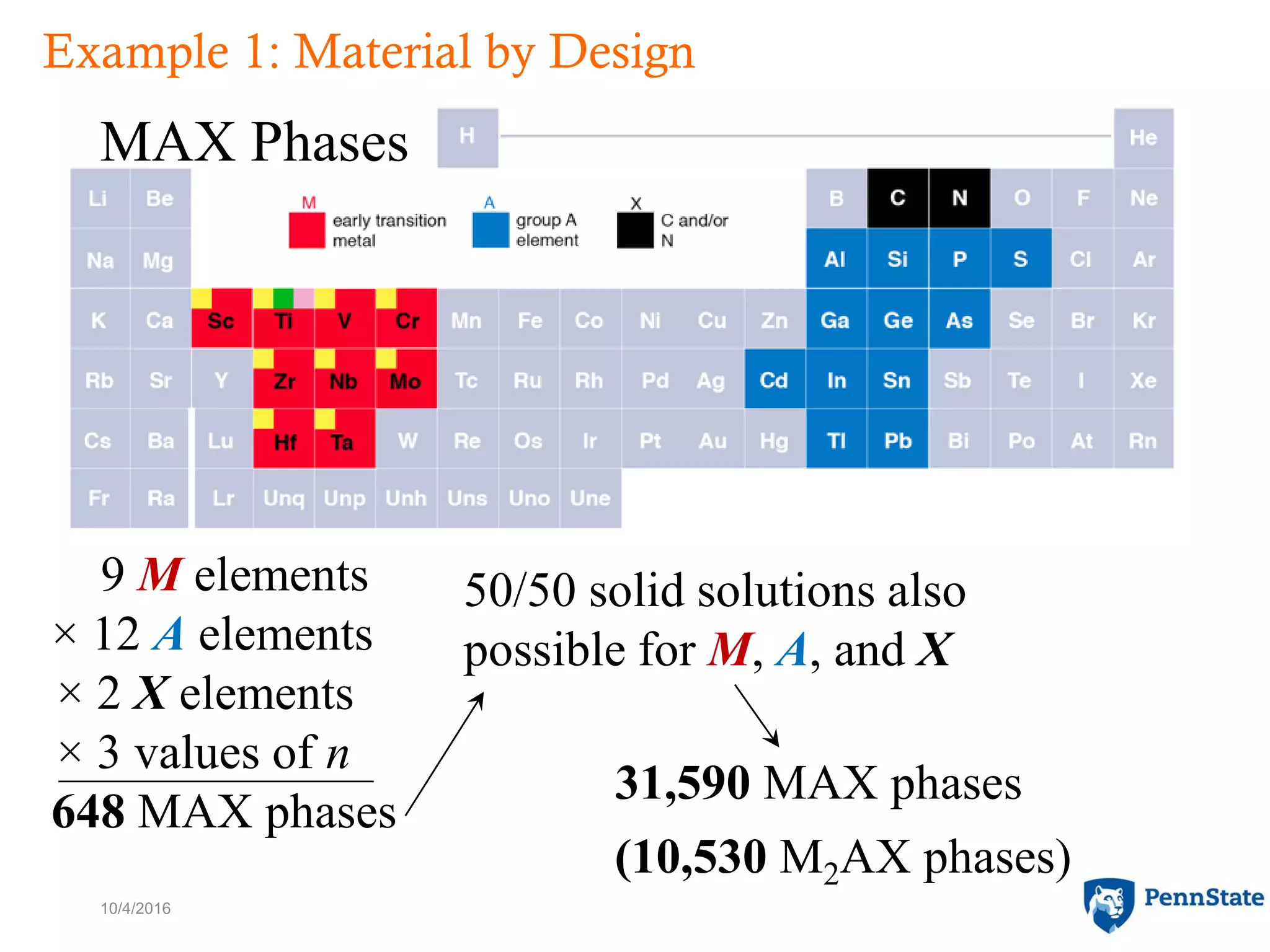
MAX Phases
10/4/2016
9 M elements
× 12 A elements
× 2 X elements
× 3 values of n
648 MAX phases
50/50 solid solutions also
possible for M, A, and X
31,590 MAX phases
(10,530 M2AX phases)
Example 1: Material by Design
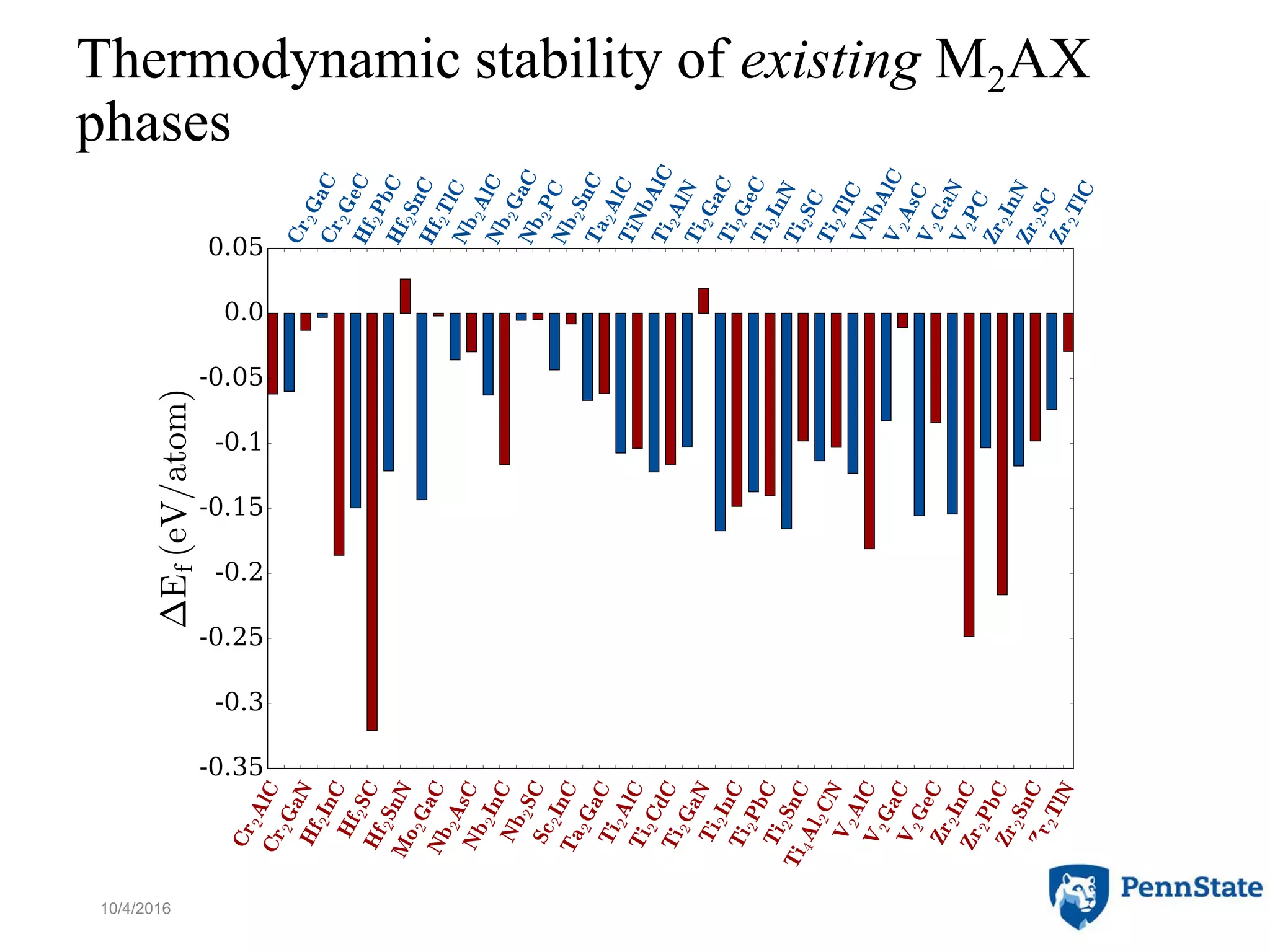
Thermodynamic stability of existing M2AX
phases
10/4/2016 4
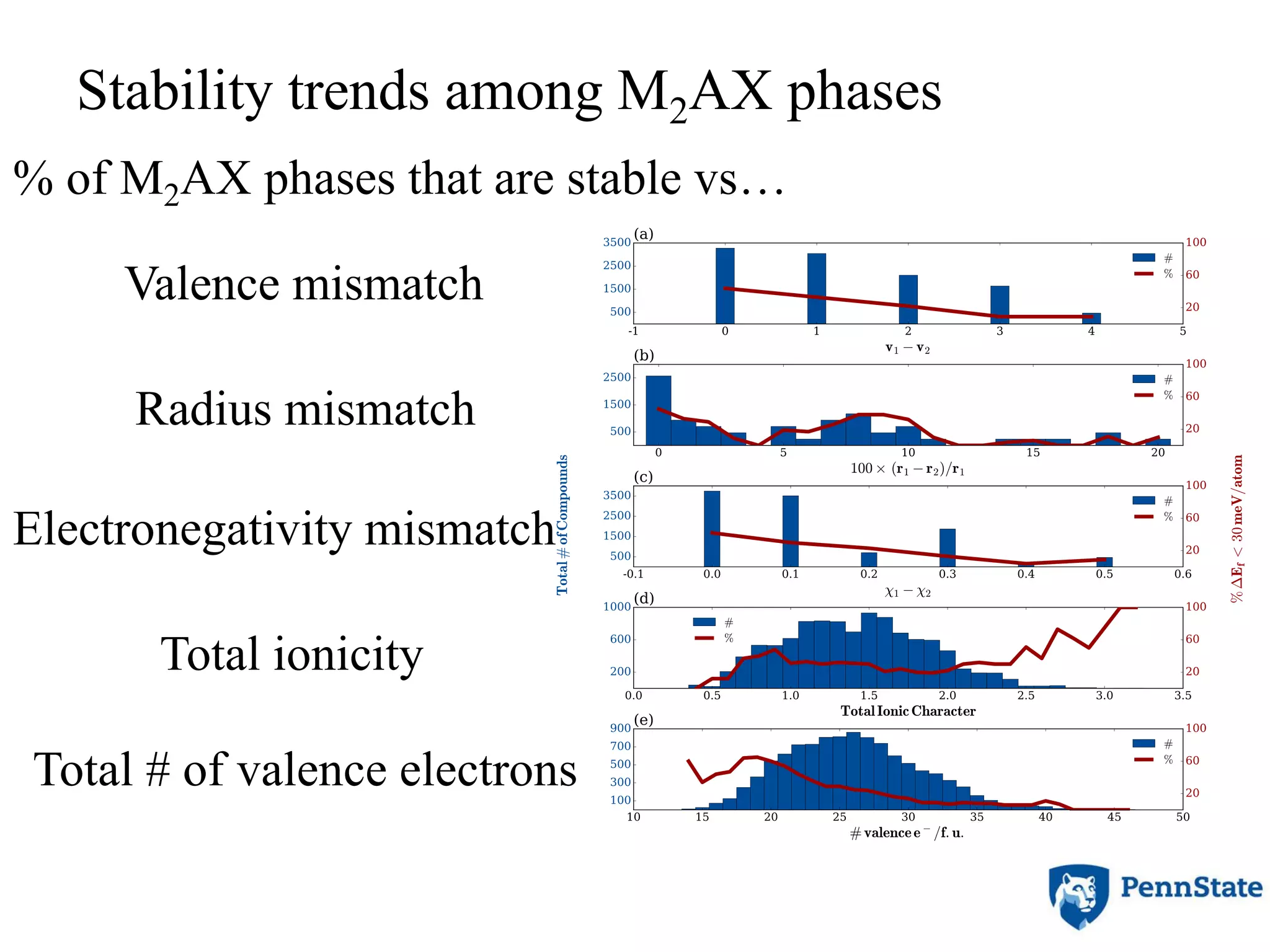
Stability trends among M2AX phases
5
Valence mismatch
Radius mismatch
Electronegativity mismatch
Total ionicity
Total # of valence electrons
% of M2AX phases that are stable vs…
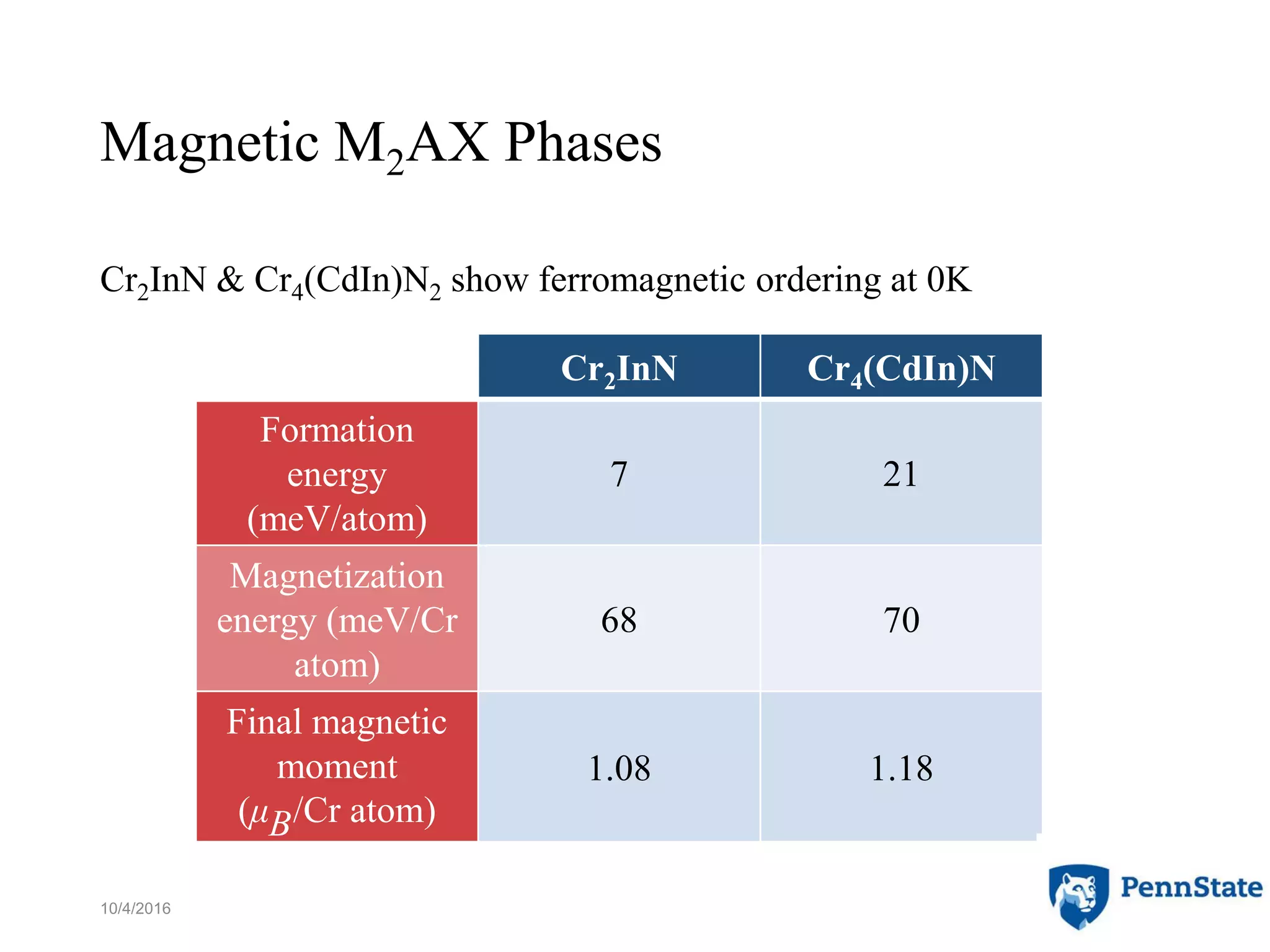
Magnetic M2AX Phases
Cr2InN & Cr4(CdIn)N2 show ferromagnetic ordering at 0K
10/4/2016 6
Cr2InN Cr4(CdIn)N
Formation
energy
(meV/atom)
7 21
Magnetization
energy (meV/Cr
atom)
68 70
Final magnetic
moment
(μB/Cr atom)
1.08 1.18
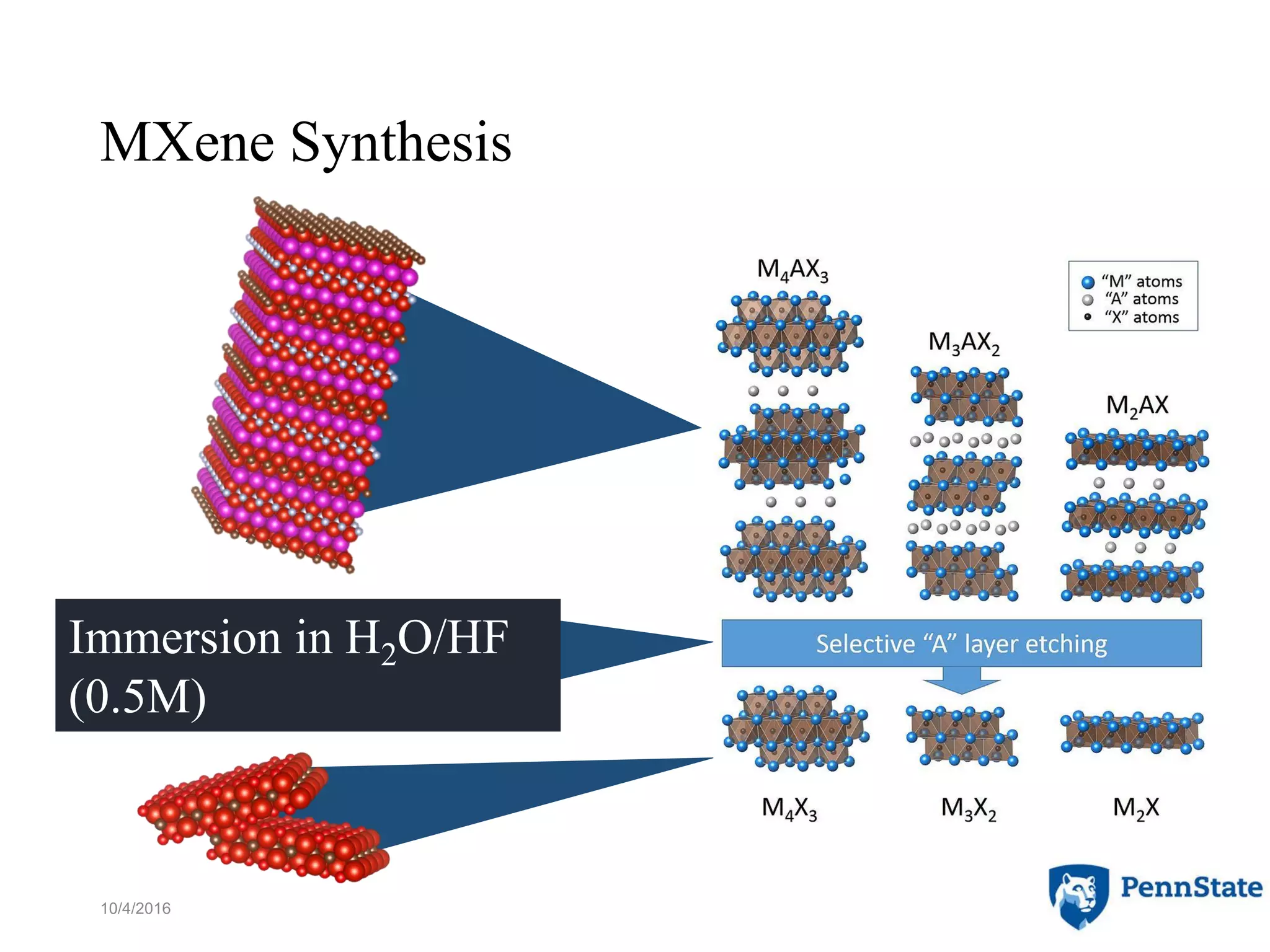
MXene Synthesis
10/4/2016 7
Immersion in H2O/HF
(0.5M)
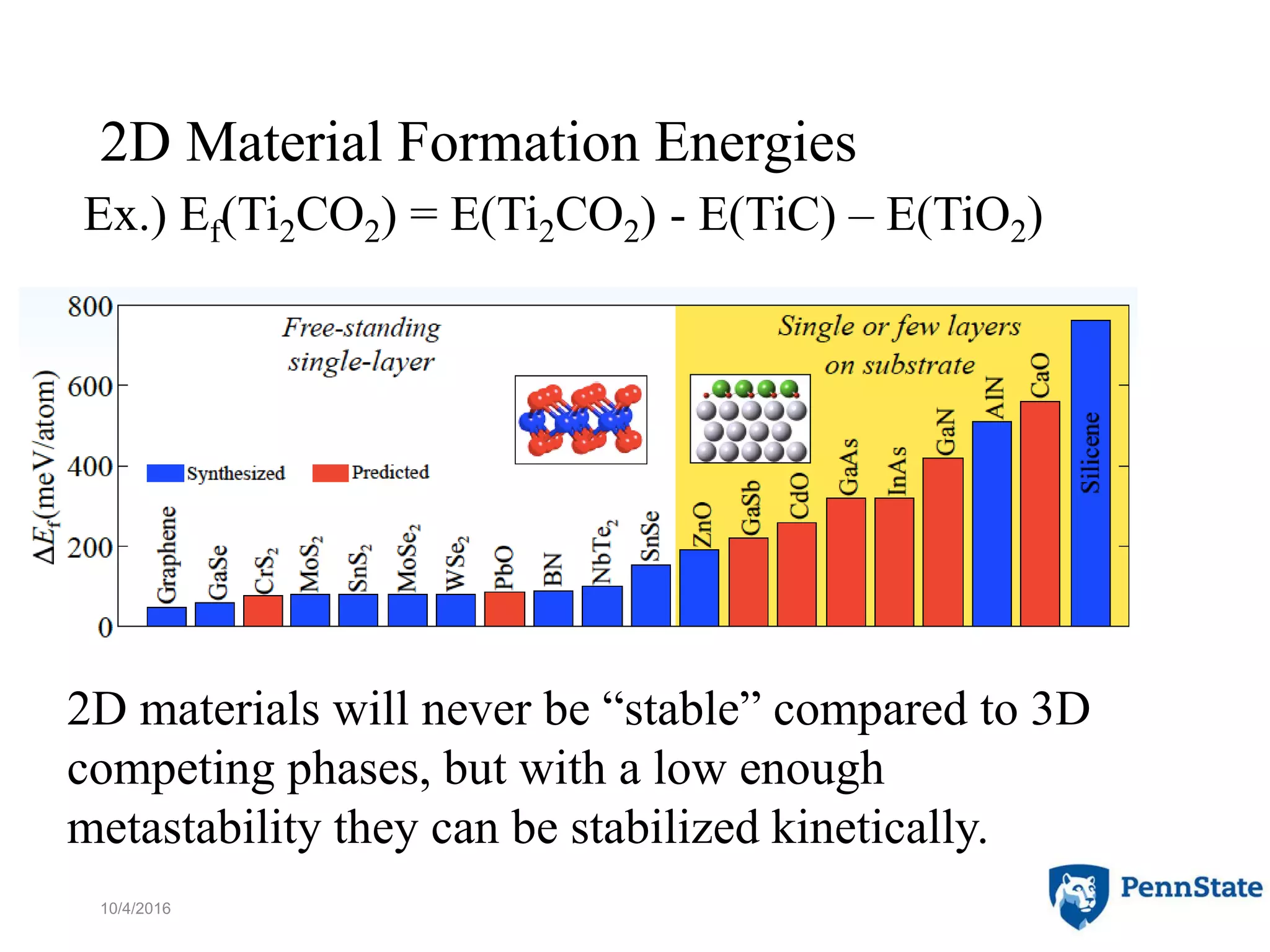
2D Material Formation Energies
10/4/2016 8
Ex.) Ef(Ti2CO2) = E(Ti2CO2) - E(TiC) – E(TiO2)
2D materials will never be “stable” compared to 3D
competing phases, but with a low enough
metastability they can be stabilized kinetically.
Comparing O, F, & OH Binding Energies
9
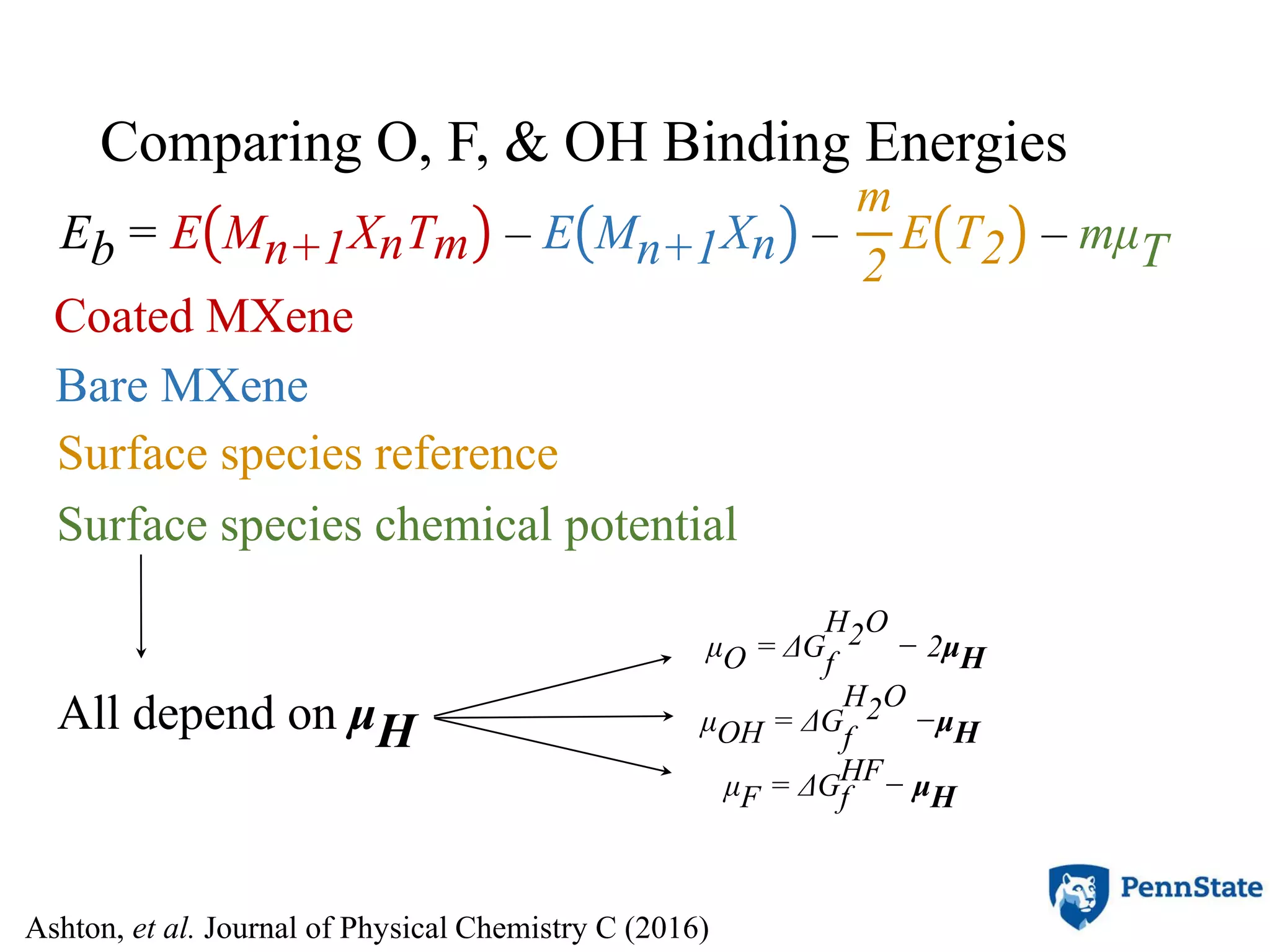
Eb = E Mn+1XnTm – E Mn+1Xn –
m
2
E T2 – mμT
Coated MXene
Bare MXene
Surface species reference
Surface species chemical potential
μO = ΔG
f
H2O
− 2μH
μOH = ΔG
f
H2O
−μH
μF = ΔGf
HF− μH
All depend on μH
Ashton, et al. Journal of Physical Chemistry C (2016)
Comparing O, F, & OH Binding Energies
10
Ti2C Sc2C
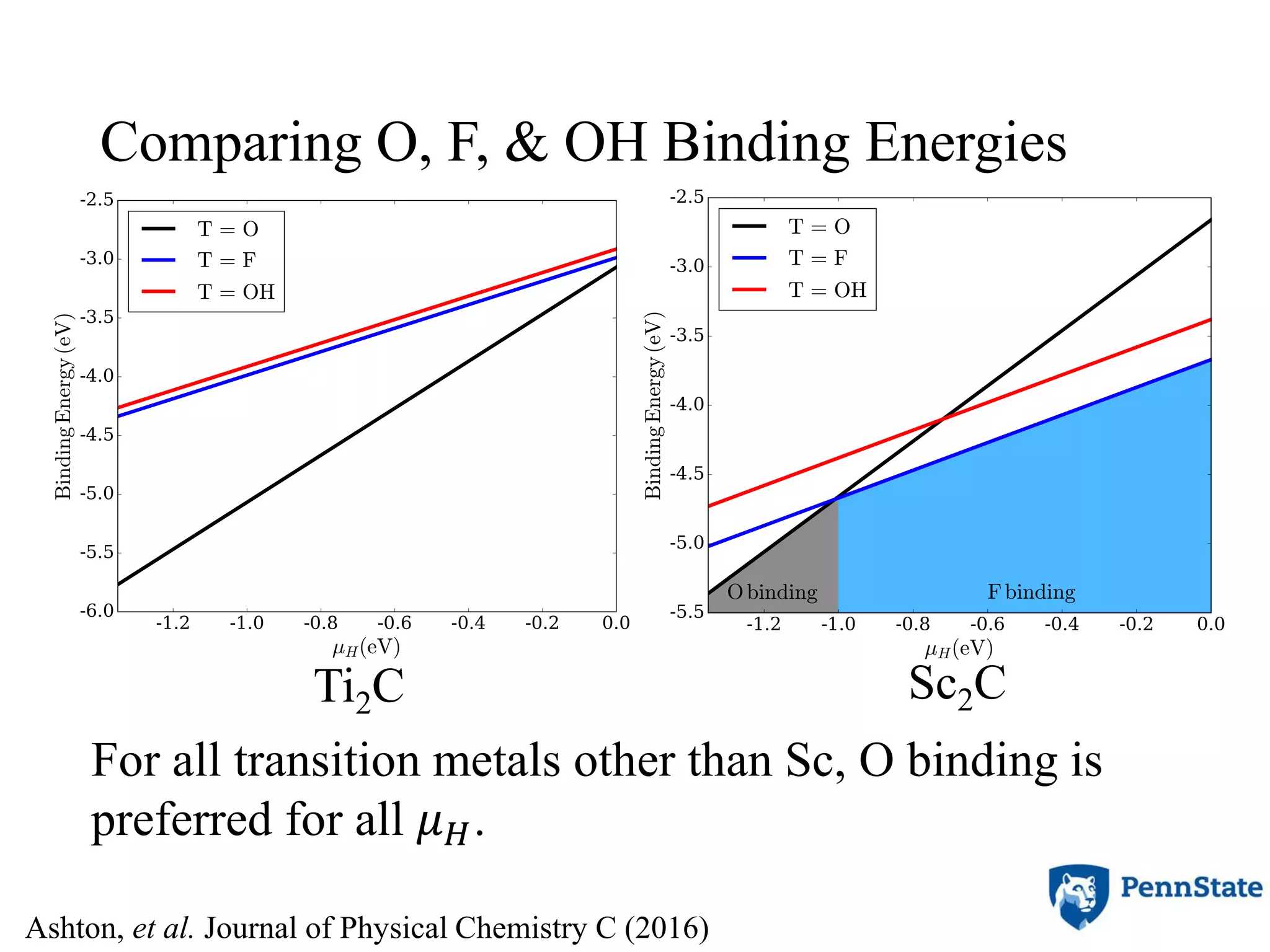
For all transition metals other than Sc, O binding is
preferred for all 𝜇 𝐻.
Ashton, et al. Journal of Physical Chemistry C (2016)
MXene Formation Energies
10/4/2016 11
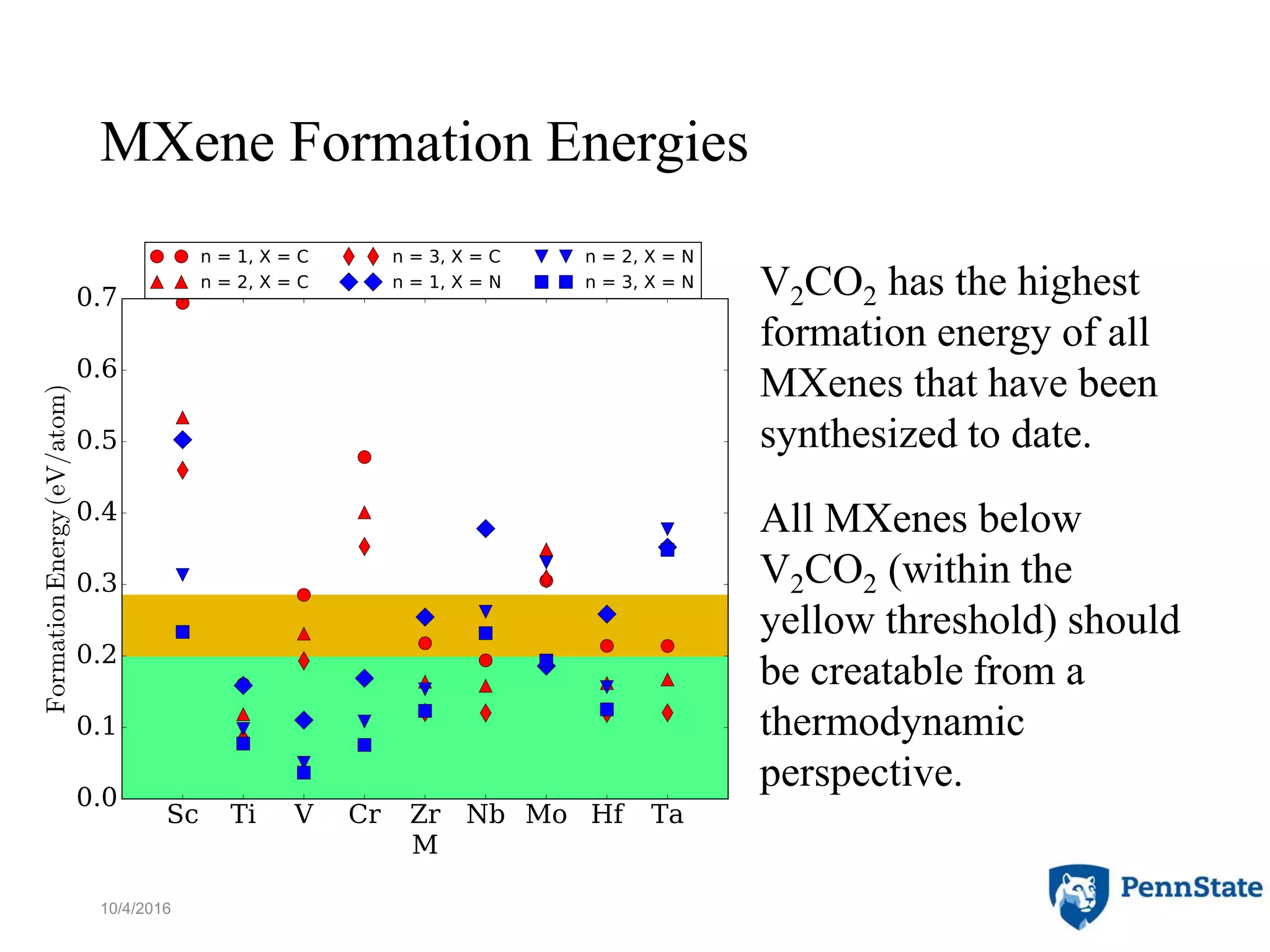
V2CO2 has the highest
formation energy of all
MXenes that have been
synthesized to date.
All MXenes below
V2CO2 (within the
yellow threshold) should
be creatable from a
thermodynamic
perspective.
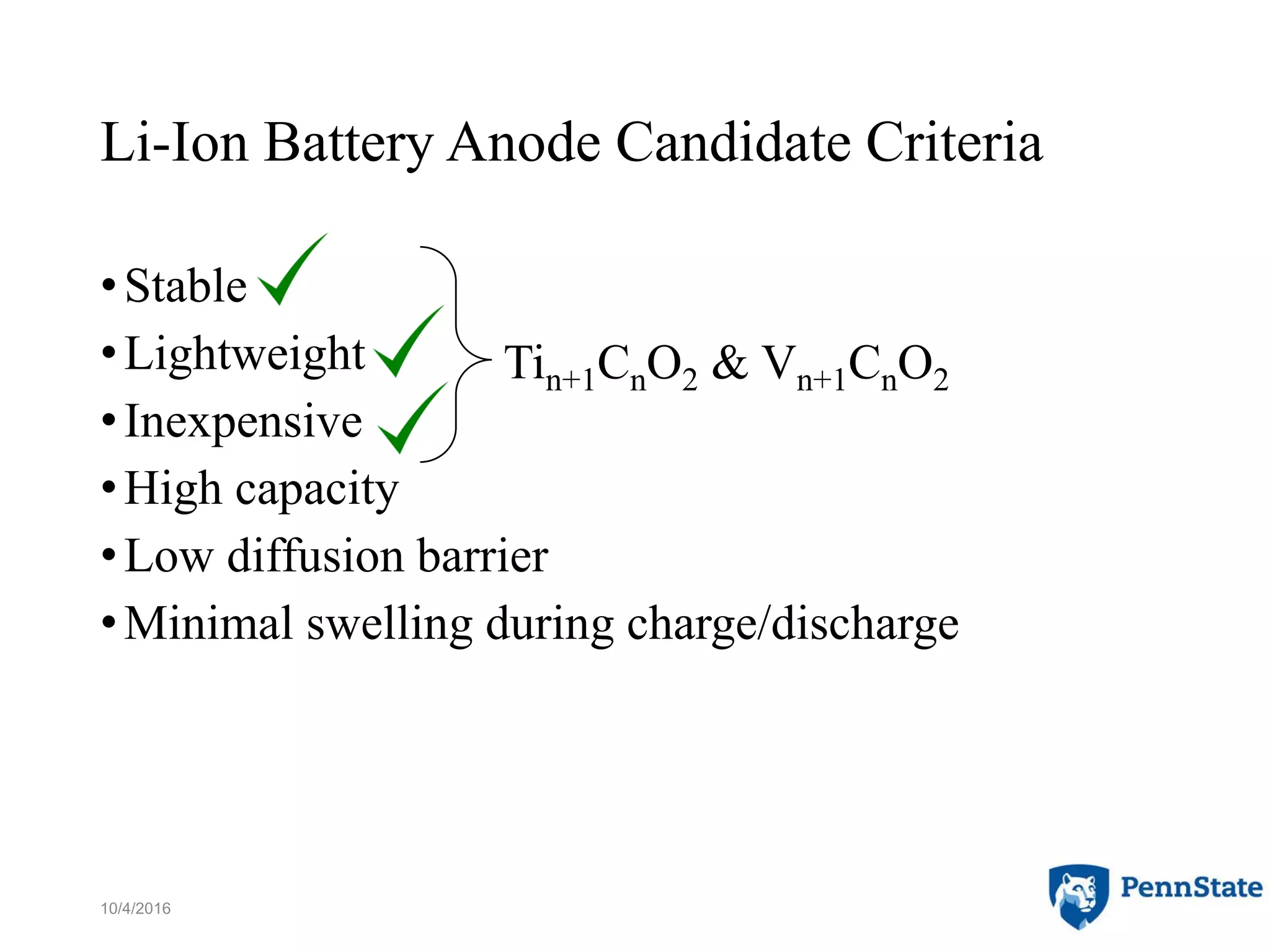
Li-Ion Battery Anode Candidate Criteria
•Stable
•Lightweight
•Inexpensive
•High capacity
•Low diffusion barrier
•Minimal swelling during charge/discharge
10/4/2016 12
Tin+1CnO2 & Vn+1CnO2
Diffusion Pathways in Multilayer MXenes
10/4/2016 13
O (over)O (under) Li
(a) (b)
[0100]
[1000]
a
b
[1200]
[1100]
Monolayer Multilayer
ΔE (eV)
1.0
2.0
3.0
4.0
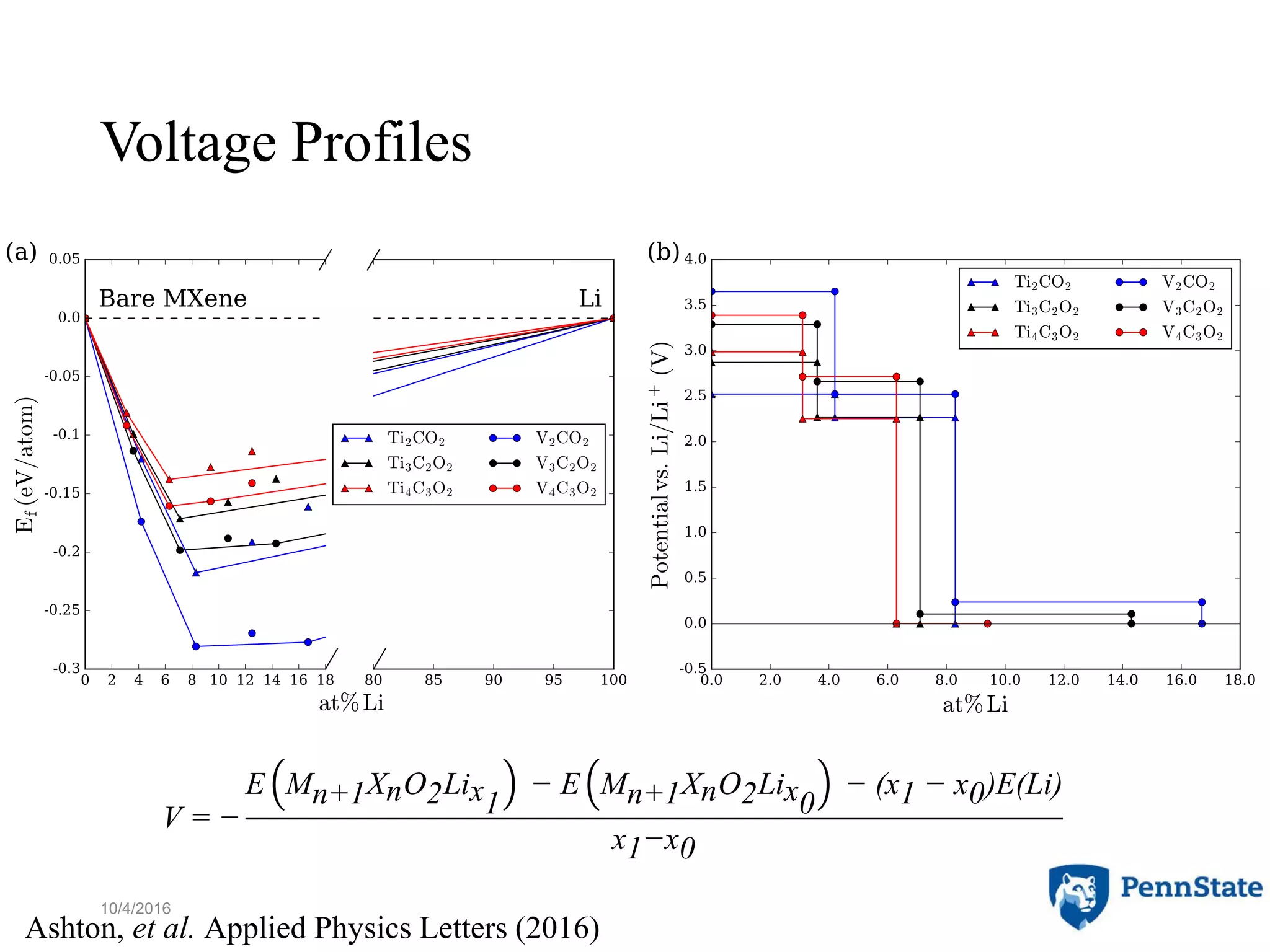
Voltage Profiles
10/4/2016 14
V = −
E Mn+1XnO2Lix1
− E Mn+1XnO2Lix0
− (x1 − x0)E(Li)
x1−x0
Ashton, et al. Applied Physics Letters (2016)
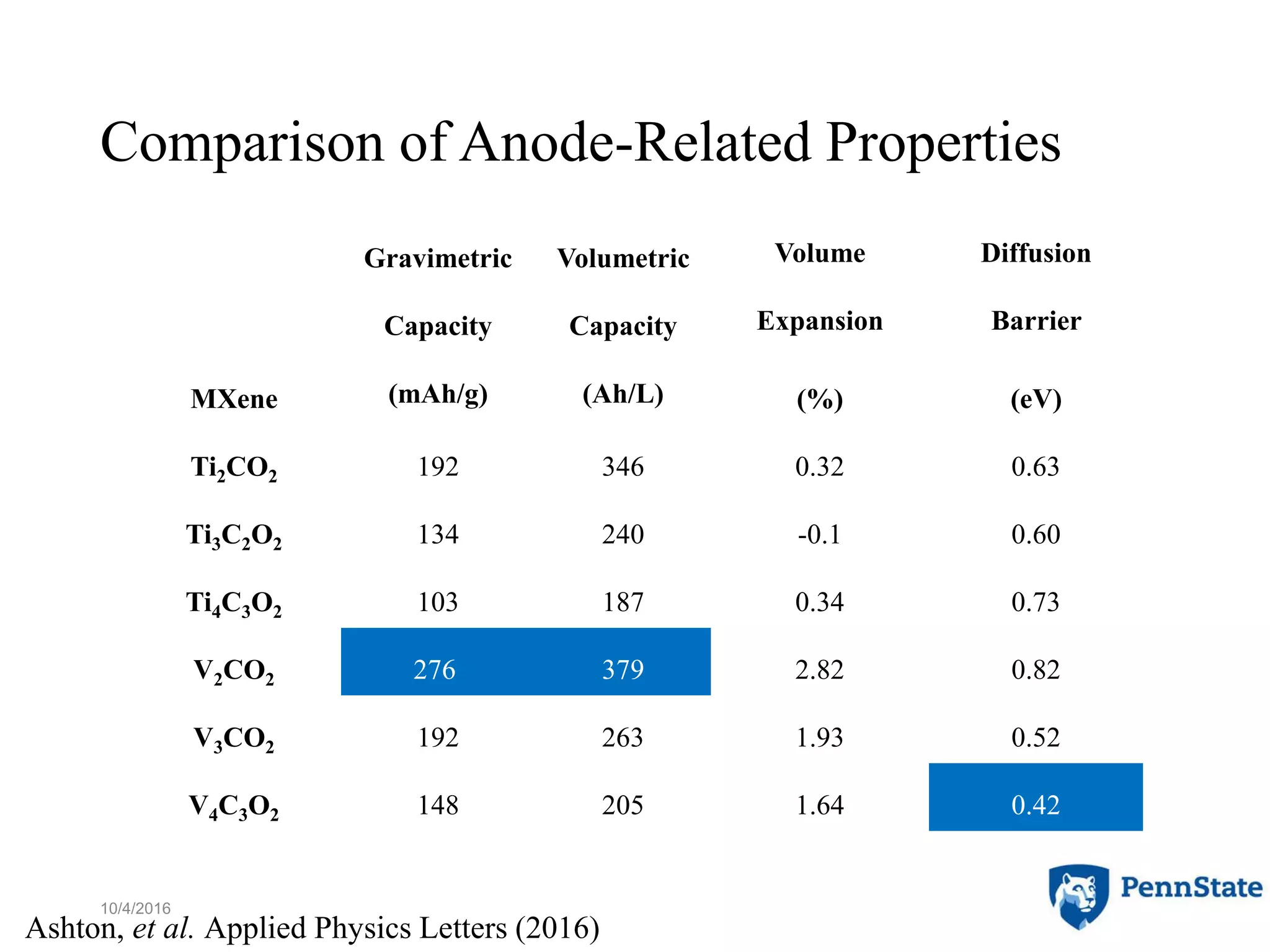
Comparison of Anode-Related Properties
10/4/2016 15
MXene
Gravimetric
Capacity
(mAh/g)
Volumetric
Capacity
(Ah/L)
Volume
Expansion
(%)
Diffusion
Barrier
(eV)
Ti2CO2 192 346 0.32 0.63
Ti3C2O2 134 240 -0.1 0.60
Ti4C3O2 103 187 0.34 0.73
V2CO2 276 379 2.82 0.82
V3CO2 192 263 1.93 0.52
V4C3O2 148 205 1.64 0.42
Ashton, et al. Applied Physics Letters (2016)
Example 2: Nickel-Based Superalloy Design
BRI: Searching for RE Alternative
through Crystal Engineering
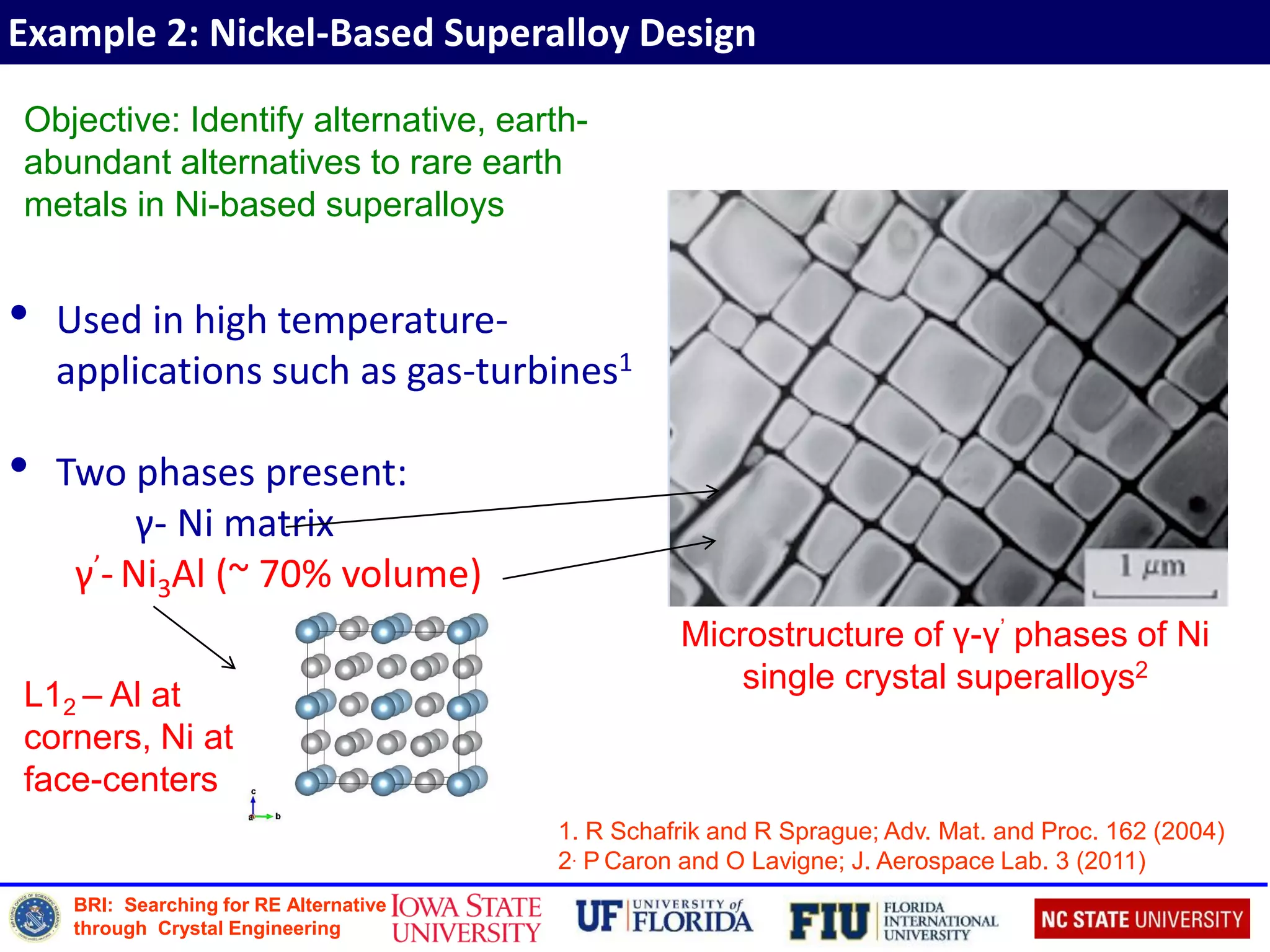
• Used in high temperature-
applications such as gas-turbines1
• Two phases present:
γ- Ni matrix
γ’- Ni3Al (~ 70% volume)
Microstructure of γ-γ’ phases of Ni
single crystal superalloys2
L12 – Al at
corners, Ni at
face-centers
1. R Schafrik and R Sprague; Adv. Mat. and Proc. 162 (2004)
2. P Caron and O Lavigne; J. Aerospace Lab. 3 (2011)
Objective: Identify alternative, earth-
abundant alternatives to rare earth
metals in Ni-based superalloys
BRI: Searching for RE Alternative
through Crystal Engineering
Defect Formation Energy
Defect formation energy of incorporating dopant X is defined as:
Etot[Xq] = total energy of the system with the defect
Etot[bulk] = total energy of the system without the defect
n = number of atoms added (n > 0) or removed (n < 0)
μi = chemical potential of species i
X Ef (XAl) (eV) Ef (XNi) (eV)
B 2.60 0.87
Cr 1.40 (1.351) 0.93 (0.921)
Ce 0.81 1.81
Zr 0.10 (0.041) 0.31 (0.201)
1. D E Kim, S L Shang, Z K Liu; Intermetallics 18 (2010)
BRI: Searching for RE Alternative
through Crystal Engineering
DFT-Materials Informatics-Experiment
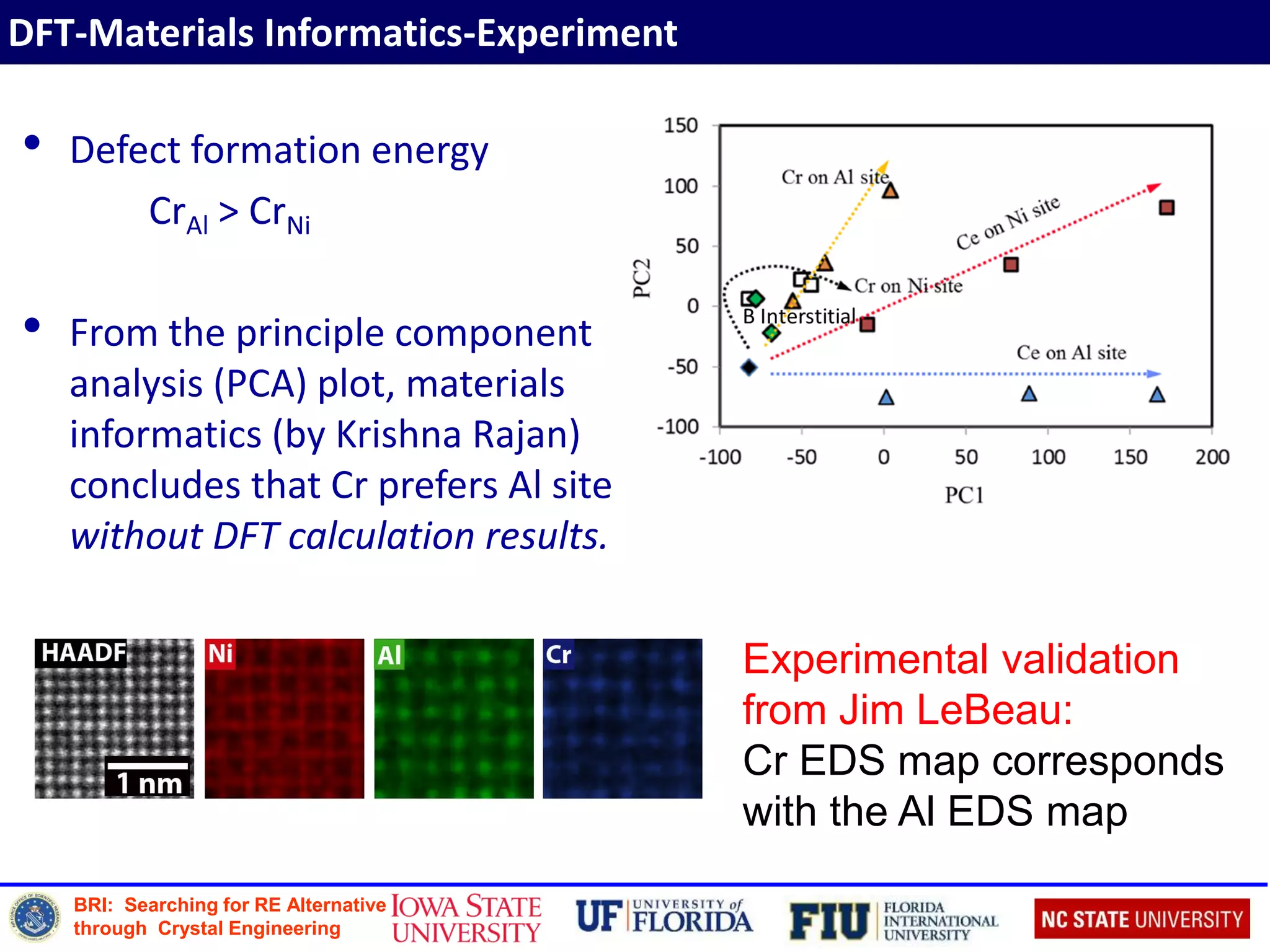
• Defect formation energy
CrAl > CrNi
• From the principle component
analysis (PCA) plot, materials
informatics (by Krishna Rajan)
concludes that Cr prefers Al site
without DFT calculation results.
Experimental validation
from Jim LeBeau:
Cr EDS map corresponds
with the Al EDS map
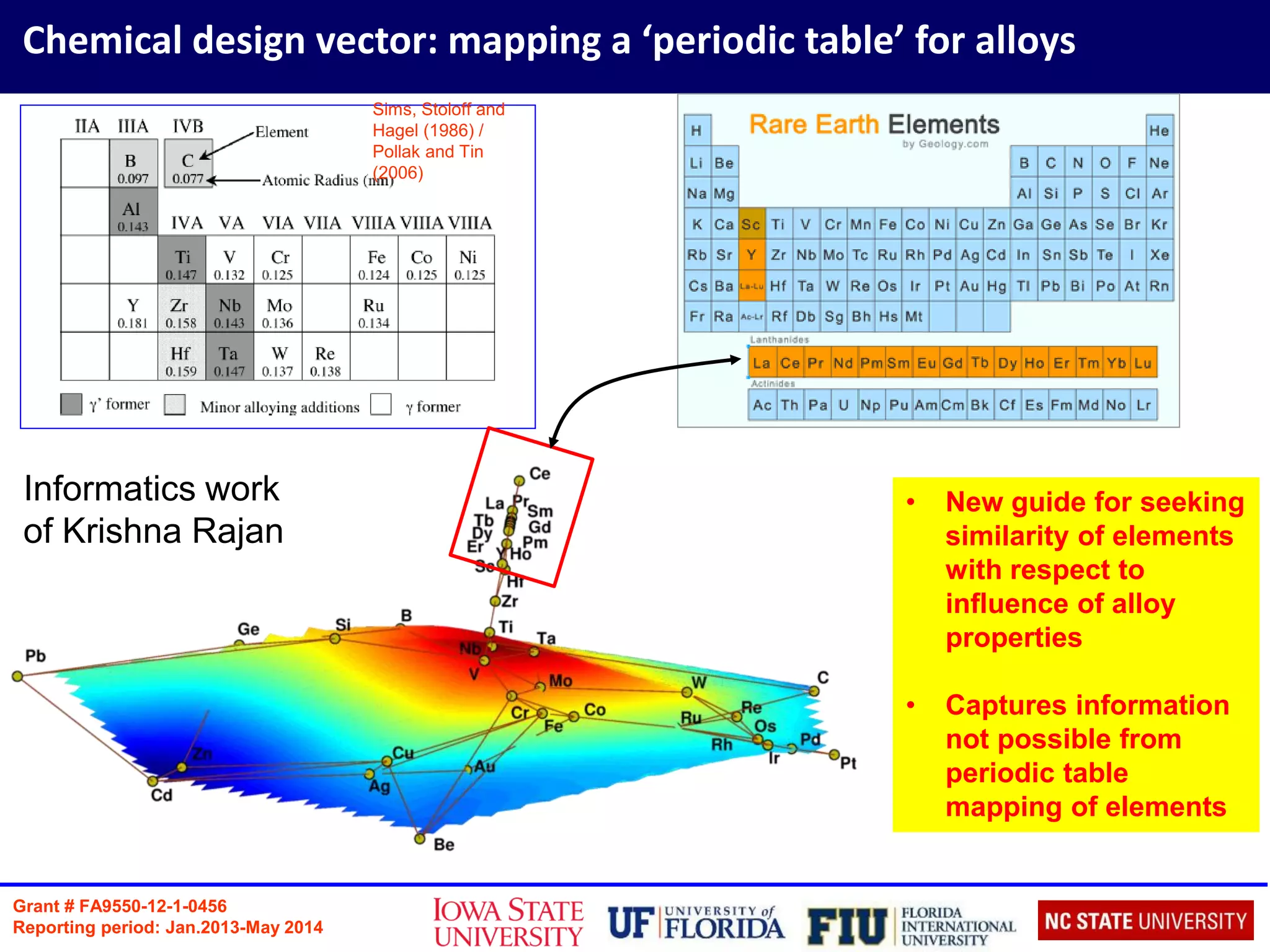
Chemical design vector: mapping a ‘periodic table’ for alloys
Grant # FA9550-12-1-0456
Reporting period: Jan.2013-May 2014
Sims, Stoloff and
Hagel (1986) /
Pollak and Tin
(2006)
• New guide for seeking
similarity of elements
with respect to
influence of alloy
properties
• Captures information
not possible from
periodic table
mapping of elements
Informatics work
of Krishna Rajan
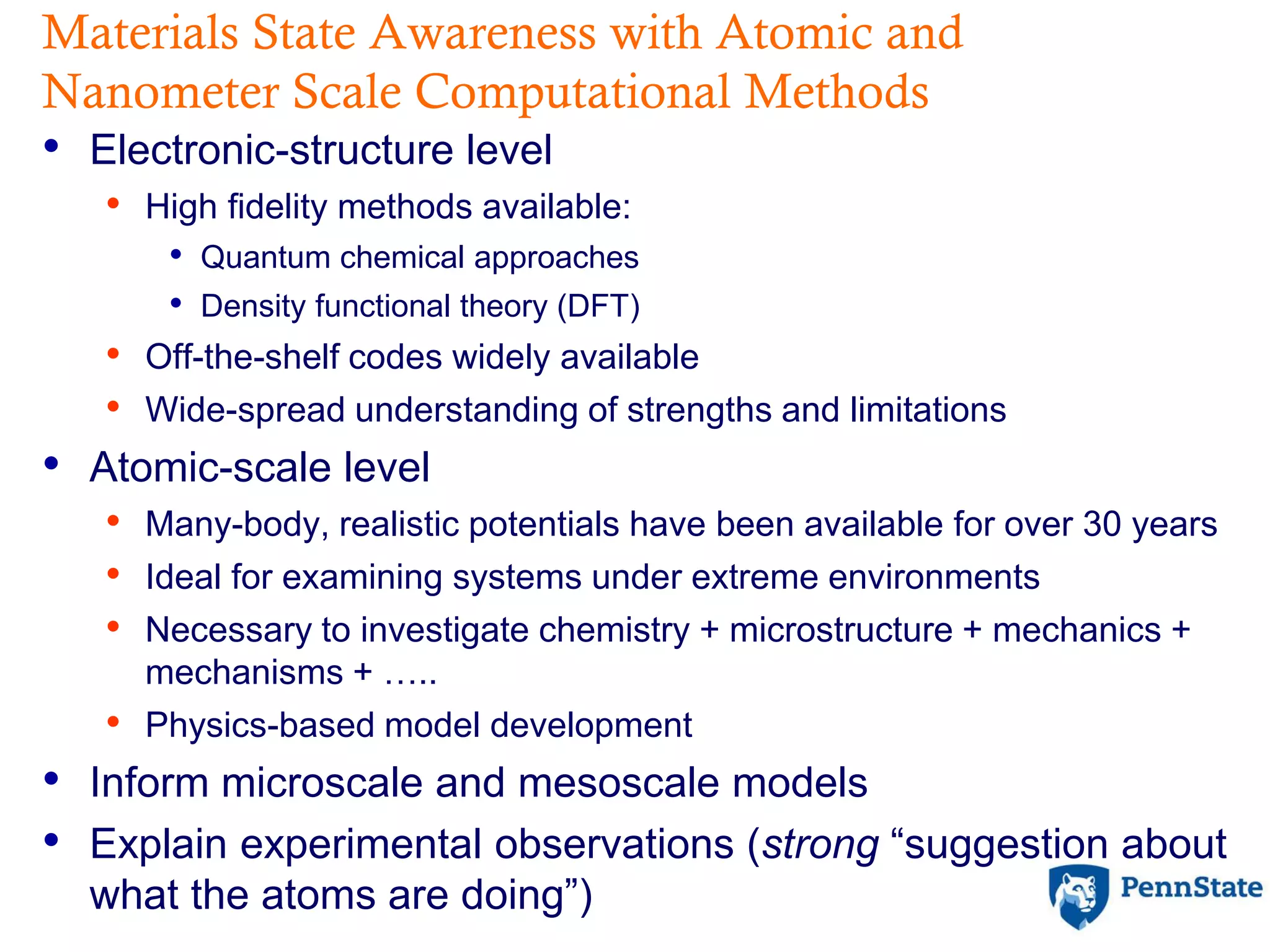
Materials State Awareness with Atomic and
Nanometer Scale Computational Methods
• Electronic-structure level
• High fidelity methods available:
• Quantum chemical approaches
• Density functional theory (DFT)
• Off-the-shelf codes widely available
• Wide-spread understanding of strengths and limitations
• Atomic-scale level
• Many-body, realistic potentials have been available for over 30 years
• Ideal for examining systems under extreme environments
• Necessary to investigate chemistry + microstructure + mechanics +
mechanisms + …..
• Physics-based model development
• Inform microscale and mesoscale models
• Explain experimental observations (strong “suggestion about
what the atoms are doing”)
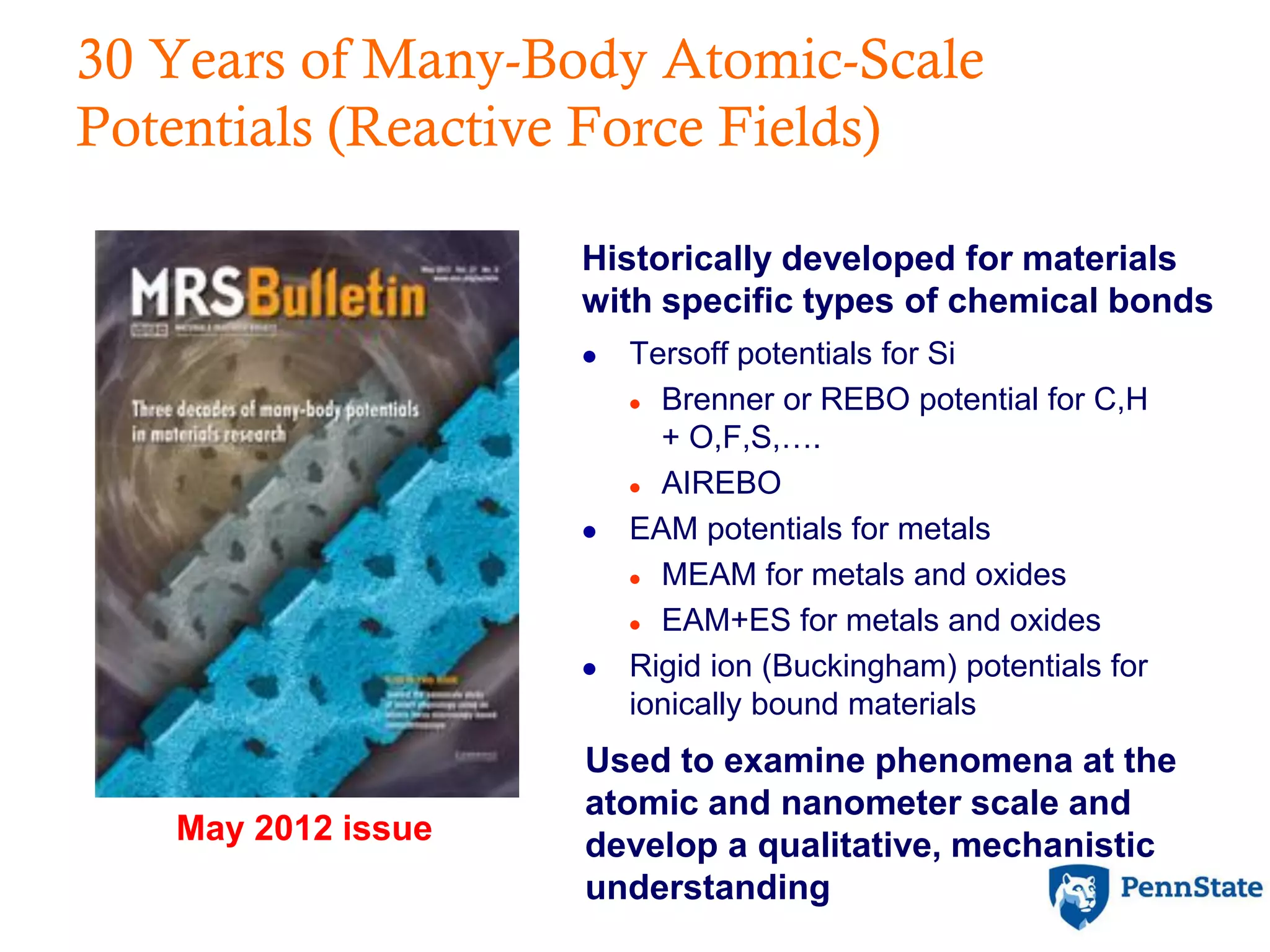
30 Years of Many-Body Atomic-Scale
Potentials (Reactive Force Fields)
May 2012 issue
Historically developed for materials
with specific types of chemical bonds
 Tersoff potentials for Si
 Brenner or REBO potential for C,H
+ O,F,S,….
 AIREBO
 EAM potentials for metals
 MEAM for metals and oxides
 EAM+ES for metals and oxides
 Rigid ion (Buckingham) potentials for
ionically bound materials
Used to examine phenomena at the
atomic and nanometer scale and
develop a qualitative, mechanistic
understanding
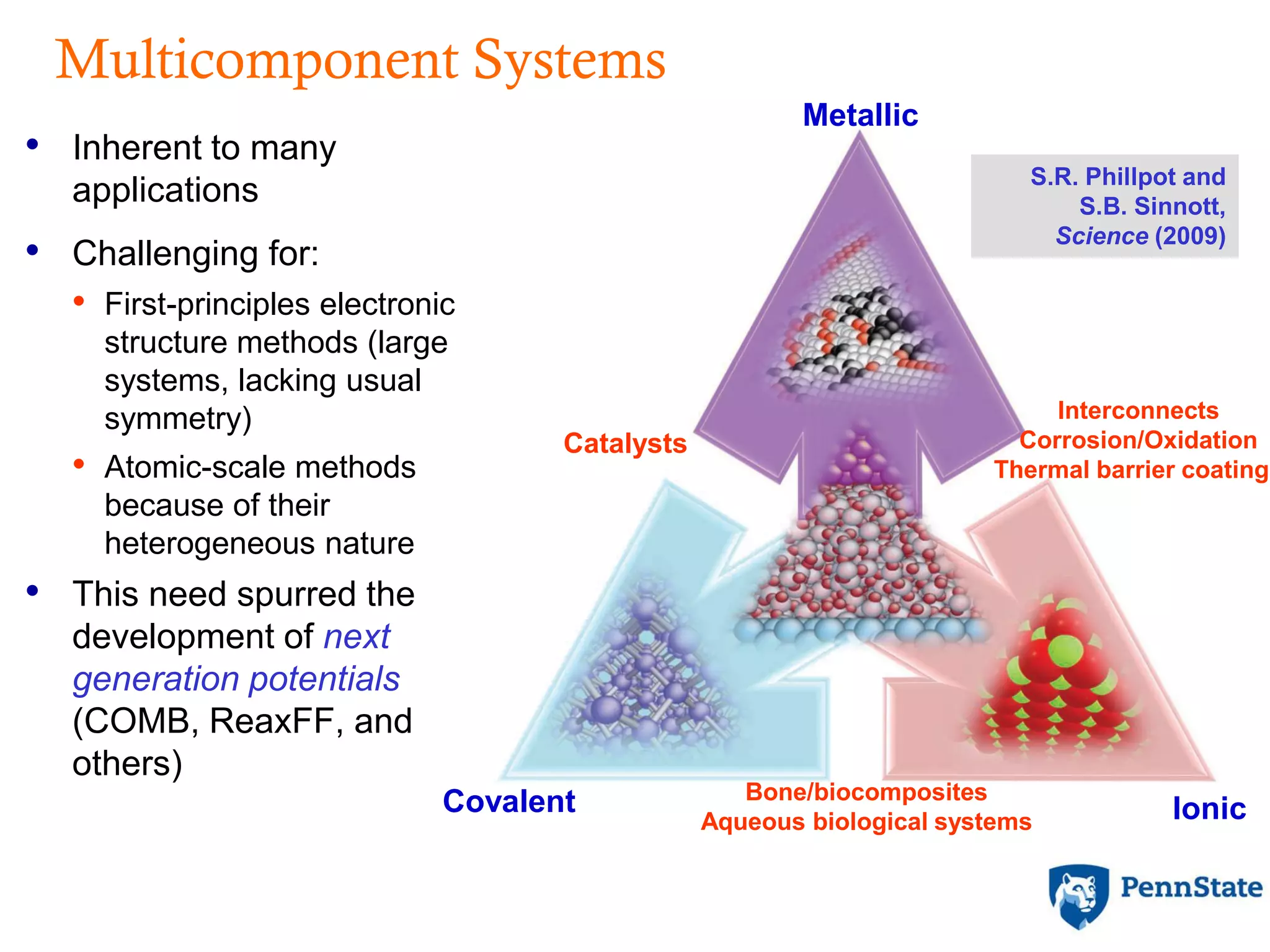
Metallic
IonicCovalent Bone/biocomposites
Aqueous biological systems
Interconnects
Corrosion/Oxidation
Thermal barrier coatings
Catalysts
Multicomponent Systems
• Inherent to many
applications
• Challenging for:
• First-principles electronic
structure methods (large
systems, lacking usual
symmetry)
• Atomic-scale methods
because of their
heterogeneous nature
• This need spurred the
development of next
generation potentials
(COMB, ReaxFF, and
others)
S.R. Phillpot and
S.B. Sinnott,
Science (2009)
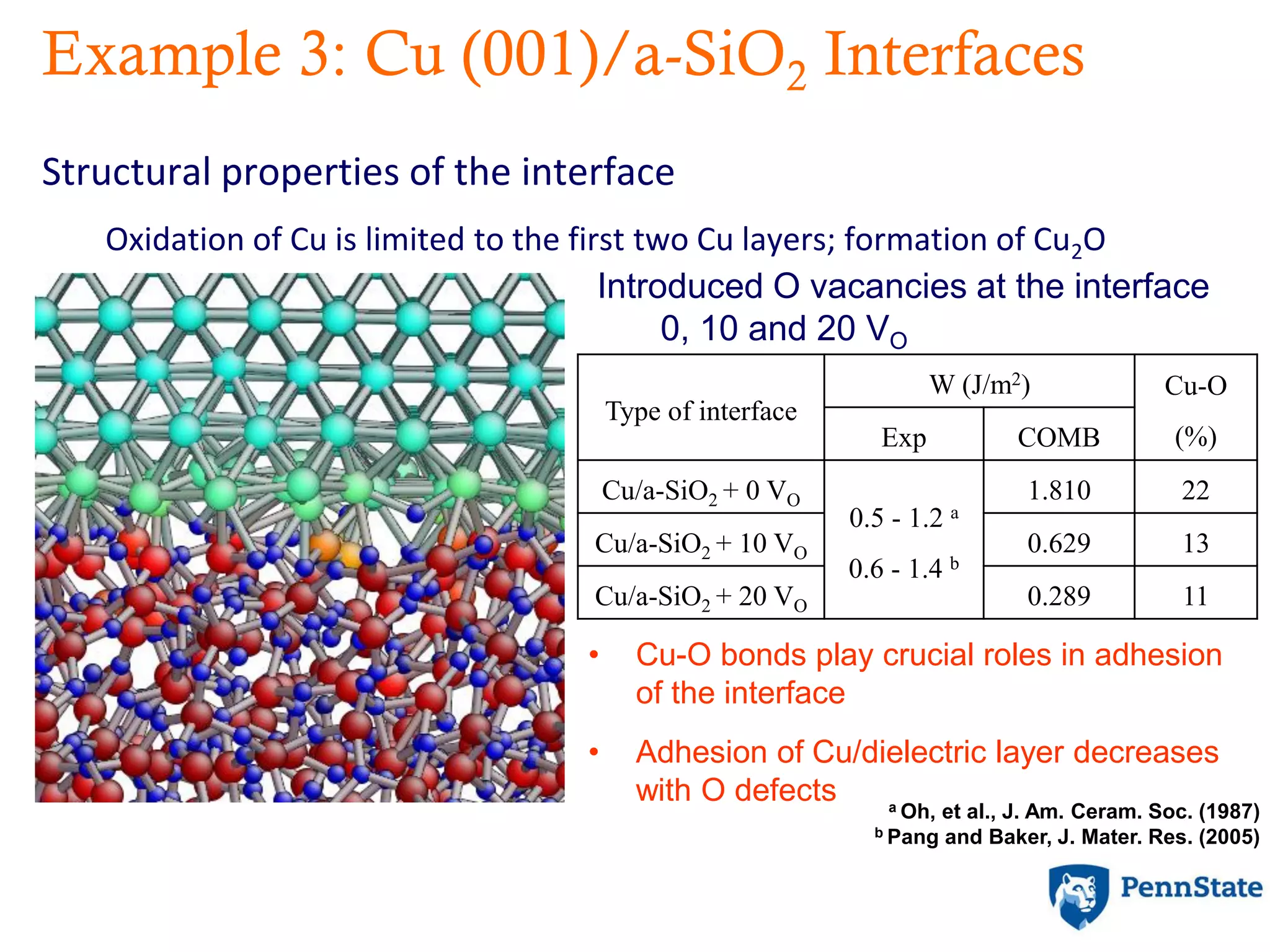
Example 3: Cu (001)/a-SiO2 Interfaces
Structural properties of the interface
Oxidation of Cu is limited to the first two Cu layers; formation of Cu2O
Type of interface
W (J/m2) Cu-O
(%)Exp COMB
Cu/a-SiO2 + 0 VO
0.5 - 1.2 a
0.6 - 1.4 b
1.810 22
Cu/a-SiO2 + 10 VO 0.629 13
Cu/a-SiO2 + 20 VO 0.289 11
a Oh, et al., J. Am. Ceram. Soc. (1987)
b Pang and Baker, J. Mater. Res. (2005)
• Cu-O bonds play crucial roles in adhesion
of the interface
• Adhesion of Cu/dielectric layer decreases
with O defects
Introduced O vacancies at the interface
0, 10 and 20 VO
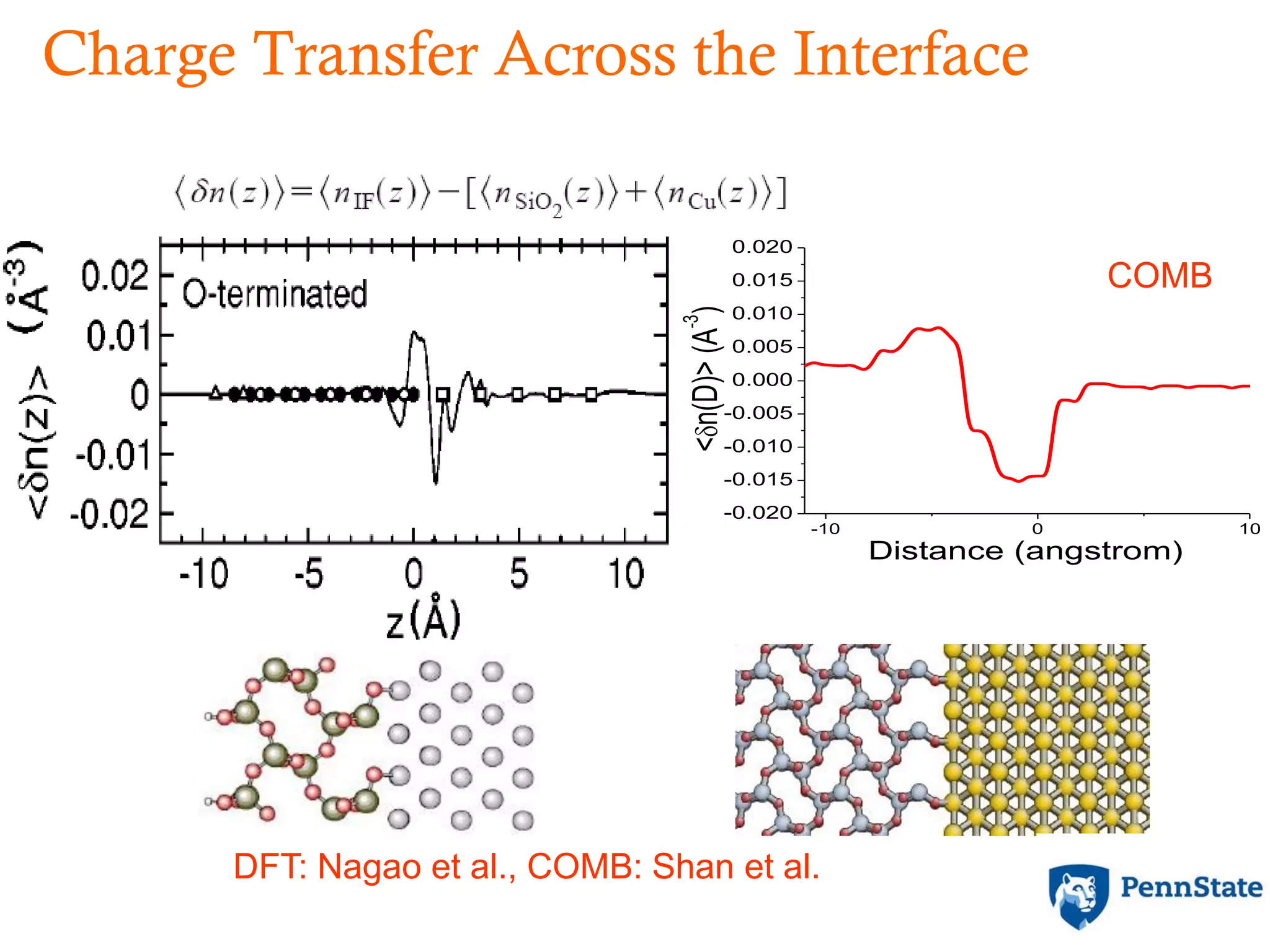
Charge Transfer Across the Interface
DFT: Nagao et al., COMB: Shan et al.
-10 0 10
-0.020
-0.015
-0.010
-0.005
0.000
0.005
0.010
0.015
0.020
<n(D)>(A
-3
)
Distance (angstrom)
COMB
BRI: Searching for RE Alternative
through Crystal Engineering
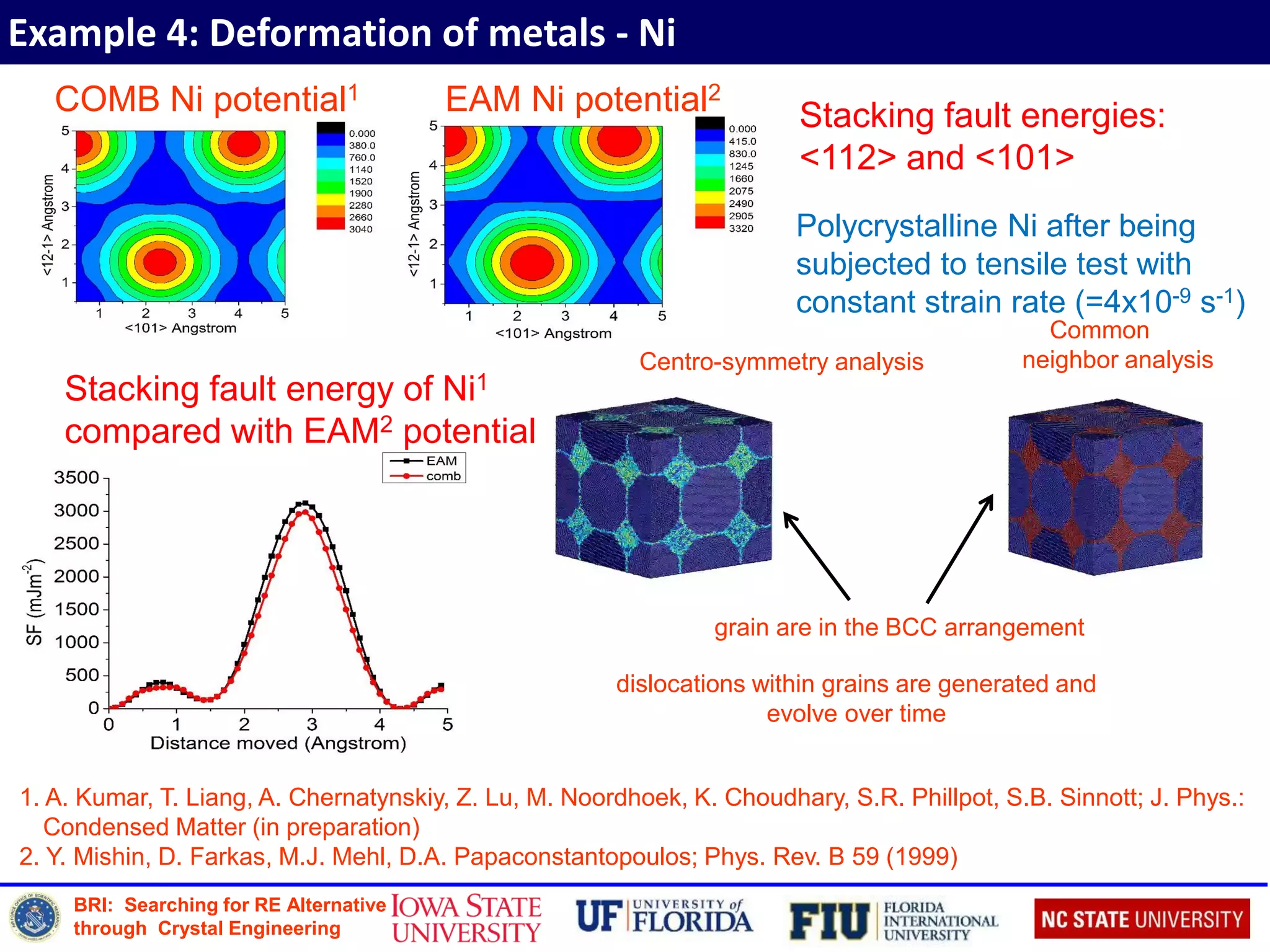
Example 4: Deformation of metals - Ni
dislocations within grains are generated and
evolve over time
grain are in the BCC arrangement
Common
neighbor analysis
Polycrystalline Ni after being
subjected to tensile test with
constant strain rate (=4x10⁻⁹ s-1)
1. A. Kumar, T. Liang, A. Chernatynskiy, Z. Lu, M. Noordhoek, K. Choudhary, S.R. Phillpot, S.B. Sinnott; J. Phys.:
Condensed Matter (in preparation)
2. Y. Mishin, D. Farkas, M.J. Mehl, D.A. Papaconstantopoulos; Phys. Rev. B 59 (1999)
Stacking fault energies:
<112> and <101>
COMB Ni potential1 EAM Ni potential2
Stacking fault energy of Ni1
compared with EAM2 potential
Centro-symmetry analysis
BRI: Searching for RE Alternative
through Crystal Engineering
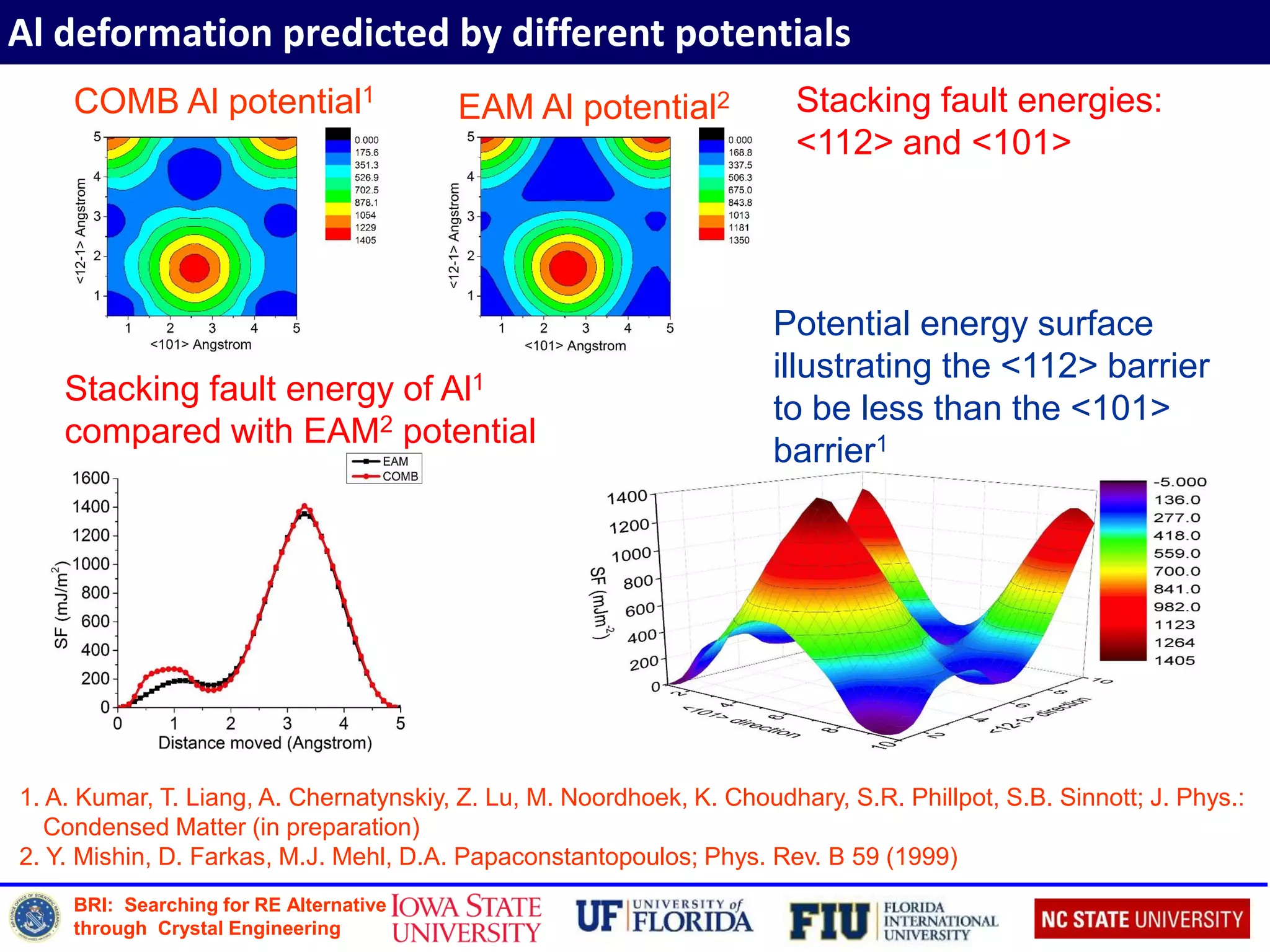
Al deformation predicted by different potentials
COMB Al potential1
EAM Al potential2 Stacking fault energies:
<112> and <101>
Stacking fault energy of Al1
compared with EAM2 potential
1. A. Kumar, T. Liang, A. Chernatynskiy, Z. Lu, M. Noordhoek, K. Choudhary, S.R. Phillpot, S.B. Sinnott; J. Phys.:
Condensed Matter (in preparation)
2. Y. Mishin, D. Farkas, M.J. Mehl, D.A. Papaconstantopoulos; Phys. Rev. B 59 (1999)
Potential energy surface
illustrating the <112> barrier
to be less than the <101>
barrier1
BRI: Searching for RE Alternative
through Crystal Engineering
Mechanical deformation of Ni3Al at the g/g’ interface
1. A. Kumar, T. Liang, A. Chernatynskiy, Z. Lu, M. Noordhoek, K. Choudhary, S. R. Phillpot, S.B. Sinnott (in
preparation)
2. M.H. Yoo, M.S. Daw, M.I. Baskes, V. Vitek, D.J. Srolovitz, Eds.; New York: Plenum Press; 1989. p. 401.
Thermostat
Active
Rigid moving
Rigid moving
Thermostat
Active
Ni3Al
Ni
τzx
Z
[010]
X
[101]
Y
[10 -1]
τzx
• Edge dislocations at the Ni-Ni3Al interface
• Predict mechanisms associated with
applied shear stress and dislocation
motion
Ni3Al Ec
(eV/atom)
B
(GPa)
G
(GPa)
COMB1 -4.61 198 93
exp.2 -4.62 195 96
Simulation box size:
16.67x16.67x9.21 nm3
Total number of
atoms: 179,600
Dislocation
Technical Fundamental Barriers
• Parameterization of transferrable, next-generation potentials is non-
trivial. For some historical potentials, numerous parameterizations exist.
The general equation for COMB is:
.
• Validation of predicted trends and quantification of error bars.
• Comfort within the broader community of how and when potentials work
well and when the transferability of parameterized properties breaks
down. The materials community is familiar with strengths and limitations
of electronic structure calculations and continuum level (e.g., finite-
element level modeling). Non-experts are less comfortable with atomic-
scale methods.
• Dissemination is straightforward, maintenance is challenging!
   






i
ij
vdW
ji
polar
ij
jikijiiijiijiji
S
iT rEriqErCqBqqrVqEE )(),(),()(,,
2
1
)( 
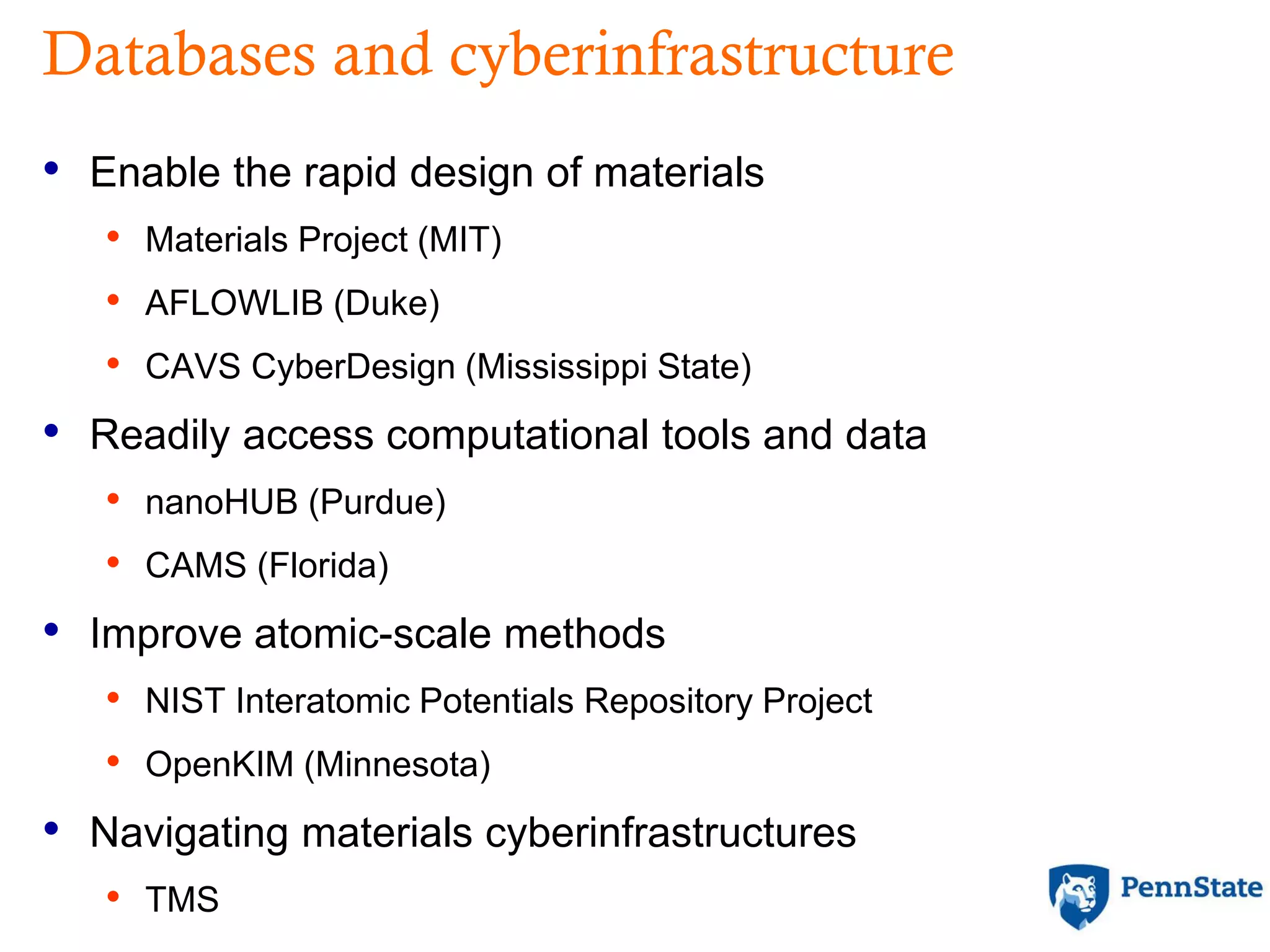
Databases and cyberinfrastructure
• Enable the rapid design of materials
• Materials Project (MIT)
• AFLOWLIB (Duke)
• CAVS CyberDesign (Mississippi State)
• Readily access computational tools and data
• nanoHUB (Purdue)
• CAMS (Florida)
• Improve atomic-scale methods
• NIST Interatomic Potentials Repository Project
• OpenKIM (Minnesota)
• Navigating materials cyberinfrastructures
• TMS
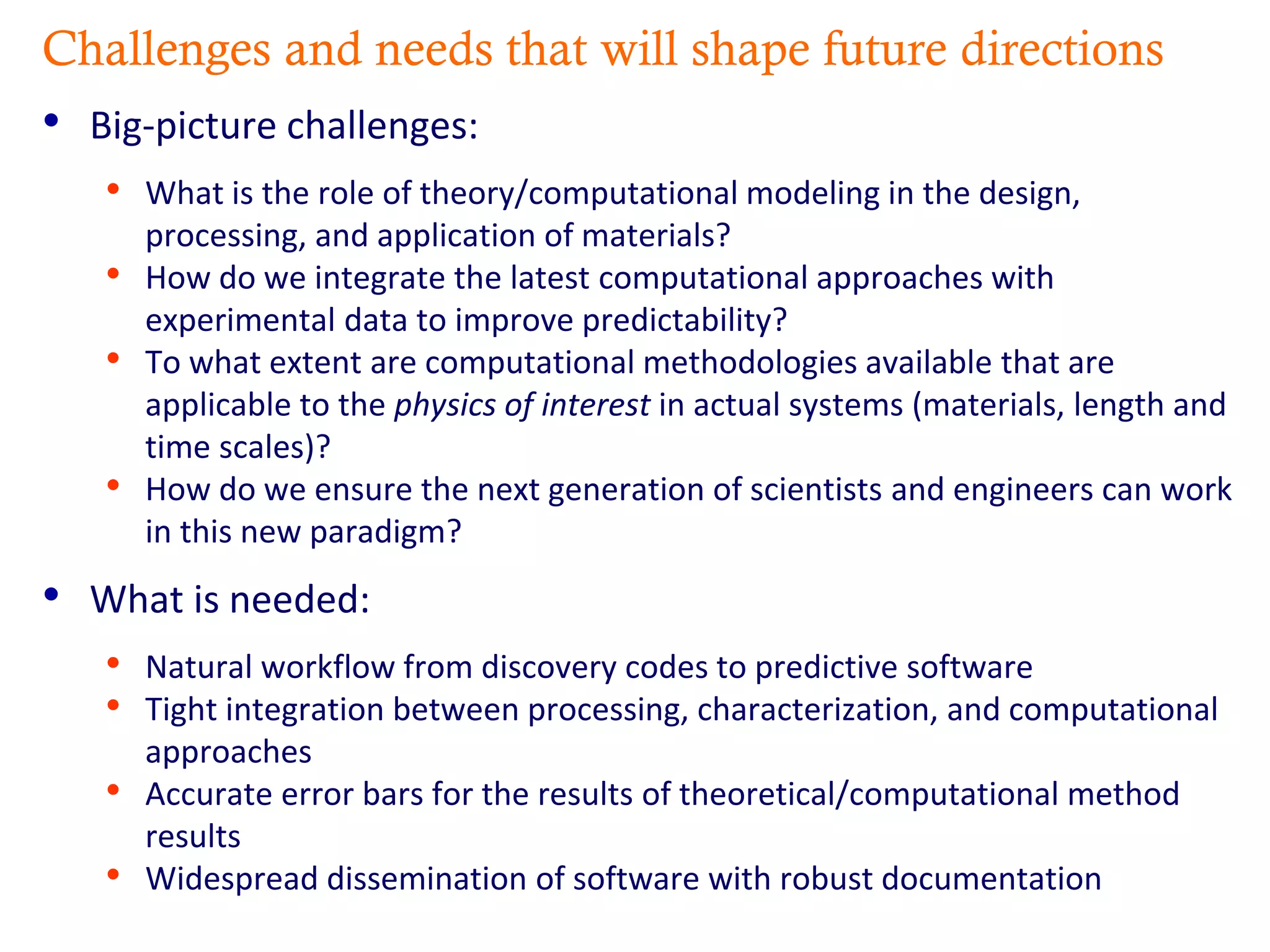
Challenges and needs that will shape future directions
• Big-picture challenges:
• What is the role of theory/computational modeling in the design,
processing, and application of materials?
• How do we integrate the latest computational approaches with
experimental data to improve predictability?
• To what extent are computational methodologies available that are
applicable to the physics of interest in actual systems (materials, length and
time scales)?
• How do we ensure the next generation of scientists and engineers can work
in this new paradigm?
• What is needed:
• Natural workflow from discovery codes to predictive software
• Tight integration between processing, characterization, and computational
approaches
• Accurate error bars for the results of theoretical/computational method
results
• Widespread dissemination of software with robust documentation

Role of Atomic-Scale Modeling in Materials Design Discovery.

  • 1.
    Role of Atomic-ScaleModeling in Materials Design Discovery Susan B. Sinnott Department of Materials Science and Engineering Penn State University University Park, PA XV Brazil MRS Meeting September 27, 2016
  • 2.
    Materials State Awarenesswith Atomic and Nanometer Scale Computational Methods • Electronic-structure level • High fidelity methods available: • Quantum chemical approaches • Density functional theory (DFT) • Off-the-shelf codes widely available • Wide-spread understanding of strengths and limitations Atomic-scale level Many-body, realistic potentials have been available for over 30 years Ideal for examining systems under extreme environments Necessary to investigate chemistry + microstructure + mechanics + mechanisms + ….. Physics-based model development Inform microscale and mesoscale models Explain experimental observations (strong “suggestion about what the atoms are doing”)
  • 3.
    MAX Phases 10/4/2016 9 Melements × 12 A elements × 2 X elements × 3 values of n 648 MAX phases 50/50 solid solutions also possible for M, A, and X 31,590 MAX phases (10,530 M2AX phases) Example 1: Material by Design
  • 4.
    Thermodynamic stability ofexisting M2AX phases 10/4/2016 4
  • 5.
    Stability trends amongM2AX phases 5 Valence mismatch Radius mismatch Electronegativity mismatch Total ionicity Total # of valence electrons % of M2AX phases that are stable vs…
  • 6.
    Magnetic M2AX Phases Cr2InN& Cr4(CdIn)N2 show ferromagnetic ordering at 0K 10/4/2016 6 Cr2InN Cr4(CdIn)N Formation energy (meV/atom) 7 21 Magnetization energy (meV/Cr atom) 68 70 Final magnetic moment (μB/Cr atom) 1.08 1.18
  • 7.
  • 8.
    2D Material FormationEnergies 10/4/2016 8 Ex.) Ef(Ti2CO2) = E(Ti2CO2) - E(TiC) – E(TiO2) 2D materials will never be “stable” compared to 3D competing phases, but with a low enough metastability they can be stabilized kinetically.
  • 9.
    Comparing O, F,& OH Binding Energies 9 Eb = E Mn+1XnTm – E Mn+1Xn – m 2 E T2 – mμT Coated MXene Bare MXene Surface species reference Surface species chemical potential μO = ΔG f H2O − 2μH μOH = ΔG f H2O −μH μF = ΔGf HF− μH All depend on μH Ashton, et al. Journal of Physical Chemistry C (2016)
  • 10.
    Comparing O, F,& OH Binding Energies 10 Ti2C Sc2C For all transition metals other than Sc, O binding is preferred for all 𝜇 𝐻. Ashton, et al. Journal of Physical Chemistry C (2016)
  • 11.
    MXene Formation Energies 10/4/201611 V2CO2 has the highest formation energy of all MXenes that have been synthesized to date. All MXenes below V2CO2 (within the yellow threshold) should be creatable from a thermodynamic perspective.
  • 12.
    Li-Ion Battery AnodeCandidate Criteria •Stable •Lightweight •Inexpensive •High capacity •Low diffusion barrier •Minimal swelling during charge/discharge 10/4/2016 12 Tin+1CnO2 & Vn+1CnO2
  • 13.
    Diffusion Pathways inMultilayer MXenes 10/4/2016 13 O (over)O (under) Li (a) (b) [0100] [1000] a b [1200] [1100] Monolayer Multilayer ΔE (eV) 1.0 2.0 3.0 4.0
  • 14.
    Voltage Profiles 10/4/2016 14 V= − E Mn+1XnO2Lix1 − E Mn+1XnO2Lix0 − (x1 − x0)E(Li) x1−x0 Ashton, et al. Applied Physics Letters (2016)
  • 15.
    Comparison of Anode-RelatedProperties 10/4/2016 15 MXene Gravimetric Capacity (mAh/g) Volumetric Capacity (Ah/L) Volume Expansion (%) Diffusion Barrier (eV) Ti2CO2 192 346 0.32 0.63 Ti3C2O2 134 240 -0.1 0.60 Ti4C3O2 103 187 0.34 0.73 V2CO2 276 379 2.82 0.82 V3CO2 192 263 1.93 0.52 V4C3O2 148 205 1.64 0.42 Ashton, et al. Applied Physics Letters (2016)
  • 16.
    Example 2: Nickel-BasedSuperalloy Design BRI: Searching for RE Alternative through Crystal Engineering • Used in high temperature- applications such as gas-turbines1 • Two phases present: γ- Ni matrix γ’- Ni3Al (~ 70% volume) Microstructure of γ-γ’ phases of Ni single crystal superalloys2 L12 – Al at corners, Ni at face-centers 1. R Schafrik and R Sprague; Adv. Mat. and Proc. 162 (2004) 2. P Caron and O Lavigne; J. Aerospace Lab. 3 (2011) Objective: Identify alternative, earth- abundant alternatives to rare earth metals in Ni-based superalloys
  • 17.
    BRI: Searching forRE Alternative through Crystal Engineering Defect Formation Energy Defect formation energy of incorporating dopant X is defined as: Etot[Xq] = total energy of the system with the defect Etot[bulk] = total energy of the system without the defect n = number of atoms added (n > 0) or removed (n < 0) μi = chemical potential of species i X Ef (XAl) (eV) Ef (XNi) (eV) B 2.60 0.87 Cr 1.40 (1.351) 0.93 (0.921) Ce 0.81 1.81 Zr 0.10 (0.041) 0.31 (0.201) 1. D E Kim, S L Shang, Z K Liu; Intermetallics 18 (2010)
  • 18.
    BRI: Searching forRE Alternative through Crystal Engineering DFT-Materials Informatics-Experiment • Defect formation energy CrAl > CrNi • From the principle component analysis (PCA) plot, materials informatics (by Krishna Rajan) concludes that Cr prefers Al site without DFT calculation results. Experimental validation from Jim LeBeau: Cr EDS map corresponds with the Al EDS map
  • 19.
    Chemical design vector:mapping a ‘periodic table’ for alloys Grant # FA9550-12-1-0456 Reporting period: Jan.2013-May 2014 Sims, Stoloff and Hagel (1986) / Pollak and Tin (2006) • New guide for seeking similarity of elements with respect to influence of alloy properties • Captures information not possible from periodic table mapping of elements Informatics work of Krishna Rajan
  • 20.
    Materials State Awarenesswith Atomic and Nanometer Scale Computational Methods • Electronic-structure level • High fidelity methods available: • Quantum chemical approaches • Density functional theory (DFT) • Off-the-shelf codes widely available • Wide-spread understanding of strengths and limitations • Atomic-scale level • Many-body, realistic potentials have been available for over 30 years • Ideal for examining systems under extreme environments • Necessary to investigate chemistry + microstructure + mechanics + mechanisms + ….. • Physics-based model development • Inform microscale and mesoscale models • Explain experimental observations (strong “suggestion about what the atoms are doing”)
  • 21.
    30 Years ofMany-Body Atomic-Scale Potentials (Reactive Force Fields) May 2012 issue Historically developed for materials with specific types of chemical bonds  Tersoff potentials for Si  Brenner or REBO potential for C,H + O,F,S,….  AIREBO  EAM potentials for metals  MEAM for metals and oxides  EAM+ES for metals and oxides  Rigid ion (Buckingham) potentials for ionically bound materials Used to examine phenomena at the atomic and nanometer scale and develop a qualitative, mechanistic understanding
  • 22.
    Metallic IonicCovalent Bone/biocomposites Aqueous biologicalsystems Interconnects Corrosion/Oxidation Thermal barrier coatings Catalysts Multicomponent Systems • Inherent to many applications • Challenging for: • First-principles electronic structure methods (large systems, lacking usual symmetry) • Atomic-scale methods because of their heterogeneous nature • This need spurred the development of next generation potentials (COMB, ReaxFF, and others) S.R. Phillpot and S.B. Sinnott, Science (2009)
  • 23.
    Example 3: Cu(001)/a-SiO2 Interfaces Structural properties of the interface Oxidation of Cu is limited to the first two Cu layers; formation of Cu2O Type of interface W (J/m2) Cu-O (%)Exp COMB Cu/a-SiO2 + 0 VO 0.5 - 1.2 a 0.6 - 1.4 b 1.810 22 Cu/a-SiO2 + 10 VO 0.629 13 Cu/a-SiO2 + 20 VO 0.289 11 a Oh, et al., J. Am. Ceram. Soc. (1987) b Pang and Baker, J. Mater. Res. (2005) • Cu-O bonds play crucial roles in adhesion of the interface • Adhesion of Cu/dielectric layer decreases with O defects Introduced O vacancies at the interface 0, 10 and 20 VO
  • 24.
    Charge Transfer Acrossthe Interface DFT: Nagao et al., COMB: Shan et al. -10 0 10 -0.020 -0.015 -0.010 -0.005 0.000 0.005 0.010 0.015 0.020 <n(D)>(A -3 ) Distance (angstrom) COMB
  • 25.
    BRI: Searching forRE Alternative through Crystal Engineering Example 4: Deformation of metals - Ni dislocations within grains are generated and evolve over time grain are in the BCC arrangement Common neighbor analysis Polycrystalline Ni after being subjected to tensile test with constant strain rate (=4x10⁻⁹ s-1) 1. A. Kumar, T. Liang, A. Chernatynskiy, Z. Lu, M. Noordhoek, K. Choudhary, S.R. Phillpot, S.B. Sinnott; J. Phys.: Condensed Matter (in preparation) 2. Y. Mishin, D. Farkas, M.J. Mehl, D.A. Papaconstantopoulos; Phys. Rev. B 59 (1999) Stacking fault energies: <112> and <101> COMB Ni potential1 EAM Ni potential2 Stacking fault energy of Ni1 compared with EAM2 potential Centro-symmetry analysis
  • 26.
    BRI: Searching forRE Alternative through Crystal Engineering Al deformation predicted by different potentials COMB Al potential1 EAM Al potential2 Stacking fault energies: <112> and <101> Stacking fault energy of Al1 compared with EAM2 potential 1. A. Kumar, T. Liang, A. Chernatynskiy, Z. Lu, M. Noordhoek, K. Choudhary, S.R. Phillpot, S.B. Sinnott; J. Phys.: Condensed Matter (in preparation) 2. Y. Mishin, D. Farkas, M.J. Mehl, D.A. Papaconstantopoulos; Phys. Rev. B 59 (1999) Potential energy surface illustrating the <112> barrier to be less than the <101> barrier1
  • 27.
    BRI: Searching forRE Alternative through Crystal Engineering Mechanical deformation of Ni3Al at the g/g’ interface 1. A. Kumar, T. Liang, A. Chernatynskiy, Z. Lu, M. Noordhoek, K. Choudhary, S. R. Phillpot, S.B. Sinnott (in preparation) 2. M.H. Yoo, M.S. Daw, M.I. Baskes, V. Vitek, D.J. Srolovitz, Eds.; New York: Plenum Press; 1989. p. 401. Thermostat Active Rigid moving Rigid moving Thermostat Active Ni3Al Ni τzx Z [010] X [101] Y [10 -1] τzx • Edge dislocations at the Ni-Ni3Al interface • Predict mechanisms associated with applied shear stress and dislocation motion Ni3Al Ec (eV/atom) B (GPa) G (GPa) COMB1 -4.61 198 93 exp.2 -4.62 195 96 Simulation box size: 16.67x16.67x9.21 nm3 Total number of atoms: 179,600 Dislocation
  • 28.
    Technical Fundamental Barriers •Parameterization of transferrable, next-generation potentials is non- trivial. For some historical potentials, numerous parameterizations exist. The general equation for COMB is: . • Validation of predicted trends and quantification of error bars. • Comfort within the broader community of how and when potentials work well and when the transferability of parameterized properties breaks down. The materials community is familiar with strengths and limitations of electronic structure calculations and continuum level (e.g., finite- element level modeling). Non-experts are less comfortable with atomic- scale methods. • Dissemination is straightforward, maintenance is challenging!           i ij vdW ji polar ij jikijiiijiijiji S iT rEriqErCqBqqrVqEE )(),(),()(,, 2 1 )( 
  • 29.
    Databases and cyberinfrastructure •Enable the rapid design of materials • Materials Project (MIT) • AFLOWLIB (Duke) • CAVS CyberDesign (Mississippi State) • Readily access computational tools and data • nanoHUB (Purdue) • CAMS (Florida) • Improve atomic-scale methods • NIST Interatomic Potentials Repository Project • OpenKIM (Minnesota) • Navigating materials cyberinfrastructures • TMS
  • 30.
    Challenges and needsthat will shape future directions • Big-picture challenges: • What is the role of theory/computational modeling in the design, processing, and application of materials? • How do we integrate the latest computational approaches with experimental data to improve predictability? • To what extent are computational methodologies available that are applicable to the physics of interest in actual systems (materials, length and time scales)? • How do we ensure the next generation of scientists and engineers can work in this new paradigm? • What is needed: • Natural workflow from discovery codes to predictive software • Tight integration between processing, characterization, and computational approaches • Accurate error bars for the results of theoretical/computational method results • Widespread dissemination of software with robust documentation