X-ray Interferometry 
Webster Cash 
University of Colorado
Co-Investigators 
• Steve Kahn - Columbia University 
• Mark Schattenburg - MIT 
• David Windt – Columbia University 
• Dennis Gallagher – Ball Aerospace
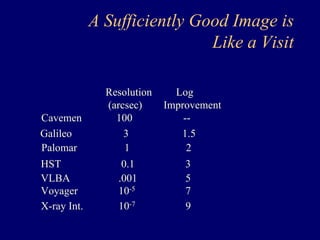
A Sufficiently Good Image is 
Like a Visit 
Resolution Log 
(arcsec) Improvement 
Cavemen 100 -- 
Galileo 3 1.5 
Palomar 1 2 
HST 0.1 3 
VLBA .001 5 
Voyager 10-5 7 
X-ray Int. 10-7 9
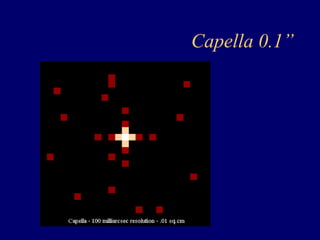
Capella 0.1”
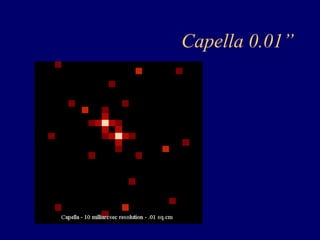
Capella 0.01”
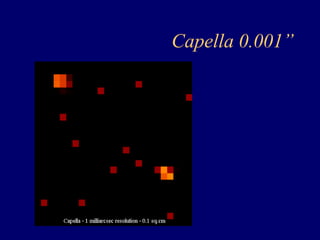
Capella 0.001”
Capella 0.0001”
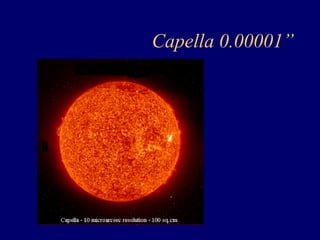
Capella 0.00001”
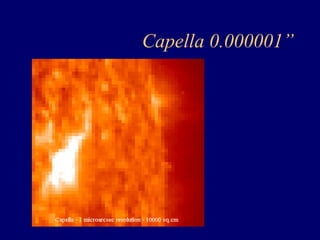
Capella 0.000001”
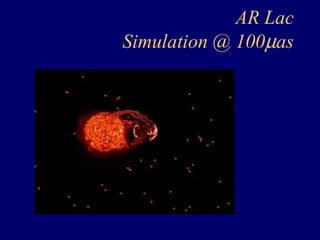
AR Lac 
Simulation @ 100μas
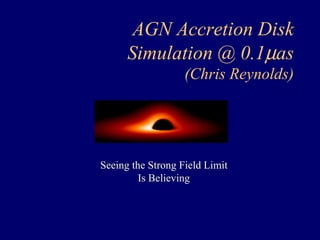
AGN Accretion Disk 
Simulation @ 0.1μas 
(Chris Reynolds) 
Seeing the Strong Field Limit 
Is Believing
Need Resolution and Signal 
If we are going to do this, we need to support 
two basic capabilities: 
• Signal 
• Resolution
X-ray Sources Are Super Bright 
Example: Mass Transfer Binary 
1037ergs/s from 109cm object 
That is ~10,000L from 10-4A = 108 B 
where B is the solar brightness in ergs/cm2/s/steradian 
Brightness is a conserved quantity and is the measure of visibility 
for a resolved object 
Note: Optically thin x-ray sources can have 
very low brightness and are inappropriate 
targets for interferometry. 
Same is true in all parts of spectrum!
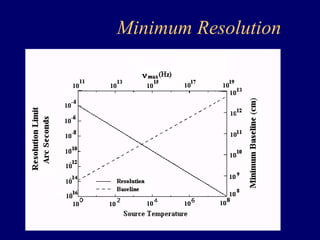
Minimum Resolution
Status of X-ray Optics 
• Modest Resolution 
– 0.5 arcsec telescopes 
– 0.5 micron microscopes 
• Severe Scatter Problem 
– Mid-Frequency Ripple 
• Extreme Cost 
– Millions of Dollars Each 
– Years to Fabricate
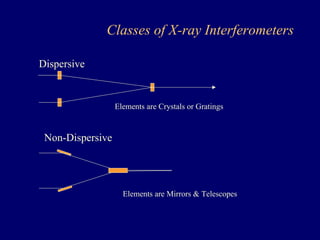
Classes of X-ray Interferometers 
Dispersive 
Non-Dispersive 
Elements are Crystals or Gratings 
Elements are Mirrors  Telescopes
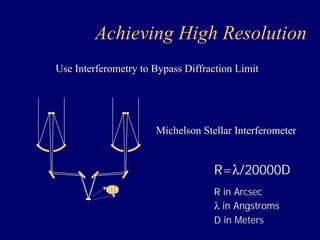
Achieving High Resolution 
Use Interferometry to Bypass Diffraction Limit 
Michelson Stellar Interferometer 
R=λ/20000D 
R in Arcsec 
λ in Angstroms 
D in Meters
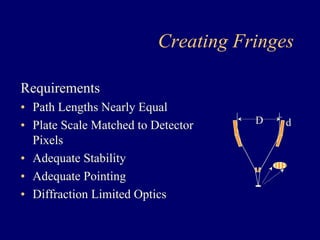
Creating Fringes 
Requirements 
• Path Lengths Nearly Equal 
• Plate Scale Matched to Detector 
Pixels 
• Adequate Stability 
• Adequate Pointing 
• Diffraction Limited Optics 
D d
δ 
sin 
B1= 
θ 
B2 = B1cos(2θ ) 
[ ( )] δ θ 
Pathlength Tolerance Analysis at Grazing Incidence 
δ θ 2 sin 
OPD = B1− B2 = 1− cos 2 = 
θ 
sin 
θ 
δ λ 
20sin 
 
θ Β2 If OPD to be  λ/10 then 
( ) 
λ 
θ θ 
20sin cos 
d Baseline  
( ) 
θ 
λ 
20sin2 
d focal  
A1 A2 
S1 
S2 
δ 
A1  A2 in Phase Here 
C 
θ 
θ 
θ 
Β1
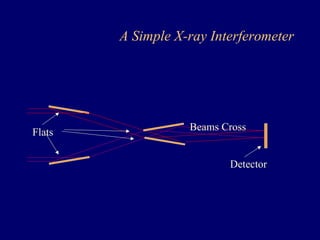
A Simple X-ray Interferometer 
Flats Beams Cross 
Detector
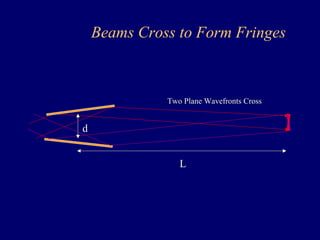
Beams Cross to Form Fringes 
d 
Two Plane Wavefronts Cross 
L
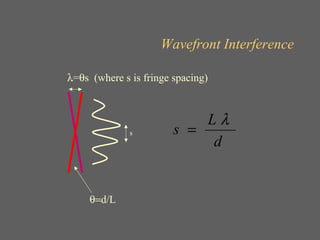
Wavefront Interference 
λ=θs (where s is fringe spacing) 
θ=d/L 
s = L λ s 
d
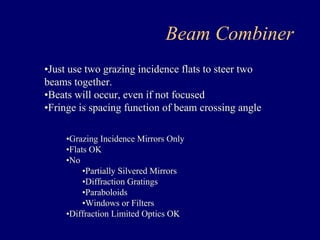
Beam Combiner 
•Just use two grazing incidence flats to steer two 
beams together. 
•Beats will occur, even if not focused 
•Fringe is spacing function of beam crossing angle 
•Grazing Incidence Mirrors Only 
•Flats OK 
•No 
•Partially Silvered Mirrors 
•Diffraction Gratings 
•Paraboloids 
•Windows or Filters 
•Diffraction Limited Optics OK
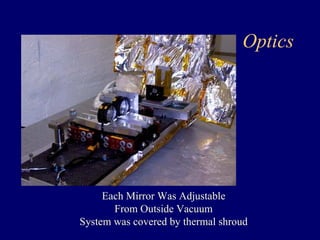
Optics 
Each Mirror Was Adjustable 
From Outside Vacuum 
System was covered by thermal shroud
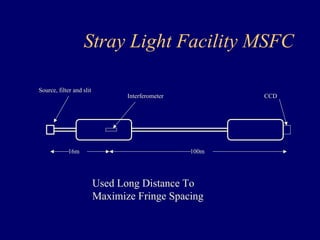
Stray Light Facility MSFC 
Source, filter and slit 
16m 
Interferometer CCD 
100m 
Used Long Distance To 
Maximize Fringe Spacing
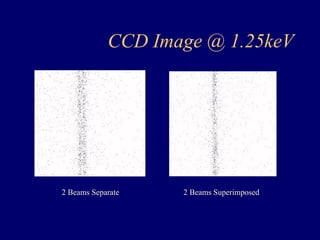
CCD Image @ 1.25keV 
2 Beams Separate 2 Beams Superimposed
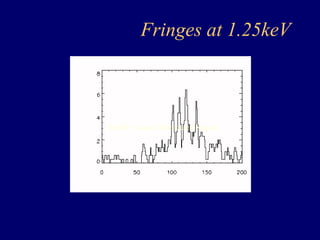
Fringes at 1.25keV 
Profile Across Illuminated Region
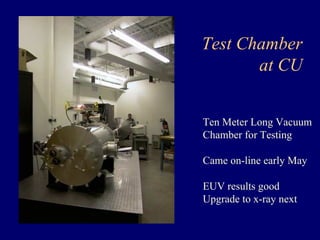
Test Chamber 
at CU 
Ten Meter Long Vacuum 
Chamber for Testing 
Came on-line early May 
EUV results good 
Upgrade to x-ray next
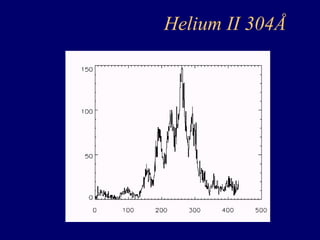
Helium II 304Å
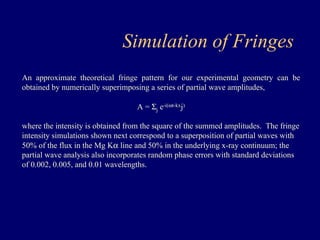
Simulation of Fringes 
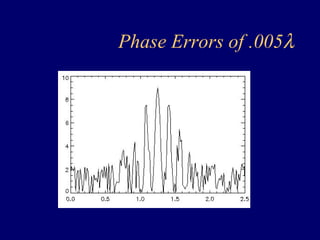
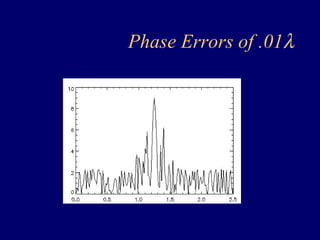
An approximate theoretical fringe pattern for our experimental geometry can be 
obtained by numerically superimposing a series of partial wave amplitudes, 
A = Σj e-i(ωt-kxj) 
where the intensity is obtained from the square of the summed amplitudes. The fringe 
intensity simulations shown next correspond to a superposition of partial waves with 
50% of the flux in the Mg Kα line and 50% in the underlying x-ray continuum; the 
partial wave analysis also incorporates random phase errors with standard deviations 
of 0.002, 0.005, and 0.01 wavelengths.
Phase Errors of .005λ
Phase Errors of .01λ
Theoretically Perfect Mirrors 
A monochromatic 1.24 keV x-ray beam
With Imperfections 
λ6328Å/12 RMS surface figure
Technology Summary 
• X-ray Interferometers Can be Built 
• Results Can be Modeled Effectively 
• Provides Basis for Design of Next 
Generations of X-ray Interferometers
MAXIM 
The Micro Arcsecond X-ray Imaging Mission 
Webster Cash Colorado 
Nicholas White Goddard 
Marshall Joy Marshall 
PLUS Contributions from the 
Maxim Team 
http://maxim.gsfc.nasa.gov
Target Class Goal 
Maxim: 
A Few Science Goals 
Resolve the corona of nearby stars: Are other coronal structures like the solar corona? 
Resolve the winds of OB stars: What kind of shocks drive the x-ray emission? 
Resolve pre-main sequence stars: How does coronal activity interact with disk? 
Image of center of Milky Way: Detect and resolve accretion disk? 
Detailed images of LMC, SMC, M31: Supernova morphology and star formation in other settings 
Image jets, outflows and BLR from AGN: Follow jet structure, search for scattered emission from BLR 
Detailed view of starbursts: Resolve supernovae and outflows 
Map center of cooling flows in clusters: Resolve star formation regions? 
Detailed maps of clusters at high redshift: Cluster evolution, cooling flows 
Image Event Horizons in AGNS: Probe Extreme Gravity Limit
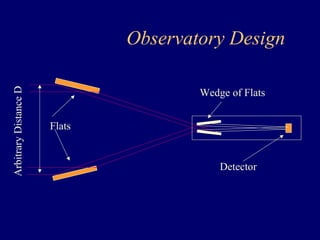
Observatory Design 
Arbitrary Distance D 
Flats 
Wedge of Flats 
Detector
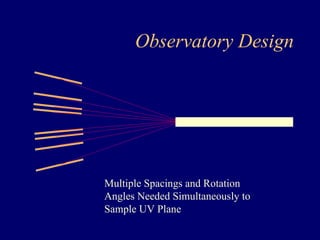
Observatory Design 
Multiple Spacings and Rotation 
Angles Needed Simultaneously to 
Sample UV Plane
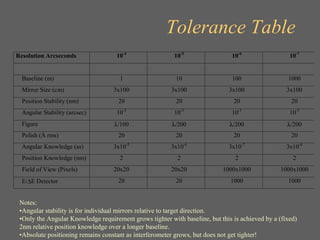
Tolerance Table 
Resolution Arcseconds 10-4 10-5 10-6 10-7 
Baseline (m) 1 10 100 1000 
Mirror Size (cm) 3x100 3x100 3x100 3x100 
Position Stability (nm) 20 20 20 20 
Angular Stability (arcsec) 10-3 10-3 10-3 10-3 
Figure λ/100 λ/200 λ/200 λ/200 
Polish (Å rms) 20 20 20 20 
Angular Knowledge (as) 3x10⁻⁵ 3x10⁻⁶ 3x10⁻⁷ 3x10⁻⁸ 
Position Knowledge (nm) 2 2 2 2 
Field of View (Pixels) 20x20 20x20 1000x1000 1000x1000 
E/ΔE Detector 20 20 1000 1000 
Notes: 
•Angular stability is for individual mirrors relative to target direction. 
•Only the Angular Knowledge requirement grows tighter with baseline, but this is achieved by a (fixed) 
2nm relative position knowledge over a longer baseline. 
•Absolute positioning remains constant as interferometer grows, but does not get tighter!
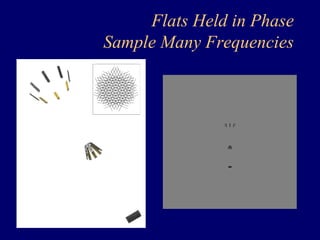
Flats Held in Phase 
Sample Many Frequencies
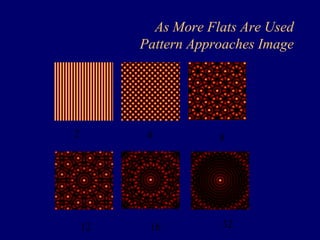
As More Flats Are Used 
Pattern Approaches Image 
2 4 8 
12 16 32
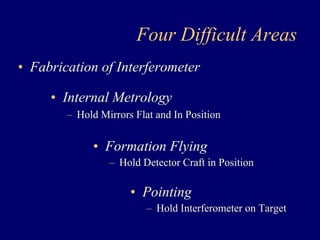
Four Difficult Areas 
• Fabrication of Interferometer 
• Internal Metrology 
– Hold Mirrors Flat and In Position 
• Formation Flying 
– Hold Detector Craft in Position 
• Pointing 
– Hold Interferometer on Target
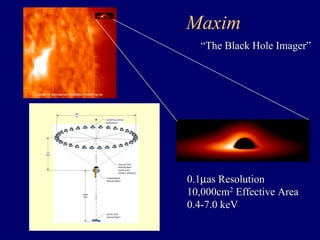
Maxim 
“The Black Hole Imager” 
0.1μas Resolution 
10,000cm2 Effective Area 
0.4-7.0 keV 
CONVERGER 
SPACECRAFT 
DETECTOR 
SPACECRAFT 
200 
M 
COLLECTOR 
SPACECRAFT 
(32 PLACES 
EVENLY SPACED) 
10 
KM 
5000 
KM 
CONSTELLATION 
BORESIGHT
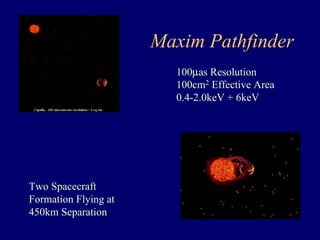
Maxim Pathfinder 
100μas Resolution 
100cm2 Effective Area 
0.4-2.0keV + 6keV 
Two Spacecraft 
Formation Flying at 
450km Separation
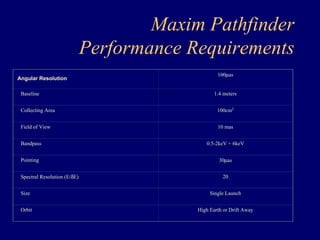
Maxim Pathfinder 
Performance Requirements 
Angular Resolution 100μas 
Baseline 1.4 meters 
Collecting Area 100cm2 
Field of View 10 mas 
Bandpass 0.5-2keV + 6keV 
Pointing 30μas 
Spectral Resolution (E/δE) 20 
Size Single Launch 
Orbit High Earth or Drift Away
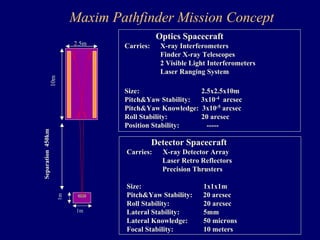
2.5m 
10m 
Optics Spacecraft 
Carries: X-ray Interferometers 
Finder X-ray Telescopes 
2 Visible Light Interferometers 
Laser Ranging System 
Size: 2.5x2.5x10m 
PitchYaw Stability: 3x10⁻⁴ arcsec 
PitchYaw Knowledge: 3x10⁻⁵ arcsec 
Roll Stability: 20 arcsec 
Position Stability: ----- 
Detector Spacecraft 
Carries: X-ray Detector Array 
Laser Retro Reflectors 
Precision Thrusters 
Size: 1x1x1m 
PitchYaw Stability: 20 arcsec 
Roll Stability: 20 arcsec 
Lateral Stability: 5mm 
Lateral Knowledge: 50 microns 
Focal Stability: 10 meters 
1m 
1m 
Separation 450km 
Maxim Pathfinder Mission Concept
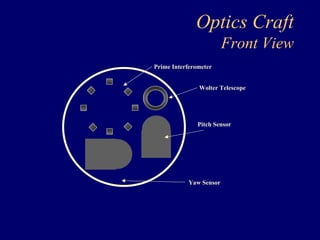
Optics Craft 
Prime Interferometer 
Wolter Telescope 
Pitch Sensor 
Yaw Sensor 
Front View
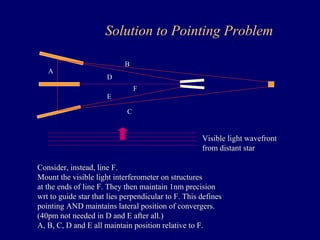
Solution to Pointing Problem 
A 
B 
C 
D 
E 
F 
Visible light wavefront 
from distant star 
Consider, instead, line F. 
Mount the visible light interferometer on structures 
at the ends of line F. They then maintain 1nm precision 
wrt to guide star that lies perpendicular to F. This defines 
pointing AND maintains lateral position of convergers. 
(40pm not needed in D and E after all.) 
A, B, C, D and E all maintain position relative to F.
Detector 
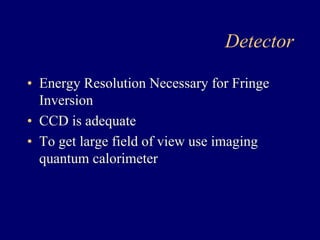
• Energy Resolution Necessary for Fringe 
Inversion 
• CCD is adequate 
• To get large field of view use imaging 
quantum calorimeter
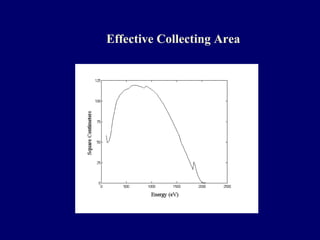
Effective Collecting Area
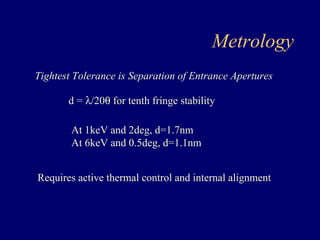
Metrology 
Tightest Tolerance is Separation of Entrance Apertures 
d = λ/20θ for tenth fringe stability 
At 1keV and 2deg, d=1.7nm 
At 6keV and 0.5deg, d=1.1nm 
Requires active thermal control and internal alignment
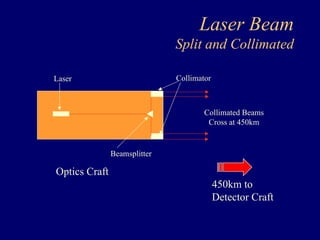
Laser 
Beamsplitter 
Laser Beam 
Split and Collimated 
Collimator 
Collimated Beams 
Cross at 450km 
Optics Craft 
450km to 
Detector Craft
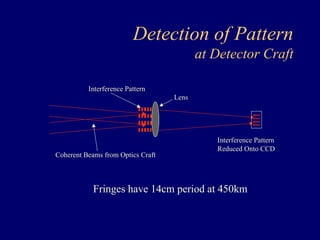
Detection of Pattern 
Interference Pattern 
Coherent Beams from Optics Craft 
Lens 
at Detector Craft 
Interference Pattern 
Reduced Onto CCD 
Fringes have 14cm period at 450km
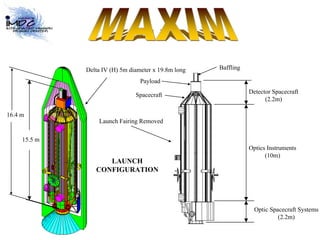
Delta IV (H) 5m diameter x 19.8m long 
Launch Fairing Removed 
Detector Spacecraft 
(2.2m) 
Optics Instruments 
(10m) 
Optic Spacecraft Systems 
(2.2m) 
Baffling 
LAUNCH 
CONFIGURATION 
16.4 m 
15.5 m 
Payload 
Spacecraft
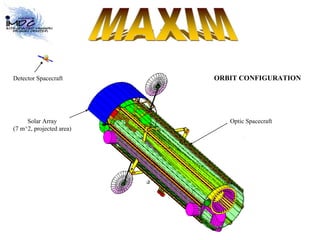
ORBIT CONFIGURATION 
Optic Spacecraft 
Detector Spacecraft 
Solar Array 
(7 m^2, projected area)
Stowed 
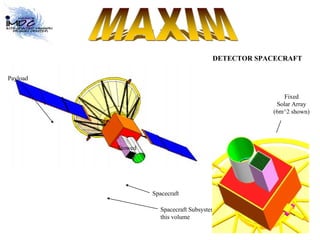
DETECTOR SPACECRAFT 
Orbit 
Payload 
Spacecraft 
Spacecraft Subsystems are mounted in 
this volume 
Fixed 
Solar Array 
(6m^2 shown)
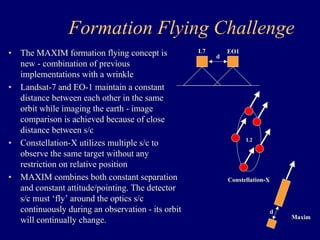
Formation Flying Challenge 
• The MAXIM formation flying concept is 
new - combination of previous 
implementations with a wrinkle 
• Landsat-7 and EO-1 maintain a constant 
distance between each other in the same 
orbit while imaging the earth - image 
comparison is achieved because of close 
distance between s/c 
• Constellation-X utilizes multiple s/c to 
observe the same target without any 
restriction on relative position 
• MAXIM combines both constant separation 
and constant attitude/pointing. The detector 
s/c must ‘fly’ around the optics s/c 
continuously during an observation - its orbit 
will continually change. 
L7 EO1 
d 
d 
Maxim 
L2 
Constellation-X
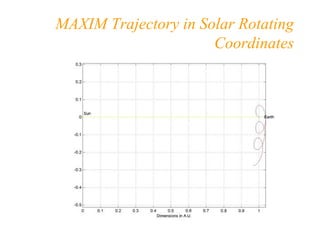
MAXIM Trajectory in Solar Rotating 
Coordinates
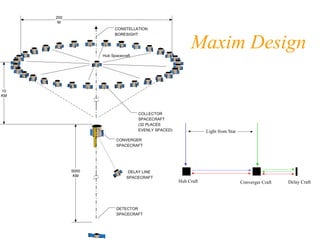
Maxim Design 
CONVERGER 
SPACECRAFT 
DELAY LINE 
DETECTOR 
SPACECRAFT 
200 
M 
COLLECTOR 
SPACECRAFT 
(32 PLACES 
EVENLY SPACED) 
10 
KM 
5000 
KM 
CONSTELLATION 
BORESIGHT 
Hub Spacecraft 
SPACECRAFT 
Light from Star 
Hub Craft Converger Craft Delay Craft
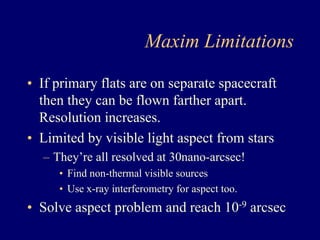
Maxim Limitations 
• If primary flats are on separate spacecraft 
then they can be flown farther apart. 
Resolution increases. 
• Limited by visible light aspect from stars 
– They’re all resolved at 30nano-arcsec! 
• Find non-thermal visible sources 
• Use x-ray interferometry for aspect too. 
• Solve aspect problem and reach 10-9 arcsec
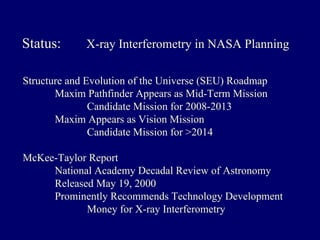
Status: X-ray Interferometry in NASA Planning 
Structure and Evolution of the Universe (SEU) Roadmap 
Maxim Pathfinder Appears as Mid-Term Mission 
Candidate Mission for 2008-2013 
Maxim Appears as Vision Mission 
Candidate Mission for 2014 
McKee-Taylor Report 
National Academy Decadal Review of Astronomy 
Released May 19, 2000 
Prominently Recommends Technology Development 
Money for X-ray Interferometry
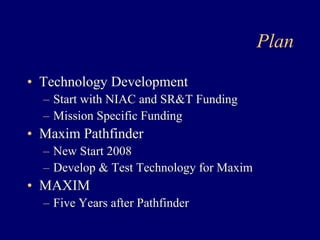
Plan 
• Technology Development 
– Start with NIAC and SRT Funding 
– Mission Specific Funding 
• Maxim Pathfinder 
– New Start 2008 
– Develop  Test Technology for Maxim 
• MAXIM 
– Five Years after Pathfinder
In Conclusion 
• In Last 2 Years 
– Demonstrated Feasibility of Optics 
– Developed Preliminary Mission Concepts 
– Raised Interest and Respect in the Community 
– Inserted X-ray Interferometry into NASA Plans 
• In NIAC Phase II 
– More Detailed Study of Missions 
– Spread the Word

Xray interferometry

  • 1.
    X-ray Interferometry WebsterCash University of Colorado
  • 2.
    Co-Investigators • SteveKahn - Columbia University • Mark Schattenburg - MIT • David Windt – Columbia University • Dennis Gallagher – Ball Aerospace
  • 3.
    A Sufficiently GoodImage is Like a Visit Resolution Log (arcsec) Improvement Cavemen 100 -- Galileo 3 1.5 Palomar 1 2 HST 0.1 3 VLBA .001 5 Voyager 10-5 7 X-ray Int. 10-7 9
  • 4.
  • 5.
  • 6.
  • 7.
  • 8.
  • 9.
  • 10.
  • 11.
    AGN Accretion Disk Simulation @ 0.1μas (Chris Reynolds) Seeing the Strong Field Limit Is Believing
  • 12.
    Need Resolution andSignal If we are going to do this, we need to support two basic capabilities: • Signal • Resolution
  • 13.
    X-ray Sources AreSuper Bright Example: Mass Transfer Binary 1037ergs/s from 109cm object That is ~10,000L from 10-4A = 108 B where B is the solar brightness in ergs/cm2/s/steradian Brightness is a conserved quantity and is the measure of visibility for a resolved object Note: Optically thin x-ray sources can have very low brightness and are inappropriate targets for interferometry. Same is true in all parts of spectrum!
  • 14.
  • 15.
    Status of X-rayOptics • Modest Resolution – 0.5 arcsec telescopes – 0.5 micron microscopes • Severe Scatter Problem – Mid-Frequency Ripple • Extreme Cost – Millions of Dollars Each – Years to Fabricate
  • 16.
    Classes of X-rayInterferometers Dispersive Non-Dispersive Elements are Crystals or Gratings Elements are Mirrors Telescopes
  • 17.
    Achieving High Resolution Use Interferometry to Bypass Diffraction Limit Michelson Stellar Interferometer R=λ/20000D R in Arcsec λ in Angstroms D in Meters
  • 18.
    Creating Fringes Requirements • Path Lengths Nearly Equal • Plate Scale Matched to Detector Pixels • Adequate Stability • Adequate Pointing • Diffraction Limited Optics D d
  • 19.
    δ sin B1= θ B2 = B1cos(2θ ) [ ( )] δ θ Pathlength Tolerance Analysis at Grazing Incidence δ θ 2 sin OPD = B1− B2 = 1− cos 2 = θ sin θ δ λ 20sin θ Β2 If OPD to be λ/10 then ( ) λ θ θ 20sin cos d Baseline ( ) θ λ 20sin2 d focal A1 A2 S1 S2 δ A1 A2 in Phase Here C θ θ θ Β1
  • 20.
    A Simple X-rayInterferometer Flats Beams Cross Detector
  • 21.
    Beams Cross toForm Fringes d Two Plane Wavefronts Cross L
  • 22.
    Wavefront Interference λ=θs(where s is fringe spacing) θ=d/L s = L λ s d
  • 23.
    Beam Combiner •Justuse two grazing incidence flats to steer two beams together. •Beats will occur, even if not focused •Fringe is spacing function of beam crossing angle •Grazing Incidence Mirrors Only •Flats OK •No •Partially Silvered Mirrors •Diffraction Gratings •Paraboloids •Windows or Filters •Diffraction Limited Optics OK
  • 24.
    Optics Each MirrorWas Adjustable From Outside Vacuum System was covered by thermal shroud
  • 25.
    Stray Light FacilityMSFC Source, filter and slit 16m Interferometer CCD 100m Used Long Distance To Maximize Fringe Spacing
  • 26.
    CCD Image @1.25keV 2 Beams Separate 2 Beams Superimposed
  • 27.
    Fringes at 1.25keV Profile Across Illuminated Region
  • 28.
    Test Chamber atCU Ten Meter Long Vacuum Chamber for Testing Came on-line early May EUV results good Upgrade to x-ray next
  • 29.
  • 30.
    Simulation of Fringes An approximate theoretical fringe pattern for our experimental geometry can be obtained by numerically superimposing a series of partial wave amplitudes, A = Σj e-i(ωt-kxj) where the intensity is obtained from the square of the summed amplitudes. The fringe intensity simulations shown next correspond to a superposition of partial waves with 50% of the flux in the Mg Kα line and 50% in the underlying x-ray continuum; the partial wave analysis also incorporates random phase errors with standard deviations of 0.002, 0.005, and 0.01 wavelengths.
  • 31.
  • 32.
  • 33.
    Theoretically Perfect Mirrors A monochromatic 1.24 keV x-ray beam
  • 34.
  • 35.
    Technology Summary •X-ray Interferometers Can be Built • Results Can be Modeled Effectively • Provides Basis for Design of Next Generations of X-ray Interferometers
  • 36.
    MAXIM The MicroArcsecond X-ray Imaging Mission Webster Cash Colorado Nicholas White Goddard Marshall Joy Marshall PLUS Contributions from the Maxim Team http://maxim.gsfc.nasa.gov
  • 37.
    Target Class Goal Maxim: A Few Science Goals Resolve the corona of nearby stars: Are other coronal structures like the solar corona? Resolve the winds of OB stars: What kind of shocks drive the x-ray emission? Resolve pre-main sequence stars: How does coronal activity interact with disk? Image of center of Milky Way: Detect and resolve accretion disk? Detailed images of LMC, SMC, M31: Supernova morphology and star formation in other settings Image jets, outflows and BLR from AGN: Follow jet structure, search for scattered emission from BLR Detailed view of starbursts: Resolve supernovae and outflows Map center of cooling flows in clusters: Resolve star formation regions? Detailed maps of clusters at high redshift: Cluster evolution, cooling flows Image Event Horizons in AGNS: Probe Extreme Gravity Limit
  • 38.
    Observatory Design ArbitraryDistance D Flats Wedge of Flats Detector
  • 39.
    Observatory Design MultipleSpacings and Rotation Angles Needed Simultaneously to Sample UV Plane
  • 40.
    Tolerance Table ResolutionArcseconds 10-4 10-5 10-6 10-7 Baseline (m) 1 10 100 1000 Mirror Size (cm) 3x100 3x100 3x100 3x100 Position Stability (nm) 20 20 20 20 Angular Stability (arcsec) 10-3 10-3 10-3 10-3 Figure λ/100 λ/200 λ/200 λ/200 Polish (Å rms) 20 20 20 20 Angular Knowledge (as) 3x10⁻⁵ 3x10⁻⁶ 3x10⁻⁷ 3x10⁻⁸ Position Knowledge (nm) 2 2 2 2 Field of View (Pixels) 20x20 20x20 1000x1000 1000x1000 E/ΔE Detector 20 20 1000 1000 Notes: •Angular stability is for individual mirrors relative to target direction. •Only the Angular Knowledge requirement grows tighter with baseline, but this is achieved by a (fixed) 2nm relative position knowledge over a longer baseline. •Absolute positioning remains constant as interferometer grows, but does not get tighter!
  • 41.
    Flats Held inPhase Sample Many Frequencies
  • 42.
    As More FlatsAre Used Pattern Approaches Image 2 4 8 12 16 32
  • 43.
    Four Difficult Areas • Fabrication of Interferometer • Internal Metrology – Hold Mirrors Flat and In Position • Formation Flying – Hold Detector Craft in Position • Pointing – Hold Interferometer on Target
  • 44.
    Maxim “The BlackHole Imager” 0.1μas Resolution 10,000cm2 Effective Area 0.4-7.0 keV CONVERGER SPACECRAFT DETECTOR SPACECRAFT 200 M COLLECTOR SPACECRAFT (32 PLACES EVENLY SPACED) 10 KM 5000 KM CONSTELLATION BORESIGHT
  • 45.
    Maxim Pathfinder 100μasResolution 100cm2 Effective Area 0.4-2.0keV + 6keV Two Spacecraft Formation Flying at 450km Separation
  • 46.
    Maxim Pathfinder PerformanceRequirements Angular Resolution 100μas Baseline 1.4 meters Collecting Area 100cm2 Field of View 10 mas Bandpass 0.5-2keV + 6keV Pointing 30μas Spectral Resolution (E/δE) 20 Size Single Launch Orbit High Earth or Drift Away
  • 47.
    2.5m 10m OpticsSpacecraft Carries: X-ray Interferometers Finder X-ray Telescopes 2 Visible Light Interferometers Laser Ranging System Size: 2.5x2.5x10m PitchYaw Stability: 3x10⁻⁴ arcsec PitchYaw Knowledge: 3x10⁻⁵ arcsec Roll Stability: 20 arcsec Position Stability: ----- Detector Spacecraft Carries: X-ray Detector Array Laser Retro Reflectors Precision Thrusters Size: 1x1x1m PitchYaw Stability: 20 arcsec Roll Stability: 20 arcsec Lateral Stability: 5mm Lateral Knowledge: 50 microns Focal Stability: 10 meters 1m 1m Separation 450km Maxim Pathfinder Mission Concept
  • 48.
    Optics Craft PrimeInterferometer Wolter Telescope Pitch Sensor Yaw Sensor Front View
  • 49.
    Solution to PointingProblem A B C D E F Visible light wavefront from distant star Consider, instead, line F. Mount the visible light interferometer on structures at the ends of line F. They then maintain 1nm precision wrt to guide star that lies perpendicular to F. This defines pointing AND maintains lateral position of convergers. (40pm not needed in D and E after all.) A, B, C, D and E all maintain position relative to F.
  • 50.
    Detector • EnergyResolution Necessary for Fringe Inversion • CCD is adequate • To get large field of view use imaging quantum calorimeter
  • 51.
  • 52.
    Metrology Tightest Toleranceis Separation of Entrance Apertures d = λ/20θ for tenth fringe stability At 1keV and 2deg, d=1.7nm At 6keV and 0.5deg, d=1.1nm Requires active thermal control and internal alignment
  • 53.
    Laser Beamsplitter LaserBeam Split and Collimated Collimator Collimated Beams Cross at 450km Optics Craft 450km to Detector Craft
  • 54.
    Detection of Pattern Interference Pattern Coherent Beams from Optics Craft Lens at Detector Craft Interference Pattern Reduced Onto CCD Fringes have 14cm period at 450km
  • 55.
    Delta IV (H)5m diameter x 19.8m long Launch Fairing Removed Detector Spacecraft (2.2m) Optics Instruments (10m) Optic Spacecraft Systems (2.2m) Baffling LAUNCH CONFIGURATION 16.4 m 15.5 m Payload Spacecraft
  • 56.
    ORBIT CONFIGURATION OpticSpacecraft Detector Spacecraft Solar Array (7 m^2, projected area)
  • 57.
    Stowed DETECTOR SPACECRAFT Orbit Payload Spacecraft Spacecraft Subsystems are mounted in this volume Fixed Solar Array (6m^2 shown)
  • 58.
    Formation Flying Challenge • The MAXIM formation flying concept is new - combination of previous implementations with a wrinkle • Landsat-7 and EO-1 maintain a constant distance between each other in the same orbit while imaging the earth - image comparison is achieved because of close distance between s/c • Constellation-X utilizes multiple s/c to observe the same target without any restriction on relative position • MAXIM combines both constant separation and constant attitude/pointing. The detector s/c must ‘fly’ around the optics s/c continuously during an observation - its orbit will continually change. L7 EO1 d d Maxim L2 Constellation-X
  • 59.
    MAXIM Trajectory inSolar Rotating Coordinates
  • 60.
    Maxim Design CONVERGER SPACECRAFT DELAY LINE DETECTOR SPACECRAFT 200 M COLLECTOR SPACECRAFT (32 PLACES EVENLY SPACED) 10 KM 5000 KM CONSTELLATION BORESIGHT Hub Spacecraft SPACECRAFT Light from Star Hub Craft Converger Craft Delay Craft
  • 61.
    Maxim Limitations •If primary flats are on separate spacecraft then they can be flown farther apart. Resolution increases. • Limited by visible light aspect from stars – They’re all resolved at 30nano-arcsec! • Find non-thermal visible sources • Use x-ray interferometry for aspect too. • Solve aspect problem and reach 10-9 arcsec
  • 62.
    Status: X-ray Interferometryin NASA Planning Structure and Evolution of the Universe (SEU) Roadmap Maxim Pathfinder Appears as Mid-Term Mission Candidate Mission for 2008-2013 Maxim Appears as Vision Mission Candidate Mission for 2014 McKee-Taylor Report National Academy Decadal Review of Astronomy Released May 19, 2000 Prominently Recommends Technology Development Money for X-ray Interferometry
  • 63.
    Plan • TechnologyDevelopment – Start with NIAC and SRT Funding – Mission Specific Funding • Maxim Pathfinder – New Start 2008 – Develop Test Technology for Maxim • MAXIM – Five Years after Pathfinder
  • 64.
    In Conclusion •In Last 2 Years – Demonstrated Feasibility of Optics – Developed Preliminary Mission Concepts – Raised Interest and Respect in the Community – Inserted X-ray Interferometry into NASA Plans • In NIAC Phase II – More Detailed Study of Missions – Spread the Word