 INTRODUCTION
 NEED OF SSPS
 DESIGN OF THE SATELLITE BASED SYSTEM
SOLAR ENERGY CONVERSION - SOLAR PHOTONS TO DC
CONVERTING DC TO MICROWAVE POWER


TRANSMISSION
RECTENNA
 SSPS: REQUIREMENT, PROBLEMS, DEPLOYMENT ISSUES, PROBLEM SOLUTION
i.
iii.ADVANTAGES OVER EARTH BASED SOLAR POWER
 CONCLUSION
 REFERENCES
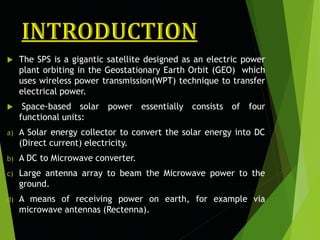
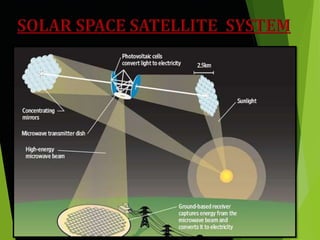
 The SPS is a gigantic satellite designed as an electric power
plant orbiting in the Geostationary Earth Orbit (GEO) which
uses wireless power transmission(WPT) technique to transfer
electrical power.
 Space-based solar power essentially consists of four
functional units:
a) A Solar energy collector to convert the solar energy into DC
(Direct current) electricity.
b) A DC to Microwave converter.
c) Large antenna array to beam the Microwave power to the
ground.
d) A means of receiving power on earth, for example via
microwave antennas (Rectenna).
NEED OF SSPS
 Increasing global energy demand
 Nonrenewable energy sources are limited
 environmental problems
 High Transmission and Conversion Efficiency
 Ease of Transmission(remote location)
 Non-hazardous Radiation
 There is no variation of power supply during the course of
the day and night, or from season to season(24x7).
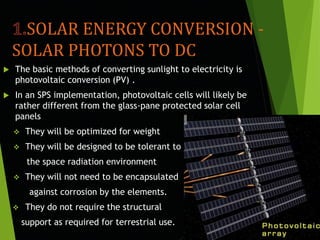
SOLAR ENERGY CONVERSION -
SOLAR PHOTONS TO DC
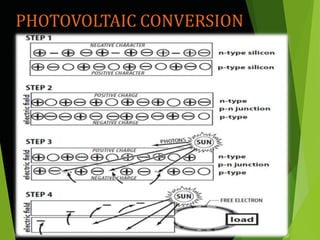
 The basic methods of converting sunlight to electricity is
photovoltaic conversion (PV) .
 In an SPS implementation, photovoltaic cells will likely be
rather different from the glass-pane protected solar cell
panels
 They will be optimized for weight
 They will be designed to be tolerant to
the space radiation environment
 They will not need to be encapsulated
against corrosion by the elements.
 They do not require the structural
support as required for terrestrial use.
PHOTOVOLTAIC CONVERSION
CONVERTING DC TO MICROWAVE
POWER
 There are mainly three dc-to-RF power converters: magnetrons,
klystrons and solid state amplifiers.
 Requirement of a transmitter
i. ability to convert dc power to RF power efficiently
ii. Radiate the power to a controlled manner with low loss.
 The transmitter’s efficiency drives the end-to-end efficiency as
well as thermal management system .
 Components of a transmitter
1. dc-to-RF converter
2. transmitting antenna.
 Power distribution at the transmitting antenna=(1-r²), where r
is the radius of antenna .
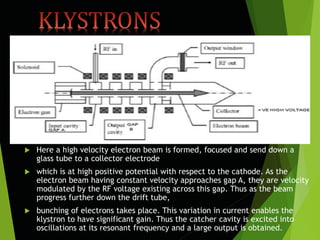
 Here a high velocity electron beam is formed, focused and send down a
glass tube to a collector electrode
 which is at high positive potential with respect to the cathode. As the
electron beam having constant velocity approaches gap A, they are velocity
modulated by the RF voltage existing across this gap. Thus as the beam
progress further down the drift tube,
 bunching of electrons takes place. This variation in current enables the
klystron to have significant gain. Thus the catcher cavity is excited into
oscillations at its resonant frequency and a large output is obtained.
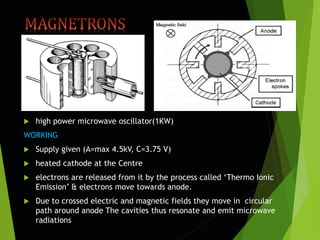
 high power microwave oscillator(1KW)
WORKING
 Supply given (A=max 4.5kV, C=3.75 V)
 heated cathode at the Centre
 electrons are released from it by the process called ‘Thermo Ionic
Emission’ & electrons move towards anode.
 Due to crossed electric and magnetic fields they move in circular
path around anode The cavities thus resonate and emit microwave
radiations
TRANSMISSION
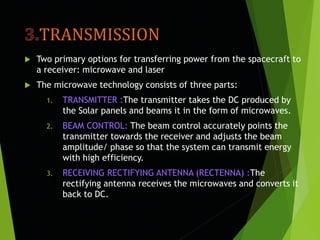
 Two primary options for transferring power from the spacecraft to
a receiver: microwave and laser
 The microwave technology consists of three parts:
1. TRANSMITTER :The transmitter takes the DC produced by
the Solar panels and beams it in the form of microwaves.
2. BEAM CONTROL: The beam control accurately points the
transmitter towards the receiver and adjusts the beam
amplitude/ phase so that the system can transmit energy
with high efficiency.
3. RECEIVING RECTIFYING ANTENNA (RECTENNA) :The
rectifying antenna receives the microwaves and converts it
back to DC.
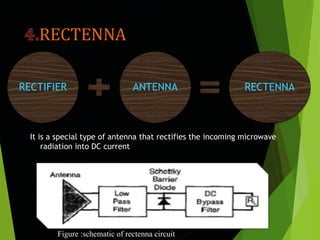
RECTENNA
It is a special type of antenna that rectifies the incoming microwave
radiation into DC current
RECTIFIER ANTENNA RECTENNA
Figure :schematic of rectenna circuit
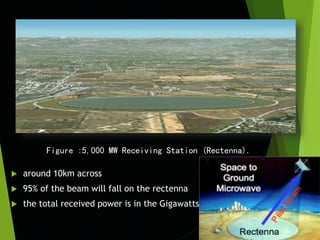
 around 10km across
 95% of the beam will fall on the rectenna
 the total received power is in the Gigawatts (GW)
Figure :5,000 MW Receiving Station (Rectenna).
The technologies and infrastructure required to make space solar
power feasible include:
• Low-cost, environmentally-friendly launch vehicles
• Large scale in-orbit construction and operations
• Power transmission.
REQUIREMENTS
 It can be used as a weapon
 High power microwave source and high gain antenna can be
used to deliver an intense burst of energy
 Complexity—30 years to complete
 Size—6.5 miles long by 3.3 miles wide
 Transmitting antenna ½ mile in diameter(1 km)
 Cost—prototype would have cost $74 billion
 safety of space workers in a heavy-radiation environment
 Microwave transmission
 Interference with other electronic devices
 Health and environmental effects
 Interaction with Space (Plasma heating, interactions and
excitation of electrostatic waves in MHz bands)
 Cost of transporting materials into space
 installation of satellite
o Space Walks
 Maintenance
o Routine
o Meteor impacts
 Geosynchronous orbit is already in heavy use
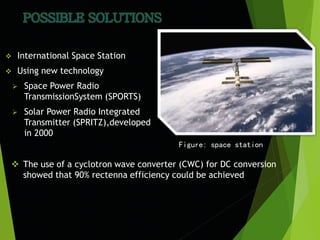
 International Space Station
 Using new technology
 Space Power Radio
TransmissionSystem (SPORTS)
 Solar Power Radio Integrated
Transmitter (SPRITZ),developed
in 2000
Figure: space station
 The use of a cyclotron wave converter (CWC) for DC conversion
showed that 90% rectenna efficiency could be achieved
 Microwaves have other features such as
 larger band width, smaller antenna size, sharp radiated beams
 they propagate along straight lines.
 frequency in the range of 2-3 GHz are consider optimal for the
transmission of power from SPS to the ground rectennas site
 Retro directive beam control capability:
 accurate target detection and high efficient beam forming
 Power level is well below international safety standard(300GW)
 The overall efficiency of the WPT system can be improved by
 Increasing directivity of the antenna array
 Using dc to ac inverters with higher conversion efficiency
 Using schottky diode with higher ratings
Microwave
 More developed
 High efficiency up to 85%
 Beams is far below the
lethal levels of
concentration even for a
prolonged exposure
 Cause interference with
satellite communication
industry
Laser
 Recently developed solid
state lasers allow
efficient transfer of
power
 Range of 10% to 20%
efficiency within a few
years
 Conform to limits on eye
and skin damage
 More intense sunlight
 In geosynchronous orbit, 36,000 km (22,369 miles) an SPS would
be illuminated over 99% of the time
 No need for costly storage devices for when the sun is not in view
o Only a few days at spring and full equinox would the satellite
be in shadow
 Waste heat is radiated back into space
 Power can be beamed to the location where it is needed, don’t
have to invest in as large a grid
 No air or water pollution is created during generation
CONCLUSION
 The SPS will be a central attraction of space and energy technology
in coming decades The increasing global energy demand is likely to
continue for many decades. Fossils fuels will run off in another 3-
4decades. However energy independence is something only Space
based solar power can deliver.
 Space based solar power (SBSP) concept is attractive because it is
much more advantageous than ground based solar power. It has
been predicted that by 2030, the world needs 30TW power from
renewable energy sources and solar energy alone has the capability
of producing around 600TW.
 The levels of CO2 gas emission can be minimized and brought under
control. Thus the problem of global warming will be solved to a
great extent.
REFERENCES
[1] Hiroshi Matsumoto, “Research on solar power satellites and microwave power transmission in Japan”,
IEEE microwave magazine, pp.36-45, Dec 2002. Ms. S.G. Satavekar200
[2] James O. Mcspadden & John C. Mankins,”Space solar power programs and microwave wireless power
transmission technology”, IEEE microwave magazine, pp.46-57, Dec 2002.
[3] J.C. Mankins,”A fresh look at space solar power: new architectures, concepts and technologies” in
38th Astronautical Federation.
[4] Seth Potter, “Solar power satellites: an idea whose time has come [online] Available on
www.freemars.org/history/sps.html, last updated on Dec.1998
[5] Consumer Energy Information: EREC Reference Briefs [online] Available on
www.eere.gov/consumerinfo/rebriefs/123.html,last updated onApr.03.
[6] Mc Graw Hill Encyclopedia of Science and Technology, vol.16, pp.41.
[7] Om P.Gandhi,” Microwave engineering and application”, PHI.
[8] Geoffrey A.Landis,” A super synchronous solar power “, Presented at SPS- 97: Space &electric power
for humanity, 24-25 Aug 1997, Montreal, Canada.
[9] Geoffrey A.Landis,”An evolutionary path to SPS”, Space power, vol.9, no.4,pp.365-371, 1990.
[10] S.S.Ahmed, T.W.Yeong and H.B.Ahmad,”Wireless power transmission and its annexure to the grid
system”, IEE Proc.-Gener.Transm.Distrib. Vol.150, No.2, March 2003.
[11] Kennedy “Electronics Communication Systems”, Tata McGraw Hill.
[12] B.O’Leary,”The construction of satellite solar power stations from non terrestrial materials: feasibity
and economics”, Alternative energy sources, Vol.3, pp.1155-1164.

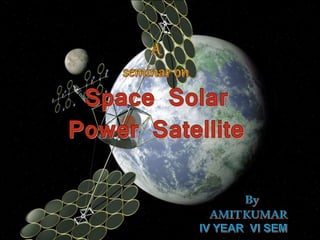
space solar power satellite

  • 2.
     INTRODUCTION  NEEDOF SSPS  DESIGN OF THE SATELLITE BASED SYSTEM SOLAR ENERGY CONVERSION - SOLAR PHOTONS TO DC CONVERTING DC TO MICROWAVE POWER   TRANSMISSION RECTENNA  SSPS: REQUIREMENT, PROBLEMS, DEPLOYMENT ISSUES, PROBLEM SOLUTION i. iii.ADVANTAGES OVER EARTH BASED SOLAR POWER  CONCLUSION  REFERENCES
  • 3.
     The SPSis a gigantic satellite designed as an electric power plant orbiting in the Geostationary Earth Orbit (GEO) which uses wireless power transmission(WPT) technique to transfer electrical power.  Space-based solar power essentially consists of four functional units: a) A Solar energy collector to convert the solar energy into DC (Direct current) electricity. b) A DC to Microwave converter. c) Large antenna array to beam the Microwave power to the ground. d) A means of receiving power on earth, for example via microwave antennas (Rectenna).
  • 4.
    NEED OF SSPS Increasing global energy demand  Nonrenewable energy sources are limited  environmental problems  High Transmission and Conversion Efficiency  Ease of Transmission(remote location)  Non-hazardous Radiation  There is no variation of power supply during the course of the day and night, or from season to season(24x7).
  • 6.
    SOLAR ENERGY CONVERSION- SOLAR PHOTONS TO DC  The basic methods of converting sunlight to electricity is photovoltaic conversion (PV) .  In an SPS implementation, photovoltaic cells will likely be rather different from the glass-pane protected solar cell panels  They will be optimized for weight  They will be designed to be tolerant to the space radiation environment  They will not need to be encapsulated against corrosion by the elements.  They do not require the structural support as required for terrestrial use.
  • 7.
  • 8.
    CONVERTING DC TOMICROWAVE POWER  There are mainly three dc-to-RF power converters: magnetrons, klystrons and solid state amplifiers.  Requirement of a transmitter i. ability to convert dc power to RF power efficiently ii. Radiate the power to a controlled manner with low loss.  The transmitter’s efficiency drives the end-to-end efficiency as well as thermal management system .  Components of a transmitter 1. dc-to-RF converter 2. transmitting antenna.  Power distribution at the transmitting antenna=(1-r²), where r is the radius of antenna .
  • 9.
     Here ahigh velocity electron beam is formed, focused and send down a glass tube to a collector electrode  which is at high positive potential with respect to the cathode. As the electron beam having constant velocity approaches gap A, they are velocity modulated by the RF voltage existing across this gap. Thus as the beam progress further down the drift tube,  bunching of electrons takes place. This variation in current enables the klystron to have significant gain. Thus the catcher cavity is excited into oscillations at its resonant frequency and a large output is obtained.
  • 10.
     high powermicrowave oscillator(1KW) WORKING  Supply given (A=max 4.5kV, C=3.75 V)  heated cathode at the Centre  electrons are released from it by the process called ‘Thermo Ionic Emission’ & electrons move towards anode.  Due to crossed electric and magnetic fields they move in circular path around anode The cavities thus resonate and emit microwave radiations
  • 11.
    TRANSMISSION  Two primaryoptions for transferring power from the spacecraft to a receiver: microwave and laser  The microwave technology consists of three parts: 1. TRANSMITTER :The transmitter takes the DC produced by the Solar panels and beams it in the form of microwaves. 2. BEAM CONTROL: The beam control accurately points the transmitter towards the receiver and adjusts the beam amplitude/ phase so that the system can transmit energy with high efficiency. 3. RECEIVING RECTIFYING ANTENNA (RECTENNA) :The rectifying antenna receives the microwaves and converts it back to DC.
  • 12.
    RECTENNA It is aspecial type of antenna that rectifies the incoming microwave radiation into DC current RECTIFIER ANTENNA RECTENNA Figure :schematic of rectenna circuit
  • 13.
     around 10kmacross  95% of the beam will fall on the rectenna  the total received power is in the Gigawatts (GW) Figure :5,000 MW Receiving Station (Rectenna).
  • 14.
    The technologies andinfrastructure required to make space solar power feasible include: • Low-cost, environmentally-friendly launch vehicles • Large scale in-orbit construction and operations • Power transmission. REQUIREMENTS
  • 15.
     It canbe used as a weapon  High power microwave source and high gain antenna can be used to deliver an intense burst of energy  Complexity—30 years to complete  Size—6.5 miles long by 3.3 miles wide  Transmitting antenna ½ mile in diameter(1 km)  Cost—prototype would have cost $74 billion  safety of space workers in a heavy-radiation environment  Microwave transmission  Interference with other electronic devices  Health and environmental effects  Interaction with Space (Plasma heating, interactions and excitation of electrostatic waves in MHz bands)
  • 16.
     Cost oftransporting materials into space  installation of satellite o Space Walks  Maintenance o Routine o Meteor impacts  Geosynchronous orbit is already in heavy use
  • 17.
     International SpaceStation  Using new technology  Space Power Radio TransmissionSystem (SPORTS)  Solar Power Radio Integrated Transmitter (SPRITZ),developed in 2000 Figure: space station  The use of a cyclotron wave converter (CWC) for DC conversion showed that 90% rectenna efficiency could be achieved
  • 18.
     Microwaves haveother features such as  larger band width, smaller antenna size, sharp radiated beams  they propagate along straight lines.  frequency in the range of 2-3 GHz are consider optimal for the transmission of power from SPS to the ground rectennas site  Retro directive beam control capability:  accurate target detection and high efficient beam forming  Power level is well below international safety standard(300GW)  The overall efficiency of the WPT system can be improved by  Increasing directivity of the antenna array  Using dc to ac inverters with higher conversion efficiency  Using schottky diode with higher ratings
  • 19.
    Microwave  More developed High efficiency up to 85%  Beams is far below the lethal levels of concentration even for a prolonged exposure  Cause interference with satellite communication industry Laser  Recently developed solid state lasers allow efficient transfer of power  Range of 10% to 20% efficiency within a few years  Conform to limits on eye and skin damage
  • 20.
     More intensesunlight  In geosynchronous orbit, 36,000 km (22,369 miles) an SPS would be illuminated over 99% of the time  No need for costly storage devices for when the sun is not in view o Only a few days at spring and full equinox would the satellite be in shadow  Waste heat is radiated back into space  Power can be beamed to the location where it is needed, don’t have to invest in as large a grid  No air or water pollution is created during generation
  • 21.
    CONCLUSION  The SPSwill be a central attraction of space and energy technology in coming decades The increasing global energy demand is likely to continue for many decades. Fossils fuels will run off in another 3- 4decades. However energy independence is something only Space based solar power can deliver.  Space based solar power (SBSP) concept is attractive because it is much more advantageous than ground based solar power. It has been predicted that by 2030, the world needs 30TW power from renewable energy sources and solar energy alone has the capability of producing around 600TW.  The levels of CO2 gas emission can be minimized and brought under control. Thus the problem of global warming will be solved to a great extent.
  • 22.
    REFERENCES [1] Hiroshi Matsumoto,“Research on solar power satellites and microwave power transmission in Japan”, IEEE microwave magazine, pp.36-45, Dec 2002. Ms. S.G. Satavekar200 [2] James O. Mcspadden & John C. Mankins,”Space solar power programs and microwave wireless power transmission technology”, IEEE microwave magazine, pp.46-57, Dec 2002. [3] J.C. Mankins,”A fresh look at space solar power: new architectures, concepts and technologies” in 38th Astronautical Federation. [4] Seth Potter, “Solar power satellites: an idea whose time has come [online] Available on www.freemars.org/history/sps.html, last updated on Dec.1998 [5] Consumer Energy Information: EREC Reference Briefs [online] Available on www.eere.gov/consumerinfo/rebriefs/123.html,last updated onApr.03. [6] Mc Graw Hill Encyclopedia of Science and Technology, vol.16, pp.41. [7] Om P.Gandhi,” Microwave engineering and application”, PHI. [8] Geoffrey A.Landis,” A super synchronous solar power “, Presented at SPS- 97: Space &electric power for humanity, 24-25 Aug 1997, Montreal, Canada. [9] Geoffrey A.Landis,”An evolutionary path to SPS”, Space power, vol.9, no.4,pp.365-371, 1990. [10] S.S.Ahmed, T.W.Yeong and H.B.Ahmad,”Wireless power transmission and its annexure to the grid system”, IEE Proc.-Gener.Transm.Distrib. Vol.150, No.2, March 2003. [11] Kennedy “Electronics Communication Systems”, Tata McGraw Hill. [12] B.O’Leary,”The construction of satellite solar power stations from non terrestrial materials: feasibity and economics”, Alternative energy sources, Vol.3, pp.1155-1164.