Surfing the First and Second Waves in 2025: 
A SOF Strategy for Regional Engagement 
A Research Paper 
Presented To 
Air Force 2025 
by 
Lt Col Thomas F. Berardinelli 
Maj Sandra R. Bignell 
Maj Michael J. Irwin 
LCDR Alfredo E. Rackauskas (USN) 
August 1996
Disclaimer 
2025 is a study designed to comply with a directive from the chief of staff of the Air Force to examine the 
concepts, capabilities, and technologies the United States will require to remain the dominant air and space 
force in the future. Presented on 17 June 1996, this report was produced in the Department of Defense school 
environment of academic freedom and in the interest of advancing concepts related to national defense. The 
views expressed in this report are those of the authors and do not reflect the official policy or position of the 
United States Air Force, Department of Defense, or the United States government. 
This report contains fictional representations of future situations/scenarios. Any similarities to real people or 
events, other than those specifically cited, are unintentional and are for purposes of illustration only. 
This publication has been reviewed by security and policy review authorities, is unclassified, and is cleared 
for public release. 
ii
Contents 
Chapter Page 
Disclaimer..........................................................................................................................................ii 
Illustrations.........................................................................................................................................v 
Tables................................................................................................................................................vi 
Preface..............................................................................................................................................vii 
Executive Summary ........................................................................................................................ viii 
1 Introduction.........................................................................................................................................1 
Scope............................................................................................................................................2 
Assumptions..................................................................................................................................3 
Methodology.................................................................................................................................4 
2 Regional Engagement..........................................................................................................................5 
Core Capability and Core Competencies......................................................................................5 
Employment Opportunity ..............................................................................................................8 
Organization..................................................................................................................................8 
Regional Orientation...............................................................................................................9 
Force Size.............................................................................................................................11 
Decentralized Control and Execution....................................................................................11 
Focus of Expertise ................................................................................................................11 
3 Concept of Operations (CONOP) .....................................................................................................13 
Defensive SORE...................................................................................................................14 
Offensive SORE....................................................................................................................14 
Advantages of SORE ............................................................................................................15 
4 Enabling Tasks..................................................................................................................................18 
Recruit, Assess, and Train..........................................................................................................19 
Observe, Communicate, and Decide...........................................................................................25 
Counter .......................................................................................................................................33 
Sustain ........................................................................................................................................37 
5 Conclusions and Recommendations ..................................................................................................45 
Appendix Page 
A Systems and Underlying Technologies ..............................................................................................48 
Recruit, Assess, and Train Systems ............................................................................................49 
Dependencies or Training Systems Provided by Non-SORE Sources ..................................53 
C4I Systems.................................................................................................................................53 
Observation or Collection Systems.............................................................................................54 
iii
Appendix Page 
Dependencies or Observation Systems Provided by Non-SORE Sources ............................55 
Communications Systems............................................................................................................56 
Dependencies or Communications Systems Provided by Non-SORE Sources .....................57 
Decision Systems........................................................................................................................59 
Counter Systems..........................................................................................................................61 
Dependencies or Counter Systems Provided by Non-SORE Sources ...................................62 
Sustain Systems...........................................................................................................................63 
Move or Transportation Systems ................................................................................................66 
B Definitions of Underlying Technologies............................................................................................68 
Bibliography.....................................................................................................................................71 
iv
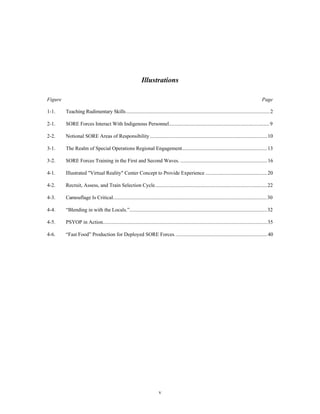
Illustrations 
Figure Page 
1-1. Teaching Rudimentary Skills..............................................................................................................2 
2-1. SORE Forces Interact With Indigenous Personnel..............................................................................9 
2-2. Notional SORE Areas of Responsibility ..........................................................................................10 
3-1. The Realm of Special Operations Regional Engagement..................................................................13 
3-2. SORE Forces Training in the First and Second Waves. ...................................................................16 
4-1. Illustrated "Virtual Reality" Center Concept to Provide Experience ................................................20 
4-2. Recruit, Assess, and Train Selection Cycle......................................................................................22 
4-3. Camouflage Is Critical......................................................................................................................30 
4-4. “Blending in with the Locals.”..........................................................................................................32 
4-5. PSYOP in Action..............................................................................................................................35 
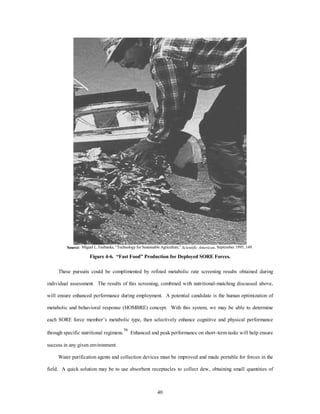
4-6. “Fast Food” Production for Deployed SORE Forces. ......................................................................40 
v
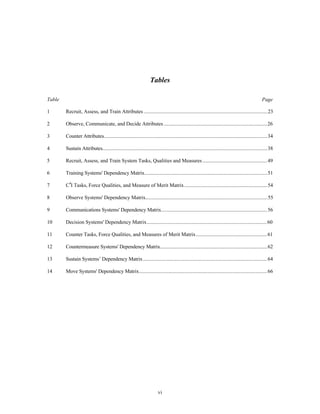
Tables 
Table Page 
1 Recruit, Assess, and Train Attributes ...............................................................................................23 
2 Observe, Communicate, and Decide Attributes ................................................................................26 
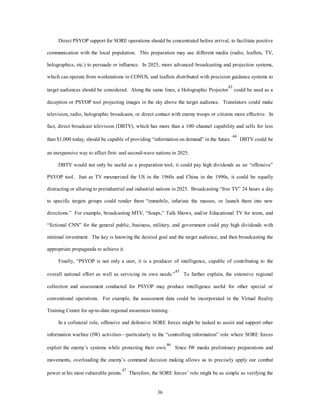
3 Counter Attributes.............................................................................................................................34 
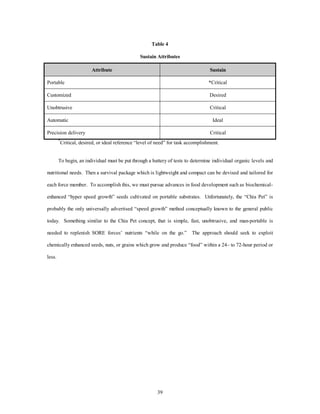
4 Sustain Attributes..............................................................................................................................38 
5 Recruit, Assess, and Train System Tasks, Qualities and Measures ..................................................49 
6 Training Systems' Dependency Matrix..............................................................................................51 
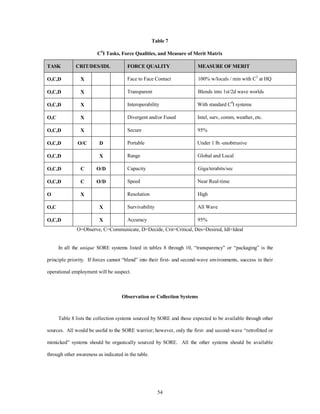
7 C4I Tasks, Force Qualities, and Measure of Merit Matrix................................................................54 
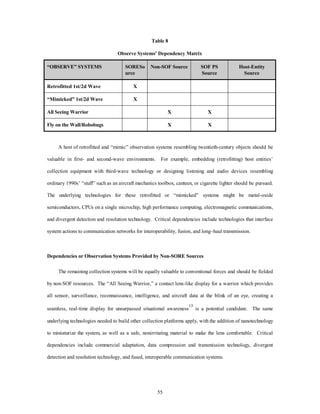
8 Observe Systems' Dependency Matrix..............................................................................................55 
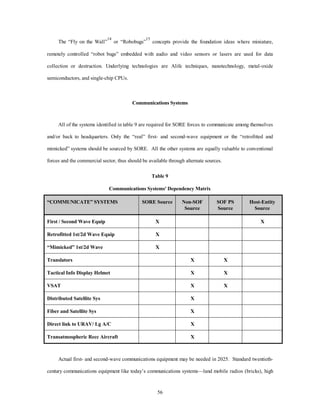
9 Communications Systems' Dependency Matrix.................................................................................56 
10 Decision Systems' Dependency Matrix.............................................................................................60 
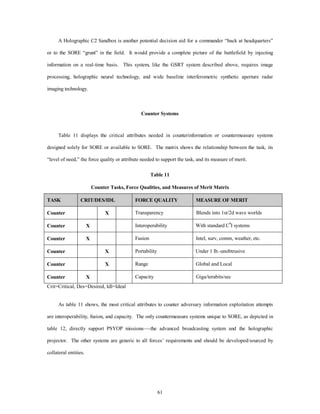
11 Counter Tasks, Force Qualities, and Measures of Merit Matrix.......................................................61 
12 Countermeasure Systems' Dependency Matrix..................................................................................62 
13 Sustain Systems’ Dependency Matrix...............................................................................................64 
14 Move Systems' Dependency Matrix..................................................................................................66 
vi
Preface 
Special Operations Regional Engagement (SORE) is the topic of this study. Its enduring qualities are 
timeless in comparison to technological advancements. To frame the function, assume the challenges faced 
by the fictional Yankee moving back to face a medieval King Arthur’s Court, or by the more contemporary 
Star Trek travelers “teleported” onto a planet resembling the earthly world of 1996. Although the travelers 
possess a multitude of techno-gadgets capable of mystifying and destroying the masses of earthly dwellers, 
they must abort the notion of dominating the planet with their intergalactic capabilities and, instead, work 
within the population they have encountered. They must assimilate the language, culture, clothing, and times; 
they must be familiar with the mores and values of the population they encounter. The travelers cannot 
influence the behavior of the “barbarian” dwellers if they do not possess the ability to evaluate the populace; 
wisdom to integrate and communicate on the local level; the knowledge and familiarity with the local 
methods of barter and trade; and collectively, operate at the inferior technical level they encounter—a level 
vastly different from which they have come. With this as a frame of reference, we expect the SORE forces of 
the next century to be faced with the same dilemmas challenging the fictional Connecticut Yankee in King 
Arthur’s Court. This paper focuses on the ability to advance those forces technologically and firmly plant the 
need to retain specific rudimentary, but extremely perishable, skills which may fall prey to the “cyber-warrior” 
vii 
quest.
Executive Summary 
The United States is riding high on the crest of “thirdwave” technology as it leads the world’s rush into 
the Information Age. It must not become so fixated on the information-based future that it is unprepared to 
deal with 78 percent of the world’s population who will still be living in preindustrial and industrial 
societies late into the twenty-first Century.1 Our thesis is that Special Operations Regional Engagement 
(SORE) forces will be the United States’ warriors prepared to successfully engage in these less developed, 
though no less threatening worlds of the first- and second-wave “the ‘Niche Warriors’ of 2025.” Their 
timeless core competencies—skill in the use of unconventional equipment and tactics, excel in politically 
sensitive environments and operations, employ unorthodox approaches, exploit limited opportunity, and 
produce/use specialized information—make them “special” and distinguish them from conventional forces. 
These core competencies underlie SORE-unique and specialized skills that make them the force of 
choice to meet this challenge. First, they possess the cross-cultural skills that will remain elusive for many 
but are needed to build and gain the trust of these underdeveloped nations—foreign language proficiency, 
cultural and area awareness, nonverbal communications, and interpersonal skills.2 Second, they “blend” into 
the environments in which they operate, either using their cross-cultural skills or the new third-wave 
technologies at their disposal. Third, SORE forces are not employed to “fight the client’s battle” but to train 
them to “defend themselves” without developing a dependency on SORE forces. There is a critical air 
power component to SORE that the Air Force must prepare itself to meet. Many first- and second-wave 
entities will face threats to their internal security that may require the proper use of air power. The fledgling 
air forces of these entities will require assistance in developing adequate tactics, procedures, maintenance, 
supply, and other support systems within their own technological limitations. Last, since conventional forces 
will no longer possess the expertise, the weapons or the equipment found in most of these first- and second-wave 
areas, it will be the responsibility of SORE forces to be the “experts” in the procedures, tactics, and 
support requirements necessary to prevent and counter the spreading threat that “outbreaks of small wars” 
viii 
pose to US national interests.
SORE activities are conducted across the spectrum of military operations, from peace to war, and focus 
their defensive and offensive operations on training, advising, and assisting. The defensive objective is to 
enable host nations or other internationally recognized entities to maintain their internal security against 
forces that promote lawlessness, subversion, and terrorism, using their own personnel and equipment. 
Although ideally conducted in noncombative environments, SORE forces may be employed or unavoidably 
find themselves in combative situations. Offensive operations target an occupying force or established entity 
threatening US national interests. It may employ guerrilla warfare, subversion, sabotage, intelligence 
activities, evasion and escape, or other activities of low visibility, covert, or clandestine nature3 to counter 
these forces. Defensive or offensive operations may require independent or combined direct combat action 
by SORE forces. The reader should not construe this paper as an attempt to “freeze” in time the SOF foreign 
internal defense (FID) and unconventional warfare (UW) missions of today. Rather, the focus must be to 
ensure the US does not lose these essential capabilities and is caught ill-prepared or off-guard when “endless 
outbreaks of small wars”4 indirectly threatening US security become the norm of first- and second-wave 
nations in 2025. SORE forces will meet these challenges head-on by exploiting the advanced technology of 
third-wave warfare to improve their ability to operate effectively in the 126 predicted first- and second-wave 
nations of the twenty-first Century.5 They will not disrupt the evolutionary stage of those countries by 
introducing third-wave technology before its time but instead will work within the constraints of those 
countries’ capabilities, using third-wave technology only to train, prepare, and protect themselves. 
The first step is employing an assessment system to “select” the best recruits for these operations, 
followed by realistic training and preparation in a virtual reality training center. Secondly, communications, 
computer, command, control, and information (C4I) systems that “blend” into SORE first- and second-wave 
environments, yet also provide “third-wave” capabilities and interoperability with conventional force 
systems, is paramount. Third, they must have the know-how and systems to counter threats in these regions 
and to assist in information warfare (IW) activities. Advances in psychological operations tools and access 
to “information weapons” will play a key role in SORE countermeasure capabilities and in their collateral 
role of IW. Lastly, since SORE is performed on a personal level, rather than from a standoff position as 
envisioned by conventional force or SOF precision strike operations, basic sustainment needs of the 
individual cannot be overlooked. Simple, portable methods to feed, water, and resupply SORE are needed. 
ix
Furthermore, lightweight and compact “energy” sources—to ensure power is available for C4I systems, 
weapons, and support equipment—must be devised. The details of these tasks and systems, as well as how 
they will be employed, are the heart of this white paper. 
Notes 
1 Charles W. Taylor, Alternative World Scenarios for a New Order of Nations, Strategic Studies 
x 
Institute, US Army War College, 1993, 26–28. 
2 These were the components of crosscultural communications identified by USCINCSOC in a briefing 
to the students of the Air War College on 25 March 1996. 
3 Joint Pub 3-05.3, Joint Special Operations Operational Procedures, II-5. 
4 Alvin and Heidi Toffler, War and Anti-War, Making Sense of Global Chaos (New York: Warner 
Books, 1993), 103. 
5 Taylor, 26–28.
Chapter 1 
Introduction 
In numerous incidents during the last two decades, the inability of developed countries 
to protect their interests and even their citizens’ lives in the face of low-level threats 
has been demonstrated time and again. 
1 
—Martin Van Creveld 
The Transformation of War 
Although not necessarily a sole superpower in 2025, the US will be a leading third-wave nation.1 As in 
the past and present, the US will look to identify a threat to national survival that it can understand and fight 
on its own terms. This potential peer competitor, like the Germany of the World Wars and Soviet Union of 
the Cold War, will, in all probability, be a nation or “entity”2 that generally thinks, plans, organizes, trains, 
and equips its forces in ways similar to the US. Justifiably, it will be important to ensure the US is a 
capable competitor in, if not the leader of, the third-wave world. However, it will be equally important that 
the US not become so fixated on building an information-based “Maginot Line” that its flanks are left 
vulnerable to the first– and second-wave threats that Western ethnocentrism or “technocentrism” often 
misunderstands or overlooks entirely. This is particularly important when one considers 78 percent of the 
world’s population (126 of 147 nations) will live in preindustrial or industrial societies in 2020.3 
The thesis of this white paper is that in 2025, SORE forces will be the “niche warriors” that provide the 
capability for the US to successfully engage in the less developed, though no less threatening, worlds of the 
first- and second-wave.
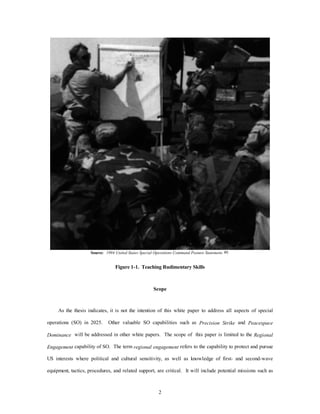
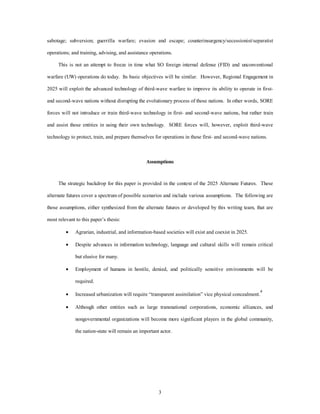
Source: 1994 United States Special Operations Command Posture Statement, 49. 
Figure 1-1. Teaching Rudimentary Skills 
Scope 
As the thesis indicates, it is not the intention of this white paper to address all aspects of special 
operations (SO) in 2025. Other valuable SO capabilities such as Precision Strike and Peacespace 
Dominance will be addressed in other white papers. The scope of this paper is limited to the Regional 
Engagement capability of SO. The term regional engagement refers to the capability to protect and pursue 
US interests where political and cultural sensitivity, as well as knowledge of first- and second-wave 
equipment, tactics, procedures, and related support, are critical. It will include potential missions such as 
2
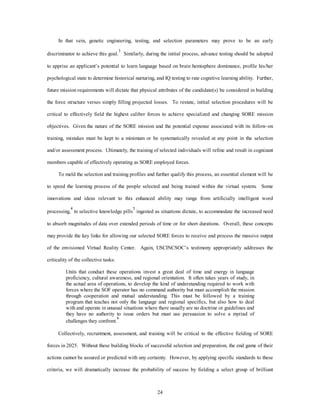
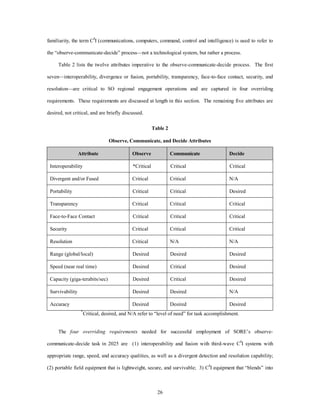
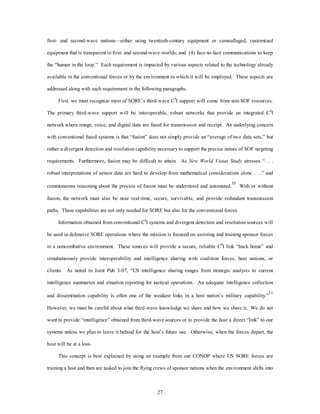
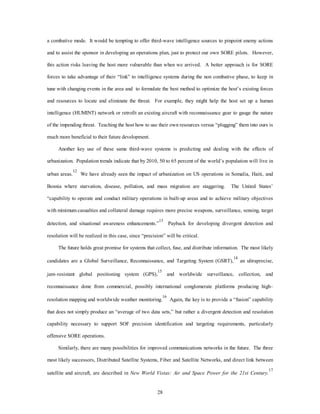
sabotage; subversion; guerrilla warfare; evasion and escape; counterinsurgency/secessionist/separatist 
operations; and training, advising, and assistance operations. 
This is not an attempt to freeze in time what SO foreign internal defense (FID) and unconventional 
warfare (UW) operations do today. Its basic objectives will be similar. However, Regional Engagement in 
2025 will exploit the advanced technology of third-wave warfare to improve its ability to operate in first-and 
second-wave nations without disrupting the evolutionary process of those nations. In other words, SORE 
forces will not introduce or train third-wave technology in first- and second-wave nations, but rather train 
and assist those entities in using their own technology. SORE forces will, however, exploit third-wave 
technology to protect, train, and prepare themselves for operations in these first- and second-wave nations. 
Assumptions 
The strategic backdrop for this paper is provided in the context of the 2025 Alternate Futures. These 
alternate futures cover a spectrum of possible scenarios and include various assumptions. The following are 
those assumptions, either synthesized from the alternate futures or developed by this writing team, that are 
3 
most relevant to this paper’s thesis: 
·  Agrarian, industrial, and information-based societies will exist and coexist in 2025. 
·  Despite advances in information technology, language and cultural skills will remain critical 
but elusive for many. 
·  Employment of humans in hostile, denied, and politically sensitive environments will be 
required. 
·  Increased urbanization will require “transparent assimilation” vice physical concealment.4 
·  Although other entities such as large transnational corporations, economic alliances, and 
nongovernmental organizations will become more significant players in the global community, 
the nation-state will remain an important actor.
Methodology 
This paper is divided into three major sections and two appendices. The thesis, assumptions, and core 
capability serve as the common thread tying the tasks, force qualities, and underlying technologies to SORE 
mission needs and core competencies in 2025. The first section (chapters 2 and 3) introduces the reader to 
SOF core competencies, the core capability of SORE, organization, and our proposed concept of operation 
(CONOP) to employ this core capability. The second section (chapter 4) addresses and details the critical 
tasks that enable the CONOP. These enabling tasks are recruitment, assessment, training, observation, 
communication, decision, countermeasures, and sustainment. Movement is also an important enabling task. 
However, since movement support for SORE operations will come from non-SOF, host or sponsor, and/or 
SOF lift platforms (designed for precision strike) and are addressed in the Airlift, Spacelift, and SOF 
Precision Strike white papers, we will not address them here. The closing section (chapter 5) provides our 
conclusions and recommendations for the future. Two appendices support the body of this paper. Appendix 
A identifies and discusses the force qualities and attributes needed in the recommended systems, as well as 
the underlying technologies required to create those systems. Appendix B provides a brief definition of those 
4 
underlying technologies. 
Notes 
1 Refers to the definitions used by the Tofflers in their books, The Third Wave and War and Anti-War. 
The first wave encompasses agrarian-based societies; the second wave, industrial societies; and the third 
wave, information-based societies. See Alvin and Heidi Toffler, War and Anti-War (New York: Warner 
Books, Inc., 1993), 8–9. 
2 “Entity” refers to potentially significant nonnational players in the world arena, such as multi- or 
transnational corporations and other nongovernmental organizations. 
3 Charles W. Taylor, Alternative World Scenarios for a New Order of Nations, Strategic Studies 
Institute, US Army War College, 1993, 26–28. 
4 For instance, today’s UW operations such as evasion and escape focus on avoiding population 
concentrations. This assumes these missions will only be conducted in isolated areas. Based on this 
assumption, transparency is achieved by physical concealment. In an urban environment, avoidance of 
indigenous personnel will be more complex. Accordingly, SORE forces must “blend in” and be capable of 
handling unanticipated contact.
Chapter 2 
Regional Engagement 
. . . a bewildering diversity of separatist wars, ethnic and religious violence, coups 
d’etat, border disputes, civil upheavals, and terrorist attacks, [push] waves of poverty-stricken, 
war-ridden immigrants (and hordes of drug traffickers as well) cross national 
boundaries. In the increasingly wired global economy, many of these seemingly small 
conflicts trigger strong secondary effects in surrounding (and even distant) countries. 
Thus a “many small wars” scenario is compelling military planners in many armies to 
look afresh at what they call “special operations” or “special forces”—the niche 
warriors of tomorrow. 
5 
—Alvin and Heidi Toffler 
War and Anti-War, Making Sense 
of Global Chaos 
Core Capability and Core Competencies 
SORE’s core capability encompasses two general components: defensive and offensive operations. 
The defensive objective of SORE is to prevent or free a society from subversion, lawlessness, and/or 
insurgency. This is primarily accomplished by training, advising, or otherwise assisting host military and 
paramilitary forces, with the goal of enabling the host to unilaterally assume responsibility for eliminating 
internal instability.1 
The offensive objective of SORE is to influence a government or nongovernmental entity whose 
behavior is contrary to US regional interests. Offensive operations involve a variety of military and 
paramilitary missions in hostile, denied, or politically sensitive areas. These missions are characterized by 
long duration, indirect activities including guerrilla warfare, and other offensive, low-visibility, covert, or 
clandestine operations.2 SORE forces conduct or train and assist clients in subversion, sabotage, intelligence
activities, evasion and escape tactics, and other activities of a covert or clandestine nature.3 Operations 
themselves are generally conducted by indigenous forces organized, trained, equipped, supported, and 
6 
directed in varying degrees by SORE forces.4 
The SORE core capability and special operations force (SOF) core competencies are closely related. 
Although the targets and focus of regional engagement may vary over time, the five core competencies are 
timeless. SOF must (1) be skilled in the use of unconventional equipment and tactics; (2) excel in politically 
sensitive environments; (3) employ unorthodox approaches; (4) exploit limited opportunities; and finally (5) 
use and produce specialized intelligence. The following paragraphs further define the core competencies and 
link them to SORE. Specifically, SORE forces must be skilled in the use of unconventional equipment and 
tactics. 
The unusual demands of a SO mission define the training and equipment required. Often, 
accomplishing the SO mission calls for a unique mixture of specialized skills and 
equipment that may be outside the capabilities of conventional forces.5 
In 2025, this will be manifested in two ways for SORE operations. First, SORE must possess 
crosscultural skills. In other words, they must be regionally focused, skilled in foreign language, and 
culturally attuned. Second, the force must be skilled in the employment of equipment, tactics, procedures, and 
support functions associated with first- and second-wave societies and warfare. 
Given the nature of their projected employment, they must excel in politically sensitive environments 
and operations. 
Virtually every aspect of a SO mission is constrained by the politically sensitive context in 
which it is conducted. For instance, the cultural mores of a country may dictate a low-profile 
operation, while in another situation, larger political considerations may require a 
visible presence in an advisory capacity. [SO] are marked by the need for political 
sensitivity and require patient, long-term commitments to achieve national objectives.6 
Patient and long-term are the key adjectives of this core competency. These terms neither characterize 
the nature of conventional force employment nor the American public’s attitude about such employment. 
SORE operations cultivate the relationships and presence necessary to conduct missions where our interests 
are at stake in politically or economically sensitive areas, not otherwise accessible to conventional (third-wave) 
forces, yet with significant economies of force. SORE operations also provide the flexibility of using 
SOF visibly when a high-profile US presence is desired or covertly/clandestinely when no US signature is 
required, but human presence is necessary.
To meet these diverse profile employment efforts, SORE forces must employ unorthodox approaches. 
SOF missions do not negate the traditional principles of war. Rather, a different emphasis 
is placed on their combination or relative importance. In a SO mission, surprise achieved 
through speed, stealth, audacity, deception, and new tactics or techniques can be far more 
effective and efficient than a conventional force using traditional tactics based on massed 
firepower and tactical maneuvers.7 
In 2025, conventional, third-wave operations and tactics may be characterized by very precise 
munitions delivered from unmanned platforms or the manipulation of data from a work station far removed 
from the intended target. In such a world, the ability to infiltrate a SOF team and remain long enough to build 
a relationship of trust with indigenous personnel will certainly be considered unorthodox, yet remain 
7 
critically important. 
These unorthodox, critical approaches will require strict windows of availability and criteria to meet 
successful fruition. Specifically, SORE forces must be capable of exploiting limited opportunities. 
Some SO missions . . . must capture the appropriate moment for complete success. 
Tactical advantage may be limited and fleeting. Repeat opportunities are unlikely, and 
failures will be politically and militarily costly.8 
Although more characteristic of SOF Precision Strike missions, SORE operations, by exploiting the 
world-wide presence of deployed forces in politically sensitive areas, may provide information or be used to 
conduct missions where a narrow window of opportunity exists. This will be true for both low-visibility and 
high-visibility missions. 
Again, relative to the exploitation role of SORE forces in these visibility missions and all other tasks, 
SORE members will use and produce specialized intelligence. 
SO missions are intelligence-driven and intelligence-dependent. They require immediate 
and continuous access to information from traditional as well as nontraditional sources. 
SO generally rely on formal intelligence structures, but, for certain sensitive missions, 
tactical and operational information must be developed using SOF assets such as advance 
or reconnaissance forces. Moreover, SOF need detailed national and theater intelligence 
products at the tactical level of execution, often in near–real-time.9 
SORE forces will be an excellent, nontraditional source of information valuable to political, 
diplomatic, economic, and military decision makers. Long-term relationships developed with indigenous 
personnel and/or host governments and military officials may allow the gathering of information not 
otherwise possible through traditional military, diplomatic, or economic contacts.
Employment Opportunity 
The opportunity to employ this SORE core capability will be ripe given any of the six 2025 Alternate 
Futures.10 All include the possibility for instability associated with lawlessness, subversion, insurgency, 
separatism, secessionism and states or other entities that sponsor or conduct terrorism and other destabilizing 
activities. Clients may include host nations or virtually any legitimate international organization whose 
maintenance of stability in a given region is in the interest of the US (e.g., multi-/transnational corporations, 
nongovernmental organizations, and regional alliances or coalitions). SORE operations may also be targeted 
against such entities should they conduct or sponsor activities that promote instability or are counter to US 
interests. Opportunities for miscalculation also exist. As noted in the following, this is particularly true 
8 
regarding language and cultural skills. 
The relevance of [training] programs . . . depends heavily on requirements that the US 
intelligence community cannot always predict. Egypt and Syria emerged as the most 
important Arabic dialects after the Arab-Israeli War of 1967. As a direct result of that 
decision, only 16 Arab linguists on active duty (less than one percent) had studied Iraqi 
before Saddam Hussein invaded Kuwait. No one predicted large-scale SOF employment 
in Kurdistan or Somalia, where Operations PROVIDE COMFORT and RESTORE HOPE 
took place. The maintenance of language skills is just as essential as initial learning but, 
for most linguists, peak proficiency occurs the day they receive their diploma.11 
The above example provides for a positive opportunity. It illustrates how third-wave information 
technology can be exploited to improve our ability to engage in first- and second-wave warfare. For 
instance, the capability to transform information into knowledge and, ultimately, into wisdom will contribute 
to our ability to identify future flash points and subsequently adjust our language training. Similarly, 
improved technology such as the introduction of more sophisticated translating devices (although no 
substitute for face-to-face conversation in the spoken language)12 and other learning enhancement devices and 
techniques will likely improve comprehension and retention. 
Organization 
It is not the intention of this white paper to become immersed in the intricacies of organizational 
structure, service component responsibility, or any other controversial organizational issues associated with
details and minutiae. Rather, the purpose is to identify and discuss the important characteristics of any SORE 
9 
organization—be it a service or joint organization. 
Regional Orientation 
Americans often become “bulls in china shops” . . . The “American way” of dealing 
with problems sometimes fails in the international milieu. It is particularly important 
for American leaders . . . to be sensitive to national concerns and to listen carefully to . . 
. other nations. 
—Perry M. Smith 
Taking Charge, A Practical 
Guide for Leaders 
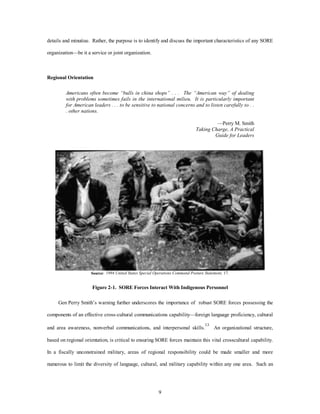
Source: 1994 United States Special Operations Command Posture Statement, 17. 
Figure 2-1. SORE Forces Interact With Indigenous Personnel 
Gen Perry Smith’s warning further underscores the importance of robust SORE forces possessing the 
components of an effective cross-cultural communications capability—foreign language proficiency, cultural 
and area awareness, nonverbal communications, and interpersonal skills.13 An organizational structure, 
based on regional orientation, is critical to ensuring SORE forces maintain this vital crosscultural capability. 
In a fiscally unconstrained military, areas of regional responsibility could be made smaller and more 
numerous to limit the diversity of language, cultural, and military capability within any one area. Such an
arrangement would allow for highly focused training and proficiency in language skills, weapons, and tactics. 
In a technologically unconstrained world in which a transparent language translation capability, “gift of 
tongues,” is available, division of regional responsibility would be less constrained or perhaps not 
necessary. However, based on the alternate futures and our developed assumptions, it is not likely such a 
favorable environment, either fiscally or technologically, will exist in 2025. With this premise in mind, 
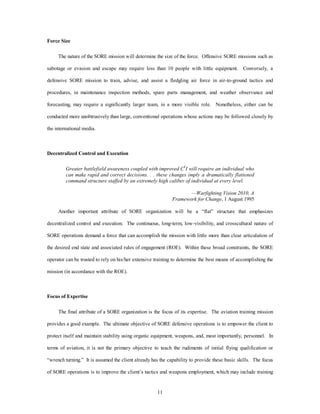
figure 2-2 illustrates a notional division of responsibility that seeks some balance between diversity within a 
region and force structure size limitations. Since SORE operations are focused on first- and second-wave 
areas; North America (less Mexico), Western Europe, Japan, Australia, and New Zealand are not included in 
the regional coverage scheme. The specific boundaries shown, although not entirely unrealistic possibilities, 
10 
are for illustrative purposes only. 
EASTERN/CENTRAL EUROPE 
AND RUSSIA 
CHINA, MONGOLIA, AND 
NORTHEAST ASIA 
SOUTHEAST ASIA AND 
OCEANA (LESS AUS & NZ) 
CENTRAL & SOUTH ASIA 
NORTH AFRICA & THE MIDDLE EAST 
SUB-SAHARAN AFRICA 
MEXICO & CENTRAL/SOUTH AMERICA 
Figure 2-2. Notional SORE Areas of Responsibility
11 
Force Size 
The nature of the SORE mission will determine the size of the force. Offensive SORE missions such as 
sabotage or evasion and escape may require less than 10 people with little equipment. Conversely, a 
defensive SORE mission to train, advise, and assist a fledgling air force in air-to-ground tactics and 
procedures, in maintenance inspection methods, spare parts management, and weather observance and 
forecasting, may require a significantly larger team, in a more visible role. Nonetheless, either can be 
conducted more unobtrusively than large, conventional operations whose actions may be followed closely by 
the international media. 
Decentralized Control and Execution 
Greater battlefield awareness coupled with improved C4I will require an individual who 
can make rapid and correct decisions. . . these changes imply a dramatically flattened 
command structure staffed by an extremely high caliber of individual at every level. 
—Warfighting Vision 2010, A 
Framework for Change, 1 August 1995 
Another important attribute of SORE organization will be a “flat” structure that emphasizes 
decentralized control and execution. The continuous, long-term, low-visibility, and crosscultural nature of 
SORE operations demand a force that can accomplish the mission with little more than clear articulation of 
the desired end state and associated rules of engagement (ROE). Within these broad constraints, the SORE 
operator can be trusted to rely on his/her extensive training to determine the best means of accomplishing the 
mission (in accordance with the ROE). 
Focus of Expertise 
The final attribute of a SORE organization is the focus of its expertise. The aviation training mission 
provides a good example. The ultimate objective of SORE defensive operations is to empower the client to 
protect itself and maintain stability using organic equipment, weapons, and, most importantly, personnel. In 
terms of aviation, it is not the primary objective to teach the rudiments of initial flying qualification or 
“wrench turning.” It is assumed the client already has the capability to provide these basic skills. The focus 
of SORE operations is to improve the client’s tactics and weapons employment, which may include training
and procedures associated with support functions such as supply, maintenance, and weather. This focus has 
force structure implications as well. Since pilots will fly in an observer role, it is only necessary for SORE 
operators to be familiar with the overall characteristics of aircraft flown in the regional area of 
responsibility. It is not necessary for them to be qualified in all aircraft in the region. Subsequently, SORE 
aviation units need only possess aircraft that closely resemble the characteristics of aviation platforms in that 
geographic area. This capability may be accommodated through leasing arrangements that allow the unit to 
change its aircraft inventory to reflect regional changes on a near–real–time basis. This approach is far less 
costly and time consuming than the traditional research, development, acquisition and life cycle maintenance 
associated with traditional military aircraft inventories. 
This flexible, regionally focused organizational structure optimizes the core competencies and 
capability discussed in this chapter. Together, they provide the foundation for successfully implementing the 
12 
CONOPs in the next chapter. 
Notes 
1 Joint Pub 3-05, Doctrine for Joint Special Operations, October 1992, II-8. 
2 The terms covert and clandestine are often confused. Doctrinally, and for the purpose of this paper, 
they are defined as follows. A clandestine operation places emphasis on the concealment of the operation 
itself. A covert operation places emphasis on the concealment of the identity of the sponsor. In special 
operations, an activity may be both covert and clandestine and may focus equally on operational 
considerations and intelligence-related activities. (See Joint Pub 1-02 and Joint Pub 3-05.) 
3 Joint Pub 3-05.3, Joint Special Operations Operational Procedures, August 1993, II-1. 
4 Joint Pub 1-02, Joint Warfare of the United States Armed Forces, January 1995, I-X. 
5 United States Special Operations Command, The United States Special Operations Forces Posture 
Statement, 1994, 3. 
6 Ibid., 3. 
7 Ibid., 4. 
8 Ibid. 
9 Ibid. 
10 Refer to the Alternate Futures white paper for specific definitions. 
11 John Collins, CRS Report for Congress, Special Operations Forces, An Assessment 1986–1993, 30 
July 1993, 1991. 
12 This assertion is further addressed under the “Advantages of SORE” section of chapter 3, Concept of 
Operations. 
13 These were the components of cross-cultural communications identified by USCINCSOC in a briefing 
to the Air War College on 25 March 1996.
Chapter 3 
Concept of Operations (CONOP) 
The Americans neglected to study history’s many examples of supposedly outmatched 
combatants prevailing over better-equipped rivals. And they took it for granted that 
their potential adversaries would accept the American interpretation of the 
“revolution.” But America’s most likely opponents were invariably unlike America and 
thus not beholden to the American interpretation. 
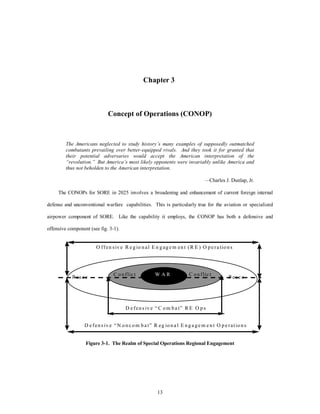
P ea c e C o n f lic t W A R C o n f lic t P ea c e 
D e fen s ive “C om ba t” RE O ps 
13 
—Charles J. Dunlap, Jr. 
The CONOPs for SORE in 2025 involves a broadening and enhancement of current foreign internal 
defense and unconventional warfare capabilities. This is particularly true for the aviation or specialized 
airpower component of SORE. Like the capability it employs, the CONOP has both a defensive and 
offensive component (see fig. 3-1). 
O ffen sive Re g io nal E n gagem en t (R E) O pe ra tions 
D e fen s ive “N oncom ba t” R eg ional Engageme n t O pe rat ions 
Figure 3-1. The Realm of Special Operations Regional Engagement
14 
Defensive SORE 
Given the diversity of the SORE missions within the “peaceful” realms, the defensive component can be 
further divided into combat and noncombat operations. Both focus on developing the indigenous leaders, 
organizations, and individual skills of host nations, or other entities determined to be legitimate and whose 
viability is considered to be in the interest of the US. In other words, these defensive SORE operations are 
centered on training, advising, and assisting. Ideally, potential customers are identified before they face an 
organized, destabilizing threat. In such cases, SORE operations would be conducted in a controlled 
environment that presents little threat of subjecting the team to hostile action. However, “when subversion, 
lawlessness, or insurgency, [separatism, or secessionist activities] threaten a friendly nation’s stability, the 
NCA may direct US forces to provide support to friendly nation’s counterinsurgency [et al] efforts. This 
support is distinct from . . . training or advisory assistance . . . because it involves the operational 
commitment of US forces . . .”1 It is entirely likely that SORE operations may begin in a noncombat 
environment and transition to a combat environment. 
An example of defensive operations may involve the employment of a SORE aviation team into a 
developing, second-wave nation. In such a case the team might assist the fledgling air force in developing 
doctrine, tactics, and procedures for conducting close air support of ground forces or combat search and 
rescue; a logistical system to support flying operations; and, perhaps, a limited weather observation and 
forecasting capability. Should the competency of this notional air force be so rudimentary, the NCA may be 
compelled to direct SORE forces to actually fly combat missions as part of the host nation’s aircrews. Such 
a decision clearly raises the consequence of failure. However, due to the possibility of a rapid transition 
from noncombat to combat, SORE forces must always be prepared for such an eventuality. 
Offensive SORE 
The offensive component of SORE “includes guerrilla warfare, subversion, sabotage, intelligence 
activities, evasion and escape, and other activities of a low visibility, covert, or clandestine nature.”2 The 
core of offensive SORE operations, similar to the defensive component, is training, advising, and assisting. 
However, there are two essential differences. The first is the nature of the target. In offensive operations,
SORE activities are directed against an established entity or “occupying” force. The second follows from 
the political sensitivity of the first. The operation will almost always be conducted in a covert or clandestine 
manner to effectively mask US involvement. This last consideration may lead to the requirement to use 
sophisticated systems to infiltrate, exfiltrate, sustain, and communicate in a clandestine or covert manner. 
The challenge will be to exploit third-wave technology such that it will be transparent in a first- or second-wave 
15 
environment. 
An example of offensive SORE operations in the context of the “Zaibatsu” alternate future may involve 
the infiltration of a SORE team into a region dominated by a multi- or transnational corporation where vital 
American interests are at stake.3 Such a mission may be characterized by training, advising, and assisting 
indigenous personnel in harassment activities. Such an operation might also facilitate or complement a SOF 
precision strike mission aimed at disrupting information systems. 
Advantages of SORE 
The advantages of possessing a core capability to conduct SORE operations in 2025 are several fold. 
First, since SORE operations are focused on first- and second-wave entities, emphasis will be on weapons, 
tactics, procedures, and support infrastructure considered crude or primitive, both today and 30 years hence 
(fig. 3-2). Conventional forces of 2025 will not possess these cruder weapons, and subsequently, have no 
expertise in their employment.
Source: USSOCOM Pub 1, Special Operations in Peace and War, 2–15. 
Figure 3-2. SORE Forces Training in the First and Second Waves. 
Second, even if technology is available for universal or programmable language translators, imagine 
how intimidating or socially offensive the use of such devices might be to a non-Western and/or lesser-developed 
people. Unless such translation devices can be made transparent to the receiver, they will be 
inadequate as a replacement for the language-skilled, culturally attuned individual. The following example 
16 
illustrates this point. 
In Uganda last year during the efforts to assist the refugees from Rwanda, an Army Special 
Forces captain was tasked to introduce American aid representatives to the President of 
Uganda. The captain started off the conversation, introducing himself and greeting the 
president in the President’s own language. This impressed the President greatly and 
smoothed the introduction of much more difficult topics and discussions. The captain’s 
[language and cultural] training and previous deployments had allowed him to . . . make 
the telling first impression.4 
Third, interpersonal relationships cultivated during SORE operations “strengthen ties with the host 
nation [or other entity] while building future ‘contacts’ that may not otherwise be available through 
traditional [or conventional] military or diplomatic channels.”5 Fourth, SORE operations are preventive in 
nature and therefore result in significant economies of scale. Early engagement of small, unobtrusive SORE 
teams in a variety of locations throughout the globe provide the ability to influence events before they become
media spectacles and take on a life of their own. These teams also provide a source of intelligence that can 
be placed in a cultural or societal context not possible with other sources. 
Having described the offensive and defensive components, as well as the advantages of the CONOP, 
this paper now turns to its enabling tasks. In the chapter that follows, these tasks and their attributes are 
17 
addressed and evaluated in detail. 
Notes 
1 Joint Pub 3-05.3 Joint Special Operations Operational Procedures, II-5. 
2 Ibid., II-1. 
3 Refer to Alternate Futures 2025 White Paper. 
4 USCINCSOC Congressional Testimony, 27 March 1995. 
5 2025 Concept, no. 900772, “Aviation Foreign Internal Defense,” 2025 Concepts Database (Maxwell 
AFB, Ala.: Air War College/2025, 1996).
Chapter 4 
Enabling Tasks 
As scarce resources are allocated and the highly visible . . . systems receive the most 
attention, it is the grunt—often equipped much as his grandfather was—that is most 
often called upon to implement foreign policy . . . Many situations . . .will still 
require...the ability to interact with local populations, and the ability to make human 
“in the loop” decisions. 
18 
—2010 Warfighting Vision, A Framework 
for Change, 1 August 1995 
Based on the concept of operations for SORE, very specific and defined enabling tasks emerge. 
Sequentially, the tasks of recruit, assess, train, observe, communicate, decide, counter, and sustain follow and 
are measured. In the tables throughout this chapter, the terms critical, desired, or ideal refer to the attribute’s 
level of need for each task. A Critical attribute is required to accomplish the task. A Desired attribute 
allows for a reasonable expectation of enhancement that is within fiscal and technological possibility. In 
other words, a desired attribute may make task accomplishment or system outcome faster, more precise, or 
lighter weight, but the mission can still be accomplished without it in 2025. Lastly, an ideal attribute 
enhances task accomplishment and ultimately mission execution, yet may push fiscal and technological limits.
Recruit, Assess, and Train 
My first plea is for the frontiers—not the mainstream. The mainstream, by definition, 
will have enough volunteers and preferences to garner the attention it needs to see us 
through the necessary doctrinal evolution. But what of the lonely, dangerous frontiers, 
with all of their uncertainties and risks? Will we have enough volunteers? Will those 
who volunteer have the wit, courage, and stamina that frontiers seem always to demand 
of pioneers? I hope that the frontiers of air and space doctrine will beckon those 
airmen who have the potential to be doctrinal pioneers. 
19 
—Carl H. Builder 
Given that SORE operations in 2025 may occur with limited opportunity to prepare are politically 
sensitive and will occur in permissive, hostile and/or denied environments, selective recruitment, detailed 
and thorough training, coupled with continuous mission rehearsal and assessment, will be critical. The use of 
specialized equipment and unique skills dictate the need for an ongoing, comprehensive recruitment, training 
and assessment program. To this end, SORE forces will undoubtedly take advantage of developing 
technologies. As mentioned previously, their efforts may include direct support of first- or second-wave 
military or fielded forces, multinational corporations, or other governmental agencies. 
If you tell me, I’ll listen. 
If you show me, I’ll see. 
If I experience it, I’ll learn. 
—Lao Tze, 430 BC
Source: http://www.afit.af.mil/schools/PA/gall3.htm. Artwork courtesy of Gene Lehman. 
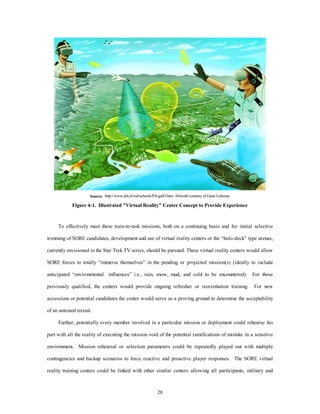
Figure 4-1. Illustrated "Virtual Reality" Center Concept to Provide Experience 
To effectively meet these train-to-task missions, both on a continuing basis and for initial selective 
trimming of SORE candidates, development and use of virtual reality centers or the “holo-deck” type arenas, 
currently envisioned in the Star Trek TV series, should be pursued. These virtual reality centers would allow 
SORE forces to totally “immerse themselves” in the pending or projected mission(s) (ideally to include 
anticipated “environmental influences” i.e., rain, snow, mud, and cold to be encountered). For those 
previously qualified, the centers would provide ongoing refresher or reorientation training. For new 
accessions or potential candidates the center would serve as a proving ground to determine the acceptability 
20 
of an untested recruit. 
Further, potentially every member involved in a particular mission or deployment could rehearse his 
part with all the reality of executing the mission void of the potential ramifications of mistake in a sensitive 
environment. Mission rehearsal or selection parameters could be repeatedly played out with multiple 
contingencies and backup scenarios to force reactive and proactive player responses. The SORE virtual 
reality training centers could be linked with other similar centers allowing all participants, military and
civilian, who are not geographically collocated to interact, train, and rehearse as a single entity—as if 
actually accomplishing assigned tasks and responsibilities well in advance of true debarkation. Additionally, 
the centers should be linked to “real-time” national assets—intelligence, information and data collection, and 
battle management systems—to afford the injection of real–time conditions into mission training and 
21 
rehearsal. 
The SORE virtual reality training centers would allow mission particulars such as cultural awareness 
and immersion to include language skills to be “experienced” first hand. Similarly, operating with 
dangerous materials, highly specialized or first-wave one-of-a-kind equipment, and unique tactics could be 
repeatedly practiced or rehearsed, improving the quality of training and likelihood of mission success. The 
virtual reality training centers would be equally useful as proving grounds for evaluating potential SORE 
candidates. 
Accordingly, SORE recruitment, assessment and training regimens and the system descriptions to 
support those regimens must be highlighted for operations in 2025. Initially, given the nature of SORE tasks, 
the potential conditions and environments in which those conditions will occur and the realistic assumption 
that SORE force structure will consist of a small number of selectively trained and experienced warriors, 
picking the “right troop” in 2025 could prove to be the cognizant driver in the accession process. 
To illustrate the importance of selecting the highest caliber forces, USCINCSOC’s testimony to 
Congress in March 1995 provides a concise vision of what those selection demands could hold for SORE 
forces of the future. 
It. . . requires a particularly mature, independent, and self-starting individual who can 
operate in small groups, often in harsh environmental conditions. Finding these kinds of 
individuals requires a special selection and assessment process that can gauge a person’s 
suitability to these kinds of tasks. 1
RECRUIT POPULATION 
22 
SELECT 
ASSESS 
TRAIN 
SORE 
FORCES 
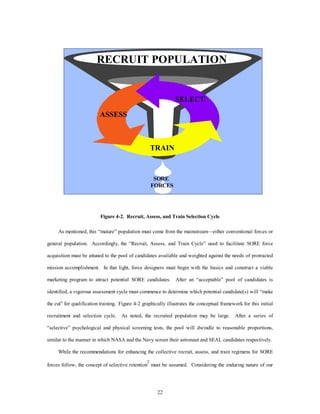
Figure 4-2. Recruit, Assess, and Train Selection Cycle 
As mentioned, this “mature” population must come from the mainstream—either conventional forces or 
general population. Accordingly, the “Recruit, Assess, and Train Cycle” used to facilitate SORE force 
acquisition must be attuned to the pool of candidates available and weighted against the needs of protracted 
mission accomplishment. In that light, force designers must begin with the basics and construct a viable 
marketing program to attract potential SORE candidates. After an “acceptable” pool of candidates is 
identified, a vigorous assessment cycle must commence to determine which potential candidate(s) will “make 
the cut” for qualification training. Figure 4-2 graphically illustrates the conceptual framework for this initial 
recruitment and selection cycle. As noted, the recruited population may be large. After a series of 
“selective” psychological and physical screening tests, the pool will dwindle to reasonable proportions, 
similar to the manner in which NASA and the Navy screen their astronaut and SEAL candidates respectively. 
While the recommendations for enhancing the collective recruit, assess, and train regimens for SORE 
forces follow, the concept of selective retention2 must be assumed. Considering the enduring nature of our
core competencies, the same “selective” process of today must occur in 30 years, yet must be replete with the 
technological and medical advances anticipated. A grounded commonality remains; the process is 
continuous. As candidates enter the recruit funnel, the continual selection, assessment, and training regimen 
must be used time and again. The outcome of the cycle will result in culturally attuned, physically and 
mentally prepared SORE forces capable of implementing and sustaining the rigorous demands of the SORE 
CONOP. At any point within this cycle, a recruit will be dismissed or returned to conventional forces since 
SORE force employment and application is a “high-risk-of-failure” proposition. 
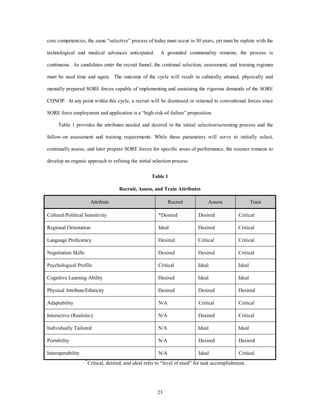
Table 1 provides the attributes needed and desired in the initial selection/screening process and the 
follow-on assessment and training requirements. While these parameters will serve to initially select, 
continually assess, and later prepare SORE forces for specific areas of performance, the essence remains to 
develop an organic approach to refining the initial selection process. 
Table 1 
Recruit, Assess, and Train Attributes 
Attribute Recruit Assess Train 
Cultural/Political Sensitivity *Desired Desired Critical 
Regional Orientation Ideal Desired Critical 
Language Proficiency Desired Critical Critical 
Negotiation Skills Desired Desired Critical 
Psychological Profile Critical Ideal Ideal 
Cognitive Learning Ability Desired Ideal Ideal 
Physical Attribute/Ethnicity Desired Desired Desired 
Adaptability N/A Critical Critical 
Interactive (Realistic) N/A Desired Critical 
Individually Tailored N/A Ideal Ideal 
Portability N/A Desired Desired 
Interoperability N/A Ideal Critical 
*Critical, desired, and ideal refer to “level of need” for task accomplishment. 
23
In that vein, genetic engineering, testing, and selection parameters may prove to be an early 
discriminator to achieve this goal.3 Similarly, during the initial process, advance testing should be adopted 
to apprise an applicant’s potential to learn language based on brain hemisphere dominance, profile his/her 
psychological state to determine historical nurturing, and IQ testing to rate cognitive learning ability. Further, 
future mission requirements will dictate that physical attributes of the candidate(s) be considered in building 
the force structure verses simply filling projected losses. To restate, initial selection procedures will be 
critical to effectively field the highest caliber forces to achieve specialized and changing SORE mission 
objectives. Given the nature of the SORE mission and the potential expense associated with its follow-on 
training, mistakes must be kept to a minimum or be systematically revealed at any point in the selection 
and/or assessment process. Ultimately, the training of selected individuals will refine and result in cognizant 
members capable of effectively operating as SORE employed forces. 
To meld the selection and training profiles and further qualify this process, an essential element will be 
to speed the learning process of the people selected and being trained within the virtual system. Some 
innovations and ideas relevant to this enhanced ability may range from artificially intelligent word 
processing,4 to selective knowledge pills5 ingested as situations dictate, to accommodate the increased need 
to absorb magnitudes of data over extended periods of time or for short durations. Overall, these concepts 
may provide the key links for allowing our selected SORE forces to receive and process the massive output 
of the envisioned Virtual Reality Center. Again, USCINCSOC’s testimony appropriately addresses the 
24 
criticality of the collective tasks: 
Units that conduct these operations invest a great deal of time and energy in language 
proficiency, cultural awareness, and regional orientation. It often takes years of study, in 
the actual area of operations, to develop the kind of understanding required to work with 
forces where the SOF operator has no command authority but must accomplish the mission 
through cooperation and mutual understanding. This must be followed by a training 
program that teaches not only the language and regional specifics, but also how to deal 
with and operate in unusual situations where there usually are no doctrine or guidelines and 
they have no authority to issue orders but must use persuasion to solve a myriad of 
challenges they confront.6 
Collectively, recruitment, assessment, and training will be critical to the effective fielding of SORE 
forces in 2025. Without these building blocks of successful selection and preparation, the end game of their 
actions cannot be assured or predicted with any certainty. However, by applying specific standards to these 
criteria, we will dramatically increase the probability of success by fielding a select group of brilliant
warriors, selected, educated, trained, and employed in diverse regions of the world. As noted by Lt Gen Jay 
W. Kelley in his unpublished article addressing the Brilliant Warrior concept as applied to professional 
military education—“Brilliant Warriors must be critical thinkers.”7 The rigorous recruit, select, and train 
regimens described in this chapter will help produce the “brilliant warriors” of 2025. 
Observe, Communicate, and Decide 
Advanced materials and electronic developments will lead to enhanced SOF 
communications capabilities. These [will] include features such as miniaturized 
command, control, and communication functions as well as embedded artificial 
intelligence for situational decision making. . . . . To keep pace with mission 
requirements, SOF will require enhanced, next- generation communications 
equipment.2 
25 
—United States Special Operations Forces 
Posture Statement, 1994 
Three enabling tasks of SORE’s core capability—observation, communication, and decision—have 
been grouped together because they are an inextricably linked process. Observing data, without 
communicating it, is of little value. Even if the ability to observe is enhanced and methods of transmitting 
data are improved, there is no value added unless there is a means of turning that information into knowledge 
useful to the decision maker. Therefore, it would be a mistake to look at these tasks individually, since the 
process must facilitate all three. 
Brig Gen William E. Harmon, USA, program manager for the Joint Tactical Fusion Program wrote, 
“The most sophisticated intelligence collection in the world is worthless if the information it provides does 
not reach the commander in a timely manner.”8 The authors of New World Vistas: Air and Space Power for 
the 21st Century also agree. They assert, “The power of the new information systems will lie in their ability 
to correlate data automatically and rapidly from many sources to form a complete picture of the operational 
area, whether it be a battlefield or the site of a mobility operation.”9 Restated, the ability to collect, fuse, and 
process data into a usable form and then ship the information to the decision maker on demand is crucial. 
Whether the process is “third wave” as discussed by New World Vistas, or crude “first- or second-wave” 
where the process may be as simple as “seeing” with one’s own eyes, “telling” someone what you saw, 
“discussing” it, and then acting—the need for effective interweaving of these three tasks remains high. For
familiarity, the term C4I (communications, computers, command, control and intelligence) is used to refer to 
the “observe-communicate-decide” process—not a technological system, but rather a process. 
Table 2 lists the twelve attributes imperative to the observe-communicate-decide process. The first 
seven—interoperability, divergence or fusion, portability, transparency, face-to-face contact, security, and 
resolution—are critical to SO regional engagement operations and are captured in four overriding 
requirements. These requirements are discussed at length in this section. The remaining five attributes are 
26 
desired, not critical, and are briefly discussed. 
Table 2 
Observe, Communicate, and Decide Attributes 
Attribute Observe Communicate Decide 
Interoperability *Critical Critical Critical 
Divergent and/or Fused Critical Critical N/A 
Portability Critical Critical Desired 
Transparency Critical Critical Critical 
Face-to-Face Contact Critical Critical Critical 
Security Critical Critical Critical 
Resolution Critical N/A N/A 
Range (global/local) Desired Desired Desired 
Speed (near real time) Desired Critical Desired 
Capacity (giga-terabits/sec) Desired Critical Desired 
Survivability Desired Desired N/A 
Accuracy Desired Desired Desired 
*Critical, desired, and N/A refer to “level of need” for task accomplishment. 
The four overriding requirements needed for successful employment of SORE’s observe-communicate- 
decide task in 2025 are (1) interoperability and fusion with third-wave C4I systems with 
appropriate range, speed, and accuracy qualities, as well as a divergent detection and resolution capability; 
(2) portable field equipment that is lightweight, secure, and survivable; 3) C4I equipment that “blends” into
first- and second-wave nations—either using twentieth-century equipment or camouflaged, customized 
equipment that is transparent in first- and second-wave worlds; and (4) face-to-face communications to keep 
the “human in the loop.” Each requirement is impacted by various aspects related to the technology already 
available in the conventional forces or by the environment in which it will be employed. These aspects are 
addressed along with each requirement in the following paragraphs. 
First, we must recognize most of SORE’s third-wave C4I support will come from non-SOF resources. 
The primary third-wave support will be interoperable, robust networks that provide an integrated C4I 
network where image, voice, and digital data are fused for transmission and receipt. An underlying concern 
with conventional fused systems is that “fusion” does not simply provide an “average of two data sets,” but 
rather a divergent detection and resolution capability necessary to support the precise nature of SOF targeting 
requirements. Furthermore, fusion may be difficult to attain. As New World Vistas Study stresses “. . . 
robust interpretations of sensor data are hard to develop from mathematical considerations alone . . .” and 
commonsense reasoning about the process of fusion must be understood and automated.10 With or without 
fusion, the network must also be near real-time, secure, survivable, and provide redundant transmission 
paths. These capabilities are not only needed for SORE but also for the conventional forces. 
Information obtained from conventional C4I systems and divergent detection and resolution sources will 
be used in defensive SORE operations where the mission is focused on assisting and training sponsor forces 
in a noncombative environment. These sources will provide a secure, reliable C4I link “back home” and 
simultaneously provide interoperability and intelligence sharing with coalition forces, host nations, or 
clients. As noted in Joint Pub 3-07, “US intelligence sharing ranges from strategic analysis to current 
intelligence summaries and situation reporting for tactical operations. An adequate intelligence collection 
and dissemination capability is often one of the weakest links in a host nation’s military capability.”11 
However, we must be careful about what third-wave knowledge we share and how we share it. We do not 
want to provide “intelligence” obtained from third-wave sources or to provide the host a direct “link” to our 
systems unless we plan to leave it behind for the host’s future use. Otherwise, when the forces depart, the 
27 
host will be at a loss. 
This concept is best explained by using an example from our CONOP where US SORE forces are 
training a host and then are tasked to join the flying crews of sponsor nations when the environment shifts into
a combative mode. It would be tempting to offer third-wave intelligence sources to pinpoint enemy actions 
and to assist the sponsor in developing an operations plan, just to protect our own SORE pilots. However, 
this action risks leaving the host more vulnerable than when we arrived. A better approach is for SORE 
forces to take advantage of their “link” to intelligence systems during the non combative phase, to keep in 
tune with changing events in the area and to formulate the best method to optimize the host’s existing forces 
and resources to locate and eliminate the threat. For example, they might help the host set up a human 
intelligence (HUMINT) network or retrofit an existing aircraft with reconnaissance gear to gauge the nature 
of the impending threat. Teaching the host how to use their own resources versus “plugging” them into ours is 
28 
much more beneficial to their future development. 
Another key use of these same third-wave systems is predicting and dealing with the effects of 
urbanization. Population trends indicate that by 2010, 50 to 65 percent of the world’s population will live in 
urban areas.12 We have already seen the impact of urbanization on US operations in Somalia, Haiti, and 
Bosnia where starvation, disease, pollution, and mass migration are staggering. The United States’ 
“capability to operate and conduct military operations in built-up areas and to achieve military objectives 
with minimum casualties and collateral damage requires more precise weapons, surveillance, sensing, target 
detection, and situational awareness enhancements.”13 Payback for developing divergent detection and 
resolution will be realized in this case, since “precision” will be critical. 
The future holds great promise for systems that collect, fuse, and distribute information. The most likely 
candidates are a Global Surveillance, Reconnaissance, and Targeting System (GSRT),14 an ultraprecise, 
jam–resistant global positioning system (GPS),15 and worldwide surveillance, collection, and 
reconnaissance done from commercial, possibly international conglomerate platforms producing high– 
resolution mapping and worldwide weather monitoring.16 Again, the key is to provide a “fusion” capability 
that does not simply produce an “average of two data sets,” but rather a divergent detection and resolution 
capability necessary to support SOF precision identification and targeting requirements, particularly 
offensive SORE operations. 
Similarly, there are many possibilities for improved communications networks in the future. The three 
most likely successors, Distributed Satellite Systems, Fiber and Satellite Networks, and direct link between 
satellite and aircraft, are described in New World Vistas: Air and Space Power for the 21st Century. 
17
Since these systems are addressed in the Information Operations, Counter Information, and S & R 
Information Operations white papers, we will describe them only briefly in the Systems and Underlying 
Technologies appendices. However, SORE “packaging” of these third-wave C4I systems for use in first- and 
second-wave nations may differ from conventional packaging. This “unique” packaging will be addressed in 
29 
the third requirement. 
The second requirement deals with the C4I systems necessary for covert or clandestine operations 
normally associated with offensive SORE. 
[These type of SOF] missions are intelligence-driven and intelligence– dependent. They 
require immediate and continuous access to information from traditional as well as 
nontraditional sources. SO generally rely on formal intelligence structures, but, for certain, 
sensitive missions, tactical and operational information must be developed using SOF 
assets such as advanced reconnaissance forces.18 
Quite simply, SOF operations will require the full array of intelligence products available 
to conventional forces, such as indications and warning data, orders of battle, threat tactics, 
weapon systems characteristics and capabilities, communications, environmental, and 
maritime factors.19 
SORE forces will need lightweight, mobile, secure, and survivable equipment that works well in harsh, 
austere environments, that ensures low visibility for covert or clandestine operations, and that inherently 
guarantees synchronization and security of small teams fighting subversion, lawlessness, insurgency, and 
terrorism. The same equipment will be needed for teams that must “up close and personally” verify 
information on enemy capabilities, intentions, and activities that are unverifiable through conventional 
surveillance and intelligence means. This equipment must have the range and capacity for teams to 
communicate securely with command and control centers, with each other, with intelligence sources, and/or 
directly to weapons delivery systems. 
A miniature C4I unit, constructed of micromechanical devices where a “single chip” is the entire system, 
could be embedded in a helmet, on a sleeve, or in a wristband. The system could be voice, gesture, or 
thought controlled as deemed plausible in New World Vistas: Air and Space Power for the 21st Century’s 
20 
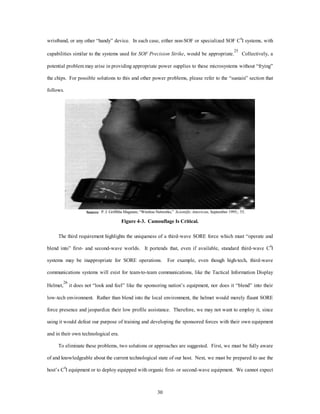
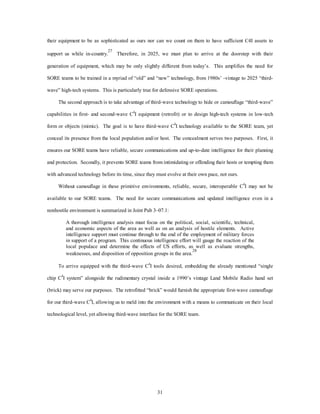
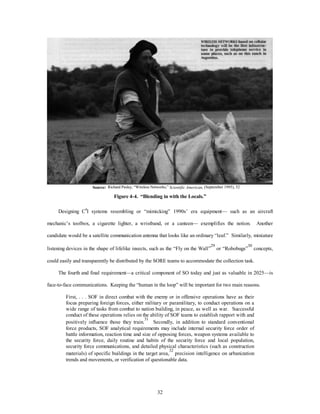
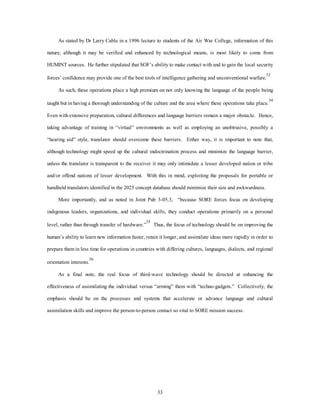
concept of Human/Machine System Fusion.21 The All Seeing Warrior concept22 or the Tactical Information 
Display Helmet23 are both excellent examples. Another possibility is to build very small aperture antennas 
(VSAT) into the receiver systems which are capable of transmitting video and sophisticated computer-generated 
data around the world.24 These VSATs could be mounted on or embedded in a C4I helmet,
wristband, or any other “handy” device. In each case, either non-SOF or specialized SOF C4I systems, with 
capabilities similar to the systems used for SOF Precision Strike, would be appropriate.25 Collectively, a 
potential problem may arise in providing appropriate power supplies to these microsystems without “frying” 
the chips. For possible solutions to this and other power problems, please refer to the “sustain” section that 
30 
follows. 
Source: P. J. Griffiths Magnum, “Wireless Networks,” Scientific American, September 1995,: 53. 
Figure 4-3. Camouflage Is Critical. 
The third requirement highlights the uniqueness of a third-wave SORE force which must “operate and 
blend into” first- and second-wave worlds. It portends that, even if available, standard third-wave C4I 
systems may be inappropriate for SORE operations. For example, even though high-tech, third-wave 
communications systems will exist for team-to-team communications, like the Tactical Information Display 
Helmet,26 it does not “look and feel” like the sponsoring nation’s equipment, nor does it “blend” into their 
low-tech environment. Rather than blend into the local environment, the helmet would merely flaunt SORE 
force presence and jeopardize their low profile assistance. Therefore, we may not want to employ it, since 
using it would defeat our purpose of training and developing the sponsored forces with their own equipment 
and in their own technological era. 
To eliminate these problems, two solutions or approaches are suggested. First, we must be fully aware 
of and knowledgeable about the current technological state of our host. Next, we must be prepared to use the 
host’s C4I equipment or to deploy equipped with organic first- or second-wave equipment. We cannot expect
their equipment to be as sophisticated as ours nor can we count on them to have sufficient C4I assets to 
support us while in-country.27 Therefore, in 2025, we must plan to arrive at the doorstep with their 
generation of equipment, which may be only slightly different from today’s. This amplifies the need for 
SORE teams to be trained in a myriad of “old” and “new” technology, from 1980s’ -vintage to 2025 “third-wave” 
high-tech systems. This is particularly true for defensive SORE operations. 
The second approach is to take advantage of third-wave technology to hide or camouflage “third-wave” 
capabilities in first- and second-wave C4I equipment (retrofit) or to design high-tech systems in low-tech 
form or objects (mimic). The goal is to have third-wave C4I technology available to the SORE team, yet 
conceal its presence from the local population and/or host. The concealment serves two purposes. First, it 
ensures our SORE teams have reliable, secure communications and up-to-date intelligence for their planning 
and protection. Secondly, it prevents SORE teams from intimidating or offending their hosts or tempting them 
with advanced technology before its time, since they must evolve at their own pace, not ours. 
Without camouflage in these primitive environments, reliable, secure, interoperable C4I may not be 
available to our SORE teams. The need for secure communications and updated intelligence even in a 
nonhostile environment is summarized in Joint Pub 3–07.1: 
A thorough intelligence analysis must focus on the political, social, scientific, technical, 
and economic aspects of the area as well as on an analysis of hostile elements. Active 
intelligence support must continue through to the end of the employment of military forces 
in support of a program. This continuous intelligence effort will gauge the reaction of the 
local populace and determine the effects of US efforts, as well as evaluate strengths, 
weaknesses, and disposition of opposition groups in the area.28 
To arrive equipped with the third-wave C4I tools desired, embedding the already mentioned “single 
chip C4I system” alongside the rudimentary crystal inside a 1990’s vintage Land Mobile Radio hand set 
(brick) may serve our purposes. The retrofitted “brick” would furnish the appropriate first-wave camouflage 
for our third-wave C4I, allowing us to meld into the environment with a means to communicate on their local 
technological level, yet allowing third-wave interface for the SORE team. 
31
Source: Richard Pasley, “Wireless Networks,” Scientific American, (September 1995), 52 
Figure 4-4. “Blending in with the Locals.” 
Designing C4I systems resembling or “mimicking” 1990s’ era equipment— such as an aircraft 
mechanic’s toolbox, a cigarette lighter, a wristband, or a canteen— exemplifies the notion. Another 
candidate would be a satellite communication antenna that looks like an ordinary “leaf.” Similarly, miniature 
listening devices in the shape of lifelike insects, such as the “Fly on the Wall”29 or “Robobugs”30 concepts, 
could easily and transparently be distributed by the SORE teams to accommodate the collection task. 
The fourth and final requirement—a critical component of SO today and just as valuable in 2025—is 
face-to-face communications. Keeping the “human in the loop” will be important for two main reasons. 
First, . . . SOF in direct combat with the enemy or in offensive operations have as their 
focus preparing foreign forces, either military or paramilitary, to conduct operations on a 
wide range of tasks from combat to nation building, in peace, as well as war. Successful 
conduct of these operations relies on the ability of SOF teams to establish rapport with and 
positively influence those they train.31 Secondly, in addition to standard conventional 
force products, SOF analytical requirements may include internal security force order of 
battle information, reaction time and size of opposing forces, weapon systems available to 
the security force, daily routine and habits of the security force and local population, 
security force communications, and detailed physical characteristics (such as construction 
materials) of specific buildings in the target area,32 precision intelligence on urbanization 
trends and movements, or verification of questionable data. 
32
As stated by Dr Larry Cable in a 1996 lecture to students of the Air War College, information of this 
nature, although it may be verified and enhanced by technological means, is most likely to come from 
HUMINT sources. He further stipulated that SOF’s ability to make contact with and to gain the local security 
forces’ confidence may provide one of the best tools of intelligence gathering and unconventional warfare.33 
As such, these operations place a high premium on not only knowing the language of the people being 
taught but in having a thorough understanding of the culture and the area where these operations take place.34 
Even with extensive preparation, cultural differences and language barriers remain a major obstacle. Hence, 
taking advantage of training in “virtual” environments as well as employing an unobtrusive, possibly a 
“hearing aid” style, translator should overcome these barriers. Either way, it is important to note that, 
although technology might speed up the cultural indoctrination process and minimize the language barrier, 
unless the translator is transparent to the receiver it may only intimidate a lesser developed nation or tribe 
and/or offend nations of lesser development. With this in mind, exploiting the proposals for portable or 
handheld translators identified in the 2025 concept database should minimize their size and awkwardness. 
More importantly, and as noted in Joint Pub 3-05.3, “because SORE forces focus on developing 
indigenous leaders, organizations, and individual skills, they conduct operations primarily on a personal 
level, rather than through transfer of hardware.”35 Thus, the focus of technology should be on improving the 
human’s ability to learn new information faster, retain it longer, and assimilate ideas more rapidly in order to 
prepare them in less time for operations in countries with differing cultures, languages, dialects, and regional 
33 
orientation interests.36 
As a final note, the real focus of third-wave technology should be directed at enhancing the 
effectiveness of assimilating the individual versus “arming” them with “techno-gadgets.” Collectively, the 
emphasis should be on the processes and systems that accelerate or advance language and cultural 
assimilation skills and improve the person-to-person contact so vital to SORE mission success.
Counter 
Since World War I, airmen have had to control the air environment effectively to employ 
airpower. What is more, air and space superiority are virtually sine qua non for 
employing ground and naval forces. Information is the next realm we must control to 
operate effectively and with the greatest economy of force. 
34 
—Cornerstone of Information Warfare 
Department of the Air Force 
The application of C4I countermeasures is another important enabling task of SORE. In fact, it is an 
integral component of any war–fighting concept that combines denial and influence of information, deception, 
disruption, and destruction to counter adversary C2 while simultaneously protecting friendly C2.37 The five 
principle military actions used to achieve these results are operations security, psychological operations 
(PSYOP), military deception, electronic warfare (EW), and destruction. Up front, we recognize that most of 
SORE C4I countermeasure systems will come from non-SOF resources since conventional and SOF will face 
similar “electronic” threats. 
Table 3 
Counter Attributes 
Attribute Counter 
Interoperability *Critical 
Fusion Critical 
Portability Desired 
Transparency Desired 
Range Desired 
Capacity Critical 
*Critical, desired, and ideal refer to “level of need” for task accomplishment. 
Some protection can be gained by enforcing good operations, computer, and communications security 
(OPSEC, COMPUSEC, and COMSEC) procedures. Poor OPSEC is not a new problem, but one that 
permeates SO operations today.
A major problem in all SOF activities is denial of critical information about friendly 
intentions, capabilities, and activities to hostile elements. This is due to the fact that 
groups engaged in lawlessness and insurgency operations may be corrupted members of 
penetrated foreign governments. US and foreign personnel involved in SOF programs 
should be provided extensive OPSEC training to ensure effectiveness of their operations.38 
Coding/decoding methods, encryption/decryption devices, as well as a host of new security 
technologies could aid in solving the problem. As Dr Martin Libicki points out, “Although the contest 
between bit senders and bit blockers gets more sophisticated on each side, new technologies (multistatic 
radar, digital signal processing, spread-spectrum, public-key encryption and authentication) favor the bits 
getting through, uninterrupted, as well as without spoofing.”39 
PSYOP as “an aspect of information warfare as old as history”40 will continue to be an invaluable 
countermeasure. The targets may not change, but the means to counter or affect them will. Communications 
support for PSYOP should concentrate on cultural assimilation, simple, and effective ways to deliver the 
information to the locals, and methods to negatively or positively persuade those individuals. 
Psychological operations . . . multiply [the] effect of military capability by communicating 
directly to their enemies the power of the US or coalition forces, threat of force or 
retaliation, conditions of surrender, safe passage for defectors, incitations to sabotage, 
support to resistance groups and other messages41 as well as strengthening economic and 
diplomatic sanctions, and emphasizing the adversaries’ isolation or weaknesses.42 
Source: USSOCOM Pub 1, Special Operations in Peace and War, 2–17. 
Figure 4-5. PSYOP in Action. 
35
Direct PSYOP support for SORE operations should be concentrated before arrival, to facilitate positive 
communication with the local population. This preparation may use different media (radio, leaflets, TV, 
holographics, etc.) to persuade or influence. In 2025, more advanced broadcasting and projection systems, 
which can operate from workstations in CONUS, and leaflets distributed with precision guidance systems to 
target audiences should be considered. Along the same lines, a Holographic Projector43 could be used as a 
deception or PSYOP tool projecting images in the sky above the target audience. Translators could make 
television, radio, holographic broadcasts, or direct contact with enemy troops or citizens more effective. In 
fact, direct broadcast television (DBTV), which has more than a 100–channel capability and sells for less 
than $1,000 today, should be capable of providing “information on demand” in the future. 44 DBTV could be 
an inexpensive way to affect first- and second-wave nations in 2025. 
DBTV would not only be useful as a preparation tool, it could pay high dividends as an “offensive” 
PSYOP tool. Just as TV mesmerized the US in the 1960s and China in the 1990s, it could be equally 
distracting or alluring to preindustrial and industrial nations in 2025. Broadcasting “free TV” 24 hours a day 
to specific targets groups could render them “immobile, infuriate the masses, or launch them into new 
directions.” For example, broadcasting MTV, “Soaps,” Talk Shows, and/or Educational TV for teens, and 
“fictional CNN” for the general public, business, military, and government could pay high dividends with 
minimal investment. The key is knowing the desired goal and the target audience, and then broadcasting the 
36 
appropriate propaganda to achieve it. 
Finally, “PSYOP is not only a user, it is a producer of intelligence, capable of contributing to the 
overall national effort as well as servicing its own needs.”45 To further explain, the extensive regional 
collection and assessment conducted for PSYOP may produce intelligence useful for other special or 
conventional operations. For example, the assessment data could be incorporated in the Virtual Reality 
Training Center for up-to-date regional awareness training. 
In a collateral role, offensive and defensive SORE forces might be tasked to assist and support other 
information warfare (IW) activities—particularly in the “controlling information” role where SORE forces 
exploit the enemy’s systems while protecting their own.46 Since IW masks preliminary preparations and 
movements, overloading the enemy’s command decision making allows us to precisely apply our combat 
power at his most vulnerable points.47 Therefore, the SORE forces’ role might be as simple as verifying the
“Information Warrior’s” information target. In-country acceptance of SORE forces makes them prime 
candidates for verifying “unconfirmed” data, providing realistic knowledge of exploitable targets for 
psychological operations or information warfare targets,48 or for attaching monitoring devices (i.e., 
37 
“tagging”) on potential targets in the region. 
Similarly, offensive SORE forces may be tasked to influence enemy perceptions using strategic 
perception management (SPM)49 or one of the many other counterinformation systems directed at military 
deception, electronic warfare, and destruction. Many of these systems will be available through non-SOF or 
specialized SOF systems. Therefore, rather than address transatmospheric reconnaissance aircraft (TRA),50 
information systems weapons or electronic countermeasures,51 defensive information warfare,52 or high 
powered microwave and high power laser directed energy weapons (HPM)53 in this paper, precise 
information can be found in the white papers dedicated to information dominance, such as Information 
Operations, Counter Information, and S & R Information Operations. 
Finally, defensive SORE forces may be required to restrict the use of third-wave systems with a host 
entity unless the technology is camouflaged. The rationale is twofold. First, the open use of advanced 
technologies, such as handheld translators may be offensive to the receivers and subsequently impede 
interpersonal interaction. Second, since the ultimate goal of defensive SORE is to advise, train, and assist 
host-entities in the use of their own aerospace equipment, it is counterproductive to make them dependent on 
an advanced system and then remove it when SORE forces leave. Furthermore, teaching them how to 
effectively use their own air assets allows them to bring their own airpower to bear on the source of internal 
instability without simply “handing” them our advanced technology. 
Sustain 
54 
I don't know what this “logistics” is . . . but I want some of it. 
As we make the mad rush into the next century, we cannot forget the basics of force survival. Although 
technology will play a pivotal role in many areas, the heart of all those advances will remain the individual. 
This is especially true for SORE forces. They may deploy to built-up, fully equipped host entities who 
possess and maintain “creature comforts” and infrastructures conducive to successful operations and training.
A more likely scenario, however, would be to employ SORE forces in preindustrial environments where 
conditions are more stark and less habitable. In these situations, their survival depends on “carrying-in” 
organic support. In this scenario, they must be self–reliant, innovative, and adaptable. This will be 
especially true for offensive SORE forces that may be isolated from more direct means of sustainment or 
38 
support. 
Assuming the latter is the norm, four main SORE sustenance needs must be considered: food, water, 
portable energy sources, and ammunition. Each is critical to the “survival” of the individual SORE warrior. 
Looking at the construct of Col John Warden’s five-ring analysis of “The Enemy as a System,”55 each SORE 
force member is, in fact, a system with its own ring of “organic essentials.” Following his premise, SORE 
forces’ survival can be affected if enemy actions are directed against this ring, or if inadequate attention is 
paid to ensuring that the needs of this ring are met. Accordingly, given our thesis that the “man-in-the-loop” 
is the prime actor and “effector” of change in 2025’s less developed regions, improvements to these 
essentials must be foremost in our advances. 
Following Warden’s analogy, all systems require certain organic essentials to survive. Without an 
energy source (food, oxygen, and water), the human system will cease to operate. At the center of the human 
system is the decision-making mechanism—the brain. Organic essentials allow the brain to process 
inductive and deductive logic—-without which, one cannot effectively function as a “Brilliant Warrior,” to 
use General Kelley’s term. Obviously, without these basic essentials, a human body cannot survive. This 
observation may appear simplistic and it is. However, the essence remains—we must pursue methods and 
technologies that provide SORE forces the day-to-day capability to exist in any environment and for 
indefinite periods of time. Table 4 provides the task attributes and level of need to meet these requirements.
Table 4 
Sustain Attributes 
Attribute Sustain 
Portable *Critical 
Customized Desired 
Unobtrusive Critical 
Automatic Ideal 
Precision delivery Critical 
*Critical, desired, or ideal reference “level of need” for task accomplishment. 
To begin, an individual must be put through a battery of tests to determine individual organic levels and 
nutritional needs. Then a survival package which is lightweight and compact can be devised and tailored for 
each force member. To accomplish this, we must pursue advances in food development such as biochemical-enhanced 
“hyper speed growth” seeds cultivated on portable substrates. Unfortunately, the “Chia Pet” is 
probably the only universally advertised “speed growth” method conceptually known to the general public 
today. Something similar to the Chia Pet concept, that is simple, fast, unobtrusive, and man-portable is 
needed to replenish SORE forces’ nutrients “while on the go.” The approach should seek to exploit 
chemically enhanced seeds, nuts, or grains which grow and produce “food” within a 24– to 72-hour period or 
39 
less.
Source: Miguel L. Fairbanks, “Technology for Sustainable Agriculture,” Scientific American, September 1995, 149. 
Figure 4-6. “Fast Food” Production for Deployed SORE Forces. 
These pursuits could be complimented by refined metabolic rate screening results obtained during 
individual assessment. The results of this screening, combined with nutritional-matching discussed above, 
will ensure enhanced performance during employment. A potential candidate is the human optimization of 
metabolic and behavioral response (HOMBRE) concept. With this system, we may be able to determine 
each SORE force member’s metabolic type, then selectively enhance cognitive and physical performance 
through specific nutritional regimens.56 Enhanced and peak performance on short–term tasks will help ensure 
40 
success in any given environment. 
Water purification agents and collection devices must be improved and made portable for forces in the 
field. A quick solution may be to use absorbent receptacles to collect dew, obtaining small quantities of
water for force sustainment in a dry environment. Long-term, more exotic sources may be the manufacture of 
dry chemicals which, when combined, bond at the molecular level to produce water. An even more far-reaching 
approach may be to filter and purify body fluids to act as an interim water supply should extreme 
conditions arise. Presumably, humans can exist for weeks without adequate food since the body will 
compensate and feed off internal reserves. However, water must be available within days, or death will 
41 
result. 
Given the multitude of electronic and kinetic gear used by SORE forces, portable power sources will 
be crucial. Several technologies must be pursued to provide these sources. For example, since water is 
critical to existence, methods to extract power from the hydrogen compounds in these water sources could be 
adapted to SORE force needs, thus doubling the benefits of having the water! Similarly, battery packs must 
be more compact, lighter, rechargeable, and retain longer life on a single charge. 
Assuming the philosophy that man is a machine, the potential exists to create and implement 
technologies to exploit human movement and central or autonomic nervous system activity as low-grade 
energy sources to provide that potential power supply.57 Discounting initial insertion and aviation-related 
missions, SORE force members will take the tried–and–true method of transport—they will walk. We must 
harness and exploit that energy dispensing action. For example, the physical motion of walking may lead to 
development of “boot chargers” located in the heels of a force member’s boots. The charger would operate 
or recharge as the member performs his/her daily routines. In the same vein, a plethora of other technologies 
are projected which may provide alternative portable energy sources. They may range from lightweight, 
solar panel collection systems for daylight operations, to ambient lunar light collection panels for day-night 
capability, to miniaturized power-generating factories on a single microchip58. The technological leaps 
made in researching and powering solar-powered automobiles and satellites, as well as microscopic 
machines, should be investigated for SORE force application. 
Finally, SORE force application may involve covert, clandestine, or hostile action. Accordingly, 
provisions must be made to arm and resupply the SORE warrior with first-to-third wave ammunition. While 
nonlethal application of force may be preferred, the nature of the SORE mission dictates possession of lethal 
weapons. When all else fails, a “gun,” whether loaded with kinetic energy, high-powered microwave, or 
1990s’ depleted uranium projectiles must be available to SORE forces. Expedient replenishment and
replacement of first-, second- and third-wave ammunition sources must be considered. Potential solutions 
are precision-guided delivery systems and energy weapon recharging via direct satellite link. In both cases, 
sensors will monitor inventory levels and track source supply points automatically and replenish as needed. 
The latter concept is a “passive-push” replenishment system similar to today’s Just-in-Time or Trickle 
Charge systems. This approach minimizes administrative communications that may compromise covert or 
clandestine units and optimizes use of limited replenishment assets. Without the “tools of the trade,” SORE 
42 
forces will be ineffective and at risk. 
With sustainment, the enabling task discussion is complete. Having addressed those tasks and their 
relative importance, the next section of the paper summarizes our findings and includes some broad 
recommendations. For a detailed prognosis and evaluation of the systems and their underlying technologies, 
please refer to appendices A and B. 
Notes 
1 USCINCSOC Congressional Testimony, March 1995. 
2 SORE force members will be recruited, assessed, retained, and employed based on actual 
performance. If a member’s performance falls below acceptable levels, he/she will be returned to 
conventional forces or separated. 
3 As noted in W. F. Anderson’s article “Gene Therapy,” Scientific American, September 1995, 96-98B, 
significant progress in the realm of gene modification to affect gene-based disease has been made. Assuming 
quantum progress continues well into the next century, selective gene screening and DNA typing may well be 
applied to potential candidates. Anderson does not advocate an era of “eugenics” to alter composite gene 
pools. Similarly, the authors of this paper do not advocate the “super human” genetic application nor 
experimentation. However, the intent of this approach is to use DNA and genetic make-up as a tool for 
selecting the pool of SORE candidates who theoretically will be capable of replicating successful SORE 
operations based on those SORE forces whose genetic makeup is similar. 
4 2025 Concept, no. 900501, “Artificially Intelligent Word Processor,” 2025 Concepts Data Base 
(Maxwell AFB, Ala.: Air War College/2025, 1996). 
5 2025 Concept, no. 900562, “A Selective Knowledge Pill,” 2025 Concepts Data Base (Maxwell AFB, 
Ala: Air War College/2025, 1996). 
6 USCINCSOC Congressional Testimony, March 1995. 
7 Jay W. Kelley, Lt Gen, USAF, “Brilliant Warriors,” (Draft article for Joint Forces Quarterly), 14. 
8 James P. Marshall, “Near Real-Time Intelligence of the Tactical Battlefield,” Theater Air Campaign 
Studies Course Book, , Maxwell AFB, Ala.: Air Command and Staff College 1996, 235. 
9 USAF Scientific Advisory Board, New World Vistas: Air and Space Power for the 21st Century, 
summary volume (Washington, D.C.: USAF Scientific Advisory Board, 15 December 1995), 11. 
10 USAF Scientific Advisory Board, New World Vistas: Air and Space Power for the 21st Century 
(unpublished draft, the information applications volume, 15 December 1995), 5. 
11 Joint Pub 3-07.1, Joint Tactics, Techniques, and Procedures for Foreign Internal Defense, 20 
December 1993, I-13.
12 Dr James Kvach, Armed Forces Medical Intelligence Center, 2025 Lecture, 31 January 96. 
13 Joint Staff Memorandum to the SECDEF, 19 December 1995, Subject: Volume 4 (Future 
Capabilities), Joint Planning Document for FY 1998 through FY 2003 (JPD FY98-03), Enclosure, 3. 
14 
Spacecast 2020, Air University into the Future, Operational Analysis, Air University, 22 June 1994, 
43 
34. 
15 Ibid., 35. 
16 
New World Vistas, summary volume, 10. 
17 
New World Vistas, summary volume, 62. 
18 Air Command and Staff College United States Special Operations Forces Posture Statement, 1994, 
4. 
19 Joint Pub 3-05.3, Joint Special Operations Operational Procedures, 25 August 1993, VI-2. 
20 
New World Vistas, summary volume, 62. 
21 Voice recognition and voice generation, gesture recognition and response, multilingual translation 
and generation, and brain control of computers technologies will all contribute to making sure the human is 
not the limiting factor. 
22 2025 Concept, no. 900263, “The All Seeing Warrior,” 2025 Concepts Data Base (Maxwell AFB, 
Ala.: Air War College/2025, 1996). 
23 2025 Concept, no. 900317, “Tactical Information Display Helmet,” 2025 Concepts Data Base 
(Maxwell AFB, Ala.: Air War College/2025, 1996). 
24 John L. Petersen, Road to 2015, Profiles of the Future (Corte Madera, Calif.: Waite Group Press, 
1994), 190–193. 
25 Power and energy supply obstacles must be overcome when developing and employing these “micro” 
systems. Those organic needs are addressed in the Sustain section of this chapter. 
26 2025 Concept, no. 900317, “Tactical Information Display Helmet,” 2025 Concepts Data Base 
(Maxwell AFB, Ala.: Air War College/2025, 1996). 
27 Nor does it allow us the opportunity to exploit our own technology in their environment—this will be 
explained in approach two. 
28 Joint Pub 3-07.1, Joint Tactics, Techniques, and Procedures for Foreign Internal Defense, 20 
December 1993, IV-1. 
29 2025 Concept, no. 900280 “Fly on the Wall,” 2025 Concepts Data Base (Maxwell AFB, Ala.: Air 
War College/2025, 1996). 
30 2025 Concept, no. 900341, “Robobugs,” 2025 Concepts Data Base (Maxwell AFB, Ala.: Air War 
College/2025, 1996). 
31 Joint Pub 3-05.3, Joint Special Operations Operational Procedures, 25 August 1993, VI-2. 
32 Ibid. 
33 Dr Larry Cable, University of North Carolina, Wilmington, AWC Lecture, 31 January 1996, 
permission granted. 
34 USCINCSOC Congressional Testimony, 27 March 1995. 
35 Joint Pub 3-05.3, Joint Special Operations Operational Procedures, II-5. 
36 2025 Concept, no. 900624, “Hand-held Translator,” 2025 Concepts Data Base (Maxwell AFB, Ala.: 
Air War College/2025, 1996). 
37 
JFACC Primer, Second Edition, February 1994, 24. 
38 Joint Pub 3-07.1, Joint Tactics, Techniques, and Procedures for Foreign Internal Defense, 20 
December 1993, IV-6. 
39 Dr Martin Libicki, “What Is Information Warfare?” Strategic Structures Course Book, Vol II 
(Maxwell AFB, Ala.; Air Command and Staff College, 1996), 684. 
40 Ibid., 685.
41 Frank L. Goldstein, “Psychological Operations—Principles and Case Studies,” (Maxwell AFB, 
44 
Ala.: Air University Press, forthcoming), 5. 
42 Jeffrey B. Jones and Michael P. Mathews, “PSYOP and the Warfighting CINC,” Joint Forces 
Quarterly, Summer 1995, 29. 
43 
Spacecast 2020, Air University into the Future, 36. 
44 Wayne A. Downing, General, USA, “Joint Special Operations in Peace and War,” Joint Forces 
Quarterly, Summer 1995, 25. 
45 Goldstein, 147. 
46 
Cornerstones of Information Warfare, Department of the Air Force, 11. 
47 
Warfighting Vision 2010, A Framework for Change, 1 August 1995, Joint Warfighting Center, 
Doctrine Division, Fort Monroe, VA, 12. 
48 Dr Cable, AWC Lecture, 31 January 1996, permission granted. 
49 Jeffrey Cooper, Another View of Information Warfare, Conflict in the Information Age, SAIC, 30. 
50 2025 Concept, no. 900351, “Transatmospheric Reconnaissance Aircraft (TRA),” 2025 Concepts 
Data Base, (Maxwell AFB, Ala.: Air War College/2025, 1996). 
51 
New World Vistas, summary volume, 60. 
52 Ibid., 10. 
53 Ibid., 46. 
54 Used in opening remarks delivered by The Honorable John H. Dalton, Secretary of the Navy, while 
christening the USNS PATUXENT (T-AO-201), at Avondale, La., 23 July 1994. Specifically, Mr. Dalton’s 
context was: “Those are the words of Fleet Admiral Ernest King shortly after he became Commander-in- 
Chief of the US Fleet and Chief of Naval Operations. The year was 1942. America had suffered a surprise 
attack and her leaders realized that a long, bloody war lay ahead . . . a war that would consume vast 
quantities of fuels, supplies and materials. It was a war in which all Americans, from admirals commanding 
fleets to the men and women working in the shipyards and factories on the "home front," would learn the 
word ‘logistics’ and its importance in achieving victory.” Although the context may change, the concept as 
applied to SORE needs remains timeless. In order to achieve victory, we must ensure the “logistics,” vis-à-vis, 
sustain requirements, are provided to our fielded SORE forces. 
55 Col John Warden, USAF, Retired, “The Enemy as a System,” Strategic Structures Course Book, 
Maxwell AFB, Ala.: Air Command and Staff College, 1996, 437–439. 
56 R. Wiley, HOMBRE Concept Submission, Technology Initiatives Game 95, Item 111-1. 
57 2025 Concept, no. 900123, “Body Heat As A Low Grade Energy Source,” 2025 Concepts Data Base 
(Maxwell AFB, Ala: Air War College/2025, 1996). 
58 Kaigham J. Gabriel, “Engineering Microscopic Machines,” (Scientific American, September 1995), 
118–121.
Chapter 5 
Conclusions and Recommendations 
Like Greely, I too would urge young men to go west—would urge airmen to look to the 
frontiers of air and space power. New doctrine is desperately needed there. The 
doctrinal gaps . . . are probably as great as those faced by the ACTS [Air Corps Tactical 
School] pioneers 60 years ago as they contemplated the doctrinal gap between an air 
service and an air force. Stalking and conquering frontiers are clearly the Air Force 
heritage. That alone should tell us where the future lies. 
45 
—Carl H. Builder 
Currently, the Air Force is struggling with its frontier missions and those missions’ place in doctrine. 
Most are familiar with our frontiers in space and information. Air Force leadership, past and present, has 
placed significant emphasis on coming to grips with the Air Force role in these areas. Other frontiers have 
not been lavished with as much attention. The aviation piece of SORE may provide a breakthrough in this 
regard. Although not a “glamorous” mission, it is nonetheless a vital one if the Air Force is to come to 
understand its role in this frontier of warfare. 
In 2025, the United States will face challenges to its leadership and interests from nations and entities in 
the first-, second-, and third-waves. SORE forces will be the military forces organized, trained, and 
equipped to engage in the first- and second-waves to protect and further US interests. SORE is not just a 
ground or riverine mission suited to “green berets” and SEALs. There is a critical air power component to 
SORE that the Air Force must prepare itself to meet. Many first- and second-wave nations and entities will 
face threats to their internal security that require the proper use of air power. The fledgling air forces of 
these entities will require assistance in developing adequate tactics, procedures, maintenance, supply, and 
other support systems within their own technological limitations.
The challenge to all SORE forces is fourfold. First, they must possess the cross cultural skills 
necessary to build the trust that underlies productive interpersonal relationships. Second, they must use these 
same crosscultural skills to make themselves as “transparent” as possible in the environments in which they 
operate. This is particularly true for SORE offensive operations which are almost always covert or 
clandestine. Third, they must exploit the advanced technology at their disposal, to prepare and protect 
themselves in the context of first- and second-wave societies. Lastly, SORE forces must ultimately ensure 
clients do not develop any dependence on them, lest we set the stage for failure when we depart. 
The myriad of challenges can be overcome and the capabilities achieved using both SOF and non-SOF 
resources. In fact, many systems forecast for SORE operations in 2025 may not be SOF-unique. However, 
to ensure the SORE tasks are accomplished, a combination of conventionally developed, commercially 
leased resources, or specially designed SOF-unique systems must be available to ensure SORE conceptual 
46 
employment goals are met. 
We recommend the following concepts and systems be pursued for SO Regional Engagement 
operations: (1) Designing a recruitment and selection system—Virtual Reality combined with genetic and 
cognitive learning ability screening; (2) Developing a similar or exclusive Virtual Reality 
Training/Battlefield Awareness Center for training, rehearsal, and assessment; (3) Retrofitting first- and 
second-wave C4I equipment with “third-wave” technology (the Land Mobile Radio “Brick” example); (4) 
Designing third-wave equipment, “mimic systems,” camouflaged in first- and second-wave form (a C4I 
system disguised as an aircraft mechanic’s toolbox or a SATCOM antenna shaped like an ordinary leaf) or 
designing third-wave technology that “fits” first- and second-wave signature (the “Fly on the Wall” or 
“Robobugs” collection devices; or “The All Seeing Warrior” contact lens); (5) Procuring standoff PSYOP 
broadcasting and projection systems as well as precision-guided delivery systems; (6) Minimizing language 
barriers with “transparent” translators; (7) Taking advantage of standard third-wave C4I systems such as the 
Global Surveillance, Reconnaissance, and Targeting System, Global Positioning System, Strategic 
Perception Management systems, distributed satellite systems, and direct satellite link to large aircraft and 
URAVs, to name a few, for interoperability and compatibility across all services; and finally; (8) Pursuing 
sustainment systems such as fast growing food, chemically bonding water capsules, microchip power
supplies or “recharging combat boots,” as well as some type of “passive push” replenishment systems and 
concurrent nutritional enhancement regimens—HOMBRE. 
Our final recommendation is to capture the requirement for a SORE capability in defense planning 
guidance. Without such emphasis and resultant funding, the research and development of these systems’ 
underlying technologies will not be possible. Without these “parts-pieces,” the systems needed will not be 
fielded, and our “2025 SORE Warriors” will be out of place in “King Arthur’s Court.” As Carl Builder 
47 
notes: 
It takes farsightedness and guts to build an armed force that will only be called to fight in, 
say, a decade. One has to guess, as best one can, what resources will be available, what 
kind of opponent the force will be called on to face, and what kind of environment they 
will have to operate in. Those fundamental questions settled, the time comes to decide 
how to best meet the challenges ahead.1 
The time is now to make these decisions. The current draft of Air Force Doctrine Document (AFDD) 1 
is not a pioneer effort regarding air power in Special Operations. It is the hope of the authors that this white 
paper will contribute to the “pioneer” spirit that Carl Builder calls for in the development of future air power 
doctrine. 
Notes 
1 Martin Van Creveld, The Transformation of War (New York: Free Press, 1991), 117.
Appendix A 
Systems and Underlying Technologies 
We cannot always be on the leading edge of technology ourselves. It is too expensive. 
We have adopted a program of prudent innovation, choosing carefully which 
technological paths to take and fully leveraging the research conducted by the Services, 
other government agencies, and the private sector. 
48 
—USINCSOC Congressional Testimony 
27 MARCH 1995 
Special Operations will require training, C4I, countermeasure, sustainment and movement 
(transportation) systems, and/or concepts that can support a wide variety of missions, ranging from nation 
assistance or civil-military activities in friendly environments, to assistance of conventional forces in hostile 
environments, to special operations in enemy-held, enemy-controlled, or politically sensitive environments. 
These systems must provide the SORE warrior the tools necessary to carry out missions of controlling, 
exploiting, and enhancing overall force effectiveness. 
This appendix is divided into seven sections—train, observe, communicate, decide, counter, sustain, 
and move. Each section identifies those systems that are SORE unique or reliant on other sources, ranging 
from conventional forces, commercially leased, host “entity,” to SOF-unique systems developed for another 
“arm” of SOF. “Dependencies” matrices are provided for each function, where a quick picture of those 
systems can be referenced—table 6 discusses training; tables 8 to 10 show C4I; table 12 reflects 
countermeasures; table 13 details sustainment, and movement systems are spelled out in table 14. Within 
each major section, the enabling task’s attributes and measures of merit (MOM) are laid out in table 5 for 
training, 7 for C4I, and 11 for countermeasures. The system descriptions follow in the text.
Recruit, Assess, and Train Systems 
SORE recruitment, training, and assessment regimens and the system attributes are presented in table 5. 
The table presents the attributes required of a training system with the respective measures of merit needed to 
gauge the effectiveness of that system. The effectiveness is based on the outcome and qualities of the 
individual skills learned. The system (as defined) must act as a filter and trainer for potential SORE 
candidates. For example, in the selection and training process, a person’s ability to adapt to a culture, learn a 
language, operate a vintage aircraft, or act as an individual negotiator in his/her region of employment must 
be the outcome and will be the measure. Hence, the matrix shows those requirements and effectively rates 
them on a scale of critical to ideal, as discussed in chapter 4. In addition, the force qualities’ level of need is 
targeted against its application to each task—recruit, assess, or train. As a note of caution, the systems may 
fill the requirements of all tasks, however the scale of importance will vary greatly depending on the status of 
the process (i.e., stage of recruitment, level of assessment after selection, or mission training requirements 
based on specific tasking). On a linear scale, as the system outcome draws closer to actual employment, 
level of criticality increases. Within the table, common criticality levels reflect an X. Where levels of 
importance vary, the task affected falls under the relevant criticality column. 
49
Table 5 
Recruit, Assess, and Train System Tasks, Qualities and Measures 
TASK CRIT/DES/IDL Force Quality Measure of Merit 
R, A, T X Cult/Pol Sensitivity Multi-Wave Skilled 
R, A, T T A R Regional Orientation Number of Regions Support 
R, A, T X Language Prof Number of Languages Prof 
R, A, T X Negotiation Skills Number of “Successful” Results 
R, A, T R A/T Psychological Profile Based on Empirical Data 
R, A, T R A/T Cognitive Learn Ability Retention Testing/Evaluation 
R X Physical Attributes “Look the Part” 
A, T X Adaptability Number of Variations Possible 
A, T T A Interactive/Realistic Number of Scenarios/Waves 
A, T X Individually Tailored Number Trained/What Level 
A, T X Portable Time/Transport Require to Move 
A, T T A Interoperable Near Real-time Input and Update 
R=Recruit, A=Assess, T=Train, Crit=Critical, Des=Desired, Idl= Ideal, X=Common 
Several training systems and concepts exist or are projected which may be unique to SORE recruitment, 
assessment, and training or may be drawn from other sources. As depicted in table 6, these systems could be 
50 
beneficial but are not essential to SORE training.
Table 6 
Training Systems' Dependency Matrix 
51 
RECRUIT, ASSESS, TRAIN 
SYSTEMS 
SORE Source NON-SOF 
Source 
OTHER SOF 
Source 
HOST Source 
Virtual Reality Trainer X X 
HOMBRE X 
Rehearsal System X X 
“Gumping” A/V Lib X 
Selective Knowledge Pill X 
AI Word Processor X 
The Virtual Reality Training Center/Virtual Battlefield allows participants, despite their geographic 
location, to simultaneously visit the same virtual battlefield in whatever type of tank, plane, ship or system 
they will be tasked to use. They “see” the battlefield from their own individual perspective which enables 
simultaneous viewing of the battlespace or the peacespace by all participants. Similarly, this approach will 
allow for real-time simulations—giving the force commander real-time, hands-on experience in the battle or 
peace space, and will afford the opportunity to try modified and divergent tactics and will interpret results, 
while the mission is in virtual progress. This virtual battlefield approach offers the specialization and 
evaluation required without the potential for deadly mistakes prior to employment. Similarly, this approach 
also tracks real-time actions taken as they are played out for subsequent mission preparation and use by other 
teams.1 
To create a realistic “virtual” environment will require technology from multiple sources. Data fusion 
and image–processing techniques will be needed to acquire, transfer, analyze, display, and interpret raw 
intelligence to change it into useful, usable information in real time.2 Virtual reality and holography 
technology must be available. As these technologies proceed, not only will they be used for the Virtual 
Battlefield System at home, but they will allow fielded SORE forces to take advantage of full-color, three-dimensional 
projection transmitted to their employment location on demand.
Similarly, high performance computing3 with extremely high–performance digital vector and massive 
parallel processor architecture will be needed to process the plethora of data in real time. Without this high-speed 
capability, information saturation will inevitably occur. Molecular nanotechnology follows the same 
principle of building “things from the bottom up.” Working at the individual atomic level, it must be possible 
to exploit this bottom-up approach to training the regional warrior, from accession through separation, using 
molecular sized machines to put information together in predetermined configurations.4 If we assume 
nanotechnology will effectively size information to the molecular level, we can then use the principle of 
condensed charge technology to produce small, tightly bound dense clusters of electron charges of enormous 
power relative to their size and effectively integrate the spark, or more accurately micro-arc discharges, into 
our system to take advantage of the phenomenon.5 Assuming human-system interface can be achieved, 
information can then be made, controlled, and used on command by the SORE member on the ground.6 As 
situations and environments change, regional engagement operators must not be surprised by the unexpected. 
Recurring training, by “plugging in,” to the “home-based” system will be the most effective method to keep 
52 
surprise to a minimum. 
Further, to optimize the cognitive learning skills of the individual, the Human Optimization of Metabolic 
and Behavioral Response (HOMBRE) system attempts to match the nutritional regimen of SORE 
intermediary metabolic profiles to systematically and sequentially enhance the needed cognitive 
performance.7 The system will match the regimen to the individual and occupy a “feed and forget” 
phenomenon to promote and predict successful performance.8 While the input and feeding may be needed for 
short durations, the possibility exists that this approach can be applied over longer periods as the situation 
dictates. Further, reverse engineering may allow for the same process to be applied in selecting SORE 
candidates, after sufficient data is obtained, which will point toward the most effective metabolic rates to 
screen and recruit for new accessions. 
Determination of metabolic genotypes will be one of the underlying technologies needed for this 
enhancement process to be possible. The notion of gene typing and selective enhancement is feasible. The 
requirement and capability for enhanced signal and pattern discrimination capability currently exist.9 The 
system matches the prognosis regimen to the individual instead of mass application and thus increases
probability of predicted outcome. Using this approach, metabolic rates can be limited and thus be more 
effective. The process can work in concert with other systematic enhancements or serve in a stand-alone 
53 
capacity. 
Dependencies or Training Systems Provided by Non-SORE Sources 
Advancing development by related forces or scientific fields should make these systems available from 
other employment efforts. Accordingly, SORE application and system modification should occur as these 
technologies evolve. For example, if available through other sources, the “Rehearsal for all Missions 
System,”10 could provide an additional resource for realistic training, while the “Gumping Audio and Video 
Library”11 could provide the highly motivated individual another tool to train at their own pace and 
convenience. The “Artificially Intelligent Word Processor”12 might be used for day-to-day training and 
preparation of conventional forces or corporate employees, or for tracking individual work progress 
automatically without the associated cumbersome filing and status system of today. The final conceptual 
approach to developing a “selective knowledge pill” relates directly to enhancing brain functions by 
intentionally introducing chemical imbalances in the central nervous system stem core. Detailed research 
must be conducted before this aggressive application can occur; however, the same principle as applied to 
behavior modification can be used. Obviously, SORE force training would benefit from these advancements, 
yet development should not occur based solely on RE mission requirements. 
C4I Systems 
Table 7 displays the attributes needed in SORE observe-communicate-decide systems. The matrix 
shows the relationship between the task, its “level of need,” the force quality or attribute needed to support 
the task, and the measure to determine the system’s merit. Again, within the table, a single “X” in either the 
critical, desired, or ideal column indicates the same “level of need” crosses all three tasks. When the level 
of need differs among the three tasks, the individual task’s “level” is indicated by its “initial” in the 
appropriate—critical, desired or, ideal—column.
Table 7 
C4I Tasks, Force Qualities, and Measure of Merit Matrix 
TASK CRIT/DES/IDL FORCE QUALITY MEASURE OF MERIT 
O,C,D X Face to Face Contact 100% w/locals / min with C2 at HQ 
O,C,D X Transparent Blends into 1st/2d wave worlds 
O,C,D X Interoperability With standard C4I systems 
O,C X Divergent and/or Fused Intel, surv, comm, weather, etc. 
O,C,D X Secure 95% 
O,C,D O/C D Portable Under 1 lb.-unobtrusive 
O,C,D X Range Global and Local 
O,C,D C O/D Capacity Giga/terabits/sec 
O,C,D C O/D Speed Near Real-time 
O X Resolution High 
O,C X Survivability All Wave 
O,C,D X Accuracy 95% 
O=Observe, C=Communicate, D=Decide, Crit=Critical, Des=Desired, Idl=Ideal 
In all the unique SORE systems listed in tables 8 through 10, “transparency” or “packaging” is the 
principle priority. If forces cannot “blend” into their first- and second-wave environments, success in their 
54 
operational employment will be suspect. 
Observation or Collection Systems 
Table 8 lists the collection systems sourced by SORE and those expected to be available through other 
sources. All would be useful to the SORE warrior; however, only the first- and second-wave “retrofitted or 
mimicked” systems should be organically sourced by SORE. All the other systems should be available 
through other awareness as indicated in the table.
Table 8 
Observe Systems' Dependency Matrix 
55 
“OBSERVE” SYSTEMS SORESo 
urce 
Non-SOF Source SOF PS 
Source 
Host-Entity 
Source 
Retrofitted 1st/2d Wave X 
“Mimicked” 1st/2d Wave X 
All Seeing Warrior X X 
Fly on the Wall/Robobugs X X 
A host of retrofitted and “mimic” observation systems resembling twentieth-century objects should be 
valuable in first- and second-wave environments. For example, embedding (retrofitting) host entities’ 
collection equipment with third-wave technology or designing listening and audio devices resembling 
ordinary 1990s’ “stuff” such as an aircraft mechanics toolbox, canteen, or cigarette lighter should be pursued. 
The underlying technologies for these retrofitted or “mimicked” systems might be metal-oxide 
semiconductors, CPUs on a single microchip, high performance computing, electromagnetic communications, 
and divergent detection and resolution technology. Critical dependencies include technologies that interface 
system actions to communication networks for interoperability, fusion, and long–haul transmission. 
Dependencies or Observation Systems Provided by Non-SORE Sources 
The remaining collection systems will be equally valuable to conventional forces and should be fielded 
by non-SOF resources. The “All Seeing Warrior,” a contact lens-like display for a warrior which provides 
all sensor, surveillance, reconnaissance, intelligence, and aircraft data at the blink of an eye, creating a 
seamless, real-time display for unsurpassed situational awareness13 is a potential candidate. The same 
underlying technologies needed to build other collection platforms apply, with the addition of nanotechnology 
to miniaturize the system, as well as a safe, nonirritating material to make the lens comfortable. Critical 
dependencies include commercial adaptation, data compression and transmission technology, divergent 
detection and resolution technology, and fused, interoperable communication systems.
The “Fly on the Wall”14 or “Robobugs”15 concepts provide the foundation ideas where miniature, 
remotely controlled “robot bugs” embedded with audio and video sensors or lasers are used for data 
collection or destruction. Underlying technologies are Alife techniques, nanotechnology, metal-oxide 
56 
semiconductors, and single-chip CPUs. 
Communications Systems 
All of the systems identified in table 9 are required for SORE forces to communicate among themselves 
and/or back to headquarters. Only the “real” first- and second-wave equipment or the “retrofitted and 
mimicked” systems should be sourced by SORE. All the other systems are equally valuable to conventional 
forces and the commercial sector, thus should be available through alternate sources. 
Table 9 
Communications Systems' Dependency Matrix 
“COMMUNICATE” SYSTEMS SORE Source Non-SOF 
Source 
SOF PS 
Source 
Host-Entity 
Source 
First / Second Wave Equip X X 
Retrofitted 1st/2d Wave Equip X 
“Mimicked” 1st/2d Wave X 
Translators X X 
Tactical Info Display Helmet X X 
VSAT X X 
Distributed Satellite Sys X 
Fiber and Satellite Sys X 
Direct link to URAV/ Lg A/C X 
Transatmospheric Recc Aircraft X 
Actual first- and second-wave communications equipment may be needed in 2025. Standard twentieth-century 
communications equipment like today’s communications systems—land mobile radios (bricks), high
frequency (HF) radios, tactical satellite systems (TACSAT), telecommunications devices such as digital 
switching systems, and computers must be available and kept operationally current. This equipment may be 
the only viable method for SORE forces to interface with host equipment. 
The most important force qualities in the next two concepts are transparency, interoperability, and fused 
or divergent data. Without these third-wave qualities, we cannot guarantee that SORE forces operating in 
crude surroundings will have access to third-wave technology and/or systems. 
The first concept is retrofitting or camouflaging “third-wave” micromechanical single chip systems into 
the host’s low-tech apparatus. For example, a 1990-vintage land mobile radio equipped with a C4I 
microchip could provide the communication link needed for all ranges and levels—from first through third-wave 
57 
environments. 
The other method is designing custom communications systems that “mimic” or “fit” into a first- or 
second-wave environment. For example, a satellite communications antenna that looks like an ordinary 
“leaf” that can be easily set up by “planting” it in the ground would be invaluable in the jungle or an urban 
area. Or, as described in the “observe” section, equipment built to look like 1990s’ everyday articles but are 
actually sophisticated, third-wave communications equipment, could be invaluable collection aids. 
The primary underlying technologies for all of these systems will be metal-oxide semiconductors, CPUs 
on a single microchip, and high performance computing. In addition, these systems will require interface to 
the communications networks described in the following section. 
Dependencies or Communications Systems Provided by Non-SORE Sources 
First, a wide array of language translators suggested in the 2025 concept database should be available 
and beneficial to the SORE warrior, especially in PSYOP where translation could enhance television and 
radio broadcasts or direct contact with enemy troops or citizens. However, unless transparent, they would 
have minimal use to the SORE warrior in the field. Therefore, a translator resembling a “hearing aid” would 
be the most beneficial. Other potential systems include the “Universal Language Translator,”16 a pendant-size 
translator capable of translating voice both to and from a receiver, and several variations of the same 
concept, the “Hand-held Translator,” the “Portable Language Translator,” and/or the “Universal 
Translator.”17
A tactical information display helmet, a helmet that provides the warrior a full spectrum of C4I 
displayed across a face screen and controlled via voice or gesture,18 coupled with a very small aperture 
antenna (VSAT) capable of transmitting audio, video, and sophisticated computer–generated data around the 
globe,19 would be a tremendous combat field device. However, the helmet may be perceived as threatening 
in a nonhostile environment, and thus unusable until engaged in a combative operation. Again, underlying 
technologies include, but are not limited to, metal-oxide semiconductors, CPUs on a single microchip, and 
high performance computing with a strong dependency on interface to the communications networks 
58 
described below. 
The key to all the C4I systems discussed thus far, and in the next two sections; whether for collection, 
communication, decision-making, or countering, is interoperability via fiber and/or satellite networks. As 
cited in the New World Vistas Report, 
Distributed satellite systems, partly or wholly commercial, are a natural way to provide 
affordable connectivity where fiber is nonexistent. We depend more and more on 
commercial terrestrial communication networks because they are redundant, reliable, 
survivable and cost effective. We seem to insist, however, on developing military satellite 
communication (SATCOM) systems in spite of their exorbitant cost and limited 
performance. 
During the next decade commercial SATCOM systems will exceed the capacity, 
reliability, and survivability of the military system. Commercial systems will have 
multiple ground stations which connect to the world wide fiber system. They will 
eventually use laser cross-links and down-links that will dramatically increase redundancy 
of the systems. It is likely that the commercial systems can be used for military purposes 
more reliably than can dedicated systems. This will be especially true if other nations 
develop anti-satellite systems.20 
An alternative is using direct satellite link to large aircraft and URAVs, which requires a much smaller 
architecture and is less expensive.21 Authors of New World Vistas reinforce the notion. Specifically, they 
assert that: “Certainly direct satellite links should be provided to all air lifters, AWACS, Joints STARS, 
URAVs and tankers. Commercial carriers will probably suffice for the air lifter links and perhaps for the 
tanker links.”22 They detail the communication ties in great depth. For example, 
We estimate that MHz bandwidth is possible [for direct communications between high 
performance aircraft and satellite] if the fighter aircraft has a conformal phased array 
antenna. Cost of this is very high. It is now true that fighter aircraft are seldom out of 
range of communication with large aircraft such as a tanker, AWACS, or Joints STARS. 
As high altitude URAVs, enter the theater in large numbers, line of sight communications 
between them and a fighter aircraft will be reliable. A URAV at 60,000 feet can transmit 
line of sight to a fighter at 20,000 feet over a range of over 400 NM. Line of sight is not
necessarily the limit of communication range for a high power transmitter . . . reliable 
communications over long range to standard antennas onboard a fighter aircraft can be 
accomplished without direct satellite links.23 The deployment of airborne transmitters and 
satellite receivers in a bistatic24 geometry . . . may be the ultimate system to provide what 
AWACs and Joint STARS provide today.25 
A similar alternative may the application of the transatmospheric reconnaissance aircraft methodology 
of providing real-time surveillance when ASAT knocks out our satellites. It operates below ASAT level and 
59 
above SAM level.26 
Warfighting Vision 2010, A Framework for Change suggested commercial adaptation for improving 
future communication networks. 
C4I for the Warrior concept integrates commercial and military networks and systems. 
This “Systems of Systems” maximizes feasibility, interoperability, capability, cost, 
security, availability, precedence and assures military service . . . Artificial Intelligence 
(AI) supports more efficient fusion and fully integrated multimedia, multi-functional 
processors capable of near real-time decision aiding. Multilevel Security (MLS) solutions 
include multiple layer encryption, combined with electron, benign, transparent 
cryptographic key distribution and automated key management approaches. Network 
security devices provide the flexibility to maintain security without degrading operational 
effectiveness. Data compression and transmission technologies involve increasing speed 
and efficiently while decreasing the cost of processing and transferring digital information, 
including voice, data, imagery and video. Computing before communicating is increasingly 
important as computer technology outpaces increased bandwidth technology.27 
Collectively, these technologies will be the underlying building blocks necessary for successful 
integration of SORE communications requirements. The need for many of these technologies will be 
widespread, serving a diverse audience ranging from business, to government, to the military, and to the 
general public. Therefore, availability of these technologies and systems should be common place and not 
sourced by SOF alone.
Decision Systems 
As table 10 indicates, none of these decision systems will be developed solely for SORE forces. 
However, all would be extremely beneficial for SORE operations, especially in their collateral mission of 
Information Warfare. The purpose of presenting these systems in this white paper is to ensure the 
60 
conventional forces pursue development. 
Table 10 
Decision Systems' Dependency Matrix 
“DECIDE” SYSTEMS SORE 
Source 
Non-SOF 
Source 
SOF PS 
Source 
Host Entity 
Source 
GSRT-Global Surv/Recon/Trk X 
GPS-Global Positioning Sys X 
Holographic C2 Sandbox X 
The most important force quality indicators or attributes required in these decision systems or “Systems 
of Systems” are interoperability and fusion of multiple sources of information. Range and “packaging” will 
also prove important for SORE operations. These requirements are noted by previous authors of both 
Spacecast 2020 and New World Vistas. Specifically, 
The Global Surveillance, Reconnaissance, and Targeting System (GSRT) provides omni-sensorial 
collection, processing, and dissemination in real time. Creates virtual reality 
images of the area of interest and could be used at all levels of command to provide 
situation awareness, technical and intelligence information, and two-way command and 
control.28 
Similarly, an ultra precise, jam resistant Global Positioning System (GPS),29 which would 
be an advancement over today’s GPS, could provide . . . increased accuracy on the order 
of centimeters, fusion with other sensor assets, enhanced on-board computational 
capabilities, and a high data rate transmitter using low power and spread spectrum 
technology. [The RE force member] would employ a system of coded signals to provide 
multi-level, fused information and selectable accuracy to deny capability to all but selected 
[or verifiable] users.30 It should provide precise and absolute positioning and timing 
which has a 30 cm spatial accuracy and 1 nanosecond (Ns) timing accuracy.31
A Holographic C2 Sandbox is another potential decision aid for a commander “back at headquarters” 
or to the SORE “grunt” in the field. It would provide a complete picture of the battlefield by injecting 
information on a real-time basis. This system, like the GSRT system described above, requires image 
processing, holographic neural technology, and wide baseline interferometric synthetic aperture radar 
61 
imaging technology. 
Counter Systems 
Table 11 displays the critical attributes needed in counterinformation or countermeasure systems 
designed solely for SORE or available to SORE. The matrix shows the relationship between the task, its 
“level of need,” the force quality or attribute needed to support the task, and its measure of merit. 
Table 11 
Counter Tasks, Force Qualities, and Measures of Merit Matrix 
TASK CRIT/DES/IDL FORCE QUALITY MEASURE OF MERIT 
Counter X Transparency Blends into 1st/2d wave worlds 
Counter X Interoperability With standard C4I systems 
Counter X Fusion Intel, surv, comm, weather, etc. 
Counter X Portability Under 1 lb.-unobtrusive 
Counter X Range Global and Local 
Counter X Capacity Giga/terabits/sec 
Crit=Critical, Des=Desired, Idl=Ideal 
As table 11 shows, the most critical attributes to counter adversary information exploitation attempts 
are interoperability, fusion, and capacity. The only countermeasure systems unique to SORE, as depicted in 
table 12, directly support PSYOP missions—-the advanced broadcasting system and the holographic 
projector. The other systems are generic to all forces’ requirements and should be developed/sourced by 
collateral entities.
Table 12 
Countermeasure Systems' Dependency Matrix 
“COUNTERMEASURE” SYS SORE 
Source 
62 
Non-SOF 
Source 
SOF PS 
Source 
Host-Entity 
Source 
Advanced Broadcasting Systems X X 
Holographic Projector X X 
Direct Broadcast TV X X X 
SPM-Strategic Perception Mgt X 
HPM X X 
Interoperability, capacity, and range are imperative to transmit large quantities of data to the target. For 
example, an advanced broadcasting system, which may be nothing more than a simple loudspeaker system but 
allows delivery from a standoff point or is capable of distributing leaflets with precision to its target 
audience, will require a wide “bandwidth” for execution. The same is true for the Holographic Projector32 
which could communicate US objectives by projecting “holographic” images directly into the region of 
concern. A few of the underlying technologies associated with these systems are image processing, 
holographic neural technology, and wide baseline interferometric synthetic aperture radar imaging, as well as 
standard communications networks. 
Dependencies or Counter Systems Provided by Non-SORE Sources 
Direct Broadcast Television, a 100 channel, relatively cheap system (less than $1000) today, should be 
capable of “information on demand” in 2025. It will be an inexpensive way to broadcast PSYOP messages 
to desired audiences. It is being researched and fielded by the commercial enterprises; therefore, off-the-shelf 
purchase of these types of systems is suggested. 
Many types of information system weapons and electronic countermeasures will be devised by the 
various services. Two possibilities are 
High Powered Microwave and High Power Laser Directed Energy Weapons. These speed 
of light weapons, with the full spectrum capability to deny, disrupt, degrade and or destroy,
will continue to evolve and may eventually replace most traditional, kinetic energy 
explosive driven weapons and self protection countermeasure systems. 
However, there are five innovative technologies required for “energy frugal” directed 
energy weapons. Specifically, they are high, light weight optics, HPM antennas using thin 
membrane fabrication, high-power short-wavelength solid-state lasers, high average power 
phase conjugation, new approaches to adaptive optics and phased arrays of diode lasers.33 
Whether used in combination or in singular application, these technologies and their ensuing systems 
may prove invaluable for SORE countermeasure efforts, especially in collaboration with information warfare 
practices. Finally, we must remember the eloquence of the New World Vistas report in addressing the 
63 
collaborative and defensive efforts. Specifically, 
Defensive IW will be pursued by the commercial community because of the obvious effects 
that malicious mischief can have on commerce. The military problem is, however, likely 
to be different enough that some effort will be required. The commercial solutions should 
be monitored closely for possible application or technology breakthroughs.34 
One approach for SORE application may be to build a Strategic Perception Management system. Under 
this concept, new tools provided by the “Information Revolution” are so formidable that when they are 
employed to affect enemy perceptions, they could provide a war-winning, or at least war-deterring 
capability.35 This may be the ultimate countermeasure for the technologies developed to measure, enhance, 
compensate, or convince the friendly decision maker.
Sustain Systems 
Sustenance of the individual will be crucial for SORE operations. A host of technological leaps and 
applications will suffice to meet these needs. The focus, however, must be to meet the organic essentials of 
the human system by providing the nutrition, water, power, and ammunition required. Table 13 provides the 
dependencies as they relate to development of the systems. 
Table 13 
Sustain Systems’ Dependency Matrix 
SUSTAIN SYSTEMS SORE Source Non-SOF 
64 
Source 
SOF PS 
Source 
Host-Entity 
Source 
“Chia pet”- Fast Food X 
Portable Water Supplies X X 
Portable Power Generators X 
Passive push Replenishment X 
Before we can feed SORE force members, we must determine individual organic levels and nutritional 
needs. Then a lightweight and compact survival package can be devised and tailored for each force member. 
To accomplish this, we must pursue advances in food development such as biochemical-enhanced “hyper 
speed growth” seeds cultivated on portable substrates. Something similar to the “Chia Pet” concept, that is 
simple, fast, unobtrusive, and man-portable is needed to replenish SORE forces’ nutrients “while on the go.” 
The approach should seek to exploit chemically enhanced seeds, nuts, or grains which grow and produce 
“food” within a 24- to 72-hour period. 
Refined metabolic rate screening, combined with nutritional-matching, will ensure enhanced 
performance during employment. A potential candidate is the HOMBRE concept. With this system, we may 
determine each SORE force member’s metabolic type, then selectively enhance their cognitive and physical 
performance through specific nutritional regimens.36
A quick solution for water purification or collection may be to use absorbent receptacles to collect 
dew, obtaining small quantities of water for force sustainment in a dry environment. A long-term, more 
exotic source may be the manufacture of dry chemicals which, when combined, bond at the molecular level to 
produce water. An even more far-reaching approach is filtering and purifying body fluids to act as an interim 
65 
water supply, should extreme conditions arise. 
Several technologies must be pursued to provide portable, organic power sources. For example, 
methods to extract power from the hydrogen compounds in water sources could be adapted to SORE force 
needs, thus doubling the benefits of having the water. 
Similarly, battery packs must be more compact, lighter, rechargeable, and retain longer life on a single 
charge. In that light, the potential exists to create technologies that exploit human movement and central or 
autonomic nervous system activity as low-grade energy sources.37 Further, since SORE forces will spend a 
lot of time walking, this “energy” must be harnessed and exploited. For example, “boot chargers” located in 
the heels of a force member’s boots could be used to operate or recharge as the member performs his/her 
daily routines. These combinations may, in turn, be applied to battery charging to accommodate the need. 
In the same vein, several energy technologies are projected which may provide alternative portable 
sources. They range from lightweight, solar panel collection systems, to ambient lunar light collection 
panels; to miniaturized power-generating factories on a single microchip.38 The technological leaps made in 
solar power, as well as microscopic machines, should be investigated for SORE force application. 
Expedient replenishment and replacement solutions might be precision-guided delivery systems and energy 
weapon recharging via direct satellite link. In both cases, sensors will monitor inventory levels and track 
source supply points automatically and replenish as needed. The latter concept is a “passive-push” 
replenishment system similar to today’s Just-in-Time or Trickle Charge systems. This approach minimizes 
administrative communications that may compromise covert or clandestine units and optimizes use of limited 
replenishment assets.
Move or Transportation Systems 
Any special transportation requirements needed by SORE forces will likely be provided by non-SORE 
resources. As table 14 indicates, non-SOF, Precision Strike SOF, and/or Host-Entity resources with fulfill 
66 
our movement requirements. 
Table 14 
Move Systems' Dependency Matrix 
“MOVE” SYSTEMS SORE 
Source 
Non-SOF 
Source 
SOF PS 
Source 
Host-Entity 
Source 
Av Foreign Internal Defense X X 
Exfiltration/Infiltration Systems X X X 
Strap-on/Strap-off for SO Acft X X 
While these new systems will be advantageous to SORE, none are SORE-unique. Hence, SORE forces 
will rely on application, access, and use of collaterally developed methods to meet their transport needs. 
Therefore, these systems are not described in this paper. The reader can refer to the Precision Strike, Airlift 
and Spacelift white papers for details. 
Notes 
1 John L. Petersen, Road to 2015, Profiles of the Future, (Corte Madera, Calif.: Waite Group Press, 
1994), 46. 
2 Ibid., 57. 
3 Ibid. 
4 Ibid., 58. 
5 Ibid., 61. 
6 Ibid. 
7 Wiley, R., Human Optimization of Metabolic and Behavioral Response (HOMBRE) Technology 
Initiatives Game ‘95, Naval War College Compendium, 1995. 
8 Ibid. 
9 Ibid. 
10 2025 Concept, no., 200007, “Rehearsal for All Missions System,” 2025 Concepts Database 
(Maxwell AFB, Ala.: Air War College/2025, 1996).
11 2025 Concept, no., 900577, “Gumping Audio and Video Library,” 2025 Concepts Database 
67 
(Maxwell AFB, Ala.: Air War College/2025, 1996). 
12 2025 Concept, no., 900501, “Artificially Intelligent Word Processor,” 2025 Concepts Database 
(Maxwell AFB, Ala.: Air War College/2025, 1996). 
13 2025 Concept, no., 900263, “The All Seeing Warrior,” 2025 Concepts Database (Maxwell AFB, 
Ala.: Air War College/2025, 1996). 
14 2025 Concept, no., 900280, “ Fly on the Wall,” 2025 Concepts Database (Maxwell AFB, Ala.: Air 
War College/2025, 1996). 
15 2025 Concept, no., 900341, “Robobugs,” 2025 Concepts Database (Maxwell AFB, Ala.: Air War 
College/2025, 1996). 
16 2025 Concept, no., 900340, “Universal Language Translator,” 2025 Concepts Database (Maxwell 
AFB, Ala.: Air War College/2025, 1996). 
17 2025 Concept, no. 900624, “Hand-held Translator,” Concept, no. 900560, “Portable Language 
Translator,” and Concept, no. 900607, “Universal Translator,” 2025 Concepts Database (Maxwell AFB, 
Ala.: Air War College/2025, 1996). 
18 2025 Concept, no., 900317, “Tactical Information Display Helmet,” 2025 Concepts Database 
(Maxwell AFB, Ala.: Air War College/2025, 1996). 
19 Petersen , 190–193. 
20 USAF Scientific Advisory Board, New World Vistas: Air and Space Power for the 21st Century, 
summary volume (Washington, D.C.: USAF Scientific Advisory Board, 15 December 1995), 27. 
21 Ibid. 
22 Ibid. 
23 Ibid. 
24 See New World Vistas Study for complete definition. 
25 Ibid., 23. 
26 2025 Concept, no., 900351, “Transatmospheric Reconnaissance Aircraft,” 2025 Concepts Database 
(Maxwell AFB, Ala.: Air War College/2025, 1996). 
27 
Warfighting Vision 2010, A Framework for Change, 1 August 1995, Joint Warfighting Center, 
Doctrine Division, Fort Monroe, Va., 12. 
28 
Spacecast 2020, Air University into the Future, Operational Analysis, Maxwell AFB, Ala.: Air 
University, 1994, 34. 
29 
New World Vistas, summary volume, 10. 
30 
Spacecast 2020, 35. 
31 
New World Vistas, summary volume, 25. 
32 
Spacecast 2020, 36. 
33 
New World Vistas, summary volume, 60. 
34 Ibid.,10. 
35 Jeffrey Cooper, Another View of Information Warfare, Conflict in the Information Age, SAIC, 30. 
36 Wiley, Item 111-1. 
37 2025 Concept, no., 900123, “Body Heat as a Low Grade Energy Source,” 2025 Concepts Data Base 
(Maxwell AFB, Ala.: Air War College/2025, 1996). 
38 Kaigham J. Gabriel, “Engineering Microscopic Machines,” Scientific American, September 1995, 
118–121.
Appendix B 
Definitions of Underlying Technologies 
Central Processing Units on a Single Microchip where the power of 16 Cray YMP super computers 
will be manufactured for under $100 on a single microchip that will contain about 1 billion transistors. 
These will be used to create micromechanical devices, micromachines, microrobots, microsensors, and be 
integrated with microelectronics devices on a “single chip.”1 
Condensed Charge Technology “produces small, tightly bound dense clusters of electron charge of 
enormous power relative to their size. Integrates spark, or more accurately micro-arc discharges, into, not 
out of, a system thereby taking advantage of the many beneficial properties inherent to the phenomenon. It can 
68 
then be made, controlled, and used on command.”2 
Data Fusion Technology whereby multivariate data from multiple sources are retried and processed as 
a single, unified entity. Fundamental to C2, with Intel being a major component.3 
Electromagnetic Communications. Development and production of a variety of telecommunications 
equipment used for electromagnetic transmission of information over any media. Analog or digital 
information ranging in bandwidth.4 
High Performance Computing. Development of extremely high performance digital computers with 
vector and massive parallel processor architecture. Needed to process massive amounts of data in real 
time.5 
Image Processing. A process that will acquire, transfer, analyze, and display real-time imagery for use 
in a variety of systems.6
Holographic Neural Technology. Software written in complex numbers (real and imaginary) using 
holographic principles and quantum theory, allowing information to be superimposed or enfolded by a 
convolution of complex vectors, requiring only one to three passes to map the desired information.7 
Metal-oxide semiconductor is a microtransistor with nanometric dimensions.8 
Molecular Nanotechnology. Building things from the bottom up. Starts with individual atoms and uses 
molecular-sized machines to put systems together in predetermined configurations.9 
69 
Non-Binary Computing 
10 where speed of data computing will be increased by magnitudes of order 
beyond today’s current standards. 
Virtual Reality. Holographic full-color, three-dimensional projection where the information can be 
digitized and transmitted to remote locations. Will enable a person to operate complex systems from remote 
locations or project themselves into an artificial environment.11 For example, “picturephones may protect 
the person on the other end of the line into the middle of your room as a ‘light sculpture’.”12 
Wide Baseline Interferometric Synthetic Aperture Radar (SAR) Imaging. 3D dimensioning where 
images can contribute important data.13 
Zero-point Energy is the process of taking energy out of the air and converting it directly into heat or 
electricity with no other by-products. Zero-point energy is the ambient energy left in space after all of the 
heat has been removed—absolute zero. Basically, it is taking energy out of the electromagnetic fluctuations 
in a vacuum.14 
Notes 
1 John L. Petersen, The Road to 2015, Profiles of the Future, Corte Madera, Calif.: Waite Group 
Press, 1994, 29. 
2 Ibid., 61. 
3 
Spacecast 2020, Air University into the Future, Maxwell AFB, Ala;: Air University Press, 1995, 56. 
4 Ibid. 
5 Ibid., 57. 
6 Ibid. 
7 Petersen, 44. 
8 Ibid., 29. 
9 Ibid., 58.
10 2025 Concept, no. 900357, “Micromechanical Devices,” 2025 Concepts Database (Maxwell AFB, 
70 
Ala.: Air War College/2025, 1996). 
11 Petersen, 45. 
12 Ibid., 62. 
13 2025 Concept, no. 200005, “Multiplatform Interferometry,” 2025 Concepts Database (Maxwell 
AFB, Ala.: Air War College/2025, 1996) and USAF Scientific Advisory Board, New World Vistas: Air and 
Space Power for the 21st Century, summary volume (Washington, D.C.: USAF Scientific Advisory Board, 
15 December 1995), 43. 
14.Petersen, 159.
Bibliography 
71 
ARTICLES/MAGAZINES 
Andre, David J. “The Art of War-Past, Present and Future” Joint Forces Quarterly, Autumn 1995. 
Builder, Carl H., “Doctrinal Frontiers” Airpower Journal, Winter 1995. 
Cooper, Jeffrey “Another View of Information Warfare, Conflict in the Information Age” SAIC, 30 August 
1995. 
Dunlap, Charles J., Jr. “How We Lost the High-Tech War of 2007” The Weekly Standard, 29 January 1996. 
Jones, Jeffrey B., and Michael P., Mathews, “PSYOP and the Warfighting CINC” Joint Force Quarterly, 
Summer, 1995. 
Libicki, Martin Dr. “What Is Information Warfare” Strategic Structures Course Book, Vol II, Maxwell AFB, 
Ala.: Air Command And Staff College, 1996. 
Marshall, James P. “Near Real-Time Intelligence of the Tactical Battlefield,” Theater Air Campaign Studies 
Course Book, (Maxwell AFB, Ala.: Air Command and Staff College, 1996. 
Scientific American, Key Technologies for the 21st Century September 1995. 
Warden, John A. “The Enemy as a System” Strategic Structures Course Book, Maxwell AFB, Ala.: Air 
Command And Staff College, 1996. 
Books 
The Chicago Manual of Style. 14th ed. Chicago: The University of Chicago Press, 1993. 
College of Aerospace Doctrine, Research, and Education. AU Press Author Guide. Maxwell AFB, Ala.: Air 
University Press, March 1995. 
———. AU Press Style Guide for Writers & Editors. Maxwell AFB, Ala.: Air University Press, December 
1994. 
Hamel, Gary, and C. K. Prahald, Competing for the Future, Breakthrough Strategies for Seizing Control of 
Your Industry and Creating the Markets of Tomorrow Boston, Mass.: Harvard Business School Press, 
1994. 
Kennedy, Paul. Preparing for the Twenty-First Century, New York: Random House Publishing, 1993. 
Pasmore, William A. Creating Strategic Change New York; John Wiley and Sons Inc., 1994. 
Petersen, John L. The Road to 2015, Profiles of the Future Corte Madera, Calif.: Waite Group Press, 1994. 
Schwartau, Winn Information Warfare—Chaos on the Electronic Superhighway New York: Thunder’s 
Mouth Press, 1994. 
Schwartz, Peter The Art of the Long View New York: Doubleday Dell, 1991.
Toffler, Alvin and Heidi War and Anti-War, Making Sense of Global Chaos New York: Warner Books, 
72 
1993. 
Van Creveld, Martin The Transformation of War New York: Free Press, 1991. 
Concepts—2025 and Technology Initiatives Game 
2025 Concept No. 200005 “Multiplatform Interferometry” 2025 Concepts Database (Maxwell AFB, Ala.: 
Air War College/2025, 1996). 
2025 Concept No. 200007 “Rehearsal for all Missions System” 2025 Concepts Database (Maxwell AFB, 
Ala.: Air War College/2025, 1996). 
2025 Concept No. 900123 “Human Body Heat As a Low Grade Energy Source” 2025 Concepts Database 
(Maxwell AFB, Ala.: Air War College/2025, 1996). 
2025 Concept No. 900263 “The All Seeing Warrior,” 2025 Concepts Database (Maxwell AFB, Ala.: Air 
War College/2025, 1996). 
2025 Concept No. 900280 “Fly on the Wall,” 2025 Concepts Database (Maxwell AFB, Ala.: Air War 
College/2025, 1996). 
2025 Concept No. 900317 “Tactical Information Display Helmet” 2025 Concepts Database (Maxwell AFB, 
Ala.: Air War College/2025, 1996). 
2025 Concept No. 900340 “Universal Language Translator” 2025 Concepts Database (Maxwell AFB, Ala.: 
Air War College/2025, 1996). 
2025 Concept No. 900341 “Robobugs, ” 2025 Concepts Database (Maxwell AFB, Ala.: Air War 
College/2025, 1996). 
2025 Concept No. 900351 “Transatmospheric Reconnaissance Aircraft (TRA),” 2025 Concepts Data Base, 
(Maxwell AFB, Ala.: Air War College/2025, 1996). 
2025 Concept No. 900357 “Micromechanical Devices” 2025 Concepts Database (Maxwell AFB, Ala.: Air 
War College/2025, 1996)(Proprietary). 
2025 Concept No. 900460 “Portable Language Translators,“ 2025 Concepts Database (Maxwell AFB, Ala.: 
Air War College/2025, 1996). 
2025 Concept No., 900501, “Artificially Intelligent Word Processor,“ 2025 Concepts Database (Maxwell 
AFB, Ala: Air War College/2025, 1996). 
2025 Concept No. 900562 “A Selective Knowledge Pill,“ 2025 Concepts Database (Maxwell AFB, Ala.: 
Air War College/2025, 1996). 
2025 Concept No. 900577 “Gumping Audio and Video Library,” 2025 Concepts Database (Maxwell AFB, 
Ala.: Air War College/2025, 1996). 
2025 Concept No. 900624 “Hand-held Translator” 2025 Concepts Database (Maxwell AFB, Ala.: Air War 
College/2025, 1996). 
2025 Concept No. 900772 “Aviation Foreign Internal Defense,” 2025 Concepts Database (Maxwell AFB, 
Ala.: Air War College/2025, 1996). 
Wiley, R. Human Optimization of Metabolic and Behavioral Response (HOMBRE), Technology Initiatives 
Game ‘95, Naval War College Compendium, 1995. 
Publication/Reports
Air Force Doctrine Document 1, Air Force Basic Doctrine (draft), 15 August 1995. 
Allotey, Sam, et al. Planning and Execution of Conflict Termination ACSC Research Project 95-05-053, 
73 
May 1995. 
Cornerstones of Information Warfare Department of the Air Force, 1995. 
Goldstein, Frank L. “Psychological Operations—Principles and Case Studies” Air University Press, 
Maxwell AFB, Ala.: 1995. 
Hammond, Grant T The New “PPBS”: Pork, Politics, Budgets and Strategy and the Active and Reserve 
Components in the US Military, National Security Strategy Chair, Air War College, Maxwell AFB, 
Ala., Draft Paper for Presentation to the American Political Science Association Annual Meeting, 31 
August 1995. 
JFACC Primer Second Edition Government Printing Office, February 1994. 
Joint Publication 1.0. Joint Warfare of the United States Armed Forces January 1995. 
Joint Publication 3-05. Doctrine for Joint Special Operations October 1992. 
Joint Publication 3-05.3. Joint Special Operations Operational Procedures August 1993. 
Joint Publication 3-07.1. Joint Tactics, Techniques, and Procedures for Foreign Internal Defense 
December 1993. 
Joint Staff Memorandum to the SECDEF, 19 December 1995. Subject: Volume 4 (Future Capabilities), 
Joint Planning Document for FY 1998 through FY 2003 (JPD FY98-03), Enclosure. 
Spacecast 2020, Air University into the Future Maxwell AFB, Ala.: Air University Press, 1995. 
Taylor, Charles W. Alternative World Scenarios for a New World of Nations Strategic Studies Institute, US 
Army War College, 1993. 
USAF Scientific Advisory Board. New World Vistas: Air and Space Power for the 21st Century, Summary 
Volume. Washington, D.C.: USAF Scientific Advisory Board, 15 December 1995. 
———. New World Vistas: Air and Space Power for the 21st Century. Unpublished draft, the Information 
Applications Volume. 15 December 1995. 
United States Special Operations Command Publication 1 Special Operations in Peace and War, January 
1996. 
United States Special Operations Command The United States Special Operations Forces Posture 
Statement Government Printing Office, 1994. 
Warfighting Vision 2010, A Framework for Change, Joint Warfighting Center, Doctrine Division, Fort 
Monroe, Va., 1 August 1995 
Speeches/Lectures 
Cable, Larry Dr. University of North Carolina, Wilmington Air War College Lecture, 31 January 1996 
Cognitive Engineering for Information Dominance 2025 Briefing, Lt Col Martin L. Fracker, Human 
Resources Directorate, Armstrong Laboratories, Human Systems Center, Brooks AFB, Tex. 16 October 
1995. 
Collins, John CRS Report to Congress Special Operations Forces, An Assessment 1986–1993, July 1993. 
Downing, Gen Wayne A., USA, USCINCSOC Senate Armed Services Committee Congressional Testimony 
March 1995.
Medical Implications in the Future Dr James Kvach, 2025 Briefing, 31 January 1996. 
Shelton, Gen Hugh M., USA, USCINCSOC Air War College Lecture, 25 March 1996. 
74

Vol3ch10

  • 1.
    Surfing the Firstand Second Waves in 2025: A SOF Strategy for Regional Engagement A Research Paper Presented To Air Force 2025 by Lt Col Thomas F. Berardinelli Maj Sandra R. Bignell Maj Michael J. Irwin LCDR Alfredo E. Rackauskas (USN) August 1996
  • 2.
    Disclaimer 2025 isa study designed to comply with a directive from the chief of staff of the Air Force to examine the concepts, capabilities, and technologies the United States will require to remain the dominant air and space force in the future. Presented on 17 June 1996, this report was produced in the Department of Defense school environment of academic freedom and in the interest of advancing concepts related to national defense. The views expressed in this report are those of the authors and do not reflect the official policy or position of the United States Air Force, Department of Defense, or the United States government. This report contains fictional representations of future situations/scenarios. Any similarities to real people or events, other than those specifically cited, are unintentional and are for purposes of illustration only. This publication has been reviewed by security and policy review authorities, is unclassified, and is cleared for public release. ii
  • 3.
    Contents Chapter Page Disclaimer..........................................................................................................................................ii Illustrations.........................................................................................................................................v Tables................................................................................................................................................vi Preface..............................................................................................................................................vii Executive Summary ........................................................................................................................ viii 1 Introduction.........................................................................................................................................1 Scope............................................................................................................................................2 Assumptions..................................................................................................................................3 Methodology.................................................................................................................................4 2 Regional Engagement..........................................................................................................................5 Core Capability and Core Competencies......................................................................................5 Employment Opportunity ..............................................................................................................8 Organization..................................................................................................................................8 Regional Orientation...............................................................................................................9 Force Size.............................................................................................................................11 Decentralized Control and Execution....................................................................................11 Focus of Expertise ................................................................................................................11 3 Concept of Operations (CONOP) .....................................................................................................13 Defensive SORE...................................................................................................................14 Offensive SORE....................................................................................................................14 Advantages of SORE ............................................................................................................15 4 Enabling Tasks..................................................................................................................................18 Recruit, Assess, and Train..........................................................................................................19 Observe, Communicate, and Decide...........................................................................................25 Counter .......................................................................................................................................33 Sustain ........................................................................................................................................37 5 Conclusions and Recommendations ..................................................................................................45 Appendix Page A Systems and Underlying Technologies ..............................................................................................48 Recruit, Assess, and Train Systems ............................................................................................49 Dependencies or Training Systems Provided by Non-SORE Sources ..................................53 C4I Systems.................................................................................................................................53 Observation or Collection Systems.............................................................................................54 iii
  • 4.
    Appendix Page Dependenciesor Observation Systems Provided by Non-SORE Sources ............................55 Communications Systems............................................................................................................56 Dependencies or Communications Systems Provided by Non-SORE Sources .....................57 Decision Systems........................................................................................................................59 Counter Systems..........................................................................................................................61 Dependencies or Counter Systems Provided by Non-SORE Sources ...................................62 Sustain Systems...........................................................................................................................63 Move or Transportation Systems ................................................................................................66 B Definitions of Underlying Technologies............................................................................................68 Bibliography.....................................................................................................................................71 iv
  • 5.
    Illustrations Figure Page 1-1. Teaching Rudimentary Skills..............................................................................................................2 2-1. SORE Forces Interact With Indigenous Personnel..............................................................................9 2-2. Notional SORE Areas of Responsibility ..........................................................................................10 3-1. The Realm of Special Operations Regional Engagement..................................................................13 3-2. SORE Forces Training in the First and Second Waves. ...................................................................16 4-1. Illustrated "Virtual Reality" Center Concept to Provide Experience ................................................20 4-2. Recruit, Assess, and Train Selection Cycle......................................................................................22 4-3. Camouflage Is Critical......................................................................................................................30 4-4. “Blending in with the Locals.”..........................................................................................................32 4-5. PSYOP in Action..............................................................................................................................35 4-6. “Fast Food” Production for Deployed SORE Forces. ......................................................................40 v
  • 6.
    Tables Table Page 1 Recruit, Assess, and Train Attributes ...............................................................................................23 2 Observe, Communicate, and Decide Attributes ................................................................................26 3 Counter Attributes.............................................................................................................................34 4 Sustain Attributes..............................................................................................................................38 5 Recruit, Assess, and Train System Tasks, Qualities and Measures ..................................................49 6 Training Systems' Dependency Matrix..............................................................................................51 7 C4I Tasks, Force Qualities, and Measure of Merit Matrix................................................................54 8 Observe Systems' Dependency Matrix..............................................................................................55 9 Communications Systems' Dependency Matrix.................................................................................56 10 Decision Systems' Dependency Matrix.............................................................................................60 11 Counter Tasks, Force Qualities, and Measures of Merit Matrix.......................................................61 12 Countermeasure Systems' Dependency Matrix..................................................................................62 13 Sustain Systems’ Dependency Matrix...............................................................................................64 14 Move Systems' Dependency Matrix..................................................................................................66 vi
  • 7.
    Preface Special OperationsRegional Engagement (SORE) is the topic of this study. Its enduring qualities are timeless in comparison to technological advancements. To frame the function, assume the challenges faced by the fictional Yankee moving back to face a medieval King Arthur’s Court, or by the more contemporary Star Trek travelers “teleported” onto a planet resembling the earthly world of 1996. Although the travelers possess a multitude of techno-gadgets capable of mystifying and destroying the masses of earthly dwellers, they must abort the notion of dominating the planet with their intergalactic capabilities and, instead, work within the population they have encountered. They must assimilate the language, culture, clothing, and times; they must be familiar with the mores and values of the population they encounter. The travelers cannot influence the behavior of the “barbarian” dwellers if they do not possess the ability to evaluate the populace; wisdom to integrate and communicate on the local level; the knowledge and familiarity with the local methods of barter and trade; and collectively, operate at the inferior technical level they encounter—a level vastly different from which they have come. With this as a frame of reference, we expect the SORE forces of the next century to be faced with the same dilemmas challenging the fictional Connecticut Yankee in King Arthur’s Court. This paper focuses on the ability to advance those forces technologically and firmly plant the need to retain specific rudimentary, but extremely perishable, skills which may fall prey to the “cyber-warrior” vii quest.
  • 8.
    Executive Summary TheUnited States is riding high on the crest of “thirdwave” technology as it leads the world’s rush into the Information Age. It must not become so fixated on the information-based future that it is unprepared to deal with 78 percent of the world’s population who will still be living in preindustrial and industrial societies late into the twenty-first Century.1 Our thesis is that Special Operations Regional Engagement (SORE) forces will be the United States’ warriors prepared to successfully engage in these less developed, though no less threatening worlds of the first- and second-wave “the ‘Niche Warriors’ of 2025.” Their timeless core competencies—skill in the use of unconventional equipment and tactics, excel in politically sensitive environments and operations, employ unorthodox approaches, exploit limited opportunity, and produce/use specialized information—make them “special” and distinguish them from conventional forces. These core competencies underlie SORE-unique and specialized skills that make them the force of choice to meet this challenge. First, they possess the cross-cultural skills that will remain elusive for many but are needed to build and gain the trust of these underdeveloped nations—foreign language proficiency, cultural and area awareness, nonverbal communications, and interpersonal skills.2 Second, they “blend” into the environments in which they operate, either using their cross-cultural skills or the new third-wave technologies at their disposal. Third, SORE forces are not employed to “fight the client’s battle” but to train them to “defend themselves” without developing a dependency on SORE forces. There is a critical air power component to SORE that the Air Force must prepare itself to meet. Many first- and second-wave entities will face threats to their internal security that may require the proper use of air power. The fledgling air forces of these entities will require assistance in developing adequate tactics, procedures, maintenance, supply, and other support systems within their own technological limitations. Last, since conventional forces will no longer possess the expertise, the weapons or the equipment found in most of these first- and second-wave areas, it will be the responsibility of SORE forces to be the “experts” in the procedures, tactics, and support requirements necessary to prevent and counter the spreading threat that “outbreaks of small wars” viii pose to US national interests.
  • 9.
    SORE activities areconducted across the spectrum of military operations, from peace to war, and focus their defensive and offensive operations on training, advising, and assisting. The defensive objective is to enable host nations or other internationally recognized entities to maintain their internal security against forces that promote lawlessness, subversion, and terrorism, using their own personnel and equipment. Although ideally conducted in noncombative environments, SORE forces may be employed or unavoidably find themselves in combative situations. Offensive operations target an occupying force or established entity threatening US national interests. It may employ guerrilla warfare, subversion, sabotage, intelligence activities, evasion and escape, or other activities of low visibility, covert, or clandestine nature3 to counter these forces. Defensive or offensive operations may require independent or combined direct combat action by SORE forces. The reader should not construe this paper as an attempt to “freeze” in time the SOF foreign internal defense (FID) and unconventional warfare (UW) missions of today. Rather, the focus must be to ensure the US does not lose these essential capabilities and is caught ill-prepared or off-guard when “endless outbreaks of small wars”4 indirectly threatening US security become the norm of first- and second-wave nations in 2025. SORE forces will meet these challenges head-on by exploiting the advanced technology of third-wave warfare to improve their ability to operate effectively in the 126 predicted first- and second-wave nations of the twenty-first Century.5 They will not disrupt the evolutionary stage of those countries by introducing third-wave technology before its time but instead will work within the constraints of those countries’ capabilities, using third-wave technology only to train, prepare, and protect themselves. The first step is employing an assessment system to “select” the best recruits for these operations, followed by realistic training and preparation in a virtual reality training center. Secondly, communications, computer, command, control, and information (C4I) systems that “blend” into SORE first- and second-wave environments, yet also provide “third-wave” capabilities and interoperability with conventional force systems, is paramount. Third, they must have the know-how and systems to counter threats in these regions and to assist in information warfare (IW) activities. Advances in psychological operations tools and access to “information weapons” will play a key role in SORE countermeasure capabilities and in their collateral role of IW. Lastly, since SORE is performed on a personal level, rather than from a standoff position as envisioned by conventional force or SOF precision strike operations, basic sustainment needs of the individual cannot be overlooked. Simple, portable methods to feed, water, and resupply SORE are needed. ix
  • 10.
    Furthermore, lightweight andcompact “energy” sources—to ensure power is available for C4I systems, weapons, and support equipment—must be devised. The details of these tasks and systems, as well as how they will be employed, are the heart of this white paper. Notes 1 Charles W. Taylor, Alternative World Scenarios for a New Order of Nations, Strategic Studies x Institute, US Army War College, 1993, 26–28. 2 These were the components of crosscultural communications identified by USCINCSOC in a briefing to the students of the Air War College on 25 March 1996. 3 Joint Pub 3-05.3, Joint Special Operations Operational Procedures, II-5. 4 Alvin and Heidi Toffler, War and Anti-War, Making Sense of Global Chaos (New York: Warner Books, 1993), 103. 5 Taylor, 26–28.
  • 11.
    Chapter 1 Introduction In numerous incidents during the last two decades, the inability of developed countries to protect their interests and even their citizens’ lives in the face of low-level threats has been demonstrated time and again. 1 —Martin Van Creveld The Transformation of War Although not necessarily a sole superpower in 2025, the US will be a leading third-wave nation.1 As in the past and present, the US will look to identify a threat to national survival that it can understand and fight on its own terms. This potential peer competitor, like the Germany of the World Wars and Soviet Union of the Cold War, will, in all probability, be a nation or “entity”2 that generally thinks, plans, organizes, trains, and equips its forces in ways similar to the US. Justifiably, it will be important to ensure the US is a capable competitor in, if not the leader of, the third-wave world. However, it will be equally important that the US not become so fixated on building an information-based “Maginot Line” that its flanks are left vulnerable to the first– and second-wave threats that Western ethnocentrism or “technocentrism” often misunderstands or overlooks entirely. This is particularly important when one considers 78 percent of the world’s population (126 of 147 nations) will live in preindustrial or industrial societies in 2020.3 The thesis of this white paper is that in 2025, SORE forces will be the “niche warriors” that provide the capability for the US to successfully engage in the less developed, though no less threatening, worlds of the first- and second-wave.
  • 12.
    Source: 1994 UnitedStates Special Operations Command Posture Statement, 49. Figure 1-1. Teaching Rudimentary Skills Scope As the thesis indicates, it is not the intention of this white paper to address all aspects of special operations (SO) in 2025. Other valuable SO capabilities such as Precision Strike and Peacespace Dominance will be addressed in other white papers. The scope of this paper is limited to the Regional Engagement capability of SO. The term regional engagement refers to the capability to protect and pursue US interests where political and cultural sensitivity, as well as knowledge of first- and second-wave equipment, tactics, procedures, and related support, are critical. It will include potential missions such as 2
  • 13.
    sabotage; subversion; guerrillawarfare; evasion and escape; counterinsurgency/secessionist/separatist operations; and training, advising, and assistance operations. This is not an attempt to freeze in time what SO foreign internal defense (FID) and unconventional warfare (UW) operations do today. Its basic objectives will be similar. However, Regional Engagement in 2025 will exploit the advanced technology of third-wave warfare to improve its ability to operate in first-and second-wave nations without disrupting the evolutionary process of those nations. In other words, SORE forces will not introduce or train third-wave technology in first- and second-wave nations, but rather train and assist those entities in using their own technology. SORE forces will, however, exploit third-wave technology to protect, train, and prepare themselves for operations in these first- and second-wave nations. Assumptions The strategic backdrop for this paper is provided in the context of the 2025 Alternate Futures. These alternate futures cover a spectrum of possible scenarios and include various assumptions. The following are those assumptions, either synthesized from the alternate futures or developed by this writing team, that are 3 most relevant to this paper’s thesis: · Agrarian, industrial, and information-based societies will exist and coexist in 2025. · Despite advances in information technology, language and cultural skills will remain critical but elusive for many. · Employment of humans in hostile, denied, and politically sensitive environments will be required. · Increased urbanization will require “transparent assimilation” vice physical concealment.4 · Although other entities such as large transnational corporations, economic alliances, and nongovernmental organizations will become more significant players in the global community, the nation-state will remain an important actor.
  • 14.
    Methodology This paperis divided into three major sections and two appendices. The thesis, assumptions, and core capability serve as the common thread tying the tasks, force qualities, and underlying technologies to SORE mission needs and core competencies in 2025. The first section (chapters 2 and 3) introduces the reader to SOF core competencies, the core capability of SORE, organization, and our proposed concept of operation (CONOP) to employ this core capability. The second section (chapter 4) addresses and details the critical tasks that enable the CONOP. These enabling tasks are recruitment, assessment, training, observation, communication, decision, countermeasures, and sustainment. Movement is also an important enabling task. However, since movement support for SORE operations will come from non-SOF, host or sponsor, and/or SOF lift platforms (designed for precision strike) and are addressed in the Airlift, Spacelift, and SOF Precision Strike white papers, we will not address them here. The closing section (chapter 5) provides our conclusions and recommendations for the future. Two appendices support the body of this paper. Appendix A identifies and discusses the force qualities and attributes needed in the recommended systems, as well as the underlying technologies required to create those systems. Appendix B provides a brief definition of those 4 underlying technologies. Notes 1 Refers to the definitions used by the Tofflers in their books, The Third Wave and War and Anti-War. The first wave encompasses agrarian-based societies; the second wave, industrial societies; and the third wave, information-based societies. See Alvin and Heidi Toffler, War and Anti-War (New York: Warner Books, Inc., 1993), 8–9. 2 “Entity” refers to potentially significant nonnational players in the world arena, such as multi- or transnational corporations and other nongovernmental organizations. 3 Charles W. Taylor, Alternative World Scenarios for a New Order of Nations, Strategic Studies Institute, US Army War College, 1993, 26–28. 4 For instance, today’s UW operations such as evasion and escape focus on avoiding population concentrations. This assumes these missions will only be conducted in isolated areas. Based on this assumption, transparency is achieved by physical concealment. In an urban environment, avoidance of indigenous personnel will be more complex. Accordingly, SORE forces must “blend in” and be capable of handling unanticipated contact.
  • 15.
    Chapter 2 RegionalEngagement . . . a bewildering diversity of separatist wars, ethnic and religious violence, coups d’etat, border disputes, civil upheavals, and terrorist attacks, [push] waves of poverty-stricken, war-ridden immigrants (and hordes of drug traffickers as well) cross national boundaries. In the increasingly wired global economy, many of these seemingly small conflicts trigger strong secondary effects in surrounding (and even distant) countries. Thus a “many small wars” scenario is compelling military planners in many armies to look afresh at what they call “special operations” or “special forces”—the niche warriors of tomorrow. 5 —Alvin and Heidi Toffler War and Anti-War, Making Sense of Global Chaos Core Capability and Core Competencies SORE’s core capability encompasses two general components: defensive and offensive operations. The defensive objective of SORE is to prevent or free a society from subversion, lawlessness, and/or insurgency. This is primarily accomplished by training, advising, or otherwise assisting host military and paramilitary forces, with the goal of enabling the host to unilaterally assume responsibility for eliminating internal instability.1 The offensive objective of SORE is to influence a government or nongovernmental entity whose behavior is contrary to US regional interests. Offensive operations involve a variety of military and paramilitary missions in hostile, denied, or politically sensitive areas. These missions are characterized by long duration, indirect activities including guerrilla warfare, and other offensive, low-visibility, covert, or clandestine operations.2 SORE forces conduct or train and assist clients in subversion, sabotage, intelligence
  • 16.
    activities, evasion andescape tactics, and other activities of a covert or clandestine nature.3 Operations themselves are generally conducted by indigenous forces organized, trained, equipped, supported, and 6 directed in varying degrees by SORE forces.4 The SORE core capability and special operations force (SOF) core competencies are closely related. Although the targets and focus of regional engagement may vary over time, the five core competencies are timeless. SOF must (1) be skilled in the use of unconventional equipment and tactics; (2) excel in politically sensitive environments; (3) employ unorthodox approaches; (4) exploit limited opportunities; and finally (5) use and produce specialized intelligence. The following paragraphs further define the core competencies and link them to SORE. Specifically, SORE forces must be skilled in the use of unconventional equipment and tactics. The unusual demands of a SO mission define the training and equipment required. Often, accomplishing the SO mission calls for a unique mixture of specialized skills and equipment that may be outside the capabilities of conventional forces.5 In 2025, this will be manifested in two ways for SORE operations. First, SORE must possess crosscultural skills. In other words, they must be regionally focused, skilled in foreign language, and culturally attuned. Second, the force must be skilled in the employment of equipment, tactics, procedures, and support functions associated with first- and second-wave societies and warfare. Given the nature of their projected employment, they must excel in politically sensitive environments and operations. Virtually every aspect of a SO mission is constrained by the politically sensitive context in which it is conducted. For instance, the cultural mores of a country may dictate a low-profile operation, while in another situation, larger political considerations may require a visible presence in an advisory capacity. [SO] are marked by the need for political sensitivity and require patient, long-term commitments to achieve national objectives.6 Patient and long-term are the key adjectives of this core competency. These terms neither characterize the nature of conventional force employment nor the American public’s attitude about such employment. SORE operations cultivate the relationships and presence necessary to conduct missions where our interests are at stake in politically or economically sensitive areas, not otherwise accessible to conventional (third-wave) forces, yet with significant economies of force. SORE operations also provide the flexibility of using SOF visibly when a high-profile US presence is desired or covertly/clandestinely when no US signature is required, but human presence is necessary.
  • 17.
    To meet thesediverse profile employment efforts, SORE forces must employ unorthodox approaches. SOF missions do not negate the traditional principles of war. Rather, a different emphasis is placed on their combination or relative importance. In a SO mission, surprise achieved through speed, stealth, audacity, deception, and new tactics or techniques can be far more effective and efficient than a conventional force using traditional tactics based on massed firepower and tactical maneuvers.7 In 2025, conventional, third-wave operations and tactics may be characterized by very precise munitions delivered from unmanned platforms or the manipulation of data from a work station far removed from the intended target. In such a world, the ability to infiltrate a SOF team and remain long enough to build a relationship of trust with indigenous personnel will certainly be considered unorthodox, yet remain 7 critically important. These unorthodox, critical approaches will require strict windows of availability and criteria to meet successful fruition. Specifically, SORE forces must be capable of exploiting limited opportunities. Some SO missions . . . must capture the appropriate moment for complete success. Tactical advantage may be limited and fleeting. Repeat opportunities are unlikely, and failures will be politically and militarily costly.8 Although more characteristic of SOF Precision Strike missions, SORE operations, by exploiting the world-wide presence of deployed forces in politically sensitive areas, may provide information or be used to conduct missions where a narrow window of opportunity exists. This will be true for both low-visibility and high-visibility missions. Again, relative to the exploitation role of SORE forces in these visibility missions and all other tasks, SORE members will use and produce specialized intelligence. SO missions are intelligence-driven and intelligence-dependent. They require immediate and continuous access to information from traditional as well as nontraditional sources. SO generally rely on formal intelligence structures, but, for certain sensitive missions, tactical and operational information must be developed using SOF assets such as advance or reconnaissance forces. Moreover, SOF need detailed national and theater intelligence products at the tactical level of execution, often in near–real-time.9 SORE forces will be an excellent, nontraditional source of information valuable to political, diplomatic, economic, and military decision makers. Long-term relationships developed with indigenous personnel and/or host governments and military officials may allow the gathering of information not otherwise possible through traditional military, diplomatic, or economic contacts.
  • 18.
    Employment Opportunity Theopportunity to employ this SORE core capability will be ripe given any of the six 2025 Alternate Futures.10 All include the possibility for instability associated with lawlessness, subversion, insurgency, separatism, secessionism and states or other entities that sponsor or conduct terrorism and other destabilizing activities. Clients may include host nations or virtually any legitimate international organization whose maintenance of stability in a given region is in the interest of the US (e.g., multi-/transnational corporations, nongovernmental organizations, and regional alliances or coalitions). SORE operations may also be targeted against such entities should they conduct or sponsor activities that promote instability or are counter to US interests. Opportunities for miscalculation also exist. As noted in the following, this is particularly true 8 regarding language and cultural skills. The relevance of [training] programs . . . depends heavily on requirements that the US intelligence community cannot always predict. Egypt and Syria emerged as the most important Arabic dialects after the Arab-Israeli War of 1967. As a direct result of that decision, only 16 Arab linguists on active duty (less than one percent) had studied Iraqi before Saddam Hussein invaded Kuwait. No one predicted large-scale SOF employment in Kurdistan or Somalia, where Operations PROVIDE COMFORT and RESTORE HOPE took place. The maintenance of language skills is just as essential as initial learning but, for most linguists, peak proficiency occurs the day they receive their diploma.11 The above example provides for a positive opportunity. It illustrates how third-wave information technology can be exploited to improve our ability to engage in first- and second-wave warfare. For instance, the capability to transform information into knowledge and, ultimately, into wisdom will contribute to our ability to identify future flash points and subsequently adjust our language training. Similarly, improved technology such as the introduction of more sophisticated translating devices (although no substitute for face-to-face conversation in the spoken language)12 and other learning enhancement devices and techniques will likely improve comprehension and retention. Organization It is not the intention of this white paper to become immersed in the intricacies of organizational structure, service component responsibility, or any other controversial organizational issues associated with
  • 19.
    details and minutiae.Rather, the purpose is to identify and discuss the important characteristics of any SORE 9 organization—be it a service or joint organization. Regional Orientation Americans often become “bulls in china shops” . . . The “American way” of dealing with problems sometimes fails in the international milieu. It is particularly important for American leaders . . . to be sensitive to national concerns and to listen carefully to . . . other nations. —Perry M. Smith Taking Charge, A Practical Guide for Leaders Source: 1994 United States Special Operations Command Posture Statement, 17. Figure 2-1. SORE Forces Interact With Indigenous Personnel Gen Perry Smith’s warning further underscores the importance of robust SORE forces possessing the components of an effective cross-cultural communications capability—foreign language proficiency, cultural and area awareness, nonverbal communications, and interpersonal skills.13 An organizational structure, based on regional orientation, is critical to ensuring SORE forces maintain this vital crosscultural capability. In a fiscally unconstrained military, areas of regional responsibility could be made smaller and more numerous to limit the diversity of language, cultural, and military capability within any one area. Such an
  • 20.
    arrangement would allowfor highly focused training and proficiency in language skills, weapons, and tactics. In a technologically unconstrained world in which a transparent language translation capability, “gift of tongues,” is available, division of regional responsibility would be less constrained or perhaps not necessary. However, based on the alternate futures and our developed assumptions, it is not likely such a favorable environment, either fiscally or technologically, will exist in 2025. With this premise in mind, figure 2-2 illustrates a notional division of responsibility that seeks some balance between diversity within a region and force structure size limitations. Since SORE operations are focused on first- and second-wave areas; North America (less Mexico), Western Europe, Japan, Australia, and New Zealand are not included in the regional coverage scheme. The specific boundaries shown, although not entirely unrealistic possibilities, 10 are for illustrative purposes only. EASTERN/CENTRAL EUROPE AND RUSSIA CHINA, MONGOLIA, AND NORTHEAST ASIA SOUTHEAST ASIA AND OCEANA (LESS AUS & NZ) CENTRAL & SOUTH ASIA NORTH AFRICA & THE MIDDLE EAST SUB-SAHARAN AFRICA MEXICO & CENTRAL/SOUTH AMERICA Figure 2-2. Notional SORE Areas of Responsibility
  • 21.
    11 Force Size The nature of the SORE mission will determine the size of the force. Offensive SORE missions such as sabotage or evasion and escape may require less than 10 people with little equipment. Conversely, a defensive SORE mission to train, advise, and assist a fledgling air force in air-to-ground tactics and procedures, in maintenance inspection methods, spare parts management, and weather observance and forecasting, may require a significantly larger team, in a more visible role. Nonetheless, either can be conducted more unobtrusively than large, conventional operations whose actions may be followed closely by the international media. Decentralized Control and Execution Greater battlefield awareness coupled with improved C4I will require an individual who can make rapid and correct decisions. . . these changes imply a dramatically flattened command structure staffed by an extremely high caliber of individual at every level. —Warfighting Vision 2010, A Framework for Change, 1 August 1995 Another important attribute of SORE organization will be a “flat” structure that emphasizes decentralized control and execution. The continuous, long-term, low-visibility, and crosscultural nature of SORE operations demand a force that can accomplish the mission with little more than clear articulation of the desired end state and associated rules of engagement (ROE). Within these broad constraints, the SORE operator can be trusted to rely on his/her extensive training to determine the best means of accomplishing the mission (in accordance with the ROE). Focus of Expertise The final attribute of a SORE organization is the focus of its expertise. The aviation training mission provides a good example. The ultimate objective of SORE defensive operations is to empower the client to protect itself and maintain stability using organic equipment, weapons, and, most importantly, personnel. In terms of aviation, it is not the primary objective to teach the rudiments of initial flying qualification or “wrench turning.” It is assumed the client already has the capability to provide these basic skills. The focus of SORE operations is to improve the client’s tactics and weapons employment, which may include training
  • 22.
    and procedures associatedwith support functions such as supply, maintenance, and weather. This focus has force structure implications as well. Since pilots will fly in an observer role, it is only necessary for SORE operators to be familiar with the overall characteristics of aircraft flown in the regional area of responsibility. It is not necessary for them to be qualified in all aircraft in the region. Subsequently, SORE aviation units need only possess aircraft that closely resemble the characteristics of aviation platforms in that geographic area. This capability may be accommodated through leasing arrangements that allow the unit to change its aircraft inventory to reflect regional changes on a near–real–time basis. This approach is far less costly and time consuming than the traditional research, development, acquisition and life cycle maintenance associated with traditional military aircraft inventories. This flexible, regionally focused organizational structure optimizes the core competencies and capability discussed in this chapter. Together, they provide the foundation for successfully implementing the 12 CONOPs in the next chapter. Notes 1 Joint Pub 3-05, Doctrine for Joint Special Operations, October 1992, II-8. 2 The terms covert and clandestine are often confused. Doctrinally, and for the purpose of this paper, they are defined as follows. A clandestine operation places emphasis on the concealment of the operation itself. A covert operation places emphasis on the concealment of the identity of the sponsor. In special operations, an activity may be both covert and clandestine and may focus equally on operational considerations and intelligence-related activities. (See Joint Pub 1-02 and Joint Pub 3-05.) 3 Joint Pub 3-05.3, Joint Special Operations Operational Procedures, August 1993, II-1. 4 Joint Pub 1-02, Joint Warfare of the United States Armed Forces, January 1995, I-X. 5 United States Special Operations Command, The United States Special Operations Forces Posture Statement, 1994, 3. 6 Ibid., 3. 7 Ibid., 4. 8 Ibid. 9 Ibid. 10 Refer to the Alternate Futures white paper for specific definitions. 11 John Collins, CRS Report for Congress, Special Operations Forces, An Assessment 1986–1993, 30 July 1993, 1991. 12 This assertion is further addressed under the “Advantages of SORE” section of chapter 3, Concept of Operations. 13 These were the components of cross-cultural communications identified by USCINCSOC in a briefing to the Air War College on 25 March 1996.
  • 23.
    Chapter 3 Conceptof Operations (CONOP) The Americans neglected to study history’s many examples of supposedly outmatched combatants prevailing over better-equipped rivals. And they took it for granted that their potential adversaries would accept the American interpretation of the “revolution.” But America’s most likely opponents were invariably unlike America and thus not beholden to the American interpretation. P ea c e C o n f lic t W A R C o n f lic t P ea c e D e fen s ive “C om ba t” RE O ps 13 —Charles J. Dunlap, Jr. The CONOPs for SORE in 2025 involves a broadening and enhancement of current foreign internal defense and unconventional warfare capabilities. This is particularly true for the aviation or specialized airpower component of SORE. Like the capability it employs, the CONOP has both a defensive and offensive component (see fig. 3-1). O ffen sive Re g io nal E n gagem en t (R E) O pe ra tions D e fen s ive “N oncom ba t” R eg ional Engageme n t O pe rat ions Figure 3-1. The Realm of Special Operations Regional Engagement
  • 24.
    14 Defensive SORE Given the diversity of the SORE missions within the “peaceful” realms, the defensive component can be further divided into combat and noncombat operations. Both focus on developing the indigenous leaders, organizations, and individual skills of host nations, or other entities determined to be legitimate and whose viability is considered to be in the interest of the US. In other words, these defensive SORE operations are centered on training, advising, and assisting. Ideally, potential customers are identified before they face an organized, destabilizing threat. In such cases, SORE operations would be conducted in a controlled environment that presents little threat of subjecting the team to hostile action. However, “when subversion, lawlessness, or insurgency, [separatism, or secessionist activities] threaten a friendly nation’s stability, the NCA may direct US forces to provide support to friendly nation’s counterinsurgency [et al] efforts. This support is distinct from . . . training or advisory assistance . . . because it involves the operational commitment of US forces . . .”1 It is entirely likely that SORE operations may begin in a noncombat environment and transition to a combat environment. An example of defensive operations may involve the employment of a SORE aviation team into a developing, second-wave nation. In such a case the team might assist the fledgling air force in developing doctrine, tactics, and procedures for conducting close air support of ground forces or combat search and rescue; a logistical system to support flying operations; and, perhaps, a limited weather observation and forecasting capability. Should the competency of this notional air force be so rudimentary, the NCA may be compelled to direct SORE forces to actually fly combat missions as part of the host nation’s aircrews. Such a decision clearly raises the consequence of failure. However, due to the possibility of a rapid transition from noncombat to combat, SORE forces must always be prepared for such an eventuality. Offensive SORE The offensive component of SORE “includes guerrilla warfare, subversion, sabotage, intelligence activities, evasion and escape, and other activities of a low visibility, covert, or clandestine nature.”2 The core of offensive SORE operations, similar to the defensive component, is training, advising, and assisting. However, there are two essential differences. The first is the nature of the target. In offensive operations,
  • 25.
    SORE activities aredirected against an established entity or “occupying” force. The second follows from the political sensitivity of the first. The operation will almost always be conducted in a covert or clandestine manner to effectively mask US involvement. This last consideration may lead to the requirement to use sophisticated systems to infiltrate, exfiltrate, sustain, and communicate in a clandestine or covert manner. The challenge will be to exploit third-wave technology such that it will be transparent in a first- or second-wave 15 environment. An example of offensive SORE operations in the context of the “Zaibatsu” alternate future may involve the infiltration of a SORE team into a region dominated by a multi- or transnational corporation where vital American interests are at stake.3 Such a mission may be characterized by training, advising, and assisting indigenous personnel in harassment activities. Such an operation might also facilitate or complement a SOF precision strike mission aimed at disrupting information systems. Advantages of SORE The advantages of possessing a core capability to conduct SORE operations in 2025 are several fold. First, since SORE operations are focused on first- and second-wave entities, emphasis will be on weapons, tactics, procedures, and support infrastructure considered crude or primitive, both today and 30 years hence (fig. 3-2). Conventional forces of 2025 will not possess these cruder weapons, and subsequently, have no expertise in their employment.
  • 26.
    Source: USSOCOM Pub1, Special Operations in Peace and War, 2–15. Figure 3-2. SORE Forces Training in the First and Second Waves. Second, even if technology is available for universal or programmable language translators, imagine how intimidating or socially offensive the use of such devices might be to a non-Western and/or lesser-developed people. Unless such translation devices can be made transparent to the receiver, they will be inadequate as a replacement for the language-skilled, culturally attuned individual. The following example 16 illustrates this point. In Uganda last year during the efforts to assist the refugees from Rwanda, an Army Special Forces captain was tasked to introduce American aid representatives to the President of Uganda. The captain started off the conversation, introducing himself and greeting the president in the President’s own language. This impressed the President greatly and smoothed the introduction of much more difficult topics and discussions. The captain’s [language and cultural] training and previous deployments had allowed him to . . . make the telling first impression.4 Third, interpersonal relationships cultivated during SORE operations “strengthen ties with the host nation [or other entity] while building future ‘contacts’ that may not otherwise be available through traditional [or conventional] military or diplomatic channels.”5 Fourth, SORE operations are preventive in nature and therefore result in significant economies of scale. Early engagement of small, unobtrusive SORE teams in a variety of locations throughout the globe provide the ability to influence events before they become
  • 27.
    media spectacles andtake on a life of their own. These teams also provide a source of intelligence that can be placed in a cultural or societal context not possible with other sources. Having described the offensive and defensive components, as well as the advantages of the CONOP, this paper now turns to its enabling tasks. In the chapter that follows, these tasks and their attributes are 17 addressed and evaluated in detail. Notes 1 Joint Pub 3-05.3 Joint Special Operations Operational Procedures, II-5. 2 Ibid., II-1. 3 Refer to Alternate Futures 2025 White Paper. 4 USCINCSOC Congressional Testimony, 27 March 1995. 5 2025 Concept, no. 900772, “Aviation Foreign Internal Defense,” 2025 Concepts Database (Maxwell AFB, Ala.: Air War College/2025, 1996).
  • 28.
    Chapter 4 EnablingTasks As scarce resources are allocated and the highly visible . . . systems receive the most attention, it is the grunt—often equipped much as his grandfather was—that is most often called upon to implement foreign policy . . . Many situations . . .will still require...the ability to interact with local populations, and the ability to make human “in the loop” decisions. 18 —2010 Warfighting Vision, A Framework for Change, 1 August 1995 Based on the concept of operations for SORE, very specific and defined enabling tasks emerge. Sequentially, the tasks of recruit, assess, train, observe, communicate, decide, counter, and sustain follow and are measured. In the tables throughout this chapter, the terms critical, desired, or ideal refer to the attribute’s level of need for each task. A Critical attribute is required to accomplish the task. A Desired attribute allows for a reasonable expectation of enhancement that is within fiscal and technological possibility. In other words, a desired attribute may make task accomplishment or system outcome faster, more precise, or lighter weight, but the mission can still be accomplished without it in 2025. Lastly, an ideal attribute enhances task accomplishment and ultimately mission execution, yet may push fiscal and technological limits.
  • 29.
    Recruit, Assess, andTrain My first plea is for the frontiers—not the mainstream. The mainstream, by definition, will have enough volunteers and preferences to garner the attention it needs to see us through the necessary doctrinal evolution. But what of the lonely, dangerous frontiers, with all of their uncertainties and risks? Will we have enough volunteers? Will those who volunteer have the wit, courage, and stamina that frontiers seem always to demand of pioneers? I hope that the frontiers of air and space doctrine will beckon those airmen who have the potential to be doctrinal pioneers. 19 —Carl H. Builder Given that SORE operations in 2025 may occur with limited opportunity to prepare are politically sensitive and will occur in permissive, hostile and/or denied environments, selective recruitment, detailed and thorough training, coupled with continuous mission rehearsal and assessment, will be critical. The use of specialized equipment and unique skills dictate the need for an ongoing, comprehensive recruitment, training and assessment program. To this end, SORE forces will undoubtedly take advantage of developing technologies. As mentioned previously, their efforts may include direct support of first- or second-wave military or fielded forces, multinational corporations, or other governmental agencies. If you tell me, I’ll listen. If you show me, I’ll see. If I experience it, I’ll learn. —Lao Tze, 430 BC
  • 30.
    Source: http://www.afit.af.mil/schools/PA/gall3.htm. Artworkcourtesy of Gene Lehman. Figure 4-1. Illustrated "Virtual Reality" Center Concept to Provide Experience To effectively meet these train-to-task missions, both on a continuing basis and for initial selective trimming of SORE candidates, development and use of virtual reality centers or the “holo-deck” type arenas, currently envisioned in the Star Trek TV series, should be pursued. These virtual reality centers would allow SORE forces to totally “immerse themselves” in the pending or projected mission(s) (ideally to include anticipated “environmental influences” i.e., rain, snow, mud, and cold to be encountered). For those previously qualified, the centers would provide ongoing refresher or reorientation training. For new accessions or potential candidates the center would serve as a proving ground to determine the acceptability 20 of an untested recruit. Further, potentially every member involved in a particular mission or deployment could rehearse his part with all the reality of executing the mission void of the potential ramifications of mistake in a sensitive environment. Mission rehearsal or selection parameters could be repeatedly played out with multiple contingencies and backup scenarios to force reactive and proactive player responses. The SORE virtual reality training centers could be linked with other similar centers allowing all participants, military and
  • 31.
    civilian, who arenot geographically collocated to interact, train, and rehearse as a single entity—as if actually accomplishing assigned tasks and responsibilities well in advance of true debarkation. Additionally, the centers should be linked to “real-time” national assets—intelligence, information and data collection, and battle management systems—to afford the injection of real–time conditions into mission training and 21 rehearsal. The SORE virtual reality training centers would allow mission particulars such as cultural awareness and immersion to include language skills to be “experienced” first hand. Similarly, operating with dangerous materials, highly specialized or first-wave one-of-a-kind equipment, and unique tactics could be repeatedly practiced or rehearsed, improving the quality of training and likelihood of mission success. The virtual reality training centers would be equally useful as proving grounds for evaluating potential SORE candidates. Accordingly, SORE recruitment, assessment and training regimens and the system descriptions to support those regimens must be highlighted for operations in 2025. Initially, given the nature of SORE tasks, the potential conditions and environments in which those conditions will occur and the realistic assumption that SORE force structure will consist of a small number of selectively trained and experienced warriors, picking the “right troop” in 2025 could prove to be the cognizant driver in the accession process. To illustrate the importance of selecting the highest caliber forces, USCINCSOC’s testimony to Congress in March 1995 provides a concise vision of what those selection demands could hold for SORE forces of the future. It. . . requires a particularly mature, independent, and self-starting individual who can operate in small groups, often in harsh environmental conditions. Finding these kinds of individuals requires a special selection and assessment process that can gauge a person’s suitability to these kinds of tasks. 1
  • 32.
    RECRUIT POPULATION 22 SELECT ASSESS TRAIN SORE FORCES Figure 4-2. Recruit, Assess, and Train Selection Cycle As mentioned, this “mature” population must come from the mainstream—either conventional forces or general population. Accordingly, the “Recruit, Assess, and Train Cycle” used to facilitate SORE force acquisition must be attuned to the pool of candidates available and weighted against the needs of protracted mission accomplishment. In that light, force designers must begin with the basics and construct a viable marketing program to attract potential SORE candidates. After an “acceptable” pool of candidates is identified, a vigorous assessment cycle must commence to determine which potential candidate(s) will “make the cut” for qualification training. Figure 4-2 graphically illustrates the conceptual framework for this initial recruitment and selection cycle. As noted, the recruited population may be large. After a series of “selective” psychological and physical screening tests, the pool will dwindle to reasonable proportions, similar to the manner in which NASA and the Navy screen their astronaut and SEAL candidates respectively. While the recommendations for enhancing the collective recruit, assess, and train regimens for SORE forces follow, the concept of selective retention2 must be assumed. Considering the enduring nature of our
  • 33.
    core competencies, thesame “selective” process of today must occur in 30 years, yet must be replete with the technological and medical advances anticipated. A grounded commonality remains; the process is continuous. As candidates enter the recruit funnel, the continual selection, assessment, and training regimen must be used time and again. The outcome of the cycle will result in culturally attuned, physically and mentally prepared SORE forces capable of implementing and sustaining the rigorous demands of the SORE CONOP. At any point within this cycle, a recruit will be dismissed or returned to conventional forces since SORE force employment and application is a “high-risk-of-failure” proposition. Table 1 provides the attributes needed and desired in the initial selection/screening process and the follow-on assessment and training requirements. While these parameters will serve to initially select, continually assess, and later prepare SORE forces for specific areas of performance, the essence remains to develop an organic approach to refining the initial selection process. Table 1 Recruit, Assess, and Train Attributes Attribute Recruit Assess Train Cultural/Political Sensitivity *Desired Desired Critical Regional Orientation Ideal Desired Critical Language Proficiency Desired Critical Critical Negotiation Skills Desired Desired Critical Psychological Profile Critical Ideal Ideal Cognitive Learning Ability Desired Ideal Ideal Physical Attribute/Ethnicity Desired Desired Desired Adaptability N/A Critical Critical Interactive (Realistic) N/A Desired Critical Individually Tailored N/A Ideal Ideal Portability N/A Desired Desired Interoperability N/A Ideal Critical *Critical, desired, and ideal refer to “level of need” for task accomplishment. 23
  • 34.
    In that vein,genetic engineering, testing, and selection parameters may prove to be an early discriminator to achieve this goal.3 Similarly, during the initial process, advance testing should be adopted to apprise an applicant’s potential to learn language based on brain hemisphere dominance, profile his/her psychological state to determine historical nurturing, and IQ testing to rate cognitive learning ability. Further, future mission requirements will dictate that physical attributes of the candidate(s) be considered in building the force structure verses simply filling projected losses. To restate, initial selection procedures will be critical to effectively field the highest caliber forces to achieve specialized and changing SORE mission objectives. Given the nature of the SORE mission and the potential expense associated with its follow-on training, mistakes must be kept to a minimum or be systematically revealed at any point in the selection and/or assessment process. Ultimately, the training of selected individuals will refine and result in cognizant members capable of effectively operating as SORE employed forces. To meld the selection and training profiles and further qualify this process, an essential element will be to speed the learning process of the people selected and being trained within the virtual system. Some innovations and ideas relevant to this enhanced ability may range from artificially intelligent word processing,4 to selective knowledge pills5 ingested as situations dictate, to accommodate the increased need to absorb magnitudes of data over extended periods of time or for short durations. Overall, these concepts may provide the key links for allowing our selected SORE forces to receive and process the massive output of the envisioned Virtual Reality Center. Again, USCINCSOC’s testimony appropriately addresses the 24 criticality of the collective tasks: Units that conduct these operations invest a great deal of time and energy in language proficiency, cultural awareness, and regional orientation. It often takes years of study, in the actual area of operations, to develop the kind of understanding required to work with forces where the SOF operator has no command authority but must accomplish the mission through cooperation and mutual understanding. This must be followed by a training program that teaches not only the language and regional specifics, but also how to deal with and operate in unusual situations where there usually are no doctrine or guidelines and they have no authority to issue orders but must use persuasion to solve a myriad of challenges they confront.6 Collectively, recruitment, assessment, and training will be critical to the effective fielding of SORE forces in 2025. Without these building blocks of successful selection and preparation, the end game of their actions cannot be assured or predicted with any certainty. However, by applying specific standards to these criteria, we will dramatically increase the probability of success by fielding a select group of brilliant
  • 35.
    warriors, selected, educated,trained, and employed in diverse regions of the world. As noted by Lt Gen Jay W. Kelley in his unpublished article addressing the Brilliant Warrior concept as applied to professional military education—“Brilliant Warriors must be critical thinkers.”7 The rigorous recruit, select, and train regimens described in this chapter will help produce the “brilliant warriors” of 2025. Observe, Communicate, and Decide Advanced materials and electronic developments will lead to enhanced SOF communications capabilities. These [will] include features such as miniaturized command, control, and communication functions as well as embedded artificial intelligence for situational decision making. . . . . To keep pace with mission requirements, SOF will require enhanced, next- generation communications equipment.2 25 —United States Special Operations Forces Posture Statement, 1994 Three enabling tasks of SORE’s core capability—observation, communication, and decision—have been grouped together because they are an inextricably linked process. Observing data, without communicating it, is of little value. Even if the ability to observe is enhanced and methods of transmitting data are improved, there is no value added unless there is a means of turning that information into knowledge useful to the decision maker. Therefore, it would be a mistake to look at these tasks individually, since the process must facilitate all three. Brig Gen William E. Harmon, USA, program manager for the Joint Tactical Fusion Program wrote, “The most sophisticated intelligence collection in the world is worthless if the information it provides does not reach the commander in a timely manner.”8 The authors of New World Vistas: Air and Space Power for the 21st Century also agree. They assert, “The power of the new information systems will lie in their ability to correlate data automatically and rapidly from many sources to form a complete picture of the operational area, whether it be a battlefield or the site of a mobility operation.”9 Restated, the ability to collect, fuse, and process data into a usable form and then ship the information to the decision maker on demand is crucial. Whether the process is “third wave” as discussed by New World Vistas, or crude “first- or second-wave” where the process may be as simple as “seeing” with one’s own eyes, “telling” someone what you saw, “discussing” it, and then acting—the need for effective interweaving of these three tasks remains high. For
  • 36.
    familiarity, the termC4I (communications, computers, command, control and intelligence) is used to refer to the “observe-communicate-decide” process—not a technological system, but rather a process. Table 2 lists the twelve attributes imperative to the observe-communicate-decide process. The first seven—interoperability, divergence or fusion, portability, transparency, face-to-face contact, security, and resolution—are critical to SO regional engagement operations and are captured in four overriding requirements. These requirements are discussed at length in this section. The remaining five attributes are 26 desired, not critical, and are briefly discussed. Table 2 Observe, Communicate, and Decide Attributes Attribute Observe Communicate Decide Interoperability *Critical Critical Critical Divergent and/or Fused Critical Critical N/A Portability Critical Critical Desired Transparency Critical Critical Critical Face-to-Face Contact Critical Critical Critical Security Critical Critical Critical Resolution Critical N/A N/A Range (global/local) Desired Desired Desired Speed (near real time) Desired Critical Desired Capacity (giga-terabits/sec) Desired Critical Desired Survivability Desired Desired N/A Accuracy Desired Desired Desired *Critical, desired, and N/A refer to “level of need” for task accomplishment. The four overriding requirements needed for successful employment of SORE’s observe-communicate- decide task in 2025 are (1) interoperability and fusion with third-wave C4I systems with appropriate range, speed, and accuracy qualities, as well as a divergent detection and resolution capability; (2) portable field equipment that is lightweight, secure, and survivable; 3) C4I equipment that “blends” into
  • 37.
    first- and second-wavenations—either using twentieth-century equipment or camouflaged, customized equipment that is transparent in first- and second-wave worlds; and (4) face-to-face communications to keep the “human in the loop.” Each requirement is impacted by various aspects related to the technology already available in the conventional forces or by the environment in which it will be employed. These aspects are addressed along with each requirement in the following paragraphs. First, we must recognize most of SORE’s third-wave C4I support will come from non-SOF resources. The primary third-wave support will be interoperable, robust networks that provide an integrated C4I network where image, voice, and digital data are fused for transmission and receipt. An underlying concern with conventional fused systems is that “fusion” does not simply provide an “average of two data sets,” but rather a divergent detection and resolution capability necessary to support the precise nature of SOF targeting requirements. Furthermore, fusion may be difficult to attain. As New World Vistas Study stresses “. . . robust interpretations of sensor data are hard to develop from mathematical considerations alone . . .” and commonsense reasoning about the process of fusion must be understood and automated.10 With or without fusion, the network must also be near real-time, secure, survivable, and provide redundant transmission paths. These capabilities are not only needed for SORE but also for the conventional forces. Information obtained from conventional C4I systems and divergent detection and resolution sources will be used in defensive SORE operations where the mission is focused on assisting and training sponsor forces in a noncombative environment. These sources will provide a secure, reliable C4I link “back home” and simultaneously provide interoperability and intelligence sharing with coalition forces, host nations, or clients. As noted in Joint Pub 3-07, “US intelligence sharing ranges from strategic analysis to current intelligence summaries and situation reporting for tactical operations. An adequate intelligence collection and dissemination capability is often one of the weakest links in a host nation’s military capability.”11 However, we must be careful about what third-wave knowledge we share and how we share it. We do not want to provide “intelligence” obtained from third-wave sources or to provide the host a direct “link” to our systems unless we plan to leave it behind for the host’s future use. Otherwise, when the forces depart, the 27 host will be at a loss. This concept is best explained by using an example from our CONOP where US SORE forces are training a host and then are tasked to join the flying crews of sponsor nations when the environment shifts into
  • 38.
    a combative mode.It would be tempting to offer third-wave intelligence sources to pinpoint enemy actions and to assist the sponsor in developing an operations plan, just to protect our own SORE pilots. However, this action risks leaving the host more vulnerable than when we arrived. A better approach is for SORE forces to take advantage of their “link” to intelligence systems during the non combative phase, to keep in tune with changing events in the area and to formulate the best method to optimize the host’s existing forces and resources to locate and eliminate the threat. For example, they might help the host set up a human intelligence (HUMINT) network or retrofit an existing aircraft with reconnaissance gear to gauge the nature of the impending threat. Teaching the host how to use their own resources versus “plugging” them into ours is 28 much more beneficial to their future development. Another key use of these same third-wave systems is predicting and dealing with the effects of urbanization. Population trends indicate that by 2010, 50 to 65 percent of the world’s population will live in urban areas.12 We have already seen the impact of urbanization on US operations in Somalia, Haiti, and Bosnia where starvation, disease, pollution, and mass migration are staggering. The United States’ “capability to operate and conduct military operations in built-up areas and to achieve military objectives with minimum casualties and collateral damage requires more precise weapons, surveillance, sensing, target detection, and situational awareness enhancements.”13 Payback for developing divergent detection and resolution will be realized in this case, since “precision” will be critical. The future holds great promise for systems that collect, fuse, and distribute information. The most likely candidates are a Global Surveillance, Reconnaissance, and Targeting System (GSRT),14 an ultraprecise, jam–resistant global positioning system (GPS),15 and worldwide surveillance, collection, and reconnaissance done from commercial, possibly international conglomerate platforms producing high– resolution mapping and worldwide weather monitoring.16 Again, the key is to provide a “fusion” capability that does not simply produce an “average of two data sets,” but rather a divergent detection and resolution capability necessary to support SOF precision identification and targeting requirements, particularly offensive SORE operations. Similarly, there are many possibilities for improved communications networks in the future. The three most likely successors, Distributed Satellite Systems, Fiber and Satellite Networks, and direct link between satellite and aircraft, are described in New World Vistas: Air and Space Power for the 21st Century. 17
  • 39.
    Since these systemsare addressed in the Information Operations, Counter Information, and S & R Information Operations white papers, we will describe them only briefly in the Systems and Underlying Technologies appendices. However, SORE “packaging” of these third-wave C4I systems for use in first- and second-wave nations may differ from conventional packaging. This “unique” packaging will be addressed in 29 the third requirement. The second requirement deals with the C4I systems necessary for covert or clandestine operations normally associated with offensive SORE. [These type of SOF] missions are intelligence-driven and intelligence– dependent. They require immediate and continuous access to information from traditional as well as nontraditional sources. SO generally rely on formal intelligence structures, but, for certain, sensitive missions, tactical and operational information must be developed using SOF assets such as advanced reconnaissance forces.18 Quite simply, SOF operations will require the full array of intelligence products available to conventional forces, such as indications and warning data, orders of battle, threat tactics, weapon systems characteristics and capabilities, communications, environmental, and maritime factors.19 SORE forces will need lightweight, mobile, secure, and survivable equipment that works well in harsh, austere environments, that ensures low visibility for covert or clandestine operations, and that inherently guarantees synchronization and security of small teams fighting subversion, lawlessness, insurgency, and terrorism. The same equipment will be needed for teams that must “up close and personally” verify information on enemy capabilities, intentions, and activities that are unverifiable through conventional surveillance and intelligence means. This equipment must have the range and capacity for teams to communicate securely with command and control centers, with each other, with intelligence sources, and/or directly to weapons delivery systems. A miniature C4I unit, constructed of micromechanical devices where a “single chip” is the entire system, could be embedded in a helmet, on a sleeve, or in a wristband. The system could be voice, gesture, or thought controlled as deemed plausible in New World Vistas: Air and Space Power for the 21st Century’s 20 concept of Human/Machine System Fusion.21 The All Seeing Warrior concept22 or the Tactical Information Display Helmet23 are both excellent examples. Another possibility is to build very small aperture antennas (VSAT) into the receiver systems which are capable of transmitting video and sophisticated computer-generated data around the world.24 These VSATs could be mounted on or embedded in a C4I helmet,
  • 40.
    wristband, or anyother “handy” device. In each case, either non-SOF or specialized SOF C4I systems, with capabilities similar to the systems used for SOF Precision Strike, would be appropriate.25 Collectively, a potential problem may arise in providing appropriate power supplies to these microsystems without “frying” the chips. For possible solutions to this and other power problems, please refer to the “sustain” section that 30 follows. Source: P. J. Griffiths Magnum, “Wireless Networks,” Scientific American, September 1995,: 53. Figure 4-3. Camouflage Is Critical. The third requirement highlights the uniqueness of a third-wave SORE force which must “operate and blend into” first- and second-wave worlds. It portends that, even if available, standard third-wave C4I systems may be inappropriate for SORE operations. For example, even though high-tech, third-wave communications systems will exist for team-to-team communications, like the Tactical Information Display Helmet,26 it does not “look and feel” like the sponsoring nation’s equipment, nor does it “blend” into their low-tech environment. Rather than blend into the local environment, the helmet would merely flaunt SORE force presence and jeopardize their low profile assistance. Therefore, we may not want to employ it, since using it would defeat our purpose of training and developing the sponsored forces with their own equipment and in their own technological era. To eliminate these problems, two solutions or approaches are suggested. First, we must be fully aware of and knowledgeable about the current technological state of our host. Next, we must be prepared to use the host’s C4I equipment or to deploy equipped with organic first- or second-wave equipment. We cannot expect
  • 41.
    their equipment tobe as sophisticated as ours nor can we count on them to have sufficient C4I assets to support us while in-country.27 Therefore, in 2025, we must plan to arrive at the doorstep with their generation of equipment, which may be only slightly different from today’s. This amplifies the need for SORE teams to be trained in a myriad of “old” and “new” technology, from 1980s’ -vintage to 2025 “third-wave” high-tech systems. This is particularly true for defensive SORE operations. The second approach is to take advantage of third-wave technology to hide or camouflage “third-wave” capabilities in first- and second-wave C4I equipment (retrofit) or to design high-tech systems in low-tech form or objects (mimic). The goal is to have third-wave C4I technology available to the SORE team, yet conceal its presence from the local population and/or host. The concealment serves two purposes. First, it ensures our SORE teams have reliable, secure communications and up-to-date intelligence for their planning and protection. Secondly, it prevents SORE teams from intimidating or offending their hosts or tempting them with advanced technology before its time, since they must evolve at their own pace, not ours. Without camouflage in these primitive environments, reliable, secure, interoperable C4I may not be available to our SORE teams. The need for secure communications and updated intelligence even in a nonhostile environment is summarized in Joint Pub 3–07.1: A thorough intelligence analysis must focus on the political, social, scientific, technical, and economic aspects of the area as well as on an analysis of hostile elements. Active intelligence support must continue through to the end of the employment of military forces in support of a program. This continuous intelligence effort will gauge the reaction of the local populace and determine the effects of US efforts, as well as evaluate strengths, weaknesses, and disposition of opposition groups in the area.28 To arrive equipped with the third-wave C4I tools desired, embedding the already mentioned “single chip C4I system” alongside the rudimentary crystal inside a 1990’s vintage Land Mobile Radio hand set (brick) may serve our purposes. The retrofitted “brick” would furnish the appropriate first-wave camouflage for our third-wave C4I, allowing us to meld into the environment with a means to communicate on their local technological level, yet allowing third-wave interface for the SORE team. 31
  • 42.
    Source: Richard Pasley,“Wireless Networks,” Scientific American, (September 1995), 52 Figure 4-4. “Blending in with the Locals.” Designing C4I systems resembling or “mimicking” 1990s’ era equipment— such as an aircraft mechanic’s toolbox, a cigarette lighter, a wristband, or a canteen— exemplifies the notion. Another candidate would be a satellite communication antenna that looks like an ordinary “leaf.” Similarly, miniature listening devices in the shape of lifelike insects, such as the “Fly on the Wall”29 or “Robobugs”30 concepts, could easily and transparently be distributed by the SORE teams to accommodate the collection task. The fourth and final requirement—a critical component of SO today and just as valuable in 2025—is face-to-face communications. Keeping the “human in the loop” will be important for two main reasons. First, . . . SOF in direct combat with the enemy or in offensive operations have as their focus preparing foreign forces, either military or paramilitary, to conduct operations on a wide range of tasks from combat to nation building, in peace, as well as war. Successful conduct of these operations relies on the ability of SOF teams to establish rapport with and positively influence those they train.31 Secondly, in addition to standard conventional force products, SOF analytical requirements may include internal security force order of battle information, reaction time and size of opposing forces, weapon systems available to the security force, daily routine and habits of the security force and local population, security force communications, and detailed physical characteristics (such as construction materials) of specific buildings in the target area,32 precision intelligence on urbanization trends and movements, or verification of questionable data. 32
  • 43.
    As stated byDr Larry Cable in a 1996 lecture to students of the Air War College, information of this nature, although it may be verified and enhanced by technological means, is most likely to come from HUMINT sources. He further stipulated that SOF’s ability to make contact with and to gain the local security forces’ confidence may provide one of the best tools of intelligence gathering and unconventional warfare.33 As such, these operations place a high premium on not only knowing the language of the people being taught but in having a thorough understanding of the culture and the area where these operations take place.34 Even with extensive preparation, cultural differences and language barriers remain a major obstacle. Hence, taking advantage of training in “virtual” environments as well as employing an unobtrusive, possibly a “hearing aid” style, translator should overcome these barriers. Either way, it is important to note that, although technology might speed up the cultural indoctrination process and minimize the language barrier, unless the translator is transparent to the receiver it may only intimidate a lesser developed nation or tribe and/or offend nations of lesser development. With this in mind, exploiting the proposals for portable or handheld translators identified in the 2025 concept database should minimize their size and awkwardness. More importantly, and as noted in Joint Pub 3-05.3, “because SORE forces focus on developing indigenous leaders, organizations, and individual skills, they conduct operations primarily on a personal level, rather than through transfer of hardware.”35 Thus, the focus of technology should be on improving the human’s ability to learn new information faster, retain it longer, and assimilate ideas more rapidly in order to prepare them in less time for operations in countries with differing cultures, languages, dialects, and regional 33 orientation interests.36 As a final note, the real focus of third-wave technology should be directed at enhancing the effectiveness of assimilating the individual versus “arming” them with “techno-gadgets.” Collectively, the emphasis should be on the processes and systems that accelerate or advance language and cultural assimilation skills and improve the person-to-person contact so vital to SORE mission success.
  • 44.
    Counter Since WorldWar I, airmen have had to control the air environment effectively to employ airpower. What is more, air and space superiority are virtually sine qua non for employing ground and naval forces. Information is the next realm we must control to operate effectively and with the greatest economy of force. 34 —Cornerstone of Information Warfare Department of the Air Force The application of C4I countermeasures is another important enabling task of SORE. In fact, it is an integral component of any war–fighting concept that combines denial and influence of information, deception, disruption, and destruction to counter adversary C2 while simultaneously protecting friendly C2.37 The five principle military actions used to achieve these results are operations security, psychological operations (PSYOP), military deception, electronic warfare (EW), and destruction. Up front, we recognize that most of SORE C4I countermeasure systems will come from non-SOF resources since conventional and SOF will face similar “electronic” threats. Table 3 Counter Attributes Attribute Counter Interoperability *Critical Fusion Critical Portability Desired Transparency Desired Range Desired Capacity Critical *Critical, desired, and ideal refer to “level of need” for task accomplishment. Some protection can be gained by enforcing good operations, computer, and communications security (OPSEC, COMPUSEC, and COMSEC) procedures. Poor OPSEC is not a new problem, but one that permeates SO operations today.
  • 45.
    A major problemin all SOF activities is denial of critical information about friendly intentions, capabilities, and activities to hostile elements. This is due to the fact that groups engaged in lawlessness and insurgency operations may be corrupted members of penetrated foreign governments. US and foreign personnel involved in SOF programs should be provided extensive OPSEC training to ensure effectiveness of their operations.38 Coding/decoding methods, encryption/decryption devices, as well as a host of new security technologies could aid in solving the problem. As Dr Martin Libicki points out, “Although the contest between bit senders and bit blockers gets more sophisticated on each side, new technologies (multistatic radar, digital signal processing, spread-spectrum, public-key encryption and authentication) favor the bits getting through, uninterrupted, as well as without spoofing.”39 PSYOP as “an aspect of information warfare as old as history”40 will continue to be an invaluable countermeasure. The targets may not change, but the means to counter or affect them will. Communications support for PSYOP should concentrate on cultural assimilation, simple, and effective ways to deliver the information to the locals, and methods to negatively or positively persuade those individuals. Psychological operations . . . multiply [the] effect of military capability by communicating directly to their enemies the power of the US or coalition forces, threat of force or retaliation, conditions of surrender, safe passage for defectors, incitations to sabotage, support to resistance groups and other messages41 as well as strengthening economic and diplomatic sanctions, and emphasizing the adversaries’ isolation or weaknesses.42 Source: USSOCOM Pub 1, Special Operations in Peace and War, 2–17. Figure 4-5. PSYOP in Action. 35
  • 46.
    Direct PSYOP supportfor SORE operations should be concentrated before arrival, to facilitate positive communication with the local population. This preparation may use different media (radio, leaflets, TV, holographics, etc.) to persuade or influence. In 2025, more advanced broadcasting and projection systems, which can operate from workstations in CONUS, and leaflets distributed with precision guidance systems to target audiences should be considered. Along the same lines, a Holographic Projector43 could be used as a deception or PSYOP tool projecting images in the sky above the target audience. Translators could make television, radio, holographic broadcasts, or direct contact with enemy troops or citizens more effective. In fact, direct broadcast television (DBTV), which has more than a 100–channel capability and sells for less than $1,000 today, should be capable of providing “information on demand” in the future. 44 DBTV could be an inexpensive way to affect first- and second-wave nations in 2025. DBTV would not only be useful as a preparation tool, it could pay high dividends as an “offensive” PSYOP tool. Just as TV mesmerized the US in the 1960s and China in the 1990s, it could be equally distracting or alluring to preindustrial and industrial nations in 2025. Broadcasting “free TV” 24 hours a day to specific targets groups could render them “immobile, infuriate the masses, or launch them into new directions.” For example, broadcasting MTV, “Soaps,” Talk Shows, and/or Educational TV for teens, and “fictional CNN” for the general public, business, military, and government could pay high dividends with minimal investment. The key is knowing the desired goal and the target audience, and then broadcasting the 36 appropriate propaganda to achieve it. Finally, “PSYOP is not only a user, it is a producer of intelligence, capable of contributing to the overall national effort as well as servicing its own needs.”45 To further explain, the extensive regional collection and assessment conducted for PSYOP may produce intelligence useful for other special or conventional operations. For example, the assessment data could be incorporated in the Virtual Reality Training Center for up-to-date regional awareness training. In a collateral role, offensive and defensive SORE forces might be tasked to assist and support other information warfare (IW) activities—particularly in the “controlling information” role where SORE forces exploit the enemy’s systems while protecting their own.46 Since IW masks preliminary preparations and movements, overloading the enemy’s command decision making allows us to precisely apply our combat power at his most vulnerable points.47 Therefore, the SORE forces’ role might be as simple as verifying the
  • 47.
    “Information Warrior’s” informationtarget. In-country acceptance of SORE forces makes them prime candidates for verifying “unconfirmed” data, providing realistic knowledge of exploitable targets for psychological operations or information warfare targets,48 or for attaching monitoring devices (i.e., 37 “tagging”) on potential targets in the region. Similarly, offensive SORE forces may be tasked to influence enemy perceptions using strategic perception management (SPM)49 or one of the many other counterinformation systems directed at military deception, electronic warfare, and destruction. Many of these systems will be available through non-SOF or specialized SOF systems. Therefore, rather than address transatmospheric reconnaissance aircraft (TRA),50 information systems weapons or electronic countermeasures,51 defensive information warfare,52 or high powered microwave and high power laser directed energy weapons (HPM)53 in this paper, precise information can be found in the white papers dedicated to information dominance, such as Information Operations, Counter Information, and S & R Information Operations. Finally, defensive SORE forces may be required to restrict the use of third-wave systems with a host entity unless the technology is camouflaged. The rationale is twofold. First, the open use of advanced technologies, such as handheld translators may be offensive to the receivers and subsequently impede interpersonal interaction. Second, since the ultimate goal of defensive SORE is to advise, train, and assist host-entities in the use of their own aerospace equipment, it is counterproductive to make them dependent on an advanced system and then remove it when SORE forces leave. Furthermore, teaching them how to effectively use their own air assets allows them to bring their own airpower to bear on the source of internal instability without simply “handing” them our advanced technology. Sustain 54 I don't know what this “logistics” is . . . but I want some of it. As we make the mad rush into the next century, we cannot forget the basics of force survival. Although technology will play a pivotal role in many areas, the heart of all those advances will remain the individual. This is especially true for SORE forces. They may deploy to built-up, fully equipped host entities who possess and maintain “creature comforts” and infrastructures conducive to successful operations and training.
  • 48.
    A more likelyscenario, however, would be to employ SORE forces in preindustrial environments where conditions are more stark and less habitable. In these situations, their survival depends on “carrying-in” organic support. In this scenario, they must be self–reliant, innovative, and adaptable. This will be especially true for offensive SORE forces that may be isolated from more direct means of sustainment or 38 support. Assuming the latter is the norm, four main SORE sustenance needs must be considered: food, water, portable energy sources, and ammunition. Each is critical to the “survival” of the individual SORE warrior. Looking at the construct of Col John Warden’s five-ring analysis of “The Enemy as a System,”55 each SORE force member is, in fact, a system with its own ring of “organic essentials.” Following his premise, SORE forces’ survival can be affected if enemy actions are directed against this ring, or if inadequate attention is paid to ensuring that the needs of this ring are met. Accordingly, given our thesis that the “man-in-the-loop” is the prime actor and “effector” of change in 2025’s less developed regions, improvements to these essentials must be foremost in our advances. Following Warden’s analogy, all systems require certain organic essentials to survive. Without an energy source (food, oxygen, and water), the human system will cease to operate. At the center of the human system is the decision-making mechanism—the brain. Organic essentials allow the brain to process inductive and deductive logic—-without which, one cannot effectively function as a “Brilliant Warrior,” to use General Kelley’s term. Obviously, without these basic essentials, a human body cannot survive. This observation may appear simplistic and it is. However, the essence remains—we must pursue methods and technologies that provide SORE forces the day-to-day capability to exist in any environment and for indefinite periods of time. Table 4 provides the task attributes and level of need to meet these requirements.
  • 49.
    Table 4 SustainAttributes Attribute Sustain Portable *Critical Customized Desired Unobtrusive Critical Automatic Ideal Precision delivery Critical *Critical, desired, or ideal reference “level of need” for task accomplishment. To begin, an individual must be put through a battery of tests to determine individual organic levels and nutritional needs. Then a survival package which is lightweight and compact can be devised and tailored for each force member. To accomplish this, we must pursue advances in food development such as biochemical-enhanced “hyper speed growth” seeds cultivated on portable substrates. Unfortunately, the “Chia Pet” is probably the only universally advertised “speed growth” method conceptually known to the general public today. Something similar to the Chia Pet concept, that is simple, fast, unobtrusive, and man-portable is needed to replenish SORE forces’ nutrients “while on the go.” The approach should seek to exploit chemically enhanced seeds, nuts, or grains which grow and produce “food” within a 24– to 72-hour period or 39 less.
  • 50.
    Source: Miguel L.Fairbanks, “Technology for Sustainable Agriculture,” Scientific American, September 1995, 149. Figure 4-6. “Fast Food” Production for Deployed SORE Forces. These pursuits could be complimented by refined metabolic rate screening results obtained during individual assessment. The results of this screening, combined with nutritional-matching discussed above, will ensure enhanced performance during employment. A potential candidate is the human optimization of metabolic and behavioral response (HOMBRE) concept. With this system, we may be able to determine each SORE force member’s metabolic type, then selectively enhance cognitive and physical performance through specific nutritional regimens.56 Enhanced and peak performance on short–term tasks will help ensure 40 success in any given environment. Water purification agents and collection devices must be improved and made portable for forces in the field. A quick solution may be to use absorbent receptacles to collect dew, obtaining small quantities of
  • 51.
    water for forcesustainment in a dry environment. Long-term, more exotic sources may be the manufacture of dry chemicals which, when combined, bond at the molecular level to produce water. An even more far-reaching approach may be to filter and purify body fluids to act as an interim water supply should extreme conditions arise. Presumably, humans can exist for weeks without adequate food since the body will compensate and feed off internal reserves. However, water must be available within days, or death will 41 result. Given the multitude of electronic and kinetic gear used by SORE forces, portable power sources will be crucial. Several technologies must be pursued to provide these sources. For example, since water is critical to existence, methods to extract power from the hydrogen compounds in these water sources could be adapted to SORE force needs, thus doubling the benefits of having the water! Similarly, battery packs must be more compact, lighter, rechargeable, and retain longer life on a single charge. Assuming the philosophy that man is a machine, the potential exists to create and implement technologies to exploit human movement and central or autonomic nervous system activity as low-grade energy sources to provide that potential power supply.57 Discounting initial insertion and aviation-related missions, SORE force members will take the tried–and–true method of transport—they will walk. We must harness and exploit that energy dispensing action. For example, the physical motion of walking may lead to development of “boot chargers” located in the heels of a force member’s boots. The charger would operate or recharge as the member performs his/her daily routines. In the same vein, a plethora of other technologies are projected which may provide alternative portable energy sources. They may range from lightweight, solar panel collection systems for daylight operations, to ambient lunar light collection panels for day-night capability, to miniaturized power-generating factories on a single microchip58. The technological leaps made in researching and powering solar-powered automobiles and satellites, as well as microscopic machines, should be investigated for SORE force application. Finally, SORE force application may involve covert, clandestine, or hostile action. Accordingly, provisions must be made to arm and resupply the SORE warrior with first-to-third wave ammunition. While nonlethal application of force may be preferred, the nature of the SORE mission dictates possession of lethal weapons. When all else fails, a “gun,” whether loaded with kinetic energy, high-powered microwave, or 1990s’ depleted uranium projectiles must be available to SORE forces. Expedient replenishment and
  • 52.
    replacement of first-,second- and third-wave ammunition sources must be considered. Potential solutions are precision-guided delivery systems and energy weapon recharging via direct satellite link. In both cases, sensors will monitor inventory levels and track source supply points automatically and replenish as needed. The latter concept is a “passive-push” replenishment system similar to today’s Just-in-Time or Trickle Charge systems. This approach minimizes administrative communications that may compromise covert or clandestine units and optimizes use of limited replenishment assets. Without the “tools of the trade,” SORE 42 forces will be ineffective and at risk. With sustainment, the enabling task discussion is complete. Having addressed those tasks and their relative importance, the next section of the paper summarizes our findings and includes some broad recommendations. For a detailed prognosis and evaluation of the systems and their underlying technologies, please refer to appendices A and B. Notes 1 USCINCSOC Congressional Testimony, March 1995. 2 SORE force members will be recruited, assessed, retained, and employed based on actual performance. If a member’s performance falls below acceptable levels, he/she will be returned to conventional forces or separated. 3 As noted in W. F. Anderson’s article “Gene Therapy,” Scientific American, September 1995, 96-98B, significant progress in the realm of gene modification to affect gene-based disease has been made. Assuming quantum progress continues well into the next century, selective gene screening and DNA typing may well be applied to potential candidates. Anderson does not advocate an era of “eugenics” to alter composite gene pools. Similarly, the authors of this paper do not advocate the “super human” genetic application nor experimentation. However, the intent of this approach is to use DNA and genetic make-up as a tool for selecting the pool of SORE candidates who theoretically will be capable of replicating successful SORE operations based on those SORE forces whose genetic makeup is similar. 4 2025 Concept, no. 900501, “Artificially Intelligent Word Processor,” 2025 Concepts Data Base (Maxwell AFB, Ala.: Air War College/2025, 1996). 5 2025 Concept, no. 900562, “A Selective Knowledge Pill,” 2025 Concepts Data Base (Maxwell AFB, Ala: Air War College/2025, 1996). 6 USCINCSOC Congressional Testimony, March 1995. 7 Jay W. Kelley, Lt Gen, USAF, “Brilliant Warriors,” (Draft article for Joint Forces Quarterly), 14. 8 James P. Marshall, “Near Real-Time Intelligence of the Tactical Battlefield,” Theater Air Campaign Studies Course Book, , Maxwell AFB, Ala.: Air Command and Staff College 1996, 235. 9 USAF Scientific Advisory Board, New World Vistas: Air and Space Power for the 21st Century, summary volume (Washington, D.C.: USAF Scientific Advisory Board, 15 December 1995), 11. 10 USAF Scientific Advisory Board, New World Vistas: Air and Space Power for the 21st Century (unpublished draft, the information applications volume, 15 December 1995), 5. 11 Joint Pub 3-07.1, Joint Tactics, Techniques, and Procedures for Foreign Internal Defense, 20 December 1993, I-13.
  • 53.
    12 Dr JamesKvach, Armed Forces Medical Intelligence Center, 2025 Lecture, 31 January 96. 13 Joint Staff Memorandum to the SECDEF, 19 December 1995, Subject: Volume 4 (Future Capabilities), Joint Planning Document for FY 1998 through FY 2003 (JPD FY98-03), Enclosure, 3. 14 Spacecast 2020, Air University into the Future, Operational Analysis, Air University, 22 June 1994, 43 34. 15 Ibid., 35. 16 New World Vistas, summary volume, 10. 17 New World Vistas, summary volume, 62. 18 Air Command and Staff College United States Special Operations Forces Posture Statement, 1994, 4. 19 Joint Pub 3-05.3, Joint Special Operations Operational Procedures, 25 August 1993, VI-2. 20 New World Vistas, summary volume, 62. 21 Voice recognition and voice generation, gesture recognition and response, multilingual translation and generation, and brain control of computers technologies will all contribute to making sure the human is not the limiting factor. 22 2025 Concept, no. 900263, “The All Seeing Warrior,” 2025 Concepts Data Base (Maxwell AFB, Ala.: Air War College/2025, 1996). 23 2025 Concept, no. 900317, “Tactical Information Display Helmet,” 2025 Concepts Data Base (Maxwell AFB, Ala.: Air War College/2025, 1996). 24 John L. Petersen, Road to 2015, Profiles of the Future (Corte Madera, Calif.: Waite Group Press, 1994), 190–193. 25 Power and energy supply obstacles must be overcome when developing and employing these “micro” systems. Those organic needs are addressed in the Sustain section of this chapter. 26 2025 Concept, no. 900317, “Tactical Information Display Helmet,” 2025 Concepts Data Base (Maxwell AFB, Ala.: Air War College/2025, 1996). 27 Nor does it allow us the opportunity to exploit our own technology in their environment—this will be explained in approach two. 28 Joint Pub 3-07.1, Joint Tactics, Techniques, and Procedures for Foreign Internal Defense, 20 December 1993, IV-1. 29 2025 Concept, no. 900280 “Fly on the Wall,” 2025 Concepts Data Base (Maxwell AFB, Ala.: Air War College/2025, 1996). 30 2025 Concept, no. 900341, “Robobugs,” 2025 Concepts Data Base (Maxwell AFB, Ala.: Air War College/2025, 1996). 31 Joint Pub 3-05.3, Joint Special Operations Operational Procedures, 25 August 1993, VI-2. 32 Ibid. 33 Dr Larry Cable, University of North Carolina, Wilmington, AWC Lecture, 31 January 1996, permission granted. 34 USCINCSOC Congressional Testimony, 27 March 1995. 35 Joint Pub 3-05.3, Joint Special Operations Operational Procedures, II-5. 36 2025 Concept, no. 900624, “Hand-held Translator,” 2025 Concepts Data Base (Maxwell AFB, Ala.: Air War College/2025, 1996). 37 JFACC Primer, Second Edition, February 1994, 24. 38 Joint Pub 3-07.1, Joint Tactics, Techniques, and Procedures for Foreign Internal Defense, 20 December 1993, IV-6. 39 Dr Martin Libicki, “What Is Information Warfare?” Strategic Structures Course Book, Vol II (Maxwell AFB, Ala.; Air Command and Staff College, 1996), 684. 40 Ibid., 685.
  • 54.
    41 Frank L.Goldstein, “Psychological Operations—Principles and Case Studies,” (Maxwell AFB, 44 Ala.: Air University Press, forthcoming), 5. 42 Jeffrey B. Jones and Michael P. Mathews, “PSYOP and the Warfighting CINC,” Joint Forces Quarterly, Summer 1995, 29. 43 Spacecast 2020, Air University into the Future, 36. 44 Wayne A. Downing, General, USA, “Joint Special Operations in Peace and War,” Joint Forces Quarterly, Summer 1995, 25. 45 Goldstein, 147. 46 Cornerstones of Information Warfare, Department of the Air Force, 11. 47 Warfighting Vision 2010, A Framework for Change, 1 August 1995, Joint Warfighting Center, Doctrine Division, Fort Monroe, VA, 12. 48 Dr Cable, AWC Lecture, 31 January 1996, permission granted. 49 Jeffrey Cooper, Another View of Information Warfare, Conflict in the Information Age, SAIC, 30. 50 2025 Concept, no. 900351, “Transatmospheric Reconnaissance Aircraft (TRA),” 2025 Concepts Data Base, (Maxwell AFB, Ala.: Air War College/2025, 1996). 51 New World Vistas, summary volume, 60. 52 Ibid., 10. 53 Ibid., 46. 54 Used in opening remarks delivered by The Honorable John H. Dalton, Secretary of the Navy, while christening the USNS PATUXENT (T-AO-201), at Avondale, La., 23 July 1994. Specifically, Mr. Dalton’s context was: “Those are the words of Fleet Admiral Ernest King shortly after he became Commander-in- Chief of the US Fleet and Chief of Naval Operations. The year was 1942. America had suffered a surprise attack and her leaders realized that a long, bloody war lay ahead . . . a war that would consume vast quantities of fuels, supplies and materials. It was a war in which all Americans, from admirals commanding fleets to the men and women working in the shipyards and factories on the "home front," would learn the word ‘logistics’ and its importance in achieving victory.” Although the context may change, the concept as applied to SORE needs remains timeless. In order to achieve victory, we must ensure the “logistics,” vis-à-vis, sustain requirements, are provided to our fielded SORE forces. 55 Col John Warden, USAF, Retired, “The Enemy as a System,” Strategic Structures Course Book, Maxwell AFB, Ala.: Air Command and Staff College, 1996, 437–439. 56 R. Wiley, HOMBRE Concept Submission, Technology Initiatives Game 95, Item 111-1. 57 2025 Concept, no. 900123, “Body Heat As A Low Grade Energy Source,” 2025 Concepts Data Base (Maxwell AFB, Ala: Air War College/2025, 1996). 58 Kaigham J. Gabriel, “Engineering Microscopic Machines,” (Scientific American, September 1995), 118–121.
  • 55.
    Chapter 5 Conclusionsand Recommendations Like Greely, I too would urge young men to go west—would urge airmen to look to the frontiers of air and space power. New doctrine is desperately needed there. The doctrinal gaps . . . are probably as great as those faced by the ACTS [Air Corps Tactical School] pioneers 60 years ago as they contemplated the doctrinal gap between an air service and an air force. Stalking and conquering frontiers are clearly the Air Force heritage. That alone should tell us where the future lies. 45 —Carl H. Builder Currently, the Air Force is struggling with its frontier missions and those missions’ place in doctrine. Most are familiar with our frontiers in space and information. Air Force leadership, past and present, has placed significant emphasis on coming to grips with the Air Force role in these areas. Other frontiers have not been lavished with as much attention. The aviation piece of SORE may provide a breakthrough in this regard. Although not a “glamorous” mission, it is nonetheless a vital one if the Air Force is to come to understand its role in this frontier of warfare. In 2025, the United States will face challenges to its leadership and interests from nations and entities in the first-, second-, and third-waves. SORE forces will be the military forces organized, trained, and equipped to engage in the first- and second-waves to protect and further US interests. SORE is not just a ground or riverine mission suited to “green berets” and SEALs. There is a critical air power component to SORE that the Air Force must prepare itself to meet. Many first- and second-wave nations and entities will face threats to their internal security that require the proper use of air power. The fledgling air forces of these entities will require assistance in developing adequate tactics, procedures, maintenance, supply, and other support systems within their own technological limitations.
  • 56.
    The challenge toall SORE forces is fourfold. First, they must possess the cross cultural skills necessary to build the trust that underlies productive interpersonal relationships. Second, they must use these same crosscultural skills to make themselves as “transparent” as possible in the environments in which they operate. This is particularly true for SORE offensive operations which are almost always covert or clandestine. Third, they must exploit the advanced technology at their disposal, to prepare and protect themselves in the context of first- and second-wave societies. Lastly, SORE forces must ultimately ensure clients do not develop any dependence on them, lest we set the stage for failure when we depart. The myriad of challenges can be overcome and the capabilities achieved using both SOF and non-SOF resources. In fact, many systems forecast for SORE operations in 2025 may not be SOF-unique. However, to ensure the SORE tasks are accomplished, a combination of conventionally developed, commercially leased resources, or specially designed SOF-unique systems must be available to ensure SORE conceptual 46 employment goals are met. We recommend the following concepts and systems be pursued for SO Regional Engagement operations: (1) Designing a recruitment and selection system—Virtual Reality combined with genetic and cognitive learning ability screening; (2) Developing a similar or exclusive Virtual Reality Training/Battlefield Awareness Center for training, rehearsal, and assessment; (3) Retrofitting first- and second-wave C4I equipment with “third-wave” technology (the Land Mobile Radio “Brick” example); (4) Designing third-wave equipment, “mimic systems,” camouflaged in first- and second-wave form (a C4I system disguised as an aircraft mechanic’s toolbox or a SATCOM antenna shaped like an ordinary leaf) or designing third-wave technology that “fits” first- and second-wave signature (the “Fly on the Wall” or “Robobugs” collection devices; or “The All Seeing Warrior” contact lens); (5) Procuring standoff PSYOP broadcasting and projection systems as well as precision-guided delivery systems; (6) Minimizing language barriers with “transparent” translators; (7) Taking advantage of standard third-wave C4I systems such as the Global Surveillance, Reconnaissance, and Targeting System, Global Positioning System, Strategic Perception Management systems, distributed satellite systems, and direct satellite link to large aircraft and URAVs, to name a few, for interoperability and compatibility across all services; and finally; (8) Pursuing sustainment systems such as fast growing food, chemically bonding water capsules, microchip power
  • 57.
    supplies or “rechargingcombat boots,” as well as some type of “passive push” replenishment systems and concurrent nutritional enhancement regimens—HOMBRE. Our final recommendation is to capture the requirement for a SORE capability in defense planning guidance. Without such emphasis and resultant funding, the research and development of these systems’ underlying technologies will not be possible. Without these “parts-pieces,” the systems needed will not be fielded, and our “2025 SORE Warriors” will be out of place in “King Arthur’s Court.” As Carl Builder 47 notes: It takes farsightedness and guts to build an armed force that will only be called to fight in, say, a decade. One has to guess, as best one can, what resources will be available, what kind of opponent the force will be called on to face, and what kind of environment they will have to operate in. Those fundamental questions settled, the time comes to decide how to best meet the challenges ahead.1 The time is now to make these decisions. The current draft of Air Force Doctrine Document (AFDD) 1 is not a pioneer effort regarding air power in Special Operations. It is the hope of the authors that this white paper will contribute to the “pioneer” spirit that Carl Builder calls for in the development of future air power doctrine. Notes 1 Martin Van Creveld, The Transformation of War (New York: Free Press, 1991), 117.
  • 58.
    Appendix A Systemsand Underlying Technologies We cannot always be on the leading edge of technology ourselves. It is too expensive. We have adopted a program of prudent innovation, choosing carefully which technological paths to take and fully leveraging the research conducted by the Services, other government agencies, and the private sector. 48 —USINCSOC Congressional Testimony 27 MARCH 1995 Special Operations will require training, C4I, countermeasure, sustainment and movement (transportation) systems, and/or concepts that can support a wide variety of missions, ranging from nation assistance or civil-military activities in friendly environments, to assistance of conventional forces in hostile environments, to special operations in enemy-held, enemy-controlled, or politically sensitive environments. These systems must provide the SORE warrior the tools necessary to carry out missions of controlling, exploiting, and enhancing overall force effectiveness. This appendix is divided into seven sections—train, observe, communicate, decide, counter, sustain, and move. Each section identifies those systems that are SORE unique or reliant on other sources, ranging from conventional forces, commercially leased, host “entity,” to SOF-unique systems developed for another “arm” of SOF. “Dependencies” matrices are provided for each function, where a quick picture of those systems can be referenced—table 6 discusses training; tables 8 to 10 show C4I; table 12 reflects countermeasures; table 13 details sustainment, and movement systems are spelled out in table 14. Within each major section, the enabling task’s attributes and measures of merit (MOM) are laid out in table 5 for training, 7 for C4I, and 11 for countermeasures. The system descriptions follow in the text.
  • 59.
    Recruit, Assess, andTrain Systems SORE recruitment, training, and assessment regimens and the system attributes are presented in table 5. The table presents the attributes required of a training system with the respective measures of merit needed to gauge the effectiveness of that system. The effectiveness is based on the outcome and qualities of the individual skills learned. The system (as defined) must act as a filter and trainer for potential SORE candidates. For example, in the selection and training process, a person’s ability to adapt to a culture, learn a language, operate a vintage aircraft, or act as an individual negotiator in his/her region of employment must be the outcome and will be the measure. Hence, the matrix shows those requirements and effectively rates them on a scale of critical to ideal, as discussed in chapter 4. In addition, the force qualities’ level of need is targeted against its application to each task—recruit, assess, or train. As a note of caution, the systems may fill the requirements of all tasks, however the scale of importance will vary greatly depending on the status of the process (i.e., stage of recruitment, level of assessment after selection, or mission training requirements based on specific tasking). On a linear scale, as the system outcome draws closer to actual employment, level of criticality increases. Within the table, common criticality levels reflect an X. Where levels of importance vary, the task affected falls under the relevant criticality column. 49
  • 60.
    Table 5 Recruit,Assess, and Train System Tasks, Qualities and Measures TASK CRIT/DES/IDL Force Quality Measure of Merit R, A, T X Cult/Pol Sensitivity Multi-Wave Skilled R, A, T T A R Regional Orientation Number of Regions Support R, A, T X Language Prof Number of Languages Prof R, A, T X Negotiation Skills Number of “Successful” Results R, A, T R A/T Psychological Profile Based on Empirical Data R, A, T R A/T Cognitive Learn Ability Retention Testing/Evaluation R X Physical Attributes “Look the Part” A, T X Adaptability Number of Variations Possible A, T T A Interactive/Realistic Number of Scenarios/Waves A, T X Individually Tailored Number Trained/What Level A, T X Portable Time/Transport Require to Move A, T T A Interoperable Near Real-time Input and Update R=Recruit, A=Assess, T=Train, Crit=Critical, Des=Desired, Idl= Ideal, X=Common Several training systems and concepts exist or are projected which may be unique to SORE recruitment, assessment, and training or may be drawn from other sources. As depicted in table 6, these systems could be 50 beneficial but are not essential to SORE training.
  • 61.
    Table 6 TrainingSystems' Dependency Matrix 51 RECRUIT, ASSESS, TRAIN SYSTEMS SORE Source NON-SOF Source OTHER SOF Source HOST Source Virtual Reality Trainer X X HOMBRE X Rehearsal System X X “Gumping” A/V Lib X Selective Knowledge Pill X AI Word Processor X The Virtual Reality Training Center/Virtual Battlefield allows participants, despite their geographic location, to simultaneously visit the same virtual battlefield in whatever type of tank, plane, ship or system they will be tasked to use. They “see” the battlefield from their own individual perspective which enables simultaneous viewing of the battlespace or the peacespace by all participants. Similarly, this approach will allow for real-time simulations—giving the force commander real-time, hands-on experience in the battle or peace space, and will afford the opportunity to try modified and divergent tactics and will interpret results, while the mission is in virtual progress. This virtual battlefield approach offers the specialization and evaluation required without the potential for deadly mistakes prior to employment. Similarly, this approach also tracks real-time actions taken as they are played out for subsequent mission preparation and use by other teams.1 To create a realistic “virtual” environment will require technology from multiple sources. Data fusion and image–processing techniques will be needed to acquire, transfer, analyze, display, and interpret raw intelligence to change it into useful, usable information in real time.2 Virtual reality and holography technology must be available. As these technologies proceed, not only will they be used for the Virtual Battlefield System at home, but they will allow fielded SORE forces to take advantage of full-color, three-dimensional projection transmitted to their employment location on demand.
  • 62.
    Similarly, high performancecomputing3 with extremely high–performance digital vector and massive parallel processor architecture will be needed to process the plethora of data in real time. Without this high-speed capability, information saturation will inevitably occur. Molecular nanotechnology follows the same principle of building “things from the bottom up.” Working at the individual atomic level, it must be possible to exploit this bottom-up approach to training the regional warrior, from accession through separation, using molecular sized machines to put information together in predetermined configurations.4 If we assume nanotechnology will effectively size information to the molecular level, we can then use the principle of condensed charge technology to produce small, tightly bound dense clusters of electron charges of enormous power relative to their size and effectively integrate the spark, or more accurately micro-arc discharges, into our system to take advantage of the phenomenon.5 Assuming human-system interface can be achieved, information can then be made, controlled, and used on command by the SORE member on the ground.6 As situations and environments change, regional engagement operators must not be surprised by the unexpected. Recurring training, by “plugging in,” to the “home-based” system will be the most effective method to keep 52 surprise to a minimum. Further, to optimize the cognitive learning skills of the individual, the Human Optimization of Metabolic and Behavioral Response (HOMBRE) system attempts to match the nutritional regimen of SORE intermediary metabolic profiles to systematically and sequentially enhance the needed cognitive performance.7 The system will match the regimen to the individual and occupy a “feed and forget” phenomenon to promote and predict successful performance.8 While the input and feeding may be needed for short durations, the possibility exists that this approach can be applied over longer periods as the situation dictates. Further, reverse engineering may allow for the same process to be applied in selecting SORE candidates, after sufficient data is obtained, which will point toward the most effective metabolic rates to screen and recruit for new accessions. Determination of metabolic genotypes will be one of the underlying technologies needed for this enhancement process to be possible. The notion of gene typing and selective enhancement is feasible. The requirement and capability for enhanced signal and pattern discrimination capability currently exist.9 The system matches the prognosis regimen to the individual instead of mass application and thus increases
  • 63.
    probability of predictedoutcome. Using this approach, metabolic rates can be limited and thus be more effective. The process can work in concert with other systematic enhancements or serve in a stand-alone 53 capacity. Dependencies or Training Systems Provided by Non-SORE Sources Advancing development by related forces or scientific fields should make these systems available from other employment efforts. Accordingly, SORE application and system modification should occur as these technologies evolve. For example, if available through other sources, the “Rehearsal for all Missions System,”10 could provide an additional resource for realistic training, while the “Gumping Audio and Video Library”11 could provide the highly motivated individual another tool to train at their own pace and convenience. The “Artificially Intelligent Word Processor”12 might be used for day-to-day training and preparation of conventional forces or corporate employees, or for tracking individual work progress automatically without the associated cumbersome filing and status system of today. The final conceptual approach to developing a “selective knowledge pill” relates directly to enhancing brain functions by intentionally introducing chemical imbalances in the central nervous system stem core. Detailed research must be conducted before this aggressive application can occur; however, the same principle as applied to behavior modification can be used. Obviously, SORE force training would benefit from these advancements, yet development should not occur based solely on RE mission requirements. C4I Systems Table 7 displays the attributes needed in SORE observe-communicate-decide systems. The matrix shows the relationship between the task, its “level of need,” the force quality or attribute needed to support the task, and the measure to determine the system’s merit. Again, within the table, a single “X” in either the critical, desired, or ideal column indicates the same “level of need” crosses all three tasks. When the level of need differs among the three tasks, the individual task’s “level” is indicated by its “initial” in the appropriate—critical, desired or, ideal—column.
  • 64.
    Table 7 C4ITasks, Force Qualities, and Measure of Merit Matrix TASK CRIT/DES/IDL FORCE QUALITY MEASURE OF MERIT O,C,D X Face to Face Contact 100% w/locals / min with C2 at HQ O,C,D X Transparent Blends into 1st/2d wave worlds O,C,D X Interoperability With standard C4I systems O,C X Divergent and/or Fused Intel, surv, comm, weather, etc. O,C,D X Secure 95% O,C,D O/C D Portable Under 1 lb.-unobtrusive O,C,D X Range Global and Local O,C,D C O/D Capacity Giga/terabits/sec O,C,D C O/D Speed Near Real-time O X Resolution High O,C X Survivability All Wave O,C,D X Accuracy 95% O=Observe, C=Communicate, D=Decide, Crit=Critical, Des=Desired, Idl=Ideal In all the unique SORE systems listed in tables 8 through 10, “transparency” or “packaging” is the principle priority. If forces cannot “blend” into their first- and second-wave environments, success in their 54 operational employment will be suspect. Observation or Collection Systems Table 8 lists the collection systems sourced by SORE and those expected to be available through other sources. All would be useful to the SORE warrior; however, only the first- and second-wave “retrofitted or mimicked” systems should be organically sourced by SORE. All the other systems should be available through other awareness as indicated in the table.
  • 65.
    Table 8 ObserveSystems' Dependency Matrix 55 “OBSERVE” SYSTEMS SORESo urce Non-SOF Source SOF PS Source Host-Entity Source Retrofitted 1st/2d Wave X “Mimicked” 1st/2d Wave X All Seeing Warrior X X Fly on the Wall/Robobugs X X A host of retrofitted and “mimic” observation systems resembling twentieth-century objects should be valuable in first- and second-wave environments. For example, embedding (retrofitting) host entities’ collection equipment with third-wave technology or designing listening and audio devices resembling ordinary 1990s’ “stuff” such as an aircraft mechanics toolbox, canteen, or cigarette lighter should be pursued. The underlying technologies for these retrofitted or “mimicked” systems might be metal-oxide semiconductors, CPUs on a single microchip, high performance computing, electromagnetic communications, and divergent detection and resolution technology. Critical dependencies include technologies that interface system actions to communication networks for interoperability, fusion, and long–haul transmission. Dependencies or Observation Systems Provided by Non-SORE Sources The remaining collection systems will be equally valuable to conventional forces and should be fielded by non-SOF resources. The “All Seeing Warrior,” a contact lens-like display for a warrior which provides all sensor, surveillance, reconnaissance, intelligence, and aircraft data at the blink of an eye, creating a seamless, real-time display for unsurpassed situational awareness13 is a potential candidate. The same underlying technologies needed to build other collection platforms apply, with the addition of nanotechnology to miniaturize the system, as well as a safe, nonirritating material to make the lens comfortable. Critical dependencies include commercial adaptation, data compression and transmission technology, divergent detection and resolution technology, and fused, interoperable communication systems.
  • 66.
    The “Fly onthe Wall”14 or “Robobugs”15 concepts provide the foundation ideas where miniature, remotely controlled “robot bugs” embedded with audio and video sensors or lasers are used for data collection or destruction. Underlying technologies are Alife techniques, nanotechnology, metal-oxide 56 semiconductors, and single-chip CPUs. Communications Systems All of the systems identified in table 9 are required for SORE forces to communicate among themselves and/or back to headquarters. Only the “real” first- and second-wave equipment or the “retrofitted and mimicked” systems should be sourced by SORE. All the other systems are equally valuable to conventional forces and the commercial sector, thus should be available through alternate sources. Table 9 Communications Systems' Dependency Matrix “COMMUNICATE” SYSTEMS SORE Source Non-SOF Source SOF PS Source Host-Entity Source First / Second Wave Equip X X Retrofitted 1st/2d Wave Equip X “Mimicked” 1st/2d Wave X Translators X X Tactical Info Display Helmet X X VSAT X X Distributed Satellite Sys X Fiber and Satellite Sys X Direct link to URAV/ Lg A/C X Transatmospheric Recc Aircraft X Actual first- and second-wave communications equipment may be needed in 2025. Standard twentieth-century communications equipment like today’s communications systems—land mobile radios (bricks), high
  • 67.
    frequency (HF) radios,tactical satellite systems (TACSAT), telecommunications devices such as digital switching systems, and computers must be available and kept operationally current. This equipment may be the only viable method for SORE forces to interface with host equipment. The most important force qualities in the next two concepts are transparency, interoperability, and fused or divergent data. Without these third-wave qualities, we cannot guarantee that SORE forces operating in crude surroundings will have access to third-wave technology and/or systems. The first concept is retrofitting or camouflaging “third-wave” micromechanical single chip systems into the host’s low-tech apparatus. For example, a 1990-vintage land mobile radio equipped with a C4I microchip could provide the communication link needed for all ranges and levels—from first through third-wave 57 environments. The other method is designing custom communications systems that “mimic” or “fit” into a first- or second-wave environment. For example, a satellite communications antenna that looks like an ordinary “leaf” that can be easily set up by “planting” it in the ground would be invaluable in the jungle or an urban area. Or, as described in the “observe” section, equipment built to look like 1990s’ everyday articles but are actually sophisticated, third-wave communications equipment, could be invaluable collection aids. The primary underlying technologies for all of these systems will be metal-oxide semiconductors, CPUs on a single microchip, and high performance computing. In addition, these systems will require interface to the communications networks described in the following section. Dependencies or Communications Systems Provided by Non-SORE Sources First, a wide array of language translators suggested in the 2025 concept database should be available and beneficial to the SORE warrior, especially in PSYOP where translation could enhance television and radio broadcasts or direct contact with enemy troops or citizens. However, unless transparent, they would have minimal use to the SORE warrior in the field. Therefore, a translator resembling a “hearing aid” would be the most beneficial. Other potential systems include the “Universal Language Translator,”16 a pendant-size translator capable of translating voice both to and from a receiver, and several variations of the same concept, the “Hand-held Translator,” the “Portable Language Translator,” and/or the “Universal Translator.”17
  • 68.
    A tactical informationdisplay helmet, a helmet that provides the warrior a full spectrum of C4I displayed across a face screen and controlled via voice or gesture,18 coupled with a very small aperture antenna (VSAT) capable of transmitting audio, video, and sophisticated computer–generated data around the globe,19 would be a tremendous combat field device. However, the helmet may be perceived as threatening in a nonhostile environment, and thus unusable until engaged in a combative operation. Again, underlying technologies include, but are not limited to, metal-oxide semiconductors, CPUs on a single microchip, and high performance computing with a strong dependency on interface to the communications networks 58 described below. The key to all the C4I systems discussed thus far, and in the next two sections; whether for collection, communication, decision-making, or countering, is interoperability via fiber and/or satellite networks. As cited in the New World Vistas Report, Distributed satellite systems, partly or wholly commercial, are a natural way to provide affordable connectivity where fiber is nonexistent. We depend more and more on commercial terrestrial communication networks because they are redundant, reliable, survivable and cost effective. We seem to insist, however, on developing military satellite communication (SATCOM) systems in spite of their exorbitant cost and limited performance. During the next decade commercial SATCOM systems will exceed the capacity, reliability, and survivability of the military system. Commercial systems will have multiple ground stations which connect to the world wide fiber system. They will eventually use laser cross-links and down-links that will dramatically increase redundancy of the systems. It is likely that the commercial systems can be used for military purposes more reliably than can dedicated systems. This will be especially true if other nations develop anti-satellite systems.20 An alternative is using direct satellite link to large aircraft and URAVs, which requires a much smaller architecture and is less expensive.21 Authors of New World Vistas reinforce the notion. Specifically, they assert that: “Certainly direct satellite links should be provided to all air lifters, AWACS, Joints STARS, URAVs and tankers. Commercial carriers will probably suffice for the air lifter links and perhaps for the tanker links.”22 They detail the communication ties in great depth. For example, We estimate that MHz bandwidth is possible [for direct communications between high performance aircraft and satellite] if the fighter aircraft has a conformal phased array antenna. Cost of this is very high. It is now true that fighter aircraft are seldom out of range of communication with large aircraft such as a tanker, AWACS, or Joints STARS. As high altitude URAVs, enter the theater in large numbers, line of sight communications between them and a fighter aircraft will be reliable. A URAV at 60,000 feet can transmit line of sight to a fighter at 20,000 feet over a range of over 400 NM. Line of sight is not
  • 69.
    necessarily the limitof communication range for a high power transmitter . . . reliable communications over long range to standard antennas onboard a fighter aircraft can be accomplished without direct satellite links.23 The deployment of airborne transmitters and satellite receivers in a bistatic24 geometry . . . may be the ultimate system to provide what AWACs and Joint STARS provide today.25 A similar alternative may the application of the transatmospheric reconnaissance aircraft methodology of providing real-time surveillance when ASAT knocks out our satellites. It operates below ASAT level and 59 above SAM level.26 Warfighting Vision 2010, A Framework for Change suggested commercial adaptation for improving future communication networks. C4I for the Warrior concept integrates commercial and military networks and systems. This “Systems of Systems” maximizes feasibility, interoperability, capability, cost, security, availability, precedence and assures military service . . . Artificial Intelligence (AI) supports more efficient fusion and fully integrated multimedia, multi-functional processors capable of near real-time decision aiding. Multilevel Security (MLS) solutions include multiple layer encryption, combined with electron, benign, transparent cryptographic key distribution and automated key management approaches. Network security devices provide the flexibility to maintain security without degrading operational effectiveness. Data compression and transmission technologies involve increasing speed and efficiently while decreasing the cost of processing and transferring digital information, including voice, data, imagery and video. Computing before communicating is increasingly important as computer technology outpaces increased bandwidth technology.27 Collectively, these technologies will be the underlying building blocks necessary for successful integration of SORE communications requirements. The need for many of these technologies will be widespread, serving a diverse audience ranging from business, to government, to the military, and to the general public. Therefore, availability of these technologies and systems should be common place and not sourced by SOF alone.
  • 70.
    Decision Systems Astable 10 indicates, none of these decision systems will be developed solely for SORE forces. However, all would be extremely beneficial for SORE operations, especially in their collateral mission of Information Warfare. The purpose of presenting these systems in this white paper is to ensure the 60 conventional forces pursue development. Table 10 Decision Systems' Dependency Matrix “DECIDE” SYSTEMS SORE Source Non-SOF Source SOF PS Source Host Entity Source GSRT-Global Surv/Recon/Trk X GPS-Global Positioning Sys X Holographic C2 Sandbox X The most important force quality indicators or attributes required in these decision systems or “Systems of Systems” are interoperability and fusion of multiple sources of information. Range and “packaging” will also prove important for SORE operations. These requirements are noted by previous authors of both Spacecast 2020 and New World Vistas. Specifically, The Global Surveillance, Reconnaissance, and Targeting System (GSRT) provides omni-sensorial collection, processing, and dissemination in real time. Creates virtual reality images of the area of interest and could be used at all levels of command to provide situation awareness, technical and intelligence information, and two-way command and control.28 Similarly, an ultra precise, jam resistant Global Positioning System (GPS),29 which would be an advancement over today’s GPS, could provide . . . increased accuracy on the order of centimeters, fusion with other sensor assets, enhanced on-board computational capabilities, and a high data rate transmitter using low power and spread spectrum technology. [The RE force member] would employ a system of coded signals to provide multi-level, fused information and selectable accuracy to deny capability to all but selected [or verifiable] users.30 It should provide precise and absolute positioning and timing which has a 30 cm spatial accuracy and 1 nanosecond (Ns) timing accuracy.31
  • 71.
    A Holographic C2Sandbox is another potential decision aid for a commander “back at headquarters” or to the SORE “grunt” in the field. It would provide a complete picture of the battlefield by injecting information on a real-time basis. This system, like the GSRT system described above, requires image processing, holographic neural technology, and wide baseline interferometric synthetic aperture radar 61 imaging technology. Counter Systems Table 11 displays the critical attributes needed in counterinformation or countermeasure systems designed solely for SORE or available to SORE. The matrix shows the relationship between the task, its “level of need,” the force quality or attribute needed to support the task, and its measure of merit. Table 11 Counter Tasks, Force Qualities, and Measures of Merit Matrix TASK CRIT/DES/IDL FORCE QUALITY MEASURE OF MERIT Counter X Transparency Blends into 1st/2d wave worlds Counter X Interoperability With standard C4I systems Counter X Fusion Intel, surv, comm, weather, etc. Counter X Portability Under 1 lb.-unobtrusive Counter X Range Global and Local Counter X Capacity Giga/terabits/sec Crit=Critical, Des=Desired, Idl=Ideal As table 11 shows, the most critical attributes to counter adversary information exploitation attempts are interoperability, fusion, and capacity. The only countermeasure systems unique to SORE, as depicted in table 12, directly support PSYOP missions—-the advanced broadcasting system and the holographic projector. The other systems are generic to all forces’ requirements and should be developed/sourced by collateral entities.
  • 72.
    Table 12 CountermeasureSystems' Dependency Matrix “COUNTERMEASURE” SYS SORE Source 62 Non-SOF Source SOF PS Source Host-Entity Source Advanced Broadcasting Systems X X Holographic Projector X X Direct Broadcast TV X X X SPM-Strategic Perception Mgt X HPM X X Interoperability, capacity, and range are imperative to transmit large quantities of data to the target. For example, an advanced broadcasting system, which may be nothing more than a simple loudspeaker system but allows delivery from a standoff point or is capable of distributing leaflets with precision to its target audience, will require a wide “bandwidth” for execution. The same is true for the Holographic Projector32 which could communicate US objectives by projecting “holographic” images directly into the region of concern. A few of the underlying technologies associated with these systems are image processing, holographic neural technology, and wide baseline interferometric synthetic aperture radar imaging, as well as standard communications networks. Dependencies or Counter Systems Provided by Non-SORE Sources Direct Broadcast Television, a 100 channel, relatively cheap system (less than $1000) today, should be capable of “information on demand” in 2025. It will be an inexpensive way to broadcast PSYOP messages to desired audiences. It is being researched and fielded by the commercial enterprises; therefore, off-the-shelf purchase of these types of systems is suggested. Many types of information system weapons and electronic countermeasures will be devised by the various services. Two possibilities are High Powered Microwave and High Power Laser Directed Energy Weapons. These speed of light weapons, with the full spectrum capability to deny, disrupt, degrade and or destroy,
  • 73.
    will continue toevolve and may eventually replace most traditional, kinetic energy explosive driven weapons and self protection countermeasure systems. However, there are five innovative technologies required for “energy frugal” directed energy weapons. Specifically, they are high, light weight optics, HPM antennas using thin membrane fabrication, high-power short-wavelength solid-state lasers, high average power phase conjugation, new approaches to adaptive optics and phased arrays of diode lasers.33 Whether used in combination or in singular application, these technologies and their ensuing systems may prove invaluable for SORE countermeasure efforts, especially in collaboration with information warfare practices. Finally, we must remember the eloquence of the New World Vistas report in addressing the 63 collaborative and defensive efforts. Specifically, Defensive IW will be pursued by the commercial community because of the obvious effects that malicious mischief can have on commerce. The military problem is, however, likely to be different enough that some effort will be required. The commercial solutions should be monitored closely for possible application or technology breakthroughs.34 One approach for SORE application may be to build a Strategic Perception Management system. Under this concept, new tools provided by the “Information Revolution” are so formidable that when they are employed to affect enemy perceptions, they could provide a war-winning, or at least war-deterring capability.35 This may be the ultimate countermeasure for the technologies developed to measure, enhance, compensate, or convince the friendly decision maker.
  • 74.
    Sustain Systems Sustenanceof the individual will be crucial for SORE operations. A host of technological leaps and applications will suffice to meet these needs. The focus, however, must be to meet the organic essentials of the human system by providing the nutrition, water, power, and ammunition required. Table 13 provides the dependencies as they relate to development of the systems. Table 13 Sustain Systems’ Dependency Matrix SUSTAIN SYSTEMS SORE Source Non-SOF 64 Source SOF PS Source Host-Entity Source “Chia pet”- Fast Food X Portable Water Supplies X X Portable Power Generators X Passive push Replenishment X Before we can feed SORE force members, we must determine individual organic levels and nutritional needs. Then a lightweight and compact survival package can be devised and tailored for each force member. To accomplish this, we must pursue advances in food development such as biochemical-enhanced “hyper speed growth” seeds cultivated on portable substrates. Something similar to the “Chia Pet” concept, that is simple, fast, unobtrusive, and man-portable is needed to replenish SORE forces’ nutrients “while on the go.” The approach should seek to exploit chemically enhanced seeds, nuts, or grains which grow and produce “food” within a 24- to 72-hour period. Refined metabolic rate screening, combined with nutritional-matching, will ensure enhanced performance during employment. A potential candidate is the HOMBRE concept. With this system, we may determine each SORE force member’s metabolic type, then selectively enhance their cognitive and physical performance through specific nutritional regimens.36
  • 75.
    A quick solutionfor water purification or collection may be to use absorbent receptacles to collect dew, obtaining small quantities of water for force sustainment in a dry environment. A long-term, more exotic source may be the manufacture of dry chemicals which, when combined, bond at the molecular level to produce water. An even more far-reaching approach is filtering and purifying body fluids to act as an interim 65 water supply, should extreme conditions arise. Several technologies must be pursued to provide portable, organic power sources. For example, methods to extract power from the hydrogen compounds in water sources could be adapted to SORE force needs, thus doubling the benefits of having the water. Similarly, battery packs must be more compact, lighter, rechargeable, and retain longer life on a single charge. In that light, the potential exists to create technologies that exploit human movement and central or autonomic nervous system activity as low-grade energy sources.37 Further, since SORE forces will spend a lot of time walking, this “energy” must be harnessed and exploited. For example, “boot chargers” located in the heels of a force member’s boots could be used to operate or recharge as the member performs his/her daily routines. These combinations may, in turn, be applied to battery charging to accommodate the need. In the same vein, several energy technologies are projected which may provide alternative portable sources. They range from lightweight, solar panel collection systems, to ambient lunar light collection panels; to miniaturized power-generating factories on a single microchip.38 The technological leaps made in solar power, as well as microscopic machines, should be investigated for SORE force application. Expedient replenishment and replacement solutions might be precision-guided delivery systems and energy weapon recharging via direct satellite link. In both cases, sensors will monitor inventory levels and track source supply points automatically and replenish as needed. The latter concept is a “passive-push” replenishment system similar to today’s Just-in-Time or Trickle Charge systems. This approach minimizes administrative communications that may compromise covert or clandestine units and optimizes use of limited replenishment assets.
  • 76.
    Move or TransportationSystems Any special transportation requirements needed by SORE forces will likely be provided by non-SORE resources. As table 14 indicates, non-SOF, Precision Strike SOF, and/or Host-Entity resources with fulfill 66 our movement requirements. Table 14 Move Systems' Dependency Matrix “MOVE” SYSTEMS SORE Source Non-SOF Source SOF PS Source Host-Entity Source Av Foreign Internal Defense X X Exfiltration/Infiltration Systems X X X Strap-on/Strap-off for SO Acft X X While these new systems will be advantageous to SORE, none are SORE-unique. Hence, SORE forces will rely on application, access, and use of collaterally developed methods to meet their transport needs. Therefore, these systems are not described in this paper. The reader can refer to the Precision Strike, Airlift and Spacelift white papers for details. Notes 1 John L. Petersen, Road to 2015, Profiles of the Future, (Corte Madera, Calif.: Waite Group Press, 1994), 46. 2 Ibid., 57. 3 Ibid. 4 Ibid., 58. 5 Ibid., 61. 6 Ibid. 7 Wiley, R., Human Optimization of Metabolic and Behavioral Response (HOMBRE) Technology Initiatives Game ‘95, Naval War College Compendium, 1995. 8 Ibid. 9 Ibid. 10 2025 Concept, no., 200007, “Rehearsal for All Missions System,” 2025 Concepts Database (Maxwell AFB, Ala.: Air War College/2025, 1996).
  • 77.
    11 2025 Concept,no., 900577, “Gumping Audio and Video Library,” 2025 Concepts Database 67 (Maxwell AFB, Ala.: Air War College/2025, 1996). 12 2025 Concept, no., 900501, “Artificially Intelligent Word Processor,” 2025 Concepts Database (Maxwell AFB, Ala.: Air War College/2025, 1996). 13 2025 Concept, no., 900263, “The All Seeing Warrior,” 2025 Concepts Database (Maxwell AFB, Ala.: Air War College/2025, 1996). 14 2025 Concept, no., 900280, “ Fly on the Wall,” 2025 Concepts Database (Maxwell AFB, Ala.: Air War College/2025, 1996). 15 2025 Concept, no., 900341, “Robobugs,” 2025 Concepts Database (Maxwell AFB, Ala.: Air War College/2025, 1996). 16 2025 Concept, no., 900340, “Universal Language Translator,” 2025 Concepts Database (Maxwell AFB, Ala.: Air War College/2025, 1996). 17 2025 Concept, no. 900624, “Hand-held Translator,” Concept, no. 900560, “Portable Language Translator,” and Concept, no. 900607, “Universal Translator,” 2025 Concepts Database (Maxwell AFB, Ala.: Air War College/2025, 1996). 18 2025 Concept, no., 900317, “Tactical Information Display Helmet,” 2025 Concepts Database (Maxwell AFB, Ala.: Air War College/2025, 1996). 19 Petersen , 190–193. 20 USAF Scientific Advisory Board, New World Vistas: Air and Space Power for the 21st Century, summary volume (Washington, D.C.: USAF Scientific Advisory Board, 15 December 1995), 27. 21 Ibid. 22 Ibid. 23 Ibid. 24 See New World Vistas Study for complete definition. 25 Ibid., 23. 26 2025 Concept, no., 900351, “Transatmospheric Reconnaissance Aircraft,” 2025 Concepts Database (Maxwell AFB, Ala.: Air War College/2025, 1996). 27 Warfighting Vision 2010, A Framework for Change, 1 August 1995, Joint Warfighting Center, Doctrine Division, Fort Monroe, Va., 12. 28 Spacecast 2020, Air University into the Future, Operational Analysis, Maxwell AFB, Ala.: Air University, 1994, 34. 29 New World Vistas, summary volume, 10. 30 Spacecast 2020, 35. 31 New World Vistas, summary volume, 25. 32 Spacecast 2020, 36. 33 New World Vistas, summary volume, 60. 34 Ibid.,10. 35 Jeffrey Cooper, Another View of Information Warfare, Conflict in the Information Age, SAIC, 30. 36 Wiley, Item 111-1. 37 2025 Concept, no., 900123, “Body Heat as a Low Grade Energy Source,” 2025 Concepts Data Base (Maxwell AFB, Ala.: Air War College/2025, 1996). 38 Kaigham J. Gabriel, “Engineering Microscopic Machines,” Scientific American, September 1995, 118–121.
  • 78.
    Appendix B Definitionsof Underlying Technologies Central Processing Units on a Single Microchip where the power of 16 Cray YMP super computers will be manufactured for under $100 on a single microchip that will contain about 1 billion transistors. These will be used to create micromechanical devices, micromachines, microrobots, microsensors, and be integrated with microelectronics devices on a “single chip.”1 Condensed Charge Technology “produces small, tightly bound dense clusters of electron charge of enormous power relative to their size. Integrates spark, or more accurately micro-arc discharges, into, not out of, a system thereby taking advantage of the many beneficial properties inherent to the phenomenon. It can 68 then be made, controlled, and used on command.”2 Data Fusion Technology whereby multivariate data from multiple sources are retried and processed as a single, unified entity. Fundamental to C2, with Intel being a major component.3 Electromagnetic Communications. Development and production of a variety of telecommunications equipment used for electromagnetic transmission of information over any media. Analog or digital information ranging in bandwidth.4 High Performance Computing. Development of extremely high performance digital computers with vector and massive parallel processor architecture. Needed to process massive amounts of data in real time.5 Image Processing. A process that will acquire, transfer, analyze, and display real-time imagery for use in a variety of systems.6
  • 79.
    Holographic Neural Technology.Software written in complex numbers (real and imaginary) using holographic principles and quantum theory, allowing information to be superimposed or enfolded by a convolution of complex vectors, requiring only one to three passes to map the desired information.7 Metal-oxide semiconductor is a microtransistor with nanometric dimensions.8 Molecular Nanotechnology. Building things from the bottom up. Starts with individual atoms and uses molecular-sized machines to put systems together in predetermined configurations.9 69 Non-Binary Computing 10 where speed of data computing will be increased by magnitudes of order beyond today’s current standards. Virtual Reality. Holographic full-color, three-dimensional projection where the information can be digitized and transmitted to remote locations. Will enable a person to operate complex systems from remote locations or project themselves into an artificial environment.11 For example, “picturephones may protect the person on the other end of the line into the middle of your room as a ‘light sculpture’.”12 Wide Baseline Interferometric Synthetic Aperture Radar (SAR) Imaging. 3D dimensioning where images can contribute important data.13 Zero-point Energy is the process of taking energy out of the air and converting it directly into heat or electricity with no other by-products. Zero-point energy is the ambient energy left in space after all of the heat has been removed—absolute zero. Basically, it is taking energy out of the electromagnetic fluctuations in a vacuum.14 Notes 1 John L. Petersen, The Road to 2015, Profiles of the Future, Corte Madera, Calif.: Waite Group Press, 1994, 29. 2 Ibid., 61. 3 Spacecast 2020, Air University into the Future, Maxwell AFB, Ala;: Air University Press, 1995, 56. 4 Ibid. 5 Ibid., 57. 6 Ibid. 7 Petersen, 44. 8 Ibid., 29. 9 Ibid., 58.
  • 80.
    10 2025 Concept,no. 900357, “Micromechanical Devices,” 2025 Concepts Database (Maxwell AFB, 70 Ala.: Air War College/2025, 1996). 11 Petersen, 45. 12 Ibid., 62. 13 2025 Concept, no. 200005, “Multiplatform Interferometry,” 2025 Concepts Database (Maxwell AFB, Ala.: Air War College/2025, 1996) and USAF Scientific Advisory Board, New World Vistas: Air and Space Power for the 21st Century, summary volume (Washington, D.C.: USAF Scientific Advisory Board, 15 December 1995), 43. 14.Petersen, 159.
  • 81.
    Bibliography 71 ARTICLES/MAGAZINES Andre, David J. “The Art of War-Past, Present and Future” Joint Forces Quarterly, Autumn 1995. Builder, Carl H., “Doctrinal Frontiers” Airpower Journal, Winter 1995. Cooper, Jeffrey “Another View of Information Warfare, Conflict in the Information Age” SAIC, 30 August 1995. Dunlap, Charles J., Jr. “How We Lost the High-Tech War of 2007” The Weekly Standard, 29 January 1996. Jones, Jeffrey B., and Michael P., Mathews, “PSYOP and the Warfighting CINC” Joint Force Quarterly, Summer, 1995. Libicki, Martin Dr. “What Is Information Warfare” Strategic Structures Course Book, Vol II, Maxwell AFB, Ala.: Air Command And Staff College, 1996. Marshall, James P. “Near Real-Time Intelligence of the Tactical Battlefield,” Theater Air Campaign Studies Course Book, (Maxwell AFB, Ala.: Air Command and Staff College, 1996. Scientific American, Key Technologies for the 21st Century September 1995. Warden, John A. “The Enemy as a System” Strategic Structures Course Book, Maxwell AFB, Ala.: Air Command And Staff College, 1996. Books The Chicago Manual of Style. 14th ed. Chicago: The University of Chicago Press, 1993. College of Aerospace Doctrine, Research, and Education. AU Press Author Guide. Maxwell AFB, Ala.: Air University Press, March 1995. ———. AU Press Style Guide for Writers & Editors. Maxwell AFB, Ala.: Air University Press, December 1994. Hamel, Gary, and C. K. Prahald, Competing for the Future, Breakthrough Strategies for Seizing Control of Your Industry and Creating the Markets of Tomorrow Boston, Mass.: Harvard Business School Press, 1994. Kennedy, Paul. Preparing for the Twenty-First Century, New York: Random House Publishing, 1993. Pasmore, William A. Creating Strategic Change New York; John Wiley and Sons Inc., 1994. Petersen, John L. The Road to 2015, Profiles of the Future Corte Madera, Calif.: Waite Group Press, 1994. Schwartau, Winn Information Warfare—Chaos on the Electronic Superhighway New York: Thunder’s Mouth Press, 1994. Schwartz, Peter The Art of the Long View New York: Doubleday Dell, 1991.
  • 82.
    Toffler, Alvin andHeidi War and Anti-War, Making Sense of Global Chaos New York: Warner Books, 72 1993. Van Creveld, Martin The Transformation of War New York: Free Press, 1991. Concepts—2025 and Technology Initiatives Game 2025 Concept No. 200005 “Multiplatform Interferometry” 2025 Concepts Database (Maxwell AFB, Ala.: Air War College/2025, 1996). 2025 Concept No. 200007 “Rehearsal for all Missions System” 2025 Concepts Database (Maxwell AFB, Ala.: Air War College/2025, 1996). 2025 Concept No. 900123 “Human Body Heat As a Low Grade Energy Source” 2025 Concepts Database (Maxwell AFB, Ala.: Air War College/2025, 1996). 2025 Concept No. 900263 “The All Seeing Warrior,” 2025 Concepts Database (Maxwell AFB, Ala.: Air War College/2025, 1996). 2025 Concept No. 900280 “Fly on the Wall,” 2025 Concepts Database (Maxwell AFB, Ala.: Air War College/2025, 1996). 2025 Concept No. 900317 “Tactical Information Display Helmet” 2025 Concepts Database (Maxwell AFB, Ala.: Air War College/2025, 1996). 2025 Concept No. 900340 “Universal Language Translator” 2025 Concepts Database (Maxwell AFB, Ala.: Air War College/2025, 1996). 2025 Concept No. 900341 “Robobugs, ” 2025 Concepts Database (Maxwell AFB, Ala.: Air War College/2025, 1996). 2025 Concept No. 900351 “Transatmospheric Reconnaissance Aircraft (TRA),” 2025 Concepts Data Base, (Maxwell AFB, Ala.: Air War College/2025, 1996). 2025 Concept No. 900357 “Micromechanical Devices” 2025 Concepts Database (Maxwell AFB, Ala.: Air War College/2025, 1996)(Proprietary). 2025 Concept No. 900460 “Portable Language Translators,“ 2025 Concepts Database (Maxwell AFB, Ala.: Air War College/2025, 1996). 2025 Concept No., 900501, “Artificially Intelligent Word Processor,“ 2025 Concepts Database (Maxwell AFB, Ala: Air War College/2025, 1996). 2025 Concept No. 900562 “A Selective Knowledge Pill,“ 2025 Concepts Database (Maxwell AFB, Ala.: Air War College/2025, 1996). 2025 Concept No. 900577 “Gumping Audio and Video Library,” 2025 Concepts Database (Maxwell AFB, Ala.: Air War College/2025, 1996). 2025 Concept No. 900624 “Hand-held Translator” 2025 Concepts Database (Maxwell AFB, Ala.: Air War College/2025, 1996). 2025 Concept No. 900772 “Aviation Foreign Internal Defense,” 2025 Concepts Database (Maxwell AFB, Ala.: Air War College/2025, 1996). Wiley, R. Human Optimization of Metabolic and Behavioral Response (HOMBRE), Technology Initiatives Game ‘95, Naval War College Compendium, 1995. Publication/Reports
  • 83.
    Air Force DoctrineDocument 1, Air Force Basic Doctrine (draft), 15 August 1995. Allotey, Sam, et al. Planning and Execution of Conflict Termination ACSC Research Project 95-05-053, 73 May 1995. Cornerstones of Information Warfare Department of the Air Force, 1995. Goldstein, Frank L. “Psychological Operations—Principles and Case Studies” Air University Press, Maxwell AFB, Ala.: 1995. Hammond, Grant T The New “PPBS”: Pork, Politics, Budgets and Strategy and the Active and Reserve Components in the US Military, National Security Strategy Chair, Air War College, Maxwell AFB, Ala., Draft Paper for Presentation to the American Political Science Association Annual Meeting, 31 August 1995. JFACC Primer Second Edition Government Printing Office, February 1994. Joint Publication 1.0. Joint Warfare of the United States Armed Forces January 1995. Joint Publication 3-05. Doctrine for Joint Special Operations October 1992. Joint Publication 3-05.3. Joint Special Operations Operational Procedures August 1993. Joint Publication 3-07.1. Joint Tactics, Techniques, and Procedures for Foreign Internal Defense December 1993. Joint Staff Memorandum to the SECDEF, 19 December 1995. Subject: Volume 4 (Future Capabilities), Joint Planning Document for FY 1998 through FY 2003 (JPD FY98-03), Enclosure. Spacecast 2020, Air University into the Future Maxwell AFB, Ala.: Air University Press, 1995. Taylor, Charles W. Alternative World Scenarios for a New World of Nations Strategic Studies Institute, US Army War College, 1993. USAF Scientific Advisory Board. New World Vistas: Air and Space Power for the 21st Century, Summary Volume. Washington, D.C.: USAF Scientific Advisory Board, 15 December 1995. ———. New World Vistas: Air and Space Power for the 21st Century. Unpublished draft, the Information Applications Volume. 15 December 1995. United States Special Operations Command Publication 1 Special Operations in Peace and War, January 1996. United States Special Operations Command The United States Special Operations Forces Posture Statement Government Printing Office, 1994. Warfighting Vision 2010, A Framework for Change, Joint Warfighting Center, Doctrine Division, Fort Monroe, Va., 1 August 1995 Speeches/Lectures Cable, Larry Dr. University of North Carolina, Wilmington Air War College Lecture, 31 January 1996 Cognitive Engineering for Information Dominance 2025 Briefing, Lt Col Martin L. Fracker, Human Resources Directorate, Armstrong Laboratories, Human Systems Center, Brooks AFB, Tex. 16 October 1995. Collins, John CRS Report to Congress Special Operations Forces, An Assessment 1986–1993, July 1993. Downing, Gen Wayne A., USA, USCINCSOC Senate Armed Services Committee Congressional Testimony March 1995.
  • 84.
    Medical Implications inthe Future Dr James Kvach, 2025 Briefing, 31 January 1996. Shelton, Gen Hugh M., USA, USCINCSOC Air War College Lecture, 25 March 1996. 74