The DIM MAK Response of Special Operations 
Forces to the World of 2025: 
“Zero Tolerance/Zero Error” 
A Research Paper 
Presented To 
Air Force 2025 
by 
COL (Sel) James A. Cerniglia (USA) 
LtCol Duane R. Schattle (USMC) 
Maj Dave B. Carr 
Maj Teresa L. Dicks 
Maj Edward M. Griffin 
Maj James M. Maxwell 
August 1996
Disclaimer 
2025 is a study designed to comply with a directive from the chief of staff of the Air Force to examine the 
concepts, capabilities, and technologies the United States will require to remain the dominant air and space 
force in the future. Presented on 17 June 1996, this report was produced in the Department of Defense school 
environment of academic freedom and in the interest of advancing concepts related to national defense. The 
views expressed in this report are those of the authors and do not reflect the official policy or position of the 
United States Air Force, Department of Defense, or the United States government. 
This report contains fictional representations of future situations/scenarios. Any similarities to real people or 
events, other than those specifically cited, are unintentional and are for purposes of illustration only. 
This publication has been reviewed by security and policy review authorities, is unclassified, and is cleared 
for public release. 
ii
Contents 
Chapter Page 
Disclaimer..........................................................................................................................................ii 
Illustrations........................................................................................................................................iv 
Tables................................................................................................................................................iv 
Preface................................................................................................................................................v 
Executive Summary ...........................................................................................................................vi 
1 Introduction.........................................................................................................................................1 
Assumptions..................................................................................................................................2 
2 Capabilities Required and Concept of Operations..............................................................................5 
Weapons of Mass Destruction Neutralization...............................................................................6 
High-Value Target Engagement.....................................................................................................8 
High-Value Asset Recovery..........................................................................................................8 
Ether Targeting .............................................................................................................................9 
3 Enabling Capabilities and Supporting Technologies.........................................................................12 
Communications..........................................................................................................................13 
Worldwide Communications.................................................................................................15 
Clandestine Operations.........................................................................................................17 
Communication Security .......................................................................................................19 
Data Fusion...........................................................................................................................20 
Mobility......................................................................................................................................21 
Stealth Airlifter .....................................................................................................................23 
Low Earth Orbiter.................................................................................................................24 
Extraction Rockets ................................................................................................................25 
Destruction/Neutralization..........................................................................................................27 
WMD Neutralization (Targeting Items) ......................................................................................28 
HVT Engagement (Targeting Items) ......................................................................................30 
HVT Engagement (Targeting People)....................................................................................31 
HVA Recovery (Targeting the System Process)....................................................................32 
Ether Targeting (Ether) .........................................................................................................34 
4 Conclusion and Investigation Recommendations...............................................................................38 
Communications..........................................................................................................................39 
Mobility......................................................................................................................................40 
Destruction/Neutralization..........................................................................................................41 
Appendix Page 
A Scenario #1 .......................................................................................................................................43 
iii
Appendix Page 
B Scenario #2 .......................................................................................................................................45 
C Scenario #3 .......................................................................................................................................47 
D Supporting Technologies Abstracts...................................................................................................50 
Bibliography.....................................................................................................................................56 
Illustrations 
Figure Page 
2-1. SOF Precision Operations..................................................................................................................6 
2-2. “Buddy” Jump...................................................................................................................................10 
3-1. System of Systems (Modified for Precision Operations in 2025).....................................................14 
3-2. MC-X ...............................................................................................................................................23 
3-3. MA-X...............................................................................................................................................27 
3-4. Future Targeting Helmet Design .......................................................................................................33 
Tables 
Table Page 
1. Relationship of Systems to SOF Missions (Mobility) ......................................................................22 
2. Relationship of Systems to SOF Missions (Destruction/Neutralization) ..........................................28 
iv
Preface 
Special operations missions are both enduring and compelling in nature. In the past, special operations 
forces (SOF) led the way for conventional forces by applying cutting-edge innovative technology and tactics. 
This Department of Defense (DOD) force multiplier effectively leverages minimum capital investment into 
military capability equally effective in first, second, and third wave environments. 
The focus of this paper is to provide new ideas for employing SOF in the world which might exist in 
2025. The methodology used allowed team members to produce new concepts of operation, employing 
innovative technologies against missions which will likely exist within the study time frame. 
After defining 2025 SOF offensive missions, the study group selected the top three capabilities needed 
to perform these missions. The three capabilities selected were required in all four SOF offensive missions 
and the missions could not be performed if any one of the three capabilities were missing. Numerous 
capabilities are required to successfully accomplish the SOF tasks, but the team restricted research to the top 
v 
three priority enabling capabilities (EC). 
The paper takes the reader through a mission validation process which provides justification for the 
envisioned four SOF offensive missions. Assumptions are used to project these missions into the future. The 
paper’s authors used alternate futures to form the boundaries for concept of operation development and 
technology solutions. The mission requirements, satisfied by the three ECs, resulted in three sets of unique 
capability requirements. Proposed technological solutions which might exist in 2025 fulfill requirements of 
the ECs. The result is a futurist view of SOF offensive missions and how these missions might be 
accomplished.
Executive Summary 
The United States enters the Twenty-first Century as the world’s lone superpower. The alternate futures 
of 2025 propose different scenarios whereby the US face different competitors.1 Col Jeffrey Barnett, in 
Future War, details two types of competitors the US will likely face in the next century— peer and niche.2 A 
peer competitor will have technologies and weapons comparable to the US while a niche competitor will 
posses limited numbers of new weapons and a considerable mix of current weapons. The goals of these 
competitors are to control or challenge vital US, national interests. These potential competitors and the threat 
they pose imply that the dangers cited in the current national military strategy will still be relevant in 2025. 
These dangers are regional instability, proliferation of weapons of mass destruction (WMD), dangers to 
vi 
democracy and reform, and transnational conflicts.3 
The authors believe special operations forces precision operations (PO) will offer senior commanders 
alternatives conventional forces cannot provide. SOF give the commander in 2025 a highly motivated and 
trained team able to respond to missions characterized by a narrow window of opportunity, low requirement 
for repetition, and a high-consequence-of-failure. 
What do the authors envision for role special operations forces in 2025? The authors define special 
operations missions and the concept of operations (CONOPS) for the missions, develop capabilities required 
to support these missions, and identify enabling technologies. 
Key special operations missions will be weapons of mass destruction (WMD) neutralization, high-value 
target (HVT) engagement, high-value asset (HVA) recovery, and ether targeting. The WMD 
neutralization mission is designed to destroy or neutralize a WMD device in a target location. The HVT 
engagement mission will cause either a permanent or temporary effect to a person or item to achieve strategic 
effects. HVA recovery operations are conducted to bring sensitive items or American citizens back under US 
control. Ether targeting missions expose or exploit vulnerabilities in the electron medium used by either peer 
or niche competitors. Special operations ether targeting requires rapid and stealthy insertion and extraction
of individuals. Long loiter in the target area significantly increases probability of detection and mission 
vii 
compromise.4 
Key capabilities will be communications, mobility, and destruction/neutralization. These three 
capabilities link global awareness (communication); global reach (mobility); global power 
(destruction/neutralization); the selected special operations missions; and the system elements that comprise 
these missions. The capability of communications not only details the communications requirements of future 
SOF precision operations missions but addresses the need for mission knowledge, fusion, integration, and 
analysis of the specialized information necessary for precision operations missions. The capability of 
mobility addresses the problems facing today’s special operations planner such as vertical lift, global range, 
and high speed of current special operations lift aircraft. The capability of destruction/neutralization looks at 
the weapons or devices required in these missions. The paper explores entire spectrum of weapons from 
nonlethal to lethal for potential application to tailor the weapon for the specific mission. This exploration 
includes the investigation of potential technical “weapons” kits for ether targeting missions. The system 
elements targeted in each of these missions are a person, item, process, or ether. 
All of these missions possess unique mobility, communications, and destruction challenges. Research 
into the requirements for these missions revealed potential technology advances to solve today’s challenges. 
The most promising technological solutions are in propulsion and powerplants for SO aircraft such as 
hypersonic aircraft; design and development of a stealth airlifter; extraction rockets; smaller, integrated, and 
more durable communications equipment; and tunable lethality weapons. 
Notes 
1 Engelbrecht, Col Joseph A. Jr., et al. Alternate Futures for 2025: Security Planning to Avoid 
Surprise.” Draft of White Paper for 2025 study. 
2 Jeffrey R. Barnett, Future War (Maxwell AFB: Air University Press, 1996), xviii. 
3 President of the United States, A National Security Strategy of Engagement and Enlargement 
(Washington D.C.: The White House, 1996), 1. 
4Political sensitivity and limited opportunity special operations competency in third wave warfare. 
While security, policy, doctrine, and technology for information dominance will reside in conventional or 
civilian domains, Special Operations will be the primary tool selected for eyes on target, special 
reconnaissance verification, and exploiting extremely limited windows of opportunity. This white paper 
focuses exclusively on the special operations slice of information dominance and tools required to enable 
this unique capability.
Chapter 1 
Introduction 
Victory smiles upon those who anticipate the changes in the character of war, not upon 
those who want to adapt themselves after the change occurs. 
1 
—Gulio Douchet 
The Command of the Air 
Dim Mak (or Dim Hsueh) is a once forbidden technique in Chinese kung fu. The literal translation is 
“The Poison Hand” (or “Touch of Death”). Dim Mak’s technique teaches to strike a vital point, with a 
certain force, at a certain time, and kill. 
The mastery of this art requires long hours of hard training with patience, perseverance, and study. It 
masterfully focuses a precise strike, accounting for both position and direction, with a variable degree of 
power, depending on the point of impact, at a target. It also requires near-perfect knowledge of the enemy 
system, and is highly dependent on both the weather and the time of day for a successful strike. The Dim Mak 
strike provides for many levels of lethality, from paralysis to death in several hundred days. 
The attributes of Dim Mak are mirrored in those of special operations forces in 2025. These forces 
will be highly dedicated, motivated, specially trained, and uniquely equipped. They will operate throughout 
the war and peace spectrum, but their forte will lay in missions characterized by political sensitivity, limited 
opportunity, and the use of unorthodox approaches. In 2025, the SOF precision operation’s capability will 
demand a continuous stand-ready posture on a global watch and, that a moment’s notice, the ability, to 
mobilize, deploy, locate, identify, and engage specific targets. Using varying levels of effect or lethality, 
SOF can then withdraw and redeploy without a trace.
In deciding how to apply SOF precision operations capabilities against a particular target, the target is 
viewed as a system whose components can be categorized into one of the following: people, items (or 
hardware), processes, and ether. With the ongoing information revolution and growing dependence on 
information technologies, ether is becoming a lucrative environment that SOF precision operations can target. 
The decision of what component to target within a system must be analyzed by thoroughly understanding the 
desired end-state, accurately evaluating system component vulnerability, and knowing the risk to precision 
2 
operations forces. 
In SOF, mission failure is not an option. In the true spirit and capability of Dim Mak, SOF offensive 
operations will provide the US with an uncanny ability to defend national interests and achieve national 
security strategy objectives. 
Assumptions 
To postulate special operations force’s missions, the authors used a limited number of assumptions that 
they generated after considering the 2025 alternate futures.1 The assumptions, together with the alternate 
futures, allowed the study group to validate the need for SOF to perform four specific missions no other US 
forces would be capable of performing. 
Competitors will still exist to challenge the US in 2025. Many of these competitors will have the same 
high technology systems as the US. Some states will lack the sophistication inherent in US systems and will 
lag behind US advances in microtechnologies, computers, electronics, aerospace technologies, 
miniaturization, and robotics. The nature of the global state environment will range from poor and 
impoverished states to third wave, high-technology states. 
Nonstate actors with the power to threaten US interests will exist in 2025. These actors may include the 
multinational corporations, terrorist organizations, drug cartels, criminal organizations, and possibly energy 
or resource coalitions. Nonstate actors will be less sensitive to political influence and economic pressure 
will have very little effect on their organization or operation. Consequently, military power may be the only 
element of national power which can control these actors. State and nonstate actors challenging US interests
may emerge with an expanded technological edge over the US. These actors may appear slowly and 
cautiously or may come on the global scene unexpectedly. 
Terrorism will be an increasing activity performed by powerless political groups. These organizations 
may reach a level of sophistication and begin using some forms of WMD to accomplish what the gun, rifle, 
and bomb did not in the Twenty century. Americans will present lucrative targets to these organizations using 
terrorism as US business people travel the world tapping into foreign markets, exploiting natural resources, 
and searching for cheap labor to assemble goods. State and nonstate actors not capable of pursuing political 
goals through military means may use hostage taking as a means of gaining world attention and achieving 
limited political objectives. The US must be prepared for this eventuality. 
A weapon of mass destruction is any weapon having the capability of killing at a level of magnitude 
much greater than conventional weapons. Today, WMD include nuclear devices and biological and 
chemical weapons, and in 2025 some forms of ether attack. These weapons will likely continue to 
proliferate; by 2025, or even well before, many of today’s third world countries will be at least capable of 
building primitive WMD devices. Both state and nonstate actors will likely possess these weapons in 2025. 
Terrorists armed with these devices may extract ransom after demonstrating use and threatening future use. 
Irrational state actors possessing WMD and delivery capability pose the gravest threat to US interests in 
3 
2025. 
The US must be able to attack selected targets which are not vulnerable to precision-guided munitions 
conventional explosives. These targets may need servicing with tunable destructive weapons which limit or 
eliminate collateral damage. These high-value targets could be people, facilities, or electronic databases. 
Enemy targets, valuable to the US, will be protected by passive and active means. Deep underground 
bunkers and mobile targets will present the greatest challenge to US targeteers. 
The information age will present many challenges to states with economies based on this technology. 
The spectrum of electronic medium will service both military and private sectors. The US must have the 
ability to react to threats in this medium in much the same manner we react to violence perpetrated by 
criminals and terrorists. The world of 2025 will have certain countries which have established electronic 
means of performing all functions performed today using paper— such as money, contracts, military orders, 
and designs for buildings or facilities. Protecting and penetrating this medium will be a US requirement.
Lastly, technology will not solve all tactical military problems. The need to have a human on the 
ground will still exist in 2025 to observe, decide, and react. Humans in the loop required for missions 
having the highest risk of failure and highest consequence of failure when the level of success guarantee nears 
100 percent. Humans will still be needed to perform these zero-failure missions. They will add the 
flexibility needed to react to the unexpected and succeed. 
Notes 
1 Engelbrecht, Col Joseph A. Jr., et. al. “Alternate Futures for 2025: Security Planning to Avoid 
4 
Surprise.” Draft of White Paper for 2025 study.
Chapter 2 
Capabilities Required and Concept of Operations 
It takes farsightedness and guts to build an armed force that will only be called to fight 
in, say, a decade. One has to guess, as best one can, what resources will be available, 
what kind of opponent the force will be called on to face, and what kind of environment 
they will have to operate in. Those fundamental questions settled, the time comes to 
decide how to best meet the challenges ahead. 
5 
— Martin van Creveld 
The Transformation of War 
SOF in 2025, like today, will focus on high-risk, highly specialized, high-consequence-of-failure 
missions; and will require nearly 100 percent guarantee of success, ‘Zero Tolerance / Zero Error’. Political 
sensitivity is so significant that only a tailored organization with special skills, training, and equipment can 
accomplish these missions and assure success. The nature of the mission, size of the force required, and 
skills needed will dictate use of small, extremely mobile, highly trained, quick to react teams of special 
operators. The frequency of the requirement to use these forces, the specialized nature of their employment, 
the target, risk, and consequence of failure levels will require employment of these unconventional forces. 
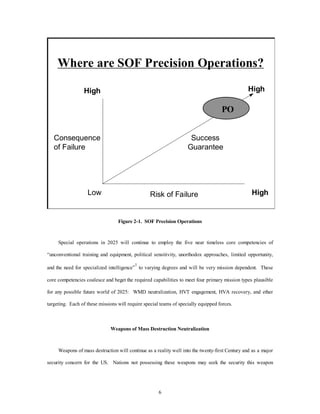
Figure 2-1 provides a graphic representation of the mission area SOF precision operations will operate in. 
There will continue to be some missions, where the consequence of failure and mission risk are so high that a 
military option may not exist.
Where are SOF Precision Operations? 
6 
High 
Consequence 
of Failure 
High 
PO 
Success 
Guarantee 
Low Risk of Failure High 
Figure 2-1. SOF Precision Operations 
Special operations in 2025 will continue to employ the five near timeless core competencies of 
“unconventional training and equipment, political sensitivity, unorthodox approaches, limited opportunity, 
and the need for specialized intelligence”1 to varying degrees and will be very mission dependent. These 
core competencies coalesce and beget the required capabilities to meet four primary mission types plausible 
for any possible future world of 2025: WMD neutralization, HVT engagement, HVA recovery, and ether 
targeting. Each of these missions will require special teams of specially equipped forces. 
Weapons of Mass Destruction Neutralization 
Weapons of mass destruction will continue as a reality well into the twenty-first Century and as a major 
security concern for the US. Nations not possessing these weapons may seek the security this weapon
provides. Nonstate actors and terrorists may successfully hold states hostage and achieve objectives by using 
these weapons once and then making demands with the threat of continued use. Irrational state actors electing 
to use WMD as preemptive tools may draw other states possessing these weapons into Armageddon. 
These weapons will be secured through passive and active means. Deep underground bunkers and 
mobile launchers will make destruction of these devices difficult. Air attacks may require precision 
designation by SOF, with a much greater accuracy than today’s capability. Several target sets may be too 
precariously positioned to permit self-designation by airborne platforms. It is additionally possible that 
precision-guided munitions and air attack, even by uninhabited aerial vehicles (UAVs), may be futile against 
some deeply buried storage sites which are protected by early warning devices and layers of air defense 
weapons. Enemy ground forces will be positioned to react to intrusion and thwart direct attack by 
conventional means. WMD storage and launch sites will be located in distant, isolated areas which naturally 
make intrusion and penetration difficult. Gathering intelligence on these sites will be challenging due to 
cover, security, and location of these sites. Mobile launchers will be moved from site to site for protection 
from attack. States threatening use will have forces at high alert to protect these high-value items. 
In 2025, WMD will include nuclear weapons, poor man’s nukes (biological and chemical weapons), 
and a new “deadly” WMD—“Information Bombs” (IB).2 Demographic and political changes described in 
the 2025 alternate futures unfortunately provide uncommonly fertile ground for Alvin Toffler’s first, second, 
and third wave entities to execute both coherent and sporadic direct actions on the United States and its allies 
and friends. The purpose of these actions by aggressor nations, terrorists, organized crime cartels, or even 
single individuals will be to “level” the distribution of wealth and resources, power redistribution, or simple 
7 
political agendas. 
WMD neutralization will require locating, analyzing, penetrating, and eliminating the weapon. 
Neutralization may include destruction at the site, transporting to friendly control, or neutralizing critical 
components. Penetrating the facility will require high-fidelity, accurate, real-time intelligence. Strategic 
and tactical mobility to move SOF teams and neutralization equipment is also required. Eliminating security 
forces will require a variety of weapons-- weapons which can stun, immobilize, or kill.
High-Value Target Engagement 
HVT engagement seeks to obtain a wide range of options, from temporarily disabling to total 
destruction. Designated high-value targets would have strategic significance affecting the highest levels of an 
organization (i.e., multinational corporation) or state during peacetime or war. These operations could be 
conducted against individuals as HVT engagement operations are tunable for a variety of results, from lethal 
to nonlethal. high-value targets may include C4I nodes, protected power generation sites, or underground 
command centers to facilities in close proximity to sensitive noncombatant sites such as hospitals, religious 
places, or schools. Both the nature of the target and the location will dictate precision operations, 
8 
eliminating or minimizing collateral damage. 
SOF will face many of the same challenges presented in WMD neutralization missions. Strategic and 
tactical mobility to and from the site is required. Some of these operations may be conducted remotely with 
essentially a reconnaissance team waiting for the opportunity to strike or designate the target. In those 
instances where a facility or deep underground facility must be penetrated, the same capabilities inherent in 
the WMD neutralization mission apply. SOF will still be faced with eliminating security, penetrating the 
target site, and applying tunable devices which manipulate the target. These devices will limit damage to 
what is required to achieve desired results. Tunable weapons will permit SOF operators to achieve results 
without producing unwanted world criticism. Precision-neutralization operations conducted against high-value 
targets require extreme precision, timing, coordination, and offer the added value of deniability. 
High-Value Asset Recovery 
HVA recovery operations return sensitive items, people, or things to US control. HVA recovery 
operations may also return allied citizens to their country and friendly control. Additionally, in 2025, HVAs 
may include financial databases, corporate trade secrets, or proprietary knowledge in Bill Gates’ brain. 
These missions are the most difficult and must be conducted as quickly as possible. Time wasted formulating 
plans, preparing forces, and deciding options allows enemy forces to gain positional advantages. Precision-operations 
forces must safeguard sensitive items and hostages. Facilities will offer the enemy protection
from direct assault. The surgical nature of these operations require sorting out enemy personnel from 
hostages and separating enemy personnel from sensitive items without damage to the item. 
SOF will require high-fidelity, accurate real-time intelligence to penetrate these facilities successfully. 
Neutralizing enemy security forces without harming hostages or damaging sensitive items is of paramount 
importance. Tunable weapons will permit separating enemy from friendly personnel. Strategic and tactical 
mobility is required to move SOF from base locations to target sites. Speed, stealth, and surprise are 
essential requirements to successful operations. Arriving undetected at the site permits securing HVAs 
before the enemy can react. Transportation of team members and hostages or sensitive equipment requires 
9 
both tactical and strategic mobility. 
Hostile governments and organizations will pose a significant threat to the safety of American citizens. 
Nations, organizations, and/or individuals not possessing the adequate power to confront the US may resort to 
kidnapping and stealing to attain political goals. 
Ether Targeting 
Despite giant strides in information dominance over the intervening years, disparity between US laws 
and customs and those of peer or competitor entities provide fertile ground for hostile activities to contravene 
US vital interests. These “unfriendlies” develop special talents to circumvent both prevailing law as they 
become the modern-day cyber pirates.3 They readily steal, lift, or appropriate commercial trade secrets, 
software, or the individual who possesses the knowledge. The market is king. US dependence on 
information systems, knowledge or “wisdom,” and commerce will make the impact of a logic bomb or a 
multimorphing power virus4 devastating.
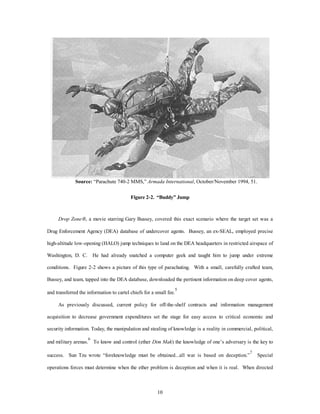
Source: “Parachute 740-2 MMS,” Armada International, October/November 1994, 51. 
Figure 2-2. “Buddy” Jump 
Drop ZoneÒ, a movie starring Gary Bussey, covered this exact scenario where the target set was a 
Drug Enforcement Agency (DEA) database of undercover agents. Bussey, an ex-SEAL, employed precise 
high-altitude low-opening (HALO) jump techniques to land on the DEA headquarters in restricted airspace of 
Washington, D. C. He had already snatched a computer geek and taught him to jump under extreme 
conditions. Figure 2-2 shows a picture of this type of parachuting. With a small, carefully crafted team, 
Bussey, and team, tapped into the DEA database, downloaded the pertinent information on deep cover agents, 
and transferred the information to cartel chiefs for a small fee.5 
As previously discussed, current policy for off-the-shelf contracts and information management 
acquisition to decrease government expenditures set the stage for easy access to critical economic and 
security information. Today, the manipulation and stealing of knowledge is a reality in commercial, political, 
and military arenas.6 To know and control (ether Dim Mak) the knowledge of one’s adversary is the key to 
success. Sun Tzu wrote “foreknowledge must be obtained...all war is based on deception.”7 Special 
operations forces must determine when the ether problem is deception and when it is real. When directed 
10
within the ether or cyber environment, special operations will neutralize or destroy target sets outside the 
11 
boundaries of conventional means. 
One commercial “system” that may be a hot prospect is the idea of intellectual property.8 Once targeted 
by an adversary or “snatched,” special operations would employ HVA recovery techniques for the property’s 
safe return. Preempting this scenario would require sophisticated ether identification, monitoring and 
“destruction” techniques. Our adversaries are investing heavily in information manipulation. Once in this 
arena, special operations forces will require an “info” kitbag. 
Notes 
1 United States Special Operations Command, 1994 United States Special Operations Forces Posture 
Statement, 3–4. GPO, Washington, D.C., 1994. 
2 2025 Concept No. 900328, “Information Bomb.” 2025 concepts database (Maxwell AFB, Ala.: Air 
War College/2025, 1996); See 2025 Counterinformation White Paper for further research on MMPVs and 
information bomb impacts on US vital interests. 
3 Microsoft Network News, “US, Japan in Piracy Battle,” Internet address: http://www.msn.com, 10 
February 1996, 1845 CST, states the “music piracy dispute could become a test case for the new intellectual 
property rules of the 116 member WTO. . . . The US argues that under the trade-related aspects of 
intellectual property rights (TRIPS) agreement of the Uruguay Round world trade accord, Japan must extend 
copyright protection to foreign records dating back 50 years. The Geneva-based WTO covers intellectual 
property rights, unlike the General Agreement on Tariffs and Trade (GATT).” 
4 Wieslaw gornicki, “In the Shadow of the L-Bomb,” Warsaw Przeglad Spoleczny Dzis, (FBIS 
Translated text—Polish officer discusses Infowar), 1 November 1995, 48–60; 2025 Counterinformation 
White Paper. 
5 
Drop ZoneÒ, Paramount Pictures, 1994. 
6 Microsoft Network News. 
7 Samuel B. Griffith, Sun Tzu, The Art of War, Translated and with an Introduction by Samuel B. 
Griffith (Oxford, England: Oxford University Press, 1971), 106 and 145. 
8 Danton K. Mak, “Intellectual Property Checklist for Ventures in the 90’s.” On-line, Internet, 20 March 
1996, available from http://www.calcom.com/sm/articles/ipcheck., 1.
Chapter 3 
Enabling Capabilities and Supporting Technologies 
This chapter performs two functions: (1) it lists and describes the requirements for each of the three 
capabilities introduced as essential to mission success in the four SOF missions; and (2) provides the reader 
with, when possible, technology solutions which satisfy each enabling capability requirement. Where 
research falls short or technology solutions are not provided, the team has provided possible alternatives or 
technology transmogrifications which might exist in the time frame of the study. The authors have carefully 
considered concepts of operation where they recommended specific technologies. The researcher has 
pointed out the potential shortcoming associated with using technologies which have a potential tactical 
shortcoming associated with its use, and when possible, has made recommendations to minimize the 
12 
drawback. 
The three essential enabling capabilities needed to successfully perform the SOF offensive missions of 
2025 are communications, mobility, and destruction/neutralization. This chapter discusses each capability, 
lists and, where necessary, defines performance requirements, and provides technological solutions. The 
chapter discusses solutions subsequent to the introduction of each performance requirement. Requirement 
parameters are expressed using the extreme end of the requirement criteria (most demanding criteria). For 
example, the range to a target may vary with the mission, but this chapter user the most demanding range to 
describe the performance criteria.
Communications 
SOF precision operations communication requirements go significantly beyond the team members 
ability to talk to each other. Communications in the context of this paper involves the quest and distribution 
of mission knowledge in a timely and useful manner to guarantee mission success. Mission knowledge 
involves intelligence (preknowledge of one’s adversary or threat), real-time remote sensing, human-enhanced 
sensing, and finally electronic information processing, distribution, and storage systems. As noted in Alan D. 
Campen’s book, The First Information War, “because of the strategies of deception, maneuver, and speed 
employed by coalition forces in Desert Storm, knowledge came to rival weapons and tactics in importance.”1 
The SOF precision operations teams of the future will depend on the ability to manage and dominate mission 
knowledge. Communications via voice, sight, touch, external sensors’ inputs, and even thought will afford 
SOF precision operations teams of 2025 the edge to gain and maintain mission knowledge dominance over 
13 
any adversary. 
Several unique factors drive communication requirements for the precision operations mission. SOF 
communication drivers currently include the requirement for worldwide, real-time, multinet linking 
capability within a precision operations team, and to other command, control, communications, computer, and 
information (C4I) nodes. Based on the authors’ assumptions, in 2025 there will be a need for communication 
systems featuring clandestine and covert modes of operation; multilevel security; and the capability to 
integrate, fuse, and manage numerous sources of data and information.” These future sources may include 
voice, video, sensor’s inputs, navigational information, and identification friend or foe (IFF) data. 
Today, this all-encompassing communication capability, “system of systems,” conceived by the former 
Vice Chairman of the Joint Chiefs of Staff, Adm William A. Owens, USN, is under initial development for 
US DOD needs.2 New technologies in computer capabilities, digital data storage, processing, data fusion 
capabilities, and global positioning supported this concept. This system of systems brings together battle 
space awareness, increased precision engagement capability, and enhanced C4I to provide the future SOF 
precision operations mission the needed advantage to achieve mission objectives.
“SYSTEM of SYSTEMS” 
2025 SOF 
Precision Operations 
Requirement BATTLESPACE 
AWARENESS 
PRECISION 
ENGAGEMENT C4I 
14 
ENHANCED 
“INFO KIT” 
PERSONNEL 
INTERFACE 
Figure 3-1. System of Systems (Modified for Precision Operations in 2025) 
Figure 3-1, a derivative of Admiral Owens’s initial idea, shows an added region to the system of 
systems called personnel interface.3 A critical requirement for PO in the 2025 time frame, the personnel 
interface section of this system of systems identifies the unique human-interfacing requirements for precision 
operations. The unique personnel interface requirements are primarily driven by needs for covert operations 
and security during precision operations missions. Nondetectable equipment and signals will be a necessity 
for precision operations in 2025 especially as the threats’ capability to detect and counter SOF missions will 
increase. Admiral Owens’s system of systems must be compatible with SOF precision operations needs, and 
this personnel interface will ensure the requirements for these communications are identified and addressed. 
The term info-kit, also shown in figure 3-1, is a proposed name for this future system and will be used 
throughout this section of the SOF precision operations white paper.
The consequences of mission failure are extreme for both the SOF team members and potentially the 
United States. Therefore, the need for extremely reliable, durable, simple, and redundant communications is 
essential. Affordability will also be a driving factor for any future communication systems, and will make 
unilateral SOF development of precision-operations communication equipment unlikely and dependency on 
commercial communication markets a necessity. The rapid pace of technological developments makes the 
ability to develop, procure, and bring to operational status communication equipment before it becomes 
obsolete or vulnerable to threat countermeasures difficult and too costly for expected SOF budgets. 
Numerous commercial applications are being developing for secure local, regional, and global 
communications capabilities. The military and SOF can take advantage of this commercial development its 
procure required communication capability, their avoiding the initial developmental costs. 
The ability to effectively communicate has always been a key component to any successful military 
operation. Sun Tzu identified the importance of communications during military operations when he wrote, “ 
. . . drums and bells . . . flags and banners . . . must be used for troop communication in battle.” Then, now, 
and in 2025, communications capabilities will provide SOF precision operations the necessary flexibility to 
achieve concentration of force, coordinated and undetected mobility, speed, precision, synergy of effort, unity 
of command, surprise, and ultimately the achievement of mission objectives. Communications truly is a force 
multiplier and one of the founding pillars supporting the fundamental principles of war. 
15 
Worldwide Communications 
SOF precision operations requirements for worldwide communications will generally fall into three 
categories, local, theater, and global. Each category may require unique equipment for several reasons 
including technology limitations, diversity, and reduced complexity allowing tailoring for specific mission 
needs. Ideally, an all-in-one device, an “info-kit,” could offer the required communication capabilities 
needed by SOF in 2025. Whatever technologies exist in the future, the info-kit must provide seamless 
communications with other DOD communication systems and provide significant interoperability with older 
communications equipment and systems that will be prevalent throughout the world. 
Local communications would SOF precision operations team members links between each other and 
with other C4I nodes. These SOF teams must be capable of communicating over relatively short distances up
to several kilometers without detection. Additionally, SOF requires the ability to use multiple nets or 
channels simultaneously allowing precision-operations team sub-elements discrete interconnected 
communications. Direct communication with other military organizations and noncooperatives would also be 
a necessary feature. The term non-cooperative identifies organizations or systems not willingly or knowingly 
communicating with the SOF precision operations team. Supporting airpower requirements for the local 
precision operations communication may include the use of prepositioned uninhabited aerial vehicles. UAVs 
may provide communication relays between local precision operations teams, other military forces in the 
local area, or relays to other theater and global C4I networks. These flying relay stations would be deployed 
singularly or in constellations as necessary for each mission and be withdrawn at mission completion.4 
The next two categories for SOF precision operations communications are theater and global. These 
categories would entail the ability to communicate with a diverse array of command and control nodes and 
mission support systems such as remote and nationally controlled sensors and transportation assets. During a 
recent lecture at the Air Force’s Air Command and Staff College (ACSC), Col John A. Warden III (Ret.) 
16 
provided the potential of future C4I 
During the initial strikes on Baghdad in January 1991, part of the air campaign planning 
staff sat around their TV sets in Washington DC watching for indications on CNN Headline 
News about the attack success on one of their first target priorities that night, Baghdad’s 
electrical power grid. Shortly after 1900 EST (0300 in Baghdad), a CNN correspondent 
team reported live from Baghdad indicated the city lights started going out.5 
Colonel Warden additionally described that some Scud missile-launch warnings were being provided to in-theater 
target areas via relays through US based command and control nodes. 
Similar to the two events described above, a diverse real-time global communication capability would 
allow for critical mission information and decision making to take place anywhere in the chain of command. 
Decisions could be made or mission results could be viewed in real-time at National Command Authorities 
(NCA), commander in chief (CINC), or joint force commander (JFC) levels, if necessary. The sensitivity of 
future precision operations missions may not permit a final mission decision until the SOF team is engaged at 
the mission objective or target site. For example, the neutralization of a rogue nuclear device may include 
several options-- device removal, device destruction, or device manipulation to give the appearance of 
operability though inoperable. The final decision concerning disposition of the device may not be realized 
until actual events develop during execution and on-scene mission environmental factors are evaluated.
Global communications will allow final mission decisions at the regional CINC, JFC, or NCA level. In this 
scenario, a worldwide communication capability has provided additional flexibility to the mission by 
allowing the mission execution decision to be made at the highest level if needed, and at a latest possible 
moment. Other solutions, such as ongoing negotiations, would have an extended chance to resolve the crisis. 
Supporting technologies for regional and global communications include the use of high-altitude UAVs 
and spaced-based satellite communications relay and processing systems similar to the advanced military 
satellite communications (MILSATCOM) concept offering significant increase in capability of today’s 
MILSATCOM systems.6 The advanced MILSATCOM will offer global, secure, personalized, high-data rate 
communication capability. Another Air Force 2025 concept applicable for worldwide communications 
suggests the capability of faster-than-light, infinite distance communications via “quantum polarization shift 
of shared photons.”7 This capability would revolutionize communication and mission knowledge dominance 
as we know it today. Finally, the technology to transmit, receive, and process very high data-flow rates, on 
the order of terra-bits per second, is a future requirement for all worldwide communications capabilities. 
17 
Clandestine Operations 
The requirement for PS teams to operate covertly drives the need for any future SOF communications to 
operate with low probability of intercept or detection (LPI/LPD). Two general approaches to this solution 
are identified. First, to develop a communication system with signals that are undetectable by the threat. 
This can be accomplished in a number of ways, including the use of very low-power transmitters, but this 
may limit equipment effective range. A smart info-kit system of the future may allow for real-time adaptive 
power modulation techniques that use only the minimum required power to accomplish the data transmission. 
Another approach to making precision operations communications undetectable would be to develop a 
system that operates outside the normal energy patterns for typical or expected communication bandwidths. 
Today, a majority of military communications occur in the very high frequency (VHF) bandwidth, generally 
in the area of 30 to 500 MHz. Undoubtedly, future military communication systems will expand to cover a 
much wider spectrum. Currently, developments in the 1.5 GHz bandwidth is ongoing with the potential to 
expand significantly higher or lower.8 Whatever communication systems exist in 2025, the ability to operate
on the fringes or outside the normal energy bandwidths could provide the needed surreptitiousness inherent in 
18 
precision operations. 
The second approach to LPI/LPD communications for precision operations teams of the future would be 
to make such equipment and associated signals blend into the surrounding environment. Currently, nearly 
every country in the world today is experiencing a communication evolution. Some estimates predict that by 
the year 2000, up to 80 percent of worldwide telecommunications will be wireless.9 Mobile 
telecommunications are expanding rapidly throughout the world, especially in many developing countries 
where land phone and data lines do not exist. Cellular-based systems for voice and data communications 
using microwave radio networks are becoming common throughout the world. They afford a developing 
nation the “quick connect” to a diverse local and worldwide communication network. Additionally future 
developments in wireless technologies will provide the popular local area network (LAN) systems, 
prevalent throughout the industrial world of today, a wireless capability.10 Over the next several decades the 
atmosphere will be “buzzing” with numerous signals from these developing wireless capabilities. The 
ability for SOF precision operations communications to blend into this noisy environment may be less of a 
challenge than trying to avoid detection and provide another means for covert communications. 
Any attempt to lower detection levels through LPI/LPD communications in the future will most likely 
require a combination of techniques. No one solution will fit all scenarios or requirements for precision 
operations’ stealthy communication. The design of these future communication systems must be adaptive and 
capable of operations in many future world environments. 
The next concern for SOF precision operations with regard to covert communications deals with the 
visibility or recognition of the communication equipment. Potential precision operations scenarios may 
require the SOF team to blend into the local populous and surrounding environments. Personnel hauling a 
communication kit with antennas, a cumbersome battery pack, and headsets will be very conspicuous and 
therefore a lower probability of success should be expected. The capability to miniaturize and hide 
communication equipment is essential. 
Under the charge of the US Army Communications Electronic Command (CECOM), the 21st Century 
Land Warrior Program is developing and field testing an individual soldier computer/radio kit.11 This kit is 
expected to weigh approximately two pounds and strap onto the soldier of the twenty-first century providing
voice, data, and imagery to each soldier and throughout the chain of command This system is expected to 
greatly enhance the overall effectiveness of Army combatant units. Though two pounds of equipment does not 
sound cumbersome by today’s standard, the packaging of this equipment will not meet precision-operations 
team requirements. Team communications equipment will need to be light, mobile, and unrecognizable as a 
communication system. Miniaturization should allow communication and supporting equipment to be 
imbedded into mission apparel or uniforms. Interfacing with the equipment could be through implanted ear 
and throat pieces. Contact lenses could be the display screens of tomorrow affording normal fields of view. 
These lenses could display necessary visual data for mission tasking and additionally act as sensors for data 
collection or enhancing as night vision goggles do today. Controls for such equipment must also be 
unrecognizable and activated through gestures, voice, touch, or even thought control. Whatever 
communication technologies develop in the future, the precision operations team will most likely need 
equipment that is unrecognizable as such for mission accomplishment. 
Advances in electrical and mechanical microminiaturization technologies will be needed to package the 
info-kit of 2025 into a usable precision operations system. Additionally, communication equipment power 
supplies often make up a large percentage of the total system volume and weight. Power supplies for the 
info-kit of 2025 will need to be inconspicuous, durable, and highly mobile. An Air Force 2025 concept 
suggests the use of human body heat as a potential energy source.12 
19 
Communication Security 
Secure communications will be required for SOF precision operations missions not only within the 
precision operations team but also with other related activities. These missions may proceed or occur 
simultaneously with other combatant operations. Being able to communicate securely with other operations 
will be crucial. The need for multilevel encryption capability will be required in the future and is currently 
being developed by CECOM in their digital integrated laboratories.13 Currently, separate networks are 
needed for different levels of classified communication. To be compatible and capable of communicating 
with different operations apart from the precision operations team, a multilevel security unit that allows the 
commingling of data with different security classifications will be needed. Interoperability will be needed
not only with other DOD communication equipment but with other secure nets to include those operated by 
other nation’s military forces and noncooperative systems described earlier. 
The info-kit of 2025 may afford an adversary an tremendous advantage should it fall into his hands. 
Therefore, operation of such a system must be protected and could be easily accomplished by 
deoxyribonucleic acid (DNA) tagging specific equipment to individuals or groups of individuals. When the 
DNA tag is lost so is the info-kits capability. Additionally, data storage areas within the info-kit would be 
self-destroying after a preset time of lost user DNA signature. 
20 
Data Fusion 
The next aspect to discuss for SOF precision operations communications involves the capability of 
future systems to integrate, process, and provide numerous sources of information to the precision operations 
team member. Admiral Owens’s system of systems now in the conceptual design and initial technology 
demonstration phase will evolve into an operational system in the early part of the Twenty-first century. In 
the time frame of 2025, this system will undoubtedly be more capable and functional for SOF precision 
operations requirements. Today, new technologies are allowing the fusing of multiple communication and 
information data into one multipurpose device. Advances in computer software, data storage, and processing 
speed capabilities along with microminiaturization advances will allow for the combination and integration 
of many data sources for precision operations. Numerous informational data source (NIDS) processing 
capability will greatly enhance the future SOF operations. A part of the info-kit, NIDS processing would 
combine real-time voice, video, external sensor data, global position location and navigation, IFF 
information, and any other system deemed necessary in 2025. 
External or remote sensor inputs to the NIDS systems could range from those at the national asset level 
such as spaced-based multispectrum satellites, theater-level UAV inputs, to local preposition or on-body 
sensors such as the Advanced Research Project Agency (ARPA) concept being developed to detect toxic 
substances. ARPA is working on a “neuron-based biosensor that can feature nerve cells growing directly on 
microchips capable of sensing toxic substances.”14 Air Force 2025 concepts such as “I Can Smell You, “and 
“Fly on the Wall” are ideas for local sensors that can be propositioned for a PO mission and provide vital 
real-time mission data directly to a NIDS type-system.15
Other subcomponents to the NIDS system could include an individual monitoring system (IMS) capable 
of evaluating, and if necessary, administrating immediate life-sustaining medication to the system user. For 
HVA recovery missions where hostage rescue is the objective, the NIDS could incorporate another 
subcomponent called Medical Emergency Reaction Instructions or MERIT guidance for self-administered 
emergency medical treatment to injured hostages or other SOF team members. When activated, the MERIT 
system would help remotely diagnose and instruct the necessary medical treatments, similar to the medical 
tricorder seen in Paramount’s Star TrekÒ TV and movie series. Through the development and use of 
artificial intelligence computer capability, the NIDS system would provide the user with the right information 
at the right time to enhance situational awareness, sustain life, and guarantee mission success. 
Communication requirements for SOF precision operations in 2025 will involve much more than just 
the ability to talk to team members. Technology is affording the future precision operations team member the 
capacity to achieve knowledge-space-dominance needed for 2025 tasks and missions. Admiral Owens’s 
system of systems will likely be in its third or forth technology evolution by 2025. Combining many of the 
emerging and developing ether technologies will provide situational awareness to SOF precision operations, 
guaranteeing mission success. By identifying SOF precision operations communication requirements now, 
the evolution of the system of systems, will be the info-kit in 2025. This capability for SOF to achieve 
knowledge-space-dominance over an adversary will ensure the US is capable of achieving its national 
21 
objectives in 2025. 
Mobility 
Mobility is one of the three enabling capabilities for special operations in 2025. It plays a key role in 
each of the missions envisioned; --WMD neutralization, HVA recovery, HVT engagement, and ether 
targeting. This section details systems attributes and required technological advances to support these 
systems. Mobility, as defined for this study, is the system or systems that provide SOF insertion and 
extraction capability for a designated mission. This study will not address any additional mobility 
requirements for the teams after initial insertion, only the strategic and tactical systems for insertion and 
extraction. The team has identified three potential mobility systems satisfying special operations 2025
mobility requirements, a stealth airlifter, low earth orbiter (LEO), and exfiltration rockets. The mobility 
systems directly affect the enemy processes in the sense that the insertion and extraction location, method, and 
route planning will impact enemy command and control efforts to counter the mission. Additionally, mobility 
has a direct impact within all facets of the HVA recovery mission due to the payload requirements for the 
people or things to be recovered. The enemy will dictate target locations; therefore, SOF must possess an 
infinite range of insertion and extraction capabilities. This will enable special operations teams to operate 
throughout the enemy system processes to conduct WMD neutralization, HVT engagement, HVA recovery, 
and ether targeting missions. Though mobility requirements exist across the full spectrum of SOF missions, 
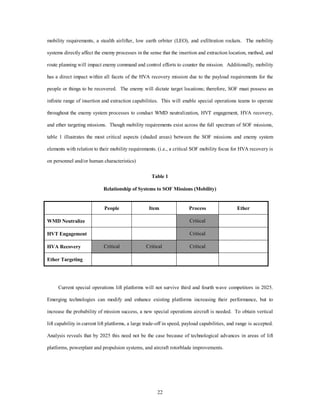
table 1 illustrates the most critical aspects (shaded areas) between the SOF missions and enemy system 
elements with relation to their mobility requirements. (i.e., a critical SOF mobility focus for HVA recovery is 
22 
on personnel and/or human characteristics) 
Table 1 
Relationship of Systems to SOF Missions (Mobility) 
People Item Process Ether 
WMD Neutralize Critical 
HVT Engagement Critical 
HVA Recovery Critical Critical Critical 
Ether Targeting 
Current special operations lift platforms will not survive third and fourth wave competitors in 2025. 
Emerging technologies can modify and enhance existing platforms increasing their performance, but to 
increase the probability of mission success, a new special operations aircraft is needed. To obtain vertical 
lift capability in current lift platforms, a large trade-off in speed, payload capabilities, and range is accepted. 
Analysis reveals that by 2025 this need not be the case because of technological advances in areas of lift 
platforms, powerplant and propulsion systems, and aircraft rotorblade improvements.
23 
Stealth Airlifter 
A primary lift system to accomplish this could be a stealth airlifter.16 A stealth airlifter is needed because 
surprise is critical to success in SOF precision operations. Primary attributes that need to be incorporated 
into the stealth airlifter are low observability, high speed, long range, global reach, increased payload, 
reliability, and durability. This new airlifter should also possess vertical take-off and landing (VTOL), 
armament, and an array of emission support sensors. Experts estimate that a special operations stealth 
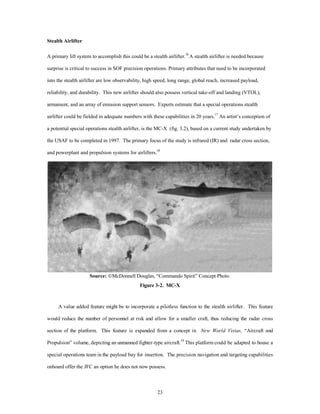
airlifter could be fielded in adequate numbers with these capabilities in 20 years.17 An artist’s conception of 
a potential special operations stealth airlifter, is the MC-X (fig. 3.2), based on a current study undertaken by 
the USAF to be completed in 1997. The primary focus of the study is infrared (IR) and radar cross section, 
and powerplant and propulsion systems for airlifters.18 
Source: ÓMcDonnell Douglas, “Commando Spirit” Concept Photo. 
Figure 3-2. MC-X 
A value added feature might be to incorporate a pilotless function to the stealth airlifter. This feature 
would reduce the number of personnel at risk and allow for a smaller craft, thus reducing the radar cross 
section of the platform. This feature is expanded from a concept in New World Vistas, “Aircraft and 
Propulsion” volume, depicting an unmanned fighter-type aircraft.19 This platform could be adapted to house a 
special operations team in the payload bay for insertion. The precision navigation and targeting capabilities 
onboard offer the JFC an option he does not now possess.
Another lift platform offering promise is a 2025 concept suggesting a modular medium lift aircraft.20 
This aircraft will employ low-observable technology, large cargo capacity, internal engines, and posses a 
6,000 nautical mile unrefueled range. A benefit of this concept is the platform can be manufactured in the 
modular level and have several different models with comparable characteristics: airlifter, tanker, global 
range strike, and the special operations version. This concept saves time and eliminates the requirement to 
invest precious research and development dollars to develop a purely special operations lift platform. 
Technological advances also offer promise in powerplant and propulsion systems. National 
Aeronautics and Space Administration (NASA), working in conjunction with aircraft manufacturers, has 
invested heavily in aircraft engine technology.21 One effort having a direct military application is a Mach 4 
civil transport with reduced nitrogen oxides emissions, and quieter engines. An additional area offering 
promise is the use of magnetic-based rotation of ionized air as a substitute for physical turbine blades.22 
Powerplant experts in the New World Vistas predict that modern adaptive control methods to engines may 
yield improvements of 10 percent in the near future.23 If successful, these technological improvements could 
give the NCA or a JFC the ability to quickly react to trouble spots with a highly trained team. 
A final area of technological solutions to aircraft problems could be the use of eclectic materials in the 
construction of aircraft rotor blades. Eclectic materials must be rigid enough to withstand effects of flight but 
be malleable enough to enable changes in shape during operation. Use of these materials will permit airfoils 
to adjust shape during flight— improving lift, reducing drag, and resulting in increased performance.24 
Retrofitting existing aircraft with this technology will deliver an increase in performance potentially 
eliminating a need to design and develop a new aircraft. 
24 
Low Earth Orbiter 
A second potential lift system for SOF in 2025 could be a Low Earth Orbiter (LEO). This platform 
would be able to deliver the two-to-four-man teams anywhere in the world with a precision landing. The 
LEO gives the JFC the ability to respond quicker than airlift platforms; however, thermal reentry signatures 
detectable by competitor threat detection systems must be overcome. 
Technological advances in hypersonic vehicles research and study has increased the potential of this 
platform for special operations use. A promising vehicle in planning would fly at hypersonic speeds and be
able to deliver a payload in 10 minutes.25 The team would be housed in the payload compartment and 
released for a precision landing at the desired location. While this system is primarily designed as a 
weapon, the payload could be designed to house the special operations team with its associated equipment. 
Precision delivery of the payload such as a circular error probable (CEP) of under 100 feet, is vital to this 
system. Special operations missions often entail night insertion and the teams must be able to begin their 
mission quickly after arrival. Dispersed teams needing to regroup or identify their exact location run the risk 
of compromising mission success. To achieve this level of accuracy the aerial delivery system (ADS) must 
continue to be improved. Advances in parachute, guided parafoil, and deployable wing systems offer 
promise in improving the ADS capability.26 Integrating these advancements with improved Global 
Positioning System (GPS) and onboard navigation systems, and digital ground mapping will enable payload 
delivery with pinpoint accuracy. It is estimated that reusable launch vehicles, if developed in conjunction 
with NASA, could be available in 10 years using rocket propulsion and twenty five years using airbreathing 
propulsion.27 A great deal of investment in fuels, propulsion, ceramics, and other technologies must be 
25 
undertaken to make this a reality. 
Additional hypersonic platforms in research at this time are rapid response/global reach aircraft system 
and space launch/support system.28 The rapid response/global reach aircraft system is projected to fly at 
speeds greater than Mach 8 with global reach. The space launch/support system proposes a reusable launch 
vehicle (RLV) that could deliver a payload in orbit on short notice and return to base. If payload pods could 
be produced, the teams could be inserted from space from this vehicle. This concept would emulate the 
delivery profile of the troops in Robert Heinlein’s science fiction novel Starship Troopers.29 In this novel, 
military forces are loaded into capsules to be ejected from the spaceship. Once through the atmosphere, 
parachutes are employed to brake the descent until landing. 
Extraction Rockets 
A solution to the vertical lift extraction problem may exist in the extraction rocket. The SOF team has 
taken an idea from the New World Vistas and used it for extraction, not delivery.30 This system would be 
inserted with the special operations team, be easy to set up and launch from field conditions, and have a 
payload capacity large enough for the team plus extra cargo. If necessary, the rockets could be hidden with
chameleon camouflage during mission execution and then used when needed.31 The extraction payload could 
be a WMD device or a HVA item. Use of this system will allow a team and payload to quickly exit the target 
location. This is critical for special operations, since the longer the team remains in the mission area, the 
26 
greater the chance they may be captured or killed. 
Another option for extraction could be a jet-pack device the team member would strap on their back. 
This device would transport the member to a safe haven for extraction by airlift or to loiter for an aerial 
recovery. 
The extraction rocket would possess the following attributes: speeds in excess of Mach 1; air 
refuelable; long range; payload capacity large enough for a two-to-four-man team and a WMD device or 
HVA item; high durability; and precision delivery. An additional possibility for the extraction rocket would 
be to launch the team into a low orbit and the team would be recovered in space. This would eliminate the 
long-range and precision delivery requirements. The extraction rocket would boost the crew into space and 
await the arrival of an RLV to return the team to earth. 
The jet pack would need to lift at least 500 pounds and transport the member up to 100NM. This would 
enable the special operations team to depart the target area and deploy to a safe haven for extraction. An 
alternative would be a deployable balloon connected to a cable to allow for aerial recovery of the member. 
Incorporated in the jet pack would be a emission-control sensor suite to reduce the signature of the member 
as he flies. Additional features could be a jet-pack suit the member would wear, which incorporates low-observable 
technology, is armored, and has a programmable navigation system. These features would allow 
the member to climb into the suit, program the navigation system, and sit back as he is delivered to the 
desired location. This would be an especially attractive feature if the member is injured and unable to pilot 
the jet pack himself or if the HVA to be extracted can not operate the controls. The propulsion system must 
be very quiet to avoid detection but still provide high speed to allow the team to quickly exit the target area. 
Technological advances offer promise to solve many of the challenges facing future SOF planners. The 
trade-offs required for vertical lift in speed, range, and payload, and other critical requirements such as 
secrecy, security, long range, and speed can be solved by technology. Specifically, advances in stealth and 
propulsion and powerplant systems will allow the development of stealth airlifters and hypersonic aircraft 
dedicated to the SO mission.
Destruction/Neutralization 
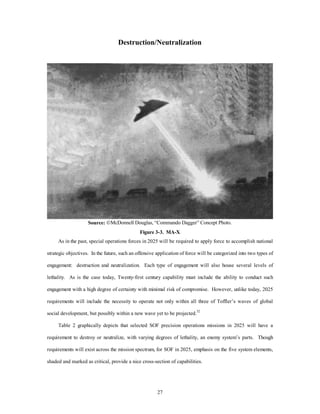
Source: ÓMcDonnell Douglas, “Commando Dagger” Concept Photo. 
Figure 3-3. MA-X 
As in the past, special operations forces in 2025 will be required to apply force to accomplish national 
strategic objectives. In the future, such an offensive application of force will be categorized into two types of 
engagement: destruction and neutralization. Each type of engagement will also house several levels of 
lethality. As is the case today, Twenty-first century capability must include the ability to conduct such 
engagement with a high degree of certainty with minimal risk of compromise. However, unlike today, 2025 
requirements will include the necessity to operate not only within all three of Toffler’s waves of global 
social development, but possibly within a new wave yet to be projected.32 
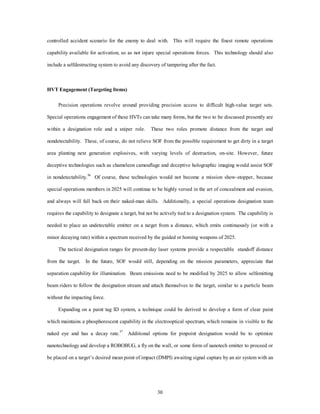
Table 2 graphically depicts that selected SOF precision operations missions in 2025 will have a 
requirement to destroy or neutralize, with varying degrees of lethality, an enemy system’s parts. Though 
requirements will exist across the mission spectrum, for SOF in 2025, emphasis on the five system elements, 
shaded and marked as critical, provide a nice cross-section of capabilities. 
27
Table 2 
Relationship of Systems to SOF Missions (Destruction/Neutralization) 
People Item Process Ether 
28 
WMD Neutralize Critical 
HVT Manipulate Critical Critical 
HVA Recovery Critical 
Ether Targeting Critical 
WMD Neutralization (Targeting Items) 
WMD resources require the host government provide the best available security or protection and 
control. Specially trained and specifically focused forces are needed to successfully engage within this 
arena. special operations forces will require an in-depth knowledge base and high-tech equipment to 
effectively target this threat. 
It is not feasible to have all special operations team members be combinations of nuclear physicists, 
biochemical professors, computer science specialists, munitions disposal experts, and special operations 
specialists. 2025 technology will allow teams to carry with them this level of expertise. Within 30 years 
virtual systems will become less cumbersome, more miniaturized, more concealable, as well as more 
capable. The capability to wear virtual sunglasses or contact lenses will be commonplace, very similar to 
technology creatively displayed in William Shatner’s futurist novel and film series Tek WarÒ.33 Special 
operations will require that this technology develop further into a seamless two-way heads-up display system 
with a direct link, to the source experts located elsewhere provide the appropriate technical data and 
procedures to perform the neutralization task. 
Nuclear weapons will remain a formidable resource within a government’s WMD arsenal but 
biological and chemical weapons will be easy to produce and afford, and will provide the most difficult 
challenge. WMD capability is presently measured categorically by payload, speed, and range but in the 
future, this measure will be more appropriately quantified by controlled distance, measurable effectiveness,
and loiter time (linger time and half-life). If SOF are to be successful in neutralizing the WMD threat, they 
must be capable of operating with complete control of these measurable variations. 
To adequately neutralize a WMD, on-site special operations forces will be required to either physically 
destroy the resource, render the destructive element unusable, render the delivery system unusable, or limit 
the effectiveness of the destructive element. Physical destruction of the resource or delivery systems, poses 
no additional requirements on SOF than any other engagement of a HVT. These requirements will be 
developed and discussed later in the HVT engagement section. However, if the neutralization of the threat 
requires hands-on manipulation of the system, then several other requirements will exist. 
SOF precision operations equipment must possess the capability to encompass and quarantine the WMD 
system and apply a technology to accelerate its decay, while maintaining the outward appearance and 
weapons system functional integrity. This, of course, secures SOF from discovery, and the antagonist will be 
operating under the false pretense of a whole-system WMD capability. Any technology that could operate 
from outside the delivery system housing, perform the decay, and never require direct tampering, would be 
29 
the optimum. 
Surgically removing the agent container mechanism from its weapons system housing provides the 
simplest form of extraction but depend on knowledge of the system. More crude systems may provide more 
difficult scenarios where friendly exposure is highly probable. Future development of the immune warrior, 
may make the risk of addressing this type of threat more acceptable.34 It has been stated that, “by the year 
2000, 15 percent to 20 percent blood doping will be proven to provide up to 25 percent enhancement of a 
soldier’s performance in a variety of environments.”35 Taking that next step in human manipulation as 
common practice, by 2025 near by 100 percent protection to selective agents should be a reality. 
Even if selective immunity for precision-operations team personnel neared 100 percent, the creation of 
a miniaturized, self-contained, translucent biosphere which will hermetically wrap as a flexible bubble 
around the weapon system, to protect the operations environment is necessary. Included within the bubble 
will be tools to neutralize the weapon through dismantling, injection, or exposure of the core to a chemical or 
biological antiagent. Sun simulators or other light-spectrum decayers can be applied from outside. 
A final requirement of SOF within the WMD realm, which leans towards a precision operation, will be 
to either insert a WMD into an enemy’s arsenal for activation or utilize an indigenous weapon and create
controlled accident scenario for the enemy to deal with. This will require the finest remote operations 
capability available for activation, so as not injure special operations forces. This technology should also 
include a selfdestructing system to avoid any discovery of tampering after the fact. 
30 
HVT Engagement (Targeting Items) 
Precision operations revolve around providing precision access to difficult high-value target sets. 
Special operations engagement of these HVTs can take many forms, but the two to be discussed presently are 
within a designation role and a sniper role. These two roles promote distance from the target and 
nondetectability. These, of course, do not relieve SOF from the possible requirement to get dirty in a target 
area planting next generation explosives, with varying levels of destruction, on-site. However, future 
deceptive technologies such as chameleon camouflage and deceptive holographic imaging would assist SOF 
in nondetectability.36 Of course, these technologies would not become a mission show-stopper, because 
special operations members in 2025 will continue to be highly versed in the art of concealment and evasion, 
and always will fall back on their naked-man skills. Additionally, a special operations designation team 
requires the capability to designate a target, but not be actively tied to a designation system. The capability is 
needed to place an undetectable emitter on a target from a distance, which emits continuously (or with a 
minor decaying rate) within a spectrum received by the guided or homing weapons of 2025. 
The tactical designation ranges for present-day laser systems provide a respectable standoff distance 
from the target. In the future, SOF would still, depending on the mission parameters, appreciate that 
separation capability for illumination. Beam emissions need to be modified by 2025 to allow selfemitting 
beam riders to follow the designation stream and attach themselves to the target, similar to a particle beam 
without the impacting force. 
Expanding on a paint tag ID system, a technique could be derived to develop a form of clear paint 
which maintains a phosphorescent capability in the electrooptical spectrum, which remains in visible to the 
naked eye and has a decay rate.37 Additional options for pinpoint designation would be to optimize 
nanotechnology and develop a ROBOBUG, a fly on the wall, or some form of nanotech emitter to proceed or 
be placed on a target’s desired mean point of impact (DMPI) awaiting signal capture by an air system with an
adequate weapons payload.38 These guided weapons-- either missile, bomb, or direct beam-- must all have 
31 
the capability to home in on the emission signal. 
HVT Engagement (Targeting People) 
Some scenarios will not allow for the convenience of outside weapons systems to provide the form of 
kill. The special operations sniper team must also possess the capability to properly identify (ID) the target, 
designate the target (if needed for internal systems), and provide the appropriate kill mechanism to 
manipulate the target. The term kill implies the completeness or finality of the engagement action, with 
varying levels of lethality, and does not imply the literal definition of death. 
The Hollywood movie, RunawayÒ, with Tom Selleck provides an interesting form of projectile for 
development.39 It is fired from a hand-held weapon, resembling a gun, but houses homing missiles with an 
individual DNA signature applied. Fired within the sensor range of the target, the missile goes active. The 
missiles could also contain varying levels of solid or liquid explosive. Of course, the movie targeted 
humans, but this system could be tied to any of the other designators already discussed and applied to 
targeting items. 
Star Trek the Next GenerationÒ, episode 157, called “The Vengeance Factor,” showed an interesting 
form of targeting people which may a SOF precision operations tool for 2025. The story involves a planet 
with a history of clan wars, and one clan developed a bio-virus that would only affect a certain clan of 
people. The developing clan was not directly affected, but could carry the virus, nearly undetected within 
their own bloodstream. By merely a touch to anyone of the enemy clan, can be death.40 The possibility of a 
SOF precision operations team, being able to infiltrate into an enemy target area, apply a predetermined or 
tunable level of lethality to enemy personnel simply by touch, would minimize the need for additional support 
equipment and weapons-- thus, allowing the forces to blend into the cultural environment. 
In all precision situations, the question of level of destruction is very important. Weapons systems 
either carried in by SOF to perform the destructive task or an external application targeted via special 
operations designation must have the capability to be controlled and/or varied in theater or via 
communications enroute. Focused blasts, yield variations, penetration with time-delay fuzing, genetic 
homing, and many others will give the SOF specialists the on-the-spot targeting capability for a given
situation. Development of a universal explosive, which by appropriate shaping and form of detonation, may 
provide for many different styles or/explosions with varying levels of destruction “Doing the right amount of 
32 
damage, to the right thing, at the right time.” 
HVA Recovery (Targeting the System Process) 
Within the high-value asset recovery mission, only two overlying capabilities exist due to the inherent 
possibility of human-to-human confrontation-- identification of friend or Foe and Self-Protection. 
Technologies in 2025 will operate in the nanosecond regime between functions, leading to a quicker output to 
SOF for decision making. A special operations team should have the capability to walk into a roomful of 
individuals, and within a split-second neutralize all the bandits, sort all the bogeys (presenting appropriate 
decision making data to all precision operations team members), and exclude all the friendlies. Primary use 
for this capability would be in hostage rescue. 
To provide this level of coverage requires advances in two areas, first the sensory/display area and then the 
fire control/weapons system. The sensory array could be tuned for target ID via DNA sensing, or possibly a 
form of pheromone sensing like that of pre - covert target marking, or as simple as those individuals with 
weapons are bad and all others require further forms of interrogate.41 These sensory inputs could then be 
filtered and combined with other team-gathered information, near instantaneously, and displayed within the 
visor of an ultimate warrior targeting helmet or a modified tactical information display helmet (fig. 3-4).42 Of 
course, the sensory/targeting system must operate in all light conditions and weather environments. The 
targeting data then is instantly fed to a hand-held slaved weapons system which will appropriately target the 
captors.
Source: ÓLitton, “Litton Night Vision” GSA Direct Advertisement, Armed Forces Journal International 
(July 1995), 12. 
Figure 3-4. Future Targeting Helmet Design 
As with these offensive improvements, the defense requires equal development. The need exists to 
sport a self-protection field which repels all forms of forceful attack and photo-reactively counters all 
biological and chemical weapons. The most impressive futuristic body armor which may have merit within 
the next 30 years was displayed in the Hollywood movie DuneÒ43 This system provided a form of 
overpressure envelopment-force field garb which would repel reactively any fast-moving projectile, while 
still allowing for any slow-movement action such as touching and picking up items to continue normally. 
33
Additionally, any form of calmative agent that could be employed prior to engagement limiting the 
amount of resistance, such as an amiability agent or delayed action agent, and possibly providing a passive, 
nonconfrontational extraction, would be welcomely employed by SOF.44 
34 
Ether Targeting (Ether) 
Sting sings, “if you want to keep something precious, you gotta lock it up and throw away the key.”45 
Information experts appear to nod sagaciously at this theory for securing databases. This may not work. 
While most invasive information dominance procedures can be done remotely, in some cases, SOF 
employment will be driven by an eyes-on-target as special reconnaissance or validation for systems 
impenetrable by conventional means.46 
The ether targeting environment also drives needs for peculiar skills and equipment. Specifically, 
adversaries will certainly avail themselves of high-fidelity sniffers and sensors to detect net invasion. By 
2025, electrons will be as identifiable as DNA strands allowing individuals to detect, identify, and target 
particular transmissions for manipulation. Unlike most warfare, cyberwar and commercial war open 
Pandora’s box—defining truth.47 This peculiar problem defines the unique requirement for special operations 
vice conventional or civilian remote expertise. SOF will get in close enough to personally verify and 
validate what the computer expert sees on his monitor. The level of threats in cyberwar will dictate absolute 
confidence in the input source and adversary motives before punitive action is taken, either overtly or 
covertly. 
A strong emphasis remains on high-fidelity intelligence, real-time intelligence, personnel selection, 
training, and limited communications along with rapid mobility of personnel, equipment, and neutralization 
device. If the special operations cyber team is interdicting a commercial piracy ring duping music, videos, 
or software packages, they will need unprecedented interagency and international authority cooperation. If the 
team is targeting an individual or network and wishes to preserve deniability, they may plant a specialized 
ether weapon such as an undetectable antidote that corrupts on system start-up. This antidote would be 
encased in a low-profile briefcase and transmit electronically up to several meters.48 
Advances in electron recognition systems enable the special operations cyber warrior to monitor ether 
lines of communication and perform a variety of missions. One would be nulling the gateway to unfriendlies
--information is sent, but stops at the gateway. It can disappear, spin into delay, receive a small parasite 
virus, or have minimal changes which corrupt perceived reality but defy detection. 
Countercountermeasures for ether targeting are remarkably similar to aircraft systems. To perform any 
ether or cyber tasks, the warrior will require (1) ether IFF; (2) better analytical tools to determine cyber 
centers of gravity; (3) feedback loops with infinitesimal precision by current standards; (4) low probability 
of intercept/low probability of detection for ether weapons and monitoring devices; and finally (5) ether 
detection avoidance systems or threat avoidance systems as the unfriendlies will be equally diligent and 
35 
capable in ether targeting techniques. 
For ether targeting within commercial warfare, SOF precision operations will require a different array 
of capabilities. In a business-suit briefcase set, the SOF warrior stands out like a sore thumb. He is ill-equipped 
today to glide effortlessly in the halls of high finance and intrigue. Yet, US national security 
defined by trade secrets and corporate knowledge determine both US power and vulnerability in both foreign 
and domestic markets. Only political sensitivity and limited opportunity would prompt SOF precision 
operations engagement. 
SOF hyper teams would target and deny commercial lines of communication to those who do not 
comply with US rules of engagement. In these cases, centers of gravity would be critical nodes such as 
gateways, undersea fiber optic cables, or other system links. The key for SOF precision strikes is effects-based 
targeting that deny the target use by foes and retain their use for friends. 
Accomplishing these objectives will require delivery platforms, very high fidelity intelligence, 
multilevel security interagency and international coordination tools, and effective feedback loops or 
measurement tools to determine point of cutoff or access denied. 
Notes 
1 Alan D. Campen, The First Information War, (Fairfax, Va.: AFCEA International Press, 1992), x. 
2 
Warfighting Vision 2010, A Framework for Change, Joint Warfighting Center Doctrine Division, Ft 
Monroe, Va. 1 August 1995, 10. 
3 Ibid. The original System of systems does not contain the 4th area called personnel interface. 
42025 Concept, no. 900604, “UAV Constellations,” 2025 Concepts Database (Maxwell AFB, Ala.: Air 
War College/2025, 1996). 
5 Col John A. Warden III, USAF, (Ret.), lecture to the 1996 ACSC class, 8 April 1996. During the 
Persian Gulf War, Colonel. Warden was assigned to Checkmate in the Pentagon, a unique directorate in Air 
Force Plans chartered to provide independent thinking and analysis on important combat-employment issues.
6 2025 Concept, no. 200004, “Advanced MILSATCOM Capability,” 2025 Concepts Database 
(Maxwell AFB, Ala.: Air War College/2025, 1996) (PROPRIETARY). 
7 2025 Concept, no. 900291, “Quantum Polarization Shift Communications,” 2025 Concepts Database 
36 
(Maxwell AFB, Ala.: Air War College/2025, 1996). 
8 Braunberg, Andrew C. “Advances Push Communications Toward Army’s Lowest Echelons.” 
Signal, November 1995, 30. 
9 USAF Scientific Advisory Board, New World Vistas: Air and Space Power for the 21st Century 
(unpublished draft, the information technology volume, 15 December 1995), 20. 
10 Ibid. 
11 Braunberg, Andrew C. “Advances Push Communications Toward Army’s Lowest Echelons.” 
Signal, November 1995, 27. 
12 2025 Concept, no. 900123, “Body Heat as a Low Grade Energy Source,” 2025 Concepts Database 
(Maxwell AFB, Ala.: Air War College/2025, 1996). 
13Ibid. 
14 Braunberg, Andrew C. “Technology Agency Aims For High Payoff Systems.” Signal, December 
1995, 29. 
15 2025 Concept, no. 900567, “I Can Smell You,” 2025 Concepts Database (Maxwell AFB, Ala.: Air 
War College/2025, 1996); and 2025 Concept, no. 900280, “Fly on the Wall,” 2025 Concepts Database 
(Maxwell AFB, Ala.: Air War College/2025, 1996). 
16 New World Vistas, (unpublished draft, the mobility volume), 22. 
17 New World Vistas, (unpublished draft, the aircraft and propulsion volume), 41. 
18 Vincent P. Grimes, “New Ships, Plane Upgrades Enhance Special Operations Punch,” National 
Defense, December 1995, 31. 
19 Ibid., 10. 
20 2025 Concept, no. 200017, “Modular Medium Lift Aircraft,” 2025 Concepts Database (Maxwell 
AFB, Ala.: Air War College/2025, 1996). 
21 John L. Petersen, The Road to 2015, Profiles of the Future, 172. Corte Madera, Calif: Waite Group 
Press, 1994. 
22 2025 Concept, no. 900130, “Use of Magnetic Based Rotation of Ionized Air,” 2025 Concepts 
Database (Maxwell AFB, Ala.: Air War College/2025, 1996). 
23 New World Vistas, summary volume, 30. 
24 2025 Concept, no. 900144, “Use of Eclectic Materials in Aircraft Rotorblades,” 2025 Concepts 
Database (Maxwell AFB, Ala.: Air War College/2025, 1996). 
25 New World Vistas, (unpublished draft, the aircraft and propulsion volume), 41. 
26 New World Vistas, (unpublished draft, the mobility volume), 22. 
27 New World Vistas, (unpublished draft, the aircraft and propulsion volume), 41. 
28 Ibid., 16–17. 
29 Robert A. Heinlein, Starship Troopers (New York: The Berkley Publishing Group, 1959), 8–12. 
30 Ibid., 20–21. 
31 2025 Concept, no. 900699, “Chameleon Camouflage,” 2025 Concepts Database (Maxwell AFB, 
Ala.: Air War College/2025, 1996). 
32 Alvin and Heidi Toffler, War and Anti-War,(Warner Books: New York), 1993. 
33 Tek WarÒ, Atlantis Productions, 1994. 
34 2025 Concept, no. 900262, “Immune Warrior,” 2025 Concepts Database (Maxwell AFB, Ala.: Air 
War College/2025, 1996). 
35 John L. Peterson, The Road to 2015, Profiles of the Future, Appendix B, 347. 
36 2025 Concept, no. 900699, “Chameleon Camouflage,” 2025 Concepts Database (Maxwell AFB, 
Ala.: Air War College/2025, 1996) and 2025 Concept, no. 900570, “Deceptive Holographic Imaging,” 2025 
Concepts Database (Maxwell AFB, Ala.: Air War College/2025, 1996). 
37 2025 Concept, no. 900532, “Paint Tag ID System,” 2025 Concepts Database (Maxwell AFB, Ala.: 
Air War College/2025, 1996). 
38 2025 Concept, no. 900341, “ROBOBUGS,” 2025 Concepts Database (Maxwell AFB, Ala.: Air War 
College/2025, 1996) and 2025 Concept, no. 900280, “Fly on the Wall,” 2025 Concepts Database (Maxwell 
AFB, Ala.: Air War College/2025, 1996).
39 RunawayÒ, TriStar Productions, 1984. 
40Star Trek: The Next GenerationÒ “The Vengeance Factor,” Episode 157, 1989. 
41 2025 Concept, no. 900375, “Target ID via DNA Sensing,” 2025 Concepts Database (Maxwell AFB, 
Ala.: Air War College/2025, 1996) and 2025 Concept, no. 900468, “Covert Target Marking,” 2025 
Concepts Database (Maxwell AFB, Ala.: Air War College/2025, 1996). 
42 ULTIMATE WARRIOR Concept Submission, R. Colvert, Technology Initiatives Game 95, 38-1 
through 38-2 and 2025 Concept, no. 900317, “Tactical Information Display Helmet,” 2025 Concepts 
Database (Maxwell AFB, Ala.: Air War College/2025, 1996). 
43 DuneÒ, De Laurentis Productions, 1984. 
44 2025 Concept, no. 900688, “Amiability Agent,” 2025 Concepts Database (Maxwell AFB, Ala.: Air 
War College/2025, 1996) and 2025 Concept, no. 900330, “Delayed Action Agents,” 2025 Concepts 
Database (Maxwell AFB, Ala.: Air War College/2025, 1996). 
45 Sting, “If You Love Somebody Set Them Free,” Fields of Gold, A&M Records, 1994. 
46 Again, this mission is not the sole purview of special operations. Commercial vendors, law 
enforcement agencies, and government will all strive to meet the growing threat with both individual and 
collective efforts. However, both cyberwar and commercial war activities will require special operations 
intervention—to protect political sensitivity and exploit limited opportunity. 
47 Gornicki (previously cited) takes exception with Col Jeffrey Jones, former psychological operations 
unit commander who states, “Truth is our best weapon.” Gornicki rebuts by invoking Socrates who “long 
ago complained about the difficulty defining truth,” 6. 
48 Discussion with Scientific Advisory Board Chair, Dr Gene McCall, during the 2025 Advisors 
meeting at Maxwell AFB, Ala. 26 March 1996. Dr McCall indicated a belief that SOF required a unique 
kitbag of equipment for ether, cyber, or commercial targeting and neutralization. This kitbag or toolkit should 
be impervious to all mediums (i.e., submersible in water up to 100 meters or more or pressurization 
tolerant), relatively nondescript such as a briefcase, and possess a robust capability for density penetration or 
communication. While several concepts address conventional information dominance tools, they do not 
explore the realm inhabited by special operations. Dr McCall agreed this required further study. 
37
Chapter 4 
Conclusion and Investigation Recommendations 
The time frame of 2025 will continue to be challenging for special operations forces and their precision 
operations missions. All alternate futures identified by 2025 research require SOF. In particular, SOF 
precision operations will provide the flexible deterrence and engagement options needed by tomorrow’s 
political and military leaders to ensure US national security and national interests are safeguarded. In the 
true spirit and capability of Dim Mak, the precision operations capability in 2025 will mandate a continuous 
stand-ready global posture and the ability to instantaneously mobilize, deploy, locate, identify, and engage a 
target. Using varying levels of effect or lethality, precision operations teams can then withdraw, and 
redeploy with no trace or evidence of their being or the operation. As identified in the beginning of this 
white paper, special operations precision operation forces will need to be highly dedicated, motivated, 
specially trained, and uniquely equipped. They will operate throughout the war and peace spectrum, but their 
niche will lay in missions characterized by political sensitivity, with limited windows of opportunity, and the 
38 
use of unorthodox approaches. 
Though each of the 2025 alternate futures worlds (Gulliver’s Travails, King Khan, Zaibatsu, Digital 
Cacophony, Crossroads 2015 & Halfs and Half-Naughts) possess unique characteristics, several variables 
remain constant. These are proliferation of WMD, the increase in terrorism, and the rapidly expanding 
worldwide interconnectivity and interdependency on ether technologies. Facets of US national interests, such 
as defense, economy, politics, environment, and communications, along with the developing global 
community are becoming more reliant on the electronic data manipulation. With this ongoing information 
revolution and growing dependency on information technologies, ether is becoming a lucrative environment 
that SOF precision operations can target.
In choosing how to apply SOF precision operations capabilities in 2025 against a particular threat, the 
threat must be viewed as a system whose components (people, hardware, processes, and ether) can be 
selectively targeted for desired effect by SOF. The enabling capabilities for 2025 precision operations 
identified in this white paper are communications, mobility, and destruction/neutralization. These three 
capabilities provide the bridge between the global awareness-communication, global reach-mobility, global 
power-destruction/neutralization, and will continue to in 2025. 
The exact mission or missions for SOF precision operations in 2025 are impossible to predict. 
However, the core competencies of SOF precision operations will most likely not vary far from the present; 
and these competencies drive the need for specific capabilities generic to any likely future precision 
operations tasking. Specific recommendations for generic capability follow. 
Communications 
Communication requirements for SOF precision operations goes significantly beyond the ability of team 
members to talk to each other. Communications involves the quest and distribution of mission knowledge in 
a timely and useful manner to guarantee mission success. The development of the system-of-systems 
suggested by Admiral Owens is a foundation for the info-kit of 2025. Fusing numerous information and data 
sources into a usable format that is interoperable for all future worldwide communication systems is 
essential. Though all 2025 alternate future worlds will require SOF to interact with ether systems, the 
Digital Cacophony future will require a distinctive edge in communication capability because one’s 
adversary will most likely be very capable of information manipulation too. 
Providing this communications capability in an inconspicuous package defines the personnel interface 
requirements for precision operations and the system-of-systems for 2025. Key technologies will be data 
compression, fusion, and transfer capabilities and new advances in software or artificial intelligence 
techniques to manage, manipulate and process required data. The right information at the right time will be 
39 
crucial for SOF precision operations in 2025. 
Global networking with multilevel security access will be needed to meet precision operations 
requirements. Robust, hardened, and diverse satellite and UAV constellations would provide this global
communication capability if developed and available for SOF in 2025. Additionally, microminaturization of 
mechanical and electronic equipment will be needed for clandestine operations. Robust but inconspicuous 
power supplies will also need further advances to satisfy SOF precision operations clandestine 
40 
requirements. 
Mobility 
Mobility remains a key to special operations in any of the envisioned futures of 2025, from the peer 
competitor of Khan to the niche competitors in Gulliver’s Travails. Regardless of the environment, insertion 
and extraction of SOF poses challenges that emerging technology can solve. The following areas offer 
suggested recommendations for investment of technology dollars to solve those challenges by 2025: stealth 
airlifter, hypersonic aircraft and low earth orbiters, and extraction rockets. 
Current airlifters will not be survivable in 2025. A stealth airlifter will offer greater potential for 
mission success due to the incorporation of current and ongoing research and development in both low-observable 
and powerplant and propulsion systems. Investment in these areas will allow the production of 
lift platforms that meet critical special operations requirements of vertical lift, long range, high speed, and 
payload. 
In a volatile world there is often a requirement to respond quickly to a given situation. Special 
operations missions are characterized by a very narrow window of opportunity for mission success. 
Hypersonic aircraft and LEOs offer the potential of inserting SOF into crisis areas quickly. Ongoing research 
and development in powerplant and propulsion systems will offer the potential for production of platforms 
suitable for special operations. 
The extraction portion of special operations missions is a critical time for mission success. The 
requirement to exit the target area quickly is paramount. An extraction rocket could offer a potential solution 
to this problem. A rocket secured at the insertion point could quickly extract the SOF team out of the target 
area for recovery by LEOs in space or by aerial recovery systems. Extracting the team for recovery into 
space or utilizing aerial recovery would shorten the range requirements of the rockets reducing the size of the 
vehicle.
Destruction/Neutralization 
All phases of the precision operations mission are critical, however, once the precision operations team 
is engaged with the target, how the target is manipulated is critical not only for desired effect but in the 
protection of political sensitivity and if need be, deniability. The insurmountable consequence of failure also 
drives the do or action phase of SOF precision operations to an extreme level of capability and reliability. 
Second chances are not viable options. To this end, recommendations for each of the four mission areas will 
41 
be addressed. 
WMD neutralization includes advances in the immune warrior concept, selective immunities to 
biological and chemical agents; and advances in technology to accelerate decay of chem/bio agents or partial 
neutralization to render the destruction element or limit its effectiveness. 
HVT engagement involves development of designation or tagging systems that operate within different 
emission spectrums. These tags would incorporate a low chance of adversary detection, self-destruction, and 
pinpoint location of the tagged item. HVT engagement will also provide for tunable lethality explosive 
technology, to select on-location the appropriate level of kill for the given target set, environment, and 
scenario. 
HVA recovery will have advances toward an integrated tactical sensory/display/targeting helmet or 
info-kit as described in the communications section. This equipment would be capable of sorting out friend or 
foe, provide real-time communication and data links between all team members and external sensors, and 
incorporate direct weapon slaving and targeting links for handheld weapons. HVA recovery will also have 
handheld weapons systems with tunable lethality, with near-instantaneous changing between levels from stun 
to paralysis to death. 
Ether targeting is the key to effective SOF precision operations targeting in either cyber war or 
commercial warfare and can preserve political deniability, exploit a very narrow window of opportunity, 
and support withdrawal. Capabilities and technologies to accomplish this mission are partially found in the 
communication section of this paper. The precision operations teams ability to interact and thus manipulate 
information of Noncooperatives lies in the capabilities envisioned with the info-kit of 2025. Other 2025 
research papers discuss actual techniques and equipment to manipulate or destroy an adversary’s electronic
data. This arena will not come naturally to a SOF hunter/killer team. These skills will seem more than 
foreign and alien, only in the magnitude of the threat and inability of civilian agencies to meet that threat will 
42 
SOF reluctantly heed the call. 
Above all, the decision of what component to target within a system must be analyzed by thoroughly 
understanding the desired end-state, accurate evaluation of system component vulnerability, and the risk to 
precision operations forces.
Appendix A 
Scenario #1 
In 2025, it is highly likely that nations possessing WMDs will also have sophisticated means of 
detecting and directing reaction forces. In all probability, WMDs will be guarded by both human and remote 
sensors or systems. Addressing the remote sensors will be accomplished by electronic disruption and/or 
deception. As a result of such efforts, electronic confusion and diversion will convince the enemy that 
attacks are in progress at other locations while full spectrum jamming and broadcasts allow SOF freedom of 
movement for short but adequate periods of time. The use of molecular altering devices and/or 
chemical/biological reversing agents will allow SOF teams to neutralize WMDs, leaving the weapons system 
intact and preventing the enemy from knowing the weapons are harmless. 
When necessary, SOF teams employed against an array of WMD sites for simultaneous destruction 
operations will be linked together for coordinated action through satellite communications display devices. 
Through a heads-up display inside the helmet, this capability will permit the operator to see actions at 
various sites or locations on demand, and allow operators to communicate with other operators regardless of 
distance or terrain. Space-based command and control centers will provide both communications 
connectivity between operators and command direction when required. The need for secure, digitized over 
the horizon, long-distance communications between operators and control centers is absolute. 
Communications mediums will have both secure voice as well as secure imaging capabilities. 
WMDs which must be transported from site locations and require manpower in the absence of 
mechanical devices will be moved by biomechanical human enhancement devices. A man capable of lifting 
200 pounds will be capable, through the use of exoskeleton devices, of lifting 500 pounds. Superhuman 
strength will be achieved through chemical injection and biomechanical devices. Climbing, lifting, and 
43
physical exertion tasks will be accomplished by enhancing human attributes through the use of these drugs and 
devices. These technologies, in addition to lightweight ceramic armored body shells, will turn the SOF 
44 
operator into a formidable foe.
Appendix B 
Scenario #2 
Because of political as well as ethical reasons, equipment and techniques used for destruction and 
neutralization missions will require a level of sophistication that results in minimal to no collateral damage, 
as well as secrecy. Target areas identified for operations will be visually fixed in a way which allows for 
continuous monitoring via the fusion of information gathered by space-based and all other information-gathering 
platforms and methods. Such fusion will provide the user (team and NCA) with information 
dominance within the objective area. Once this dominance is achieved (including secure communications), 
teams will be inserted into a region via stealthy LEO spacecraft (referred to earlier) from which they will 
infiltrate by foot to the objective site. Once at the site, teams will emplace systems which will provide 
continuous, secure, on-site video and BDA systems for post-attack analysis and real-time observation by 
45 
the NCA or appropriate command authority. 
Upon completion of the tasks mentioned above, teams will mark targets for engagement by using 
advanced laser designation systems or other systems which place permanent emitters on the target tuned to a 
specific frequency or infrared (IR) pattern identifiable only to the team and missile or system chosen for 
engagement. During this process the team will select the appropriate type of system to engage the target and 
transmit the information via secure SATCOM methods so that the appropriate delivery platform can be made 
available. The selection of the engagement system will be determined based on such things as the location 
and construction of the target, security, and defensive systems protecting the target, flight path obstacles, 
engagement angles, and civilian locations. Platforms chosen to deliver the required weapons system will be 
allocated by higher authority based on such items as platform location, time of flight, availability, and risk of 
compromise. While there may be exceptions to the rule, in most situations, teams will be extracted prior to
target engagement. Engagement will be conducted using precision-guidance weapons launched from 
platforms well outside territorial air, land, and sea space. 
46
Appendix C 
Scenario #3 
Firsthand experience developing an unclassified local and wide-area network for special operations in 
the late 1980s and early 1990s illuminated the potential of ether targeting in the future. Sitting at a desk in 
Washington, D.C., my computer would crash. I could call the system administrator at Hurlburt Field, Florida 
who would dial into my computer and “see what was happening. Within limits, he or she accomplished real-time 
troubleshooting, blasted patches or software upgrades, and I’d be back in business.1 If I sent e-mail, he 
could watch it clear respective gateways until reaching its destination in seconds. However, occasionally I 
would have to confirm what was really happening on the monitor when it did not correspond to data on his 
screen. The lesson learned was that with the root password and proper training, anyone could dial into my 
system and watch while I worked. The second lesson learned was that the military will not be able to select 
the personnel to design or maintain our communications, or computers, command and control networks once 
the military establishment shifts totally to off-the-shelf (OTS) acquisition. 
People unfriendly to the United States will probably exploit this dependence on the commercial sector. 
Winn Schwartau provides a provocative quote from Lester Thurow 
History is clear. While military power can sometimes outlast economic power for 
centuries, eventually it depends upon having a successful economic base. America’s 
success in the Gulf War proves that it is, and will be, a military superpower in the century 
to come. But its success in the Gulf in no way guarantees that it will be an economic 
superpower in the twenty-first century.2 
Our economic base is both the source of our strength and the primary target of our foes. “The knowledge and 
beliefs of decision makers are the Achilles’ heel of hierarchies.”3 As our decision makers depend on the US 
47
industrial base to research, develop and maintain their metasystems(complex and interconnected galactic 
spider webs), we observe the creation of a weak link—the vulnerability to cyberwar. 
Toffler describes a second vulnerability during an interview with Peter Schwartz for Wired magazine 
in 1995. “The thesis (of War and AntiWar) is very simple. The way you make war is the way you make 
wealth. If you change the way you make wealth, you inevitably change the way you make war.”4 Toffler 
contends that making wealth in the twenty-first century is a complete reversal of the industrial age mass 
production, marketing, investments and trade. Instead, third wave economic and information warfare will 
center on microtrade/capital/markets/technologies and microweaponry. This is more than mere 
miniaturization of existing force. Mass production begat mass destruction, or 
industrialized warfare. And if we are now in the process of transforming the way we create 
wealth, from the industrial to the informational, or call it whatever you wish, there is a 
parallel change taking place with warfare, of which the Gulf War gives only the palest, 
palest little hint. The transition actually started back in the late-1970s, early-1980s, to a 
new form of warfare based on information superiority. It mirrors the way the economy has 
become information-dependent.5 
The density and redundancy of metasystems defy targeting. Yet, within the military lies a vulnerability. 
As the Pentagon becomes ever-more dependent on high tech, it finds itself deeper and 
deeper in a maze: 
•It is developing a new cyberspace warfare strategy that is intended both to defend and 
wreck the very computer networks that support it and all other modern armed forces. 
•Military officials acknowledge that they have no ability to protect themselves from 
cyberspace attacks and no legal or political authority to protect commercial phone lines, 
the electrical power grid and vast, vital databases against hackers, saboteurs and 
terrorists.6 
Individuals with questionable agendas can now fulfill Toffler’s prophecy of a one man, one-niche market, 
one-weapon threat. This drives the requirement for an equally potent countercapability. 
Special operations must confirm or deny input and output of economy, security, or knowledge 
information systems before application of force. Just seeing it on your screen or tracing the electrons back to 
a source may not be sufficient verification of hostile intent. In this case, seeing is not believing. In 
developing a counter capability, we need to understand the environment. Col Richard Szafranski effectively 
narrowed the ether target set for special operations in “A Theory of Information Warfare.” 
Warfare is the set of all lethal and nonlethal activities undertaken to subdue the hostile will 
of an adversary or enemy. In this sense, warfare is not synonymous with “war.” . . . 
Warfare is hostile activity directed against an adversary or enemy. Information warfare is 
48
a form of conflict that attacks information systems directly as a means to attack adversary 
knowledge or beliefs…netwar or cyberwar.7 
If the adversary is attacking knowledge or beliefs through ether means, special operations tasks may be to 
confirm the hostile nature of the activity. Special operations will confirm that what you see IS what you get. 
Thus, both the US education system and Wall Street provide targets of opportunity for an enterprising 
foe. Planting seeds early for fruition down the road, applications at defense contractor facilities will contain 
impeccable credentials from the finest institutions of learning. But, everyone working for the defense 
49 
industry will not possess hostile intent. 
Special operations ability to act decisively in politically sensitive situations with limited opportunity 
require specialized enabling capabilities in cyber or commercial warfare. At a recent nonlethal weapons 
conference held in Washington, D. C., Lt Gen Lloyd (“Fig”) Newton, assistant vice chief of staff of the Air 
Force and former USSOCOM/J-3, “introduced information warfare and the use of electronic warfare . . . 
(and) establishment of appropriate rules of engagement . . . the requirement for seamless integration of lethal 
and nonlethal weapons.”8 Special operations conducted in cyberwar and commercial war require tools to 
complement and seamlessly interface with both civilian and conventional primes as a force multiplier. 
Notes 
1 ARINC’s Software Reusability Group (SRG) patented a procedure for simultaneously updating 
widely dispersed networks and dubbed it “blast.” 
2 Quoted in Winn Schwartau, Information Warfare, (New York: Thunder’s Mouth Press, 1994), 38. 
3 Col Richard Szafranski, USAF, “A Theory of Information Warfare: Preparing For 2020.” Culled 
from the Internet off the worldwide web, IASIW homepage, 1996. On-line, Internet, 20 March 1996, 
available from http://www.psycom.net/iwar.1.html. 
4 Kevin Kelly, “Shock Wave (Anti) Warrior,” Wired. On-line, Internet, 20 March 1996, available from 
http://www.hotwired.com/wired/1.5/features/toffler.html. 1995. 
5 Ibid. 
6 Neil Munro, “The Pentagon's New Nightmare: An Electronic Pearl Harbor: A Look At The On-Line 
Frontier,” The Washington Post, 16 July 1995. 
7 Col Richard Szafranski, USAF, “A Theory of Information Warfare: Preparing For 2020.” Culled 
from the Internet off the worldwide web, IASIW homepage, 1996. On-line, Internet, 20 March 1996, 
available from http://www.psycom.net/iwar.1.html. 
8 John Alexander, “Nonlethal Weapons: The Requirements,” unpublished article documenting the 
March 1996 DOD Conference on Nonlethal Weapons—accepted by Jane’s IDR for publication. Used by 
permission.
Appendix D 
Supporting Technologies Abstracts 
Advanced MILSATCOM Capability (AF 2025 Concept #200004) 
The advantages of future MILSATCOM systems will affect virtually all Air Force mission categories to 
include SOF precision operations. With the ability to securely transmit and receive large amounts of data in 
near-real-time, and employ fully interactive communications, significant advances in precision operations 
50 
effectiveness can be expected. 
Amiability Agent (AF 2025 Concept #900668) 
This agent causes those individuals contacted to become very easily persuadable. This could become 
quite useful in hostage negotiations, providing a quick and peaceful defusing of the situation. 
Body Heat as a Low Grade Energy Source (AF 2025 Concept #900123) 
This capability would eliminate or reduce the need for separate battery power units for low energy 
consumption communication gear carried personally. 
Chameleon Camouflage (AF 2025 Concept #900699) 
The goal is to develop camouflage paint or uniforms that can change color to blend with the surrounding 
terrain. Tiny sensors and nanotech electronic devices provide the color-change capability. Color changes
are provided to help minimize visibility, but could also be adapted for work in the near-visual spectrum, 
masking IR signature or other emissions. Advantages include the reduced preparation for deployment with no 
51 
need to modify current camouflage schemes. 
Covert Target Marking (Using Bug B.O.) (AF 2025 Concept #900468) 
Making use of a pheromone-imitating substance or device to mark HVTs, exit trails, and extraction 
points for SOF. With a target marked, a new form of guidance kit must be developed to home in on this 
signature. Targets could, additionally, be marked well in advance depending on the persistence of the 
pheromone and weather conditions. 
Deceptive Holographic Imaging (AF 2025 Concept #900570) 
This concept calls for the development of the capability to project an array of holographic images about 
certain locations. The intent being to deceive the adversary into misallocation of resources, attention, and/or 
effort around the present operation. 
Delayed Action Agents (AF 2025 Concept #900330) 
Development of a poison or nonlethal agent (e.g., sleep-inducing) that has a controlled delay time 
before becoming effective. Such a substance could be clandestinely introduced into the food, water, or air of 
the adversary. The advantage is to disable the adversary without them knowing who is responsible and 
allowing for uncontested SOF precision operations. 
Fly on the Wall (AF 2025 Concept #900280) 
Modifying the original mission of this concept from reconnaissance to a fly-to placement of itself on a 
target, configured to emit low energy code, allowing a homing weapon to guide in on its position. The fly 
requires advances in nanotechnology that would give it full mobility, flight a large field of view, visual 
acuity, and optimize the fly’s bulging hex-covered eyes with simultaneously views in nearly all directions.
The fly would be operated via remote control by on-site special operations personnel to the DMPI, providing 
52 
near-pinpoint targeting accuracy. 
I Can Smell You (AF 2025 Concept #900567) 
This concept proposes developing a computer chip or targeting system to detect the smell of a particular 
target. For precision operations, this type of device could be used in the counter WMD where once a target 
was detected a weapon with “smell-seeking” guidance could home in on the aroma or scent of the device. 
Immune Warrior (AF 2025 Concept #900262) 
By the year 2005, scientists plan to decipher the entire human genetic code, and by 2015 expectations 
are to have a complete DNA coding or functional definition for each of over 100,000 genes that make up a 
human being. The plan is to create super boosters for the human immune system, consisting of adaptive 
antibodies capable of responding to a wide range of pathogens from chemical or biological weapons. These 
super boosters will have an unlimited useful lifetime in the bloodstream and have no side effects. The 
special operations specialist of 2025 could selectively remain immune to any known chemical or biological 
agent that the enemy owned, while performing the neutralization mission. 
Information Bomb (AF 2025 Concept #900328) 
The commanders of adversarial forces can be paralyzed by a flood of information that SOF could 
directly disseminate into their computer systems, their sensors, or their satellites. This would be a controlled 
and timely information overload. 
Modular Medium Lift Aircraft (AF 2025 Concept #200017) 
Aircraft is a high-efficiency modular aircraft in the 100-ton weight class. Four comparable models are 
designed for airlift, tanker, global range strike, and SOF. This aircraft would employ low observable 
technology, provide adequate range (6000 NM) unrefueled payload size (90kLB), and vertical lift for SOF 
variant.
Paint Tag Identification System (AF 2025 Concept #900532) 
This concept provides a more efficient means of distinguishing between friendly and enemy platforms. 
The paint tag identification concept incorporates an undetectable microscopic transponder embedded in 
specialized, conductive paints. A low power signal is emitted from the friendly source for discerning ID, or 
on the targeted enemy item for destruction by a homing weapon. 
Quantum Polarization Shift Communications (AF 2025 Concept #900291) 
Since quantum polarization has the potential for faster than light communications at any distance and is 
jam proof, it would revolutionize communication as we know it today. Quantum physics has demonstrated 
that when two photons are emitted by a particular light source and given a unique and identical polarization, 
they always share the same orientation. If polarity of one photon is changed, the other photon changes its 
polarity instantaneously. This concept invokes the notion of subspace communication capability postulated in 
the Star Trek television series and would offer SOF precision operations teams tremendous capability. 
53 
ROBOBUGS (AF 2025 Concept #900341) 
Same as the Fly on the Wall concept described above. 
Tactical Information Display Helmet (TID-H) (AF 2025 Concept #900317) 
Target sets detected by advanced battlefield sensors and other team member helmets would be data 
linked to all helmets. A set of targeting and recognition symbols would be projected within the SOF 
precision operations team member’s visors, using an adaptation of helmet-mounted sight technology and 
virtual reality systems. Dispersed, multiaxis attacks by team members are now less susceptible to friendly 
fire targeting, with minimal oral communication required.
Target Identification using DNA Sensing (AF 2025 Concept #900375) 
This is the capability to identify weapons, targets, and friend or foe, through the DNA sensing 
technology. Each object has its own DNA fingerprint; the ability to recognize this DNA fingerprint could 
revolutionize target ID. An ongoing data-gathering process allows for data base growth; displays for SOF in 
54 
the form of a HUD within a targeting helmet. 
UAV Constellations (AF 2025 Concept #900604) 
This concept would allow the deployment of several UAVs to provide radio or sensor coverage in an 
area of operations during a precision operations mission. If other communications systems were not 
available, UAVs would provide temporary or augmentation for precision operations mission tasking. 
Ultimate Warrior (TIG 95 Concept) 
Omnipotence in surrounding area data flow. A SOF precision operations member looks through the 
equivalent to a HUD; superimposed on that observation are geo-registered data, presented in visual icon 
form, for terrain mapping, friendly forces ID, threat positions and radii, battle plans, and communication. 
Added within the system could be a sophisticated targeting system, slaved to offensive and defensive 
weaponry. 
Use of Eclectic Materials in Aircraft Rotorblades (AF 2025 Concept #900144) 
Eclectic materials would permit the airfoils to adjust their shape during power on and off flight. These 
changes inflight would improve efficiency by improving lift, increase autorotational glide distances, reduce 
drag, and increase retreating blade-stall airspeeds. Primary advantages are that they can be retrofitted on 
current aircraft. This improvement, coupled with increase in powerplant and propulsion systems, would 
increase helicopter performance. A significant increase in current systems performance could negate the 
immediate requirement for new helicopter design.
Use of Magnetic-Based Rotation of Ionized Air (AF 2025 Concept #900130) 
This concept is based on the use of magnetic-based rotation of ionized air as a substitute for physical 
turbine blades incremental compression of air. The advantages of this technology are that it reduces the 
number of moving parts and decreases the weight of the vehicle. The reduction in moving parts increases 
reliability rates and the reduction in weight would offer a potential increase in range and speed. All three of 
these factors are critical to any special operations system. 
55
Bibliography 
Articles/Magazines/Newspapers 
Alexander, John. “Nonlethal Weapons: The Requirements.” (unpublished article). March 1996. 
Braunberg, Andrew C. “Advanced Push Communications Toward Army’s Lowest Echelons.” Signal, 
56 
November 1995. 
Braunberg, Andrew C. “Technology Agency Aims For High Payoff Systems.” Signal, December 1995. 
Grimes, Vincent P. “New Ships, Plane Upgrades Enhance Special Ops Punch.” National Defense, December 
1995. 
Munro, Neil. “The Pentagon’s New Nightmare: An Electronic Pearl Harbor: A Look At The On-Line 
Frontier.” The Washington Post. 16 July 1995. 
Books 
Barnett, Jeffrey R. Future War. Maxwell AFB, Ala.: Air University Press. 1996. 
Campen, Alan D. The First Information War. Fairfax, Virginia: AFCEA International Press, 1992. 
The Chicago Manual of Style. 14TH ed. Chicago: The University of Chicago Press, 1993. 
College of Aerospace Doctrine, Research, and Education. AU Press Author Guide. Maxwell AFB, Ala.: Air 
University Press, March 1995. 
College of Aerospace Doctrine, Research, and Education. AU Press Style Guide for Writers & Editors. 
Maxwell AFB, Ala.: Air University Press, December 1994. 
Douhet, Gulio. The Command of the Air. Washington D.C.: Office of Air Force History, 1983. 
Griffith, Samuel B. Sun Tzu, The Art of War, Translated and with an introduction by Samuel B. Griffith. 
Oxford, England: Oxford University Press, 1971. 
Heinlein, Robert A. Starship Troopers. New York: The Berkley Publishing Group. 1987. 
Petersen, John L. The Road to 2015, Profiles of the Future. Corte Madera, Calif.: Waite Group Press, 1994. 
Schwartau, Winn. Information Warfare--Chaos on the Electronic Superhighway. New York: Thunder’s 
Mouth Press, 1994. 
Schwartz, Peter. The Art of the Long View. New York: Doubleday Dell, 1991. 
Toffler, Alvin and Heidi. War and AntiWar, Making Sense of Global Chaos. New York: Warner Books, 
1993. 
Van Creveld, Martin. The Transformation of War. New York: Free Press, 1991. 
Concepts--AF 2025 and Technology Initiatives Game 
2025 Concept No. 200004. “Advanced MILSATCOM Capabilities.” 2025 Concepts Data Base. Maxwell 
AFB, Ala.: Air War College/2025, 1996. (PROPRIETARY) 
2025 Concept No. 200017. “Modular Medium Lift Aircraft.” 2025 Concepts Data Base. Maxwell AFB, Ala.: 
Air War College/202, 1996.
2025 Concept No. 900123. “Body Heat as a Low Grade Energy Source.” 2025 Concepts Data Base. 
Maxwell AFB, Ala.: Air War College/2025, 1996. 
2025 Concept No. 900130. “Use of Magnetic Based Rotation of Ionized Air.” 2025 Concepts Data Base. 
Maxwell AFB, Ala.: Air War College/2025, 1996. 
2025 Concept No. 900144. “Use of Eclectic Materials in Aircraft Rotorblades.” 2025 Concepts Data Base. 
Maxwell AFB, Ala.: Air War College/2025, 1996. 
2025 Concept No. 900262. “Immune Warrior.” 2025 Concepts Data Base. Maxwell AFB, Ala.: Air War 
57 
College/2025, 1996. 
2025 Concept No. 900280. “Fly on the Wall.” 2025 Concepts Data Base. Maxwell AFB, Ala.: Air War 
College/2025, 1996. 
2025 Concept No. 900291. “Quantum Polarization Shift Communications.” 2025 Concepts Data Base. 
Maxwell AFB, Ala.: Air War College/2025, 1996. 
2025 Concept No. 900317. “Tactical Information Display Helmet.” 2025 Concepts Data Base. Maxwell 
AFB, Ala.: Air War College/2025, 1996. 
2025 Concept No. 900328. “Information Bomb.” 2025 Concepts Data Base. Maxwell AFB, Ala.: Air War 
College/2025, 1996. 
2025 Concept No. 900330. “Delayed Action Bombs.” 2025 Concepts Data Base. Maxwell AFB, Ala.: Air 
War College/2025, 1996. 
2025 Concept No. 900341. “ROBOBUGS.” 2025 Concepts Data Base, Maxwell AFB, Ala.: Air War 
College/2025, 1996. 
2025 Concept No. 900375. “Target ID via DNA Sensing.” 2025 Concepts Data Base. Maxwell AFB, Ala.: 
Air War College/2025, 1996. 
2025 Concept No. 900468. “Covert Target Marking.” 2025 Concepts Data Base. Maxwell AFB, Ala.: Air 
War College/2025, 1996. 
2025 Concept No. 900532. “Paint Tag ID System.” 2025 Concepts Data Base. Maxwell AFB, Ala.: Air War 
College/2025, 1996. 
2025 Concept No. 900567. “I Can Smell You.” 2025 Concepts Data Base. Maxwell AFB, Ala.: Air War 
College/2025, 1996. 
2025 Concept No. 900570. “Deceptive Holographic Imaging.” 2025 Concepts Data Base. Maxwell AFB, 
Ala.: Air War College/2025, 1996. 
2025 Concept No. 900604. “UAV Constellations.” 2025 Concepts Data Base. Maxwell AFB, Ala.: Air War 
College/2025, 1996. 
2025 Concept No. 900688. “Amiability Agent.” 2025 Concepts Data Base. Maxwell AFB, Ala.: Air War 
College/2025. 1996. 
2025 Concept No. 900699. “Chameleon Camouflage.” 2025 Concepts Data Base. Maxwell AFB, Ala.: Air 
War College/2025, 1996. 
2025 Study White Paper. “Counterinformation.” 2025 Concepts Data Base. Maxwell AFB, Ala.: Air War 
College/2025, 1996. 
Colvert, R. Ultimate Warrior. Technology Initiatives Game ‘95. Naval War College Compendium. 1995 
(FOUO). 
Publications/Reports/Pamphlets 
Gornicki, Wieslaw. “In the Shadow of the L-Bomb.” Warsaw Przeglad Spoleczny Dzis. (FBIS Translated 
Text), 1 November 1995.
`Spacecast 2020, Air University Into the Future. AU Press, 1995. 
USAF Scientific Advisory Board. New World Vistas: Air and Space Power for the 21st Century, Summary 
Volume. Washington, D.C.: USAF Scientific Advisory Board, 15 December 1995. 
———. New World Vistas: Air and Space Power for the 21st Century. Unpublished draft, the Aircraft and 
58 
Propulsion Volume. 15 December 1995. 
———. New World Vistas: Air and Space Power for the 21st Century. Unpublished draft, the Information 
Technology Volume. 15 December 1995. 
———. New World Vistas: Air and Space Power for the 21st Century. Unpublished draft, the Mobility 
Volume. 15 December 1995. 
United States Special Operations Command. The United States Special Operations Forces Posture 
Statement. GPO, Washington, D.C., 1994. 
US President. A National Security Strategy of Engagement and Enlargement. Washington D.C.: The White 
House, 1996. 
Warfighting Vision 2010, A Framework for Change. Ft Monroe, Va.: Joint Warfighting Center, Doctrine 
Division, 1 August 1995. 
Movies/Television/Music 
Drop ZoneÒ. Paramount Pictures, 1994. 
DuneÒ. De Laurentis Productions. David Lynch - Screenplay Author. (7th draft - 1983), 1984. 
RunawayÒ. TriStar Productions, 1984. 
Star Trek: The Next GenerationÒ. Episode 157. “The Vengeance Factor,” 1989. 
Sting. “If You Love Somebody Set Them Free.” Fields of Gold. A&M Records, 1994. 
Tek WarÒ. (TekWar:TekLordsÒ, TekWar:TekLabÒ, TekWar:TekJusticeÒ). Atlantis Productions. William 
Shatner - Writer/Director, 1994. 
Speeches/Lectures 
Collins, John. CRS Report to Congress. Special Operations Forces, An Assessment 1986-1993, July 1993. 
GPO, Washington, D. C., 1993. 
Medical Implications in the Future. Dr James Kvach. 2025 Briefing. 31 January 1996. 
Internet Resources 
Kelly, Kevin. Wired. “Shock Wave (Anti) Warrior.” Internet address: 
http://www.hotwired.com/wired/1.5/features/toffler.html. 1995. 
Mak, Danton K. “Intellectual Property Checklist for Ventures in the 90’s.” On-line, Internet, 20 March 1996, 
available from http://www.calcom.com/sm/articles/ipcheck, 1. 
Microsoft Network News. “US, Japan in Piracy Battle.” Internet address: http://www.msn.com. February 
1996. 
Szafranski, Richard. “A Theory of Information Warfare: Preparing For 2020.” Internet address: 
http://www.cdsar.af.mil/apj/szfran.html. 1996.

Vol3ch11

  • 1.
    The DIM MAKResponse of Special Operations Forces to the World of 2025: “Zero Tolerance/Zero Error” A Research Paper Presented To Air Force 2025 by COL (Sel) James A. Cerniglia (USA) LtCol Duane R. Schattle (USMC) Maj Dave B. Carr Maj Teresa L. Dicks Maj Edward M. Griffin Maj James M. Maxwell August 1996
  • 2.
    Disclaimer 2025 isa study designed to comply with a directive from the chief of staff of the Air Force to examine the concepts, capabilities, and technologies the United States will require to remain the dominant air and space force in the future. Presented on 17 June 1996, this report was produced in the Department of Defense school environment of academic freedom and in the interest of advancing concepts related to national defense. The views expressed in this report are those of the authors and do not reflect the official policy or position of the United States Air Force, Department of Defense, or the United States government. This report contains fictional representations of future situations/scenarios. Any similarities to real people or events, other than those specifically cited, are unintentional and are for purposes of illustration only. This publication has been reviewed by security and policy review authorities, is unclassified, and is cleared for public release. ii
  • 3.
    Contents Chapter Page Disclaimer..........................................................................................................................................ii Illustrations........................................................................................................................................iv Tables................................................................................................................................................iv Preface................................................................................................................................................v Executive Summary ...........................................................................................................................vi 1 Introduction.........................................................................................................................................1 Assumptions..................................................................................................................................2 2 Capabilities Required and Concept of Operations..............................................................................5 Weapons of Mass Destruction Neutralization...............................................................................6 High-Value Target Engagement.....................................................................................................8 High-Value Asset Recovery..........................................................................................................8 Ether Targeting .............................................................................................................................9 3 Enabling Capabilities and Supporting Technologies.........................................................................12 Communications..........................................................................................................................13 Worldwide Communications.................................................................................................15 Clandestine Operations.........................................................................................................17 Communication Security .......................................................................................................19 Data Fusion...........................................................................................................................20 Mobility......................................................................................................................................21 Stealth Airlifter .....................................................................................................................23 Low Earth Orbiter.................................................................................................................24 Extraction Rockets ................................................................................................................25 Destruction/Neutralization..........................................................................................................27 WMD Neutralization (Targeting Items) ......................................................................................28 HVT Engagement (Targeting Items) ......................................................................................30 HVT Engagement (Targeting People)....................................................................................31 HVA Recovery (Targeting the System Process)....................................................................32 Ether Targeting (Ether) .........................................................................................................34 4 Conclusion and Investigation Recommendations...............................................................................38 Communications..........................................................................................................................39 Mobility......................................................................................................................................40 Destruction/Neutralization..........................................................................................................41 Appendix Page A Scenario #1 .......................................................................................................................................43 iii
  • 4.
    Appendix Page BScenario #2 .......................................................................................................................................45 C Scenario #3 .......................................................................................................................................47 D Supporting Technologies Abstracts...................................................................................................50 Bibliography.....................................................................................................................................56 Illustrations Figure Page 2-1. SOF Precision Operations..................................................................................................................6 2-2. “Buddy” Jump...................................................................................................................................10 3-1. System of Systems (Modified for Precision Operations in 2025).....................................................14 3-2. MC-X ...............................................................................................................................................23 3-3. MA-X...............................................................................................................................................27 3-4. Future Targeting Helmet Design .......................................................................................................33 Tables Table Page 1. Relationship of Systems to SOF Missions (Mobility) ......................................................................22 2. Relationship of Systems to SOF Missions (Destruction/Neutralization) ..........................................28 iv
  • 5.
    Preface Special operationsmissions are both enduring and compelling in nature. In the past, special operations forces (SOF) led the way for conventional forces by applying cutting-edge innovative technology and tactics. This Department of Defense (DOD) force multiplier effectively leverages minimum capital investment into military capability equally effective in first, second, and third wave environments. The focus of this paper is to provide new ideas for employing SOF in the world which might exist in 2025. The methodology used allowed team members to produce new concepts of operation, employing innovative technologies against missions which will likely exist within the study time frame. After defining 2025 SOF offensive missions, the study group selected the top three capabilities needed to perform these missions. The three capabilities selected were required in all four SOF offensive missions and the missions could not be performed if any one of the three capabilities were missing. Numerous capabilities are required to successfully accomplish the SOF tasks, but the team restricted research to the top v three priority enabling capabilities (EC). The paper takes the reader through a mission validation process which provides justification for the envisioned four SOF offensive missions. Assumptions are used to project these missions into the future. The paper’s authors used alternate futures to form the boundaries for concept of operation development and technology solutions. The mission requirements, satisfied by the three ECs, resulted in three sets of unique capability requirements. Proposed technological solutions which might exist in 2025 fulfill requirements of the ECs. The result is a futurist view of SOF offensive missions and how these missions might be accomplished.
  • 6.
    Executive Summary TheUnited States enters the Twenty-first Century as the world’s lone superpower. The alternate futures of 2025 propose different scenarios whereby the US face different competitors.1 Col Jeffrey Barnett, in Future War, details two types of competitors the US will likely face in the next century— peer and niche.2 A peer competitor will have technologies and weapons comparable to the US while a niche competitor will posses limited numbers of new weapons and a considerable mix of current weapons. The goals of these competitors are to control or challenge vital US, national interests. These potential competitors and the threat they pose imply that the dangers cited in the current national military strategy will still be relevant in 2025. These dangers are regional instability, proliferation of weapons of mass destruction (WMD), dangers to vi democracy and reform, and transnational conflicts.3 The authors believe special operations forces precision operations (PO) will offer senior commanders alternatives conventional forces cannot provide. SOF give the commander in 2025 a highly motivated and trained team able to respond to missions characterized by a narrow window of opportunity, low requirement for repetition, and a high-consequence-of-failure. What do the authors envision for role special operations forces in 2025? The authors define special operations missions and the concept of operations (CONOPS) for the missions, develop capabilities required to support these missions, and identify enabling technologies. Key special operations missions will be weapons of mass destruction (WMD) neutralization, high-value target (HVT) engagement, high-value asset (HVA) recovery, and ether targeting. The WMD neutralization mission is designed to destroy or neutralize a WMD device in a target location. The HVT engagement mission will cause either a permanent or temporary effect to a person or item to achieve strategic effects. HVA recovery operations are conducted to bring sensitive items or American citizens back under US control. Ether targeting missions expose or exploit vulnerabilities in the electron medium used by either peer or niche competitors. Special operations ether targeting requires rapid and stealthy insertion and extraction
  • 7.
    of individuals. Longloiter in the target area significantly increases probability of detection and mission vii compromise.4 Key capabilities will be communications, mobility, and destruction/neutralization. These three capabilities link global awareness (communication); global reach (mobility); global power (destruction/neutralization); the selected special operations missions; and the system elements that comprise these missions. The capability of communications not only details the communications requirements of future SOF precision operations missions but addresses the need for mission knowledge, fusion, integration, and analysis of the specialized information necessary for precision operations missions. The capability of mobility addresses the problems facing today’s special operations planner such as vertical lift, global range, and high speed of current special operations lift aircraft. The capability of destruction/neutralization looks at the weapons or devices required in these missions. The paper explores entire spectrum of weapons from nonlethal to lethal for potential application to tailor the weapon for the specific mission. This exploration includes the investigation of potential technical “weapons” kits for ether targeting missions. The system elements targeted in each of these missions are a person, item, process, or ether. All of these missions possess unique mobility, communications, and destruction challenges. Research into the requirements for these missions revealed potential technology advances to solve today’s challenges. The most promising technological solutions are in propulsion and powerplants for SO aircraft such as hypersonic aircraft; design and development of a stealth airlifter; extraction rockets; smaller, integrated, and more durable communications equipment; and tunable lethality weapons. Notes 1 Engelbrecht, Col Joseph A. Jr., et al. Alternate Futures for 2025: Security Planning to Avoid Surprise.” Draft of White Paper for 2025 study. 2 Jeffrey R. Barnett, Future War (Maxwell AFB: Air University Press, 1996), xviii. 3 President of the United States, A National Security Strategy of Engagement and Enlargement (Washington D.C.: The White House, 1996), 1. 4Political sensitivity and limited opportunity special operations competency in third wave warfare. While security, policy, doctrine, and technology for information dominance will reside in conventional or civilian domains, Special Operations will be the primary tool selected for eyes on target, special reconnaissance verification, and exploiting extremely limited windows of opportunity. This white paper focuses exclusively on the special operations slice of information dominance and tools required to enable this unique capability.
  • 8.
    Chapter 1 Introduction Victory smiles upon those who anticipate the changes in the character of war, not upon those who want to adapt themselves after the change occurs. 1 —Gulio Douchet The Command of the Air Dim Mak (or Dim Hsueh) is a once forbidden technique in Chinese kung fu. The literal translation is “The Poison Hand” (or “Touch of Death”). Dim Mak’s technique teaches to strike a vital point, with a certain force, at a certain time, and kill. The mastery of this art requires long hours of hard training with patience, perseverance, and study. It masterfully focuses a precise strike, accounting for both position and direction, with a variable degree of power, depending on the point of impact, at a target. It also requires near-perfect knowledge of the enemy system, and is highly dependent on both the weather and the time of day for a successful strike. The Dim Mak strike provides for many levels of lethality, from paralysis to death in several hundred days. The attributes of Dim Mak are mirrored in those of special operations forces in 2025. These forces will be highly dedicated, motivated, specially trained, and uniquely equipped. They will operate throughout the war and peace spectrum, but their forte will lay in missions characterized by political sensitivity, limited opportunity, and the use of unorthodox approaches. In 2025, the SOF precision operation’s capability will demand a continuous stand-ready posture on a global watch and, that a moment’s notice, the ability, to mobilize, deploy, locate, identify, and engage specific targets. Using varying levels of effect or lethality, SOF can then withdraw and redeploy without a trace.
  • 9.
    In deciding howto apply SOF precision operations capabilities against a particular target, the target is viewed as a system whose components can be categorized into one of the following: people, items (or hardware), processes, and ether. With the ongoing information revolution and growing dependence on information technologies, ether is becoming a lucrative environment that SOF precision operations can target. The decision of what component to target within a system must be analyzed by thoroughly understanding the desired end-state, accurately evaluating system component vulnerability, and knowing the risk to precision 2 operations forces. In SOF, mission failure is not an option. In the true spirit and capability of Dim Mak, SOF offensive operations will provide the US with an uncanny ability to defend national interests and achieve national security strategy objectives. Assumptions To postulate special operations force’s missions, the authors used a limited number of assumptions that they generated after considering the 2025 alternate futures.1 The assumptions, together with the alternate futures, allowed the study group to validate the need for SOF to perform four specific missions no other US forces would be capable of performing. Competitors will still exist to challenge the US in 2025. Many of these competitors will have the same high technology systems as the US. Some states will lack the sophistication inherent in US systems and will lag behind US advances in microtechnologies, computers, electronics, aerospace technologies, miniaturization, and robotics. The nature of the global state environment will range from poor and impoverished states to third wave, high-technology states. Nonstate actors with the power to threaten US interests will exist in 2025. These actors may include the multinational corporations, terrorist organizations, drug cartels, criminal organizations, and possibly energy or resource coalitions. Nonstate actors will be less sensitive to political influence and economic pressure will have very little effect on their organization or operation. Consequently, military power may be the only element of national power which can control these actors. State and nonstate actors challenging US interests
  • 10.
    may emerge withan expanded technological edge over the US. These actors may appear slowly and cautiously or may come on the global scene unexpectedly. Terrorism will be an increasing activity performed by powerless political groups. These organizations may reach a level of sophistication and begin using some forms of WMD to accomplish what the gun, rifle, and bomb did not in the Twenty century. Americans will present lucrative targets to these organizations using terrorism as US business people travel the world tapping into foreign markets, exploiting natural resources, and searching for cheap labor to assemble goods. State and nonstate actors not capable of pursuing political goals through military means may use hostage taking as a means of gaining world attention and achieving limited political objectives. The US must be prepared for this eventuality. A weapon of mass destruction is any weapon having the capability of killing at a level of magnitude much greater than conventional weapons. Today, WMD include nuclear devices and biological and chemical weapons, and in 2025 some forms of ether attack. These weapons will likely continue to proliferate; by 2025, or even well before, many of today’s third world countries will be at least capable of building primitive WMD devices. Both state and nonstate actors will likely possess these weapons in 2025. Terrorists armed with these devices may extract ransom after demonstrating use and threatening future use. Irrational state actors possessing WMD and delivery capability pose the gravest threat to US interests in 3 2025. The US must be able to attack selected targets which are not vulnerable to precision-guided munitions conventional explosives. These targets may need servicing with tunable destructive weapons which limit or eliminate collateral damage. These high-value targets could be people, facilities, or electronic databases. Enemy targets, valuable to the US, will be protected by passive and active means. Deep underground bunkers and mobile targets will present the greatest challenge to US targeteers. The information age will present many challenges to states with economies based on this technology. The spectrum of electronic medium will service both military and private sectors. The US must have the ability to react to threats in this medium in much the same manner we react to violence perpetrated by criminals and terrorists. The world of 2025 will have certain countries which have established electronic means of performing all functions performed today using paper— such as money, contracts, military orders, and designs for buildings or facilities. Protecting and penetrating this medium will be a US requirement.
  • 11.
    Lastly, technology willnot solve all tactical military problems. The need to have a human on the ground will still exist in 2025 to observe, decide, and react. Humans in the loop required for missions having the highest risk of failure and highest consequence of failure when the level of success guarantee nears 100 percent. Humans will still be needed to perform these zero-failure missions. They will add the flexibility needed to react to the unexpected and succeed. Notes 1 Engelbrecht, Col Joseph A. Jr., et. al. “Alternate Futures for 2025: Security Planning to Avoid 4 Surprise.” Draft of White Paper for 2025 study.
  • 12.
    Chapter 2 CapabilitiesRequired and Concept of Operations It takes farsightedness and guts to build an armed force that will only be called to fight in, say, a decade. One has to guess, as best one can, what resources will be available, what kind of opponent the force will be called on to face, and what kind of environment they will have to operate in. Those fundamental questions settled, the time comes to decide how to best meet the challenges ahead. 5 — Martin van Creveld The Transformation of War SOF in 2025, like today, will focus on high-risk, highly specialized, high-consequence-of-failure missions; and will require nearly 100 percent guarantee of success, ‘Zero Tolerance / Zero Error’. Political sensitivity is so significant that only a tailored organization with special skills, training, and equipment can accomplish these missions and assure success. The nature of the mission, size of the force required, and skills needed will dictate use of small, extremely mobile, highly trained, quick to react teams of special operators. The frequency of the requirement to use these forces, the specialized nature of their employment, the target, risk, and consequence of failure levels will require employment of these unconventional forces. Figure 2-1 provides a graphic representation of the mission area SOF precision operations will operate in. There will continue to be some missions, where the consequence of failure and mission risk are so high that a military option may not exist.
  • 13.
    Where are SOFPrecision Operations? 6 High Consequence of Failure High PO Success Guarantee Low Risk of Failure High Figure 2-1. SOF Precision Operations Special operations in 2025 will continue to employ the five near timeless core competencies of “unconventional training and equipment, political sensitivity, unorthodox approaches, limited opportunity, and the need for specialized intelligence”1 to varying degrees and will be very mission dependent. These core competencies coalesce and beget the required capabilities to meet four primary mission types plausible for any possible future world of 2025: WMD neutralization, HVT engagement, HVA recovery, and ether targeting. Each of these missions will require special teams of specially equipped forces. Weapons of Mass Destruction Neutralization Weapons of mass destruction will continue as a reality well into the twenty-first Century and as a major security concern for the US. Nations not possessing these weapons may seek the security this weapon
  • 14.
    provides. Nonstate actorsand terrorists may successfully hold states hostage and achieve objectives by using these weapons once and then making demands with the threat of continued use. Irrational state actors electing to use WMD as preemptive tools may draw other states possessing these weapons into Armageddon. These weapons will be secured through passive and active means. Deep underground bunkers and mobile launchers will make destruction of these devices difficult. Air attacks may require precision designation by SOF, with a much greater accuracy than today’s capability. Several target sets may be too precariously positioned to permit self-designation by airborne platforms. It is additionally possible that precision-guided munitions and air attack, even by uninhabited aerial vehicles (UAVs), may be futile against some deeply buried storage sites which are protected by early warning devices and layers of air defense weapons. Enemy ground forces will be positioned to react to intrusion and thwart direct attack by conventional means. WMD storage and launch sites will be located in distant, isolated areas which naturally make intrusion and penetration difficult. Gathering intelligence on these sites will be challenging due to cover, security, and location of these sites. Mobile launchers will be moved from site to site for protection from attack. States threatening use will have forces at high alert to protect these high-value items. In 2025, WMD will include nuclear weapons, poor man’s nukes (biological and chemical weapons), and a new “deadly” WMD—“Information Bombs” (IB).2 Demographic and political changes described in the 2025 alternate futures unfortunately provide uncommonly fertile ground for Alvin Toffler’s first, second, and third wave entities to execute both coherent and sporadic direct actions on the United States and its allies and friends. The purpose of these actions by aggressor nations, terrorists, organized crime cartels, or even single individuals will be to “level” the distribution of wealth and resources, power redistribution, or simple 7 political agendas. WMD neutralization will require locating, analyzing, penetrating, and eliminating the weapon. Neutralization may include destruction at the site, transporting to friendly control, or neutralizing critical components. Penetrating the facility will require high-fidelity, accurate, real-time intelligence. Strategic and tactical mobility to move SOF teams and neutralization equipment is also required. Eliminating security forces will require a variety of weapons-- weapons which can stun, immobilize, or kill.
  • 15.
    High-Value Target Engagement HVT engagement seeks to obtain a wide range of options, from temporarily disabling to total destruction. Designated high-value targets would have strategic significance affecting the highest levels of an organization (i.e., multinational corporation) or state during peacetime or war. These operations could be conducted against individuals as HVT engagement operations are tunable for a variety of results, from lethal to nonlethal. high-value targets may include C4I nodes, protected power generation sites, or underground command centers to facilities in close proximity to sensitive noncombatant sites such as hospitals, religious places, or schools. Both the nature of the target and the location will dictate precision operations, 8 eliminating or minimizing collateral damage. SOF will face many of the same challenges presented in WMD neutralization missions. Strategic and tactical mobility to and from the site is required. Some of these operations may be conducted remotely with essentially a reconnaissance team waiting for the opportunity to strike or designate the target. In those instances where a facility or deep underground facility must be penetrated, the same capabilities inherent in the WMD neutralization mission apply. SOF will still be faced with eliminating security, penetrating the target site, and applying tunable devices which manipulate the target. These devices will limit damage to what is required to achieve desired results. Tunable weapons will permit SOF operators to achieve results without producing unwanted world criticism. Precision-neutralization operations conducted against high-value targets require extreme precision, timing, coordination, and offer the added value of deniability. High-Value Asset Recovery HVA recovery operations return sensitive items, people, or things to US control. HVA recovery operations may also return allied citizens to their country and friendly control. Additionally, in 2025, HVAs may include financial databases, corporate trade secrets, or proprietary knowledge in Bill Gates’ brain. These missions are the most difficult and must be conducted as quickly as possible. Time wasted formulating plans, preparing forces, and deciding options allows enemy forces to gain positional advantages. Precision-operations forces must safeguard sensitive items and hostages. Facilities will offer the enemy protection
  • 16.
    from direct assault.The surgical nature of these operations require sorting out enemy personnel from hostages and separating enemy personnel from sensitive items without damage to the item. SOF will require high-fidelity, accurate real-time intelligence to penetrate these facilities successfully. Neutralizing enemy security forces without harming hostages or damaging sensitive items is of paramount importance. Tunable weapons will permit separating enemy from friendly personnel. Strategic and tactical mobility is required to move SOF from base locations to target sites. Speed, stealth, and surprise are essential requirements to successful operations. Arriving undetected at the site permits securing HVAs before the enemy can react. Transportation of team members and hostages or sensitive equipment requires 9 both tactical and strategic mobility. Hostile governments and organizations will pose a significant threat to the safety of American citizens. Nations, organizations, and/or individuals not possessing the adequate power to confront the US may resort to kidnapping and stealing to attain political goals. Ether Targeting Despite giant strides in information dominance over the intervening years, disparity between US laws and customs and those of peer or competitor entities provide fertile ground for hostile activities to contravene US vital interests. These “unfriendlies” develop special talents to circumvent both prevailing law as they become the modern-day cyber pirates.3 They readily steal, lift, or appropriate commercial trade secrets, software, or the individual who possesses the knowledge. The market is king. US dependence on information systems, knowledge or “wisdom,” and commerce will make the impact of a logic bomb or a multimorphing power virus4 devastating.
  • 17.
    Source: “Parachute 740-2MMS,” Armada International, October/November 1994, 51. Figure 2-2. “Buddy” Jump Drop ZoneÒ, a movie starring Gary Bussey, covered this exact scenario where the target set was a Drug Enforcement Agency (DEA) database of undercover agents. Bussey, an ex-SEAL, employed precise high-altitude low-opening (HALO) jump techniques to land on the DEA headquarters in restricted airspace of Washington, D. C. He had already snatched a computer geek and taught him to jump under extreme conditions. Figure 2-2 shows a picture of this type of parachuting. With a small, carefully crafted team, Bussey, and team, tapped into the DEA database, downloaded the pertinent information on deep cover agents, and transferred the information to cartel chiefs for a small fee.5 As previously discussed, current policy for off-the-shelf contracts and information management acquisition to decrease government expenditures set the stage for easy access to critical economic and security information. Today, the manipulation and stealing of knowledge is a reality in commercial, political, and military arenas.6 To know and control (ether Dim Mak) the knowledge of one’s adversary is the key to success. Sun Tzu wrote “foreknowledge must be obtained...all war is based on deception.”7 Special operations forces must determine when the ether problem is deception and when it is real. When directed 10
  • 18.
    within the etheror cyber environment, special operations will neutralize or destroy target sets outside the 11 boundaries of conventional means. One commercial “system” that may be a hot prospect is the idea of intellectual property.8 Once targeted by an adversary or “snatched,” special operations would employ HVA recovery techniques for the property’s safe return. Preempting this scenario would require sophisticated ether identification, monitoring and “destruction” techniques. Our adversaries are investing heavily in information manipulation. Once in this arena, special operations forces will require an “info” kitbag. Notes 1 United States Special Operations Command, 1994 United States Special Operations Forces Posture Statement, 3–4. GPO, Washington, D.C., 1994. 2 2025 Concept No. 900328, “Information Bomb.” 2025 concepts database (Maxwell AFB, Ala.: Air War College/2025, 1996); See 2025 Counterinformation White Paper for further research on MMPVs and information bomb impacts on US vital interests. 3 Microsoft Network News, “US, Japan in Piracy Battle,” Internet address: http://www.msn.com, 10 February 1996, 1845 CST, states the “music piracy dispute could become a test case for the new intellectual property rules of the 116 member WTO. . . . The US argues that under the trade-related aspects of intellectual property rights (TRIPS) agreement of the Uruguay Round world trade accord, Japan must extend copyright protection to foreign records dating back 50 years. The Geneva-based WTO covers intellectual property rights, unlike the General Agreement on Tariffs and Trade (GATT).” 4 Wieslaw gornicki, “In the Shadow of the L-Bomb,” Warsaw Przeglad Spoleczny Dzis, (FBIS Translated text—Polish officer discusses Infowar), 1 November 1995, 48–60; 2025 Counterinformation White Paper. 5 Drop ZoneÒ, Paramount Pictures, 1994. 6 Microsoft Network News. 7 Samuel B. Griffith, Sun Tzu, The Art of War, Translated and with an Introduction by Samuel B. Griffith (Oxford, England: Oxford University Press, 1971), 106 and 145. 8 Danton K. Mak, “Intellectual Property Checklist for Ventures in the 90’s.” On-line, Internet, 20 March 1996, available from http://www.calcom.com/sm/articles/ipcheck., 1.
  • 19.
    Chapter 3 EnablingCapabilities and Supporting Technologies This chapter performs two functions: (1) it lists and describes the requirements for each of the three capabilities introduced as essential to mission success in the four SOF missions; and (2) provides the reader with, when possible, technology solutions which satisfy each enabling capability requirement. Where research falls short or technology solutions are not provided, the team has provided possible alternatives or technology transmogrifications which might exist in the time frame of the study. The authors have carefully considered concepts of operation where they recommended specific technologies. The researcher has pointed out the potential shortcoming associated with using technologies which have a potential tactical shortcoming associated with its use, and when possible, has made recommendations to minimize the 12 drawback. The three essential enabling capabilities needed to successfully perform the SOF offensive missions of 2025 are communications, mobility, and destruction/neutralization. This chapter discusses each capability, lists and, where necessary, defines performance requirements, and provides technological solutions. The chapter discusses solutions subsequent to the introduction of each performance requirement. Requirement parameters are expressed using the extreme end of the requirement criteria (most demanding criteria). For example, the range to a target may vary with the mission, but this chapter user the most demanding range to describe the performance criteria.
  • 20.
    Communications SOF precisionoperations communication requirements go significantly beyond the team members ability to talk to each other. Communications in the context of this paper involves the quest and distribution of mission knowledge in a timely and useful manner to guarantee mission success. Mission knowledge involves intelligence (preknowledge of one’s adversary or threat), real-time remote sensing, human-enhanced sensing, and finally electronic information processing, distribution, and storage systems. As noted in Alan D. Campen’s book, The First Information War, “because of the strategies of deception, maneuver, and speed employed by coalition forces in Desert Storm, knowledge came to rival weapons and tactics in importance.”1 The SOF precision operations teams of the future will depend on the ability to manage and dominate mission knowledge. Communications via voice, sight, touch, external sensors’ inputs, and even thought will afford SOF precision operations teams of 2025 the edge to gain and maintain mission knowledge dominance over 13 any adversary. Several unique factors drive communication requirements for the precision operations mission. SOF communication drivers currently include the requirement for worldwide, real-time, multinet linking capability within a precision operations team, and to other command, control, communications, computer, and information (C4I) nodes. Based on the authors’ assumptions, in 2025 there will be a need for communication systems featuring clandestine and covert modes of operation; multilevel security; and the capability to integrate, fuse, and manage numerous sources of data and information.” These future sources may include voice, video, sensor’s inputs, navigational information, and identification friend or foe (IFF) data. Today, this all-encompassing communication capability, “system of systems,” conceived by the former Vice Chairman of the Joint Chiefs of Staff, Adm William A. Owens, USN, is under initial development for US DOD needs.2 New technologies in computer capabilities, digital data storage, processing, data fusion capabilities, and global positioning supported this concept. This system of systems brings together battle space awareness, increased precision engagement capability, and enhanced C4I to provide the future SOF precision operations mission the needed advantage to achieve mission objectives.
  • 21.
    “SYSTEM of SYSTEMS” 2025 SOF Precision Operations Requirement BATTLESPACE AWARENESS PRECISION ENGAGEMENT C4I 14 ENHANCED “INFO KIT” PERSONNEL INTERFACE Figure 3-1. System of Systems (Modified for Precision Operations in 2025) Figure 3-1, a derivative of Admiral Owens’s initial idea, shows an added region to the system of systems called personnel interface.3 A critical requirement for PO in the 2025 time frame, the personnel interface section of this system of systems identifies the unique human-interfacing requirements for precision operations. The unique personnel interface requirements are primarily driven by needs for covert operations and security during precision operations missions. Nondetectable equipment and signals will be a necessity for precision operations in 2025 especially as the threats’ capability to detect and counter SOF missions will increase. Admiral Owens’s system of systems must be compatible with SOF precision operations needs, and this personnel interface will ensure the requirements for these communications are identified and addressed. The term info-kit, also shown in figure 3-1, is a proposed name for this future system and will be used throughout this section of the SOF precision operations white paper.
  • 22.
    The consequences ofmission failure are extreme for both the SOF team members and potentially the United States. Therefore, the need for extremely reliable, durable, simple, and redundant communications is essential. Affordability will also be a driving factor for any future communication systems, and will make unilateral SOF development of precision-operations communication equipment unlikely and dependency on commercial communication markets a necessity. The rapid pace of technological developments makes the ability to develop, procure, and bring to operational status communication equipment before it becomes obsolete or vulnerable to threat countermeasures difficult and too costly for expected SOF budgets. Numerous commercial applications are being developing for secure local, regional, and global communications capabilities. The military and SOF can take advantage of this commercial development its procure required communication capability, their avoiding the initial developmental costs. The ability to effectively communicate has always been a key component to any successful military operation. Sun Tzu identified the importance of communications during military operations when he wrote, “ . . . drums and bells . . . flags and banners . . . must be used for troop communication in battle.” Then, now, and in 2025, communications capabilities will provide SOF precision operations the necessary flexibility to achieve concentration of force, coordinated and undetected mobility, speed, precision, synergy of effort, unity of command, surprise, and ultimately the achievement of mission objectives. Communications truly is a force multiplier and one of the founding pillars supporting the fundamental principles of war. 15 Worldwide Communications SOF precision operations requirements for worldwide communications will generally fall into three categories, local, theater, and global. Each category may require unique equipment for several reasons including technology limitations, diversity, and reduced complexity allowing tailoring for specific mission needs. Ideally, an all-in-one device, an “info-kit,” could offer the required communication capabilities needed by SOF in 2025. Whatever technologies exist in the future, the info-kit must provide seamless communications with other DOD communication systems and provide significant interoperability with older communications equipment and systems that will be prevalent throughout the world. Local communications would SOF precision operations team members links between each other and with other C4I nodes. These SOF teams must be capable of communicating over relatively short distances up
  • 23.
    to several kilometerswithout detection. Additionally, SOF requires the ability to use multiple nets or channels simultaneously allowing precision-operations team sub-elements discrete interconnected communications. Direct communication with other military organizations and noncooperatives would also be a necessary feature. The term non-cooperative identifies organizations or systems not willingly or knowingly communicating with the SOF precision operations team. Supporting airpower requirements for the local precision operations communication may include the use of prepositioned uninhabited aerial vehicles. UAVs may provide communication relays between local precision operations teams, other military forces in the local area, or relays to other theater and global C4I networks. These flying relay stations would be deployed singularly or in constellations as necessary for each mission and be withdrawn at mission completion.4 The next two categories for SOF precision operations communications are theater and global. These categories would entail the ability to communicate with a diverse array of command and control nodes and mission support systems such as remote and nationally controlled sensors and transportation assets. During a recent lecture at the Air Force’s Air Command and Staff College (ACSC), Col John A. Warden III (Ret.) 16 provided the potential of future C4I During the initial strikes on Baghdad in January 1991, part of the air campaign planning staff sat around their TV sets in Washington DC watching for indications on CNN Headline News about the attack success on one of their first target priorities that night, Baghdad’s electrical power grid. Shortly after 1900 EST (0300 in Baghdad), a CNN correspondent team reported live from Baghdad indicated the city lights started going out.5 Colonel Warden additionally described that some Scud missile-launch warnings were being provided to in-theater target areas via relays through US based command and control nodes. Similar to the two events described above, a diverse real-time global communication capability would allow for critical mission information and decision making to take place anywhere in the chain of command. Decisions could be made or mission results could be viewed in real-time at National Command Authorities (NCA), commander in chief (CINC), or joint force commander (JFC) levels, if necessary. The sensitivity of future precision operations missions may not permit a final mission decision until the SOF team is engaged at the mission objective or target site. For example, the neutralization of a rogue nuclear device may include several options-- device removal, device destruction, or device manipulation to give the appearance of operability though inoperable. The final decision concerning disposition of the device may not be realized until actual events develop during execution and on-scene mission environmental factors are evaluated.
  • 24.
    Global communications willallow final mission decisions at the regional CINC, JFC, or NCA level. In this scenario, a worldwide communication capability has provided additional flexibility to the mission by allowing the mission execution decision to be made at the highest level if needed, and at a latest possible moment. Other solutions, such as ongoing negotiations, would have an extended chance to resolve the crisis. Supporting technologies for regional and global communications include the use of high-altitude UAVs and spaced-based satellite communications relay and processing systems similar to the advanced military satellite communications (MILSATCOM) concept offering significant increase in capability of today’s MILSATCOM systems.6 The advanced MILSATCOM will offer global, secure, personalized, high-data rate communication capability. Another Air Force 2025 concept applicable for worldwide communications suggests the capability of faster-than-light, infinite distance communications via “quantum polarization shift of shared photons.”7 This capability would revolutionize communication and mission knowledge dominance as we know it today. Finally, the technology to transmit, receive, and process very high data-flow rates, on the order of terra-bits per second, is a future requirement for all worldwide communications capabilities. 17 Clandestine Operations The requirement for PS teams to operate covertly drives the need for any future SOF communications to operate with low probability of intercept or detection (LPI/LPD). Two general approaches to this solution are identified. First, to develop a communication system with signals that are undetectable by the threat. This can be accomplished in a number of ways, including the use of very low-power transmitters, but this may limit equipment effective range. A smart info-kit system of the future may allow for real-time adaptive power modulation techniques that use only the minimum required power to accomplish the data transmission. Another approach to making precision operations communications undetectable would be to develop a system that operates outside the normal energy patterns for typical or expected communication bandwidths. Today, a majority of military communications occur in the very high frequency (VHF) bandwidth, generally in the area of 30 to 500 MHz. Undoubtedly, future military communication systems will expand to cover a much wider spectrum. Currently, developments in the 1.5 GHz bandwidth is ongoing with the potential to expand significantly higher or lower.8 Whatever communication systems exist in 2025, the ability to operate
  • 25.
    on the fringesor outside the normal energy bandwidths could provide the needed surreptitiousness inherent in 18 precision operations. The second approach to LPI/LPD communications for precision operations teams of the future would be to make such equipment and associated signals blend into the surrounding environment. Currently, nearly every country in the world today is experiencing a communication evolution. Some estimates predict that by the year 2000, up to 80 percent of worldwide telecommunications will be wireless.9 Mobile telecommunications are expanding rapidly throughout the world, especially in many developing countries where land phone and data lines do not exist. Cellular-based systems for voice and data communications using microwave radio networks are becoming common throughout the world. They afford a developing nation the “quick connect” to a diverse local and worldwide communication network. Additionally future developments in wireless technologies will provide the popular local area network (LAN) systems, prevalent throughout the industrial world of today, a wireless capability.10 Over the next several decades the atmosphere will be “buzzing” with numerous signals from these developing wireless capabilities. The ability for SOF precision operations communications to blend into this noisy environment may be less of a challenge than trying to avoid detection and provide another means for covert communications. Any attempt to lower detection levels through LPI/LPD communications in the future will most likely require a combination of techniques. No one solution will fit all scenarios or requirements for precision operations’ stealthy communication. The design of these future communication systems must be adaptive and capable of operations in many future world environments. The next concern for SOF precision operations with regard to covert communications deals with the visibility or recognition of the communication equipment. Potential precision operations scenarios may require the SOF team to blend into the local populous and surrounding environments. Personnel hauling a communication kit with antennas, a cumbersome battery pack, and headsets will be very conspicuous and therefore a lower probability of success should be expected. The capability to miniaturize and hide communication equipment is essential. Under the charge of the US Army Communications Electronic Command (CECOM), the 21st Century Land Warrior Program is developing and field testing an individual soldier computer/radio kit.11 This kit is expected to weigh approximately two pounds and strap onto the soldier of the twenty-first century providing
  • 26.
    voice, data, andimagery to each soldier and throughout the chain of command This system is expected to greatly enhance the overall effectiveness of Army combatant units. Though two pounds of equipment does not sound cumbersome by today’s standard, the packaging of this equipment will not meet precision-operations team requirements. Team communications equipment will need to be light, mobile, and unrecognizable as a communication system. Miniaturization should allow communication and supporting equipment to be imbedded into mission apparel or uniforms. Interfacing with the equipment could be through implanted ear and throat pieces. Contact lenses could be the display screens of tomorrow affording normal fields of view. These lenses could display necessary visual data for mission tasking and additionally act as sensors for data collection or enhancing as night vision goggles do today. Controls for such equipment must also be unrecognizable and activated through gestures, voice, touch, or even thought control. Whatever communication technologies develop in the future, the precision operations team will most likely need equipment that is unrecognizable as such for mission accomplishment. Advances in electrical and mechanical microminiaturization technologies will be needed to package the info-kit of 2025 into a usable precision operations system. Additionally, communication equipment power supplies often make up a large percentage of the total system volume and weight. Power supplies for the info-kit of 2025 will need to be inconspicuous, durable, and highly mobile. An Air Force 2025 concept suggests the use of human body heat as a potential energy source.12 19 Communication Security Secure communications will be required for SOF precision operations missions not only within the precision operations team but also with other related activities. These missions may proceed or occur simultaneously with other combatant operations. Being able to communicate securely with other operations will be crucial. The need for multilevel encryption capability will be required in the future and is currently being developed by CECOM in their digital integrated laboratories.13 Currently, separate networks are needed for different levels of classified communication. To be compatible and capable of communicating with different operations apart from the precision operations team, a multilevel security unit that allows the commingling of data with different security classifications will be needed. Interoperability will be needed
  • 27.
    not only withother DOD communication equipment but with other secure nets to include those operated by other nation’s military forces and noncooperative systems described earlier. The info-kit of 2025 may afford an adversary an tremendous advantage should it fall into his hands. Therefore, operation of such a system must be protected and could be easily accomplished by deoxyribonucleic acid (DNA) tagging specific equipment to individuals or groups of individuals. When the DNA tag is lost so is the info-kits capability. Additionally, data storage areas within the info-kit would be self-destroying after a preset time of lost user DNA signature. 20 Data Fusion The next aspect to discuss for SOF precision operations communications involves the capability of future systems to integrate, process, and provide numerous sources of information to the precision operations team member. Admiral Owens’s system of systems now in the conceptual design and initial technology demonstration phase will evolve into an operational system in the early part of the Twenty-first century. In the time frame of 2025, this system will undoubtedly be more capable and functional for SOF precision operations requirements. Today, new technologies are allowing the fusing of multiple communication and information data into one multipurpose device. Advances in computer software, data storage, and processing speed capabilities along with microminiaturization advances will allow for the combination and integration of many data sources for precision operations. Numerous informational data source (NIDS) processing capability will greatly enhance the future SOF operations. A part of the info-kit, NIDS processing would combine real-time voice, video, external sensor data, global position location and navigation, IFF information, and any other system deemed necessary in 2025. External or remote sensor inputs to the NIDS systems could range from those at the national asset level such as spaced-based multispectrum satellites, theater-level UAV inputs, to local preposition or on-body sensors such as the Advanced Research Project Agency (ARPA) concept being developed to detect toxic substances. ARPA is working on a “neuron-based biosensor that can feature nerve cells growing directly on microchips capable of sensing toxic substances.”14 Air Force 2025 concepts such as “I Can Smell You, “and “Fly on the Wall” are ideas for local sensors that can be propositioned for a PO mission and provide vital real-time mission data directly to a NIDS type-system.15
  • 28.
    Other subcomponents tothe NIDS system could include an individual monitoring system (IMS) capable of evaluating, and if necessary, administrating immediate life-sustaining medication to the system user. For HVA recovery missions where hostage rescue is the objective, the NIDS could incorporate another subcomponent called Medical Emergency Reaction Instructions or MERIT guidance for self-administered emergency medical treatment to injured hostages or other SOF team members. When activated, the MERIT system would help remotely diagnose and instruct the necessary medical treatments, similar to the medical tricorder seen in Paramount’s Star TrekÒ TV and movie series. Through the development and use of artificial intelligence computer capability, the NIDS system would provide the user with the right information at the right time to enhance situational awareness, sustain life, and guarantee mission success. Communication requirements for SOF precision operations in 2025 will involve much more than just the ability to talk to team members. Technology is affording the future precision operations team member the capacity to achieve knowledge-space-dominance needed for 2025 tasks and missions. Admiral Owens’s system of systems will likely be in its third or forth technology evolution by 2025. Combining many of the emerging and developing ether technologies will provide situational awareness to SOF precision operations, guaranteeing mission success. By identifying SOF precision operations communication requirements now, the evolution of the system of systems, will be the info-kit in 2025. This capability for SOF to achieve knowledge-space-dominance over an adversary will ensure the US is capable of achieving its national 21 objectives in 2025. Mobility Mobility is one of the three enabling capabilities for special operations in 2025. It plays a key role in each of the missions envisioned; --WMD neutralization, HVA recovery, HVT engagement, and ether targeting. This section details systems attributes and required technological advances to support these systems. Mobility, as defined for this study, is the system or systems that provide SOF insertion and extraction capability for a designated mission. This study will not address any additional mobility requirements for the teams after initial insertion, only the strategic and tactical systems for insertion and extraction. The team has identified three potential mobility systems satisfying special operations 2025
  • 29.
    mobility requirements, astealth airlifter, low earth orbiter (LEO), and exfiltration rockets. The mobility systems directly affect the enemy processes in the sense that the insertion and extraction location, method, and route planning will impact enemy command and control efforts to counter the mission. Additionally, mobility has a direct impact within all facets of the HVA recovery mission due to the payload requirements for the people or things to be recovered. The enemy will dictate target locations; therefore, SOF must possess an infinite range of insertion and extraction capabilities. This will enable special operations teams to operate throughout the enemy system processes to conduct WMD neutralization, HVT engagement, HVA recovery, and ether targeting missions. Though mobility requirements exist across the full spectrum of SOF missions, table 1 illustrates the most critical aspects (shaded areas) between the SOF missions and enemy system elements with relation to their mobility requirements. (i.e., a critical SOF mobility focus for HVA recovery is 22 on personnel and/or human characteristics) Table 1 Relationship of Systems to SOF Missions (Mobility) People Item Process Ether WMD Neutralize Critical HVT Engagement Critical HVA Recovery Critical Critical Critical Ether Targeting Current special operations lift platforms will not survive third and fourth wave competitors in 2025. Emerging technologies can modify and enhance existing platforms increasing their performance, but to increase the probability of mission success, a new special operations aircraft is needed. To obtain vertical lift capability in current lift platforms, a large trade-off in speed, payload capabilities, and range is accepted. Analysis reveals that by 2025 this need not be the case because of technological advances in areas of lift platforms, powerplant and propulsion systems, and aircraft rotorblade improvements.
  • 30.
    23 Stealth Airlifter A primary lift system to accomplish this could be a stealth airlifter.16 A stealth airlifter is needed because surprise is critical to success in SOF precision operations. Primary attributes that need to be incorporated into the stealth airlifter are low observability, high speed, long range, global reach, increased payload, reliability, and durability. This new airlifter should also possess vertical take-off and landing (VTOL), armament, and an array of emission support sensors. Experts estimate that a special operations stealth airlifter could be fielded in adequate numbers with these capabilities in 20 years.17 An artist’s conception of a potential special operations stealth airlifter, is the MC-X (fig. 3.2), based on a current study undertaken by the USAF to be completed in 1997. The primary focus of the study is infrared (IR) and radar cross section, and powerplant and propulsion systems for airlifters.18 Source: ÓMcDonnell Douglas, “Commando Spirit” Concept Photo. Figure 3-2. MC-X A value added feature might be to incorporate a pilotless function to the stealth airlifter. This feature would reduce the number of personnel at risk and allow for a smaller craft, thus reducing the radar cross section of the platform. This feature is expanded from a concept in New World Vistas, “Aircraft and Propulsion” volume, depicting an unmanned fighter-type aircraft.19 This platform could be adapted to house a special operations team in the payload bay for insertion. The precision navigation and targeting capabilities onboard offer the JFC an option he does not now possess.
  • 31.
    Another lift platformoffering promise is a 2025 concept suggesting a modular medium lift aircraft.20 This aircraft will employ low-observable technology, large cargo capacity, internal engines, and posses a 6,000 nautical mile unrefueled range. A benefit of this concept is the platform can be manufactured in the modular level and have several different models with comparable characteristics: airlifter, tanker, global range strike, and the special operations version. This concept saves time and eliminates the requirement to invest precious research and development dollars to develop a purely special operations lift platform. Technological advances also offer promise in powerplant and propulsion systems. National Aeronautics and Space Administration (NASA), working in conjunction with aircraft manufacturers, has invested heavily in aircraft engine technology.21 One effort having a direct military application is a Mach 4 civil transport with reduced nitrogen oxides emissions, and quieter engines. An additional area offering promise is the use of magnetic-based rotation of ionized air as a substitute for physical turbine blades.22 Powerplant experts in the New World Vistas predict that modern adaptive control methods to engines may yield improvements of 10 percent in the near future.23 If successful, these technological improvements could give the NCA or a JFC the ability to quickly react to trouble spots with a highly trained team. A final area of technological solutions to aircraft problems could be the use of eclectic materials in the construction of aircraft rotor blades. Eclectic materials must be rigid enough to withstand effects of flight but be malleable enough to enable changes in shape during operation. Use of these materials will permit airfoils to adjust shape during flight— improving lift, reducing drag, and resulting in increased performance.24 Retrofitting existing aircraft with this technology will deliver an increase in performance potentially eliminating a need to design and develop a new aircraft. 24 Low Earth Orbiter A second potential lift system for SOF in 2025 could be a Low Earth Orbiter (LEO). This platform would be able to deliver the two-to-four-man teams anywhere in the world with a precision landing. The LEO gives the JFC the ability to respond quicker than airlift platforms; however, thermal reentry signatures detectable by competitor threat detection systems must be overcome. Technological advances in hypersonic vehicles research and study has increased the potential of this platform for special operations use. A promising vehicle in planning would fly at hypersonic speeds and be
  • 32.
    able to delivera payload in 10 minutes.25 The team would be housed in the payload compartment and released for a precision landing at the desired location. While this system is primarily designed as a weapon, the payload could be designed to house the special operations team with its associated equipment. Precision delivery of the payload such as a circular error probable (CEP) of under 100 feet, is vital to this system. Special operations missions often entail night insertion and the teams must be able to begin their mission quickly after arrival. Dispersed teams needing to regroup or identify their exact location run the risk of compromising mission success. To achieve this level of accuracy the aerial delivery system (ADS) must continue to be improved. Advances in parachute, guided parafoil, and deployable wing systems offer promise in improving the ADS capability.26 Integrating these advancements with improved Global Positioning System (GPS) and onboard navigation systems, and digital ground mapping will enable payload delivery with pinpoint accuracy. It is estimated that reusable launch vehicles, if developed in conjunction with NASA, could be available in 10 years using rocket propulsion and twenty five years using airbreathing propulsion.27 A great deal of investment in fuels, propulsion, ceramics, and other technologies must be 25 undertaken to make this a reality. Additional hypersonic platforms in research at this time are rapid response/global reach aircraft system and space launch/support system.28 The rapid response/global reach aircraft system is projected to fly at speeds greater than Mach 8 with global reach. The space launch/support system proposes a reusable launch vehicle (RLV) that could deliver a payload in orbit on short notice and return to base. If payload pods could be produced, the teams could be inserted from space from this vehicle. This concept would emulate the delivery profile of the troops in Robert Heinlein’s science fiction novel Starship Troopers.29 In this novel, military forces are loaded into capsules to be ejected from the spaceship. Once through the atmosphere, parachutes are employed to brake the descent until landing. Extraction Rockets A solution to the vertical lift extraction problem may exist in the extraction rocket. The SOF team has taken an idea from the New World Vistas and used it for extraction, not delivery.30 This system would be inserted with the special operations team, be easy to set up and launch from field conditions, and have a payload capacity large enough for the team plus extra cargo. If necessary, the rockets could be hidden with
  • 33.
    chameleon camouflage duringmission execution and then used when needed.31 The extraction payload could be a WMD device or a HVA item. Use of this system will allow a team and payload to quickly exit the target location. This is critical for special operations, since the longer the team remains in the mission area, the 26 greater the chance they may be captured or killed. Another option for extraction could be a jet-pack device the team member would strap on their back. This device would transport the member to a safe haven for extraction by airlift or to loiter for an aerial recovery. The extraction rocket would possess the following attributes: speeds in excess of Mach 1; air refuelable; long range; payload capacity large enough for a two-to-four-man team and a WMD device or HVA item; high durability; and precision delivery. An additional possibility for the extraction rocket would be to launch the team into a low orbit and the team would be recovered in space. This would eliminate the long-range and precision delivery requirements. The extraction rocket would boost the crew into space and await the arrival of an RLV to return the team to earth. The jet pack would need to lift at least 500 pounds and transport the member up to 100NM. This would enable the special operations team to depart the target area and deploy to a safe haven for extraction. An alternative would be a deployable balloon connected to a cable to allow for aerial recovery of the member. Incorporated in the jet pack would be a emission-control sensor suite to reduce the signature of the member as he flies. Additional features could be a jet-pack suit the member would wear, which incorporates low-observable technology, is armored, and has a programmable navigation system. These features would allow the member to climb into the suit, program the navigation system, and sit back as he is delivered to the desired location. This would be an especially attractive feature if the member is injured and unable to pilot the jet pack himself or if the HVA to be extracted can not operate the controls. The propulsion system must be very quiet to avoid detection but still provide high speed to allow the team to quickly exit the target area. Technological advances offer promise to solve many of the challenges facing future SOF planners. The trade-offs required for vertical lift in speed, range, and payload, and other critical requirements such as secrecy, security, long range, and speed can be solved by technology. Specifically, advances in stealth and propulsion and powerplant systems will allow the development of stealth airlifters and hypersonic aircraft dedicated to the SO mission.
  • 34.
    Destruction/Neutralization Source: ÓMcDonnellDouglas, “Commando Dagger” Concept Photo. Figure 3-3. MA-X As in the past, special operations forces in 2025 will be required to apply force to accomplish national strategic objectives. In the future, such an offensive application of force will be categorized into two types of engagement: destruction and neutralization. Each type of engagement will also house several levels of lethality. As is the case today, Twenty-first century capability must include the ability to conduct such engagement with a high degree of certainty with minimal risk of compromise. However, unlike today, 2025 requirements will include the necessity to operate not only within all three of Toffler’s waves of global social development, but possibly within a new wave yet to be projected.32 Table 2 graphically depicts that selected SOF precision operations missions in 2025 will have a requirement to destroy or neutralize, with varying degrees of lethality, an enemy system’s parts. Though requirements will exist across the mission spectrum, for SOF in 2025, emphasis on the five system elements, shaded and marked as critical, provide a nice cross-section of capabilities. 27
  • 35.
    Table 2 Relationshipof Systems to SOF Missions (Destruction/Neutralization) People Item Process Ether 28 WMD Neutralize Critical HVT Manipulate Critical Critical HVA Recovery Critical Ether Targeting Critical WMD Neutralization (Targeting Items) WMD resources require the host government provide the best available security or protection and control. Specially trained and specifically focused forces are needed to successfully engage within this arena. special operations forces will require an in-depth knowledge base and high-tech equipment to effectively target this threat. It is not feasible to have all special operations team members be combinations of nuclear physicists, biochemical professors, computer science specialists, munitions disposal experts, and special operations specialists. 2025 technology will allow teams to carry with them this level of expertise. Within 30 years virtual systems will become less cumbersome, more miniaturized, more concealable, as well as more capable. The capability to wear virtual sunglasses or contact lenses will be commonplace, very similar to technology creatively displayed in William Shatner’s futurist novel and film series Tek WarÒ.33 Special operations will require that this technology develop further into a seamless two-way heads-up display system with a direct link, to the source experts located elsewhere provide the appropriate technical data and procedures to perform the neutralization task. Nuclear weapons will remain a formidable resource within a government’s WMD arsenal but biological and chemical weapons will be easy to produce and afford, and will provide the most difficult challenge. WMD capability is presently measured categorically by payload, speed, and range but in the future, this measure will be more appropriately quantified by controlled distance, measurable effectiveness,
  • 36.
    and loiter time(linger time and half-life). If SOF are to be successful in neutralizing the WMD threat, they must be capable of operating with complete control of these measurable variations. To adequately neutralize a WMD, on-site special operations forces will be required to either physically destroy the resource, render the destructive element unusable, render the delivery system unusable, or limit the effectiveness of the destructive element. Physical destruction of the resource or delivery systems, poses no additional requirements on SOF than any other engagement of a HVT. These requirements will be developed and discussed later in the HVT engagement section. However, if the neutralization of the threat requires hands-on manipulation of the system, then several other requirements will exist. SOF precision operations equipment must possess the capability to encompass and quarantine the WMD system and apply a technology to accelerate its decay, while maintaining the outward appearance and weapons system functional integrity. This, of course, secures SOF from discovery, and the antagonist will be operating under the false pretense of a whole-system WMD capability. Any technology that could operate from outside the delivery system housing, perform the decay, and never require direct tampering, would be 29 the optimum. Surgically removing the agent container mechanism from its weapons system housing provides the simplest form of extraction but depend on knowledge of the system. More crude systems may provide more difficult scenarios where friendly exposure is highly probable. Future development of the immune warrior, may make the risk of addressing this type of threat more acceptable.34 It has been stated that, “by the year 2000, 15 percent to 20 percent blood doping will be proven to provide up to 25 percent enhancement of a soldier’s performance in a variety of environments.”35 Taking that next step in human manipulation as common practice, by 2025 near by 100 percent protection to selective agents should be a reality. Even if selective immunity for precision-operations team personnel neared 100 percent, the creation of a miniaturized, self-contained, translucent biosphere which will hermetically wrap as a flexible bubble around the weapon system, to protect the operations environment is necessary. Included within the bubble will be tools to neutralize the weapon through dismantling, injection, or exposure of the core to a chemical or biological antiagent. Sun simulators or other light-spectrum decayers can be applied from outside. A final requirement of SOF within the WMD realm, which leans towards a precision operation, will be to either insert a WMD into an enemy’s arsenal for activation or utilize an indigenous weapon and create
  • 37.
    controlled accident scenariofor the enemy to deal with. This will require the finest remote operations capability available for activation, so as not injure special operations forces. This technology should also include a selfdestructing system to avoid any discovery of tampering after the fact. 30 HVT Engagement (Targeting Items) Precision operations revolve around providing precision access to difficult high-value target sets. Special operations engagement of these HVTs can take many forms, but the two to be discussed presently are within a designation role and a sniper role. These two roles promote distance from the target and nondetectability. These, of course, do not relieve SOF from the possible requirement to get dirty in a target area planting next generation explosives, with varying levels of destruction, on-site. However, future deceptive technologies such as chameleon camouflage and deceptive holographic imaging would assist SOF in nondetectability.36 Of course, these technologies would not become a mission show-stopper, because special operations members in 2025 will continue to be highly versed in the art of concealment and evasion, and always will fall back on their naked-man skills. Additionally, a special operations designation team requires the capability to designate a target, but not be actively tied to a designation system. The capability is needed to place an undetectable emitter on a target from a distance, which emits continuously (or with a minor decaying rate) within a spectrum received by the guided or homing weapons of 2025. The tactical designation ranges for present-day laser systems provide a respectable standoff distance from the target. In the future, SOF would still, depending on the mission parameters, appreciate that separation capability for illumination. Beam emissions need to be modified by 2025 to allow selfemitting beam riders to follow the designation stream and attach themselves to the target, similar to a particle beam without the impacting force. Expanding on a paint tag ID system, a technique could be derived to develop a form of clear paint which maintains a phosphorescent capability in the electrooptical spectrum, which remains in visible to the naked eye and has a decay rate.37 Additional options for pinpoint designation would be to optimize nanotechnology and develop a ROBOBUG, a fly on the wall, or some form of nanotech emitter to proceed or be placed on a target’s desired mean point of impact (DMPI) awaiting signal capture by an air system with an
  • 38.
    adequate weapons payload.38These guided weapons-- either missile, bomb, or direct beam-- must all have 31 the capability to home in on the emission signal. HVT Engagement (Targeting People) Some scenarios will not allow for the convenience of outside weapons systems to provide the form of kill. The special operations sniper team must also possess the capability to properly identify (ID) the target, designate the target (if needed for internal systems), and provide the appropriate kill mechanism to manipulate the target. The term kill implies the completeness or finality of the engagement action, with varying levels of lethality, and does not imply the literal definition of death. The Hollywood movie, RunawayÒ, with Tom Selleck provides an interesting form of projectile for development.39 It is fired from a hand-held weapon, resembling a gun, but houses homing missiles with an individual DNA signature applied. Fired within the sensor range of the target, the missile goes active. The missiles could also contain varying levels of solid or liquid explosive. Of course, the movie targeted humans, but this system could be tied to any of the other designators already discussed and applied to targeting items. Star Trek the Next GenerationÒ, episode 157, called “The Vengeance Factor,” showed an interesting form of targeting people which may a SOF precision operations tool for 2025. The story involves a planet with a history of clan wars, and one clan developed a bio-virus that would only affect a certain clan of people. The developing clan was not directly affected, but could carry the virus, nearly undetected within their own bloodstream. By merely a touch to anyone of the enemy clan, can be death.40 The possibility of a SOF precision operations team, being able to infiltrate into an enemy target area, apply a predetermined or tunable level of lethality to enemy personnel simply by touch, would minimize the need for additional support equipment and weapons-- thus, allowing the forces to blend into the cultural environment. In all precision situations, the question of level of destruction is very important. Weapons systems either carried in by SOF to perform the destructive task or an external application targeted via special operations designation must have the capability to be controlled and/or varied in theater or via communications enroute. Focused blasts, yield variations, penetration with time-delay fuzing, genetic homing, and many others will give the SOF specialists the on-the-spot targeting capability for a given
  • 39.
    situation. Development ofa universal explosive, which by appropriate shaping and form of detonation, may provide for many different styles or/explosions with varying levels of destruction “Doing the right amount of 32 damage, to the right thing, at the right time.” HVA Recovery (Targeting the System Process) Within the high-value asset recovery mission, only two overlying capabilities exist due to the inherent possibility of human-to-human confrontation-- identification of friend or Foe and Self-Protection. Technologies in 2025 will operate in the nanosecond regime between functions, leading to a quicker output to SOF for decision making. A special operations team should have the capability to walk into a roomful of individuals, and within a split-second neutralize all the bandits, sort all the bogeys (presenting appropriate decision making data to all precision operations team members), and exclude all the friendlies. Primary use for this capability would be in hostage rescue. To provide this level of coverage requires advances in two areas, first the sensory/display area and then the fire control/weapons system. The sensory array could be tuned for target ID via DNA sensing, or possibly a form of pheromone sensing like that of pre - covert target marking, or as simple as those individuals with weapons are bad and all others require further forms of interrogate.41 These sensory inputs could then be filtered and combined with other team-gathered information, near instantaneously, and displayed within the visor of an ultimate warrior targeting helmet or a modified tactical information display helmet (fig. 3-4).42 Of course, the sensory/targeting system must operate in all light conditions and weather environments. The targeting data then is instantly fed to a hand-held slaved weapons system which will appropriately target the captors.
  • 40.
    Source: ÓLitton, “LittonNight Vision” GSA Direct Advertisement, Armed Forces Journal International (July 1995), 12. Figure 3-4. Future Targeting Helmet Design As with these offensive improvements, the defense requires equal development. The need exists to sport a self-protection field which repels all forms of forceful attack and photo-reactively counters all biological and chemical weapons. The most impressive futuristic body armor which may have merit within the next 30 years was displayed in the Hollywood movie DuneÒ43 This system provided a form of overpressure envelopment-force field garb which would repel reactively any fast-moving projectile, while still allowing for any slow-movement action such as touching and picking up items to continue normally. 33
  • 41.
    Additionally, any formof calmative agent that could be employed prior to engagement limiting the amount of resistance, such as an amiability agent or delayed action agent, and possibly providing a passive, nonconfrontational extraction, would be welcomely employed by SOF.44 34 Ether Targeting (Ether) Sting sings, “if you want to keep something precious, you gotta lock it up and throw away the key.”45 Information experts appear to nod sagaciously at this theory for securing databases. This may not work. While most invasive information dominance procedures can be done remotely, in some cases, SOF employment will be driven by an eyes-on-target as special reconnaissance or validation for systems impenetrable by conventional means.46 The ether targeting environment also drives needs for peculiar skills and equipment. Specifically, adversaries will certainly avail themselves of high-fidelity sniffers and sensors to detect net invasion. By 2025, electrons will be as identifiable as DNA strands allowing individuals to detect, identify, and target particular transmissions for manipulation. Unlike most warfare, cyberwar and commercial war open Pandora’s box—defining truth.47 This peculiar problem defines the unique requirement for special operations vice conventional or civilian remote expertise. SOF will get in close enough to personally verify and validate what the computer expert sees on his monitor. The level of threats in cyberwar will dictate absolute confidence in the input source and adversary motives before punitive action is taken, either overtly or covertly. A strong emphasis remains on high-fidelity intelligence, real-time intelligence, personnel selection, training, and limited communications along with rapid mobility of personnel, equipment, and neutralization device. If the special operations cyber team is interdicting a commercial piracy ring duping music, videos, or software packages, they will need unprecedented interagency and international authority cooperation. If the team is targeting an individual or network and wishes to preserve deniability, they may plant a specialized ether weapon such as an undetectable antidote that corrupts on system start-up. This antidote would be encased in a low-profile briefcase and transmit electronically up to several meters.48 Advances in electron recognition systems enable the special operations cyber warrior to monitor ether lines of communication and perform a variety of missions. One would be nulling the gateway to unfriendlies
  • 42.
    --information is sent,but stops at the gateway. It can disappear, spin into delay, receive a small parasite virus, or have minimal changes which corrupt perceived reality but defy detection. Countercountermeasures for ether targeting are remarkably similar to aircraft systems. To perform any ether or cyber tasks, the warrior will require (1) ether IFF; (2) better analytical tools to determine cyber centers of gravity; (3) feedback loops with infinitesimal precision by current standards; (4) low probability of intercept/low probability of detection for ether weapons and monitoring devices; and finally (5) ether detection avoidance systems or threat avoidance systems as the unfriendlies will be equally diligent and 35 capable in ether targeting techniques. For ether targeting within commercial warfare, SOF precision operations will require a different array of capabilities. In a business-suit briefcase set, the SOF warrior stands out like a sore thumb. He is ill-equipped today to glide effortlessly in the halls of high finance and intrigue. Yet, US national security defined by trade secrets and corporate knowledge determine both US power and vulnerability in both foreign and domestic markets. Only political sensitivity and limited opportunity would prompt SOF precision operations engagement. SOF hyper teams would target and deny commercial lines of communication to those who do not comply with US rules of engagement. In these cases, centers of gravity would be critical nodes such as gateways, undersea fiber optic cables, or other system links. The key for SOF precision strikes is effects-based targeting that deny the target use by foes and retain their use for friends. Accomplishing these objectives will require delivery platforms, very high fidelity intelligence, multilevel security interagency and international coordination tools, and effective feedback loops or measurement tools to determine point of cutoff or access denied. Notes 1 Alan D. Campen, The First Information War, (Fairfax, Va.: AFCEA International Press, 1992), x. 2 Warfighting Vision 2010, A Framework for Change, Joint Warfighting Center Doctrine Division, Ft Monroe, Va. 1 August 1995, 10. 3 Ibid. The original System of systems does not contain the 4th area called personnel interface. 42025 Concept, no. 900604, “UAV Constellations,” 2025 Concepts Database (Maxwell AFB, Ala.: Air War College/2025, 1996). 5 Col John A. Warden III, USAF, (Ret.), lecture to the 1996 ACSC class, 8 April 1996. During the Persian Gulf War, Colonel. Warden was assigned to Checkmate in the Pentagon, a unique directorate in Air Force Plans chartered to provide independent thinking and analysis on important combat-employment issues.
  • 43.
    6 2025 Concept,no. 200004, “Advanced MILSATCOM Capability,” 2025 Concepts Database (Maxwell AFB, Ala.: Air War College/2025, 1996) (PROPRIETARY). 7 2025 Concept, no. 900291, “Quantum Polarization Shift Communications,” 2025 Concepts Database 36 (Maxwell AFB, Ala.: Air War College/2025, 1996). 8 Braunberg, Andrew C. “Advances Push Communications Toward Army’s Lowest Echelons.” Signal, November 1995, 30. 9 USAF Scientific Advisory Board, New World Vistas: Air and Space Power for the 21st Century (unpublished draft, the information technology volume, 15 December 1995), 20. 10 Ibid. 11 Braunberg, Andrew C. “Advances Push Communications Toward Army’s Lowest Echelons.” Signal, November 1995, 27. 12 2025 Concept, no. 900123, “Body Heat as a Low Grade Energy Source,” 2025 Concepts Database (Maxwell AFB, Ala.: Air War College/2025, 1996). 13Ibid. 14 Braunberg, Andrew C. “Technology Agency Aims For High Payoff Systems.” Signal, December 1995, 29. 15 2025 Concept, no. 900567, “I Can Smell You,” 2025 Concepts Database (Maxwell AFB, Ala.: Air War College/2025, 1996); and 2025 Concept, no. 900280, “Fly on the Wall,” 2025 Concepts Database (Maxwell AFB, Ala.: Air War College/2025, 1996). 16 New World Vistas, (unpublished draft, the mobility volume), 22. 17 New World Vistas, (unpublished draft, the aircraft and propulsion volume), 41. 18 Vincent P. Grimes, “New Ships, Plane Upgrades Enhance Special Operations Punch,” National Defense, December 1995, 31. 19 Ibid., 10. 20 2025 Concept, no. 200017, “Modular Medium Lift Aircraft,” 2025 Concepts Database (Maxwell AFB, Ala.: Air War College/2025, 1996). 21 John L. Petersen, The Road to 2015, Profiles of the Future, 172. Corte Madera, Calif: Waite Group Press, 1994. 22 2025 Concept, no. 900130, “Use of Magnetic Based Rotation of Ionized Air,” 2025 Concepts Database (Maxwell AFB, Ala.: Air War College/2025, 1996). 23 New World Vistas, summary volume, 30. 24 2025 Concept, no. 900144, “Use of Eclectic Materials in Aircraft Rotorblades,” 2025 Concepts Database (Maxwell AFB, Ala.: Air War College/2025, 1996). 25 New World Vistas, (unpublished draft, the aircraft and propulsion volume), 41. 26 New World Vistas, (unpublished draft, the mobility volume), 22. 27 New World Vistas, (unpublished draft, the aircraft and propulsion volume), 41. 28 Ibid., 16–17. 29 Robert A. Heinlein, Starship Troopers (New York: The Berkley Publishing Group, 1959), 8–12. 30 Ibid., 20–21. 31 2025 Concept, no. 900699, “Chameleon Camouflage,” 2025 Concepts Database (Maxwell AFB, Ala.: Air War College/2025, 1996). 32 Alvin and Heidi Toffler, War and Anti-War,(Warner Books: New York), 1993. 33 Tek WarÒ, Atlantis Productions, 1994. 34 2025 Concept, no. 900262, “Immune Warrior,” 2025 Concepts Database (Maxwell AFB, Ala.: Air War College/2025, 1996). 35 John L. Peterson, The Road to 2015, Profiles of the Future, Appendix B, 347. 36 2025 Concept, no. 900699, “Chameleon Camouflage,” 2025 Concepts Database (Maxwell AFB, Ala.: Air War College/2025, 1996) and 2025 Concept, no. 900570, “Deceptive Holographic Imaging,” 2025 Concepts Database (Maxwell AFB, Ala.: Air War College/2025, 1996). 37 2025 Concept, no. 900532, “Paint Tag ID System,” 2025 Concepts Database (Maxwell AFB, Ala.: Air War College/2025, 1996). 38 2025 Concept, no. 900341, “ROBOBUGS,” 2025 Concepts Database (Maxwell AFB, Ala.: Air War College/2025, 1996) and 2025 Concept, no. 900280, “Fly on the Wall,” 2025 Concepts Database (Maxwell AFB, Ala.: Air War College/2025, 1996).
  • 44.
    39 RunawayÒ, TriStarProductions, 1984. 40Star Trek: The Next GenerationÒ “The Vengeance Factor,” Episode 157, 1989. 41 2025 Concept, no. 900375, “Target ID via DNA Sensing,” 2025 Concepts Database (Maxwell AFB, Ala.: Air War College/2025, 1996) and 2025 Concept, no. 900468, “Covert Target Marking,” 2025 Concepts Database (Maxwell AFB, Ala.: Air War College/2025, 1996). 42 ULTIMATE WARRIOR Concept Submission, R. Colvert, Technology Initiatives Game 95, 38-1 through 38-2 and 2025 Concept, no. 900317, “Tactical Information Display Helmet,” 2025 Concepts Database (Maxwell AFB, Ala.: Air War College/2025, 1996). 43 DuneÒ, De Laurentis Productions, 1984. 44 2025 Concept, no. 900688, “Amiability Agent,” 2025 Concepts Database (Maxwell AFB, Ala.: Air War College/2025, 1996) and 2025 Concept, no. 900330, “Delayed Action Agents,” 2025 Concepts Database (Maxwell AFB, Ala.: Air War College/2025, 1996). 45 Sting, “If You Love Somebody Set Them Free,” Fields of Gold, A&M Records, 1994. 46 Again, this mission is not the sole purview of special operations. Commercial vendors, law enforcement agencies, and government will all strive to meet the growing threat with both individual and collective efforts. However, both cyberwar and commercial war activities will require special operations intervention—to protect political sensitivity and exploit limited opportunity. 47 Gornicki (previously cited) takes exception with Col Jeffrey Jones, former psychological operations unit commander who states, “Truth is our best weapon.” Gornicki rebuts by invoking Socrates who “long ago complained about the difficulty defining truth,” 6. 48 Discussion with Scientific Advisory Board Chair, Dr Gene McCall, during the 2025 Advisors meeting at Maxwell AFB, Ala. 26 March 1996. Dr McCall indicated a belief that SOF required a unique kitbag of equipment for ether, cyber, or commercial targeting and neutralization. This kitbag or toolkit should be impervious to all mediums (i.e., submersible in water up to 100 meters or more or pressurization tolerant), relatively nondescript such as a briefcase, and possess a robust capability for density penetration or communication. While several concepts address conventional information dominance tools, they do not explore the realm inhabited by special operations. Dr McCall agreed this required further study. 37
  • 45.
    Chapter 4 Conclusionand Investigation Recommendations The time frame of 2025 will continue to be challenging for special operations forces and their precision operations missions. All alternate futures identified by 2025 research require SOF. In particular, SOF precision operations will provide the flexible deterrence and engagement options needed by tomorrow’s political and military leaders to ensure US national security and national interests are safeguarded. In the true spirit and capability of Dim Mak, the precision operations capability in 2025 will mandate a continuous stand-ready global posture and the ability to instantaneously mobilize, deploy, locate, identify, and engage a target. Using varying levels of effect or lethality, precision operations teams can then withdraw, and redeploy with no trace or evidence of their being or the operation. As identified in the beginning of this white paper, special operations precision operation forces will need to be highly dedicated, motivated, specially trained, and uniquely equipped. They will operate throughout the war and peace spectrum, but their niche will lay in missions characterized by political sensitivity, with limited windows of opportunity, and the 38 use of unorthodox approaches. Though each of the 2025 alternate futures worlds (Gulliver’s Travails, King Khan, Zaibatsu, Digital Cacophony, Crossroads 2015 & Halfs and Half-Naughts) possess unique characteristics, several variables remain constant. These are proliferation of WMD, the increase in terrorism, and the rapidly expanding worldwide interconnectivity and interdependency on ether technologies. Facets of US national interests, such as defense, economy, politics, environment, and communications, along with the developing global community are becoming more reliant on the electronic data manipulation. With this ongoing information revolution and growing dependency on information technologies, ether is becoming a lucrative environment that SOF precision operations can target.
  • 46.
    In choosing howto apply SOF precision operations capabilities in 2025 against a particular threat, the threat must be viewed as a system whose components (people, hardware, processes, and ether) can be selectively targeted for desired effect by SOF. The enabling capabilities for 2025 precision operations identified in this white paper are communications, mobility, and destruction/neutralization. These three capabilities provide the bridge between the global awareness-communication, global reach-mobility, global power-destruction/neutralization, and will continue to in 2025. The exact mission or missions for SOF precision operations in 2025 are impossible to predict. However, the core competencies of SOF precision operations will most likely not vary far from the present; and these competencies drive the need for specific capabilities generic to any likely future precision operations tasking. Specific recommendations for generic capability follow. Communications Communication requirements for SOF precision operations goes significantly beyond the ability of team members to talk to each other. Communications involves the quest and distribution of mission knowledge in a timely and useful manner to guarantee mission success. The development of the system-of-systems suggested by Admiral Owens is a foundation for the info-kit of 2025. Fusing numerous information and data sources into a usable format that is interoperable for all future worldwide communication systems is essential. Though all 2025 alternate future worlds will require SOF to interact with ether systems, the Digital Cacophony future will require a distinctive edge in communication capability because one’s adversary will most likely be very capable of information manipulation too. Providing this communications capability in an inconspicuous package defines the personnel interface requirements for precision operations and the system-of-systems for 2025. Key technologies will be data compression, fusion, and transfer capabilities and new advances in software or artificial intelligence techniques to manage, manipulate and process required data. The right information at the right time will be 39 crucial for SOF precision operations in 2025. Global networking with multilevel security access will be needed to meet precision operations requirements. Robust, hardened, and diverse satellite and UAV constellations would provide this global
  • 47.
    communication capability ifdeveloped and available for SOF in 2025. Additionally, microminaturization of mechanical and electronic equipment will be needed for clandestine operations. Robust but inconspicuous power supplies will also need further advances to satisfy SOF precision operations clandestine 40 requirements. Mobility Mobility remains a key to special operations in any of the envisioned futures of 2025, from the peer competitor of Khan to the niche competitors in Gulliver’s Travails. Regardless of the environment, insertion and extraction of SOF poses challenges that emerging technology can solve. The following areas offer suggested recommendations for investment of technology dollars to solve those challenges by 2025: stealth airlifter, hypersonic aircraft and low earth orbiters, and extraction rockets. Current airlifters will not be survivable in 2025. A stealth airlifter will offer greater potential for mission success due to the incorporation of current and ongoing research and development in both low-observable and powerplant and propulsion systems. Investment in these areas will allow the production of lift platforms that meet critical special operations requirements of vertical lift, long range, high speed, and payload. In a volatile world there is often a requirement to respond quickly to a given situation. Special operations missions are characterized by a very narrow window of opportunity for mission success. Hypersonic aircraft and LEOs offer the potential of inserting SOF into crisis areas quickly. Ongoing research and development in powerplant and propulsion systems will offer the potential for production of platforms suitable for special operations. The extraction portion of special operations missions is a critical time for mission success. The requirement to exit the target area quickly is paramount. An extraction rocket could offer a potential solution to this problem. A rocket secured at the insertion point could quickly extract the SOF team out of the target area for recovery by LEOs in space or by aerial recovery systems. Extracting the team for recovery into space or utilizing aerial recovery would shorten the range requirements of the rockets reducing the size of the vehicle.
  • 48.
    Destruction/Neutralization All phasesof the precision operations mission are critical, however, once the precision operations team is engaged with the target, how the target is manipulated is critical not only for desired effect but in the protection of political sensitivity and if need be, deniability. The insurmountable consequence of failure also drives the do or action phase of SOF precision operations to an extreme level of capability and reliability. Second chances are not viable options. To this end, recommendations for each of the four mission areas will 41 be addressed. WMD neutralization includes advances in the immune warrior concept, selective immunities to biological and chemical agents; and advances in technology to accelerate decay of chem/bio agents or partial neutralization to render the destruction element or limit its effectiveness. HVT engagement involves development of designation or tagging systems that operate within different emission spectrums. These tags would incorporate a low chance of adversary detection, self-destruction, and pinpoint location of the tagged item. HVT engagement will also provide for tunable lethality explosive technology, to select on-location the appropriate level of kill for the given target set, environment, and scenario. HVA recovery will have advances toward an integrated tactical sensory/display/targeting helmet or info-kit as described in the communications section. This equipment would be capable of sorting out friend or foe, provide real-time communication and data links between all team members and external sensors, and incorporate direct weapon slaving and targeting links for handheld weapons. HVA recovery will also have handheld weapons systems with tunable lethality, with near-instantaneous changing between levels from stun to paralysis to death. Ether targeting is the key to effective SOF precision operations targeting in either cyber war or commercial warfare and can preserve political deniability, exploit a very narrow window of opportunity, and support withdrawal. Capabilities and technologies to accomplish this mission are partially found in the communication section of this paper. The precision operations teams ability to interact and thus manipulate information of Noncooperatives lies in the capabilities envisioned with the info-kit of 2025. Other 2025 research papers discuss actual techniques and equipment to manipulate or destroy an adversary’s electronic
  • 49.
    data. This arenawill not come naturally to a SOF hunter/killer team. These skills will seem more than foreign and alien, only in the magnitude of the threat and inability of civilian agencies to meet that threat will 42 SOF reluctantly heed the call. Above all, the decision of what component to target within a system must be analyzed by thoroughly understanding the desired end-state, accurate evaluation of system component vulnerability, and the risk to precision operations forces.
  • 50.
    Appendix A Scenario#1 In 2025, it is highly likely that nations possessing WMDs will also have sophisticated means of detecting and directing reaction forces. In all probability, WMDs will be guarded by both human and remote sensors or systems. Addressing the remote sensors will be accomplished by electronic disruption and/or deception. As a result of such efforts, electronic confusion and diversion will convince the enemy that attacks are in progress at other locations while full spectrum jamming and broadcasts allow SOF freedom of movement for short but adequate periods of time. The use of molecular altering devices and/or chemical/biological reversing agents will allow SOF teams to neutralize WMDs, leaving the weapons system intact and preventing the enemy from knowing the weapons are harmless. When necessary, SOF teams employed against an array of WMD sites for simultaneous destruction operations will be linked together for coordinated action through satellite communications display devices. Through a heads-up display inside the helmet, this capability will permit the operator to see actions at various sites or locations on demand, and allow operators to communicate with other operators regardless of distance or terrain. Space-based command and control centers will provide both communications connectivity between operators and command direction when required. The need for secure, digitized over the horizon, long-distance communications between operators and control centers is absolute. Communications mediums will have both secure voice as well as secure imaging capabilities. WMDs which must be transported from site locations and require manpower in the absence of mechanical devices will be moved by biomechanical human enhancement devices. A man capable of lifting 200 pounds will be capable, through the use of exoskeleton devices, of lifting 500 pounds. Superhuman strength will be achieved through chemical injection and biomechanical devices. Climbing, lifting, and 43
  • 51.
    physical exertion taskswill be accomplished by enhancing human attributes through the use of these drugs and devices. These technologies, in addition to lightweight ceramic armored body shells, will turn the SOF 44 operator into a formidable foe.
  • 52.
    Appendix B Scenario#2 Because of political as well as ethical reasons, equipment and techniques used for destruction and neutralization missions will require a level of sophistication that results in minimal to no collateral damage, as well as secrecy. Target areas identified for operations will be visually fixed in a way which allows for continuous monitoring via the fusion of information gathered by space-based and all other information-gathering platforms and methods. Such fusion will provide the user (team and NCA) with information dominance within the objective area. Once this dominance is achieved (including secure communications), teams will be inserted into a region via stealthy LEO spacecraft (referred to earlier) from which they will infiltrate by foot to the objective site. Once at the site, teams will emplace systems which will provide continuous, secure, on-site video and BDA systems for post-attack analysis and real-time observation by 45 the NCA or appropriate command authority. Upon completion of the tasks mentioned above, teams will mark targets for engagement by using advanced laser designation systems or other systems which place permanent emitters on the target tuned to a specific frequency or infrared (IR) pattern identifiable only to the team and missile or system chosen for engagement. During this process the team will select the appropriate type of system to engage the target and transmit the information via secure SATCOM methods so that the appropriate delivery platform can be made available. The selection of the engagement system will be determined based on such things as the location and construction of the target, security, and defensive systems protecting the target, flight path obstacles, engagement angles, and civilian locations. Platforms chosen to deliver the required weapons system will be allocated by higher authority based on such items as platform location, time of flight, availability, and risk of compromise. While there may be exceptions to the rule, in most situations, teams will be extracted prior to
  • 53.
    target engagement. Engagementwill be conducted using precision-guidance weapons launched from platforms well outside territorial air, land, and sea space. 46
  • 54.
    Appendix C Scenario#3 Firsthand experience developing an unclassified local and wide-area network for special operations in the late 1980s and early 1990s illuminated the potential of ether targeting in the future. Sitting at a desk in Washington, D.C., my computer would crash. I could call the system administrator at Hurlburt Field, Florida who would dial into my computer and “see what was happening. Within limits, he or she accomplished real-time troubleshooting, blasted patches or software upgrades, and I’d be back in business.1 If I sent e-mail, he could watch it clear respective gateways until reaching its destination in seconds. However, occasionally I would have to confirm what was really happening on the monitor when it did not correspond to data on his screen. The lesson learned was that with the root password and proper training, anyone could dial into my system and watch while I worked. The second lesson learned was that the military will not be able to select the personnel to design or maintain our communications, or computers, command and control networks once the military establishment shifts totally to off-the-shelf (OTS) acquisition. People unfriendly to the United States will probably exploit this dependence on the commercial sector. Winn Schwartau provides a provocative quote from Lester Thurow History is clear. While military power can sometimes outlast economic power for centuries, eventually it depends upon having a successful economic base. America’s success in the Gulf War proves that it is, and will be, a military superpower in the century to come. But its success in the Gulf in no way guarantees that it will be an economic superpower in the twenty-first century.2 Our economic base is both the source of our strength and the primary target of our foes. “The knowledge and beliefs of decision makers are the Achilles’ heel of hierarchies.”3 As our decision makers depend on the US 47
  • 55.
    industrial base toresearch, develop and maintain their metasystems(complex and interconnected galactic spider webs), we observe the creation of a weak link—the vulnerability to cyberwar. Toffler describes a second vulnerability during an interview with Peter Schwartz for Wired magazine in 1995. “The thesis (of War and AntiWar) is very simple. The way you make war is the way you make wealth. If you change the way you make wealth, you inevitably change the way you make war.”4 Toffler contends that making wealth in the twenty-first century is a complete reversal of the industrial age mass production, marketing, investments and trade. Instead, third wave economic and information warfare will center on microtrade/capital/markets/technologies and microweaponry. This is more than mere miniaturization of existing force. Mass production begat mass destruction, or industrialized warfare. And if we are now in the process of transforming the way we create wealth, from the industrial to the informational, or call it whatever you wish, there is a parallel change taking place with warfare, of which the Gulf War gives only the palest, palest little hint. The transition actually started back in the late-1970s, early-1980s, to a new form of warfare based on information superiority. It mirrors the way the economy has become information-dependent.5 The density and redundancy of metasystems defy targeting. Yet, within the military lies a vulnerability. As the Pentagon becomes ever-more dependent on high tech, it finds itself deeper and deeper in a maze: •It is developing a new cyberspace warfare strategy that is intended both to defend and wreck the very computer networks that support it and all other modern armed forces. •Military officials acknowledge that they have no ability to protect themselves from cyberspace attacks and no legal or political authority to protect commercial phone lines, the electrical power grid and vast, vital databases against hackers, saboteurs and terrorists.6 Individuals with questionable agendas can now fulfill Toffler’s prophecy of a one man, one-niche market, one-weapon threat. This drives the requirement for an equally potent countercapability. Special operations must confirm or deny input and output of economy, security, or knowledge information systems before application of force. Just seeing it on your screen or tracing the electrons back to a source may not be sufficient verification of hostile intent. In this case, seeing is not believing. In developing a counter capability, we need to understand the environment. Col Richard Szafranski effectively narrowed the ether target set for special operations in “A Theory of Information Warfare.” Warfare is the set of all lethal and nonlethal activities undertaken to subdue the hostile will of an adversary or enemy. In this sense, warfare is not synonymous with “war.” . . . Warfare is hostile activity directed against an adversary or enemy. Information warfare is 48
  • 56.
    a form ofconflict that attacks information systems directly as a means to attack adversary knowledge or beliefs…netwar or cyberwar.7 If the adversary is attacking knowledge or beliefs through ether means, special operations tasks may be to confirm the hostile nature of the activity. Special operations will confirm that what you see IS what you get. Thus, both the US education system and Wall Street provide targets of opportunity for an enterprising foe. Planting seeds early for fruition down the road, applications at defense contractor facilities will contain impeccable credentials from the finest institutions of learning. But, everyone working for the defense 49 industry will not possess hostile intent. Special operations ability to act decisively in politically sensitive situations with limited opportunity require specialized enabling capabilities in cyber or commercial warfare. At a recent nonlethal weapons conference held in Washington, D. C., Lt Gen Lloyd (“Fig”) Newton, assistant vice chief of staff of the Air Force and former USSOCOM/J-3, “introduced information warfare and the use of electronic warfare . . . (and) establishment of appropriate rules of engagement . . . the requirement for seamless integration of lethal and nonlethal weapons.”8 Special operations conducted in cyberwar and commercial war require tools to complement and seamlessly interface with both civilian and conventional primes as a force multiplier. Notes 1 ARINC’s Software Reusability Group (SRG) patented a procedure for simultaneously updating widely dispersed networks and dubbed it “blast.” 2 Quoted in Winn Schwartau, Information Warfare, (New York: Thunder’s Mouth Press, 1994), 38. 3 Col Richard Szafranski, USAF, “A Theory of Information Warfare: Preparing For 2020.” Culled from the Internet off the worldwide web, IASIW homepage, 1996. On-line, Internet, 20 March 1996, available from http://www.psycom.net/iwar.1.html. 4 Kevin Kelly, “Shock Wave (Anti) Warrior,” Wired. On-line, Internet, 20 March 1996, available from http://www.hotwired.com/wired/1.5/features/toffler.html. 1995. 5 Ibid. 6 Neil Munro, “The Pentagon's New Nightmare: An Electronic Pearl Harbor: A Look At The On-Line Frontier,” The Washington Post, 16 July 1995. 7 Col Richard Szafranski, USAF, “A Theory of Information Warfare: Preparing For 2020.” Culled from the Internet off the worldwide web, IASIW homepage, 1996. On-line, Internet, 20 March 1996, available from http://www.psycom.net/iwar.1.html. 8 John Alexander, “Nonlethal Weapons: The Requirements,” unpublished article documenting the March 1996 DOD Conference on Nonlethal Weapons—accepted by Jane’s IDR for publication. Used by permission.
  • 57.
    Appendix D SupportingTechnologies Abstracts Advanced MILSATCOM Capability (AF 2025 Concept #200004) The advantages of future MILSATCOM systems will affect virtually all Air Force mission categories to include SOF precision operations. With the ability to securely transmit and receive large amounts of data in near-real-time, and employ fully interactive communications, significant advances in precision operations 50 effectiveness can be expected. Amiability Agent (AF 2025 Concept #900668) This agent causes those individuals contacted to become very easily persuadable. This could become quite useful in hostage negotiations, providing a quick and peaceful defusing of the situation. Body Heat as a Low Grade Energy Source (AF 2025 Concept #900123) This capability would eliminate or reduce the need for separate battery power units for low energy consumption communication gear carried personally. Chameleon Camouflage (AF 2025 Concept #900699) The goal is to develop camouflage paint or uniforms that can change color to blend with the surrounding terrain. Tiny sensors and nanotech electronic devices provide the color-change capability. Color changes
  • 58.
    are provided tohelp minimize visibility, but could also be adapted for work in the near-visual spectrum, masking IR signature or other emissions. Advantages include the reduced preparation for deployment with no 51 need to modify current camouflage schemes. Covert Target Marking (Using Bug B.O.) (AF 2025 Concept #900468) Making use of a pheromone-imitating substance or device to mark HVTs, exit trails, and extraction points for SOF. With a target marked, a new form of guidance kit must be developed to home in on this signature. Targets could, additionally, be marked well in advance depending on the persistence of the pheromone and weather conditions. Deceptive Holographic Imaging (AF 2025 Concept #900570) This concept calls for the development of the capability to project an array of holographic images about certain locations. The intent being to deceive the adversary into misallocation of resources, attention, and/or effort around the present operation. Delayed Action Agents (AF 2025 Concept #900330) Development of a poison or nonlethal agent (e.g., sleep-inducing) that has a controlled delay time before becoming effective. Such a substance could be clandestinely introduced into the food, water, or air of the adversary. The advantage is to disable the adversary without them knowing who is responsible and allowing for uncontested SOF precision operations. Fly on the Wall (AF 2025 Concept #900280) Modifying the original mission of this concept from reconnaissance to a fly-to placement of itself on a target, configured to emit low energy code, allowing a homing weapon to guide in on its position. The fly requires advances in nanotechnology that would give it full mobility, flight a large field of view, visual acuity, and optimize the fly’s bulging hex-covered eyes with simultaneously views in nearly all directions.
  • 59.
    The fly wouldbe operated via remote control by on-site special operations personnel to the DMPI, providing 52 near-pinpoint targeting accuracy. I Can Smell You (AF 2025 Concept #900567) This concept proposes developing a computer chip or targeting system to detect the smell of a particular target. For precision operations, this type of device could be used in the counter WMD where once a target was detected a weapon with “smell-seeking” guidance could home in on the aroma or scent of the device. Immune Warrior (AF 2025 Concept #900262) By the year 2005, scientists plan to decipher the entire human genetic code, and by 2015 expectations are to have a complete DNA coding or functional definition for each of over 100,000 genes that make up a human being. The plan is to create super boosters for the human immune system, consisting of adaptive antibodies capable of responding to a wide range of pathogens from chemical or biological weapons. These super boosters will have an unlimited useful lifetime in the bloodstream and have no side effects. The special operations specialist of 2025 could selectively remain immune to any known chemical or biological agent that the enemy owned, while performing the neutralization mission. Information Bomb (AF 2025 Concept #900328) The commanders of adversarial forces can be paralyzed by a flood of information that SOF could directly disseminate into their computer systems, their sensors, or their satellites. This would be a controlled and timely information overload. Modular Medium Lift Aircraft (AF 2025 Concept #200017) Aircraft is a high-efficiency modular aircraft in the 100-ton weight class. Four comparable models are designed for airlift, tanker, global range strike, and SOF. This aircraft would employ low observable technology, provide adequate range (6000 NM) unrefueled payload size (90kLB), and vertical lift for SOF variant.
  • 60.
    Paint Tag IdentificationSystem (AF 2025 Concept #900532) This concept provides a more efficient means of distinguishing between friendly and enemy platforms. The paint tag identification concept incorporates an undetectable microscopic transponder embedded in specialized, conductive paints. A low power signal is emitted from the friendly source for discerning ID, or on the targeted enemy item for destruction by a homing weapon. Quantum Polarization Shift Communications (AF 2025 Concept #900291) Since quantum polarization has the potential for faster than light communications at any distance and is jam proof, it would revolutionize communication as we know it today. Quantum physics has demonstrated that when two photons are emitted by a particular light source and given a unique and identical polarization, they always share the same orientation. If polarity of one photon is changed, the other photon changes its polarity instantaneously. This concept invokes the notion of subspace communication capability postulated in the Star Trek television series and would offer SOF precision operations teams tremendous capability. 53 ROBOBUGS (AF 2025 Concept #900341) Same as the Fly on the Wall concept described above. Tactical Information Display Helmet (TID-H) (AF 2025 Concept #900317) Target sets detected by advanced battlefield sensors and other team member helmets would be data linked to all helmets. A set of targeting and recognition symbols would be projected within the SOF precision operations team member’s visors, using an adaptation of helmet-mounted sight technology and virtual reality systems. Dispersed, multiaxis attacks by team members are now less susceptible to friendly fire targeting, with minimal oral communication required.
  • 61.
    Target Identification usingDNA Sensing (AF 2025 Concept #900375) This is the capability to identify weapons, targets, and friend or foe, through the DNA sensing technology. Each object has its own DNA fingerprint; the ability to recognize this DNA fingerprint could revolutionize target ID. An ongoing data-gathering process allows for data base growth; displays for SOF in 54 the form of a HUD within a targeting helmet. UAV Constellations (AF 2025 Concept #900604) This concept would allow the deployment of several UAVs to provide radio or sensor coverage in an area of operations during a precision operations mission. If other communications systems were not available, UAVs would provide temporary or augmentation for precision operations mission tasking. Ultimate Warrior (TIG 95 Concept) Omnipotence in surrounding area data flow. A SOF precision operations member looks through the equivalent to a HUD; superimposed on that observation are geo-registered data, presented in visual icon form, for terrain mapping, friendly forces ID, threat positions and radii, battle plans, and communication. Added within the system could be a sophisticated targeting system, slaved to offensive and defensive weaponry. Use of Eclectic Materials in Aircraft Rotorblades (AF 2025 Concept #900144) Eclectic materials would permit the airfoils to adjust their shape during power on and off flight. These changes inflight would improve efficiency by improving lift, increase autorotational glide distances, reduce drag, and increase retreating blade-stall airspeeds. Primary advantages are that they can be retrofitted on current aircraft. This improvement, coupled with increase in powerplant and propulsion systems, would increase helicopter performance. A significant increase in current systems performance could negate the immediate requirement for new helicopter design.
  • 62.
    Use of Magnetic-BasedRotation of Ionized Air (AF 2025 Concept #900130) This concept is based on the use of magnetic-based rotation of ionized air as a substitute for physical turbine blades incremental compression of air. The advantages of this technology are that it reduces the number of moving parts and decreases the weight of the vehicle. The reduction in moving parts increases reliability rates and the reduction in weight would offer a potential increase in range and speed. All three of these factors are critical to any special operations system. 55
  • 63.
    Bibliography Articles/Magazines/Newspapers Alexander,John. “Nonlethal Weapons: The Requirements.” (unpublished article). March 1996. Braunberg, Andrew C. “Advanced Push Communications Toward Army’s Lowest Echelons.” Signal, 56 November 1995. Braunberg, Andrew C. “Technology Agency Aims For High Payoff Systems.” Signal, December 1995. Grimes, Vincent P. “New Ships, Plane Upgrades Enhance Special Ops Punch.” National Defense, December 1995. Munro, Neil. “The Pentagon’s New Nightmare: An Electronic Pearl Harbor: A Look At The On-Line Frontier.” The Washington Post. 16 July 1995. Books Barnett, Jeffrey R. Future War. Maxwell AFB, Ala.: Air University Press. 1996. Campen, Alan D. The First Information War. Fairfax, Virginia: AFCEA International Press, 1992. The Chicago Manual of Style. 14TH ed. Chicago: The University of Chicago Press, 1993. College of Aerospace Doctrine, Research, and Education. AU Press Author Guide. Maxwell AFB, Ala.: Air University Press, March 1995. College of Aerospace Doctrine, Research, and Education. AU Press Style Guide for Writers & Editors. Maxwell AFB, Ala.: Air University Press, December 1994. Douhet, Gulio. The Command of the Air. Washington D.C.: Office of Air Force History, 1983. Griffith, Samuel B. Sun Tzu, The Art of War, Translated and with an introduction by Samuel B. Griffith. Oxford, England: Oxford University Press, 1971. Heinlein, Robert A. Starship Troopers. New York: The Berkley Publishing Group. 1987. Petersen, John L. The Road to 2015, Profiles of the Future. Corte Madera, Calif.: Waite Group Press, 1994. Schwartau, Winn. Information Warfare--Chaos on the Electronic Superhighway. New York: Thunder’s Mouth Press, 1994. Schwartz, Peter. The Art of the Long View. New York: Doubleday Dell, 1991. Toffler, Alvin and Heidi. War and AntiWar, Making Sense of Global Chaos. New York: Warner Books, 1993. Van Creveld, Martin. The Transformation of War. New York: Free Press, 1991. Concepts--AF 2025 and Technology Initiatives Game 2025 Concept No. 200004. “Advanced MILSATCOM Capabilities.” 2025 Concepts Data Base. Maxwell AFB, Ala.: Air War College/2025, 1996. (PROPRIETARY) 2025 Concept No. 200017. “Modular Medium Lift Aircraft.” 2025 Concepts Data Base. Maxwell AFB, Ala.: Air War College/202, 1996.
  • 64.
    2025 Concept No.900123. “Body Heat as a Low Grade Energy Source.” 2025 Concepts Data Base. Maxwell AFB, Ala.: Air War College/2025, 1996. 2025 Concept No. 900130. “Use of Magnetic Based Rotation of Ionized Air.” 2025 Concepts Data Base. Maxwell AFB, Ala.: Air War College/2025, 1996. 2025 Concept No. 900144. “Use of Eclectic Materials in Aircraft Rotorblades.” 2025 Concepts Data Base. Maxwell AFB, Ala.: Air War College/2025, 1996. 2025 Concept No. 900262. “Immune Warrior.” 2025 Concepts Data Base. Maxwell AFB, Ala.: Air War 57 College/2025, 1996. 2025 Concept No. 900280. “Fly on the Wall.” 2025 Concepts Data Base. Maxwell AFB, Ala.: Air War College/2025, 1996. 2025 Concept No. 900291. “Quantum Polarization Shift Communications.” 2025 Concepts Data Base. Maxwell AFB, Ala.: Air War College/2025, 1996. 2025 Concept No. 900317. “Tactical Information Display Helmet.” 2025 Concepts Data Base. Maxwell AFB, Ala.: Air War College/2025, 1996. 2025 Concept No. 900328. “Information Bomb.” 2025 Concepts Data Base. Maxwell AFB, Ala.: Air War College/2025, 1996. 2025 Concept No. 900330. “Delayed Action Bombs.” 2025 Concepts Data Base. Maxwell AFB, Ala.: Air War College/2025, 1996. 2025 Concept No. 900341. “ROBOBUGS.” 2025 Concepts Data Base, Maxwell AFB, Ala.: Air War College/2025, 1996. 2025 Concept No. 900375. “Target ID via DNA Sensing.” 2025 Concepts Data Base. Maxwell AFB, Ala.: Air War College/2025, 1996. 2025 Concept No. 900468. “Covert Target Marking.” 2025 Concepts Data Base. Maxwell AFB, Ala.: Air War College/2025, 1996. 2025 Concept No. 900532. “Paint Tag ID System.” 2025 Concepts Data Base. Maxwell AFB, Ala.: Air War College/2025, 1996. 2025 Concept No. 900567. “I Can Smell You.” 2025 Concepts Data Base. Maxwell AFB, Ala.: Air War College/2025, 1996. 2025 Concept No. 900570. “Deceptive Holographic Imaging.” 2025 Concepts Data Base. Maxwell AFB, Ala.: Air War College/2025, 1996. 2025 Concept No. 900604. “UAV Constellations.” 2025 Concepts Data Base. Maxwell AFB, Ala.: Air War College/2025, 1996. 2025 Concept No. 900688. “Amiability Agent.” 2025 Concepts Data Base. Maxwell AFB, Ala.: Air War College/2025. 1996. 2025 Concept No. 900699. “Chameleon Camouflage.” 2025 Concepts Data Base. Maxwell AFB, Ala.: Air War College/2025, 1996. 2025 Study White Paper. “Counterinformation.” 2025 Concepts Data Base. Maxwell AFB, Ala.: Air War College/2025, 1996. Colvert, R. Ultimate Warrior. Technology Initiatives Game ‘95. Naval War College Compendium. 1995 (FOUO). Publications/Reports/Pamphlets Gornicki, Wieslaw. “In the Shadow of the L-Bomb.” Warsaw Przeglad Spoleczny Dzis. (FBIS Translated Text), 1 November 1995.
  • 65.
    `Spacecast 2020, AirUniversity Into the Future. AU Press, 1995. USAF Scientific Advisory Board. New World Vistas: Air and Space Power for the 21st Century, Summary Volume. Washington, D.C.: USAF Scientific Advisory Board, 15 December 1995. ———. New World Vistas: Air and Space Power for the 21st Century. Unpublished draft, the Aircraft and 58 Propulsion Volume. 15 December 1995. ———. New World Vistas: Air and Space Power for the 21st Century. Unpublished draft, the Information Technology Volume. 15 December 1995. ———. New World Vistas: Air and Space Power for the 21st Century. Unpublished draft, the Mobility Volume. 15 December 1995. United States Special Operations Command. The United States Special Operations Forces Posture Statement. GPO, Washington, D.C., 1994. US President. A National Security Strategy of Engagement and Enlargement. Washington D.C.: The White House, 1996. Warfighting Vision 2010, A Framework for Change. Ft Monroe, Va.: Joint Warfighting Center, Doctrine Division, 1 August 1995. Movies/Television/Music Drop ZoneÒ. Paramount Pictures, 1994. DuneÒ. De Laurentis Productions. David Lynch - Screenplay Author. (7th draft - 1983), 1984. RunawayÒ. TriStar Productions, 1984. Star Trek: The Next GenerationÒ. Episode 157. “The Vengeance Factor,” 1989. Sting. “If You Love Somebody Set Them Free.” Fields of Gold. A&M Records, 1994. Tek WarÒ. (TekWar:TekLordsÒ, TekWar:TekLabÒ, TekWar:TekJusticeÒ). Atlantis Productions. William Shatner - Writer/Director, 1994. Speeches/Lectures Collins, John. CRS Report to Congress. Special Operations Forces, An Assessment 1986-1993, July 1993. GPO, Washington, D. C., 1993. Medical Implications in the Future. Dr James Kvach. 2025 Briefing. 31 January 1996. Internet Resources Kelly, Kevin. Wired. “Shock Wave (Anti) Warrior.” Internet address: http://www.hotwired.com/wired/1.5/features/toffler.html. 1995. Mak, Danton K. “Intellectual Property Checklist for Ventures in the 90’s.” On-line, Internet, 20 March 1996, available from http://www.calcom.com/sm/articles/ipcheck, 1. Microsoft Network News. “US, Japan in Piracy Battle.” Internet address: http://www.msn.com. February 1996. Szafranski, Richard. “A Theory of Information Warfare: Preparing For 2020.” Internet address: http://www.cdsar.af.mil/apj/szfran.html. 1996.