A Hypersonic Attack Platform: 
The S3 Concept 
A Research Paper 
Presented To 
Air Force 2025 
by 
Dr. John J. Bertin 
Cadet John M. Boehm 
Cadet Stephen B. Matthews 
Cadet Thomas C. McIntyre 
Cadet Brandon L. Rasmussen 
Cadet Adam R. Sitler 
Cadet J. Brett Taylor 
Cadet Robert A. Williamson 
Cadet George R. Wyse 
August 1996
Disclaimer 
2025 is a study designed to comply with a directive from the chief of staff of the Air Force to examine the concepts, 
capabilities, and technologies the United States will require to remain the dominant air and space force in the future. 
Presented on 17 June 1996, this report was produced in the Department of Defense school environment of academic 
freedom and in the interest of advancing concepts related to national defense. The views expressed in this report are 
those of the authors and do not reflect the official policy or position of the United States Air Force, Department of 
Defense, or the United States government. 
This report contains fictional representations of future situations/scenarios. Any similarities to real people or events, 
other than those specifically cited, are unintentional and are for purposes of illustration only. 
This publication has been reviewed by security and policy review authorities, is unclassified, and is cleared for 
public release. 
ii
Contents 
Chapter Page 
Disclaimer ........................................................................................................................................................ii 
Illustrations ....................................................................................................................................................... v 
Tables..............................................................................................................................................................vi 
Preface............................................................................................................................................................vii 
Executive Summary.......................................................................................................................................... ix 
1 Overview of Proposed Integrated Weapons System.......................................................................................... 1 
Characterization of the Proposed Weapons System............................................................................... 2 
Features of the Elements of the Proposed Weapons System.................................................................. 5 
Utilization of the Proposed Weapons System........................................................................................ 7 
Technology Considerations................................................................................................................. 13 
2 Supersonic/Hypersonic Attack Aircraft (SHAAFT) ....................................................................................... 17 
General Mission Requirements................................................................................................................. 18 
CONUS Basing ................................................................................................................................... 18 
Cost-Saving......................................................................................................................................... 18 
Hypersonic Requirement..................................................................................................................... 19 
Range .................................................................................................................................................. 20 
Payloads.............................................................................................................................................. 20 
SHAAFT Vehicle Concepts...................................................................................................................... 20 
The “Zero-Stage” Flying Wing............................................................................................................ 20 
SHAAFT Design................................................................................................................................. 22 
Flight Control Systems ........................................................................................................................ 29 
Special Considerations ....................................................................................................................... 30 
Mission ..................................................................................................................................................... 31 
Flight Profile ....................................................................................................................................... 31 
Landing Phase ..................................................................................................................................... 31 
Payload Deployment ........................................................................................................................... 32 
Threats to the SHAAFT ............................................................................................................................ 33 
Component Summary................................................................................................................................. 34 
3 Standoff Hypersonic Missile with Attack Capability (SHMAC) .................................................................... 36 
General Mission Requirements................................................................................................................. 38 
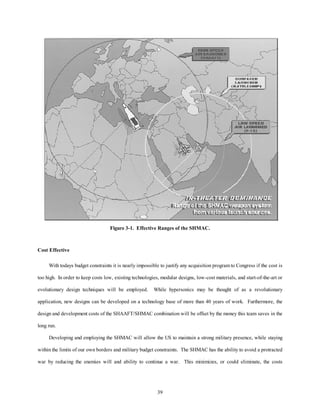
Range and Time to Target ................................................................................................................... 38 
Cost Effective...................................................................................................................................... 39 
Operational Simplicity........................................................................................................................ 40 
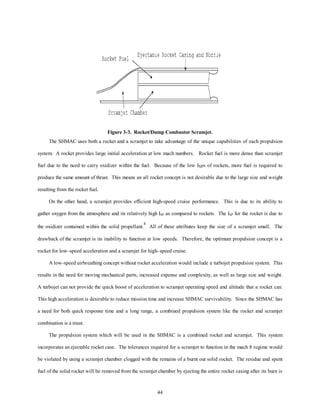
SHMAC Vehicle Concepts ....................................................................................................................... 41 
SHMAC Design .................................................................................................................................. 41 
Propulsion........................................................................................................................................... 43 
Guidance ............................................................................................................................................. 45 
iii
Chapter............................................................................................................................................................... Page 
Modular Weapons Bay........................................................................................................................ 46 
Special Considerations ....................................................................................................................... 46 
Mission ..................................................................................................................................................... 47 
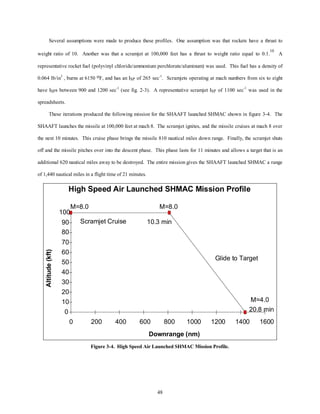
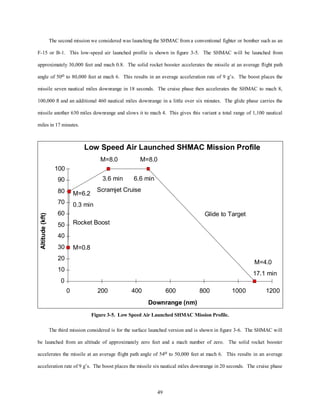
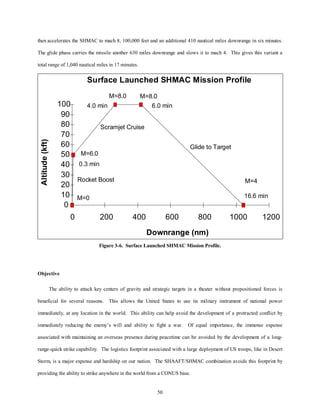
Flight Profiles ..................................................................................................................................... 47 
Objective............................................................................................................................................. 50 
Component Summary................................................................................................................................. 53 
4 Space Control with a Reusable Military Aircraft (SCREMAR) ..................................................................... 55 
System Overview................................................................................................................................ 55 
The Need for Access to Space ............................................................................................................ 56 
General Mission Requirements................................................................................................................. 59 
Payload ............................................................................................................................................... 59 
Sizing .................................................................................................................................................. 60 
Staging................................................................................................................................................. 61 
Operational Efficiency ........................................................................................................................ 63 
Development ....................................................................................................................................... 64 
Infrastructure ....................................................................................................................................... 64 
Special Considerations ....................................................................................................................... 66 
Missions.................................................................................................................................................... 68 
Deployment/Retrieval of Satellites ..................................................................................................... 70 
Repair of Damaged Satellites.............................................................................................................. 70 
Antisatellite Warfare........................................................................................................................... 71 
Additional Possibilities ...................................................................................................................... 71 
Operations........................................................................................................................................... 72 
SCREMAR Vehicle Concepts................................................................................................................... 74 
Component Summary................................................................................................................................. 76 
5 Critical Technology Requirements.................................................................................................................. 79 
Cruise Phase Velocity Study: The Driving Force............................................................................... 79 
Thermal Protection Systems................................................................................................................ 83 
Conclusion ................................................................................................................................................ 85 
Bibliography ................................................................................................................................................................. 87 
iv
Illustrations 
Figure Page 
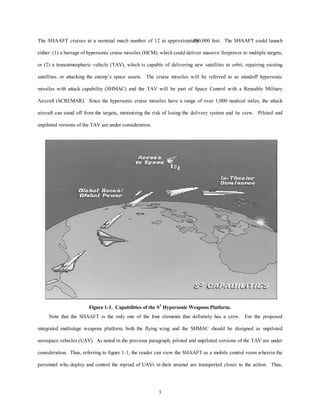
1-1. Capabilities of the S3 Hypersonic Weapons Platform....................................................................................... 3 
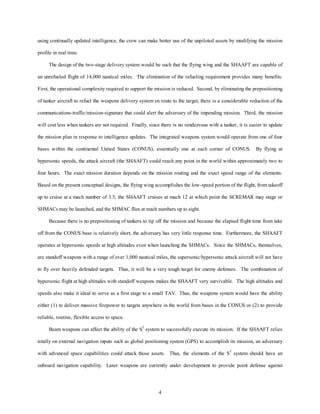
1-2. Standoff Capabilities of SHAAFT/SHMAC..................................................................................................... 8 
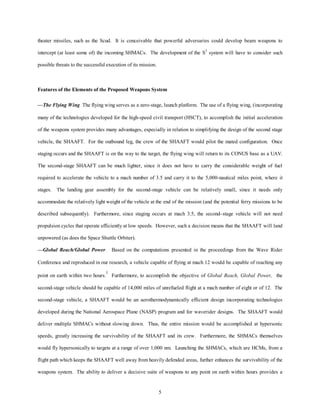
1-3. Aerospace Roles and Missions Fulfilled by S3............................................................................................... 12 
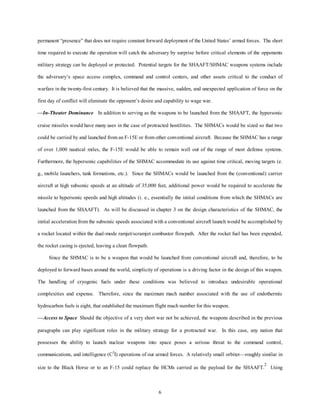
1-4. Schematic of Mated S3 Platform (with SCREMAR)....................................................................................... 13 
2-1. Zero-Stage Flying Wing.................................................................................................................................. 21 
2-2. Conically Derived Waverider. ....................................................................................................................... 23 
2-3. Specific Impulse Variation. ............................................................................................................................ 24 
2-4. L/D Barrier for Waveriders............................................................................................................................ 26 
2-5. Supersonic/Hypersonic Attack Aircraft (SHAAFT)....................................................................................... 27 
2-6. SHAAFT Sizing.............................................................................................................................................. 28 
3-1. Effective Ranges of the SHMAC. ................................................................................................................... 39 
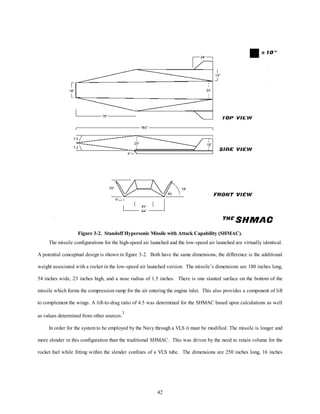
3-2. Standoff Hypersonic Missile with Attack Capability (SHMAC).................................................................... 42 
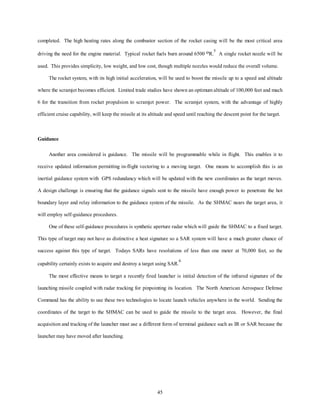
3-3. Rocket/Dump Combustor Scramjet................................................................................................................. 44 
3-4. High Speed Air Launched SHMAC Mission Profile. ..................................................................................... 48 
3-5. Low Speed Air Launched SHMAC Mission Profile....................................................................................... 49 
3-6. Surface Launched SHMAC Mission Profile. .................................................................................................. 50 
4-1. SCREMAR Performing Various On-Orbit Operations. .................................................................................. 69 
4-2. Space Control with a Reusable Military Aircraft (SCREMAR)..................................................................... 75 
v
Tables 
Table Page 
1 Density Values of Slush Hydrogen (All Values at Triple Point)..................................................................... 25 
2 Parameters Considered for the Supersonic/Hypersonic Attack Aircraft (SHAAFT) at Mach 8 Flight ........... 81 
3 Parameters Considered for the Supersonic/Hypersonic Attack Aircraft (SHAAFT) at Mach 12 Flight ......... 82 
vi
Preface 
In the Spring of 1995, Col Richard Szafranski (Air University, Maxwell Air Force Base) invited personnel from 
the US Air Force Academy to take part in the study: “2025.” Col Randy J. Stiles, who was acting chairman of the 
Department of Aeronautics (DFAN), suggested that a section of the senior design course be dedicated to the support of 
that study. Their role was instrumental to the birth of this project. 
This study was accomplished by the cadets of a Senior Design Class (AE481Z and AE 482ZS) at the USAF 
Academy during the Academic Year 1995–1996. The authors of this report received numerous briefings from leaders 
of the aerospace community. Those who briefed the class at various times during the Academic Year 1995-1996 
vii 
include: 
John Bode, Sandia National Laboratories, Albuquerque, N.Mex 87185 
Ramon Chase, principal, ANSER Corporation, Arlington, Va 22202 
Chuck Eldred, head, Vehicle Analysis Branch, Langley Research Center, Hampton, Va 23681-0001 
Col Jae Engelbrecht, professor, National Security Studies, Air University, Maxwell Air Force Base, Ala 
36112 
Harry Hillaker, Consultant (Member of USAF Scientific Advisory Board), Fort Worth, Tex 76116 
Dr Jim Horkovich, senior engineer, Science Applications International Corporation (SAIC), Albuquerque, 
N.Mex 87106 
Dr Hans Mark, professor, the University of Texas at Austin, Austin, Tex 78712 
Lt Col Rich Moore, HyTech Program Office/WL, Wright-Patterson Air Force Base, Ohio 45433 
Don Rondeau, Sandia National Laboratories, Albuquerque, N.Mex 87185 
Maj Bert Schneider, Wright Laboratory, Eglin Air Force Base, Fla 32543 
Don Stava, Flight Dynamics Directorate/WL, Wright-Patterson Air Force Base, Ohio 45433 
Dr Jim Trolier, technical director, Science Applications International Corporation (SAIC), Wayne, Pa 
19087 
In January 1996, the cadets traveled to the Wright Laboratory where they shared their ideas with and received 
briefings from: Val Dahlem, Peter Gord, Harry Karasopoulos, Don Stava, and Don Stull. They also received tours of 
the relevant research facilities at the Wright Laboratory. This exchange of information provided midcourse guidance 
to the project. 
In April 1996, Dale Gay, Ron Kay, and Mary Dyster at the US Air Force Academy provided substantial 
graphical support that had a significant impact on the quality of the final product.
The authors would like to express their gratitude for all who gave of their time and of their talent to share their 
expertise. The visions they shared and the challenges they offered made significant contributions to the education of 
the cadet authors. The cadet authors and Dr Bertin thank you. 
viii
Executive Summary 
Place yourself into the future, into the world of 2025. Where will our nation be and what adversaries will we 
face? Possibilities include a resurgent Russia, a hostile China, or possibly a hostile Korea or Iraq. What capabilities 
will opposing nations have to our military? One thing is for certain, all of these possible adversaries will have access 
to high technology weapons. What capabilities will we need to counter these potential adversaries? 
To counter these problems, we have identified three broad missions that the United States (US) military must 
accomplish in 2025. First, we must have the ability to deliver accurate lethal blows before or at the onset of 
hostilities. Second, we must be able to sustain our fighting potential without a large support infrastructure and 
logistical footprint. Third, we must be able to provide a routine, reliable, and flexible access-to-space capability. 
Based upon these three missions, we feel that our best option is the use of hypersonics. 
Proposed is an integrated weapons platform approach, the S3 concept, which would accomplish these 
objectives. It involves three separate, but integrated, vehicles. These include the SHAAFT (supersonic/hypersonic 
attack aircraft), the SHMAC (standoff hypersonic missile with attack capabilities), and the SCREMAR (space control 
with a reusable military aircraft). SHAAFT, SHMAC, SCREMAR (S3) can accomplish the broad roles of Global 
Reach/Global Power, in-theater dominance, and access to space. 
The SHAAFT is a dual stage hypersonic aircraft that fulfills future requirements for Global Reach/Global 
Power. It is a mach 12 hypersonic aircraft that uses a “zero-stage” flying wing to stage at mach 3.5. It is designed for 
compatible use with a hypersonic missile, the SHMAC, and a transatmospheric (TAV) orbiter, the SCREMAR. These 
two components combine with the SHAAFT to form the S3 concept and allow for the fulfillment of the in-theater 
dominance and access to space mission requirements, respectively. 
The initial goal of this study was to investigate Air Force missions that are best accomplished by hypersonic 
vehicles and the technology required to support them. The identification of the three broad missions to be 
accomplished by military forces in the year 2025 led to the need for a hypersonic weapons platform. The diversity of 
these missions yielded a need for different platforms with different capabilities. However, with current military 
budget cuts and drawdowns, development of three different weapons systems is impractical. Instead, we opted for a 
ix
fresh approach based on previous studies and our own research that integrated the necessary features for 
accomplishment of these missions. The result was the S3 concept: a highly survivable, lethal integrated hypersonic 
weapons platform that allows the US to accomplish a diverse set of missions and is capable of deterring and/or 
x 
punishing adversaries anywhere in the world.
Chapter 1 
Overview of Proposed Integrated Weapons System 
The clairvoyant who in 1996 gazes into a crystal ball with the intent of predicting the world of 2025 indeed faces 
daunting challenges. The economic, political, and military environment of the world is changing rapidly. Apparently, 
gone are the continued stress and tension associated with the confrontation between two superpowers. Gone also is 
the stability that resulted because the two superpowers developed alliances in which most of the other nation states of 
the world took a subservient role. Military strategists from one alliance could focus on a single adversary (or a single 
alliance of adversaries). Although regional military conflicts occurred, there was an absence of global conflict, since 
both of the superpowers recognized the substantial risks of MAD (mutually assured destruction). 
Some vestiges of the cold war remain today (e. g., traditional alliances, such as the NATO alliance, continue to 
exist, albeit aiming for a membership expanded to include former adversaries). However, in addition to the 
traditional alliances, ad hoc alliances are developed in real time in response to regional conflicts, such as Operation 
Desert Storm, and to “internal” conflicts, such as the conflict in the Balkans. Rogue nations, no longer constrained by 
dependence on a superpower’s military aid or financial aid, follow confrontational policies which threaten the peace 
and security, both of a region and of the world. Whether it is the desire of Iraq to dominate a region of the world or 
the desire of North Korea to develop nuclear weapons, these rogue nations are less likely to consider the downside of 
1 
aggressive actions, before initiating hostilities. 
While the level of economic and of political constraint diminishes, the potential for destruction grows. The 
military strategist of the twenty-first century can expect that most adversaries—whether a relatively traditional 
alliance of nation states, a rogue nation using military hostilities as a tool of national policy, or an ethnic army from a 
fragmented country—will have weapons of considerable destructive power, speed, and range. Many countries have
nuclear weapons and other weapons of mass destruction (WMD). Theater missiles and high performance aircraft 
armed with sophisticated missile systems are available to all the countries of the world. 
Thus, no matter what model one postulates to describe the world of 2025, it is very likely that the air and space 
forces of the United States (US) will have (at least) three broad roles in any conflict in 2025. They include 
(1) Deliver decisive blows at the outset of hostilities, with the goal of destroying the adversary’s desire to 
fight a protracted war. 
(2) Deliver cost-effective weapons to defeat time-critical targets and to establish in-theater dominance, if a 
protracted war cannot be avoided. 
(3) Maintain flexible, readily accomplished access to space. (As will be noted subsequently, the access-to- 
space missions will also be conducted during peacetime to develop operational procedures should the 
transition to the pace of wartime operations be necessary.) 
This paper proposes an integrated multistage weapon system, which is capable of performing a variety of 
missions, both strategic and tactical. The design of this weapon system would be based on technologies developed 
during a variety of previous and of existing programs. Furthermore, the design process would include consideration of 
mission planning activities, base operational support requirements, etc. 
In addition to the three broad roles described above, the air and space forces of the United States of the twenty-first 
century will have many other tasks to perform, including: counter air, close air support, and air lift (including 
humanitarian relief). However, these missions are best accomplished by other air force assets, such as the F-15, the 
F-16, the C-17, or their twenty-first century replacements. The proposed weapons platform is designed to be a 
deterrent, used at the onset of hostilities to stop the war before it begins. In short, the SHAAFT, SHMAC, SCREMAR 
(S3) hypersonic weapons platform can deliver lethal blows quickly and without a large support infrastructure, is 
survivable with both the vehicle and the crew returning safely to their base in continental United States, and can 
provide routine, sustained access to space for a variety of scenarios. 
2 
Characterization of the Proposed Weapons System 
The proposed weapon system is an integrated multistage system, which can perform all three roles defined 
previously, as indicated in figure 1-1. A two-stage configuration serves as the delivery system. The weapons 
delivery system includes (1) an unpiloted flying wing, which is used to accelerate the weapons system from the 
runway to a flight condition of mach 3.5 at approximately 60,000 feet and (2) a piloted, aerodynamically efficient, 
attack aircraft capable of sustained hypersonic flight, known as the supersonic/hypersonic attack aircraft (SHAAFT).
The SHAAFT cruises at a nominal mach number of 12 at approximate1l0y0 ,000 feet. The SHAAFT could launch 
either: (1) a barrage of hypersonic cruise missiles (HCM), which could deliver massive firepower to multiple targets, 
or (2) a transatmospheric vehicle (TAV), which is capable of delivering new satellites to orbit, repairing existing 
satellites, or attacking the enemy’s space assets. The cruise missiles will be referred to as standoff hypersonic 
missiles with attack capability (SHMAC) and the TAV will be part of Space Control with a Reusable Military 
Aircraft (SCREMAR). Since the hypersonic cruise missiles have a range of over 1,000 nautical miles, the attack 
aircraft can stand off from the targets, minimizing the risk of losing the delivery system and its crew. Piloted and 
3 
unpiloted versions of the TAV are under consideration. 
Figure 1-1. Capabilities of the S3 Hypersonic Weapons Platform. 
Note that the SHAAFT is the only one of the four elements that definitely has a crew. For the proposed 
integrated multistage weapons platform, both the flying wing and the SHMAC should be designed as unpiloted 
aerospace vehicles (UAV). As noted in the previous paragraph, piloted and unpiloted versions of the TAV are under 
consideration. Thus, referring to figure 1-1, the reader can view the SHAAFT as a mobile control room wherein the 
personnel who deploy and control the myriad of UAVs in their arsenal are transported closer to the action. Thus,
using continually updated intelligence, the crew can make better use of the unpiloted assets by modifying the mission 
4 
profile in real time. 
The design of the two-stage delivery system would be such that the flying wing and the SHAAFT are capable of 
an unrefueled flight of 14,000 nautical miles. The elimination of the refueling requirement provides many benefits. 
First, the operational complexity required to support the mission is reduced. Second, by eliminating the prepositioning 
of tanker aircraft to refuel the weapons delivery system en route to the target, there is a considerable reduction of the 
communications-traffic/mission-signature that could alert the adversary of the impending mission. Third, the mission 
will cost less when tankers are not required. Finally, since there is no rendezvous with a tanker, it is easier to update 
the mission plan in response to intelligence updates. The integrated weapons system would operate from one of four 
bases within the continental United States (CONUS), essentially one at each corner of CONUS. By flying at 
hypersonic speeds, the attack aircraft (the SHAAFT) could reach any point in the world within approximately two to 
four hours. The exact mission duration depends on the mission routing and the exact speed range of the elements. 
Based on the present conceptual designs, the flying wing accomplishes the low-speed portion of the flight, from takeoff 
up to cruise at a mach number of 3.5, the SHAAFT cruises at mach 12 at which point the SCREMAR may stage or 
SHMACs may be launched, and the SHMAC flies at mach numbers up to eight. 
Because there is no prepositioning of tankers to tip off the mission and because the elapsed flight time from take 
off from the CONUS base is relatively short, the adversary has very little response time. Furthermore, the SHAAFT 
operates at hypersonic speeds at high altitudes even when launching the SHMACs. Since the SHMACs, themselves, 
are standoff weapons with a range of over 1,000 nautical miles, the supersonic/hypersonic attack aircraft will not have 
to fly over heavily defended targets. Thus, it will be a very tough target for enemy defenses. The combination of 
hypersonic flight at high altitudes with standoff weapons makes the SHAAFT very survivable. The high altitudes and 
speeds also make it ideal to serve as a first stage to a small TAV. Thus, the weapons system would have the ability 
either (1) to deliver massive firepower to targets anywhere in the world from bases in the CONUS or (2) to provide 
reliable, routine, flexible access to space. 
Beam weapons can affect the ability of the S3 system to successfully execute its mission. If the SHAAFT relies 
totally on external navigation inputs such as global positioning system (GPS) to accomplish its mission, an adversary 
with advanced space capabilities could attack those assets. Thus, the elements of the S3 system should have an 
onboard navigation capability. Laser weapons are currently under development to provide point defense against
theater missiles, such as the Scud. It is conceivable that powerful adversaries could develop beam weapons to 
intercept (at least some of) the incoming SHMACs. The development of the S3 system will have to consider such 
5 
possible threats to the successful execution of its mission. 
Features of the Elements of the Proposed Weapons System 
—The Flying Wing The flying wing serves as a zero-stage, launch platform. The use of a flying wing, (incorporating 
many of the technologies developed for the high-speed civil transport (HSCT), to accomplish the initial acceleration 
of the weapons system provides many advantages, especially in relation to simplifying the design of the second stage 
vehicle, the SHAAFT. For the outbound leg, the crew of the SHAAFT would pilot the mated configuration. Once 
staging occurs and the SHAAFT is on the way to the target, the flying wing will return to its CONUS base as a UAV. 
The second-stage SHAAFT can be much lighter, since it does not have to carry the considerable weight of fuel 
required to accelerate the vehicle to a mach number of 3.5 and carry it to the 5,000-nautical miles point, where it 
stages. The landing gear assembly for the second-stage vehicle can be relatively small, since it needs only 
accommodate the relatively light weight of the vehicle at the end of the mission (and the potential ferry missions to be 
described subsequently). Furthermore, since staging occurs at mach 3.5, the second–stage vehicle will not need 
propulsion cycles that operate efficiently at low speeds. However, such a decision means that the SHAAFT will land 
unpowered (as does the Space Shuttle Orbiter). 
—Global Reach/Global Power Based on the computations presented in the proceedings from the Wave Rider 
Conference and reproduced in our research, a vehicle capable of flying at mach 12 would be capable of reaching any 
point on earth within two hours.1 Furthermore, to accomplish the objective of Global Reach, Global Power, the 
second-stage vehicle should be capable of 14,000 miles of unrefueled flight at a mach number of eight or of 12. The 
second-stage vehicle, a SHAAFT would be an aerothermodynamically efficient design incorporating technologies 
developed during the National Aerospace Plane (NASP) program and for waverider designs. The SHAAFT would 
deliver multiple SHMACs without slowing down. Thus, the entire mission would be accomplished at hypersonic 
speeds, greatly increasing the survivability of the SHAAFT and its crew. Furthermore, the SHMACs themselves 
would fly hypersonically to targets at a range of over 1,000 nm. Launching the SHMACs, which are HCMs, from a 
flight path which keeps the SHAAFT well away from heavily defended areas, further enhances the survivability of the 
weapons system. The ability to deliver a decisive suite of weapons to any point on earth within hours provides a
permanent “presence” that does not require constant forward deployment of the United States’ armed forces. The short 
time required to execute the operation will catch the adversary by surprise before critical elements of the opponents 
military strategy can be deployed or protected. Potential targets for the SHAAFT/SHMAC weapons systems include 
the adversary’s space access complex, command and control centers, and other assets critical to the conduct of 
warfare in the twenty-first century. It is believed that the massive, sudden, and unexpected application of force on the 
first day of conflict will eliminate the opponent’s desire and capability to wage war. 
—In-Theater Dominance In addition to serving as the weapons to be launched from the SHAAFT, the hypersonic 
cruise missiles would have many uses in the case of protracted hostilities. The SHMACs would be sized so that two 
could be carried by and launched from an F-15E or from other conventional aircraft. Because the SHMAC has a range 
of over 1,000 nautical miles, the F-15E would be able to remain well out of the range of most defense systems. 
Furthermore, the hypersonic capabilities of the SHMAC accommodate its use against time critical, moving targets (e. 
g., mobile launchers, tank formations, etc.). Since the SHMACs would be launched from the (conventional) carrier 
aircraft at high subsonic speeds at an altitude of 35,000 feet, additional power would be required to accelerate the 
missile to hypersonic speeds and high altitudes (i. e., essentially the initial conditions from which the SHMACs are 
launched from the SHAAFT). As will be discussed in chapter 3 on the design characteristics of the SHMAC, the 
initial acceleration from the subsonic speeds associated with a conventional aircraft launch would be accomplished by 
a rocket located within the dual-mode ramjet/scramjet combustor flowpath. After the rocket fuel has been expended, 
6 
the rocket casing is ejected, leaving a clean flowpath. 
Since the SHMAC is to be a weapon that would be launched from conventional aircraft and, therefore, to be 
deployed to forward bases around the world, simplicity of operations is a driving factor in the design of this weapon. 
The handling of cryogenic fuels under these conditions was believed to introduce undesirable operational 
complexities and expense. Therefore, since the maximum mach number associated with the use of endothermic 
hydrocarbon fuels is eight, that established the maximum flight mach number for this weapon. 
—Access to Space Should the objective of a very short war not be achieved, the weapons described in the previous 
paragraphs can play significant roles in the military strategy for a protracted war. In this case, any nation that 
possesses the ability to launch nuclear weapons into space poses a serious threat to the command control, 
communications, and intelligence (C3I) operations of our armed forces. A relatively small orbiter—roughly similar in 
size to the Black Horse or to an F-15 could replace the HCMs carried as the payload for the SHAAFT.2 Using
multistage concepts similar to the Beta3 or the Saenger,4 the flying wing and the SHAAFT would deliver the orbiter to 
efficient initial conditions for its “Access-to-Space” mission. The multiple-stage system would provide flexible 
access to space from conventional military runways, which would be a most valuable characteristic in the event that 
the adversary had destroyed the facilities at Cape Canaveral and at Vandenberg. Using rocket propulsion and 
aerodynamic forces to achieve the desired orbits, the SCREMAR would be able to place as many as three to four 
satellites (nominally six feet by six feet by six feet and weighing 1,000 pounds) into low earth orbit (LEO). The same 
TAV could also be configured to repair satellites on-orbit as well as perform sophisticated antisatellite (ASAT) 
7 
missions. 
Utilization of the Proposed Weapons System 
The proposed integrated multistage weapons system is capable of performing a variety of missions, both 
strategic and tactical. Consider the scenario where an adversary threatens to invade (the threat may include nuclear 
blackmail) or has just invaded a neighbor state. Based on recent headlines, the adversary in this scenario could be 
Iraq or North Korea. Future headlines might include China or a resurgent Russia. Despite negotiations at the highest 
levels, the adversary shows no signs of backing down or retreating from the occupied territory. Plans are made for a 
mission that would strike at the key war-fighting infrastructure of the adversary. The targets include the command, 
control, communications, computer center(s), the space launch facilities, critical supply depots, massed formations of 
enemy tanks, etc. An ultimatum from the president of the United States suggests that, if the enemy does not act 
responsibly, massive force will be applied, suddenly and without further warning. Authority is given to plan a 
mission that would seriously damage the adversary’s ability and will to fight.
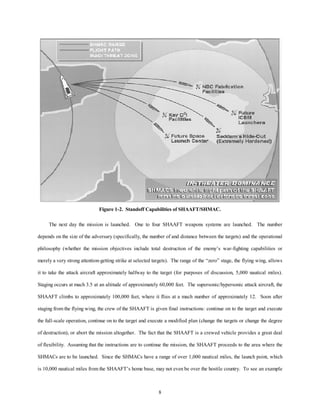
Figure 1-2. Standoff Capabilities of SHAAFT/SHMAC. 
The next day the mission is launched. One to four SHAAFT weapons systems are launched. The number 
depends on the size of the adversary (specifically, the number of and distance between the targets) and the operational 
philosophy (whether the mission objectives include total destruction of the enemy’s war-fighting capabilities or 
merely a very strong attention-getting strike at selected targets). The range of the “zero” stage, the flying wing, allows 
it to take the attack aircraft approximately halfway to the target (for purposes of discussion, 5,000 nautical miles). 
Staging occurs at mach 3.5 at an altitude of approximately 60,000 feet. The supersonic/hypersonic attack aircraft, the 
SHAAFT climbs to approximately 100,000 feet, where it flies at a mach number of approximately 12. Soon after 
staging from the flying wing, the crew of the SHAAFT is given final instructions: continue on to the target and execute 
the full-scale operation, continue on to the target and execute a modified plan (change the targets or change the degree 
of destruction), or abort the mission altogether. The fact that the SHAAFT is a crewed vehicle provides a great deal 
of flexibility. Assuming that the instructions are to continue the mission, the SHAAFT proceeds to the area where the 
SHMACs are to be launched. Since the SHMACs have a range of over 1,000 nautical miles, the launch point, which 
is 10,000 nautical miles from the SHAAFT’s home base, may not even be over the hostile country. To see an example 
8
of the standoff capability of the SHAAFT/SHMAC weapon system, refer to figure 1-2. Without slowing down, the 
SHAAFT launches a barrage of SHMACs from a point well out the enemy’s threat zone. Since the SHAAFT does not 
slow from its cruise mach number of 12, the SHMACs will decelerate to their design cruise mach number of eight. 
The SHMACs themselves may strike the target or they may deploy submunitions, which further prioritize and diversify 
the targeting philosophy. The suite of weapons may be nuclear, conventional, or ray devices. 
Having delivered massive firepower to the targets, the next consideration is the safe recovery of the SHAAFT. 
The optimum scenario would have the SHAAFT return to its CONUS base. However, if there is not sufficient fuel to 
reach the CONUS, the SHAAFT would proceed to an alternate, preselected recovery base. Depending on the mission, 
Hawaii or Diego Garcia seem natural selections for the non-CONUS recovery base. The recovery base will be within 
the 14,000 nm overall mission capability of the flying wing/SHAAFT. Once it releases the SHAAFT, the flying wing 
would proceed directly to Hawaii or Diego Garcia, where it would await the SHAAFT to complete its mission. 
Procedures by which the SHAAFT returns safely to its CONUS base from other recovery bases, such as Diego 
Garcia, will be evaluated through further study. One possibility is sending a flying wing to retrieve the SHAAFT. 
The mated configuration would be flown home using the engines of the “zero” stage, the flying wing, and fuel added at 
the recovery base. Fuel and supplies would be brought to this base so that the SHAAFT could be serviced for its 
flight back to its home base in the CONUS. Because the technology base for the flying wing is that of the HSCT, the 
logistics infrastructure at the alternate recovery bases is relatively conventional. 
Considerable savings can be realized through the elimination of the constant forward deployment of the more 
conventional forces to provide a “presence” of US armed forces. For those regions of the world where our forces do 
not have a permanent physical presence, the deployment of forces for a regional conflict is a very expensive and time-consuming 
project. Recall that Desert Shield took longer than Desert Storm. Furthermore, it is not likely that a future 
adversary will leave in place a near-by base infrastructure and then allow us the luxury of several months to build up 
our forces in the region. The savings described in the previous sentences could pay for most, if not all, of the design 
and of the development costs for the proposed, integrated hypersonic weapons system. The total fleet would consist of 
(approximately) five vehicles, deployed from four bases in the CONUS, two on each coast. By having an integrated 
weapons system strategy, the cost of the technology programs required to design and to develop the system would be 
greatly reduced. Furthermore, technology programs relevant to the various elements of this integrated weapons system 
9
(the flying wing, the supersonic/hypersonic attack aircraft, space control with a reusable military aircraft, and the 
standoff hypersonic missile with attack capability) have been in various stages of development for more than a decade. 
Consider next the application, where the weapons delivery system (the flying wing and the SHAAFT) would 
serve as the first stage of a multi-stage access-to-space system. A transatmospheric vehicle would replace the 
SHMACs as the payload carried by the weapons delivery system. In a mission concept similar to that of the Beta 
System5 or to that of the Saenger,6 the two elements of the first stage would carry the TAV/orbiter to its launch point. 
Although the exact conditions for launch of the TAV/orbiter would be the subject of design trade studies, obtaining a 
high speed for staging appears to be more important that obtaining a high altitude.7 Preliminary calculations indicate 
that the orbiter would be lighter or the payload would be greater, if staging occurred at mach 12. Since the proposed 
system is to be an integrated, multipurpose weapons system, the results of the staging trade studies will influence 
decisions relating to the maximum velocity capabilities of the SHAAFT (in addition to the constraints placed on the 
SHAAFT as a result of its mission as the delivery system for the SHMACs). 
It is assumed that the armed forces of the United States will have a constellation of satellites (on the order of 
hundreds) in place at the outbreak of hostilities. Using a variety of launch vehicles, these satellites (some large, others 
small) will have been placed in space over the years, as part of an evolving, strategic military strategy. However, at 
the outbreak of hostilities, the military leaders identify the need for additional satellites (perhaps to fill a gap in 
coverage, to provide additional information using special sensors, etc.) or the need to repair existing satellites. The 
situation becomes more critical if our adversary has disabled and/or destroyed a considerable fraction of our 
satellites. The armed forces of the United States have become very dependent on military/commercial satellites for 
communication and reconnaissance and are becoming increasingly dependent on other systems, such as GPS and 
Milstar. The elimination of a significant fraction of these assets by an enemy would paralyze our C3I . Rapid 
replenishment of lost assets is critical to the successful execution of our military operations. The flying-wing/ 
SHAAFT combinations take the TAV/orbiter to mach numbers near 12 at 100,000 feet, where it stages. The 
TAV is a rocket-powered vehicle, approximately the size of an F-15, capable of carrying three or four small satellites 
(6 feet x 6 feet x 6 feet, weighing 1,000 pounds) into LEO. Thus, after a handful of missions, the country’s military 
leaders could have a minimum of a dozen new satellites in place within days of the outbreak of hostilities. These 
satellites would provide communication links, intelligence information, etc. 
10
It is envisioned that the flying-wing/SHAAFT/SCREMAR system would be routinely used during peacetime to 
place military satellites in space, to repair and to reposition existing military satellites, etc. This would be done to 
develop mission planning and operational experience, so that our armed forces could easily shift to the wartime pace 
of operations in the event that hostilities cannot be avoided. 
Furthermore, the TAV/orbiter of the SCREMAR could perform the ASAT role should our adversary also have 
significant space assets. Finally, once sufficient technology for the TAV/orbiter is developed, it could be modified to 
fulfill other missions: it could deliver weapons in a strategic attack on the enemy for a suborbital profile or serve as a 
space-based laser (SBL) or airborne laser (ABL) weapons platform. 
It is quite possible that, despite the severity of the strike described in previous paragraphs, the enemy will 
choose to continue to fight a war. One enemy may view the conflict as a Holy War and would consider early 
surrender unthinkable. Another enemy may have the resources (large population and widely scattered assets) to 
absorb such a blow and continue the fight. A third possible scenario would be the case where the United States was 
confronted with two Regional Conflicts and the strike described above would be used to eliminate one enemy, 
allowing us to focus on the other. In each case, our forces are involved in a protracted war. 
For the protracted war, the elements of the integrated weapons system could serve as significant elements of our 
arsenal. For instance, in addition to serving as the weapons to be launched from the SHAAFT, the hypersonic cruise 
missiles would have many uses in the case of protracted hostilities. The SHMACs would be sized so that two could 
be carried by and launched from an F-15E or some other conventional aircraft. Because the SHMAC has a range of 
over 1,000 nautical miles, the F-15E would be able to remain well out of the range of most defense systems. 
Furthermore, the hypersonic capabilities of the SHMAC accommodate its use against time critical, moving targets (e. 
11 
g., mobile launchers, tank formations, etc.).
)25&( 
$33/,&$7,21 
12 
$(5263$&( 
&21752/ 
&2817(563$&( 
&2817(5,1)2 
675$7(*,& 
$77$&. 
& 
$77$. 
,17(5',7,21 
)25( 
(1+$1(0(17 
$(5263$( 
5(3/(1,6+0(17 
63$(/,)7 
,1)250$7,21 
23(5$7,216 
)25( 
6833257 
2125%,7 
6833257 
/2*,67,6 
20%$76833257 
21752/	(;3/2,7$7,21 
2)$,5	63$( 
Roles 
Missions 
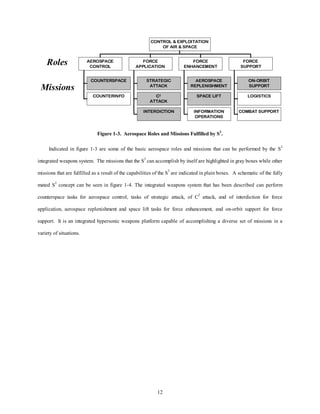
Figure 1-3. Aerospace Roles and Missions Fulfilled by S3. 
Indicated in figure 1-3 are some of the basic aerospace roles and missions that can be performed by the S3 
integrated weapons system. The missions that the S3 can accomplish by itself are highlighted in gray boxes while other 
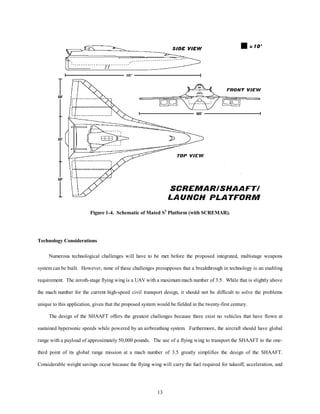
missions that are fulfilled as a result of the capabilities of the S3 are indicated in plain boxes. A schematic of the fully 
mated S3 concept can be seen in figure 1-4. The integrated weapons system that has been described can perform 
counterspace tasks for aerospace control, tasks of strategic attack, of C2 attack, and of interdiction for force 
application, aerospace replenishment and space lift tasks for force enhancement, and on-orbit support for force 
support. It is an integrated hypersonic weapons platform capable of accomplishing a diverse set of missions in a 
variety of situations.
Figure 1-4. Schematic of Mated S3 Platform (with SCREMAR). 
13 
Technology Considerations 
Numerous technological challenges will have to be met before the proposed integrated, multistage weapons 
system can be built. However, none of these challenges presupposes that a breakthrough in technology is an enabling 
requirement. The zeroth-stage flying wing is a UAV with a maximum mach number of 3.5. While that is slightly above 
the mach number for the current high-speed civil transport design, it should not be difficult to solve the problems 
unique to this application, given that the proposed system would be fielded in the twenty-first century. 
The design of the SHAAFT offers the greatest challenges because there exist no vehicles that have flown at 
sustained hypersonic speeds while powered by an airbreathing system. Furthermore, the aircraft should have global 
range with a payload of approximately 50,000 pounds. The use of a flying wing to transport the SHAAFT to the one-third 
point of its global range mission at a mach number of 3.5 greatly simplifies the design of the SHAAFT. 
Considerable weight savings occur because the flying wing will carry the fuel required for takeoff, acceleration, and
flight to the one-third point. The SHAAFT won’t need heavy landing gear to support the takeoff weight. Furthermore, 
it does not need a zero-speed or a low-speed propulsion system. It appears that a dual-mode ramjet/scramjet 
combustor8 could be used to accelerate the vehicle from mach 3.5 to its cruise mach number of eight or of 12 and to 
sustain flight in this speed range. The decision as to whether to limit the vehicle design to mach 8 flight or to extend 
its capabilities to mach 12 flight is dominated by the propulsion system. Assuming reasonable development of the 
technologies of hypersonic-airbreathing propulsion systems and their fuels, it is assumed that mach 8 is the upper limit 
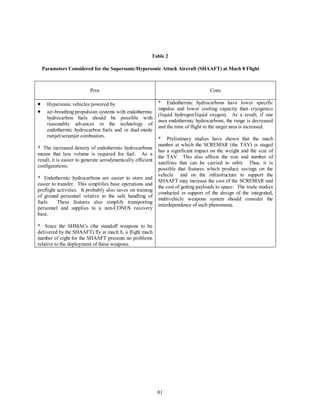
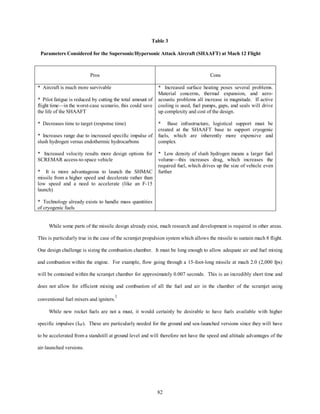
for the use of endothermic hydrocarbon fuels. One will need cryogenic fuels to extend the maximum cruise speed to 
mach 12. Some of the pros and cons of this problem are presented in the Critical Technology Requirements chapter, 
tables 5-1 and 5-2. Based on the survivability and on the range of the SHAAFT as a weapons platform for delivering 
SHMACs and as the initial stages for the SCREMAR, mach 12 flight would probably be preferred. Based on 
considerations relating to ground operations and support, especially if a recovery base is needed as an intermediate 
host, the endothermic fuels support a decision to limit the vehicle to a maximum mach number of eight. In any case, a 
serious trade study (including the effect on the design of the TAV/orbiter and its payload) should be conducted at the 
14 
outset of the SHAAFT program. 
An aerothermodynamically efficient vehicle having a hypersonic lift-to-drag ratio of five, or better, will be a 
long, slender body with relatively small leading-edge radii (the nose radius, the cowl radius, and the wing leading-edge 
radius). Thus, the heating rates in these regions will be relatively high. Controlling the vehicle weight will have 
a high priority. Therefore, the development of high-strength, lightweight materials and the ability to efficiently use 
them for the load-carrying structure and for the thermal protection system are high-priority items. Researchers at the 
National Aeronautics and Space Administration’s Ames Research Center (NASA) are developing advanced Diboride 
Ceramic Matrix Composites (CMC), including Zirconium Dibirode and Hafnium Diboride materials which are 
reportedly able to withstand repeated exposure to temperatures of 3660 degrees fahrenheit and of 4,130 degrees 
fahrenheit, respectively. Materials for thermal protection systems developed for Shuttle derivatives, for the NASP, 
for the X-33, and for the X-34 should be reviewed for use in the proposed weapons system. 
Major problems facing the aerothermodynamicist include the determination of boundary-layer transition criteria 
and the complex viscous/inviscid interaction associated with the multiple shock waves that occur, when the payloads 
(either the SHMACs or the SCREMAR) are released from the SHAAFT. The problem of developing boundary-layer 
transition criteria challenged the developers of the first reentry vehicles; it challenged the developers of the NASP;
and it will challenge the developers of the SHAAFT. In the end, most likely, a criteria will be selected (with a degree 
of conservatism appropriate to the acceptable risk) and the design will proceed. The problem of shock/shock 
interactions associated with two objects flying in close proximity at hypersonic should be solvable. Some work has 
15 
already been done, for on the staging of the Saenger.9 
The decision to limit the SHMAC to a maximum flight mach number of eight was straight forward. Since a 
variant of the SHMACs will be launched from conventional aircraft, such as the F-22 or the F-15E, simplicity of 
ground operations, of fuel handling, and of weapons loading at forward bases dictates against cryogenic fuels. By 
limiting the SHMAC to a maximum mach number of eight, hydrocarbon fuels can be used. Use of hydrocarbon fuels 
instead of cryogenics greatly simplifies in-theater logistics, ground-support operations, and training requirements for 
base personnel. However, the SHMAC design must accommodate the transient loads associated with the short-duration 
overspeed when being launched from the SHAAFT. 
Technology developments will be needed in the areas of guidance, navigation, and control (GNC) and sensors 
for both the SHAAFT and SHMAC. Large changes in weight and in weight distribution will occur during the flight of 
the SHAAFT. Control of an aircraft flying at hypersonic speeds over great ranges requires advances in the state of the 
art. Collection and interpretation of data (threats, targets, political considerations at the brink of war) and decisions 
as to how to react must be continuously incorporated into the mission plan. 
The design of the TAV/orbiter, a.k.a. the SCREMAR, should make use of the large 
number of access-to-space programs continuing around the world, including international programs, such as, the 
Japanese HOPE, as well as US programs, such as the X-33, the X-34, and the XCRV (currently under development at 
NASA). Since the SCREMAR is all rocket powered and operates in a similar manner as the Space Shuttle once 
separated from the SHAAFT, it should use as much of the current technology incorporated by the Space Shuttle as 
possible. 
The technology programs used to develop the SHAAFT can be transferred directly to the SHMAC and 
SCREMAR, and vice versa. This is another application of the term integrated weapons system. The development of 
the S3 concept as a single weapons platform with several similar and fully compatible vehicles will be much easier on 
the technology demands as well the development costs than attempting to fulfill the same roles with different weapons 
systems.
1 I. M. Blankson, J.D. Anderson, M. Lewis, and S. Corda, “Air Breathing Hypersonic Waveriders: A Survey of 
Research Needs,” Proceeding from the Wave Rider Conference, University of Maryland, 1993. 
2 R. M. Zubrin and M. B. Clapp, “An Examination of the Feasibility of Winged SSTO Vehicles Utilizing Aerial 
Propellant Transfer,” AIA 94-2923, 30th Joint AIAA/ASME/SAE/ASEE Joint Propulsion Conference, Indianapolis, 
Indiana, June 1994. 
3 P. R. Gord, K.J. Langan, and M.E. Stringer, “Advanced Launch Vehicle Configurations and Performance 
Trades,” Paper from AGARD Conference Proceedings No. 489, Space Vehicle Flight Mechanics. 
4 E. Hoegenauer and D. Koelle, “Saenger, the German Aerospace Vehicle Program,” AIA-89-5007, AIAA First 
National Aero-Space Plane Conference, Dayton, Ohio, July 1989. 
5 Gord, Langan, and Stringer. 
6 Hoegenauer and Koelle. 
7 G. Moore, private discussion, February 1996. 
8 E. T. Curran, W. H. Heiser, and D. T. Pratt, “Fluid Phenomena in Scramjet Combustion Systems, Annual 
16 
Review of Fluid Mechanics, 28, 1996, 323–360. 
9 W. Schroeder, G. Hartmann, “Analysis of Inviscid and Viscous Hypersonic Flow past a Two-Stage 
Spacecraft,” Journal of Spacecraft and Rockets 30, no. 1 January–February.
Chapter 2 
Supersonic/Hypersonic Attack Aircraft 
(SHAAFT) 
The SHAAFT (Supersonic/Hypersonic Attack AircraFT) is an airborne weapons system designed for 
operational use in the year 2025. It is capable of putting munitions on target, anywhere in the world, within four hours 
after takeoff. It is a direct result of the defined mission requirements of Global Reach/Global Power and specifically, 
Global Force Projection. The SHAAFT can fight and win two major regional conflicts simultaneously. It also 
complies with the current force draw down in which the majority of all US military forces will be based in the 
continental United States (CONUS). Flight line operations would require cryogenic support for the fuel needs of 
SHAAFT. It cruises to and from the target at mach 12 and at 100,000 feet. It is a completely reusable vehicle, like 
most USAF aircraft. The SHAAFT will deploy various weapons to destroy nearly any type of essential enemy target, 
dependent on real-time battlefield information or existing intelligence data to destroy targets. The SHAAFT will also 
serve as the base component to accomplishing in-theater dominance with the SHMAC and access to space with the 
17 
SCREMAR. 
The goal of the SHAAFT is to cause enough destruction and chaos in the first hours of a conflict such that the 
enemy realizes war is a futile choice. The enemy is then crippled and nearly defenseless against subsequent attacks 
from conventional forces in a protracted war. It would also serve as an extremely effective deterrent force, since the 
enemy would know that any military movement could be utterly upset if not completely destroyed within a matter of 
hours from its discovery. But unlike conventional aircraft, the hypersonic flight regime makes SHAAFT a difficult, 
and therefore highly survivable, target. 
A hypothetical attack scheme consists of five SHAAFTs, dispensing nearly 50 hypersonic, precision strike, 
cruise missiles, for example, SHMACs. These would hit vital targets such as command, control, and communications
facilities (C3I network), power centers, transportation hubs, and potential space launch complexes. This attack alone 
would not cripple an advanced country's war machine, but it would severely disrupt their war-fighting operations to 
the point that they are no longer able to immediately continue any operations. Within hours of the initiation of 
hostilities, the enemy’s infrastructure would be in shambles with their ground forces unable to communicate, 
maneuver, or fight a coordinated battle. The hostiles would then be unable to defend themselves against conventional 
18 
military forces. 
In the event that an enemy is able to perform some form of ASAT warfare, the SHAAFT would also serve as a 
staging vehicle for the SCREMAR reusable access to space vehicle. The SHAAFT/SCREMAR combination could be 
used to repair and replace damaged satellites. The system would be used in peacetime for routine replacement and 
replenishment of satellites, which would also produce operational experience that could be adapted to a critical 
wartime situation. 
General Mission Requirements 
CONUS Basing 
The reasons for avoidance of overseas basing are extremely important. The SHAAFT, incorporating hypersonic 
technology, will be costly. Thus, few would ever be produced. This craft is essentially a golden bullet that will aid 
the United States (US) in deterring conflicts, or if that fails, to win a war, hopefully in a short period of time. 
Overseas basing provides the advantage of reduced range. But with shrinking defense budgets, such basing can 
no longer be relied upon. The security and stability of these foreign assets cannot be guaranteed in the year 2025. 
Basing the SHAAFT at large CONUS bases would enable a secure area in which to operate for years. Bases would 
be chosen such that infrastructure and geographic positioning could best support the hypersonic mission. 
Cost-Saving 
CONUS basing of the SHAAFT allows for security and stability in aircraft maintenance. But keeping the 
mission of global reach/global power restricted to one aircraft saves a great deal of money. That is, the logistics
usually required to maintain a fleet of attack aircraft are extensive and time-consuming, utilizing precious resources 
19 
that could be saved. 
The SHAAFT attempts to eliminate the swarms of tankers, airlifters, and support personnel that are normally 
required to sustain overseas operations. This aircraft takes off, deploys munitions, and returns, without refueling. 
Therefore, the SHAAFT saves money by reducing the logistics footprint required. It could save more money by 
stopping a war that would certainly cost billions. Had Desert Storm been prevented by a preemptive strike with well-placed 
munitions, the US could have saved many dollars in hardware and, more importantly, saved lives. 
Hypersonic Requirement 
The reasons that the SHAAFT must go hypersonic match the new face of warfare. It must make nearly 
instantaneous attacks while hiding under the cloak of survivability. If this attack aircraft travels at mach 12 and 
100,000 feet, it is improbable that 2025-era enemy technology would be able to overtake it. Considering the amount 
of time that it would take to detect, track, identify, and then launch an interceptor that must climb to 100,000 feet and 
then overtake the SHAAFT, the chances of losing the SHAAFT to an interceptor or surfaced launched missiles are 
next to impossible. 
The SHAAFT would launch SHMAC missiles hundreds of miles from the hostile airspace of the enemy. Such a 
standoff attack would provide several layers of defense to the SHAAFT. First, the cruising velocity and altitude are 
unmatched by any current aircraft. Also, it is improbable that future adversaries would have the research and 
technology base to attain this envelope, although not impossible. Second, the aircraft never passes over a threat area. 
Enemy forces would undoubtedly see the SHAAFT coming, but a counterattack would have to occur far from their 
home base. Combined with the speed of the SHAAFT, the enemy force now has to fly a long way to intercept. Third, 
hypersonic cruise missiles like the SHMAC increases the synergy of the attack. These three layers of defense provide 
extensive protection against enemy forces. 
The SHAAFT also serves as the staging vehicle for the SCREMAR. The achieve orbit, a transatmospheric 
vehicle (TAV), such as the SCREMAR, has to produce a large velocity change typically on the order of 25,000 feet 
per second for a LEO. The greater the velocity provided by the staging vehicle, the less the TAV/orbiter has to 
produce on its own, thus resulting in a smaller size or greater payload for the TAV. The overall effects of having the 
SHAAFT fly at different hypersonic speeds (i.e., mach 8 versus mach 12, are covered in greater detail in chapter 5.
20 
Range 
Because of CONUS basing, the SHAAFT would require a large range. Because of the unusual flight regime and 
cryogenic fuels, tanker aircraft would be of little support (unless an entirely new tanker fleet were developed, which, 
under current budgetary constraints, is not foreseeable). Depending on the enemy, the SHAAFT can attain a range of 
14,000 nautical miles. 
This large range requires a vehicle that is aerothermodynamically designed for a high lift-to-drag ratio. The 
range is directly related to the mach number—the faster the flight velocity, the farther the range. This range also 
includes the turning radius. At mach 12, the radius of a 2-g turn is 480 statute miles. The equivalent turn diameter 
equals about half the width of the US. Such a turn would take approximately 23 minutes, requiring long-term straining 
maneuvers of the pilot. 
Payloads 
Pay load concerns include both the weight and volume. The SHAAFT is designed to carry a payload of 50,000 
pounds. If the SHAAFT carries 10 cruise missiles at 4,000 pounds each, that leaves 10,000 pounds for pylons and 
supporting hardware on the aircraft. Furthermore, the SHAAFT is designed to carry an orbital vehicle. For instance, 
the SCREMAR, would be placed into low-earth orbit, requiring the volume of a light F-15. 
SHAAFT Vehicle Concepts 
The “Zero-Stage” Flying Wing 
Because the SHAAFT will be taking off from conventional runways and operating across such a huge airspeed 
spectrum, the design team will have numerous challenges to overcome. How will an aircraft configured to cruise at 
mach 12 take off from a runway and remain airborne at low speeds? These two speed regimes demand completely 
different wings, propulsion systems, and fuel systems. If the SHAAFT were to use turbofans for takeoff, then switch to 
ramjets, and then scramjets for hypersonic cruise, it would have to carry thousands of pounds of extra weight in the 
form of inert turbofan engines.
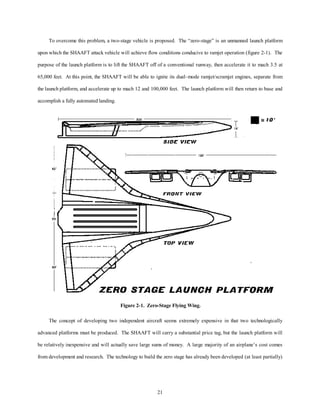
To overcome this problem, a two-stage vehicle is proposed. The “zero-stage” is an unmanned launch platform 
upon which the SHAAFT attack vehicle will achieve flow conditions conducive to ramjet operation (figure 2-1). The 
purpose of the launch platform is to lift the SHAAFT off of a conventional runway, then accelerate it to mach 3.5 at 
65,000 feet. At this point, the SHAAFT will be able to ignite its dual–mode ramjet/scramjet engines, separate from 
the launch platform, and accelerate up to mach 12 and 100,000 feet. The launch platform will then return to base and 
21 
accomplish a fully automated landing. 
Figure 2-1. Zero-Stage Flying Wing. 
The concept of developing two independent aircraft seems extremely expensive in that two technologically 
advanced platforms must be produced. The SHAAFT will carry a substantial price tag, but the launch platform will 
be relatively inexpensive and will actually save large sums of money. A large majority of an airplane’s cost comes 
from development and research. The technology to build the zero stage has already been developed (at least partially)
in such aircraft as the high-speed civil transport (HSCT) and operational aircraft such as the Concorde. In addition, 
its mission is so narrow and specific that it will not require complex systems and components. 
The zero stage will be required to accelerate down a long runway (no short field capability required), lift off 
without the use of complex lifting devices, accelerate straight ahead to mach 3.5, release the SHAAFT, and then return 
to base. It must carry enough fuel for a radius of 5,000 miles at the higher mach number. It will not perform any 
demanding maneuvers or be subject to aeromechanically exhaustive flight regimes. Because of these limited demands, 
the launch platform will not incur large development or production costs. Furthermore, it greatly simplifies the design 
of the cruiser and dramatically reduces its size requirements. 
Current design proposals consist of the following configuration, as studied by the National Aeronautics and 
Space Administration’s (NASA) Boeing HSCT Study in 1989.1 The proposed design is similar in platform to the 
HSCT, powered by six afterburning turbofans, each producing 50,000 pounds of thrust. A delta wing with a span of 
160 feet and an area of 6,370 square feet would be able to take off with a gross weight of 2,000,000 pounds at 290 
22 
mph and a lift coefficient of 1.5. 
It is essential that the SHAAFT be able to return to its home base or another SHAAFT-equipped recovery base. 
In order to do this, it will have to be able to land on a conventional runway. When it returns from a mission it will be 
much lighter than when it took off, having burned thousands of pounds of fuel. (The weight of the fuel is more than any 
other component on the aircraft, including structures and propulsion.) However, due to its aerodynamically configured 
shape, it will have to land extremely fast. It will need the assistance of a parachute braking system to slow down. 
Each SHAAFT would possess its own zero-stage vehicle, along with one extra for sustained operations through any 
contingency, in order to allow all five SHAAFTs to launch at once. 
SHAAFT Design 
Sizing and building the SHAAFT design will be the most difficult process. In this section, attempts to size the 
vehicle were made to fulfill mission requirements. The first step in deriving a platform involved the aerodynamic 
forces and how to use them to come up with a vehicle. The second step involved simple lift, drag, thrust, and weight 
trade studies to derive a generic design for the 14,000–mile journey to enemy territory and back. The third step 
verifies vehicle size using the Breguet range equation.
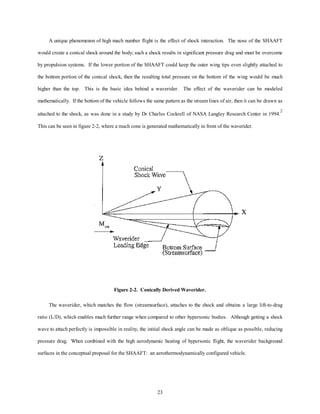
A unique phenomenon of high mach number flight is the effect of shock interaction. The nose of the SHAAFT 
would create a conical shock around the body; such a shock results in significant pressure drag and must be overcome 
by propulsion systems. If the lower portion of the SHAAFT could keep the outer wing tips even slightly attached to 
the bottom portion of the conical shock, then the resulting total pressure on the bottom of the wing would be much 
higher than the top. This is the basic idea behind a waverider. The effect of the waverider can be modeled 
mathematically. If the bottom of the vehicle follows the same pattern as the stream lines of air, then it can be drawn as 
attached to the shock, as was done in a study by Dr Charles Cockrell of NASA Langley Research Center in 1994.2 
This can be seen in figure 2-2, where a mach cone is generated mathematically in front of the waverider. 
Figure 2-2. Conically Derived Waverider. 
The waverider, which matches the flow (streamsurface), attaches to the shock and obtains a large lift-to-drag 
ratio (L/D), which enables much further range when compared to other hypersonic bodies. Although getting a shock 
wave to attach perfectly is impossible in reality, the initial shock angle can be made as oblique as possible, reducing 
pressure drag. When combined with the high aerodynamic heating of hypersonic flight, the waverider background 
surfaces in the conceptual proposal for the SHAAFT: an aerothermodynamically configured vehicle. 
23
Overcoming drag in excess of 358,000 pounds will be required by the power plant of the SHAAFT. A 10,000– 
mile flight at mach 12 lasts approximately 74 minutes (this range subtracts the range of the zero stage). This figure 
includes time from zero–stage separation to engine shut-down and glide-in (in which no fuel is spent), therefore, extra 
fuel will be available for emergency contingents. The 74-minute flight will require the most amount of thrust for the 
24 
least amount of fuel. 
For mach 12 flight, the large heating rates (which will be discussed later) cause dissociation of atomic oxygen. 
Typical, large-molecule hydrocarbon fuels— such as JP-4, JP-8, JP-12, gasoline, and other petroleum-based fuels— 
would suffer incomplete burning and poor efficiency under these conditions. The other fuel alternative is cryogenics 
such as liquid hydrogen, liquid methane, and others. Liquid hydrogen allows for the highest ISP; its light molecular 
weight and high energy combustion rate make it ideal for the mach 12 mission. 
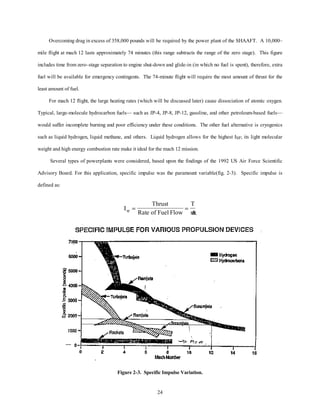
Several types of powerplants were considered, based upon the findings of the 1992 US Air Force Scientific 
Advisory Board. For this application, specific impulse was the paramount variable(fig. 2-3). Specific impulse is 
defined as: 
I 
Thrust 
Rate of Fu 
T 
sp m = = 
el Flow  
Figure 2-3. Specific Impulse Variation.
Two alternatives exist for SHAAFT propulsion: rockets and dual-mode ramjet/scramjets. Rockets have 
excellent acceleration characteristics but poor cruising characteristics. Because rockets have such poor specific 
impulse, requiring their own oxidizers, ramjet/scramjets are the best alternative. Their air breathing technology, 
combined with hydrogen fuel, allows for the most “bang for your buck”. As seen in figure 2-3, the ISP of such a 
combination lies between 1,400 second and 1,800 second. Since this aircraft would become operational around the 
year 2020, an ISP of 1,700 second will be assumed for the design point. 
The negative consequence to hydrogen fuel is the extremely large volume it occupies which will cause the 
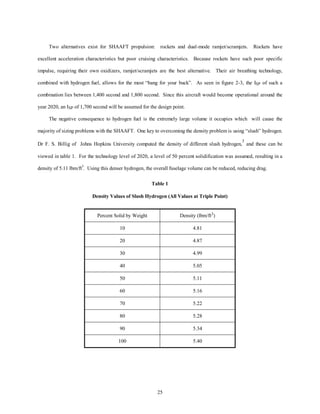
majority of sizing problems with the SHAAFT. One key to overcoming the density problem is using “slush” hydrogen. 
Dr F. S. Billig of Johns Hopkins University computed the density of different slush hydrogen,3 and these can be 
viewed in table 1. For the technology level of 2020, a level of 50 percent solidification was assumed, resulting in a 
density of 5.11 lbm/ft3. Using this denser hydrogen, the overall fuselage volume can be reduced, reducing drag. 
Table 1 
Density Values of Slush Hydrogen (All Values at Triple Point) 
Percent Solid by Weight Density (lbm/ft3) 
10 4.81 
20 4.87 
30 4.99 
40 5.05 
50 5.11 
60 5.16 
70 5.22 
80 5.28 
90 5.34 
100 5.40 
25
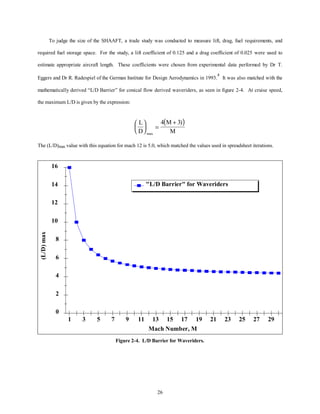
To judge the size of the SHAAFT, a trade study was conducted to measure lift, drag, fuel requirements, and 
required fuel storage space. For the study, a lift coefficient of 0.125 and a drag coefficient of 0.025 were used to 
estimate appropriate aircraft length. These coefficients were chosen from experimental data performed by Dr T. 
Eggers and Dr R. Radespiel of the German Institute for Design Aerodynamics in 1993.4 It was also matched with the 
mathematically derived “L/D Barrier” for conical flow derived waveriders, as seen in figure 2-4. At cruise speed, 
L/D Barrier for Waveriders 
26 
the maximum L/D is given by the expression: 
L ( M 
) 
D 
M 
æè ç 
öø 
÷ = 
+ 
max 
4 3) 
The (L/D)max value with this equation for mach 12 is 5.0, which matched the values used in spreadsheet iterations. 
16 
14 
12 
10 
8 
6 
4 
2 
0 
(L/D) max 
1 3 5 7 9 11 13 15 17 19 21 23 25 27 29 
Mach Number, M 
Figure 2-4. L/D Barrier for Waveriders.
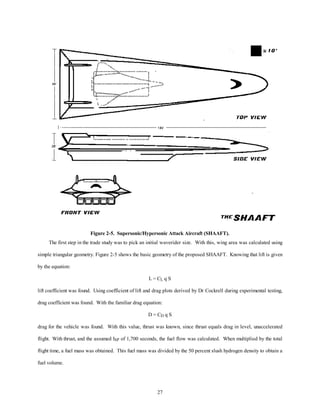
Figure 2-5. Supersonic/Hypersonic Attack Aircraft (SHAAFT). 
The first step in the trade study was to pick an initial waverider size. With this, wing area was calculated using 
simple triangular geometry. Figure 2-5 shows the basic geometry of the proposed SHAAFT. Knowing that lift is given 
27 
by the equation: 
L = CL q S 
lift coefficient was found. Using coefficient of lift and drag plots derived by Dr Cockrell during experimental testing, 
drag coefficient was found. With the familiar drag equation: 
D = CD q S 
drag for the vehicle was found. With this value, thrust was known, since thrust equals drag in level, unaccelerated 
flight. With thrust, and the assumed ISP of 1,700 seconds, the fuel flow was calculated. When multiplied by the total 
flight time, a fuel mass was obtained. This fuel mass was divided by the 50 percent slush hydrogen density to obtain a 
fuel volume.
Fuel volume was compared to available tank volume from initial waverider dimensions chosen. Using 
traditional aircraft design, the fuel tank accounted for 50 percent of total aircraft volume. With an actual fuel volume 
calculated, the aircraft size was changed to try to match available fuel volume with required fuel volume. Aircraft 
weight was calculated with this volume of fuel, and the assumption that five pounds were required per square foot of 
wing area. This information was revealed in meetings with personnel of Wright Laboratory's Flight Dynamics 
Directorate, Wright-Patterson AFB, Ohio. This results in a SHAAFT body weight of 28,500 pounds, not including the 
SHAAFT Length and Fuel Dependency 
Mach = 12, Alt = 100,000 ft 
28 
50,000 pound payload weight. 
With the trade study, the fuel mass required met the fuel mass available at a waverider length of 190 feet. The 
tail end of the SHAAFT has a wingspan of approximately 60 feet. This design requires approximately 875,000 
pounds of slush hydrogen to complete the 10,000 statute mile journey. The effects of the different iterations can be 
seen in figure 2-6. This particular iteration showed that the aircraft volume was too small, requiring further iterations. 
4000000 
3500000 
3000000 
2500000 
2000000 
1500000 
1000000 
500000 
0 
Fuel Weight (lb) 
100 150 200 250 300 350 400 450 
Aircraft Length (ft) 
Fuel Available Fuel Required 
Figure 2-6. SHAAFT Sizing.
The Breguet range equation can be used to verify the aircraft size. With the assumption of cruise flight only and 
W 
W t 
29 
at constant velocity, the equation is 
Range 
V 
C 
L 
D 
i 
o 
= 
æ 
è ç 
ö 
ø ÷ 
æè ç 
öø ÷ 
æ 
è ç 
ö 
ø ÷ 
ln 
where V is velocity, Ct is thrust specific fuel consumption, L/D is the (L/D)max for the SHAAFT at mach 12, Wi is 
initial weight and Wo is final weight. 
It is also important to note that Ct is related to the previously mentioned ISP: 
I 
sp C 
t 
» 
1 
Thus if ISP is 1,700 seconds, Ct is 0.000588 pound/pound mass seconds. V is 11,891 feet/second, L/D is five, Wi is 
954,000 pounds, and fuel mass required is 875,000 pounds, then Wo is approximately 78,500 pounds. Using the 
Breguet range equation, the mathematical range is over 25,000 miles, far exceeding the 14,000–mile requirement. 
However, the reason the mathematical range is nearly double what is needed is because the equation does not account 
for the excessive amount of fuel that is needed to takeoff and accelerate the SHAAFT to its cruise condition where it is 
most efficient. Approximately half the fuel will be spent taking off and accelerating the SHAAFT while also covering 
a large range. The extra calculated range is to ensure sufficient range throughout the entire flight. It also does not 
account for the large turning radius, given by the equation: 
R 
V 
g n 
= 
- 
2 
2 1 
Here, R is turn radius, V is velocity, g is acceleration due to gravity, and n is the load factor of the turn. The SHAAFT 
would slow to mach 8 for turning and simultaneously launch SHMAC missiles. This gives a velocity of 11,890 feet 
per second. At a constant inch 2-g inch turn, the radius is approximately 480 miles, assuming a 50,000 pound payload 
is still in the aircraft. 
Flight Control Systems 
Payloads will be placed on the back end of the SHAAFT, requiring room and center of gravity considerations. 
By the year 2020, the level of fly-by-wire technology should be very commonplace, and application of such
technology to the waverider concept should be simple. The pilot would have a typical control stick, interfaced with a 
black box computer. The pilot’s inputs would be fed into two outboard split ailerons, giving both yaw and roll 
control, and into inboard elevons, giving both pitch and roll control. During cruise flight, such control inputs would be 
very minor, as surface deflections produce extreme moments at mach 12. 
Payloads would have to be located near the center of gravity of the SHAAFT. When these payloads are 
deployed, the shifting center of gravity could be disastrous if not properly accounted for in fuel ballast and in 
placement of loads along the fuselage. As 50,000 pounds of equipment depart the SHAAFT, the separation should 
30 
occur smoothly and quickly to avoid dangerous situations. 
Special Considerations 
The unique mission and design of the SHAAFT will require facilities that are currently very rare or nonexistent. 
In addition to cryogenic storage and handling equipment, it will need an extensive facility to mate the SHAAFT with 
the launch platform. This would most likely be performed with a crane structure that would raise the SHAAFT into 
the air while the wing taxied into position beneath it (not unlike the space shuttle being mated to the Boeing 747). 
Automated facilities and technicians would then mate the two craft together. 
Another consideration which can not be overlooked is the reality of an in-flight emergency developing and the 
SHAAFT being forced to land at a base which is not equipped to handle it. In this situation, some manner of getting 
the “Golden Bullet” back to the US would be imperative. This would be accomplished by dispatching a zero–stage 
wing to act as a ferry. The launch platform has extensive volume within its wings that is used up quickly during 
supersonic flight—but acting as a ferry, this range and endurance would increase substantially due to the low drag 
incurred by subsonic velocity. The alternative base would be equipped with a simple mating device, or if emergency 
demands, one could be airlifted to the foreign base. Once the two crafts are mated, the launch platform will take off 
and return to CONUS. It is important to remember that the SHAAFT is essentially a flying gas tank and that most of its 
weight comes from fuel. It would obviously be drained of unnecessary fuel and payload for the trip back to the US to 
reduce the workload on the launch platform. The zero–stage launch platform would use conventional, hydrocarbon 
fuels for all points in its mission, landing at specific points around the globe to refuel.
Mission 
31 
Flight Profile 
After being brought to mach 3.5 by the zero stage launch platform, the SHAAFT would release and pitch up, 
automatically initiating the start of ramjets. From there, it would accelerate and increase in altitude until it reaches the 
cruise phase. 
The cruise phase, at mach 12 and 100,000 feet, consists of the majority of the flight, including attack or 
SCREMAR transatmospheric vehicle deployment. The SHAAFT would continue at its cruise speed throughout the 
entire envelope, with the exception of takeoff, landing. This is due to safety considerations for the SHAAFT. If it 
entered or departed the target area at a much slower speed, to reduce negative aerothermodynamic effects, it would be 
vulnerable to more conventional types of attack. For instance, if an enemy country expected a SHAAFT attack, it 
could set up remote–based (possibly sea based, fleet launched) aircraft or SAM sites that do, and most likely will, 
have the capability in 2025 to destroy mach 5+/- aircraft. 
In the attack phase, the SHAAFT would launch missiles/munitions from a considerable distance away from the 
target. It would have to release its munitions early in the attack phase to allow the munitions to acquire and adjust its 
course at such high speeds. Once the munitions were released, the SHAAFT would most likely make a constant 2-g 
turn and head back to the planned landing base. The precise routing would have to be precisely planned knowing that 
a 180 degree turn going mach 12 may take place over several countries. 
If the SHAAFT were launching an orbital vehicle such as the SCREMAR TAV, it would takeoff, adjust its 
course to get to the desired inclination, and release the TAV going mach 12 at 100,000 feet. This gives the orbital 
vehicle an extreme advantage in potential and kinetic energy. An even greater advantage is that space access vehicles 
could be launched from any long runway in the world, rather than specific launch sites. This would be of an extreme 
advantage in wartime when it is possible and likely that our space centers will be a primary target. 
Landing Phase 
The landing phase would begin approximately 30 minutes prior to landing. While at cruise phase, the SHAAFT 
will shut down engines and decelerate to subsonic speeds to begin convectively cooling the skin surface. The glide
aspects will be very similar to current Space Shuttle landings. It will continue gliding until touchdown, where the 
pilot can maintain control during the most critical phase of flight. The onboard computers would assist the pilot in 
setting up the airspeed and altitude adjustments to avoid pilot error. 
The landing gear will be relatively small and only capable of operation during landing (due to the zero–stage 
launch platform). Since the aircraft weight is reduced dramatically during cruise flight (fuel is an enormous 
percentage of the total weight), and substantially during takeoff with the launch platform, the landing gear does not 
need to be extremely heavy, at least in comparison with take off requirements. This also assists in overall aircraft 
design by drastically reducing the weight fraction of the landing gear. 
The flying wing zero stage was able to lift the SHAAFT off the ground at conventional airspeeds. But the 
SHAAFT, being an aerothermodynamically configured vehicle for mach 12 cruise flight, would have much less lifting 
capability at traditional landing speeds. Therefore, it would have to land at high speeds, nearly 250–300 mph, which 
is similar to Space Shuttle landing speeds. In order to land this vehicle on large, but typical runways, a self-contained 
arresting system consisting of drag parachutes being deployed and extremely powerful brakes being applied upon 
32 
landing would be incorporated into the design. 
Payload Deployment 
The inherent attack advantages of a hypersonic cruiser must not degrade its attack capability by deploying slow 
speed and ineffective munitions. Therefore, the focus of weaponry to be added to the SHAAFT should be newly 
designed and developed weapons that are capable of supersonic/hypersonic speeds and contain extremely lethal 
yields. At first sight, the SHMAC missile is an excellent complement to the SHAAFT in that it flies at hypersonic 
speeds and is extremely lethal. It should also increase the range of the SHAAFT by approximately 1,000 nautical 
miles. This could allow the SHAAFT to either carry less fuel and more payload (weapons) or be more simply 
designed with less required weight (in fuel and range). It would also allow the SHAAFT to stay well out of enemy 
defense zones by using the less expensive, expendable SHMAC to fly into the threat zone. These two systems would 
be of excellent complement to each other. 
Another nearly ideally complementary system to the SHAAFT is the space access mission complement that can 
be accomplished. With a typical TAV, the size of a light F-15, the SHAAFT could be a rapid, reusable, and extremely 
advantageous launch platform. It could carry TAV vehicles with the capability to launch them into orbit at any
inclination and give them an initial, “free,” boost to 100,000 feet and mach 12. This would be of extreme benefit to 
the simplification of the design of the still futuristic TAV concept. 
The primary considerations are that weapons be developed with varied capabilities to be able to attack multiple 
types or targets depending what appears at the moment as the primary threats. In addition to the SHMAC, penetrating 
rods, flechettes, conventional bombs, self-guided antiarmor munitions, subnuclear munitions, and whatever is 
developed in future years are all possible payloads for the SHAAFT. They would all have to be developed much 
further, but there is a potential for some extremely powerful and lethal weapons arising from hypersonic speeds. 
Overall, the SHAAFT has an extremely varied capability either to attack to or be used as a mother vehicle for 
various other missions. The standard payload area should be able to accept a myriad of different weapons and 
clusters of weapons. It should be capable of striking not only multiple targets in one sortie, but striking different target 
types with the varied types of munitions it can carry. For instance, it would be very feasible for the SHAAFT to fly 
abreast of a country the size of Iraq, drop a few SHMAC’s at primary C3 facilities, then drop precise antiarmor type 
munitions at key defensive sites. This capability would almost assuredly destroy the enemy's will and capability to 
wage war within a matter of several hours and a few sorties. High-value targets are key to success. With such a 
capability, it is assured that we could, on demand and nearly always, completely and definitively put a stop to the war 
33 
before it begins. 
Threats to the SHAAFT 
Two possible threats that the SHAAFT could encounter are interceptors or laser weapons. The problems that an 
interceptor would face are enormous. It would have to detect, track, identify, launch, accelerate while climbing to 
100,000 feet, and then overtake a target moving at 12 times the speed of sound. An interceptor that could do this 
would have to be traveling on the order of mach 20. Even if the enemy did spend the money to develop this super 
surface-to-air missile (SAM), where would they put it? It does no good to place it near key targets because the 
SHAAFT is releasing its cruise missiles from 1,000 miles away! An enemy would have to create a ring of super 
SAMs thousands of miles long around its entire perimeter to keep the SHAAFT from entering. However, if the 
SHAAFT launches its payload from 1,000 miles out to sea, or over a neighboring country, little ground protection 
exists.
The other potential threat comes from lasers. The advantage that the laser has is that it can nearly instantaneously 
track and then fire at a moving target. It does not have to catch up to its target nor can it be outmaneuvered. But its 
disadvantage is its range and power supply. A laser that was powerful enough to reach both hundreds of miles 
downrange to the SHAAFT and 100,000 feet in altitude would require enormous energy stores.5 A facility to supply 
this type of power could not be placed in a van and hidden on a mountain top. It would be a sprawling, high visibility 
complex that would be easily visible. Once again, if Special Forces units could not neutralize it before the attack 
occurs, the SHAAFT could attack the site from a thousand miles away or avoid it altogether. 
Component Summary 
The idea of the Supersonic/Hypersonic Attack Aircraft was derived by taking a look at what the U.S. Air Force 
will need to accomplish in the year 2025. Gone are the massive enemies of east and west; gone also are the large 
budgets which could support their armies. Now the United States must deal with regional threats, in a timely manner, 
in a costly manner, and in a manner safe to the members of U.S. armed forces. The SHAAFT is simply a tool to 
34 
achieve these ends. 
Hypersonics drives the missions of the SHAAFT. The infrastructure-intensive framework of supporting a fleet 
of turbine-driven attack aircraft reduces to a few supporting facilities in CONUS bases that support the SHAAFT. But 
the SHAAFT does not replace all existing and future Air Force inventory--it is a means to prevent the costly use of all 
other weapons. It saves money. 
The SHAAFT has been designed to promote the proper usage of energy. By staging, it leaves bulky turbine 
engines on the ground as it completes the hypersonic attack role. By going hypersonic, the survivability of the 
SHAAFT increases tremendously. As of now, no known defensive weapons counter the SHAAFT threat; it simply 
flies too fast and too high. Upon completion of the mission, the aircraft would shut down engines and land on 
conventional runways, deploying drag parachutes to reduce the braking required. Such braking would occur with 
landing gear that has already been reduced greatly in weight due to the light airframe that would land back in the 
CONUS (the flying wing staging aircraft is equipped with bulky, expensive landing gear). 
Technological improvements will be required to formalize this design. An operational ramjet/scramjet is key to 
designing such an aircraft. Aeroacoustic loads on the airframe cause many mechanical loading problems.
Aerothermal heating requires the use of advanced heat dissipation materials. Command and control of the aircraft 
would require computational software and a hydraulics system that can perform under extreme circumstances. But 
many of the technologies for SHAAFT would be drawn from existing areas of research. The flying wing zero stage 
would utilize designs from the high-speed civil transport program. Waverider studies would finalize the design of the 
SHAAFT. Hypersonic research of ramjets would be used for power plant designs. Such measures should be easy in 
35 
the information-rich age of 2025. 
Imagine a single aircraft that could fly up the Mississippi River and simultaneously destroy key facilities at 
Falcon AFB, Colorado, Cape Canaveral, Florida, and Washington, D.C. A similar blow to some rogue nation would 
cause them to seriously question their current military and political endeavors. If you ignite conflict with the US, the 
motto is You’ll Get The SHAAFT! 
Notes 
1 Boeing Commercial Airplanes. High-Speed Civil Transport Study, NASA Contractor Report 4234, under 
Contract NASI- 18377, 1989. 
2 Charles Edward Cockrell, Jr. Vehicle Integration Effects on Hypersonic Waveriders, George Washington 
University School of Engineering and Applied Science, 21 April 1994. 
3 Frederick S. Billig, Propulsion Systems from Takeoff to High-Speed Flight, American Institute of Aeronautics 
and Astronautics, 1990. 
4 T. Eggers and R. Radespiel, Design of Waveriders. DLR, Institute for Design Aerodynamics, 11 October 
1993. 
5 During the SDI development, several laser systems were proposed that would be powerful enough to fire into 
space. Remember that these were fired straight up through 50 miles of atmosphere to reflecting satellites. A laser 
attacking the SHAAFT would have to fire at a slant angle through a thousand miles of atmosphere, refracting the beam 
and posing much less of a threat.
Chapter 3 
Standoff Hypersonic Missile with Attack Capability 
(SHMAC) 
The SHMAC (Standoff Hypersonic Missile with Attack Capability) is proposed as a weapon system which has 
in-theater dominance capability. This weapon system strikes quickly, accurately, and can survive enemy air defenses. 
The SHMAC can be fired from future hypersonic aircraft such as the SHAAFT (Supersonic/Hypersonic Attack 
Aircraft), from a low-speed conventional aircraft like the F-15E or the future F-22, from standard ship-based vertical 
launch system (VLS) tubes, or from mobile or fixed ground launch sites. The propulsion system and warheads will be 
varied to accommodate the launch platform and the service employing the SHMAC, be it the Army, Navy, Air Force, 
or Marines. In order to best exploit the range and response time of hypersonic weapons, the SHMAC will be most 
effective when launched from a hypersonic weapon system, such as the SHAAFT. The SHMAC concept has evolved 
into an in-theater dominance hypersonic missile, whose design is based upon the need to strike quickly with a high 
probability of success. The SHMAC will be the primary weapon delivered from the SHAAFT. Its range allows the 
SHAAFT to safely deliver SHMACs outside the range of air defense systems. 
The United States armed forces do not have the ability to strike enemy centers of gravity quickly, decisively, and 
with a high degree of safety. To destroy targets such as space launch facilities, power grids, communication facilities, 
and command centers, a rapidly deployable, highly survivable, extremely accurate weapon is needed. Hypersonics is 
the key to reaching these heavily defended targets in a timely manner and attacking them with a high probability of 
success. The range and response time inherent in a hypersonic weapon gives the United States armed forces the ability 
to destroy any ground target in any theater. This is an enormous advantage for US forces as it allows complete in-theater 
dominance. The SHMAC is a hypersonic weapon system capable of fulfilling this mission. 
36
Several factors drive the design of the SHMAC. These include range, time to target, survivability, guidance 
requirements, payload requirements, launch platform size restrictions, heating rates, acceleration loads, and 
maintenance requirements. Initial designs include easy-loading modular payloads. The limitation for the payload is a 
maximum warhead of 500 to 1,000 pounds. This restriction is driven by the weight limit and size limit of the entire 
vehicle. Modularity offers flexibility of application of the SHMAC in a fluid war environment. 
The missile body has a conventional cruise missile configuration adapted for hypersonic speeds. The propulsion 
concept is a combination of a rocket for the initial acceleration and a scramjet for sustained propulsion to the design 
speed of mach 8. The rocket engine will not be necessary for the high-speed air-launched version (SHAAFT 
launched) because the missile will be deployed at or above cruise speed and altitude. The technology for the 
rocket/dump combustor-scramjet propulsion system has been studied in the ramjet form by engineers at the Flight 
37 
Dynamics Laboratory at Wright Labs from 1977 to 1980. 
The leading edges could be comprised of ablative materials or an ultrahigh temperature ceramic (UHTC) 
composed of a dibromide material like ZrB2/SiC.1 Ablators are an economical thermal protection system (TPS) 
because the SHMAC is a single use weapon. Albatross are much less expensive than more exotic reusable materials. 
The shape of the missile will not change during flight when high temperature regions are protected with UHTC 
materials. This ensures that the flight characteristics of the missile will not change during the course of the flight. The 
ablative technology employed in the thermal protection system is currently available, while UHTC materials are 
currently being developed by the Ames Research Center.2 
The guidance technology takes into account the unique high-speed environment in which the missile will be 
operating. Possible technologies employed in the SHMAC guidance system include inertial navigation systems (INS) 
and global positioning system (GPS) usage for the cruise phase. Synthetic aperture radar (SAR) and infrared (IR) 
guidance is employed in the missile's terminal phase. The technology required to support the design of this missile 
should mature and become readily available within the next 10 years. 
The SHMAC is the first step in developing a line of hypersonic vehicles to meet the needs of the Air Force well 
into the twenty-first century. These technologies will build upon each other, covering the complete spectrum of 
hypersonic speeds all the way to orbital velocities. The weapons systems range from in-theater dominance to global 
and space power projection. This hypersonics program will be an integrated effort (S3) which allows one program to 
build upon previous research and development and the lessons learned in the other projects.
General Mission Requirements 
38 
Range and Time to Target 
There are several minimum requirements that military planners have set for a hypersonic weapon system like the 
SHMAC. The ultimate constraint is for the missile to have a range of 1,000 nautical miles or more. It is desirable to 
be able to travel this distance in approximately 20 minutes although this is not as important as the range. Figure 3-1 
shows the effective ranges of the high-speed air launched, low-speed air launched, and surface launched SHMACs in 
the Middle Eastern and European theaters. The time-to-target requirement of 20 minutes is based upon the time from 
missile launch until the SHMAC reaches the intended target. This time requirement, as well as survivability 
considerations, drives the need for the missile to cruise at mach 8. Technologically, mach 8 is an upper limit on the 
speed because of the desire to use endothermic hydrocarbons as a scramjet fuel, eliminating the need for cryogenics 
and the associated complexities.
Figure 3-1. Effective Ranges of the SHMAC. 
39 
Cost Effective 
With todays budget constraints it is nearly impossible to justify any acquisition program to Congress if the cost is 
too high. In order to keep costs low, existing technologies, modular designs, low-cost materials, and start-of-the-art or 
evolutionary design techniques will be employed. While hypersonics may be thought of as a revolutionary 
application, new designs can be developed on a technology base of more than 40 years of work. Furthermore, the 
design and development costs of the SHAAFT/SHMAC combination will be offset by the money this team saves in the 
long run. 
Developing and employing the SHMAC will allow the US to maintain a strong military presence, while staying 
within the limits of our own borders and military budget constraints. The SHMAC has the ability to avoid a protracted 
war by reducing the enemies will and ability to continue a war. This minimizes, or could eliminate, the costs
associated with a major force deployment. This cost is not only measured in dollars but more importantly in human 
lives. If a conflict can not be avoided, the SHMAC has the ability to save lives, aircraft, and operational costs by 
striking heavily defended, hard to reach, key targets with accuracy and lethality. At first glance the price tag for this 
Platinum Bullet may seem high; but when all the opportunities and benefits are considered this is an economically 
40 
feasible weapon system. 
Operational Simplicity 
The missile will be relatively inexpensive and operationally simple. This includes technology considerations 
such as thermal protection systems, propulsion and fuels, payloads, and guidance as well as base infrastructure such as 
missile maintenance and other support activities. 
At a mach number of eight and an altitude of 100,000 feet, the aerothermodynamic environment produces high 
surface temperatures, approximately 3500 oR at the stagnation points. This environment drives the design of the 
thermal protection, propulsion, and guidance and control systems. The TPS for the nose and leading edge will be 
comprised of either ablators or UHTC. Existing rocket technology will be utilized in combination with a scramjet. 
The weapons bay will be designed to accommodate existing warheads and smart submunitions. Guidance and control 
will take advantage of GPS and SAR technology to acquire and destroy targets. 
A goal throughout the entire design process has been to keep the missiles required support, maintenance, and 
other infrastructure very small, simple, and cheap. The missile requires only a small number of support personnel to 
maintain it. Since it is one use only, there is no need for through-flight maintenance. All munitions crews will be 
trained in proper methods to handle the SHMAC. Therefore the missile can be shipped or flown to the operational 
theater and be ready for deployment on any aircraft without requiring specifically trained personnel. Since it will be 
hard to know exactly what the targets will be in advance, the missile design also allows for easy transfer of existing 
munitions into the missile. Personnel trained to prepare the missile can configure the SHMAC for any mission on a 
moments notice by interchanging the modular payloads.
SHMAC Vehicle Concepts 
41 
SHMAC Design 
Three distinct versions of the SHMAC will be originally developed to allow for launch platform diversity. The 
versions are high-speed air launched, low-speed air launched, and surface launched. The high-speed air launched 
category includes all hypersonic delivery platforms. The SHAAFT will deliver SHMACs designed for high-speed 
launch. The low-speed air-launched category includes current and future transonic attack aircraft. Existing aircraft 
which could launch SHMACs include the F-15E, F-16, F-14, B-1, B-52, F-111, P-3, S-3, and the B-2. The surface-launched 
category includes both ship launched missiles from a standard Navy VLS tube, as well as ground launched 
missiles from a mobile or fixed launch platform. 
A unique design feature of the SHMAC is a platypus nose. This provides two distinct advantages. First, a 
platypus nose has a lower heating rate than a conical nose. This is due to the ability of the cross section to better 
distribute the heating across the missile nose in two dimensions, rather than concentrating it at a single point. The 
heating rates will still be high at the stagnation point of the nose. The second advantage is the higher lift-to-drag ratio 
inherent in a platypus nose design.
Figure 3-2. Standoff Hypersonic Missile with Attack Capability (SHMAC). 
The missile configurations for the high-speed air launched and the low-speed air launched are virtually identical. 
A potential conceptual design is shown in figure 3-2. Both have the same dimensions, the difference is the additional 
weight associated with a rocket in the low-speed air launched version. The missile’s dimensions are 180 inches long, 
54 inches wide, 23 inches high, and a nose radius of 1.5 inches. There is one slanted surface on the bottom of the 
missile which forms the compression ramp for the air entering the engine inlet. This also provides a component of lift 
to complement the wings. A lift-to-drag ratio of 4.5 was determined for the SHMAC based upon calculations as well 
42 
as values determined from other sources.3 
In order for the system to be employed by the Navy through a VLS it must be modified. The missile is longer and 
more slender in this configuration than the traditional SHMAC. This was driven by the need to retain volume for the 
rocket fuel while fitting within the slender confines of a VLS tube. The dimensions are 250 inches long, 16 inches
high, and 22 inches wide. In addition, folding control fins are utilized to allow the missile to fit within a VLS tube. 
These will deploy after launch and provide the required control and stability for the missile. 
The SHMAC exploits modular payload designs. This missile must be flexible in the types of targets it can hit. 
As a result, the SHMAC has the ability to change payload depending on the intended target. Payload variations range 
from high explosives to smart submunitions. Based on current missile designs, we plan to target the enemy with 
approximately 500 to 1,000 pounds of explosive material. The entire missile design is an iterative process that must 
balance propulsion, aerodynamics, payload, guidance and navigation, and many other considerations. 
43 
Propulsion 
The first area of consideration is propulsion. For the low-speed air launched or surface launched SHMAC 
configuration, we recommend concentrating on developing an integral rocket/scramjet engine. This choice of engine is 
driven by the desire to accomplish the mission at a low cost without sacrificing effectiveness. This type of combined 
propulsion cycle provides high initial acceleration without multiple air-breathing propulsion concepts. The rocket 
will quickly accelerate the missile to high altitude and a mach number where the scramjet takes over. 
The driving force behind the entire design of this missile is the mission. However, as previously mentioned, 
further considerations must be made to account for the delivery platform. For example, if the SHAAFT will be the 
primary delivery system, the missile needs to be easily compatible with that aircraft. Further modifications need to be 
made if the SHMAC is to be used by today’s fighter/bomber aircraft because of their unique limitations. Ship based 
SHMACs will be sized to fit into the Navy’s VLS tubes. The largest modification for a land or sea fired SHMAC is 
the rocket engine. A rocket propulsion system is required to accelerate the SHMAC to cruising altitude and mach 
number before the scramjet engine becomes effective. The rocket/dump combustor scramjet combination is shown in 
figure 3-3.
Figure 3-3. Rocket/Dump Combustor Scramjet. 
The SHMAC uses both a rocket and a scramjet to take advantage of the unique capabilities of each propulsion 
system. A rocket provides large initial acceleration at low mach numbers. Rocket fuel is more dense than scramjet 
fuel due to the need to carry oxidizer within the fuel. Because of the low ISPs of rockets, more fuel is required to 
produce the same amount of thrust. This means an all rocket concept is not desirable due to the large size and weight 
44 
resulting from the rocket fuel. 
On the other hand, a scramjet provides efficient high-speed cruise performance. This is due to its ability to 
gather oxygen from the atmosphere and its relatively high ISP as compared to rockets. The ISP for the rocket is due to 
the oxidizer contained within the solid propellant.4 All of these attributes keep the size of a scramjet small. The 
drawback of the scramjet is its inability to function at low speeds. Therefore, the optimum propulsion concept is a 
rocket for low–speed acceleration and a scramjet for high–speed cruise. 
A low-speed airbreathing concept without rocket acceleration would include a turbojet propulsion system. This 
results in the need for moving mechanical parts, increased expense and complexity, as well as large size and weight. 
A turbojet can not provide the quick boost of acceleration to scramjet operating speed and altitude that a rocket can. 
This high acceleration is desirable to reduce mission time and increase SHMAC survivability. Since the SHMAC has 
a need for both quick response time and a long range, a combined propulsion system like the rocket and scramjet 
combination is a must. 
The propulsion system which will be used in the SHMAC is a combined rocket and scramjet. This system 
incorporates an ejectable rocket case. The tolerances required for a scramjet to function in the mach 8 regime would 
be violated by using a scramjet chamber clogged with the remains of a burnt out solid rocket. The residue and spent 
fuel of the solid rocket will be removed from the scramjet chamber by ejecting the entire rocket casing after its burn is
completed. The high heating rates along the combustor section of the rocket casing will be the most critical area 
driving the need for the engine material. Typical rocket fuels burn around 6500 oR.5 A single rocket nozzle will be 
used. This provides simplicity, low weight, and low cost, though multiple nozzles would reduce the overall volume. 
The rocket system, with its high initial acceleration, will be used to boost the missile up to a speed and altitude 
where the scramjet becomes efficient. Limited trade studies have shown an optimum altitude of 100,000 feet and mach 
6 for the transition from rocket propulsion to scramjet power. The scramjet system, with the advantage of highly 
efficient cruise capability, will keep the missile at its altitude and speed until reaching the descent point for the target. 
45 
Guidance 
Another area considered is guidance. The missile will be programmable while in flight. This enables it to 
receive updated information permitting in-flight vectoring to a moving target. One means to accomplish this is an 
inertial guidance system with GPS redundancy which will be updated with the new coordinates as the target moves. 
A design challenge is ensuring that the guidance signals sent to the missile have enough power to penetrate the hot 
boundary layer and relay information to the guidance system of the missile. As the SHMAC nears the target area, it 
will employ self-guidance procedures. 
One of these self-guidance procedures is synthetic aperture radar which will guide the SHMAC to a fixed target. 
This type of target may not have as distinctive a heat signature so a SAR system will have a much greater chance of 
success against this type of target. Todays SARs have resolutions of less than one meter at 70,000 feet, so the 
capability certainly exists to acquire and destroy a target using SAR.6 
The most effective means to target a recently fired launcher is initial detection of the infrared signature of the 
launching missile coupled with radar tracking for pinpointing its location. The North American Aerospace Defense 
Command has the ability to use these two technologies to locate launch vehicles anywhere in the world. Sending the 
coordinates of the target to the SHMAC can be used to guide the missile to the target area. However, the final 
acquisition and tracking of the launcher must use a different form of terminal guidance such as IR or SAR because the 
launcher may have moved after launching.
46 
Modular Weapons Bay 
The SHMAC has so many different missions (flexibility is the key to air power), that modular design to 
accommodate different weapons and guidance payloads is a must. This will simplify the tasks for maintenance crews 
on the flight line by allowing them to reconfigure the missile easily. In general, this missile will not be harder to 
maintain than another single use weapon like the Sparrow or Sidewinder. The rocket booster contains solid fuel and 
the scramjet uses an easily maintainable endothermic hydrocarbon fuel, JP-8 or some derivative. Fueling the missile 
before it is placed upon the aircraft will not require excessive support personnel or time. 
Special Considerations 
An important consideration in propulsion system design is the engine inlet. All three SHMAC versions are 
characterized by an underbody engine inlet that was shown in figure 3-2. A favorable forebody compression field is 
created by the interaction of the shock from the nose and the inlet lip. Other oblique shocks are formed along the inlet 
ramp to the combustion chamber which further slow the flow. The disadvantage of an underbody inlet is that the 
missile needs bank to turn in order to ensure good flow into the engine during flight maneuvers.7 This increases the 
complexity of the flight control system. 
The ideal intake scenario is one in which the flow transitions from laminar to turbulent upstream of the inlet. A 
laminar boundary layer is desired in front of the inlet, since it will keep the heating rates along the compression face of 
the missile lower than if this flow is turbulent. However, a mature turbulent boundary layer is required before the 
flow enters the inlet. This transition needs to occur soon enough so that the inlet shock has a turbulent boundary layer 
across it. The shock-boundary layer interaction works better with turbulent flow. Turbulent flow is also better suited 
for rapid mixing of fuel and air in the scramjet.8 The burn phase must be completed extremely quickly for the scramjet 
to operate effectively. At high mach numbers, the flameholders and fuel injectors must be highly advanced to 
successfully mix the fuel and airflow and fully combust it in the scramjet chamber for the most efficient burn. 
One solution to the flameholder problem is to use highly reactive fuels (such as hydrocarbons with 20 percent 
ethyl decaborane).9 Reactive fuels spontaneously combust when mixed with the airflow, eliminating the need for 
flameholders. This would enhance the performance of the engine by reducing the drag and flow problems caused by
the flameholders. One problem with reactive fuels is safely storing and maintaining them as well as their high cost 
47 
when compared to conventional fuels. 
The scramjet will have an on-design point of mach 8 which is the desired cruising speed. To further reduce the 
cost, the inlet to the scramjet will be fixed geometry designed for mach 8 freestream velocity. Since the scramjet has 
no moving parts, the overall cost of manufacturing it will be fairly low, an important consideration in a single-use 
weapon. The cost of the scramjet is mostly driven by the materials contained in the scramjet/ rocket engine. These 
materials will need to withstand the burning of the endothermic hydrocarbons and the oblique shocks formed on the 
inlet ramp. 
The next area considered is the thermal protection system for the SHMAC. A great deal of thermal protection 
system research was conducted during the Apollo and Shuttle program. This research established many low cost 
thermal protection alternatives which are readily available for use on the SHMAC. The Space Shuttle program has 
also led to the development of new TPS. There has also been great progress in the study of ultrahigh temperature 
ceramics. Since the SHMAC is a single-use vehicle, the most cost-effective form of TPS seems to be ablators. 
However, significant research still needs to be conducted in this area as to what form of TPS is best for the SHMAC. 
Further considerations in this area are discussed in greater detail in chapter 5. 
Mission 
Flight Profiles 
Spreadsheets were used to develop the high-speed and low-speed air launched and surface launched 
representative mission profiles. For each flight phase, values were calculated based on a simple free body diagram of 
the missile. The independent variables in this iteration were rocket boost end altitude, rocket boost downrange, 
descent downrange, acceleration cruise downrange, and unaccelerated cruise downrange. The estimated rocket fuel 
and scramjet fuel values were adjusted to match the iterated values produced from the calculations. All of these 
variables were iterated and manipulated until the mission profile could be successfully met, and the overall vehicle 
weight did not exceed 4,000 pounds.
Several assumptions were made to produce these profiles. One assumption was that rockets have a thrust to 
weight ratio of 10. Another was that a scramjet at 100,000 feet has a thrust to weight ratio equal to 0.1.10 A 
representative rocket fuel (polyvinyl chloride/ammonium perchlorate/aluminum) was used. This fuel has a density of 
0.064 lb/in3 , burns at 6150 oF, and has an ISP of 265 sec-1. Scramjets operating at mach numbers from six to eight 
have ISPs between 900 and 1200 sec-1 (see fig. 2-3). A representative scramjet ISP of 1100 sec-1 was used in the 
spreadsheets. 
These iterations produced the following mission for the SHAAFT launched SHMAC shown in figure 3-4. The 
SHAAFT launches the missile at 100,000 feet at mach 8. The scramjet ignites, and the missile cruises at mach 8 over 
the next 10 minutes. This cruise phase brings the missile 810 nautical miles down range. Finally, the scramjet shuts 
off and the missile pitches over into the descent phase. This phase lasts for 11 minutes and allows a target that is an 
additional 620 nautical miles away to be destroyed. The entire mission gives the SHAAFT launched SHMAC a range 
48 
of 1,440 nautical miles in a flight time of 21 minutes. 
High Speed Air Launched SHMAC Mission Profile 
100 
90 
80 
70 
60 
50 
40 
30 
20 
10 
0 
0 200 400 600 800 1000 1200 1400 1600 
Downrange (nm) 
Altitude (kft) 
Scramjet Cruise 
Glide to Target 
M=8.0 M=8.0 
M=4.0 
10.3 min 
20.8 min 
Figure 3-4. High Speed Air Launched SHMAC Mission Profile.
The second mission we considered was launching the SHMAC from a conventional fighter or bomber such as an 
F-15 or B-1. This low-speed air launched profile is shown in figure 3-5. The SHMAC will be launched from 
approximately 30,000 feet and mach 0.8. The solid rocket booster accelerates the missile at an average flight path 
angle of 50o to 80,000 feet at mach 6. This results in an average acceleration rate of 9 g’s. The boost places the 
missile seven nautical miles downrange in 18 seconds. The cruise phase then accelerates the SHMAC to mach 8, 
100,000 ft and an additional 460 nautical miles downrange in a little over six minutes. The glide phase carries the 
missile another 630 miles downrange and slows it to mach 4. This gives this variant a total range of 1,100 nautical 
49 
miles in 17 minutes. 
Low Speed Air Launched SHMAC Mission Profile 
100 
90 
80 
70 
60 
50 
40 
30 
20 
10 
0 
M=6.2 
Scramjet Cruise 
0 200 400 600 800 1000 1200 
Downrange (nm) 
Altitude (kft) 
M=0.8 
M=8.0 
M=4.0 
Rocket Boost 
Glide to Target 
0.3 min 
3.6 min 
17.1 min 
M=8.0 
6.6 min 
Figure 3-5. Low Speed Air Launched SHMAC Mission Profile. 
The third mission considered is for the surface launched version and is shown in figure 3-6. The SHMAC will 
be launched from an altitude of approximately zero feet and a mach number of zero. The solid rocket booster 
accelerates the missile at an average flight path angle of 54o to 50,000 feet at mach 6. This results in an average 
acceleration rate of 9 g’s. The boost places the missile six nautical miles downrange in 20 seconds. The cruise phase
then accelerates the SHMAC to mach 8, 100,000 feet and an additional 410 nautical miles downrange in six minutes. 
The glide phase carries the missile another 630 miles downrange and slows it to mach 4. This gives this variant a 
50 
total range of 1,040 nautical miles in 17 minutes. 
Surface Launched SHMAC Mission Profile 
100 
90 
80 
70 
60 
50 
40 
30 
20 
10 
0 
Rocket Boost 
0 200 400 600 800 1000 1200 
Downrange (nm) 
Altitude (kft) 
M=4 
M=6.0 
M=8.0 
M=0 
Scramjet Cruise 
Glide to Target 
0.3 min 
16.6 min 
4.0 min 
M=8.0 
6.0 min 
Figure 3-6. Surface Launched SHMAC Mission Profile. 
Objective 
The ability to attack key centers of gravity and strategic targets in a theater without prepositioned forces is 
beneficial for several reasons. This allows the United States to use its military instrument of national power 
immediately, at any location in the world. This ability can help avoid the development of a protracted conflict by 
immediately reducing the enemy’s will and ability to fight a war. Of equal importance, the immense expense 
associated with maintaining an overseas presence during peacetime can be avoided by the development of a long-range- 
quick strike capability. The logistics footprint associated with a large deployment of US troops, like in Desert 
Storm, is a major expense and hardship on our nation. The SHAAFT/SHMAC combination avoids this footprint by 
providing the ability to strike anywhere in the world from a CONUS base.
The SHMAC gives the Air Force the essential capability to make a decisive strike in the first hours of a conflict. 
If a conflict arises, it takes a significant amount of time to mobilize a response force. The SHAAFT/SHMAC 
integrated weapon system gives the US the ability to strike enemy centers of gravity within hours. 
Another advantage of the SHMAC is its ability to protect other war-fighting assets. The 1,000 nautical mile 
range of the SHMAC allows the SHAAFT to place weapons on target from a safe distance. The SHMAC is released 
from its host, be it a SHAAFT, F-15E, sea launcher, or ground launcher from a distance safely outside of enemy air 
and ground defenses. The SHMAC can attack enemy centers of gravity such as command and control centers, access 
to space assets, and power and communication centers without putting more valuable assets, like aircraft, ships, and, 
51 
most importantly, human lives into harms way. 
The speed of information gathering and distribution in warfare has matured at a phenomenal rate, but the military 
technology to deliver ordnance quickly enough to take advantage of this increased capability has not followed suit. 
The inability to attack detected targets of opportunity is a major shortcoming of our present force structure. These 
targets may include recently fired mobile ballistic missile launchers or military commanders whose whereabouts were 
recently discovered. This is where the speed and range of a hypersonic missile is a needed and crucial advantage. 
With SHMAC technology, the enemy will have no safe haven or freedom of movement. Anytime they are detected, 
they can be quickly attacked and destroyed. 
There will be no escape from the oncoming SHMAC. The SHMAC will expand the Air Force's power-projection 
ability and increase our national security by enhancing the attack capability of all our armed forces. As 
mentioned earlier, the US military will now be able to stop the development of a protracted war without deploying any 
troops. 
Possibly the greatest advantage of the SHMAC is its survivability. This weapon is highly survivable due to its 
mission profiles. The SHMAC will cruise at mach 8 and at an altitude of 100,000 feet. This flight regime is 
exceedingly difficult to reach with current air defense weapon systems. A surface-to-air missile system with 200 
miles of coverage would have just over one minute to acquire and launch a missile at the SHMAC. This assumes the 
SHMAC is detected and classified as a threat at the limit of the missiles radar range. If they delay longer than this 
period, the missile will already be overhead and almost impossible to catch up to in flight. During the descent, to the 
target the missile never slows below mach 4 and numerous submunitions can be deployed. Therefore, there is very 
little chance that an enemy will be able to destroy it with a conventional surface-to-air missile in the terminal flight
phase. Furthermore, the missile is not a dumb bomb but is capable of maneuvering, further increasing its survivability 
52 
and success. 
Possible threats to the SHMAC in the future are directed energy weapons such as lasers and microwaves. 
However, though these weapons may be developed, their complexity and high-power consumption will limit who is 
able to deploy them and how many are deployed. Only well-developed countries will be able to afford these weapons 
and only to protect key targets. This kind of threat is a definite possibility, but the standoff capability of the SHMAC 
ensures that the missiles will be targeted instead of manned aircraft, ships, or trucks. 
Although the SHMAC has the potential to be used for many different types of missions, it was designed with a 
specific mission in mind. That mission is to strike a ground target 1,000 nm away in 20 minutes or less after release 
from a launch system. This mission was chosen to be the primary focus because it represents a current void in the 
US’s ability to project military force. The ability to strike and destroy ground targets deep inside enemy territory is a 
mission that will continue to plague US forces in future conflicts unless this problem is solved now. 
Future variants of the SHMAC may accomplish different types of missions using the same basic SHMAC 
technologies incorporated into the first version. These additional missions may include ballistic missile intercept, 
cruise missile intercept, air to air, surface to air, antiship, close air support, interdiction, and psychological 
operations. The speed and survivability of the SHMAC can enhance all of these missions. However, modifying the 
SHMAC to complete these missions will need to be accompanied by large advances in technology in other areas, 
especially guidance and control. This list represents the flexibility of a hypersonic missile, it is not an advertisement 
of the near-term capability of the SHMAC. 
One of these missions, ballistic missile intercept, was a particularly plaguing problem for the US during 
Operation Desert Storm. The most effective way to destroy a ballistic missile is to reach it in its boost phase. 
Attempting to destroy the missile in the reentry phase when decoys, submunitions, and debris are present is extremely 
difficult. Hypersonic technology is required to reach a ballistic missile in the boost phase. The SHMAC could 
provide this capability. 
Boost phase intercept capability will become more important in the future as more countries obtain the capability 
to employ weapons of mass destruction. We do not want to destroy a chemical or nuclear weapon over our own 
troops since the chemicals or fallout will then harm our own forces. Destroying a nuclear biological chemical weapon 
over our foe's territory is an extremely attractive option for a commander in the field.
When the technology required for a boost phase intercept is developed, this will still be a difficult mission for 
the SHMAC. One challenge in this mission is getting to the enemy missile while it is still in the boost phase. The 
SHMAC’s speed and range is essential for completion of this mission during the enemy missile’s vulnerable boost 
phase. The largest technological challenge is targeting another hypersonic missile in the air. Closure rates of well 
over 12,000 feet per second are probable when a SHMAC intercepts another missile. Not only must the SHMAC 
detect and track the missile, it needs to be able to physically strike the enemy missile to achieve a kinetic kill. 
Component Summary 
It is critical that funding be provided for the SHMAC immediately. With it the US will truly be able to dominate 
any theater during any future conflict. Also, the average cost of a fleet of SHMACs will still be considerably lower 
than the current cost required for the Navy’s tomahawk land attack missile to hit a target. In addition, it will be highly 
survivable, fast, and lethal. In short, there will be no escaping the oncoming SHMAC. 
A hypersonic attack missile should be the first step towards developing an Air Force that can truly achieve 
Global Reach/Global Power through hypersonics. As explained before, the SHMAC falls into the first of three major 
categories of hypersonic vehicles: in-theater dominance, global reach/global power (SHAAFT), and access to space 
(SCREMAR). An in-theater dominance weapon like the SHMAC has the simplest mission and is closest to 
development today; using existing hypersonic vehicle and missile technologies. The SHMAC can become a stepping 
stone towards developing more complex vehicles and should later be integrated into other hypersonic platforms like 
53 
the SHAAFT. 
Notes 
1 Jeff E. Bull and Paul Kolodziej, “X-34 Sharp Wing Integrated Flight Test (SWIFT), Thermal Protection 
Materials. 
2 Ibid. 
3 R. J. Krieger et al., “Aerodynamic Configured Missile Development—Final Report,” Wright Laboratories, 15 
March 1980. 
4 Frederick S. Billig, “Tactical Missile Design Concepts,” Johns Hopkins APL Technical Digest, 139–54. 
5 Ibid. 
6 Dan Rondeaux, private discussion, 20 November 1995. 
7 Billig. 
8 E. T. Curran, W. H. Heiser, and D. T. Pratt. “Fluid Phenomena in Scramjet Combustion Systems,” Fluid 
Mechanics Annual Review, 1996.
54 
9 Billig. 
10 Ibid.
Chapter 4 
Space Control with a Reusable Military Aircraft 
(SCREMAR) 
55 
System Overview 
The SCREMAR (Space Control with a REusable Military AiRcraft) is a transatmospheric vehicle that can 
provide flexible, reliable, routine, and readily available access to space well into the future for a variety of 
applications. It is a multiple-stage-to-orbit (MSTO) vehicle designed for integrated use with the SHAAFT. It is 66 
feet long with a gross takeoff weight of 50,000 pounds, roughly the size of an F-15, and fits piggyback on the 
SHAAFT. The hypersonic capabilities of the SHAAFT are used to take the SCREMAR to mach 12 at 100,000 feet 
where the SCREMAR then separates. The SCREMAR then uses its two rocket engines to complete the remainder of 
the access-to-space mission in a similar fashion as the Space Shuttle, returning to a predetermined base for a 
horizontal landing on a conventional runway. Since SHAAFT produces a significant portion of the velocity change 
required to get the SCREMAR to orbit, the size of the SCREMAR can be greatly reduced while the payload increased. 
The SCREMAR is a TAV/orbiter capable of carrying a 3,000 pound payload to a low-earth orbit. This payload 
will most likely be three 1,000-pound satellites, but there are also other options. The SCREMAR is not designed to 
replace the existing fleet of space launch vehicles. Rather, it is designed to fulfill a specific niche that current launch 
systems do not occupy. Specifically, the SCREMAR accomplishes the deployment and retrieval of satellites for a 
variety of scenarios (to include critical wartime replenishment), on-orbit support and repair of damaged satellites, and 
sophisticated ASAT warfare against vulnerable space assets of potential adversaries. Essentially, the SCREMAR can 
fulfill the essential mission requirements for spacelift, on-orbit support, and counterspace applications.
There are a variety of scenarios where an easily planned access-to-space mission is critical. The best means for 
accomplishing these missions is a reusable TAV/orbiter, for example, the SCREMAR. The most likely is a 
situation in which an adversary has managed to render a significant portion of a satellite constellation inoperable. In 
this situation, the SHAAFT/SCREMAR combination would be a means of quickly replenishing vital space 
capabilities. This would occur in two possible ways: the SCREMAR would take several new satellites to space to 
be deployed and replace damaged satellites or the SCREMAR could simply repair damaged satellites by docking with 
56 
them in their orbit. 
The role SCREMAR will play in helping the US maintain its space superiority status well into the future is 
crucial. In the past, and even present day, the US has enjoyed unopposed access to space, albeit at a very costly and 
time-consuming process. In the vastly changing political structures throughout the world, it is very likely potential 
adversaries will have the capabilities required to significantly hinder the missions we now accomplish from space 
through the use of satellites as well as our access-to-space capability. Due to its increasing importance, space is most 
likely to be the dominion of the modern battlefield. 
The Need for Access to Space 
The accelerated pace of the modern battlefield has dictated that the US become increasingly dependent upon 
their space assets. In fact, the success of the Army, Navy, and Air Force throughout Desert Shield and Desert Storm 
was due in large part to the advantages provided by global positioning system, communication, and intelligence 
satellites. The war was won in the air and on the ground because there was no contest in space; the United States 
maintained control of the ultimate high ground throughout the entire conflict. In the future, space power and control 
over the ultimate high ground will be critical to winning battles on the sea, in the air, and on land. The SCREMAR 
can maintain this control. 
With the increasing importance on space assets, the US cannot afford to neglect the necessity of space 
superiority. Space has become a vital means of communication, intelligence, and navigation for the Army, Navy, and 
Air Force in all military operations. Already in place are large and small satellites of varying types arranged in 
constellations to perform these and many other specific functions. Most nations of concern do not possess an adequate 
space infrastructure, but they do, however, possess the ability to level the playing field against the US through the use 
of nuclear weapons in space. For example, Russia and China, with their formidable space infrastructure, have the
capability of posing a serious threat to US space assets. With the assets the US currently has in place and the vital role 
they fulfill in all military operations, America cannot lose a significant portion of this infrastructure and still function 
57 
as a modern-day military power. 
Nations without a strong access-to-space infrastructure (e.g., Iraq and North Korea) could still significantly 
hinder the US space capabilities at low costs and with little effort. Consider this: Iraq possess an enormous Scud 
missile inventory and possibly the ability to procure nuclear warheads. This could be extremely dangerous to US 
interests abroad. Although the range of the Scud missile is very limited and nowhere close to being able to strike the 
US mainland, it is a ballistic missile with the capability of reaching the earth’s upper atmosphere and lower regions of 
space if launched straight up. If fitted with a nuclear warhead, the electromagnetic pulse alone due to a nuclear 
detonation in the ionosphere could wipe out a significant portion of a satellite constellation’s ability to operate 
effectively. Several detonations could make our satellite fleets inoperable. 
Future concerns also include the possibility of a nation with notable space capabilities, such as Russia, 
performing sophisticated ASAT warfare. A resurgent ultranationalist Russia or a disgruntled China could either 
selectively engage and destroy our satellites as needed or use the previously mentioned method of random destruction 
depending on how many space assets they have in the area and if they can afford to lose them. 
Satellites are extremely fragile spacecraft. This is due largely to the push for lower spacecraft weights (directly 
impacting lower launch costs) and the fact that no real threat exists in space to damage satellites other than the solar 
radiation damage (which we have made significant progress over the last few years in reducing) and the extremely 
unlikely and very rare event of the satellite being struck by a projectile of significant size, such as an asteroid or man-made 
object. The ability of a rogue nation with no legitimate space infrastructure being able to guide an object to 
impact a satellite in the vastness of space is an extremely difficult task. 
However, with nuclear weapons, accuracy is not an issue. A nuclear detonation close to the earth’s atmosphere 
in the lower regions of space would have enough energy alone to completely obliterate all satellites in the region 
overhead that are positioned in low-earth orbits. Although the exact effective region for such an explosion alone in 
space is unknown, it is estimated in the thousands of miles. Clearly accuracy is not a driving factor for an adversary 
wanting only to take out America’s ability to look at them for several hours; they could clear out the entire region 
above them while they launch a surprise attack on allied forces.
The damage to US satellites extends far beyond just what is done from the impact of the explosion. There is also 
an electromagnetic pulse that is dispensed by the explosion, extending for thousands of miles beyond the area affected 
from the detonation forces, which could incapacitate satellites’ sensitive sensors and circuits, although the satellites’ 
structures themselves would not be significantly damaged. This electromagnetic disturbance also tends to linger over 
an affected area for extended periods of time (e.g. several days) that make operations over the infected area extremely 
58 
difficult until the disturbance had degenerated. 
Regardless of the duration of the electromagnetic disturbance, there would be a significant US interest to replace 
those satellites in the constellation which have been destroyed and repair those which have been damaged. Replaced 
and repaired satellites should be ready to become fully operational as soon as conditions permit or in as little as a 
couple of days. Although current technology uses “hot spares” (satellites that are already in the constellation, but not 
turned on) to cover for satellites that quit working for various reasons, these extra satellites would most likely also be 
damaged to some extent from the detonations. Using hot spare satellites that are in other orbital planes in order to 
reduce the impact of such an explosion is extremely difficult. Only if the satellite is in the same orbital plane does it 
have a chance of being effective in covering the area of responsibility for a destroyed or damaged satellite in an 
emergency situation. In the event that several nukes are set off at given intervals over an area, the effect of hot spares 
being able to restore previous capabilities is drastically reduced. 
With flexible access to space through the use of a transatmospheric vehicle, (for example, the SCREMAR, the 
military would be able to replenish destroyed satellites and repair damaged ones in a substantially reduced time frame 
relative to what is required by today’s launch systems. This restoration time would be measured in terms of hours in 
getting a spacecraft that is on alert status into orbit with its payload of new satellites and/or replacement parts and 
getting the new/repaired satellites operational. A specially configured TAV could also perform various aspects of 
sophisticated ASAT warfare again enemy space assets. Also of importance would be the development of a technology 
that would readily allow access to space on a regular basis during all phases of conflict: before, during, and after the 
war. Having easily obtainable access to space on a regularly repeated basis would greatly increase the United States’ 
chances of maintaining overall combat effectiveness through such a situation as previously described. Space control 
would become as regular a mission as air superiority. There is a definite need for the US to develop some form of 
countermeasure to the diverse space threats in anticipation of maintaining space control throughout the duration of any 
battle.
General Mission Requirements 
The success of the access-to-space mission is dependent on several key requirements. Although not all of the 
requirements mentioned in this section are critical, they are necessary in terms of getting the flexibility, reliability, 
responsiveness, and low costs desired in an access-to-space TAV/orbiter. Some of the more critical requirements 
include (1) ability to get a 3,000-pound to a LEO, (2) 50,000-pound gross weight, (3) release point from first stage at 
mach 12 at 100,000 feet, (4) launch-on-demand capability, (5) ease of mission planning, (6) small, flexible, highly 
trained ground crew, (7) build off of existing infrastructure as much as possible, (8) develop in conjunction with other 
hypersonic technologies, (9) rapid turnaround time, (10) horizontal takeoff and landing (HTOL), and (11) global reach 
from a suborbital flight path. These requirements are directly related to increasing flexibility and cost effectiveness. 
Other important requirements to be considered are manned and unmanned aircraft versions and modular cargo bay for 
59 
ease of integration of various cargo and weapon systems. 
Payload 
The most critical requirement for a reusable military aircraft to fulfill the flexible access-to-space mission is the 
ability to take a sizable payload into a LEO. Having a military aircraft that is just designed to get to space without 
carrying any type of payload, as past programs have suggested, is virtually useless as a space control asset. The US’ 
presence in space is based on the number of deployed and usable satellites. 
Typical communication and intelligence satellites weigh in the neighborhood of 1,000 pounds or so and have 
dimensions roughly 6 feet x 6 feet x 6 feet when folded up. This is more or less the case for the newest constellation 
of satellites being deployed, the Iridium satellites, with expected reductions in size and weight in time with technology 
advances in materials and electronics. Having this capability would allow the SCREMAR to put approximately three 
satellites into a LEO (approximately 100 nm x 400 nm) in a single mission that can be planned and executed in a few 
days. Using today’s technology, this would most likely take three separate missions with several weeks of planning in 
between each launch. 
The benefits in terms of time and monetary costs can be seen from just this aspect while operational benefits 
extend even further. The SCREMAR could replenish an entire orbital plane of a satellite constellation with just three 
missions that could be accomplished in succession. The importance of the ability to plan and execute these missions
in a short time as well as turn around the vehicle for subsequent missions quickly will be discussed in more detail 
later. Nevertheless, the importance of this capability can be seen in that satellites cannot be deployed (or repaired) if 
60 
they (or the necessary tools) cannot be taken to orbit. 
Sizing 
The requirement for a gross takeoff weight around 50,000 pounds is driven by several factors. First and 
foremost is that this is the maximum payload of the SHAAFT. Also of importance is the fact that the lighter the overall 
weight, less fuel will have to be used to get the required change in velocity to get such a spacecraft into orbit. This 
places less demands on the need for significant improvements in both fuel and rocket propulsion technology. This 
relationship can be seen from the following orbital velocity equation: 
DV gI 
m 
m m sp 
p 
= 
- 
æ 
è ç 
ö 
ø ÷ 
ln 0 
0 
where g is the earth’s gravitational acceleration, ISP is the specific impulse of the fuel, m0 is the initial mass, and mp is 
the mass of the propellant. Thus, costs savings are realized both in terms of cost to build and cost to launch/operate 
when existing fuel and propulsion technologies can be taken advantage of. 
The constraints placed upon a final stage TAV/orbiter from the first stage, for example the SHAAFT are critical. 
Having a TAV/orbiter much greater than 50,000 pounds causes a significant impact on the ability for the SHAAFT to 
accelerate the SCREMAR to mach 12 at 100,000 feet. The rationale for needing to stage at mach 12 at 100,000 feet is 
explained later; however, it is important to realize that the issues of size, weight of dry structure, weight of payload, 
weight of fuel, and staging are all interrelated and have significant impacts on each other. Previous studies, such as 
Blackhorse,1 Beta,2 and Saenger,3 have concluded that a spacecraft roughly the size of an F-15 or F-16 would be the 
most beneficial configuration in terms of technology required to produce such a vehicle. 
Another important consideration is the fact that attempting to produce such an orbiter that carries an equivalent 
payload, 3,000 pounds, that is much lighter than 50,000 pounds requires a significant breakthrough in structure 
materials. As it stands now, the proposed SCREMAR’s total weight is nearly 75 percent fuel and the other 25 percent 
encompassing both the payload and dry structural weight. As can already be seen, this is going to require
improvements in structural technology; however, it will not require a significant breakthrough, only the natural 
61 
progression of technology with time. 
Staging 
As alluded to earlier, there is also a critical need for staging at mach 12 at 100,000 feet. Studies have shown that 
the altitude is not so much a factor as is the staging mach number. In order to reach a LEO, the required velocity is 
around 26,000 feet/s (30,000 feet/s considering losses due to losses from pressure, drag, etc.). Since the desired orbit 
is at least 100 nm, the effects on required velocity change of staging at 50,000 feet versus 100,000 feet versus 150,000 
feet are nearly negligible versus staging mach number. The overriding factor is the change in velocity that the 
TAV/orbiter, SCREMAR, has to produce on its own. Staging at mach 12 versus mach 8 means a starting velocity 
difference of approximately 12,000 feet/s versus 8,000 feet/s. This is a difference of having nearly 40 percent of the 
required orbital velocity supplied by the first stage versus 27 percent. Similarly, the staging height of 50,000 ft versus 
150,000 feet is only between 10–25 percent of the total height above the earth needed, but the same velocity change 
has to be produced. 
Staging at a lower altitude requires a larger vehicle since more fuel will be required to achieve the additional 
height as well as overcome the effects of air density. This places more demands on the structure all over, including 
weights and TPS. Staging at a higher altitude is limited to the capabilities of the first stage, e.g. the SHAAFT, since it 
uses airbreathing engines. Either way, the same amount of total energy is required to put an object in orbit. The 
velocity of the TAV/orbiter that is required to get it to a specified orbit is given by: 
r 
2 
V 
1 
r ( r r ) 1 1 2 
= 2 
+ 
æ 
è çç 
ö 
ø ÷÷ 
m 
where v1 is the tangential velocity at the minimum radius, r1 is the minimum radius, r2 is the maximum radius, and m is 
the earth’s gravitational constant. The only biggest difference is how much of this velocity is supplied by the first 
stage, the SHAAFT, and how much will have to be supplied by the final TAV/orbiter stage. The diagram for 
describing this orbital equation around earth is given below (note: the figure is not drawn to scale):
r r2 1 
62 
re 
V1 
Using the LEO previously described, r1 would relate to the 100 nm part of the orbit and r2 would relate to the 
400 nm part of the obit. However, this equation also takes into account the radius of earth, re, which is 3,443 nm 
(much greater than the 100 nm or 400 nm height above the earth’s surface). For instance, r1 = re + 100 nm and r2 = re 
+ 400 nm. Therefore, the real benefits in terms of the velocity change that would have to be produced by the 
TAV/orbiter considering staging at 150,000 feet versus 50,000 feet are less than 0.01 percent. Staging above 100,000 
feet places other excessive demands on the SHAAFT since it is an airbreathing aircraft. Having a staging height 
somewhere below 100,000 ft means that more fuel will have to be burned to achieve the additional height, increasing 
operating costs. This would also mean that additional size would be needed to hold the additional fuel. In terms of 
benefits versus costs, 100,000 feet appears to be the optimum staging altitude. From this altitude, SCREMAR size 
increases significantly with a 50 percent decrease in staging height; but the size does not decrease significantly for a 
50 percent increase in staging height. 
The effects of staging velocity are even more critical. Using the two equations above and spreadsheets that 
varied the different parameters affecting the SCREMAR, relationships were determined between staging height, mach 
number, payload weight, gross total weight, and fuel weight. Various fuels with different densities and ISPs were used 
with staging heights between 50,000 feet and 150,000 feet and staging mach numbers between eight and 12. With 
height, the only amount of additional fuel required is that to achieve an extra 50,000 feet or so of altitude. However, 
the study showed that much more additional fuel is required to produce the extra required velocity from mach 8 than 
from mach 12 at every altitude than the amount of additional fuel required to produce the additional height from 50,000 
feet to 150,000 feet at either mach 8 or mach 12. Thus, a TAV staging at mach 12 at 50,000 feet would be about half 
the size of a TAV staging at mach 8 at 150,000 feet. With the considerations mentioned before, the optimum staging 
conditions for the SCREMAR are mach 12 at 100,000 feet.
Also, developing the technology for the first stage to have the capability to stage at mach 12 will be less costly in 
the long run than trying to develop a TAV/orbiter of roughly the same size that overcomes greater velocity changes. 
The SCREMAR TAV/orbiter concept is already stretched in terms of existing technology for dry structural weight 
versus size. Having a staging point of mach 12 at 100,000 feet greatly reduces the amount of fuel needed to achieve 
the required velocity change, and thus the overall size of the TAV/orbiter. Also, 100,000 feet is a reasonable altitude 
in which the SHAAFT can operate with sufficient air and without the excessive drag penalties. This topic is also 
63 
discussed in more detail in chapter 5. 
Operational Efficiency 
The requirements for launch-on-demand capability, ease of mission planning, rapid turn-around time, and a 
small, flexible, highly trained ground crew go hand-in-hand. The requirement for launch-on-demand capability stems 
from the need for time-critical replenishment/repair of US satellites. Only by having the capability to replace 
damaged satellites in a short time can the US maintain the upperhand with space assets during a military operations. 
As previously mentioned, consider the case in which a majority of our space assets or a key satellite have been 
destroyed. Today’s capabilities would require weeks to replace a single key asset, months or even years to replace a 
majority of a constellation. With the pace of the modern battlefield, the war could long be over before we could even 
get a single satellite on-line with today’s launch systems. By having launch-on-demand capability, a mission to 
replace damaged or destroyed satellites could be underway within hours of the incapacitation of the satellites, thus 
getting the US back into the war with C3I in a matter of days. 
Of course, getting three satellites into orbit in a matter of hours is great, but really means nothing if another 
mission cannot be launched for several weeks. Thus, the need for launch-on-demand is required in conjunction with 
the need for ease of mission planning and rapid turnaround time for vehicle missions. A given mission should be able 
to be identified and planned within a days time. The proposed time frame for turnaround time, six to eight hours, is 
enough to allow for two missions to be completed in a single day, allowing also for a four to six hour mission time. A 
normal orbital plane of a constellation usually consists of 5-15 satellites, depending on the orbital height and number 
of satellites required in a field-of-view (FOV). Having six satellites placed in an orbital plane would be enough in 
most situations to provide substantial coverage over any given area.
It is also important to realize that these two requirements of launch-on-demand and rapid turnaround can only be 
met with a small, flexible, highly trained ground crew. The more people involved, the more time required for 
everyone to communicate and agree upon the status of the vehicle and increased chances of breakdowns in 
communication. Also, having a small, highly trained ground crew reduces the operating costs by not having to use as 
many resources to maintain operability. A small, flexible crew would also be much easier to transport in the event 
that the SCREMAR has to divert to a remote base. Most importantly, it implicitly requires that everything be done in a 
relatively simple manner. The less complexity, the cheaper the costs, the easier to operate and maintain, and the less 
64 
chance there is for a major catastrophe. 
Development 
With the need for reducing the complexity of the overall system, there are a couple of complementary 
requirements: (1) develop critical technologies in conjunction with other hypersonic programs (for example, the 
SHAAFT and SHMAC) and (2) build off the existing infrastructure as much as possible. These requirements produce 
several key benefits to the program. 
Savings in time and costs can also be realized by developing critical technologies, such as propulsion, fuels, 
TPS, and structural materials in conjunction with the other hypersonic programs of the SHAAFT and the SHMAC as 
well as extracting information and experience gained from vehicle and technology programs done and underway 
elsewhere. Since the technologies will be developed together, they will be cheaper in terms of the usefulness gained 
among the different systems (SCREMAR, SHAAFT, and SHMAC) rather than applying technology to only one. It will 
also make it easier to integrate the technologies among the three systems since they will be applicable to all systems. 
By building off of the existing infrastructure and developing hypersonic technologies together at one time, the 
SHAAFT/SCREMAR/SHMAC becomes a much lower-cost and less-complex integrated weapons system. 
Infrastructure 
Building off of the existing infrastructure means several things. Considerable monetary savings can be realized 
by not having to develop and build and entirely new and different access-to-space infrastructure. Existing 
infrastructures for both space and general aviation can be utilized and combined. Also, facilities for handling the
support of the SHAAFT and SCREMAR combination will be available worldwide, wherever, for example, the 
SCREMAR lands, providing greater flexibility to the SHAAFT/SCREMAR system. Only slight modifications to 
training and facilities would be required, reducing both costs and time to produce an operational infrastructure that is 
65 
mission capable. 
Building from the existing infrastructure has several advantages. First is the reduced costs associated with being 
able to redesign and utilize existing structures versus having to develop a completely new infrastructure. This is due 
primarily to the fact that almost everything needed to support operations is already in place and has already 
demonstrated the capability to support similar operations. Also, by combining assets from both the aero and space 
infrastructures, all US Air Force aircraft operations could be conducted from one multifunctional infrastructure rather 
than three separate ones. This is consistent with the Air Force’s movements towards composite wings. It also 
increases the flexibility of the SHAAFT/SCREMAR system by expanding the number of bases from which it can 
operate. This is an extremely important factor in the storage of fuels. If a majority of bases do not possess the ability 
to store the fuels required by both the SHAAFT and the SCREMAR, the base is essentially useless unless the fuels can 
be transported in by a special aircraft, such as a modified KC-10. However, if this is not possible, then the 
SCREMAR can be transported to wherever the SHAAFT is located via a Boeing 747, similar to the Shuttle. 
It is also necessary that the infrastructure be able to support both the SHAAFT/SCREMAR system. This is 
because the SHAAFT is required for SCREMAR operation. The SCREMAR is not designed to takeoff on its own. It 
must be loaded onto the SHAAFT in order to get off the ground. As designed, the SCREMAR is currently expected to 
fit on top of the SHAAFT. This could present some problems with bases having the capability to load the SCREMAR 
onto the SHAAFT in the situation where the SCREMAR must be diverted to a remote base. If a majority of bases do 
not have this capability, then they become useless. The means fitting the aircraft together, either to the SHAAFT or a 
747, should either be transportable or extremely simple. The Beta concept of rolling the TAV/orbiter underneath the 
staging vehicle and then attaching it should be explored more.4 In any case, the SHAAFT should be able to get to any 
location of the SCREMAR and at least be able to return it to a staging base, if not launch another mission from where 
it is. 
As previously mentioned, requirements dictate that rapid turnaround is a capability that should definitely be 
sought after. The ability for rapid turnaround extends primarily from the ability to perform maintenance and other 
ground operations. Normal maintenance and ground operations, such as refueling and reloading, should be able to be
accomplished in the desired time to meet the six to eight hour turnaround time requirement on the ground. Other 
maintenance and ground tasks, such as cleaning and damage repair, should be able to be accomplished within 
reasonable times. A good criteria would be approximately the same time it takes to accomplish these with today’s 
fighter aircraft. Also of importance here are members of the ground crew. They play an important role in 
accomplishing all of the maintenance and ground tasks. They should be highly trained and specialized in 
accomplishing all of the necessary functions that occur on the ground. 
Current launch systems are not standardized in their configurations. There is a definite need for standardizing 
launch vehicles and payload interfaces. Having payloads that are interchangeable among different vehicles increases 
the flexibility of both the payload and the launch system. This standardization also reduces the complexity involved 
with having to put similar payloads on different spacecraft or a variety of different payloads upon a single spacecraft, 
such as the SCREMAR. It could be done simply by using modular cargo bays that can be added and removed 
depending upon mission requirements and payload. Thus making it easier to reload cargo onto another spacecraft in 
the event that a mission is aborted prior to takeoff. The ability for cargo to be placed on different airframes allows for 
easier transportation of cargo to different bases. In a way, it also inherently implies that subsequent space transport 
systems will be developed. Having standardized payload interfaces also allows for the vehicle and payload to be 
prepared in parallel. Today’s systems often require that the payload be prepared and loaded only after the vehicle is 
in place or vice-versa. Using modular cargo bays, the SCREMAR would be able to be prepared for launch and 
already loaded onto the SHAAFT while the cargo is still being modified. The cargo could be loaded into the 
SCREMAR either before or after connection to the SHAAFT. 
66 
Special Considerations 
Because of SCREMAR’s integration with the SHAAFT, there are two other important requirements: (1) the 
capability for horizontal takeoff and landing and (2) the capability for global reach from a suborbital flight path. Like 
previous requirements, these two also go hand in hand. The ability for horizontal takeoff will be provided by the 
SHAAFT. Having this capability allows for the SHAAFT/SCREMAR system to operate from any base with a 
sufficient support structure and a conventional Class A runway. This would be extremely important in the event that 
the enemy has taken out our current space facilities at Vandenberg AFB, California, and Cape Canaveral AFS, 
Florida. In the event of war, these bases would become primary targets for a nation trying to hinder our space control
capability. This ability also provides for greater flexibility in the planning, timing, and versatility of access-to-space 
67 
missions. 
Likewise, the capability for horizontal landing provides similar advantages along with others and is 
characteristic for both the SCREMAR and SHAAFT as individual aircraft. First is the reduced weight since the 
TAV/orbiter will be able to glide to a landing in a similar manner as the Shuttle. The landing gear would only have to 
be designed to support the nearly empty weight of the TAV/orbiter since almost all of the fuel will be spent in 
achieving orbit. Landing vertically on rockets after reentering the earth’s atmosphere not only presents a challenge but 
also requires that additional fuel be carried in order to provide significant thrust as the vehicle reaches the ground. 
Conversely, vertical landing would provide for the capability to land practically anywhere a concrete pad could be 
laid. Although already demonstrated through programs such as the DC-X, this technology need not be exploited since 
a little fuel will remain in the SCREMAR in order to ensure global reach from a suborbital flight path. Also, being 
able to land in the middle of nowhere does little good if the SCREMAR can not be efficiently transported back to a 
base where is can be mated with the SHAAFT and its zero stage. Nevertheless, the capabilities of global reach from a 
suborbital flight path would allow the SCREMAR to reach and land on any conventional runway in the world. Which 
is very essential if our current facilities are destroyed, especially if they are destroyed while the SCREMAR is 
accomplishing a mission. 
The requirements mentioned throughout this section seem to be the most critical requirements driving the design 
of the SCREMAR TAV/orbiter concept; however, they are not the only factors to be considered. If the access-to-space 
mission is to truly ever become cheap, flexible, and reliable, there are millions of other considerations that need 
to be taken into account. A couple of the more important of these considerations seem to stand out. First is the 
potential to develop both piloted and unpiloted versions of the SCREMAR. The first step lends itself to the piloted 
version since real-time control and on-hands experience will be necessary in accomplishing the prescribed missions. 
However, with increases in technology, unpiloted versions will allow for the accomplishment of almost all of the 
prescribed missions (with the possible exception of only on-orbit support) while providing less risk of human 
casualties. Having less manpower to operate would also be a substantial benefit since the entire mission could be 
controlled by one person on the ground. 
As alluded to earlier, another important consideration is a modular cargo bay with standardized cargo and 
weapon modules. This speeds up the turnaround time significantly since subsequent missions can already be
preplanned and prepackaged before the TAV/orbiter even returns to the ground. It also reduces the costs of having to 
fit individual payloads to individual spacecraft cargo bays. A standardized system could be incorporated that could 
be applied to future spacecraft, reducing the need to continually redesign cargo. 
The requirements, as defined throughout this section, play a critical role in determining the final design of the 
SCREMAR TAV/orbiter concept. Obviously, these are not the only factors involved in developing access-to-space 
technology, nor are they absolute. Although there are many factors to be considered, these consistently appear 
throughout various studies to be the most critical in developing ready, reliable, flexible access to space. 
Concentrating on these requirements yields the greatest possibility of developing an access-to-space vehicle that 
successfully accomplishes all of the missions previously presented in this study. 
Missions 
With the increasing importance being placed on space assets such as communication, intelligence, and GPS 
satellites, the US can not afford to overlook the drastic impact of having a significant portion of the existing satellite 
fleet wiped out. It takes dozens of satellites in a constellation just to make the constellation operational enough for 
practical applications. With today’s launch capabilities, it normally takes months, or even years, to insert a satellite 
constellation into orbit. This is due to the inefficiencies of only being able to take up one or two satellites at a time 
with launch intervals that take months to be planned and executed. 
With the future possibilities of threats that face space assets, the US must have a viable means of maintaining 
control of space. As with maintaining control over the air, there must be a space infrastructure designed to provide 
Force Enhancement, Force Support, and Space Control. The most likely solution to accomplishing these missions with 
a single system is Space Control with a Reusable Military Aircraft. A TAV/orbiter (fig. 4-1) roughly the size of an F- 
15 and capable of carrying a 3,000-pound payload to LEOs could fill the major facets of these missions by 
accomplishing ready, reliable spacelift and on-orbit support while also providing a platform for counterspace 
operations. In fulfilling these multiple roles, the advantages of flexible access to space with a single platform can be 
68 
realized.
Figure 4-1. SCREMAR Performing Various On-Orbit Operations. 
The three primary missions to be accomplished by the SCREMAR TAV/orbiter are (1) deployment/retrieval of 
satellites, (2) repair of damaged satellites on-orbit, and (3) antisatellite warfare against enemy space assets. These 
missions (fig. 1-3) help achieve the broader concepts of Force Enhancement with spacelift and replenishment of space 
assets, Force Support by providing on-orbit support, and Aerospace Control through counterspace and 
counterinformation tactics achieved with ASAT. However, with the capabilities of a small TAV/orbiter, other 
possible missions still exist. SCREMAR could also be used as weapons platform for launching key strikes from 
above (strategic attack) as well as reconnaissance platform to gain and disseminate tactical information and 
intelligence in real time (Information Operations and Combat Support). These missions could be accomplished by 
69 
manned or unmanned versions of the SCREMAR.
70 
Deployment/Retrieval of Satellites 
The current successes enjoyed by US space operations are due primarily to the large, unopposed fleet of satellite 
constellations which has taken years to acquire. With an enemy capable of performing any of the various kinds of 
ASAT, these years and billions of dollars could become vain as the US would be unable to operate on the modern 
military battlefield. Having routine, easily accomplished access to space allows the effects of such a blow to be 
significantly reduced. This is best accomplished by the capability of ready, reliable deployment of satellites provided 
by a small TAV/orbiter. In a situation where the enemy has detonated a nuclear weapon, or a series of nuclear 
weapons, near satellite orbits, wiping out a majority of a constellation, the SCREMAR could be used to replenish 
destroyed satellites. 
With a rapid turnaround mission time, the SCREMAR could deploy as many as six satellites within a single day. 
Time to get a complete satellite constellation on-line and operational could be reduced to just a few days. This limits 
the enemy’s ability to downgrade our command, control, communication, and intelligence (C3I) operations for any 
significant period of time. Satellite replenishment could be used in any situation in which more satellites are desired, 
including the cases where an enemy has selectively destroyed several key satellites and just adding new constellations 
for various reasons. The TAV/orbiter could also be used to retrieve severely damaged satellites and return them to 
earth for repairs. Although the need for this mission is clear during war, it could also be accomplished during 
peacetime to aid in the normal deployment of satellites on a regular basis, also providing operational experience to the 
crews of the SHAAFT/SCREMAR platform so that they have the knowledge and understanding to accomplish the 
same missions during the accelerated pace of war. 
Repair of Damaged Satellites 
In the situations described previously, not all satellites will be destroyed. In some cases, it might be more cost 
and time efficient to have many of the damaged satellites repaired while in orbit. This is especially true if all of the 
satellites are in the same orbital plane. The SCREMAR TAV/orbiter could accomplish this by simply slowing down 
or speeding up within the orbital plane to dock with individual satellites and repair them real time. This significantly 
reduces the costs of an operation by not having to take as much of a payload into orbit (only the necessary tools and 
replacement parts) as well as the costs of not having to actually build replacement satellites. Time would be reduced
in that the in-orbit satellites would not have to be positioned nor configured. As soon as they are repaired, they would 
71 
be on-line and ready to go. 
This mission could also be accomplished in conjunction with the deployment/retrieval of satellites for maximum 
effectiveness, for example, the SCREMAR would reach orbit with replacement satellites and deploy them, repair the 
slightly damaged satellites, and retrieve the severely damaged satellites, all in one mission. As previously mentioned, 
the missions of spacelift and on-orbit support could also be performed during peacetime as a means of maintaining a 
viable satellite fleet as well as providing practice for routine access to space during wartime situations. This would 
be an essential portion of the training the crews receive. 
Antisatellite Warfare 
Another integral form in maintaining space control is space superiority. In a wartime situation, it is very 
plausible that our enemy will also have significant space assets. SCREMAR could be used to perform sophisticated 
ASAT to take out the enemy’s “eyes” and “ears.” Just as the destruction of our satellites could significantly hinder our 
C3I capabilities, so could the destruction of the enemy’s satellites hinder theirs. Having the ability to gain an 
intelligence advantage over the enemy and to be able to communicate when they cannot provides a significant 
advantage, especially in the fast pace of the modern battlefield, as demonstrated in Desert Shield and Desert Storm. 
This could be accomplished by fitting the SCREMAR TAV/orbiter with a weapons system capable of destroying 
satellites at varied ranges, perhaps a laser or other beam weapon. Also, the SCREMAR TAV/orbiter could simply 
“capture” the enemy’s satellite, take it out of orbit, and bring it back to earth. The satellite could be dismantled and 
probed for valuable information with regards to the enemy. Another concept is to have the SCREMAR dock with the 
enemy satellite, similar to repairing operations (fig. 4-1), and “fix” the satellite so that it sends falsified information 
controlled by the US as a means of deceiving the enemy. This mission achieves several principles of war, including 
taking out the enemy’s ability to see and communicate along with surprise by deception. 
Additional Possibilities 
Although these missions alone are enough to provide the US with the ability to control and exploit space, the 
SCREMAR is not limited to just these. Once the technology for a TAV/orbiter is developed, variations of the
SCREMAR could be developed to serve as a suborbital or space-based weapons platform (depending on the various 
treaty requirements) for attacking the enemy from overhead as part of a strategic attack or as a reconnaissance platform 
for gaining wartime intelligence in real time. The SCREMAR could serve as the ultimate standoff weapon by being 
able to attack well out of range of any enemy fighter or missile. 
Possible weapon configurations include an extremely powerful laser for attacking pinpoint strategic locations 
and the capability to release either conventional or nuclear “brilliant” munitions from the cargo bay and guide them to 
their targets from a suborbital flight path. As a reconnaissance spacecraft, the SCREMAR could be used to direct a 
battle in real time by gaining valuable intelligence information from above and sending it to particular on-field 
commanders. The TAV/orbiter could also be used to gain information in a gap that working satellites do not cover. 
72 
Operations 
Having a well-developed infrastructure does not mean just being able to provide maintenance to the SCREMAR 
while it is on the ground. The infrastructure must also have the necessary systems to allow the SHAAFT/SCREMAR 
to function operationally. This is in reference primarily to the control centers that communicate with, exchange 
information with, and direct operations of the SCREMAR. It is the operations of the SCREMAR that accomplish the 
missions, not the ground operations. Operationally, there are four phases of a mission that must be considered: (1) 
preflight, (2) takeoff/separation, (3) space operations, and (4) reentry/landing. Each is unique and presents its own 
challenges to the SCREMAR. 
Preflight. The preflight phase includes all of the ground operations: mission planning, refueling, loading cargo, 
loading onto the SHAAFT, maintenance, etc. The importance of many of the factors to be considered during the 
preflight phase have already been addressed. The main focus in this phase is on the ability to have reliable and quick 
ground operations that allow for the SCREMAR to be launched on demand and accomplish successive missions 
rapidly. Of great importance is the ability to be able to reload the SCREMAR with cargo and onto the SHAAFT for a 
turnaround mission. It is in the other three phases where the SCREMAR as an operational vehicle will earn its money. 
Takeoff/Separation. The takeoff/separation phase begins once the SHAAFT has started its takeoff roll and ends 
once the SCREMAR has successfully separated from the SHAAFT and is climbing to space under its own power. The 
SCREMAR will be loaded in a piggyback fashion aboard the SHAAFT. The SHAAFT will already be placed on its 
zero-stage flying wing. Essentially, the SCREMAR will take off by means of the SHAAFT’s and zero-stage’s engines
as a multiple-stage-to-orbit (MSTO) vehicle. Upon departure, the SHAAFT will separate from its zero-stage around 
mach 3.5 at 60,000 feet, as previously described in chapter 2. The SHAAFT will then continue to accelerate and 
climb to its maximum velocity of mach 12 at 100,000 feet. Here, a pop-up maneuver will be performed in which the 
SCREMAR will detach from the SHAAFT. Once free and clear from the SHAAFT’s wake, the SCREMAR will 
73 
ignite its rocket engines and accelerate to orbit. 
There are a couple of very important factors that need to be examined during this phase. First is the shock/shock 
interactions that would occur during separation and the impact they would have on both the SHAAFT and the 
SCREMAR. If they cause significant problems, then ways to reduce the problems need to be sought, such as releasing 
or ejecting the SCREMAR directly backwards. Another consideration is how the maneuver should be performed to 
release the SCREMAR or if any maneuver needs to be performed at all. This is the most critical phase of the entire 
mission. More things could go awry here than at any other time, with a likely exception being the landing phase. 
Nevertheless, separations at these high speeds have never been demonstrated before and must be studied extensively 
in order to quantify the effects and reduce the chance for mishap. Other possibilities for failure during this phase, such 
as rocket engines not igniting, the SCREMAR not separating, etc. need to be carefully examined to ensure successful 
completion of the stage. 
Space Operations and Reentry/Landing. The next phase is where the mission accomplishment occurs, space 
operations. This phase, although complex, has already been demonstrated in some respects by the Shuttle and other 
space vehicles. Similarly, so has the reentry/landing phase. Important items to be considered in these two phases 
have already had extensive research in past programs. Particularly, these items include thrusters for maneuver in 
space, thermal protection systems and gliding to a landing from a suborbital flight path. 
The SCREMAR will require a means to maneuver in space, especially if it is going to dock with several 
satellites for retrieval, repair, and ASAT. Of essential importance is how much latitude the SCREMAR will have 
while maneuvering in LEOs. It is an extremely difficult task with limited maneuverability because of the proximity to 
the earth’s atmosphere. Nevertheless, it can be accomplished by placing small thrusters at various points on the 
SCREMAR. They will also assist in maneuvering the TAV/orbiter into the proper position for reentry. 
Thermal protection systems have been studied extensively. The capability to use heat absorbent tiles for reentry 
has been successfully demonstrated with the Shuttle; although a similar concept might not be recommended for the
SCREMAR. Nevertheless, a significant advancement in TPS would not need to be made for the SCREMAR to 
accomplish its mission other than what is required for the SHAAFT. This topic is also discussed further in chapter 5. 
The ability to glide to a horizontal landing on a conventional runway has also been demonstrated by the Shuttle. 
The capability just needs to be improved so that global range to any conventional runway can be achieved from a 
74 
suborbital flight path. 
SCREMAR Vehicle Concepts 
The design of the SCREMAR TAV/orbiter concept is driven primarily from the environments it must endure as 
well as the multiple mission profiles and the respective requirements. Increased cost benefits can be realized by 
increasing the vehicle’s flexibility for multiple missions, using common logistics and operational procedures with 
other systems, using the existing infrastructure for support, and designing critical technologies in conjunction with 
other programs, such as the SHAAFT and SHMAC. A schematic of the SCREMAR TAV/orbiter concept can be seen 
in figure 4-2.
Figure 4-2. Space Control with a Reusable Military Aircraft (SCREMAR). 
The SCREMAR is aerothermodynamically designed as a TAV/orbiter that piggybacks aboard the SHAAFT to a 
release point of mach 12 at 100,000 feet where it then separates and uses two rocket engines to boost up to orbit. It 
can carry a 3,000-pound payload to orbit, roughly the size of three 6 feet x 6 feet x 6 feet, 1,000-pound satellites. The 
cargo bay is 6 feet x 18 feet x 6 feet. With a modular cargo bay integration, payloads could vary anywhere from tools 
to satellites to weapons systems. Upon returning to the atmosphere, the TAV/orbiter would have the ability to reach 
and land on any Class A conventional runway worldwide. The design is simple enough so all that needs to be done 
once it returns is loaded with the new prepackaged payload, refueled, and reloaded onto the SHAAFT for another 
mission. Of course, due to the changing needs, the US has in the operational space environment versions that could be 
75 
developed for both piloted and unpiloted vehicles. 
As previously mentioned, the SCREMAR TAV/orbiter concept is roughly the size of an F-15. It is 66 feet in 
length and a total wingspan of 40 feet. It has an inverse-cokebottle type of shape that is similar in some respects to 
that of a lifting body or waverider concept. The wings themselves are fairly short, being only seven feet long each
with a slight anhedral but rounded underside to produce a detached shock wave during reentry. Other concepts could 
have the wings with a slight dihedral and keeping everything else the same. Studies would need to be conducted on 
which design would be the most beneficial in terms of heating during reentry to the atmosphere, which provides the 
better lift to drag ratio in order to ensure global range from a suborbital flight path, and which is easier to integrate 
with the SHAFFT. Studies may also need to be conducted as to whether having the SCREMAR piggyback on top of 
the SHAFFT (as considered for this report) or whether it might be more beneficial to have the SCREMAR stored 
inside or underneath the SHAAFT, similar to the Beta concept.5 
Considering the vertical stabilizer component of the wings, then each wingspan could actually be considered to 
be 12 feet. This is due to the fact that the vertical fins are actually canted at roughly 50° from the edges of the wings 
themselves. The reasoning for placing these vertical stabilizers in such a manner is so that lateral-directional stability 
can be maintained throughout the high angles of attack that occur during reentry as well as help lower the q¥’s. This 
is why the vertical stabilizer of the Shuttle had to be enlarged; it was not very effective at the high angles of attack the 
Shuttle encountered during reentry since it was directly blocked from the airflow by the body. Since there is no inlet 
for an airbreathing portion of the engine, the entire body configuration can be even more aerothermodynamically 
76 
designed to support the mission. 
There are two rocket engines that would provide enough thrust to get the spacecraft to orbit. There would also 
be various other thrusters along the body so that the SCREMAR TAV/orbiter could maneuver in orbit. Roughly 75 
percent of the TAV/orbiters gross takeoff weight would consist of fuel which would be loaded throughout the entire 
body, maximizing the available volume. The only areas that would not contain fuel would be the cargo bay, cockpit, 
and the nose forward of the cockpit where all of the electronics would be placed. As previously mentioned, the 
density of the fuel as well as the ISP are critical in maintaining the ideal size and weight of the spacecraft. Studies as 
to which fuels are the most efficient in terms of both ISP and density are discussed further in chapter 5 as well as other 
important design considerations. 
Component Summary 
The SCREMAR TAV/orbiter concept has the capability to fulfill all of the tenets of aerospace power: Force 
Enhancement, Force Support, Aerospace Control, and Force Application. It can perform the missions of spacelift, on-
orbit support, counterspace, and possibly strategic attack and reconnaissance. It provides a direct contribution to the 
missions of C3I operations and counterinformation operations which are accomplished by the satellites it deploys. 
Refinements may also be used as part of a strategic attack and combat support operations. The use of a small 
TAV/orbiter, such as SCREMAR, allows for responsive, reliable, flexible access to space in all situations that are 
77 
crucial to controlling and exploiting space. 
The technologies needed for the SCREMAR should be developed in conjunction with the SHAAFT and SHMAC 
and from other similar programs to reduce time and costs. The infrastructure for supporting the SCREMAR should be 
developed from existing infrastructures. Because of the integrated nature of the SCREMAR with the SHAAFT, an 
integrated infrastructure should also be developed. This is because the SCREMAR functions operationally by means 
of the SHAAFT. Maintenance and other ground operations should be able to be accomplished within the times of 
what is already required for today’s fighters. 
There is also a need for standardization among launch vehicles and payload interfaces. In reducing planning, 
preparation, and turnaround times, the payload and spacecraft should be able to be prepared in parallel. The 
infrastructure should be able to allow the SHAAFT/SCREMAR to be launched on demand from a quick-reaction alert 
status while also allowing for the use of the widest number of bases possible. The infrastructure should be designed 
so that the SHAAFT/SCREMAR can function operationally similarly to today’s aircraft. 
There is no doubt that space is going to be the battlefield of tomorrow. The SCREMAR TAV/orbiter concept is 
designed to fulfill a vital role in maintaining control over that battlefield. It is intended to build off of the technologies 
and infrastructures that already exist or are in the process of being developed. Because of the simplicity of the 
SCREMAR and the reliance on near-term technologies, a significant breakthrough in technological achievement will 
not be required. This makes the development costs cheaper and the development time shorter. The SCREMAR, or 
similar vehicle, is destined to become a mainstay in the fleet of the US Air Force’s vehicles. It is the capabilities of 
such a vehicle that will ensure that the US is able to control and exploit space for years to come through reliable, 
flexible, routine access to space. This concept will enable the United States to Screaming into the Future! 
Notes 
1 R. M. Zurbin and M. B. Clapp, “An Examination of the Feasibility of Winged SSTO Vehicles Utilizing Aerial 
Propellant Transfer,: AIAA 94-29-23, 30th Joint AIAA/ASME/SAE/ASEE Joint Propulsion Conference, 
Indianapolis, Indiana, June 1994.
2 R. M. Zurbin and M. B. Clapp, “An Examination of the Feasibility of Winged SSTO Vehicles Utilizing Aerial 
Propellant Transfer,: AIAA 94-29-23, 30th Joint AIAA/ASME/SAE/ASEE Joint Propulsion Conference, 
Indianapolis, Indiana, June 1994. 
3 E. Hoegenauer and D. Koelle, “Saenger, the German Aerospace Vehicle Program,” AIAA-89-5007, AIAA 
First National Aero-Space Plane Conference, Dayton, Ohio, July 1989. 
78 
4 Ibid. 
5 Ibid.
Chapter 5 
Critical Technology Requirements 
79 
Cruise Phase Velocity Study: The Driving Force 
Defining the mission of SHAAFT was crucial to determining what type of vehicle was required. Similarly, 
defining the cruising velocities is vital to determining generic vehicle size, shape, performance, and supporting 
elements in the attack mission. This study considered two mach numbers (8.0 and 12.0) at which to fly. These two 
mach numbers represent the best means in which to achieve the desired survivability. mach 8.0 characterizes the 
highest velocity in which endothermic hydrocarbons can be effective in scramjet engines, while being used as a 
coolant for aircraft surface skins. mach 12.0 requires cryogenic fuels, such as liquid hydrogen, that can be used as an 
active coolant to accommodate extreme aircraft heating. However, active cooling requires a great deal of pipes, 
gasket, and seals which must be maintained. This report assumes that material strengths will be great enough by the 
year 2025 (as will be discussed later) such that this type of cooling will not be necessary. Therefore, mach 12.0 
appeared to be the best design choice. 
One advantage of mach 12 flight involves the usage of current technology. Although developing cryogenic 
facilities for the SHAAFT would cost money, much of the technology exists for handling mass quantities of liquid or 
even slush hydrogen. Furthermore, with slush hydrogen, SCREMAR deployment would occur at a higher velocity, 
increase satellite payload capability or increasing the orbital altitude. 
Table 2 summarizes the positive and negative points of limiting the mach number to eight. Table 3 summarizes 
the same points for mach 12. Overall, the advantages of mach 12 flight appeared much greater than mach 8 and 
resulted in their incorporation into the SHAAFT. These key benefits include the reduction of the logistics arm
required to support an allied attack on foreign land, the increased survivability, and expedient nature of attack. Also, a 
higher range results from higher velocity, thus conserving fuel. 
80
Table 2 
Parameters Considered for the Supersonic/Hypersonic Attack Aircraft (SHAAFT) at Mach 8 Flight 
Pros Cons 
81 
·  Hypersonic vehicles powered by 
·  air-breathing propulsion systems with endothermic 
hydrocarbon fuels should be possible with 
reasonable advances in the technology of 
endothermic hydrocarbon fuels and in dual-mode 
ramjet/scramjet combustors. 
* The increased density of endothermic hydrocarbons 
means that less volume is required for fuel. As a 
result, it is easier to generate aerodynamically efficient 
configurations. 
* Endothermic hydrocarbons are easier to store and 
easier to transfer. This simplifies base operations and 
preflight activities. It probably also saves on training 
of ground personnel relative to the safe handling of 
fuels. These features also simplify transporting 
personnel and supplies to a non-CONUS recovery 
base. 
* Since the SHMACs (the standoff weapons to be 
delivered by the SHAAFT) fly at mach 8, a flight mach 
number of eight for the SHAAFT presents no problems 
relative to the deployment of these weapons. 
* Endothermic hydrocarbons have lower specific 
impulse and lower cooling capacity than cryogenics 
(liquid hydrogen/liquid oxygen). As a result, if one 
uses endothermic hydrocarbons, the range is decreased 
and the time of flight to the target area is increased. 
* Preliminary studies have shown that the mach 
number at which the SCREMAR (the TAV) is staged 
has a significant impact on the weight and the size of 
the TAV. This also affects the size and number of 
satellites that can be carried to orbit. Thus, it is 
possible that features which produce savings on the 
vehicle and on the infrastructure to support the 
SHAAFT may increase the cost of the SCREMAR and 
the cost of getting payloads to space. The trade studies 
conducted in support of the design of the integrated, 
multivehicle weapons system should consider the 
interdependence of such phenomena.
Table 3 
Parameters Considered for the Supersonic/Hypersonic Attack Aircraft (SHAAFT) at Mach 12 Flight 
Pros Cons 
82 
* Aircraft is much more survivable 
* Pilot fatigue is reduced by cutting the total amount of 
flight time—in the worst-case scenario, this could save 
the life of the SHAAFT 
* Decreases time to target (response time) 
* Increases range due to increased specific impulse of 
slush hydrogen versus endothermic hydrocarbons 
* Increased velocity results more design options for 
SCREMAR access-to-space vehicle 
* It is more advantageous to launch the SHMAC 
missile from a higher speed and decelerate rather than 
low speed and a need to accelerate (like an F-15 
launch) 
* Technology already exists to handle mass quantities 
of cryogenic fuels 
* Increased surface heating poses several problems. 
Material concerns, thermal expansion, and aero-acoustic 
problems all increase in magnitude. If active 
cooling is used, fuel pumps, gaps, and seals will drive 
up complexity and cost of the design. 
* Base infrastructure, logistical support must be 
created at the SHAAFT base to support cryogenic 
fuels, which are inherently more expensive and 
complex 
* Low density of slush hydrogen means a larger fuel 
volume—this increases drag, which increases the 
required fuel, which drives up the size of vehicle even 
further 
While some parts of the missile design already exist, much research and development is required in other areas. 
This is particularly true in the case of the scramjet propulsion system which allows the missile to sustain mach 8 flight. 
One design challenge is sizing the combustion chamber. It must be long enough to allow adequate air and fuel mixing 
and combustion within the engine. For example, flow going through a 15-foot-long missile at mach 2.0 (2,000 fps) 
will be contained within the scramjet chamber for approximately 0.007 seconds. This is an incredibly short time and 
does not allow for efficient mixing and combustion of all the fuel and air in the chamber of the scramjet using 
conventional fuel mixers and igniters.1 
While new rocket fuels are not a must, it would certainly be desirable to have fuels available with higher 
specific impulses (ISP). These are particularly needed for the ground and sea-launched versions since they will have 
to be accelerated from a standstill at ground level and will therefore not have the speed and altitude advantages of the 
air-launched versions.
Structurally, the missile will have to withstand the high initial acceleration of the rocket boost phase and 
maneuvering en route to the target. The average load factor in the acceleration phase is nine Gs. This is a 
consideration since it is desirable to keep the overall weight of the missile as low as possible. 
Better high-speed guidance, targeting, and control systems will also need to be developed if the SHMAC’s 
capability is to be maximized. For example, it is believed that the SHMAC could be used in 2025 to intercept 
ballistic missiles in flight, although with current technology, this is not very feasible. However, with all of the 
research currently going on in this area, it is very possible that this mission will be one of the SHMAC’s. 
83 
Thermal Protection Systems 
The expected temperature extreme on the SHMAC is approximately 3,400 °R for a leading edge radius of 1.0 in. 
This was based on calculations of the stagnation point heating rate as it varies with the nose radius and altitude of the 
vehicle. 
The variant used in the shuttle is LI-900 (Lockheed Insulation, nine pounds per cubic foot) and LI-2200 (22 
pounds per cubic foot) which are used to cover 50 percent of the exterior of the shuttle orbiter. They can withstand 
temperatures as high as 2,300 °F. The black radiative coating applied to these silica tiles allows 90 percent of the 
heat generated upon reentry to be radiated back out into the atmosphere. The temperatures on the shuttle’s aluminum 
skin never exceed 350 °F. 
FRCI-12 was used to replace LI-2200 and by so doing reduced the shuttle weight by 1,000 pounds. FRCI stands 
for Fibrous Refractory Composite Insulation and weighs 12 pounds per cubic foot. It is just as strong as LI-2200. It is 
tested up to 2,400 °F with gradual reduction in strength beginning at approximately 1,600 °F. 
LI-900 has no organic constituents that will outgas to contaminate scramjet combustion chamber parts or 
equipment. It also does not weaken with increasing heat loads. It can withstand 2,500 °F and does not degrade until 
3,100 °F. It is inert, therefore it does not react with most fluids and substances. Any of these variants will be 
acceptable for use on the SHMAC. 
Flexible external insulation (FEI) was developed as an element for HERMES. Produced in blankets which bond 
to the primary structure. The bonding surface must not exceed 650 °C during normal flight conditions, a maximum of 
800 °C is permitted for short periods of time in case of an emergency. FEI will be dimensioned such that its back
surface does not normally exceed 200 °C. It is sensitive to acoustic loads and tends to exhibit aerodynamic flutter. 
The density of it is 2,200 Kg/m3. 
Honeycomb TPS is applied in panels. It is generally used for hot structures and heat shields which rely on 
thermally resistant materials and connections between core and cover sheets. Honeycomb TPS is attached by screw 
connections through the upper plate which have to be protected by ceramic plugs. This structure must be vented to 
allow for pressure equalization due to altitude and high speeds. The density of this material is 4.43g/m3. 
Multiwall TPS is being developed at NASA. This consists of dimple foils made of superplastic forming and 
shear foils. Used for the heat shield and at the panel back face. Upper surface is coated with highly emissive Al2O3 . 
This construction principle can be used with different metallic alloys depending on the temperature range desired. 
84 
Density: 4.43 g/m3 to 8.98 g/m3. 
Ceramic shingles are associated with the HERMES program. This consists of intermediate multiscreen 
insulation with ceramic and coated screens separating individual layers from quartz silica fibers. Panel mass depends 
on material thickness which results from a tradeoff between manufacturing technology and mechanical panel design. 
Still under development in France and Germany. This material has a density of 2.2 g/cm3. 
A new thermal protection technology currently under development by the Ames Research Center division of the 
National Aeronautics and Space Administration is ultrahigh temperature ceramics (UHTC). These ceramics are 
generally formulated from dibromide compounds. Experiments have validated these ceramics' ability to withstand 
temperatures up to 3822 oR. 
In order to choose a proper thermal protection system, the tradeoff between cost for a UHTC against the effect an 
ablator will have on aerothermodynamic performance must be weighed. The advantage of the UHTC is that the shape 
of the leading edges of the missile will not change throughout the course of the flight. A disadvantage is its high cost 
due to its recent development as a revolutionary technology. Although the cost of ablators is attractive, the drawback 
is the changing shape of leading edges caused by the ablator burning off throughout the course of the flight and any 
possible effects this may have on the control and propulsion system of the missile.
Conclusion 
For all of the possibilities described throughout this paper, the US needs a flexible, robust, easily planned and 
executed capability for global reach/global power and for access to space. The SHAAFT would serve as a mobile 
platform for deploying a widerange of UAV assets. The SHMACs would destroy key targets, including space ports, 
communications centers, computer centers, time critical targets, etc. The SCREMAR would serve the many war-time 
applications which require access to space. Thus, the integrated S3 (SHAAFT, SHMAC, SCREMAR) weapons 
system that has been described can perform Counterspace tasks for Aerospace Control, tasks of Strategic Attack, of C2 
Attack, of Interdiction for Force Application, Aerospace Replenishment and Space Lift tasks for Force Enhancement, 
85 
and On-Orbit Support for Force Support. 
Furthermore, it is quite possible (perhaps, even likely) that, at the outset of hostilities, our adversary has created 
significant damage to our space launch complexes (just as we did to theirs with our SHAAFT mission), leaving the 
United States in an “Infrastructure Poor” situation (the term is attributed to Maj. (sel) M. B. Clapp). Thus, we need to 
be able to launch our global-range air and space missions from conventional military bases. The integrated, 
hypersonic weapons system described in this paper allows the US to accomplish a diverse set of missions, with a 
highly survivable, lethal weapon system capable of deterring and/or punishing adversaries anywhere in the world. 
There is still room for further research and development. The first among these areas is the need for study on 
propulsion systems and the technology development for scramjet/rocket engines. Other areas to consider for further 
study include enhanced and improved thermal protection systems. Research developments are expected in finding 
ways to communicate through hot plasma boundary layers for continual data uplinks. 
Also included in the need for further research are understanding shock/shock interactions at high speeds that the 
weapons systems would be operating at. Advances in the capabilities and accuracy of CFD are needed to explore the 
flight regimes that S3 will operate within. 
It is of importance to note that most of these technologies have already been developed or are in the process of 
being developed. It is also important to realize that each advancement taken in a particular area aids in the 
development of not just one weapons unit, but to the entire S3 weapons platform, as well as other technology areas that 
will be important to the growth and survival of the US in the world of 2025.
1 Frederick S. Billig, “Tactical Missile Design Concept,” Johns Hopkins APL Technical Digest, 139–54. 
86
Bibliography 
Abbot, Ira H., and Albert E. Von Doenhoff. Theory of Wing Sections. New York: Dover Publications, Inc. 1949. 
Anderson, John D. Introduction to Flight. New York: McGraw-Hill, Inc. 1989. 
Bertin, John J., and Michael L. Smith. Aerodynamics for Engineers. Englewood Cliffs, N.J.: Prentice Hall. 1989. 
Gord, Ron. Personal Communication Concerning the Weight Per Wing Area of Conventional Aircraft. 25 January 
87 
1996. 
Grallert, H. and K. Vollmer. Conceptual Design of the Thermal Protection System for the Reference Concept 
SAENGER by Means of Advanced Methods. Deutsche Aerospace AG. 3 December 1993. 
“Spacecast 2020: Spacelift - Suborbital, Earth to Orbit, and on Orbit.” Airpower Journal. Summer 1995. 
Waltrup, Paul J. “Hypersonic Airbreathing Propulsion: Evolution and Opportunities.” Applied Physics Laboratory, 
The Johns Hopkins University, April 1987. 
Waltrup, Paul J., Frederick S. Billig, and Richard D. Stockbridge. “Engine Sizing and Integration Requirements for 
Hypersonic Airbreathing Missile Applications.” Applied Physics Laboratory, The Johns Hopkins University.

Vol3ch12

  • 1.
    A Hypersonic AttackPlatform: The S3 Concept A Research Paper Presented To Air Force 2025 by Dr. John J. Bertin Cadet John M. Boehm Cadet Stephen B. Matthews Cadet Thomas C. McIntyre Cadet Brandon L. Rasmussen Cadet Adam R. Sitler Cadet J. Brett Taylor Cadet Robert A. Williamson Cadet George R. Wyse August 1996
  • 2.
    Disclaimer 2025 isa study designed to comply with a directive from the chief of staff of the Air Force to examine the concepts, capabilities, and technologies the United States will require to remain the dominant air and space force in the future. Presented on 17 June 1996, this report was produced in the Department of Defense school environment of academic freedom and in the interest of advancing concepts related to national defense. The views expressed in this report are those of the authors and do not reflect the official policy or position of the United States Air Force, Department of Defense, or the United States government. This report contains fictional representations of future situations/scenarios. Any similarities to real people or events, other than those specifically cited, are unintentional and are for purposes of illustration only. This publication has been reviewed by security and policy review authorities, is unclassified, and is cleared for public release. ii
  • 3.
    Contents Chapter Page Disclaimer ........................................................................................................................................................ii Illustrations ....................................................................................................................................................... v Tables..............................................................................................................................................................vi Preface............................................................................................................................................................vii Executive Summary.......................................................................................................................................... ix 1 Overview of Proposed Integrated Weapons System.......................................................................................... 1 Characterization of the Proposed Weapons System............................................................................... 2 Features of the Elements of the Proposed Weapons System.................................................................. 5 Utilization of the Proposed Weapons System........................................................................................ 7 Technology Considerations................................................................................................................. 13 2 Supersonic/Hypersonic Attack Aircraft (SHAAFT) ....................................................................................... 17 General Mission Requirements................................................................................................................. 18 CONUS Basing ................................................................................................................................... 18 Cost-Saving......................................................................................................................................... 18 Hypersonic Requirement..................................................................................................................... 19 Range .................................................................................................................................................. 20 Payloads.............................................................................................................................................. 20 SHAAFT Vehicle Concepts...................................................................................................................... 20 The “Zero-Stage” Flying Wing............................................................................................................ 20 SHAAFT Design................................................................................................................................. 22 Flight Control Systems ........................................................................................................................ 29 Special Considerations ....................................................................................................................... 30 Mission ..................................................................................................................................................... 31 Flight Profile ....................................................................................................................................... 31 Landing Phase ..................................................................................................................................... 31 Payload Deployment ........................................................................................................................... 32 Threats to the SHAAFT ............................................................................................................................ 33 Component Summary................................................................................................................................. 34 3 Standoff Hypersonic Missile with Attack Capability (SHMAC) .................................................................... 36 General Mission Requirements................................................................................................................. 38 Range and Time to Target ................................................................................................................... 38 Cost Effective...................................................................................................................................... 39 Operational Simplicity........................................................................................................................ 40 SHMAC Vehicle Concepts ....................................................................................................................... 41 SHMAC Design .................................................................................................................................. 41 Propulsion........................................................................................................................................... 43 Guidance ............................................................................................................................................. 45 iii
  • 4.
    Chapter............................................................................................................................................................... Page ModularWeapons Bay........................................................................................................................ 46 Special Considerations ....................................................................................................................... 46 Mission ..................................................................................................................................................... 47 Flight Profiles ..................................................................................................................................... 47 Objective............................................................................................................................................. 50 Component Summary................................................................................................................................. 53 4 Space Control with a Reusable Military Aircraft (SCREMAR) ..................................................................... 55 System Overview................................................................................................................................ 55 The Need for Access to Space ............................................................................................................ 56 General Mission Requirements................................................................................................................. 59 Payload ............................................................................................................................................... 59 Sizing .................................................................................................................................................. 60 Staging................................................................................................................................................. 61 Operational Efficiency ........................................................................................................................ 63 Development ....................................................................................................................................... 64 Infrastructure ....................................................................................................................................... 64 Special Considerations ....................................................................................................................... 66 Missions.................................................................................................................................................... 68 Deployment/Retrieval of Satellites ..................................................................................................... 70 Repair of Damaged Satellites.............................................................................................................. 70 Antisatellite Warfare........................................................................................................................... 71 Additional Possibilities ...................................................................................................................... 71 Operations........................................................................................................................................... 72 SCREMAR Vehicle Concepts................................................................................................................... 74 Component Summary................................................................................................................................. 76 5 Critical Technology Requirements.................................................................................................................. 79 Cruise Phase Velocity Study: The Driving Force............................................................................... 79 Thermal Protection Systems................................................................................................................ 83 Conclusion ................................................................................................................................................ 85 Bibliography ................................................................................................................................................................. 87 iv
  • 5.
    Illustrations Figure Page 1-1. Capabilities of the S3 Hypersonic Weapons Platform....................................................................................... 3 1-2. Standoff Capabilities of SHAAFT/SHMAC..................................................................................................... 8 1-3. Aerospace Roles and Missions Fulfilled by S3............................................................................................... 12 1-4. Schematic of Mated S3 Platform (with SCREMAR)....................................................................................... 13 2-1. Zero-Stage Flying Wing.................................................................................................................................. 21 2-2. Conically Derived Waverider. ....................................................................................................................... 23 2-3. Specific Impulse Variation. ............................................................................................................................ 24 2-4. L/D Barrier for Waveriders............................................................................................................................ 26 2-5. Supersonic/Hypersonic Attack Aircraft (SHAAFT)....................................................................................... 27 2-6. SHAAFT Sizing.............................................................................................................................................. 28 3-1. Effective Ranges of the SHMAC. ................................................................................................................... 39 3-2. Standoff Hypersonic Missile with Attack Capability (SHMAC).................................................................... 42 3-3. Rocket/Dump Combustor Scramjet................................................................................................................. 44 3-4. High Speed Air Launched SHMAC Mission Profile. ..................................................................................... 48 3-5. Low Speed Air Launched SHMAC Mission Profile....................................................................................... 49 3-6. Surface Launched SHMAC Mission Profile. .................................................................................................. 50 4-1. SCREMAR Performing Various On-Orbit Operations. .................................................................................. 69 4-2. Space Control with a Reusable Military Aircraft (SCREMAR)..................................................................... 75 v
  • 6.
    Tables Table Page 1 Density Values of Slush Hydrogen (All Values at Triple Point)..................................................................... 25 2 Parameters Considered for the Supersonic/Hypersonic Attack Aircraft (SHAAFT) at Mach 8 Flight ........... 81 3 Parameters Considered for the Supersonic/Hypersonic Attack Aircraft (SHAAFT) at Mach 12 Flight ......... 82 vi
  • 7.
    Preface In theSpring of 1995, Col Richard Szafranski (Air University, Maxwell Air Force Base) invited personnel from the US Air Force Academy to take part in the study: “2025.” Col Randy J. Stiles, who was acting chairman of the Department of Aeronautics (DFAN), suggested that a section of the senior design course be dedicated to the support of that study. Their role was instrumental to the birth of this project. This study was accomplished by the cadets of a Senior Design Class (AE481Z and AE 482ZS) at the USAF Academy during the Academic Year 1995–1996. The authors of this report received numerous briefings from leaders of the aerospace community. Those who briefed the class at various times during the Academic Year 1995-1996 vii include: John Bode, Sandia National Laboratories, Albuquerque, N.Mex 87185 Ramon Chase, principal, ANSER Corporation, Arlington, Va 22202 Chuck Eldred, head, Vehicle Analysis Branch, Langley Research Center, Hampton, Va 23681-0001 Col Jae Engelbrecht, professor, National Security Studies, Air University, Maxwell Air Force Base, Ala 36112 Harry Hillaker, Consultant (Member of USAF Scientific Advisory Board), Fort Worth, Tex 76116 Dr Jim Horkovich, senior engineer, Science Applications International Corporation (SAIC), Albuquerque, N.Mex 87106 Dr Hans Mark, professor, the University of Texas at Austin, Austin, Tex 78712 Lt Col Rich Moore, HyTech Program Office/WL, Wright-Patterson Air Force Base, Ohio 45433 Don Rondeau, Sandia National Laboratories, Albuquerque, N.Mex 87185 Maj Bert Schneider, Wright Laboratory, Eglin Air Force Base, Fla 32543 Don Stava, Flight Dynamics Directorate/WL, Wright-Patterson Air Force Base, Ohio 45433 Dr Jim Trolier, technical director, Science Applications International Corporation (SAIC), Wayne, Pa 19087 In January 1996, the cadets traveled to the Wright Laboratory where they shared their ideas with and received briefings from: Val Dahlem, Peter Gord, Harry Karasopoulos, Don Stava, and Don Stull. They also received tours of the relevant research facilities at the Wright Laboratory. This exchange of information provided midcourse guidance to the project. In April 1996, Dale Gay, Ron Kay, and Mary Dyster at the US Air Force Academy provided substantial graphical support that had a significant impact on the quality of the final product.
  • 8.
    The authors wouldlike to express their gratitude for all who gave of their time and of their talent to share their expertise. The visions they shared and the challenges they offered made significant contributions to the education of the cadet authors. The cadet authors and Dr Bertin thank you. viii
  • 9.
    Executive Summary Placeyourself into the future, into the world of 2025. Where will our nation be and what adversaries will we face? Possibilities include a resurgent Russia, a hostile China, or possibly a hostile Korea or Iraq. What capabilities will opposing nations have to our military? One thing is for certain, all of these possible adversaries will have access to high technology weapons. What capabilities will we need to counter these potential adversaries? To counter these problems, we have identified three broad missions that the United States (US) military must accomplish in 2025. First, we must have the ability to deliver accurate lethal blows before or at the onset of hostilities. Second, we must be able to sustain our fighting potential without a large support infrastructure and logistical footprint. Third, we must be able to provide a routine, reliable, and flexible access-to-space capability. Based upon these three missions, we feel that our best option is the use of hypersonics. Proposed is an integrated weapons platform approach, the S3 concept, which would accomplish these objectives. It involves three separate, but integrated, vehicles. These include the SHAAFT (supersonic/hypersonic attack aircraft), the SHMAC (standoff hypersonic missile with attack capabilities), and the SCREMAR (space control with a reusable military aircraft). SHAAFT, SHMAC, SCREMAR (S3) can accomplish the broad roles of Global Reach/Global Power, in-theater dominance, and access to space. The SHAAFT is a dual stage hypersonic aircraft that fulfills future requirements for Global Reach/Global Power. It is a mach 12 hypersonic aircraft that uses a “zero-stage” flying wing to stage at mach 3.5. It is designed for compatible use with a hypersonic missile, the SHMAC, and a transatmospheric (TAV) orbiter, the SCREMAR. These two components combine with the SHAAFT to form the S3 concept and allow for the fulfillment of the in-theater dominance and access to space mission requirements, respectively. The initial goal of this study was to investigate Air Force missions that are best accomplished by hypersonic vehicles and the technology required to support them. The identification of the three broad missions to be accomplished by military forces in the year 2025 led to the need for a hypersonic weapons platform. The diversity of these missions yielded a need for different platforms with different capabilities. However, with current military budget cuts and drawdowns, development of three different weapons systems is impractical. Instead, we opted for a ix
  • 10.
    fresh approach basedon previous studies and our own research that integrated the necessary features for accomplishment of these missions. The result was the S3 concept: a highly survivable, lethal integrated hypersonic weapons platform that allows the US to accomplish a diverse set of missions and is capable of deterring and/or x punishing adversaries anywhere in the world.
  • 11.
    Chapter 1 Overviewof Proposed Integrated Weapons System The clairvoyant who in 1996 gazes into a crystal ball with the intent of predicting the world of 2025 indeed faces daunting challenges. The economic, political, and military environment of the world is changing rapidly. Apparently, gone are the continued stress and tension associated with the confrontation between two superpowers. Gone also is the stability that resulted because the two superpowers developed alliances in which most of the other nation states of the world took a subservient role. Military strategists from one alliance could focus on a single adversary (or a single alliance of adversaries). Although regional military conflicts occurred, there was an absence of global conflict, since both of the superpowers recognized the substantial risks of MAD (mutually assured destruction). Some vestiges of the cold war remain today (e. g., traditional alliances, such as the NATO alliance, continue to exist, albeit aiming for a membership expanded to include former adversaries). However, in addition to the traditional alliances, ad hoc alliances are developed in real time in response to regional conflicts, such as Operation Desert Storm, and to “internal” conflicts, such as the conflict in the Balkans. Rogue nations, no longer constrained by dependence on a superpower’s military aid or financial aid, follow confrontational policies which threaten the peace and security, both of a region and of the world. Whether it is the desire of Iraq to dominate a region of the world or the desire of North Korea to develop nuclear weapons, these rogue nations are less likely to consider the downside of 1 aggressive actions, before initiating hostilities. While the level of economic and of political constraint diminishes, the potential for destruction grows. The military strategist of the twenty-first century can expect that most adversaries—whether a relatively traditional alliance of nation states, a rogue nation using military hostilities as a tool of national policy, or an ethnic army from a fragmented country—will have weapons of considerable destructive power, speed, and range. Many countries have
  • 12.
    nuclear weapons andother weapons of mass destruction (WMD). Theater missiles and high performance aircraft armed with sophisticated missile systems are available to all the countries of the world. Thus, no matter what model one postulates to describe the world of 2025, it is very likely that the air and space forces of the United States (US) will have (at least) three broad roles in any conflict in 2025. They include (1) Deliver decisive blows at the outset of hostilities, with the goal of destroying the adversary’s desire to fight a protracted war. (2) Deliver cost-effective weapons to defeat time-critical targets and to establish in-theater dominance, if a protracted war cannot be avoided. (3) Maintain flexible, readily accomplished access to space. (As will be noted subsequently, the access-to- space missions will also be conducted during peacetime to develop operational procedures should the transition to the pace of wartime operations be necessary.) This paper proposes an integrated multistage weapon system, which is capable of performing a variety of missions, both strategic and tactical. The design of this weapon system would be based on technologies developed during a variety of previous and of existing programs. Furthermore, the design process would include consideration of mission planning activities, base operational support requirements, etc. In addition to the three broad roles described above, the air and space forces of the United States of the twenty-first century will have many other tasks to perform, including: counter air, close air support, and air lift (including humanitarian relief). However, these missions are best accomplished by other air force assets, such as the F-15, the F-16, the C-17, or their twenty-first century replacements. The proposed weapons platform is designed to be a deterrent, used at the onset of hostilities to stop the war before it begins. In short, the SHAAFT, SHMAC, SCREMAR (S3) hypersonic weapons platform can deliver lethal blows quickly and without a large support infrastructure, is survivable with both the vehicle and the crew returning safely to their base in continental United States, and can provide routine, sustained access to space for a variety of scenarios. 2 Characterization of the Proposed Weapons System The proposed weapon system is an integrated multistage system, which can perform all three roles defined previously, as indicated in figure 1-1. A two-stage configuration serves as the delivery system. The weapons delivery system includes (1) an unpiloted flying wing, which is used to accelerate the weapons system from the runway to a flight condition of mach 3.5 at approximately 60,000 feet and (2) a piloted, aerodynamically efficient, attack aircraft capable of sustained hypersonic flight, known as the supersonic/hypersonic attack aircraft (SHAAFT).
  • 13.
    The SHAAFT cruisesat a nominal mach number of 12 at approximate1l0y0 ,000 feet. The SHAAFT could launch either: (1) a barrage of hypersonic cruise missiles (HCM), which could deliver massive firepower to multiple targets, or (2) a transatmospheric vehicle (TAV), which is capable of delivering new satellites to orbit, repairing existing satellites, or attacking the enemy’s space assets. The cruise missiles will be referred to as standoff hypersonic missiles with attack capability (SHMAC) and the TAV will be part of Space Control with a Reusable Military Aircraft (SCREMAR). Since the hypersonic cruise missiles have a range of over 1,000 nautical miles, the attack aircraft can stand off from the targets, minimizing the risk of losing the delivery system and its crew. Piloted and 3 unpiloted versions of the TAV are under consideration. Figure 1-1. Capabilities of the S3 Hypersonic Weapons Platform. Note that the SHAAFT is the only one of the four elements that definitely has a crew. For the proposed integrated multistage weapons platform, both the flying wing and the SHMAC should be designed as unpiloted aerospace vehicles (UAV). As noted in the previous paragraph, piloted and unpiloted versions of the TAV are under consideration. Thus, referring to figure 1-1, the reader can view the SHAAFT as a mobile control room wherein the personnel who deploy and control the myriad of UAVs in their arsenal are transported closer to the action. Thus,
  • 14.
    using continually updatedintelligence, the crew can make better use of the unpiloted assets by modifying the mission 4 profile in real time. The design of the two-stage delivery system would be such that the flying wing and the SHAAFT are capable of an unrefueled flight of 14,000 nautical miles. The elimination of the refueling requirement provides many benefits. First, the operational complexity required to support the mission is reduced. Second, by eliminating the prepositioning of tanker aircraft to refuel the weapons delivery system en route to the target, there is a considerable reduction of the communications-traffic/mission-signature that could alert the adversary of the impending mission. Third, the mission will cost less when tankers are not required. Finally, since there is no rendezvous with a tanker, it is easier to update the mission plan in response to intelligence updates. The integrated weapons system would operate from one of four bases within the continental United States (CONUS), essentially one at each corner of CONUS. By flying at hypersonic speeds, the attack aircraft (the SHAAFT) could reach any point in the world within approximately two to four hours. The exact mission duration depends on the mission routing and the exact speed range of the elements. Based on the present conceptual designs, the flying wing accomplishes the low-speed portion of the flight, from takeoff up to cruise at a mach number of 3.5, the SHAAFT cruises at mach 12 at which point the SCREMAR may stage or SHMACs may be launched, and the SHMAC flies at mach numbers up to eight. Because there is no prepositioning of tankers to tip off the mission and because the elapsed flight time from take off from the CONUS base is relatively short, the adversary has very little response time. Furthermore, the SHAAFT operates at hypersonic speeds at high altitudes even when launching the SHMACs. Since the SHMACs, themselves, are standoff weapons with a range of over 1,000 nautical miles, the supersonic/hypersonic attack aircraft will not have to fly over heavily defended targets. Thus, it will be a very tough target for enemy defenses. The combination of hypersonic flight at high altitudes with standoff weapons makes the SHAAFT very survivable. The high altitudes and speeds also make it ideal to serve as a first stage to a small TAV. Thus, the weapons system would have the ability either (1) to deliver massive firepower to targets anywhere in the world from bases in the CONUS or (2) to provide reliable, routine, flexible access to space. Beam weapons can affect the ability of the S3 system to successfully execute its mission. If the SHAAFT relies totally on external navigation inputs such as global positioning system (GPS) to accomplish its mission, an adversary with advanced space capabilities could attack those assets. Thus, the elements of the S3 system should have an onboard navigation capability. Laser weapons are currently under development to provide point defense against
  • 15.
    theater missiles, suchas the Scud. It is conceivable that powerful adversaries could develop beam weapons to intercept (at least some of) the incoming SHMACs. The development of the S3 system will have to consider such 5 possible threats to the successful execution of its mission. Features of the Elements of the Proposed Weapons System —The Flying Wing The flying wing serves as a zero-stage, launch platform. The use of a flying wing, (incorporating many of the technologies developed for the high-speed civil transport (HSCT), to accomplish the initial acceleration of the weapons system provides many advantages, especially in relation to simplifying the design of the second stage vehicle, the SHAAFT. For the outbound leg, the crew of the SHAAFT would pilot the mated configuration. Once staging occurs and the SHAAFT is on the way to the target, the flying wing will return to its CONUS base as a UAV. The second-stage SHAAFT can be much lighter, since it does not have to carry the considerable weight of fuel required to accelerate the vehicle to a mach number of 3.5 and carry it to the 5,000-nautical miles point, where it stages. The landing gear assembly for the second-stage vehicle can be relatively small, since it needs only accommodate the relatively light weight of the vehicle at the end of the mission (and the potential ferry missions to be described subsequently). Furthermore, since staging occurs at mach 3.5, the second–stage vehicle will not need propulsion cycles that operate efficiently at low speeds. However, such a decision means that the SHAAFT will land unpowered (as does the Space Shuttle Orbiter). —Global Reach/Global Power Based on the computations presented in the proceedings from the Wave Rider Conference and reproduced in our research, a vehicle capable of flying at mach 12 would be capable of reaching any point on earth within two hours.1 Furthermore, to accomplish the objective of Global Reach, Global Power, the second-stage vehicle should be capable of 14,000 miles of unrefueled flight at a mach number of eight or of 12. The second-stage vehicle, a SHAAFT would be an aerothermodynamically efficient design incorporating technologies developed during the National Aerospace Plane (NASP) program and for waverider designs. The SHAAFT would deliver multiple SHMACs without slowing down. Thus, the entire mission would be accomplished at hypersonic speeds, greatly increasing the survivability of the SHAAFT and its crew. Furthermore, the SHMACs themselves would fly hypersonically to targets at a range of over 1,000 nm. Launching the SHMACs, which are HCMs, from a flight path which keeps the SHAAFT well away from heavily defended areas, further enhances the survivability of the weapons system. The ability to deliver a decisive suite of weapons to any point on earth within hours provides a
  • 16.
    permanent “presence” thatdoes not require constant forward deployment of the United States’ armed forces. The short time required to execute the operation will catch the adversary by surprise before critical elements of the opponents military strategy can be deployed or protected. Potential targets for the SHAAFT/SHMAC weapons systems include the adversary’s space access complex, command and control centers, and other assets critical to the conduct of warfare in the twenty-first century. It is believed that the massive, sudden, and unexpected application of force on the first day of conflict will eliminate the opponent’s desire and capability to wage war. —In-Theater Dominance In addition to serving as the weapons to be launched from the SHAAFT, the hypersonic cruise missiles would have many uses in the case of protracted hostilities. The SHMACs would be sized so that two could be carried by and launched from an F-15E or from other conventional aircraft. Because the SHMAC has a range of over 1,000 nautical miles, the F-15E would be able to remain well out of the range of most defense systems. Furthermore, the hypersonic capabilities of the SHMAC accommodate its use against time critical, moving targets (e. g., mobile launchers, tank formations, etc.). Since the SHMACs would be launched from the (conventional) carrier aircraft at high subsonic speeds at an altitude of 35,000 feet, additional power would be required to accelerate the missile to hypersonic speeds and high altitudes (i. e., essentially the initial conditions from which the SHMACs are launched from the SHAAFT). As will be discussed in chapter 3 on the design characteristics of the SHMAC, the initial acceleration from the subsonic speeds associated with a conventional aircraft launch would be accomplished by a rocket located within the dual-mode ramjet/scramjet combustor flowpath. After the rocket fuel has been expended, 6 the rocket casing is ejected, leaving a clean flowpath. Since the SHMAC is to be a weapon that would be launched from conventional aircraft and, therefore, to be deployed to forward bases around the world, simplicity of operations is a driving factor in the design of this weapon. The handling of cryogenic fuels under these conditions was believed to introduce undesirable operational complexities and expense. Therefore, since the maximum mach number associated with the use of endothermic hydrocarbon fuels is eight, that established the maximum flight mach number for this weapon. —Access to Space Should the objective of a very short war not be achieved, the weapons described in the previous paragraphs can play significant roles in the military strategy for a protracted war. In this case, any nation that possesses the ability to launch nuclear weapons into space poses a serious threat to the command control, communications, and intelligence (C3I) operations of our armed forces. A relatively small orbiter—roughly similar in size to the Black Horse or to an F-15 could replace the HCMs carried as the payload for the SHAAFT.2 Using
  • 17.
    multistage concepts similarto the Beta3 or the Saenger,4 the flying wing and the SHAAFT would deliver the orbiter to efficient initial conditions for its “Access-to-Space” mission. The multiple-stage system would provide flexible access to space from conventional military runways, which would be a most valuable characteristic in the event that the adversary had destroyed the facilities at Cape Canaveral and at Vandenberg. Using rocket propulsion and aerodynamic forces to achieve the desired orbits, the SCREMAR would be able to place as many as three to four satellites (nominally six feet by six feet by six feet and weighing 1,000 pounds) into low earth orbit (LEO). The same TAV could also be configured to repair satellites on-orbit as well as perform sophisticated antisatellite (ASAT) 7 missions. Utilization of the Proposed Weapons System The proposed integrated multistage weapons system is capable of performing a variety of missions, both strategic and tactical. Consider the scenario where an adversary threatens to invade (the threat may include nuclear blackmail) or has just invaded a neighbor state. Based on recent headlines, the adversary in this scenario could be Iraq or North Korea. Future headlines might include China or a resurgent Russia. Despite negotiations at the highest levels, the adversary shows no signs of backing down or retreating from the occupied territory. Plans are made for a mission that would strike at the key war-fighting infrastructure of the adversary. The targets include the command, control, communications, computer center(s), the space launch facilities, critical supply depots, massed formations of enemy tanks, etc. An ultimatum from the president of the United States suggests that, if the enemy does not act responsibly, massive force will be applied, suddenly and without further warning. Authority is given to plan a mission that would seriously damage the adversary’s ability and will to fight.
  • 18.
    Figure 1-2. StandoffCapabilities of SHAAFT/SHMAC. The next day the mission is launched. One to four SHAAFT weapons systems are launched. The number depends on the size of the adversary (specifically, the number of and distance between the targets) and the operational philosophy (whether the mission objectives include total destruction of the enemy’s war-fighting capabilities or merely a very strong attention-getting strike at selected targets). The range of the “zero” stage, the flying wing, allows it to take the attack aircraft approximately halfway to the target (for purposes of discussion, 5,000 nautical miles). Staging occurs at mach 3.5 at an altitude of approximately 60,000 feet. The supersonic/hypersonic attack aircraft, the SHAAFT climbs to approximately 100,000 feet, where it flies at a mach number of approximately 12. Soon after staging from the flying wing, the crew of the SHAAFT is given final instructions: continue on to the target and execute the full-scale operation, continue on to the target and execute a modified plan (change the targets or change the degree of destruction), or abort the mission altogether. The fact that the SHAAFT is a crewed vehicle provides a great deal of flexibility. Assuming that the instructions are to continue the mission, the SHAAFT proceeds to the area where the SHMACs are to be launched. Since the SHMACs have a range of over 1,000 nautical miles, the launch point, which is 10,000 nautical miles from the SHAAFT’s home base, may not even be over the hostile country. To see an example 8
  • 19.
    of the standoffcapability of the SHAAFT/SHMAC weapon system, refer to figure 1-2. Without slowing down, the SHAAFT launches a barrage of SHMACs from a point well out the enemy’s threat zone. Since the SHAAFT does not slow from its cruise mach number of 12, the SHMACs will decelerate to their design cruise mach number of eight. The SHMACs themselves may strike the target or they may deploy submunitions, which further prioritize and diversify the targeting philosophy. The suite of weapons may be nuclear, conventional, or ray devices. Having delivered massive firepower to the targets, the next consideration is the safe recovery of the SHAAFT. The optimum scenario would have the SHAAFT return to its CONUS base. However, if there is not sufficient fuel to reach the CONUS, the SHAAFT would proceed to an alternate, preselected recovery base. Depending on the mission, Hawaii or Diego Garcia seem natural selections for the non-CONUS recovery base. The recovery base will be within the 14,000 nm overall mission capability of the flying wing/SHAAFT. Once it releases the SHAAFT, the flying wing would proceed directly to Hawaii or Diego Garcia, where it would await the SHAAFT to complete its mission. Procedures by which the SHAAFT returns safely to its CONUS base from other recovery bases, such as Diego Garcia, will be evaluated through further study. One possibility is sending a flying wing to retrieve the SHAAFT. The mated configuration would be flown home using the engines of the “zero” stage, the flying wing, and fuel added at the recovery base. Fuel and supplies would be brought to this base so that the SHAAFT could be serviced for its flight back to its home base in the CONUS. Because the technology base for the flying wing is that of the HSCT, the logistics infrastructure at the alternate recovery bases is relatively conventional. Considerable savings can be realized through the elimination of the constant forward deployment of the more conventional forces to provide a “presence” of US armed forces. For those regions of the world where our forces do not have a permanent physical presence, the deployment of forces for a regional conflict is a very expensive and time-consuming project. Recall that Desert Shield took longer than Desert Storm. Furthermore, it is not likely that a future adversary will leave in place a near-by base infrastructure and then allow us the luxury of several months to build up our forces in the region. The savings described in the previous sentences could pay for most, if not all, of the design and of the development costs for the proposed, integrated hypersonic weapons system. The total fleet would consist of (approximately) five vehicles, deployed from four bases in the CONUS, two on each coast. By having an integrated weapons system strategy, the cost of the technology programs required to design and to develop the system would be greatly reduced. Furthermore, technology programs relevant to the various elements of this integrated weapons system 9
  • 20.
    (the flying wing,the supersonic/hypersonic attack aircraft, space control with a reusable military aircraft, and the standoff hypersonic missile with attack capability) have been in various stages of development for more than a decade. Consider next the application, where the weapons delivery system (the flying wing and the SHAAFT) would serve as the first stage of a multi-stage access-to-space system. A transatmospheric vehicle would replace the SHMACs as the payload carried by the weapons delivery system. In a mission concept similar to that of the Beta System5 or to that of the Saenger,6 the two elements of the first stage would carry the TAV/orbiter to its launch point. Although the exact conditions for launch of the TAV/orbiter would be the subject of design trade studies, obtaining a high speed for staging appears to be more important that obtaining a high altitude.7 Preliminary calculations indicate that the orbiter would be lighter or the payload would be greater, if staging occurred at mach 12. Since the proposed system is to be an integrated, multipurpose weapons system, the results of the staging trade studies will influence decisions relating to the maximum velocity capabilities of the SHAAFT (in addition to the constraints placed on the SHAAFT as a result of its mission as the delivery system for the SHMACs). It is assumed that the armed forces of the United States will have a constellation of satellites (on the order of hundreds) in place at the outbreak of hostilities. Using a variety of launch vehicles, these satellites (some large, others small) will have been placed in space over the years, as part of an evolving, strategic military strategy. However, at the outbreak of hostilities, the military leaders identify the need for additional satellites (perhaps to fill a gap in coverage, to provide additional information using special sensors, etc.) or the need to repair existing satellites. The situation becomes more critical if our adversary has disabled and/or destroyed a considerable fraction of our satellites. The armed forces of the United States have become very dependent on military/commercial satellites for communication and reconnaissance and are becoming increasingly dependent on other systems, such as GPS and Milstar. The elimination of a significant fraction of these assets by an enemy would paralyze our C3I . Rapid replenishment of lost assets is critical to the successful execution of our military operations. The flying-wing/ SHAAFT combinations take the TAV/orbiter to mach numbers near 12 at 100,000 feet, where it stages. The TAV is a rocket-powered vehicle, approximately the size of an F-15, capable of carrying three or four small satellites (6 feet x 6 feet x 6 feet, weighing 1,000 pounds) into LEO. Thus, after a handful of missions, the country’s military leaders could have a minimum of a dozen new satellites in place within days of the outbreak of hostilities. These satellites would provide communication links, intelligence information, etc. 10
  • 21.
    It is envisionedthat the flying-wing/SHAAFT/SCREMAR system would be routinely used during peacetime to place military satellites in space, to repair and to reposition existing military satellites, etc. This would be done to develop mission planning and operational experience, so that our armed forces could easily shift to the wartime pace of operations in the event that hostilities cannot be avoided. Furthermore, the TAV/orbiter of the SCREMAR could perform the ASAT role should our adversary also have significant space assets. Finally, once sufficient technology for the TAV/orbiter is developed, it could be modified to fulfill other missions: it could deliver weapons in a strategic attack on the enemy for a suborbital profile or serve as a space-based laser (SBL) or airborne laser (ABL) weapons platform. It is quite possible that, despite the severity of the strike described in previous paragraphs, the enemy will choose to continue to fight a war. One enemy may view the conflict as a Holy War and would consider early surrender unthinkable. Another enemy may have the resources (large population and widely scattered assets) to absorb such a blow and continue the fight. A third possible scenario would be the case where the United States was confronted with two Regional Conflicts and the strike described above would be used to eliminate one enemy, allowing us to focus on the other. In each case, our forces are involved in a protracted war. For the protracted war, the elements of the integrated weapons system could serve as significant elements of our arsenal. For instance, in addition to serving as the weapons to be launched from the SHAAFT, the hypersonic cruise missiles would have many uses in the case of protracted hostilities. The SHMACs would be sized so that two could be carried by and launched from an F-15E or some other conventional aircraft. Because the SHMAC has a range of over 1,000 nautical miles, the F-15E would be able to remain well out of the range of most defense systems. Furthermore, the hypersonic capabilities of the SHMAC accommodate its use against time critical, moving targets (e. 11 g., mobile launchers, tank formations, etc.).
  • 22.
    )25&( $33/,&$7,21 12 $(5263$&( &21752/ &2817(563$&( &2817(5,1)2 675$7(*,& $77$&. & $77$. ,17(5',7,21 )25( (1+$1(0(17 $(5263$( 5(3/(1,6+0(17 63$(/,)7 ,1)250$7,21 23(5$7,216 )25( 6833257 2125%,7 6833257 /2*,67,6 20%$76833257 21752/ (;3/2,7$7,21 2)$,5 63$( Roles Missions Figure 1-3. Aerospace Roles and Missions Fulfilled by S3. Indicated in figure 1-3 are some of the basic aerospace roles and missions that can be performed by the S3 integrated weapons system. The missions that the S3 can accomplish by itself are highlighted in gray boxes while other missions that are fulfilled as a result of the capabilities of the S3 are indicated in plain boxes. A schematic of the fully mated S3 concept can be seen in figure 1-4. The integrated weapons system that has been described can perform counterspace tasks for aerospace control, tasks of strategic attack, of C2 attack, and of interdiction for force application, aerospace replenishment and space lift tasks for force enhancement, and on-orbit support for force support. It is an integrated hypersonic weapons platform capable of accomplishing a diverse set of missions in a variety of situations.
  • 23.
    Figure 1-4. Schematicof Mated S3 Platform (with SCREMAR). 13 Technology Considerations Numerous technological challenges will have to be met before the proposed integrated, multistage weapons system can be built. However, none of these challenges presupposes that a breakthrough in technology is an enabling requirement. The zeroth-stage flying wing is a UAV with a maximum mach number of 3.5. While that is slightly above the mach number for the current high-speed civil transport design, it should not be difficult to solve the problems unique to this application, given that the proposed system would be fielded in the twenty-first century. The design of the SHAAFT offers the greatest challenges because there exist no vehicles that have flown at sustained hypersonic speeds while powered by an airbreathing system. Furthermore, the aircraft should have global range with a payload of approximately 50,000 pounds. The use of a flying wing to transport the SHAAFT to the one-third point of its global range mission at a mach number of 3.5 greatly simplifies the design of the SHAAFT. Considerable weight savings occur because the flying wing will carry the fuel required for takeoff, acceleration, and
  • 24.
    flight to theone-third point. The SHAAFT won’t need heavy landing gear to support the takeoff weight. Furthermore, it does not need a zero-speed or a low-speed propulsion system. It appears that a dual-mode ramjet/scramjet combustor8 could be used to accelerate the vehicle from mach 3.5 to its cruise mach number of eight or of 12 and to sustain flight in this speed range. The decision as to whether to limit the vehicle design to mach 8 flight or to extend its capabilities to mach 12 flight is dominated by the propulsion system. Assuming reasonable development of the technologies of hypersonic-airbreathing propulsion systems and their fuels, it is assumed that mach 8 is the upper limit for the use of endothermic hydrocarbon fuels. One will need cryogenic fuels to extend the maximum cruise speed to mach 12. Some of the pros and cons of this problem are presented in the Critical Technology Requirements chapter, tables 5-1 and 5-2. Based on the survivability and on the range of the SHAAFT as a weapons platform for delivering SHMACs and as the initial stages for the SCREMAR, mach 12 flight would probably be preferred. Based on considerations relating to ground operations and support, especially if a recovery base is needed as an intermediate host, the endothermic fuels support a decision to limit the vehicle to a maximum mach number of eight. In any case, a serious trade study (including the effect on the design of the TAV/orbiter and its payload) should be conducted at the 14 outset of the SHAAFT program. An aerothermodynamically efficient vehicle having a hypersonic lift-to-drag ratio of five, or better, will be a long, slender body with relatively small leading-edge radii (the nose radius, the cowl radius, and the wing leading-edge radius). Thus, the heating rates in these regions will be relatively high. Controlling the vehicle weight will have a high priority. Therefore, the development of high-strength, lightweight materials and the ability to efficiently use them for the load-carrying structure and for the thermal protection system are high-priority items. Researchers at the National Aeronautics and Space Administration’s Ames Research Center (NASA) are developing advanced Diboride Ceramic Matrix Composites (CMC), including Zirconium Dibirode and Hafnium Diboride materials which are reportedly able to withstand repeated exposure to temperatures of 3660 degrees fahrenheit and of 4,130 degrees fahrenheit, respectively. Materials for thermal protection systems developed for Shuttle derivatives, for the NASP, for the X-33, and for the X-34 should be reviewed for use in the proposed weapons system. Major problems facing the aerothermodynamicist include the determination of boundary-layer transition criteria and the complex viscous/inviscid interaction associated with the multiple shock waves that occur, when the payloads (either the SHMACs or the SCREMAR) are released from the SHAAFT. The problem of developing boundary-layer transition criteria challenged the developers of the first reentry vehicles; it challenged the developers of the NASP;
  • 25.
    and it willchallenge the developers of the SHAAFT. In the end, most likely, a criteria will be selected (with a degree of conservatism appropriate to the acceptable risk) and the design will proceed. The problem of shock/shock interactions associated with two objects flying in close proximity at hypersonic should be solvable. Some work has 15 already been done, for on the staging of the Saenger.9 The decision to limit the SHMAC to a maximum flight mach number of eight was straight forward. Since a variant of the SHMACs will be launched from conventional aircraft, such as the F-22 or the F-15E, simplicity of ground operations, of fuel handling, and of weapons loading at forward bases dictates against cryogenic fuels. By limiting the SHMAC to a maximum mach number of eight, hydrocarbon fuels can be used. Use of hydrocarbon fuels instead of cryogenics greatly simplifies in-theater logistics, ground-support operations, and training requirements for base personnel. However, the SHMAC design must accommodate the transient loads associated with the short-duration overspeed when being launched from the SHAAFT. Technology developments will be needed in the areas of guidance, navigation, and control (GNC) and sensors for both the SHAAFT and SHMAC. Large changes in weight and in weight distribution will occur during the flight of the SHAAFT. Control of an aircraft flying at hypersonic speeds over great ranges requires advances in the state of the art. Collection and interpretation of data (threats, targets, political considerations at the brink of war) and decisions as to how to react must be continuously incorporated into the mission plan. The design of the TAV/orbiter, a.k.a. the SCREMAR, should make use of the large number of access-to-space programs continuing around the world, including international programs, such as, the Japanese HOPE, as well as US programs, such as the X-33, the X-34, and the XCRV (currently under development at NASA). Since the SCREMAR is all rocket powered and operates in a similar manner as the Space Shuttle once separated from the SHAAFT, it should use as much of the current technology incorporated by the Space Shuttle as possible. The technology programs used to develop the SHAAFT can be transferred directly to the SHMAC and SCREMAR, and vice versa. This is another application of the term integrated weapons system. The development of the S3 concept as a single weapons platform with several similar and fully compatible vehicles will be much easier on the technology demands as well the development costs than attempting to fulfill the same roles with different weapons systems.
  • 26.
    1 I. M.Blankson, J.D. Anderson, M. Lewis, and S. Corda, “Air Breathing Hypersonic Waveriders: A Survey of Research Needs,” Proceeding from the Wave Rider Conference, University of Maryland, 1993. 2 R. M. Zubrin and M. B. Clapp, “An Examination of the Feasibility of Winged SSTO Vehicles Utilizing Aerial Propellant Transfer,” AIA 94-2923, 30th Joint AIAA/ASME/SAE/ASEE Joint Propulsion Conference, Indianapolis, Indiana, June 1994. 3 P. R. Gord, K.J. Langan, and M.E. Stringer, “Advanced Launch Vehicle Configurations and Performance Trades,” Paper from AGARD Conference Proceedings No. 489, Space Vehicle Flight Mechanics. 4 E. Hoegenauer and D. Koelle, “Saenger, the German Aerospace Vehicle Program,” AIA-89-5007, AIAA First National Aero-Space Plane Conference, Dayton, Ohio, July 1989. 5 Gord, Langan, and Stringer. 6 Hoegenauer and Koelle. 7 G. Moore, private discussion, February 1996. 8 E. T. Curran, W. H. Heiser, and D. T. Pratt, “Fluid Phenomena in Scramjet Combustion Systems, Annual 16 Review of Fluid Mechanics, 28, 1996, 323–360. 9 W. Schroeder, G. Hartmann, “Analysis of Inviscid and Viscous Hypersonic Flow past a Two-Stage Spacecraft,” Journal of Spacecraft and Rockets 30, no. 1 January–February.
  • 27.
    Chapter 2 Supersonic/HypersonicAttack Aircraft (SHAAFT) The SHAAFT (Supersonic/Hypersonic Attack AircraFT) is an airborne weapons system designed for operational use in the year 2025. It is capable of putting munitions on target, anywhere in the world, within four hours after takeoff. It is a direct result of the defined mission requirements of Global Reach/Global Power and specifically, Global Force Projection. The SHAAFT can fight and win two major regional conflicts simultaneously. It also complies with the current force draw down in which the majority of all US military forces will be based in the continental United States (CONUS). Flight line operations would require cryogenic support for the fuel needs of SHAAFT. It cruises to and from the target at mach 12 and at 100,000 feet. It is a completely reusable vehicle, like most USAF aircraft. The SHAAFT will deploy various weapons to destroy nearly any type of essential enemy target, dependent on real-time battlefield information or existing intelligence data to destroy targets. The SHAAFT will also serve as the base component to accomplishing in-theater dominance with the SHMAC and access to space with the 17 SCREMAR. The goal of the SHAAFT is to cause enough destruction and chaos in the first hours of a conflict such that the enemy realizes war is a futile choice. The enemy is then crippled and nearly defenseless against subsequent attacks from conventional forces in a protracted war. It would also serve as an extremely effective deterrent force, since the enemy would know that any military movement could be utterly upset if not completely destroyed within a matter of hours from its discovery. But unlike conventional aircraft, the hypersonic flight regime makes SHAAFT a difficult, and therefore highly survivable, target. A hypothetical attack scheme consists of five SHAAFTs, dispensing nearly 50 hypersonic, precision strike, cruise missiles, for example, SHMACs. These would hit vital targets such as command, control, and communications
  • 28.
    facilities (C3I network),power centers, transportation hubs, and potential space launch complexes. This attack alone would not cripple an advanced country's war machine, but it would severely disrupt their war-fighting operations to the point that they are no longer able to immediately continue any operations. Within hours of the initiation of hostilities, the enemy’s infrastructure would be in shambles with their ground forces unable to communicate, maneuver, or fight a coordinated battle. The hostiles would then be unable to defend themselves against conventional 18 military forces. In the event that an enemy is able to perform some form of ASAT warfare, the SHAAFT would also serve as a staging vehicle for the SCREMAR reusable access to space vehicle. The SHAAFT/SCREMAR combination could be used to repair and replace damaged satellites. The system would be used in peacetime for routine replacement and replenishment of satellites, which would also produce operational experience that could be adapted to a critical wartime situation. General Mission Requirements CONUS Basing The reasons for avoidance of overseas basing are extremely important. The SHAAFT, incorporating hypersonic technology, will be costly. Thus, few would ever be produced. This craft is essentially a golden bullet that will aid the United States (US) in deterring conflicts, or if that fails, to win a war, hopefully in a short period of time. Overseas basing provides the advantage of reduced range. But with shrinking defense budgets, such basing can no longer be relied upon. The security and stability of these foreign assets cannot be guaranteed in the year 2025. Basing the SHAAFT at large CONUS bases would enable a secure area in which to operate for years. Bases would be chosen such that infrastructure and geographic positioning could best support the hypersonic mission. Cost-Saving CONUS basing of the SHAAFT allows for security and stability in aircraft maintenance. But keeping the mission of global reach/global power restricted to one aircraft saves a great deal of money. That is, the logistics
  • 29.
    usually required tomaintain a fleet of attack aircraft are extensive and time-consuming, utilizing precious resources 19 that could be saved. The SHAAFT attempts to eliminate the swarms of tankers, airlifters, and support personnel that are normally required to sustain overseas operations. This aircraft takes off, deploys munitions, and returns, without refueling. Therefore, the SHAAFT saves money by reducing the logistics footprint required. It could save more money by stopping a war that would certainly cost billions. Had Desert Storm been prevented by a preemptive strike with well-placed munitions, the US could have saved many dollars in hardware and, more importantly, saved lives. Hypersonic Requirement The reasons that the SHAAFT must go hypersonic match the new face of warfare. It must make nearly instantaneous attacks while hiding under the cloak of survivability. If this attack aircraft travels at mach 12 and 100,000 feet, it is improbable that 2025-era enemy technology would be able to overtake it. Considering the amount of time that it would take to detect, track, identify, and then launch an interceptor that must climb to 100,000 feet and then overtake the SHAAFT, the chances of losing the SHAAFT to an interceptor or surfaced launched missiles are next to impossible. The SHAAFT would launch SHMAC missiles hundreds of miles from the hostile airspace of the enemy. Such a standoff attack would provide several layers of defense to the SHAAFT. First, the cruising velocity and altitude are unmatched by any current aircraft. Also, it is improbable that future adversaries would have the research and technology base to attain this envelope, although not impossible. Second, the aircraft never passes over a threat area. Enemy forces would undoubtedly see the SHAAFT coming, but a counterattack would have to occur far from their home base. Combined with the speed of the SHAAFT, the enemy force now has to fly a long way to intercept. Third, hypersonic cruise missiles like the SHMAC increases the synergy of the attack. These three layers of defense provide extensive protection against enemy forces. The SHAAFT also serves as the staging vehicle for the SCREMAR. The achieve orbit, a transatmospheric vehicle (TAV), such as the SCREMAR, has to produce a large velocity change typically on the order of 25,000 feet per second for a LEO. The greater the velocity provided by the staging vehicle, the less the TAV/orbiter has to produce on its own, thus resulting in a smaller size or greater payload for the TAV. The overall effects of having the SHAAFT fly at different hypersonic speeds (i.e., mach 8 versus mach 12, are covered in greater detail in chapter 5.
  • 30.
    20 Range Becauseof CONUS basing, the SHAAFT would require a large range. Because of the unusual flight regime and cryogenic fuels, tanker aircraft would be of little support (unless an entirely new tanker fleet were developed, which, under current budgetary constraints, is not foreseeable). Depending on the enemy, the SHAAFT can attain a range of 14,000 nautical miles. This large range requires a vehicle that is aerothermodynamically designed for a high lift-to-drag ratio. The range is directly related to the mach number—the faster the flight velocity, the farther the range. This range also includes the turning radius. At mach 12, the radius of a 2-g turn is 480 statute miles. The equivalent turn diameter equals about half the width of the US. Such a turn would take approximately 23 minutes, requiring long-term straining maneuvers of the pilot. Payloads Pay load concerns include both the weight and volume. The SHAAFT is designed to carry a payload of 50,000 pounds. If the SHAAFT carries 10 cruise missiles at 4,000 pounds each, that leaves 10,000 pounds for pylons and supporting hardware on the aircraft. Furthermore, the SHAAFT is designed to carry an orbital vehicle. For instance, the SCREMAR, would be placed into low-earth orbit, requiring the volume of a light F-15. SHAAFT Vehicle Concepts The “Zero-Stage” Flying Wing Because the SHAAFT will be taking off from conventional runways and operating across such a huge airspeed spectrum, the design team will have numerous challenges to overcome. How will an aircraft configured to cruise at mach 12 take off from a runway and remain airborne at low speeds? These two speed regimes demand completely different wings, propulsion systems, and fuel systems. If the SHAAFT were to use turbofans for takeoff, then switch to ramjets, and then scramjets for hypersonic cruise, it would have to carry thousands of pounds of extra weight in the form of inert turbofan engines.
  • 31.
    To overcome thisproblem, a two-stage vehicle is proposed. The “zero-stage” is an unmanned launch platform upon which the SHAAFT attack vehicle will achieve flow conditions conducive to ramjet operation (figure 2-1). The purpose of the launch platform is to lift the SHAAFT off of a conventional runway, then accelerate it to mach 3.5 at 65,000 feet. At this point, the SHAAFT will be able to ignite its dual–mode ramjet/scramjet engines, separate from the launch platform, and accelerate up to mach 12 and 100,000 feet. The launch platform will then return to base and 21 accomplish a fully automated landing. Figure 2-1. Zero-Stage Flying Wing. The concept of developing two independent aircraft seems extremely expensive in that two technologically advanced platforms must be produced. The SHAAFT will carry a substantial price tag, but the launch platform will be relatively inexpensive and will actually save large sums of money. A large majority of an airplane’s cost comes from development and research. The technology to build the zero stage has already been developed (at least partially)
  • 32.
    in such aircraftas the high-speed civil transport (HSCT) and operational aircraft such as the Concorde. In addition, its mission is so narrow and specific that it will not require complex systems and components. The zero stage will be required to accelerate down a long runway (no short field capability required), lift off without the use of complex lifting devices, accelerate straight ahead to mach 3.5, release the SHAAFT, and then return to base. It must carry enough fuel for a radius of 5,000 miles at the higher mach number. It will not perform any demanding maneuvers or be subject to aeromechanically exhaustive flight regimes. Because of these limited demands, the launch platform will not incur large development or production costs. Furthermore, it greatly simplifies the design of the cruiser and dramatically reduces its size requirements. Current design proposals consist of the following configuration, as studied by the National Aeronautics and Space Administration’s (NASA) Boeing HSCT Study in 1989.1 The proposed design is similar in platform to the HSCT, powered by six afterburning turbofans, each producing 50,000 pounds of thrust. A delta wing with a span of 160 feet and an area of 6,370 square feet would be able to take off with a gross weight of 2,000,000 pounds at 290 22 mph and a lift coefficient of 1.5. It is essential that the SHAAFT be able to return to its home base or another SHAAFT-equipped recovery base. In order to do this, it will have to be able to land on a conventional runway. When it returns from a mission it will be much lighter than when it took off, having burned thousands of pounds of fuel. (The weight of the fuel is more than any other component on the aircraft, including structures and propulsion.) However, due to its aerodynamically configured shape, it will have to land extremely fast. It will need the assistance of a parachute braking system to slow down. Each SHAAFT would possess its own zero-stage vehicle, along with one extra for sustained operations through any contingency, in order to allow all five SHAAFTs to launch at once. SHAAFT Design Sizing and building the SHAAFT design will be the most difficult process. In this section, attempts to size the vehicle were made to fulfill mission requirements. The first step in deriving a platform involved the aerodynamic forces and how to use them to come up with a vehicle. The second step involved simple lift, drag, thrust, and weight trade studies to derive a generic design for the 14,000–mile journey to enemy territory and back. The third step verifies vehicle size using the Breguet range equation.
  • 33.
    A unique phenomenonof high mach number flight is the effect of shock interaction. The nose of the SHAAFT would create a conical shock around the body; such a shock results in significant pressure drag and must be overcome by propulsion systems. If the lower portion of the SHAAFT could keep the outer wing tips even slightly attached to the bottom portion of the conical shock, then the resulting total pressure on the bottom of the wing would be much higher than the top. This is the basic idea behind a waverider. The effect of the waverider can be modeled mathematically. If the bottom of the vehicle follows the same pattern as the stream lines of air, then it can be drawn as attached to the shock, as was done in a study by Dr Charles Cockrell of NASA Langley Research Center in 1994.2 This can be seen in figure 2-2, where a mach cone is generated mathematically in front of the waverider. Figure 2-2. Conically Derived Waverider. The waverider, which matches the flow (streamsurface), attaches to the shock and obtains a large lift-to-drag ratio (L/D), which enables much further range when compared to other hypersonic bodies. Although getting a shock wave to attach perfectly is impossible in reality, the initial shock angle can be made as oblique as possible, reducing pressure drag. When combined with the high aerodynamic heating of hypersonic flight, the waverider background surfaces in the conceptual proposal for the SHAAFT: an aerothermodynamically configured vehicle. 23
  • 34.
    Overcoming drag inexcess of 358,000 pounds will be required by the power plant of the SHAAFT. A 10,000– mile flight at mach 12 lasts approximately 74 minutes (this range subtracts the range of the zero stage). This figure includes time from zero–stage separation to engine shut-down and glide-in (in which no fuel is spent), therefore, extra fuel will be available for emergency contingents. The 74-minute flight will require the most amount of thrust for the 24 least amount of fuel. For mach 12 flight, the large heating rates (which will be discussed later) cause dissociation of atomic oxygen. Typical, large-molecule hydrocarbon fuels— such as JP-4, JP-8, JP-12, gasoline, and other petroleum-based fuels— would suffer incomplete burning and poor efficiency under these conditions. The other fuel alternative is cryogenics such as liquid hydrogen, liquid methane, and others. Liquid hydrogen allows for the highest ISP; its light molecular weight and high energy combustion rate make it ideal for the mach 12 mission. Several types of powerplants were considered, based upon the findings of the 1992 US Air Force Scientific Advisory Board. For this application, specific impulse was the paramount variable(fig. 2-3). Specific impulse is defined as: I Thrust Rate of Fu T sp m = = el Flow Figure 2-3. Specific Impulse Variation.
  • 35.
    Two alternatives existfor SHAAFT propulsion: rockets and dual-mode ramjet/scramjets. Rockets have excellent acceleration characteristics but poor cruising characteristics. Because rockets have such poor specific impulse, requiring their own oxidizers, ramjet/scramjets are the best alternative. Their air breathing technology, combined with hydrogen fuel, allows for the most “bang for your buck”. As seen in figure 2-3, the ISP of such a combination lies between 1,400 second and 1,800 second. Since this aircraft would become operational around the year 2020, an ISP of 1,700 second will be assumed for the design point. The negative consequence to hydrogen fuel is the extremely large volume it occupies which will cause the majority of sizing problems with the SHAAFT. One key to overcoming the density problem is using “slush” hydrogen. Dr F. S. Billig of Johns Hopkins University computed the density of different slush hydrogen,3 and these can be viewed in table 1. For the technology level of 2020, a level of 50 percent solidification was assumed, resulting in a density of 5.11 lbm/ft3. Using this denser hydrogen, the overall fuselage volume can be reduced, reducing drag. Table 1 Density Values of Slush Hydrogen (All Values at Triple Point) Percent Solid by Weight Density (lbm/ft3) 10 4.81 20 4.87 30 4.99 40 5.05 50 5.11 60 5.16 70 5.22 80 5.28 90 5.34 100 5.40 25
  • 36.
    To judge thesize of the SHAAFT, a trade study was conducted to measure lift, drag, fuel requirements, and required fuel storage space. For the study, a lift coefficient of 0.125 and a drag coefficient of 0.025 were used to estimate appropriate aircraft length. These coefficients were chosen from experimental data performed by Dr T. Eggers and Dr R. Radespiel of the German Institute for Design Aerodynamics in 1993.4 It was also matched with the mathematically derived “L/D Barrier” for conical flow derived waveriders, as seen in figure 2-4. At cruise speed, L/D Barrier for Waveriders 26 the maximum L/D is given by the expression: L ( M ) D M æè ç öø ÷ = + max 4 3) The (L/D)max value with this equation for mach 12 is 5.0, which matched the values used in spreadsheet iterations. 16 14 12 10 8 6 4 2 0 (L/D) max 1 3 5 7 9 11 13 15 17 19 21 23 25 27 29 Mach Number, M Figure 2-4. L/D Barrier for Waveriders.
  • 37.
    Figure 2-5. Supersonic/HypersonicAttack Aircraft (SHAAFT). The first step in the trade study was to pick an initial waverider size. With this, wing area was calculated using simple triangular geometry. Figure 2-5 shows the basic geometry of the proposed SHAAFT. Knowing that lift is given 27 by the equation: L = CL q S lift coefficient was found. Using coefficient of lift and drag plots derived by Dr Cockrell during experimental testing, drag coefficient was found. With the familiar drag equation: D = CD q S drag for the vehicle was found. With this value, thrust was known, since thrust equals drag in level, unaccelerated flight. With thrust, and the assumed ISP of 1,700 seconds, the fuel flow was calculated. When multiplied by the total flight time, a fuel mass was obtained. This fuel mass was divided by the 50 percent slush hydrogen density to obtain a fuel volume.
  • 38.
    Fuel volume wascompared to available tank volume from initial waverider dimensions chosen. Using traditional aircraft design, the fuel tank accounted for 50 percent of total aircraft volume. With an actual fuel volume calculated, the aircraft size was changed to try to match available fuel volume with required fuel volume. Aircraft weight was calculated with this volume of fuel, and the assumption that five pounds were required per square foot of wing area. This information was revealed in meetings with personnel of Wright Laboratory's Flight Dynamics Directorate, Wright-Patterson AFB, Ohio. This results in a SHAAFT body weight of 28,500 pounds, not including the SHAAFT Length and Fuel Dependency Mach = 12, Alt = 100,000 ft 28 50,000 pound payload weight. With the trade study, the fuel mass required met the fuel mass available at a waverider length of 190 feet. The tail end of the SHAAFT has a wingspan of approximately 60 feet. This design requires approximately 875,000 pounds of slush hydrogen to complete the 10,000 statute mile journey. The effects of the different iterations can be seen in figure 2-6. This particular iteration showed that the aircraft volume was too small, requiring further iterations. 4000000 3500000 3000000 2500000 2000000 1500000 1000000 500000 0 Fuel Weight (lb) 100 150 200 250 300 350 400 450 Aircraft Length (ft) Fuel Available Fuel Required Figure 2-6. SHAAFT Sizing.
  • 39.
    The Breguet rangeequation can be used to verify the aircraft size. With the assumption of cruise flight only and W W t 29 at constant velocity, the equation is Range V C L D i o = æ è ç ö ø ÷ æè ç öø ÷ æ è ç ö ø ÷ ln where V is velocity, Ct is thrust specific fuel consumption, L/D is the (L/D)max for the SHAAFT at mach 12, Wi is initial weight and Wo is final weight. It is also important to note that Ct is related to the previously mentioned ISP: I sp C t » 1 Thus if ISP is 1,700 seconds, Ct is 0.000588 pound/pound mass seconds. V is 11,891 feet/second, L/D is five, Wi is 954,000 pounds, and fuel mass required is 875,000 pounds, then Wo is approximately 78,500 pounds. Using the Breguet range equation, the mathematical range is over 25,000 miles, far exceeding the 14,000–mile requirement. However, the reason the mathematical range is nearly double what is needed is because the equation does not account for the excessive amount of fuel that is needed to takeoff and accelerate the SHAAFT to its cruise condition where it is most efficient. Approximately half the fuel will be spent taking off and accelerating the SHAAFT while also covering a large range. The extra calculated range is to ensure sufficient range throughout the entire flight. It also does not account for the large turning radius, given by the equation: R V g n = - 2 2 1 Here, R is turn radius, V is velocity, g is acceleration due to gravity, and n is the load factor of the turn. The SHAAFT would slow to mach 8 for turning and simultaneously launch SHMAC missiles. This gives a velocity of 11,890 feet per second. At a constant inch 2-g inch turn, the radius is approximately 480 miles, assuming a 50,000 pound payload is still in the aircraft. Flight Control Systems Payloads will be placed on the back end of the SHAAFT, requiring room and center of gravity considerations. By the year 2020, the level of fly-by-wire technology should be very commonplace, and application of such
  • 40.
    technology to thewaverider concept should be simple. The pilot would have a typical control stick, interfaced with a black box computer. The pilot’s inputs would be fed into two outboard split ailerons, giving both yaw and roll control, and into inboard elevons, giving both pitch and roll control. During cruise flight, such control inputs would be very minor, as surface deflections produce extreme moments at mach 12. Payloads would have to be located near the center of gravity of the SHAAFT. When these payloads are deployed, the shifting center of gravity could be disastrous if not properly accounted for in fuel ballast and in placement of loads along the fuselage. As 50,000 pounds of equipment depart the SHAAFT, the separation should 30 occur smoothly and quickly to avoid dangerous situations. Special Considerations The unique mission and design of the SHAAFT will require facilities that are currently very rare or nonexistent. In addition to cryogenic storage and handling equipment, it will need an extensive facility to mate the SHAAFT with the launch platform. This would most likely be performed with a crane structure that would raise the SHAAFT into the air while the wing taxied into position beneath it (not unlike the space shuttle being mated to the Boeing 747). Automated facilities and technicians would then mate the two craft together. Another consideration which can not be overlooked is the reality of an in-flight emergency developing and the SHAAFT being forced to land at a base which is not equipped to handle it. In this situation, some manner of getting the “Golden Bullet” back to the US would be imperative. This would be accomplished by dispatching a zero–stage wing to act as a ferry. The launch platform has extensive volume within its wings that is used up quickly during supersonic flight—but acting as a ferry, this range and endurance would increase substantially due to the low drag incurred by subsonic velocity. The alternative base would be equipped with a simple mating device, or if emergency demands, one could be airlifted to the foreign base. Once the two crafts are mated, the launch platform will take off and return to CONUS. It is important to remember that the SHAAFT is essentially a flying gas tank and that most of its weight comes from fuel. It would obviously be drained of unnecessary fuel and payload for the trip back to the US to reduce the workload on the launch platform. The zero–stage launch platform would use conventional, hydrocarbon fuels for all points in its mission, landing at specific points around the globe to refuel.
  • 41.
    Mission 31 FlightProfile After being brought to mach 3.5 by the zero stage launch platform, the SHAAFT would release and pitch up, automatically initiating the start of ramjets. From there, it would accelerate and increase in altitude until it reaches the cruise phase. The cruise phase, at mach 12 and 100,000 feet, consists of the majority of the flight, including attack or SCREMAR transatmospheric vehicle deployment. The SHAAFT would continue at its cruise speed throughout the entire envelope, with the exception of takeoff, landing. This is due to safety considerations for the SHAAFT. If it entered or departed the target area at a much slower speed, to reduce negative aerothermodynamic effects, it would be vulnerable to more conventional types of attack. For instance, if an enemy country expected a SHAAFT attack, it could set up remote–based (possibly sea based, fleet launched) aircraft or SAM sites that do, and most likely will, have the capability in 2025 to destroy mach 5+/- aircraft. In the attack phase, the SHAAFT would launch missiles/munitions from a considerable distance away from the target. It would have to release its munitions early in the attack phase to allow the munitions to acquire and adjust its course at such high speeds. Once the munitions were released, the SHAAFT would most likely make a constant 2-g turn and head back to the planned landing base. The precise routing would have to be precisely planned knowing that a 180 degree turn going mach 12 may take place over several countries. If the SHAAFT were launching an orbital vehicle such as the SCREMAR TAV, it would takeoff, adjust its course to get to the desired inclination, and release the TAV going mach 12 at 100,000 feet. This gives the orbital vehicle an extreme advantage in potential and kinetic energy. An even greater advantage is that space access vehicles could be launched from any long runway in the world, rather than specific launch sites. This would be of an extreme advantage in wartime when it is possible and likely that our space centers will be a primary target. Landing Phase The landing phase would begin approximately 30 minutes prior to landing. While at cruise phase, the SHAAFT will shut down engines and decelerate to subsonic speeds to begin convectively cooling the skin surface. The glide
  • 42.
    aspects will bevery similar to current Space Shuttle landings. It will continue gliding until touchdown, where the pilot can maintain control during the most critical phase of flight. The onboard computers would assist the pilot in setting up the airspeed and altitude adjustments to avoid pilot error. The landing gear will be relatively small and only capable of operation during landing (due to the zero–stage launch platform). Since the aircraft weight is reduced dramatically during cruise flight (fuel is an enormous percentage of the total weight), and substantially during takeoff with the launch platform, the landing gear does not need to be extremely heavy, at least in comparison with take off requirements. This also assists in overall aircraft design by drastically reducing the weight fraction of the landing gear. The flying wing zero stage was able to lift the SHAAFT off the ground at conventional airspeeds. But the SHAAFT, being an aerothermodynamically configured vehicle for mach 12 cruise flight, would have much less lifting capability at traditional landing speeds. Therefore, it would have to land at high speeds, nearly 250–300 mph, which is similar to Space Shuttle landing speeds. In order to land this vehicle on large, but typical runways, a self-contained arresting system consisting of drag parachutes being deployed and extremely powerful brakes being applied upon 32 landing would be incorporated into the design. Payload Deployment The inherent attack advantages of a hypersonic cruiser must not degrade its attack capability by deploying slow speed and ineffective munitions. Therefore, the focus of weaponry to be added to the SHAAFT should be newly designed and developed weapons that are capable of supersonic/hypersonic speeds and contain extremely lethal yields. At first sight, the SHMAC missile is an excellent complement to the SHAAFT in that it flies at hypersonic speeds and is extremely lethal. It should also increase the range of the SHAAFT by approximately 1,000 nautical miles. This could allow the SHAAFT to either carry less fuel and more payload (weapons) or be more simply designed with less required weight (in fuel and range). It would also allow the SHAAFT to stay well out of enemy defense zones by using the less expensive, expendable SHMAC to fly into the threat zone. These two systems would be of excellent complement to each other. Another nearly ideally complementary system to the SHAAFT is the space access mission complement that can be accomplished. With a typical TAV, the size of a light F-15, the SHAAFT could be a rapid, reusable, and extremely advantageous launch platform. It could carry TAV vehicles with the capability to launch them into orbit at any
  • 43.
    inclination and givethem an initial, “free,” boost to 100,000 feet and mach 12. This would be of extreme benefit to the simplification of the design of the still futuristic TAV concept. The primary considerations are that weapons be developed with varied capabilities to be able to attack multiple types or targets depending what appears at the moment as the primary threats. In addition to the SHMAC, penetrating rods, flechettes, conventional bombs, self-guided antiarmor munitions, subnuclear munitions, and whatever is developed in future years are all possible payloads for the SHAAFT. They would all have to be developed much further, but there is a potential for some extremely powerful and lethal weapons arising from hypersonic speeds. Overall, the SHAAFT has an extremely varied capability either to attack to or be used as a mother vehicle for various other missions. The standard payload area should be able to accept a myriad of different weapons and clusters of weapons. It should be capable of striking not only multiple targets in one sortie, but striking different target types with the varied types of munitions it can carry. For instance, it would be very feasible for the SHAAFT to fly abreast of a country the size of Iraq, drop a few SHMAC’s at primary C3 facilities, then drop precise antiarmor type munitions at key defensive sites. This capability would almost assuredly destroy the enemy's will and capability to wage war within a matter of several hours and a few sorties. High-value targets are key to success. With such a capability, it is assured that we could, on demand and nearly always, completely and definitively put a stop to the war 33 before it begins. Threats to the SHAAFT Two possible threats that the SHAAFT could encounter are interceptors or laser weapons. The problems that an interceptor would face are enormous. It would have to detect, track, identify, launch, accelerate while climbing to 100,000 feet, and then overtake a target moving at 12 times the speed of sound. An interceptor that could do this would have to be traveling on the order of mach 20. Even if the enemy did spend the money to develop this super surface-to-air missile (SAM), where would they put it? It does no good to place it near key targets because the SHAAFT is releasing its cruise missiles from 1,000 miles away! An enemy would have to create a ring of super SAMs thousands of miles long around its entire perimeter to keep the SHAAFT from entering. However, if the SHAAFT launches its payload from 1,000 miles out to sea, or over a neighboring country, little ground protection exists.
  • 44.
    The other potentialthreat comes from lasers. The advantage that the laser has is that it can nearly instantaneously track and then fire at a moving target. It does not have to catch up to its target nor can it be outmaneuvered. But its disadvantage is its range and power supply. A laser that was powerful enough to reach both hundreds of miles downrange to the SHAAFT and 100,000 feet in altitude would require enormous energy stores.5 A facility to supply this type of power could not be placed in a van and hidden on a mountain top. It would be a sprawling, high visibility complex that would be easily visible. Once again, if Special Forces units could not neutralize it before the attack occurs, the SHAAFT could attack the site from a thousand miles away or avoid it altogether. Component Summary The idea of the Supersonic/Hypersonic Attack Aircraft was derived by taking a look at what the U.S. Air Force will need to accomplish in the year 2025. Gone are the massive enemies of east and west; gone also are the large budgets which could support their armies. Now the United States must deal with regional threats, in a timely manner, in a costly manner, and in a manner safe to the members of U.S. armed forces. The SHAAFT is simply a tool to 34 achieve these ends. Hypersonics drives the missions of the SHAAFT. The infrastructure-intensive framework of supporting a fleet of turbine-driven attack aircraft reduces to a few supporting facilities in CONUS bases that support the SHAAFT. But the SHAAFT does not replace all existing and future Air Force inventory--it is a means to prevent the costly use of all other weapons. It saves money. The SHAAFT has been designed to promote the proper usage of energy. By staging, it leaves bulky turbine engines on the ground as it completes the hypersonic attack role. By going hypersonic, the survivability of the SHAAFT increases tremendously. As of now, no known defensive weapons counter the SHAAFT threat; it simply flies too fast and too high. Upon completion of the mission, the aircraft would shut down engines and land on conventional runways, deploying drag parachutes to reduce the braking required. Such braking would occur with landing gear that has already been reduced greatly in weight due to the light airframe that would land back in the CONUS (the flying wing staging aircraft is equipped with bulky, expensive landing gear). Technological improvements will be required to formalize this design. An operational ramjet/scramjet is key to designing such an aircraft. Aeroacoustic loads on the airframe cause many mechanical loading problems.
  • 45.
    Aerothermal heating requiresthe use of advanced heat dissipation materials. Command and control of the aircraft would require computational software and a hydraulics system that can perform under extreme circumstances. But many of the technologies for SHAAFT would be drawn from existing areas of research. The flying wing zero stage would utilize designs from the high-speed civil transport program. Waverider studies would finalize the design of the SHAAFT. Hypersonic research of ramjets would be used for power plant designs. Such measures should be easy in 35 the information-rich age of 2025. Imagine a single aircraft that could fly up the Mississippi River and simultaneously destroy key facilities at Falcon AFB, Colorado, Cape Canaveral, Florida, and Washington, D.C. A similar blow to some rogue nation would cause them to seriously question their current military and political endeavors. If you ignite conflict with the US, the motto is You’ll Get The SHAAFT! Notes 1 Boeing Commercial Airplanes. High-Speed Civil Transport Study, NASA Contractor Report 4234, under Contract NASI- 18377, 1989. 2 Charles Edward Cockrell, Jr. Vehicle Integration Effects on Hypersonic Waveriders, George Washington University School of Engineering and Applied Science, 21 April 1994. 3 Frederick S. Billig, Propulsion Systems from Takeoff to High-Speed Flight, American Institute of Aeronautics and Astronautics, 1990. 4 T. Eggers and R. Radespiel, Design of Waveriders. DLR, Institute for Design Aerodynamics, 11 October 1993. 5 During the SDI development, several laser systems were proposed that would be powerful enough to fire into space. Remember that these were fired straight up through 50 miles of atmosphere to reflecting satellites. A laser attacking the SHAAFT would have to fire at a slant angle through a thousand miles of atmosphere, refracting the beam and posing much less of a threat.
  • 46.
    Chapter 3 StandoffHypersonic Missile with Attack Capability (SHMAC) The SHMAC (Standoff Hypersonic Missile with Attack Capability) is proposed as a weapon system which has in-theater dominance capability. This weapon system strikes quickly, accurately, and can survive enemy air defenses. The SHMAC can be fired from future hypersonic aircraft such as the SHAAFT (Supersonic/Hypersonic Attack Aircraft), from a low-speed conventional aircraft like the F-15E or the future F-22, from standard ship-based vertical launch system (VLS) tubes, or from mobile or fixed ground launch sites. The propulsion system and warheads will be varied to accommodate the launch platform and the service employing the SHMAC, be it the Army, Navy, Air Force, or Marines. In order to best exploit the range and response time of hypersonic weapons, the SHMAC will be most effective when launched from a hypersonic weapon system, such as the SHAAFT. The SHMAC concept has evolved into an in-theater dominance hypersonic missile, whose design is based upon the need to strike quickly with a high probability of success. The SHMAC will be the primary weapon delivered from the SHAAFT. Its range allows the SHAAFT to safely deliver SHMACs outside the range of air defense systems. The United States armed forces do not have the ability to strike enemy centers of gravity quickly, decisively, and with a high degree of safety. To destroy targets such as space launch facilities, power grids, communication facilities, and command centers, a rapidly deployable, highly survivable, extremely accurate weapon is needed. Hypersonics is the key to reaching these heavily defended targets in a timely manner and attacking them with a high probability of success. The range and response time inherent in a hypersonic weapon gives the United States armed forces the ability to destroy any ground target in any theater. This is an enormous advantage for US forces as it allows complete in-theater dominance. The SHMAC is a hypersonic weapon system capable of fulfilling this mission. 36
  • 47.
    Several factors drivethe design of the SHMAC. These include range, time to target, survivability, guidance requirements, payload requirements, launch platform size restrictions, heating rates, acceleration loads, and maintenance requirements. Initial designs include easy-loading modular payloads. The limitation for the payload is a maximum warhead of 500 to 1,000 pounds. This restriction is driven by the weight limit and size limit of the entire vehicle. Modularity offers flexibility of application of the SHMAC in a fluid war environment. The missile body has a conventional cruise missile configuration adapted for hypersonic speeds. The propulsion concept is a combination of a rocket for the initial acceleration and a scramjet for sustained propulsion to the design speed of mach 8. The rocket engine will not be necessary for the high-speed air-launched version (SHAAFT launched) because the missile will be deployed at or above cruise speed and altitude. The technology for the rocket/dump combustor-scramjet propulsion system has been studied in the ramjet form by engineers at the Flight 37 Dynamics Laboratory at Wright Labs from 1977 to 1980. The leading edges could be comprised of ablative materials or an ultrahigh temperature ceramic (UHTC) composed of a dibromide material like ZrB2/SiC.1 Ablators are an economical thermal protection system (TPS) because the SHMAC is a single use weapon. Albatross are much less expensive than more exotic reusable materials. The shape of the missile will not change during flight when high temperature regions are protected with UHTC materials. This ensures that the flight characteristics of the missile will not change during the course of the flight. The ablative technology employed in the thermal protection system is currently available, while UHTC materials are currently being developed by the Ames Research Center.2 The guidance technology takes into account the unique high-speed environment in which the missile will be operating. Possible technologies employed in the SHMAC guidance system include inertial navigation systems (INS) and global positioning system (GPS) usage for the cruise phase. Synthetic aperture radar (SAR) and infrared (IR) guidance is employed in the missile's terminal phase. The technology required to support the design of this missile should mature and become readily available within the next 10 years. The SHMAC is the first step in developing a line of hypersonic vehicles to meet the needs of the Air Force well into the twenty-first century. These technologies will build upon each other, covering the complete spectrum of hypersonic speeds all the way to orbital velocities. The weapons systems range from in-theater dominance to global and space power projection. This hypersonics program will be an integrated effort (S3) which allows one program to build upon previous research and development and the lessons learned in the other projects.
  • 48.
    General Mission Requirements 38 Range and Time to Target There are several minimum requirements that military planners have set for a hypersonic weapon system like the SHMAC. The ultimate constraint is for the missile to have a range of 1,000 nautical miles or more. It is desirable to be able to travel this distance in approximately 20 minutes although this is not as important as the range. Figure 3-1 shows the effective ranges of the high-speed air launched, low-speed air launched, and surface launched SHMACs in the Middle Eastern and European theaters. The time-to-target requirement of 20 minutes is based upon the time from missile launch until the SHMAC reaches the intended target. This time requirement, as well as survivability considerations, drives the need for the missile to cruise at mach 8. Technologically, mach 8 is an upper limit on the speed because of the desire to use endothermic hydrocarbons as a scramjet fuel, eliminating the need for cryogenics and the associated complexities.
  • 49.
    Figure 3-1. EffectiveRanges of the SHMAC. 39 Cost Effective With todays budget constraints it is nearly impossible to justify any acquisition program to Congress if the cost is too high. In order to keep costs low, existing technologies, modular designs, low-cost materials, and start-of-the-art or evolutionary design techniques will be employed. While hypersonics may be thought of as a revolutionary application, new designs can be developed on a technology base of more than 40 years of work. Furthermore, the design and development costs of the SHAAFT/SHMAC combination will be offset by the money this team saves in the long run. Developing and employing the SHMAC will allow the US to maintain a strong military presence, while staying within the limits of our own borders and military budget constraints. The SHMAC has the ability to avoid a protracted war by reducing the enemies will and ability to continue a war. This minimizes, or could eliminate, the costs
  • 50.
    associated with amajor force deployment. This cost is not only measured in dollars but more importantly in human lives. If a conflict can not be avoided, the SHMAC has the ability to save lives, aircraft, and operational costs by striking heavily defended, hard to reach, key targets with accuracy and lethality. At first glance the price tag for this Platinum Bullet may seem high; but when all the opportunities and benefits are considered this is an economically 40 feasible weapon system. Operational Simplicity The missile will be relatively inexpensive and operationally simple. This includes technology considerations such as thermal protection systems, propulsion and fuels, payloads, and guidance as well as base infrastructure such as missile maintenance and other support activities. At a mach number of eight and an altitude of 100,000 feet, the aerothermodynamic environment produces high surface temperatures, approximately 3500 oR at the stagnation points. This environment drives the design of the thermal protection, propulsion, and guidance and control systems. The TPS for the nose and leading edge will be comprised of either ablators or UHTC. Existing rocket technology will be utilized in combination with a scramjet. The weapons bay will be designed to accommodate existing warheads and smart submunitions. Guidance and control will take advantage of GPS and SAR technology to acquire and destroy targets. A goal throughout the entire design process has been to keep the missiles required support, maintenance, and other infrastructure very small, simple, and cheap. The missile requires only a small number of support personnel to maintain it. Since it is one use only, there is no need for through-flight maintenance. All munitions crews will be trained in proper methods to handle the SHMAC. Therefore the missile can be shipped or flown to the operational theater and be ready for deployment on any aircraft without requiring specifically trained personnel. Since it will be hard to know exactly what the targets will be in advance, the missile design also allows for easy transfer of existing munitions into the missile. Personnel trained to prepare the missile can configure the SHMAC for any mission on a moments notice by interchanging the modular payloads.
  • 51.
    SHMAC Vehicle Concepts 41 SHMAC Design Three distinct versions of the SHMAC will be originally developed to allow for launch platform diversity. The versions are high-speed air launched, low-speed air launched, and surface launched. The high-speed air launched category includes all hypersonic delivery platforms. The SHAAFT will deliver SHMACs designed for high-speed launch. The low-speed air-launched category includes current and future transonic attack aircraft. Existing aircraft which could launch SHMACs include the F-15E, F-16, F-14, B-1, B-52, F-111, P-3, S-3, and the B-2. The surface-launched category includes both ship launched missiles from a standard Navy VLS tube, as well as ground launched missiles from a mobile or fixed launch platform. A unique design feature of the SHMAC is a platypus nose. This provides two distinct advantages. First, a platypus nose has a lower heating rate than a conical nose. This is due to the ability of the cross section to better distribute the heating across the missile nose in two dimensions, rather than concentrating it at a single point. The heating rates will still be high at the stagnation point of the nose. The second advantage is the higher lift-to-drag ratio inherent in a platypus nose design.
  • 52.
    Figure 3-2. StandoffHypersonic Missile with Attack Capability (SHMAC). The missile configurations for the high-speed air launched and the low-speed air launched are virtually identical. A potential conceptual design is shown in figure 3-2. Both have the same dimensions, the difference is the additional weight associated with a rocket in the low-speed air launched version. The missile’s dimensions are 180 inches long, 54 inches wide, 23 inches high, and a nose radius of 1.5 inches. There is one slanted surface on the bottom of the missile which forms the compression ramp for the air entering the engine inlet. This also provides a component of lift to complement the wings. A lift-to-drag ratio of 4.5 was determined for the SHMAC based upon calculations as well 42 as values determined from other sources.3 In order for the system to be employed by the Navy through a VLS it must be modified. The missile is longer and more slender in this configuration than the traditional SHMAC. This was driven by the need to retain volume for the rocket fuel while fitting within the slender confines of a VLS tube. The dimensions are 250 inches long, 16 inches
  • 53.
    high, and 22inches wide. In addition, folding control fins are utilized to allow the missile to fit within a VLS tube. These will deploy after launch and provide the required control and stability for the missile. The SHMAC exploits modular payload designs. This missile must be flexible in the types of targets it can hit. As a result, the SHMAC has the ability to change payload depending on the intended target. Payload variations range from high explosives to smart submunitions. Based on current missile designs, we plan to target the enemy with approximately 500 to 1,000 pounds of explosive material. The entire missile design is an iterative process that must balance propulsion, aerodynamics, payload, guidance and navigation, and many other considerations. 43 Propulsion The first area of consideration is propulsion. For the low-speed air launched or surface launched SHMAC configuration, we recommend concentrating on developing an integral rocket/scramjet engine. This choice of engine is driven by the desire to accomplish the mission at a low cost without sacrificing effectiveness. This type of combined propulsion cycle provides high initial acceleration without multiple air-breathing propulsion concepts. The rocket will quickly accelerate the missile to high altitude and a mach number where the scramjet takes over. The driving force behind the entire design of this missile is the mission. However, as previously mentioned, further considerations must be made to account for the delivery platform. For example, if the SHAAFT will be the primary delivery system, the missile needs to be easily compatible with that aircraft. Further modifications need to be made if the SHMAC is to be used by today’s fighter/bomber aircraft because of their unique limitations. Ship based SHMACs will be sized to fit into the Navy’s VLS tubes. The largest modification for a land or sea fired SHMAC is the rocket engine. A rocket propulsion system is required to accelerate the SHMAC to cruising altitude and mach number before the scramjet engine becomes effective. The rocket/dump combustor scramjet combination is shown in figure 3-3.
  • 54.
    Figure 3-3. Rocket/DumpCombustor Scramjet. The SHMAC uses both a rocket and a scramjet to take advantage of the unique capabilities of each propulsion system. A rocket provides large initial acceleration at low mach numbers. Rocket fuel is more dense than scramjet fuel due to the need to carry oxidizer within the fuel. Because of the low ISPs of rockets, more fuel is required to produce the same amount of thrust. This means an all rocket concept is not desirable due to the large size and weight 44 resulting from the rocket fuel. On the other hand, a scramjet provides efficient high-speed cruise performance. This is due to its ability to gather oxygen from the atmosphere and its relatively high ISP as compared to rockets. The ISP for the rocket is due to the oxidizer contained within the solid propellant.4 All of these attributes keep the size of a scramjet small. The drawback of the scramjet is its inability to function at low speeds. Therefore, the optimum propulsion concept is a rocket for low–speed acceleration and a scramjet for high–speed cruise. A low-speed airbreathing concept without rocket acceleration would include a turbojet propulsion system. This results in the need for moving mechanical parts, increased expense and complexity, as well as large size and weight. A turbojet can not provide the quick boost of acceleration to scramjet operating speed and altitude that a rocket can. This high acceleration is desirable to reduce mission time and increase SHMAC survivability. Since the SHMAC has a need for both quick response time and a long range, a combined propulsion system like the rocket and scramjet combination is a must. The propulsion system which will be used in the SHMAC is a combined rocket and scramjet. This system incorporates an ejectable rocket case. The tolerances required for a scramjet to function in the mach 8 regime would be violated by using a scramjet chamber clogged with the remains of a burnt out solid rocket. The residue and spent fuel of the solid rocket will be removed from the scramjet chamber by ejecting the entire rocket casing after its burn is
  • 55.
    completed. The highheating rates along the combustor section of the rocket casing will be the most critical area driving the need for the engine material. Typical rocket fuels burn around 6500 oR.5 A single rocket nozzle will be used. This provides simplicity, low weight, and low cost, though multiple nozzles would reduce the overall volume. The rocket system, with its high initial acceleration, will be used to boost the missile up to a speed and altitude where the scramjet becomes efficient. Limited trade studies have shown an optimum altitude of 100,000 feet and mach 6 for the transition from rocket propulsion to scramjet power. The scramjet system, with the advantage of highly efficient cruise capability, will keep the missile at its altitude and speed until reaching the descent point for the target. 45 Guidance Another area considered is guidance. The missile will be programmable while in flight. This enables it to receive updated information permitting in-flight vectoring to a moving target. One means to accomplish this is an inertial guidance system with GPS redundancy which will be updated with the new coordinates as the target moves. A design challenge is ensuring that the guidance signals sent to the missile have enough power to penetrate the hot boundary layer and relay information to the guidance system of the missile. As the SHMAC nears the target area, it will employ self-guidance procedures. One of these self-guidance procedures is synthetic aperture radar which will guide the SHMAC to a fixed target. This type of target may not have as distinctive a heat signature so a SAR system will have a much greater chance of success against this type of target. Todays SARs have resolutions of less than one meter at 70,000 feet, so the capability certainly exists to acquire and destroy a target using SAR.6 The most effective means to target a recently fired launcher is initial detection of the infrared signature of the launching missile coupled with radar tracking for pinpointing its location. The North American Aerospace Defense Command has the ability to use these two technologies to locate launch vehicles anywhere in the world. Sending the coordinates of the target to the SHMAC can be used to guide the missile to the target area. However, the final acquisition and tracking of the launcher must use a different form of terminal guidance such as IR or SAR because the launcher may have moved after launching.
  • 56.
    46 Modular WeaponsBay The SHMAC has so many different missions (flexibility is the key to air power), that modular design to accommodate different weapons and guidance payloads is a must. This will simplify the tasks for maintenance crews on the flight line by allowing them to reconfigure the missile easily. In general, this missile will not be harder to maintain than another single use weapon like the Sparrow or Sidewinder. The rocket booster contains solid fuel and the scramjet uses an easily maintainable endothermic hydrocarbon fuel, JP-8 or some derivative. Fueling the missile before it is placed upon the aircraft will not require excessive support personnel or time. Special Considerations An important consideration in propulsion system design is the engine inlet. All three SHMAC versions are characterized by an underbody engine inlet that was shown in figure 3-2. A favorable forebody compression field is created by the interaction of the shock from the nose and the inlet lip. Other oblique shocks are formed along the inlet ramp to the combustion chamber which further slow the flow. The disadvantage of an underbody inlet is that the missile needs bank to turn in order to ensure good flow into the engine during flight maneuvers.7 This increases the complexity of the flight control system. The ideal intake scenario is one in which the flow transitions from laminar to turbulent upstream of the inlet. A laminar boundary layer is desired in front of the inlet, since it will keep the heating rates along the compression face of the missile lower than if this flow is turbulent. However, a mature turbulent boundary layer is required before the flow enters the inlet. This transition needs to occur soon enough so that the inlet shock has a turbulent boundary layer across it. The shock-boundary layer interaction works better with turbulent flow. Turbulent flow is also better suited for rapid mixing of fuel and air in the scramjet.8 The burn phase must be completed extremely quickly for the scramjet to operate effectively. At high mach numbers, the flameholders and fuel injectors must be highly advanced to successfully mix the fuel and airflow and fully combust it in the scramjet chamber for the most efficient burn. One solution to the flameholder problem is to use highly reactive fuels (such as hydrocarbons with 20 percent ethyl decaborane).9 Reactive fuels spontaneously combust when mixed with the airflow, eliminating the need for flameholders. This would enhance the performance of the engine by reducing the drag and flow problems caused by
  • 57.
    the flameholders. Oneproblem with reactive fuels is safely storing and maintaining them as well as their high cost 47 when compared to conventional fuels. The scramjet will have an on-design point of mach 8 which is the desired cruising speed. To further reduce the cost, the inlet to the scramjet will be fixed geometry designed for mach 8 freestream velocity. Since the scramjet has no moving parts, the overall cost of manufacturing it will be fairly low, an important consideration in a single-use weapon. The cost of the scramjet is mostly driven by the materials contained in the scramjet/ rocket engine. These materials will need to withstand the burning of the endothermic hydrocarbons and the oblique shocks formed on the inlet ramp. The next area considered is the thermal protection system for the SHMAC. A great deal of thermal protection system research was conducted during the Apollo and Shuttle program. This research established many low cost thermal protection alternatives which are readily available for use on the SHMAC. The Space Shuttle program has also led to the development of new TPS. There has also been great progress in the study of ultrahigh temperature ceramics. Since the SHMAC is a single-use vehicle, the most cost-effective form of TPS seems to be ablators. However, significant research still needs to be conducted in this area as to what form of TPS is best for the SHMAC. Further considerations in this area are discussed in greater detail in chapter 5. Mission Flight Profiles Spreadsheets were used to develop the high-speed and low-speed air launched and surface launched representative mission profiles. For each flight phase, values were calculated based on a simple free body diagram of the missile. The independent variables in this iteration were rocket boost end altitude, rocket boost downrange, descent downrange, acceleration cruise downrange, and unaccelerated cruise downrange. The estimated rocket fuel and scramjet fuel values were adjusted to match the iterated values produced from the calculations. All of these variables were iterated and manipulated until the mission profile could be successfully met, and the overall vehicle weight did not exceed 4,000 pounds.
  • 58.
    Several assumptions weremade to produce these profiles. One assumption was that rockets have a thrust to weight ratio of 10. Another was that a scramjet at 100,000 feet has a thrust to weight ratio equal to 0.1.10 A representative rocket fuel (polyvinyl chloride/ammonium perchlorate/aluminum) was used. This fuel has a density of 0.064 lb/in3 , burns at 6150 oF, and has an ISP of 265 sec-1. Scramjets operating at mach numbers from six to eight have ISPs between 900 and 1200 sec-1 (see fig. 2-3). A representative scramjet ISP of 1100 sec-1 was used in the spreadsheets. These iterations produced the following mission for the SHAAFT launched SHMAC shown in figure 3-4. The SHAAFT launches the missile at 100,000 feet at mach 8. The scramjet ignites, and the missile cruises at mach 8 over the next 10 minutes. This cruise phase brings the missile 810 nautical miles down range. Finally, the scramjet shuts off and the missile pitches over into the descent phase. This phase lasts for 11 minutes and allows a target that is an additional 620 nautical miles away to be destroyed. The entire mission gives the SHAAFT launched SHMAC a range 48 of 1,440 nautical miles in a flight time of 21 minutes. High Speed Air Launched SHMAC Mission Profile 100 90 80 70 60 50 40 30 20 10 0 0 200 400 600 800 1000 1200 1400 1600 Downrange (nm) Altitude (kft) Scramjet Cruise Glide to Target M=8.0 M=8.0 M=4.0 10.3 min 20.8 min Figure 3-4. High Speed Air Launched SHMAC Mission Profile.
  • 59.
    The second missionwe considered was launching the SHMAC from a conventional fighter or bomber such as an F-15 or B-1. This low-speed air launched profile is shown in figure 3-5. The SHMAC will be launched from approximately 30,000 feet and mach 0.8. The solid rocket booster accelerates the missile at an average flight path angle of 50o to 80,000 feet at mach 6. This results in an average acceleration rate of 9 g’s. The boost places the missile seven nautical miles downrange in 18 seconds. The cruise phase then accelerates the SHMAC to mach 8, 100,000 ft and an additional 460 nautical miles downrange in a little over six minutes. The glide phase carries the missile another 630 miles downrange and slows it to mach 4. This gives this variant a total range of 1,100 nautical 49 miles in 17 minutes. Low Speed Air Launched SHMAC Mission Profile 100 90 80 70 60 50 40 30 20 10 0 M=6.2 Scramjet Cruise 0 200 400 600 800 1000 1200 Downrange (nm) Altitude (kft) M=0.8 M=8.0 M=4.0 Rocket Boost Glide to Target 0.3 min 3.6 min 17.1 min M=8.0 6.6 min Figure 3-5. Low Speed Air Launched SHMAC Mission Profile. The third mission considered is for the surface launched version and is shown in figure 3-6. The SHMAC will be launched from an altitude of approximately zero feet and a mach number of zero. The solid rocket booster accelerates the missile at an average flight path angle of 54o to 50,000 feet at mach 6. This results in an average acceleration rate of 9 g’s. The boost places the missile six nautical miles downrange in 20 seconds. The cruise phase
  • 60.
    then accelerates theSHMAC to mach 8, 100,000 feet and an additional 410 nautical miles downrange in six minutes. The glide phase carries the missile another 630 miles downrange and slows it to mach 4. This gives this variant a 50 total range of 1,040 nautical miles in 17 minutes. Surface Launched SHMAC Mission Profile 100 90 80 70 60 50 40 30 20 10 0 Rocket Boost 0 200 400 600 800 1000 1200 Downrange (nm) Altitude (kft) M=4 M=6.0 M=8.0 M=0 Scramjet Cruise Glide to Target 0.3 min 16.6 min 4.0 min M=8.0 6.0 min Figure 3-6. Surface Launched SHMAC Mission Profile. Objective The ability to attack key centers of gravity and strategic targets in a theater without prepositioned forces is beneficial for several reasons. This allows the United States to use its military instrument of national power immediately, at any location in the world. This ability can help avoid the development of a protracted conflict by immediately reducing the enemy’s will and ability to fight a war. Of equal importance, the immense expense associated with maintaining an overseas presence during peacetime can be avoided by the development of a long-range- quick strike capability. The logistics footprint associated with a large deployment of US troops, like in Desert Storm, is a major expense and hardship on our nation. The SHAAFT/SHMAC combination avoids this footprint by providing the ability to strike anywhere in the world from a CONUS base.
  • 61.
    The SHMAC givesthe Air Force the essential capability to make a decisive strike in the first hours of a conflict. If a conflict arises, it takes a significant amount of time to mobilize a response force. The SHAAFT/SHMAC integrated weapon system gives the US the ability to strike enemy centers of gravity within hours. Another advantage of the SHMAC is its ability to protect other war-fighting assets. The 1,000 nautical mile range of the SHMAC allows the SHAAFT to place weapons on target from a safe distance. The SHMAC is released from its host, be it a SHAAFT, F-15E, sea launcher, or ground launcher from a distance safely outside of enemy air and ground defenses. The SHMAC can attack enemy centers of gravity such as command and control centers, access to space assets, and power and communication centers without putting more valuable assets, like aircraft, ships, and, 51 most importantly, human lives into harms way. The speed of information gathering and distribution in warfare has matured at a phenomenal rate, but the military technology to deliver ordnance quickly enough to take advantage of this increased capability has not followed suit. The inability to attack detected targets of opportunity is a major shortcoming of our present force structure. These targets may include recently fired mobile ballistic missile launchers or military commanders whose whereabouts were recently discovered. This is where the speed and range of a hypersonic missile is a needed and crucial advantage. With SHMAC technology, the enemy will have no safe haven or freedom of movement. Anytime they are detected, they can be quickly attacked and destroyed. There will be no escape from the oncoming SHMAC. The SHMAC will expand the Air Force's power-projection ability and increase our national security by enhancing the attack capability of all our armed forces. As mentioned earlier, the US military will now be able to stop the development of a protracted war without deploying any troops. Possibly the greatest advantage of the SHMAC is its survivability. This weapon is highly survivable due to its mission profiles. The SHMAC will cruise at mach 8 and at an altitude of 100,000 feet. This flight regime is exceedingly difficult to reach with current air defense weapon systems. A surface-to-air missile system with 200 miles of coverage would have just over one minute to acquire and launch a missile at the SHMAC. This assumes the SHMAC is detected and classified as a threat at the limit of the missiles radar range. If they delay longer than this period, the missile will already be overhead and almost impossible to catch up to in flight. During the descent, to the target the missile never slows below mach 4 and numerous submunitions can be deployed. Therefore, there is very little chance that an enemy will be able to destroy it with a conventional surface-to-air missile in the terminal flight
  • 62.
    phase. Furthermore, themissile is not a dumb bomb but is capable of maneuvering, further increasing its survivability 52 and success. Possible threats to the SHMAC in the future are directed energy weapons such as lasers and microwaves. However, though these weapons may be developed, their complexity and high-power consumption will limit who is able to deploy them and how many are deployed. Only well-developed countries will be able to afford these weapons and only to protect key targets. This kind of threat is a definite possibility, but the standoff capability of the SHMAC ensures that the missiles will be targeted instead of manned aircraft, ships, or trucks. Although the SHMAC has the potential to be used for many different types of missions, it was designed with a specific mission in mind. That mission is to strike a ground target 1,000 nm away in 20 minutes or less after release from a launch system. This mission was chosen to be the primary focus because it represents a current void in the US’s ability to project military force. The ability to strike and destroy ground targets deep inside enemy territory is a mission that will continue to plague US forces in future conflicts unless this problem is solved now. Future variants of the SHMAC may accomplish different types of missions using the same basic SHMAC technologies incorporated into the first version. These additional missions may include ballistic missile intercept, cruise missile intercept, air to air, surface to air, antiship, close air support, interdiction, and psychological operations. The speed and survivability of the SHMAC can enhance all of these missions. However, modifying the SHMAC to complete these missions will need to be accompanied by large advances in technology in other areas, especially guidance and control. This list represents the flexibility of a hypersonic missile, it is not an advertisement of the near-term capability of the SHMAC. One of these missions, ballistic missile intercept, was a particularly plaguing problem for the US during Operation Desert Storm. The most effective way to destroy a ballistic missile is to reach it in its boost phase. Attempting to destroy the missile in the reentry phase when decoys, submunitions, and debris are present is extremely difficult. Hypersonic technology is required to reach a ballistic missile in the boost phase. The SHMAC could provide this capability. Boost phase intercept capability will become more important in the future as more countries obtain the capability to employ weapons of mass destruction. We do not want to destroy a chemical or nuclear weapon over our own troops since the chemicals or fallout will then harm our own forces. Destroying a nuclear biological chemical weapon over our foe's territory is an extremely attractive option for a commander in the field.
  • 63.
    When the technologyrequired for a boost phase intercept is developed, this will still be a difficult mission for the SHMAC. One challenge in this mission is getting to the enemy missile while it is still in the boost phase. The SHMAC’s speed and range is essential for completion of this mission during the enemy missile’s vulnerable boost phase. The largest technological challenge is targeting another hypersonic missile in the air. Closure rates of well over 12,000 feet per second are probable when a SHMAC intercepts another missile. Not only must the SHMAC detect and track the missile, it needs to be able to physically strike the enemy missile to achieve a kinetic kill. Component Summary It is critical that funding be provided for the SHMAC immediately. With it the US will truly be able to dominate any theater during any future conflict. Also, the average cost of a fleet of SHMACs will still be considerably lower than the current cost required for the Navy’s tomahawk land attack missile to hit a target. In addition, it will be highly survivable, fast, and lethal. In short, there will be no escaping the oncoming SHMAC. A hypersonic attack missile should be the first step towards developing an Air Force that can truly achieve Global Reach/Global Power through hypersonics. As explained before, the SHMAC falls into the first of three major categories of hypersonic vehicles: in-theater dominance, global reach/global power (SHAAFT), and access to space (SCREMAR). An in-theater dominance weapon like the SHMAC has the simplest mission and is closest to development today; using existing hypersonic vehicle and missile technologies. The SHMAC can become a stepping stone towards developing more complex vehicles and should later be integrated into other hypersonic platforms like 53 the SHAAFT. Notes 1 Jeff E. Bull and Paul Kolodziej, “X-34 Sharp Wing Integrated Flight Test (SWIFT), Thermal Protection Materials. 2 Ibid. 3 R. J. Krieger et al., “Aerodynamic Configured Missile Development—Final Report,” Wright Laboratories, 15 March 1980. 4 Frederick S. Billig, “Tactical Missile Design Concepts,” Johns Hopkins APL Technical Digest, 139–54. 5 Ibid. 6 Dan Rondeaux, private discussion, 20 November 1995. 7 Billig. 8 E. T. Curran, W. H. Heiser, and D. T. Pratt. “Fluid Phenomena in Scramjet Combustion Systems,” Fluid Mechanics Annual Review, 1996.
  • 64.
    54 9 Billig. 10 Ibid.
  • 65.
    Chapter 4 SpaceControl with a Reusable Military Aircraft (SCREMAR) 55 System Overview The SCREMAR (Space Control with a REusable Military AiRcraft) is a transatmospheric vehicle that can provide flexible, reliable, routine, and readily available access to space well into the future for a variety of applications. It is a multiple-stage-to-orbit (MSTO) vehicle designed for integrated use with the SHAAFT. It is 66 feet long with a gross takeoff weight of 50,000 pounds, roughly the size of an F-15, and fits piggyback on the SHAAFT. The hypersonic capabilities of the SHAAFT are used to take the SCREMAR to mach 12 at 100,000 feet where the SCREMAR then separates. The SCREMAR then uses its two rocket engines to complete the remainder of the access-to-space mission in a similar fashion as the Space Shuttle, returning to a predetermined base for a horizontal landing on a conventional runway. Since SHAAFT produces a significant portion of the velocity change required to get the SCREMAR to orbit, the size of the SCREMAR can be greatly reduced while the payload increased. The SCREMAR is a TAV/orbiter capable of carrying a 3,000 pound payload to a low-earth orbit. This payload will most likely be three 1,000-pound satellites, but there are also other options. The SCREMAR is not designed to replace the existing fleet of space launch vehicles. Rather, it is designed to fulfill a specific niche that current launch systems do not occupy. Specifically, the SCREMAR accomplishes the deployment and retrieval of satellites for a variety of scenarios (to include critical wartime replenishment), on-orbit support and repair of damaged satellites, and sophisticated ASAT warfare against vulnerable space assets of potential adversaries. Essentially, the SCREMAR can fulfill the essential mission requirements for spacelift, on-orbit support, and counterspace applications.
  • 66.
    There are avariety of scenarios where an easily planned access-to-space mission is critical. The best means for accomplishing these missions is a reusable TAV/orbiter, for example, the SCREMAR. The most likely is a situation in which an adversary has managed to render a significant portion of a satellite constellation inoperable. In this situation, the SHAAFT/SCREMAR combination would be a means of quickly replenishing vital space capabilities. This would occur in two possible ways: the SCREMAR would take several new satellites to space to be deployed and replace damaged satellites or the SCREMAR could simply repair damaged satellites by docking with 56 them in their orbit. The role SCREMAR will play in helping the US maintain its space superiority status well into the future is crucial. In the past, and even present day, the US has enjoyed unopposed access to space, albeit at a very costly and time-consuming process. In the vastly changing political structures throughout the world, it is very likely potential adversaries will have the capabilities required to significantly hinder the missions we now accomplish from space through the use of satellites as well as our access-to-space capability. Due to its increasing importance, space is most likely to be the dominion of the modern battlefield. The Need for Access to Space The accelerated pace of the modern battlefield has dictated that the US become increasingly dependent upon their space assets. In fact, the success of the Army, Navy, and Air Force throughout Desert Shield and Desert Storm was due in large part to the advantages provided by global positioning system, communication, and intelligence satellites. The war was won in the air and on the ground because there was no contest in space; the United States maintained control of the ultimate high ground throughout the entire conflict. In the future, space power and control over the ultimate high ground will be critical to winning battles on the sea, in the air, and on land. The SCREMAR can maintain this control. With the increasing importance on space assets, the US cannot afford to neglect the necessity of space superiority. Space has become a vital means of communication, intelligence, and navigation for the Army, Navy, and Air Force in all military operations. Already in place are large and small satellites of varying types arranged in constellations to perform these and many other specific functions. Most nations of concern do not possess an adequate space infrastructure, but they do, however, possess the ability to level the playing field against the US through the use of nuclear weapons in space. For example, Russia and China, with their formidable space infrastructure, have the
  • 67.
    capability of posinga serious threat to US space assets. With the assets the US currently has in place and the vital role they fulfill in all military operations, America cannot lose a significant portion of this infrastructure and still function 57 as a modern-day military power. Nations without a strong access-to-space infrastructure (e.g., Iraq and North Korea) could still significantly hinder the US space capabilities at low costs and with little effort. Consider this: Iraq possess an enormous Scud missile inventory and possibly the ability to procure nuclear warheads. This could be extremely dangerous to US interests abroad. Although the range of the Scud missile is very limited and nowhere close to being able to strike the US mainland, it is a ballistic missile with the capability of reaching the earth’s upper atmosphere and lower regions of space if launched straight up. If fitted with a nuclear warhead, the electromagnetic pulse alone due to a nuclear detonation in the ionosphere could wipe out a significant portion of a satellite constellation’s ability to operate effectively. Several detonations could make our satellite fleets inoperable. Future concerns also include the possibility of a nation with notable space capabilities, such as Russia, performing sophisticated ASAT warfare. A resurgent ultranationalist Russia or a disgruntled China could either selectively engage and destroy our satellites as needed or use the previously mentioned method of random destruction depending on how many space assets they have in the area and if they can afford to lose them. Satellites are extremely fragile spacecraft. This is due largely to the push for lower spacecraft weights (directly impacting lower launch costs) and the fact that no real threat exists in space to damage satellites other than the solar radiation damage (which we have made significant progress over the last few years in reducing) and the extremely unlikely and very rare event of the satellite being struck by a projectile of significant size, such as an asteroid or man-made object. The ability of a rogue nation with no legitimate space infrastructure being able to guide an object to impact a satellite in the vastness of space is an extremely difficult task. However, with nuclear weapons, accuracy is not an issue. A nuclear detonation close to the earth’s atmosphere in the lower regions of space would have enough energy alone to completely obliterate all satellites in the region overhead that are positioned in low-earth orbits. Although the exact effective region for such an explosion alone in space is unknown, it is estimated in the thousands of miles. Clearly accuracy is not a driving factor for an adversary wanting only to take out America’s ability to look at them for several hours; they could clear out the entire region above them while they launch a surprise attack on allied forces.
  • 68.
    The damage toUS satellites extends far beyond just what is done from the impact of the explosion. There is also an electromagnetic pulse that is dispensed by the explosion, extending for thousands of miles beyond the area affected from the detonation forces, which could incapacitate satellites’ sensitive sensors and circuits, although the satellites’ structures themselves would not be significantly damaged. This electromagnetic disturbance also tends to linger over an affected area for extended periods of time (e.g. several days) that make operations over the infected area extremely 58 difficult until the disturbance had degenerated. Regardless of the duration of the electromagnetic disturbance, there would be a significant US interest to replace those satellites in the constellation which have been destroyed and repair those which have been damaged. Replaced and repaired satellites should be ready to become fully operational as soon as conditions permit or in as little as a couple of days. Although current technology uses “hot spares” (satellites that are already in the constellation, but not turned on) to cover for satellites that quit working for various reasons, these extra satellites would most likely also be damaged to some extent from the detonations. Using hot spare satellites that are in other orbital planes in order to reduce the impact of such an explosion is extremely difficult. Only if the satellite is in the same orbital plane does it have a chance of being effective in covering the area of responsibility for a destroyed or damaged satellite in an emergency situation. In the event that several nukes are set off at given intervals over an area, the effect of hot spares being able to restore previous capabilities is drastically reduced. With flexible access to space through the use of a transatmospheric vehicle, (for example, the SCREMAR, the military would be able to replenish destroyed satellites and repair damaged ones in a substantially reduced time frame relative to what is required by today’s launch systems. This restoration time would be measured in terms of hours in getting a spacecraft that is on alert status into orbit with its payload of new satellites and/or replacement parts and getting the new/repaired satellites operational. A specially configured TAV could also perform various aspects of sophisticated ASAT warfare again enemy space assets. Also of importance would be the development of a technology that would readily allow access to space on a regular basis during all phases of conflict: before, during, and after the war. Having easily obtainable access to space on a regularly repeated basis would greatly increase the United States’ chances of maintaining overall combat effectiveness through such a situation as previously described. Space control would become as regular a mission as air superiority. There is a definite need for the US to develop some form of countermeasure to the diverse space threats in anticipation of maintaining space control throughout the duration of any battle.
  • 69.
    General Mission Requirements The success of the access-to-space mission is dependent on several key requirements. Although not all of the requirements mentioned in this section are critical, they are necessary in terms of getting the flexibility, reliability, responsiveness, and low costs desired in an access-to-space TAV/orbiter. Some of the more critical requirements include (1) ability to get a 3,000-pound to a LEO, (2) 50,000-pound gross weight, (3) release point from first stage at mach 12 at 100,000 feet, (4) launch-on-demand capability, (5) ease of mission planning, (6) small, flexible, highly trained ground crew, (7) build off of existing infrastructure as much as possible, (8) develop in conjunction with other hypersonic technologies, (9) rapid turnaround time, (10) horizontal takeoff and landing (HTOL), and (11) global reach from a suborbital flight path. These requirements are directly related to increasing flexibility and cost effectiveness. Other important requirements to be considered are manned and unmanned aircraft versions and modular cargo bay for 59 ease of integration of various cargo and weapon systems. Payload The most critical requirement for a reusable military aircraft to fulfill the flexible access-to-space mission is the ability to take a sizable payload into a LEO. Having a military aircraft that is just designed to get to space without carrying any type of payload, as past programs have suggested, is virtually useless as a space control asset. The US’ presence in space is based on the number of deployed and usable satellites. Typical communication and intelligence satellites weigh in the neighborhood of 1,000 pounds or so and have dimensions roughly 6 feet x 6 feet x 6 feet when folded up. This is more or less the case for the newest constellation of satellites being deployed, the Iridium satellites, with expected reductions in size and weight in time with technology advances in materials and electronics. Having this capability would allow the SCREMAR to put approximately three satellites into a LEO (approximately 100 nm x 400 nm) in a single mission that can be planned and executed in a few days. Using today’s technology, this would most likely take three separate missions with several weeks of planning in between each launch. The benefits in terms of time and monetary costs can be seen from just this aspect while operational benefits extend even further. The SCREMAR could replenish an entire orbital plane of a satellite constellation with just three missions that could be accomplished in succession. The importance of the ability to plan and execute these missions
  • 70.
    in a shorttime as well as turn around the vehicle for subsequent missions quickly will be discussed in more detail later. Nevertheless, the importance of this capability can be seen in that satellites cannot be deployed (or repaired) if 60 they (or the necessary tools) cannot be taken to orbit. Sizing The requirement for a gross takeoff weight around 50,000 pounds is driven by several factors. First and foremost is that this is the maximum payload of the SHAAFT. Also of importance is the fact that the lighter the overall weight, less fuel will have to be used to get the required change in velocity to get such a spacecraft into orbit. This places less demands on the need for significant improvements in both fuel and rocket propulsion technology. This relationship can be seen from the following orbital velocity equation: DV gI m m m sp p = - æ è ç ö ø ÷ ln 0 0 where g is the earth’s gravitational acceleration, ISP is the specific impulse of the fuel, m0 is the initial mass, and mp is the mass of the propellant. Thus, costs savings are realized both in terms of cost to build and cost to launch/operate when existing fuel and propulsion technologies can be taken advantage of. The constraints placed upon a final stage TAV/orbiter from the first stage, for example the SHAAFT are critical. Having a TAV/orbiter much greater than 50,000 pounds causes a significant impact on the ability for the SHAAFT to accelerate the SCREMAR to mach 12 at 100,000 feet. The rationale for needing to stage at mach 12 at 100,000 feet is explained later; however, it is important to realize that the issues of size, weight of dry structure, weight of payload, weight of fuel, and staging are all interrelated and have significant impacts on each other. Previous studies, such as Blackhorse,1 Beta,2 and Saenger,3 have concluded that a spacecraft roughly the size of an F-15 or F-16 would be the most beneficial configuration in terms of technology required to produce such a vehicle. Another important consideration is the fact that attempting to produce such an orbiter that carries an equivalent payload, 3,000 pounds, that is much lighter than 50,000 pounds requires a significant breakthrough in structure materials. As it stands now, the proposed SCREMAR’s total weight is nearly 75 percent fuel and the other 25 percent encompassing both the payload and dry structural weight. As can already be seen, this is going to require
  • 71.
    improvements in structuraltechnology; however, it will not require a significant breakthrough, only the natural 61 progression of technology with time. Staging As alluded to earlier, there is also a critical need for staging at mach 12 at 100,000 feet. Studies have shown that the altitude is not so much a factor as is the staging mach number. In order to reach a LEO, the required velocity is around 26,000 feet/s (30,000 feet/s considering losses due to losses from pressure, drag, etc.). Since the desired orbit is at least 100 nm, the effects on required velocity change of staging at 50,000 feet versus 100,000 feet versus 150,000 feet are nearly negligible versus staging mach number. The overriding factor is the change in velocity that the TAV/orbiter, SCREMAR, has to produce on its own. Staging at mach 12 versus mach 8 means a starting velocity difference of approximately 12,000 feet/s versus 8,000 feet/s. This is a difference of having nearly 40 percent of the required orbital velocity supplied by the first stage versus 27 percent. Similarly, the staging height of 50,000 ft versus 150,000 feet is only between 10–25 percent of the total height above the earth needed, but the same velocity change has to be produced. Staging at a lower altitude requires a larger vehicle since more fuel will be required to achieve the additional height as well as overcome the effects of air density. This places more demands on the structure all over, including weights and TPS. Staging at a higher altitude is limited to the capabilities of the first stage, e.g. the SHAAFT, since it uses airbreathing engines. Either way, the same amount of total energy is required to put an object in orbit. The velocity of the TAV/orbiter that is required to get it to a specified orbit is given by: r 2 V 1 r ( r r ) 1 1 2 = 2 + æ è çç ö ø ÷÷ m where v1 is the tangential velocity at the minimum radius, r1 is the minimum radius, r2 is the maximum radius, and m is the earth’s gravitational constant. The only biggest difference is how much of this velocity is supplied by the first stage, the SHAAFT, and how much will have to be supplied by the final TAV/orbiter stage. The diagram for describing this orbital equation around earth is given below (note: the figure is not drawn to scale):
  • 72.
    r r2 1 62 re V1 Using the LEO previously described, r1 would relate to the 100 nm part of the orbit and r2 would relate to the 400 nm part of the obit. However, this equation also takes into account the radius of earth, re, which is 3,443 nm (much greater than the 100 nm or 400 nm height above the earth’s surface). For instance, r1 = re + 100 nm and r2 = re + 400 nm. Therefore, the real benefits in terms of the velocity change that would have to be produced by the TAV/orbiter considering staging at 150,000 feet versus 50,000 feet are less than 0.01 percent. Staging above 100,000 feet places other excessive demands on the SHAAFT since it is an airbreathing aircraft. Having a staging height somewhere below 100,000 ft means that more fuel will have to be burned to achieve the additional height, increasing operating costs. This would also mean that additional size would be needed to hold the additional fuel. In terms of benefits versus costs, 100,000 feet appears to be the optimum staging altitude. From this altitude, SCREMAR size increases significantly with a 50 percent decrease in staging height; but the size does not decrease significantly for a 50 percent increase in staging height. The effects of staging velocity are even more critical. Using the two equations above and spreadsheets that varied the different parameters affecting the SCREMAR, relationships were determined between staging height, mach number, payload weight, gross total weight, and fuel weight. Various fuels with different densities and ISPs were used with staging heights between 50,000 feet and 150,000 feet and staging mach numbers between eight and 12. With height, the only amount of additional fuel required is that to achieve an extra 50,000 feet or so of altitude. However, the study showed that much more additional fuel is required to produce the extra required velocity from mach 8 than from mach 12 at every altitude than the amount of additional fuel required to produce the additional height from 50,000 feet to 150,000 feet at either mach 8 or mach 12. Thus, a TAV staging at mach 12 at 50,000 feet would be about half the size of a TAV staging at mach 8 at 150,000 feet. With the considerations mentioned before, the optimum staging conditions for the SCREMAR are mach 12 at 100,000 feet.
  • 73.
    Also, developing thetechnology for the first stage to have the capability to stage at mach 12 will be less costly in the long run than trying to develop a TAV/orbiter of roughly the same size that overcomes greater velocity changes. The SCREMAR TAV/orbiter concept is already stretched in terms of existing technology for dry structural weight versus size. Having a staging point of mach 12 at 100,000 feet greatly reduces the amount of fuel needed to achieve the required velocity change, and thus the overall size of the TAV/orbiter. Also, 100,000 feet is a reasonable altitude in which the SHAAFT can operate with sufficient air and without the excessive drag penalties. This topic is also 63 discussed in more detail in chapter 5. Operational Efficiency The requirements for launch-on-demand capability, ease of mission planning, rapid turn-around time, and a small, flexible, highly trained ground crew go hand-in-hand. The requirement for launch-on-demand capability stems from the need for time-critical replenishment/repair of US satellites. Only by having the capability to replace damaged satellites in a short time can the US maintain the upperhand with space assets during a military operations. As previously mentioned, consider the case in which a majority of our space assets or a key satellite have been destroyed. Today’s capabilities would require weeks to replace a single key asset, months or even years to replace a majority of a constellation. With the pace of the modern battlefield, the war could long be over before we could even get a single satellite on-line with today’s launch systems. By having launch-on-demand capability, a mission to replace damaged or destroyed satellites could be underway within hours of the incapacitation of the satellites, thus getting the US back into the war with C3I in a matter of days. Of course, getting three satellites into orbit in a matter of hours is great, but really means nothing if another mission cannot be launched for several weeks. Thus, the need for launch-on-demand is required in conjunction with the need for ease of mission planning and rapid turnaround time for vehicle missions. A given mission should be able to be identified and planned within a days time. The proposed time frame for turnaround time, six to eight hours, is enough to allow for two missions to be completed in a single day, allowing also for a four to six hour mission time. A normal orbital plane of a constellation usually consists of 5-15 satellites, depending on the orbital height and number of satellites required in a field-of-view (FOV). Having six satellites placed in an orbital plane would be enough in most situations to provide substantial coverage over any given area.
  • 74.
    It is alsoimportant to realize that these two requirements of launch-on-demand and rapid turnaround can only be met with a small, flexible, highly trained ground crew. The more people involved, the more time required for everyone to communicate and agree upon the status of the vehicle and increased chances of breakdowns in communication. Also, having a small, highly trained ground crew reduces the operating costs by not having to use as many resources to maintain operability. A small, flexible crew would also be much easier to transport in the event that the SCREMAR has to divert to a remote base. Most importantly, it implicitly requires that everything be done in a relatively simple manner. The less complexity, the cheaper the costs, the easier to operate and maintain, and the less 64 chance there is for a major catastrophe. Development With the need for reducing the complexity of the overall system, there are a couple of complementary requirements: (1) develop critical technologies in conjunction with other hypersonic programs (for example, the SHAAFT and SHMAC) and (2) build off the existing infrastructure as much as possible. These requirements produce several key benefits to the program. Savings in time and costs can also be realized by developing critical technologies, such as propulsion, fuels, TPS, and structural materials in conjunction with the other hypersonic programs of the SHAAFT and the SHMAC as well as extracting information and experience gained from vehicle and technology programs done and underway elsewhere. Since the technologies will be developed together, they will be cheaper in terms of the usefulness gained among the different systems (SCREMAR, SHAAFT, and SHMAC) rather than applying technology to only one. It will also make it easier to integrate the technologies among the three systems since they will be applicable to all systems. By building off of the existing infrastructure and developing hypersonic technologies together at one time, the SHAAFT/SCREMAR/SHMAC becomes a much lower-cost and less-complex integrated weapons system. Infrastructure Building off of the existing infrastructure means several things. Considerable monetary savings can be realized by not having to develop and build and entirely new and different access-to-space infrastructure. Existing infrastructures for both space and general aviation can be utilized and combined. Also, facilities for handling the
  • 75.
    support of theSHAAFT and SCREMAR combination will be available worldwide, wherever, for example, the SCREMAR lands, providing greater flexibility to the SHAAFT/SCREMAR system. Only slight modifications to training and facilities would be required, reducing both costs and time to produce an operational infrastructure that is 65 mission capable. Building from the existing infrastructure has several advantages. First is the reduced costs associated with being able to redesign and utilize existing structures versus having to develop a completely new infrastructure. This is due primarily to the fact that almost everything needed to support operations is already in place and has already demonstrated the capability to support similar operations. Also, by combining assets from both the aero and space infrastructures, all US Air Force aircraft operations could be conducted from one multifunctional infrastructure rather than three separate ones. This is consistent with the Air Force’s movements towards composite wings. It also increases the flexibility of the SHAAFT/SCREMAR system by expanding the number of bases from which it can operate. This is an extremely important factor in the storage of fuels. If a majority of bases do not possess the ability to store the fuels required by both the SHAAFT and the SCREMAR, the base is essentially useless unless the fuels can be transported in by a special aircraft, such as a modified KC-10. However, if this is not possible, then the SCREMAR can be transported to wherever the SHAAFT is located via a Boeing 747, similar to the Shuttle. It is also necessary that the infrastructure be able to support both the SHAAFT/SCREMAR system. This is because the SHAAFT is required for SCREMAR operation. The SCREMAR is not designed to takeoff on its own. It must be loaded onto the SHAAFT in order to get off the ground. As designed, the SCREMAR is currently expected to fit on top of the SHAAFT. This could present some problems with bases having the capability to load the SCREMAR onto the SHAAFT in the situation where the SCREMAR must be diverted to a remote base. If a majority of bases do not have this capability, then they become useless. The means fitting the aircraft together, either to the SHAAFT or a 747, should either be transportable or extremely simple. The Beta concept of rolling the TAV/orbiter underneath the staging vehicle and then attaching it should be explored more.4 In any case, the SHAAFT should be able to get to any location of the SCREMAR and at least be able to return it to a staging base, if not launch another mission from where it is. As previously mentioned, requirements dictate that rapid turnaround is a capability that should definitely be sought after. The ability for rapid turnaround extends primarily from the ability to perform maintenance and other ground operations. Normal maintenance and ground operations, such as refueling and reloading, should be able to be
  • 76.
    accomplished in thedesired time to meet the six to eight hour turnaround time requirement on the ground. Other maintenance and ground tasks, such as cleaning and damage repair, should be able to be accomplished within reasonable times. A good criteria would be approximately the same time it takes to accomplish these with today’s fighter aircraft. Also of importance here are members of the ground crew. They play an important role in accomplishing all of the maintenance and ground tasks. They should be highly trained and specialized in accomplishing all of the necessary functions that occur on the ground. Current launch systems are not standardized in their configurations. There is a definite need for standardizing launch vehicles and payload interfaces. Having payloads that are interchangeable among different vehicles increases the flexibility of both the payload and the launch system. This standardization also reduces the complexity involved with having to put similar payloads on different spacecraft or a variety of different payloads upon a single spacecraft, such as the SCREMAR. It could be done simply by using modular cargo bays that can be added and removed depending upon mission requirements and payload. Thus making it easier to reload cargo onto another spacecraft in the event that a mission is aborted prior to takeoff. The ability for cargo to be placed on different airframes allows for easier transportation of cargo to different bases. In a way, it also inherently implies that subsequent space transport systems will be developed. Having standardized payload interfaces also allows for the vehicle and payload to be prepared in parallel. Today’s systems often require that the payload be prepared and loaded only after the vehicle is in place or vice-versa. Using modular cargo bays, the SCREMAR would be able to be prepared for launch and already loaded onto the SHAAFT while the cargo is still being modified. The cargo could be loaded into the SCREMAR either before or after connection to the SHAAFT. 66 Special Considerations Because of SCREMAR’s integration with the SHAAFT, there are two other important requirements: (1) the capability for horizontal takeoff and landing and (2) the capability for global reach from a suborbital flight path. Like previous requirements, these two also go hand in hand. The ability for horizontal takeoff will be provided by the SHAAFT. Having this capability allows for the SHAAFT/SCREMAR system to operate from any base with a sufficient support structure and a conventional Class A runway. This would be extremely important in the event that the enemy has taken out our current space facilities at Vandenberg AFB, California, and Cape Canaveral AFS, Florida. In the event of war, these bases would become primary targets for a nation trying to hinder our space control
  • 77.
    capability. This abilityalso provides for greater flexibility in the planning, timing, and versatility of access-to-space 67 missions. Likewise, the capability for horizontal landing provides similar advantages along with others and is characteristic for both the SCREMAR and SHAAFT as individual aircraft. First is the reduced weight since the TAV/orbiter will be able to glide to a landing in a similar manner as the Shuttle. The landing gear would only have to be designed to support the nearly empty weight of the TAV/orbiter since almost all of the fuel will be spent in achieving orbit. Landing vertically on rockets after reentering the earth’s atmosphere not only presents a challenge but also requires that additional fuel be carried in order to provide significant thrust as the vehicle reaches the ground. Conversely, vertical landing would provide for the capability to land practically anywhere a concrete pad could be laid. Although already demonstrated through programs such as the DC-X, this technology need not be exploited since a little fuel will remain in the SCREMAR in order to ensure global reach from a suborbital flight path. Also, being able to land in the middle of nowhere does little good if the SCREMAR can not be efficiently transported back to a base where is can be mated with the SHAAFT and its zero stage. Nevertheless, the capabilities of global reach from a suborbital flight path would allow the SCREMAR to reach and land on any conventional runway in the world. Which is very essential if our current facilities are destroyed, especially if they are destroyed while the SCREMAR is accomplishing a mission. The requirements mentioned throughout this section seem to be the most critical requirements driving the design of the SCREMAR TAV/orbiter concept; however, they are not the only factors to be considered. If the access-to-space mission is to truly ever become cheap, flexible, and reliable, there are millions of other considerations that need to be taken into account. A couple of the more important of these considerations seem to stand out. First is the potential to develop both piloted and unpiloted versions of the SCREMAR. The first step lends itself to the piloted version since real-time control and on-hands experience will be necessary in accomplishing the prescribed missions. However, with increases in technology, unpiloted versions will allow for the accomplishment of almost all of the prescribed missions (with the possible exception of only on-orbit support) while providing less risk of human casualties. Having less manpower to operate would also be a substantial benefit since the entire mission could be controlled by one person on the ground. As alluded to earlier, another important consideration is a modular cargo bay with standardized cargo and weapon modules. This speeds up the turnaround time significantly since subsequent missions can already be
  • 78.
    preplanned and prepackagedbefore the TAV/orbiter even returns to the ground. It also reduces the costs of having to fit individual payloads to individual spacecraft cargo bays. A standardized system could be incorporated that could be applied to future spacecraft, reducing the need to continually redesign cargo. The requirements, as defined throughout this section, play a critical role in determining the final design of the SCREMAR TAV/orbiter concept. Obviously, these are not the only factors involved in developing access-to-space technology, nor are they absolute. Although there are many factors to be considered, these consistently appear throughout various studies to be the most critical in developing ready, reliable, flexible access to space. Concentrating on these requirements yields the greatest possibility of developing an access-to-space vehicle that successfully accomplishes all of the missions previously presented in this study. Missions With the increasing importance being placed on space assets such as communication, intelligence, and GPS satellites, the US can not afford to overlook the drastic impact of having a significant portion of the existing satellite fleet wiped out. It takes dozens of satellites in a constellation just to make the constellation operational enough for practical applications. With today’s launch capabilities, it normally takes months, or even years, to insert a satellite constellation into orbit. This is due to the inefficiencies of only being able to take up one or two satellites at a time with launch intervals that take months to be planned and executed. With the future possibilities of threats that face space assets, the US must have a viable means of maintaining control of space. As with maintaining control over the air, there must be a space infrastructure designed to provide Force Enhancement, Force Support, and Space Control. The most likely solution to accomplishing these missions with a single system is Space Control with a Reusable Military Aircraft. A TAV/orbiter (fig. 4-1) roughly the size of an F- 15 and capable of carrying a 3,000-pound payload to LEOs could fill the major facets of these missions by accomplishing ready, reliable spacelift and on-orbit support while also providing a platform for counterspace operations. In fulfilling these multiple roles, the advantages of flexible access to space with a single platform can be 68 realized.
  • 79.
    Figure 4-1. SCREMARPerforming Various On-Orbit Operations. The three primary missions to be accomplished by the SCREMAR TAV/orbiter are (1) deployment/retrieval of satellites, (2) repair of damaged satellites on-orbit, and (3) antisatellite warfare against enemy space assets. These missions (fig. 1-3) help achieve the broader concepts of Force Enhancement with spacelift and replenishment of space assets, Force Support by providing on-orbit support, and Aerospace Control through counterspace and counterinformation tactics achieved with ASAT. However, with the capabilities of a small TAV/orbiter, other possible missions still exist. SCREMAR could also be used as weapons platform for launching key strikes from above (strategic attack) as well as reconnaissance platform to gain and disseminate tactical information and intelligence in real time (Information Operations and Combat Support). These missions could be accomplished by 69 manned or unmanned versions of the SCREMAR.
  • 80.
    70 Deployment/Retrieval ofSatellites The current successes enjoyed by US space operations are due primarily to the large, unopposed fleet of satellite constellations which has taken years to acquire. With an enemy capable of performing any of the various kinds of ASAT, these years and billions of dollars could become vain as the US would be unable to operate on the modern military battlefield. Having routine, easily accomplished access to space allows the effects of such a blow to be significantly reduced. This is best accomplished by the capability of ready, reliable deployment of satellites provided by a small TAV/orbiter. In a situation where the enemy has detonated a nuclear weapon, or a series of nuclear weapons, near satellite orbits, wiping out a majority of a constellation, the SCREMAR could be used to replenish destroyed satellites. With a rapid turnaround mission time, the SCREMAR could deploy as many as six satellites within a single day. Time to get a complete satellite constellation on-line and operational could be reduced to just a few days. This limits the enemy’s ability to downgrade our command, control, communication, and intelligence (C3I) operations for any significant period of time. Satellite replenishment could be used in any situation in which more satellites are desired, including the cases where an enemy has selectively destroyed several key satellites and just adding new constellations for various reasons. The TAV/orbiter could also be used to retrieve severely damaged satellites and return them to earth for repairs. Although the need for this mission is clear during war, it could also be accomplished during peacetime to aid in the normal deployment of satellites on a regular basis, also providing operational experience to the crews of the SHAAFT/SCREMAR platform so that they have the knowledge and understanding to accomplish the same missions during the accelerated pace of war. Repair of Damaged Satellites In the situations described previously, not all satellites will be destroyed. In some cases, it might be more cost and time efficient to have many of the damaged satellites repaired while in orbit. This is especially true if all of the satellites are in the same orbital plane. The SCREMAR TAV/orbiter could accomplish this by simply slowing down or speeding up within the orbital plane to dock with individual satellites and repair them real time. This significantly reduces the costs of an operation by not having to take as much of a payload into orbit (only the necessary tools and replacement parts) as well as the costs of not having to actually build replacement satellites. Time would be reduced
  • 81.
    in that thein-orbit satellites would not have to be positioned nor configured. As soon as they are repaired, they would 71 be on-line and ready to go. This mission could also be accomplished in conjunction with the deployment/retrieval of satellites for maximum effectiveness, for example, the SCREMAR would reach orbit with replacement satellites and deploy them, repair the slightly damaged satellites, and retrieve the severely damaged satellites, all in one mission. As previously mentioned, the missions of spacelift and on-orbit support could also be performed during peacetime as a means of maintaining a viable satellite fleet as well as providing practice for routine access to space during wartime situations. This would be an essential portion of the training the crews receive. Antisatellite Warfare Another integral form in maintaining space control is space superiority. In a wartime situation, it is very plausible that our enemy will also have significant space assets. SCREMAR could be used to perform sophisticated ASAT to take out the enemy’s “eyes” and “ears.” Just as the destruction of our satellites could significantly hinder our C3I capabilities, so could the destruction of the enemy’s satellites hinder theirs. Having the ability to gain an intelligence advantage over the enemy and to be able to communicate when they cannot provides a significant advantage, especially in the fast pace of the modern battlefield, as demonstrated in Desert Shield and Desert Storm. This could be accomplished by fitting the SCREMAR TAV/orbiter with a weapons system capable of destroying satellites at varied ranges, perhaps a laser or other beam weapon. Also, the SCREMAR TAV/orbiter could simply “capture” the enemy’s satellite, take it out of orbit, and bring it back to earth. The satellite could be dismantled and probed for valuable information with regards to the enemy. Another concept is to have the SCREMAR dock with the enemy satellite, similar to repairing operations (fig. 4-1), and “fix” the satellite so that it sends falsified information controlled by the US as a means of deceiving the enemy. This mission achieves several principles of war, including taking out the enemy’s ability to see and communicate along with surprise by deception. Additional Possibilities Although these missions alone are enough to provide the US with the ability to control and exploit space, the SCREMAR is not limited to just these. Once the technology for a TAV/orbiter is developed, variations of the
  • 82.
    SCREMAR could bedeveloped to serve as a suborbital or space-based weapons platform (depending on the various treaty requirements) for attacking the enemy from overhead as part of a strategic attack or as a reconnaissance platform for gaining wartime intelligence in real time. The SCREMAR could serve as the ultimate standoff weapon by being able to attack well out of range of any enemy fighter or missile. Possible weapon configurations include an extremely powerful laser for attacking pinpoint strategic locations and the capability to release either conventional or nuclear “brilliant” munitions from the cargo bay and guide them to their targets from a suborbital flight path. As a reconnaissance spacecraft, the SCREMAR could be used to direct a battle in real time by gaining valuable intelligence information from above and sending it to particular on-field commanders. The TAV/orbiter could also be used to gain information in a gap that working satellites do not cover. 72 Operations Having a well-developed infrastructure does not mean just being able to provide maintenance to the SCREMAR while it is on the ground. The infrastructure must also have the necessary systems to allow the SHAAFT/SCREMAR to function operationally. This is in reference primarily to the control centers that communicate with, exchange information with, and direct operations of the SCREMAR. It is the operations of the SCREMAR that accomplish the missions, not the ground operations. Operationally, there are four phases of a mission that must be considered: (1) preflight, (2) takeoff/separation, (3) space operations, and (4) reentry/landing. Each is unique and presents its own challenges to the SCREMAR. Preflight. The preflight phase includes all of the ground operations: mission planning, refueling, loading cargo, loading onto the SHAAFT, maintenance, etc. The importance of many of the factors to be considered during the preflight phase have already been addressed. The main focus in this phase is on the ability to have reliable and quick ground operations that allow for the SCREMAR to be launched on demand and accomplish successive missions rapidly. Of great importance is the ability to be able to reload the SCREMAR with cargo and onto the SHAAFT for a turnaround mission. It is in the other three phases where the SCREMAR as an operational vehicle will earn its money. Takeoff/Separation. The takeoff/separation phase begins once the SHAAFT has started its takeoff roll and ends once the SCREMAR has successfully separated from the SHAAFT and is climbing to space under its own power. The SCREMAR will be loaded in a piggyback fashion aboard the SHAAFT. The SHAAFT will already be placed on its zero-stage flying wing. Essentially, the SCREMAR will take off by means of the SHAAFT’s and zero-stage’s engines
  • 83.
    as a multiple-stage-to-orbit(MSTO) vehicle. Upon departure, the SHAAFT will separate from its zero-stage around mach 3.5 at 60,000 feet, as previously described in chapter 2. The SHAAFT will then continue to accelerate and climb to its maximum velocity of mach 12 at 100,000 feet. Here, a pop-up maneuver will be performed in which the SCREMAR will detach from the SHAAFT. Once free and clear from the SHAAFT’s wake, the SCREMAR will 73 ignite its rocket engines and accelerate to orbit. There are a couple of very important factors that need to be examined during this phase. First is the shock/shock interactions that would occur during separation and the impact they would have on both the SHAAFT and the SCREMAR. If they cause significant problems, then ways to reduce the problems need to be sought, such as releasing or ejecting the SCREMAR directly backwards. Another consideration is how the maneuver should be performed to release the SCREMAR or if any maneuver needs to be performed at all. This is the most critical phase of the entire mission. More things could go awry here than at any other time, with a likely exception being the landing phase. Nevertheless, separations at these high speeds have never been demonstrated before and must be studied extensively in order to quantify the effects and reduce the chance for mishap. Other possibilities for failure during this phase, such as rocket engines not igniting, the SCREMAR not separating, etc. need to be carefully examined to ensure successful completion of the stage. Space Operations and Reentry/Landing. The next phase is where the mission accomplishment occurs, space operations. This phase, although complex, has already been demonstrated in some respects by the Shuttle and other space vehicles. Similarly, so has the reentry/landing phase. Important items to be considered in these two phases have already had extensive research in past programs. Particularly, these items include thrusters for maneuver in space, thermal protection systems and gliding to a landing from a suborbital flight path. The SCREMAR will require a means to maneuver in space, especially if it is going to dock with several satellites for retrieval, repair, and ASAT. Of essential importance is how much latitude the SCREMAR will have while maneuvering in LEOs. It is an extremely difficult task with limited maneuverability because of the proximity to the earth’s atmosphere. Nevertheless, it can be accomplished by placing small thrusters at various points on the SCREMAR. They will also assist in maneuvering the TAV/orbiter into the proper position for reentry. Thermal protection systems have been studied extensively. The capability to use heat absorbent tiles for reentry has been successfully demonstrated with the Shuttle; although a similar concept might not be recommended for the
  • 84.
    SCREMAR. Nevertheless, asignificant advancement in TPS would not need to be made for the SCREMAR to accomplish its mission other than what is required for the SHAAFT. This topic is also discussed further in chapter 5. The ability to glide to a horizontal landing on a conventional runway has also been demonstrated by the Shuttle. The capability just needs to be improved so that global range to any conventional runway can be achieved from a 74 suborbital flight path. SCREMAR Vehicle Concepts The design of the SCREMAR TAV/orbiter concept is driven primarily from the environments it must endure as well as the multiple mission profiles and the respective requirements. Increased cost benefits can be realized by increasing the vehicle’s flexibility for multiple missions, using common logistics and operational procedures with other systems, using the existing infrastructure for support, and designing critical technologies in conjunction with other programs, such as the SHAAFT and SHMAC. A schematic of the SCREMAR TAV/orbiter concept can be seen in figure 4-2.
  • 85.
    Figure 4-2. SpaceControl with a Reusable Military Aircraft (SCREMAR). The SCREMAR is aerothermodynamically designed as a TAV/orbiter that piggybacks aboard the SHAAFT to a release point of mach 12 at 100,000 feet where it then separates and uses two rocket engines to boost up to orbit. It can carry a 3,000-pound payload to orbit, roughly the size of three 6 feet x 6 feet x 6 feet, 1,000-pound satellites. The cargo bay is 6 feet x 18 feet x 6 feet. With a modular cargo bay integration, payloads could vary anywhere from tools to satellites to weapons systems. Upon returning to the atmosphere, the TAV/orbiter would have the ability to reach and land on any Class A conventional runway worldwide. The design is simple enough so all that needs to be done once it returns is loaded with the new prepackaged payload, refueled, and reloaded onto the SHAAFT for another mission. Of course, due to the changing needs, the US has in the operational space environment versions that could be 75 developed for both piloted and unpiloted vehicles. As previously mentioned, the SCREMAR TAV/orbiter concept is roughly the size of an F-15. It is 66 feet in length and a total wingspan of 40 feet. It has an inverse-cokebottle type of shape that is similar in some respects to that of a lifting body or waverider concept. The wings themselves are fairly short, being only seven feet long each
  • 86.
    with a slightanhedral but rounded underside to produce a detached shock wave during reentry. Other concepts could have the wings with a slight dihedral and keeping everything else the same. Studies would need to be conducted on which design would be the most beneficial in terms of heating during reentry to the atmosphere, which provides the better lift to drag ratio in order to ensure global range from a suborbital flight path, and which is easier to integrate with the SHAFFT. Studies may also need to be conducted as to whether having the SCREMAR piggyback on top of the SHAFFT (as considered for this report) or whether it might be more beneficial to have the SCREMAR stored inside or underneath the SHAAFT, similar to the Beta concept.5 Considering the vertical stabilizer component of the wings, then each wingspan could actually be considered to be 12 feet. This is due to the fact that the vertical fins are actually canted at roughly 50° from the edges of the wings themselves. The reasoning for placing these vertical stabilizers in such a manner is so that lateral-directional stability can be maintained throughout the high angles of attack that occur during reentry as well as help lower the q¥’s. This is why the vertical stabilizer of the Shuttle had to be enlarged; it was not very effective at the high angles of attack the Shuttle encountered during reentry since it was directly blocked from the airflow by the body. Since there is no inlet for an airbreathing portion of the engine, the entire body configuration can be even more aerothermodynamically 76 designed to support the mission. There are two rocket engines that would provide enough thrust to get the spacecraft to orbit. There would also be various other thrusters along the body so that the SCREMAR TAV/orbiter could maneuver in orbit. Roughly 75 percent of the TAV/orbiters gross takeoff weight would consist of fuel which would be loaded throughout the entire body, maximizing the available volume. The only areas that would not contain fuel would be the cargo bay, cockpit, and the nose forward of the cockpit where all of the electronics would be placed. As previously mentioned, the density of the fuel as well as the ISP are critical in maintaining the ideal size and weight of the spacecraft. Studies as to which fuels are the most efficient in terms of both ISP and density are discussed further in chapter 5 as well as other important design considerations. Component Summary The SCREMAR TAV/orbiter concept has the capability to fulfill all of the tenets of aerospace power: Force Enhancement, Force Support, Aerospace Control, and Force Application. It can perform the missions of spacelift, on-
  • 87.
    orbit support, counterspace,and possibly strategic attack and reconnaissance. It provides a direct contribution to the missions of C3I operations and counterinformation operations which are accomplished by the satellites it deploys. Refinements may also be used as part of a strategic attack and combat support operations. The use of a small TAV/orbiter, such as SCREMAR, allows for responsive, reliable, flexible access to space in all situations that are 77 crucial to controlling and exploiting space. The technologies needed for the SCREMAR should be developed in conjunction with the SHAAFT and SHMAC and from other similar programs to reduce time and costs. The infrastructure for supporting the SCREMAR should be developed from existing infrastructures. Because of the integrated nature of the SCREMAR with the SHAAFT, an integrated infrastructure should also be developed. This is because the SCREMAR functions operationally by means of the SHAAFT. Maintenance and other ground operations should be able to be accomplished within the times of what is already required for today’s fighters. There is also a need for standardization among launch vehicles and payload interfaces. In reducing planning, preparation, and turnaround times, the payload and spacecraft should be able to be prepared in parallel. The infrastructure should be able to allow the SHAAFT/SCREMAR to be launched on demand from a quick-reaction alert status while also allowing for the use of the widest number of bases possible. The infrastructure should be designed so that the SHAAFT/SCREMAR can function operationally similarly to today’s aircraft. There is no doubt that space is going to be the battlefield of tomorrow. The SCREMAR TAV/orbiter concept is designed to fulfill a vital role in maintaining control over that battlefield. It is intended to build off of the technologies and infrastructures that already exist or are in the process of being developed. Because of the simplicity of the SCREMAR and the reliance on near-term technologies, a significant breakthrough in technological achievement will not be required. This makes the development costs cheaper and the development time shorter. The SCREMAR, or similar vehicle, is destined to become a mainstay in the fleet of the US Air Force’s vehicles. It is the capabilities of such a vehicle that will ensure that the US is able to control and exploit space for years to come through reliable, flexible, routine access to space. This concept will enable the United States to Screaming into the Future! Notes 1 R. M. Zurbin and M. B. Clapp, “An Examination of the Feasibility of Winged SSTO Vehicles Utilizing Aerial Propellant Transfer,: AIAA 94-29-23, 30th Joint AIAA/ASME/SAE/ASEE Joint Propulsion Conference, Indianapolis, Indiana, June 1994.
  • 88.
    2 R. M.Zurbin and M. B. Clapp, “An Examination of the Feasibility of Winged SSTO Vehicles Utilizing Aerial Propellant Transfer,: AIAA 94-29-23, 30th Joint AIAA/ASME/SAE/ASEE Joint Propulsion Conference, Indianapolis, Indiana, June 1994. 3 E. Hoegenauer and D. Koelle, “Saenger, the German Aerospace Vehicle Program,” AIAA-89-5007, AIAA First National Aero-Space Plane Conference, Dayton, Ohio, July 1989. 78 4 Ibid. 5 Ibid.
  • 89.
    Chapter 5 CriticalTechnology Requirements 79 Cruise Phase Velocity Study: The Driving Force Defining the mission of SHAAFT was crucial to determining what type of vehicle was required. Similarly, defining the cruising velocities is vital to determining generic vehicle size, shape, performance, and supporting elements in the attack mission. This study considered two mach numbers (8.0 and 12.0) at which to fly. These two mach numbers represent the best means in which to achieve the desired survivability. mach 8.0 characterizes the highest velocity in which endothermic hydrocarbons can be effective in scramjet engines, while being used as a coolant for aircraft surface skins. mach 12.0 requires cryogenic fuels, such as liquid hydrogen, that can be used as an active coolant to accommodate extreme aircraft heating. However, active cooling requires a great deal of pipes, gasket, and seals which must be maintained. This report assumes that material strengths will be great enough by the year 2025 (as will be discussed later) such that this type of cooling will not be necessary. Therefore, mach 12.0 appeared to be the best design choice. One advantage of mach 12 flight involves the usage of current technology. Although developing cryogenic facilities for the SHAAFT would cost money, much of the technology exists for handling mass quantities of liquid or even slush hydrogen. Furthermore, with slush hydrogen, SCREMAR deployment would occur at a higher velocity, increase satellite payload capability or increasing the orbital altitude. Table 2 summarizes the positive and negative points of limiting the mach number to eight. Table 3 summarizes the same points for mach 12. Overall, the advantages of mach 12 flight appeared much greater than mach 8 and resulted in their incorporation into the SHAAFT. These key benefits include the reduction of the logistics arm
  • 90.
    required to supportan allied attack on foreign land, the increased survivability, and expedient nature of attack. Also, a higher range results from higher velocity, thus conserving fuel. 80
  • 91.
    Table 2 ParametersConsidered for the Supersonic/Hypersonic Attack Aircraft (SHAAFT) at Mach 8 Flight Pros Cons 81 · Hypersonic vehicles powered by · air-breathing propulsion systems with endothermic hydrocarbon fuels should be possible with reasonable advances in the technology of endothermic hydrocarbon fuels and in dual-mode ramjet/scramjet combustors. * The increased density of endothermic hydrocarbons means that less volume is required for fuel. As a result, it is easier to generate aerodynamically efficient configurations. * Endothermic hydrocarbons are easier to store and easier to transfer. This simplifies base operations and preflight activities. It probably also saves on training of ground personnel relative to the safe handling of fuels. These features also simplify transporting personnel and supplies to a non-CONUS recovery base. * Since the SHMACs (the standoff weapons to be delivered by the SHAAFT) fly at mach 8, a flight mach number of eight for the SHAAFT presents no problems relative to the deployment of these weapons. * Endothermic hydrocarbons have lower specific impulse and lower cooling capacity than cryogenics (liquid hydrogen/liquid oxygen). As a result, if one uses endothermic hydrocarbons, the range is decreased and the time of flight to the target area is increased. * Preliminary studies have shown that the mach number at which the SCREMAR (the TAV) is staged has a significant impact on the weight and the size of the TAV. This also affects the size and number of satellites that can be carried to orbit. Thus, it is possible that features which produce savings on the vehicle and on the infrastructure to support the SHAAFT may increase the cost of the SCREMAR and the cost of getting payloads to space. The trade studies conducted in support of the design of the integrated, multivehicle weapons system should consider the interdependence of such phenomena.
  • 92.
    Table 3 ParametersConsidered for the Supersonic/Hypersonic Attack Aircraft (SHAAFT) at Mach 12 Flight Pros Cons 82 * Aircraft is much more survivable * Pilot fatigue is reduced by cutting the total amount of flight time—in the worst-case scenario, this could save the life of the SHAAFT * Decreases time to target (response time) * Increases range due to increased specific impulse of slush hydrogen versus endothermic hydrocarbons * Increased velocity results more design options for SCREMAR access-to-space vehicle * It is more advantageous to launch the SHMAC missile from a higher speed and decelerate rather than low speed and a need to accelerate (like an F-15 launch) * Technology already exists to handle mass quantities of cryogenic fuels * Increased surface heating poses several problems. Material concerns, thermal expansion, and aero-acoustic problems all increase in magnitude. If active cooling is used, fuel pumps, gaps, and seals will drive up complexity and cost of the design. * Base infrastructure, logistical support must be created at the SHAAFT base to support cryogenic fuels, which are inherently more expensive and complex * Low density of slush hydrogen means a larger fuel volume—this increases drag, which increases the required fuel, which drives up the size of vehicle even further While some parts of the missile design already exist, much research and development is required in other areas. This is particularly true in the case of the scramjet propulsion system which allows the missile to sustain mach 8 flight. One design challenge is sizing the combustion chamber. It must be long enough to allow adequate air and fuel mixing and combustion within the engine. For example, flow going through a 15-foot-long missile at mach 2.0 (2,000 fps) will be contained within the scramjet chamber for approximately 0.007 seconds. This is an incredibly short time and does not allow for efficient mixing and combustion of all the fuel and air in the chamber of the scramjet using conventional fuel mixers and igniters.1 While new rocket fuels are not a must, it would certainly be desirable to have fuels available with higher specific impulses (ISP). These are particularly needed for the ground and sea-launched versions since they will have to be accelerated from a standstill at ground level and will therefore not have the speed and altitude advantages of the air-launched versions.
  • 93.
    Structurally, the missilewill have to withstand the high initial acceleration of the rocket boost phase and maneuvering en route to the target. The average load factor in the acceleration phase is nine Gs. This is a consideration since it is desirable to keep the overall weight of the missile as low as possible. Better high-speed guidance, targeting, and control systems will also need to be developed if the SHMAC’s capability is to be maximized. For example, it is believed that the SHMAC could be used in 2025 to intercept ballistic missiles in flight, although with current technology, this is not very feasible. However, with all of the research currently going on in this area, it is very possible that this mission will be one of the SHMAC’s. 83 Thermal Protection Systems The expected temperature extreme on the SHMAC is approximately 3,400 °R for a leading edge radius of 1.0 in. This was based on calculations of the stagnation point heating rate as it varies with the nose radius and altitude of the vehicle. The variant used in the shuttle is LI-900 (Lockheed Insulation, nine pounds per cubic foot) and LI-2200 (22 pounds per cubic foot) which are used to cover 50 percent of the exterior of the shuttle orbiter. They can withstand temperatures as high as 2,300 °F. The black radiative coating applied to these silica tiles allows 90 percent of the heat generated upon reentry to be radiated back out into the atmosphere. The temperatures on the shuttle’s aluminum skin never exceed 350 °F. FRCI-12 was used to replace LI-2200 and by so doing reduced the shuttle weight by 1,000 pounds. FRCI stands for Fibrous Refractory Composite Insulation and weighs 12 pounds per cubic foot. It is just as strong as LI-2200. It is tested up to 2,400 °F with gradual reduction in strength beginning at approximately 1,600 °F. LI-900 has no organic constituents that will outgas to contaminate scramjet combustion chamber parts or equipment. It also does not weaken with increasing heat loads. It can withstand 2,500 °F and does not degrade until 3,100 °F. It is inert, therefore it does not react with most fluids and substances. Any of these variants will be acceptable for use on the SHMAC. Flexible external insulation (FEI) was developed as an element for HERMES. Produced in blankets which bond to the primary structure. The bonding surface must not exceed 650 °C during normal flight conditions, a maximum of 800 °C is permitted for short periods of time in case of an emergency. FEI will be dimensioned such that its back
  • 94.
    surface does notnormally exceed 200 °C. It is sensitive to acoustic loads and tends to exhibit aerodynamic flutter. The density of it is 2,200 Kg/m3. Honeycomb TPS is applied in panels. It is generally used for hot structures and heat shields which rely on thermally resistant materials and connections between core and cover sheets. Honeycomb TPS is attached by screw connections through the upper plate which have to be protected by ceramic plugs. This structure must be vented to allow for pressure equalization due to altitude and high speeds. The density of this material is 4.43g/m3. Multiwall TPS is being developed at NASA. This consists of dimple foils made of superplastic forming and shear foils. Used for the heat shield and at the panel back face. Upper surface is coated with highly emissive Al2O3 . This construction principle can be used with different metallic alloys depending on the temperature range desired. 84 Density: 4.43 g/m3 to 8.98 g/m3. Ceramic shingles are associated with the HERMES program. This consists of intermediate multiscreen insulation with ceramic and coated screens separating individual layers from quartz silica fibers. Panel mass depends on material thickness which results from a tradeoff between manufacturing technology and mechanical panel design. Still under development in France and Germany. This material has a density of 2.2 g/cm3. A new thermal protection technology currently under development by the Ames Research Center division of the National Aeronautics and Space Administration is ultrahigh temperature ceramics (UHTC). These ceramics are generally formulated from dibromide compounds. Experiments have validated these ceramics' ability to withstand temperatures up to 3822 oR. In order to choose a proper thermal protection system, the tradeoff between cost for a UHTC against the effect an ablator will have on aerothermodynamic performance must be weighed. The advantage of the UHTC is that the shape of the leading edges of the missile will not change throughout the course of the flight. A disadvantage is its high cost due to its recent development as a revolutionary technology. Although the cost of ablators is attractive, the drawback is the changing shape of leading edges caused by the ablator burning off throughout the course of the flight and any possible effects this may have on the control and propulsion system of the missile.
  • 95.
    Conclusion For allof the possibilities described throughout this paper, the US needs a flexible, robust, easily planned and executed capability for global reach/global power and for access to space. The SHAAFT would serve as a mobile platform for deploying a widerange of UAV assets. The SHMACs would destroy key targets, including space ports, communications centers, computer centers, time critical targets, etc. The SCREMAR would serve the many war-time applications which require access to space. Thus, the integrated S3 (SHAAFT, SHMAC, SCREMAR) weapons system that has been described can perform Counterspace tasks for Aerospace Control, tasks of Strategic Attack, of C2 Attack, of Interdiction for Force Application, Aerospace Replenishment and Space Lift tasks for Force Enhancement, 85 and On-Orbit Support for Force Support. Furthermore, it is quite possible (perhaps, even likely) that, at the outset of hostilities, our adversary has created significant damage to our space launch complexes (just as we did to theirs with our SHAAFT mission), leaving the United States in an “Infrastructure Poor” situation (the term is attributed to Maj. (sel) M. B. Clapp). Thus, we need to be able to launch our global-range air and space missions from conventional military bases. The integrated, hypersonic weapons system described in this paper allows the US to accomplish a diverse set of missions, with a highly survivable, lethal weapon system capable of deterring and/or punishing adversaries anywhere in the world. There is still room for further research and development. The first among these areas is the need for study on propulsion systems and the technology development for scramjet/rocket engines. Other areas to consider for further study include enhanced and improved thermal protection systems. Research developments are expected in finding ways to communicate through hot plasma boundary layers for continual data uplinks. Also included in the need for further research are understanding shock/shock interactions at high speeds that the weapons systems would be operating at. Advances in the capabilities and accuracy of CFD are needed to explore the flight regimes that S3 will operate within. It is of importance to note that most of these technologies have already been developed or are in the process of being developed. It is also important to realize that each advancement taken in a particular area aids in the development of not just one weapons unit, but to the entire S3 weapons platform, as well as other technology areas that will be important to the growth and survival of the US in the world of 2025.
  • 96.
    1 Frederick S.Billig, “Tactical Missile Design Concept,” Johns Hopkins APL Technical Digest, 139–54. 86
  • 97.
    Bibliography Abbot, IraH., and Albert E. Von Doenhoff. Theory of Wing Sections. New York: Dover Publications, Inc. 1949. Anderson, John D. Introduction to Flight. New York: McGraw-Hill, Inc. 1989. Bertin, John J., and Michael L. Smith. Aerodynamics for Engineers. Englewood Cliffs, N.J.: Prentice Hall. 1989. Gord, Ron. Personal Communication Concerning the Weight Per Wing Area of Conventional Aircraft. 25 January 87 1996. Grallert, H. and K. Vollmer. Conceptual Design of the Thermal Protection System for the Reference Concept SAENGER by Means of Advanced Methods. Deutsche Aerospace AG. 3 December 1993. “Spacecast 2020: Spacelift - Suborbital, Earth to Orbit, and on Orbit.” Airpower Journal. Summer 1995. Waltrup, Paul J. “Hypersonic Airbreathing Propulsion: Evolution and Opportunities.” Applied Physics Laboratory, The Johns Hopkins University, April 1987. Waltrup, Paul J., Frederick S. Billig, and Richard D. Stockbridge. “Engine Sizing and Integration Requirements for Hypersonic Airbreathing Missile Applications.” Applied Physics Laboratory, The Johns Hopkins University.