SPACE MAINTAINERS
SPACE MAINTENANCE IN
THE PRIMARY DENTITION
Space maintenance can be defined as the
provision of an appliance (active or passive )
which is concerned only with the control of
space loss without taking into consideration
measures to supervise the development of
dentition.
Space maintainers are appliances used to
maintain space or regain minor amounts of
space lost,so as to guide the unerupted
tooth into a proper position in the arch.
IDEAL REQUIREMENTS
It should maintain the entire mesio-distal space
created by a lost tooth.
It must restore the function as far as possible &
prevent over-eruption of opposing teeth.
It should be simple in construction.
It should be strong enough to withstand the
functional forces.
It should not exert excessive stress on adjoining
teeth.
It must permit maintenance of oral hygiene.
It must not restrict normal growth & development
and natural adjustments which take place during
the transition from deciduous to permanent
dentition.
It should not come in the way of other functions.
CLASSIFICATION OF SPACE
MAINTAINERS
1) Acc. To Hitchcock-
Removable or fixed or semi-fixed.
With bands or without bands.
Functional or non-functional.
Active or passive.
Certain combinations of the above.
2) Acc. To Raymond C.Thurow-
Removable
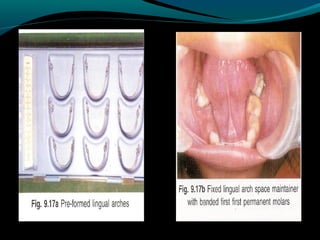
Complete arch
Lingual arch
Extra-oral anchorage
Individual tooth
3) Acc. To Hinrichsen-
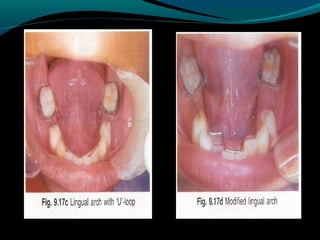
Fixed space maintainers-
CLASS I (a) Non-functional types-
i. Bar type.
ii. Loop type.
(b) Functional types-
i. Pontic type.
ii. Lingual arch
type.
CLASS II Cantilever type (distal shoe,band
& loop.)
Removable space maintainers-
Acrylic partial dentures
PLANNING FOR SPACE
MAINTENANCE
The following considerations are important to
the dentist when space maintenance is
considered after the untimely loss of primary
teeth-
a) Time elapsed since loss-
if space closure
occurs,it usually takes place during the first 6
months after the extraction.When a primary
tooth is removed & all factors indicate the
need for space maintenance,it is best to insert
an appliance as soon as possible after the
extraction.Often the best approach,if
possible,is to fabricate an appliance before the
extraction & deliver it at the extraction
appointment.
b) Dental age of the patient-
the chronologic age of
the patient is not so important as the
developmental age.Gron studied the
emergence of permanent teeth based on the
amount of root development,as viewed on
radiographs,at the time of emergence.she
found that teeth erupt when three-fourths
of the root is developed,regardless of the
child’s chronologic age.
c) Amount of bone covering the unerupted tooth-
if there is bone covering the crowns,it can be
readily predicted that eruption will not occur for
many months,a space-maintaining appliance is
indicated.
d) Sequence of eruption of teeth-
the dentist should observe the relationship of
developing & erupting teeth adjacent to the space
created by the untimely loss of a tooth.
e) Delayed eruption of the permanent tooth-
in case of impacted
permanent tooth,it is necessary to
extract the primary tooth,construct a
space maintainer & allow the permanent
tooth to erupt at its normal position.
If the permanent teeth in the
same area of the opposing dentition have
erupted,it is advisable to incorporate an
occlusal stop in the appliance to prevent
supraeruption in the opposing arch.
f) Congenital absence of the permanent tooth-
if permanent teeth are
congenitally absent,the dentist must decide
whether it is wise to hold the space for many
years until a fixed replacement can be provided
or it is better to allow the space to close.
If the decision is made to allow
the space to close,there will rarely if ever be
bodily movement of the teeth adjacent to the
space.Therefore,orthodontic treatment will be
needed to guide the teeth into a desirable
position.
g) Presentation of problems to parents-
take sufficient time to explain
existing conditions & discuss the possibility
of the development of a future malocclusion
if steps are not taken to maintain the space
or to guide the development of the
occlusion. Also explain that the space-
maintaining appliance will not correct an
existing malocclusion but will only prevent an
undesirable condition from becoming worse
or more complicated.
APPLIANCE
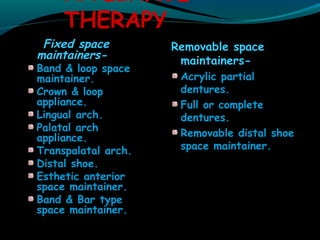
THERAPY
Fixed space
maintainers-
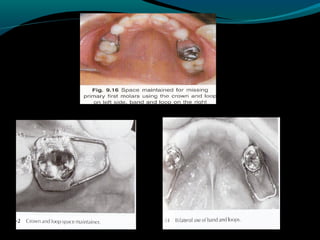
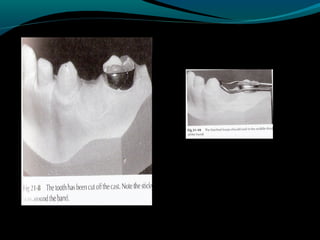
Band & loop space
maintainer.
Crown & loop
appliance.
Lingual arch.
Palatal arch
appliance.
Transpalatal arch.
Distal shoe.
Esthetic anterior
space maintainer.
Band & Bar type
space maintainer.
Removable space
maintainers-
Acrylic partial
dentures.
Full or complete
dentures.
Removable distal shoe
space maintainer.
Four appliances generally used to
maintain space in the primary
dentition are-
The Band & Loop
The Lingual Arch
The Distal Shoe
The Removable Appliance
Fixed Space
Maintainers
Space maintainers which are fixed or fitted onto the
teeth are called fixed space maintainers.
ADVANTAGES:
1. Bands and crowns are used which require minimum or
no tooth preparation.
2. They do not interfere with passive eruption of
abutment teeth.
3. Jaw growth is not hampered.
4. The Succedaneous permanent teeth are free to erupt
into the oral cavity.
5. They can be used in un-co-operative patients.
6. Masticatory functions is restored if pontics are
placed.
DISADVANTAGES:
1. Elaborate instrumentation with expert skill is
needed.
2. They may result in decalcification of tooth
material under the bands.
3. Supra eruption of opposing teeth can take place if
pontics are not used.
4. If pontics are used it can interfere with vertical
eruption of the abutment tooth & may prevent
eruption of replacing permanent teeth if patient fails
to report.
CONSTRUCTION-
The fixed space maintainer generally are
constituted of the following components-
a) Band
b) Loop / arch wire
c) Solder joint
d) Auxiliaries
BAND-
The band forms an important part of the
constructions of the various fixed appliances
several bands are employed such as-
1) Loop bands
2) Tailored bands
3) Preformed seamless bands
made of precious metal or chrome alloy.
Every band should possess a few ideal
criteria such that-
It should fit the contours of the tooth as
closely as possible,thereby enhancing the
placement of the attachment in relationship
to the tooth.
Should not extend subgingivally any more
than necessary.
Band material should resist deformation
under stresses in the mouth.
Resist tarnish.
Inherent springiness.
Cause no occlusal interference.
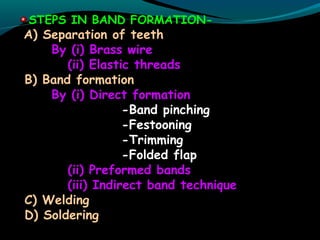
STEPS IN BAND FORMATION-
A) Separation of teeth
By (i) Brass wire
(ii) Elastic threads
B) Band formation
By (i) Direct formation
-Band pinching
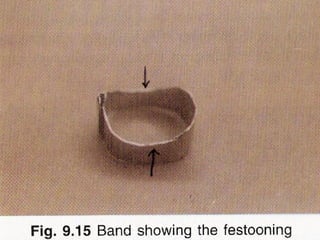
-Festooning
-Trimming
-Folded flap
(ii) Preformed bands
(iii) Indirect band technique
C) Welding
D) Soldering
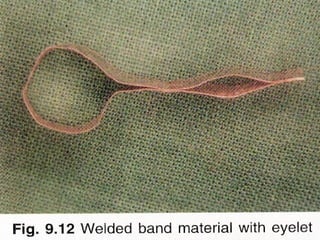
WELDING-
It is the process during which a portion of
the metal being joined is melted & flowed
together.
Bands are generally joined by welding.
SOLDERING-
It is the process by which the two metals
are joined together by an intermediary
metal of a lower fusion temperature.The
most common solder used is the silver solder
containing silver,zinc,copper & tin.
REMOVABLE
APPLIANCE
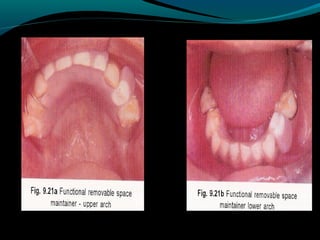
The appliance is typically used when more than
one tooth has been lost in a quadrant.
It is often the only alternative because there
are no suitable abutment teeth and bacause the
cantilever design of the distal shoe or the band
and loop is too weak to withstand occlusal forces
over a two-tooth span.
Not only can the partial denture replace more
than one tooth, it also can replace occlusal
function.
Two drawbacks of the appliance are retention
and compliance.
Advantages:
1. Easy to clean and permit maintainance of
proper oral hygiene.
2. Maintain or restore the vertical dimension.
3. Can be worn part time allowing circulation of
the blood to the soft tissues.
4. Room can be made for permanent teeth to
erupt without changing the appliance.
5. Stimulate eruption of permanent teeth.
6. Help in preventing development of tongue
thrust habit into the extraction space.
DISADVANTAGES:
1. May be lost or broken by the patient.
2. Un-co-operative patients may not
wear the appliance.
3. Lateral jaw growth may be restricted,
if clasps are incorporated.
4. May cause irritation of the undrelying
soft tissues.
Indication:
1.When aesthetics is of importance.
2.In case the abutment teeth cannot support a
fixed appliance.
3.In cleft palate patients who require obturation
of the palatal defect.
4.In case the radiograph reveals that the
unerupted permanent tooth is not going to erupt
in less than five months time.
5.If the permanent teeth have not fully erupted
it may be difficult to adapt bands.
6.Multiple loss of deciduous teeth which may
require functional replacement in the form of
either partial or complete dentures.
CONTRAINDICATIONS-
1.Lack of patient co-operation.
2.patients who are allergic to acrylic
material.
3.Epileptic patients.
BAND & LOOP APPLIANCE
(Fixed,Non functional,Passive space
maintainer)
It is used to maintain the space of a single
tooth.
Inexpensive & easy to fabricate.
It does not restore the occlusal function of
the missing tooth.
Indications
Unilateral loss of the primary first molar
before or after eruption of the permanent
first molar.
Bilateral loss of a primary molar before the
eruption of the permanent incisors.
LINGUAL ARCH
(Fixed,Non functional,Passive
Mandibular arch appliance)
Used to maintain the posterior space in
the primary dentition.
The lingual arch is often suggested when
teeth are lost in both quadrants of the
same arch.
Belong to those group of space control
appliances which not only control
anteroposterior movements but also are
capable of controlling & preventing an
arch perimeter distortion,by controlling
the lingual collapse of single tooth or
segments of the arch.
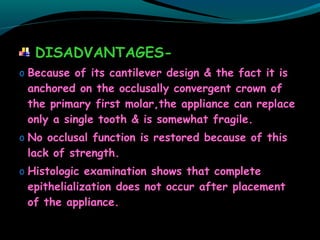
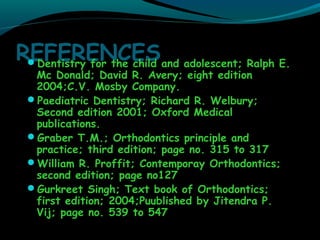
It consist of a round stainless steel or
precious alloy wire,0.32 to 0.40 inches in
diameter closely adapted to the lingual
surfaces of the teeth & anchored to bands
on the first permanent molars.
The means used to anchor the archwire to
the bands will define whether the lingual
arch is of a removable or fixed type.
Because the permanent incisor tooth buds
develop & erupt somewhat lingual to their
primary precursors,a conventional
mandibular lingual arch is not recommended
in the primary dentition (bilateral band &
loop appliances are recommended in this
situation.)
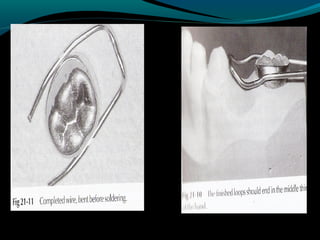
PASSIVATION-
The lingual archwire should be
completely passive.This is done by
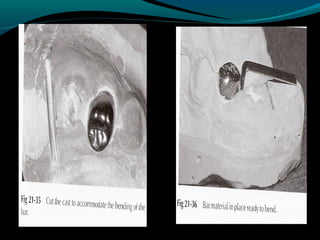
heating the wire to a dull brownish
appearance,while keeping the wire gently
in place on the cingula with an old
instrument.
The maxillary lingual arch is feasible in the primary
dentition because it can be constructed to rest
away from the incisors.
Two types of lingual arch designs are used to
maintain maxillary space-
the Nance arch.
the Transpalatal arches.
These appliances use a large wire(36 mil) to
connect the banded primary teeth on both sides of
the arch that are distal to the extraction site.
The difference b/w the two appliances amounts
to where the wire is placed in the palate.The
Nance arch incorporates an acrylic button that
rests directly on the palatal rugae.The
Transpalatal arch(TPA) is made from a wire that
traverses the palate directly without touching it.
NANCE ARCH or NANCE
SPACE HOLDING APPLIANCE
(Fixed,Non-
functional,Passive,Maxillary arch
appliance)
Nance(1947) described the “preventive
lingual wire”.
It consists of bands on the upper
molars,with the arch wire extending forward
into the vault.
CONSTRUCTION-
 The acrylic button is present on the
slope of the palate & provides an
excellent resistance against forward
movement(U loop).The wire should extend
from the lingual of bands to the deepest
& most anterior point in the middle of
hard palate.
 ‘U’ bend is given in the wire for the
retention of the acrylic 1-2mm away
from the soft tissue.
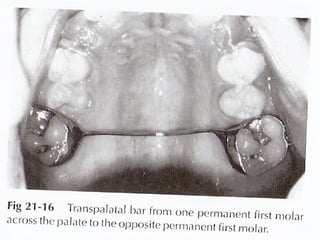
TRANSPALATAL ARCH
(Fixed,Non-functional,Passive
appliance)
The arch is soldered to both sides,straight
without a button & without touching the
palate.
The basis of the appliance is that the
migration & rotation is caused by rotation
around the lingual root.By preventing
this,space loss is prevented by the
appliance.
Cross arch anchorage can be used if only
one of the primary molars is lost & both the
permanent molars are erupted.
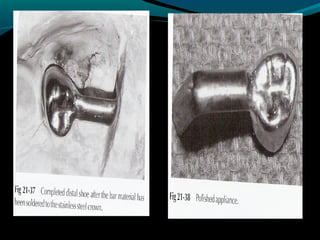
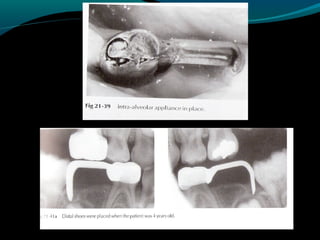
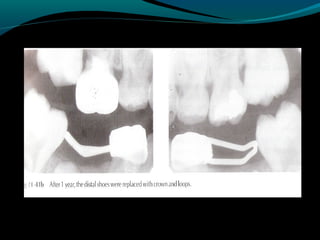
DISTAL SHOE
(Intra-alveolar,Eruption guidance
appliance)
o Used to maintain the space of a primary
second molar that has been lost before
the eruption of the permanent first
molar.
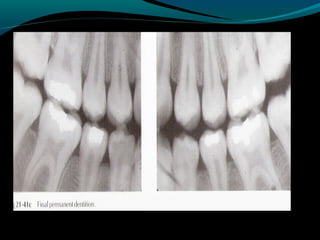
o An unerupted permanent first molar
drifts mesially within the alveolar bone if
the primary second molar is lost
prematurely.The result of the mesial
drifts is loss of arch length & possible
impaction of the second premolar.
DISADVANTAGES-
o Because of its cantilever design & the fact it is
anchored on the occlusally convergent crown of
the primary first molar,the appliance can replace
only a single tooth & is somewhat fragile.
o No occlusal function is restored because of this
lack of strength.
o Histologic examination shows that complete
epithelialization does not occur after placement
of the appliance.
REFERENCESDentistry for the child and adolescent; Ralph E.
Mc Donald; David R. Avery; eight edition
2004;C.V. Mosby Company.
Paediatric Dentistry; Richard R. Welbury;
Second edition 2001; Oxford Medical
publications.
Graber T.M.; Orthodontics principle and
practice; third edition; page no. 315 to 317
William R. Proffit; Contemporay Orthodontics;
second edition; page no127
Gurkreet Singh; Text book of Orthodontics;
first edition; 2004;Puublished by Jitendra P.
Vij; page no. 539 to 547

Spacemaintainerspedo 110901090650-phpapp01

  • 1.
  • 2.
    SPACE MAINTENANCE IN THEPRIMARY DENTITION Space maintenance can be defined as the provision of an appliance (active or passive ) which is concerned only with the control of space loss without taking into consideration measures to supervise the development of dentition.
  • 3.
    Space maintainers areappliances used to maintain space or regain minor amounts of space lost,so as to guide the unerupted tooth into a proper position in the arch.
  • 4.
    IDEAL REQUIREMENTS It shouldmaintain the entire mesio-distal space created by a lost tooth. It must restore the function as far as possible & prevent over-eruption of opposing teeth. It should be simple in construction. It should be strong enough to withstand the functional forces. It should not exert excessive stress on adjoining teeth. It must permit maintenance of oral hygiene. It must not restrict normal growth & development and natural adjustments which take place during the transition from deciduous to permanent dentition. It should not come in the way of other functions.
  • 5.
    CLASSIFICATION OF SPACE MAINTAINERS 1)Acc. To Hitchcock- Removable or fixed or semi-fixed. With bands or without bands. Functional or non-functional. Active or passive. Certain combinations of the above.
  • 6.
    2) Acc. ToRaymond C.Thurow- Removable Complete arch Lingual arch Extra-oral anchorage Individual tooth
  • 7.
    3) Acc. ToHinrichsen- Fixed space maintainers- CLASS I (a) Non-functional types- i. Bar type. ii. Loop type. (b) Functional types- i. Pontic type. ii. Lingual arch type. CLASS II Cantilever type (distal shoe,band & loop.) Removable space maintainers- Acrylic partial dentures
  • 8.
    PLANNING FOR SPACE MAINTENANCE Thefollowing considerations are important to the dentist when space maintenance is considered after the untimely loss of primary teeth- a) Time elapsed since loss- if space closure occurs,it usually takes place during the first 6 months after the extraction.When a primary tooth is removed & all factors indicate the need for space maintenance,it is best to insert an appliance as soon as possible after the extraction.Often the best approach,if possible,is to fabricate an appliance before the extraction & deliver it at the extraction appointment.
  • 9.
    b) Dental ageof the patient- the chronologic age of the patient is not so important as the developmental age.Gron studied the emergence of permanent teeth based on the amount of root development,as viewed on radiographs,at the time of emergence.she found that teeth erupt when three-fourths of the root is developed,regardless of the child’s chronologic age.
  • 10.
    c) Amount ofbone covering the unerupted tooth- if there is bone covering the crowns,it can be readily predicted that eruption will not occur for many months,a space-maintaining appliance is indicated. d) Sequence of eruption of teeth- the dentist should observe the relationship of developing & erupting teeth adjacent to the space created by the untimely loss of a tooth.
  • 11.
    e) Delayed eruptionof the permanent tooth- in case of impacted permanent tooth,it is necessary to extract the primary tooth,construct a space maintainer & allow the permanent tooth to erupt at its normal position. If the permanent teeth in the same area of the opposing dentition have erupted,it is advisable to incorporate an occlusal stop in the appliance to prevent supraeruption in the opposing arch.
  • 12.
    f) Congenital absenceof the permanent tooth- if permanent teeth are congenitally absent,the dentist must decide whether it is wise to hold the space for many years until a fixed replacement can be provided or it is better to allow the space to close. If the decision is made to allow the space to close,there will rarely if ever be bodily movement of the teeth adjacent to the space.Therefore,orthodontic treatment will be needed to guide the teeth into a desirable position.
  • 13.
    g) Presentation ofproblems to parents- take sufficient time to explain existing conditions & discuss the possibility of the development of a future malocclusion if steps are not taken to maintain the space or to guide the development of the occlusion. Also explain that the space- maintaining appliance will not correct an existing malocclusion but will only prevent an undesirable condition from becoming worse or more complicated.
  • 14.
    APPLIANCE THERAPY Fixed space maintainers- Band &loop space maintainer. Crown & loop appliance. Lingual arch. Palatal arch appliance. Transpalatal arch. Distal shoe. Esthetic anterior space maintainer. Band & Bar type space maintainer. Removable space maintainers- Acrylic partial dentures. Full or complete dentures. Removable distal shoe space maintainer.
  • 15.
    Four appliances generallyused to maintain space in the primary dentition are- The Band & Loop The Lingual Arch The Distal Shoe The Removable Appliance
  • 16.
    Fixed Space Maintainers Space maintainerswhich are fixed or fitted onto the teeth are called fixed space maintainers. ADVANTAGES: 1. Bands and crowns are used which require minimum or no tooth preparation. 2. They do not interfere with passive eruption of abutment teeth. 3. Jaw growth is not hampered. 4. The Succedaneous permanent teeth are free to erupt into the oral cavity. 5. They can be used in un-co-operative patients. 6. Masticatory functions is restored if pontics are placed.
  • 17.
    DISADVANTAGES: 1. Elaborate instrumentationwith expert skill is needed. 2. They may result in decalcification of tooth material under the bands. 3. Supra eruption of opposing teeth can take place if pontics are not used. 4. If pontics are used it can interfere with vertical eruption of the abutment tooth & may prevent eruption of replacing permanent teeth if patient fails to report.
  • 18.
    CONSTRUCTION- The fixed spacemaintainer generally are constituted of the following components- a) Band b) Loop / arch wire c) Solder joint d) Auxiliaries
  • 19.
    BAND- The band formsan important part of the constructions of the various fixed appliances several bands are employed such as- 1) Loop bands 2) Tailored bands 3) Preformed seamless bands made of precious metal or chrome alloy.
  • 20.
    Every band shouldpossess a few ideal criteria such that- It should fit the contours of the tooth as closely as possible,thereby enhancing the placement of the attachment in relationship to the tooth. Should not extend subgingivally any more than necessary. Band material should resist deformation under stresses in the mouth. Resist tarnish. Inherent springiness. Cause no occlusal interference.
  • 21.
    STEPS IN BANDFORMATION- A) Separation of teeth By (i) Brass wire (ii) Elastic threads B) Band formation By (i) Direct formation -Band pinching -Festooning -Trimming -Folded flap (ii) Preformed bands (iii) Indirect band technique C) Welding D) Soldering
  • 23.
    WELDING- It is theprocess during which a portion of the metal being joined is melted & flowed together. Bands are generally joined by welding.
  • 25.
    SOLDERING- It is theprocess by which the two metals are joined together by an intermediary metal of a lower fusion temperature.The most common solder used is the silver solder containing silver,zinc,copper & tin.
  • 26.
    REMOVABLE APPLIANCE The appliance istypically used when more than one tooth has been lost in a quadrant. It is often the only alternative because there are no suitable abutment teeth and bacause the cantilever design of the distal shoe or the band and loop is too weak to withstand occlusal forces over a two-tooth span. Not only can the partial denture replace more than one tooth, it also can replace occlusal function. Two drawbacks of the appliance are retention and compliance.
  • 29.
    Advantages: 1. Easy toclean and permit maintainance of proper oral hygiene. 2. Maintain or restore the vertical dimension. 3. Can be worn part time allowing circulation of the blood to the soft tissues. 4. Room can be made for permanent teeth to erupt without changing the appliance. 5. Stimulate eruption of permanent teeth. 6. Help in preventing development of tongue thrust habit into the extraction space.
  • 30.
    DISADVANTAGES: 1. May belost or broken by the patient. 2. Un-co-operative patients may not wear the appliance. 3. Lateral jaw growth may be restricted, if clasps are incorporated. 4. May cause irritation of the undrelying soft tissues.
  • 31.
    Indication: 1.When aesthetics isof importance. 2.In case the abutment teeth cannot support a fixed appliance. 3.In cleft palate patients who require obturation of the palatal defect. 4.In case the radiograph reveals that the unerupted permanent tooth is not going to erupt in less than five months time. 5.If the permanent teeth have not fully erupted it may be difficult to adapt bands. 6.Multiple loss of deciduous teeth which may require functional replacement in the form of either partial or complete dentures.
  • 32.
    CONTRAINDICATIONS- 1.Lack of patientco-operation. 2.patients who are allergic to acrylic material. 3.Epileptic patients.
  • 33.
    BAND & LOOPAPPLIANCE (Fixed,Non functional,Passive space maintainer) It is used to maintain the space of a single tooth. Inexpensive & easy to fabricate. It does not restore the occlusal function of the missing tooth.
  • 35.
    Indications Unilateral loss ofthe primary first molar before or after eruption of the permanent first molar. Bilateral loss of a primary molar before the eruption of the permanent incisors.
  • 39.
    LINGUAL ARCH (Fixed,Non functional,Passive Mandibulararch appliance) Used to maintain the posterior space in the primary dentition. The lingual arch is often suggested when teeth are lost in both quadrants of the same arch. Belong to those group of space control appliances which not only control anteroposterior movements but also are capable of controlling & preventing an arch perimeter distortion,by controlling the lingual collapse of single tooth or segments of the arch.
  • 40.
    It consist ofa round stainless steel or precious alloy wire,0.32 to 0.40 inches in diameter closely adapted to the lingual surfaces of the teeth & anchored to bands on the first permanent molars. The means used to anchor the archwire to the bands will define whether the lingual arch is of a removable or fixed type. Because the permanent incisor tooth buds develop & erupt somewhat lingual to their primary precursors,a conventional mandibular lingual arch is not recommended in the primary dentition (bilateral band & loop appliances are recommended in this situation.)
  • 42.
    PASSIVATION- The lingual archwireshould be completely passive.This is done by heating the wire to a dull brownish appearance,while keeping the wire gently in place on the cingula with an old instrument.
  • 44.
    The maxillary lingualarch is feasible in the primary dentition because it can be constructed to rest away from the incisors. Two types of lingual arch designs are used to maintain maxillary space- the Nance arch. the Transpalatal arches. These appliances use a large wire(36 mil) to connect the banded primary teeth on both sides of the arch that are distal to the extraction site. The difference b/w the two appliances amounts to where the wire is placed in the palate.The Nance arch incorporates an acrylic button that rests directly on the palatal rugae.The Transpalatal arch(TPA) is made from a wire that traverses the palate directly without touching it.
  • 45.
    NANCE ARCH orNANCE SPACE HOLDING APPLIANCE (Fixed,Non- functional,Passive,Maxillary arch appliance) Nance(1947) described the “preventive lingual wire”. It consists of bands on the upper molars,with the arch wire extending forward into the vault.
  • 46.
    CONSTRUCTION-  The acrylicbutton is present on the slope of the palate & provides an excellent resistance against forward movement(U loop).The wire should extend from the lingual of bands to the deepest & most anterior point in the middle of hard palate.  ‘U’ bend is given in the wire for the retention of the acrylic 1-2mm away from the soft tissue.
  • 47.
    TRANSPALATAL ARCH (Fixed,Non-functional,Passive appliance) The archis soldered to both sides,straight without a button & without touching the palate. The basis of the appliance is that the migration & rotation is caused by rotation around the lingual root.By preventing this,space loss is prevented by the appliance. Cross arch anchorage can be used if only one of the primary molars is lost & both the permanent molars are erupted.
  • 49.
    DISTAL SHOE (Intra-alveolar,Eruption guidance appliance) oUsed to maintain the space of a primary second molar that has been lost before the eruption of the permanent first molar. o An unerupted permanent first molar drifts mesially within the alveolar bone if the primary second molar is lost prematurely.The result of the mesial drifts is loss of arch length & possible impaction of the second premolar.
  • 54.
    DISADVANTAGES- o Because ofits cantilever design & the fact it is anchored on the occlusally convergent crown of the primary first molar,the appliance can replace only a single tooth & is somewhat fragile. o No occlusal function is restored because of this lack of strength. o Histologic examination shows that complete epithelialization does not occur after placement of the appliance.
  • 55.
    REFERENCESDentistry for thechild and adolescent; Ralph E. Mc Donald; David R. Avery; eight edition 2004;C.V. Mosby Company. Paediatric Dentistry; Richard R. Welbury; Second edition 2001; Oxford Medical publications. Graber T.M.; Orthodontics principle and practice; third edition; page no. 315 to 317 William R. Proffit; Contemporay Orthodontics; second edition; page no127 Gurkreet Singh; Text book of Orthodontics; first edition; 2004;Puublished by Jitendra P. Vij; page no. 539 to 547