Lingual Holding Arch
Space Maintainer
• Presented by:
Jigyasha Timsina
Contents
• Introduction
• Indication and contraindication
• Advantages and disadvantages
• Fabrication
• Modification
• Patient Instruction
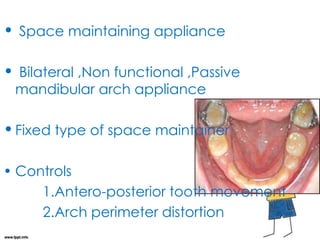
• Space maintaining appliance
• Bilateral ,Non functional ,Passive
mandibular arch appliance
•Fixed type of space maintainer
• Controls
1.Antero-posterior tooth movement
2.Arch perimeter distortion
CONTRAINDICATION
 Before the eruption
of mandibular incisors
INDICATIONS
 Bilateral loss of posterior
teeth
 Minor movement of
anterior teeth
 Maintenance of leeway
space
 Space regaining
Advantage
 Many modifications
are possible
Can also be used to
regain space
Disadvantage
Construction is difficult
Chances of distortion
of appliance by tongue
pressure
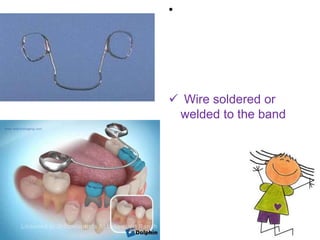
• Consists of :
1.round stainless steel or precious alloy
wire (0.32 to 0.40 inches in diameter)
2.molar bands -most commonly on
permanent first molar rarely second
deciduous molar
•
 Wire soldered or
welded to the band
Fabrication
 Bands are adapted to the most posterior
tooth remaining on the arch
A pick up alginate impression is taken.
 pre fabricated wire placed or soldered to
the band or can be custom made in lab
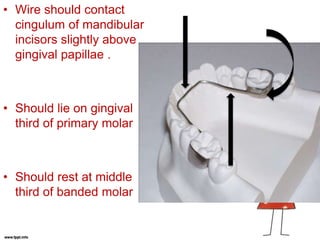
• Wire should contact
cingulum of mandibular
incisors slightly above
gingival papillae .
• Should lie on gingival
third of primary molar
• Should rest at middle
third of banded molar
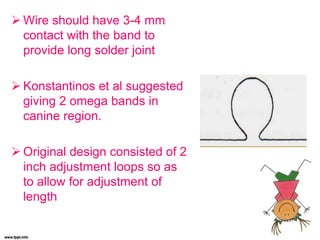
 Wire should have 3-4 mm
contact with the band to
provide long solder joint
 Konstantinos et al suggested
giving 2 omega bands in
canine region.
 Original design consisted of 2
inch adjustment loops so as
to allow for adjustment of
length
• Passivation
achieved by heating the wire to dull
brownish appearance
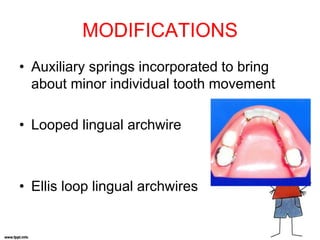
MODIFICATIONS
• Auxiliary springs incorporated to bring
about minor individual tooth movement
• Looped lingual archwire
• Ellis loop lingual archwires
Instruction to the patients
• Brush teeth at least 2 times daily.
• Use a water pick or floss to remove food
caught underneath the appliance.
• Contact if bands come loose or anything
breaks or wire gets bent.
• Warm salt water rinses for sores.
• 'Rescue' wax for bands until cheeks get
used to new appliance
References
• Textbook of Pediatric Dentistry
-Nikhil Marwah
• Text book of Pedodontics
-Shova Tandon
• Internet sources
lingual holding arch space maintainer

lingual holding arch space maintainer

  • 1.
    Lingual Holding Arch SpaceMaintainer • Presented by: Jigyasha Timsina
  • 2.
    Contents • Introduction • Indicationand contraindication • Advantages and disadvantages • Fabrication • Modification • Patient Instruction
  • 3.
    • Space maintainingappliance • Bilateral ,Non functional ,Passive mandibular arch appliance •Fixed type of space maintainer • Controls 1.Antero-posterior tooth movement 2.Arch perimeter distortion
  • 4.
    CONTRAINDICATION  Before theeruption of mandibular incisors INDICATIONS  Bilateral loss of posterior teeth  Minor movement of anterior teeth  Maintenance of leeway space  Space regaining
  • 5.
    Advantage  Many modifications arepossible Can also be used to regain space Disadvantage Construction is difficult Chances of distortion of appliance by tongue pressure
  • 6.
    • Consists of: 1.round stainless steel or precious alloy wire (0.32 to 0.40 inches in diameter) 2.molar bands -most commonly on permanent first molar rarely second deciduous molar
  • 7.
    •  Wire solderedor welded to the band
  • 8.
    Fabrication  Bands areadapted to the most posterior tooth remaining on the arch A pick up alginate impression is taken.  pre fabricated wire placed or soldered to the band or can be custom made in lab
  • 9.
    • Wire shouldcontact cingulum of mandibular incisors slightly above gingival papillae . • Should lie on gingival third of primary molar • Should rest at middle third of banded molar
  • 10.
     Wire shouldhave 3-4 mm contact with the band to provide long solder joint  Konstantinos et al suggested giving 2 omega bands in canine region.  Original design consisted of 2 inch adjustment loops so as to allow for adjustment of length
  • 11.
    • Passivation achieved byheating the wire to dull brownish appearance
  • 12.
    MODIFICATIONS • Auxiliary springsincorporated to bring about minor individual tooth movement • Looped lingual archwire • Ellis loop lingual archwires
  • 13.
    Instruction to thepatients • Brush teeth at least 2 times daily. • Use a water pick or floss to remove food caught underneath the appliance. • Contact if bands come loose or anything breaks or wire gets bent. • Warm salt water rinses for sores. • 'Rescue' wax for bands until cheeks get used to new appliance
  • 14.
    References • Textbook ofPediatric Dentistry -Nikhil Marwah • Text book of Pedodontics -Shova Tandon • Internet sources