PROF (Dr.) SAIBEL FARISHTA
SPACE MAINTAINERS
DEFINATION
IT IS AN APPLIANCE GIVEN TO
MAINTAIN THE SPACE WHICH IS
LOST PREMATURELY.
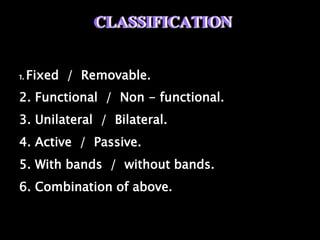
CLASSIFICATION
1. Fixed / Removable.
2. Functional / Non - functional.
3. Unilateral / Bilateral.
4. Active / Passive.
5. With bands / without bands.
6. Combination of above.
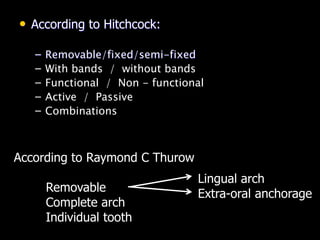
• According to Hitchcock:
– Removable/fixed/semi-fixed
– With bands / without bands
– Functional / Non - functional
– Active / Passive
– Combinations
According to Raymond C Thurow
Removable
Complete arch
Individual tooth
Lingual arch
Extra-oral anchorage
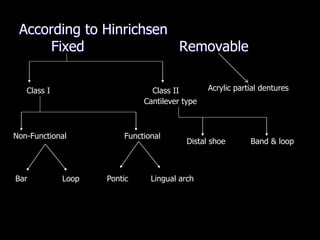
According to Hinrichsen
Fixed Removable
Acrylic partial denturesClass I Class II
Non-Functional Functional
Bar Loop Pontic Lingual arch
Cantilever type
Distal shoe Band & loop
Requirements of Space maintainer
• To maintain M-D dimension created by lost tooth
• Must restore function as far as possible
• Prevent over eruption of opposing teeth
• Simple in construction
• Strong to withstand functional forces
• Should not exert excessive stress on adjoining
teeth
• Must permit oral hygiene maintenance
• Should not restrict normal growth &
development & natural adjustments which take
place during the transition from deciduous to
permanent dentition
Removable Space Maintainers
Helps in-
• Mastication
• Speech
• Esthetics
• To prevent space closure
Advantages
• Easy to clean
• Permits oral hygiene maintenance
• Can be worn part time allowing circulation of blood to
soft tissue
• Serve other function like mastication, phonetics &
esthetics
• Dental check-up for caries detection- possible
• Room for permanent teeth to erupt without changing the
appliance
• Stimulate eruption of permanent teeth
• Band construction is necessary
• Help prevent development of tongue thrust habit into
extraction space
Disadvantage:
• May be lost or broken
• Not effective in un-cooperative patients
• Lateral jaw growth may be restricted if clasps
are incorporated
• May cause irritation of underlying soft tissue
Contraindications
• Cannot be used in case of acrylic allergy
• Cannot be used in case of epileptic patients who
have uncontrolled seizures
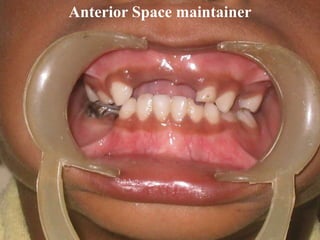
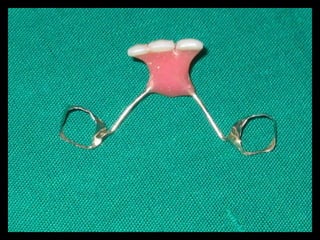
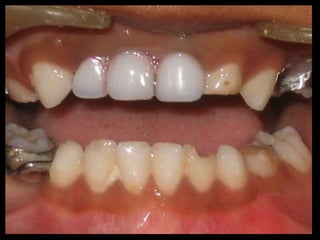
If anteriors are missing ?????
Actually there is no needof treatment,
But…… considering Esthetics, speech, and psychological aspects………..
•Fixed,
•Bilateral,
•Functional,
•Passive,
•Withbands.
Anterior Space maintainer
Fixed Space maintainers
Advantages:
• Bands & crown are used which require minimum
or no tooth preparation
• Do not interfere with passive eruption of
abutment tooth
• Jaw growth is not hampered
• Succedaneous permanent tooth is free to erupt
• Can be used in uncooperative patients
• Masticatory functions is restored if pontics is
placed
Disadvantages:
• Elaborate instrumentation with expert
skills needed
• May result in decalcification of tooth
material under the bands
• Supra eruption of opposing teeth can take
place if pontics are not used
• If pontics are used it can interfere with
vertical eruption of abutment tooth & may
prevent eruption o for placing permanent
teeth if the patient fails to report
• E.g. of fixed space maintainers
– Band & loop
– Crown & loop
– Lingual arch
– Palatal arch appliance
– Trans palatal arch
– Distal shoe space maintainer
– Esthetic anterior space maintainer
– Band & bar type
DISTAL SHOE APPLIANCE
INDICATION
GIVENWHEN‘E’ IS EXTRACTED BEFORE THE
ERUPTIONOF ‘ 6 ‘
ALSO CALLED AS
- ERUPTION GUDING APPLIANCE
- WILLETTE‘S APPLIANCE
- INTRAGINGIVAL APPLIANCE
- ROCHE’S APPLIANCE
- MODIFIED ROCHE’S APPLIANCE
- STARKEYS APPLIANCE [ REMOVABLE DS]
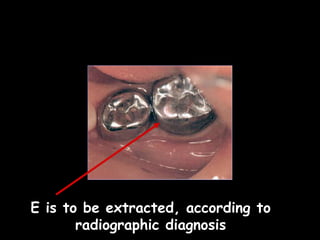
E is to be extracted, according to
radiographic diagnosis
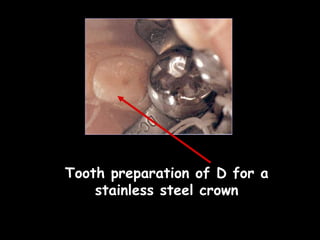
Tooth preparation of D for a
stainless steel crown
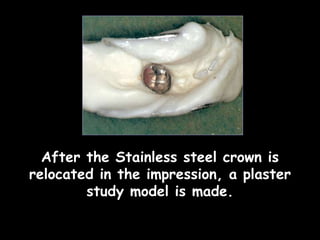
After the Stainless steel crown is
relocated in the impression, a plaster
study model is made.
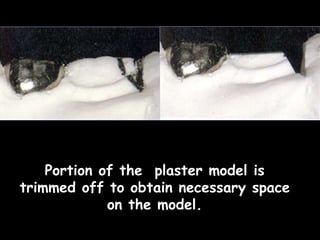
Portion of the plaster model is
trimmed off to obtain necessary space
on the model.
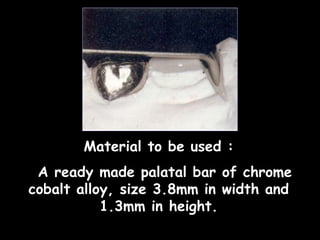
Material to be used :
A ready made palatal bar of chrome
cobalt alloy, size 3.8mm in width and
1.3mm in height.
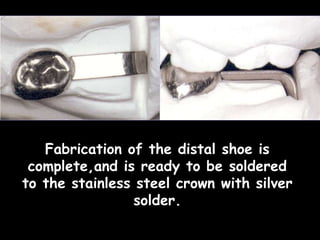
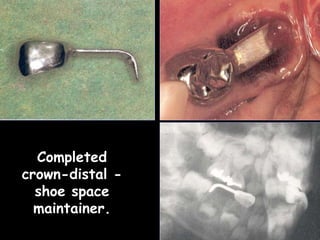
Fabrication of the distal shoe is
complete,and is ready to be soldered
to the stainless steel crown with silver
solder.
Completed
crown-distal -
shoe space
maintainer.
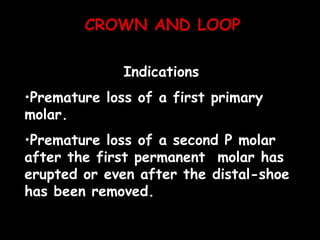
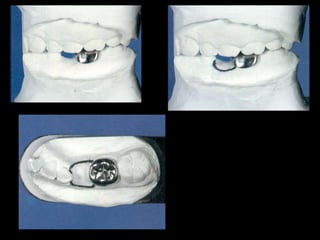
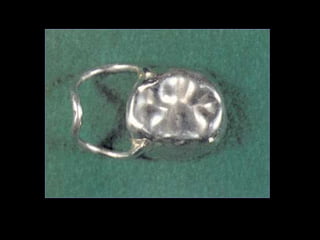
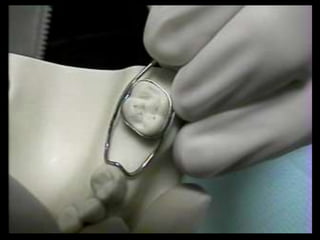
CROWN AND LOOP
Indications
•Premature loss of a first primary
molar.
•Premature loss of a second P molar
after the first permanent molar has
erupted or even after the distal-shoe
has been removed.
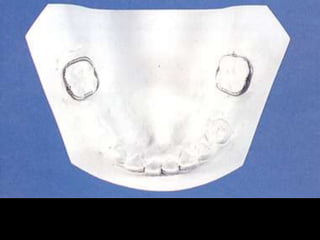
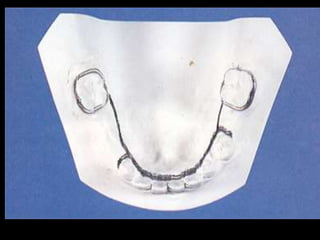
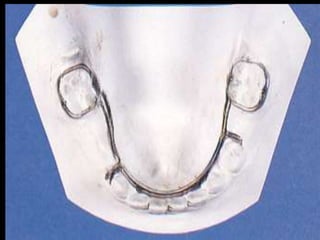
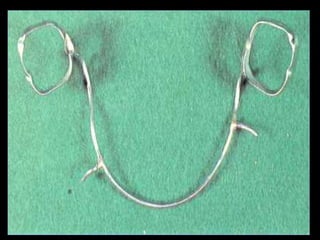
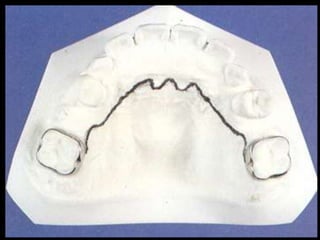
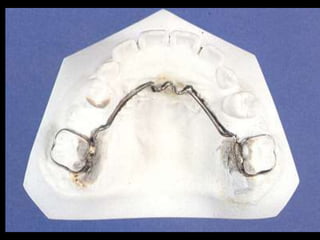
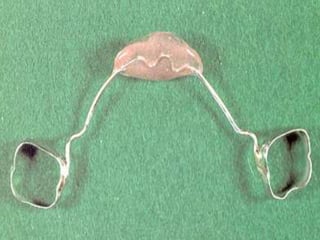
Passive lingual
arch
Nance appliance
Band and loop
Space
maintainer
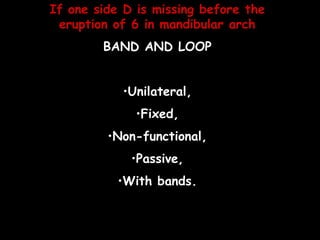
If one side D is missing before the
eruption of 6 in mandibular arch
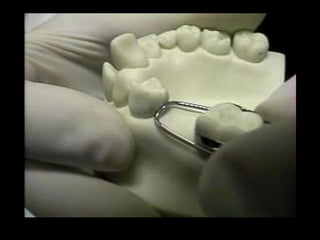
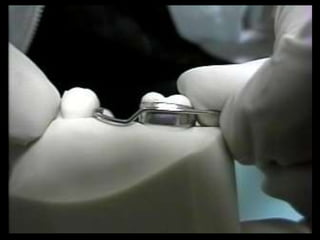
BAND AND LOOP
•Unilateral,
•Fixed,
•Non-functional,
•Passive,
•With bands.
IDEAL REQUIREMENTS :
--- Should maintain the mesiodistal
dimension of the tooth
--- Should not interfere with eruption of
adjacent teeth or permanent teeth
--- Should prevent supraeruption of
opposing tooth.
--- Should provide mesiodistal space
opening, if required
--- Maintain functional movements of teeth
Planning for Space maintainer
Following factors should be considered
• Time elapsed since the lost of tooth:
– Advised to place as soon as the primary tooth is removed
– Studies indicate maximum space lost with in 6 months.
• Dental Age of the patient:
– Should always be considered rather than chronological age
because of the variation in eruption of teeth observed
• Thickness of bone covering the un-erupted tooth
– The more the bone covering the un-erupted tooth the
more the time it would take to erupt
– Normally premolars take 4-5 months to erupt through a
bone of 1mm
• Sequence of eruption of teeth
– Space maintainer is planned in adequate
consideration is given to adjacent developing
& erupting teeth
– Neighboring dentition greatly influence the
closure of space. ( Mesial migration)
• Congenital absence of permanent tooth
– If congenital missing-should decide retain the
space for replacement
Thank You

Space Maintainers

  • 1.
    PROF (Dr.) SAIBELFARISHTA SPACE MAINTAINERS
  • 2.
    DEFINATION IT IS ANAPPLIANCE GIVEN TO MAINTAIN THE SPACE WHICH IS LOST PREMATURELY.
  • 3.
    CLASSIFICATION 1. Fixed /Removable. 2. Functional / Non - functional. 3. Unilateral / Bilateral. 4. Active / Passive. 5. With bands / without bands. 6. Combination of above.
  • 4.
    • According toHitchcock: – Removable/fixed/semi-fixed – With bands / without bands – Functional / Non - functional – Active / Passive – Combinations According to Raymond C Thurow Removable Complete arch Individual tooth Lingual arch Extra-oral anchorage
  • 5.
    According to Hinrichsen FixedRemovable Acrylic partial denturesClass I Class II Non-Functional Functional Bar Loop Pontic Lingual arch Cantilever type Distal shoe Band & loop
  • 6.
    Requirements of Spacemaintainer • To maintain M-D dimension created by lost tooth • Must restore function as far as possible • Prevent over eruption of opposing teeth • Simple in construction • Strong to withstand functional forces • Should not exert excessive stress on adjoining teeth • Must permit oral hygiene maintenance • Should not restrict normal growth & development & natural adjustments which take place during the transition from deciduous to permanent dentition
  • 7.
    Removable Space Maintainers Helpsin- • Mastication • Speech • Esthetics • To prevent space closure
  • 8.
    Advantages • Easy toclean • Permits oral hygiene maintenance • Can be worn part time allowing circulation of blood to soft tissue • Serve other function like mastication, phonetics & esthetics • Dental check-up for caries detection- possible • Room for permanent teeth to erupt without changing the appliance • Stimulate eruption of permanent teeth • Band construction is necessary • Help prevent development of tongue thrust habit into extraction space
  • 9.
    Disadvantage: • May belost or broken • Not effective in un-cooperative patients • Lateral jaw growth may be restricted if clasps are incorporated • May cause irritation of underlying soft tissue Contraindications • Cannot be used in case of acrylic allergy • Cannot be used in case of epileptic patients who have uncontrolled seizures
  • 10.
    If anteriors aremissing ????? Actually there is no needof treatment, But…… considering Esthetics, speech, and psychological aspects……….. •Fixed, •Bilateral, •Functional, •Passive, •Withbands.
  • 11.
  • 14.
    Fixed Space maintainers Advantages: •Bands & crown are used which require minimum or no tooth preparation • Do not interfere with passive eruption of abutment tooth • Jaw growth is not hampered • Succedaneous permanent tooth is free to erupt • Can be used in uncooperative patients • Masticatory functions is restored if pontics is placed
  • 15.
    Disadvantages: • Elaborate instrumentationwith expert skills needed • May result in decalcification of tooth material under the bands • Supra eruption of opposing teeth can take place if pontics are not used • If pontics are used it can interfere with vertical eruption of abutment tooth & may prevent eruption o for placing permanent teeth if the patient fails to report
  • 16.
    • E.g. offixed space maintainers – Band & loop – Crown & loop – Lingual arch – Palatal arch appliance – Trans palatal arch – Distal shoe space maintainer – Esthetic anterior space maintainer – Band & bar type
  • 17.
    DISTAL SHOE APPLIANCE INDICATION GIVENWHEN‘E’IS EXTRACTED BEFORE THE ERUPTIONOF ‘ 6 ‘ ALSO CALLED AS - ERUPTION GUDING APPLIANCE - WILLETTE‘S APPLIANCE - INTRAGINGIVAL APPLIANCE - ROCHE’S APPLIANCE - MODIFIED ROCHE’S APPLIANCE - STARKEYS APPLIANCE [ REMOVABLE DS]
  • 18.
    E is tobe extracted, according to radiographic diagnosis
  • 19.
    Tooth preparation ofD for a stainless steel crown
  • 20.
    After the Stainlesssteel crown is relocated in the impression, a plaster study model is made.
  • 21.
    Portion of theplaster model is trimmed off to obtain necessary space on the model.
  • 22.
    Material to beused : A ready made palatal bar of chrome cobalt alloy, size 3.8mm in width and 1.3mm in height.
  • 23.
    Fabrication of thedistal shoe is complete,and is ready to be soldered to the stainless steel crown with silver solder.
  • 24.
  • 25.
    CROWN AND LOOP Indications •Prematureloss of a first primary molar. •Premature loss of a second P molar after the first permanent molar has erupted or even after the distal-shoe has been removed.
  • 28.
  • 33.
  • 37.
  • 38.
    If one sideD is missing before the eruption of 6 in mandibular arch BAND AND LOOP •Unilateral, •Fixed, •Non-functional, •Passive, •With bands.
  • 39.
    IDEAL REQUIREMENTS : ---Should maintain the mesiodistal dimension of the tooth --- Should not interfere with eruption of adjacent teeth or permanent teeth --- Should prevent supraeruption of opposing tooth. --- Should provide mesiodistal space opening, if required --- Maintain functional movements of teeth
  • 43.
    Planning for Spacemaintainer Following factors should be considered • Time elapsed since the lost of tooth: – Advised to place as soon as the primary tooth is removed – Studies indicate maximum space lost with in 6 months. • Dental Age of the patient: – Should always be considered rather than chronological age because of the variation in eruption of teeth observed • Thickness of bone covering the un-erupted tooth – The more the bone covering the un-erupted tooth the more the time it would take to erupt – Normally premolars take 4-5 months to erupt through a bone of 1mm
  • 44.
    • Sequence oferuption of teeth – Space maintainer is planned in adequate consideration is given to adjacent developing & erupting teeth – Neighboring dentition greatly influence the closure of space. ( Mesial migration) • Congenital absence of permanent tooth – If congenital missing-should decide retain the space for replacement
  • 45.