Soundness Test of
Aggregates
 This test is used to determine
the resistance of aggregates to
disintegrate by saturated
solutions of sodium sulphate
or magnesium sulphate.
 This Test is easy but time
consuming.
Introduction:
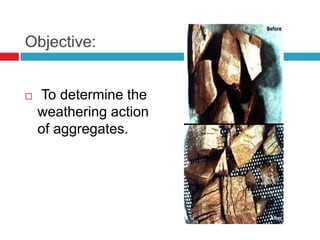
Objective:
 To determine the
weathering action
of aggregates.
Apparatus & Materials Required:
 Sample container
 Weighing
machine
 Drying oven
 Immersion tank
 Coarse Aggregates
 Sodium
Sulphate(Na2So4)
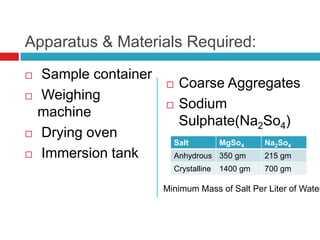
Salt MgSo4 Na2So4
Anhydrous 350 gm 215 gm
Crystalline 1400 gm 700 gm
Minimum Mass of Salt Per Liter of Water
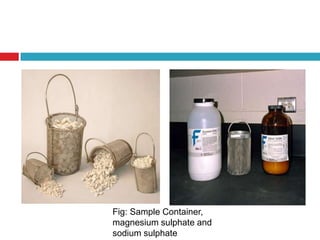
Fig: Sample Container,
magnesium sulphate and
sodium sulphate
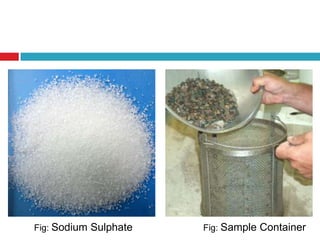
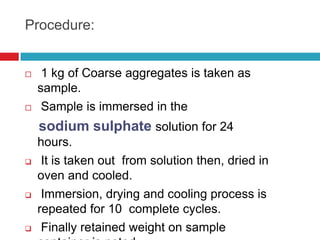
Fig: Sodium Sulphate Fig: Sample Container
Procedure:
 1 kg of Coarse aggregates is taken as
sample.
 Sample is immersed in the
sodium sulphate solution for 24
hours.
 It is taken out from solution then, dried in
oven and cooled.
 Immersion, drying and cooling process is
repeated for 10 complete cycles.
 Finally retained weight on sample
Observation & Calculation:
Percentage loss = *100 %
W0-W1
W0
Where, w0 = initial wt of sample
w1= final retained wt on sample
container after 10 cycles
For example:
Let w0=100 gm
w1= 82 gm
Then, percentage loss = [(100-82)/100] *100 %
= 18 % which is less than 25%
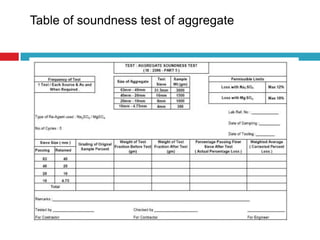
Table of soundness test of aggregate
Discussion & Conclusion:
Since no. of cycles is 10 and re-agent
used is Na2So4 so the maximum
percentage loss is 25%.
When the percentage loss is greater
than 25% then, this test shows that
aggregate undergoes weathering process
which ultimately decreases bearing
strength. Hence, such aggregates cannot
be used in road pavement.
Aggregate having percentage loss less
than 25% is used in road pavement.
Soundness test

Soundness test

  • 1.
    Soundness Test of Aggregates This test is used to determine the resistance of aggregates to disintegrate by saturated solutions of sodium sulphate or magnesium sulphate.  This Test is easy but time consuming. Introduction:
  • 2.
    Objective:  To determinethe weathering action of aggregates.
  • 3.
    Apparatus & MaterialsRequired:  Sample container  Weighing machine  Drying oven  Immersion tank  Coarse Aggregates  Sodium Sulphate(Na2So4) Salt MgSo4 Na2So4 Anhydrous 350 gm 215 gm Crystalline 1400 gm 700 gm Minimum Mass of Salt Per Liter of Water
  • 4.
    Fig: Sample Container, magnesiumsulphate and sodium sulphate
  • 5.
    Fig: Sodium SulphateFig: Sample Container
  • 6.
    Procedure:  1 kgof Coarse aggregates is taken as sample.  Sample is immersed in the sodium sulphate solution for 24 hours.  It is taken out from solution then, dried in oven and cooled.  Immersion, drying and cooling process is repeated for 10 complete cycles.  Finally retained weight on sample
  • 7.
    Observation & Calculation: Percentageloss = *100 % W0-W1 W0 Where, w0 = initial wt of sample w1= final retained wt on sample container after 10 cycles For example: Let w0=100 gm w1= 82 gm Then, percentage loss = [(100-82)/100] *100 % = 18 % which is less than 25%
  • 8.
    Table of soundnesstest of aggregate
  • 9.
    Discussion & Conclusion: Sinceno. of cycles is 10 and re-agent used is Na2So4 so the maximum percentage loss is 25%. When the percentage loss is greater than 25% then, this test shows that aggregate undergoes weathering process which ultimately decreases bearing strength. Hence, such aggregates cannot be used in road pavement. Aggregate having percentage loss less than 25% is used in road pavement.