

Some Basic
concept of
chemistry
What is chemistry?
Physical and chemical method
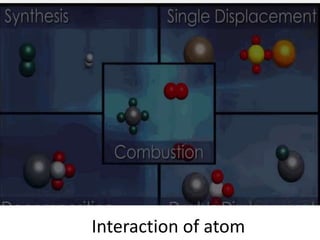
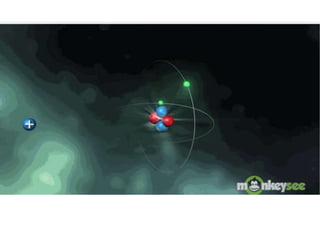
Interaction of atom
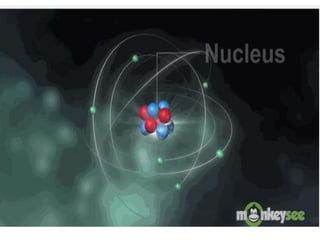
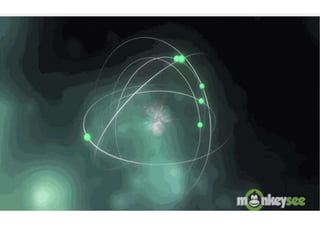
What is atom?
Atomic Number and Atomic mass no. ?
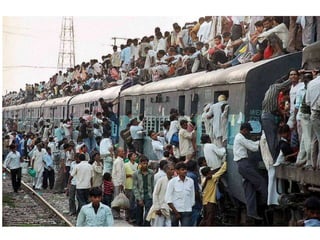
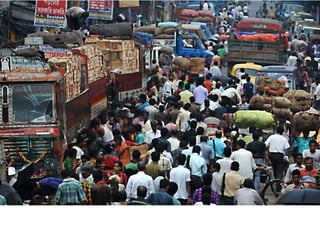
‘Anna, vastra ani nivara’
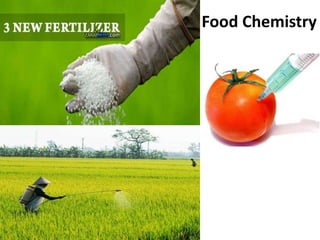
Food Chemistry
Cloth
Cloth
chemistry
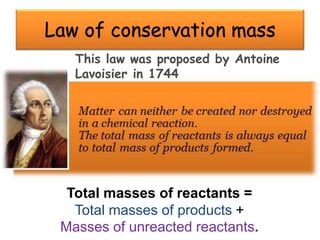
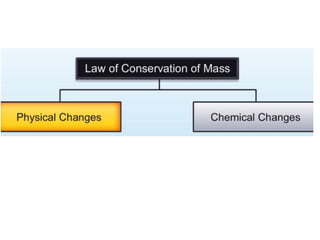
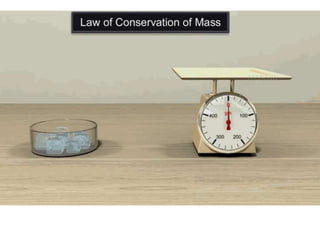
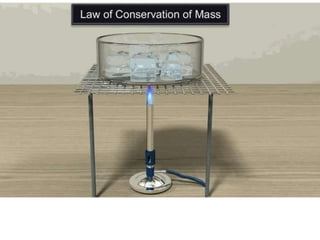
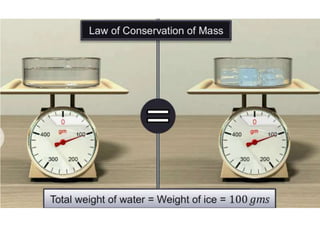
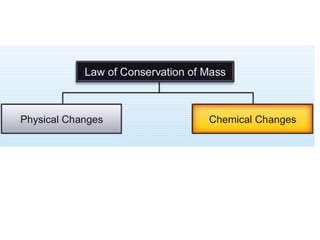
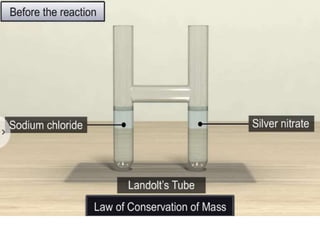
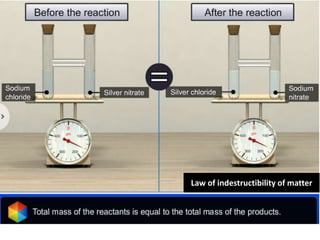
Law of conservation mass
Total masses of reactants =
Total masses of products +
Masses of unreacted reactants.
This law was proposed by Antoine
Lavoisier in 1744
Law of indestructibility of matter
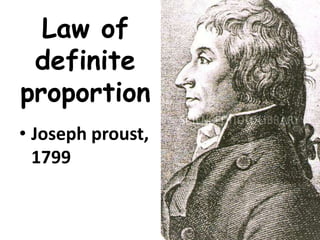
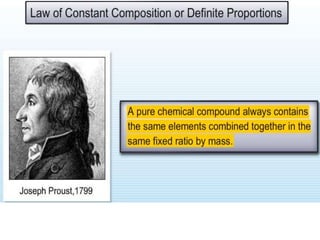
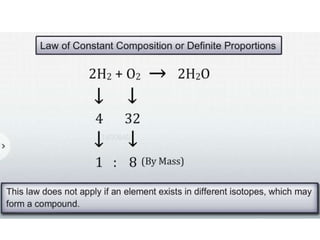
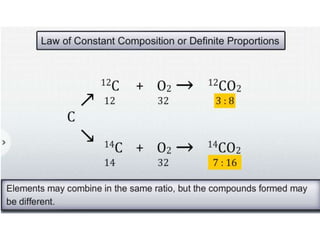
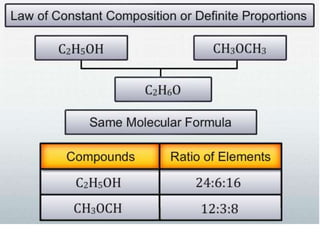
Law of
definite
proportion
• Joseph proust,
1799
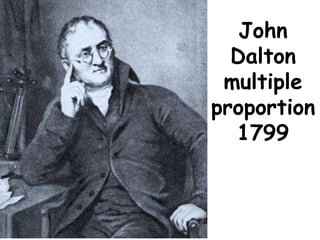
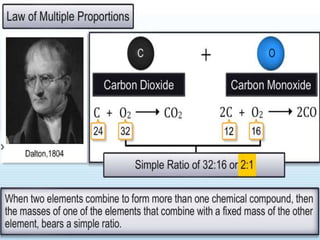
John
Dalton
multiple
proportion
1799
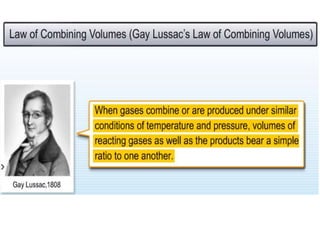
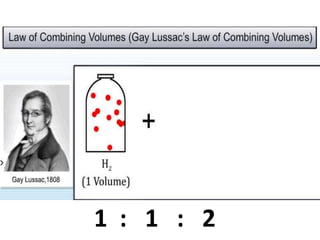
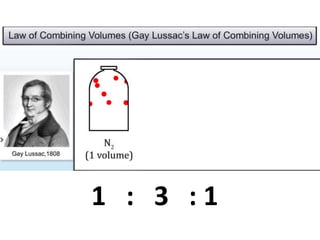
Gay lussac Law, 1808
1 : 1 : 2
1 : 3 : 1
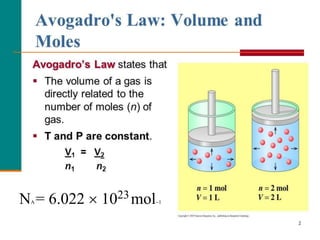
NA = 6.022  1023mol-1
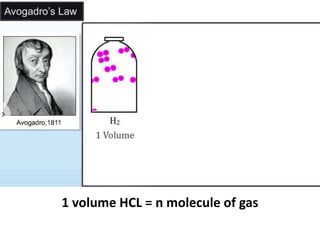
1 volume HCL = n molecule of gas
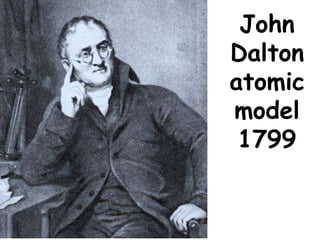
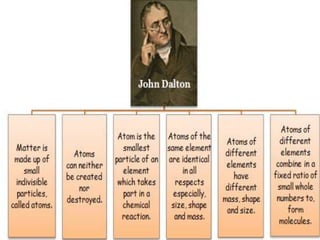
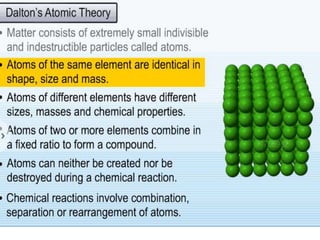
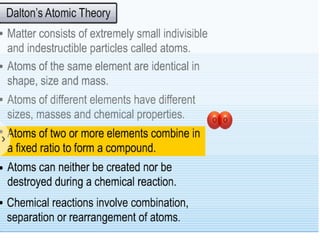
John
Dalton
atomic
model
1799
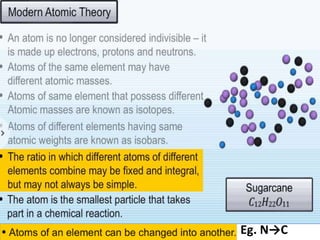
Eg. N→C
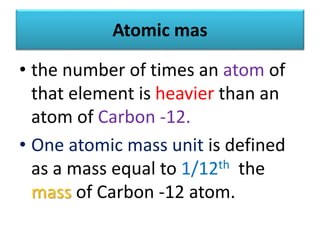
Atomic mas
• the number of times an atom of
that element is heavier than an
atom of Carbon -12.
• One atomic mass unit is defined
as a mass equal to 1/12th the
mass of Carbon -12 atom.
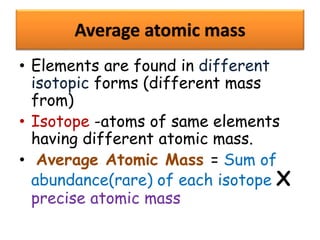
Average atomic mass
• Elements are found in different
isotopic forms (different mass
from)
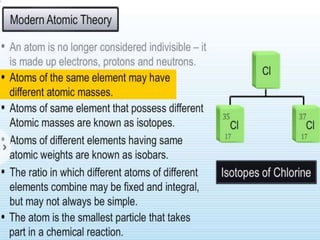
• Isotope -atoms of same elements
having different atomic mass.
• Average Atomic Mass = Sum of
abundance(rare) of each isotope X
precise atomic mass
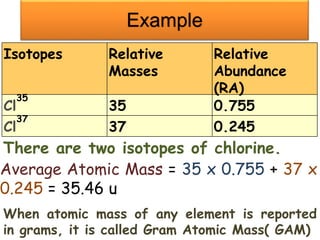
Example
Isotopes Relative
Masses
Relative
Abundance
(RA)
Cl
35
35 0.755
Cl
37
37 0.245
Average Atomic Mass = 35 x 0.755 + 37 x
0.245 = 35.46 u
There are two isotopes of chlorine.
When atomic mass of any element is reported
in grams, it is called Gram Atomic Mass( GAM)
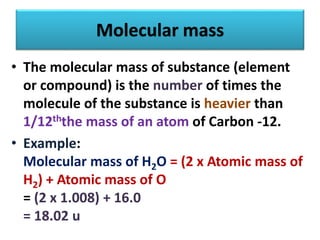
Molecular mass
• The molecular mass of substance (element
or compound) is the number of times the
molecule of the substance is heavier than
1/12ththe mass of an atom of Carbon -12.
• Example:
Molecular mass of H2O = (2 x Atomic mass of
H2) + Atomic mass of O
= (2 x 1.008) + 16.0
= 18.02 u
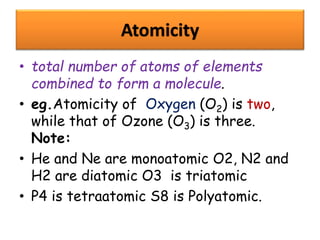
Atomicity
• total number of atoms of elements
combined to form a molecule.
• eg.Atomicity of Oxygen (O2) is two,
while that of Ozone (O3) is three.
Note:
• He and Ne are monoatomic O2, N2 and
H2 are diatomic O3 is triatomic
• P4 is tetraatomic S8 is Polyatomic.
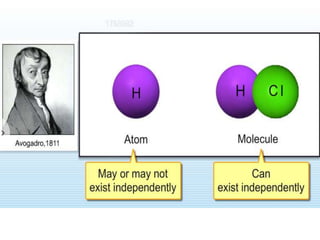
Atom is distinguished from its molecule
• Consider the formation of hydrogen chloride from
hydrogen and chlorine.
• Hydrogen and chlorine do not exist in free atomic
state but exist in molecular state hydrogen chloride.
H2 + Cl2 --> 2HCl
[1v] [1v] [2 volumes]
[n molecules] [n molecules] [2n molecules]
½ ½ 1
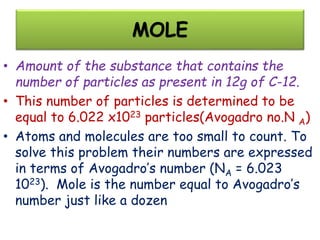
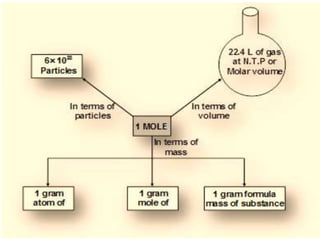
MOLE
• Amount of the substance that contains the
number of particles as present in 12g of C-12.
• This number of particles is determined to be
equal to 6.022 x10²³ particles(Avogadro no.N A)
• Atoms and molecules are too small to count. To
solve this problem their numbers are expressed
in terms of Avogadro’s number (NA = 6.023
1023). Mole is the number equal to Avogadro’s
number just like a dozen
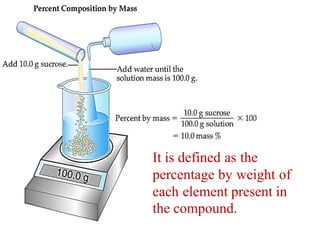
It is defined as the
percentage by weight of
each element present in
the compound.
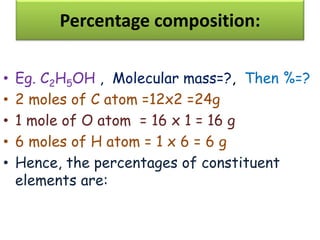
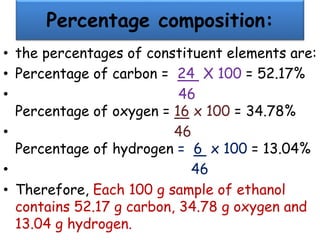
Percentage composition:
• Eg. C2H5OH , Molecular mass=?, Then %=?
• 2 moles of C atom =12x2 =24g
• 1 mole of O atom = 16 x 1 = 16 g
• 6 moles of H atom = 1 x 6 = 6 g
• Hence, the percentages of constituent
elements are:
Percentage composition:
• the percentages of constituent elements are:
• Percentage of carbon = 24 X 100 = 52.17%
• 46
Percentage of oxygen = 16 x 100 = 34.78%
• 46
Percentage of hydrogen = 6 x 100 = 13.04%
• 46
• Therefore, Each 100 g sample of ethanol
contains 52.17 g carbon, 34.78 g oxygen and
13.04 g hydrogen.
Empirical
formula
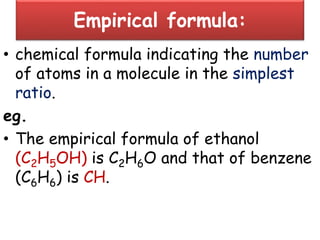
Empirical formula:
• chemical formula indicating the number
of atoms in a molecule in the simplest
ratio.
eg.
• The empirical formula of ethanol
(C2H5OH) is C2H6O and that of benzene
(C6H6) is CH.
Molecular formula
Molecular formula
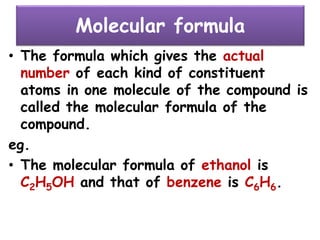
• The formula which gives the actual
number of each kind of constituent
atoms in one molecule of the compound is
called the molecular formula of the
compound.
eg.
• The molecular formula of ethanol is
C2H5OH and that of benzene is C6H6.
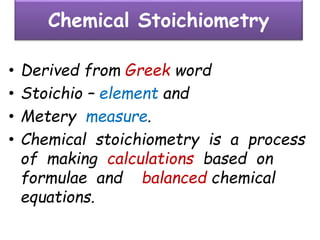
Chemical Stoichiometry
• Derived from Greek word
• Stoichio – element and
• Metery measure.
• Chemical stoichiometry is a process
of making calculations based on
formulae and balanced chemical
equations.
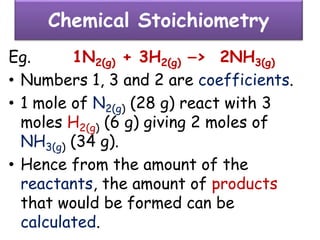
Chemical Stoichiometry
Eg. 1N2(g) + 3H2(g) ⎯> 2NH3(g)
• Numbers 1, 3 and 2 are coefficients.
• 1 mole of N2(g) (28 g) react with 3
moles H2(g) (6 g) giving 2 moles of
NH3(g) (34 g).
• Hence from the amount of the
reactants, the amount of products
that would be formed can be
calculated.
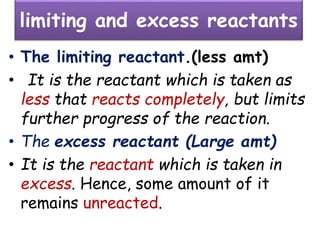
limiting and excess reactants
• The limiting reactant.(less amt)
• It is the reactant which is taken as
less that reacts completely, but limits
further progress of the reaction.
• The excess reactant (Large amt)
• It is the reactant which is taken in
excess. Hence, some amount of it
remains unreacted.

Some basic concept of chemistry 2017

  • 1.
  • 2.
  • 4.
  • 5.
  • 7.
  • 10.
    Atomic Number andAtomic mass no. ?
  • 12.
  • 15.
  • 16.
  • 19.
    Law of conservationmass Total masses of reactants = Total masses of products + Masses of unreacted reactants. This law was proposed by Antoine Lavoisier in 1744
  • 28.
  • 30.
  • 35.
  • 37.
  • 39.
    1 : 1: 2
  • 40.
    1 : 3: 1
  • 41.
    NA = 6.022 1023mol-1
  • 46.
    1 volume HCL= n molecule of gas
  • 48.
  • 57.
  • 58.
    Atomic mas • thenumber of times an atom of that element is heavier than an atom of Carbon -12. • One atomic mass unit is defined as a mass equal to 1/12th the mass of Carbon -12 atom.
  • 59.
    Average atomic mass •Elements are found in different isotopic forms (different mass from) • Isotope -atoms of same elements having different atomic mass. • Average Atomic Mass = Sum of abundance(rare) of each isotope X precise atomic mass
  • 60.
    Example Isotopes Relative Masses Relative Abundance (RA) Cl 35 35 0.755 Cl 37 370.245 Average Atomic Mass = 35 x 0.755 + 37 x 0.245 = 35.46 u There are two isotopes of chlorine. When atomic mass of any element is reported in grams, it is called Gram Atomic Mass( GAM)
  • 61.
    Molecular mass • Themolecular mass of substance (element or compound) is the number of times the molecule of the substance is heavier than 1/12ththe mass of an atom of Carbon -12. • Example: Molecular mass of H2O = (2 x Atomic mass of H2) + Atomic mass of O = (2 x 1.008) + 16.0 = 18.02 u
  • 62.
    Atomicity • total numberof atoms of elements combined to form a molecule. • eg.Atomicity of Oxygen (O2) is two, while that of Ozone (O3) is three. Note: • He and Ne are monoatomic O2, N2 and H2 are diatomic O3 is triatomic • P4 is tetraatomic S8 is Polyatomic.
  • 63.
    Atom is distinguishedfrom its molecule • Consider the formation of hydrogen chloride from hydrogen and chlorine. • Hydrogen and chlorine do not exist in free atomic state but exist in molecular state hydrogen chloride. H2 + Cl2 --> 2HCl [1v] [1v] [2 volumes] [n molecules] [n molecules] [2n molecules] ½ ½ 1
  • 64.
    MOLE • Amount ofthe substance that contains the number of particles as present in 12g of C-12. • This number of particles is determined to be equal to 6.022 x10²³ particles(Avogadro no.N A) • Atoms and molecules are too small to count. To solve this problem their numbers are expressed in terms of Avogadro’s number (NA = 6.023 1023). Mole is the number equal to Avogadro’s number just like a dozen
  • 66.
    It is definedas the percentage by weight of each element present in the compound.
  • 67.
    Percentage composition: • Eg.C2H5OH , Molecular mass=?, Then %=? • 2 moles of C atom =12x2 =24g • 1 mole of O atom = 16 x 1 = 16 g • 6 moles of H atom = 1 x 6 = 6 g • Hence, the percentages of constituent elements are:
  • 68.
    Percentage composition: • thepercentages of constituent elements are: • Percentage of carbon = 24 X 100 = 52.17% • 46 Percentage of oxygen = 16 x 100 = 34.78% • 46 Percentage of hydrogen = 6 x 100 = 13.04% • 46 • Therefore, Each 100 g sample of ethanol contains 52.17 g carbon, 34.78 g oxygen and 13.04 g hydrogen.
  • 69.
  • 70.
    Empirical formula: • chemicalformula indicating the number of atoms in a molecule in the simplest ratio. eg. • The empirical formula of ethanol (C2H5OH) is C2H6O and that of benzene (C6H6) is CH.
  • 71.
  • 72.
    Molecular formula • Theformula which gives the actual number of each kind of constituent atoms in one molecule of the compound is called the molecular formula of the compound. eg. • The molecular formula of ethanol is C2H5OH and that of benzene is C6H6.
  • 73.
  • 74.
    Chemical Stoichiometry • Derivedfrom Greek word • Stoichio – element and • Metery measure. • Chemical stoichiometry is a process of making calculations based on formulae and balanced chemical equations.
  • 75.
    Chemical Stoichiometry Eg. 1N2(g)+ 3H2(g) ⎯> 2NH3(g) • Numbers 1, 3 and 2 are coefficients. • 1 mole of N2(g) (28 g) react with 3 moles H2(g) (6 g) giving 2 moles of NH3(g) (34 g). • Hence from the amount of the reactants, the amount of products that would be formed can be calculated.
  • 76.
  • 77.
    limiting and excessreactants • The limiting reactant.(less amt) • It is the reactant which is taken as less that reacts completely, but limits further progress of the reaction. • The excess reactant (Large amt) • It is the reactant which is taken in excess. Hence, some amount of it remains unreacted.

Editor's Notes

  • #9 If 2 same element have same no.. Of proton. When we combine proton and neutron called amu. Electron revolve around the nucleus like planet and sun.
  • #10 Electron revolve attracted proton they attract both each other.
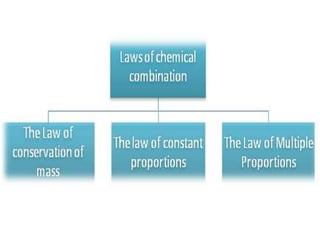
  • #21 Laws Of Chemical Combination And Dalton's Atomic Theory - Lesson Summary The five basic laws of chemical combination that govern every chemical reaction are: Laws of Conservation of Mass  Law of Constant Composition or Definite Proportions  Law of Multiple Proportions  Law of Combining Volumes (Gay-Lussac’s Law of Gaseous Volumes)  Avogadro’s Law Laws of Conservation of Mass:  In 1789, Lavoisier proposed the law of conservation of mass. It states that in all physical and chemical changes, the total mass of the reactants is equal to the total mass of the products. 
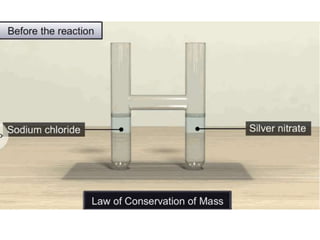
  • #28 After shaking reaction take place and white ppt formed.
  • #29 During chemical reaction matter neither gain nor loss. This law is called law of conservation energy or also called law of indestructibility of matter.
  • #33 If isotope is there where this law is not followed for eg.
  • #34 One more demerit in this law is which is above there.
  • #35 Here one of the best example.
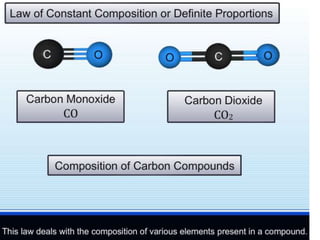
  • #37 Carbon atomic mass no is 12 and O atomic mass no. is 16. here fixed amount of carbon is react with fixed amount of oxygen to fomr co2. it only possible in particular amount.
  • #38 Suulfur atomic mass no. 32 and
  • #40 Co efficient check karne ka.
  • #44 Molecule single compound. They said atom hosake hai or nahi bhi hossakte hai environemnt me free form me present eg. Iron soil ke saath mix rehta but molecule exist in one form eg. Water.
  • #45 He conclude that jo smalllest particle of gas jo independently hai. Wo molecule hai na ke atom. So volume of gas must be related to no. of gas.
  • #46 Matlab ek type ka volume mean container hai to usme gas ki quantity bhi utni hai. Mean same volume container me same no. of gas rahegi.
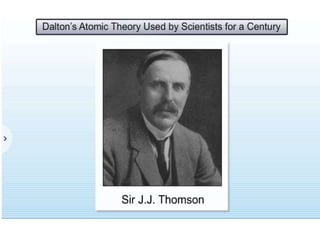
  • #52 Scientist use theory for century for understanding matter.
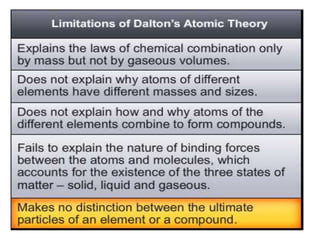
  • #53 This scinetis research delton theory and find the demerits of their theory.
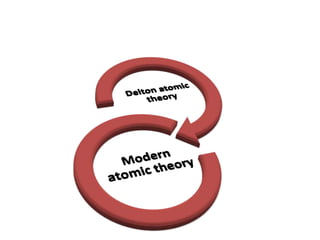
  • #55 Now scientist modify this theory and make modern atomic theory.
  • #58 By x-ray bomberdment nitrogen is converted into carbon.