University of St. La Salle
FIN1
A.Y. 2016-2017
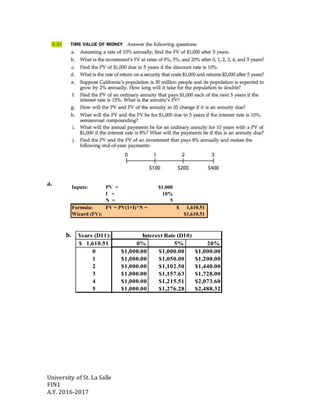
a.
b. Years (D11):
1,610.51$ 0% 5% 20%
0 $1,000.00 $1,000.00 $1,000.00
1 $1,000.00 $1,050.00 $1,200.00
2 $1,000.00 $1,102.50 $1,440.00
3 $1,000.00 $1,157.63 $1,728.00
4 $1,000.00 $1,215.51 $2,073.60
5 $1,000.00 $1,276.28 $2,488.32
Interest Rate (D10)
Inputs: PV = $1,000
I = 10%
N = 5
Formula: FV = PV(1+I)^N = 1,610.51$
Wizard (FV): $1,610.51
University of St. La Salle
FIN1
A.Y. 2016-2017
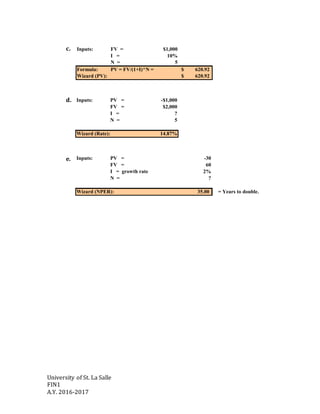
c.
d.
e.
Inputs: FV = $1,000
I = 10%
N = 5
Formula: PV = FV/(1+I)^N = 620.92$
Wizard (PV): 620.92$
Inputs: PV = -$1,000
FV = $2,000
I = ?
N = 5
Wizard (Rate): 14.87%
Inputs: PV = -30
FV = 60
I = growth rate 2%
N = ?
Wizard (NPER): 35.00 = Years to double.
University of St. La Salle
FIN1
A.Y. 2016-2017
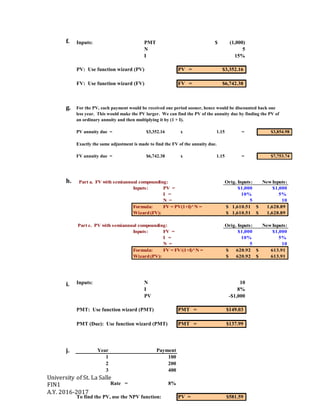
f.
g.
h.
i.
j.
Inputs: PMT (1,000)$
N 5
I 15%
PV: Use function wizard (PV) PV = $3,352.16
FV: Use function wizard (FV) FV = $6,742.38
For the PV, each payment would be received one period sooner, hence would be discounted back one
less year. This would make the PV larger. We can find the PV of the annuity due by finding the PV of
an ordinary annuity and then multiplying it by (1 + I).
PV annuity due = $3,352.16 x 1.15 = $3,854.98
Exactly the same adjustment is made to find the FV of the annuity due.
FV annuity due = $6,742.38 x 1.15 = $7,753.74
Inputs: N 10
I 8%
PV -$1,000
PMT: Use function wizard (PMT) PMT = $149.03
PMT (Due): Use function wizard (PMT) PMT = $137.99
Year Payment
1 100
2 200
3 400
Rate = 8%
To find the PV, use the NPV function: PV = $581.59
Part a. FV with semiannual compounding: Orig. Inputs: NewInputs:
Inputs: PV = $1,000 $1,000
I = 10% 5%
N = 5 10
Formula: FV = PV(1+I)^N = 1,610.51$ 1,628.89$
Wizard(FV): 1,610.51$ 1,628.89$
Part c. PV with semiannual compounding: Orig. Inputs: NewInputs:
Inputs: FV = $1,000 $1,000
I = 10% 5%
N = 5 10
Formula: FV = FV/(1+I)^N = 620.92$ 613.91$
Wizard(PV): 620.92$ 613.91$
University of St. La Salle
FIN1
A.Y. 2016-2017
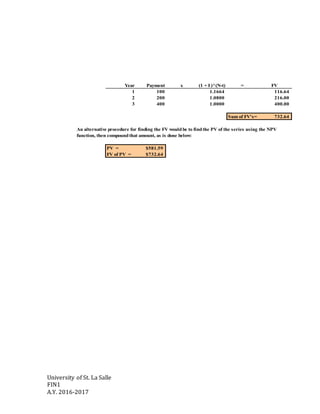
Year Payment x (1 + I )^(N-t) = FV
1 100 1.1664 116.64
2 200 1.0800 216.00
3 400 1.0000 400.00
Sum of FV's= 732.64
An alternative procedure for finding the FV wouldbe to findthe PV of the series using the NPV
function, then compoundthat amount, as is done below:
PV = $581.59
FV of PV = $732.64
University of St. La Salle
FIN1
A.Y. 2016-2017

Solutions to Problem 5-41 (Brigham)

  • 1.
    University of St.La Salle FIN1 A.Y. 2016-2017 a. b. Years (D11): 1,610.51$ 0% 5% 20% 0 $1,000.00 $1,000.00 $1,000.00 1 $1,000.00 $1,050.00 $1,200.00 2 $1,000.00 $1,102.50 $1,440.00 3 $1,000.00 $1,157.63 $1,728.00 4 $1,000.00 $1,215.51 $2,073.60 5 $1,000.00 $1,276.28 $2,488.32 Interest Rate (D10) Inputs: PV = $1,000 I = 10% N = 5 Formula: FV = PV(1+I)^N = 1,610.51$ Wizard (FV): $1,610.51
  • 2.
    University of St.La Salle FIN1 A.Y. 2016-2017 c. d. e. Inputs: FV = $1,000 I = 10% N = 5 Formula: PV = FV/(1+I)^N = 620.92$ Wizard (PV): 620.92$ Inputs: PV = -$1,000 FV = $2,000 I = ? N = 5 Wizard (Rate): 14.87% Inputs: PV = -30 FV = 60 I = growth rate 2% N = ? Wizard (NPER): 35.00 = Years to double.
  • 3.
    University of St.La Salle FIN1 A.Y. 2016-2017 f. g. h. i. j. Inputs: PMT (1,000)$ N 5 I 15% PV: Use function wizard (PV) PV = $3,352.16 FV: Use function wizard (FV) FV = $6,742.38 For the PV, each payment would be received one period sooner, hence would be discounted back one less year. This would make the PV larger. We can find the PV of the annuity due by finding the PV of an ordinary annuity and then multiplying it by (1 + I). PV annuity due = $3,352.16 x 1.15 = $3,854.98 Exactly the same adjustment is made to find the FV of the annuity due. FV annuity due = $6,742.38 x 1.15 = $7,753.74 Inputs: N 10 I 8% PV -$1,000 PMT: Use function wizard (PMT) PMT = $149.03 PMT (Due): Use function wizard (PMT) PMT = $137.99 Year Payment 1 100 2 200 3 400 Rate = 8% To find the PV, use the NPV function: PV = $581.59 Part a. FV with semiannual compounding: Orig. Inputs: NewInputs: Inputs: PV = $1,000 $1,000 I = 10% 5% N = 5 10 Formula: FV = PV(1+I)^N = 1,610.51$ 1,628.89$ Wizard(FV): 1,610.51$ 1,628.89$ Part c. PV with semiannual compounding: Orig. Inputs: NewInputs: Inputs: FV = $1,000 $1,000 I = 10% 5% N = 5 10 Formula: FV = FV/(1+I)^N = 620.92$ 613.91$ Wizard(PV): 620.92$ 613.91$
  • 4.
    University of St.La Salle FIN1 A.Y. 2016-2017 Year Payment x (1 + I )^(N-t) = FV 1 100 1.1664 116.64 2 200 1.0800 216.00 3 400 1.0000 400.00 Sum of FV's= 732.64 An alternative procedure for finding the FV wouldbe to findthe PV of the series using the NPV function, then compoundthat amount, as is done below: PV = $581.59 FV of PV = $732.64
  • 5.
    University of St.La Salle FIN1 A.Y. 2016-2017