
UNIT 1
BUSINESS AND ITS ENVIRONMENT
CHAPTER 1
ENTERPRISE
Siti Naquiah Mohd Hanapi
A-Levels Centre
International Islamic School Malaysia, Kuala Lumpur
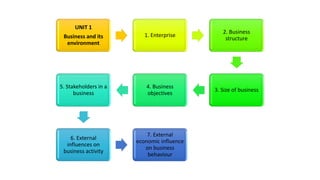
UNIT 1
Business and its
environment
1. Enterprise
2. Business
structure
3. Size of business
4. Business
objectives
5. Stakeholders in a
business
6. External
influences on
business activity
7. External
economic influence
on business
behaviour
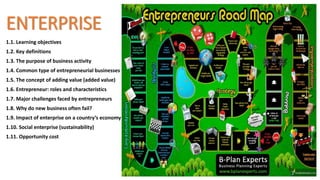
ENTERPRISE
1.1. Learning objectives
1.2. Key definitions
1.3. The purpose of business activity
1.4. Common type of entrepreneurial businesses
1.5. The concept of adding value (added value)
1.6. Entrepreneur: roles and characteristics
1.7. Major challenges faced by entrepreneurs
1.8. Why do new business often fail?
1.9. Impact of enterprise on a country’s economy
1.10. Social enterprise (sustainability)
1.11. Opportunity cost
• Understand what business activity involves
• Analyse the meaning and importance of value added
• Recognize the key characteristics of successful entrepreneurs
• Assess the importance of enterprise and entrepreneurs to a country’s
economy
• Understand the meaning of social enterprise and the difference
between this and other businesses
1.1. Learning objectives
1.2. Key definitions
• Consumer goods: the physical and tangible goods sold to the general public – they include durable
consumer goods, such as cars and washing machines, and non-durable consumer goods, such as food,
drinks, and sweets that can only be used only once
• Consumer services: the non-tangible products sold to the general public – they include hotel
accommodation, insurance services, and train journeys
• Capital goods: the physical goods used by industry to aid in the production of other goods and
services, such as machines and commercial vehicles
• Added value: the difference between the cost of purchasing raw materials and the price the finished
goods are sold for
• Entrepreneur: someone who takes the financial risk of starting and managing a new venture
• Social enterprise: a business with mainly social objectives that reinvests most of its profits into
benefiting the society rather than maximising return to owners
• Triple bottom line: the three objectives of social enterprises – economic, social, and environmental
1.3. The purpose of business activity
• A business is any organisation that uses resources to meet the needs
of customers by providing a product or a service that they demand
Adding value to resources  making them more desirable to be owned or
purchased
• Factors of production
Land
Labour
Capital
Enterprise
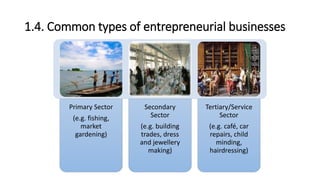
1.4. Common types of entrepreneurial businesses
Primary Sector
(e.g. fishing,
market
gardening)
Secondary
Sector
(e.g. building
trades, dress
and jewellery
making)
Tertiary/Service
Sector
(e.g. café, car
repairs, child
minding,
hairdressing)
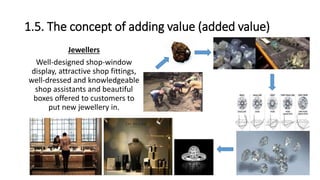
1.5. The concept of adding value (added value)
Jewellers
Well-designed shop-window
display, attractive shop fittings,
well-dressed and knowledgeable
shop assistants and beautiful
boxes offered to customers to
put new jewellery in.
1.6. Entrepreneur: roles and characteristics
• Had an idea for a new business
• Invested some of their own savings and capital
• Accepted the responsibility of managing the
business
• Accepted the possible risks of failure
• ……and……??? Anything else you want to add?
INNOVATION
SELF CONFIDENCE AND THE
ABILITY TO BOUNCE BACK
LEADERSHIP
SKILLS
COMMITMENT AND
SELF-MOTIVATION
RISK TAKING
MULTI-SKILLED
Watch – Five Surprising Traits of Successful Entrepreneurs
1.7. Major challenges faced by entrepreneurs
• Identifying successful business
opportunities
Own skills or hobbies?
Previous employment
experience?
Franchising conferences and
exhibition
Small-budget market research
• Sourcing capital (finance)
Lack of sufficient own finance
Lack of awareness of financial
support and grants available
Lack of any trading record
A poorly produced business plan
• Determining a location
It may not be close to area with good
market potential
It lacks status
It may cause family tensions
It may be difficult to separate private
life from working life
• Competition
Existing, well-established competitors
• Building a customer base
Personal customer service
Knowledgeable pre- and after-sales
service
Providing for-off customer requests
that larger firms may be reluctant to
provide for
Watch – 10 Myths of Entrepreneurship
1.8. Why do new business often fail?
• Lack of working capital. How to overcome?
Construct a cash flow forecast
Inject sufficient capital at start-up for the first few months
Establish good relationship with the banks
Use effective credit control over customers
• Poor management skills. Thus must learn important and necessary skills including…
Leadership, cash handling, cash management, planning, coordinating, decision-making,
communication, marketing, promotion, and selling
• Changes in business environment
New competitors
Economic recession
Technological advancement
Legal changes e.g. restrictions on non-halal products, outlawing the products altogether
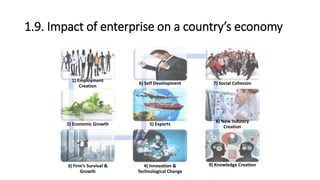
1.9. Impact of enterprise on a country’s economy
1) Employment
Creation
2) Economic Growth
3) Firm’s Survival &
Growth
4) Innovation &
Technological Change
5) Exports
6) Self Development 7) Social Cohesion
8) New Industry
Creation
9) Knowledge Creation
1.10.
Social enterprise
(sustainability)
1.11. Opportunity cost
References
• Grichnik, D., Hinnen, A., Gahwiler, C., Poddubna, I., Kohlmunzer, J., and Lendi, S. (2012). The 10
Myths of Entrepreneurship. Switzerland: University of St. Gallen and Zense. Retrieved from
https://www.youtube.com/watch?v=G8gRkJ9cnzo
• Khir, K., Gupta, L., and Shanmugan, B. (2008). Islamic Banking A Practical Perspective. 1st Edition.
Selangor: Longman.
• Minute MBA (2012). Five Surprising Traits of Entrepreneurs. Houston TX: OnlineMBA.com.
Retrieved from
http://www.onlinemba.com/blog/5-surprising-traits-of-successful-entrepreneurs/
• Ramos, K. (2012). Opportunity Cost. United States: Go! Animate. Retrieved from
https://www.youtube.com/watch?v=yw6wB7haSu8
• Stimpson, P. and Farquharson, A. (2010). Cambridge International AS and A Level Business
Studies. 2nd Edition. Cambridge: Cambridge University Press.

Enterprise

  • 1.
    UNIT 1 BUSINESS ANDITS ENVIRONMENT CHAPTER 1 ENTERPRISE Siti Naquiah Mohd Hanapi A-Levels Centre International Islamic School Malaysia, Kuala Lumpur
  • 2.
    UNIT 1 Business andits environment 1. Enterprise 2. Business structure 3. Size of business 4. Business objectives 5. Stakeholders in a business 6. External influences on business activity 7. External economic influence on business behaviour
  • 3.
    ENTERPRISE 1.1. Learning objectives 1.2.Key definitions 1.3. The purpose of business activity 1.4. Common type of entrepreneurial businesses 1.5. The concept of adding value (added value) 1.6. Entrepreneur: roles and characteristics 1.7. Major challenges faced by entrepreneurs 1.8. Why do new business often fail? 1.9. Impact of enterprise on a country’s economy 1.10. Social enterprise (sustainability) 1.11. Opportunity cost
  • 4.
    • Understand whatbusiness activity involves • Analyse the meaning and importance of value added • Recognize the key characteristics of successful entrepreneurs • Assess the importance of enterprise and entrepreneurs to a country’s economy • Understand the meaning of social enterprise and the difference between this and other businesses 1.1. Learning objectives
  • 5.
    1.2. Key definitions •Consumer goods: the physical and tangible goods sold to the general public – they include durable consumer goods, such as cars and washing machines, and non-durable consumer goods, such as food, drinks, and sweets that can only be used only once • Consumer services: the non-tangible products sold to the general public – they include hotel accommodation, insurance services, and train journeys • Capital goods: the physical goods used by industry to aid in the production of other goods and services, such as machines and commercial vehicles • Added value: the difference between the cost of purchasing raw materials and the price the finished goods are sold for • Entrepreneur: someone who takes the financial risk of starting and managing a new venture • Social enterprise: a business with mainly social objectives that reinvests most of its profits into benefiting the society rather than maximising return to owners • Triple bottom line: the three objectives of social enterprises – economic, social, and environmental
  • 6.
    1.3. The purposeof business activity • A business is any organisation that uses resources to meet the needs of customers by providing a product or a service that they demand Adding value to resources  making them more desirable to be owned or purchased • Factors of production Land Labour Capital Enterprise
  • 7.
    1.4. Common typesof entrepreneurial businesses Primary Sector (e.g. fishing, market gardening) Secondary Sector (e.g. building trades, dress and jewellery making) Tertiary/Service Sector (e.g. café, car repairs, child minding, hairdressing)
  • 8.
    1.5. The conceptof adding value (added value) Jewellers Well-designed shop-window display, attractive shop fittings, well-dressed and knowledgeable shop assistants and beautiful boxes offered to customers to put new jewellery in.
  • 9.
    1.6. Entrepreneur: rolesand characteristics • Had an idea for a new business • Invested some of their own savings and capital • Accepted the responsibility of managing the business • Accepted the possible risks of failure • ……and……??? Anything else you want to add?
  • 10.
    INNOVATION SELF CONFIDENCE ANDTHE ABILITY TO BOUNCE BACK LEADERSHIP SKILLS COMMITMENT AND SELF-MOTIVATION RISK TAKING MULTI-SKILLED
  • 11.
    Watch – FiveSurprising Traits of Successful Entrepreneurs
  • 12.
    1.7. Major challengesfaced by entrepreneurs • Identifying successful business opportunities Own skills or hobbies? Previous employment experience? Franchising conferences and exhibition Small-budget market research • Sourcing capital (finance) Lack of sufficient own finance Lack of awareness of financial support and grants available Lack of any trading record A poorly produced business plan • Determining a location It may not be close to area with good market potential It lacks status It may cause family tensions It may be difficult to separate private life from working life • Competition Existing, well-established competitors • Building a customer base Personal customer service Knowledgeable pre- and after-sales service Providing for-off customer requests that larger firms may be reluctant to provide for
  • 13.
    Watch – 10Myths of Entrepreneurship
  • 14.
    1.8. Why donew business often fail? • Lack of working capital. How to overcome? Construct a cash flow forecast Inject sufficient capital at start-up for the first few months Establish good relationship with the banks Use effective credit control over customers • Poor management skills. Thus must learn important and necessary skills including… Leadership, cash handling, cash management, planning, coordinating, decision-making, communication, marketing, promotion, and selling • Changes in business environment New competitors Economic recession Technological advancement Legal changes e.g. restrictions on non-halal products, outlawing the products altogether
  • 15.
    1.9. Impact ofenterprise on a country’s economy 1) Employment Creation 2) Economic Growth 3) Firm’s Survival & Growth 4) Innovation & Technological Change 5) Exports 6) Self Development 7) Social Cohesion 8) New Industry Creation 9) Knowledge Creation
  • 16.
  • 17.
  • 18.
    References • Grichnik, D.,Hinnen, A., Gahwiler, C., Poddubna, I., Kohlmunzer, J., and Lendi, S. (2012). The 10 Myths of Entrepreneurship. Switzerland: University of St. Gallen and Zense. Retrieved from https://www.youtube.com/watch?v=G8gRkJ9cnzo • Khir, K., Gupta, L., and Shanmugan, B. (2008). Islamic Banking A Practical Perspective. 1st Edition. Selangor: Longman. • Minute MBA (2012). Five Surprising Traits of Entrepreneurs. Houston TX: OnlineMBA.com. Retrieved from http://www.onlinemba.com/blog/5-surprising-traits-of-successful-entrepreneurs/ • Ramos, K. (2012). Opportunity Cost. United States: Go! Animate. Retrieved from https://www.youtube.com/watch?v=yw6wB7haSu8 • Stimpson, P. and Farquharson, A. (2010). Cambridge International AS and A Level Business Studies. 2nd Edition. Cambridge: Cambridge University Press.