Chapter 6
THE TIME VALUE OF MONEY
OUTLINE
• Why Time Value
• Future Value of a Single Amount
• Future Value of an Annuity
• Present Value of a Single Amount
• Present Value of an Annuity
• Intra-year Compounding and Discounting
WHY TIME VALUE
A rupee today is more valuable than a rupee a year hence. Why ?
• Preference for current consumption over future consumption.
• Productivity of capital.
• Inflation.
Many financial problems involve cash flows occurring at different
points of time. For evaluating such cash flows, an explicit
consideration of time value of money is required
TIME LINE
Part A
0 1 2 3 4 5
12% 12% 12% 12% 12%
10,000 10,000 10,000 10,000 10,000
Part B
0 1 2 3 4 5
12% 12% 12% 12% 12%
10,000 10,000 10,000 10,000 10,000
NOTATION
PV : Present value
FVn : Future value n years hence
Ct : Cash flow occurring at the end of year t
A : A stream of constant periodic cash flow over a given time
r : Interest rate or discount rate
g : Expected growth rate in cash flows
n : Number of periods over which the cash flows occur.
Time Value of
Money
Future Value
Single
FVIFr,n
= PV (1 + r)n
Annuity
FVIFAr,n
=A[{(1 + r)n-1)}/r]
Present Value
Single
PVIFr,n
= FVn [1/ (1 + r)n]
Annuity
PVIFAr,n
=A[1-{1/(1 + r)n}/r]
FUTURE VALUE OF A SINGLE AMOUNT
Rs
First year: Principal at the beginning 1,000
Interest for the year
(Rs.1,000 x 0.10) 100
Principal at the end 1,100
Second year: Principal at the beginning 1,100
Interest for the year
(Rs.1,100 x 0.10) 110
Principal at the end 1,210
Third year: Principal at the beginning 1,210
Interest for the year
(Rs.1,210 x 0.10) 121
Principal at the end 1,331
FORMULA
FUTURE VALUE = PRESENT VALUE (1+r)n
Value of FVIFr,n for various combinations of r and n
DOUBLING PERIOD
Thumb Rule : Rule of 72
72
Interest rate
Interest rate : 15 percent
72
15
A more accurate thumb rule : Rule of 69
69
Interest rate
Interest rate : 15 percent
69
15
Doubling period =
= 4.8 years
Doubling period =
Doubling period = 0.35 +
Doubling period = 0.35 + = 4.95 years
PRESENT VALUE OF A SINGLE AMOUNT
PV = FVn [1/ (1 + r)n]
n/r 6% 8% 10% 12% 14%
2 0.890 0.857 0.826 0.797 0.770
4 0.792 0.735 0.683 0.636 0.592
6 0.705 0.630 0.565 0.507 0.456
8 0.626 0.540 0.467 0.404 0.351
10 0.558 0.463 0.386 0.322 0.270
12 0.497 0.397 0.319 0.257 0.208
 An annuity is a series of periodic cash flows (payments and receipts )
of equal amounts.
FUTURE VALUE OF AN ANNUITY
WHAT LIES IN STORE FOR YOU
Suppose you have decided to deposit Rs.30,000 per year in your Public
Provident Fund Account for 30 years. What will be the accumulated
amount in your Public Provident Fund Account at the end of 30 years if
the interest rate is 11 percent ?
The accumulated sum will be :
Rs.30,000 (FVIFA11%,30yrs)
= Rs.30,000 (1.11)30 - 1
.11
= Rs.30,000 [ 199.02]
= Rs.5,970,600
HOW MUCH SHOULD YOU SAVE ANNUALLY
You want to buy a house after 5 years when it is expected to cost Rs.2
million. How much should you save annually if your savings earn a
compound return of 12 percent ?
The future value interest factor for a 5 year annuity, given an interest
rate of 12 percent, is :
(1+0.12)5 - 1
FVIFA n=5, r =12% = = 6.353
0.12
The annual savings should be :
Rs.2000,000 = Rs.314,812
6.353
ANNUAL DEPOSIT IN A SINKING FUND
Futura Limited has an obligation to redeem Rs.500 million bonds 6
years hence. How much should the company deposit annually in a
sinking fund account wherein it earns 14 percent interest to
cumulate Rs.500 million in 6 years time ?
The future value interest factor for a 5 year annuity, given an
interest rate of 14 percent is :
FVIFAn=6, r=14% = (1+0.14)6 – 1 = 8.536
0.14
The annual sinking fund deposit should be :
Rs.500 million = Rs.58.575 million
8.536
FINDING THE INTEREST RATE
A finance company advertises that it will pay a lump sum of Rs.8,000 at the end
of 6 years to investors who deposit annually Rs.1,000 for 6 years. What interest
rate is implicit in this offer?
The interest rate may be calculated in two steps :
1. Find the FVIFAr,6 for this contract as follows :
Rs.8,000 = Rs.1,000 x FVIFAr,6
FVIFAr,6 = Rs.8,000 = 8.000
Rs.1,000
2. Look at the FVIFAr,n table and read the row corresponding to 6 years
until you find a value close to 8.000. Doing so, we find that
FVIFA12%,6 is 8.115 . So, we conclude that the interest rate is slightly below 12
percent.
HOW LONG SHOULD YOU WAIT
You want to take up a trip to the moon which costs Rs.1,000,000 the cost is expected to
remain unchanged in nominal terms. You can save annually Rs.50,000 to fulfill your
desire. How long will you have to wait if your savings earn an interest of 12 percent ?
The future value of an annuity of Rs.50,000 that earns 12 percent is equated to
Rs.1,000,000.
50,000 x FVIFAn=?,12% = 1,000,000
50,000 x 1.12n – 1 = 1,000,000
0.12
1.12n - 1 = 1,000,000 x 0.12 = 2.4
50,000
1.12n = 2.4 + 1 = 3.4
n log 1.12 = log 3.4
n x 0.0492 = 0.5315
n = 0.5315 = 10.8 years
0.0492
You will have to wait for about 11 years.
PRESENT VALUE OF AN ANNUITY
Value of PVIFAr,n for Various Combinations of r and n
How Much Can You Borrow for a Car: After reviewing your
budget, you have determined that you can afford to pay Rs. 12,000
per month for 3 years toward a new car. You call a finance company
and learn that the going rate of interest on car finance is 1.5 percent
per month for 36 months. How much can you borrow?
Ans. Rs. 331,920
Period of Loan Amortisation: You want to borrow Rs. 1,080,000 to
buy a flat. You approach a housing finance company which charges
12.5 percent interest. You can pay Rs. 180,000 per year toward loan
amortisation. What should be the maturity period of the loan?
Ans. 11.76 years
Suppose a firm borrows Rs.1,000,000 at an interest rate of 15 percent and the
loan is to be repaid in 5 equal installments payable at the end of each of the
next 5 years. The annual installment payment A is obtained by solving the
following equation.
LOAN AMORTISATION SCHEDULE
EQUATED MONTHLY INSTALMENT
Loan = 1,000,000, Interest = 1% p.m, Repayment period = 180
months
A x [1-1/(0.01)180]
0.01
A = Rs.12,002
1,000,000 =
Determining the Periodic Withdrawal: Your father deposits Rs. 300,000 on
retirement in a bank which pays 10 percent annual interest. How much can be
withdrawn annually for a period of 10 years?
Ans. Rs. 48, 820
Finding the Interest Rate: Suppose someone offers you the following
financial contract: If you deposit Rs. 10,000 with him he promises to pay Rs.
2,500 annually for 6 years. What interest rate do you earn on this deposit? The
interest rate may be calculated in two steps:
Ans. 13 percent
Valuing an Infrequent Annuity: Raghavan will receive an annuity of Rs.
50,000, payable once every two years. The payments will stretch out over 30
years. The first payment will be received at the end of two years. If the annual
interest rate is 8 percent, what is the present value of the annuity?
Ans. Rs. 270,620
PRESENT VALUE OF AN UNEVEN SERIES
PRESENT VALUE OF A GROWING ANNUITY
A cash flow that grows at a constant rate for a specified period of time is a
growing annuity. The time line of a growing annuity is shown below:
A(1 + g) A(1 + g)2 A(1 + g)n
0 1 2 3 n
The present value of a growing annuity can be determined using the following
formula :
(1 + g)n
(1 + r)n
PV of a Growing Annuity = A (1 + g)
r – g
The above formula can be used when the growth rate is less than the discount rate
(g < r) as well as when the growth rate is more than the discount rate (g > r).
However, it does not work when the growth rate is equal to the discount rate
(g = r) – in this case, the present value is simply equal to n A.
1 –
PRESENT VALUE OF A GROWING ANNUITY
For example, suppose you have the right to harvest a teak plantation for
the next 20 years over which you expect to get 100,000 cubic feet of teak
per year. The current price per cubic foot of teak is Rs 500, but it is
expected to increase at a rate of 8 percent per year. The discount rate is
15 percent. The present value of the teak that you can harvest from the
teak forest can be determined as follows:
1.0820
1 –
1.1520
PV of teak = Rs 500 x 100,000 (1.08)
0.15 – 0.08
= Rs.551,736,683
ANNUITY DUE
A A … A A
0 1 2 n – 1 n
A A A … A
0 1 2 n – 1 n
Thus,
Annuity due value = Ordinary annuity value (1 + r)
This applies to both present and future values
Ordinary
annuity
Annuity
due
Present Value Of Perpetuity:
Present Value Of Growing Perpetuity:
SHORTER COMPOUNDING PERIOD
Future value = Present value 1+ r mxn
m
Where r = nominal annual interest rate
m = number of times compounding is done in a
year
n = number of years over which compounding is
done
Example : Rs.5000, 12 percent, 4 times a year, 6 years
5000(1+ 0.12/4)4x6 = 5000 (1.03)24
= Rs.10,164
EFFECTIVE VERSUS NOMINAL RATE
r = (1+k/m)m –1
r = effective rate of interest
k = nominal rate of interest
m = frequency of compounding per year
Example : k = 8 percent, m=4
r = (1+.08/4)4 – 1 = 0.0824
= 8.24 percent
Nominal and Effective Rates of Interest
Effective Rate %
Nominal Annual Semi-annual Quarterly Monthly
Rate % Compounding Compounding Compounding Compounding
8 8.00 8.16 8.24 8.30
12 12.00 12.36 12.55 12.68
EAR AND APR
• Effective annual rate (EAR) reflects the total amount of interest that
will be earned at the end of the year. It is also referred to as the
effective annual yield (EAY) or the annual percentage yield (APY).
• Annual percentage rate (APR) is the amount of simple interest
earned without considering the effect of intra- year compounding.
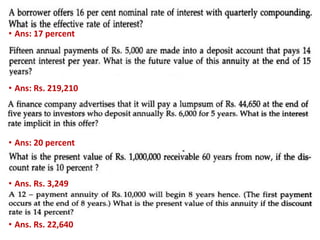
• Ans: 17 percent
• Ans: Rs. 219,210
• Ans: 20 percent
• Ans. Rs. 3,249
• Ans. Rs. 22,640
• What is the present value of the following cash stream if the discount rate is
14 percent?
• Ans. Rs. 27,225
• Ans. Rs. 26,295
• Ans. 7.72 years
• Ans. Rs. 7,221
• Ans.: 30 years
• Ans. 18%
• Ans. Rs. 79,481
• Ans. Rs. 5,698.30
• Ans. 20.30 %
• Ans. 20.3%
• Ans. 17.4%
• Ans. present value of an annual pension Rs. 58470
• Ans. Rs.22,683
• Ans. Rs.26,212
• Ans. Rs.13,165
• Ans. 15.1%
• Ans. Rs.21,910
• Ans. Rs.9,030
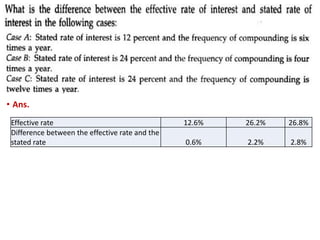
• Ans.
Effective rate 12.6% 26.2% 26.8%
Difference between the effective rate and the
stated rate 0.6% 2.2% 2.8%
• Ans. Rs. 40,388
• Ans. 20,000 option (Implied interest rate = 14.87%)
• Ans. Rs. 12,283
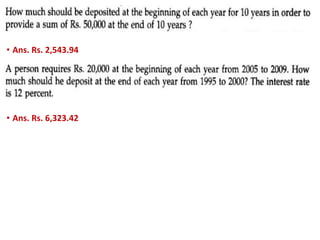
• Ans. Rs. 2,543.94
• Ans. Rs. 6,323.42

FM_Chapter6.pdf

  • 1.
    Chapter 6 THE TIMEVALUE OF MONEY
  • 2.
    OUTLINE • Why TimeValue • Future Value of a Single Amount • Future Value of an Annuity • Present Value of a Single Amount • Present Value of an Annuity • Intra-year Compounding and Discounting
  • 3.
    WHY TIME VALUE Arupee today is more valuable than a rupee a year hence. Why ? • Preference for current consumption over future consumption. • Productivity of capital. • Inflation. Many financial problems involve cash flows occurring at different points of time. For evaluating such cash flows, an explicit consideration of time value of money is required
  • 4.
    TIME LINE Part A 01 2 3 4 5 12% 12% 12% 12% 12% 10,000 10,000 10,000 10,000 10,000 Part B 0 1 2 3 4 5 12% 12% 12% 12% 12% 10,000 10,000 10,000 10,000 10,000
  • 5.
    NOTATION PV : Presentvalue FVn : Future value n years hence Ct : Cash flow occurring at the end of year t A : A stream of constant periodic cash flow over a given time r : Interest rate or discount rate g : Expected growth rate in cash flows n : Number of periods over which the cash flows occur.
  • 6.
    Time Value of Money FutureValue Single FVIFr,n = PV (1 + r)n Annuity FVIFAr,n =A[{(1 + r)n-1)}/r] Present Value Single PVIFr,n = FVn [1/ (1 + r)n] Annuity PVIFAr,n =A[1-{1/(1 + r)n}/r]
  • 7.
    FUTURE VALUE OFA SINGLE AMOUNT Rs First year: Principal at the beginning 1,000 Interest for the year (Rs.1,000 x 0.10) 100 Principal at the end 1,100 Second year: Principal at the beginning 1,100 Interest for the year (Rs.1,100 x 0.10) 110 Principal at the end 1,210 Third year: Principal at the beginning 1,210 Interest for the year (Rs.1,210 x 0.10) 121 Principal at the end 1,331 FORMULA FUTURE VALUE = PRESENT VALUE (1+r)n
  • 8.
    Value of FVIFr,nfor various combinations of r and n
  • 9.
    DOUBLING PERIOD Thumb Rule: Rule of 72 72 Interest rate Interest rate : 15 percent 72 15 A more accurate thumb rule : Rule of 69 69 Interest rate Interest rate : 15 percent 69 15 Doubling period = = 4.8 years Doubling period = Doubling period = 0.35 + Doubling period = 0.35 + = 4.95 years
  • 10.
    PRESENT VALUE OFA SINGLE AMOUNT PV = FVn [1/ (1 + r)n] n/r 6% 8% 10% 12% 14% 2 0.890 0.857 0.826 0.797 0.770 4 0.792 0.735 0.683 0.636 0.592 6 0.705 0.630 0.565 0.507 0.456 8 0.626 0.540 0.467 0.404 0.351 10 0.558 0.463 0.386 0.322 0.270 12 0.497 0.397 0.319 0.257 0.208
  • 11.
     An annuityis a series of periodic cash flows (payments and receipts ) of equal amounts. FUTURE VALUE OF AN ANNUITY
  • 12.
    WHAT LIES INSTORE FOR YOU Suppose you have decided to deposit Rs.30,000 per year in your Public Provident Fund Account for 30 years. What will be the accumulated amount in your Public Provident Fund Account at the end of 30 years if the interest rate is 11 percent ? The accumulated sum will be : Rs.30,000 (FVIFA11%,30yrs) = Rs.30,000 (1.11)30 - 1 .11 = Rs.30,000 [ 199.02] = Rs.5,970,600
  • 13.
    HOW MUCH SHOULDYOU SAVE ANNUALLY You want to buy a house after 5 years when it is expected to cost Rs.2 million. How much should you save annually if your savings earn a compound return of 12 percent ? The future value interest factor for a 5 year annuity, given an interest rate of 12 percent, is : (1+0.12)5 - 1 FVIFA n=5, r =12% = = 6.353 0.12 The annual savings should be : Rs.2000,000 = Rs.314,812 6.353
  • 14.
    ANNUAL DEPOSIT INA SINKING FUND Futura Limited has an obligation to redeem Rs.500 million bonds 6 years hence. How much should the company deposit annually in a sinking fund account wherein it earns 14 percent interest to cumulate Rs.500 million in 6 years time ? The future value interest factor for a 5 year annuity, given an interest rate of 14 percent is : FVIFAn=6, r=14% = (1+0.14)6 – 1 = 8.536 0.14 The annual sinking fund deposit should be : Rs.500 million = Rs.58.575 million 8.536
  • 15.
    FINDING THE INTERESTRATE A finance company advertises that it will pay a lump sum of Rs.8,000 at the end of 6 years to investors who deposit annually Rs.1,000 for 6 years. What interest rate is implicit in this offer? The interest rate may be calculated in two steps : 1. Find the FVIFAr,6 for this contract as follows : Rs.8,000 = Rs.1,000 x FVIFAr,6 FVIFAr,6 = Rs.8,000 = 8.000 Rs.1,000 2. Look at the FVIFAr,n table and read the row corresponding to 6 years until you find a value close to 8.000. Doing so, we find that FVIFA12%,6 is 8.115 . So, we conclude that the interest rate is slightly below 12 percent.
  • 16.
    HOW LONG SHOULDYOU WAIT You want to take up a trip to the moon which costs Rs.1,000,000 the cost is expected to remain unchanged in nominal terms. You can save annually Rs.50,000 to fulfill your desire. How long will you have to wait if your savings earn an interest of 12 percent ? The future value of an annuity of Rs.50,000 that earns 12 percent is equated to Rs.1,000,000. 50,000 x FVIFAn=?,12% = 1,000,000 50,000 x 1.12n – 1 = 1,000,000 0.12 1.12n - 1 = 1,000,000 x 0.12 = 2.4 50,000 1.12n = 2.4 + 1 = 3.4 n log 1.12 = log 3.4 n x 0.0492 = 0.5315 n = 0.5315 = 10.8 years 0.0492 You will have to wait for about 11 years.
  • 17.
    PRESENT VALUE OFAN ANNUITY
  • 18.
    Value of PVIFAr,nfor Various Combinations of r and n
  • 19.
    How Much CanYou Borrow for a Car: After reviewing your budget, you have determined that you can afford to pay Rs. 12,000 per month for 3 years toward a new car. You call a finance company and learn that the going rate of interest on car finance is 1.5 percent per month for 36 months. How much can you borrow? Ans. Rs. 331,920 Period of Loan Amortisation: You want to borrow Rs. 1,080,000 to buy a flat. You approach a housing finance company which charges 12.5 percent interest. You can pay Rs. 180,000 per year toward loan amortisation. What should be the maturity period of the loan? Ans. 11.76 years
  • 20.
    Suppose a firmborrows Rs.1,000,000 at an interest rate of 15 percent and the loan is to be repaid in 5 equal installments payable at the end of each of the next 5 years. The annual installment payment A is obtained by solving the following equation. LOAN AMORTISATION SCHEDULE
  • 21.
    EQUATED MONTHLY INSTALMENT Loan= 1,000,000, Interest = 1% p.m, Repayment period = 180 months A x [1-1/(0.01)180] 0.01 A = Rs.12,002 1,000,000 =
  • 22.
    Determining the PeriodicWithdrawal: Your father deposits Rs. 300,000 on retirement in a bank which pays 10 percent annual interest. How much can be withdrawn annually for a period of 10 years? Ans. Rs. 48, 820 Finding the Interest Rate: Suppose someone offers you the following financial contract: If you deposit Rs. 10,000 with him he promises to pay Rs. 2,500 annually for 6 years. What interest rate do you earn on this deposit? The interest rate may be calculated in two steps: Ans. 13 percent Valuing an Infrequent Annuity: Raghavan will receive an annuity of Rs. 50,000, payable once every two years. The payments will stretch out over 30 years. The first payment will be received at the end of two years. If the annual interest rate is 8 percent, what is the present value of the annuity? Ans. Rs. 270,620
  • 23.
    PRESENT VALUE OFAN UNEVEN SERIES
  • 24.
    PRESENT VALUE OFA GROWING ANNUITY A cash flow that grows at a constant rate for a specified period of time is a growing annuity. The time line of a growing annuity is shown below: A(1 + g) A(1 + g)2 A(1 + g)n 0 1 2 3 n The present value of a growing annuity can be determined using the following formula : (1 + g)n (1 + r)n PV of a Growing Annuity = A (1 + g) r – g The above formula can be used when the growth rate is less than the discount rate (g < r) as well as when the growth rate is more than the discount rate (g > r). However, it does not work when the growth rate is equal to the discount rate (g = r) – in this case, the present value is simply equal to n A. 1 –
  • 25.
    PRESENT VALUE OFA GROWING ANNUITY For example, suppose you have the right to harvest a teak plantation for the next 20 years over which you expect to get 100,000 cubic feet of teak per year. The current price per cubic foot of teak is Rs 500, but it is expected to increase at a rate of 8 percent per year. The discount rate is 15 percent. The present value of the teak that you can harvest from the teak forest can be determined as follows: 1.0820 1 – 1.1520 PV of teak = Rs 500 x 100,000 (1.08) 0.15 – 0.08 = Rs.551,736,683
  • 26.
    ANNUITY DUE A A… A A 0 1 2 n – 1 n A A A … A 0 1 2 n – 1 n Thus, Annuity due value = Ordinary annuity value (1 + r) This applies to both present and future values Ordinary annuity Annuity due
  • 27.
    Present Value OfPerpetuity: Present Value Of Growing Perpetuity:
  • 28.
    SHORTER COMPOUNDING PERIOD Futurevalue = Present value 1+ r mxn m Where r = nominal annual interest rate m = number of times compounding is done in a year n = number of years over which compounding is done Example : Rs.5000, 12 percent, 4 times a year, 6 years 5000(1+ 0.12/4)4x6 = 5000 (1.03)24 = Rs.10,164
  • 29.
    EFFECTIVE VERSUS NOMINALRATE r = (1+k/m)m –1 r = effective rate of interest k = nominal rate of interest m = frequency of compounding per year Example : k = 8 percent, m=4 r = (1+.08/4)4 – 1 = 0.0824 = 8.24 percent Nominal and Effective Rates of Interest Effective Rate % Nominal Annual Semi-annual Quarterly Monthly Rate % Compounding Compounding Compounding Compounding 8 8.00 8.16 8.24 8.30 12 12.00 12.36 12.55 12.68
  • 30.
    EAR AND APR •Effective annual rate (EAR) reflects the total amount of interest that will be earned at the end of the year. It is also referred to as the effective annual yield (EAY) or the annual percentage yield (APY). • Annual percentage rate (APR) is the amount of simple interest earned without considering the effect of intra- year compounding.
  • 31.
    • Ans: 17percent • Ans: Rs. 219,210 • Ans: 20 percent • Ans. Rs. 3,249 • Ans. Rs. 22,640
  • 32.
    • What isthe present value of the following cash stream if the discount rate is 14 percent? • Ans. Rs. 27,225 • Ans. Rs. 26,295 • Ans. 7.72 years • Ans. Rs. 7,221
  • 34.
    • Ans.: 30years • Ans. 18% • Ans. Rs. 79,481 • Ans. Rs. 5,698.30 • Ans. 20.30 % • Ans. 20.3%
  • 35.
    • Ans. 17.4% •Ans. present value of an annual pension Rs. 58470 • Ans. Rs.22,683 • Ans. Rs.26,212
  • 36.
    • Ans. Rs.13,165 •Ans. 15.1% • Ans. Rs.21,910 • Ans. Rs.9,030
  • 37.
    • Ans. Effective rate12.6% 26.2% 26.8% Difference between the effective rate and the stated rate 0.6% 2.2% 2.8%
  • 38.
    • Ans. Rs.40,388 • Ans. 20,000 option (Implied interest rate = 14.87%) • Ans. Rs. 12,283
  • 39.
    • Ans. Rs.2,543.94 • Ans. Rs. 6,323.42