

M.PHARM SEMINAR(2nd SEM)(PHARMACEUTICS)
SUBJECT-APP
TOPIC-SOLUBILIZATION BY INCLUSION COMPLEXATION METHOD
School Of Pharmaceutical Sciences
Siksha ‘O’Anusandhan University, Bhubaneswar
 Solubility & solubilization.
 Need of solubilization.
 Inclusion Complexation.
 Cyclodextrin.
 Mechanism of complex formation.
 Method of preparation of drug-CD complex.
 Limitation of complexation.
 Journal review.
 Reference.
 Solubility is defined in quantitative terms as
concentration of solute in concentrated solution at
a certain temperature, and in qualitative way it can
be defined as a spontaneous interaction of two or
more substances to form a homogenous molecular
dispersion.
 Solubilization can be defined as a preparation of
thermodynamically stable isotropic solution of a
substance normally insoluble or slightly soluble in a
given solvent by introduction of an additional
component or components.
 Therapeutic effectiveness of a drug depends upon the
bioavailability & ultimately upon the solubility of drug
molecules.
 Solubility is one of the important parameter to achieve
desired concentration of drug in systemic circulation for
pharmacological response to be shown.
 Low aqueous solubility is the major problem encountered
with formulation development of new chemical entities.
 Any drug to be absorbed must be present in the form of an
aqueous solution at the site of absorption.
 Therefore some solubilization enhancement techniques
are needed to increase the solubility of a drug.
INCLUSION COMPLEXATION AS A SOLUBILIZATION
ENHANCEMENT TECHNIQUE…
 Complexation is a solubility enhancement process.
 Complexation is the reversible association
between two or more molecules to form a non-
bonded entity with a well defined stoichiometry.
 Complexation relies on relatively weak forces such
as van-derwaal forces, hydrogen bonding and
hydrophobic interaction.
 2Types of complexation.
1. Self association/stacking complexation.
2. Inclusion complexation.
 These are formed by the insertion of the non-polar
molecule or the non-polar region of one
molecule(guest) into the cavity of another
molecule or group of molecules(host).
 When the guest molecule enters the host molecule
the contact between water and the non-polar
regions of both is reduced.
 The most commonly used host molecules are the
CYCLODEXTRINS.
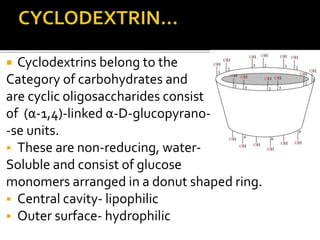
 Cyclodextrins belong to the
Category of carbohydrates and
are cyclic oligosaccharides consist
of (α-1,4)-linked α-D-glucopyrano-
-se units.
 These are non-reducing, water-
Soluble and consist of glucose
monomers arranged in a donut shaped ring.
 Central cavity- lipophilic
 Outer surface- hydrophilic
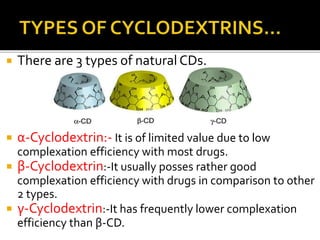
 There are 3 types of natural CDs.
 α-Cyclodextrin:- It is of limited value due to low
complexation efficiency with most drugs.
 β-Cyclodextrin:-It usually posses rather good
complexation efficiency with drugs in comparison to other
2 types.
 γ-Cyclodextrin:-It has frequently lower complexation
efficiency than β-CD.
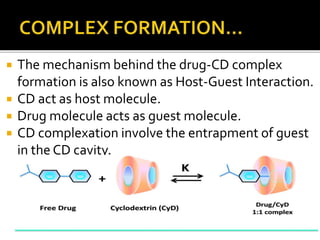
 The mechanism behind the drug-CD complex
formation is also known as Host-Guest Interaction.
 CD act as host molecule.
 Drug molecule acts as guest molecule.
 CD complexation involve the entrapment of guest
in the CD cavity.
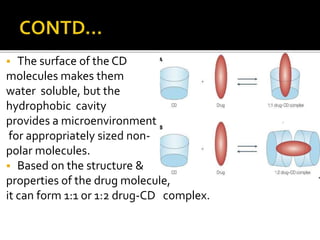
 The surface of the CD
molecules makes them
water soluble, but the
hydrophobic cavity
provides a microenvironment
for appropriately sized non-
polar molecules.
 Based on the structure &
properties of the drug molecule,
it can form 1:1 or 1:2 drug-CD complex.
 KNEADING:-
This process involves the formation of paste of CD with
the drug by using small quantity of either water or
ethanol to form kneaded mass.Then this kneaded mass
is dried at 45°C and pulverized.
 MELTING:-
In this process excess quantity of guest is melted & mixed
with powdered CD.Then after cooling excess quantity of
guest is removed by washing with weak complex forming
solvent.This method is restricted to sublimable guest
like menthol .
CO-EVAPORATION:-
Alcoholic solution of guest & aqueous solution of host is
mixed & stirred for sometimes.Then it is evaporated at
room temp until dried mass is obtained, pulverized &
sieved & fraction is collected.
FREEZE DRYING:-
The required stoichiometric quantity of host & guest were
added to aqueous solution of CD.This suspension is stirred
magnetically for 24 hours. Resulting mixture is freeze
dried at -60°C for 24 hours.
SPRAY DRYING:-
Host solution is prepared in ethanol:water 50% v/v.
To this solution guest is added & resulting mixture is
stirred for 24 hours at room temperature.
Then the solution is spray dried by observing
conditions like:-
 Air flow rate,
Atomizing air pressure,
Inlet temperature,
Outlet temperature,
 These are very expensive materials.
 In some cases when the complexing agent is too
concentrated, the complex can precipitate out of
solution as more complexing agent is added.
 Natural CDs are not useful for parenteral drug
delivery as they posses renal toxicity and
cytotoxicity. In this case some of the chemically
modifiedCDs are used.
Eg:- Hydroxypropyl & sulfobutyl ether derivatives.
 Here the inclusion complex with Hydroxypropyl-ß-cyclodextrin
(HPß CD) and ß-cyclodextrin (ß-CD) have been prepared by
different methods like kneading method, solvent evaporation
method,& physical evaporation method in different ratios.
 The drug content and % inclusion yield were calculated.The
characterization (FTIR and SEM) of the complexes shows that the
drug shows amorphous form in the complexes. Amorphous form has
higher dissolution efficiency than the crystalline drug.
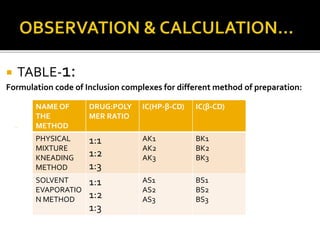
 TABLE-1:
Formulation code of Inclusion complexes for different method of preparation:
NAME OF
THE
METHOD
DRUG:POLY
MER RATIO
IC(HP-β-CD) IC(β-CD)
PHYSICAL
MIXTURE
KNEADING
METHOD
1:1
1:2
1:3
AK1
AK2
AK3
BK1
BK2
BK3
SOLVENT
EVAPORATIO
N METHOD
1:1
1:2
1:3
AS1
AS2
AS3
BS1
BS2
BS3
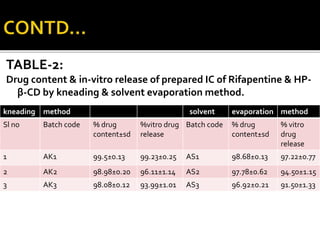
TABLE-2:
Drug content & in-vitro release of prepared IC of Rifapentine & HP-
β-CD by kneading & solvent evaporation method.
kneading method ssolvent evaporation method
Sl no Batch code % drug
content±sd
%vitro drug
release
Batch code % drug
content±sd
% vitro
drug
release
1 AK1 99.5±0.13 99.23±0.25 AS1 98.68±0.13 97.22±0.77
2 AK2 98.98±0.20 96.11±1.14 AS2 97.78±0.62 94.50±1.15
3 AK3 98.08±0.12 93.99±1.01 AS3 96.92±0.21 91.50±1.33
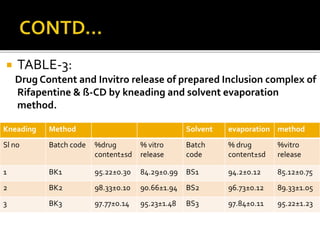
 TABLE-3:
Drug Content and Invitro release of prepared Inclusion complex of
Rifapentine & ß-CD by kneading and solvent evaporation
method.
Kneading Method Solvent evaporation method
Sl no Batch code %drug
content±sd
% vitro
release
Batch
code
% drug
content±sd
%vitro
release
1 BK1 95.22±0.30 84.29±0.99 BS1 94.2±0.12 85.12±0.75
2 BK2 98.33±0.10 90.66±1.94 BS2 96.73±0.12 89.33±1.05
3 BK3 97.77±0.14 95.23±1.48 BS3 97.84±0.11 95.22±1.23
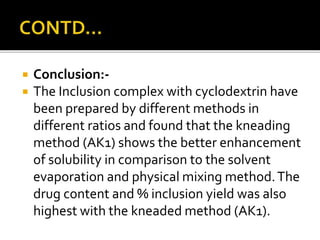
 Conclusion:-
 The Inclusion complex with cyclodextrin have
been prepared by different methods in
different ratios and found that the kneading
method (AK1) shows the better enhancement
of solubility in comparison to the solvent
evaporation and physical mixing method.The
drug content and % inclusion yield was also
highest with the kneaded method (AK1).
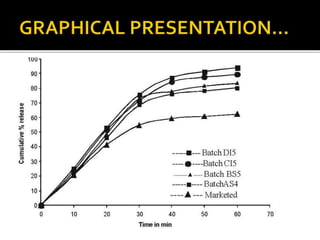
 Here inclusion complexes of Acyclovir were
prepared by kneading method by dissolving
Acyclovir & β-CD,HP-β-CD at 5 different ratios in
distilled water.
 The dissolution studies for inclusion complexes
were performed in 0.1 N Hcl at pH 7.4.
 Among all preparation of inclusion complex
of Acyclovir with β-CD or HP-β-CD, IC of
Acyclovir with the HP-β-CD(DI5) shows
higher solubility & dissolution rate.
1. Kalra K,Gaur M,Nainwal P, Jain D.A, Solubility
enhancement of Rifapentine by inclusion
complexation method,International Journal of Drug
Delivery.3:432-438(2011).
2. Sachan.N, Pushkar S, Solanki S.S,Enhancement of
solubility of Acyclovir by inclusion complexation
method,World Applied Science Journal.7:857-
864(2010).
3. Mehta H,Prabhakara P,Kamath J.V, Enhancement of
solubility by complexation with Cyclodextrin &
nanocrystallisation,International Research Journal Of
Pharmacy.5:101-105(2012).
THANKYOU…

SOLUBILITY ENHANCEMENT BY INCLUSION COMPLEXATION

  • 1.
    M.PHARM SEMINAR(2nd SEM)(PHARMACEUTICS) SUBJECT-APP TOPIC-SOLUBILIZATIONBY INCLUSION COMPLEXATION METHOD School Of Pharmaceutical Sciences Siksha ‘O’Anusandhan University, Bhubaneswar
  • 2.
     Solubility &solubilization.  Need of solubilization.  Inclusion Complexation.  Cyclodextrin.  Mechanism of complex formation.  Method of preparation of drug-CD complex.  Limitation of complexation.  Journal review.  Reference.
  • 3.
     Solubility isdefined in quantitative terms as concentration of solute in concentrated solution at a certain temperature, and in qualitative way it can be defined as a spontaneous interaction of two or more substances to form a homogenous molecular dispersion.  Solubilization can be defined as a preparation of thermodynamically stable isotropic solution of a substance normally insoluble or slightly soluble in a given solvent by introduction of an additional component or components.
  • 4.
     Therapeutic effectivenessof a drug depends upon the bioavailability & ultimately upon the solubility of drug molecules.  Solubility is one of the important parameter to achieve desired concentration of drug in systemic circulation for pharmacological response to be shown.  Low aqueous solubility is the major problem encountered with formulation development of new chemical entities.  Any drug to be absorbed must be present in the form of an aqueous solution at the site of absorption.  Therefore some solubilization enhancement techniques are needed to increase the solubility of a drug.
  • 5.
    INCLUSION COMPLEXATION ASA SOLUBILIZATION ENHANCEMENT TECHNIQUE…
  • 6.
     Complexation isa solubility enhancement process.  Complexation is the reversible association between two or more molecules to form a non- bonded entity with a well defined stoichiometry.  Complexation relies on relatively weak forces such as van-derwaal forces, hydrogen bonding and hydrophobic interaction.  2Types of complexation. 1. Self association/stacking complexation. 2. Inclusion complexation.
  • 7.
     These areformed by the insertion of the non-polar molecule or the non-polar region of one molecule(guest) into the cavity of another molecule or group of molecules(host).  When the guest molecule enters the host molecule the contact between water and the non-polar regions of both is reduced.  The most commonly used host molecules are the CYCLODEXTRINS.
  • 8.
     Cyclodextrins belongto the Category of carbohydrates and are cyclic oligosaccharides consist of (α-1,4)-linked α-D-glucopyrano- -se units.  These are non-reducing, water- Soluble and consist of glucose monomers arranged in a donut shaped ring.  Central cavity- lipophilic  Outer surface- hydrophilic
  • 9.
     There are3 types of natural CDs.  α-Cyclodextrin:- It is of limited value due to low complexation efficiency with most drugs.  β-Cyclodextrin:-It usually posses rather good complexation efficiency with drugs in comparison to other 2 types.  γ-Cyclodextrin:-It has frequently lower complexation efficiency than β-CD.
  • 10.
     The mechanismbehind the drug-CD complex formation is also known as Host-Guest Interaction.  CD act as host molecule.  Drug molecule acts as guest molecule.  CD complexation involve the entrapment of guest in the CD cavity.
  • 11.
     The surfaceof the CD molecules makes them water soluble, but the hydrophobic cavity provides a microenvironment for appropriately sized non- polar molecules.  Based on the structure & properties of the drug molecule, it can form 1:1 or 1:2 drug-CD complex.
  • 12.
     KNEADING:- This processinvolves the formation of paste of CD with the drug by using small quantity of either water or ethanol to form kneaded mass.Then this kneaded mass is dried at 45°C and pulverized.  MELTING:- In this process excess quantity of guest is melted & mixed with powdered CD.Then after cooling excess quantity of guest is removed by washing with weak complex forming solvent.This method is restricted to sublimable guest like menthol .
  • 13.
    CO-EVAPORATION:- Alcoholic solution ofguest & aqueous solution of host is mixed & stirred for sometimes.Then it is evaporated at room temp until dried mass is obtained, pulverized & sieved & fraction is collected. FREEZE DRYING:- The required stoichiometric quantity of host & guest were added to aqueous solution of CD.This suspension is stirred magnetically for 24 hours. Resulting mixture is freeze dried at -60°C for 24 hours.
  • 14.
    SPRAY DRYING:- Host solutionis prepared in ethanol:water 50% v/v. To this solution guest is added & resulting mixture is stirred for 24 hours at room temperature. Then the solution is spray dried by observing conditions like:-  Air flow rate, Atomizing air pressure, Inlet temperature, Outlet temperature,
  • 15.
     These arevery expensive materials.  In some cases when the complexing agent is too concentrated, the complex can precipitate out of solution as more complexing agent is added.  Natural CDs are not useful for parenteral drug delivery as they posses renal toxicity and cytotoxicity. In this case some of the chemically modifiedCDs are used. Eg:- Hydroxypropyl & sulfobutyl ether derivatives.
  • 16.
     Here theinclusion complex with Hydroxypropyl-ß-cyclodextrin (HPß CD) and ß-cyclodextrin (ß-CD) have been prepared by different methods like kneading method, solvent evaporation method,& physical evaporation method in different ratios.  The drug content and % inclusion yield were calculated.The characterization (FTIR and SEM) of the complexes shows that the drug shows amorphous form in the complexes. Amorphous form has higher dissolution efficiency than the crystalline drug.
  • 17.
     TABLE-1: Formulation codeof Inclusion complexes for different method of preparation: NAME OF THE METHOD DRUG:POLY MER RATIO IC(HP-β-CD) IC(β-CD) PHYSICAL MIXTURE KNEADING METHOD 1:1 1:2 1:3 AK1 AK2 AK3 BK1 BK2 BK3 SOLVENT EVAPORATIO N METHOD 1:1 1:2 1:3 AS1 AS2 AS3 BS1 BS2 BS3
  • 18.
    TABLE-2: Drug content &in-vitro release of prepared IC of Rifapentine & HP- β-CD by kneading & solvent evaporation method. kneading method ssolvent evaporation method Sl no Batch code % drug content±sd %vitro drug release Batch code % drug content±sd % vitro drug release 1 AK1 99.5±0.13 99.23±0.25 AS1 98.68±0.13 97.22±0.77 2 AK2 98.98±0.20 96.11±1.14 AS2 97.78±0.62 94.50±1.15 3 AK3 98.08±0.12 93.99±1.01 AS3 96.92±0.21 91.50±1.33
  • 19.
     TABLE-3: Drug Contentand Invitro release of prepared Inclusion complex of Rifapentine & ß-CD by kneading and solvent evaporation method. Kneading Method Solvent evaporation method Sl no Batch code %drug content±sd % vitro release Batch code % drug content±sd %vitro release 1 BK1 95.22±0.30 84.29±0.99 BS1 94.2±0.12 85.12±0.75 2 BK2 98.33±0.10 90.66±1.94 BS2 96.73±0.12 89.33±1.05 3 BK3 97.77±0.14 95.23±1.48 BS3 97.84±0.11 95.22±1.23
  • 20.
     Conclusion:-  TheInclusion complex with cyclodextrin have been prepared by different methods in different ratios and found that the kneading method (AK1) shows the better enhancement of solubility in comparison to the solvent evaporation and physical mixing method.The drug content and % inclusion yield was also highest with the kneaded method (AK1).
  • 21.
     Here inclusioncomplexes of Acyclovir were prepared by kneading method by dissolving Acyclovir & β-CD,HP-β-CD at 5 different ratios in distilled water.  The dissolution studies for inclusion complexes were performed in 0.1 N Hcl at pH 7.4.
  • 23.
     Among allpreparation of inclusion complex of Acyclovir with β-CD or HP-β-CD, IC of Acyclovir with the HP-β-CD(DI5) shows higher solubility & dissolution rate.
  • 24.
    1. Kalra K,GaurM,Nainwal P, Jain D.A, Solubility enhancement of Rifapentine by inclusion complexation method,International Journal of Drug Delivery.3:432-438(2011). 2. Sachan.N, Pushkar S, Solanki S.S,Enhancement of solubility of Acyclovir by inclusion complexation method,World Applied Science Journal.7:857- 864(2010). 3. Mehta H,Prabhakara P,Kamath J.V, Enhancement of solubility by complexation with Cyclodextrin & nanocrystallisation,International Research Journal Of Pharmacy.5:101-105(2012).
  • 25.