Define and discuss the
Biomedical importance of
peptides and polypeptides
Proteins are Primary Component of our
Body Tissues and All Living Cells
High molecular weight, Nitrogenous,
Organic Compounds.
Proteins are Polymer of AminoAcids.
Each protein molecule is a complex and large
chain of basic units “Amino Acids”.
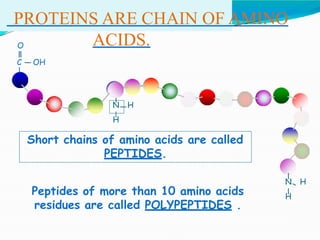
PROTEINS ARE CHAIN OF AMINO
ACIDS.
O
C OH
N H
H
N H
H
Short chains of amino acids are called
PEPTIDES.
Peptides of more than 10 amino acids
residues are called POLYPEPTIDES .
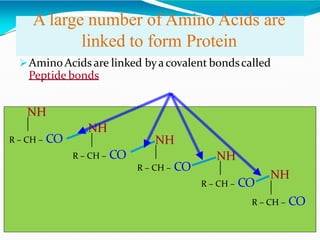
A large number of Amino Acids are
linked to form Protein
Amino Acids are linked bya covalent bondscalled
Peptide bonds
NH

R – CH – CO
NH

R – CH – CO
NH

R – CH – CO
NH

R – CH – CO
NH

R – CH – CO
5
Peptides
 Amino acids are joined together to form polymers of
amino acids called oligopeptides (2-10 amino acids)
and polypeptides (more than 10 amino acids).
Collectively, oligopeptides and polypeptides are
called peptides.
The amino acids are joined together by an amide
bond called a peptide bond, which is similar to the
glycosidic bond found in oligosaccharides and
polysaccharides.
Peptides
The bond and its characteristics
• Proteins are macromolecules with a backbone
formed by polymerization of amino acids in a
polyamide structure.
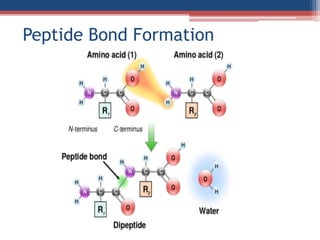
• These amide bonds in protein, known as peptide
bonds formed by linkage of α - carboxyl group of
one amino acid with α- amino groups of the next
amino acid by amide bonds.
Polypeptide
• Definition. The polypeptide definition
describes a chain of more than twenty and
less than fifty amino acids bound together
via covalent peptide bonds. Singular amino
acids are the building blocks of life and can
be linked to form oligopeptides,
polypeptides, and proteins inside the cell
PEPTIDE BOND
⚫As a general rule: Amino Acids are attached
covalently by αCOOH group on one side and
αNH2 group on another side.
⚫ Now there is formation of ACID-
AMIDE BOND===PEPTIDE BOND.
Different types of Peptide Bond
• Peptides are mainly categorized in different
ways: According to how many amino acids
make up the chain:
 Dipeptide = contains 2 amino acid units.
 Tripeptide = contains 3 amino acid units.
 Tetrapeptide = contains 4 amino acid units.
 Oligopeptide = contains not more than 10
amino acid units.
Structure of Peptide bond
•
A peptide bond is a planar, trans and rigid
configuration.
• It also shows a partial double bond character.
• The coplanarity of the peptide bond denotes
the resonance or partial sharing of two pairs of
electrons between the amide nitrogen and
carboxyl oxygen.
CHARACTERISTICS OF PEPTIDE
BOND:
⚫Poly Peptides of high Molecular weight
(i.e: Above 10,000) are called PROTEINS.
⚫Peptide bond is rigid because it has a partial
double bond.
⚫They can take part in the formation of
Hydrogen Bond.
Peptide Bond Formation
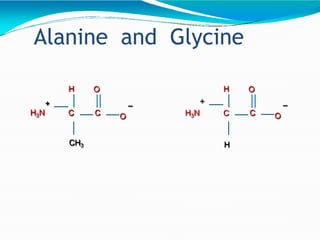
Alanine and Glycine
CH3
O
H
C O
–
+
H3N C
O
H
H
C
+
H3N C O
–
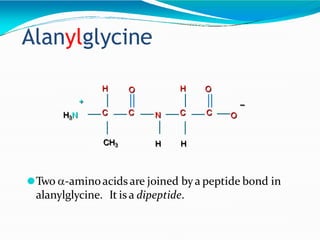
Alanylglycine
CH3
O
C
H3N
+
H
C
O
C
N
H
H
C O
–
H
⚫Two -aminoacids are joined bya peptide bond in
alanylglycine. It is a dipeptide.
Biologically Important Classification Of
Peptides
• They are classified into two groups:
1. ribosomally synthesized peptides
2. non-ribosomally synthesized peptides.
Ribosomally synthesized peptides:
• Ribosomally synthesized peptides with antimicrobial
properties (antimicrobial peptides-AMPs) are produced
by eukaryotes and prokaryotes and represent crucial
components of their defense systems against
microorganisms.
Non-ribosomally synthesized peptides.
Non-ribosomally synthesized peptides are
elaborated in different organisms (bacteria,
fungi, and streptomycetes containing two or
more moieties derived from amino acids) and
composed of multienzyme complexes.
BIO-MEDICAL IMPORTANCE OF
PEPTIDES
⚫GLUTATHIONE= Glutamic acid +Cysteine
+Glycine
⚫BRADYKININ= (9 amino acids) Relaxant
effects on smooth muscle.
⚫ANGIOTENSIN=(10 amino acids) plays
role in hypertension.
⚫ANTIBIOTICS= Penicillin, Actinomycin,
Chloramphenicol are all peptide which
act as antibiotics.
Biomedical Importance of Peptides
• Peptides transfer the information from cell to cell
and regulate the life which is involved in biological
signalling mechanism.
• Peptides consist of a combination of two or more
amino acids which are linked together to form a
polypeptide.
• Peptides are unable to enter into the cell since they
are water soluble molecule
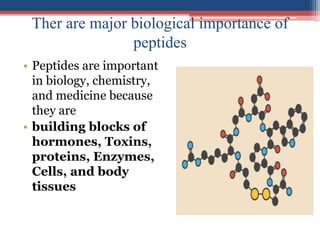
Ther are major biological importance of
peptides
• Peptides are important
in biology, chemistry,
and medicine because
they are
• building blocks of
hormones, Toxins,
proteins, Enzymes,
Cells, and body
tissues
Biological Function of Peptide and
polypeptide
• One or more polypeptides are linked together
to make proteins.
• As a result, proteins are essentially very long
peptides.
• In actuality, some researchers use the term
peptide to refer to oligopeptides, or short amino
acid chains, while the term polypeptide is used to
refer to proteins or chains of 50 or more amino
acids.
Key points of Peptides
I. A peptide is a polymer formed by linking amino
acid subunits.
II. A peptide molecule may be biologically active
on its own or it may act as a subunit for a larger
molecule.
III. Proteins are essentially very large peptides,
often consisting of multiple peptide subunits.
IV. Peptides are important in biology, chemistry,
and medicine because they are building blocks
of hormones, toxins, proteins, enzymes, cells,
and body tissues.
Functions
• Peptides are biologically and medically important
molecules.
• They naturally occur within organisms, plus lab-
synthesized compounds are active when introduced
into a body.
• Peptides act as structural components of cells and
tissues, hormones, toxins, antibiotics, and enzymes.
• Examples: of peptides include the hormone oxytocin,
glutathione (stimulates tissue growth), melittin
(honey bee venom), the pancreatic hormone insulin,
and glucagon (a hyperglycemic factor)
Functions of peptides
• They function in higher organisms as hormones.
• These are of many types such as antimicrobial
peptides, tachykinin peptides, vasoactive
intestinal peptides, pancreatic polypeptide etc.
• Peptones – They are formed during the
proteolysis of milk and meat.
• They are used for growing fungi, bacteria for
various purposes.
Function of peptide hormones
• Peptide hormones play a prominent role
in controlling energy homeostasis and
metabolism.
• They have been implicated in controlling
appetite, the function of the gastrointestinal
and cardiovascular systems, energy
expenditure, and reproduction.
The list of peptides for bodybuilding
has increased to include the following:
• IGF-1 – Boosts insulin sensitivity for muscle
growth.
• MGF – Helps initiate hypertrophy and repair
of damaged muscles.
• GHRP – Stimulates the release of the human
growth hormone (HGH)
• BPC-157 – Helps heal joints and muscles.
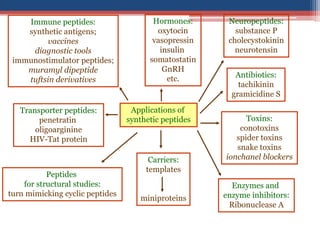
Applications of
synthetic peptides
Immune peptides:
synthetic antigens;
vaccines
diagnostic tools
immunostimulator peptides;
muramyl dipeptide
tuftsin derivatives
Hormones:
oxytocin
vasopressin
insulin
somatostatin
GnRH
etc.
Neuropeptides:
substance P
cholecystokinin
neurotensin
Antibiotics:
tachikinin
gramicidine S
Toxins:
conotoxins
spider toxins
snake toxins
ionchanel blockers
Enzymes and
enzyme inhibitors:
Ribonuclease A
Carriers:
templates
miniproteins
Peptides
for structural studies:
turn mimicking cyclic peptides
Transporter peptides:
penetratin
oligoarginine
HIV-Tat protein
Peptides 06-04-2023.pptx

Peptides 06-04-2023.pptx

  • 1.
    Define and discussthe Biomedical importance of peptides and polypeptides
  • 2.
    Proteins are PrimaryComponent of our Body Tissues and All Living Cells High molecular weight, Nitrogenous, Organic Compounds. Proteins are Polymer of AminoAcids. Each protein molecule is a complex and large chain of basic units “Amino Acids”.
  • 3.
    PROTEINS ARE CHAINOF AMINO ACIDS. O C OH N H H N H H Short chains of amino acids are called PEPTIDES. Peptides of more than 10 amino acids residues are called POLYPEPTIDES .
  • 4.
    A large numberof Amino Acids are linked to form Protein Amino Acids are linked bya covalent bondscalled Peptide bonds NH  R – CH – CO NH  R – CH – CO NH  R – CH – CO NH  R – CH – CO NH  R – CH – CO
  • 5.
    5 Peptides  Amino acidsare joined together to form polymers of amino acids called oligopeptides (2-10 amino acids) and polypeptides (more than 10 amino acids). Collectively, oligopeptides and polypeptides are called peptides. The amino acids are joined together by an amide bond called a peptide bond, which is similar to the glycosidic bond found in oligosaccharides and polysaccharides.
  • 6.
    Peptides The bond andits characteristics • Proteins are macromolecules with a backbone formed by polymerization of amino acids in a polyamide structure. • These amide bonds in protein, known as peptide bonds formed by linkage of α - carboxyl group of one amino acid with α- amino groups of the next amino acid by amide bonds.
  • 7.
    Polypeptide • Definition. Thepolypeptide definition describes a chain of more than twenty and less than fifty amino acids bound together via covalent peptide bonds. Singular amino acids are the building blocks of life and can be linked to form oligopeptides, polypeptides, and proteins inside the cell
  • 8.
    PEPTIDE BOND ⚫As ageneral rule: Amino Acids are attached covalently by αCOOH group on one side and αNH2 group on another side. ⚫ Now there is formation of ACID- AMIDE BOND===PEPTIDE BOND.
  • 9.
    Different types ofPeptide Bond • Peptides are mainly categorized in different ways: According to how many amino acids make up the chain:  Dipeptide = contains 2 amino acid units.  Tripeptide = contains 3 amino acid units.  Tetrapeptide = contains 4 amino acid units.  Oligopeptide = contains not more than 10 amino acid units.
  • 10.
    Structure of Peptidebond • A peptide bond is a planar, trans and rigid configuration. • It also shows a partial double bond character. • The coplanarity of the peptide bond denotes the resonance or partial sharing of two pairs of electrons between the amide nitrogen and carboxyl oxygen.
  • 11.
    CHARACTERISTICS OF PEPTIDE BOND: ⚫PolyPeptides of high Molecular weight (i.e: Above 10,000) are called PROTEINS. ⚫Peptide bond is rigid because it has a partial double bond. ⚫They can take part in the formation of Hydrogen Bond.
  • 12.
  • 13.
    Alanine and Glycine CH3 O H CO – + H3N C O H H C + H3N C O –
  • 14.
    Alanylglycine CH3 O C H3N + H C O C N H H C O – H ⚫Two -aminoacidsare joined bya peptide bond in alanylglycine. It is a dipeptide.
  • 15.
    Biologically Important ClassificationOf Peptides • They are classified into two groups: 1. ribosomally synthesized peptides 2. non-ribosomally synthesized peptides. Ribosomally synthesized peptides: • Ribosomally synthesized peptides with antimicrobial properties (antimicrobial peptides-AMPs) are produced by eukaryotes and prokaryotes and represent crucial components of their defense systems against microorganisms.
  • 16.
    Non-ribosomally synthesized peptides. Non-ribosomallysynthesized peptides are elaborated in different organisms (bacteria, fungi, and streptomycetes containing two or more moieties derived from amino acids) and composed of multienzyme complexes.
  • 17.
    BIO-MEDICAL IMPORTANCE OF PEPTIDES ⚫GLUTATHIONE=Glutamic acid +Cysteine +Glycine ⚫BRADYKININ= (9 amino acids) Relaxant effects on smooth muscle. ⚫ANGIOTENSIN=(10 amino acids) plays role in hypertension. ⚫ANTIBIOTICS= Penicillin, Actinomycin, Chloramphenicol are all peptide which act as antibiotics.
  • 18.
    Biomedical Importance ofPeptides • Peptides transfer the information from cell to cell and regulate the life which is involved in biological signalling mechanism. • Peptides consist of a combination of two or more amino acids which are linked together to form a polypeptide. • Peptides are unable to enter into the cell since they are water soluble molecule
  • 19.
    Ther are majorbiological importance of peptides • Peptides are important in biology, chemistry, and medicine because they are • building blocks of hormones, Toxins, proteins, Enzymes, Cells, and body tissues
  • 20.
    Biological Function ofPeptide and polypeptide • One or more polypeptides are linked together to make proteins. • As a result, proteins are essentially very long peptides. • In actuality, some researchers use the term peptide to refer to oligopeptides, or short amino acid chains, while the term polypeptide is used to refer to proteins or chains of 50 or more amino acids.
  • 21.
    Key points ofPeptides I. A peptide is a polymer formed by linking amino acid subunits. II. A peptide molecule may be biologically active on its own or it may act as a subunit for a larger molecule. III. Proteins are essentially very large peptides, often consisting of multiple peptide subunits. IV. Peptides are important in biology, chemistry, and medicine because they are building blocks of hormones, toxins, proteins, enzymes, cells, and body tissues.
  • 22.
    Functions • Peptides arebiologically and medically important molecules. • They naturally occur within organisms, plus lab- synthesized compounds are active when introduced into a body. • Peptides act as structural components of cells and tissues, hormones, toxins, antibiotics, and enzymes. • Examples: of peptides include the hormone oxytocin, glutathione (stimulates tissue growth), melittin (honey bee venom), the pancreatic hormone insulin, and glucagon (a hyperglycemic factor)
  • 23.
    Functions of peptides •They function in higher organisms as hormones. • These are of many types such as antimicrobial peptides, tachykinin peptides, vasoactive intestinal peptides, pancreatic polypeptide etc. • Peptones – They are formed during the proteolysis of milk and meat. • They are used for growing fungi, bacteria for various purposes.
  • 24.
    Function of peptidehormones • Peptide hormones play a prominent role in controlling energy homeostasis and metabolism. • They have been implicated in controlling appetite, the function of the gastrointestinal and cardiovascular systems, energy expenditure, and reproduction.
  • 25.
    The list ofpeptides for bodybuilding has increased to include the following: • IGF-1 – Boosts insulin sensitivity for muscle growth. • MGF – Helps initiate hypertrophy and repair of damaged muscles. • GHRP – Stimulates the release of the human growth hormone (HGH) • BPC-157 – Helps heal joints and muscles.
  • 26.
    Applications of synthetic peptides Immunepeptides: synthetic antigens; vaccines diagnostic tools immunostimulator peptides; muramyl dipeptide tuftsin derivatives Hormones: oxytocin vasopressin insulin somatostatin GnRH etc. Neuropeptides: substance P cholecystokinin neurotensin Antibiotics: tachikinin gramicidine S Toxins: conotoxins spider toxins snake toxins ionchanel blockers Enzymes and enzyme inhibitors: Ribonuclease A Carriers: templates miniproteins Peptides for structural studies: turn mimicking cyclic peptides Transporter peptides: penetratin oligoarginine HIV-Tat protein