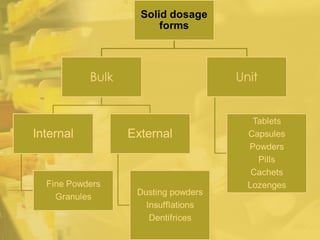
Solid Dosage Forms
Powders
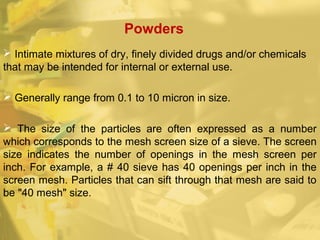
 Intimate mixtures of dry, finely divided drugs and/or chemicals
that may be intended for internal or external use.
 Generally range from 0.1 to 10 micron in size.
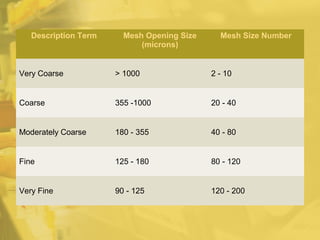
 The size of the particles are often expressed as a number
which corresponds to the mesh screen size of a sieve. The screen
size indicates the number of openings in the mesh screen per
inch. For example, a # 40 sieve has 40 openings per inch in the
screen mesh. Particles that can sift through that mesh are said to
be "40 mesh" size.
Description Term Mesh Opening Size
(microns)
Mesh Size Number
Very Coarse > 1000 2 - 10
Coarse 355 -1000 20 - 40
Moderately Coarse 180 - 355 40 - 80
Fine 125 - 180 80 - 120
Very Fine 90 - 125 120 - 200
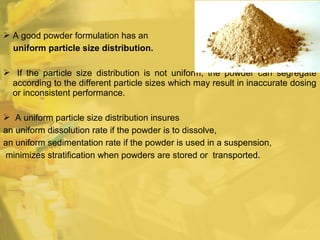
 A good powder formulation has an
uniform particle size distribution.
 If the particle size distribution is not uniform, the powder can segregate
according to the different particle sizes which may result in inaccurate dosing
or inconsistent performance.
 A uniform particle size distribution insures
an uniform dissolution rate if the powder is to dissolve,
an uniform sedimentation rate if the powder is used in a suspension,
minimizes stratification when powders are stored or transported.
Powders for Internal use
Bulk Powders- are nonpotent and can be dosed
with acceptable accuracy and safety using
measuring devices such as the teaspoon, cup, or
insufflator.
Divided Powders - are single doses of powdered
medicinals individually wrapped in cellophane,
metallic foil, or paper.
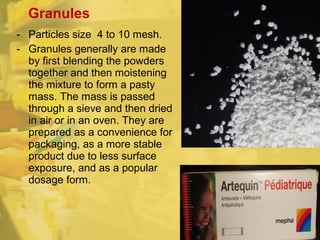
- Particles size 4 to 10 mesh.
- Granules generally are made
by first blending the powders
together and then moistening
the mixture to form a pasty
mass. The mass is passed
through a sieve and then dried
in air or in an oven. They are
prepared as a convenience for
packaging, as a more stable
product due to less surface
exposure, and as a popular
dosage form.
Granules
Capsules
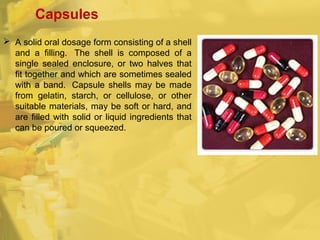
 A solid oral dosage form consisting of a shell
and a filling. The shell is composed of a
single sealed enclosure, or two halves that
fit together and which are sometimes sealed
with a band. Capsule shells may be made
from gelatin, starch, or cellulose, or other
suitable materials, may be soft or hard, and
are filled with solid or liquid ingredients that
can be poured or squeezed.
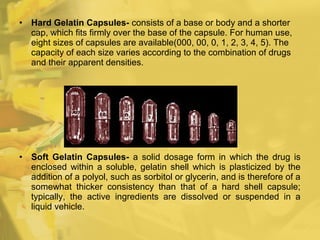
• Hard Gelatin Capsules- consists of a base or body and a shorter
cap, which fits firmly over the base of the capsule. For human use,
eight sizes of capsules are available(000, 00, 0, 1, 2, 3, 4, 5). The
capacity of each size varies according to the combination of drugs
and their apparent densities.
• Soft Gelatin Capsules- a solid dosage form in which the drug is
enclosed within a soluble, gelatin shell which is plasticized by the
addition of a polyol, such as sorbitol or glycerin, and is therefore of a
somewhat thicker consistency than that of a hard shell capsule;
typically, the active ingredients are dissolved or suspended in a
liquid vehicle.
Hard gelatin capsules Soft gelatin capsules
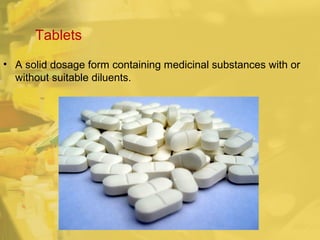
Tablets
• A solid dosage form containing medicinal substances with or
without suitable diluents.
Types Of Tablets
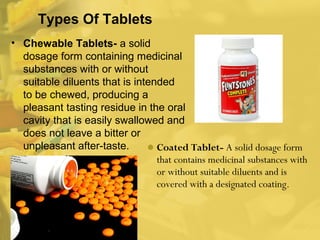
• Chewable Tablets- a solid
dosage form containing medicinal
substances with or without
suitable diluents that is intended
to be chewed, producing a
pleasant tasting residue in the oral
cavity that is easily swallowed and
does not leave a bitter or
unpleasant after-taste. Coated Tablet- A solid dosage form
that contains medicinal substances with
or without suitable diluents and is
covered with a designated coating.
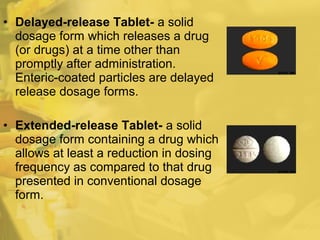
• Delayed-release Tablet- a solid
dosage form which releases a drug
(or drugs) at a time other than
promptly after administration.
Enteric-coated particles are delayed
release dosage forms.
• Extended-release Tablet- a solid
dosage form containing a drug which
allows at least a reduction in dosing
frequency as compared to that drug
presented in conventional dosage
form.
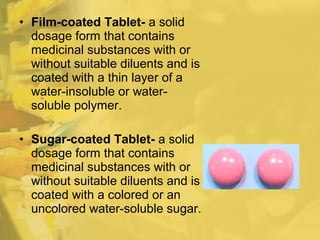
• Film-coated Tablet- a solid
dosage form that contains
medicinal substances with or
without suitable diluents and is
coated with a thin layer of a
water-insoluble or water-
soluble polymer.
• Sugar-coated Tablet- a solid
dosage form that contains
medicinal substances with or
without suitable diluents and is
coated with a colored or an
uncolored water-soluble sugar.
Other Solid Dosage Forms for Oral
Administration
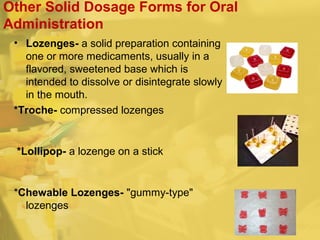
• Lozenges- a solid preparation containing
one or more medicaments, usually in a
flavored, sweetened base which is
intended to dissolve or disintegrate slowly
in the mouth.
*Troche- compressed lozenges
*Lollipop- a lozenge on a stick
*Chewable Lozenges- "gummy-type"
lozenges
• Pills- small, round solid dosage form
containing a medicinal agent intended for oral
administration.
Solid dosage-form scb

Solid dosage-form scb

  • 1.
  • 3.
    Powders  Intimate mixturesof dry, finely divided drugs and/or chemicals that may be intended for internal or external use.  Generally range from 0.1 to 10 micron in size.  The size of the particles are often expressed as a number which corresponds to the mesh screen size of a sieve. The screen size indicates the number of openings in the mesh screen per inch. For example, a # 40 sieve has 40 openings per inch in the screen mesh. Particles that can sift through that mesh are said to be "40 mesh" size.
  • 4.
    Description Term MeshOpening Size (microns) Mesh Size Number Very Coarse > 1000 2 - 10 Coarse 355 -1000 20 - 40 Moderately Coarse 180 - 355 40 - 80 Fine 125 - 180 80 - 120 Very Fine 90 - 125 120 - 200
  • 5.
     A goodpowder formulation has an uniform particle size distribution.  If the particle size distribution is not uniform, the powder can segregate according to the different particle sizes which may result in inaccurate dosing or inconsistent performance.  A uniform particle size distribution insures an uniform dissolution rate if the powder is to dissolve, an uniform sedimentation rate if the powder is used in a suspension, minimizes stratification when powders are stored or transported.
  • 6.
    Powders for Internaluse Bulk Powders- are nonpotent and can be dosed with acceptable accuracy and safety using measuring devices such as the teaspoon, cup, or insufflator. Divided Powders - are single doses of powdered medicinals individually wrapped in cellophane, metallic foil, or paper.
  • 7.
    - Particles size4 to 10 mesh. - Granules generally are made by first blending the powders together and then moistening the mixture to form a pasty mass. The mass is passed through a sieve and then dried in air or in an oven. They are prepared as a convenience for packaging, as a more stable product due to less surface exposure, and as a popular dosage form. Granules
  • 8.
    Capsules  A solidoral dosage form consisting of a shell and a filling. The shell is composed of a single sealed enclosure, or two halves that fit together and which are sometimes sealed with a band. Capsule shells may be made from gelatin, starch, or cellulose, or other suitable materials, may be soft or hard, and are filled with solid or liquid ingredients that can be poured or squeezed.
  • 9.
    • Hard GelatinCapsules- consists of a base or body and a shorter cap, which fits firmly over the base of the capsule. For human use, eight sizes of capsules are available(000, 00, 0, 1, 2, 3, 4, 5). The capacity of each size varies according to the combination of drugs and their apparent densities. • Soft Gelatin Capsules- a solid dosage form in which the drug is enclosed within a soluble, gelatin shell which is plasticized by the addition of a polyol, such as sorbitol or glycerin, and is therefore of a somewhat thicker consistency than that of a hard shell capsule; typically, the active ingredients are dissolved or suspended in a liquid vehicle.
  • 10.
    Hard gelatin capsulesSoft gelatin capsules
  • 11.
    Tablets • A soliddosage form containing medicinal substances with or without suitable diluents.
  • 12.
    Types Of Tablets •Chewable Tablets- a solid dosage form containing medicinal substances with or without suitable diluents that is intended to be chewed, producing a pleasant tasting residue in the oral cavity that is easily swallowed and does not leave a bitter or unpleasant after-taste. Coated Tablet- A solid dosage form that contains medicinal substances with or without suitable diluents and is covered with a designated coating.
  • 13.
    • Delayed-release Tablet-a solid dosage form which releases a drug (or drugs) at a time other than promptly after administration. Enteric-coated particles are delayed release dosage forms. • Extended-release Tablet- a solid dosage form containing a drug which allows at least a reduction in dosing frequency as compared to that drug presented in conventional dosage form.
  • 14.
    • Film-coated Tablet-a solid dosage form that contains medicinal substances with or without suitable diluents and is coated with a thin layer of a water-insoluble or water- soluble polymer. • Sugar-coated Tablet- a solid dosage form that contains medicinal substances with or without suitable diluents and is coated with a colored or an uncolored water-soluble sugar.
  • 15.
    Other Solid DosageForms for Oral Administration • Lozenges- a solid preparation containing one or more medicaments, usually in a flavored, sweetened base which is intended to dissolve or disintegrate slowly in the mouth. *Troche- compressed lozenges *Lollipop- a lozenge on a stick *Chewable Lozenges- "gummy-type" lozenges
  • 16.
    • Pills- small,round solid dosage form containing a medicinal agent intended for oral administration.