1
PHARMACEUTICAL
DOSAGE FORMS
B.PHARM SEM-I UNIT-I PHARMACEUTICS-I
Ms. S. B. Gaurkar
Assistant Professor,
DRGIOP, Amravati
2
Introduction to Dosage Forms
Definition of Dosage Form
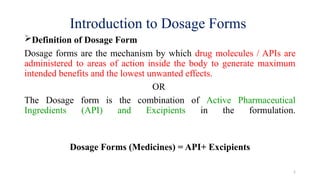
Dosage forms are the mechanism by which drug molecules / APIs are
administered to areas of action inside the body to generate maximum
intended benefits and the lowest unwanted effects.
OR
The Dosage form is the combination of Active Pharmaceutical
Ingredients (API) and Excipients in the formulation.
Dosage Forms (Medicines) = API+ Excipients
3
Definition of Drug (Active Pharmaceutical Ingredients)
• Drogue is an old French term that means "dry herb" and is sometimes
used interchangeably with the word "drug".
• Chemical compounds intended for use in the diagnosis, prevention,
treatment, and management of disease(s) in humans and other animals
are referred to as "pharmaceutical products" or "pharmaceuticals".
• Chemical/organic synthesis, molecular modification, and biotechnology
have all been used to produce medicines in recent years.
OR
• The Active Pharmaceutical Ingredient (API) is the component of a
medication that creates its action.
Active Pharmaceutical Ingredients (API)
4
Excipients
• Do not increase or affect the therapeutic action of the active
components.
• They are also known as inactive components or excipients and have no
pharmacological action in general.
• Examples of inactive components are dyes, preservatives, sweetening
agents, binding materials, coloring agents and flavoring agents, etc.
5
Need of Dosage Forms
• Mainly depend on Patient Safety and Drug Safety/ Benefits.
• 1. Deliver precise dosages in a safe and easy manner.
Example – Tablets, capsules, syrups
• 2. Cover bitter taste or odor of drug substances.
Example – Capsules, coated tablets, flavored syrups
• 3. Insoluble or unstable in the selected vehicle, provide a liquid formulation of the
insoluble or unstable medication.
Example – Suspension
• 4. Controlled-release methods prolong the duration of medication effect.
Example – Controlled release tablets, capsules, suspensions
• 5. After oral delivery, a drug substance is protected from stomach acid.
Example – Enteric-coated tablets
6
Need of Dosage Forms
• 6. Provide optional drug action from topical administration sites.
Example – Ointment, cream, ear and nasal preparations
• 7. Drugs can be injected into the body's tissues.
Example – Implants
• 8. Inhalation treatment is the most effective way to get optimum medication activity.
Example – Inhalants
• 9. Liquid dosage forms of chemicals soluble in the vehicle of your choice.
Example – Solution
• 10. Provide for the introduction of medication into the body’s orifice.
Example – Rectal and vaginal suppositories
• 11. Protection of a drug substance from atmospheric oxygen or moisture.
Example – Coated capsules, sealed ampules.
7
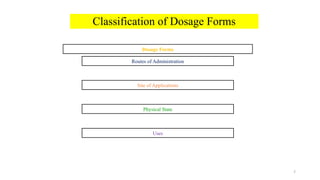
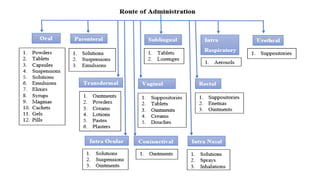
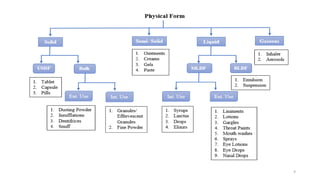
Classification of Dosage Forms
Dosage Forms
Routes of Administration
Site of Applications
Physical State
Uses
8
9
10
11
Solid Dosage Forms
12
• Solid dosage forms are pharmaceutical formulations in which the active drug is
combined with suitable excipients and presented in a solid state.
• These are among the most commonly used drug delivery systems due to their stability,
ease of administration, accurate dosing, and convenience in manufacturing, packaging,
and transport.
• Solid dosage forms are available mostly in unit dosage forms.
• Some solids are packed and supplied in bulk.
• The bulk forms meant for internal use are supplied either as granules or fine powder.
• The bulk powder meant for external use are dusting powder, insufflations, snuffs
and tooth powders.
13
14
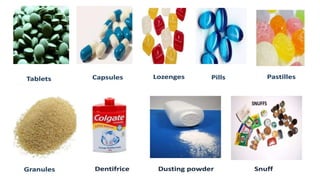
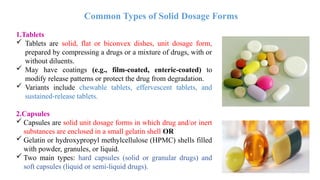
1.Tablets
 Tablets are solid, flat or biconvex dishes, unit dosage form,
prepared by compressing a drugs or a mixture of drugs, with or
without diluents.
 May have coatings (e.g., film-coated, enteric-coated) to
modify release patterns or protect the drug from degradation.
 Variants include chewable tablets, effervescent tablets, and
sustained-release tablets.
2.Capsules
 Capsules are solid unit dosage forms in which drug and/or inert
substances are enclosed in a small gelatin shell OR
 Gelatin or hydroxypropyl methylcellulose (HPMC) shells filled
with powder, granules, or liquid.
 Two main types: hard capsules (solid or granular drugs) and
soft capsules (liquid or semi-liquid drugs).
Common Types of Solid Dosage Forms
15
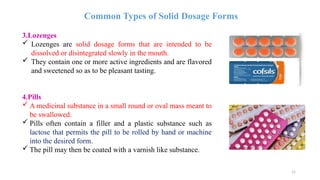
3.Lozenges
 Lozenges are solid dosage forms that are intended to be
dissolved or disintegrated slowly in the mouth.
 They contain one or more active ingredients and are flavored
and sweetened so as to be pleasant tasting.
4.Pills
 A medicinal substance in a small round or oval mass meant to
be swallowed.
 Pills often contain a filler and a plastic substance such as
lactose that permits the pill to be rolled by hand or machine
into the desired form.
 The pill may then be coated with a varnish like substance.
Common Types of Solid Dosage Forms
16
17
POWDERS are a type of pharmaceutical solid dosage form intended for internal or
external use, where the powder is supplied in large quantities rather than as individually
measured doses.
• They are available in crystalline or amorphous form.
• Bulk powder for internal use e.g. fine powders or granules
• Bulk powder for external use e.g. snuffs, dusting powders, tooth powders, and
insufflations.
• Simple and compound powders for internal use
• Powders in the form of compressed tablets and tablets triturates
• Powder enclosed in cachets and capsules
POWDERS
18
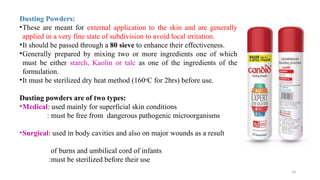
Dusting Powders:
•These are meant for external application to the skin and are generally
applied in a very fine state of subdivision to avoid local irritation.
•It should be passed through a 80 sieve to enhance their effectiveness.
•Generally prepared by mixing two or more ingredients one of which
must be either starch, Kaolin or talc as one of the ingredients of the
formulation.
•It must be sterilized dry heat method (160o
C for 2hrs) before use.
Dusting powders are of two types:
•Medical: used mainly for superficial skin conditions
: must be free from dangerous pathogenic microorganisms
•Surgical: used in body cavities and also on major wounds as a result
of burns and umbilical cord of infants
:must be sterilized before their use
19
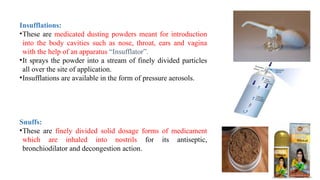
Insufflations:
•These are medicated dusting powders meant for introduction
into the body cavities such as nose, throat, ears and vagina
with the help of an apparatus “Insufflator”.
•It sprays the powder into a stream of finely divided particles
all over the site of application.
•Insufflations are available in the form of pressure aerosols.
Snuffs:
•These are finely divided solid dosage forms of medicament
which are inhaled into nostrils for its antiseptic,
bronchiodilator and decongestion action.
20
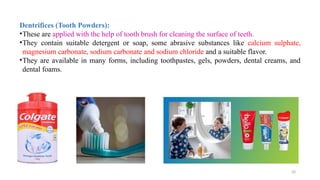
Dentrifices (Tooth Powders):
•These are applied with the help of tooth brush for cleaning the surface of teeth.
•They contain suitable detergent or soap, some abrasive substances like calcium sulphate,
magnesium carbonate, sodium carbonate and sodium chloride and a suitable flavor.
•They are available in many forms, including toothpastes, gels, powders, dental creams, and
dental foams.
21
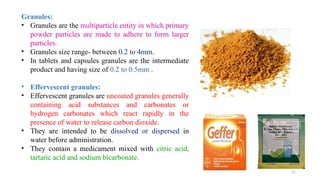
Granules:
• Granules are the multiparticle entity in which primary
powder particles are made to adhere to form larger
particles.
• Granules size range- between 0.2 to 4mm.
• In tablets and capsules granules are the intermediate
product and having size of 0.2 to 0.5mm .
• Effervescent granules:
• Effervescent granules are uncoated granules generally
containing acid substances and carbonates or
hydrogen carbonates which react rapidly in the
presence of water to release carbon dioxide.
• They are intended to be dissolved or dispersed in
water before administration.
• They contain a medicament mixed with citric acid,
tartaric acid and sodium bicarbonate.
22
Liquid Dosage Forms
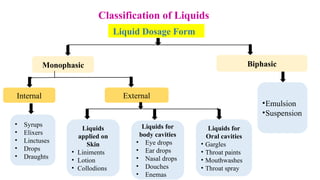
Classification of Liquids
Liquid Dosage Form
Monophasic Biphasic
External
Liquids
applied on
Skin
• Liniments
• Lotion
• Collodions
Liquids for
body cavities
• Eye drops
• Ear drops
• Nasal drops
• Douches
• Enemas
Liquids for
Oral cavities
• Gargles
• Throat paints
• Mouthwashes
• Throat spray
• Syrups
• Elixers
• Linctuses
• Drops
• Draughts
•Emulsion
•Suspension
Internal
24
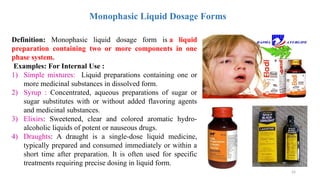
Monophasic Liquid Dosage Forms
Definition: Monophasic liquid dosage form is a liquid
preparation containing two or more components in one
phase system.
Examples: For Internal Use :
1) Simple mixtures: Liquid preparations containing one or
more medicinal substances in dissolved form.
2) Syrup : Concentrated, aqueous preparations of sugar or
sugar substitutes with or without added flavoring agents
and medicinal substances.
3) Elixirs: Sweetened, clear and colored aromatic hydro-
alcoholic liquids of potent or nauseous drugs.
4) Draughts: A draught is a single-dose liquid medicine,
typically prepared and consumed immediately or within a
short time after preparation. It is often used for specific
treatments requiring precise dosing in liquid form.
25
Monophasic Liquid Dosage Forms
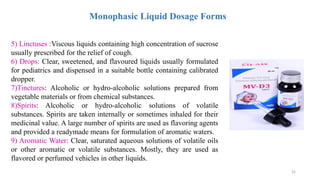
5) Linctuses :Viscous liquids containing high concentration of sucrose
usually prescribed for the relief of cough.
6) Drops: Clear, sweetened, and flavoured liquids usually formulated
for pediatrics and dispensed in a suitable bottle containing calibrated
dropper.
7)Tinctures: Alcoholic or hydro-alcoholic solutions prepared from
vegetable materials or from chemical substances.
8)Spirits: Alcoholic or hydro-alcoholic solutions of volatile
substances. Spirits are taken internally or sometimes inhaled for their
medicinal value. A large number of spirits are used as flavoring agents
and provided a readymade means for formulation of aromatic waters.
9) Aromatic Water: Clear, saturated aqueous solutions of volatile oils
or other aromatic or volatile substances. Mostly, they are used as
flavored or perfumed vehicles in other liquids.
26
Monophasic Liquid Dosage Forms
Examples:
For External Use : Liquids applied on Skin
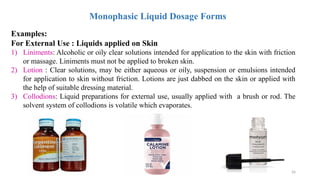
1) Liniments: Alcoholic or oily clear solutions intended for application to the skin with friction
or massage. Liniments must not be applied to broken skin.
2) Lotion : Clear solutions, may be either aqueous or oily, suspension or emulsions intended
for application to skin without friction. Lotions are just dabbed on the skin or applied with
the help of suitable dressing material.
3) Collodions: Liquid preparations for external use, usually applied with a brush or rod. The
solvent system of collodions is volatile which evaporates.
27
Monophasic Liquid Dosage Forms
Examples:
For External Use : Liquids for body cavities
1) Eye Drops: Aqueous or oily solutions of drugs intended to be
instilled into a conjunctival sac.
2) Nasal Drops : Aqueous solutions of drugs intended to be instilled
into the nose with dropper.
3) Ear Drops: Solutions of drugs intended to be instilled into ear with
a dropper.
4) Douches: Medicated solutions for rinsing a body cavity. The word
“douche” is most often used for rinsing vaginal cavity.
5) Enemas: Aqueous solutions of drug intended for rectal
administration.
28
Monophasic Liquid Dosage Forms
Examples:
For External Use : Liquids for oral cavities
1) Gargles: Aqueous solutions employed for local action in the throat. They are dispensed in
concentrated form with directions for dilution with luke-warm water before use.
2) Paints: Solutions in viscous vehicle intended to be applied on the mucosa with some soft
device such a brush or cotton. Example: Iodine Throat Paint
3) Mouthwashes: Liquid preparations for treating oral infections and bad breath and
providing feeling of freshness. They are usually supplied in concentrated form and diluted
before use.
29
Monophasic Liquid Dosage Forms
Examples:
For Other External Use :
1) Irrigations: Solutions of medicament used to treat infections of the
bladder, vagina and less often the nose. They are usually supplied
in concentrated form and diluted before use.
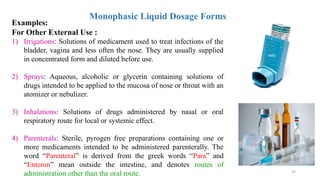
2) Sprays: Aqueous, alcoholic or glycerin containing solutions of
drugs intended to be applied to the mucosa of nose or throat with an
atomizer or nebulizer.
3) Inhalations: Solutions of drugs administered by nasal or oral
respiratory route for local or systemic effect.
4) Parenterals: Sterile, pyrogen free preparations containing one or
more medicaments intended to be administered parenterally. The
word “Parenteral” is derived from the greek words “Para” and
“Enteron” mean outside the intestine, and denotes routes of
administration other than the oral route.
30
Biphasic Liquid Dosage Forms
 The liquid which consist of two phases are known as biphasic liquids.
Examples:
For Oral Use :
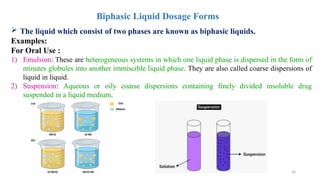
1) Emulsion: These are heterogeneous systems in which one liquid phase is dispersed in the form of
minutes globules into another immiscible liquid phase. They are also called coarse dispersions of
liquid in liquid.
2) Suspension: Aqueous or oily coarse dispersions containing finely divided insoluble drug
suspended in a liquid medium.
31
Biphasic Liquid Dosage Forms
Examples:
For External Use :
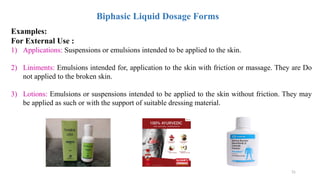
1) Applications: Suspensions or emulsions intended to be applied to the skin.
2) Liniments: Emulsions intended for, application to the skin with friction or massage. They are Do
not applied to the broken skin.
3) Lotions: Emulsions or suspensions intended to be applied to the skin without friction. They may
be applied as such or with the support of suitable dressing material.
32
Biphasic Liquid Dosage Forms
Examples:
For Special Use :
1) Enemas: Suspensions or emulsions of medicaments intended for rectal administration.
2) Eye drops: Suspensions of drugs intended to be instilled into conjunctival sac.
3) Inhalations: Suspensions of volatile oils or substances adsorbed on some adsorbing agent. The
vapors of volatile substances are inhaled by adding the preparation to hot water or by placing the
preparation on an absorbent.
4) Ear drops: Suspensions or aqueous solutions of drugs that are instilled into the ear.
5) Aerosols: Suspensions of fine solid or liquid particles in a gas. They are used to apply drug to
respiratory tract and skin.
33
Semisolid Dosage Forms
34
Semisolid Dosage Forms
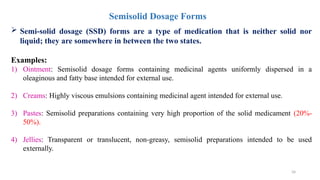
 Semi-solid dosage (SSD) forms are a type of medication that is neither solid nor
liquid; they are somewhere in between the two states.
Examples:
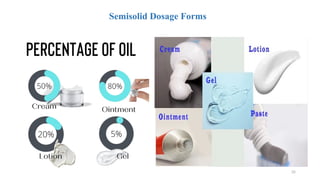
1) Ointment: Semisolid dosage forms containing medicinal agents uniformly dispersed in a
oleaginous and fatty base intended for external use.
2) Creams: Highly viscous emulsions containing medicinal agent intended for external use.
3) Pastes: Semisolid preparations containing very high proportion of the solid medicament (20%-
50%).
4) Jellies: Transparent or translucent, non-greasy, semisolid preparations intended to be used
externally.
35
Semisolid Dosage Forms
36
Semisolid Dosage Forms
Examples:
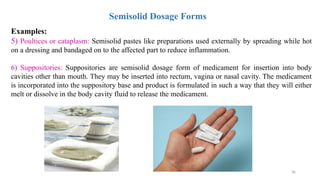
5) Poultices or cataplasm: Semisolid pastes like preparations used externally by spreading while hot
on a dressing and bandaged on to the affected part to reduce inflammation.
6) Suppositories: Suppositories are semisolid dosage form of medicament for insertion into body
cavities other than mouth. They may be inserted into rectum, vagina or nasal cavity. The medicament
is incorporated into the suppository base and product is formulated in such a way that they will either
melt or dissolve in the body cavity fluid to release the medicament.
37
Novel Drug Delivery System
38
Novel Drug Delivery System
• ‘Novel’ means something new.
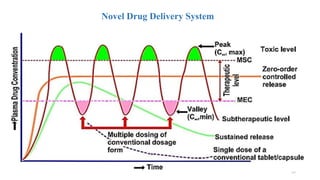
• The term ‘Novel Drug Delivery Systems’ refers to the dosage forms different from the
conventional systems.
• The conventional dosage forms such as tablets, capsules, injectables, etc. , are even today
widely used all over the world.
• The chief disadvantage with these dosage forms is that the concentration of drug
administered cannot be maintained within the therapeutically effective range for a long time
and it is necessary to take conventional dosage forms several times a day.
• Examples :
• Implants
• Liposome drug carriers
• Controlled drug delivery system
• Erythrocytes
• Nanoparticles
• Prodrugs
39
Novel Drug Delivery System
40
Novel Drug Delivery System
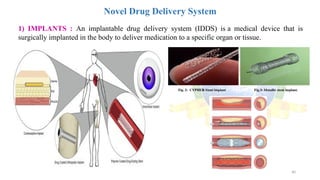
1) IMPLANTS : An implantable drug delivery system (IDDS) is a medical device that is
surgically implanted in the body to deliver medication to a specific organ or tissue.
41
Novel Drug Delivery System
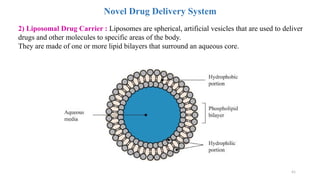
2) Liposomal Drug Carrier : Liposomes are spherical, artificial vesicles that are used to deliver
drugs and other molecules to specific areas of the body.
They are made of one or more lipid bilayers that surround an aqueous core.
42
Novel Drug Delivery System
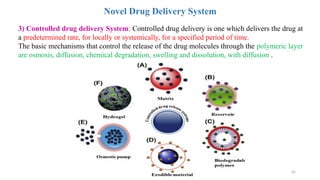
3) Controlled drug delivery System: Controlled drug delivery is one which delivers the drug at
a predetermined rate, for locally or systemically, for a specified period of time.
The basic mechanisms that control the release of the drug molecules through the polymeric layer
are osmosis, diffusion, chemical degradation, swelling and dissolution, with diffusion .
43
Novel Drug Delivery System
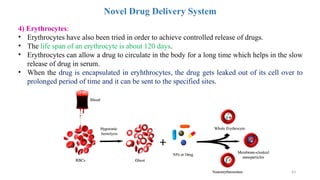
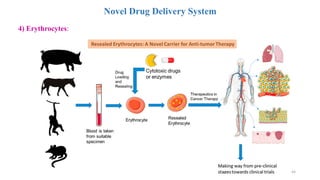
4) Erythrocytes:
• Erythrocytes have also been tried in order to achieve controlled release of drugs.
• The life span of an erythrocyte is about 120 days.
• Erythrocytes can allow a drug to circulate in the body for a long time which helps in the slow
release of drug in serum.
• When the drug is encapsulated in eryhthrocytes, the drug gets leaked out of its cell over to
prolonged period of time and it can be sent to the specified sites.
44
Novel Drug Delivery System
4) Erythrocytes:
45
Novel Drug Delivery System
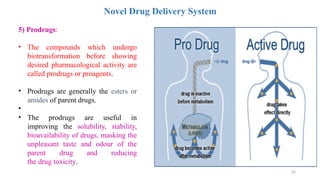
5) Prodrugs:
• The compounds which undergo
biotransformation before showing
desired pharmacological activity are
called prodrugs or proagents.
• Prodrugs are generally the esters or
amides of parent drugs.
•
• The prodrugs are useful in
improving the solubility, stability,
bioavailability of drugs, masking the
unpleasant taste and odour of the
parent drug and reducing
the drug toxicity.
46

INTRODUCTION AND CLASSIFICATION OF DOSAGE FORMS.pptx

  • 1.
    1 PHARMACEUTICAL DOSAGE FORMS B.PHARM SEM-IUNIT-I PHARMACEUTICS-I Ms. S. B. Gaurkar Assistant Professor, DRGIOP, Amravati
  • 2.
    2 Introduction to DosageForms Definition of Dosage Form Dosage forms are the mechanism by which drug molecules / APIs are administered to areas of action inside the body to generate maximum intended benefits and the lowest unwanted effects. OR The Dosage form is the combination of Active Pharmaceutical Ingredients (API) and Excipients in the formulation. Dosage Forms (Medicines) = API+ Excipients
  • 3.
    3 Definition of Drug(Active Pharmaceutical Ingredients) • Drogue is an old French term that means "dry herb" and is sometimes used interchangeably with the word "drug". • Chemical compounds intended for use in the diagnosis, prevention, treatment, and management of disease(s) in humans and other animals are referred to as "pharmaceutical products" or "pharmaceuticals". • Chemical/organic synthesis, molecular modification, and biotechnology have all been used to produce medicines in recent years. OR • The Active Pharmaceutical Ingredient (API) is the component of a medication that creates its action. Active Pharmaceutical Ingredients (API)
  • 4.
    4 Excipients • Do notincrease or affect the therapeutic action of the active components. • They are also known as inactive components or excipients and have no pharmacological action in general. • Examples of inactive components are dyes, preservatives, sweetening agents, binding materials, coloring agents and flavoring agents, etc.
  • 5.
    5 Need of DosageForms • Mainly depend on Patient Safety and Drug Safety/ Benefits. • 1. Deliver precise dosages in a safe and easy manner. Example – Tablets, capsules, syrups • 2. Cover bitter taste or odor of drug substances. Example – Capsules, coated tablets, flavored syrups • 3. Insoluble or unstable in the selected vehicle, provide a liquid formulation of the insoluble or unstable medication. Example – Suspension • 4. Controlled-release methods prolong the duration of medication effect. Example – Controlled release tablets, capsules, suspensions • 5. After oral delivery, a drug substance is protected from stomach acid. Example – Enteric-coated tablets
  • 6.
    6 Need of DosageForms • 6. Provide optional drug action from topical administration sites. Example – Ointment, cream, ear and nasal preparations • 7. Drugs can be injected into the body's tissues. Example – Implants • 8. Inhalation treatment is the most effective way to get optimum medication activity. Example – Inhalants • 9. Liquid dosage forms of chemicals soluble in the vehicle of your choice. Example – Solution • 10. Provide for the introduction of medication into the body’s orifice. Example – Rectal and vaginal suppositories • 11. Protection of a drug substance from atmospheric oxygen or moisture. Example – Coated capsules, sealed ampules.
  • 7.
    7 Classification of DosageForms Dosage Forms Routes of Administration Site of Applications Physical State Uses
  • 8.
  • 9.
  • 10.
  • 11.
  • 12.
    12 • Solid dosageforms are pharmaceutical formulations in which the active drug is combined with suitable excipients and presented in a solid state. • These are among the most commonly used drug delivery systems due to their stability, ease of administration, accurate dosing, and convenience in manufacturing, packaging, and transport. • Solid dosage forms are available mostly in unit dosage forms. • Some solids are packed and supplied in bulk. • The bulk forms meant for internal use are supplied either as granules or fine powder. • The bulk powder meant for external use are dusting powder, insufflations, snuffs and tooth powders.
  • 13.
  • 14.
    14 1.Tablets  Tablets aresolid, flat or biconvex dishes, unit dosage form, prepared by compressing a drugs or a mixture of drugs, with or without diluents.  May have coatings (e.g., film-coated, enteric-coated) to modify release patterns or protect the drug from degradation.  Variants include chewable tablets, effervescent tablets, and sustained-release tablets. 2.Capsules  Capsules are solid unit dosage forms in which drug and/or inert substances are enclosed in a small gelatin shell OR  Gelatin or hydroxypropyl methylcellulose (HPMC) shells filled with powder, granules, or liquid.  Two main types: hard capsules (solid or granular drugs) and soft capsules (liquid or semi-liquid drugs). Common Types of Solid Dosage Forms
  • 15.
    15 3.Lozenges  Lozenges aresolid dosage forms that are intended to be dissolved or disintegrated slowly in the mouth.  They contain one or more active ingredients and are flavored and sweetened so as to be pleasant tasting. 4.Pills  A medicinal substance in a small round or oval mass meant to be swallowed.  Pills often contain a filler and a plastic substance such as lactose that permits the pill to be rolled by hand or machine into the desired form.  The pill may then be coated with a varnish like substance. Common Types of Solid Dosage Forms
  • 16.
  • 17.
    17 POWDERS are atype of pharmaceutical solid dosage form intended for internal or external use, where the powder is supplied in large quantities rather than as individually measured doses. • They are available in crystalline or amorphous form. • Bulk powder for internal use e.g. fine powders or granules • Bulk powder for external use e.g. snuffs, dusting powders, tooth powders, and insufflations. • Simple and compound powders for internal use • Powders in the form of compressed tablets and tablets triturates • Powder enclosed in cachets and capsules POWDERS
  • 18.
    18 Dusting Powders: •These aremeant for external application to the skin and are generally applied in a very fine state of subdivision to avoid local irritation. •It should be passed through a 80 sieve to enhance their effectiveness. •Generally prepared by mixing two or more ingredients one of which must be either starch, Kaolin or talc as one of the ingredients of the formulation. •It must be sterilized dry heat method (160o C for 2hrs) before use. Dusting powders are of two types: •Medical: used mainly for superficial skin conditions : must be free from dangerous pathogenic microorganisms •Surgical: used in body cavities and also on major wounds as a result of burns and umbilical cord of infants :must be sterilized before their use
  • 19.
    19 Insufflations: •These are medicateddusting powders meant for introduction into the body cavities such as nose, throat, ears and vagina with the help of an apparatus “Insufflator”. •It sprays the powder into a stream of finely divided particles all over the site of application. •Insufflations are available in the form of pressure aerosols. Snuffs: •These are finely divided solid dosage forms of medicament which are inhaled into nostrils for its antiseptic, bronchiodilator and decongestion action.
  • 20.
    20 Dentrifices (Tooth Powders): •Theseare applied with the help of tooth brush for cleaning the surface of teeth. •They contain suitable detergent or soap, some abrasive substances like calcium sulphate, magnesium carbonate, sodium carbonate and sodium chloride and a suitable flavor. •They are available in many forms, including toothpastes, gels, powders, dental creams, and dental foams.
  • 21.
    21 Granules: • Granules arethe multiparticle entity in which primary powder particles are made to adhere to form larger particles. • Granules size range- between 0.2 to 4mm. • In tablets and capsules granules are the intermediate product and having size of 0.2 to 0.5mm . • Effervescent granules: • Effervescent granules are uncoated granules generally containing acid substances and carbonates or hydrogen carbonates which react rapidly in the presence of water to release carbon dioxide. • They are intended to be dissolved or dispersed in water before administration. • They contain a medicament mixed with citric acid, tartaric acid and sodium bicarbonate.
  • 22.
  • 23.
    Classification of Liquids LiquidDosage Form Monophasic Biphasic External Liquids applied on Skin • Liniments • Lotion • Collodions Liquids for body cavities • Eye drops • Ear drops • Nasal drops • Douches • Enemas Liquids for Oral cavities • Gargles • Throat paints • Mouthwashes • Throat spray • Syrups • Elixers • Linctuses • Drops • Draughts •Emulsion •Suspension Internal
  • 24.
    24 Monophasic Liquid DosageForms Definition: Monophasic liquid dosage form is a liquid preparation containing two or more components in one phase system. Examples: For Internal Use : 1) Simple mixtures: Liquid preparations containing one or more medicinal substances in dissolved form. 2) Syrup : Concentrated, aqueous preparations of sugar or sugar substitutes with or without added flavoring agents and medicinal substances. 3) Elixirs: Sweetened, clear and colored aromatic hydro- alcoholic liquids of potent or nauseous drugs. 4) Draughts: A draught is a single-dose liquid medicine, typically prepared and consumed immediately or within a short time after preparation. It is often used for specific treatments requiring precise dosing in liquid form.
  • 25.
    25 Monophasic Liquid DosageForms 5) Linctuses :Viscous liquids containing high concentration of sucrose usually prescribed for the relief of cough. 6) Drops: Clear, sweetened, and flavoured liquids usually formulated for pediatrics and dispensed in a suitable bottle containing calibrated dropper. 7)Tinctures: Alcoholic or hydro-alcoholic solutions prepared from vegetable materials or from chemical substances. 8)Spirits: Alcoholic or hydro-alcoholic solutions of volatile substances. Spirits are taken internally or sometimes inhaled for their medicinal value. A large number of spirits are used as flavoring agents and provided a readymade means for formulation of aromatic waters. 9) Aromatic Water: Clear, saturated aqueous solutions of volatile oils or other aromatic or volatile substances. Mostly, they are used as flavored or perfumed vehicles in other liquids.
  • 26.
    26 Monophasic Liquid DosageForms Examples: For External Use : Liquids applied on Skin 1) Liniments: Alcoholic or oily clear solutions intended for application to the skin with friction or massage. Liniments must not be applied to broken skin. 2) Lotion : Clear solutions, may be either aqueous or oily, suspension or emulsions intended for application to skin without friction. Lotions are just dabbed on the skin or applied with the help of suitable dressing material. 3) Collodions: Liquid preparations for external use, usually applied with a brush or rod. The solvent system of collodions is volatile which evaporates.
  • 27.
    27 Monophasic Liquid DosageForms Examples: For External Use : Liquids for body cavities 1) Eye Drops: Aqueous or oily solutions of drugs intended to be instilled into a conjunctival sac. 2) Nasal Drops : Aqueous solutions of drugs intended to be instilled into the nose with dropper. 3) Ear Drops: Solutions of drugs intended to be instilled into ear with a dropper. 4) Douches: Medicated solutions for rinsing a body cavity. The word “douche” is most often used for rinsing vaginal cavity. 5) Enemas: Aqueous solutions of drug intended for rectal administration.
  • 28.
    28 Monophasic Liquid DosageForms Examples: For External Use : Liquids for oral cavities 1) Gargles: Aqueous solutions employed for local action in the throat. They are dispensed in concentrated form with directions for dilution with luke-warm water before use. 2) Paints: Solutions in viscous vehicle intended to be applied on the mucosa with some soft device such a brush or cotton. Example: Iodine Throat Paint 3) Mouthwashes: Liquid preparations for treating oral infections and bad breath and providing feeling of freshness. They are usually supplied in concentrated form and diluted before use.
  • 29.
    29 Monophasic Liquid DosageForms Examples: For Other External Use : 1) Irrigations: Solutions of medicament used to treat infections of the bladder, vagina and less often the nose. They are usually supplied in concentrated form and diluted before use. 2) Sprays: Aqueous, alcoholic or glycerin containing solutions of drugs intended to be applied to the mucosa of nose or throat with an atomizer or nebulizer. 3) Inhalations: Solutions of drugs administered by nasal or oral respiratory route for local or systemic effect. 4) Parenterals: Sterile, pyrogen free preparations containing one or more medicaments intended to be administered parenterally. The word “Parenteral” is derived from the greek words “Para” and “Enteron” mean outside the intestine, and denotes routes of administration other than the oral route.
  • 30.
    30 Biphasic Liquid DosageForms  The liquid which consist of two phases are known as biphasic liquids. Examples: For Oral Use : 1) Emulsion: These are heterogeneous systems in which one liquid phase is dispersed in the form of minutes globules into another immiscible liquid phase. They are also called coarse dispersions of liquid in liquid. 2) Suspension: Aqueous or oily coarse dispersions containing finely divided insoluble drug suspended in a liquid medium.
  • 31.
    31 Biphasic Liquid DosageForms Examples: For External Use : 1) Applications: Suspensions or emulsions intended to be applied to the skin. 2) Liniments: Emulsions intended for, application to the skin with friction or massage. They are Do not applied to the broken skin. 3) Lotions: Emulsions or suspensions intended to be applied to the skin without friction. They may be applied as such or with the support of suitable dressing material.
  • 32.
    32 Biphasic Liquid DosageForms Examples: For Special Use : 1) Enemas: Suspensions or emulsions of medicaments intended for rectal administration. 2) Eye drops: Suspensions of drugs intended to be instilled into conjunctival sac. 3) Inhalations: Suspensions of volatile oils or substances adsorbed on some adsorbing agent. The vapors of volatile substances are inhaled by adding the preparation to hot water or by placing the preparation on an absorbent. 4) Ear drops: Suspensions or aqueous solutions of drugs that are instilled into the ear. 5) Aerosols: Suspensions of fine solid or liquid particles in a gas. They are used to apply drug to respiratory tract and skin.
  • 33.
  • 34.
    34 Semisolid Dosage Forms Semi-solid dosage (SSD) forms are a type of medication that is neither solid nor liquid; they are somewhere in between the two states. Examples: 1) Ointment: Semisolid dosage forms containing medicinal agents uniformly dispersed in a oleaginous and fatty base intended for external use. 2) Creams: Highly viscous emulsions containing medicinal agent intended for external use. 3) Pastes: Semisolid preparations containing very high proportion of the solid medicament (20%- 50%). 4) Jellies: Transparent or translucent, non-greasy, semisolid preparations intended to be used externally.
  • 35.
  • 36.
    36 Semisolid Dosage Forms Examples: 5)Poultices or cataplasm: Semisolid pastes like preparations used externally by spreading while hot on a dressing and bandaged on to the affected part to reduce inflammation. 6) Suppositories: Suppositories are semisolid dosage form of medicament for insertion into body cavities other than mouth. They may be inserted into rectum, vagina or nasal cavity. The medicament is incorporated into the suppository base and product is formulated in such a way that they will either melt or dissolve in the body cavity fluid to release the medicament.
  • 37.
  • 38.
    38 Novel Drug DeliverySystem • ‘Novel’ means something new. • The term ‘Novel Drug Delivery Systems’ refers to the dosage forms different from the conventional systems. • The conventional dosage forms such as tablets, capsules, injectables, etc. , are even today widely used all over the world. • The chief disadvantage with these dosage forms is that the concentration of drug administered cannot be maintained within the therapeutically effective range for a long time and it is necessary to take conventional dosage forms several times a day. • Examples : • Implants • Liposome drug carriers • Controlled drug delivery system • Erythrocytes • Nanoparticles • Prodrugs
  • 39.
  • 40.
    40 Novel Drug DeliverySystem 1) IMPLANTS : An implantable drug delivery system (IDDS) is a medical device that is surgically implanted in the body to deliver medication to a specific organ or tissue.
  • 41.
    41 Novel Drug DeliverySystem 2) Liposomal Drug Carrier : Liposomes are spherical, artificial vesicles that are used to deliver drugs and other molecules to specific areas of the body. They are made of one or more lipid bilayers that surround an aqueous core.
  • 42.
    42 Novel Drug DeliverySystem 3) Controlled drug delivery System: Controlled drug delivery is one which delivers the drug at a predetermined rate, for locally or systemically, for a specified period of time. The basic mechanisms that control the release of the drug molecules through the polymeric layer are osmosis, diffusion, chemical degradation, swelling and dissolution, with diffusion .
  • 43.
    43 Novel Drug DeliverySystem 4) Erythrocytes: • Erythrocytes have also been tried in order to achieve controlled release of drugs. • The life span of an erythrocyte is about 120 days. • Erythrocytes can allow a drug to circulate in the body for a long time which helps in the slow release of drug in serum. • When the drug is encapsulated in eryhthrocytes, the drug gets leaked out of its cell over to prolonged period of time and it can be sent to the specified sites.
  • 44.
    44 Novel Drug DeliverySystem 4) Erythrocytes:
  • 45.
    45 Novel Drug DeliverySystem 5) Prodrugs: • The compounds which undergo biotransformation before showing desired pharmacological activity are called prodrugs or proagents. • Prodrugs are generally the esters or amides of parent drugs. • • The prodrugs are useful in improving the solubility, stability, bioavailability of drugs, masking the unpleasant taste and odour of the parent drug and reducing the drug toxicity.
  • 46.