INTRODUCTION TO DIFFERENT
DOSAGE FORMS
Powered By
Dept. of Pharmaceutics
Drug
 Drug may be defined as an
agent or substance,
intended for use in the
diagnosis, mitigation,
treatment, cure or
prevention of disease in
human beings or animals.
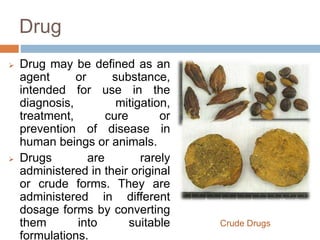
 Drugs are rarely
administered in their original
or crude forms. They are
administered in different
dosage forms by converting
them into suitable
formulations.
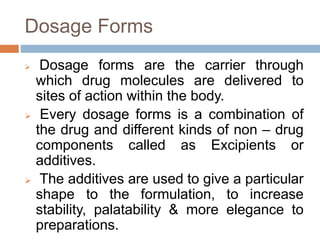
Crude Drugs
Dosage Forms
 Dosage forms are the carrier through
which drug molecules are delivered to
sites of action within the body.
 Every dosage forms is a combination of
the drug and different kinds of non – drug
components called as Excipients or
additives.
 The additives are used to give a particular
shape to the formulation, to increase
stability, palatability & more elegance to
preparations.
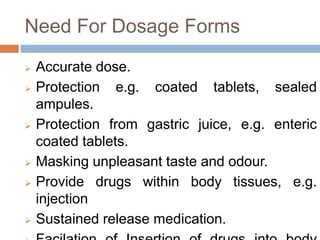
Need For Dosage Forms
 Accurate dose.
 Protection e.g. coated tablets, sealed
ampules.
 Protection from gastric juice, e.g. enteric
coated tablets.
 Masking unpleasant taste and odour.
 Provide drugs within body tissues, e.g.
injection
 Sustained release medication.
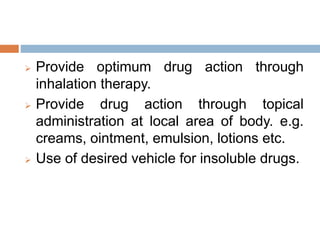
 Provide optimum drug action through
inhalation therapy.
 Provide drug action through topical
administration at local area of body. e.g.
creams, ointment, emulsion, lotions etc.
 Use of desired vehicle for insoluble drugs.
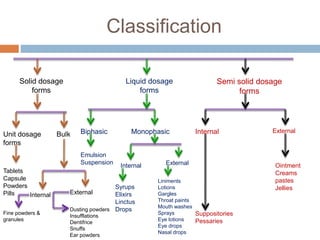
Classification
Solid dosage
forms
Unit dosage
forms
Tablets
Capsule
Powders
Pills
Bulk
Internal
Fine powders &
granules
External
Dusting powders
Insufflations
Dentifrice
Snuffs
Ear powders
Liquid dosage
forms
Biphasic
Emulsion
Suspension
Monophasic
Internal External
Syrups
Elixirs
Linctus
Drops
Liniments
Lotions
Gargles
Throat paints
Mouth washes
Sprays
Eye lotions
Eye drops
Nasal drops
Semi solid dosage
forms
Internal External
Suppositories
Pessaries
Ointment
Creams
pastes
Jellies
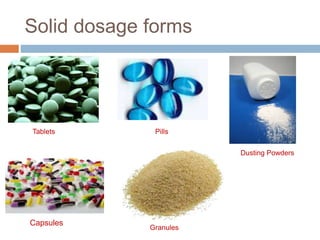
Solid dosage forms
Solid dosage forms
Tablets Pills
Dusting Powders
Capsules
Granules
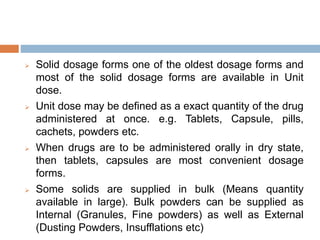
 Solid dosage forms one of the oldest dosage forms and
most of the solid dosage forms are available in Unit
dose.
 Unit dose may be defined as a exact quantity of the drug
administered at once. e.g. Tablets, Capsule, pills,
cachets, powders etc.
 When drugs are to be administered orally in dry state,
then tablets, capsules are most convenient dosage
forms.
 Some solids are supplied in bulk (Means quantity
available in large). Bulk powders can be supplied as
Internal (Granules, Fine powders) as well as External
(Dusting Powders, Insufflations etc)
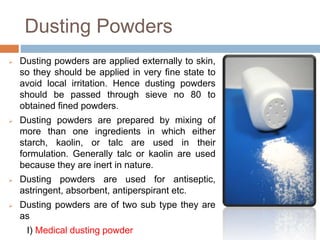
Dusting Powders
 Dusting powders are applied externally to skin,
so they should be applied in very fine state to
avoid local irritation. Hence dusting powders
should be passed through sieve no 80 to
obtained fined powders.
 Dusting powders are prepared by mixing of
more than one ingredients in which either
starch, kaolin, or talc are used in their
formulation. Generally talc or kaolin are used
because they are inert in nature.
 Dusting powders are used for antiseptic,
astringent, absorbent, antiperspirant etc.
 Dusting powders are of two sub type they are
as
I) Medical dusting powder
Medical Dusting
Powders
 Medical Dusting powders are used to
increase superficial condition of skin.
 These are not applied on wounds, burns etc
 Medical dusting powders must be free from
dangerous pathogenic micro- organism.
Surgical Dusting Powders
 Surgical dusting powders are used in body
cavities and also on major wounds like as
burns etc.
 They should be sterilized before use.
 They are mainly used for their antiseptic,
absorbent action.
Insufflations
 These are medicated dusting powders meant for
introduction into body cavities (nose, throat, ear,
vagina etc) with the help of an apparatus known as
a insufflator.
 It sprays the powders (in a state of fine particles)
on site of application.
 Now a days insufflations are also available in
pressure aerosols. This pressure aerosols are
used for administration of potent drug.
 They are used in the treatment of ear, nose, throat
infections with antibiotics to produce local effect of
drugs.
Snuffs
 These are finely divided solid dosage forms of
medicaments which are inhaled into nostrils.
 They are mainly used for their antiseptic,
bronchodilator and decongestion action.
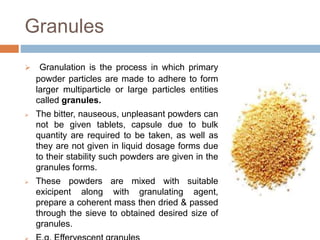
Granules
 Granulation is the process in which primary
powder particles are made to adhere to form
larger multiparticle or large particles entities
called granules.
 The bitter, nauseous, unpleasant powders can
not be given tablets, capsule due to bulk
quantity are required to be taken, as well as
they are not given in liquid dosage forms due
to their stability such powders are given in the
granules forms.
 These powders are mixed with suitable
exicipent along with granulating agent,
prepare a coherent mass then dried & passed
through the sieve to obtained desired size of
granules.
Effervescent Granules
 Effervescent granules are meant for internal use.
 They contained medicaments mixed with citric acid,
tartaric acid & sodium bi carbonates, sometime
saccharin or sucrose may be added for sweetening
taste.
 Before, administration desired quantity of granules are
dissolved in water, the acid & bicarbonate reacts with
each other to produce effervescence.
 Effervescent granules are prepared by two methods,
namely as, I) Heat method, II) Wet method
Heat method
 A large porcelain or stainless steel evaporating dish is placed over
the boiling water bath.
 The dish must be sufficiently hot (generally heating takes place for 1
– 5 min.) before transferring the powders into it, to ensure rapid
liberation of water of crystallization from citric acid.
 If heating of the dish is delayed then the powder which is added to
it, will heat up slowly & liberated water of crystallization will also be
liberated simultaneously.
 As a result, sufficient water will not be available to make a coherent
mass.
 This coherent mass will pass through the sieve to obtained suitable
size of granules, dry it in oven at 600c then packed in air tight
container.
Wet method
 In this methods all the ingredients are mixed thoroughly
 This powders mixture make moistened with non –
aqueous vehicle (e.g. alcohol), to prepare a coherent
mass which is then passed through sieve no 8 to
obtained suitable granules.
 Then dried in oven at 600c. The dried granules are again
passed through the sieve to break the lumps which may
be formed during drying.
 The dried granules are packed in air tight container.
Tablets
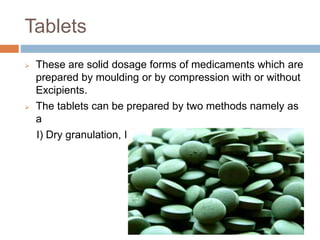
 These are solid dosage forms of medicaments which are
prepared by moulding or by compression with or without
Excipients.
 The tablets can be prepared by two methods namely as
a
I) Dry granulation, II) Wet Granulation
Capsule
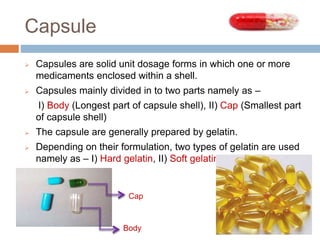
 Capsules are solid unit dosage forms in which one or more
medicaments enclosed within a shell.
 Capsules mainly divided in to two parts namely as –
I) Body (Longest part of capsule shell), II) Cap (Smallest part
of capsule shell)
 The capsule are generally prepared by gelatin.
 Depending on their formulation, two types of gelatin are used
namely as – I) Hard gelatin, II) Soft gelatin.
Body
Cap
Pills
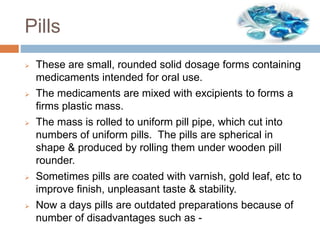
 These are small, rounded solid dosage forms containing
medicaments intended for oral use.
 The medicaments are mixed with excipients to forms a
firms plastic mass.
 The mass is rolled to uniform pill pipe, which cut into
numbers of uniform pills. The pills are spherical in
shape & produced by rolling them under wooden pill
rounder.
 Sometimes pills are coated with varnish, gold leaf, etc to
improve finish, unpleasant taste & stability.
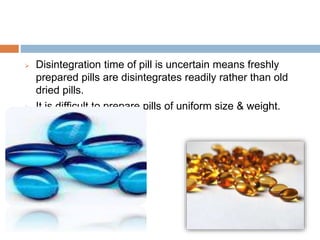
 Now a days pills are outdated preparations because of
number of disadvantages such as -
 Disintegration time of pill is uncertain means freshly
prepared pills are disintegrates readily rather than old
dried pills.
 It is difficult to prepare pills of uniform size & weight.
Liquid dosage forms
Liquid dosage
forms
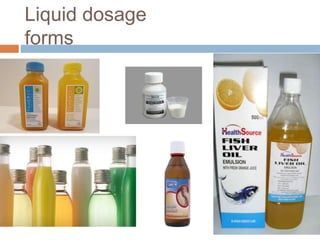
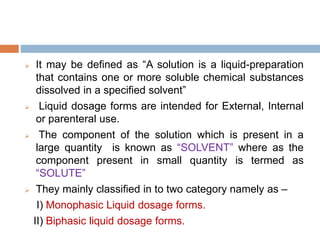
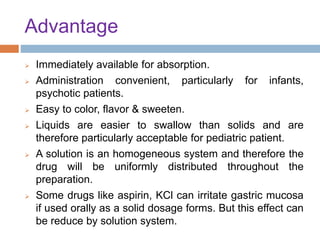
 It may be defined as “A solution is a liquid-preparation
that contains one or more soluble chemical substances
dissolved in a specified solvent”
 Liquid dosage forms are intended for External, Internal
or parenteral use.
 The component of the solution which is present in a
large quantity is known as “SOLVENT” where as the
component present in small quantity is termed as
“SOLUTE”
 They mainly classified in to two category namely as –
I) Monophasic Liquid dosage forms.
II) Biphasic liquid dosage forms.
Advantage
 Immediately available for absorption.
 Administration convenient, particularly for infants,
psychotic patients.
 Easy to color, flavor & sweeten.
 Liquids are easier to swallow than solids and are
therefore particularly acceptable for pediatric patient.
 A solution is an homogeneous system and therefore the
drug will be uniformly distributed throughout the
preparation.
 Some drugs like aspirin, KCl can irritate gastric mucosa
if used orally as a solid dosage forms. But this effect can
be reduce by solution system.
Disadvantage
 Less stable in aqueous system. Incompatibility is faster in
solution than solid dosage form.
 Patients have no accurate measuring device.
 Accident breakage of container results in complete loss.
 Solution often provide suitable media for the growth of micro
organisms.
 The taste of a drug, which is often unpleasant, is always more
pronounced when in solution than in a solid form.
 Bulky than tablets or capsule, so difficult to carry transport.
Monophasic liquid dosage
forms
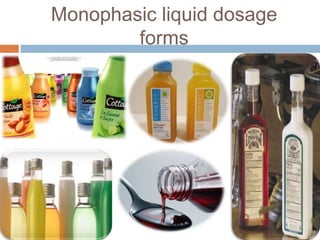
 Monophasic liquid dosage forms are represent by true or
colloidal solution.
 The component of the solution which is present in a large
quantity is known as “SOLVENT” where as the component
present in small quantity is termed as “SOLUTE”.
 A solution is homogenous because the solute is an ionic or
molecular forms of subdivision.
 In case of colloidal solutions, the solutes are present as
aggregates although they cannot be seen by necked eye or
ordinary microscope.
 It is sub classified as –
I) Internal Use, II) External use
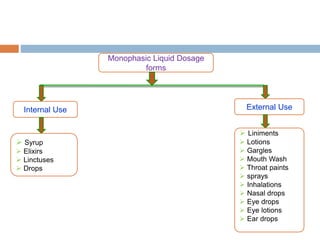
Monophasic Liquid Dosage
forms
Internal Use External Use
 Syrup
 Elixirs
 Linctuses
 Drops
 Liniments
 Lotions
 Gargles
 Mouth Wash
 Throat paints
 sprays
 Inhalations
 Nasal drops
 Eye drops
 Eye lotions
 Ear drops
Monophasic liquid dosage forms
for Internal Use
Syru
p
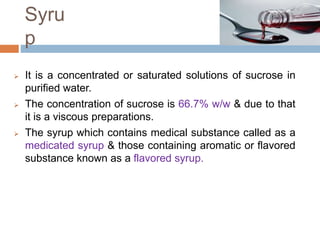
 It is a concentrated or saturated solutions of sucrose in
purified water.
 The concentration of sucrose is 66.7% w/w & due to that
it is a viscous preparations.
 The syrup which contains medical substance called as a
medicated syrup & those containing aromatic or flavored
substance known as a flavored syrup.
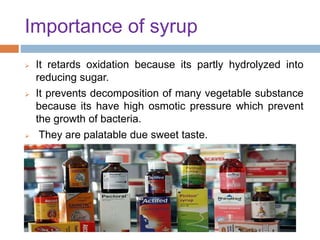
Importance of syrup
 It retards oxidation because its partly hydrolyzed into
reducing sugar.
 It prevents decomposition of many vegetable substance
because its have high osmotic pressure which prevent
the growth of bacteria.
 They are palatable due sweet taste.
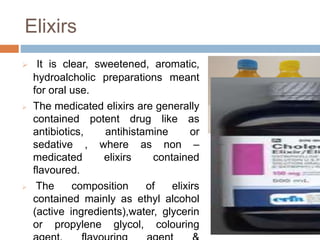
 It is clear, sweetened, aromatic,
hydroalcholic preparations meant
for oral use.
 The medicated elixirs are generally
contained potent drug like as
antibiotics, antihistamine or
sedative , where as non –
medicated elixirs contained
flavoured.
 The composition of elixirs
contained mainly as ethyl alcohol
(active ingredients),water, glycerin
or propylene glycol, colouring
Elixirs
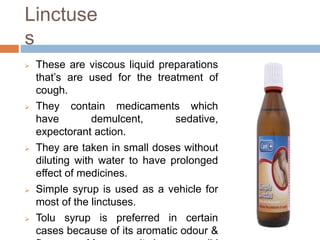
Linctuse
s
 These are viscous liquid preparations
that’s are used for the treatment of
cough.
 They contain medicaments which
have demulcent, sedative,
expectorant action.
 They are taken in small doses without
diluting with water to have prolonged
effect of medicines.
 Simple syrup is used as a vehicle for
most of the linctuses.
 Tolu syrup is preferred in certain
cases because of its aromatic odour &
Drop
s
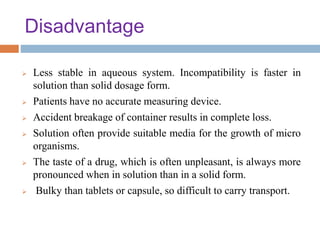
 These are liquid preparations meant for oral
administration.
 The oil soluble vitamins, such as vitamin A & D
concentrates in fish – liver oil are presented as drops for
administration.
 Since these preparations contain potent medicaments,
the dose must be measured accurately
 The following two methods are commonly used for this
purpose.
 Use of a dropper which is accurately graduated in
fractions of a milliliters.
 Use of a pre – calibrated dropper.
Monophasic liquid dosage
forms for External use
Liniments
 Liniments are liquid or semi- liquid
preparations meant for external application to
the skin.
 They are usually applied to the skin with
friction & rubbing of the skin.
 Are usually alcoholic and oily liquid
preparations (monophasic) or emulsion
(biphasic).
 Alcoholic liniments are used generally for
their rubefacient and counterirritant effects.
Such liniments penetrate the skin more
readily than do those with an oil base.
 The oily liniments are milder in their action
and may function solely as protective
coatings
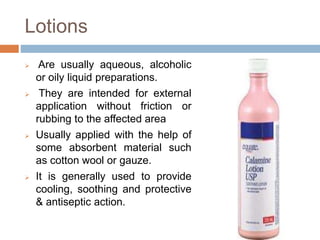
Lotions
 Are usually aqueous, alcoholic
or oily liquid preparations.
 They are intended for external
application without friction or
rubbing to the affected area
 Usually applied with the help of
some absorbent material such
as cotton wool or gauze.
 It is generally used to provide
cooling, soothing and protective
& antiseptic action.
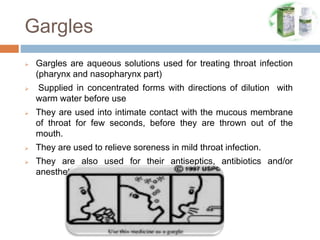
Gargles
 Gargles are aqueous solutions used for treating throat infection
(pharynx and nasopharynx part)
 Supplied in concentrated forms with directions of dilution with
warm water before use
 They are used into intimate contact with the mucous membrane
of throat for few seconds, before they are thrown out of the
mouth.
 They are used to relieve soreness in mild throat infection.
 They are also used for their antiseptics, antibiotics and/or
anesthetics
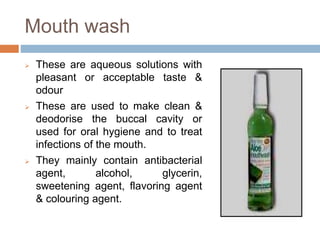
Mouth wash
 These are aqueous solutions with
pleasant or acceptable taste &
odour
 These are used to make clean &
deodorise the buccal cavity or
used for oral hygiene and to treat
infections of the mouth.
 They mainly contain antibacterial
agent, alcohol, glycerin,
sweetening agent, flavoring agent
& colouring agent.
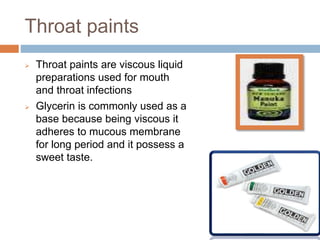
Throat paints
 Throat paints are viscous liquid
preparations used for mouth
and throat infections
 Glycerin is commonly used as a
base because being viscous it
adheres to mucous membrane
for long period and it possess a
sweet taste.
Sprays
 These are the preparations of drugs in
media which may be aqueous, alcoholic,
or glycerin.
 They are applied to the mucous
membrane of throat or nose with an
atomizer.
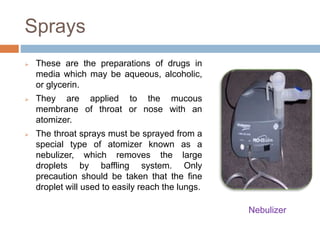
 The throat sprays must be sprayed from a
special type of atomizer known as a
nebulizer, which removes the large
droplets by baffling system. Only
precaution should be taken that the fine
droplet will used to easily reach the lungs.
Nebulizer
Inhalations
 These are liquid preparations containing volatile substance & are
used to relieve decongestion & inflammations of respiratory tract.
 The volatile substance in inhalations would be volatile at room
temperature so that they should be placed on some adsorbent pad
or handkerchief.
 In some cases inhalations will added to hot water (650c) then
vapors will inhaled.
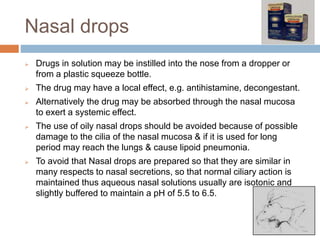
Nasal drops
 Drugs in solution may be instilled into the nose from a dropper or
from a plastic squeeze bottle.
 The drug may have a local effect, e.g. antihistamine, decongestant.
 Alternatively the drug may be absorbed through the nasal mucosa
to exert a systemic effect.
 The use of oily nasal drops should be avoided because of possible
damage to the cilia of the nasal mucosa & if it is used for long
period may reach the lungs & cause lipoid pneumonia.
 To avoid that Nasal drops are prepared so that they are similar in
many respects to nasal secretions, so that normal ciliary action is
maintained thus aqueous nasal solutions usually are isotonic and
slightly buffered to maintain a pH of 5.5 to 6.5.
Eye drops
 Sterile, aqueous/oily solutions or suspensions intended for
instillation in eye sac.
 Eye drops may contain buffers, stabilizing agents, dispersing
agents, solubilising agents, anti-oxidants & agents required for
tonicity/ viscosity adjustment
 Single dose container should not contain anti-microbial
preservative.
 In case of multi dose container a dropper should be supplied with it
for administration. Maximum size of such containers is 10 ml.
Eye lotions
 These are the aqueous solutions used for washing the eyes.
 These are supplied in concentrated forms & are required to diluted
with warm water immediately before use.
 They should be free from foreign particles to avoids irritation to the
eye.
 They are required to prepared fresh & should not be stored for
more than two days to avoid microbial contaminations.
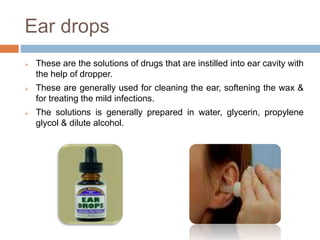
Ear drops
 These are the solutions of drugs that are instilled into ear cavity with
the help of dropper.
 These are generally used for cleaning the ear, softening the wax &
for treating the mild infections.
 The solutions is generally prepared in water, glycerin, propylene
glycol & dilute alcohol.
Biphasic liquid dosage
forms
Biphasic liquid dosage forms
 The liquid which consist of two phases are known as a biphasic
liquid dosage forms.
 They are sub categorized into two different forms namely as –
I) Emulsion
II) Suspension
 In emulsion both phases are available in liquid where as in
suspension, finely divided solid particles are suspended in liquid
medium.
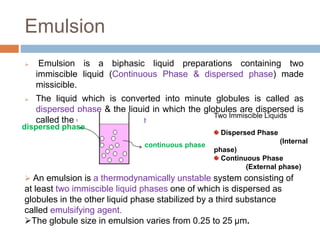
Emulsion
 Emulsion is a biphasic liquid preparations containing two
immiscible liquid (Continuous Phase & dispersed phase) made
missicible.
 The liquid which is converted into minute globules is called as
dispersed phase & the liquid in which the globules are dispersed is
called the continuous phase
dispersed phase
continuous phase
Two Immiscible Liquids
Dispersed Phase
(Internal
phase)
Continuous Phase
(External phase)
 An emulsion is a thermodynamically unstable system consisting of
at least two immiscible liquid phases one of which is dispersed as
globules in the other liquid phase stabilized by a third substance
called emulsifying agent.
The globule size in emulsion varies from 0.25 to 25 µm.
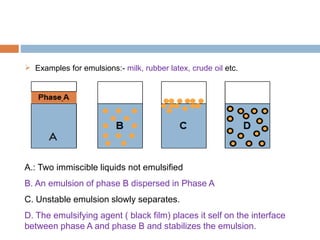
 Examples for emulsions:- milk, rubber latex, crude oil etc.
A.: Two immiscible liquids not emulsified
B. An emulsion of phase B dispersed in Phase A
C. Unstable emulsion slowly separates.
D. The emulsifying agent ( black film) places it self on the interface
between phase A and phase B and stabilizes the emulsion.
Types of emulsions
Simple type
 Water in oil (w/o)
 Oil in water (o/w)
Depending on globule size
 Micro emulsion
 Fine emulsion
Special type
 Multiple emulsion (w/o/w, o/w/o)
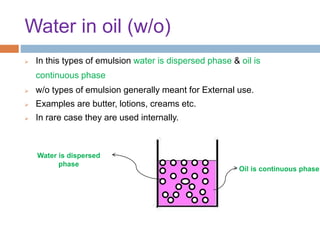
Water in oil (w/o)
 In this types of emulsion water is dispersed phase & oil is
continuous phase
 w/o types of emulsion generally meant for External use.
 Examples are butter, lotions, creams etc.
 In rare case they are used internally.
Water is dispersed
phase
Oil is continuous phase
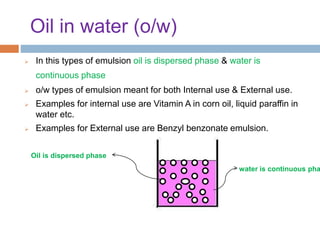
Oil in water (o/w)
 In this types of emulsion oil is dispersed phase & water is
continuous phase
 o/w types of emulsion meant for both Internal use & External use.
 Examples for internal use are Vitamin A in corn oil, liquid paraffin in
water etc.
 Examples for External use are Benzyl benzonate emulsion.
Oil is dispersed phase
water is continuous pha
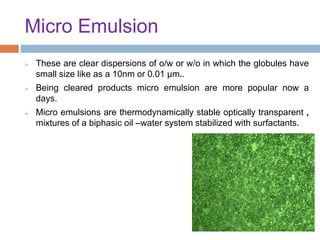
Micro Emulsion
 These are clear dispersions of o/w or w/o in which the globules have
small size like as a 10nm or 0.01 µm..
 Being cleared products micro emulsion are more popular now a
days.
 Micro emulsions are thermodynamically stable optically transparent ,
mixtures of a biphasic oil –water system stabilized with surfactants.
Fine emulsion
 Normally these have a milky appearance.
 The globule size ranges from 0.25 to 25 µm.
Multiple emulsion
 These are emulsion with in emulsion & designated as w/o/w or
o/w/o.
 The drugs that is incorporated in the innermost phase must cross
two phase boundaries before getting absorbed.
 It is generally used in oral sustained release or intramuscular
therapy.
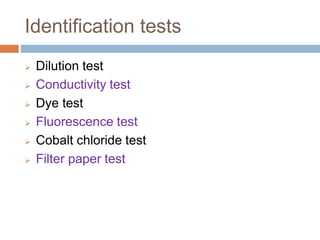
Identification tests
 Dilution test
 Conductivity test
 Dye test
 Fluorescence test
 Cobalt chloride test
 Filter paper test
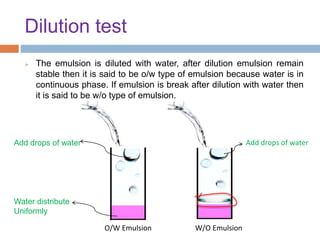
Dilution test
 The emulsion is diluted with water, after dilution emulsion remain
stable then it is said to be o/w type of emulsion because water is in
continuous phase. If emulsion is break after dilution with water then
it is said to be w/o type of emulsion.
Add drops of water
Water distribute
Uniformly
Add drops of water
O/W Emulsion W/O Emulsion
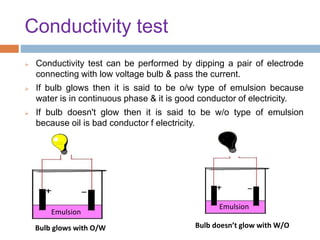
Conductivity test
 Conductivity test can be performed by dipping a pair of electrode
connecting with low voltage bulb & pass the current.
 If bulb glows then it is said to be o/w type of emulsion because
water is in continuous phase & it is good conductor of electricity.
 If bulb doesn't glow then it is said to be w/o type of emulsion
because oil is bad conductor f electricity.
Bulb glows with O/W
Emulsion
Emulsion
Bulb doesn’t glow with W/O
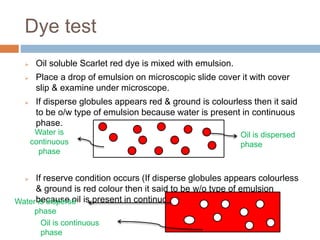
Dye test
 Oil soluble Scarlet red dye is mixed with emulsion.
 Place a drop of emulsion on microscopic slide cover it with cover
slip & examine under microscope.
 If disperse globules appears red & ground is colourless then it said
to be o/w type of emulsion because water is present in continuous
phase.
 If reserve condition occurs (If disperse globules appears colourless
& ground is red colour then it said to be w/o type of emulsion
because oil is present in continuous phase.)
Oil is dispersed
phase
Water is
continuous
phase
Water is disperse
phase
Oil is continuous
phase
Fluorescence test
 Certain fixed oil posses the physical properties of fluorescing in the
presence of ultraviolet radiations.
 If examine under microscope ground is fluorescence then it said to
be w/o type of emulsion because oil is present in continuous phase.
 If examine under microscope droplet is fluorescence then it said to
be o/w type of emulsion because oil is present in disperse phase.
Creaming test
 The direction of creaming identifies the emulsion type, if the
densities of aqueous and oil phases are known.
 Water-in-oil emulsions normally cream downward as oil is usually
less dense than water.
 Oil-in-water emulsions normally cream upwards.
Cobalt chloride test
 Pour the emulsion on filter paper then it is soaked in cobalt chloride
solutions & allowed to dry turns from blue to pink.
 Then this emulsion is said to be o/w type of emulsion.
 This test may fail if emulsion unstable or breaks in presence of
electrolyte.
Filter paper test
 This test is based on the fact that an o/w emulsion will spread out
rapidly when dropped onto filter paper.
 In contrast, a w/o emulsion will migrate only slowly. This method
should not be used for highly viscous creams.
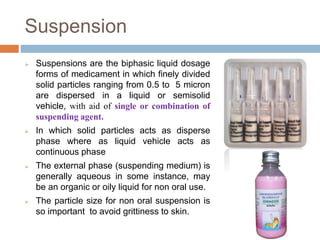
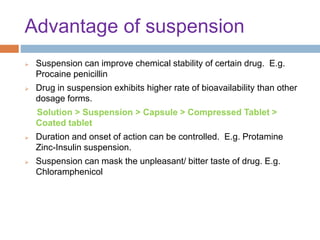
Suspension
 Suspensions are the biphasic liquid dosage
forms of medicament in which finely divided
solid particles ranging from 0.5 to 5 micron
are dispersed in a liquid or semisolid
vehicle, with aid of single or combination of
suspending agent.
 In which solid particles acts as disperse
phase where as liquid vehicle acts as
continuous phase
 The external phase (suspending medium) is
generally aqueous in some instance, may
be an organic or oily liquid for non oral use.
 The particle size for non oral suspension is
so important to avoid grittiness to skin.
Advantage of suspension
 Suspension can improve chemical stability of certain drug. E.g.
Procaine penicillin
 Drug in suspension exhibits higher rate of bioavailability than other
dosage forms.
Solution > Suspension > Capsule > Compressed Tablet >
Coated tablet
 Duration and onset of action can be controlled. E.g. Protamine
Zinc-Insulin suspension.
 Suspension can mask the unpleasant/ bitter taste of drug. E.g.
Chloramphenicol
Disadvantage of suspension
 Physical stability , sedimentation and compaction can causes
problems.
 It is difficult to formulate.
 Uniform and accurate dose can not be achieved unless
suspension are packed in unit dosage form.
 All suspensions are required to be shaken before measuring of
dose.
 The storage of suspension may lead to changes in disperse
system especially, when there is fluctuations in temperatures.
Ideal qualities of good
suspension
 It should settle slowly & easily re – dispersed on shaking
 It should readily & evenly pour from container.
 It should be chemically inert.
 It should not forms hard cake.
 It should prevent degradation of drug or to improve stability of
drug.
 It should mask the taste of bitter of unpleasant drug.
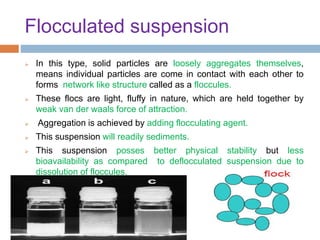
Flocculated suspension
 In this type, solid particles are loosely aggregates themselves,
means individual particles are come in contact with each other to
forms network like structure called as a floccules.
 These flocs are light, fluffy in nature, which are held together by
weak van der waals force of attraction.
 Aggregation is achieved by adding flocculating agent.
 This suspension will readily sediments.
 This suspension posses better physical stability but less
bioavailability as compared to deflocculated suspension due to
dissolution of floccules.
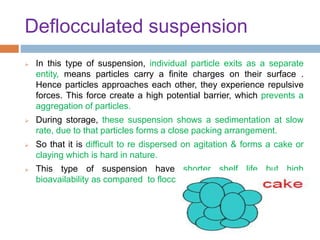
Deflocculated suspension
 In this type of suspension, individual particle exits as a separate
entity, means particles carry a finite charges on their surface .
Hence particles approaches each other, they experience repulsive
forces. This force create a high potential barrier, which prevents a
aggregation of particles.
 During storage, these suspension shows a sedimentation at slow
rate, due to that particles forms a close packing arrangement.
 So that it is difficult to re dispersed on agitation & forms a cake or
claying which is hard in nature.
 This type of suspension have shorter shelf life but high
bioavailability as compared to flocculated suspension.
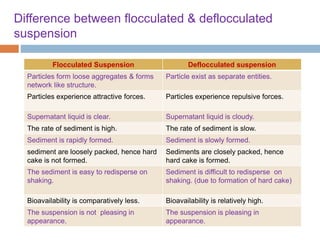
Difference between flocculated & deflocculated
suspension
Flocculated Suspension Deflocculated suspension
Particles form loose aggregates & forms
network like structure.
Particle exist as separate entities.
Particles experience attractive forces. Particles experience repulsive forces.
Supernatant liquid is clear. Supernatant liquid is cloudy.
The rate of sediment is high. The rate of sediment is slow.
Sediment is rapidly formed. Sediment is slowly formed.
sediment are loosely packed, hence hard
cake is not formed.
Sediments are closely packed, hence
hard cake is formed.
The sediment is easy to redisperse on
shaking.
Sediment is difficult to redisperse on
shaking. (due to formation of hard cake)
Bioavailability is comparatively less. Bioavailability is relatively high.
The suspension is not pleasing in
appearance.
The suspension is pleasing in
appearance.
Semisolid dosage forms
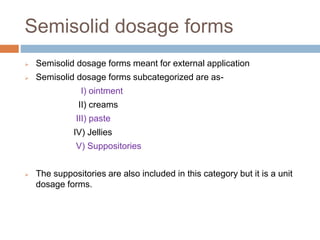
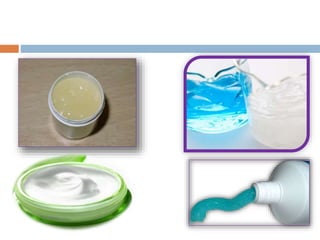
 Semisolid dosage forms meant for external application
 Semisolid dosage forms subcategorized are as-
I) ointment
II) creams
III) paste
IV) Jellies
V) Suppositories
 The suppositories are also included in this category but it is a unit
dosage forms.
Semisolid dosage forms
Ointment
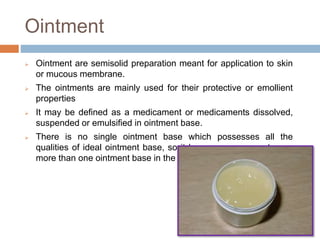
 Ointment are semisolid preparation meant for application to skin
or mucous membrane.
 The ointments are mainly used for their protective or emollient
properties
 It may be defined as a medicament or medicaments dissolved,
suspended or emulsified in ointment base.
 There is no single ointment base which possesses all the
qualities of ideal ointment base, so it become necessary to use
more than one ointment base in the preparation of ointment.
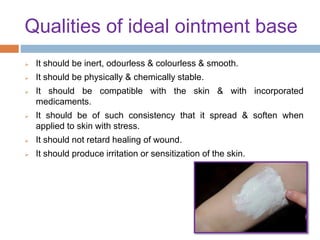
Qualities of ideal ointment base
 It should be inert, odourless & colourless & smooth.
 It should be physically & chemically stable.
 It should be compatible with the skin & with incorporated
medicaments.
 It should be of such consistency that it spread & soften when
applied to skin with stress.
 It should not retard healing of wound.
 It should produce irritation or sensitization of the skin.
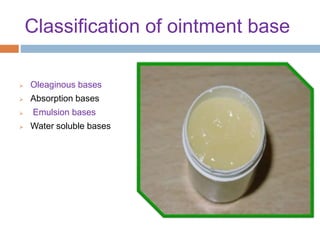
Classification of ointment base
 Oleaginous bases
 Absorption bases
 Emulsion bases
 Water soluble bases
Oleaginous base
 These bases consist of water soluble hydrocarbons, vegetable oils,
animal fats & wax.
 The constituents of hydrocarbon bases are soft paraffin, hard
paraffin & liquid paraffin.
 The vegetable oils are mainly used in ointment to lower the melting
point or to soften the bases.
 These bases serve to keep the medicaments in prolonged contact
with the skin & also act as occlusive dressings. They have a low
capacity to absorb water & are used chiefly for their emollient effect.
 These bases losing their importance now a days for the many
reason.
Disadvantages of oleaginous
bases
 They are greasy.
 They are sticky & are difficult to remove both from skin & clothing.
 They retain body heat which may produce an uncomfortable feeling
of warmth.
 They do not help in the absorption of medicaments.
Absorption bases
 These bases are generally anhydrous substance which have the
property of absorbing considerable quantities of water but still
retaining their ointment like consistency.
 The absorption bases are of two type namely as
I) Non emulsified bases
II) Water in oil emulsion
 Non emulsified bases absorb water & aqueous solutions producing
w/o emulsion. E.g. Wool fat, wool alcohol, beeswax & cholesterol.
 Water in oil emulsions are capable of absorbing more water & have
the properties of non- emulsified bases. E.g. hydrous wool fat (
lanoline)
Emulsion bases
 These bases are semisolid or have cream like consistency.
 Both o/w or w/o emulsions are used as a ointment base.
 The o/w emulsion base is more popular now days because ease of
application will easily achieved.
 The w/o type of emulsion bases are greasy & sticky.
 The emulsifying ointment is prepared from emulsifying wax, white
soft paraffin & liquid paraffin.
Water soluble bases
 These are commonly known as greaseless ointment bases.
 The water soluble bases consist of water soluble ingredients such
as carbowaxes ( polyethylene glycol polymer)
 The carbowaxes are water soluble, non – volatile & inert substance.
 Selection of appropriate carbowaxes is depend on their molecular
weight.
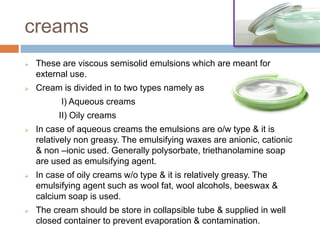
creams
 These are viscous semisolid emulsions which are meant for
external use.
 Cream is divided in to two types namely as
I) Aqueous creams
II) Oily creams
 In case of aqueous creams the emulsions are o/w type & it is
relatively non greasy. The emulsifying waxes are anionic, cationic
& non –ionic used. Generally polysorbate, triethanolamine soap
are used as emulsifying agent.
 In case of oily creams w/o type & it is relatively greasy. The
emulsifying agent such as wool fat, wool alcohols, beeswax &
calcium soap is used.
 The cream should be store in collapsible tube & supplied in well
closed container to prevent evaporation & contamination.
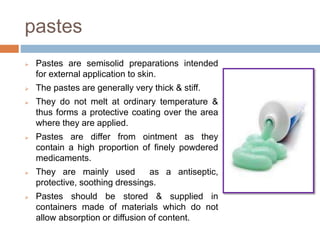
pastes
 Pastes are semisolid preparations intended
for external application to skin.
 The pastes are generally very thick & stiff.
 They do not melt at ordinary temperature &
thus forms a protective coating over the area
where they are applied.
 Pastes are differ from ointment as they
contain a high proportion of finely powdered
medicaments.
 They are mainly used as a antiseptic,
protective, soothing dressings.
 Pastes should be stored & supplied in
containers made of materials which do not
allow absorption or diffusion of content.
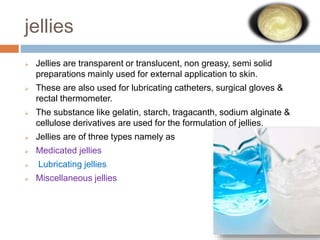
jellies
 Jellies are transparent or translucent, non greasy, semi solid
preparations mainly used for external application to skin.
 These are also used for lubricating catheters, surgical gloves &
rectal thermometer.
 The substance like gelatin, starch, tragacanth, sodium alginate &
cellulose derivatives are used for the formulation of jellies.
 Jellies are of three types namely as
 Medicated jellies
 Lubricating jellies
 Miscellaneous jellies
New drug delivery system
Introduction
With the advancement of pharmaceutical sciences, a new concept
have evolved various modern dosage forms & methods of their
administration. Some of the modern dosage forms are
 Implants
 Films & strips
 Liposome drug carriers
 Controlled drug delivery modules
 Erythrocytes
 Nanoparticles
 prodrugs
Implants
 These are hypodermic tablets are placed under the skin by a minor
surgery in order to release drugs over prolonged periods of time.
 Now the magnetically controlled implants have been developed
which can be opened or closed at will in order to release or stop the
drug.
 These implants are placed at upper thigh at a depth of 5mm.
 These implants are useful in hormone therapy.
Films & strips
These are meant for topical application for slow release of drug over
predetermined period of time. Films & strips are more popular these
days. They are sub categorized in to following types namely as
 Zero order release films
 Buccal strips
 Spray bandages
Zero order release films
 These are called as laminates & meant for topical application. E.g.
 Nitroglycerine laminates are prepared by mixing propylene glycol
with about 1% carbopol resin. The mixture is neutralized with NaoH
solution & then 0.1% of nitroglycerin is added. It is then placed in
polythene sheet 5*5 cm & its edges are sealed by heat. It is then
placed on pressure sensitive adhesive sheet of 5.5 * 5.5 cm so that
it can be properly adhesive to skin. Such laminates release the drug
slowly into circulation for about 12 hours.
Buccal strips
 The buccal & sublingual tablets are now replaced with buccal strips.
 These strips consist of a thin absorbent base of fabrics, filter paper
& cotton etc.
 The buccal strips are prepared by immersing a long piece of fabric
made from polyamide fibers into a molten mixture of carbowaxes &
dissolved or dispersed the drug.
 The fabric is then cooled & cut into small pieces.
 It should be contact with buccal mucosa for about 15 min. & then
removed & discarded.
Spray bandage
 These bandage are prepared by spraying the solution of drug in
polylactide (polymer of lactic acid anhydride)
 A solution of purified lactide polymer is made in chloroform.
 It is then packed in aerosol container having suitable propellant.
 When these solution sprayed then it will be a comfortable bandage
which can simply washed of with warm water.
Liposome drug carriers
 These are several carriers in our body which transport both to an
other like as enzymes, proteins etc.
 These are phospholipids which can transport both hydrophilic &
hydrophobic drugs.
 The large multilamellar vesicles (LMV), small unilamellar vesicles
(SUV), large unilamellar vesicles (LUV) are some of the liposome's
known today.
Applications
 Used in diseases caused by intracellular parasites. E.g. malaria,
tuberculosis & amoebiasis.
 It entrapped insulin is active orally & can be replaced by IM
administration of insulin.
 It can be used to transport functional DNA/RNA molecules into cell.
 It can be used to transport radio pharmaceuticals & immunological
products.
 Liposomal daunomycin has longer duration of action than free
daunomycin which is used in the treatment of neoplasia.
Controlled drug delivery
modules
 These are the device which are formed by embedding the drug
within a polymeric matrix so that it gets released slowly to the body
over a long period of time.
 It will formed drug – polymer complex & may be formulated in to
tablet, capsule or any other suitable formulation.
 These modules are punctured before administration with leaser
beam to make a small orifice for release of the drugs.
 The drugs is released from these modules by diffusion, osmosis or
chemical reactions.
 These are applied to skin, implanted subcutaneously or inserted
into various body cavities.
Erythrocytes
 Erythrocytes are tried in order to achieve controlled release of
drugs.
 The life span of erythrocytes are 120 days.
 It can allow a drug to circulate in the body for long period of time
which help slow release of the drugs in to serum.
 Released erythrocytes are prepared by putting them in to a
hypotonic medium. So that they can easily swollen.
 The aqueous solutions of the drug is added to the medium so that
drugs gets in to erythrocytes through open pores.
 When isotonicity is adjusted the erythrocytes shrink, thus
encapsulating the drug with in them. These erythrocytes may be
suspended in normal saline solutions for preparing injections.
Applications
 Released erythrocytes of urease have been used in kidney failure to
degrade serum urea.
 Released erythrocytes of asparaginase have shown good result in
asparaginase dependent leukemia.
 Released erythrocytes of methotrexate & adrianycin have been tried
in cancer therapy.
 Released erythrocytes of prednisolone have shown good result to
prolong the anti-inflammatory action.
Nanoparticles
 It is based on colloidal drug delivery system.
 The particles size of this system is in nanometer range (200 – 500
mm)
 The system consist of a drug & carriers to deposit the drug at target
site.
 The carriers used are naturally occurring macromolecules like
human serum albumin, bovine serum albumin, & other substances
like gelatin, casein & ethylcellulose.
Applications
 Flourescein isothinocyanate (FITC) nanoparticles have been used
to incorporate cytotoxic agent into tumor cell in cancer
chemotherapy.
 Nanoparticles along with biological maker like immunoglobulin can
be used to target the drugs to very specific site.
Prodrugs
 The compound which undergo biotransformation before showing
desired pharmacological activity are called prodrugs or proagents.
 Prodrugs are generally the ester or amides of parent drugs.
 These are useful to improving the stability, solubility, bioavailability
of drugs, masking the unpleasant taste & odour of the parent drug &
reducing the toxicity
Applications
 Choramphenicol palmitate, the prodrug of chloramphenicol is used
in the preparation of pediatrics suspension because it has no bitter
taste.
 Procaine penicillin G & benzathine penicillin G are prodrugs of
penicillin G which shows resistance to hydrolysis as compared to
the parent drug.
 Cindamycin 2- phosphate the prodrug of cindamycin has no bitter
taste of parent drug.
Thank you

dosage forms.ppt

  • 1.
    INTRODUCTION TO DIFFERENT DOSAGEFORMS Powered By Dept. of Pharmaceutics
  • 2.
    Drug  Drug maybe defined as an agent or substance, intended for use in the diagnosis, mitigation, treatment, cure or prevention of disease in human beings or animals.  Drugs are rarely administered in their original or crude forms. They are administered in different dosage forms by converting them into suitable formulations. Crude Drugs
  • 3.
    Dosage Forms  Dosageforms are the carrier through which drug molecules are delivered to sites of action within the body.  Every dosage forms is a combination of the drug and different kinds of non – drug components called as Excipients or additives.  The additives are used to give a particular shape to the formulation, to increase stability, palatability & more elegance to preparations.
  • 4.
    Need For DosageForms  Accurate dose.  Protection e.g. coated tablets, sealed ampules.  Protection from gastric juice, e.g. enteric coated tablets.  Masking unpleasant taste and odour.  Provide drugs within body tissues, e.g. injection  Sustained release medication.
  • 5.
     Provide optimumdrug action through inhalation therapy.  Provide drug action through topical administration at local area of body. e.g. creams, ointment, emulsion, lotions etc.  Use of desired vehicle for insoluble drugs.
  • 6.
    Classification Solid dosage forms Unit dosage forms Tablets Capsule Powders Pills Bulk Internal Finepowders & granules External Dusting powders Insufflations Dentifrice Snuffs Ear powders Liquid dosage forms Biphasic Emulsion Suspension Monophasic Internal External Syrups Elixirs Linctus Drops Liniments Lotions Gargles Throat paints Mouth washes Sprays Eye lotions Eye drops Nasal drops Semi solid dosage forms Internal External Suppositories Pessaries Ointment Creams pastes Jellies
  • 7.
  • 8.
    Solid dosage forms TabletsPills Dusting Powders Capsules Granules
  • 9.
     Solid dosageforms one of the oldest dosage forms and most of the solid dosage forms are available in Unit dose.  Unit dose may be defined as a exact quantity of the drug administered at once. e.g. Tablets, Capsule, pills, cachets, powders etc.  When drugs are to be administered orally in dry state, then tablets, capsules are most convenient dosage forms.  Some solids are supplied in bulk (Means quantity available in large). Bulk powders can be supplied as Internal (Granules, Fine powders) as well as External (Dusting Powders, Insufflations etc)
  • 10.
    Dusting Powders  Dustingpowders are applied externally to skin, so they should be applied in very fine state to avoid local irritation. Hence dusting powders should be passed through sieve no 80 to obtained fined powders.  Dusting powders are prepared by mixing of more than one ingredients in which either starch, kaolin, or talc are used in their formulation. Generally talc or kaolin are used because they are inert in nature.  Dusting powders are used for antiseptic, astringent, absorbent, antiperspirant etc.  Dusting powders are of two sub type they are as I) Medical dusting powder
  • 11.
    Medical Dusting Powders  MedicalDusting powders are used to increase superficial condition of skin.  These are not applied on wounds, burns etc  Medical dusting powders must be free from dangerous pathogenic micro- organism.
  • 12.
    Surgical Dusting Powders Surgical dusting powders are used in body cavities and also on major wounds like as burns etc.  They should be sterilized before use.  They are mainly used for their antiseptic, absorbent action.
  • 13.
    Insufflations  These aremedicated dusting powders meant for introduction into body cavities (nose, throat, ear, vagina etc) with the help of an apparatus known as a insufflator.  It sprays the powders (in a state of fine particles) on site of application.  Now a days insufflations are also available in pressure aerosols. This pressure aerosols are used for administration of potent drug.  They are used in the treatment of ear, nose, throat infections with antibiotics to produce local effect of drugs.
  • 14.
    Snuffs  These arefinely divided solid dosage forms of medicaments which are inhaled into nostrils.  They are mainly used for their antiseptic, bronchodilator and decongestion action.
  • 15.
    Granules  Granulation isthe process in which primary powder particles are made to adhere to form larger multiparticle or large particles entities called granules.  The bitter, nauseous, unpleasant powders can not be given tablets, capsule due to bulk quantity are required to be taken, as well as they are not given in liquid dosage forms due to their stability such powders are given in the granules forms.  These powders are mixed with suitable exicipent along with granulating agent, prepare a coherent mass then dried & passed through the sieve to obtained desired size of granules.
  • 16.
    Effervescent Granules  Effervescentgranules are meant for internal use.  They contained medicaments mixed with citric acid, tartaric acid & sodium bi carbonates, sometime saccharin or sucrose may be added for sweetening taste.  Before, administration desired quantity of granules are dissolved in water, the acid & bicarbonate reacts with each other to produce effervescence.  Effervescent granules are prepared by two methods, namely as, I) Heat method, II) Wet method
  • 17.
    Heat method  Alarge porcelain or stainless steel evaporating dish is placed over the boiling water bath.  The dish must be sufficiently hot (generally heating takes place for 1 – 5 min.) before transferring the powders into it, to ensure rapid liberation of water of crystallization from citric acid.  If heating of the dish is delayed then the powder which is added to it, will heat up slowly & liberated water of crystallization will also be liberated simultaneously.  As a result, sufficient water will not be available to make a coherent mass.  This coherent mass will pass through the sieve to obtained suitable size of granules, dry it in oven at 600c then packed in air tight container.
  • 18.
    Wet method  Inthis methods all the ingredients are mixed thoroughly  This powders mixture make moistened with non – aqueous vehicle (e.g. alcohol), to prepare a coherent mass which is then passed through sieve no 8 to obtained suitable granules.  Then dried in oven at 600c. The dried granules are again passed through the sieve to break the lumps which may be formed during drying.  The dried granules are packed in air tight container.
  • 19.
    Tablets  These aresolid dosage forms of medicaments which are prepared by moulding or by compression with or without Excipients.  The tablets can be prepared by two methods namely as a I) Dry granulation, II) Wet Granulation
  • 20.
    Capsule  Capsules aresolid unit dosage forms in which one or more medicaments enclosed within a shell.  Capsules mainly divided in to two parts namely as – I) Body (Longest part of capsule shell), II) Cap (Smallest part of capsule shell)  The capsule are generally prepared by gelatin.  Depending on their formulation, two types of gelatin are used namely as – I) Hard gelatin, II) Soft gelatin. Body Cap
  • 21.
    Pills  These aresmall, rounded solid dosage forms containing medicaments intended for oral use.  The medicaments are mixed with excipients to forms a firms plastic mass.  The mass is rolled to uniform pill pipe, which cut into numbers of uniform pills. The pills are spherical in shape & produced by rolling them under wooden pill rounder.  Sometimes pills are coated with varnish, gold leaf, etc to improve finish, unpleasant taste & stability.  Now a days pills are outdated preparations because of number of disadvantages such as -
  • 22.
     Disintegration timeof pill is uncertain means freshly prepared pills are disintegrates readily rather than old dried pills.  It is difficult to prepare pills of uniform size & weight.
  • 23.
  • 24.
  • 25.
     It maybe defined as “A solution is a liquid-preparation that contains one or more soluble chemical substances dissolved in a specified solvent”  Liquid dosage forms are intended for External, Internal or parenteral use.  The component of the solution which is present in a large quantity is known as “SOLVENT” where as the component present in small quantity is termed as “SOLUTE”  They mainly classified in to two category namely as – I) Monophasic Liquid dosage forms. II) Biphasic liquid dosage forms.
  • 26.
    Advantage  Immediately availablefor absorption.  Administration convenient, particularly for infants, psychotic patients.  Easy to color, flavor & sweeten.  Liquids are easier to swallow than solids and are therefore particularly acceptable for pediatric patient.  A solution is an homogeneous system and therefore the drug will be uniformly distributed throughout the preparation.  Some drugs like aspirin, KCl can irritate gastric mucosa if used orally as a solid dosage forms. But this effect can be reduce by solution system.
  • 27.
    Disadvantage  Less stablein aqueous system. Incompatibility is faster in solution than solid dosage form.  Patients have no accurate measuring device.  Accident breakage of container results in complete loss.  Solution often provide suitable media for the growth of micro organisms.  The taste of a drug, which is often unpleasant, is always more pronounced when in solution than in a solid form.  Bulky than tablets or capsule, so difficult to carry transport.
  • 28.
  • 29.
     Monophasic liquiddosage forms are represent by true or colloidal solution.  The component of the solution which is present in a large quantity is known as “SOLVENT” where as the component present in small quantity is termed as “SOLUTE”.  A solution is homogenous because the solute is an ionic or molecular forms of subdivision.  In case of colloidal solutions, the solutes are present as aggregates although they cannot be seen by necked eye or ordinary microscope.  It is sub classified as – I) Internal Use, II) External use
  • 30.
    Monophasic Liquid Dosage forms InternalUse External Use  Syrup  Elixirs  Linctuses  Drops  Liniments  Lotions  Gargles  Mouth Wash  Throat paints  sprays  Inhalations  Nasal drops  Eye drops  Eye lotions  Ear drops
  • 31.
    Monophasic liquid dosageforms for Internal Use
  • 32.
    Syru p  It isa concentrated or saturated solutions of sucrose in purified water.  The concentration of sucrose is 66.7% w/w & due to that it is a viscous preparations.  The syrup which contains medical substance called as a medicated syrup & those containing aromatic or flavored substance known as a flavored syrup.
  • 33.
    Importance of syrup It retards oxidation because its partly hydrolyzed into reducing sugar.  It prevents decomposition of many vegetable substance because its have high osmotic pressure which prevent the growth of bacteria.  They are palatable due sweet taste.
  • 34.
     It isclear, sweetened, aromatic, hydroalcholic preparations meant for oral use.  The medicated elixirs are generally contained potent drug like as antibiotics, antihistamine or sedative , where as non – medicated elixirs contained flavoured.  The composition of elixirs contained mainly as ethyl alcohol (active ingredients),water, glycerin or propylene glycol, colouring Elixirs
  • 35.
    Linctuse s  These areviscous liquid preparations that’s are used for the treatment of cough.  They contain medicaments which have demulcent, sedative, expectorant action.  They are taken in small doses without diluting with water to have prolonged effect of medicines.  Simple syrup is used as a vehicle for most of the linctuses.  Tolu syrup is preferred in certain cases because of its aromatic odour &
  • 36.
    Drop s  These areliquid preparations meant for oral administration.  The oil soluble vitamins, such as vitamin A & D concentrates in fish – liver oil are presented as drops for administration.  Since these preparations contain potent medicaments, the dose must be measured accurately  The following two methods are commonly used for this purpose.  Use of a dropper which is accurately graduated in fractions of a milliliters.  Use of a pre – calibrated dropper.
  • 37.
  • 38.
    Liniments  Liniments areliquid or semi- liquid preparations meant for external application to the skin.  They are usually applied to the skin with friction & rubbing of the skin.  Are usually alcoholic and oily liquid preparations (monophasic) or emulsion (biphasic).  Alcoholic liniments are used generally for their rubefacient and counterirritant effects. Such liniments penetrate the skin more readily than do those with an oil base.  The oily liniments are milder in their action and may function solely as protective coatings
  • 39.
    Lotions  Are usuallyaqueous, alcoholic or oily liquid preparations.  They are intended for external application without friction or rubbing to the affected area  Usually applied with the help of some absorbent material such as cotton wool or gauze.  It is generally used to provide cooling, soothing and protective & antiseptic action.
  • 40.
    Gargles  Gargles areaqueous solutions used for treating throat infection (pharynx and nasopharynx part)  Supplied in concentrated forms with directions of dilution with warm water before use  They are used into intimate contact with the mucous membrane of throat for few seconds, before they are thrown out of the mouth.  They are used to relieve soreness in mild throat infection.  They are also used for their antiseptics, antibiotics and/or anesthetics
  • 41.
    Mouth wash  Theseare aqueous solutions with pleasant or acceptable taste & odour  These are used to make clean & deodorise the buccal cavity or used for oral hygiene and to treat infections of the mouth.  They mainly contain antibacterial agent, alcohol, glycerin, sweetening agent, flavoring agent & colouring agent.
  • 42.
    Throat paints  Throatpaints are viscous liquid preparations used for mouth and throat infections  Glycerin is commonly used as a base because being viscous it adheres to mucous membrane for long period and it possess a sweet taste.
  • 43.
    Sprays  These arethe preparations of drugs in media which may be aqueous, alcoholic, or glycerin.  They are applied to the mucous membrane of throat or nose with an atomizer.  The throat sprays must be sprayed from a special type of atomizer known as a nebulizer, which removes the large droplets by baffling system. Only precaution should be taken that the fine droplet will used to easily reach the lungs. Nebulizer
  • 44.
    Inhalations  These areliquid preparations containing volatile substance & are used to relieve decongestion & inflammations of respiratory tract.  The volatile substance in inhalations would be volatile at room temperature so that they should be placed on some adsorbent pad or handkerchief.  In some cases inhalations will added to hot water (650c) then vapors will inhaled.
  • 45.
    Nasal drops  Drugsin solution may be instilled into the nose from a dropper or from a plastic squeeze bottle.  The drug may have a local effect, e.g. antihistamine, decongestant.  Alternatively the drug may be absorbed through the nasal mucosa to exert a systemic effect.  The use of oily nasal drops should be avoided because of possible damage to the cilia of the nasal mucosa & if it is used for long period may reach the lungs & cause lipoid pneumonia.  To avoid that Nasal drops are prepared so that they are similar in many respects to nasal secretions, so that normal ciliary action is maintained thus aqueous nasal solutions usually are isotonic and slightly buffered to maintain a pH of 5.5 to 6.5.
  • 46.
    Eye drops  Sterile,aqueous/oily solutions or suspensions intended for instillation in eye sac.  Eye drops may contain buffers, stabilizing agents, dispersing agents, solubilising agents, anti-oxidants & agents required for tonicity/ viscosity adjustment  Single dose container should not contain anti-microbial preservative.  In case of multi dose container a dropper should be supplied with it for administration. Maximum size of such containers is 10 ml.
  • 47.
    Eye lotions  Theseare the aqueous solutions used for washing the eyes.  These are supplied in concentrated forms & are required to diluted with warm water immediately before use.  They should be free from foreign particles to avoids irritation to the eye.  They are required to prepared fresh & should not be stored for more than two days to avoid microbial contaminations.
  • 48.
    Ear drops  Theseare the solutions of drugs that are instilled into ear cavity with the help of dropper.  These are generally used for cleaning the ear, softening the wax & for treating the mild infections.  The solutions is generally prepared in water, glycerin, propylene glycol & dilute alcohol.
  • 49.
  • 50.
    Biphasic liquid dosageforms  The liquid which consist of two phases are known as a biphasic liquid dosage forms.  They are sub categorized into two different forms namely as – I) Emulsion II) Suspension  In emulsion both phases are available in liquid where as in suspension, finely divided solid particles are suspended in liquid medium.
  • 51.
    Emulsion  Emulsion isa biphasic liquid preparations containing two immiscible liquid (Continuous Phase & dispersed phase) made missicible.  The liquid which is converted into minute globules is called as dispersed phase & the liquid in which the globules are dispersed is called the continuous phase dispersed phase continuous phase Two Immiscible Liquids Dispersed Phase (Internal phase) Continuous Phase (External phase)  An emulsion is a thermodynamically unstable system consisting of at least two immiscible liquid phases one of which is dispersed as globules in the other liquid phase stabilized by a third substance called emulsifying agent. The globule size in emulsion varies from 0.25 to 25 µm.
  • 52.
     Examples foremulsions:- milk, rubber latex, crude oil etc. A.: Two immiscible liquids not emulsified B. An emulsion of phase B dispersed in Phase A C. Unstable emulsion slowly separates. D. The emulsifying agent ( black film) places it self on the interface between phase A and phase B and stabilizes the emulsion.
  • 53.
    Types of emulsions Simpletype  Water in oil (w/o)  Oil in water (o/w) Depending on globule size  Micro emulsion  Fine emulsion Special type  Multiple emulsion (w/o/w, o/w/o)
  • 54.
    Water in oil(w/o)  In this types of emulsion water is dispersed phase & oil is continuous phase  w/o types of emulsion generally meant for External use.  Examples are butter, lotions, creams etc.  In rare case they are used internally. Water is dispersed phase Oil is continuous phase
  • 55.
    Oil in water(o/w)  In this types of emulsion oil is dispersed phase & water is continuous phase  o/w types of emulsion meant for both Internal use & External use.  Examples for internal use are Vitamin A in corn oil, liquid paraffin in water etc.  Examples for External use are Benzyl benzonate emulsion. Oil is dispersed phase water is continuous pha
  • 56.
    Micro Emulsion  Theseare clear dispersions of o/w or w/o in which the globules have small size like as a 10nm or 0.01 µm..  Being cleared products micro emulsion are more popular now a days.  Micro emulsions are thermodynamically stable optically transparent , mixtures of a biphasic oil –water system stabilized with surfactants.
  • 57.
    Fine emulsion  Normallythese have a milky appearance.  The globule size ranges from 0.25 to 25 µm.
  • 58.
    Multiple emulsion  Theseare emulsion with in emulsion & designated as w/o/w or o/w/o.  The drugs that is incorporated in the innermost phase must cross two phase boundaries before getting absorbed.  It is generally used in oral sustained release or intramuscular therapy.
  • 59.
    Identification tests  Dilutiontest  Conductivity test  Dye test  Fluorescence test  Cobalt chloride test  Filter paper test
  • 60.
    Dilution test  Theemulsion is diluted with water, after dilution emulsion remain stable then it is said to be o/w type of emulsion because water is in continuous phase. If emulsion is break after dilution with water then it is said to be w/o type of emulsion. Add drops of water Water distribute Uniformly Add drops of water O/W Emulsion W/O Emulsion
  • 61.
    Conductivity test  Conductivitytest can be performed by dipping a pair of electrode connecting with low voltage bulb & pass the current.  If bulb glows then it is said to be o/w type of emulsion because water is in continuous phase & it is good conductor of electricity.  If bulb doesn't glow then it is said to be w/o type of emulsion because oil is bad conductor f electricity. Bulb glows with O/W Emulsion Emulsion Bulb doesn’t glow with W/O
  • 62.
    Dye test  Oilsoluble Scarlet red dye is mixed with emulsion.  Place a drop of emulsion on microscopic slide cover it with cover slip & examine under microscope.  If disperse globules appears red & ground is colourless then it said to be o/w type of emulsion because water is present in continuous phase.  If reserve condition occurs (If disperse globules appears colourless & ground is red colour then it said to be w/o type of emulsion because oil is present in continuous phase.) Oil is dispersed phase Water is continuous phase Water is disperse phase Oil is continuous phase
  • 63.
    Fluorescence test  Certainfixed oil posses the physical properties of fluorescing in the presence of ultraviolet radiations.  If examine under microscope ground is fluorescence then it said to be w/o type of emulsion because oil is present in continuous phase.  If examine under microscope droplet is fluorescence then it said to be o/w type of emulsion because oil is present in disperse phase.
  • 64.
    Creaming test  Thedirection of creaming identifies the emulsion type, if the densities of aqueous and oil phases are known.  Water-in-oil emulsions normally cream downward as oil is usually less dense than water.  Oil-in-water emulsions normally cream upwards.
  • 65.
    Cobalt chloride test Pour the emulsion on filter paper then it is soaked in cobalt chloride solutions & allowed to dry turns from blue to pink.  Then this emulsion is said to be o/w type of emulsion.  This test may fail if emulsion unstable or breaks in presence of electrolyte.
  • 66.
    Filter paper test This test is based on the fact that an o/w emulsion will spread out rapidly when dropped onto filter paper.  In contrast, a w/o emulsion will migrate only slowly. This method should not be used for highly viscous creams.
  • 67.
    Suspension  Suspensions arethe biphasic liquid dosage forms of medicament in which finely divided solid particles ranging from 0.5 to 5 micron are dispersed in a liquid or semisolid vehicle, with aid of single or combination of suspending agent.  In which solid particles acts as disperse phase where as liquid vehicle acts as continuous phase  The external phase (suspending medium) is generally aqueous in some instance, may be an organic or oily liquid for non oral use.  The particle size for non oral suspension is so important to avoid grittiness to skin.
  • 68.
    Advantage of suspension Suspension can improve chemical stability of certain drug. E.g. Procaine penicillin  Drug in suspension exhibits higher rate of bioavailability than other dosage forms. Solution > Suspension > Capsule > Compressed Tablet > Coated tablet  Duration and onset of action can be controlled. E.g. Protamine Zinc-Insulin suspension.  Suspension can mask the unpleasant/ bitter taste of drug. E.g. Chloramphenicol
  • 69.
    Disadvantage of suspension Physical stability , sedimentation and compaction can causes problems.  It is difficult to formulate.  Uniform and accurate dose can not be achieved unless suspension are packed in unit dosage form.  All suspensions are required to be shaken before measuring of dose.  The storage of suspension may lead to changes in disperse system especially, when there is fluctuations in temperatures.
  • 70.
    Ideal qualities ofgood suspension  It should settle slowly & easily re – dispersed on shaking  It should readily & evenly pour from container.  It should be chemically inert.  It should not forms hard cake.  It should prevent degradation of drug or to improve stability of drug.  It should mask the taste of bitter of unpleasant drug.
  • 71.
    Flocculated suspension  Inthis type, solid particles are loosely aggregates themselves, means individual particles are come in contact with each other to forms network like structure called as a floccules.  These flocs are light, fluffy in nature, which are held together by weak van der waals force of attraction.  Aggregation is achieved by adding flocculating agent.  This suspension will readily sediments.  This suspension posses better physical stability but less bioavailability as compared to deflocculated suspension due to dissolution of floccules.
  • 72.
    Deflocculated suspension  Inthis type of suspension, individual particle exits as a separate entity, means particles carry a finite charges on their surface . Hence particles approaches each other, they experience repulsive forces. This force create a high potential barrier, which prevents a aggregation of particles.  During storage, these suspension shows a sedimentation at slow rate, due to that particles forms a close packing arrangement.  So that it is difficult to re dispersed on agitation & forms a cake or claying which is hard in nature.  This type of suspension have shorter shelf life but high bioavailability as compared to flocculated suspension.
  • 73.
    Difference between flocculated& deflocculated suspension Flocculated Suspension Deflocculated suspension Particles form loose aggregates & forms network like structure. Particle exist as separate entities. Particles experience attractive forces. Particles experience repulsive forces. Supernatant liquid is clear. Supernatant liquid is cloudy. The rate of sediment is high. The rate of sediment is slow. Sediment is rapidly formed. Sediment is slowly formed. sediment are loosely packed, hence hard cake is not formed. Sediments are closely packed, hence hard cake is formed. The sediment is easy to redisperse on shaking. Sediment is difficult to redisperse on shaking. (due to formation of hard cake) Bioavailability is comparatively less. Bioavailability is relatively high. The suspension is not pleasing in appearance. The suspension is pleasing in appearance.
  • 74.
  • 75.
     Semisolid dosageforms meant for external application  Semisolid dosage forms subcategorized are as- I) ointment II) creams III) paste IV) Jellies V) Suppositories  The suppositories are also included in this category but it is a unit dosage forms. Semisolid dosage forms
  • 77.
    Ointment  Ointment aresemisolid preparation meant for application to skin or mucous membrane.  The ointments are mainly used for their protective or emollient properties  It may be defined as a medicament or medicaments dissolved, suspended or emulsified in ointment base.  There is no single ointment base which possesses all the qualities of ideal ointment base, so it become necessary to use more than one ointment base in the preparation of ointment.
  • 78.
    Qualities of idealointment base  It should be inert, odourless & colourless & smooth.  It should be physically & chemically stable.  It should be compatible with the skin & with incorporated medicaments.  It should be of such consistency that it spread & soften when applied to skin with stress.  It should not retard healing of wound.  It should produce irritation or sensitization of the skin.
  • 79.
    Classification of ointmentbase  Oleaginous bases  Absorption bases  Emulsion bases  Water soluble bases
  • 80.
    Oleaginous base  Thesebases consist of water soluble hydrocarbons, vegetable oils, animal fats & wax.  The constituents of hydrocarbon bases are soft paraffin, hard paraffin & liquid paraffin.  The vegetable oils are mainly used in ointment to lower the melting point or to soften the bases.  These bases serve to keep the medicaments in prolonged contact with the skin & also act as occlusive dressings. They have a low capacity to absorb water & are used chiefly for their emollient effect.  These bases losing their importance now a days for the many reason.
  • 81.
    Disadvantages of oleaginous bases They are greasy.  They are sticky & are difficult to remove both from skin & clothing.  They retain body heat which may produce an uncomfortable feeling of warmth.  They do not help in the absorption of medicaments.
  • 82.
    Absorption bases  Thesebases are generally anhydrous substance which have the property of absorbing considerable quantities of water but still retaining their ointment like consistency.  The absorption bases are of two type namely as I) Non emulsified bases II) Water in oil emulsion  Non emulsified bases absorb water & aqueous solutions producing w/o emulsion. E.g. Wool fat, wool alcohol, beeswax & cholesterol.  Water in oil emulsions are capable of absorbing more water & have the properties of non- emulsified bases. E.g. hydrous wool fat ( lanoline)
  • 83.
    Emulsion bases  Thesebases are semisolid or have cream like consistency.  Both o/w or w/o emulsions are used as a ointment base.  The o/w emulsion base is more popular now days because ease of application will easily achieved.  The w/o type of emulsion bases are greasy & sticky.  The emulsifying ointment is prepared from emulsifying wax, white soft paraffin & liquid paraffin.
  • 84.
    Water soluble bases These are commonly known as greaseless ointment bases.  The water soluble bases consist of water soluble ingredients such as carbowaxes ( polyethylene glycol polymer)  The carbowaxes are water soluble, non – volatile & inert substance.  Selection of appropriate carbowaxes is depend on their molecular weight.
  • 85.
    creams  These areviscous semisolid emulsions which are meant for external use.  Cream is divided in to two types namely as I) Aqueous creams II) Oily creams  In case of aqueous creams the emulsions are o/w type & it is relatively non greasy. The emulsifying waxes are anionic, cationic & non –ionic used. Generally polysorbate, triethanolamine soap are used as emulsifying agent.  In case of oily creams w/o type & it is relatively greasy. The emulsifying agent such as wool fat, wool alcohols, beeswax & calcium soap is used.  The cream should be store in collapsible tube & supplied in well closed container to prevent evaporation & contamination.
  • 86.
    pastes  Pastes aresemisolid preparations intended for external application to skin.  The pastes are generally very thick & stiff.  They do not melt at ordinary temperature & thus forms a protective coating over the area where they are applied.  Pastes are differ from ointment as they contain a high proportion of finely powdered medicaments.  They are mainly used as a antiseptic, protective, soothing dressings.  Pastes should be stored & supplied in containers made of materials which do not allow absorption or diffusion of content.
  • 87.
    jellies  Jellies aretransparent or translucent, non greasy, semi solid preparations mainly used for external application to skin.  These are also used for lubricating catheters, surgical gloves & rectal thermometer.  The substance like gelatin, starch, tragacanth, sodium alginate & cellulose derivatives are used for the formulation of jellies.  Jellies are of three types namely as  Medicated jellies  Lubricating jellies  Miscellaneous jellies
  • 88.
  • 89.
    Introduction With the advancementof pharmaceutical sciences, a new concept have evolved various modern dosage forms & methods of their administration. Some of the modern dosage forms are  Implants  Films & strips  Liposome drug carriers  Controlled drug delivery modules  Erythrocytes  Nanoparticles  prodrugs
  • 90.
    Implants  These arehypodermic tablets are placed under the skin by a minor surgery in order to release drugs over prolonged periods of time.  Now the magnetically controlled implants have been developed which can be opened or closed at will in order to release or stop the drug.  These implants are placed at upper thigh at a depth of 5mm.  These implants are useful in hormone therapy.
  • 91.
    Films & strips Theseare meant for topical application for slow release of drug over predetermined period of time. Films & strips are more popular these days. They are sub categorized in to following types namely as  Zero order release films  Buccal strips  Spray bandages
  • 92.
    Zero order releasefilms  These are called as laminates & meant for topical application. E.g.  Nitroglycerine laminates are prepared by mixing propylene glycol with about 1% carbopol resin. The mixture is neutralized with NaoH solution & then 0.1% of nitroglycerin is added. It is then placed in polythene sheet 5*5 cm & its edges are sealed by heat. It is then placed on pressure sensitive adhesive sheet of 5.5 * 5.5 cm so that it can be properly adhesive to skin. Such laminates release the drug slowly into circulation for about 12 hours.
  • 93.
    Buccal strips  Thebuccal & sublingual tablets are now replaced with buccal strips.  These strips consist of a thin absorbent base of fabrics, filter paper & cotton etc.  The buccal strips are prepared by immersing a long piece of fabric made from polyamide fibers into a molten mixture of carbowaxes & dissolved or dispersed the drug.  The fabric is then cooled & cut into small pieces.  It should be contact with buccal mucosa for about 15 min. & then removed & discarded.
  • 94.
    Spray bandage  Thesebandage are prepared by spraying the solution of drug in polylactide (polymer of lactic acid anhydride)  A solution of purified lactide polymer is made in chloroform.  It is then packed in aerosol container having suitable propellant.  When these solution sprayed then it will be a comfortable bandage which can simply washed of with warm water.
  • 95.
    Liposome drug carriers These are several carriers in our body which transport both to an other like as enzymes, proteins etc.  These are phospholipids which can transport both hydrophilic & hydrophobic drugs.  The large multilamellar vesicles (LMV), small unilamellar vesicles (SUV), large unilamellar vesicles (LUV) are some of the liposome's known today.
  • 96.
    Applications  Used indiseases caused by intracellular parasites. E.g. malaria, tuberculosis & amoebiasis.  It entrapped insulin is active orally & can be replaced by IM administration of insulin.  It can be used to transport functional DNA/RNA molecules into cell.  It can be used to transport radio pharmaceuticals & immunological products.  Liposomal daunomycin has longer duration of action than free daunomycin which is used in the treatment of neoplasia.
  • 97.
    Controlled drug delivery modules These are the device which are formed by embedding the drug within a polymeric matrix so that it gets released slowly to the body over a long period of time.  It will formed drug – polymer complex & may be formulated in to tablet, capsule or any other suitable formulation.  These modules are punctured before administration with leaser beam to make a small orifice for release of the drugs.  The drugs is released from these modules by diffusion, osmosis or chemical reactions.  These are applied to skin, implanted subcutaneously or inserted into various body cavities.
  • 98.
    Erythrocytes  Erythrocytes aretried in order to achieve controlled release of drugs.  The life span of erythrocytes are 120 days.  It can allow a drug to circulate in the body for long period of time which help slow release of the drugs in to serum.  Released erythrocytes are prepared by putting them in to a hypotonic medium. So that they can easily swollen.  The aqueous solutions of the drug is added to the medium so that drugs gets in to erythrocytes through open pores.  When isotonicity is adjusted the erythrocytes shrink, thus encapsulating the drug with in them. These erythrocytes may be suspended in normal saline solutions for preparing injections.
  • 99.
    Applications  Released erythrocytesof urease have been used in kidney failure to degrade serum urea.  Released erythrocytes of asparaginase have shown good result in asparaginase dependent leukemia.  Released erythrocytes of methotrexate & adrianycin have been tried in cancer therapy.  Released erythrocytes of prednisolone have shown good result to prolong the anti-inflammatory action.
  • 100.
    Nanoparticles  It isbased on colloidal drug delivery system.  The particles size of this system is in nanometer range (200 – 500 mm)  The system consist of a drug & carriers to deposit the drug at target site.  The carriers used are naturally occurring macromolecules like human serum albumin, bovine serum albumin, & other substances like gelatin, casein & ethylcellulose.
  • 101.
    Applications  Flourescein isothinocyanate(FITC) nanoparticles have been used to incorporate cytotoxic agent into tumor cell in cancer chemotherapy.  Nanoparticles along with biological maker like immunoglobulin can be used to target the drugs to very specific site.
  • 102.
    Prodrugs  The compoundwhich undergo biotransformation before showing desired pharmacological activity are called prodrugs or proagents.  Prodrugs are generally the ester or amides of parent drugs.  These are useful to improving the stability, solubility, bioavailability of drugs, masking the unpleasant taste & odour of the parent drug & reducing the toxicity
  • 103.
    Applications  Choramphenicol palmitate,the prodrug of chloramphenicol is used in the preparation of pediatrics suspension because it has no bitter taste.  Procaine penicillin G & benzathine penicillin G are prodrugs of penicillin G which shows resistance to hydrolysis as compared to the parent drug.  Cindamycin 2- phosphate the prodrug of cindamycin has no bitter taste of parent drug.
  • 104.