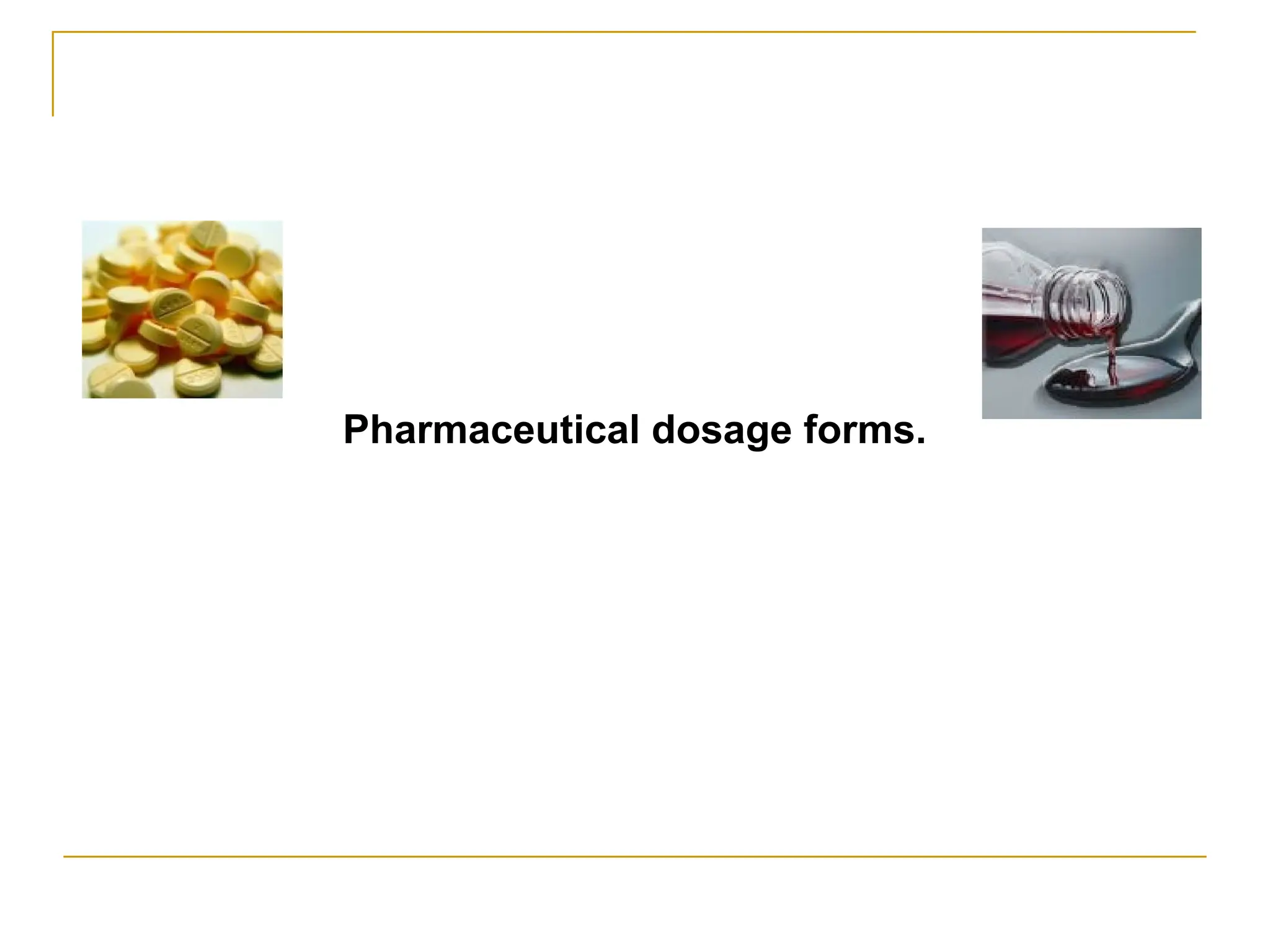
Pharmaceutical dosage forms.
Drug formulation
Dosage forms or
pharmaceutical preparation
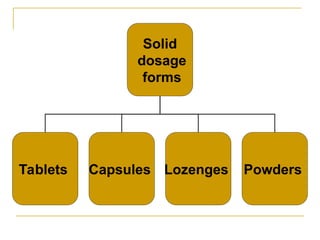
Solid
dosage
forms
Tablets Capsules Lozenges Powders
Why to use different formulation?
 The physical nature of the drug
 Drug size
 Drug solubility
 Drug taste
 Drug absorption, first pass effect
 Drug side effects
 Drug half life
 Site of disease or infection
 Patient compliance
I-Solid dosage forms
 Capsules, sustained-release capsules, tablets,
pills, are used to divide a drug or mixture of
drugs into definite doses and avoid the
inconvenience of preparing the dose from dry
powders.
 Tablets are a convenient way of giving drugs
that have an unpleasant taste
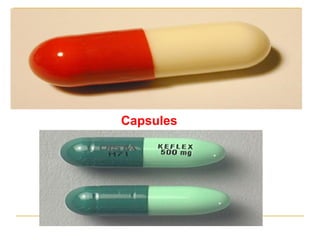
Capsules
 the most popular dosage forms for the oral
administration of powders, oils, and liquids.
 They dissolve readily in the stomach and make the
contents available for absorption only slightly less quickly
than a liquid medicament
 Are usually made of gelatin and may be hard or soft
- Hard gelatin capsule : contains powder
- Soft gelatin capsule : contains Liquids
Gelatin capsules may be coated with a substance that
resists the action of gastric juice and so will not
disintegrate until they reach the alkaline secretions of the
intestine. Such capsules are said to be ‘enteric coated’
Tablets
 Tablets are preparations of powdered drug that are
compressed or molded into small disks.
 They may be made with or without a diluent
(dextrose, lactose, starch),
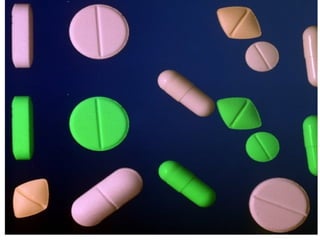
 And they may differ greatly in size, weight, and shape.
 Compressed tablets are made with heavy machinery.
Tablets
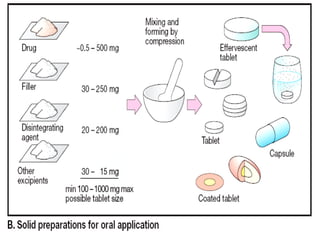
 Compressed tablets usually contain in addition to the
drug:
 Diluents, are used when the amount of active
ingredient is small
 A binder are substances that give adhesiveness to
the powdered drug.
 A disintegrator , such a starch, helps the tablet to
dissolve readily when it is placed in water, because
the starch expands when it gets wet
 and a lubricant keep the tablet from sticking to the
machines
Tablets
 Tablets are sometimes scored (marked with an
indented line across the surface) so-that they can be
broken easily if half a tablet is the dose required.
 Tablets may be coated with sugar or chocolate to
enhance their palatability.
 They may be covered with a colored coating to make
them more attractive to patients, easier to swallow,
or identifiable by the use of distinctive colors.
 Both tablets and capsules may be enteric coated,
 to protect the drug from the effect of the gastric secretions
 to prevent drug irritation of the gastric mucosa
Tablets
 Normal tablets
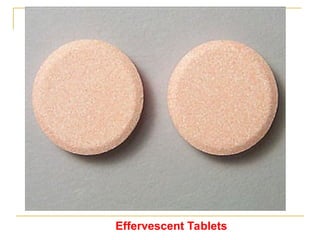
 Effervescent tablets
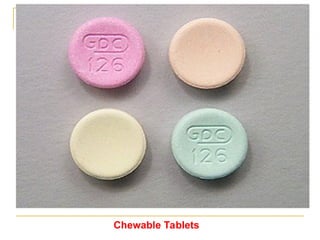
 Chewable tablets
 Delayed release tablets
 Film coated tablets
 Sugar coated tablets
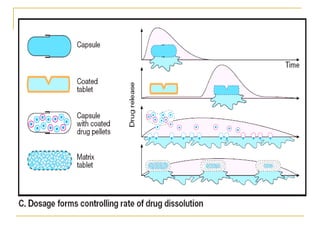
Sustained-release dosage forms
 Dosage forms providing for gradual but continued
release of drug .
 Sustained-release dosage forms contain small
particles of the drug coated with materials that require
a varying amount of time to dissolve.. This provides for
a long continuous period of absorption and effect.
Some particles dissolve and-are absorbed almost
immediately, others require 2 or 3 hours
Lozenges
 Troches or lozenges are flat, round, or rectangular preparations
that are held in the mouth until they dissolve, liberating the drug
or drugs involved.
 They usually contain water, sugar, and a mucilage in addition
to the drug and are dried in hot air.
 They temporarily produce a high concentration of the drug in
the oral cavity.
 They are held in the mouth until entirely dissolved.
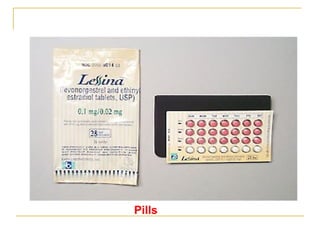
Pills
 Pills are mixtures of a drug or drugs with some
cohesive materials.
 The mass is molded into globular, oval, or
flattened bodies convenient for swallowing.
 They have been replaced to a great extent by
capsules and tablets.
Powders
 Powders are finely divided solid drugs or
mixtures of drugs for internal or external use.
 Dusting powders
 Granules
 Sachets
Chewable Tablets
Effervescent Tablets
Capsules
Pills
II-Liquid dosage forms
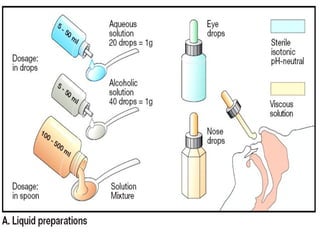
 Solutions
 Aqueous solutions have one or more substances dissolved in
water. Examples are strong iodine solution (Lugol's Solution),
epinephrine nasal solution
 Syrups
 For their demulcent(soothing) effect on irritated membranes
of the throat e.g. Promethazine hydrochloride syrup
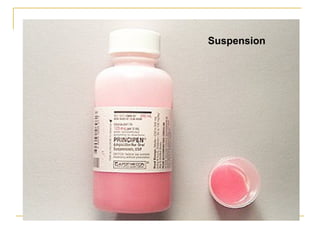
 Suspensions
 are defined as preparations of finely divided drugs either
intended for suspension or already in suspension in some
suitable liquid vehicle
Liquid dosage forms
 Emulsions
 are suspensions of fats or oils in water with the aid of an,
emulsifying agent, which lowers the interfacial tension between
the two susbtances, masking its oily feel.
 These oils are more easily digested than undispersed oils.
Emulsions are stabilized by agents such as acacia and gelatin,
which coat the tiny droplets of oil and prevent them from
coming in direct contact with water.
 An example is cod liver oil emulsion
 Elixirs
 are aromatic, sweetened, alcoholic preparations,
frequently used as flavored vehicles, such as
aromatic elixir, or as active medicinal agents if they
are medicated elixirs, such as phenobarbital elixir.
Liquid dosage forms
Liquid dosage forms
Liquid forms are composed of:
 Active ingredients
 Solvents
 Sweetening agents
 Flavorings and coloring agents
 Stabilizers
 Preservatives and antioxidants
Liquid dosage forms
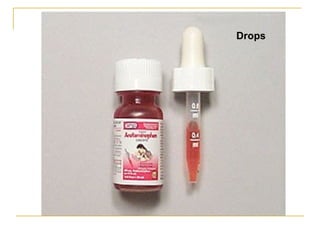
 -Drops
eye (ophthalmic ) – ear (otic) – nose
(Nasal) – oral (commonly for infants)
 - Paints
 Lotions
 -Tinctures
• -Sprays
- nasal – oral - local
Liquid dosage forms
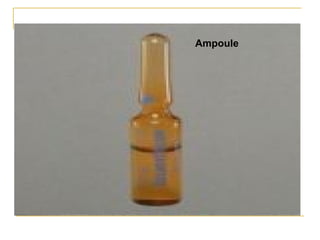
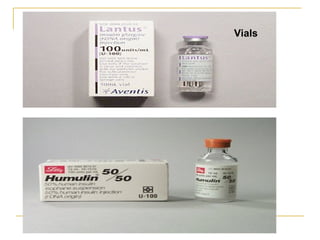
 -Ampoules and the like
1-Ampoules ( Single Dose).
2- vials ( multi -dose containers with rubber
capped stopper ).
3- Bottles.
4- Disposable syringes.
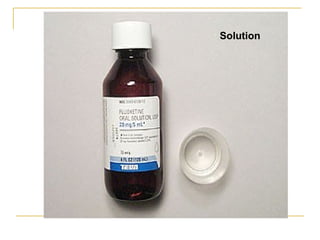
Solution
Suspension
Ampoule
Vials
Drops
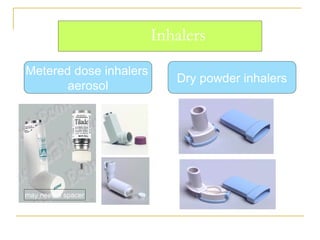
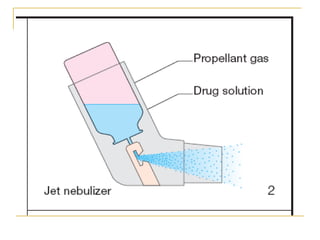
Inhalers
Metered dose inhalers
aerosol
Dry powder inhalers
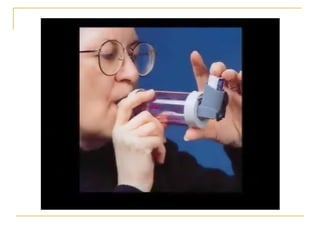
may need a spacer
INHALATION (make notes)
Advantages Disadvantages
III-Semi-solid dosage forms
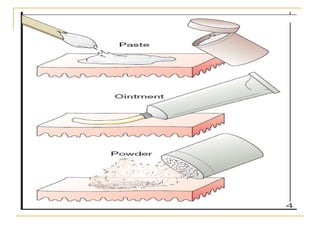
 1- Ointments and the like
- Ointments
- Creams
- Gels
- Pasts
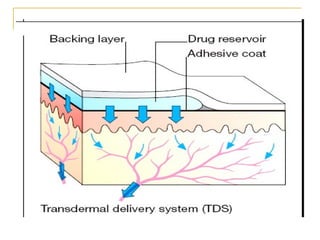
 2- Transdermal therapeutic system
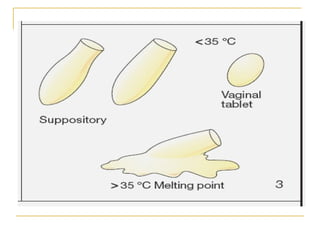
 3- Suppositories and the like
- Rectal supp.
- Vaginal inserts ( tablets – ovules – supp. pessary )
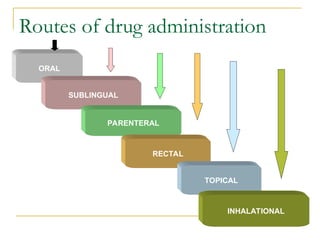
Routes of drug administration
ORAL
SUBLINGUAL
PARENTERAL
RECTAL
TOPICAL
INHALATIONAL
Get the advantages & disadvantages
of each route of administration.
Advantages Disadvantages
END

formulation.ppt 2hq42lbds562kvfbddildjui

  • 1.
  • 2.
    Drug formulation Dosage formsor pharmaceutical preparation
  • 3.
  • 4.
    Why to usedifferent formulation?  The physical nature of the drug  Drug size  Drug solubility  Drug taste  Drug absorption, first pass effect  Drug side effects  Drug half life  Site of disease or infection  Patient compliance
  • 5.
    I-Solid dosage forms Capsules, sustained-release capsules, tablets, pills, are used to divide a drug or mixture of drugs into definite doses and avoid the inconvenience of preparing the dose from dry powders.  Tablets are a convenient way of giving drugs that have an unpleasant taste
  • 6.
    Capsules  the mostpopular dosage forms for the oral administration of powders, oils, and liquids.  They dissolve readily in the stomach and make the contents available for absorption only slightly less quickly than a liquid medicament  Are usually made of gelatin and may be hard or soft - Hard gelatin capsule : contains powder - Soft gelatin capsule : contains Liquids Gelatin capsules may be coated with a substance that resists the action of gastric juice and so will not disintegrate until they reach the alkaline secretions of the intestine. Such capsules are said to be ‘enteric coated’
  • 7.
    Tablets  Tablets arepreparations of powdered drug that are compressed or molded into small disks.  They may be made with or without a diluent (dextrose, lactose, starch),  And they may differ greatly in size, weight, and shape.  Compressed tablets are made with heavy machinery.
  • 8.
    Tablets  Compressed tabletsusually contain in addition to the drug:  Diluents, are used when the amount of active ingredient is small  A binder are substances that give adhesiveness to the powdered drug.  A disintegrator , such a starch, helps the tablet to dissolve readily when it is placed in water, because the starch expands when it gets wet  and a lubricant keep the tablet from sticking to the machines
  • 9.
    Tablets  Tablets aresometimes scored (marked with an indented line across the surface) so-that they can be broken easily if half a tablet is the dose required.  Tablets may be coated with sugar or chocolate to enhance their palatability.  They may be covered with a colored coating to make them more attractive to patients, easier to swallow, or identifiable by the use of distinctive colors.  Both tablets and capsules may be enteric coated,  to protect the drug from the effect of the gastric secretions  to prevent drug irritation of the gastric mucosa
  • 10.
    Tablets  Normal tablets Effervescent tablets  Chewable tablets  Delayed release tablets  Film coated tablets  Sugar coated tablets
  • 11.
    Sustained-release dosage forms Dosage forms providing for gradual but continued release of drug .  Sustained-release dosage forms contain small particles of the drug coated with materials that require a varying amount of time to dissolve.. This provides for a long continuous period of absorption and effect. Some particles dissolve and-are absorbed almost immediately, others require 2 or 3 hours
  • 12.
    Lozenges  Troches orlozenges are flat, round, or rectangular preparations that are held in the mouth until they dissolve, liberating the drug or drugs involved.  They usually contain water, sugar, and a mucilage in addition to the drug and are dried in hot air.  They temporarily produce a high concentration of the drug in the oral cavity.  They are held in the mouth until entirely dissolved.
  • 13.
    Pills  Pills aremixtures of a drug or drugs with some cohesive materials.  The mass is molded into globular, oval, or flattened bodies convenient for swallowing.  They have been replaced to a great extent by capsules and tablets.
  • 14.
    Powders  Powders arefinely divided solid drugs or mixtures of drugs for internal or external use.  Dusting powders  Granules  Sachets
  • 16.
  • 17.
  • 18.
  • 19.
  • 22.
    II-Liquid dosage forms Solutions  Aqueous solutions have one or more substances dissolved in water. Examples are strong iodine solution (Lugol's Solution), epinephrine nasal solution  Syrups  For their demulcent(soothing) effect on irritated membranes of the throat e.g. Promethazine hydrochloride syrup  Suspensions  are defined as preparations of finely divided drugs either intended for suspension or already in suspension in some suitable liquid vehicle
  • 23.
    Liquid dosage forms Emulsions  are suspensions of fats or oils in water with the aid of an, emulsifying agent, which lowers the interfacial tension between the two susbtances, masking its oily feel.  These oils are more easily digested than undispersed oils. Emulsions are stabilized by agents such as acacia and gelatin, which coat the tiny droplets of oil and prevent them from coming in direct contact with water.  An example is cod liver oil emulsion
  • 24.
     Elixirs  arearomatic, sweetened, alcoholic preparations, frequently used as flavored vehicles, such as aromatic elixir, or as active medicinal agents if they are medicated elixirs, such as phenobarbital elixir. Liquid dosage forms
  • 25.
    Liquid dosage forms Liquidforms are composed of:  Active ingredients  Solvents  Sweetening agents  Flavorings and coloring agents  Stabilizers  Preservatives and antioxidants
  • 26.
    Liquid dosage forms -Drops eye (ophthalmic ) – ear (otic) – nose (Nasal) – oral (commonly for infants)  - Paints  Lotions  -Tinctures • -Sprays - nasal – oral - local
  • 27.
    Liquid dosage forms -Ampoules and the like 1-Ampoules ( Single Dose). 2- vials ( multi -dose containers with rubber capped stopper ). 3- Bottles. 4- Disposable syringes.
  • 28.
  • 29.
  • 30.
  • 31.
  • 32.
  • 33.
    Inhalers Metered dose inhalers aerosol Drypowder inhalers may need a spacer
  • 36.
  • 38.
    III-Semi-solid dosage forms 1- Ointments and the like - Ointments - Creams - Gels - Pasts  2- Transdermal therapeutic system  3- Suppositories and the like - Rectal supp. - Vaginal inserts ( tablets – ovules – supp. pessary )
  • 42.
    Routes of drugadministration ORAL SUBLINGUAL PARENTERAL RECTAL TOPICAL INHALATIONAL
  • 43.
    Get the advantages& disadvantages of each route of administration. Advantages Disadvantages
  • 44.