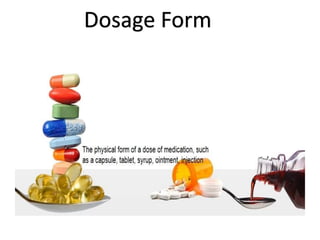
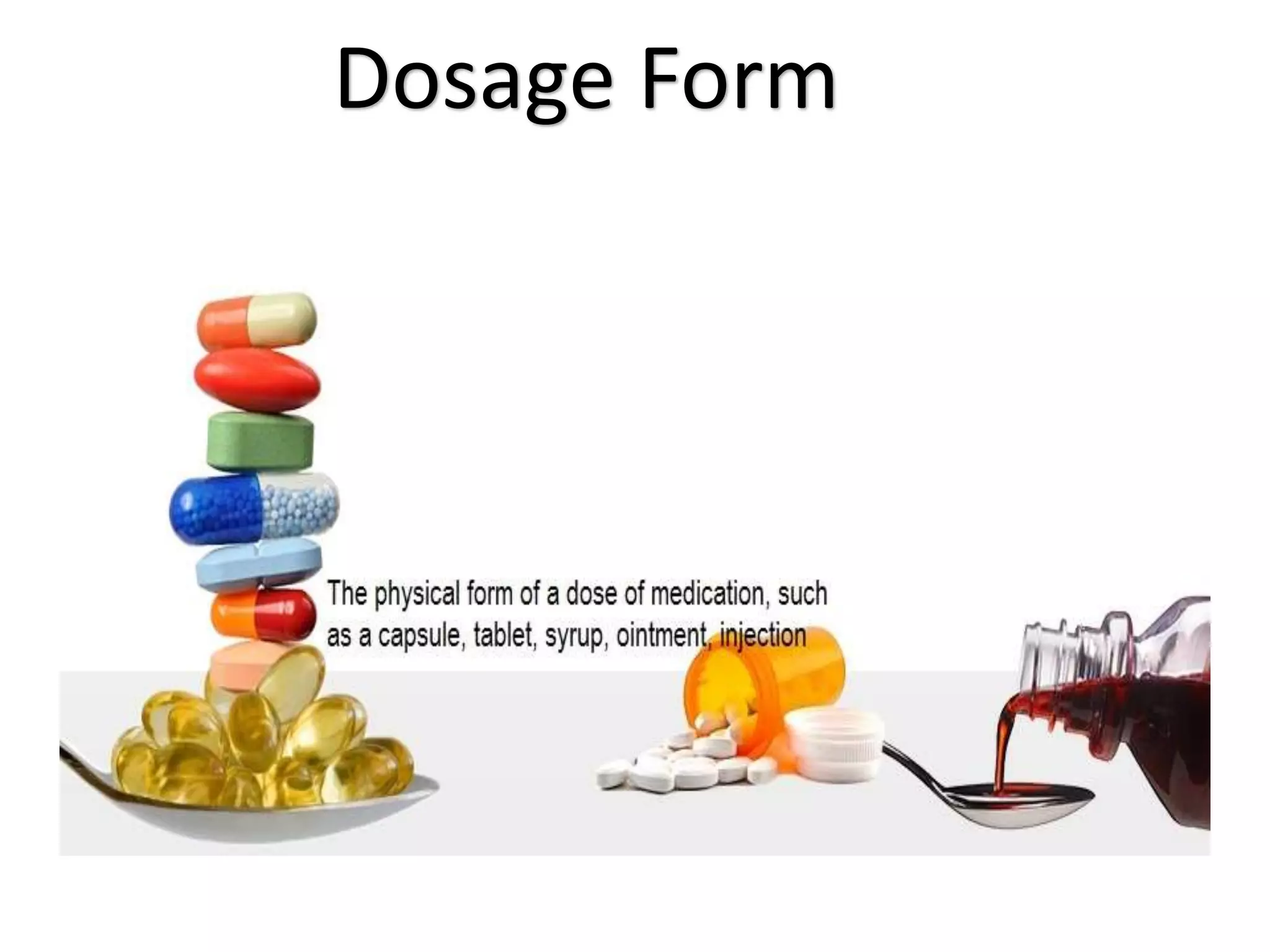
Dosage Form
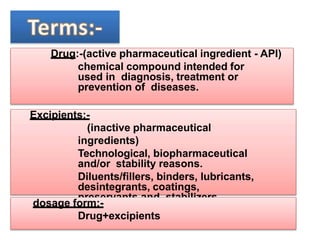
Drug:-(active pharmaceutical ingredient - API)
chemical compound intended for
used in diagnosis, treatment or
prevention of diseases.
Excipients:-
(inactive pharmaceutical
ingredients)
Technological, biopharmaceutical
and/or stability reasons.
Diluents/fillers, binders, lubricants,
desintegrants, coatings,
preservants and stabilizers,
colorants and flavourings
dosage form:-
Drug+excipients
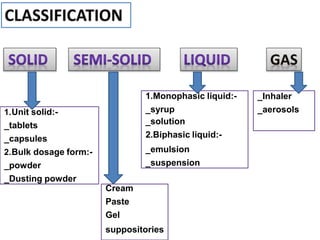
1.Unit solid:-
_tablets
_capsules
2.Bulk dosage form:-
_powder
_Dusting powder
1.Monophasic liquid:-
_syrup
_solution
2.Biphasic liquid:-
_emulsion
_suspension
_Inhaler
_aerosols
Cream
Paste
Gel
suppositories
4
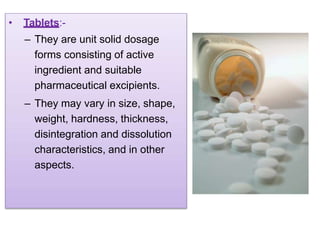
• Tablets:-
– They are unit solid dosage
forms consisting of active
ingredient and suitable
pharmaceutical excipients.
– They may vary in size, shape,
weight, hardness, thickness,
disintegration and dissolution
characteristics, and in other
aspects.
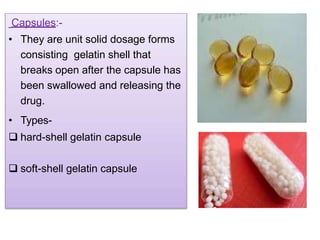
Capsules:-
• They are unit solid dosage forms
consisting gelatin shell that
breaks open after the capsule has
been swallowed and releasing the
drug.
• Types-
 hard-shell gelatin capsule
 soft-shell gelatin capsule
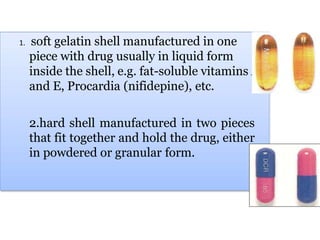
1. soft gelatin shell manufactured in one
piece with drug usually in liquid form
inside the shell, e.g. fat-soluble vitamins A
and E, Procardia (nifidepine), etc.
2.hard shell manufactured in two pieces
that fit together and hold the drug, either
in powdered or granular form.
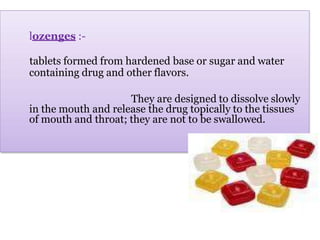
lozenges :-
tablets formed from hardened base or sugar and water
containing drug and other flavors.
They are designed to dissolve slowly
in the mouth and release the drug topically to the tissues
of mouth and throat; they are not to be swallowed.
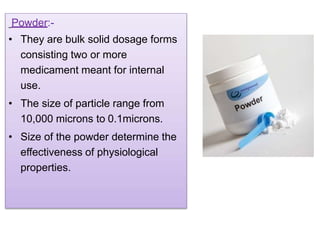
Powder:-
• They are bulk solid dosage forms
consisting two or more
medicament meant for internal
use.
• The size of particle range from
10,000 microns to 0.1microns.
• Size of the powder determine the
effectiveness of physiological
properties.
10
• Semisolids contain both liquids and solids semi-solid.
• dosage forms that are too soft in structure to qualify for
solids but too thick to be considered liquid.
• They are meant for topical application.
Creams: -
Creams are semi-solid emulsions, that is mixtures of oil
and water.
They are divided into two types-
1.O/W TYPE
2.W/O TYPE
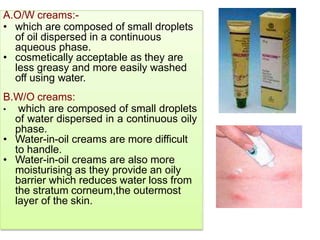
A.O/W creams:-
• which are composed of small droplets
of oil dispersed in a continuous
aqueous phase.
• cosmetically acceptable as they are
less greasy and more easily washed
off using water.
B.W/O creams:
• which are composed of small droplets
of water dispersed in a continuous oily
phase.
• Water-in-oil creams are more difficult
to handle.
• Water-in-oil creams are also more
moisturising as they provide an oily
barrier which reduces water loss from
the stratum corneum,the outermost
layer of the skin.
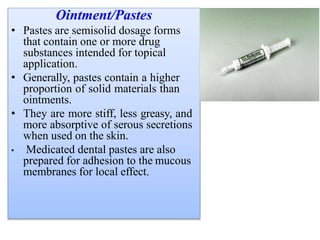
Ointment/Pastes
• Pastes are semisolid dosage forms
that contain one or more drug
substances intended for topical
application.
• Generally, pastes contain a higher
proportion of solid materials than
ointments.
• They are more stiff, less greasy, and
more absorptive of serous secretions
when used on the skin.
• Medicated dental pastes are also
prepared for adhesion to the mucous
membranes for local effect.
Elixirs:-
solutions that contain an alcohol and water base, added sugar and
flavorings, e.g. Tylenol; commonly used for pediatric and elderly
patients who have difficulty swallowing tablets or capsules.
Syrups:-
do not contain alcohol and are concentrated solutions of sugar,
water, and flavorings. They are sweeter and more viscous than elixirs.
Most OTC cough medications are syrup based and don’t only carry
the drug but also act to soothe the inflamed mucous membranes of
the throat.
Solutions:-
one homogenous phase, prepared by dissolving one or more
solutes in a solvent.
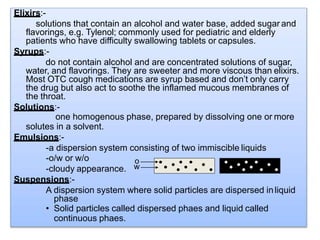
Emulsions:-
-a dispersion system consisting of two immiscible liquids
-o/w or w/o
-cloudy appearance.
Suspensions:-
A dispersion system where solid particles are dispersed inliquid
phase
• Solid particles called dispersed phaes and liquid called
continuous phaes.
o
w
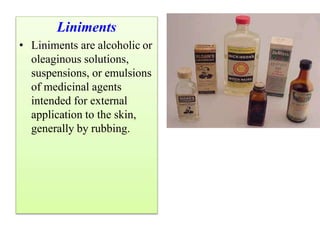
Liniments
• Liniments are alcoholic or
oleaginous solutions,
suspensions, or emulsions
of medicinal agents
intended for external
application to the skin,
generally by rubbing.
17
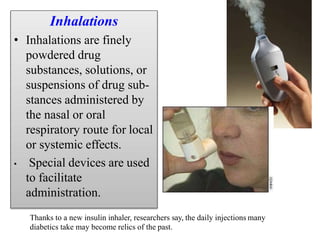
Inhalations
• Inhalations are finely
powdered drug
substances, solutions, or
suspensions of drug sub-
stances administered by
the nasal or oral
respiratory route for local
or systemic effects.
• Special devices are used
to facilitate
administration.
Thanks to a new insulin inhaler, researchers say, the daily injections many
diabetics take may become relics of the past.
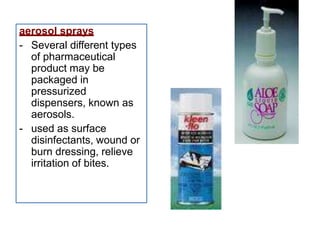
aerosol sprays
- Several different types
of pharmaceutical
product may be
packaged in
pressurized
dispensers, known as
aerosols.
- used as surface
disinfectants, wound or
burn dressing, relieve
irritation of bites.
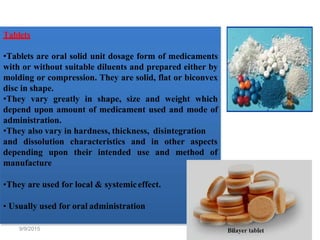
Tablets
•Tablets are oral solid unit dosage form of medicaments
with or without suitable diluents and prepared either by
molding or compression. They are solid, flat or biconvex
disc in shape.
•They vary greatly in shape, size and weight which
depend upon amount of medicament used and mode of
administration.
•They also vary in hardness, thickness, disintegration
and dissolution
depending upon
characteristics
their intended
and in other aspects
use and method of
manufacture
•They are used for local & systemiceffect.
• Usually used for oral administration
9/9/2015 21
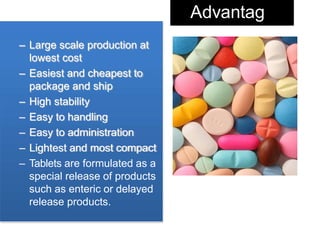
Advantag
es
– Large scale production at
lowest cost
– Easiest and cheapest to
package and ship
– High stability
– Easy to handling
– Easy to administration
– Lightest and most compact
– Tablets are formulated as a
special release of products
such as enteric or delayed
release products.
Disadvantages
• It’s not suitable for poorly
water-soluble or poorly
absorbable drugs, less
bioavailability.
• Drugs that are sensitive to
oxygen or may also require
special coating.
• Enhances local irritant effect
of some drugs or cause harm
to the gastrointestinal mucosa
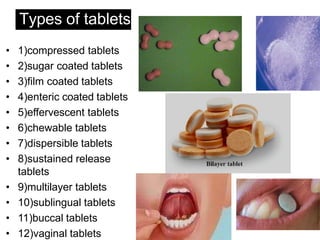
Types of tablets
• 1)compressed tablets
• 2)sugar coated tablets
• 3)film coated tablets
• 4)enteric coated tablets
• 5)effervescent tablets
• 6)chewable tablets
• 7)dispersible tablets
• 8)sustained release
tablets
• 9)multilayer tablets
• 10)sublingual tablets
• 11)buccal tablets
• 12)vaginal tablets
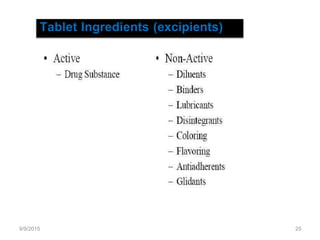
Tablet Ingredients (excipients)
9/9/2015 25
9/9/2015 26
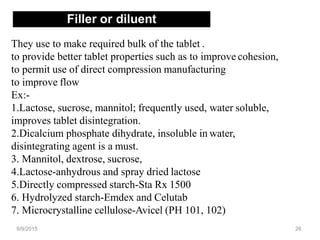
They use to make required bulk of the tablet .
to provide better tablet properties such as to improve cohesion,
to permit use of direct compression manufacturing
to improve flow
Ex:-
1.Lactose, sucrose, mannitol; frequently used, water soluble,
improves tablet disintegration.
2.Dicalcium phosphate dihydrate, insoluble in water,
disintegrating agent is a must.
3. Mannitol, dextrose, sucrose,
4.Lactose-anhydrous and spray dried lactose
5.Directly compressed starch-Sta Rx 1500
6. Hydrolyzed starch-Emdex and Celutab
7. Microcrystalline cellulose-Avicel (PH 101, 102)
Filler or diluent
9/9/2015 27
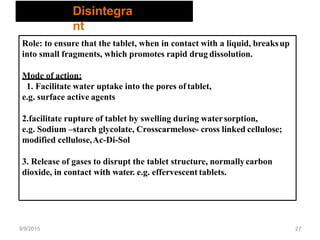
Role: to ensure that the tablet, when in contact with a liquid, breaksup
into small fragments, which promotes rapid drug dissolution.
Mode of action:
1. Facilitate water uptake into the pores of tablet,
e.g. surface active agents
2.facilitate rupture of tablet by swelling during watersorption,
e.g. Sodium –starch glycolate, Crosscarmelose- cross linked cellulose;
modified cellulose,Ac-Di-Sol
3. Release of gases to disrupt the tablet structure, normallycarbon
dioxide, in contact with water. e.g. effervescent tablets.
Disintegra
nt
9/9/2015 28
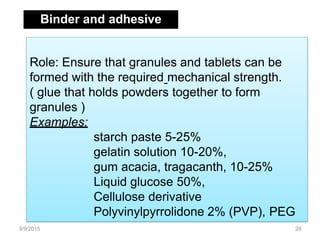
Role: Ensure that granules and tablets can be
formed with the required mechanical strength.
( glue that holds powders together to form
granules )
Examples:
starch paste 5-25%
gelatin solution 10-20%,
gum acacia, tragacanth, 10-25%
Liquid glucose 50%,
Cellulose derivative
Polyvinylpyrrolidone 2% (PVP), PEG
Binder and adhesive
9/9/2015 29
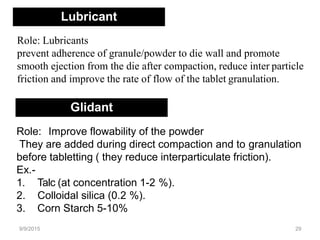
Role: Lubricants
prevent adherence of granule/powder to die wall and promote
smooth ejection from the die after compaction, reduce inter particle
friction and improve the rate of flow of the tablet granulation.
Lubricant
Glidant
Role: Improve flowability of the powder
They are added during direct compaction and to granulation
before tabletting ( they reduce interparticulate friction).
Ex.-
1. Talc (at concentration 1-2 %).
2. Colloidal silica (0.2 %).
3. Corn Starch 5-10%
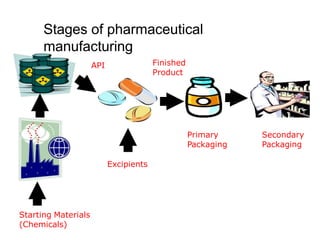
Stages of pharmaceutical
manufacturing
API
Excipients
Primary
Packaging
Secondary
Packaging
API Finished
Product
Starting Materials
(Chemicals)
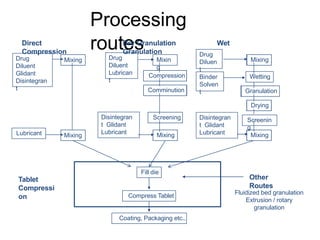
Processing
routes
Fill die
Coating, Packaging etc..
Compress Tablet
Direct
Compression
Drug
Diluent
Glidant
Disintegran
t
Lubricant Mixing
Mixing
Dry Granulation Wet
Granulation
Disintegran
t Glidant
Lubricant
Drug
Diluent
Lubrican
t
Mixin
g
Compression
Comminution
Screening
Mixing
Mixing
Wetting
Granulation
Drying
Screenin
g
Mixing
Drug
Diluen
t
Binder
Solven
t
Disintegran
t Glidant
Lubricant
Other
Routes
Fluidized bed granulation
Extrusion / rotary
granulation
Tablet
Compressi
on
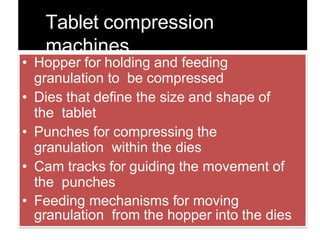
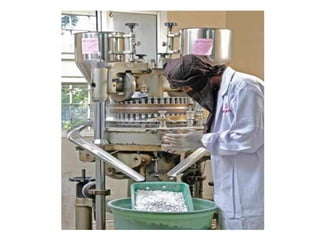
Tablet compression
machines
• Hopper for holding and feeding
granulation to be compressed
• Dies that define the size and shape of
the tablet
• Punches for compressing the
granulation within the dies
• Cam tracks for guiding the movement of
the punches
• Feeding mechanisms for moving
granulation from the hopper into the dies
Single punch machine
Multiple punch machine
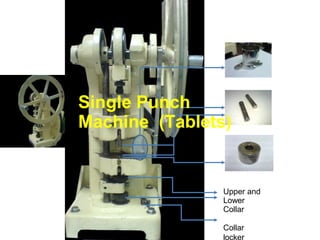
Upper and
Lower
Collar
Collar
locker
Single Punch
Machine (Tablets)
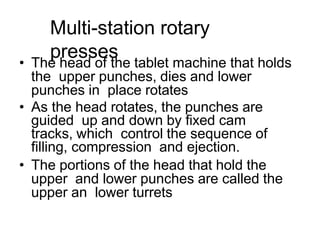
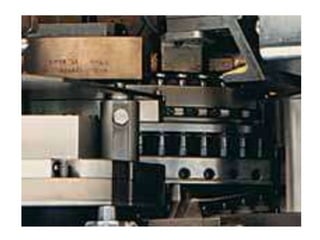
Multi-station rotary
presses
• The head of the tablet machine that holds
the upper punches, dies and lower
punches in place rotates
• As the head rotates, the punches are
guided up and down by fixed cam
tracks, which control the sequence of
filling, compression and ejection.
• The portions of the head that hold the
upper and lower punches are called the
upper an lower turrets
The way to get started is to quit
talking & being doing.. – Walt
Disney.

dosage form

  • 1.
  • 2.
    Drug:-(active pharmaceutical ingredient- API) chemical compound intended for used in diagnosis, treatment or prevention of diseases. Excipients:- (inactive pharmaceutical ingredients) Technological, biopharmaceutical and/or stability reasons. Diluents/fillers, binders, lubricants, desintegrants, coatings, preservants and stabilizers, colorants and flavourings dosage form:- Drug+excipients
  • 3.
    1.Unit solid:- _tablets _capsules 2.Bulk dosageform:- _powder _Dusting powder 1.Monophasic liquid:- _syrup _solution 2.Biphasic liquid:- _emulsion _suspension _Inhaler _aerosols Cream Paste Gel suppositories
  • 4.
  • 5.
    • Tablets:- – Theyare unit solid dosage forms consisting of active ingredient and suitable pharmaceutical excipients. – They may vary in size, shape, weight, hardness, thickness, disintegration and dissolution characteristics, and in other aspects.
  • 6.
    Capsules:- • They areunit solid dosage forms consisting gelatin shell that breaks open after the capsule has been swallowed and releasing the drug. • Types-  hard-shell gelatin capsule  soft-shell gelatin capsule
  • 7.
    1. soft gelatinshell manufactured in one piece with drug usually in liquid form inside the shell, e.g. fat-soluble vitamins A and E, Procardia (nifidepine), etc. 2.hard shell manufactured in two pieces that fit together and hold the drug, either in powdered or granular form.
  • 8.
    lozenges :- tablets formedfrom hardened base or sugar and water containing drug and other flavors. They are designed to dissolve slowly in the mouth and release the drug topically to the tissues of mouth and throat; they are not to be swallowed.
  • 9.
    Powder:- • They arebulk solid dosage forms consisting two or more medicament meant for internal use. • The size of particle range from 10,000 microns to 0.1microns. • Size of the powder determine the effectiveness of physiological properties.
  • 10.
  • 11.
    • Semisolids containboth liquids and solids semi-solid. • dosage forms that are too soft in structure to qualify for solids but too thick to be considered liquid. • They are meant for topical application. Creams: - Creams are semi-solid emulsions, that is mixtures of oil and water. They are divided into two types- 1.O/W TYPE 2.W/O TYPE
  • 12.
    A.O/W creams:- • whichare composed of small droplets of oil dispersed in a continuous aqueous phase. • cosmetically acceptable as they are less greasy and more easily washed off using water. B.W/O creams: • which are composed of small droplets of water dispersed in a continuous oily phase. • Water-in-oil creams are more difficult to handle. • Water-in-oil creams are also more moisturising as they provide an oily barrier which reduces water loss from the stratum corneum,the outermost layer of the skin.
  • 13.
    Ointment/Pastes • Pastes aresemisolid dosage forms that contain one or more drug substances intended for topical application. • Generally, pastes contain a higher proportion of solid materials than ointments. • They are more stiff, less greasy, and more absorptive of serous secretions when used on the skin. • Medicated dental pastes are also prepared for adhesion to the mucous membranes for local effect.
  • 15.
    Elixirs:- solutions that containan alcohol and water base, added sugar and flavorings, e.g. Tylenol; commonly used for pediatric and elderly patients who have difficulty swallowing tablets or capsules. Syrups:- do not contain alcohol and are concentrated solutions of sugar, water, and flavorings. They are sweeter and more viscous than elixirs. Most OTC cough medications are syrup based and don’t only carry the drug but also act to soothe the inflamed mucous membranes of the throat. Solutions:- one homogenous phase, prepared by dissolving one or more solutes in a solvent. Emulsions:- -a dispersion system consisting of two immiscible liquids -o/w or w/o -cloudy appearance. Suspensions:- A dispersion system where solid particles are dispersed inliquid phase • Solid particles called dispersed phaes and liquid called continuous phaes. o w
  • 16.
    Liniments • Liniments arealcoholic or oleaginous solutions, suspensions, or emulsions of medicinal agents intended for external application to the skin, generally by rubbing.
  • 17.
  • 18.
    Inhalations • Inhalations arefinely powdered drug substances, solutions, or suspensions of drug sub- stances administered by the nasal or oral respiratory route for local or systemic effects. • Special devices are used to facilitate administration. Thanks to a new insulin inhaler, researchers say, the daily injections many diabetics take may become relics of the past.
  • 19.
    aerosol sprays - Severaldifferent types of pharmaceutical product may be packaged in pressurized dispensers, known as aerosols. - used as surface disinfectants, wound or burn dressing, relieve irritation of bites.
  • 21.
    Tablets •Tablets are oralsolid unit dosage form of medicaments with or without suitable diluents and prepared either by molding or compression. They are solid, flat or biconvex disc in shape. •They vary greatly in shape, size and weight which depend upon amount of medicament used and mode of administration. •They also vary in hardness, thickness, disintegration and dissolution depending upon characteristics their intended and in other aspects use and method of manufacture •They are used for local & systemiceffect. • Usually used for oral administration 9/9/2015 21
  • 22.
    Advantag es – Large scaleproduction at lowest cost – Easiest and cheapest to package and ship – High stability – Easy to handling – Easy to administration – Lightest and most compact – Tablets are formulated as a special release of products such as enteric or delayed release products.
  • 23.
    Disadvantages • It’s notsuitable for poorly water-soluble or poorly absorbable drugs, less bioavailability. • Drugs that are sensitive to oxygen or may also require special coating. • Enhances local irritant effect of some drugs or cause harm to the gastrointestinal mucosa
  • 24.
    Types of tablets •1)compressed tablets • 2)sugar coated tablets • 3)film coated tablets • 4)enteric coated tablets • 5)effervescent tablets • 6)chewable tablets • 7)dispersible tablets • 8)sustained release tablets • 9)multilayer tablets • 10)sublingual tablets • 11)buccal tablets • 12)vaginal tablets
  • 25.
  • 26.
    9/9/2015 26 They useto make required bulk of the tablet . to provide better tablet properties such as to improve cohesion, to permit use of direct compression manufacturing to improve flow Ex:- 1.Lactose, sucrose, mannitol; frequently used, water soluble, improves tablet disintegration. 2.Dicalcium phosphate dihydrate, insoluble in water, disintegrating agent is a must. 3. Mannitol, dextrose, sucrose, 4.Lactose-anhydrous and spray dried lactose 5.Directly compressed starch-Sta Rx 1500 6. Hydrolyzed starch-Emdex and Celutab 7. Microcrystalline cellulose-Avicel (PH 101, 102) Filler or diluent
  • 27.
    9/9/2015 27 Role: toensure that the tablet, when in contact with a liquid, breaksup into small fragments, which promotes rapid drug dissolution. Mode of action: 1. Facilitate water uptake into the pores of tablet, e.g. surface active agents 2.facilitate rupture of tablet by swelling during watersorption, e.g. Sodium –starch glycolate, Crosscarmelose- cross linked cellulose; modified cellulose,Ac-Di-Sol 3. Release of gases to disrupt the tablet structure, normallycarbon dioxide, in contact with water. e.g. effervescent tablets. Disintegra nt
  • 28.
    9/9/2015 28 Role: Ensurethat granules and tablets can be formed with the required mechanical strength. ( glue that holds powders together to form granules ) Examples: starch paste 5-25% gelatin solution 10-20%, gum acacia, tragacanth, 10-25% Liquid glucose 50%, Cellulose derivative Polyvinylpyrrolidone 2% (PVP), PEG Binder and adhesive
  • 29.
    9/9/2015 29 Role: Lubricants preventadherence of granule/powder to die wall and promote smooth ejection from the die after compaction, reduce inter particle friction and improve the rate of flow of the tablet granulation. Lubricant Glidant Role: Improve flowability of the powder They are added during direct compaction and to granulation before tabletting ( they reduce interparticulate friction). Ex.- 1. Talc (at concentration 1-2 %). 2. Colloidal silica (0.2 %). 3. Corn Starch 5-10%
  • 31.
  • 32.
    Processing routes Fill die Coating, Packagingetc.. Compress Tablet Direct Compression Drug Diluent Glidant Disintegran t Lubricant Mixing Mixing Dry Granulation Wet Granulation Disintegran t Glidant Lubricant Drug Diluent Lubrican t Mixin g Compression Comminution Screening Mixing Mixing Wetting Granulation Drying Screenin g Mixing Drug Diluen t Binder Solven t Disintegran t Glidant Lubricant Other Routes Fluidized bed granulation Extrusion / rotary granulation Tablet Compressi on
  • 33.
    Tablet compression machines • Hopperfor holding and feeding granulation to be compressed • Dies that define the size and shape of the tablet • Punches for compressing the granulation within the dies • Cam tracks for guiding the movement of the punches • Feeding mechanisms for moving granulation from the hopper into the dies
  • 34.
  • 35.
  • 36.
    Multi-station rotary presses • Thehead of the tablet machine that holds the upper punches, dies and lower punches in place rotates • As the head rotates, the punches are guided up and down by fixed cam tracks, which control the sequence of filling, compression and ejection. • The portions of the head that hold the upper and lower punches are called the upper an lower turrets
  • 39.
    The way toget started is to quit talking & being doing.. – Walt Disney.