


Course Title: Application of Information Technology In
Agriculture
Course No.-AEX 302
SLIDE PRESENTATION
ON
SOLAR WATER PUMP
ANURAG BERA
ROLL NO - 01
SUBHA CHAKRABORTY
ROLL NO - 03
SAPTAPARNEE DEY
ROLL NO - 04
SANDIP KR. SARKAR
ROLL NO - 05
SURANJANA BISWAS
ROLL NO - 06
GROUP MEMBERS
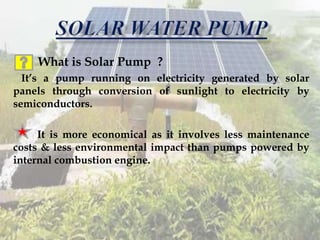
What is Solar Pump ?
It’s a pump running on electricity generated by solar
panels through conversion of sunlight to electricity by
semiconductors.
It is more economical as it involves less maintenance
costs & less environmental impact than pumps powered by
internal combustion engine.
The electricity consumption in agriculture sector
amounts to 27% of total consumption of electricity in
India. About 25% of electricity consumption account
for Irrigation pumps used in the agriculture sector in
India.
Around 21 million irrigation pump sets in India, of
which 9 million are run on diesel and rest are grid
based.
 Unavailability of electricity in remote areas.
 Limited reservoir of fossil fuel.
 Easy to transfer & relocate.
 Increased output with the times of need.
 Low operational cost.
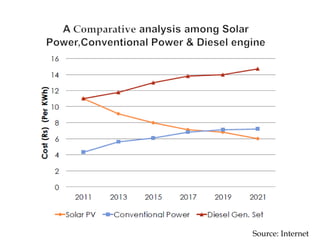
Source: Internet
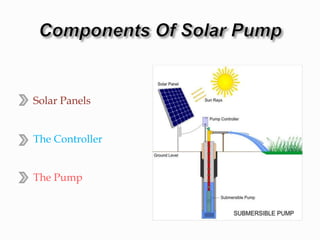
Solar Panels
The Controller
The Pump
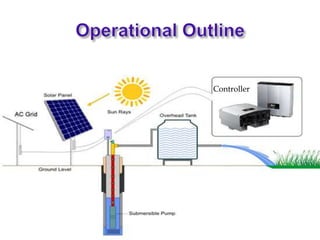
Controller
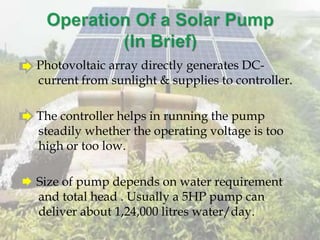
Photovoltaic array directly generates DC-
current from sunlight & supplies to controller.
The controller helps in running the pump
steadily whether the operating voltage is too
high or too low.
Size of pump depends on water requirement
and total head . Usually a 5HP pump can
deliver about 1,24,000 litres water/day.
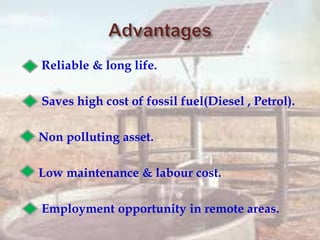
 Reliable & long life.
 Saves high cost of fossil fuel(Diesel , Petrol).
 Non polluting asset.
 Low maintenance & labour cost.
 Employment opportunity in remote areas.
A cumulative potential of power requirement in agriculture
sector is 16GW by 2022. Target is 20 GW.
 Such innovation can fill this gap.
India’s Ministry of New and Renewable Energy estimates
700,000 diesel pumps that could be replaced in India every
year.
 This reduces large scale of pollution & maintenance cost.
 During fallow or off period the solar current can be used in
domestic purposes .This saves significant amount of
conventional electricity.
MNRE (Ministry of New & Renewable Energy) planned to
implement yearly 30,000 solar pumps for large scale
irrigation scheme.
The 40% subsidy is given to the eligible farmers in assistance
from the banks with the association of NABARD.
The subsidy is applicable on the system installation along with
5 years maintenance costs & taxes.
THANK YOU !

Solar Water Pump - a new Innovative Project

  • 1.
    Course Title: Applicationof Information Technology In Agriculture Course No.-AEX 302
  • 2.
  • 3.
    ANURAG BERA ROLL NO- 01 SUBHA CHAKRABORTY ROLL NO - 03 SAPTAPARNEE DEY ROLL NO - 04 SANDIP KR. SARKAR ROLL NO - 05 SURANJANA BISWAS ROLL NO - 06 GROUP MEMBERS
  • 4.
    What is SolarPump ? It’s a pump running on electricity generated by solar panels through conversion of sunlight to electricity by semiconductors. It is more economical as it involves less maintenance costs & less environmental impact than pumps powered by internal combustion engine.
  • 5.
    The electricity consumptionin agriculture sector amounts to 27% of total consumption of electricity in India. About 25% of electricity consumption account for Irrigation pumps used in the agriculture sector in India. Around 21 million irrigation pump sets in India, of which 9 million are run on diesel and rest are grid based.
  • 6.
     Unavailability ofelectricity in remote areas.  Limited reservoir of fossil fuel.  Easy to transfer & relocate.  Increased output with the times of need.  Low operational cost.
  • 7.
  • 8.
  • 9.
  • 10.
    Photovoltaic array directlygenerates DC- current from sunlight & supplies to controller. The controller helps in running the pump steadily whether the operating voltage is too high or too low. Size of pump depends on water requirement and total head . Usually a 5HP pump can deliver about 1,24,000 litres water/day.
  • 11.
     Reliable &long life.  Saves high cost of fossil fuel(Diesel , Petrol).  Non polluting asset.  Low maintenance & labour cost.  Employment opportunity in remote areas.
  • 12.
    A cumulative potentialof power requirement in agriculture sector is 16GW by 2022. Target is 20 GW.  Such innovation can fill this gap. India’s Ministry of New and Renewable Energy estimates 700,000 diesel pumps that could be replaced in India every year.  This reduces large scale of pollution & maintenance cost.  During fallow or off period the solar current can be used in domestic purposes .This saves significant amount of conventional electricity.
  • 13.
    MNRE (Ministry ofNew & Renewable Energy) planned to implement yearly 30,000 solar pumps for large scale irrigation scheme. The 40% subsidy is given to the eligible farmers in assistance from the banks with the association of NABARD. The subsidy is applicable on the system installation along with 5 years maintenance costs & taxes.
  • 14.