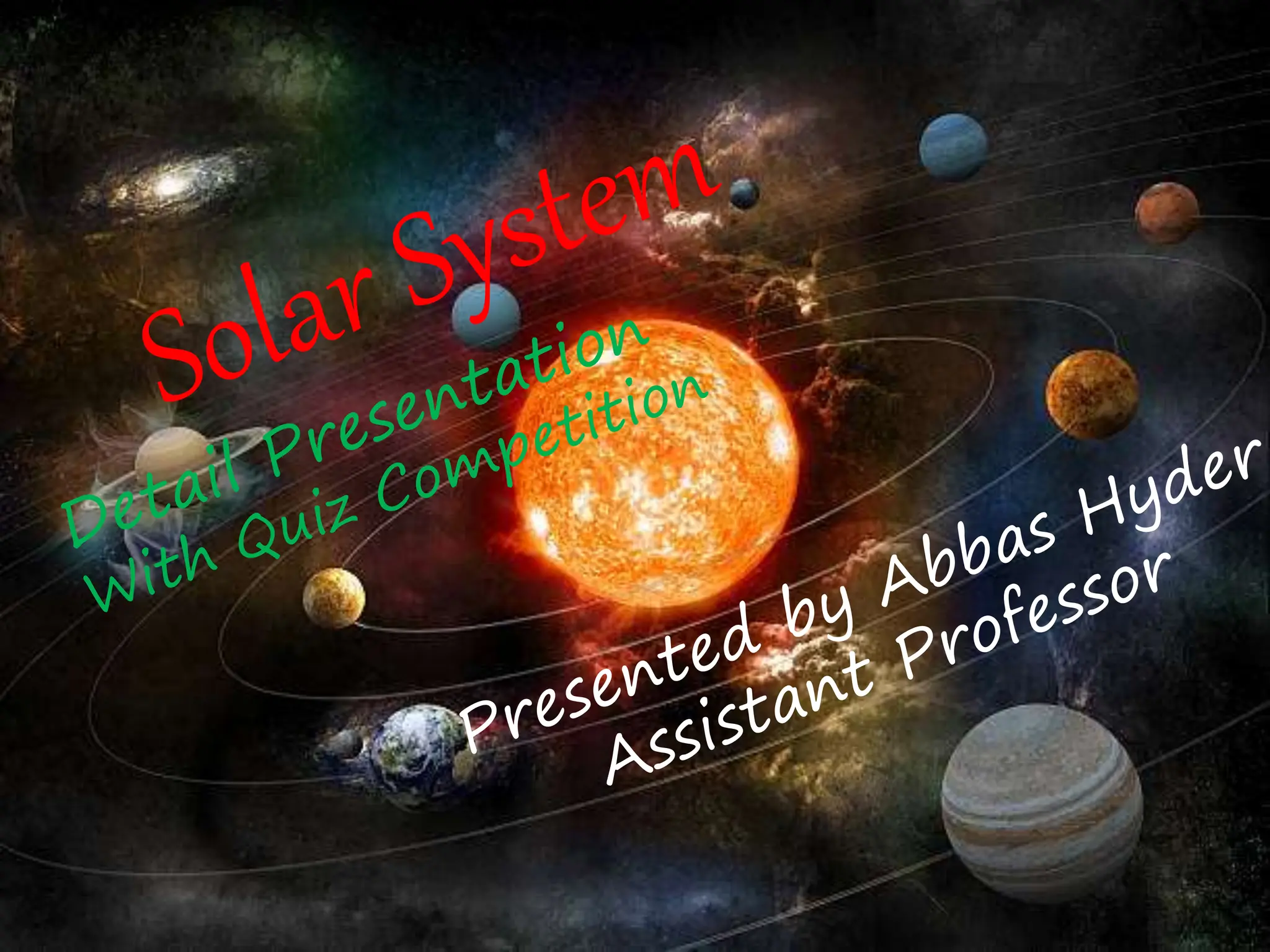
The Sun, its planets and other objects
in orbit are all together known as the
solar system.
Mercury
Venus
Earth
Mars
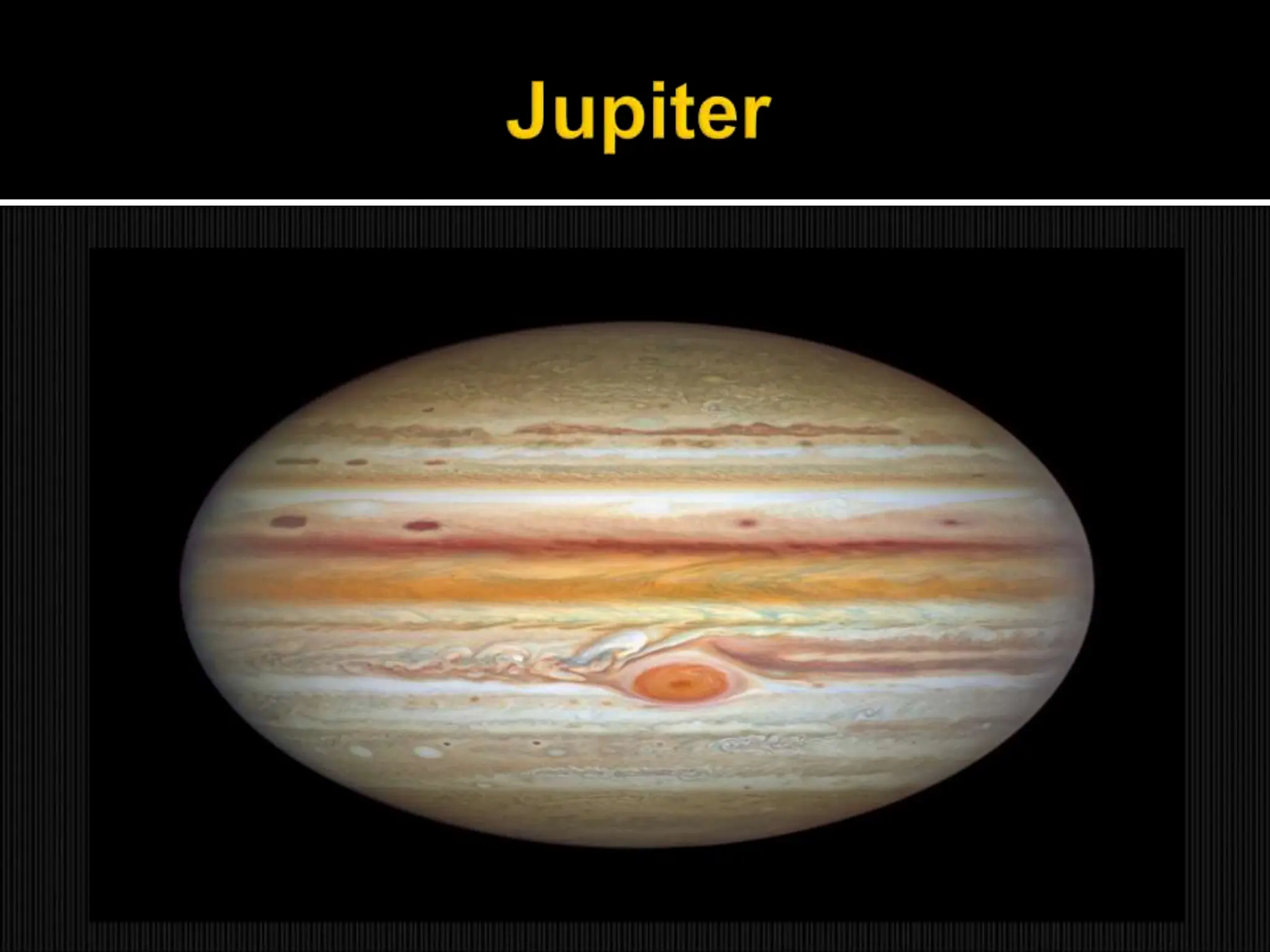
Jupiter
Saturn
Uranus
Neptune
Pluto
 The Sun is a star which the Eight planets move
around.
 The path each planet travels around is called it orbit.
 The planets are kept in their orbits due to the pulling
force of the Sun’s gravity.
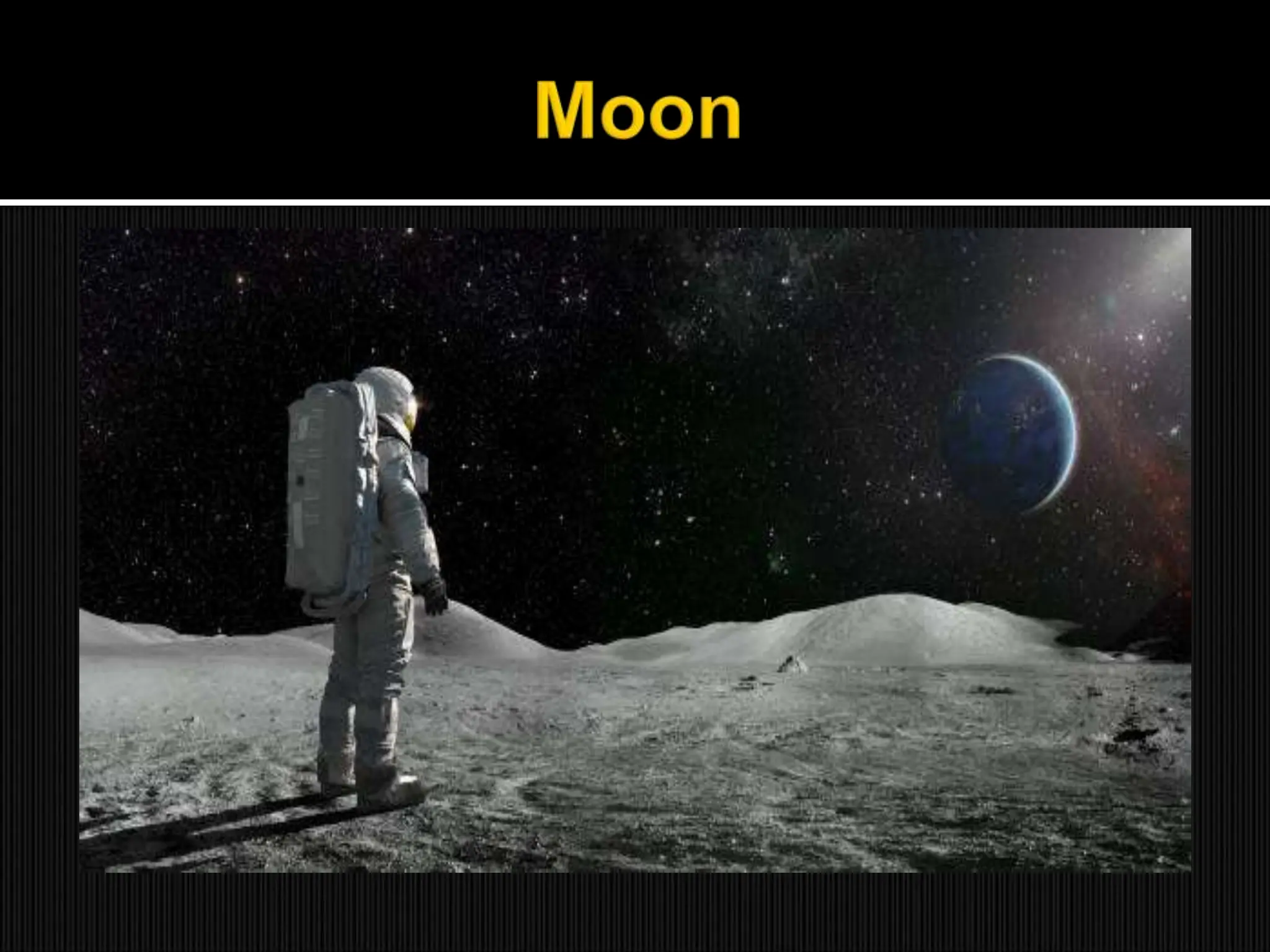
 Moons are ‘Natural Satellites’.
 Moons orbit around a planet.
 The moon stays in its orbit due to the
gravitational pull of the planet.
 Our moon has a circular orbit.
 We see the moon because it reflects light.
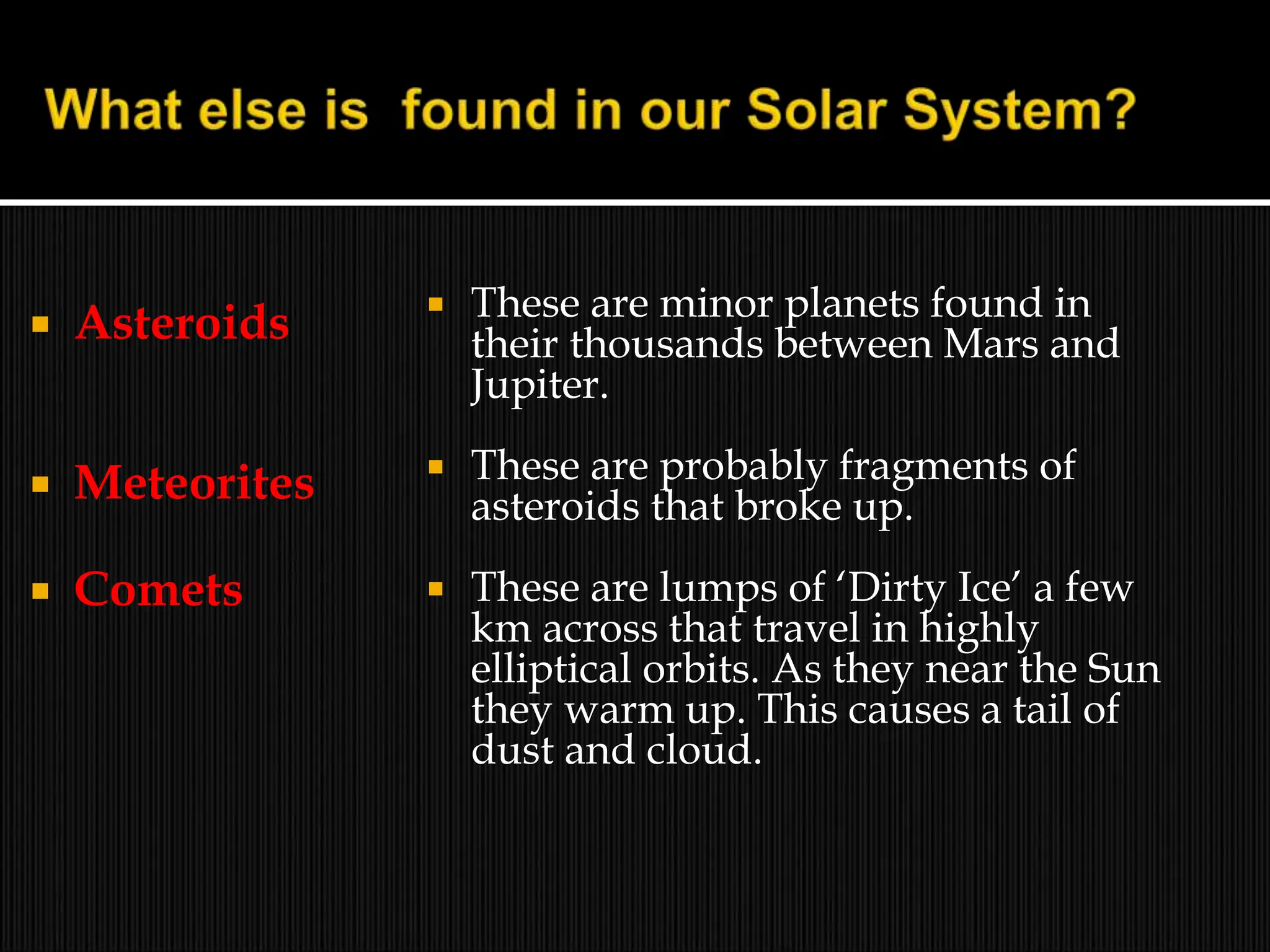
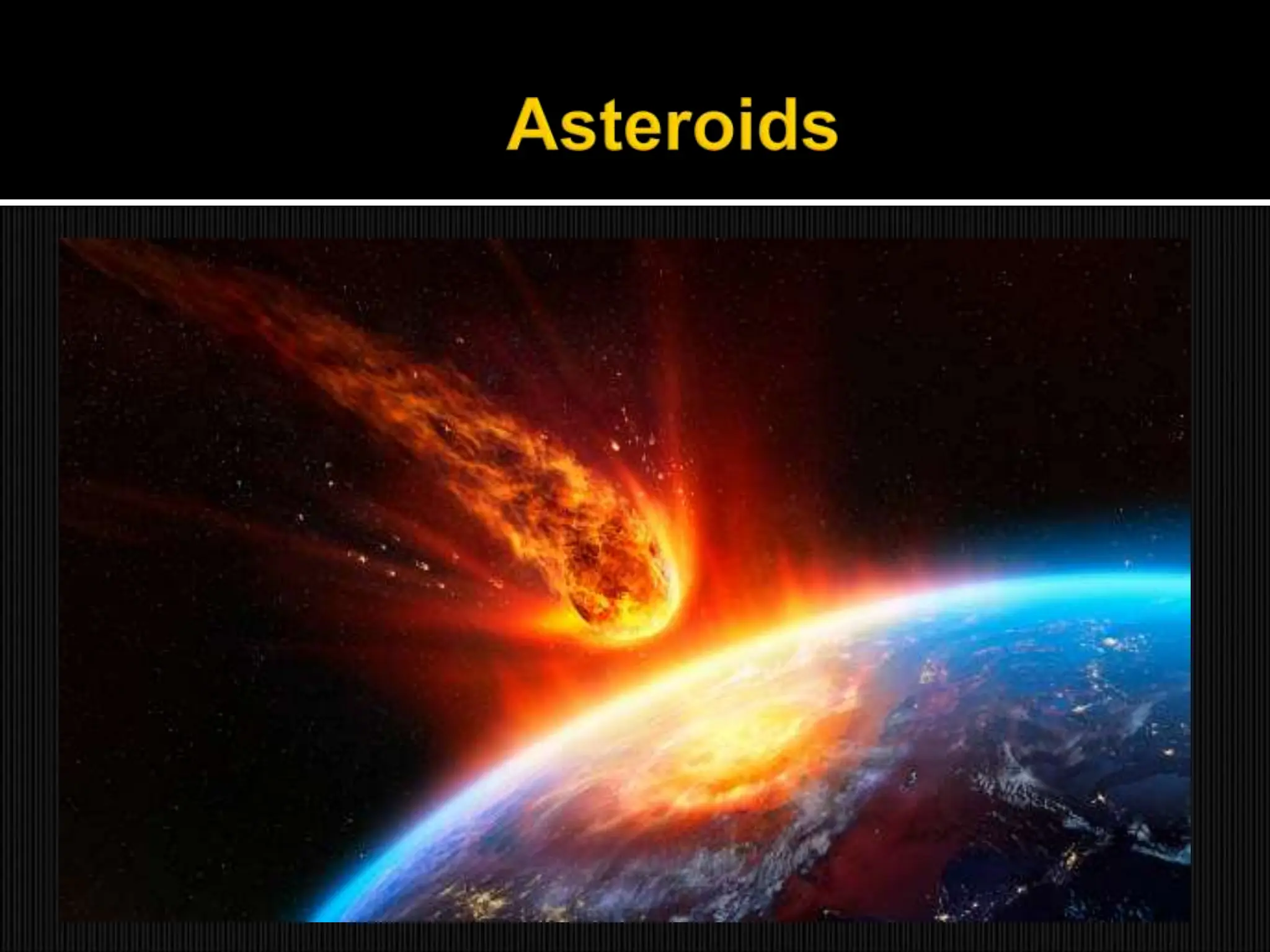
 Asteroids
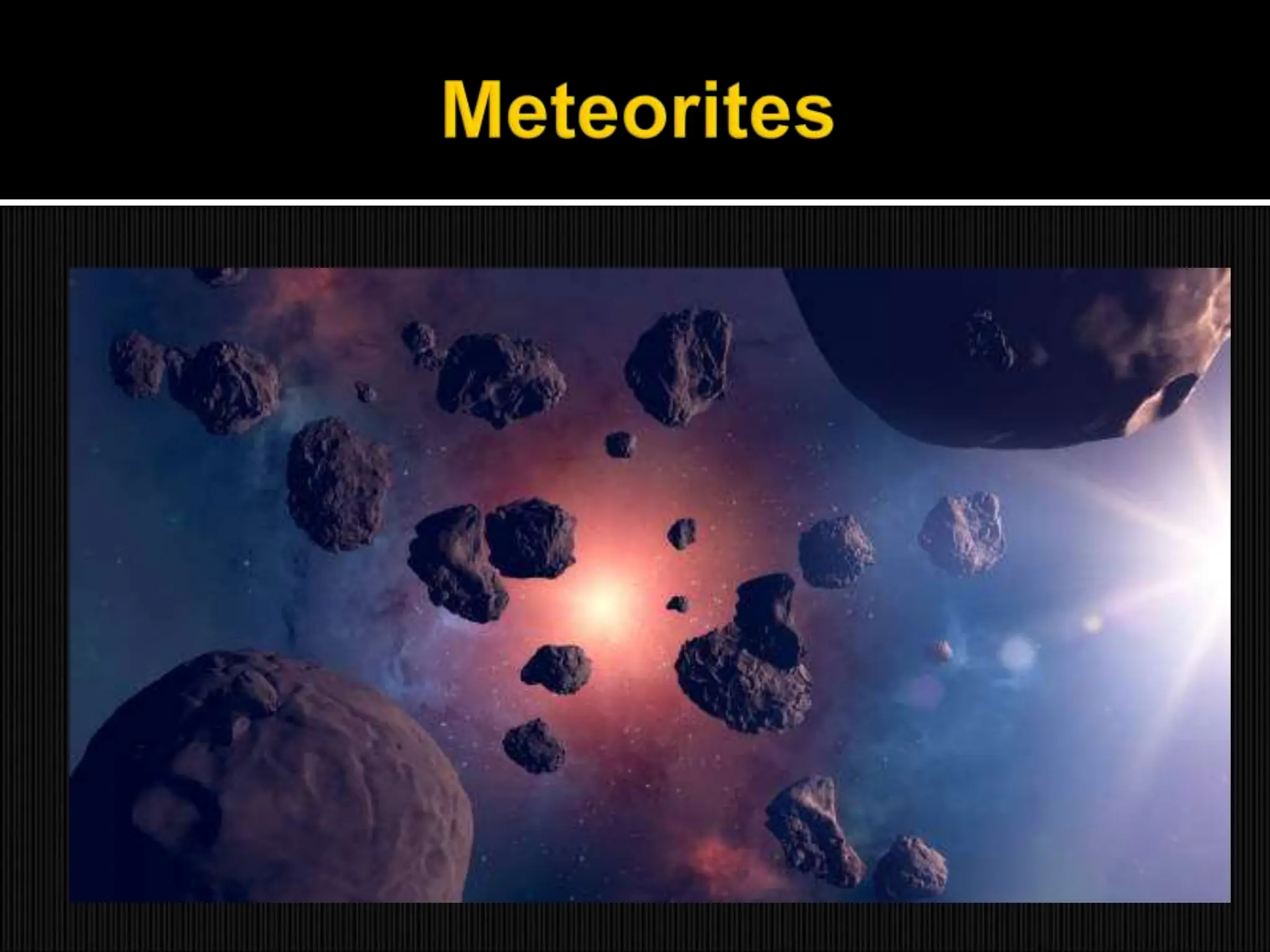
 Meteorites
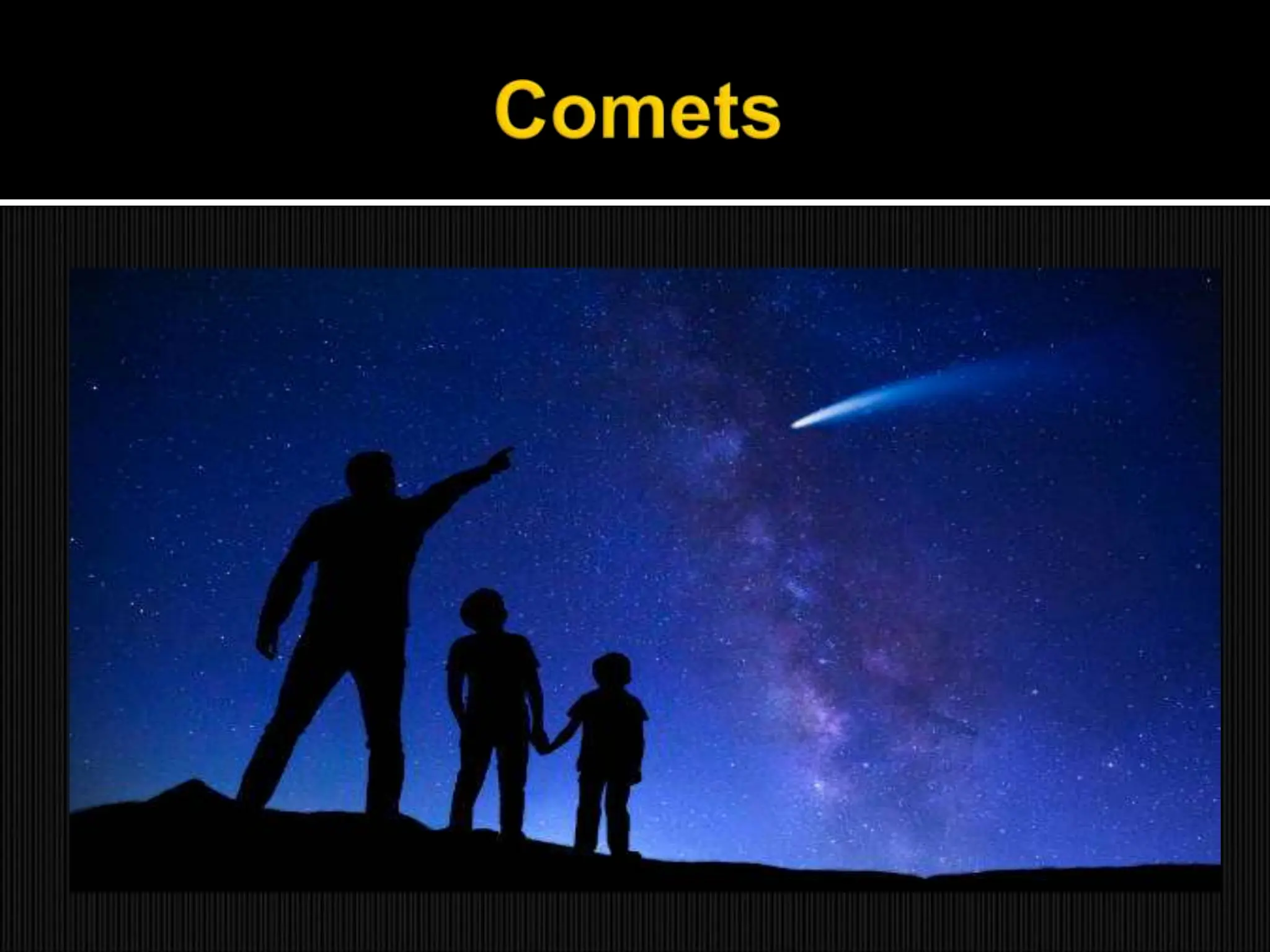
 Comets
 These are minor planets found in
their thousands between Mars and
Jupiter.
 These are probably fragments of
asteroids that broke up.
 These are lumps of ‘Dirty Ice’ a few
km across that travel in highly
elliptical orbits. As they near the Sun
they warm up. This causes a tail of
dust and cloud.
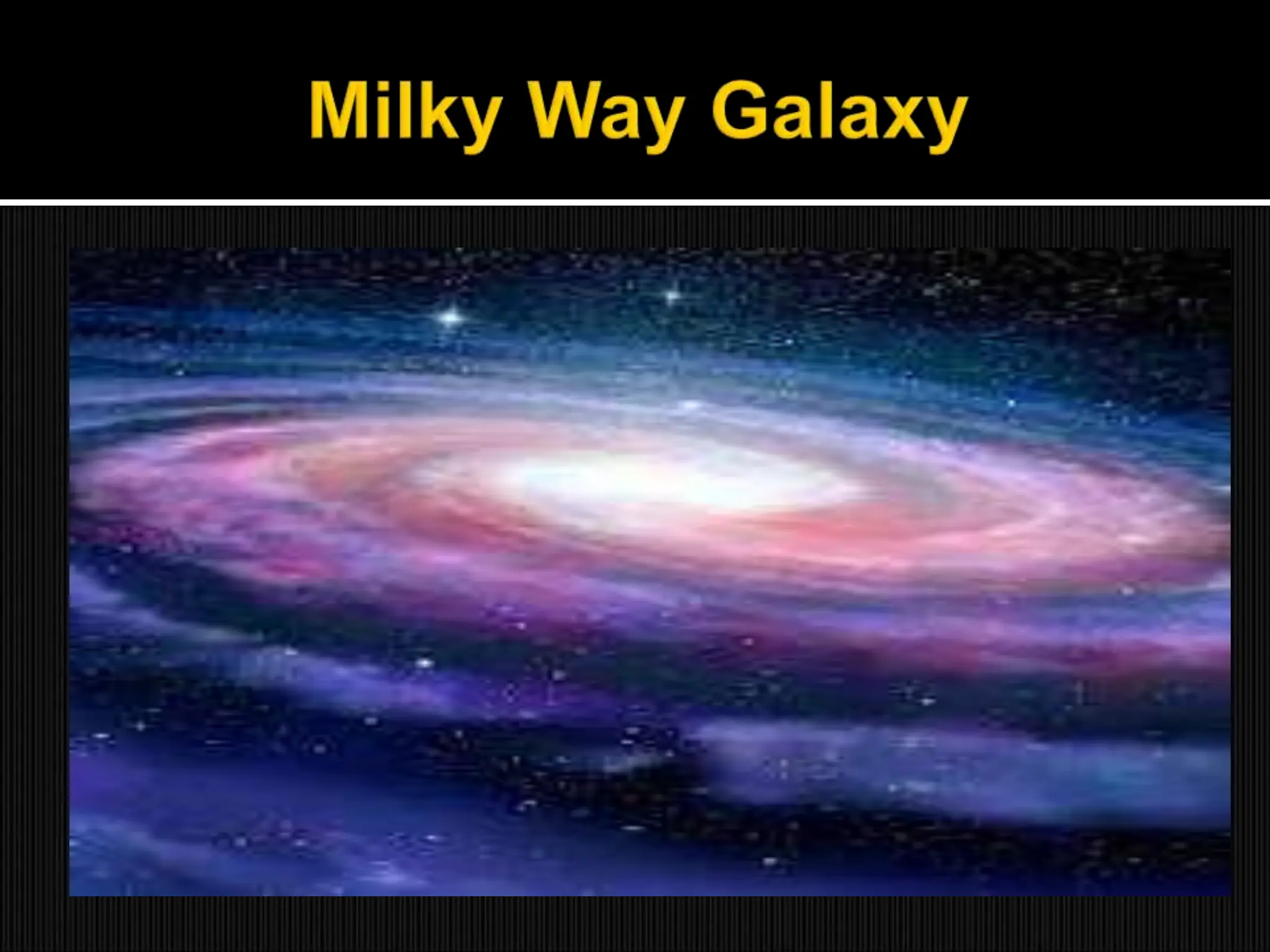
 A galaxy is made up of billions of stars.
 Our galaxy is called the Milky Way galaxy, that has a spiral
shape.
 Our Sun is just one of the stars that form the Milky way
galaxy.
 The Milky Way is 100 000 light years across, and the nearest
star to Earth (apart from the Sun) is 4.2 light years away.
 Our Solar System is here.
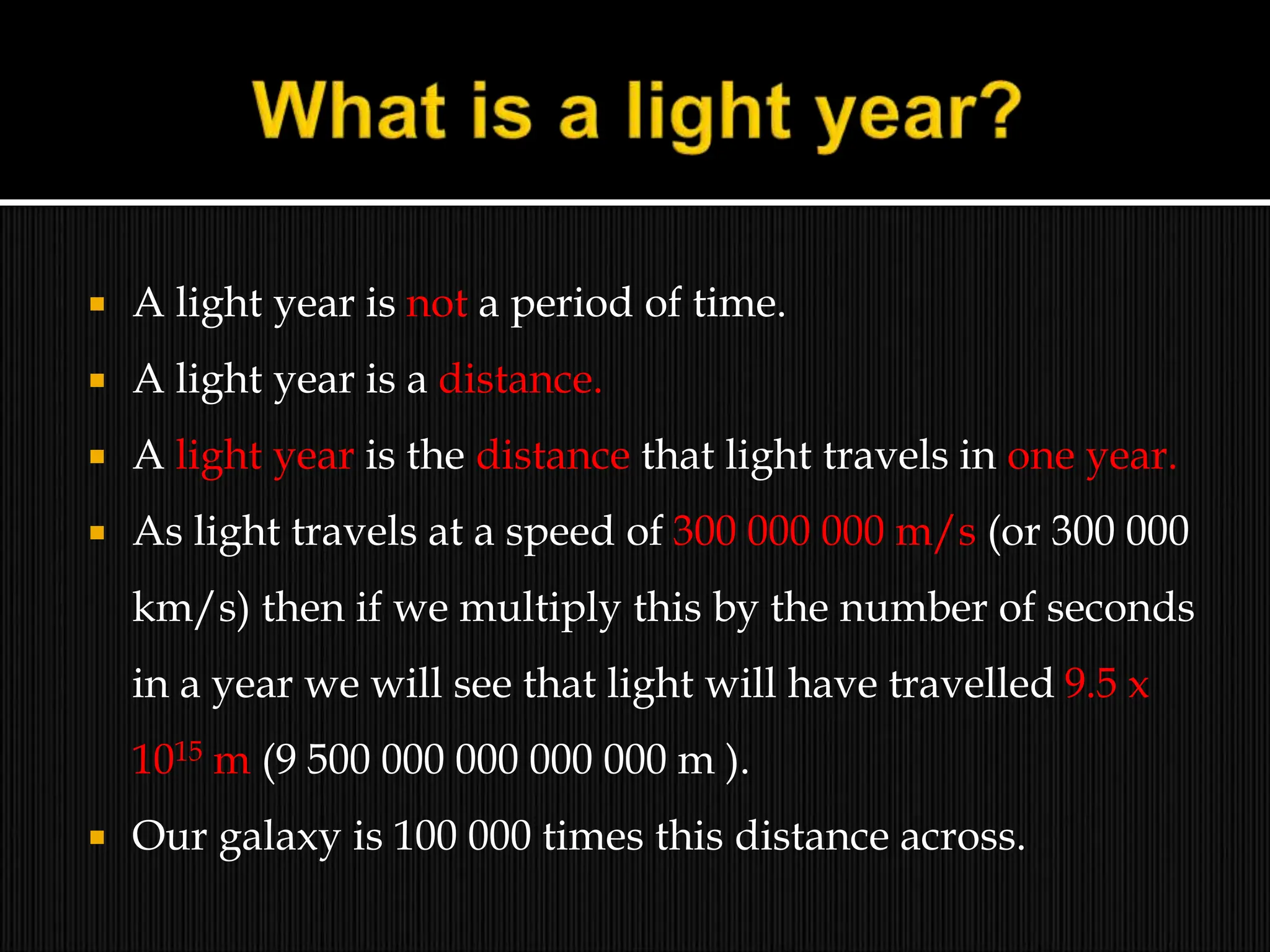
 A light year is not a period of time.
 A light year is a distance.
 A light year is the distance that light travels in one year.
 As light travels at a speed of 300 000 000 m/s (or 300 000
km/s) then if we multiply this by the number of seconds
in a year we will see that light will have travelled 9.5 x
1015 m (9 500 000 000 000 000 m ).
 Our galaxy is 100 000 times this distance across.
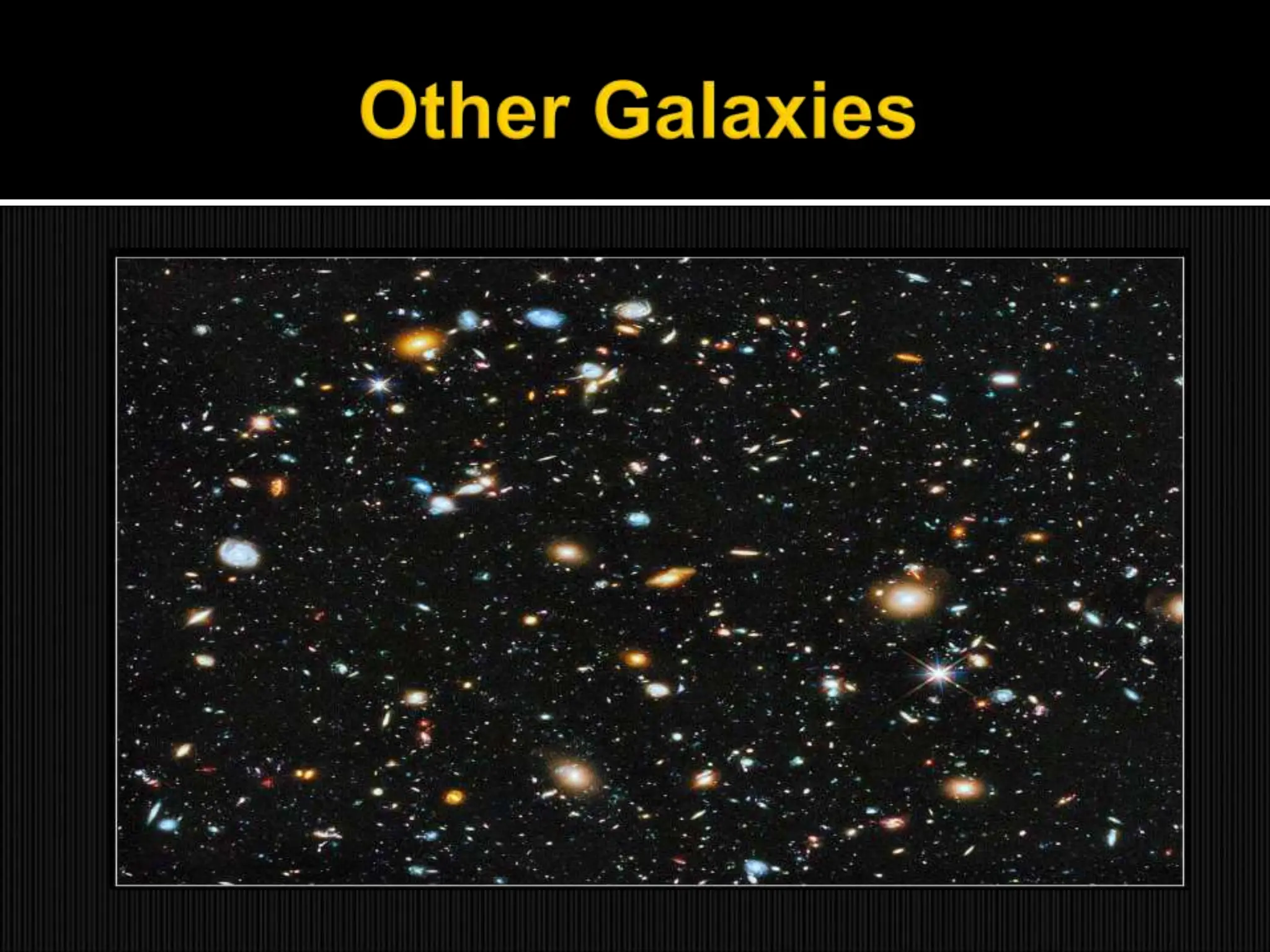
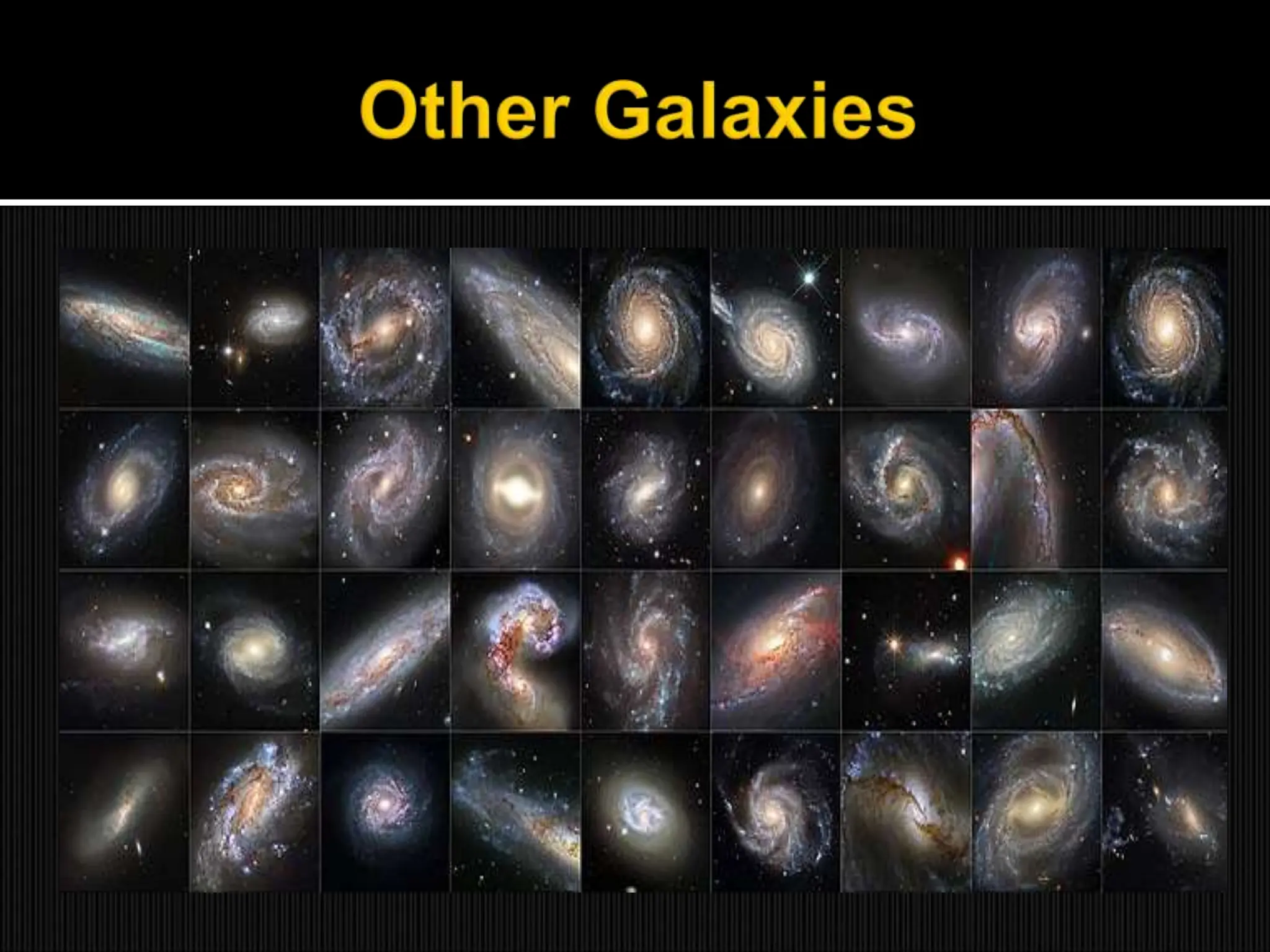
 There are millions of other galaxies which are seen
further and further away in the space.
 Galaxies themselves are millions of times further apart
than the stars are within a galaxy.
 All these galaxies make up the Universe (which includes
all the empty space between galaxies).
 The Universe is perhaps 20 000 million light years across.
 Planet word comes from Greek ,which means wandering star.
 Planets are heavenly bodies ,which revolve around the Sun in elliptical
orbits.
 Earlier it was considered there were 9 planets in Solar system but lately
one planet called Pluto was de-classified from being a planet.
 All planets fall in 2 groups
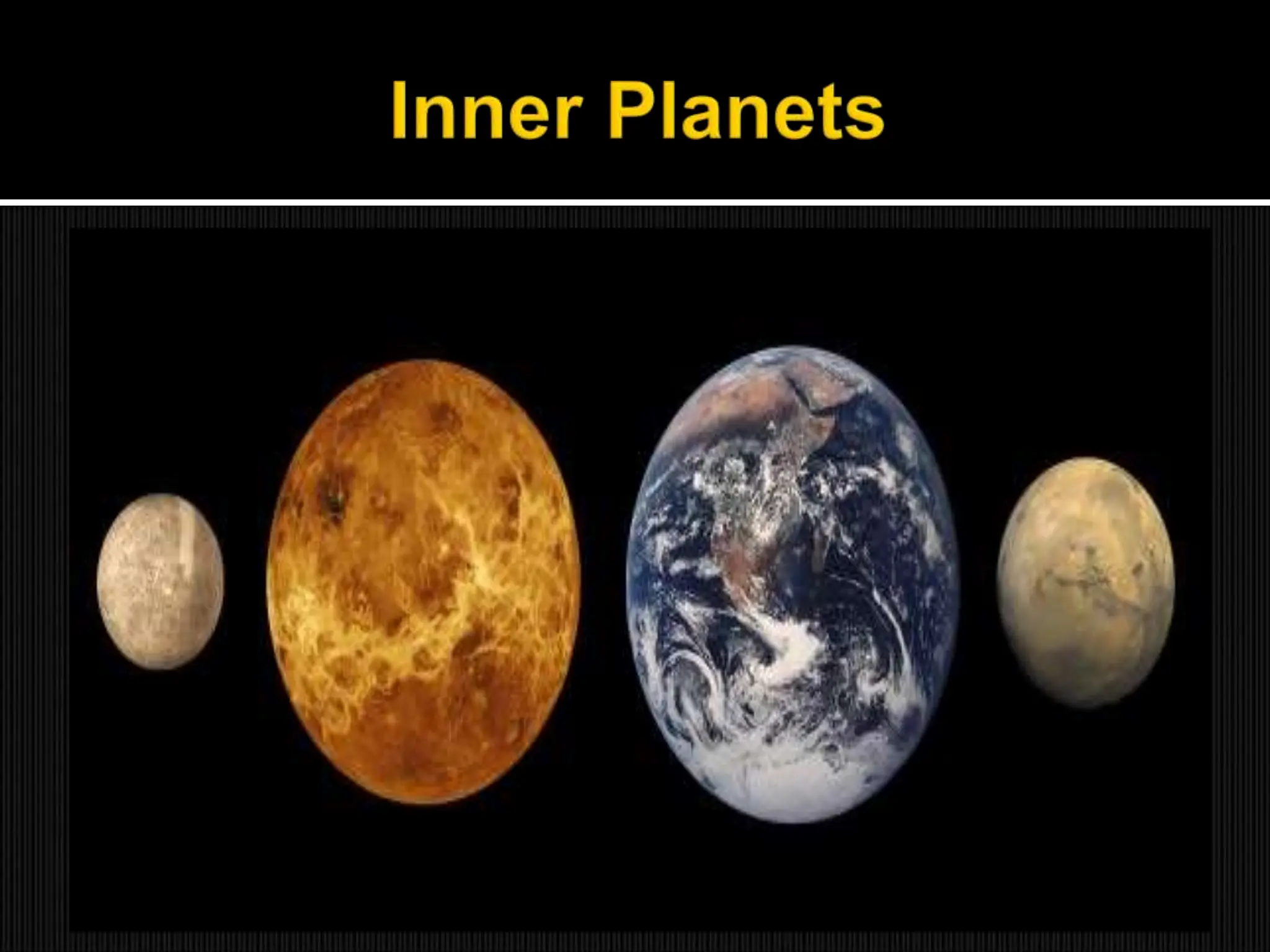
Inner Planets: Mercury , Venus, Mars and Earth are called
inner planets.
Outer Planets: Jupiter , Saturn, Uranus, Neptune are called
outer planets.
 The four planets closest to the Sun—Mercury, Venus, Earth, and Mars—
are the inner planets or terrestrial planets.
 They are similar to Earth.
 All are solid, dense, and rocky. None of the inner planets has rings.
Compared to the outer planets, the inner planets are small. They have
shorter orbits around the Sun and they spin more slowly. Venus spins
backward and spins the slowest of all the planets.
 All of the inner planets were geologically active at one time. They are all
made of cooled igneous rock with inner iron cores. Earth has one big,
round moon,
 while Mars has two very small, irregular moons. Mercury and Venus do
 Jupiter, Saturn, Uranus, and Neptune are the outer
planets of our solar system.
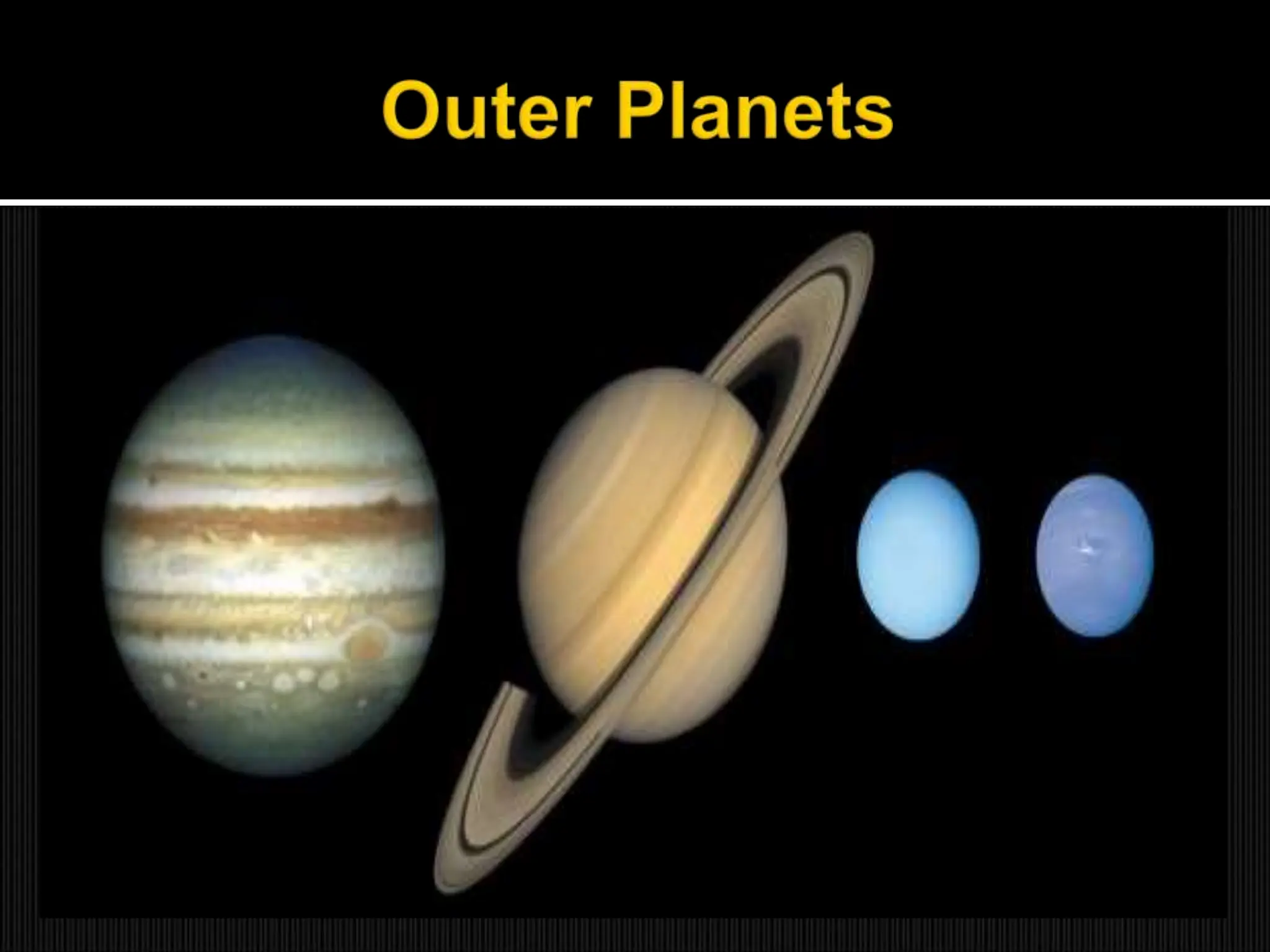
 These are the four planets farthest from the Sun.
 The outer planets are much larger than the inner
planets.
 Since they are mostly made of gases, they are also
called gas giants.
 Dwarf planets are objects that are similar to
planets except that they orbit the Sun in areas
where there are many similar objects.
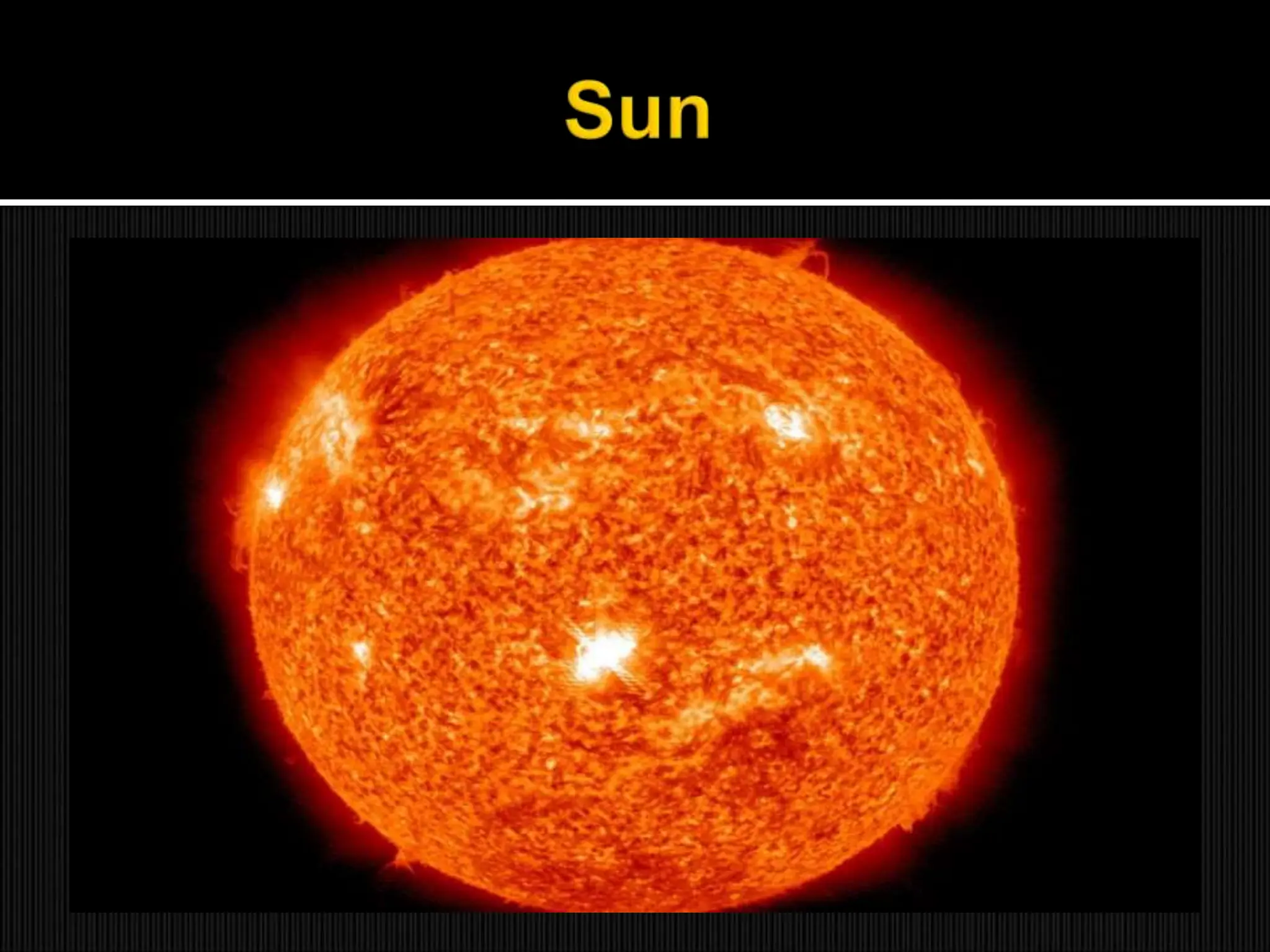
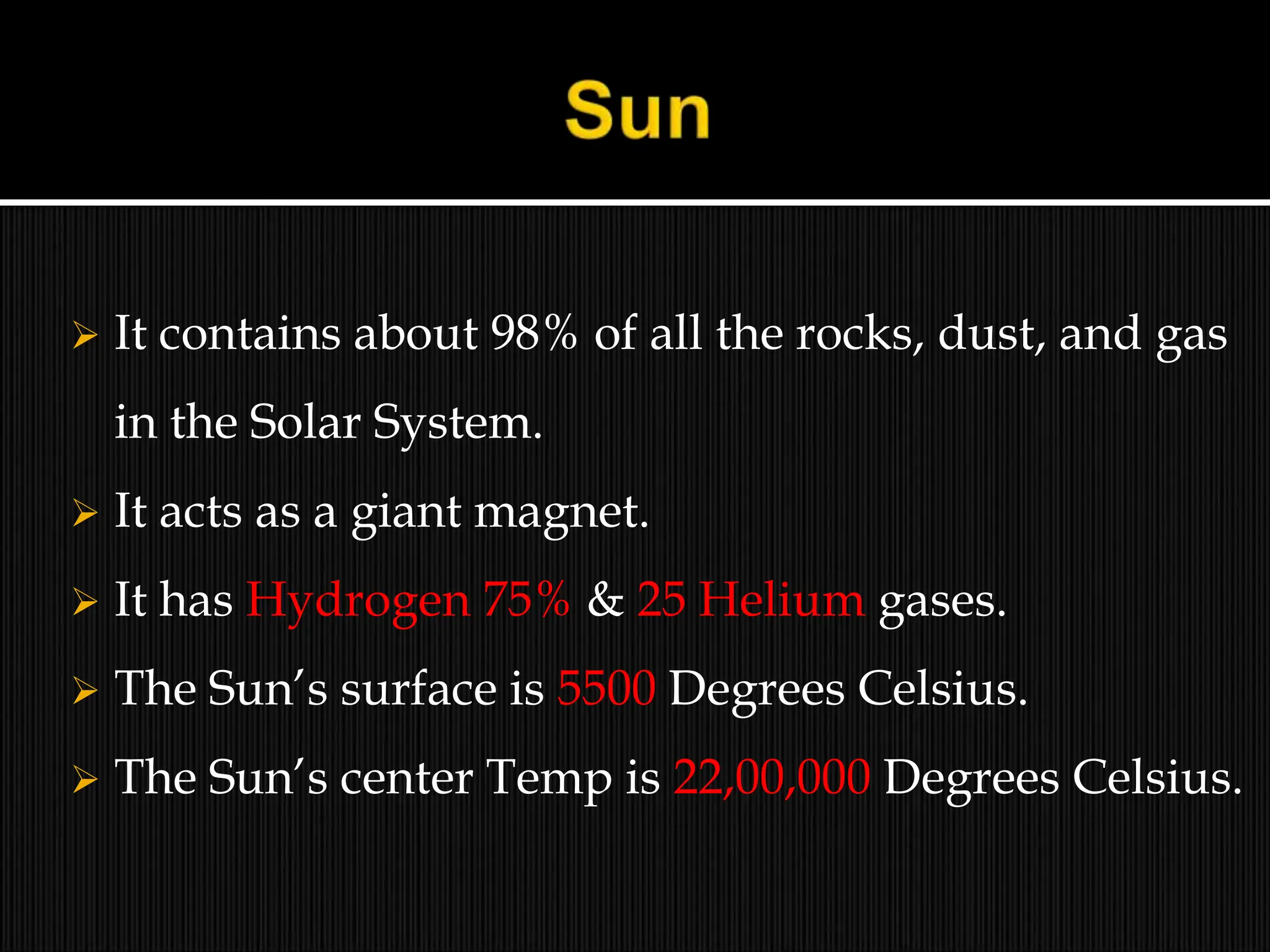
 It contains about 98% of all the rocks, dust, and gas
in the Solar System.
 It acts as a giant magnet.
 It has Hydrogen 75% & 25 Helium gases.
 The Sun’s surface is 5500 Degrees Celsius.
 The Sun’s center Temp is 22,00,000 Degrees Celsius.
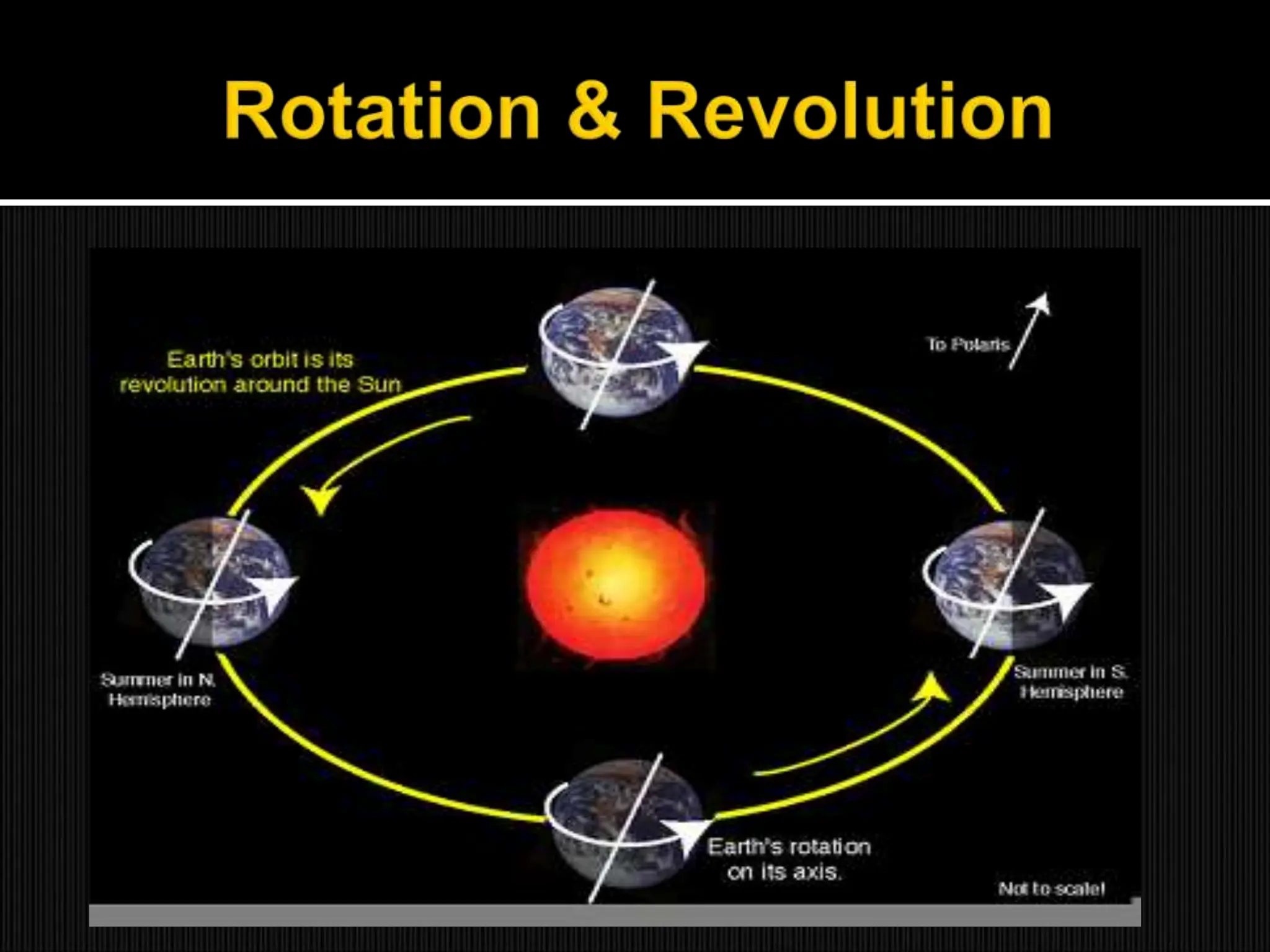
 Rotation refers to an object's spinning motion about its own axis.
 For example, Earth rotates on its own axis, producing the 24-
hours in a day.
 Revolution refers the object's orbital motion around another
object.
 Earth revolves about the Sun, producing the 365-days in a year
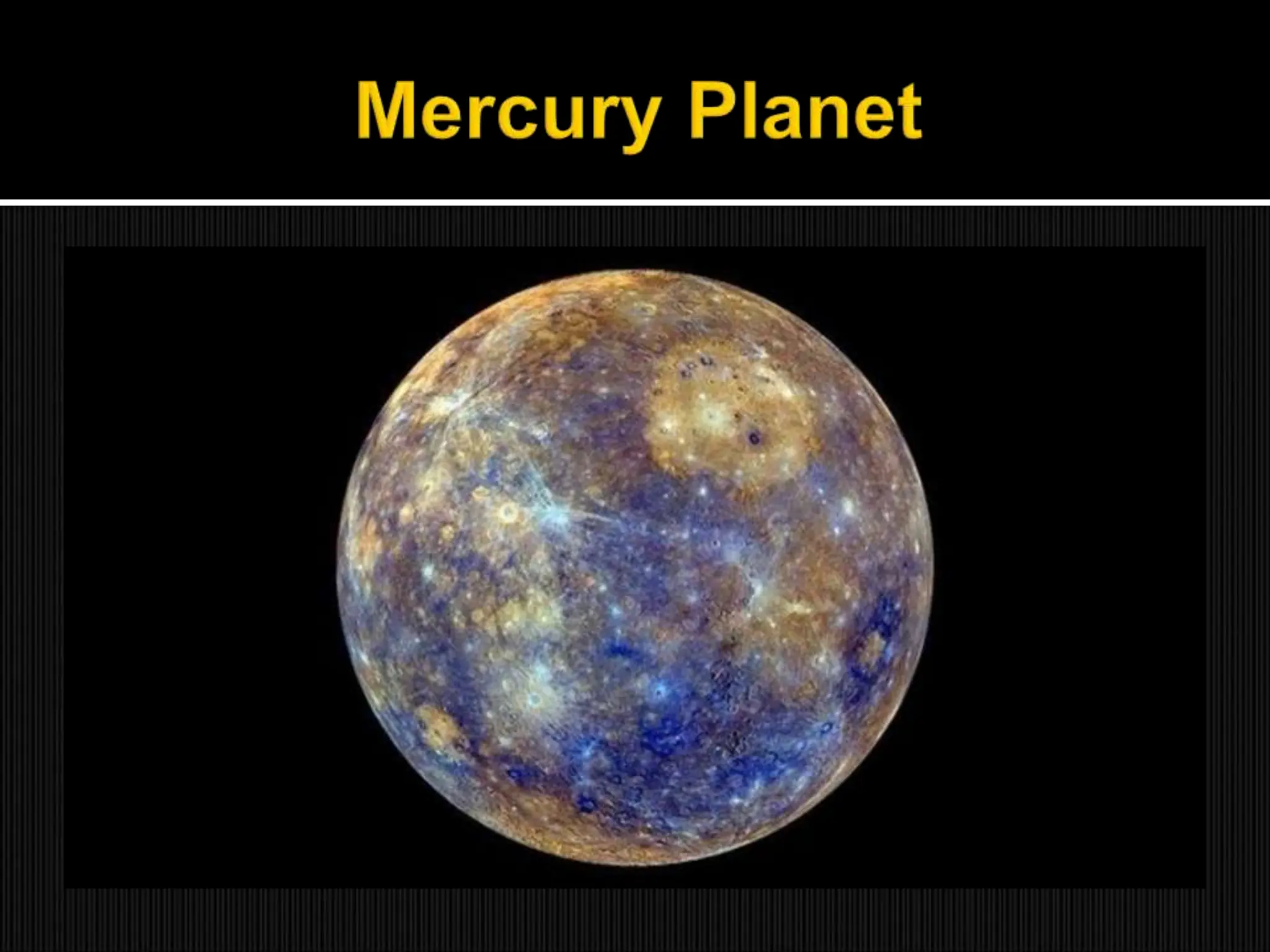
 It takes 88 days to Revolve.
 It takes 58.7 days to Rotate.
 It smaller than the Earth, it has less gravity than the Earth.
 It has no Moons.
 It has oxygen, sodium, hydrogen, helium and potassium.
 It is 57.9 million km away from the Sun.
 Mercury is hot in day & so cold in Night due to slowly spins.
 Mercury: Mercury is the smallest planet in our Solar System
 It is also the closest to the Sun.
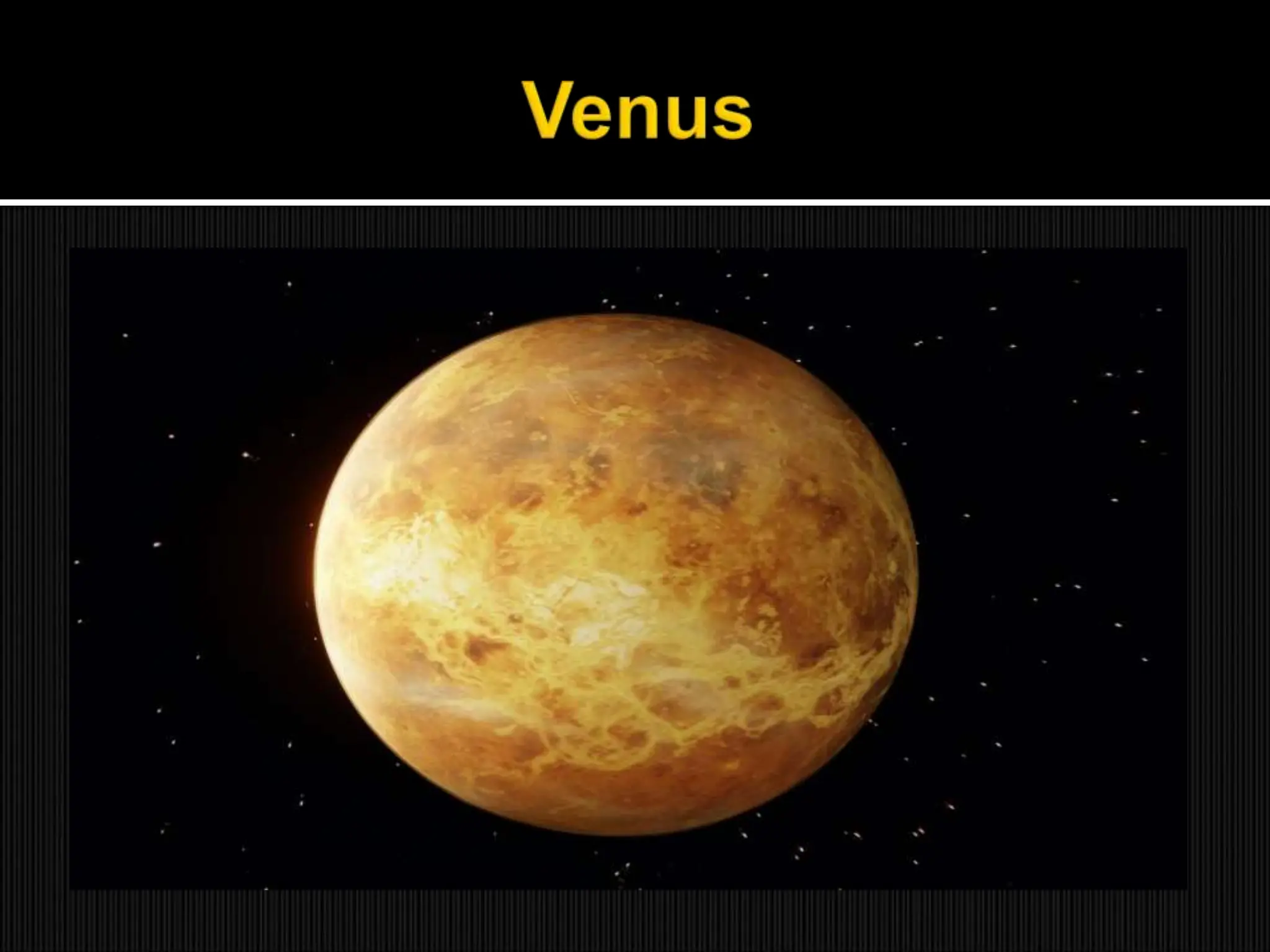
 It takes 224 days to Revolve.
 It takes 18 hours to Rotate.
 It is too hot due to its composition.
 It has Carbon Dioxide 96 & Nitrogen 3.5 gases.
 Venus has no moons.
 It is 108.2 million kilometer away from the Sun.
 Venus has temperature 480 Degrees Celsius.
 It is known as the hottest & brightest planet in the Solar
System.
 It takes 365.25 days to Revolve.
 It takes 23 hours, 56 minutes, 0.4 seconds to Rotate.
 It has 150 million kilometer away form Sun.
 A.U means Astronomical Unit, One A.U is equal to 150
million kilometer distance.
 It has Nitrogen 78% & Oxygen 21%.
 Earth has one moon called Luna.
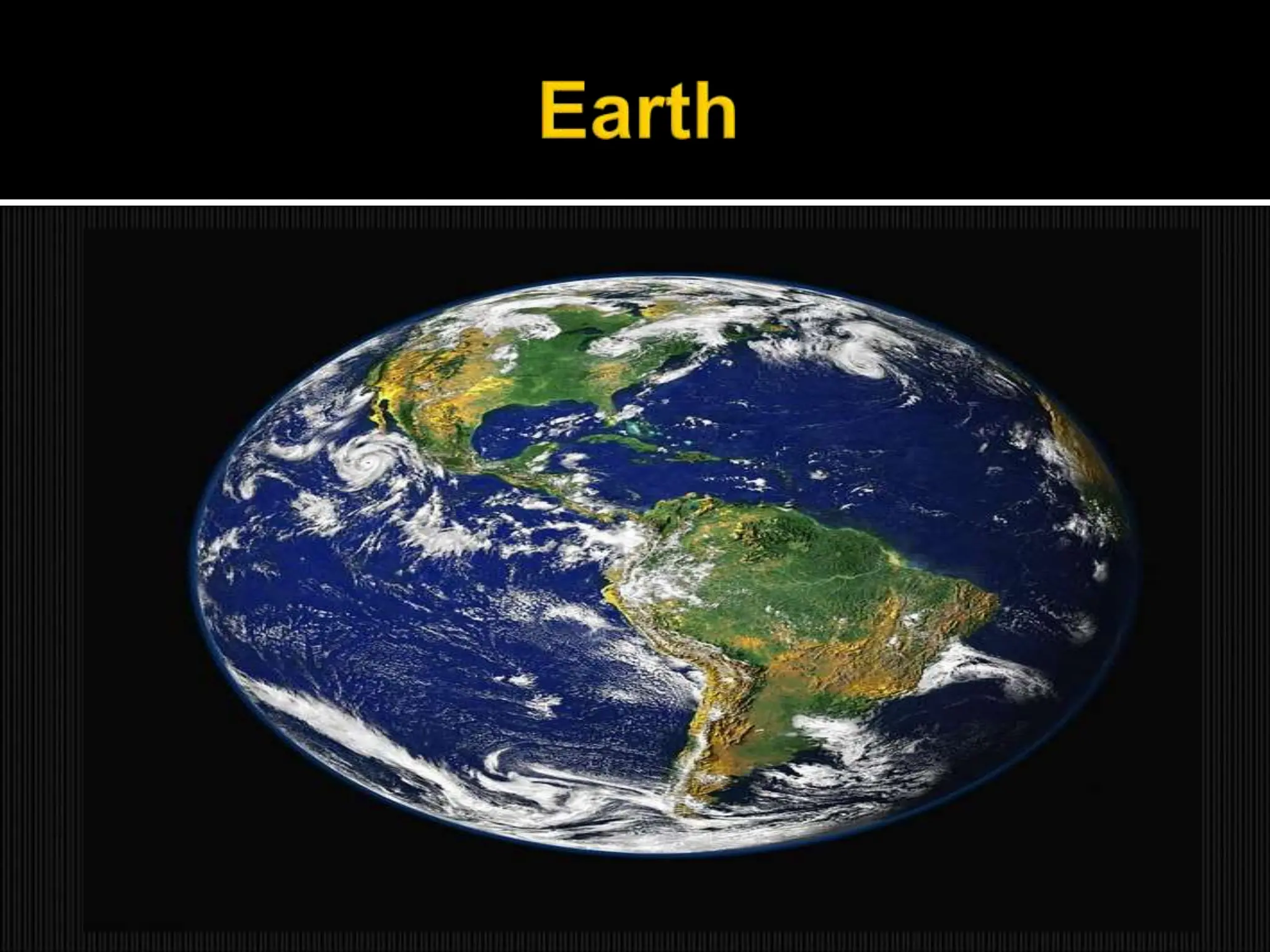
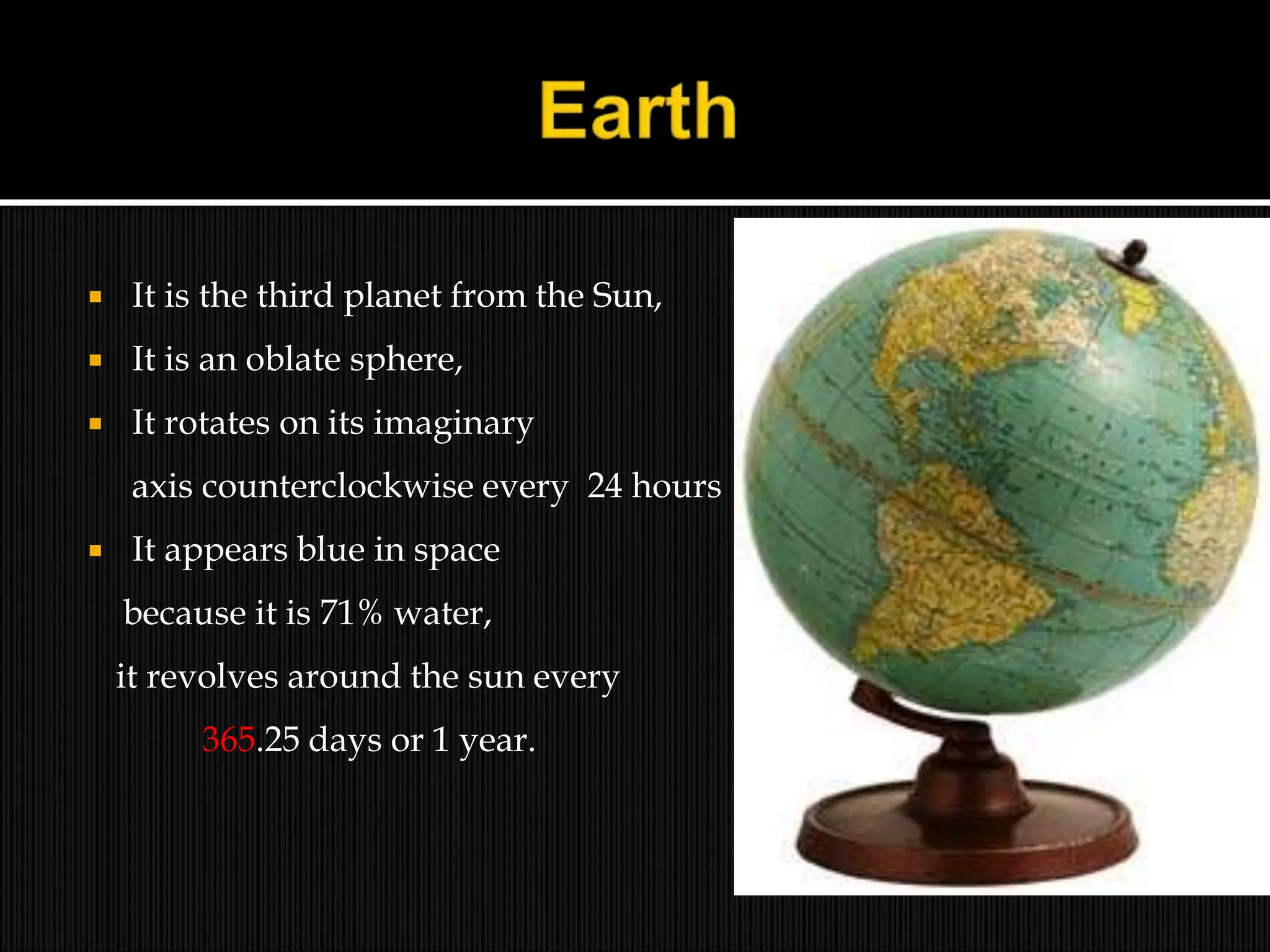
 It is the third planet from the Sun,
 It is an oblate sphere,
 It rotates on its imaginary
axis counterclockwise every 24 hours
 It appears blue in space
because it is 71% water,
it revolves around the sun every
365.25 days or 1 year.
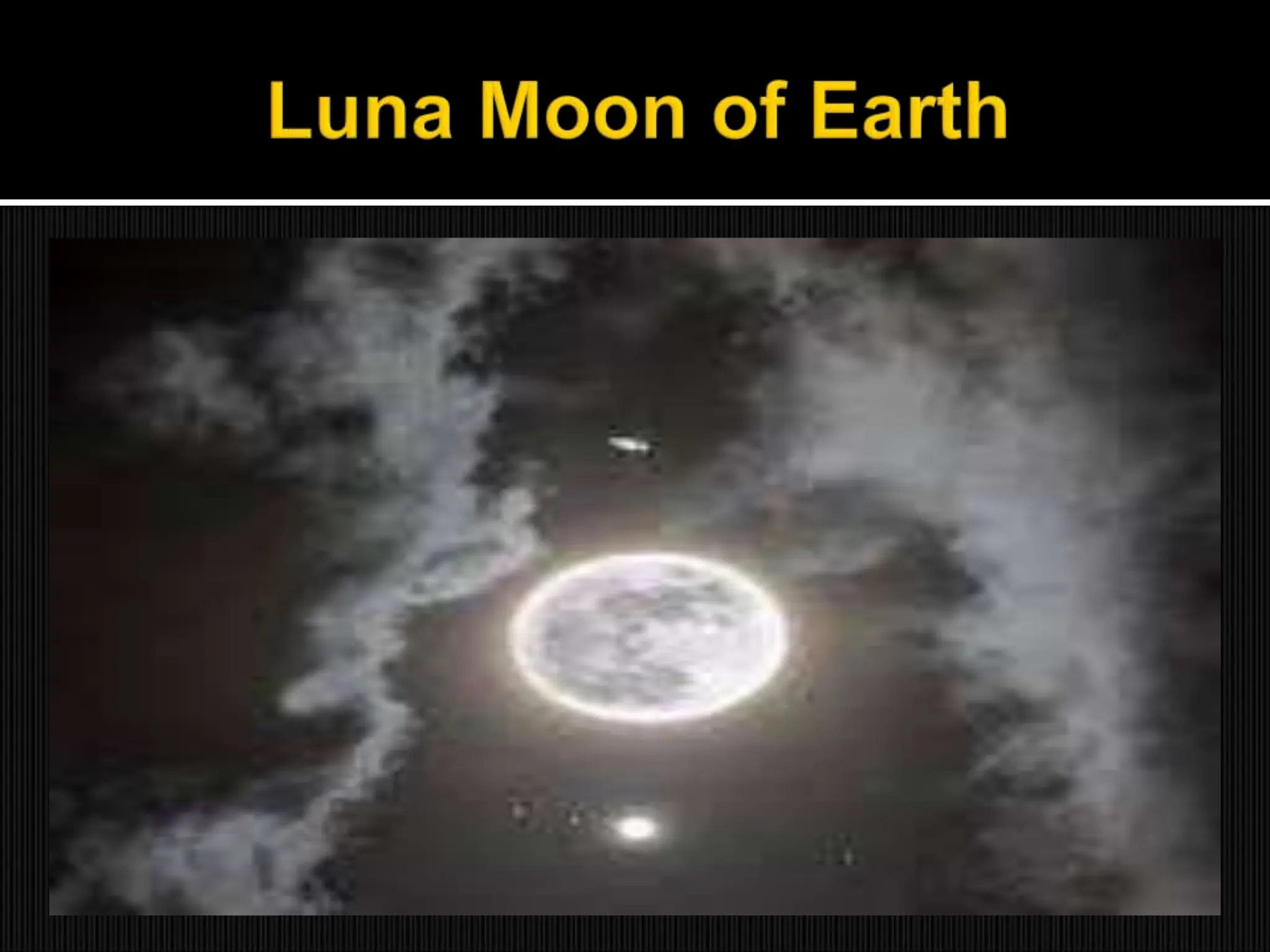
 Luna is Earth’s Moon,
 Luna is 384400 Km away from Earth.
 It has Physical Features like mountains, valleys,
old volcanoes, & craters.
 Craters are caused by asteroids & comets
colliding with the Moon.
 Luna & Earth are very close in size.
 It has dark spots.
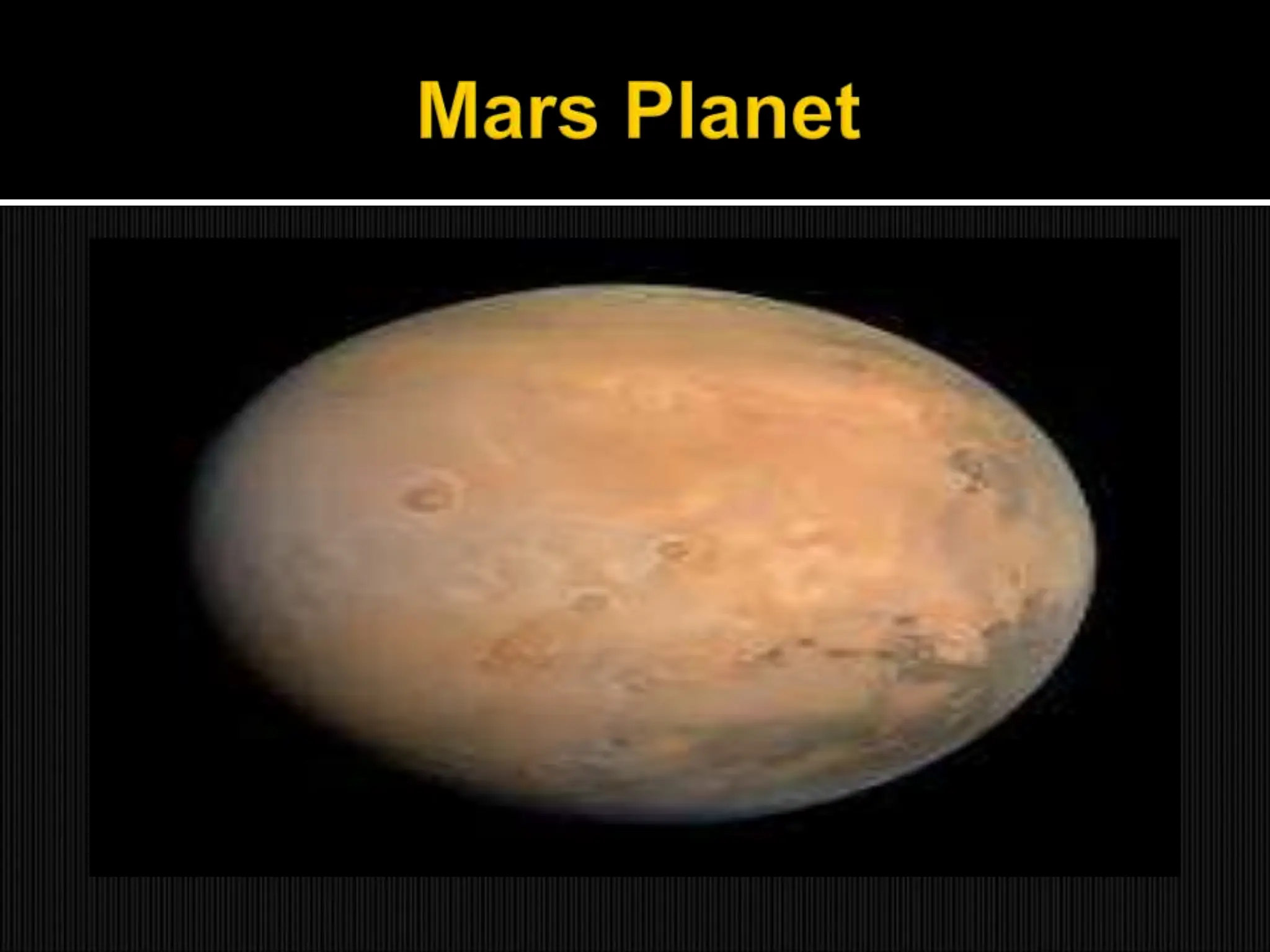
 It takes 687 days to Revolve.
 It takes 24.6 hours to Rotate.
 Mars is 227.9 million kilometer away from the Sun.
 It has Carbon Dioxide & oxygen gases.
 Less gravity than Earth.
 Scientists have found that Mars once had steams, rivers,
lakes & an ocean.
 Mars has Two moons, Deimos & Phobos.
 Mars has the highest mountains & deepest canyons in the
 It takes 11.5 years to Revolve.
 It takes 10 hours to Rotate.
 It is 778.4 million kilometer away from the Sun.
 It has greater gravity than Earth.
 Jupiter has a great red spot.
 It has 63 moons.
 It has Hydrogen, Helium & Methane gases.
 There is no solid surface here, it has just one huge ocean of
hydrogen & water.
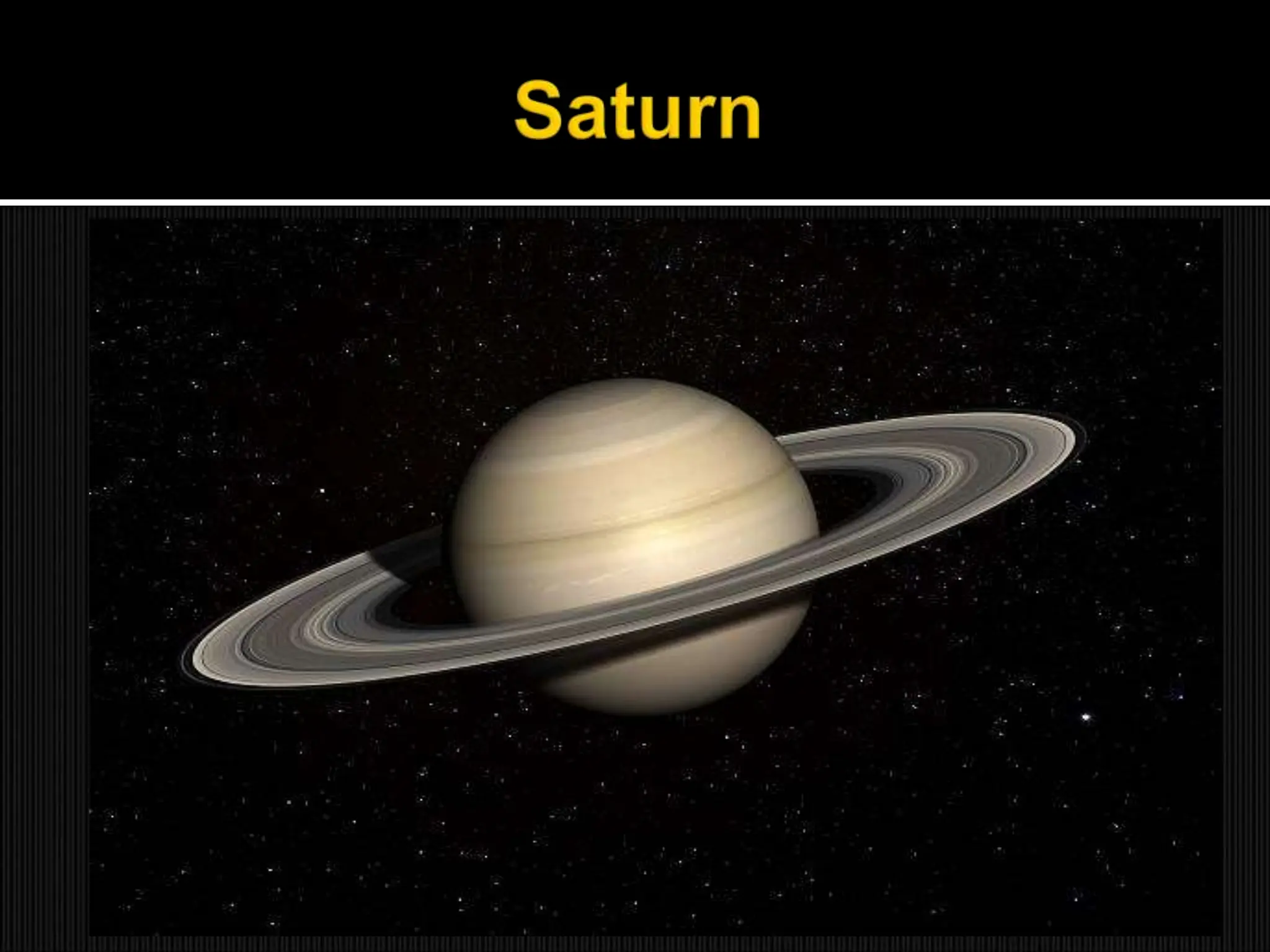
 It takes 29.5 years to Revolve.
 It takes 10.25 hours to Rotate.
 It is 1424 million kilometers away from Sun.
 It has huge gravity than Earth.
 It has rings around it.
 It has Hydrogen & Helium gases.
 It has 18 moons.
 Saturn is very similar to Jupiter.
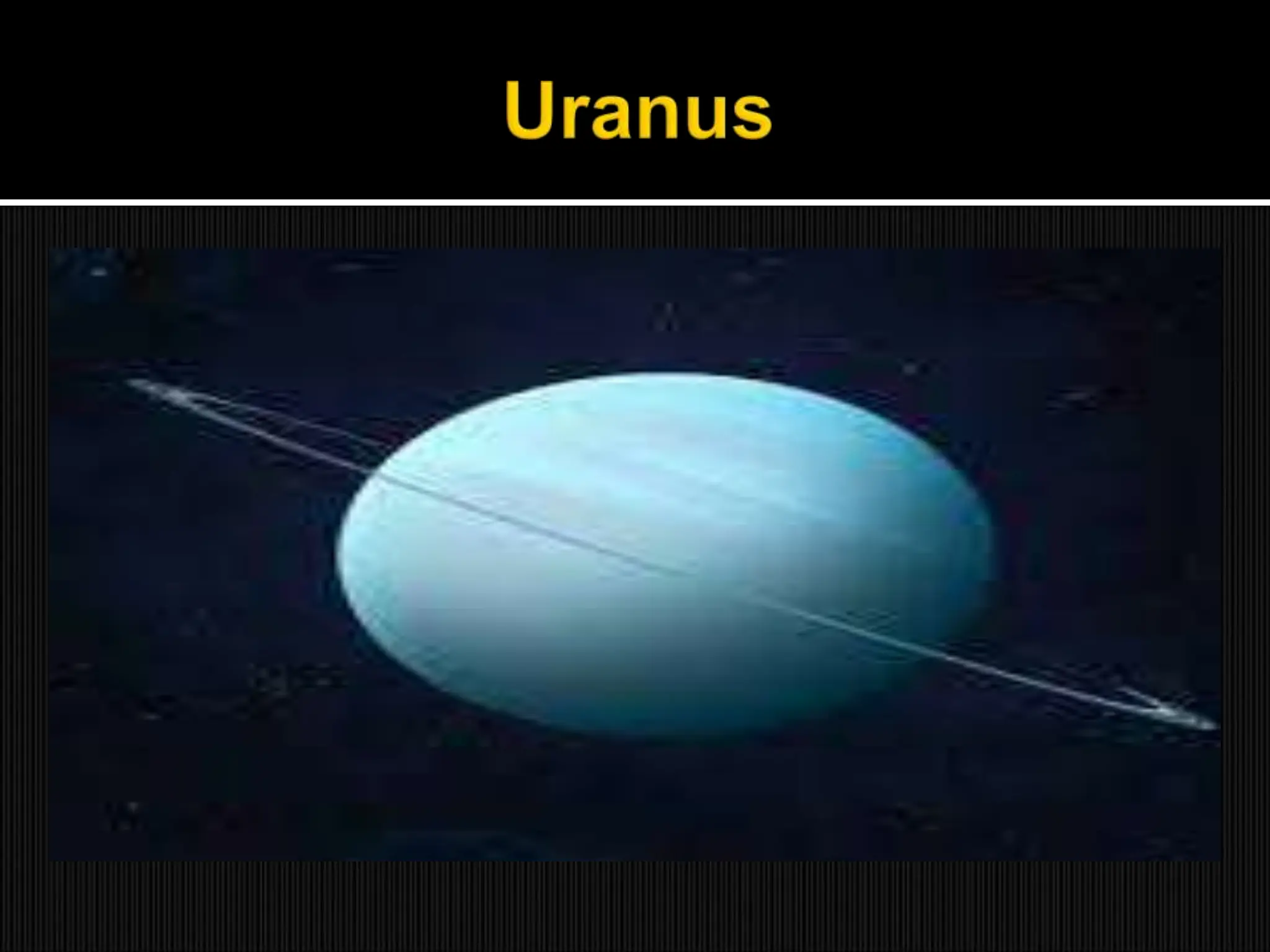
 It takes 84 years to Revolve.
 It takes 17 hours to Rotate.
 It is 2872 million kilometers away form the Sun.
 It has huge gravity than the Earth.
 It is 27 moons.
 It has Anomie, Hydrogen & Methane gases.
 Uranus could have ocean its atmosphere, & possible have
trillions of large diamonds.
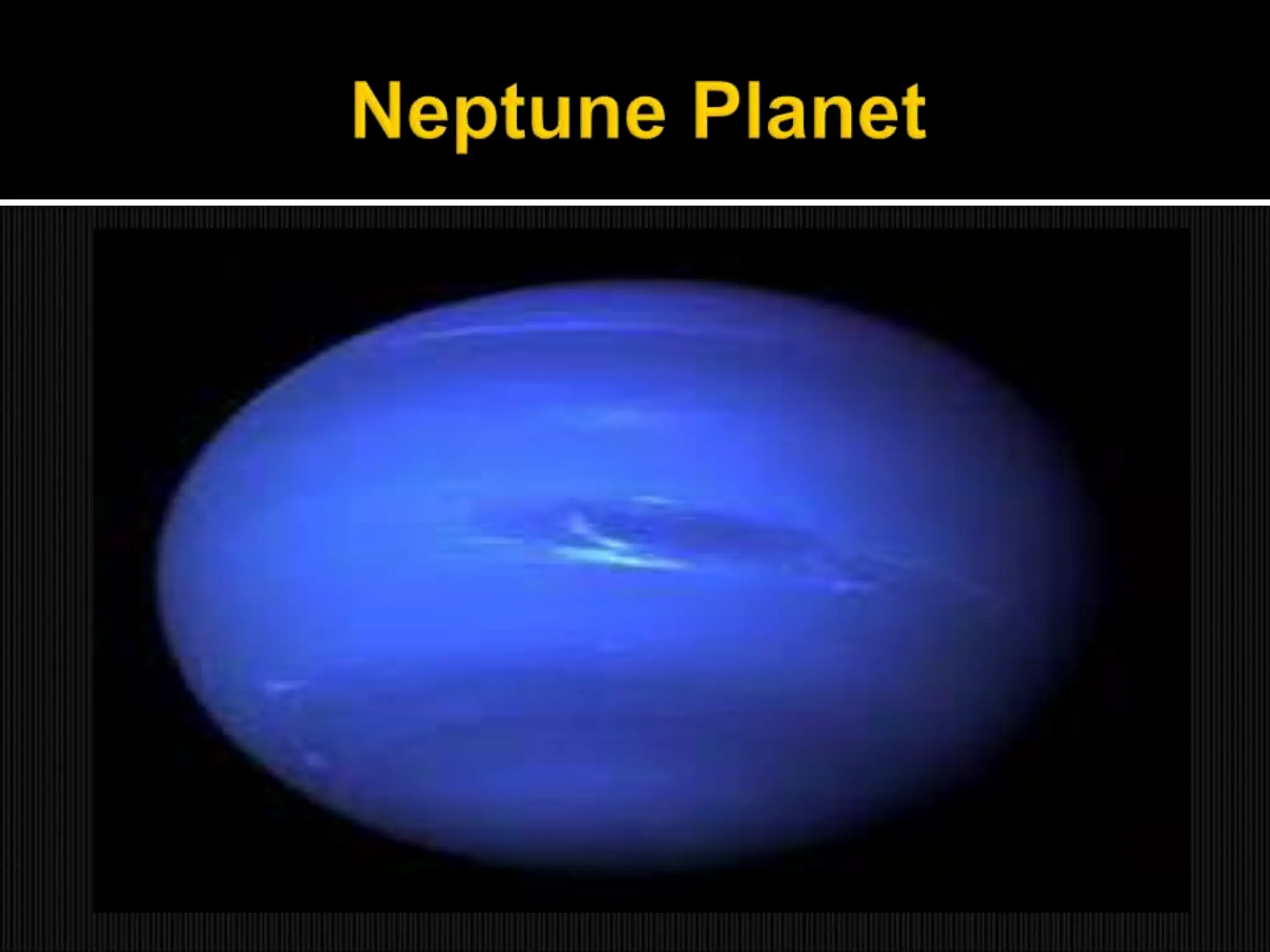
 It takes 165 years to Revolve.
 It takes 16 hours to Rotate.
 It is 2,794 million miles away from the Sun.
 Neptune has a giant storm jus like Jupiter, is called the
Great Dark Spot.
 It has Hydrogen, Helium & Methane gases.
 It has 6 rings around it.
 It is 14 Moons.
 It was discovered in 1846.
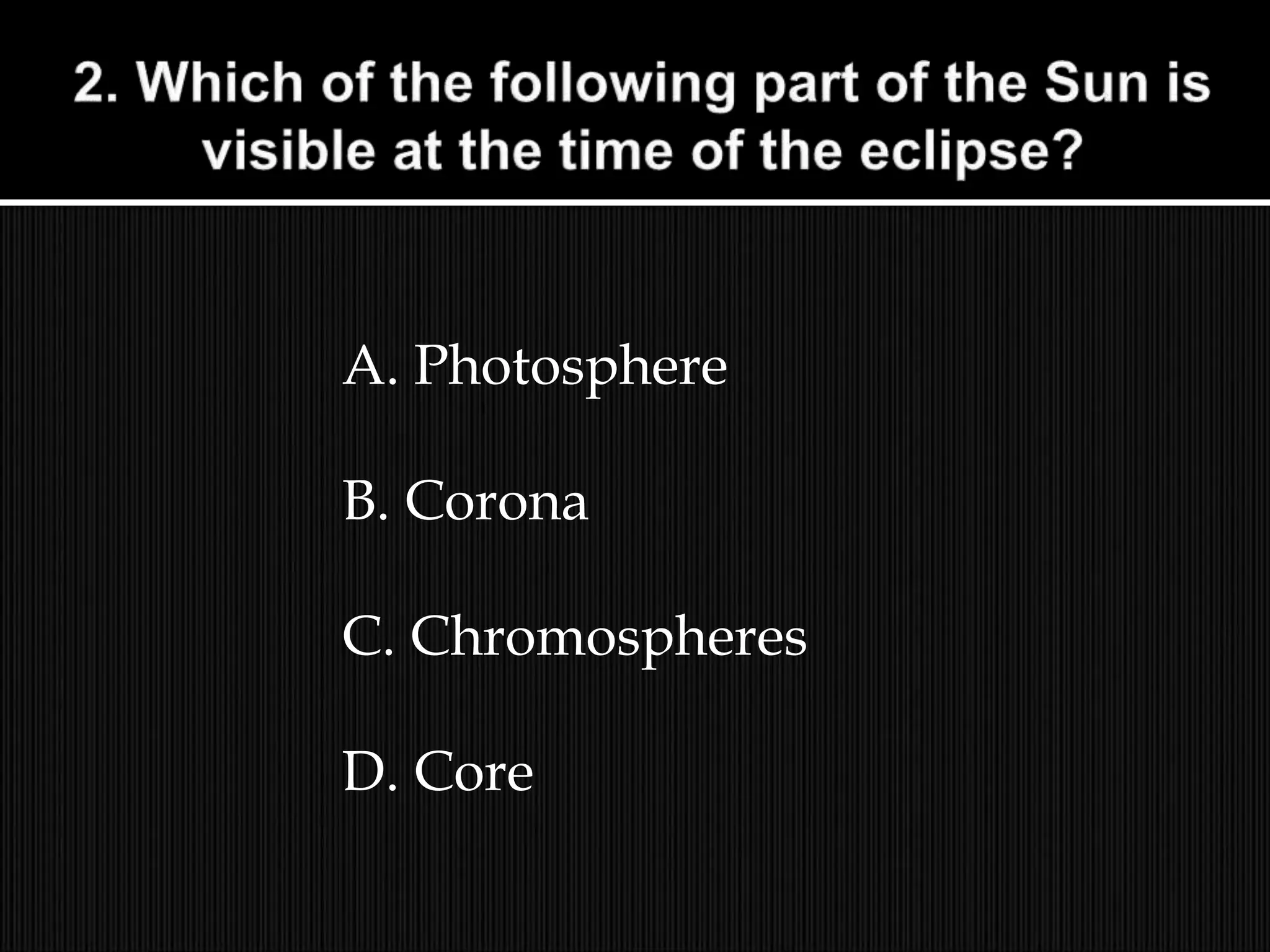
A. Photosphere
B. Corona
C. Chromospheres
D. Core
A. Photosphere
A. Photosphere
B. Corona
C. Chromospheres
D. Core
B. Corona
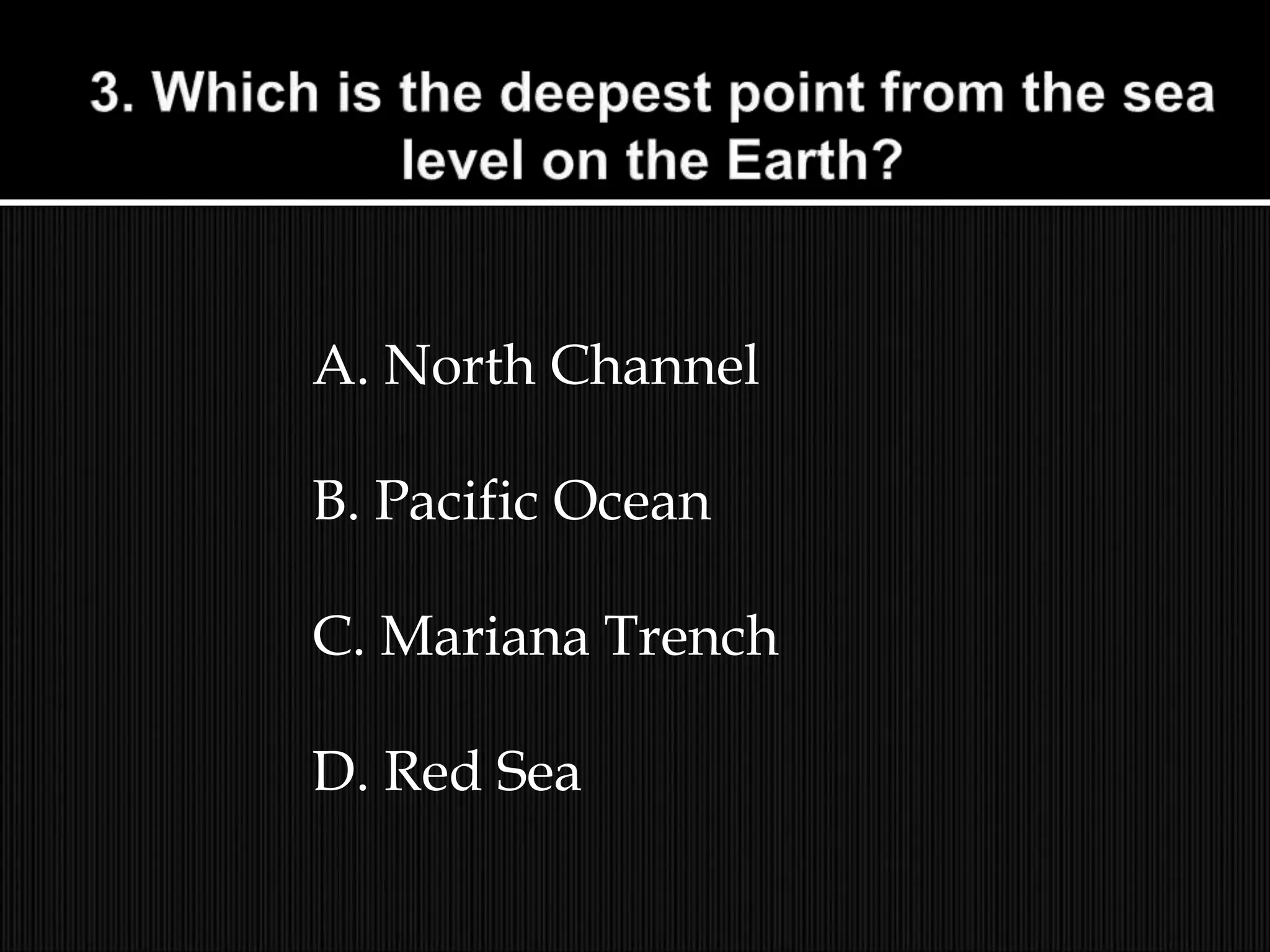
A. North Channel
B. Pacific Ocean
C. Mariana Trench
D. Red Sea
C. Mariana Trench
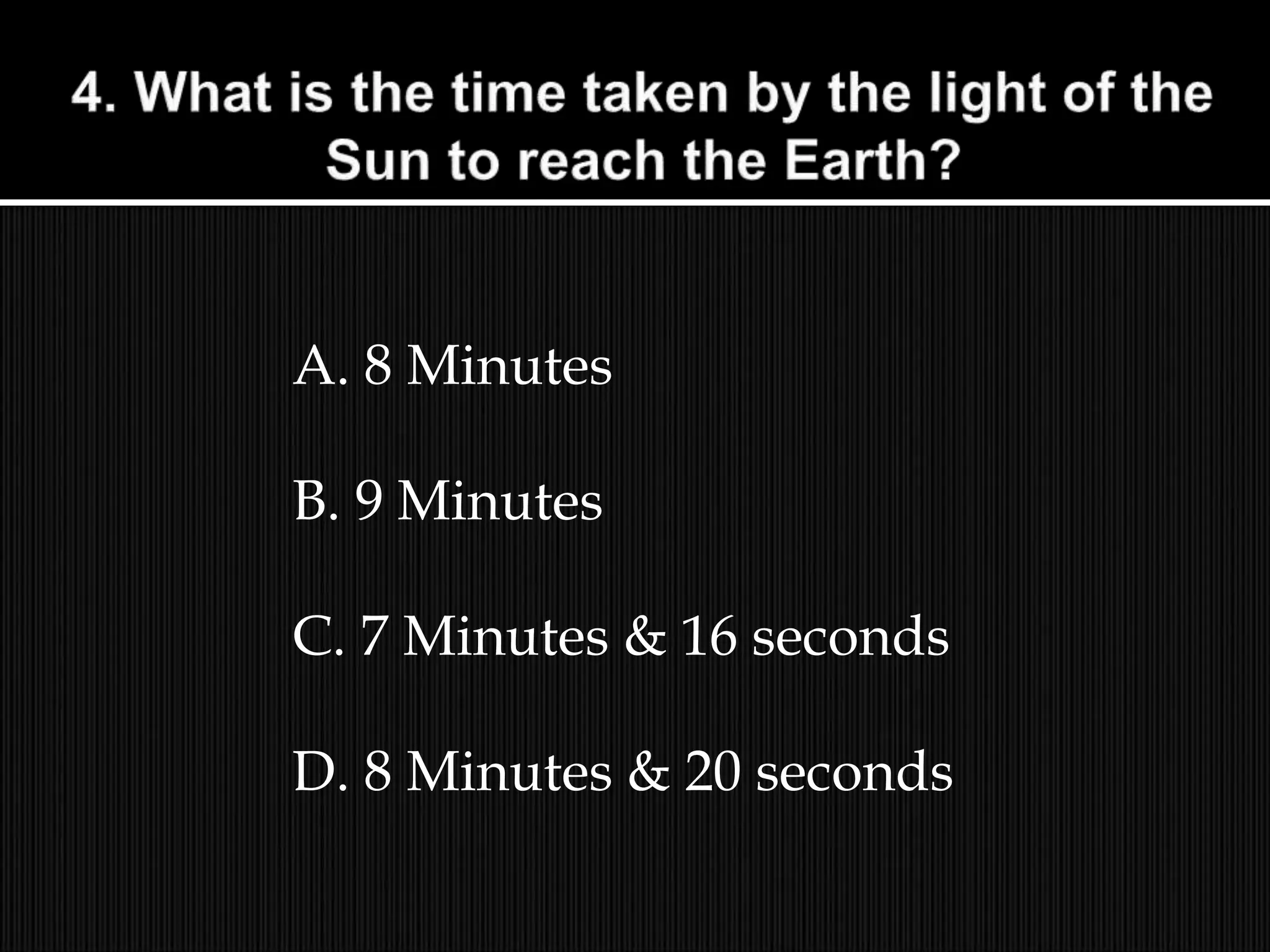
A. 8 Minutes
B. 9 Minutes
C. 7 Minutes & 16 seconds
D. 8 Minutes & 20 seconds
D. 8 Minutes & 20 second
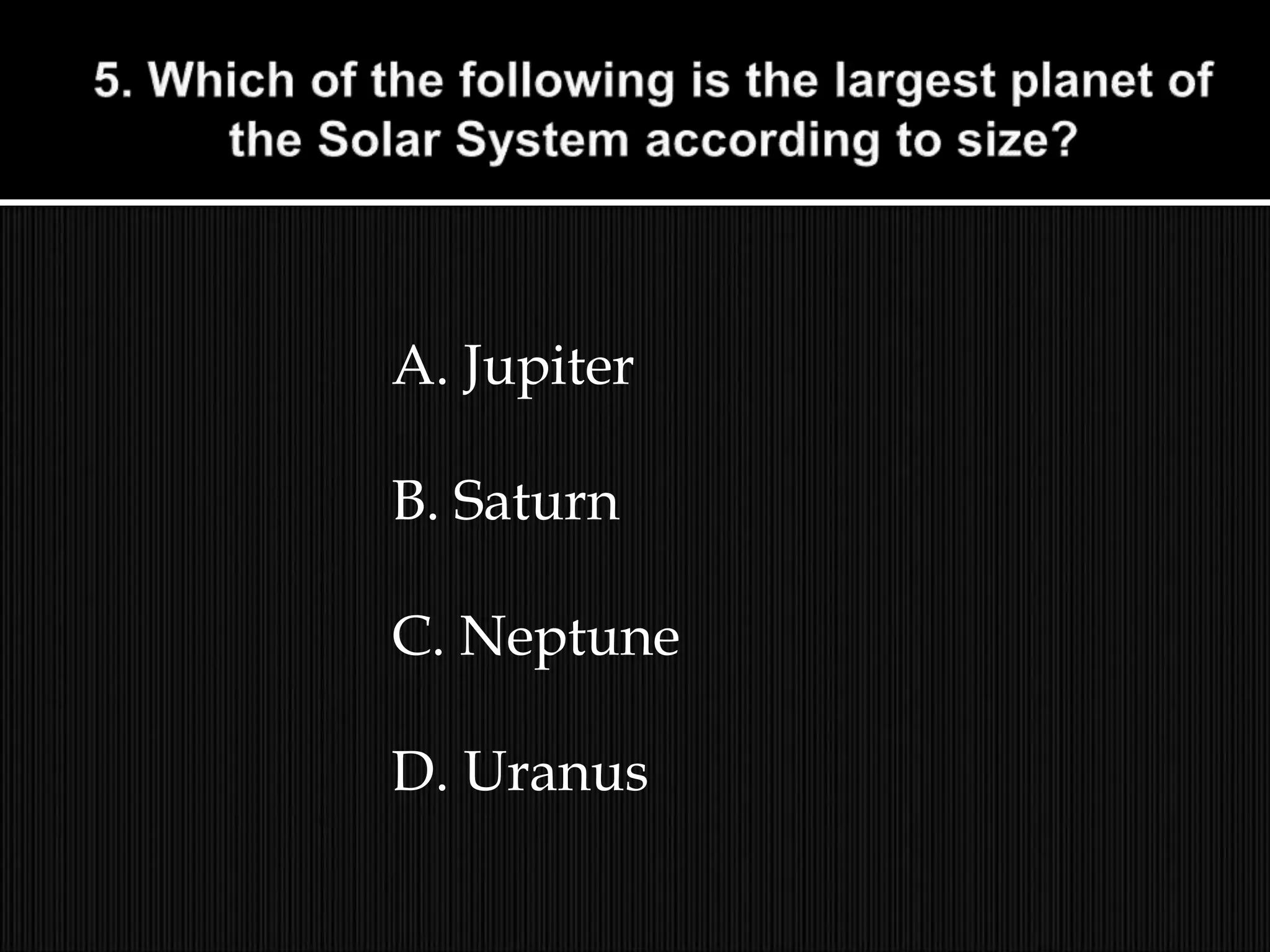
A. Jupiter
B. Saturn
C. Neptune
D. Uranus
A. Jupiter
A. Neptune
B. Mars
C. Mercury
D. Venus
C. Mercury
A. Mars
B. Earth
C. Venus
D. Uranus
D. Uranus
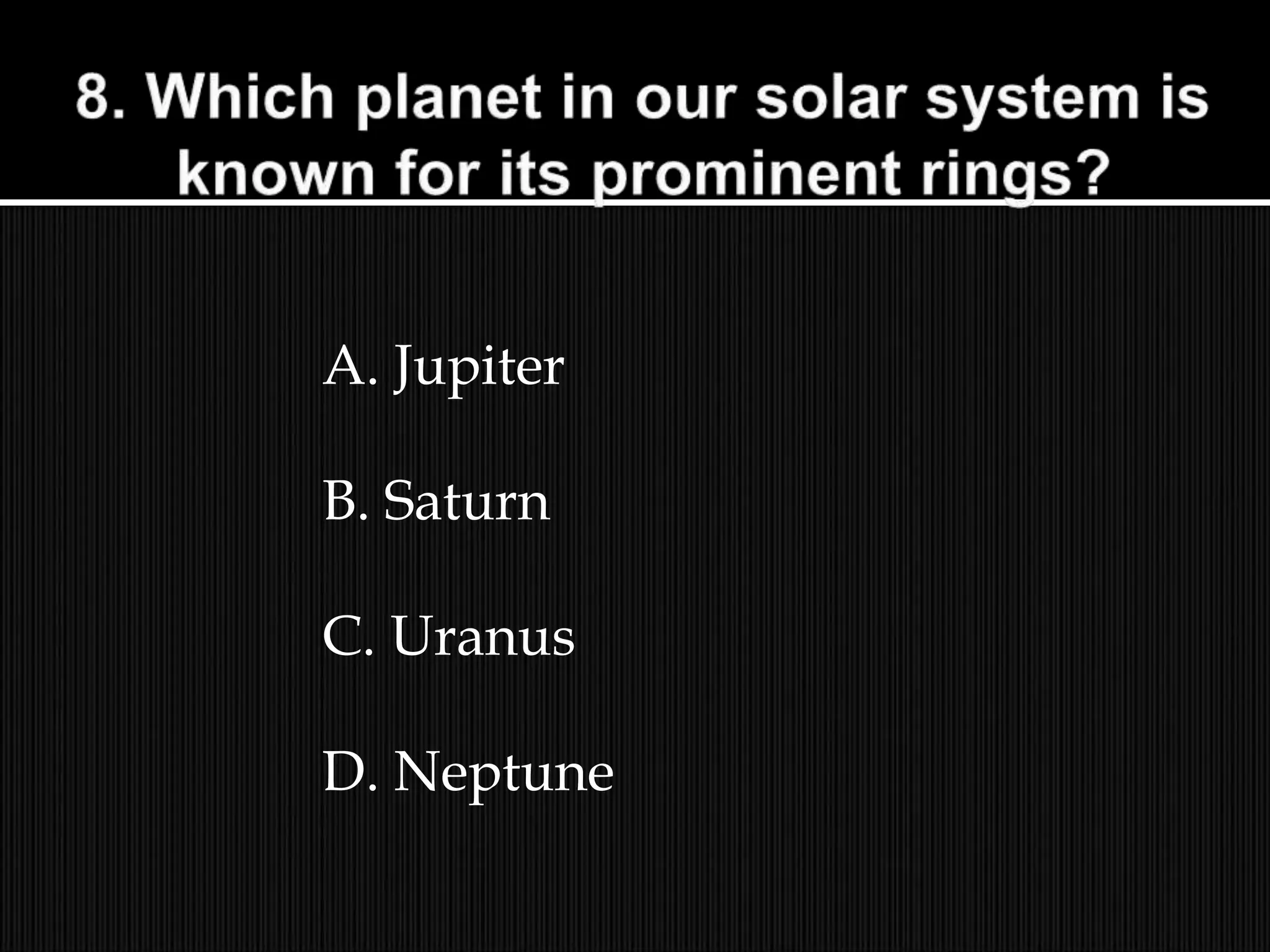
A. Jupiter
B. Saturn
C. Uranus
D. Neptune
B. Saturn
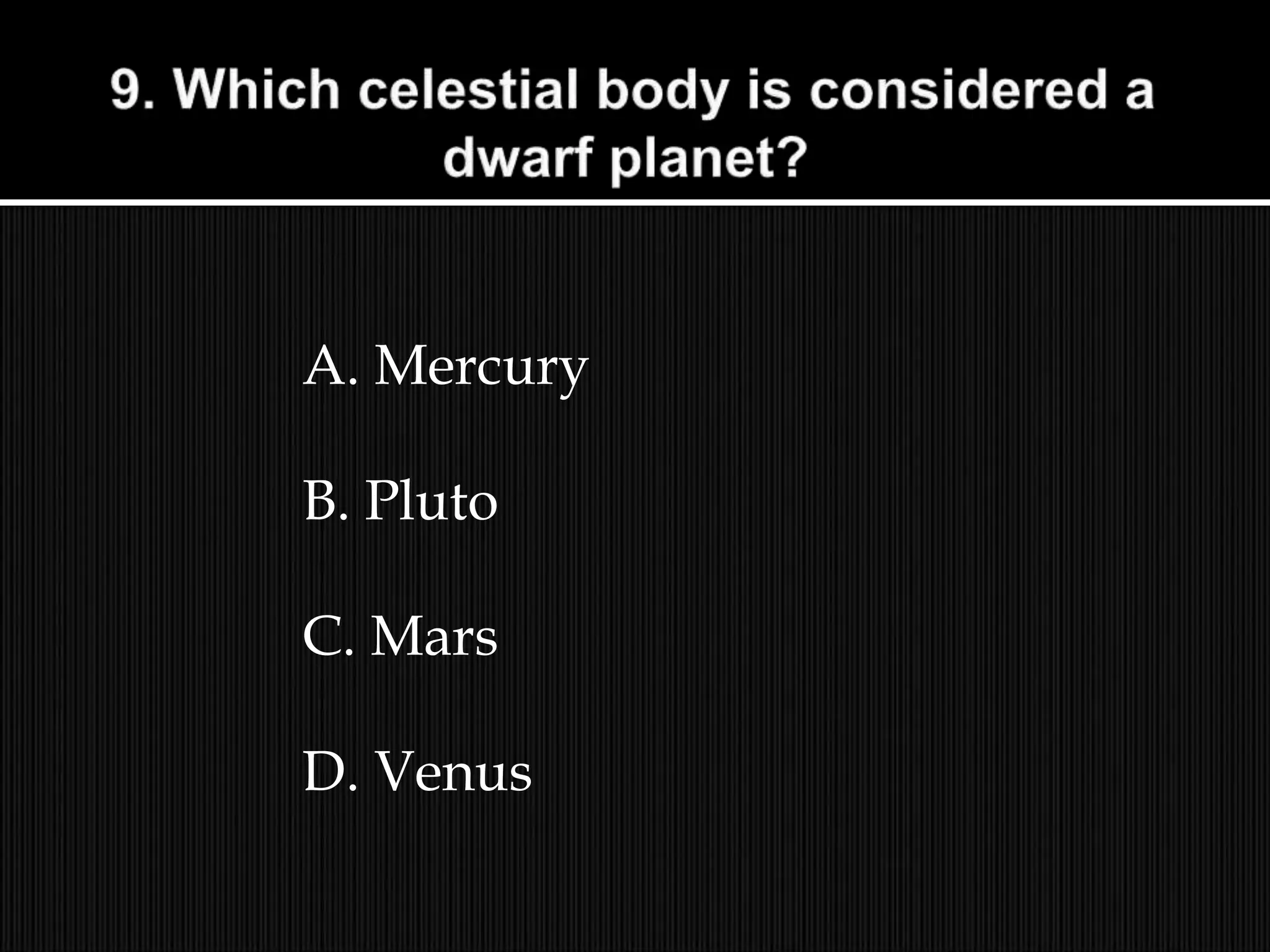
A. Mercury
B. Pluto
C. Mars
D. Venus
B. Pluto
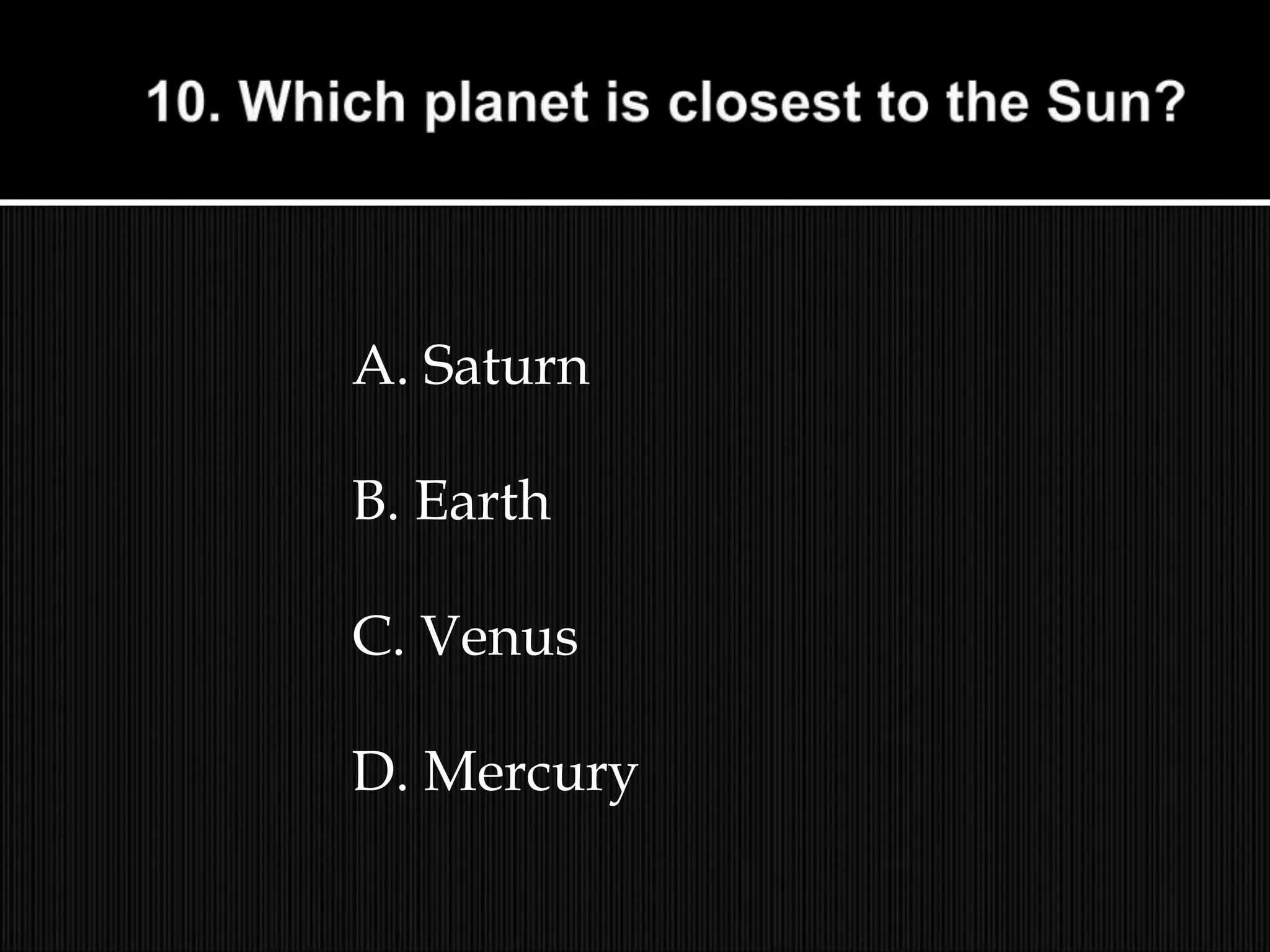
A. Saturn
B. Earth
C. Venus
D. Mercury
D. Mercury
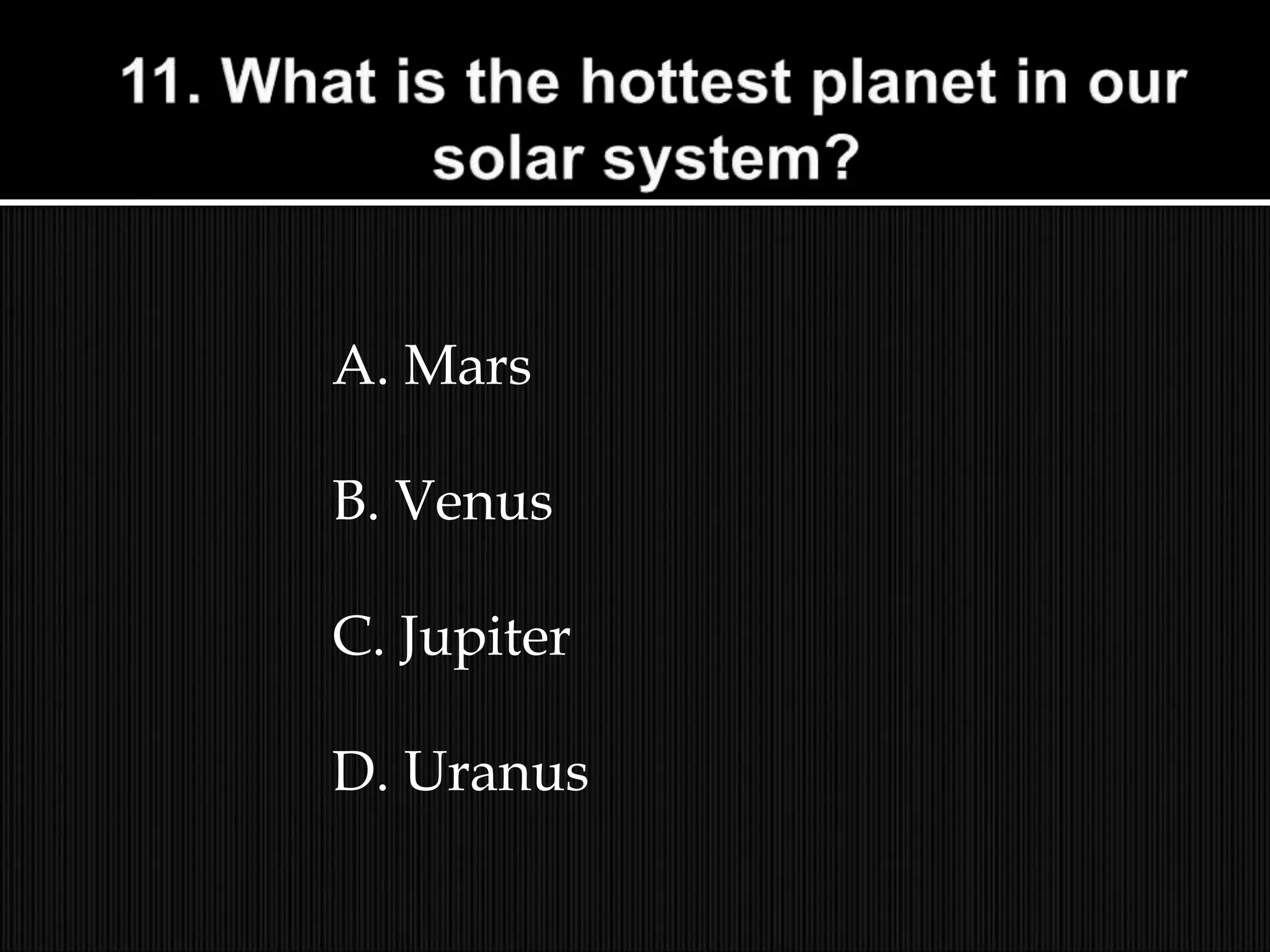
A. Mars
B. Venus
C. Jupiter
D. Uranus
B. Venus
A. Earth
B. Uranus
C. Mars
D. Neptune
C. Mars
A. Jupiter
B. Saturn
C. Uranus
D. Neptune
B. Saturn
A. Asteroid
D. Meteoroid
B. Comet
D Meteorite
B. Comet
Solar System & Quiz.ppt

Solar System & Quiz.ppt

  • 2.
    The Sun, itsplanets and other objects in orbit are all together known as the solar system.
  • 3.
  • 4.
     The Sunis a star which the Eight planets move around.  The path each planet travels around is called it orbit.  The planets are kept in their orbits due to the pulling force of the Sun’s gravity.
  • 6.
     Moons are‘Natural Satellites’.  Moons orbit around a planet.  The moon stays in its orbit due to the gravitational pull of the planet.  Our moon has a circular orbit.  We see the moon because it reflects light.
  • 7.
     Asteroids  Meteorites Comets  These are minor planets found in their thousands between Mars and Jupiter.  These are probably fragments of asteroids that broke up.  These are lumps of ‘Dirty Ice’ a few km across that travel in highly elliptical orbits. As they near the Sun they warm up. This causes a tail of dust and cloud.
  • 11.
     A galaxyis made up of billions of stars.  Our galaxy is called the Milky Way galaxy, that has a spiral shape.  Our Sun is just one of the stars that form the Milky way galaxy.  The Milky Way is 100 000 light years across, and the nearest star to Earth (apart from the Sun) is 4.2 light years away.
  • 12.
     Our SolarSystem is here.
  • 16.
     A lightyear is not a period of time.  A light year is a distance.  A light year is the distance that light travels in one year.  As light travels at a speed of 300 000 000 m/s (or 300 000 km/s) then if we multiply this by the number of seconds in a year we will see that light will have travelled 9.5 x 10¹⁵ m (9 500 000 000 000 000 m ).  Our galaxy is 100 000 times this distance across.
  • 17.
     There aremillions of other galaxies which are seen further and further away in the space.  Galaxies themselves are millions of times further apart than the stars are within a galaxy.  All these galaxies make up the Universe (which includes all the empty space between galaxies).  The Universe is perhaps 20 000 million light years across.
  • 18.
     Planet wordcomes from Greek ,which means wandering star.  Planets are heavenly bodies ,which revolve around the Sun in elliptical orbits.  Earlier it was considered there were 9 planets in Solar system but lately one planet called Pluto was de-classified from being a planet.  All planets fall in 2 groups Inner Planets: Mercury , Venus, Mars and Earth are called inner planets. Outer Planets: Jupiter , Saturn, Uranus, Neptune are called outer planets.
  • 20.
     The fourplanets closest to the Sun—Mercury, Venus, Earth, and Mars— are the inner planets or terrestrial planets.  They are similar to Earth.  All are solid, dense, and rocky. None of the inner planets has rings. Compared to the outer planets, the inner planets are small. They have shorter orbits around the Sun and they spin more slowly. Venus spins backward and spins the slowest of all the planets.  All of the inner planets were geologically active at one time. They are all made of cooled igneous rock with inner iron cores. Earth has one big, round moon,  while Mars has two very small, irregular moons. Mercury and Venus do
  • 21.
     Jupiter, Saturn,Uranus, and Neptune are the outer planets of our solar system.  These are the four planets farthest from the Sun.  The outer planets are much larger than the inner planets.  Since they are mostly made of gases, they are also called gas giants.
  • 23.
     Dwarf planetsare objects that are similar to planets except that they orbit the Sun in areas where there are many similar objects.
  • 25.
     It containsabout 98% of all the rocks, dust, and gas in the Solar System.  It acts as a giant magnet.  It has Hydrogen 75% & 25 Helium gases.  The Sun’s surface is 5500 Degrees Celsius.  The Sun’s center Temp is 22,00,000 Degrees Celsius.
  • 27.
     Rotation refersto an object's spinning motion about its own axis.  For example, Earth rotates on its own axis, producing the 24- hours in a day.  Revolution refers the object's orbital motion around another object.  Earth revolves about the Sun, producing the 365-days in a year
  • 29.
     It takes88 days to Revolve.  It takes 58.7 days to Rotate.  It smaller than the Earth, it has less gravity than the Earth.  It has no Moons.  It has oxygen, sodium, hydrogen, helium and potassium.  It is 57.9 million km away from the Sun.  Mercury is hot in day & so cold in Night due to slowly spins.  Mercury: Mercury is the smallest planet in our Solar System  It is also the closest to the Sun.
  • 31.
     It takes224 days to Revolve.  It takes 18 hours to Rotate.  It is too hot due to its composition.  It has Carbon Dioxide 96 & Nitrogen 3.5 gases.  Venus has no moons.  It is 108.2 million kilometer away from the Sun.  Venus has temperature 480 Degrees Celsius.  It is known as the hottest & brightest planet in the Solar System.
  • 33.
     It takes365.25 days to Revolve.  It takes 23 hours, 56 minutes, 0.4 seconds to Rotate.  It has 150 million kilometer away form Sun.  A.U means Astronomical Unit, One A.U is equal to 150 million kilometer distance.  It has Nitrogen 78% & Oxygen 21%.  Earth has one moon called Luna.
  • 34.
     It isthe third planet from the Sun,  It is an oblate sphere,  It rotates on its imaginary axis counterclockwise every 24 hours  It appears blue in space because it is 71% water, it revolves around the sun every 365.25 days or 1 year.
  • 36.
     Luna isEarth’s Moon,  Luna is 384400 Km away from Earth.  It has Physical Features like mountains, valleys, old volcanoes, & craters.  Craters are caused by asteroids & comets colliding with the Moon.  Luna & Earth are very close in size.  It has dark spots.
  • 38.
     It takes687 days to Revolve.  It takes 24.6 hours to Rotate.  Mars is 227.9 million kilometer away from the Sun.  It has Carbon Dioxide & oxygen gases.  Less gravity than Earth.  Scientists have found that Mars once had steams, rivers, lakes & an ocean.  Mars has Two moons, Deimos & Phobos.  Mars has the highest mountains & deepest canyons in the
  • 40.
     It takes11.5 years to Revolve.  It takes 10 hours to Rotate.  It is 778.4 million kilometer away from the Sun.  It has greater gravity than Earth.  Jupiter has a great red spot.  It has 63 moons.  It has Hydrogen, Helium & Methane gases.  There is no solid surface here, it has just one huge ocean of hydrogen & water.
  • 42.
     It takes29.5 years to Revolve.  It takes 10.25 hours to Rotate.  It is 1424 million kilometers away from Sun.  It has huge gravity than Earth.  It has rings around it.  It has Hydrogen & Helium gases.  It has 18 moons.  Saturn is very similar to Jupiter.
  • 44.
     It takes84 years to Revolve.  It takes 17 hours to Rotate.  It is 2872 million kilometers away form the Sun.  It has huge gravity than the Earth.  It is 27 moons.  It has Anomie, Hydrogen & Methane gases.  Uranus could have ocean its atmosphere, & possible have trillions of large diamonds.
  • 46.
     It takes165 years to Revolve.  It takes 16 hours to Rotate.  It is 2,794 million miles away from the Sun.  Neptune has a giant storm jus like Jupiter, is called the Great Dark Spot.  It has Hydrogen, Helium & Methane gases.  It has 6 rings around it.  It is 14 Moons.  It was discovered in 1846.
  • 49.
    A. Photosphere B. Corona C.Chromospheres D. Core
  • 50.
  • 51.
    A. Photosphere B. Corona C.Chromospheres D. Core
  • 52.
  • 53.
    A. North Channel B.Pacific Ocean C. Mariana Trench D. Red Sea
  • 54.
  • 55.
    A. 8 Minutes B.9 Minutes C. 7 Minutes & 16 seconds D. 8 Minutes & 20 seconds
  • 56.
    D. 8 Minutes& 20 second
  • 57.
    A. Jupiter B. Saturn C.Neptune D. Uranus
  • 58.
  • 59.
    A. Neptune B. Mars C.Mercury D. Venus
  • 60.
  • 61.
    A. Mars B. Earth C.Venus D. Uranus
  • 62.
  • 63.
    A. Jupiter B. Saturn C.Uranus D. Neptune
  • 64.
  • 65.
  • 66.
  • 67.
    A. Saturn B. Earth C.Venus D. Mercury
  • 68.
  • 69.
    A. Mars B. Venus C.Jupiter D. Uranus
  • 70.
  • 71.
    A. Earth B. Uranus C.Mars D. Neptune
  • 72.
  • 73.
    A. Jupiter B. Saturn C.Uranus D. Neptune
  • 74.
  • 75.
    A. Asteroid D. Meteoroid B.Comet D Meteorite
  • 76.