Our
Solar
System
Our Solar System
Our solar system is made up of:
   Sun
   Nine planets
   Their moons
   Asteroids
   Comets
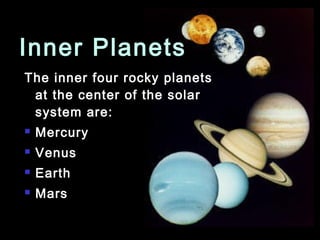
Inner Planets
The inner four rocky planets
 at the center of the solar
 system are:
   Mercury
   Venus
   Earth
   Mars
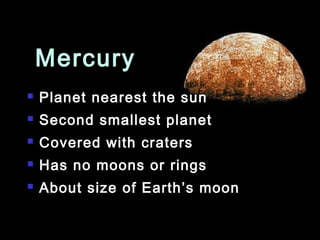
Mercury
   Planet nearest the sun
   Second smallest planet
   Covered with craters
   Has no moons or rings
   About size of Earth’s moon
Venus
   Sister planet to Earth
   Has no moons or rings
   Hot, thick atmosphere
   Brightest object in sky besides
    sun and moon (looks like bright
    star)
   Covered with craters, volcanoes,
Earth
   Third planet from sun
   Only planet known to have life
    and liquid water
   Atmosphere composed of
    composed of Nitrogen (78%),
    Oxygen (21%), and other gases
    (1%).
Mars
   Fourth planet from sun
   Appears as bright reddish color in
    the night sky
   Surface features volcanoes and
    huge dust storms
   Has 2 moons: Phobos and
    Deimos
Outer Planets
The outer planets
 composed of gas are :
   Jupiter
   Saturn
   Uranus
   Neptune
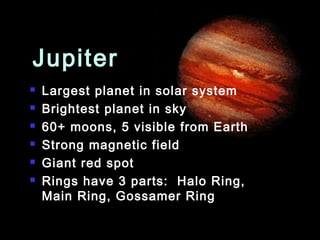
Jupiter
   Largest planet in solar system
   Brightest planet in sky
   60+ moons, 5 visible from Earth
   Strong magnetic field
   Giant red spot
   Rings have 3 parts: Halo Ring,
    Main Ring, Gossamer Ring
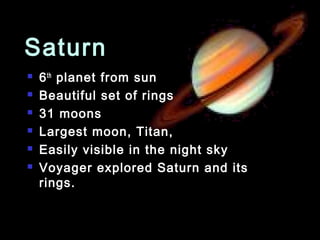
Saturn
   6 th planet from sun
   Beautiful set of rings
   31 moons
   Largest moon, Titan,
   Easily visible in the night sky
   Voyager explored Saturn and its
    rings.
Uranus
   7 th planet from sun
   Has a faint ring system
   27 known moons
   Covered with clouds
   Uranus sits on its side with
    the north and south poles
    sticking out the sides.
Neptune
   8 th planet from sun
   Discovered through math
   7 known moons
   Triton largest moon
   Great Dark Spot thought to be
    a hole, similar to the hole in
    the ozone layer on Earth
Outermost Planet
   Pluto, the outermost
    planet, is a small
    solid icy planet is
    smaller than the
    Earth's Moon.
Pluto
   9 th planet from sun
    (usually)
   Never visited by
    spacecraft
   Orbits very slowly
   Moon, Charon, is very
    close to Pluto and about
    the same size
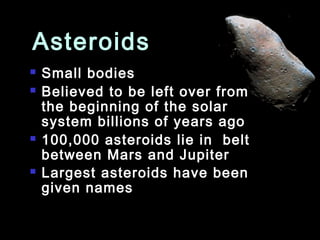
Asteroids
   Small bodies
   Believed to be left over from
    the beginning of the solar
    system billions of years ago
   100,000 asteroids lie in belt
    between Mars and Jupiter
   Largest asteroids have been
    given names
Comets
   Small icy bodies
   Travel past the Sun
   Give off gas and dust as
    they pass by

Solar system

  • 1.
  • 2.
    Our Solar System Oursolar system is made up of:  Sun  Nine planets  Their moons  Asteroids  Comets
  • 3.
    Inner Planets The innerfour rocky planets at the center of the solar system are:  Mercury  Venus  Earth  Mars
  • 4.
    Mercury  Planet nearest the sun  Second smallest planet  Covered with craters  Has no moons or rings  About size of Earth’s moon
  • 5.
    Venus  Sister planet to Earth  Has no moons or rings  Hot, thick atmosphere  Brightest object in sky besides sun and moon (looks like bright star)  Covered with craters, volcanoes,
  • 6.
    Earth  Third planet from sun  Only planet known to have life and liquid water  Atmosphere composed of composed of Nitrogen (78%), Oxygen (21%), and other gases (1%).
  • 7.
    Mars  Fourth planet from sun  Appears as bright reddish color in the night sky  Surface features volcanoes and huge dust storms  Has 2 moons: Phobos and Deimos
  • 8.
    Outer Planets The outerplanets composed of gas are :  Jupiter  Saturn  Uranus  Neptune
  • 9.
    Jupiter  Largest planet in solar system  Brightest planet in sky  60+ moons, 5 visible from Earth  Strong magnetic field  Giant red spot  Rings have 3 parts: Halo Ring, Main Ring, Gossamer Ring
  • 10.
    Saturn  6 th planet from sun  Beautiful set of rings  31 moons  Largest moon, Titan,  Easily visible in the night sky  Voyager explored Saturn and its rings.
  • 11.
    Uranus  7 th planet from sun  Has a faint ring system  27 known moons  Covered with clouds  Uranus sits on its side with the north and south poles sticking out the sides.
  • 12.
    Neptune  8 th planet from sun  Discovered through math  7 known moons  Triton largest moon  Great Dark Spot thought to be a hole, similar to the hole in the ozone layer on Earth
  • 13.
    Outermost Planet  Pluto, the outermost planet, is a small solid icy planet is smaller than the Earth's Moon.
  • 14.
    Pluto  9 th planet from sun (usually)  Never visited by spacecraft  Orbits very slowly  Moon, Charon, is very close to Pluto and about the same size
  • 15.
    Asteroids  Small bodies  Believed to be left over from the beginning of the solar system billions of years ago  100,000 asteroids lie in belt between Mars and Jupiter  Largest asteroids have been given names
  • 16.
    Comets  Small icy bodies  Travel past the Sun  Give off gas and dust as they pass by