INTRODUCTION
Photovoltaic (PV) power systems convert sunlight
directly into electricity. A residential PV power
system enables a homeowner to generate some or
all of their daily electrical energy demand on their
own roof, exchanging daytime excess power for
future energy needs (i.e. nighttime usage). The
house remains connected to the electric utility at all
times, so any power needed above what the solar
system can produce is simply drawn from the
utility.
4/16/2017
solar power - introduction - pavithran
,MNU
1
PV systems can also include battery backup or
uninterruptible power supply (UPS) capability
to operate selected circuits in the residence for
hours or days during a utility outage. The purpose
of this document is to provide tools and
guidelines for the installer to help ensure that
residential photovoltaic power systems are
properly specified and installed, resulting in a
system that operates to its design potential.
4/16/2017
solar power - introduction - pavithran
,MNU
2
1.1. Basic Principles to Follow When Designing a Quality PV System
1. Select a packaged system that meets the owner's needs. Customer criteria for a
system may include reduction in monthly electricity bill, environmental
benefits, desire for backup power, initial budget constraints, etc. Size and orient
the PV array to provide the expected electrical power and energy.
2. Ensure the roof area or other installation site is capable of handling the desired
system size.
3. Specify sunlight and weather resistant materials for all outdoor equipment.
4. Locate the array to minimize shading from foliage, vent pipes, and adjacent
structures.
4/16/2017
solar power - introduction - pavithran
,MNU
3
5. Design the system in compliance with all applicable
building and electrical codes. 6. Design the system with a
minimum of electrical losses due to wiring, fuses, switches,
and inverters.
7. Properly house and manage the battery system, should
batteries be required.
8. Ensure the design meets local utility interconnection
requirements.
4/16/2017
solar power - introduction - pavithran
,MNU
4
1.2. Basic Steps to Follow When Installing a PV System
1. Ensure the roof area or other installation site is capable of
handling the desired system size.
2. 2. If roof mounted, verify that the roof is capable of
handling additional weight of PV system. Augment roof
structure as necessary.
3. 3. Properly seal any roof penetrations with roofing industry
approved sealing methods.
4. 4. Install equipment according to manufacturers
specifications, using installation requirements and
procedures from the manufacturers' specifications.
4/16/2017
solar power - introduction - pavithran
,MNU
5
5. Properly ground the system parts to reduce the threat of shock
hazards and induced surges.
6. Check for proper PV system operation by following the
checkout procedures on the PV System Installation Checklist.
7. Ensure the design meets local utility interconnection
requirements
8. Have final inspections completed by the Authority Having
Jurisdiction (AHJ) and the utility (if required).
4/16/2017
solar power - introduction - pavithran
,MNU
6
SECTION 2: SYSTEM DESIGN CONSIDERATIONS
2.1 Typical System Designs and Options
PV Electrical System Types There are two general types of
electrical designs for PV power systems for homes; Systems
that interact with the utility power grid and have no battery
backup capability; and Systems that interact and include
battery backup as well.
4/16/2017
solar power - introduction - pavithran
,MNU
7
2.1.1. Grid-Interactive Only (No Battery Backup)
This type of system only operates when the utility is
available. Since utility outages are rare, this system will
normally provide the greatest amount of bill savings to the
customer per dollar of investment. However, in the event of
an outage, the system is designed to shut down until utility
power is restored.
4/16/2017
solar power - introduction - pavithran
,MNU
8
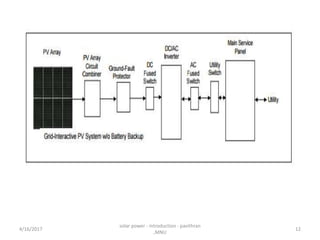
Typical System Components:
PV Array:
A PV Array is made up of PV modules, which are
environmentally-sealed collections of PV Cells— the
devices that convert sunlight to electricity. The most
common PV module that is 5-to-25 square feet in size and
weighs about 3-4 lbs./ft2 . Often sets of four or more
smaller modules are framed or attached together by struts
in what is called a panel. This panel is typically around
20-35 square feet in area for ease of handling on a roof.
This allows some assembly and wiring functions to be
done on the ground if called for by the installation
instructions.
4/16/2017
solar power - introduction - pavithran
,MNU
9
Balance of system equipment (BOS):
BOS includes mounting systems and wiring systems used
to integrate the solar modules into the structural and
electrical systems of the home. The wiring systems
include disconnects for the dc and ac sides of the inverter,
ground-fault protection, and overcurrent protection for the
solar modules. Most systems include a combiner board of
some kind since most modules require fusing for each
module source circuit. Some inverters include this fusing
and combining function within the inverter enclosure.
4/16/2017
solar power - introduction - pavithran
,MNU
10
dc-ac inverter:
This is the device that takes the dc power from the PV array
and converts it into standard ac power used by the house
appliances.
Metering: This includes meters to provide indication of
system performance. Some meters can indicate home energy
usage.
Other components: utility switch (depending on local
utility)
4/16/2017
solar power - introduction - pavithran
,MNU
11
4/16/2017
solar power - introduction - pavithran
,MNU
12
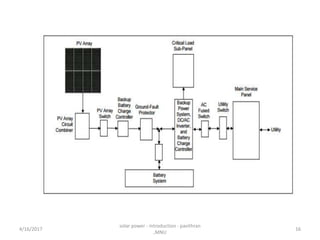
2.1.2. Grid-Interactive With Battery Backup
This type of system incorporates energy storage in the form
of a battery to keep “critical load” circuits in the house
operating during a utility outage. When an outage occurs the
unit disconnects from the utility and powers specific circuits
in the home. These critical load circuits are wired from a
subpanel that is separate from the rest of the electrical
circuits. If the outage occurs during daylight hours, the PV
array is able to assist the battery in supplying the house
loads. If the outage occurs at night, the battery supplies the
load. The amount of time critical loads can operate depends
on the amount of power they consume and the energy
stored in the battery system..
4/16/2017
solar power - introduction - pavithran
,MNU
13
A typical backup battery system may
provide about 8kWh of energy storage at
an 8-hour discharge rate, which means
that the battery will operate a 1-kW load
for 8 hours. A 1-kW load is the average
usage for a home when not running an
air conditioner
4/16/2017
solar power - introduction - pavithran
,MNU
14
Typical System Components:
In addition to components listed in 2.1.1.,
A battery backup system may include some or
all of the following:
1. Batteries and battery enclosures
2. Battery charge controller
3. Separate subpanel(s) for critical load circuits
4/16/2017
solar power - introduction - pavithran
,MNU
15
4/16/2017
solar power - introduction - pavithran
,MNU
16
2.2. Mounting Options
There are several ways to install a PV array at a residence.
Most PV systems produce 5-to-10 Watts per square foot
of array area. This is based on a variety of different
technologies and the varying efficiency of different PV
products. A typical 2- kW PV system will need 200-400
square feet of unobstructed area to site the system.
Consideration should also be given for access to the
system. This access space can add up to 20% of needed
area to the mounting area required.
4/16/2017
solar power - introduction - pavithran
,MNU
17
2.2.1. Roof mount
Often the most convenient and appropriate place to put the
PV array is on the roof of the building. The PV array may
be mounted above and parallel to the roof surface with a
standoff of several inches for cooling purposes. Sometimes,
such as with flat roofs, a separate structure with a more
optimal tilt angle is mounted on the roof. Proper roof
mounting can be labor intensive. Particular attention must
be paid to the roof structure and the weather sealing of roof
penetrations. It is typical to have one support bracket for
every 100 Watts of PV modules.
4/16/2017
solar power - introduction - pavithran
,MNU
18
For new construction, support brackets are usually mounted
after the roof decking is applied and before the roofing
materials is installed. The crew in charge of laying out the
array mounting system normally installs the brackets. The
roofing contractor can then flash around the brackets as they
install the roof. A simple installation detail and a sample of
the support bracket is often all that is needed for a roofing
contractor to estimate the flashing cost.
4/16/2017
solar power - introduction - pavithran
,MNU
19
Masonry roofs are often structurally designed near the limit
of their weight-bearing capacity. In this case, the roof
structure must either be enhanced to handle the additional
weight of the PV system or the masonry roof transitioned to
composition shingles in the area where the PV array is to be
mounted. By transitioning to a lighter roofing product, there
is no need to reinforce the roof structure since the combined
weight of composite shingles and PV array is usually less
than the displaced masonry product.
4/16/2017
solar power - introduction - pavithran
,MNU
20
2.2.2. Shade Structure
An alternative to roof mounting is to mount the system as a
shade structure. A shade structure may be a patio cover or
deck shade trellis where the PV array becomes the shade.
These shade systems can support small to large PV systems.
The construction cost with a PV system is a little different
than for a standard patio cover, especially if the PV array is
acts as part or the entire shade roof. If the PV array is
mounted at a steeper angle than a typical shade structure,
additional structural enhancements may be necessary to
handle the additional wind loads.
4/16/2017
solar power - introduction - pavithran
,MNU
21
The weight of the PV array is 3-to-5 lbs./ft2 , which is well
within structural limits of most shade support structures. The
avoided cost of installing roof brackets and the associated labor
could be counted toward the cost of a fully constructed patio
cover. The overall cost of this option will likely be higher than
roof mounting, , but the value of the shade often offsets the
additional costs. Other issues to consider include
• Simplified array access for maintenance
• Module wiring, if visible from underneath, must be carefully
concealed to keep the installation aesthetically pleasing
• Cannot grow vines, or must be diligent about keeping it
trimmed back from modules and wiring
4/16/2017
solar power - introduction - pavithran
,MNU
22
2.2.3. Building-Integrated PV Array (BIPV)
Another type of system displaces some of the
conventional roofing product with building
integrated PV modules. Commercially available
products currently include roof slates (similar to
masonry roofing) and standing seam metal roofing
products. Special attention must be paid to ensure
that these products are installed properly and carry
the necessary fire ratings.
Dimensional tolerances are critical and installation
requirements must followed precisely to avoid roof
leaks.
4/16/2017
solar power - introduction - pavithran
,MNU
23
2.3 Estimating System Output
PV systems produce power in proportion to the
intensity of sunlight striking the solar array surface.
The intensity of light on a surface varies throughout
a day, as well as day to day, so the actual output of a
solar power system can vary substantial. There are
other factors that affect the output of a solar power
system.
These factors need to be understood so that the
customer has realistic expectations of overall system
output and economic benefits under variable
weather conditions over time.
4/16/2017
solar power - introduction - pavithran
,MNU
24

Solar presenta1

  • 1.
    INTRODUCTION Photovoltaic (PV) powersystems convert sunlight directly into electricity. A residential PV power system enables a homeowner to generate some or all of their daily electrical energy demand on their own roof, exchanging daytime excess power for future energy needs (i.e. nighttime usage). The house remains connected to the electric utility at all times, so any power needed above what the solar system can produce is simply drawn from the utility. 4/16/2017 solar power - introduction - pavithran ,MNU 1
  • 2.
    PV systems canalso include battery backup or uninterruptible power supply (UPS) capability to operate selected circuits in the residence for hours or days during a utility outage. The purpose of this document is to provide tools and guidelines for the installer to help ensure that residential photovoltaic power systems are properly specified and installed, resulting in a system that operates to its design potential. 4/16/2017 solar power - introduction - pavithran ,MNU 2
  • 3.
    1.1. Basic Principlesto Follow When Designing a Quality PV System 1. Select a packaged system that meets the owner's needs. Customer criteria for a system may include reduction in monthly electricity bill, environmental benefits, desire for backup power, initial budget constraints, etc. Size and orient the PV array to provide the expected electrical power and energy. 2. Ensure the roof area or other installation site is capable of handling the desired system size. 3. Specify sunlight and weather resistant materials for all outdoor equipment. 4. Locate the array to minimize shading from foliage, vent pipes, and adjacent structures. 4/16/2017 solar power - introduction - pavithran ,MNU 3
  • 4.
    5. Design thesystem in compliance with all applicable building and electrical codes. 6. Design the system with a minimum of electrical losses due to wiring, fuses, switches, and inverters. 7. Properly house and manage the battery system, should batteries be required. 8. Ensure the design meets local utility interconnection requirements. 4/16/2017 solar power - introduction - pavithran ,MNU 4
  • 5.
    1.2. Basic Stepsto Follow When Installing a PV System 1. Ensure the roof area or other installation site is capable of handling the desired system size. 2. 2. If roof mounted, verify that the roof is capable of handling additional weight of PV system. Augment roof structure as necessary. 3. 3. Properly seal any roof penetrations with roofing industry approved sealing methods. 4. 4. Install equipment according to manufacturers specifications, using installation requirements and procedures from the manufacturers' specifications. 4/16/2017 solar power - introduction - pavithran ,MNU 5
  • 6.
    5. Properly groundthe system parts to reduce the threat of shock hazards and induced surges. 6. Check for proper PV system operation by following the checkout procedures on the PV System Installation Checklist. 7. Ensure the design meets local utility interconnection requirements 8. Have final inspections completed by the Authority Having Jurisdiction (AHJ) and the utility (if required). 4/16/2017 solar power - introduction - pavithran ,MNU 6
  • 7.
    SECTION 2: SYSTEMDESIGN CONSIDERATIONS 2.1 Typical System Designs and Options PV Electrical System Types There are two general types of electrical designs for PV power systems for homes; Systems that interact with the utility power grid and have no battery backup capability; and Systems that interact and include battery backup as well. 4/16/2017 solar power - introduction - pavithran ,MNU 7
  • 8.
    2.1.1. Grid-Interactive Only(No Battery Backup) This type of system only operates when the utility is available. Since utility outages are rare, this system will normally provide the greatest amount of bill savings to the customer per dollar of investment. However, in the event of an outage, the system is designed to shut down until utility power is restored. 4/16/2017 solar power - introduction - pavithran ,MNU 8
  • 9.
    Typical System Components: PVArray: A PV Array is made up of PV modules, which are environmentally-sealed collections of PV Cells— the devices that convert sunlight to electricity. The most common PV module that is 5-to-25 square feet in size and weighs about 3-4 lbs./ft2 . Often sets of four or more smaller modules are framed or attached together by struts in what is called a panel. This panel is typically around 20-35 square feet in area for ease of handling on a roof. This allows some assembly and wiring functions to be done on the ground if called for by the installation instructions. 4/16/2017 solar power - introduction - pavithran ,MNU 9
  • 10.
    Balance of systemequipment (BOS): BOS includes mounting systems and wiring systems used to integrate the solar modules into the structural and electrical systems of the home. The wiring systems include disconnects for the dc and ac sides of the inverter, ground-fault protection, and overcurrent protection for the solar modules. Most systems include a combiner board of some kind since most modules require fusing for each module source circuit. Some inverters include this fusing and combining function within the inverter enclosure. 4/16/2017 solar power - introduction - pavithran ,MNU 10
  • 11.
    dc-ac inverter: This isthe device that takes the dc power from the PV array and converts it into standard ac power used by the house appliances. Metering: This includes meters to provide indication of system performance. Some meters can indicate home energy usage. Other components: utility switch (depending on local utility) 4/16/2017 solar power - introduction - pavithran ,MNU 11
  • 12.
    4/16/2017 solar power -introduction - pavithran ,MNU 12
  • 13.
    2.1.2. Grid-Interactive WithBattery Backup This type of system incorporates energy storage in the form of a battery to keep “critical load” circuits in the house operating during a utility outage. When an outage occurs the unit disconnects from the utility and powers specific circuits in the home. These critical load circuits are wired from a subpanel that is separate from the rest of the electrical circuits. If the outage occurs during daylight hours, the PV array is able to assist the battery in supplying the house loads. If the outage occurs at night, the battery supplies the load. The amount of time critical loads can operate depends on the amount of power they consume and the energy stored in the battery system.. 4/16/2017 solar power - introduction - pavithran ,MNU 13
  • 14.
    A typical backupbattery system may provide about 8kWh of energy storage at an 8-hour discharge rate, which means that the battery will operate a 1-kW load for 8 hours. A 1-kW load is the average usage for a home when not running an air conditioner 4/16/2017 solar power - introduction - pavithran ,MNU 14
  • 15.
    Typical System Components: Inaddition to components listed in 2.1.1., A battery backup system may include some or all of the following: 1. Batteries and battery enclosures 2. Battery charge controller 3. Separate subpanel(s) for critical load circuits 4/16/2017 solar power - introduction - pavithran ,MNU 15
  • 16.
    4/16/2017 solar power -introduction - pavithran ,MNU 16
  • 17.
    2.2. Mounting Options Thereare several ways to install a PV array at a residence. Most PV systems produce 5-to-10 Watts per square foot of array area. This is based on a variety of different technologies and the varying efficiency of different PV products. A typical 2- kW PV system will need 200-400 square feet of unobstructed area to site the system. Consideration should also be given for access to the system. This access space can add up to 20% of needed area to the mounting area required. 4/16/2017 solar power - introduction - pavithran ,MNU 17
  • 18.
    2.2.1. Roof mount Oftenthe most convenient and appropriate place to put the PV array is on the roof of the building. The PV array may be mounted above and parallel to the roof surface with a standoff of several inches for cooling purposes. Sometimes, such as with flat roofs, a separate structure with a more optimal tilt angle is mounted on the roof. Proper roof mounting can be labor intensive. Particular attention must be paid to the roof structure and the weather sealing of roof penetrations. It is typical to have one support bracket for every 100 Watts of PV modules. 4/16/2017 solar power - introduction - pavithran ,MNU 18
  • 19.
    For new construction,support brackets are usually mounted after the roof decking is applied and before the roofing materials is installed. The crew in charge of laying out the array mounting system normally installs the brackets. The roofing contractor can then flash around the brackets as they install the roof. A simple installation detail and a sample of the support bracket is often all that is needed for a roofing contractor to estimate the flashing cost. 4/16/2017 solar power - introduction - pavithran ,MNU 19
  • 20.
    Masonry roofs areoften structurally designed near the limit of their weight-bearing capacity. In this case, the roof structure must either be enhanced to handle the additional weight of the PV system or the masonry roof transitioned to composition shingles in the area where the PV array is to be mounted. By transitioning to a lighter roofing product, there is no need to reinforce the roof structure since the combined weight of composite shingles and PV array is usually less than the displaced masonry product. 4/16/2017 solar power - introduction - pavithran ,MNU 20
  • 21.
    2.2.2. Shade Structure Analternative to roof mounting is to mount the system as a shade structure. A shade structure may be a patio cover or deck shade trellis where the PV array becomes the shade. These shade systems can support small to large PV systems. The construction cost with a PV system is a little different than for a standard patio cover, especially if the PV array is acts as part or the entire shade roof. If the PV array is mounted at a steeper angle than a typical shade structure, additional structural enhancements may be necessary to handle the additional wind loads. 4/16/2017 solar power - introduction - pavithran ,MNU 21
  • 22.
    The weight ofthe PV array is 3-to-5 lbs./ft2 , which is well within structural limits of most shade support structures. The avoided cost of installing roof brackets and the associated labor could be counted toward the cost of a fully constructed patio cover. The overall cost of this option will likely be higher than roof mounting, , but the value of the shade often offsets the additional costs. Other issues to consider include • Simplified array access for maintenance • Module wiring, if visible from underneath, must be carefully concealed to keep the installation aesthetically pleasing • Cannot grow vines, or must be diligent about keeping it trimmed back from modules and wiring 4/16/2017 solar power - introduction - pavithran ,MNU 22
  • 23.
    2.2.3. Building-Integrated PVArray (BIPV) Another type of system displaces some of the conventional roofing product with building integrated PV modules. Commercially available products currently include roof slates (similar to masonry roofing) and standing seam metal roofing products. Special attention must be paid to ensure that these products are installed properly and carry the necessary fire ratings. Dimensional tolerances are critical and installation requirements must followed precisely to avoid roof leaks. 4/16/2017 solar power - introduction - pavithran ,MNU 23
  • 24.
    2.3 Estimating SystemOutput PV systems produce power in proportion to the intensity of sunlight striking the solar array surface. The intensity of light on a surface varies throughout a day, as well as day to day, so the actual output of a solar power system can vary substantial. There are other factors that affect the output of a solar power system. These factors need to be understood so that the customer has realistic expectations of overall system output and economic benefits under variable weather conditions over time. 4/16/2017 solar power - introduction - pavithran ,MNU 24