04/30/18Pavithran Puthiyapurayil , FET, MNU 1
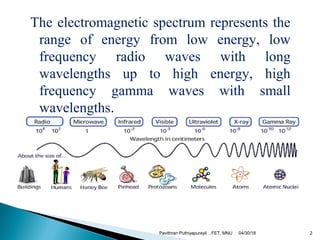
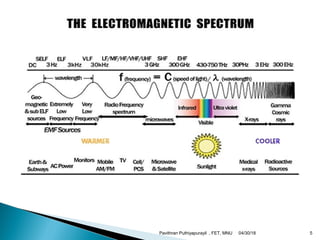
The electromagnetic spectrum represents the
range of energy from low energy, low
frequency radio waves with long
wavelengths up to high energy, high
frequency gamma waves with small
wavelengths.
04/30/18Pavithran Puthiyapurayil , FET, MNU 2

04/30/18Pavithran Puthiyapurayil , FET, MNU 3
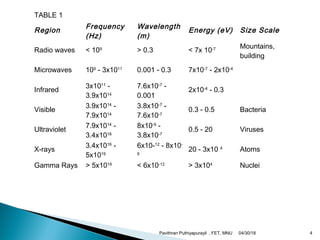
TABLE 1
Region
Frequency
(Hz)
Wavelength
(m)
Energy (eV) Size Scale
Radio waves < 109
> 0.3 < 7x 10⁻⁷ Mountains,
building
Microwaves 109
 - 3x10¹¹
0.001 - 0.3 7x10⁻⁷
 - 2x10⁻⁴
 
Infrared
3x10¹¹
 -
3.9x10¹⁴
7.6x10⁻⁷
 -
0.001
2x10⁻⁴
 - 0.3  
Visible
3.9x10¹⁴
 -
7.9x10¹⁴
3.8x10⁻⁷
 -
7.6x10⁻⁷
0.3 - 0.5 Bacteria
Ultraviolet
7.9x10¹⁴
 -
3.4x10¹⁶
8x10⁻⁹
 -
3.8x10⁻⁷
0.5 - 20 Viruses
X-rays
3.4x10¹⁶
 -
5x10¹⁹
6x10-12
 - 8x10-
9
20 - 3x10 4
Atoms
Gamma Rays > 5x10¹⁹
< 6x10-12
> 3x10⁴
Nuclei
04/30/18Pavithran Puthiyapurayil , FET, MNU 4
04/30/18Pavithran Puthiyapurayil , FET, MNU 5
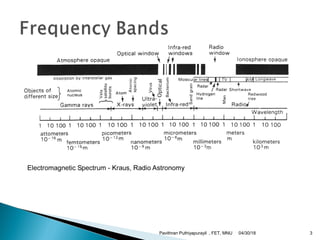
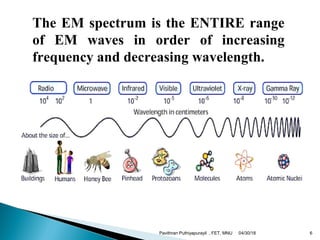
The EM spectrum is the ENTIRE range
of EM waves in order of increasing
frequency and decreasing wavelength.
04/30/18Pavithran Puthiyapurayil , FET, MNU 6
04/30/18
Pavithran Puthiyapurayil , FET,
MNU 7
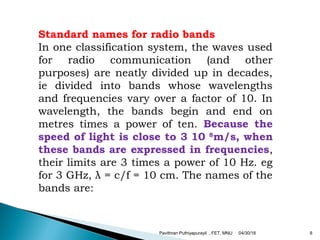
Standard names for radio bands
In one classification system, the waves used
for radio communication (and other
purposes) are neatly divided up in decades,
ie divided into bands whose wavelengths
and frequencies vary over a factor of 10. In
wavelength, the bands begin and end on
metres times a power of ten. Because the
speed of light is close to 3 10 8
m/s, when
these bands are expressed in frequencies,
their limits are 3 times a power of 10 Hz. eg
for 3 GHz, λ = c/f = 10 cm. The names of the
bands are:
04/30/18Pavithran Puthiyapurayil , FET, MNU 8
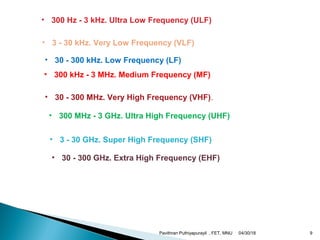
• 300 Hz - 3 kHz. Ultra Low Frequency (ULF)
• 3 - 30 kHz. Very Low Frequency (VLF)
• 30 - 300 kHz. Low Frequency (LF)
• 300 kHz - 3 MHz. Medium Frequency (MF)
• 30 - 300 MHz. Very High Frequency (VHF).
• 300 MHz - 3 GHz. Ultra High Frequency (UHF)
• 3 - 30 GHz. Super High Frequency (SHF)
• 30 - 300 GHz. Extra High Frequency (EHF)
04/30/18Pavithran Puthiyapurayil , FET, MNU 9
Common names for radio bands. For practical
purposes, other divisions of the radio part of the
spectrum are used, including those bands allotted for
specific types of communication. So for instance
people talk of the AM radio band, of the CB band etc.
Here are some examples:
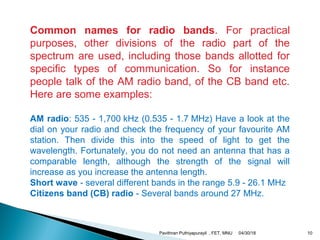
AM radio: 535 - 1,700 kHz (0.535 - 1.7 MHz) Have a look at the
dial on your radio and check the frequency of your favourite AM
station. Then divide this into the speed of light to get the
wavelength. Fortunately, you do not need an antenna that has a
comparable length, although the strength of the signal will
increase as you increase the antenna length.
Short wave - several different bands in the range 5.9 - 26.1 MHz
Citizens band (CB) radio - Several bands around 27 MHz.
04/30/18Pavithran Puthiyapurayil , FET, MNU 10
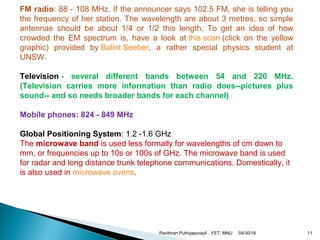
FM radio: 88 - 108 MHz. If the announcer says 102.5 FM, she is telling you
the frequency of her station. The wavelength are about 3 metres, so simple
antennae should be about 1/4 or 1/2 this length. To get an idea of how
crowded the EM spectrum is, have a look at this scan (click on the yellow
graphic) provided by Balint Seeber, a rather special physics student at
UNSW.
Television - several different bands between 54 and 220 MHz.
(Television carries more information than radio does--pictures plus
sound-- and so needs broader bands for each channel)
Mobile phones: 824 - 849 MHz
Global Positioning System: 1.2 -1.6 GHz
The microwave band is used less formally for wavelengths of cm down to
mm, or frequencies up to 10s or 100s of GHz. The microwave band is used
for radar and long distance trunk telephone communications. Domestically, it
is also used in microwave ovens.
04/30/18Pavithran Puthiyapurayil , FET, MNU 11
04/30/18Pavithran Puthiyapurayil , FET, MNU 12
04/30/18Pavithran Puthiyapurayil , FET, MNU 13
Things to RememberThings to Remember
The higher the frequency, the more energy the wave has.The higher the frequency, the more energy the wave has.
EM waves do not require media in which to travel orEM waves do not require media in which to travel or
move.move.
EM waves are considered to be transverse wavesEM waves are considered to be transverse waves
because they are made of vibrating electric and magneticbecause they are made of vibrating electric and magnetic
fields at right angles to each other, and to the directionfields at right angles to each other, and to the direction
the waves are traveling.the waves are traveling.
Inverse relationship between wave size and frequency:
as wavelengths get smaller, frequencies get higher.
04/30/18Pavithran Puthiyapurayil , FET, MNU 14
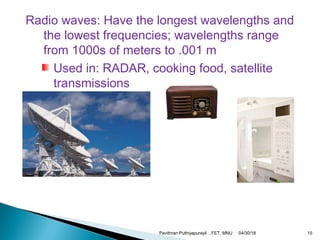
Radio waves: Have the longest wavelengths and
the lowest frequencies; wavelengths range
from 1000s of meters to .001 m
Used in: RADAR, cooking food, satellite
transmissions
04/30/18Pavithran Puthiyapurayil , FET, MNU 15
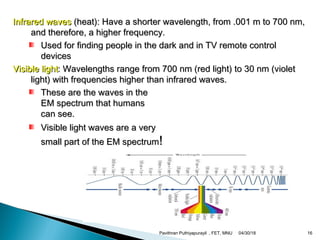
Infrared wavesInfrared waves (heat): Have a shorter wavelength, from .001 m to 700 nm,(heat): Have a shorter wavelength, from .001 m to 700 nm,
and therefore, a higher frequency.and therefore, a higher frequency.
Used for finding people in the dark and in TV remote controlUsed for finding people in the dark and in TV remote control
devicesdevices
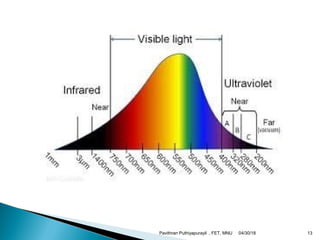
Visible lightVisible light: Wavelengths range from 700 nm (red light) to 30 nm (violet: Wavelengths range from 700 nm (red light) to 30 nm (violet
light) with frequencies higher than infrared waves.light) with frequencies higher than infrared waves.
These are the waves in theThese are the waves in the
EM spectrum that humansEM spectrum that humans
can see.can see.
Visible light waves are a veryVisible light waves are a very
small part of the EM spectrumsmall part of the EM spectrum!!
04/30/18Pavithran Puthiyapurayil , FET, MNU 16
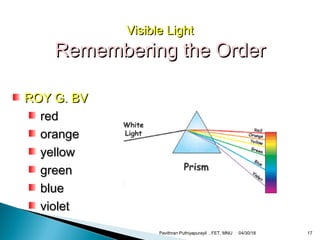
ROY G. BVROY G. BV
redred
orangeorange
yellowyellow
greengreen
blueblue
violetviolet
Visible LightVisible Light
Remembering the OrderRemembering the Order
04/30/18Pavithran Puthiyapurayil , FET, MNU 17
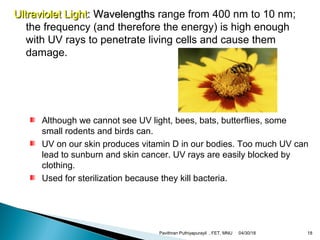
Ultraviolet LightUltraviolet Light: Wavelengths: Wavelengths range from 400 nm to 10 nm;
the frequency (and therefore the energy) is high enough
with UV rays to penetrate living cells and cause them
damage.
Although we cannot see UV light, bees, bats, butterflies, some
small rodents and birds can.
UV on our skin produces vitamin D in our bodies. Too much UV can
lead to sunburn and skin cancer. UV rays are easily blocked by
clothing.
Used for sterilization because they kill bacteria.
04/30/18Pavithran Puthiyapurayil , FET, MNU 18
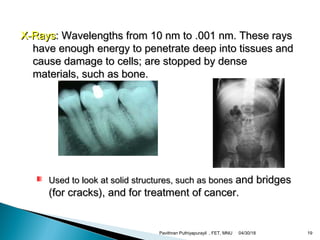
X-RaysX-Rays: Wavelengths from 10 nm to .001 nm. These rays: Wavelengths from 10 nm to .001 nm. These rays
have enough energy to penetrate deep into tissues andhave enough energy to penetrate deep into tissues and
cause damage to cells; are stopped by densecause damage to cells; are stopped by dense
materials, such as bone.materials, such as bone.
Used to look at solid structures, such as bonesUsed to look at solid structures, such as bones and bridgesand bridges
(for cracks), and for treatment of cancer.(for cracks), and for treatment of cancer.
04/30/18Pavithran Puthiyapurayil , FET, MNU 19
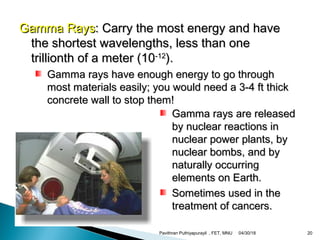
Gamma RaysGamma Rays: Carry the most energy and have: Carry the most energy and have
the shortest wavelengths, less than onethe shortest wavelengths, less than one
trillionth of a meter (10trillionth of a meter (10-12-12
).).
Gamma rays have enough energy to go throughGamma rays have enough energy to go through
most materials easily; you would need a 3-4 ft thickmost materials easily; you would need a 3-4 ft thick
concrete wall to stop them!concrete wall to stop them!
Gamma rays are releasedGamma rays are released
by nuclear reactions inby nuclear reactions in
nuclear power plants, bynuclear power plants, by
nuclear bombs, and bynuclear bombs, and by
naturally occurringnaturally occurring
elements on Earth.elements on Earth.
Sometimes used in theSometimes used in the
treatment of cancers.treatment of cancers.
04/30/18Pavithran Puthiyapurayil , FET, MNU 20
Gamma RaysGamma Rays
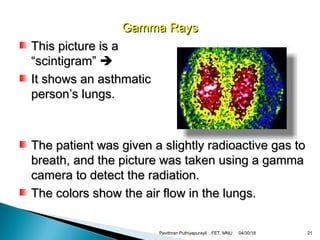
This picture is aThis picture is a
“scintigram”“scintigram” 
It shows an asthmaticIt shows an asthmatic
person’s lungs.person’s lungs.
The patient was given a slightly radioactive gas toThe patient was given a slightly radioactive gas to
breath, and the picture was taken using a gammabreath, and the picture was taken using a gamma
camera to detect the radiation.camera to detect the radiation.
The colors show the air flow in the lungs.The colors show the air flow in the lungs.
04/30/18Pavithran Puthiyapurayil , FET, MNU 21
04/30/18Pavithran Puthiyapurayil , FET, MNU 22
 The electromagnetic spectrum includes many
different types of radiation.
 Visible light accounts for only a small part of
the spectrum
 Other familiar forms include: radio waves,
microwaves, X rays
 All forms of light travel in waves
04/30/18Pavithran Puthiyapurayil , FET, MNU 23
04/30/18Pavithran Puthiyapurayil , FET, MNU 24
Pavithran Puthiyapurayil ,
FET, MNU 25
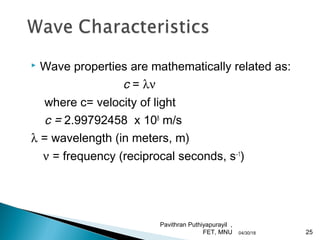
 Wave properties are mathematically related as:
c = λν
where c= velocity of light
c = 2.99792458 x 10⁸
m/s
λ = wavelength (in meters, m)
ν = frequency (reciprocal seconds, s−1
)
04/30/18
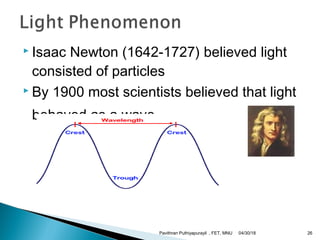
 Isaac Newton (1642-1727) believed light
consisted of particles
 By 1900 most scientists believed that light
behaved as a wave.
04/30/18Pavithran Puthiyapurayil , FET, MNU 26
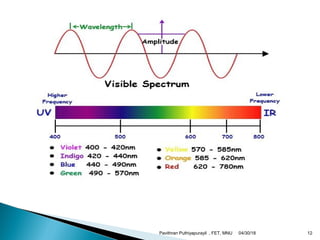
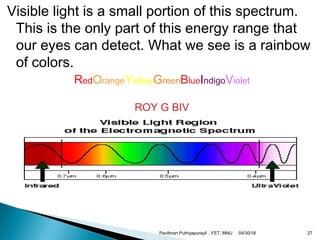
Visible light is a small portion of this spectrum.
This is the only part of this energy range that
our eyes can detect. What we see is a rainbow
of colors.
RedOrangeYellowGreenBlueIndigoViolet
ROY G BIV
04/30/18Pavithran Puthiyapurayil , FET, MNU 27
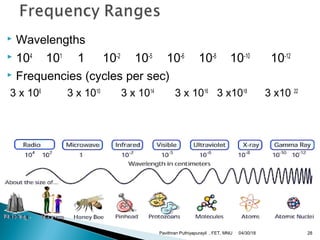
 Wavelengths
 104
101
1 10-2
10-5
10-6
10-8
10-10
10-12
 Frequencies (cycles per sec)
3 x 10⁶
3 x 10¹⁰
3 x 10¹⁴
3 x 10¹⁶
3 x10¹⁸
3 x10 22
04/30/18Pavithran Puthiyapurayil , FET, MNU 28
Red light has a frequency of roughly
4.3 × 10¹⁴
Hz, and a wavelength of about 7.0 ×
10­7
m (700nm).
Violet light, at the other end of the visible
range, has nearly double the frequency—7.5
× 1014
Hz—and (since the speed of light is the
same in either case) just over half the
wavelength—
4.0 × 10­7
m (400nm).
04/30/18Pavithran Puthiyapurayil , FET, MNU 29
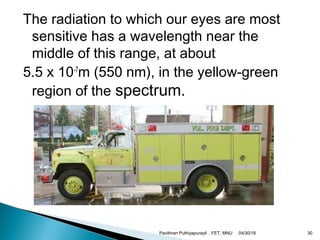
The radiation to which our eyes are most
sensitive has a wavelength near the
middle of this range, at about
5.5 x 10⁻⁷
m (550 nm), in the yellow-green
region of the spectrum.
04/30/18Pavithran Puthiyapurayil , FET, MNU 30
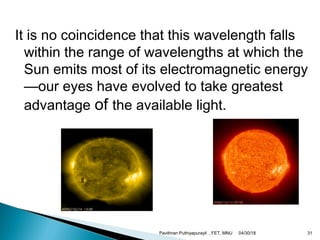
It is no coincidence that this wavelength falls
within the range of wavelengths at which the
Sun emits most of its electromagnetic energy
—our eyes have evolved to take greatest
advantage of the available light.
04/30/18Pavithran Puthiyapurayil , FET, MNU 31
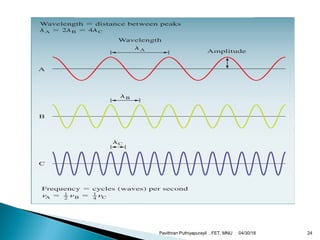
The frequency (v) of a wave is
the number of waves to cross a
point in 1 second (units are Hertz –
cycles/sec or sec-1
)
λ is the wavelength- the distance
from crest to crest on a wave
04/30/18Pavithran Puthiyapurayil , FET, MNU 32
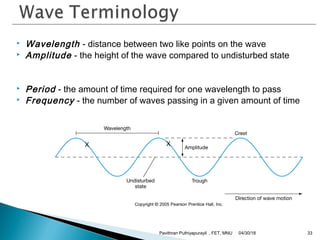
 Wavelength - distance between two like points on the wave
 Amplitude - the height of the wave compared to undisturbed state
 Period - the amount of time required for one wavelength to pass
 Frequency - the number of waves passing in a given amount of time
04/30/18Pavithran Puthiyapurayil , FET, MNU 33
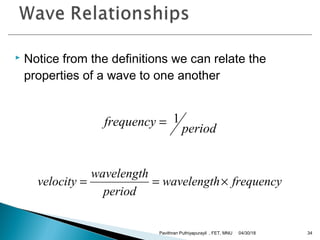
 Notice from the definitions we can relate the
properties of a wave to one another
period
frequency 1=
frequencywavelength
period
wavelength
velocity ×==
04/30/18Pavithran Puthiyapurayil , FET, MNU 34
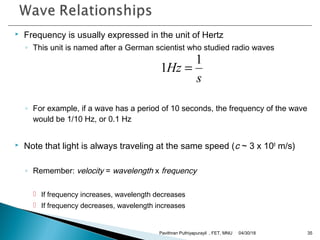
 Frequency is usually expressed in the unit of Hertz
◦ This unit is named after a German scientist who studied radio waves
◦ For example, if a wave has a period of 10 seconds, the frequency of the wave
would be 1/10 Hz, or 0.1 Hz
 Note that light is always traveling at the same speed (c ~ 3 x 10⁸
m/s)
◦ Remember: velocity = wavelength x frequency
 If frequency increases, wavelength decreases
 If frequency decreases, wavelength increases
s
Hz
1
1 =
04/30/18Pavithran Puthiyapurayil , FET, MNU 35
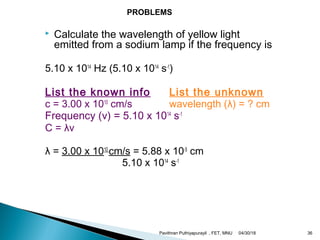
 Calculate the wavelength of yellow light
emitted from a sodium lamp if the frequency is
5.10 x 10¹⁴
Hz (5.10 x 10¹⁴
s-1
)
List the known info List the unknown
c = 3.00 x 10¹⁰
cm/s wavelength (λ) = ? cm
Frequency (v) = 5.10 x 10¹⁴
s-1
C = λv
λ = 3.00 x 10¹⁰
cm/s = 5.88 x 10⁻⁵
cm
5.10 x 10¹⁴
s-1
PROBLEMS
04/30/18Pavithran Puthiyapurayil , FET, MNU 36
Pavithran Puthiyapurayil ,
FET, MNU 37
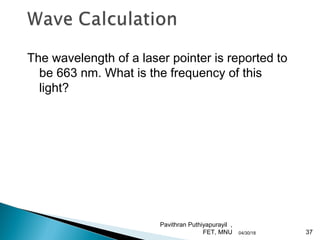
The wavelength of a laser pointer is reported to
be 663 nm. What is the frequency of this
light?
04/30/18
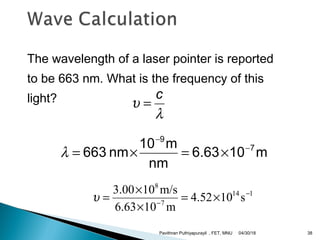
The wavelength of a laser pointer is reported
to be 663 nm. What is the frequency of this
light?
114
7
8
s104.52
m106.63
m/s103.00 −
−
×=
×
×
=υ
m106.63
nm
m10
nm663 7
9
−
−
×=×=λ
λ
υ
c
=
04/30/18Pavithran Puthiyapurayil , FET, MNU 38
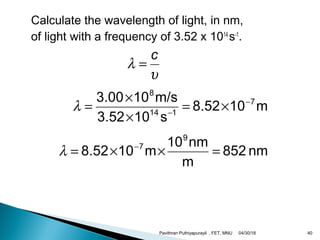
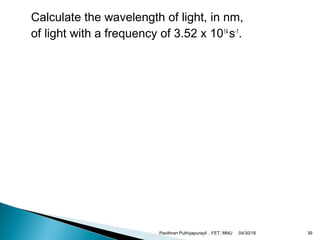
Calculate the wavelength of light, in nm,
of light with a frequency of 3.52 x 10¹⁴
s-1
.
04/30/18Pavithran Puthiyapurayil , FET, MNU 39
Calculate the wavelength of light, in nm,
of light with a frequency of 3.52 x 10¹⁴
s-1
.
υ
λ
c
=
m108.52
s103.52
m/s103.00 7
114
8
−
−
×=
×
×
=λ
nm852
m
nm10
m108.52
9
7
=××= −
λ
04/30/18Pavithran Puthiyapurayil , FET, MNU 40

Electromagnetic spectrum

  • 1.
  • 2.
    The electromagnetic spectrumrepresents the range of energy from low energy, low frequency radio waves with long wavelengths up to high energy, high frequency gamma waves with small wavelengths. 04/30/18Pavithran Puthiyapurayil , FET, MNU 2
  • 3.
  • 4.
    TABLE 1 Region Frequency (Hz) Wavelength (m) Energy (eV)Size Scale Radio waves < 109 > 0.3 < 7x 10⁻⁷ Mountains, building Microwaves 109  - 3x10¹¹ 0.001 - 0.3 7x10⁻⁷  - 2x10⁻⁴   Infrared 3x10¹¹  - 3.9x10¹⁴ 7.6x10⁻⁷  - 0.001 2x10⁻⁴  - 0.3   Visible 3.9x10¹⁴  - 7.9x10¹⁴ 3.8x10⁻⁷  - 7.6x10⁻⁷ 0.3 - 0.5 Bacteria Ultraviolet 7.9x10¹⁴  - 3.4x10¹⁶ 8x10⁻⁹  - 3.8x10⁻⁷ 0.5 - 20 Viruses X-rays 3.4x10¹⁶  - 5x10¹⁹ 6x10-12  - 8x10- 9 20 - 3x10 4 Atoms Gamma Rays > 5x10¹⁹ < 6x10-12 > 3x10⁴ Nuclei 04/30/18Pavithran Puthiyapurayil , FET, MNU 4
  • 5.
  • 6.
    The EM spectrumis the ENTIRE range of EM waves in order of increasing frequency and decreasing wavelength. 04/30/18Pavithran Puthiyapurayil , FET, MNU 6
  • 7.
  • 8.
    Standard names forradio bands In one classification system, the waves used for radio communication (and other purposes) are neatly divided up in decades, ie divided into bands whose wavelengths and frequencies vary over a factor of 10. In wavelength, the bands begin and end on metres times a power of ten. Because the speed of light is close to 3 10 8 m/s, when these bands are expressed in frequencies, their limits are 3 times a power of 10 Hz. eg for 3 GHz, λ = c/f = 10 cm. The names of the bands are: 04/30/18Pavithran Puthiyapurayil , FET, MNU 8
  • 9.
    • 300 Hz- 3 kHz. Ultra Low Frequency (ULF) • 3 - 30 kHz. Very Low Frequency (VLF) • 30 - 300 kHz. Low Frequency (LF) • 300 kHz - 3 MHz. Medium Frequency (MF) • 30 - 300 MHz. Very High Frequency (VHF). • 300 MHz - 3 GHz. Ultra High Frequency (UHF) • 3 - 30 GHz. Super High Frequency (SHF) • 30 - 300 GHz. Extra High Frequency (EHF) 04/30/18Pavithran Puthiyapurayil , FET, MNU 9
  • 10.
    Common names forradio bands. For practical purposes, other divisions of the radio part of the spectrum are used, including those bands allotted for specific types of communication. So for instance people talk of the AM radio band, of the CB band etc. Here are some examples: AM radio: 535 - 1,700 kHz (0.535 - 1.7 MHz) Have a look at the dial on your radio and check the frequency of your favourite AM station. Then divide this into the speed of light to get the wavelength. Fortunately, you do not need an antenna that has a comparable length, although the strength of the signal will increase as you increase the antenna length. Short wave - several different bands in the range 5.9 - 26.1 MHz Citizens band (CB) radio - Several bands around 27 MHz. 04/30/18Pavithran Puthiyapurayil , FET, MNU 10
  • 11.
    FM radio: 88- 108 MHz. If the announcer says 102.5 FM, she is telling you the frequency of her station. The wavelength are about 3 metres, so simple antennae should be about 1/4 or 1/2 this length. To get an idea of how crowded the EM spectrum is, have a look at this scan (click on the yellow graphic) provided by Balint Seeber, a rather special physics student at UNSW. Television - several different bands between 54 and 220 MHz. (Television carries more information than radio does--pictures plus sound-- and so needs broader bands for each channel) Mobile phones: 824 - 849 MHz Global Positioning System: 1.2 -1.6 GHz The microwave band is used less formally for wavelengths of cm down to mm, or frequencies up to 10s or 100s of GHz. The microwave band is used for radar and long distance trunk telephone communications. Domestically, it is also used in microwave ovens. 04/30/18Pavithran Puthiyapurayil , FET, MNU 11
  • 12.
  • 13.
  • 14.
    Things to RememberThingsto Remember The higher the frequency, the more energy the wave has.The higher the frequency, the more energy the wave has. EM waves do not require media in which to travel orEM waves do not require media in which to travel or move.move. EM waves are considered to be transverse wavesEM waves are considered to be transverse waves because they are made of vibrating electric and magneticbecause they are made of vibrating electric and magnetic fields at right angles to each other, and to the directionfields at right angles to each other, and to the direction the waves are traveling.the waves are traveling. Inverse relationship between wave size and frequency: as wavelengths get smaller, frequencies get higher. 04/30/18Pavithran Puthiyapurayil , FET, MNU 14
  • 15.
    Radio waves: Havethe longest wavelengths and the lowest frequencies; wavelengths range from 1000s of meters to .001 m Used in: RADAR, cooking food, satellite transmissions 04/30/18Pavithran Puthiyapurayil , FET, MNU 15
  • 16.
    Infrared wavesInfrared waves(heat): Have a shorter wavelength, from .001 m to 700 nm,(heat): Have a shorter wavelength, from .001 m to 700 nm, and therefore, a higher frequency.and therefore, a higher frequency. Used for finding people in the dark and in TV remote controlUsed for finding people in the dark and in TV remote control devicesdevices Visible lightVisible light: Wavelengths range from 700 nm (red light) to 30 nm (violet: Wavelengths range from 700 nm (red light) to 30 nm (violet light) with frequencies higher than infrared waves.light) with frequencies higher than infrared waves. These are the waves in theThese are the waves in the EM spectrum that humansEM spectrum that humans can see.can see. Visible light waves are a veryVisible light waves are a very small part of the EM spectrumsmall part of the EM spectrum!! 04/30/18Pavithran Puthiyapurayil , FET, MNU 16
  • 17.
    ROY G. BVROYG. BV redred orangeorange yellowyellow greengreen blueblue violetviolet Visible LightVisible Light Remembering the OrderRemembering the Order 04/30/18Pavithran Puthiyapurayil , FET, MNU 17
  • 18.
    Ultraviolet LightUltraviolet Light:Wavelengths: Wavelengths range from 400 nm to 10 nm; the frequency (and therefore the energy) is high enough with UV rays to penetrate living cells and cause them damage. Although we cannot see UV light, bees, bats, butterflies, some small rodents and birds can. UV on our skin produces vitamin D in our bodies. Too much UV can lead to sunburn and skin cancer. UV rays are easily blocked by clothing. Used for sterilization because they kill bacteria. 04/30/18Pavithran Puthiyapurayil , FET, MNU 18
  • 19.
    X-RaysX-Rays: Wavelengths from10 nm to .001 nm. These rays: Wavelengths from 10 nm to .001 nm. These rays have enough energy to penetrate deep into tissues andhave enough energy to penetrate deep into tissues and cause damage to cells; are stopped by densecause damage to cells; are stopped by dense materials, such as bone.materials, such as bone. Used to look at solid structures, such as bonesUsed to look at solid structures, such as bones and bridgesand bridges (for cracks), and for treatment of cancer.(for cracks), and for treatment of cancer. 04/30/18Pavithran Puthiyapurayil , FET, MNU 19
  • 20.
    Gamma RaysGamma Rays:Carry the most energy and have: Carry the most energy and have the shortest wavelengths, less than onethe shortest wavelengths, less than one trillionth of a meter (10trillionth of a meter (10-12-12 ).). Gamma rays have enough energy to go throughGamma rays have enough energy to go through most materials easily; you would need a 3-4 ft thickmost materials easily; you would need a 3-4 ft thick concrete wall to stop them!concrete wall to stop them! Gamma rays are releasedGamma rays are released by nuclear reactions inby nuclear reactions in nuclear power plants, bynuclear power plants, by nuclear bombs, and bynuclear bombs, and by naturally occurringnaturally occurring elements on Earth.elements on Earth. Sometimes used in theSometimes used in the treatment of cancers.treatment of cancers. 04/30/18Pavithran Puthiyapurayil , FET, MNU 20
  • 21.
    Gamma RaysGamma Rays Thispicture is aThis picture is a “scintigram”“scintigram”  It shows an asthmaticIt shows an asthmatic person’s lungs.person’s lungs. The patient was given a slightly radioactive gas toThe patient was given a slightly radioactive gas to breath, and the picture was taken using a gammabreath, and the picture was taken using a gamma camera to detect the radiation.camera to detect the radiation. The colors show the air flow in the lungs.The colors show the air flow in the lungs. 04/30/18Pavithran Puthiyapurayil , FET, MNU 21
  • 22.
  • 23.
     The electromagneticspectrum includes many different types of radiation.  Visible light accounts for only a small part of the spectrum  Other familiar forms include: radio waves, microwaves, X rays  All forms of light travel in waves 04/30/18Pavithran Puthiyapurayil , FET, MNU 23
  • 24.
  • 25.
    Pavithran Puthiyapurayil , FET,MNU 25  Wave properties are mathematically related as: c = λν where c= velocity of light c = 2.99792458 x 10⁸ m/s λ = wavelength (in meters, m) ν = frequency (reciprocal seconds, s−1 ) 04/30/18
  • 26.
     Isaac Newton(1642-1727) believed light consisted of particles  By 1900 most scientists believed that light behaved as a wave. 04/30/18Pavithran Puthiyapurayil , FET, MNU 26
  • 27.
    Visible light isa small portion of this spectrum. This is the only part of this energy range that our eyes can detect. What we see is a rainbow of colors. RedOrangeYellowGreenBlueIndigoViolet ROY G BIV 04/30/18Pavithran Puthiyapurayil , FET, MNU 27
  • 28.
     Wavelengths  104 101 110-2 10-5 10-6 10-8 10-10 10-12  Frequencies (cycles per sec) 3 x 10⁶ 3 x 10¹⁰ 3 x 10¹⁴ 3 x 10¹⁶ 3 x10¹⁸ 3 x10 22 04/30/18Pavithran Puthiyapurayil , FET, MNU 28
  • 29.
    Red light hasa frequency of roughly 4.3 × 10¹⁴ Hz, and a wavelength of about 7.0 × 10­7 m (700nm). Violet light, at the other end of the visible range, has nearly double the frequency—7.5 × 10¹⁴ Hz—and (since the speed of light is the same in either case) just over half the wavelength— 4.0 × 10­7 m (400nm). 04/30/18Pavithran Puthiyapurayil , FET, MNU 29
  • 30.
    The radiation towhich our eyes are most sensitive has a wavelength near the middle of this range, at about 5.5 x 10⁻⁷ m (550 nm), in the yellow-green region of the spectrum. 04/30/18Pavithran Puthiyapurayil , FET, MNU 30
  • 31.
    It is nocoincidence that this wavelength falls within the range of wavelengths at which the Sun emits most of its electromagnetic energy —our eyes have evolved to take greatest advantage of the available light. 04/30/18Pavithran Puthiyapurayil , FET, MNU 31
  • 32.
    The frequency (v)of a wave is the number of waves to cross a point in 1 second (units are Hertz – cycles/sec or sec-1 ) λ is the wavelength- the distance from crest to crest on a wave 04/30/18Pavithran Puthiyapurayil , FET, MNU 32
  • 33.
     Wavelength -distance between two like points on the wave  Amplitude - the height of the wave compared to undisturbed state  Period - the amount of time required for one wavelength to pass  Frequency - the number of waves passing in a given amount of time 04/30/18Pavithran Puthiyapurayil , FET, MNU 33
  • 34.
     Notice fromthe definitions we can relate the properties of a wave to one another period frequency 1= frequencywavelength period wavelength velocity ×== 04/30/18Pavithran Puthiyapurayil , FET, MNU 34
  • 35.
     Frequency isusually expressed in the unit of Hertz ◦ This unit is named after a German scientist who studied radio waves ◦ For example, if a wave has a period of 10 seconds, the frequency of the wave would be 1/10 Hz, or 0.1 Hz  Note that light is always traveling at the same speed (c ~ 3 x 10⁸ m/s) ◦ Remember: velocity = wavelength x frequency  If frequency increases, wavelength decreases  If frequency decreases, wavelength increases s Hz 1 1 = 04/30/18Pavithran Puthiyapurayil , FET, MNU 35
  • 36.
     Calculate thewavelength of yellow light emitted from a sodium lamp if the frequency is 5.10 x 10¹⁴ Hz (5.10 x 10¹⁴ s-1 ) List the known info List the unknown c = 3.00 x 1010 cm/s wavelength (λ) = ? cm Frequency (v) = 5.10 x 10¹⁴ s-1 C = λv λ = 3.00 x 1010 cm/s = 5.88 x 10⁻⁵ cm 5.10 x 10¹⁴ s-1 PROBLEMS 04/30/18Pavithran Puthiyapurayil , FET, MNU 36
  • 37.
    Pavithran Puthiyapurayil , FET,MNU 37 The wavelength of a laser pointer is reported to be 663 nm. What is the frequency of this light? 04/30/18
  • 38.
    The wavelength ofa laser pointer is reported to be 663 nm. What is the frequency of this light? 114 7 8 s104.52 m106.63 m/s103.00 − − ×= × × =υ m106.63 nm m10 nm663 7 9 − − ×=×=λ λ υ c = 04/30/18Pavithran Puthiyapurayil , FET, MNU 38
  • 39.
    Calculate the wavelengthof light, in nm, of light with a frequency of 3.52 x 10¹⁴ s-1 . 04/30/18Pavithran Puthiyapurayil , FET, MNU 39
  • 40.
    Calculate the wavelengthof light, in nm, of light with a frequency of 3.52 x 10¹⁴ s-1 . υ λ c = m108.52 s103.52 m/s103.00 7 114 8 − − ×= × × =λ nm852 m nm10 m108.52 9 7 =××= − λ 04/30/18Pavithran Puthiyapurayil , FET, MNU 40

Editor's Notes

  • #4 1x10^-16 m to 1000 km from subatomic particles to marathon lengths, very broad spectrum therefore many different types of telescopes, instruments, and observing techniques. Gamma and X-ray Space based telescopes. Luckily there are windows for Ground based telescopes . . . ~Melanie Leong
  • #18 Light from the sun looks white, but it is really made up of all the colors of the rainbow. A prism is a specially shaped crystal. When white light shines through a prism, the light is separated into all its colors.