 Producing electricity in space from sunlight is used by
hundreds of satellites in operation today.
 In 1968, Dr. Peter Glaser, formerly of NASA, introduced the
concept of a solar power satellite system with square miles of
solar collectors in high geosynchronous orbit to collect and
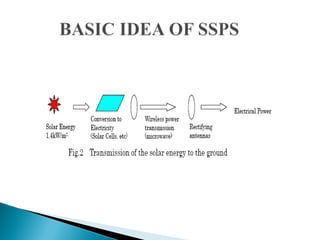
convert the sun's energy into a microwave beam to transmit
energy to large receiving antennas (rectennas) on earth.
 NASA and DoE (Department of Energy) of U.S.A. conducted
feasibility study of the proposed SPS in 1970’s.
 In 1999 NASA formed SERT, the Space Solar Power
Exploratory Research and Technology program to perform
design studies and evaluate feasibility.
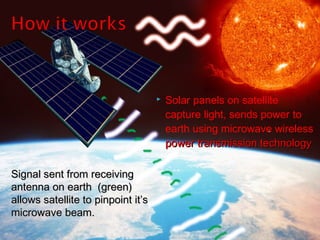
 Solar panels on satellite
capture light, sends power to
earth using microwave wireless
power transmission technologypower transmission technology
Signal sent from receivingSignal sent from receiving
antenna on earth (green)antenna on earth (green)
allows satellite to pinpoint it’sallows satellite to pinpoint it’s
microwave beam.microwave beam.
 Solar energy conversion
 Wireless power transmission to the Earth
 Spacecraft sizing
 Two basic methods of converting sunlight to
electricity are PV and SD
 Photovoltaic cells convert photons into electrical
power via a quantum mechanical mechanism.
 Solar Dynamic conversion uses a heat engine,
consisting of a piston or a turbine which uses
expansion of a working fluid to produce motion from
heat.
 The power could be transmitted as either microwave
or laser radiation at a variety of frequencies
depending on system design.
 the transmitting radiation would have to be non-
ionizing to avoid potential disturbances either
ecologically or biologically.
 To minimize the sizes of the antennas used, the
wavelength should be small.
 The size of an SPS will be dominated by two factors
o the size of the collecting apparatus
o the size of the transmitting antenna
 For best efficiency, the satellite antenna should be circular
and for the probable microwave wavelength, about 1 kms in
diameter or larger; the ground antenna should be elliptical,
10km wide, and a length that makes the rectenna appear
circular from GSO.
 NASA/DOE Reference Model
 Recent NASA’s concepts
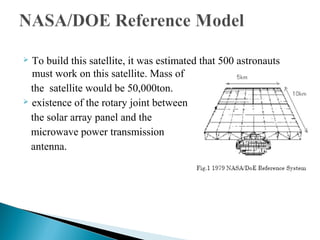
 To build this satellite, it was estimated that 500 astronauts
must work on this satellite. Mass of
the satellite would be 50,000ton.
 existence of the rotary joint between
the solar array panel and the
microwave power transmission
antenna.
 In 1999 NASA conducted
SERT program.
 Each solar collector and
power generator are
connected each other by
a tether.
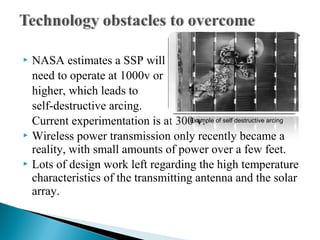
 NASA estimates a SSP will
need to operate at 1000v or
higher, which leads to
self-destructive arcing.
Current experimentation is at 300 v.
 Wireless power transmission only recently became a
reality, with small amounts of power over a few feet.
 Lots of design work left regarding the high temperature
characteristics of the transmitting antenna and the solar
array.
Example of self destructive arcing
 No pollution after construction
 Source of energy is free
 Large amount of energy potential.
 Less atmosphere for sunlight to penetrate for more
power per unit area
 Any location on Earth can receive power
 Satellite can provide power up to 96% of the time
 Solar panels do not take up land on Earth
 Lots of space in space
 Promote growth of space, solar, and power
transmission technology
 solar power satellites are a realistic possibility for
solving Earth’s future energy needs in an
environmentally clean and safe way.
ANY QUEARIES ?

291 ( space solar power satellite system) (1)

  • 3.
     Producing electricityin space from sunlight is used by hundreds of satellites in operation today.  In 1968, Dr. Peter Glaser, formerly of NASA, introduced the concept of a solar power satellite system with square miles of solar collectors in high geosynchronous orbit to collect and convert the sun's energy into a microwave beam to transmit energy to large receiving antennas (rectennas) on earth.  NASA and DoE (Department of Energy) of U.S.A. conducted feasibility study of the proposed SPS in 1970’s.  In 1999 NASA formed SERT, the Space Solar Power Exploratory Research and Technology program to perform design studies and evaluate feasibility.
  • 5.
     Solar panelson satellite capture light, sends power to earth using microwave wireless power transmission technologypower transmission technology Signal sent from receivingSignal sent from receiving antenna on earth (green)antenna on earth (green) allows satellite to pinpoint it’sallows satellite to pinpoint it’s microwave beam.microwave beam.
  • 6.
     Solar energyconversion  Wireless power transmission to the Earth  Spacecraft sizing
  • 7.
     Two basicmethods of converting sunlight to electricity are PV and SD  Photovoltaic cells convert photons into electrical power via a quantum mechanical mechanism.  Solar Dynamic conversion uses a heat engine, consisting of a piston or a turbine which uses expansion of a working fluid to produce motion from heat.
  • 8.
     The powercould be transmitted as either microwave or laser radiation at a variety of frequencies depending on system design.  the transmitting radiation would have to be non- ionizing to avoid potential disturbances either ecologically or biologically.  To minimize the sizes of the antennas used, the wavelength should be small.
  • 9.
     The sizeof an SPS will be dominated by two factors o the size of the collecting apparatus o the size of the transmitting antenna  For best efficiency, the satellite antenna should be circular and for the probable microwave wavelength, about 1 kms in diameter or larger; the ground antenna should be elliptical, 10km wide, and a length that makes the rectenna appear circular from GSO.
  • 10.
     NASA/DOE ReferenceModel  Recent NASA’s concepts
  • 11.
     To buildthis satellite, it was estimated that 500 astronauts must work on this satellite. Mass of the satellite would be 50,000ton.  existence of the rotary joint between the solar array panel and the microwave power transmission antenna.
  • 12.
     In 1999NASA conducted SERT program.  Each solar collector and power generator are connected each other by a tether.
  • 13.
     NASA estimatesa SSP will need to operate at 1000v or higher, which leads to self-destructive arcing. Current experimentation is at 300 v.  Wireless power transmission only recently became a reality, with small amounts of power over a few feet.  Lots of design work left regarding the high temperature characteristics of the transmitting antenna and the solar array. Example of self destructive arcing
  • 14.
     No pollutionafter construction  Source of energy is free  Large amount of energy potential.
  • 15.
     Less atmospherefor sunlight to penetrate for more power per unit area  Any location on Earth can receive power  Satellite can provide power up to 96% of the time  Solar panels do not take up land on Earth  Lots of space in space  Promote growth of space, solar, and power transmission technology
  • 16.
     solar powersatellites are a realistic possibility for solving Earth’s future energy needs in an environmentally clean and safe way.
  • 17.

Editor's Notes

  • #4 the Department of Energy funded a bunch of research in the 1970’s, and then the idea was not heavily researched until 1995 when the idea started gaining momentum again.