Current Trends
                      in
              Backsheet Evolution

Prepared and presented by:
Marina Temchenko
R&D Manager
Madico, Inc.
March 2012
Presentation Outline
1.   Backsheet history

2.   Current trends in Backsheet design

3.   Backsheet contribution to module performance

4.   New Technologies

5.   Conclusions
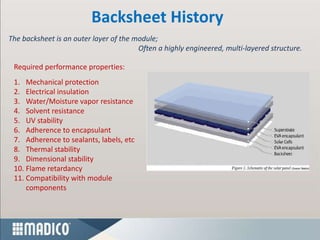
Backsheet History
The backsheet is an outer layer of the module;
                                        Often a highly engineered, multi-layered structure.

 Required performance properties:
 1. Mechanical protection
 2. Electrical insulation
 3. Water/Moisture vapor resistance
 4. Solvent resistance
 5. UV stability
 6. Adherence to encapsulant
 7. Adherence to sealants, labels, etc
 8. Thermal stability
 9. Dimensional stability
 10. Flame retardancy
 11. Compatibility with module
     components
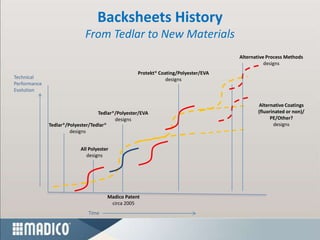
Backsheets History
                             From Tedlar to New Materials
                                                                                    Alternative Process Methods
                                                                                               designs
                                                   Protekt® Coating/Polyester/EVA
Technical                                                      designs
Performance
Evolution

                                                                                           Alternative Coatings
                                   Tedlar®/Polyester/EVA                                   (fluorinated or non)/
                                          designs                                                PE/Other?
              Tedlar®/Polyester/Tedlar®                                                           designs
                       designs


                           All Polyester
                              designs


                                       Madico Patent
                                        circa 2005
                              Time
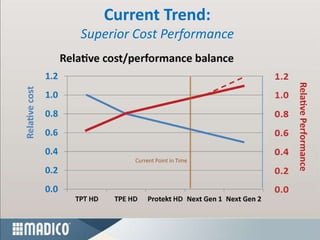
Current Trend:
Superior Cost Performance
The Holistic Design Process
                                    Creativity/Innovation/Action
1.   It begins with the outer Weather-able Layer:
      Composition Choice: A) Inherently weather-able polymers, or
                          B) Additive-compounded polymers

      Thickness Choice:     A) Commercially available films
                            B) Precision Coating


2.    Next in the chain is the Inner Layer:
                                                              Current design
       1. Polyethylene terephtalate: A) Hydrolytically unstable
                                     B) Cost

       2. Polyamides

       3. Polyolefins
       4. Others
                                                                               Sequential Logic is the
3.   The third building block: the interior Outer Layer:                       key to Innovative
      Composition Choice: A) Degree of Reflectivity                            Backsheet Design!
                          B) Thermal Conductivity
                          C) Compliment to Module Design
                                    1. For Bi-facial Modules
                                    2. For back-contact cells
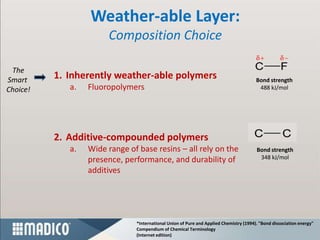
Weather-able Layer:
                       Composition Choice

 The
Smart     1. Inherently weather-able polymers                                           Bond strength
Choice!      a.   Fluoropolymers                                                         488 kJ/mol


          2. Additive-compounded polymers
             a.   Wide range of base resins – all rely on the                           Bond strength
                  presence, performance, and durability of                               348 kJ/mol

                  additives


                               *International Union of Pure and Applied Chemistry (1994). "Bond dissociation energy"
                               Compendium of Chemical Terminology
                               (Internet edition)
Weather-able Layer:
   Precise Thickness
Weather-able Layer:
Durability and material selection

                               Product 1
                               Product 2
Interior Outer Layer
          (Adjacent to the encapsulant)

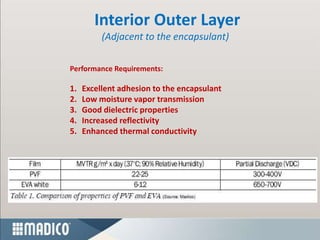
Performance Requirements:

1.   Excellent adhesion to the encapsulant
2.   Low moisture vapor transmission
3.   Good dielectric properties
4.   Increased reflectivity
5.   Enhanced thermal conductivity
Interior Outer Layer
                                 (Adjacent to the encapsulant)

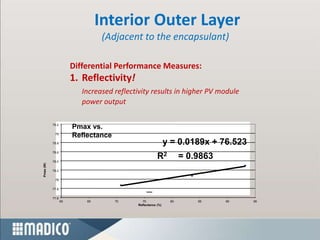
                       Differential Performance Measures:
                       1. Reflectivity!
                          Increased reflectivity results in higher PV module
                          power output

           79.2
                       Pmax vs.
            79
                       Reflectance
           78.8                                              y = 0.0189x + 76.523
           78.6

           78.4
                                                       R2          = 0.9863
Pmax (W)


           78.2

            78

           77.8

           77.6
                  60       65        70      75               80       85     90    95
                                           Reflectance (%)
Interior Outer Layer
        (Adjacent to the encapsulant)

Differential Performance Measures:
1. Reflectivity
2. Sustained Reflectivity over module
   performance life


                                        Product 1
                                        Product 2
Current Trend
           Adhesive-less construction

Possibilities:
• Coating/PET/Coating
• Coating/PET/extruded layer

Possible Benefits:
• “Greener” manufacturing process – less VOC
• Elimination of weak link – an adhesive
Adhesive-less construction

                         Product 1
                         Product 2
Compliment PV Module Designs
               Bifacial Solar Cells
• Converts the sunlight
  incident on both sides
  of the modules

• Increase module
  efficiency by 3-4%

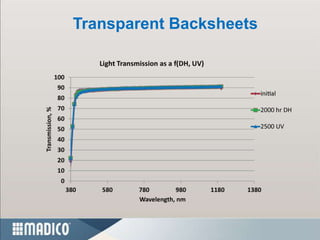
• Requires transparent
  backsheet
Transparent Backsheets
Conclusion
1. High performance Low cost backsheets

2. Specifically designed films or coatings for PV
   applications, replacing off the shelf pre-engineered
   films

3. Adhesiveless construction

4. Compliment Module Design
Special thanks to the contributors of this presentation


                  Amy Schweighardt
                  Andrea Jones
                  Brad Forest
                  Dave Avison
                  Katrina Sampson
                  Robert Comeau
                  Sam Lim
                  Shreyans Shingi
                  Tony Lim
                  Venkatesh Natarajan
Questions?

Current Trends in Backsheet Evolution

  • 1.
    Current Trends in Backsheet Evolution Prepared and presented by: Marina Temchenko R&D Manager Madico, Inc. March 2012
  • 2.
    Presentation Outline 1. Backsheet history 2. Current trends in Backsheet design 3. Backsheet contribution to module performance 4. New Technologies 5. Conclusions
  • 3.
    Backsheet History The backsheetis an outer layer of the module; Often a highly engineered, multi-layered structure. Required performance properties: 1. Mechanical protection 2. Electrical insulation 3. Water/Moisture vapor resistance 4. Solvent resistance 5. UV stability 6. Adherence to encapsulant 7. Adherence to sealants, labels, etc 8. Thermal stability 9. Dimensional stability 10. Flame retardancy 11. Compatibility with module components
  • 4.
    Backsheets History From Tedlar to New Materials Alternative Process Methods designs Protekt® Coating/Polyester/EVA Technical designs Performance Evolution Alternative Coatings Tedlar®/Polyester/EVA (fluorinated or non)/ designs PE/Other? Tedlar®/Polyester/Tedlar® designs designs All Polyester designs Madico Patent circa 2005 Time
  • 5.
  • 6.
    The Holistic DesignProcess Creativity/Innovation/Action 1. It begins with the outer Weather-able Layer: Composition Choice: A) Inherently weather-able polymers, or B) Additive-compounded polymers Thickness Choice: A) Commercially available films B) Precision Coating 2. Next in the chain is the Inner Layer: Current design 1. Polyethylene terephtalate: A) Hydrolytically unstable B) Cost 2. Polyamides 3. Polyolefins 4. Others Sequential Logic is the 3. The third building block: the interior Outer Layer: key to Innovative Composition Choice: A) Degree of Reflectivity Backsheet Design! B) Thermal Conductivity C) Compliment to Module Design 1. For Bi-facial Modules 2. For back-contact cells
  • 7.
    Weather-able Layer: Composition Choice The Smart 1. Inherently weather-able polymers Bond strength Choice! a. Fluoropolymers 488 kJ/mol 2. Additive-compounded polymers a. Wide range of base resins – all rely on the Bond strength presence, performance, and durability of 348 kJ/mol additives *International Union of Pure and Applied Chemistry (1994). "Bond dissociation energy" Compendium of Chemical Terminology (Internet edition)
  • 8.
    Weather-able Layer: Precise Thickness
  • 9.
    Weather-able Layer: Durability andmaterial selection Product 1 Product 2
  • 10.
    Interior Outer Layer (Adjacent to the encapsulant) Performance Requirements: 1. Excellent adhesion to the encapsulant 2. Low moisture vapor transmission 3. Good dielectric properties 4. Increased reflectivity 5. Enhanced thermal conductivity
  • 11.
    Interior Outer Layer (Adjacent to the encapsulant) Differential Performance Measures: 1. Reflectivity! Increased reflectivity results in higher PV module power output 79.2 Pmax vs. 79 Reflectance 78.8 y = 0.0189x + 76.523 78.6 78.4 R2 = 0.9863 Pmax (W) 78.2 78 77.8 77.6 60 65 70 75 80 85 90 95 Reflectance (%)
  • 12.
    Interior Outer Layer (Adjacent to the encapsulant) Differential Performance Measures: 1. Reflectivity 2. Sustained Reflectivity over module performance life Product 1 Product 2
  • 13.
    Current Trend Adhesive-less construction Possibilities: • Coating/PET/Coating • Coating/PET/extruded layer Possible Benefits: • “Greener” manufacturing process – less VOC • Elimination of weak link – an adhesive
  • 14.
    Adhesive-less construction Product 1 Product 2
  • 15.
    Compliment PV ModuleDesigns Bifacial Solar Cells • Converts the sunlight incident on both sides of the modules • Increase module efficiency by 3-4% • Requires transparent backsheet
  • 16.
  • 17.
  • 18.
    Conclusion 1. High performanceLow cost backsheets 2. Specifically designed films or coatings for PV applications, replacing off the shelf pre-engineered films 3. Adhesiveless construction 4. Compliment Module Design
  • 19.
    Special thanks tothe contributors of this presentation Amy Schweighardt Andrea Jones Brad Forest Dave Avison Katrina Sampson Robert Comeau Sam Lim Shreyans Shingi Tony Lim Venkatesh Natarajan
  • 20.

Editor's Notes

  • #2 GenrichAltshuller evolutionary S-curves
  • #3 GenrichAltshuller identified a trend in which systems always evolve towards increasing ‘ideality’ and that this evolution process takes place through a series of evolutionary S-curve characteristics