Solar
Battery
Charger
MINI PROJECT PRESENTED
BY:-
SWEDEL DSOUZA
&
JENIFER NADAR
CONTENTS
 INTRODUCTION
 OBJECTIVE
 BLOCK DIAGRAM
 DESIGN
 PROCESS
 ADVANTAGES
 APPLICATION
 CONCLUSION
 REFERENCE
INTRODUCTIO
NSolar energy has proven its worth of
alternative energy.
With the help of existing system push in
direction of sustainable clean source of
power, it is no surprise that solar power
has become one of the most popular
alternative energy sources.
As per the techniques available, the
solar battery charger has been devised.
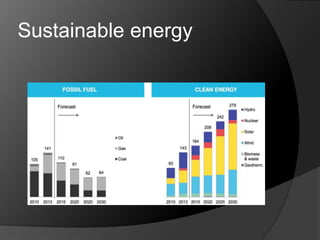
Sustainable energy
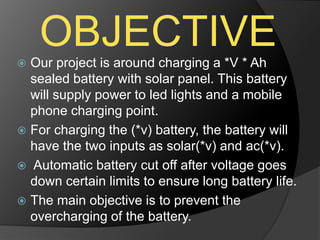
OBJECTIVE Our project is around charging a *V * Ah
sealed battery with solar panel. This battery
will supply power to led lights and a mobile
phone charging point.
 For charging the (*v) battery, the battery will
have the two inputs as solar(*v) and ac(*v).
 Automatic battery cut off after voltage goes
down certain limits to ensure long battery life.
 The main objective is to prevent the
overcharging of the battery.
g
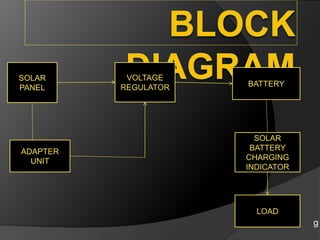
SOLAR
PANEL
VOLTAGE
REGULATOR BATTERY
SOLAR
BATTERY
CHARGING
INDICATOR
LOAD
ADAPTER
UNIT
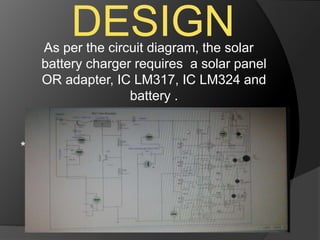
DESIGNAs per the circuit diagram, the solar
battery charger requires a solar panel
OR adapter, IC LM317, IC LM324 and
battery .
*(PASTE CKT DIAG HERE)
SOLAR
PROCESS
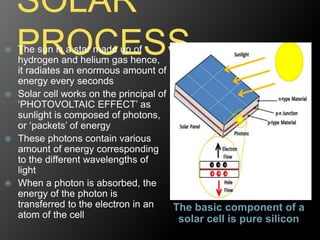
The basic component of a
solar cell is pure silicon
 The sun is a star made up of
hydrogen and helium gas hence,
it radiates an enormous amount of
energy every seconds
 Solar cell works on the principal of
‘PHOTOVOLTAIC EFFECT’ as
sunlight is composed of photons,
or ‘packets’ of energy
 These photons contain various
amount of energy corresponding
to the different wavelengths of
light
 When a photon is absorbed, the
energy of the photon is
transferred to the electron in an
atom of the cell
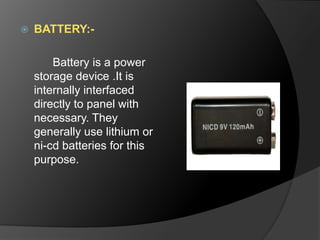
 BATTERY:-
Battery is a power
storage device .It is
internally interfaced
directly to panel with
necessary. They
generally use lithium or
ni-cd batteries for this
purpose.
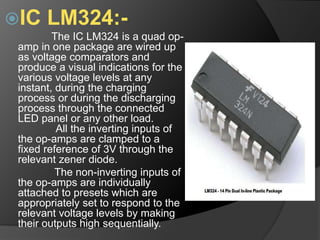
IC LM324:-
The IC LM324 is a quad op-
amp in one package are wired up
as voltage comparators and
produce a visual indications for the
various voltage levels at any
instant, during the charging
process or during the discharging
process through the connected
LED panel or any other load.
All the inverting inputs of
the op-amps are clamped to a
fixed reference of 3V through the
relevant zener diode.
The non-inverting inputs of
the op-amps are individually
attached to presets which are
appropriately set to respond to the
relevant voltage levels by making
their outputs high sequentially.
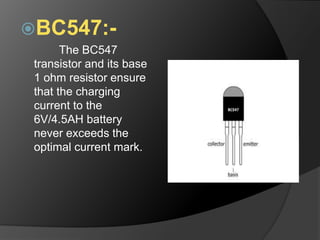
BC547:-
The BC547
transistor and its base
1 ohm resistor ensure
that the charging
current to the
6V/4.5AH battery
never exceeds the
optimal current mark.
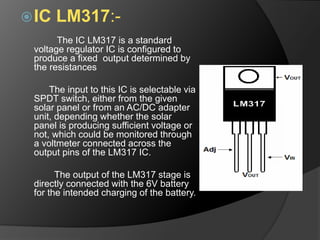
IC LM317:-
The IC LM317 is a standard
voltage regulator IC is configured to
produce a fixed output determined by
the resistances
The input to this IC is selectable via
SPDT switch, either from the given
solar panel or from an AC/DC adapter
unit, depending whether the solar
panel is producing sufficient voltage or
not, which could be monitored through
a voltmeter connected across the
output pins of the LM317 IC.
The output of the LM317 stage is
directly connected with the 6V battery
for the intended charging of the battery.
How do I know the battery status ?
Chargers have LED to determine the battery status.
 LED deplicts :- -Battery status
-charging status
-discharging status
The indications for the same could be
monitored via the connected coloured LEDs.
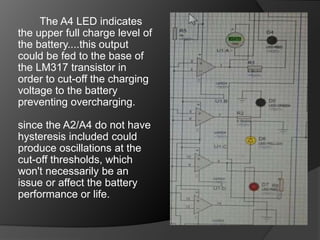
The yellow LED associated with A2 may be set for
indicating the low voltage cut-off threshold. When
this LED shuts off , the transistor TIP122 is inhibited
from conducting and cuts off the supply to the load,
thereby ensuring that the battery is never allowed to
discharge to dangerous unrecoverable limits.
The A4 LED indicates
the upper full charge level of
the battery....this output
could be fed to the base of
the LM317 transistor in
order to cut-off the charging
voltage to the battery
preventing overcharging.
since the A2/A4 do not have
hysteresis included could
produce oscillations at the
cut-off thresholds, which
won't necessarily be an
issue or affect the battery
performance or life.
ADVANTAGE
 As we use DC power supply directly to
charge the mobile, the ripples will not be
there in solar mobile charger.
 Prevents from overcharging the battery
which may affect the battery.
 Emission free.
 Battery life will be high as we use solar
mobile charger.
APPLICATION
 EMERGENCY POWER
 TRAVELLING IN REMOTE LOCATION
 DOMESTIC APPLIANCE
 EVERDAY USE
CONCLUSIO
N The latest appliances being devised by the scientist are being
made in an solar mobile charger as environment friendly
manner, and so the large amount of energy can be saved
when we use environment friendly products.
 Versatility of solar charger is high.
 Adaptability is high.
 The most recommended solar mobile charger are:-xtorm,
voltaic, XD, solUrja.
 Hence with the basic knowledge of electronics and
components we have designed a mobile battery charger by
using a solar power.
BOOKS:-
 Childress, vincent w, solar power the solution.
 Marshall cavendish, science and technology.
WEBSITES:-
www.solarbuzz.com/going-solar.
www.solarserver.com/knowledge.
THANK
YOU

solar battery Charger using adapter or solar panel

  • 1.
  • 2.
    MINI PROJECT PRESENTED BY:- SWEDELDSOUZA & JENIFER NADAR
  • 3.
    CONTENTS  INTRODUCTION  OBJECTIVE BLOCK DIAGRAM  DESIGN  PROCESS  ADVANTAGES  APPLICATION  CONCLUSION  REFERENCE
  • 4.
    INTRODUCTIO NSolar energy hasproven its worth of alternative energy. With the help of existing system push in direction of sustainable clean source of power, it is no surprise that solar power has become one of the most popular alternative energy sources. As per the techniques available, the solar battery charger has been devised.
  • 5.
  • 6.
    OBJECTIVE Our projectis around charging a *V * Ah sealed battery with solar panel. This battery will supply power to led lights and a mobile phone charging point.  For charging the (*v) battery, the battery will have the two inputs as solar(*v) and ac(*v).  Automatic battery cut off after voltage goes down certain limits to ensure long battery life.  The main objective is to prevent the overcharging of the battery.
  • 7.
  • 8.
    DESIGNAs per thecircuit diagram, the solar battery charger requires a solar panel OR adapter, IC LM317, IC LM324 and battery . *(PASTE CKT DIAG HERE)
  • 9.
    SOLAR PROCESS The basic componentof a solar cell is pure silicon  The sun is a star made up of hydrogen and helium gas hence, it radiates an enormous amount of energy every seconds  Solar cell works on the principal of ‘PHOTOVOLTAIC EFFECT’ as sunlight is composed of photons, or ‘packets’ of energy  These photons contain various amount of energy corresponding to the different wavelengths of light  When a photon is absorbed, the energy of the photon is transferred to the electron in an atom of the cell
  • 10.
     BATTERY:- Battery isa power storage device .It is internally interfaced directly to panel with necessary. They generally use lithium or ni-cd batteries for this purpose.
  • 11.
    IC LM324:- The ICLM324 is a quad op- amp in one package are wired up as voltage comparators and produce a visual indications for the various voltage levels at any instant, during the charging process or during the discharging process through the connected LED panel or any other load. All the inverting inputs of the op-amps are clamped to a fixed reference of 3V through the relevant zener diode. The non-inverting inputs of the op-amps are individually attached to presets which are appropriately set to respond to the relevant voltage levels by making their outputs high sequentially.
  • 12.
    BC547:- The BC547 transistor andits base 1 ohm resistor ensure that the charging current to the 6V/4.5AH battery never exceeds the optimal current mark.
  • 13.
    IC LM317:- The ICLM317 is a standard voltage regulator IC is configured to produce a fixed output determined by the resistances The input to this IC is selectable via SPDT switch, either from the given solar panel or from an AC/DC adapter unit, depending whether the solar panel is producing sufficient voltage or not, which could be monitored through a voltmeter connected across the output pins of the LM317 IC. The output of the LM317 stage is directly connected with the 6V battery for the intended charging of the battery.
  • 14.
    How do Iknow the battery status ? Chargers have LED to determine the battery status.  LED deplicts :- -Battery status -charging status -discharging status The indications for the same could be monitored via the connected coloured LEDs. The yellow LED associated with A2 may be set for indicating the low voltage cut-off threshold. When this LED shuts off , the transistor TIP122 is inhibited from conducting and cuts off the supply to the load, thereby ensuring that the battery is never allowed to discharge to dangerous unrecoverable limits.
  • 15.
    The A4 LEDindicates the upper full charge level of the battery....this output could be fed to the base of the LM317 transistor in order to cut-off the charging voltage to the battery preventing overcharging. since the A2/A4 do not have hysteresis included could produce oscillations at the cut-off thresholds, which won't necessarily be an issue or affect the battery performance or life.
  • 16.
    ADVANTAGE  As weuse DC power supply directly to charge the mobile, the ripples will not be there in solar mobile charger.  Prevents from overcharging the battery which may affect the battery.  Emission free.  Battery life will be high as we use solar mobile charger.
  • 17.
    APPLICATION  EMERGENCY POWER TRAVELLING IN REMOTE LOCATION  DOMESTIC APPLIANCE  EVERDAY USE
  • 18.
    CONCLUSIO N The latestappliances being devised by the scientist are being made in an solar mobile charger as environment friendly manner, and so the large amount of energy can be saved when we use environment friendly products.  Versatility of solar charger is high.  Adaptability is high.  The most recommended solar mobile charger are:-xtorm, voltaic, XD, solUrja.  Hence with the basic knowledge of electronics and components we have designed a mobile battery charger by using a solar power.
  • 19.
    BOOKS:-  Childress, vincentw, solar power the solution.  Marshall cavendish, science and technology. WEBSITES:- www.solarbuzz.com/going-solar. www.solarserver.com/knowledge.
  • 20.