Submitted by:
Nadipatti Subramanyam
Yekolla Kesava
Manoj Kumar T.S
Solar Mobile Charger
Outline
• Introduction
• Objectives
• Methods and Procedures
• Working
• Results and Discussion
• Specifications
• Conclusion
• References
2
Introduction
• The sun is made up of hydrogen and helium and it emits
enormous amount of heat.
• A solar cell which forms a primary part of the solar mobile
charger works on the principle of photovoltaic effect.
• It is made up of packets of energy called “Photons”.
• When a photon is absorbed the energy of the photon is
transferred to the electron.
• Given the current energy crisis the need of a more sustainable
energy is required which is provided by solar energy.
3
Objectives
• To study the basic operations of a solar mobile charger.
• To know the advantages and limitations of its use.
• To know the future scope of the solar mobile charger.
• Maximizing the use of it in day to day life.
4
Methods and Procedures
• The hardware components needed for making a solar
mobile charger are:
• Solar Panel
• Voltage Regulator
• Switch
• Resistors
• Output Jack.
5
Working
• This is the diagrammatic
working of a Solar panel.
• This forms the basic
principle of a Solar
mobile charger.
6
Working(contd.)
• Photons attacking the solar cells are absorbed by any
semiconducting material such as silicon.
• The energy of the absorbed photon is transferred to the
electron.
• This energy knocks off the electrons from the atoms.
• It flows unidirectional through the material which provides
electrical energy.
• An array of solar cells convert solar energy into usable
Electrical energy.
7
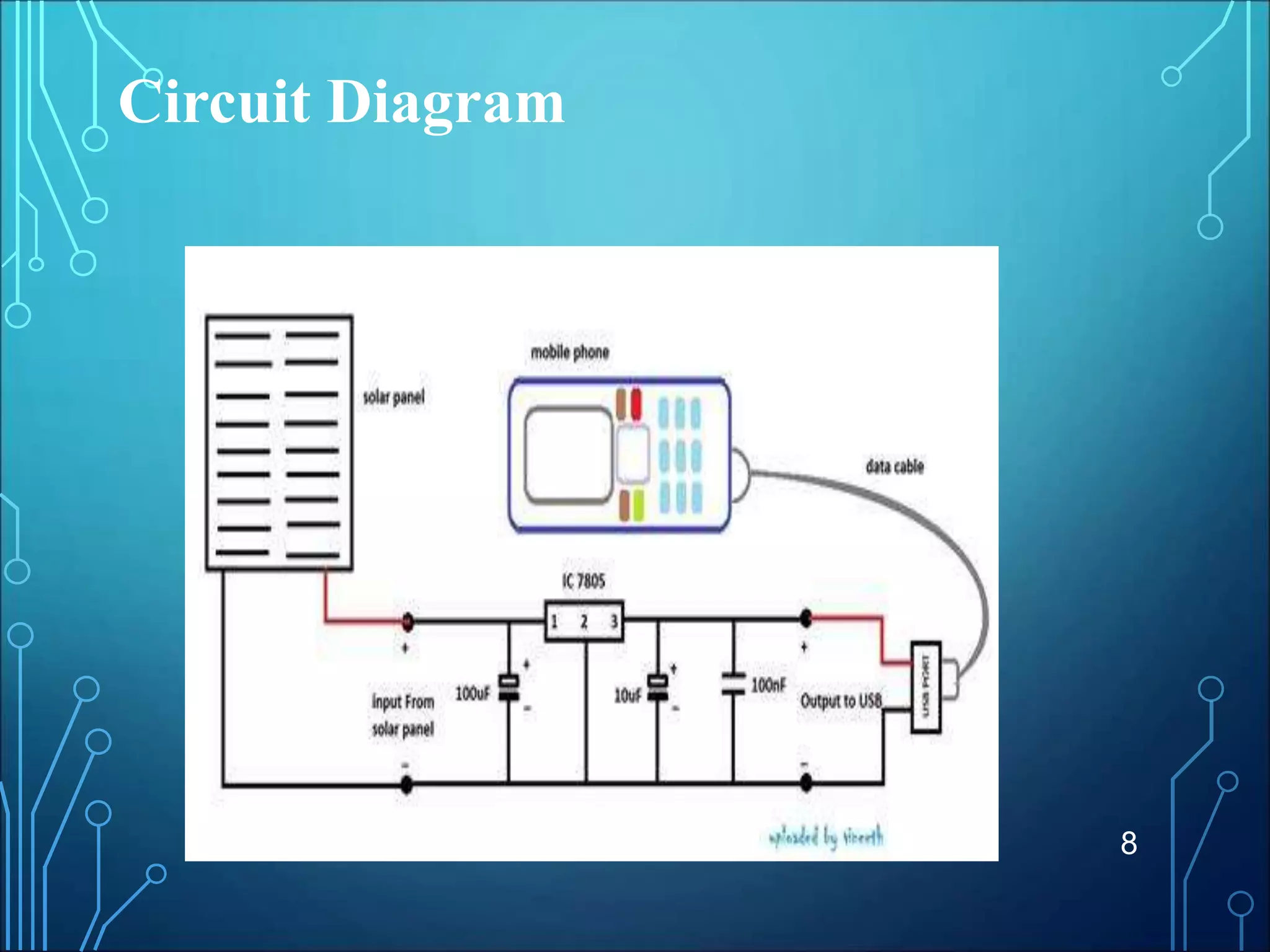
Circuit Diagram
8
Circuit(contd.)
• The electrons thus convert solar energy to electrical
energy.
• The output from the solar panel is now sent to a voltage
regulator IC7805.
• The voltage regulator ensures that the final output
voltage does not exceed 5V.
• Thus a constant voltage is supplied and the mobile gets
charged.
9
Block Diagram
10
Results and Discussion
• It can be used in various applications and has a lot of
features.
• Relatively small size and can be used anywhere(portability).
• Requires no electrical start-up power.
• Higher efficiency than photovoltaic systems of the same size.
• Low maintenance, emission free and environment friendly.
11
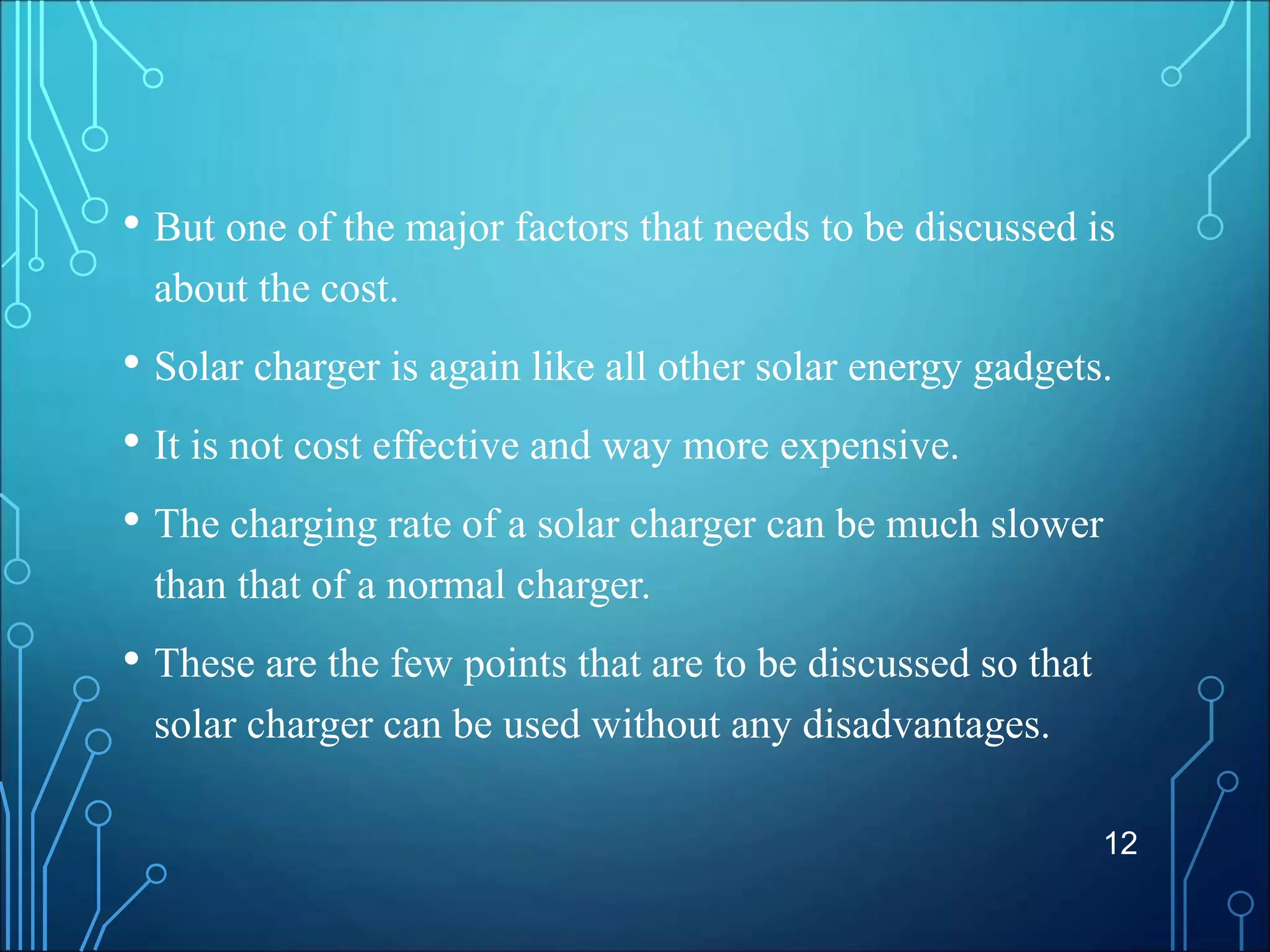
• But one of the major factors that needs to be discussed is
about the cost.
• Solar charger is again like all other solar energy gadgets.
• It is not cost effective and way more expensive.
• The charging rate of a solar charger can be much slower
than that of a normal charger.
• These are the few points that are to be discussed so that
solar charger can be used without any disadvantages.
12
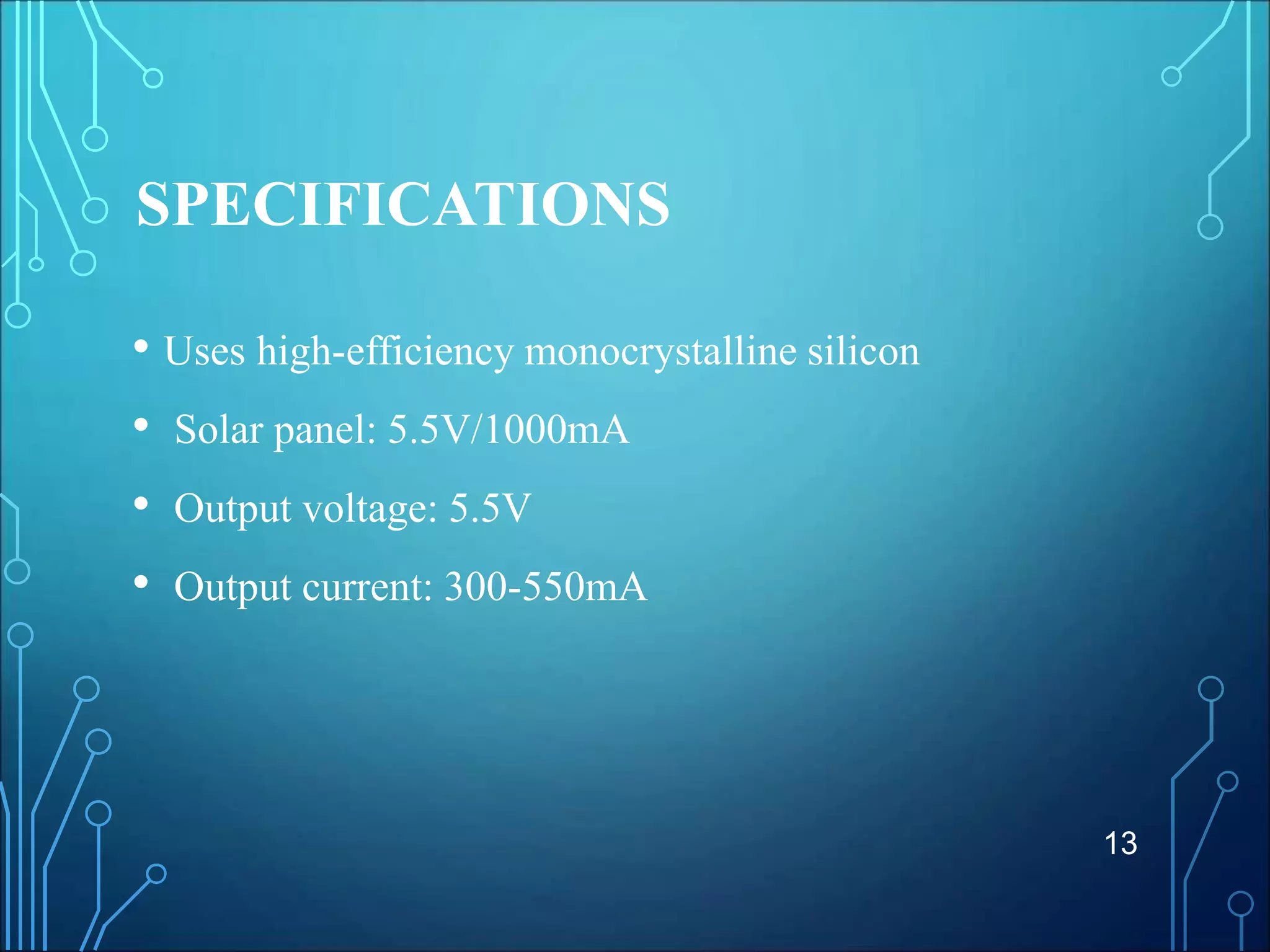
SPECIFICATIONS
• Uses high-efficiency monocrystalline silicon
• Solar panel: 5.5V/1000mA
• Output voltage: 5.5V
• Output current: 300-550mA
13
Conclusion
• The energy must thus be conserved and used efficiently.
• In solar mobile charger ripples are not produced as a direct DC
power is supplied.
• Battery life is high and also its adaptability.
• So, Solar mobile charger is highly applicable in today’s world.
• This is due to the continual depletion of resources.
• Solar energy is renewable and can be used for the simplest of
purpose i.e. solar mobile charger.
14
References
• www.google.com
• www.wikipedia.com
• www.studymafia.org
15
THANKS
16

SOLAR-MOBILE-CHARGER- 123.ppt

  • 1.
    Submitted by: Nadipatti Subramanyam YekollaKesava Manoj Kumar T.S Solar Mobile Charger
  • 2.
    Outline • Introduction • Objectives •Methods and Procedures • Working • Results and Discussion • Specifications • Conclusion • References 2
  • 3.
    Introduction • The sunis made up of hydrogen and helium and it emits enormous amount of heat. • A solar cell which forms a primary part of the solar mobile charger works on the principle of photovoltaic effect. • It is made up of packets of energy called “Photons”. • When a photon is absorbed the energy of the photon is transferred to the electron. • Given the current energy crisis the need of a more sustainable energy is required which is provided by solar energy. 3
  • 4.
    Objectives • To studythe basic operations of a solar mobile charger. • To know the advantages and limitations of its use. • To know the future scope of the solar mobile charger. • Maximizing the use of it in day to day life. 4
  • 5.
    Methods and Procedures •The hardware components needed for making a solar mobile charger are: • Solar Panel • Voltage Regulator • Switch • Resistors • Output Jack. 5
  • 6.
    Working • This isthe diagrammatic working of a Solar panel. • This forms the basic principle of a Solar mobile charger. 6
  • 7.
    Working(contd.) • Photons attackingthe solar cells are absorbed by any semiconducting material such as silicon. • The energy of the absorbed photon is transferred to the electron. • This energy knocks off the electrons from the atoms. • It flows unidirectional through the material which provides electrical energy. • An array of solar cells convert solar energy into usable Electrical energy. 7
  • 8.
  • 9.
    Circuit(contd.) • The electronsthus convert solar energy to electrical energy. • The output from the solar panel is now sent to a voltage regulator IC7805. • The voltage regulator ensures that the final output voltage does not exceed 5V. • Thus a constant voltage is supplied and the mobile gets charged. 9
  • 10.
  • 11.
    Results and Discussion •It can be used in various applications and has a lot of features. • Relatively small size and can be used anywhere(portability). • Requires no electrical start-up power. • Higher efficiency than photovoltaic systems of the same size. • Low maintenance, emission free and environment friendly. 11
  • 12.
    • But oneof the major factors that needs to be discussed is about the cost. • Solar charger is again like all other solar energy gadgets. • It is not cost effective and way more expensive. • The charging rate of a solar charger can be much slower than that of a normal charger. • These are the few points that are to be discussed so that solar charger can be used without any disadvantages. 12
  • 13.
    SPECIFICATIONS • Uses high-efficiencymonocrystalline silicon • Solar panel: 5.5V/1000mA • Output voltage: 5.5V • Output current: 300-550mA 13
  • 14.
    Conclusion • The energymust thus be conserved and used efficiently. • In solar mobile charger ripples are not produced as a direct DC power is supplied. • Battery life is high and also its adaptability. • So, Solar mobile charger is highly applicable in today’s world. • This is due to the continual depletion of resources. • Solar energy is renewable and can be used for the simplest of purpose i.e. solar mobile charger. 14
  • 15.
  • 16.

Editor's Notes