Introduction:
Chemical fertilizer indeed boosts up crop production initially however; it
causes gradual decrease in fertilizer use efficiency. Application of
chemical fertilizer without conservation of soil fertility not only results
in depletion of soil nutrient reserve but disrupts the biological balance of
soil-plant system also. Whereas Integrated nutrient management not only
sustains the soil and crop productivity but also ensure environmental and
ecological security.
Integrated Nutrient Management (INM)
by
Dr. Anil Kumar Singh
Assistant Professor
Department of Agricultural Chemistry and Soil Science
SMM Town PG College, Ballia, UP
Why Integrated Nutrient Management?
Integrated nutrient management envisages the use of chemical
fertilizers in conjunction with organic manures, legumes in cropping
system, biofertilizers and other locally available nutrient sources for
sustaining soil health and productivity. In other words we can say
that INM is the appropriate combination of organic manures,
inorganic chemical fertilizers, and biofertilizers for optimum
economic yield.
What is Integrated Nutrient Management?
 To increase crop yield and quality
 Increasing farm income and profitability.
 Correction of inherent soil nutrient deficiencies.
 Improving lasting soil fertility.
 Avoiding/minimizing damage to the environment.
 Restoring fertility and productivity of land that has been degraded by
faulty management practices.
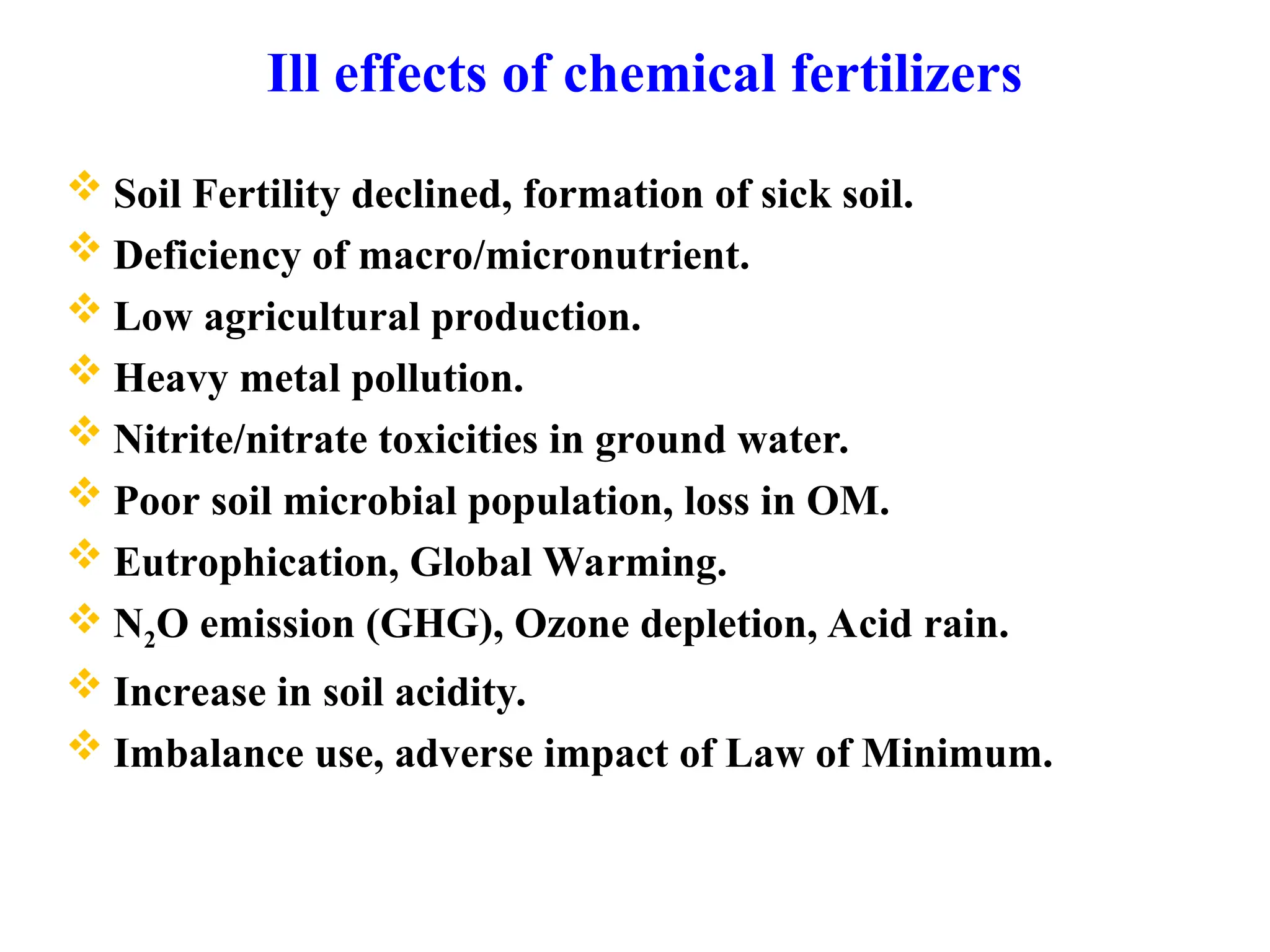
Ill effects of chemical fertilizers
 Soil Fertility declined, formation of sick soil.
 Deficiency of macro/micronutrient.
 Low agricultural production.
 Heavy metal pollution.
 Nitrite/nitrate toxicities in ground water.
 Poor soil microbial population, loss in OM.
 Eutrophication, Global Warming.
 N2O emission (GHG), Ozone depletion, Acid rain.
 Increase in soil acidity.
 Imbalance use, adverse impact of Law of Minimum.
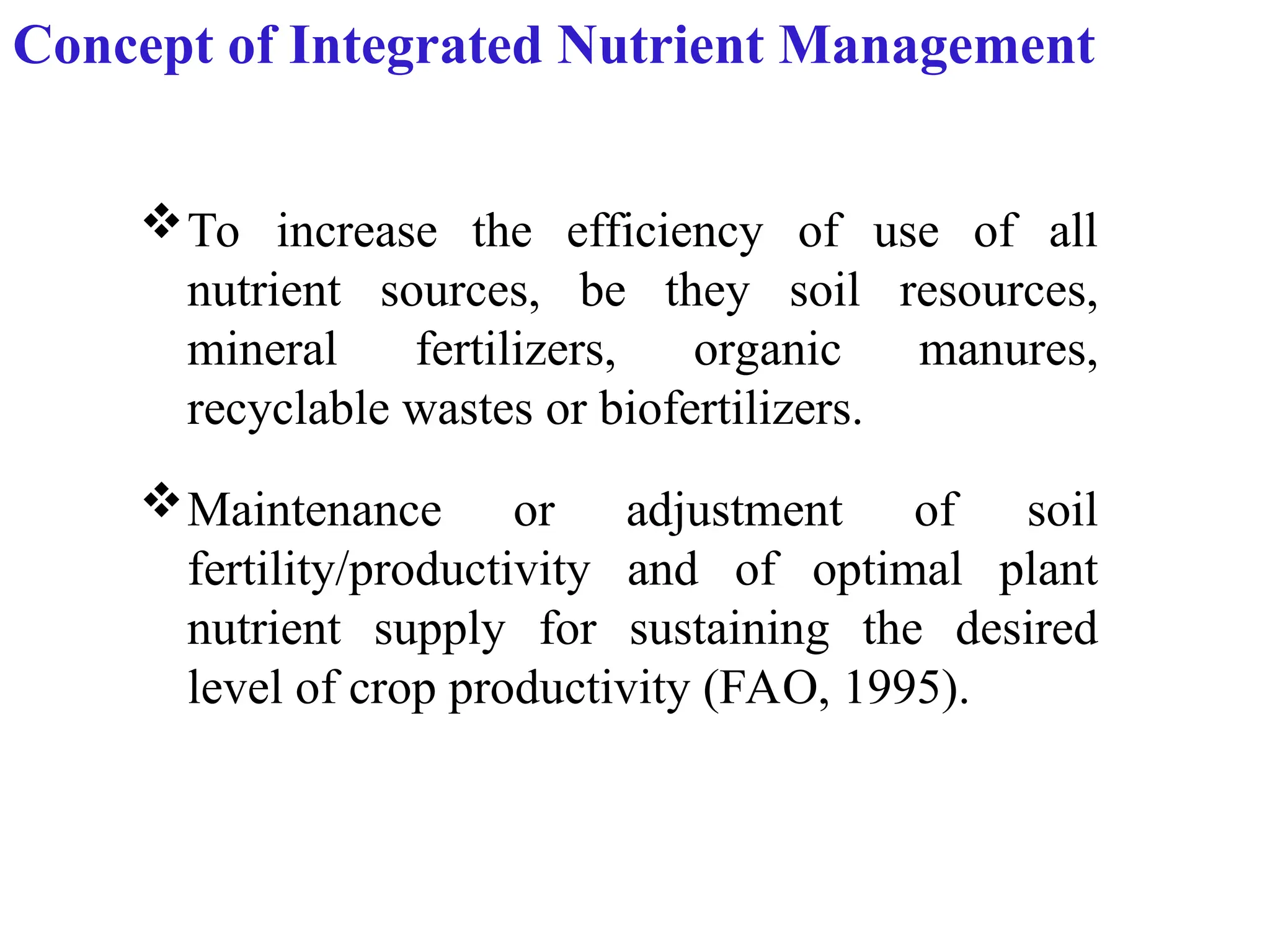
Concept of Integrated Nutrient Management
To increase the efficiency of use of all
nutrient sources, be they soil resources,
mineral fertilizers, organic manures,
recyclable wastes or biofertilizers.
Maintenance or adjustment of soil
fertility/productivity and of optimal plant
nutrient supply for sustaining the desired
level of crop productivity (FAO, 1995).
The concept of INM is that of a nutrient integrator. The major
components of INM are sources of plant nutrients both organic and
inorganic which are as follows.
Chemical fertilizers containing both major nutrients and
micronutrients.
Crop residues.
Green manures and green leaf manures.
Organic manures of plant, animal, human and industrial origin.
Recyclable wastes from various sources with or without processing
provided these do not contain harmful substances or pathogens above
permissible limits.
Animal slurries and biogas plant slurry.
Microbial inoculants (biofertilizers).
Commercial organic fertilizers.
Components of Integrated Nutrient Management
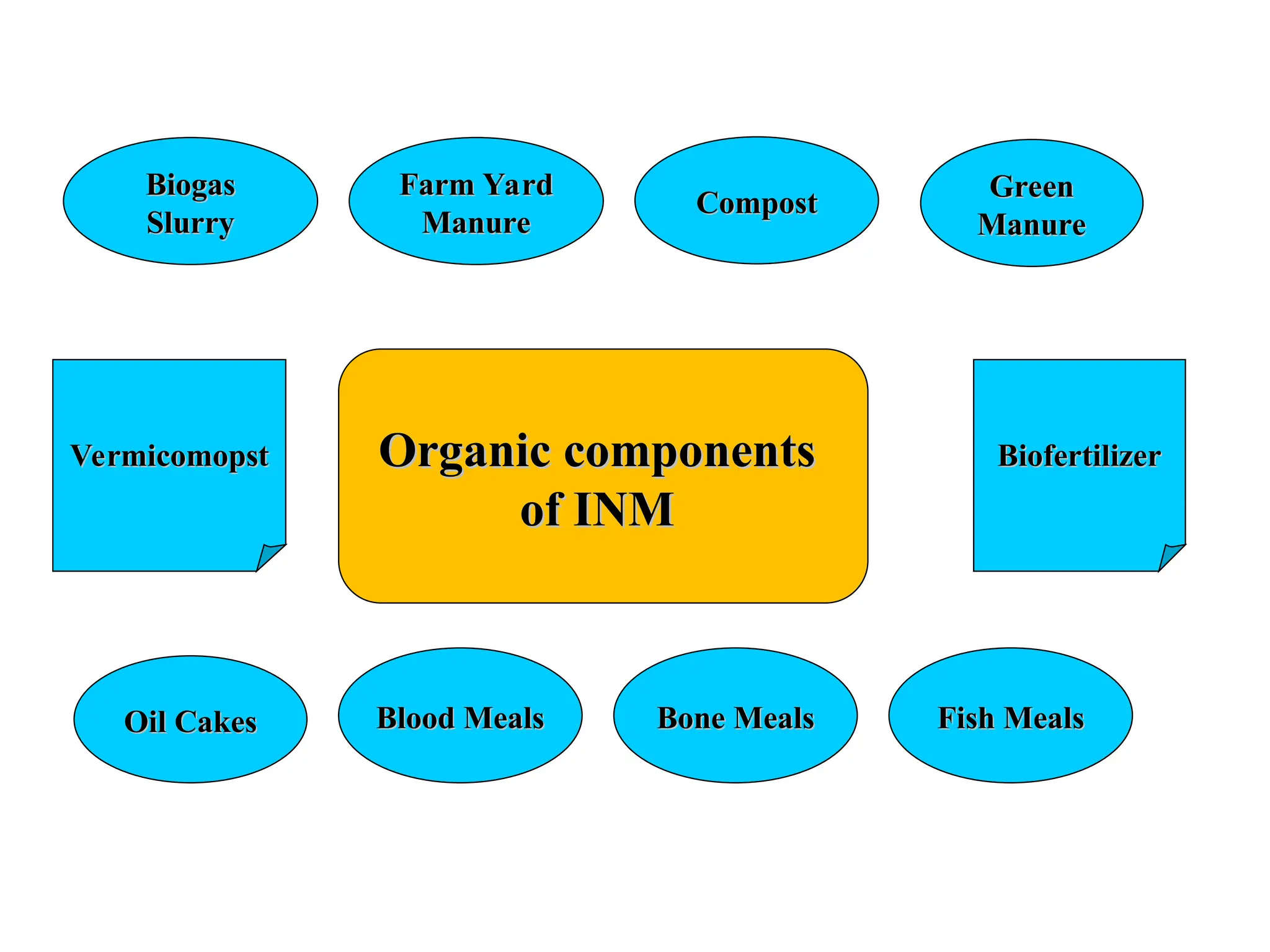
Organic components
Organic components
of INM
of INM
Farm Yard
Farm Yard
Manure
Manure
Biogas
Biogas
Slurry
Slurry
Compost
Compost Green
Green
Manure
Manure
Blood Meals
Blood Meals
Oil Cakes
Oil Cakes Bone Meals
Bone Meals Fish Meals
Fish Meals
Vermicomopst
Vermicomopst Biofertilizer
Biofertilizer
Type of organic manures
Bulky organic manure:
* Farm Yard Manure, Compost, Biogas Slurry
Advantages of bulky organic manure:
1- Besides the major nutrients, bulky organic manures also contain traces of
micronutrients.
2 - Bulky organic manures increase organic matter content and hence improve the
physical properties of soils.
3 -Bulky organic manures provide food for soil microorganisms. It increases activity of
microbes which in turn help convert unavailable plant nutrient into available forms.
Concentrated organic manures:
* Oil cakes , Blood meals, Bone meals and Fish meal etc.
Others:
* Vermicompost is the most preferred option for organic matter addition in soil
* Biofertilizers
* Biodynamic preparations
Organic inputs N (%) P(%) K(%) OC (%)
Vermicompost 1.63 1.26 0.34 12.01
Compost 1.87 1.18 0.23 24.48
Groundnut Cake 3.71 0.86 0.69 40.78
Mustard Oil Cake 5.21 1.38 0.65 41.39
Rice Bran 3.54 0.78 0.65 37.46
Bone Meal 6.56 1.08 1.17 -
Kusum Cake 3.11 1.71 0.49 -
Til Cake 3.33 0.55 0.22 35.51
Karanj Cake 3.86 0.62 0.41 43.87
Neem Cake 1.40 0.22 0.99 43.36
Nutrient content of some important organic manures
(Dry weight basis)
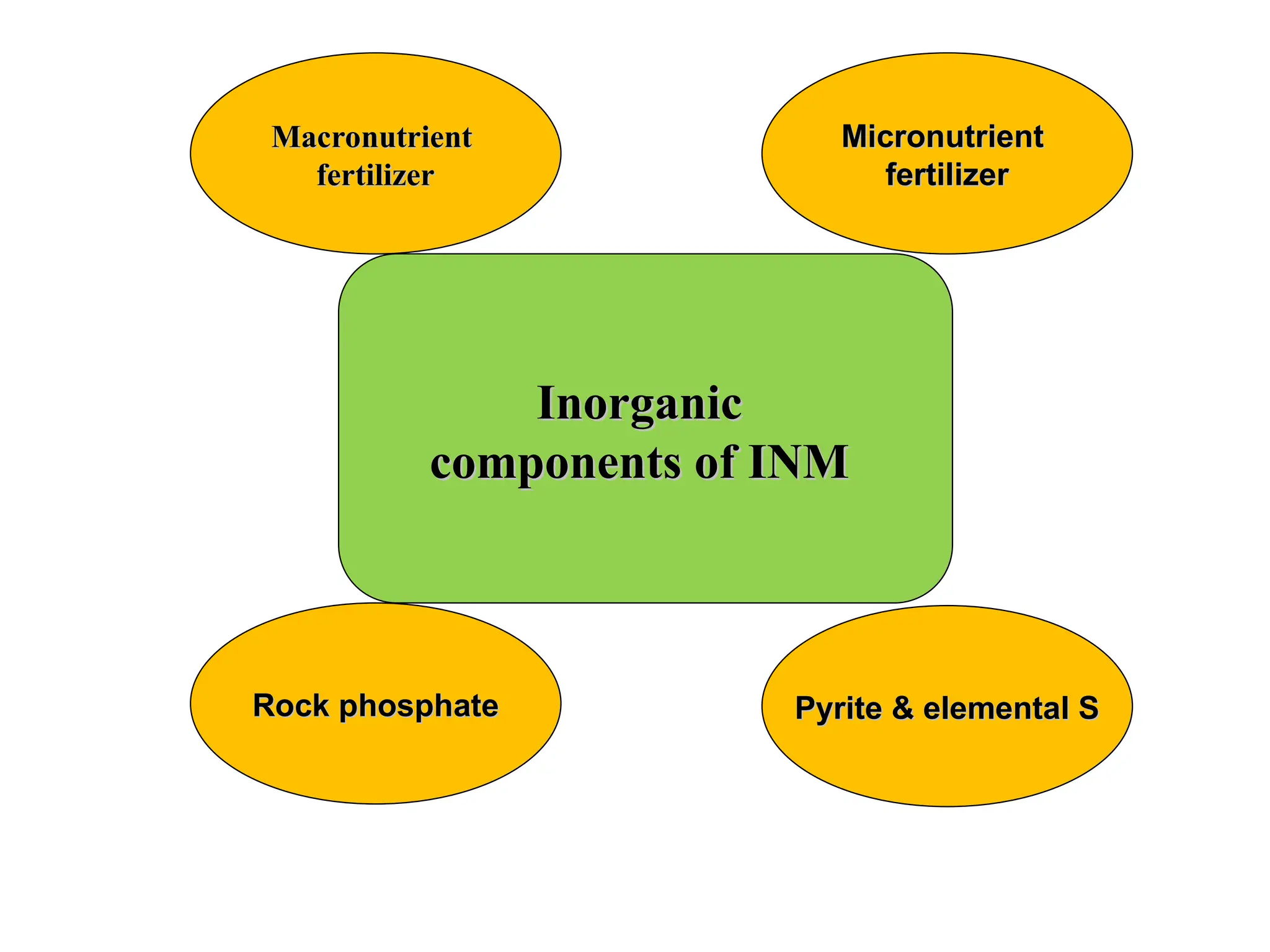
Inorganic
Inorganic
components of INM
components of INM
Macronutrient
Macronutrient
fertilizer
fertilizer
Micronutrient
Micronutrient
fertilizer
fertilizer
Pyrite & elemental S
Rock phosphate
Rock phosphate
Biofertilizer as component of INM
Nitrogen fixing
Nitrogen fixing
Biofertilizer (NBF)
Biofertilizer (NBF)
Phosphate solubiliser
Bacillus
Bacillus
Pseudomonas
Pseudomonas
Aspergillus
Aspergillus
Phosphate mobilizing
Biofertilizer (PMBF)
NBF for legumes
NBF for legumes
Rhizobium
Rhizobium
NBF for cereals
NBF for cereals
Azospirillum
Azospirillum
Azotobacter
Azotobacter
Azolla
Azolla
BGA
BGA
Phosphate absorber
Phosphate absorber
VAM
VAM
Green manuring as component of INM
Types of green
Manuring:
 Green Manuring
Green Manuring In situ
In situ
 Green Leaf Manuring
Green Leaf Manuring
Benefits of green manuring:
 Add organic matter to the soil
Add organic matter to the soil
 Fix atmospheric nitrogen (legumes)
Fix atmospheric nitrogen (legumes)
 Add nutrient to the soil
Add nutrient to the soil
 Provide shade to new plant
Provide shade to new plant
 Conserve soil moisture
Conserve soil moisture
Crotalaria
Note: Green manuring has been discussed in detail in green manuring
lecture note
Good Agricultural Practices for Nutrient Management Planning
Nutrient management is an important component of a soil and crop management
system. Nutrient management planning as such is a relatively new term; however, the
principles involved are basic, sound fundamentals necessary for good management.
Nutrient management plan must be site-specific. They should be tailored to the soils,
crops and cultivars, landscapes, and management of a particular farm. Important steps
for nutrient management planning are as follows:
Soil samples should be collected and analyzed as per recognized standard soil
fertility analytical procedures in order to generate accurate soil fertility information for
each field management unit.
Yield potential for each field should be estimated based on soil productivity and
intended management and then yield target should be fixes up.
Work out the plant nutrient needs to achieve the pre-set yield target. Nutrient uptake
and removal data for all crops are available from various sources. It is important to
distinguish between nutrient removal/uptake by the target crop, or the physical
displacement of the nutrients from the field through the crop harvest.
 Determine the amount of the nutrients to be supplied separately through
organic and inorganic available sources. The best method is to sample the
manures to be used in the field and get analyzed accurately the nutrient
contents of the manure and the nutrient release patterns.
 Doses of the nutrients to be supplied through fertilizers should be decided
considering indigenous nutrient supply capacity. Record of the nutrient
sources, their rate, method and time of application should be maintained.
 Use a combination of organic mulches and fertilizer to maintain the health
of the crop.
 Promote use of locally available organic sources viz. compost, FYM and
vermicompost etc. to minimize the need for inorganic chemical fertilizer
application.
 Fertilizer recommendations should be followed, but always taking into
account the actual condition of the crop.
Use leguminous species green manuring crop which helps to
improve biological nitrogen fixation and availability to the plants.
Maintain optimum level of soil organic matter which is an
important component of soil to provide optimum condition in the
soil for proper plant growth.
Retain crop residues in the field as complementary source of
nutrient.
Soil should be covered by a crop or mulch, including pruning
litter, especially in rainy season.
Apply both bulky and concentrated organic manure and plant
residues etc. where soil organic matter is poor.
Include growing of in situ green manuring in cropping system and
grow suitable crop species like, sun hemp and dhaincha etc. to add
organic matter and other nutrients in the soil.
Factors affecting optimum
fertilizer dose
fertilizer dose
Soil pH
Soil pH
Initial soil
Initial soil
fertility
fertility
Soil texture
Soil texture Soil erosion
Soil erosion
Sowing period
Sowing period
Variety of crop
Variety of crop
Use of organic
Use of organic
manure
manure
Cropping intensity
Cropping intensity
& plant density
& plant density
Rainfall &
Rainfall &
distribution
distribution
Previous crop
Previous crop
raised
raised
Profitable use of fertilizers
For the most profitable use of fertilizers, the following
common questions should be answered.
1.How much fertilizer to use? i. e. right amount
2.What kind of fertilizer to use? i. e. right type of
fertilizers
3.How to apply fertilizer? i. e. the right place
4.When to apply? i. e. right time
Source: Yawalkar et al, (2002)
Reference
 FAO (2006). Fertilizer and plant nutrition bulletin 16, Plant nutrition for food security A guide for INM.
 Singh, A. K., Singh, A. K and Pal, M. (2019). Good Agricultural Practices for Soil Fertility and Nutrient
Management. In: Innovations in Agriculture, Environmental and Health Research for Ecological
Restoration, pp. 73-76. (Ed.) Pant H., Yadav A. S., Singh M. K., Verma J., Srivastava V. K and Kumar
A., Society of Biological Sciences and Rural Development, Allahabad, UP, India.
 Singh, A. K., Singh, A. K. and Kumar, A. (2014). Quality parameters, harvest index of hybrid rice (Oryza
sativa L.) and economics of various treatments under various levels of zinc sulphate and integrated
nutrient management. International Journal on Agricultural Sciences, 5 (2): 137-144.
 Singh, A. K. (2014). Soil fertility, yield and nutrient uptake of hybrid rice as influenced by integrated
nutrient management. Advances in Plant Sciences, 27 (1): 189-192.
 Singh, A. K. (2013). Impact of integrated nutrient management on growth parameters, physiological
characteristics, yield and yield attributes of hybrid rice. Journal of Soils and Crops, 23 (2): 259-263.
 Singh, A. K.; Bisen, J. S.; Bora, D. K.; Kumar, R. and Bera, B. (2011). Comparative study of organic,
inorganic and integrated plant nutrient supply on the yield of Darjeeling tea and soil health. Two and a
Bud, 58: 58-61.
 Yawalkar, K. S., Agarwal, J. P. and Bokde, S. (2002). Manures and Fertilizers.

INutrientManagementbyDr.AnilKumarSinghRG.ppt

  • 1.
    Introduction: Chemical fertilizer indeedboosts up crop production initially however; it causes gradual decrease in fertilizer use efficiency. Application of chemical fertilizer without conservation of soil fertility not only results in depletion of soil nutrient reserve but disrupts the biological balance of soil-plant system also. Whereas Integrated nutrient management not only sustains the soil and crop productivity but also ensure environmental and ecological security. Integrated Nutrient Management (INM) by Dr. Anil Kumar Singh Assistant Professor Department of Agricultural Chemistry and Soil Science SMM Town PG College, Ballia, UP
  • 2.
    Why Integrated NutrientManagement? Why Integrated Nutrient Management? Integrated nutrient management envisages the use of chemical fertilizers in conjunction with organic manures, legumes in cropping system, biofertilizers and other locally available nutrient sources for sustaining soil health and productivity. In other words we can say that INM is the appropriate combination of organic manures, inorganic chemical fertilizers, and biofertilizers for optimum economic yield. What is Integrated Nutrient Management? What is Integrated Nutrient Management?  To increase crop yield and quality  Increasing farm income and profitability.  Correction of inherent soil nutrient deficiencies.  Improving lasting soil fertility.  Avoiding/minimizing damage to the environment.  Restoring fertility and productivity of land that has been degraded by faulty management practices.
  • 3.
    Ill effects ofchemical fertilizers  Soil Fertility declined, formation of sick soil.  Deficiency of macro/micronutrient.  Low agricultural production.  Heavy metal pollution.  Nitrite/nitrate toxicities in ground water.  Poor soil microbial population, loss in OM.  Eutrophication, Global Warming.  N2O emission (GHG), Ozone depletion, Acid rain.  Increase in soil acidity.  Imbalance use, adverse impact of Law of Minimum.
  • 4.
    Concept of IntegratedNutrient Management To increase the efficiency of use of all nutrient sources, be they soil resources, mineral fertilizers, organic manures, recyclable wastes or biofertilizers. Maintenance or adjustment of soil fertility/productivity and of optimal plant nutrient supply for sustaining the desired level of crop productivity (FAO, 1995).
  • 5.
    The concept ofINM is that of a nutrient integrator. The major components of INM are sources of plant nutrients both organic and inorganic which are as follows. Chemical fertilizers containing both major nutrients and micronutrients. Crop residues. Green manures and green leaf manures. Organic manures of plant, animal, human and industrial origin. Recyclable wastes from various sources with or without processing provided these do not contain harmful substances or pathogens above permissible limits. Animal slurries and biogas plant slurry. Microbial inoculants (biofertilizers). Commercial organic fertilizers. Components of Integrated Nutrient Management
  • 6.
    Organic components Organic components ofINM of INM Farm Yard Farm Yard Manure Manure Biogas Biogas Slurry Slurry Compost Compost Green Green Manure Manure Blood Meals Blood Meals Oil Cakes Oil Cakes Bone Meals Bone Meals Fish Meals Fish Meals Vermicomopst Vermicomopst Biofertilizer Biofertilizer
  • 7.
    Type of organicmanures Bulky organic manure: * Farm Yard Manure, Compost, Biogas Slurry Advantages of bulky organic manure: 1- Besides the major nutrients, bulky organic manures also contain traces of micronutrients. 2 - Bulky organic manures increase organic matter content and hence improve the physical properties of soils. 3 -Bulky organic manures provide food for soil microorganisms. It increases activity of microbes which in turn help convert unavailable plant nutrient into available forms. Concentrated organic manures: * Oil cakes , Blood meals, Bone meals and Fish meal etc. Others: * Vermicompost is the most preferred option for organic matter addition in soil * Biofertilizers * Biodynamic preparations
  • 8.
    Organic inputs N(%) P(%) K(%) OC (%) Vermicompost 1.63 1.26 0.34 12.01 Compost 1.87 1.18 0.23 24.48 Groundnut Cake 3.71 0.86 0.69 40.78 Mustard Oil Cake 5.21 1.38 0.65 41.39 Rice Bran 3.54 0.78 0.65 37.46 Bone Meal 6.56 1.08 1.17 - Kusum Cake 3.11 1.71 0.49 - Til Cake 3.33 0.55 0.22 35.51 Karanj Cake 3.86 0.62 0.41 43.87 Neem Cake 1.40 0.22 0.99 43.36 Nutrient content of some important organic manures (Dry weight basis)
  • 9.
    Inorganic Inorganic components of INM componentsof INM Macronutrient Macronutrient fertilizer fertilizer Micronutrient Micronutrient fertilizer fertilizer Pyrite & elemental S Pyrite & elemental S Rock phosphate Rock phosphate
  • 10.
    Biofertilizer as componentof INM Biofertilizer as component of INM Nitrogen fixing Nitrogen fixing Biofertilizer (NBF) Biofertilizer (NBF) Phosphate solubiliser Phosphate solubiliser Bacillus Bacillus Pseudomonas Pseudomonas Aspergillus Aspergillus Phosphate mobilizing Phosphate mobilizing Biofertilizer (PMBF) Biofertilizer (PMBF) NBF for legumes NBF for legumes Rhizobium Rhizobium NBF for cereals NBF for cereals Azospirillum Azospirillum Azotobacter Azotobacter Azolla Azolla BGA BGA Phosphate absorber Phosphate absorber VAM VAM
  • 11.
    Green manuring ascomponent of INM Green manuring as component of INM Types of green Manuring:  Green Manuring Green Manuring In situ In situ  Green Leaf Manuring Green Leaf Manuring Benefits of green manuring:  Add organic matter to the soil Add organic matter to the soil  Fix atmospheric nitrogen (legumes) Fix atmospheric nitrogen (legumes)  Add nutrient to the soil Add nutrient to the soil  Provide shade to new plant Provide shade to new plant  Conserve soil moisture Conserve soil moisture Crotalaria Note: Green manuring has been discussed in detail in green manuring lecture note
  • 12.
    Good Agricultural Practicesfor Nutrient Management Planning Nutrient management is an important component of a soil and crop management system. Nutrient management planning as such is a relatively new term; however, the principles involved are basic, sound fundamentals necessary for good management. Nutrient management plan must be site-specific. They should be tailored to the soils, crops and cultivars, landscapes, and management of a particular farm. Important steps for nutrient management planning are as follows: Soil samples should be collected and analyzed as per recognized standard soil fertility analytical procedures in order to generate accurate soil fertility information for each field management unit. Yield potential for each field should be estimated based on soil productivity and intended management and then yield target should be fixes up. Work out the plant nutrient needs to achieve the pre-set yield target. Nutrient uptake and removal data for all crops are available from various sources. It is important to distinguish between nutrient removal/uptake by the target crop, or the physical displacement of the nutrients from the field through the crop harvest.
  • 13.
     Determine theamount of the nutrients to be supplied separately through organic and inorganic available sources. The best method is to sample the manures to be used in the field and get analyzed accurately the nutrient contents of the manure and the nutrient release patterns.  Doses of the nutrients to be supplied through fertilizers should be decided considering indigenous nutrient supply capacity. Record of the nutrient sources, their rate, method and time of application should be maintained.  Use a combination of organic mulches and fertilizer to maintain the health of the crop.  Promote use of locally available organic sources viz. compost, FYM and vermicompost etc. to minimize the need for inorganic chemical fertilizer application.  Fertilizer recommendations should be followed, but always taking into account the actual condition of the crop.
  • 14.
    Use leguminous speciesgreen manuring crop which helps to improve biological nitrogen fixation and availability to the plants. Maintain optimum level of soil organic matter which is an important component of soil to provide optimum condition in the soil for proper plant growth. Retain crop residues in the field as complementary source of nutrient. Soil should be covered by a crop or mulch, including pruning litter, especially in rainy season. Apply both bulky and concentrated organic manure and plant residues etc. where soil organic matter is poor. Include growing of in situ green manuring in cropping system and grow suitable crop species like, sun hemp and dhaincha etc. to add organic matter and other nutrients in the soil.
  • 15.
    Factors affecting optimum Factorsaffecting optimum fertilizer dose fertilizer dose Soil pH Soil pH Initial soil Initial soil fertility fertility Soil texture Soil texture Soil erosion Soil erosion Sowing period Sowing period Variety of crop Variety of crop Use of organic Use of organic manure manure Cropping intensity Cropping intensity & plant density & plant density Rainfall & Rainfall & distribution distribution Previous crop Previous crop raised raised
  • 16.
    Profitable use offertilizers For the most profitable use of fertilizers, the following common questions should be answered. 1.How much fertilizer to use? i. e. right amount 2.What kind of fertilizer to use? i. e. right type of fertilizers 3.How to apply fertilizer? i. e. the right place 4.When to apply? i. e. right time Source: Yawalkar et al, (2002)
  • 17.
    Reference  FAO (2006).Fertilizer and plant nutrition bulletin 16, Plant nutrition for food security A guide for INM.  Singh, A. K., Singh, A. K and Pal, M. (2019). Good Agricultural Practices for Soil Fertility and Nutrient Management. In: Innovations in Agriculture, Environmental and Health Research for Ecological Restoration, pp. 73-76. (Ed.) Pant H., Yadav A. S., Singh M. K., Verma J., Srivastava V. K and Kumar A., Society of Biological Sciences and Rural Development, Allahabad, UP, India.  Singh, A. K., Singh, A. K. and Kumar, A. (2014). Quality parameters, harvest index of hybrid rice (Oryza sativa L.) and economics of various treatments under various levels of zinc sulphate and integrated nutrient management. International Journal on Agricultural Sciences, 5 (2): 137-144.  Singh, A. K. (2014). Soil fertility, yield and nutrient uptake of hybrid rice as influenced by integrated nutrient management. Advances in Plant Sciences, 27 (1): 189-192.  Singh, A. K. (2013). Impact of integrated nutrient management on growth parameters, physiological characteristics, yield and yield attributes of hybrid rice. Journal of Soils and Crops, 23 (2): 259-263.  Singh, A. K.; Bisen, J. S.; Bora, D. K.; Kumar, R. and Bera, B. (2011). Comparative study of organic, inorganic and integrated plant nutrient supply on the yield of Darjeeling tea and soil health. Two and a Bud, 58: 58-61.  Yawalkar, K. S., Agarwal, J. P. and Bokde, S. (2002). Manures and Fertilizers.