This lecture is dedicated to the great Soil Scientist
Dr. B. Ramamoorthy
Conceptual Framework of Soil Fertility Management in
Tamil Nadu – Developing Stories to Strengthen
Successes and Rectify Failures
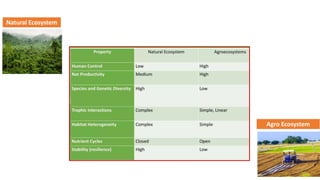
Natural Ecosystem
Agro Ecosystem
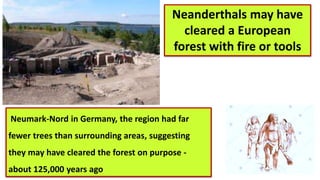
Neanderthals may have
cleared a European
forest with fire or tools
Neumark-Nord in Germany, the region had far
fewer trees than surrounding areas, suggesting
they may have cleared the forest on purpose -
about 125,000 years ago
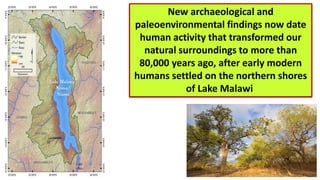
New archaeological and
paleoenvironmental findings now date
human activity that transformed our
natural surroundings to more than
80,000 years ago, after early modern
humans settled on the northern shores
of Lake Malawi
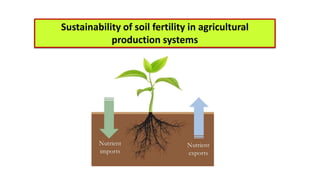
Sustainability of soil fertility in agricultural
production systems
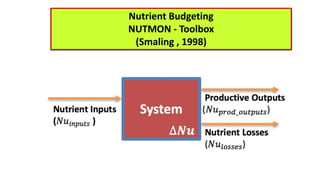
Nutrient Budgeting
NUTMON - Toolbox
(Smaling , 1998)
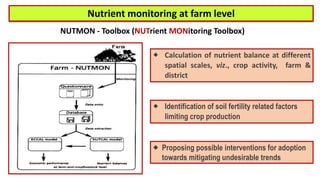
 Proposing possible interventions for adoption
towards mitigating undesirable trends
 Identification of soil fertility related factors
limiting crop production
 Calculation of nutrient balance at different
spatial scales, viz., crop activity, farm &
district
NUTMON - Toolbox (NUTrient MONitoring Toolbox)
Nutrient monitoring at farm level
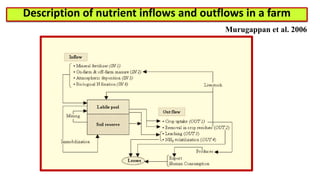
Description of nutrient inflows and outflows in a farm
Murugappan et al. 2006
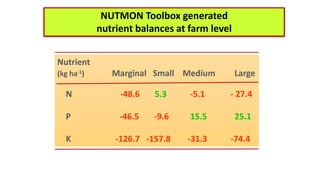
NUTMON Toolbox generated
nutrient balances at farm level
Nutrient
(kg ha-1) Marginal Small Medium Large
N -48.6 5.3 -5.1 - 27.4
P -46.5 -9.6 15.5 25.1
K -126.7 -157.8 -31.3 -74.4
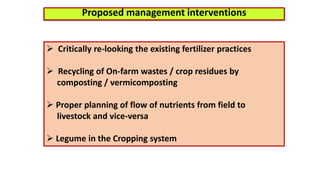
 Critically re-looking the existing fertilizer practices
 Recycling of On-farm wastes / crop residues by
composting / vermicomposting
 Proper planning of flow of nutrients from field to
livestock and vice-versa
 Legume in the Cropping system
Proposed management interventions
Soil Fertility Management
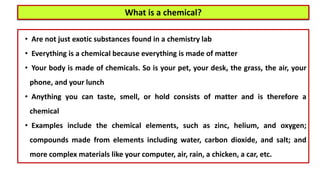
What is a chemical?
• Are not just exotic substances found in a chemistry lab
• Everything is a chemical because everything is made of matter
• Your body is made of chemicals. So is your pet, your desk, the grass, the air, your
phone, and your lunch
• Anything you can taste, smell, or hold consists of matter and is therefore a
chemical
• Examples include the chemical elements, such as zinc, helium, and oxygen;
compounds made from elements including water, carbon dioxide, and salt; and
more complex materials like your computer, air, rain, a chicken, a car, etc.
The research output of
Soil Fertility Scientists are easy to tell but
not that easy to sell
General / Blanket recommendation
Followed in Tamil Nadu since 1953
• Based on the results of model agronomic experiments on
government farms
• Simple fertilizer trials on cultivator's field
• Economy and efficiency of fertilizer use not known
• Leads to either over or under usage of fertilizer nutrients
Soil nutrient as an index of soil fertility
S. No. Soil Nutrients
Soil Fertility Rating
Low Medium High
1 Organic carbon as a measure of available N (%) < 0.5 0.5 - 0.75 > 0.75
2 Available N (Alkaline KMnO4-N) (kgha-1) < 280 280 - 560 > 560
3 Available P (Olsen-P) (kgha-1) < 10 10 - 24.6 > 24.6
4 Available K (Neutral N NH4OAc-K) (kgha-1) < 108 108 - 280 > 280
Soil fertility rating
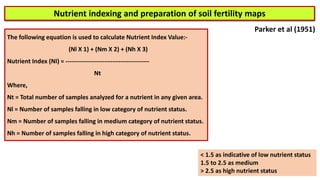
Nutrient indexing and preparation of soil fertility maps
The following equation is used to calculate Nutrient Index Value:-
(Nl X 1) + (Nm X 2) + (Nh X 3)
Nutrient Index (NI) = -----------------------------------------
Nt
Where,
Nt = Total number of samples analyzed for a nutrient in any given area.
Nl = Number of samples falling in low category of nutrient status.
Nm = Number of samples falling in medium category of nutrient status.
Nh = Number of samples falling in high category of nutrient status.
Parker et al (1951)
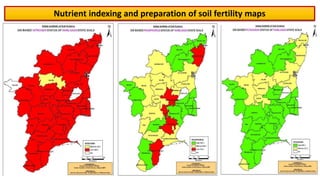
< 1.5 as indicative of low nutrient status
1.5 to 2.5 as medium
> 2.5 as high nutrient status
Nutrient indexing and preparation of soil fertility maps
Soil fertility management through targeted yield approach
Ramamoorthy et al. (1967)
Nutrient Requirement (NR) Soil (α ) & fertilizer (β ) nutrient
efficiencies
U = f (S, F)
U = α S + β F
NR = U / Y (or) U = NR Y
NR Y = α S + β F
NR = U / Y, α = U0/S0, β = [UF – (α SF)] / F
F = 1/ β [ NR Y - α S ]
Drawbacks
α > 1, β > 1
Does not lend for the estimation of standard errors of α & β
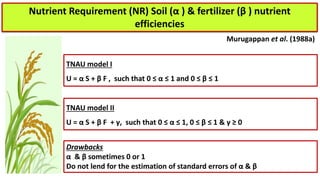
Nutrient Requirement (NR) Soil (α ) & fertilizer (β ) nutrient
efficiencies
TNAU model I
U = α S + β F , such that 0 ≤ α ≤ 1 and 0 ≤ β ≤ 1
TNAU model II
U = α S + β F + γ, such that 0 ≤ α ≤ 1, 0 ≤ β ≤ 1 & γ ≥ 0
Drawbacks
α & β sometimes 0 or 1
Do not lend for the estimation of standard errors of α & β
Murugappan et al. (1988a)
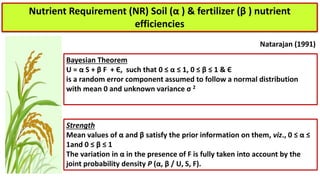
Nutrient Requirement (NR) Soil (α ) & fertilizer (β ) nutrient
efficiencies
Natarajan (1991)
Bayesian Theorem
U = α S + β F + Є, such that 0 ≤ α ≤ 1, 0 ≤ β ≤ 1 & Є
is a random error component assumed to follow a normal distribution
with mean 0 and unknown variance σ 2
Strength
Mean values of α and β satisfy the prior information on them, viz., 0 ≤ α ≤
1and 0 ≤ β ≤ 1
The variation in α in the presence of F is fully taken into account by the
joint probability density P (α, β / U, S, F).
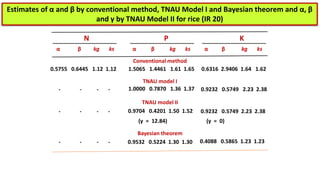
N P K
α β kg ks α β kg ks α β kg ks
Conventional method
0.5755 0.6445 1.12 1.12 1.5065 1.4461 1.61 1.65 0.6316 2.9406 1.64 1.62
TNAU model I
- - - - 1.0000 0.7870 1.36 1.37 0.9232 0.5749 2.23 2.38
TNAU model II
- - - - 0.9704 0.4201 1.50 1.52 0.9232 0.5749 2.23 2.38
(γ = 12.84) (γ = 0)
Bayesian theorem
- - - - 0.9532 0.5224 1.30 1.30 0.4088 0.5865 1.23 1.23
Estimates of α and β by conventional method, TNAU Model I and Bayesian theorem and α, β
and γ by TNAU Model II for rice (IR 20)
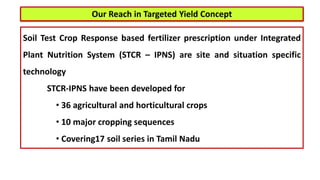
Soil Test Crop Response based fertilizer prescription under Integrated
Plant Nutrition System (STCR – IPNS) are site and situation specific
technology
STCR-IPNS have been developed for
• 36 agricultural and horticultural crops
• 10 major cropping sequences
• Covering17 soil series in Tamil Nadu
Our Reach in Targeted Yield Concept
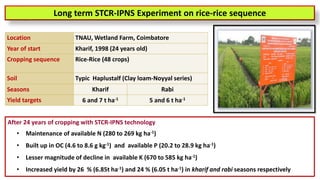
Location TNAU, Wetland Farm, Coimbatore
Year of start Kharif, 1998 (24 years old)
Cropping sequence Rice-Rice (48 crops)
Soil Typic Haplustalf (Clay loam-Noyyal series)
Seasons Kharif Rabi
Yield targets 6 and 7 t ha-1 5 and 6 t ha-1
After 24 years of cropping with STCR-IPNS technology
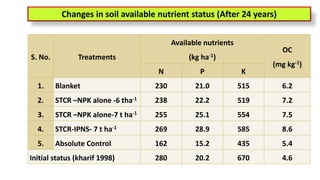
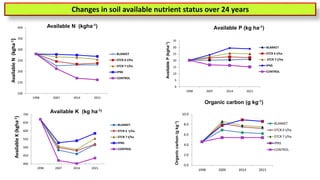
• Maintenance of available N (280 to 269 kg ha-1)
• Built up in OC (4.6 to 8.6 g kg-1) and available P (20.2 to 28.9 kg ha-1)
• Lesser magnitude of decline in available K (670 to 585 kg ha-1)
• Increased yield by 26 % (6.85t ha-1) and 24 % (6.05 t ha-1) in kharif and rabi seasons respectively
Long term STCR-IPNS Experiment on rice-rice sequence
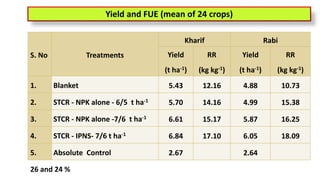
S. No Treatments
Kharif Rabi
Yield
(t ha-1)
RR
(kg kg-1)
Yield
(t ha-1)
RR
(kg kg-1)
1. Blanket 5.43 12.16 4.88 10.73
2. STCR - NPK alone - 6/5 t ha-1 5.70 14.16 4.99 15.38
3. STCR - NPK alone -7/6 t ha-1 6.61 15.17 5.87 16.25
4. STCR - IPNS- 7/6 t ha-1 6.84 17.10 6.05 18.09
5. Absolute Control 2.67 2.64
26 and 24 %
Yield and FUE (mean of 24 crops)
S. No. Treatments
Available nutrients
(kg ha-1)
OC
(mg kg-1)
N P K
1. Blanket 230 21.0 515 6.2
2. STCR –NPK alone -6 tha-1 238 22.2 519 7.2
3. STCR –NPK alone-7 t ha-1 255 25.1 554 7.5
4. STCR-IPNS- 7 t ha-1 269 28.9 585 8.6
5. Absolute Control 162 15.2 435 5.4
Initial status (kharif 1998) 280 20.2 670 4.6
Changes in soil available nutrient status (After 24 years)
Available
K
(kgha
-1
)
0
5
10
15
20
25
30
35
1998 2007 2014 2021
BLANKET
STCR 6 t/ha
STCR 7 t/ha
IPNS
CONTROL
Available P (kg ha-1)
Available
P
(kgha
-1
)
100
150
200
250
300
350
400
1998 2007 2014 2021
Available
N
(kgha
-1
)
Available N (kgha-1)
BLANKET
STCR 6 t/ha
STCR 7 t/ha
IPNS
CONTROL
400
450
500
550
600
650
700
1998 2007 2014 2021
BLANKET
STCR 6 t/ha
STCR 7 t/ha
IPNS
CONTROL
Available K (kg ha-1)
0.0
2.0
4.0
6.0
8.0
10.0
1998 2009 2014 2021
BLANKET
STCR 6 t/ha
STCR 7 t/ha
IPNS
CONTROL
Organic carbon (g kg-1)
Organic
carbon
(g
kg
-1
)
Changes in soil available nutrient status over 24 years
Soil fertility management through percentage yield sufficiency concept
(Bray, 1954)
The Mitscherlich-Bray equation is:
Y=A (1 - e-C1b – Cx)
This equation can be deduced to
Log (A-Y) = Log A – C1b – Cx
Where,
A = calculated (theoretical) maximum yield,
Y = percentage yield,
C1 = proportionality factor for soil nutrient b = soil test value (kgha-1),
C = proportionality factor for fertilizer nutrient
x = dose of fertilizer added (kgha-1).
The maximum yield (A) is calculated by extrapolation.
Decision Support System for Integrated FErtilizer
Recommendation (DSSIFER)
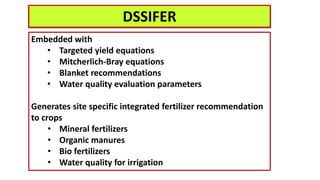
DSSIFER
Embedded with
• Targeted yield equations
• Mitcherlich-Bray equations
• Blanket recommendations
• Water quality evaluation parameters
Generates site specific integrated fertilizer recommendation
to crops
• Mineral fertilizers
• Organic manures
• Bio fertilizers
• Water quality for irrigation
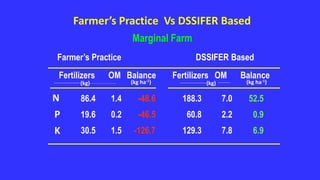
Farmer’s Practice Vs DSSIFER Based
Marginal Farm
Farmer’s Practice DSSIFER Based
86.4 1.4 -48.6 188.3 7.0 52.5
19.6 0.2 -46.5 60.8 2.2 0.9
30.5 1.5 -126.7 129.3 7.8 6.9
Fertilizers OM Balance
(kg ha-1)
(kg) (kg)
(kg ha-1)
N
P
K
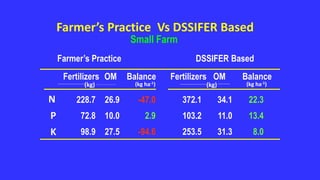
Farmer’s Practice Vs DSSIFER Based
Small Farm
Farmer’s Practice DSSIFER Based
228.7 26.9 -47.0 372.1 34.1 22.3
72.8 10.0 2.9 103.2 11.0 13.4
98.9 27.5 -94.6 253.5 31.3 8.0
Fertilizers OM Balance
N
P
K
(kg ha-1)
(kg)
(kg ha-1)
(kg)
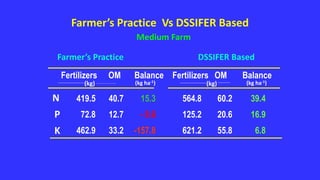
Farmer’s Practice Vs DSSIFER Based
Medium Farm
Farmer’s Practice DSSIFER Based
419.5 40.7 15.3 564.8 60.2 39.4
72.8 12.7 - 9.6 125.2 20.6 16.9
462.9 33.2 -157.8 621.2 55.8 6.8
Fertilizers OM Balance
(kg ha-1)
Fertilizers OM Balance
N
P
K
(kg)
(kg ha-1)
(kg)
Farmer’s Practice Vs DSSIFER Based
Large Farm
Farmer’s Practice DSSIFER Based
379.4 11.3 -27.4 638.8 19.6 27.2
133.7 4.1 25.1 225.9 6.1 46.9
210.9 12.5 -74.4 390.4 18.9 4.5
Fertilizers OM Balance
(kg ha-1)
(kg)
(kg ha-1)
(kg)
N
P
K
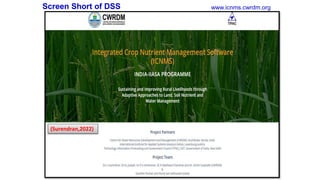
Construction of Decision Support System
Screen Short of DSS www.icnms.cwrdm.org
(Surendran,2022)
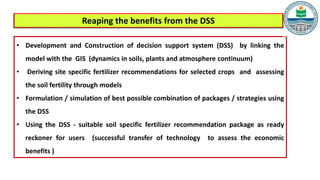
• Development and Construction of decision support system (DSS) by linking the
model with the GIS (dynamics in soils, plants and atmosphere continuum)
• Deriving site specific fertilizer recommendations for selected crops and assessing
the soil fertility through models
• Formulation / simulation of best possible combination of packages / strategies using
the DSS
• Using the DSS - suitable soil specific fertilizer recommendation package as ready
reckoner for users (successful transfer of technology to assess the economic
benefits )
Reaping the benefits from the DSS
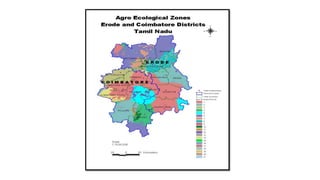
Agroecological framework for nutrient management
AEZ is based on,
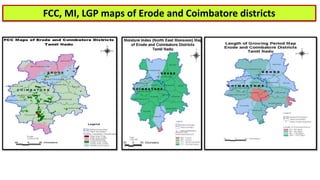
• soil texture (FCC - Buol et al., 1975)
• soil moisture balance
• length of growing period (rainfall and potential evapotranspiration)
Agroecological framework for nutrient management
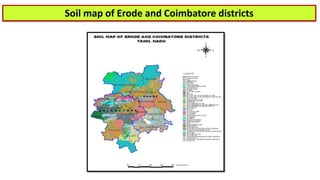
Soil map of Erode and Coimbatore districts
FCC, MI, LGP maps of Erode and Coimbatore districts
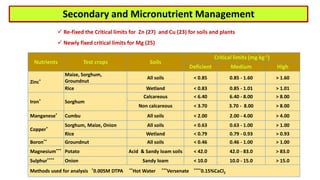
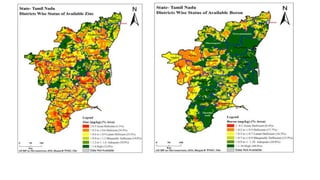
Secondary and Micronutrient Management
 Re-fixed the Critical limits for Zn (27) and Cu (23) for soils and plants
 Newly fixed critical limits for Mg (25)
Nutrients Test crops Soils
Critical limits (mg kg-1)
Deficient Medium High
Zinc*
Maize, Sorghum,
Groundnut
All soils < 0.85 0.85 - 1.60 > 1.60
Rice Wetland < 0.83 0.85 - 1.01 > 1.01
Iron* Sorghum
Calcareous < 6.40 6.40 - 8.00 > 8.00
Non calcareous < 3.70 3.70 - 8.00 > 8.00
Manganese* Cumbu All soils < 2.00 2.00 - 4.00 > 4.00
Copper*
Sorghum, Maize, Onion All soils < 0.63 0.63 - 1.00 > 1.00
Rice Wetland < 0.79 0.79 - 0.93 > 0.93
Boron** Groundnut All soils < 0.46 0.46 - 1.00 > 1.00
Magnesium*** Potato Acid & Sandy loam soils < 42.0 42.0 - 83.0 > 83.0
Sulphur**** Onion Sandy loam < 10.0 10.0 - 15.0 > 15.0
Methods used for analysis *0.005M DTPA **Hot Water ***Versenate ****0.15%CaCl2
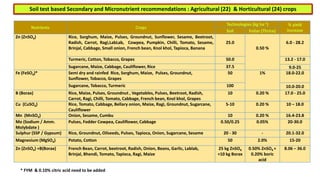
Secondary and Micronutrient Management
Nutrients Crops
Technologies (kg ha-1) % yield
increase
Soil Foliar (Thrice)
Zn (ZnSO4) Rice, Sorghum, Maize, Pulses, Groundnut, Sunflower, Sesame, Beetroot,
Radish, Carrot, Ragi,LabLab, Cowpea, Pumpkin, Chilli, Tomato, Sesame,
Brinjal, Cabbage, Small onion, French bean, Knol khol, Tapioca, Banana
25.0
0.50 %
6.0 - 28.2
Turmeric, Cotton, Tobacco, Grapes 50.0 13.2 - 17.0
Sugarcane, Maize, Cabbage, Cauliflower, Rice 37.5 9.0-25
Fe (FeSO4)* Semi dry and rainfed Rice, Sorghum, Maize, Pulses, Groundnut,
Sunflower, Tobacco, Grapes
50 1% 18.0-22.0
Sugarcane, Tobacco, Turmeric 100 10.0-20.0
B (Borax) Rice, Maize, Pulses, Groundnut , Vegetables, Pulses, Beetroot, Radish,
Carrot, Ragi, Chilli, Tomato, Cabbage, French bean, Knol khol, Grapes
10 0.20 % 17.0 - 25.0
Cu (CuSO4) Rice, Tomato, Cabbage, Bellary onion, Maize, Ragi, Groundnut, Sugarcane,
Cauliflower
5-10 0.20 % 10 – 18.0
Mn (MnSO4) Onion, Sesame, Cumbu 10 0.20 % 16.4-23.8
Mo (Sodium / Amm.
Molybdate )
Pulses, Fodder Cowpea, Cauliflower, Cabbage 0.50/0.25 0.05% 20-30.0
Sulphur (SSP / Gypsum) Rice, Groundnut, Oilseeds, Pulses, Tapioca, Onion, Sugarcane, Sesame 20 - 30 - 20.1-32.0
Magnesium (MgSO4) Potato, Cotton 50 2.0% 15-20
Zn (ZnSO4) +B(Borax) French Bean, Carrot, beetroot, Radish, Onion, Beans, Garlic, Lablab,
Brinjal, Bhendi, Tomato, Tapioca, Ragi, Maize
25 kg ZnSO4
+10 kg Borax
0.50% ZnSO4 +
0.20% boric
acid
8.06 – 36.0
* FYM & 0.10% citric acid need to be added
Soil test based Secondary and Micronutrient recommendations : Agricultural (22) & Horticultural (24) crops
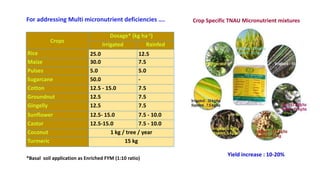
For addressing Multi micronutrient deficiencies …. Crop Specific TNAU Micronutrient mixtures
Crops
Dosage* (kg ha-1)
Irrigated Rainfed
Rice 25.0 12.5
Maize 30.0 7.5
Pulses 5.0 5.0
Sugarcane 50.0 -
Cotton 12.5 - 15.0 7.5
Groundnut 12.5 7.5
Gingelly 12.5 7.5
Sunflower 12.5- 15.0 7.5 - 10.0
Castor 12.5-15.0 7.5 - 10.0
Coconut 1 kg / tree / year
Turmeric 15 kg
*Basal soil application as Enriched FYM (1:10 ratio)
Yield increase : 10-20%
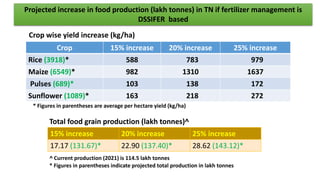
15% increase 20% increase 25% increase
17.17 (131.67)* 22.90 (137.40)* 28.62 (143.12)*
Projected increase in food production (lakh tonnes) in TN if fertilizer management is
DSSIFER based
Total food grain production (lakh tonnes)^
* Figures in parentheses indicate projected total production in lakh tonnes
Crop 15% increase 20% increase 25% increase
Rice (3918)* 588 783 979
Maize (6549)* 982 1310 1637
Pulses (689)* 103 138 172
Sunflower (1089)* 163 218 272
Crop wise yield increase (kg/ha)
* Figures in parentheses are average per hectare yield (kg/ha)
^ Current production (2021) is 114.5 lakh tonnes
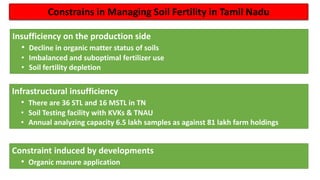
Constrains in Managing Soil Fertility in Tamil Nadu
Infrastructural insufficiency
• There are 36 STL and 16 MSTL in TN
• Soil Testing facility with KVKs & TNAU
• Annual analyzing capacity 6.5 lakh samples as against 81 lakh farm holdings
Insufficiency on the production side
• Decline in organic matter status of soils
• Imbalanced and suboptimal fertilizer use
• Soil fertility depletion
Constraint induced by developments
• Organic manure application
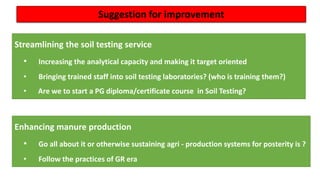
Suggestion for improvement
Enhancing manure production
• Go all about it or otherwise sustaining agri - production systems for posterity is ?
• Follow the practices of GR era
Streamlining the soil testing service
• Increasing the analytical capacity and making it target oriented
• Bringing trained staff into soil testing laboratories? (who is training them?)
• Are we to start a PG diploma/certificate course in Soil Testing?
Ramamoorthy memorial final 1ppt.pptx

Ramamoorthy memorial final 1ppt.pptx

  • 1.
    This lecture isdedicated to the great Soil Scientist Dr. B. Ramamoorthy
  • 2.
    Conceptual Framework ofSoil Fertility Management in Tamil Nadu – Developing Stories to Strengthen Successes and Rectify Failures
  • 3.
  • 5.
    Neanderthals may have cleareda European forest with fire or tools Neumark-Nord in Germany, the region had far fewer trees than surrounding areas, suggesting they may have cleared the forest on purpose - about 125,000 years ago
  • 6.
    New archaeological and paleoenvironmentalfindings now date human activity that transformed our natural surroundings to more than 80,000 years ago, after early modern humans settled on the northern shores of Lake Malawi
  • 7.
    Sustainability of soilfertility in agricultural production systems
  • 8.
    Nutrient Budgeting NUTMON -Toolbox (Smaling , 1998)
  • 9.
     Proposing possibleinterventions for adoption towards mitigating undesirable trends  Identification of soil fertility related factors limiting crop production  Calculation of nutrient balance at different spatial scales, viz., crop activity, farm & district NUTMON - Toolbox (NUTrient MONitoring Toolbox) Nutrient monitoring at farm level
  • 10.
    Description of nutrientinflows and outflows in a farm Murugappan et al. 2006
  • 11.
    NUTMON Toolbox generated nutrientbalances at farm level Nutrient (kg ha-1) Marginal Small Medium Large N -48.6 5.3 -5.1 - 27.4 P -46.5 -9.6 15.5 25.1 K -126.7 -157.8 -31.3 -74.4
  • 12.
     Critically re-lookingthe existing fertilizer practices  Recycling of On-farm wastes / crop residues by composting / vermicomposting  Proper planning of flow of nutrients from field to livestock and vice-versa  Legume in the Cropping system Proposed management interventions
  • 13.
  • 15.
    What is achemical? • Are not just exotic substances found in a chemistry lab • Everything is a chemical because everything is made of matter • Your body is made of chemicals. So is your pet, your desk, the grass, the air, your phone, and your lunch • Anything you can taste, smell, or hold consists of matter and is therefore a chemical • Examples include the chemical elements, such as zinc, helium, and oxygen; compounds made from elements including water, carbon dioxide, and salt; and more complex materials like your computer, air, rain, a chicken, a car, etc.
  • 16.
    The research outputof Soil Fertility Scientists are easy to tell but not that easy to sell
  • 17.
    General / Blanketrecommendation Followed in Tamil Nadu since 1953 • Based on the results of model agronomic experiments on government farms • Simple fertilizer trials on cultivator's field • Economy and efficiency of fertilizer use not known • Leads to either over or under usage of fertilizer nutrients
  • 18.
    Soil nutrient asan index of soil fertility S. No. Soil Nutrients Soil Fertility Rating Low Medium High 1 Organic carbon as a measure of available N (%) < 0.5 0.5 - 0.75 > 0.75 2 Available N (Alkaline KMnO4-N) (kgha-1) < 280 280 - 560 > 560 3 Available P (Olsen-P) (kgha-1) < 10 10 - 24.6 > 24.6 4 Available K (Neutral N NH4OAc-K) (kgha-1) < 108 108 - 280 > 280 Soil fertility rating
  • 19.
    Nutrient indexing andpreparation of soil fertility maps The following equation is used to calculate Nutrient Index Value:- (Nl X 1) + (Nm X 2) + (Nh X 3) Nutrient Index (NI) = ----------------------------------------- Nt Where, Nt = Total number of samples analyzed for a nutrient in any given area. Nl = Number of samples falling in low category of nutrient status. Nm = Number of samples falling in medium category of nutrient status. Nh = Number of samples falling in high category of nutrient status. Parker et al (1951) < 1.5 as indicative of low nutrient status 1.5 to 2.5 as medium > 2.5 as high nutrient status
  • 20.
    Nutrient indexing andpreparation of soil fertility maps
  • 21.
    Soil fertility managementthrough targeted yield approach
  • 22.
    Ramamoorthy et al.(1967) Nutrient Requirement (NR) Soil (α ) & fertilizer (β ) nutrient efficiencies U = f (S, F) U = α S + β F NR = U / Y (or) U = NR Y NR Y = α S + β F NR = U / Y, α = U0/S0, β = [UF – (α SF)] / F F = 1/ β [ NR Y - α S ] Drawbacks α > 1, β > 1 Does not lend for the estimation of standard errors of α & β
  • 23.
    Nutrient Requirement (NR)Soil (α ) & fertilizer (β ) nutrient efficiencies TNAU model I U = α S + β F , such that 0 ≤ α ≤ 1 and 0 ≤ β ≤ 1 TNAU model II U = α S + β F + γ, such that 0 ≤ α ≤ 1, 0 ≤ β ≤ 1 & γ ≥ 0 Drawbacks α & β sometimes 0 or 1 Do not lend for the estimation of standard errors of α & β Murugappan et al. (1988a)
  • 24.
    Nutrient Requirement (NR)Soil (α ) & fertilizer (β ) nutrient efficiencies Natarajan (1991) Bayesian Theorem U = α S + β F + Є, such that 0 ≤ α ≤ 1, 0 ≤ β ≤ 1 & Є is a random error component assumed to follow a normal distribution with mean 0 and unknown variance σ 2 Strength Mean values of α and β satisfy the prior information on them, viz., 0 ≤ α ≤ 1and 0 ≤ β ≤ 1 The variation in α in the presence of F is fully taken into account by the joint probability density P (α, β / U, S, F).
  • 25.
    N P K αβ kg ks α β kg ks α β kg ks Conventional method 0.5755 0.6445 1.12 1.12 1.5065 1.4461 1.61 1.65 0.6316 2.9406 1.64 1.62 TNAU model I - - - - 1.0000 0.7870 1.36 1.37 0.9232 0.5749 2.23 2.38 TNAU model II - - - - 0.9704 0.4201 1.50 1.52 0.9232 0.5749 2.23 2.38 (γ = 12.84) (γ = 0) Bayesian theorem - - - - 0.9532 0.5224 1.30 1.30 0.4088 0.5865 1.23 1.23 Estimates of α and β by conventional method, TNAU Model I and Bayesian theorem and α, β and γ by TNAU Model II for rice (IR 20)
  • 26.
    Soil Test CropResponse based fertilizer prescription under Integrated Plant Nutrition System (STCR – IPNS) are site and situation specific technology STCR-IPNS have been developed for • 36 agricultural and horticultural crops • 10 major cropping sequences • Covering17 soil series in Tamil Nadu Our Reach in Targeted Yield Concept
  • 27.
    Location TNAU, WetlandFarm, Coimbatore Year of start Kharif, 1998 (24 years old) Cropping sequence Rice-Rice (48 crops) Soil Typic Haplustalf (Clay loam-Noyyal series) Seasons Kharif Rabi Yield targets 6 and 7 t ha-1 5 and 6 t ha-1 After 24 years of cropping with STCR-IPNS technology • Maintenance of available N (280 to 269 kg ha-1) • Built up in OC (4.6 to 8.6 g kg-1) and available P (20.2 to 28.9 kg ha-1) • Lesser magnitude of decline in available K (670 to 585 kg ha-1) • Increased yield by 26 % (6.85t ha-1) and 24 % (6.05 t ha-1) in kharif and rabi seasons respectively Long term STCR-IPNS Experiment on rice-rice sequence
  • 28.
    S. No Treatments KharifRabi Yield (t ha-1) RR (kg kg-1) Yield (t ha-1) RR (kg kg-1) 1. Blanket 5.43 12.16 4.88 10.73 2. STCR - NPK alone - 6/5 t ha-1 5.70 14.16 4.99 15.38 3. STCR - NPK alone -7/6 t ha-1 6.61 15.17 5.87 16.25 4. STCR - IPNS- 7/6 t ha-1 6.84 17.10 6.05 18.09 5. Absolute Control 2.67 2.64 26 and 24 % Yield and FUE (mean of 24 crops)
  • 29.
    S. No. Treatments Availablenutrients (kg ha-1) OC (mg kg-1) N P K 1. Blanket 230 21.0 515 6.2 2. STCR –NPK alone -6 tha-1 238 22.2 519 7.2 3. STCR –NPK alone-7 t ha-1 255 25.1 554 7.5 4. STCR-IPNS- 7 t ha-1 269 28.9 585 8.6 5. Absolute Control 162 15.2 435 5.4 Initial status (kharif 1998) 280 20.2 670 4.6 Changes in soil available nutrient status (After 24 years)
  • 30.
    Available K (kgha -1 ) 0 5 10 15 20 25 30 35 1998 2007 20142021 BLANKET STCR 6 t/ha STCR 7 t/ha IPNS CONTROL Available P (kg ha-1) Available P (kgha -1 ) 100 150 200 250 300 350 400 1998 2007 2014 2021 Available N (kgha -1 ) Available N (kgha-1) BLANKET STCR 6 t/ha STCR 7 t/ha IPNS CONTROL 400 450 500 550 600 650 700 1998 2007 2014 2021 BLANKET STCR 6 t/ha STCR 7 t/ha IPNS CONTROL Available K (kg ha-1) 0.0 2.0 4.0 6.0 8.0 10.0 1998 2009 2014 2021 BLANKET STCR 6 t/ha STCR 7 t/ha IPNS CONTROL Organic carbon (g kg-1) Organic carbon (g kg -1 ) Changes in soil available nutrient status over 24 years
  • 31.
    Soil fertility managementthrough percentage yield sufficiency concept (Bray, 1954) The Mitscherlich-Bray equation is: Y=A (1 - e-C1b – Cx) This equation can be deduced to Log (A-Y) = Log A – C1b – Cx Where, A = calculated (theoretical) maximum yield, Y = percentage yield, C1 = proportionality factor for soil nutrient b = soil test value (kgha-1), C = proportionality factor for fertilizer nutrient x = dose of fertilizer added (kgha-1). The maximum yield (A) is calculated by extrapolation.
  • 32.
    Decision Support Systemfor Integrated FErtilizer Recommendation (DSSIFER)
  • 35.
    DSSIFER Embedded with • Targetedyield equations • Mitcherlich-Bray equations • Blanket recommendations • Water quality evaluation parameters Generates site specific integrated fertilizer recommendation to crops • Mineral fertilizers • Organic manures • Bio fertilizers • Water quality for irrigation
  • 36.
    Farmer’s Practice VsDSSIFER Based Marginal Farm Farmer’s Practice DSSIFER Based 86.4 1.4 -48.6 188.3 7.0 52.5 19.6 0.2 -46.5 60.8 2.2 0.9 30.5 1.5 -126.7 129.3 7.8 6.9 Fertilizers OM Balance Fertilizers OM Balance (kg ha-1) (kg) (kg) (kg ha-1) N P K
  • 37.
    Farmer’s Practice VsDSSIFER Based Small Farm Farmer’s Practice DSSIFER Based 228.7 26.9 -47.0 372.1 34.1 22.3 72.8 10.0 2.9 103.2 11.0 13.4 98.9 27.5 -94.6 253.5 31.3 8.0 Fertilizers OM Balance Fertilizers OM Balance N P K (kg ha-1) (kg) (kg ha-1) (kg)
  • 38.
    Farmer’s Practice VsDSSIFER Based Medium Farm Farmer’s Practice DSSIFER Based 419.5 40.7 15.3 564.8 60.2 39.4 72.8 12.7 - 9.6 125.2 20.6 16.9 462.9 33.2 -157.8 621.2 55.8 6.8 Fertilizers OM Balance (kg ha-1) Fertilizers OM Balance N P K (kg) (kg ha-1) (kg)
  • 39.
    Farmer’s Practice VsDSSIFER Based Large Farm Farmer’s Practice DSSIFER Based 379.4 11.3 -27.4 638.8 19.6 27.2 133.7 4.1 25.1 225.9 6.1 46.9 210.9 12.5 -74.4 390.4 18.9 4.5 Fertilizers OM Balance Fertilizers OM Balance (kg ha-1) (kg) (kg ha-1) (kg) N P K
  • 40.
  • 41.
    Screen Short ofDSS www.icnms.cwrdm.org (Surendran,2022)
  • 42.
    • Development andConstruction of decision support system (DSS) by linking the model with the GIS (dynamics in soils, plants and atmosphere continuum) • Deriving site specific fertilizer recommendations for selected crops and assessing the soil fertility through models • Formulation / simulation of best possible combination of packages / strategies using the DSS • Using the DSS - suitable soil specific fertilizer recommendation package as ready reckoner for users (successful transfer of technology to assess the economic benefits ) Reaping the benefits from the DSS
  • 43.
    Agroecological framework fornutrient management
  • 44.
    AEZ is basedon, • soil texture (FCC - Buol et al., 1975) • soil moisture balance • length of growing period (rainfall and potential evapotranspiration) Agroecological framework for nutrient management
  • 45.
    Soil map ofErode and Coimbatore districts
  • 46.
    FCC, MI, LGPmaps of Erode and Coimbatore districts
  • 48.
  • 49.
     Re-fixed theCritical limits for Zn (27) and Cu (23) for soils and plants  Newly fixed critical limits for Mg (25) Nutrients Test crops Soils Critical limits (mg kg-1) Deficient Medium High Zinc* Maize, Sorghum, Groundnut All soils < 0.85 0.85 - 1.60 > 1.60 Rice Wetland < 0.83 0.85 - 1.01 > 1.01 Iron* Sorghum Calcareous < 6.40 6.40 - 8.00 > 8.00 Non calcareous < 3.70 3.70 - 8.00 > 8.00 Manganese* Cumbu All soils < 2.00 2.00 - 4.00 > 4.00 Copper* Sorghum, Maize, Onion All soils < 0.63 0.63 - 1.00 > 1.00 Rice Wetland < 0.79 0.79 - 0.93 > 0.93 Boron** Groundnut All soils < 0.46 0.46 - 1.00 > 1.00 Magnesium*** Potato Acid & Sandy loam soils < 42.0 42.0 - 83.0 > 83.0 Sulphur**** Onion Sandy loam < 10.0 10.0 - 15.0 > 15.0 Methods used for analysis *0.005M DTPA **Hot Water ***Versenate ****0.15%CaCl2 Secondary and Micronutrient Management
  • 51.
    Nutrients Crops Technologies (kgha-1) % yield increase Soil Foliar (Thrice) Zn (ZnSO4) Rice, Sorghum, Maize, Pulses, Groundnut, Sunflower, Sesame, Beetroot, Radish, Carrot, Ragi,LabLab, Cowpea, Pumpkin, Chilli, Tomato, Sesame, Brinjal, Cabbage, Small onion, French bean, Knol khol, Tapioca, Banana 25.0 0.50 % 6.0 - 28.2 Turmeric, Cotton, Tobacco, Grapes 50.0 13.2 - 17.0 Sugarcane, Maize, Cabbage, Cauliflower, Rice 37.5 9.0-25 Fe (FeSO4)* Semi dry and rainfed Rice, Sorghum, Maize, Pulses, Groundnut, Sunflower, Tobacco, Grapes 50 1% 18.0-22.0 Sugarcane, Tobacco, Turmeric 100 10.0-20.0 B (Borax) Rice, Maize, Pulses, Groundnut , Vegetables, Pulses, Beetroot, Radish, Carrot, Ragi, Chilli, Tomato, Cabbage, French bean, Knol khol, Grapes 10 0.20 % 17.0 - 25.0 Cu (CuSO4) Rice, Tomato, Cabbage, Bellary onion, Maize, Ragi, Groundnut, Sugarcane, Cauliflower 5-10 0.20 % 10 – 18.0 Mn (MnSO4) Onion, Sesame, Cumbu 10 0.20 % 16.4-23.8 Mo (Sodium / Amm. Molybdate ) Pulses, Fodder Cowpea, Cauliflower, Cabbage 0.50/0.25 0.05% 20-30.0 Sulphur (SSP / Gypsum) Rice, Groundnut, Oilseeds, Pulses, Tapioca, Onion, Sugarcane, Sesame 20 - 30 - 20.1-32.0 Magnesium (MgSO4) Potato, Cotton 50 2.0% 15-20 Zn (ZnSO4) +B(Borax) French Bean, Carrot, beetroot, Radish, Onion, Beans, Garlic, Lablab, Brinjal, Bhendi, Tomato, Tapioca, Ragi, Maize 25 kg ZnSO4 +10 kg Borax 0.50% ZnSO4 + 0.20% boric acid 8.06 – 36.0 * FYM & 0.10% citric acid need to be added Soil test based Secondary and Micronutrient recommendations : Agricultural (22) & Horticultural (24) crops
  • 52.
    For addressing Multimicronutrient deficiencies …. Crop Specific TNAU Micronutrient mixtures Crops Dosage* (kg ha-1) Irrigated Rainfed Rice 25.0 12.5 Maize 30.0 7.5 Pulses 5.0 5.0 Sugarcane 50.0 - Cotton 12.5 - 15.0 7.5 Groundnut 12.5 7.5 Gingelly 12.5 7.5 Sunflower 12.5- 15.0 7.5 - 10.0 Castor 12.5-15.0 7.5 - 10.0 Coconut 1 kg / tree / year Turmeric 15 kg *Basal soil application as Enriched FYM (1:10 ratio) Yield increase : 10-20%
  • 53.
    15% increase 20%increase 25% increase 17.17 (131.67)* 22.90 (137.40)* 28.62 (143.12)* Projected increase in food production (lakh tonnes) in TN if fertilizer management is DSSIFER based Total food grain production (lakh tonnes)^ * Figures in parentheses indicate projected total production in lakh tonnes Crop 15% increase 20% increase 25% increase Rice (3918)* 588 783 979 Maize (6549)* 982 1310 1637 Pulses (689)* 103 138 172 Sunflower (1089)* 163 218 272 Crop wise yield increase (kg/ha) * Figures in parentheses are average per hectare yield (kg/ha) ^ Current production (2021) is 114.5 lakh tonnes
  • 55.
    Constrains in ManagingSoil Fertility in Tamil Nadu Infrastructural insufficiency • There are 36 STL and 16 MSTL in TN • Soil Testing facility with KVKs & TNAU • Annual analyzing capacity 6.5 lakh samples as against 81 lakh farm holdings Insufficiency on the production side • Decline in organic matter status of soils • Imbalanced and suboptimal fertilizer use • Soil fertility depletion Constraint induced by developments • Organic manure application
  • 56.
    Suggestion for improvement Enhancingmanure production • Go all about it or otherwise sustaining agri - production systems for posterity is ? • Follow the practices of GR era Streamlining the soil testing service • Increasing the analytical capacity and making it target oriented • Bringing trained staff into soil testing laboratories? (who is training them?) • Are we to start a PG diploma/certificate course in Soil Testing?