MASTER SEMINAR
ON
INTEGRATED NUTRIENT MANAGEMENT IN
RICE- BASED CROPPING SYSTEM
Integrated Nutrient management
Definition:
Integrated Nutrient Management is a
practice where all sources of nutrients namely organic
inorganic chemical fertilizer Biofertilizer can be
combined use for improving soil health get good quality
yield and maintain ecology and environment.
Concept of INM
 The basic consept of INM system is the maintenace of
plant nutrient supply to achieve a given level of crop
production by optimizing the benefits from all possible
sources of plant nutreints in an integrated manner,
approprite to each cropping system and farming
situation (Mahajan and Sharma,2005 ,Subba Rao, A.
and Sammi Reddy,A.2005)
One major task of INM system will be to at least stop
the ongoing loss of surface or top nutrients(Mahajan
and Sharma,2005)
PRINCIPLES OF INM
Maximize the use of organic materials.
Ensure access to inorganic fertilizer and improve the
efficiency of its use.
Minimize losses the plant nutrient.
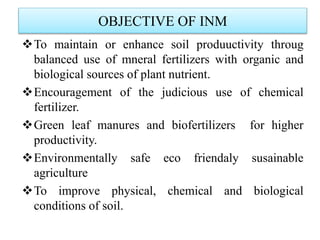
OBJECTIVE OF INM
To maintain or enhance soil produuctivity throug
balanced use of mneral fertilizers with organic and
biological sources of plant nutrient.
Encouragement of the judicious use of chemical
fertilizer.
Green leaf manures and biofertilizers for higher
productivity.
Environmentally safe eco friendaly susainable
agriculture
To improve physical, chemical and biological
conditions of soil.
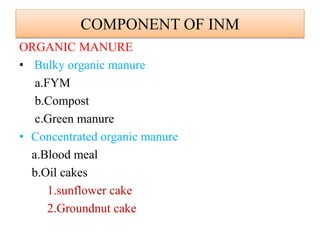
COMPONENT OF INM
ORGANIC MANURE
• Bulky organic manure
a.FYM
b.Compost
c.Green manure
• Concentrated organic manure
a.Blood meal
b.Oil cakes
1.sunflower cake
2.Groundnut cake
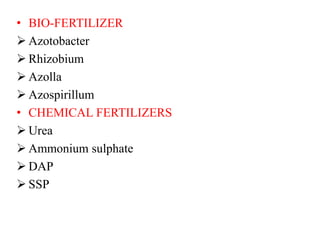
• BIO-FERTILIZER
 Azotobacter
 Rhizobium
 Azolla
 Azospirillum
• CHEMICAL FERTILIZERS
 Urea
 Ammonium sulphate
 DAP
 SSP
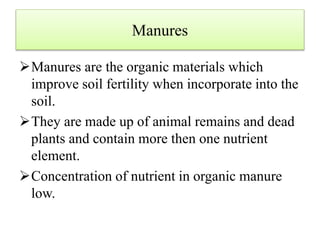
Manures
Manures are the organic materials which
improve soil fertility when incorporate into the
soil.
They are made up of animal remains and dead
plants and contain more then one nutrient
element.
Concentration of nutrient in organic manure
low.
ADVANTAGES OF MANURE
They improve soil physical properties like
structure water holding capacity.
To increase nutrient availabilty.
They prevent the loss of nutrient by leaching
or erosion.
Manures supply,plant nutrients including
micro-organism.
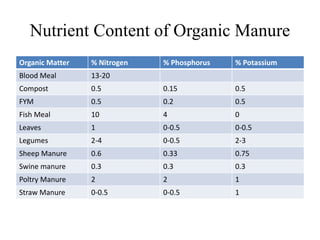
Nutrient Content of Organic Manure
Organic Matter % Nitrogen % Phosphorus % Potassium
Blood Meal 13-20
Compost 0.5 0.15 0.5
FYM 0.5 0.2 0.5
Fish Meal 10 4 0
Leaves 1 0-0.5 0-0.5
Legumes 2-4 0-0.5 2-3
Sheep Manure 0.6 0.33 0.75
Swine manure 0.3 0.3 0.3
Poltry Manure 2 2 1
Straw Manure 0-0.5 0-0.5 1
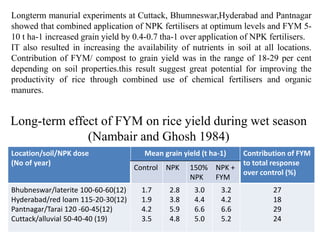
Long-term effect of FYM on rice yield during wet season
(Nambair and Ghosh 1984)
Location/soil/NPK dose
(No of year)
Mean grain yield (t ha-1) Contribution of FYM
to total response
over control (%)
Control NPK 150%
NPK
NPK +
FYM
Bhubneswar/laterite 100-60-60(12)
Hyderabad/red loam 115-20-30(12)
Pantnagar/Tarai 120 -60-45(12)
Cuttack/alluvial 50-40-40 (19)
1.7
1.9
4.2
3.5
2.8
3.8
5.9
4.8
3.0
4.4
6.6
5.0
3.2
4.2
6.6
5.2
27
18
29
24
Longterm manurial experiments at Cuttack, Bhumneswar,Hyderabad and Pantnagar
showed that combined application of NPK fertilisers at optimum levels and FYM 5-
10 t ha-1 increased grain yield by 0.4-0.7 tha-1 over application of NPK fertilisers.
IT also resulted in increasing the availability of nutrients in soil at all locations.
Contribution of FYM/ compost to grain yield was in the range of 18-29 per cent
depending on soil properties.this result suggest great potential for improving the
productivity of rice through combined use of chemical fertilisers and organic
manures.
Green manuring
• Greeen manuring is the practice of growing a
short duration, succulant and leafy legume
crop and ploughing the plants in the same field
before they form seed.
• Green leaf manuring refers to adding the
lopping from legume plants or trees to afield
and then incorporating them into the soil by
ploughing.
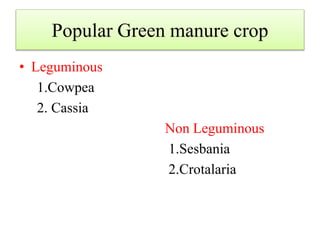
Popular Green manure crop
• Leguminous
1.Cowpea
2. Cassia
Non Leguminous
1.Sesbania
2.Crotalaria
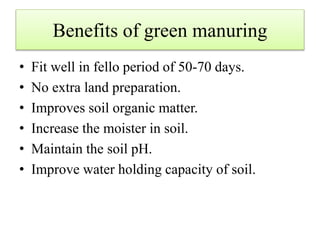
Benefits of green manuring
• Fit well in fello period of 50-70 days.
• No extra land preparation.
• Improves soil organic matter.
• Increase the moister in soil.
• Maintain the soil pH.
• Improve water holding capacity of soil.
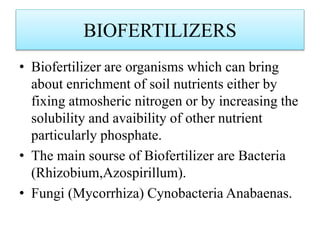
BIOFERTILIZERS
• Biofertilizer are organisms which can bring
about enrichment of soil nutrients either by
fixing atmosheric nitrogen or by increasing the
solubility and avaibility of other nutrient
particularly phosphate.
• The main sourse of Biofertilizer are Bacteria
(Rhizobium,Azospirillum).
• Fungi (Mycorrhiza) Cynobacteria Anabaenas.
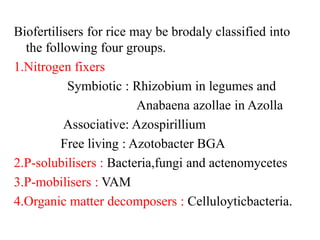
Biofertilisers for rice may be brodaly classified into
the following four groups.
1.Nitrogen fixers
Symbiotic : Rhizobium in legumes and
Anabaena azollae in Azolla
Associative: Azospirillium
Free living : Azotobacter BGA
2.P-solubilisers : Bacteria,fungi and actenomycetes
3.P-mobilisers : VAM
4.Organic matter decomposers : Celluloyticbacteria.
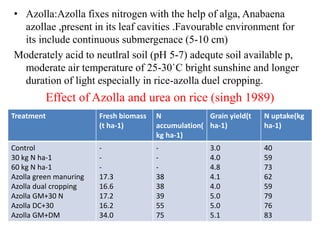
• Azolla:Azolla fixes nitrogen with the help of alga, Anabaena
azollae ,present in its leaf cavities .Favourable environment for
its include continuous submergenace (5-10 cm)
Moderately acid to neutlral soil (pH 5-7) adequte soil available p,
moderate air temperature of 25-30`C bright sunshine and longer
duration of light especially in rice-azolla duel cropping.
Effect of Azolla and urea on rice (singh 1989)
Treatment Fresh biomass
(t ha-1)
N
accumulation(
kg ha-1)
Grain yield(t
ha-1)
N uptake(kg
ha-1)
Control
30 kg N ha-1
60 kg N ha-1
Azolla green manuring
Azolla dual cropping
Azolla GM+30 N
Azolla DC+30
Azolla GM+DM
-
-
-
17.3
16.6
17.2
16.2
34.0
-
-
-
38
38
39
55
75
3.0
4.0
4.8
4.1
4.0
5.0
5.0
5.1
40
59
73
62
59
79
76
83
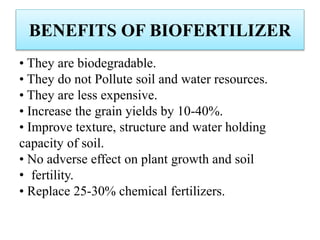
BENEFITS OF BIOFERTILIZER
• They are biodegradable.
• They do not Pollute soil and water resources.
• They are less expensive.
• Increase the grain yields by 10-40%.
• Improve texture, structure and water holding
capacity of soil.
• No adverse effect on plant growth and soil
• fertility.
• Replace 25-30% chemical fertilizers.
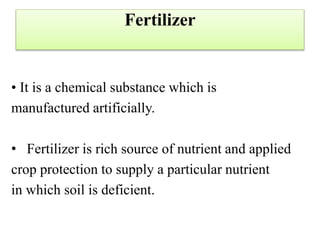
Fertilizer
• It is a chemical substance which is
manufactured artificially.
• Fertilizer is rich source of nutrient and applied
crop protection to supply a particular nutrient
in which soil is deficient.
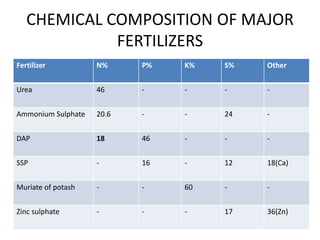
CHEMICAL COMPOSITION OF MAJOR
FERTILIZERS
Fertilizer N% P% K% S% Other
Urea 46 - - - -
Ammonium Sulphate 20.6 - - 24 -
DAP 18 46 - - -
SSP - 16 - 12 18(Ca)
Muriate of potash - - 60 - -
Zinc sulphate - - - 17 36(Zn)
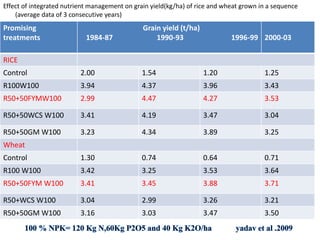
Effect of integrated nutrient management on grain yield(kg/ha) of rice and wheat grown in a sequence
(average data of 3 consecutive years)
Promising
treatments
Grain yield (t/ha)
1984-87 1990-93 1996-99 2000-03
RICE
Control 2.00 1.54 1.20 1.25
R100W100 3.94 4.37 3.96 3.43
R50+50FYMW100 2.99 4.47 4.27 3.53
R50+50WCS W100 3.41 4.19 3.47 3.04
R50+50GM W100 3.23 4.34 3.89 3.25
Wheat
Control 1.30 0.74 0.64 0.71
R100 W100 3.42 3.25 3.53 3.64
R50+50FYM W100 3.41 3.45 3.88 3.71
R50+WCS W100 3.04 2.99 3.26 3.21
R50+50GM W100 3.16 3.03 3.47 3.50
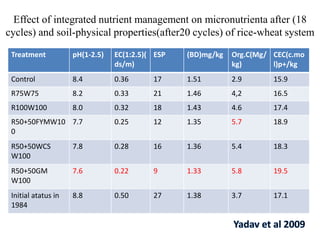
Effect of integrated nutrient management on micronutrienta after (18
cycles) and soil-physical properties(after20 cycles) of rice-wheat system
Treatment pH(1-2.5) EC(1:2.5)(
ds/m)
ESP (BD)mg/kg Org.C(Mg/
kg)
CEC(c.mo
l)p+/kg
Control 8.4 0.36 17 1.51 2.9 15.9
R75W75 8.2 0.33 21 1.46 4,2 16.5
R100W100 8.0 0.32 18 1.43 4.6 17.4
R50+50FYMW10
0
7.7 0.25 12 1.35 5.7 18.9
R50+50WCS
W100
7.8 0.28 16 1.36 5.4 18.3
R50+50GM
W100
7.6 0.22 9 1.33 5.8 19.5
Initial atatus in
1984
8.8 0.50 27 1.38 3.7 17.1
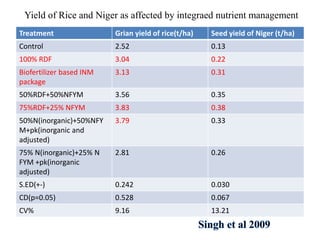
Yield of Rice and Niger as affected by integraed nutrient management
Treatment Grian yield of rice(t/ha) Seed yield of Niger (t/ha)
Control 2.52 0.13
100% RDF 3.04 0.22
Biofertilizer based INM
package
3.13 0.31
50%RDF+50%NFYM 3.56 0.35
75%RDF+25% NFYM 3.83 0.38
50%N(inorganic)+50%NFY
M+pk(inorganic and
adjusted)
3.79 0.33
75% N(inorganic)+25% N
FYM +pk(inorganic
adjusted)
2.81 0.26
S.ED(+-) 0.242 0.030
CD(p=0.05) 0.528 0.067
CV% 9.16 13.21
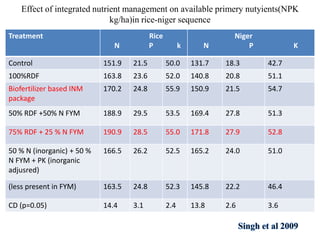
Effect of integrated nutrient management on available primery nutyients(NPK
kg/ha)in rice-niger sequence
Treatment Rice
N P k
Niger
N P K
Control 151.9 21.5 50.0 131.7 18.3 42.7
100%RDF 163.8 23.6 52.0 140.8 20.8 51.1
Biofertilizer based INM
package
170.2 24.8 55.9 150.9 21.5 54.7
50% RDF +50% N FYM 188.9 29.5 53.5 169.4 27.8 51.3
75% RDF + 25 % N FYM 190.9 28.5 55.0 171.8 27.9 52.8
50 % N (inorganic) + 50 %
N FYM + PK (inorganic
adjusred)
166.5 26.2 52.5 165.2 24.0 51.0
(less present in FYM) 163.5 24.8 52.3 145.8 22.2 46.4
CD (p=0.05) 14.4 3.1 2.4 13.8 2.6 3.6
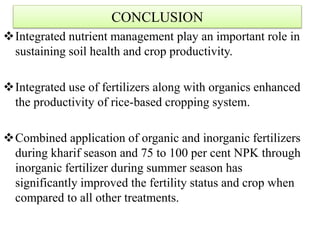
CONCLUSION
Integrated nutrient management play an important role in
sustaining soil health and crop productivity.
Integrated use of fertilizers along with organics enhanced
the productivity of rice-based cropping system.
Combined application of organic and inorganic fertilizers
during kharif season and 75 to 100 per cent NPK through
inorganic fertilizer during summer season has
significantly improved the fertility status and crop when
compared to all other treatments.
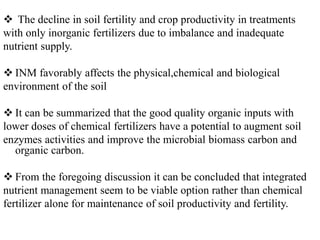
 The decline in soil fertility and crop productivity in treatments
with only inorganic fertilizers due to imbalance and inadequate
nutrient supply.
 INM favorably affects the physical,chemical and biological
environment of the soil
 It can be summarized that the good quality organic inputs with
lower doses of chemical fertilizers have a potential to augment soil
enzymes activities and improve the microbial biomass carbon and
organic carbon.
 From the foregoing discussion it can be concluded that integrated
nutrient management seem to be viable option rather than chemical
fertilizer alone for maintenance of soil productivity and fertility.
REFERENCES
• Singh, R.A.; Singh, J.; Yadav, D.; Singh, H.K.; Singh, J.
Integrated nutrient management in rice-wheat cropping
system. Int. J. Agric. Sci. 2012, 8, 523–526.
• Mahajan, A.; Bhagat, R.M.; Gupta, R.D.
Integratednutrient management in sustainable rice-wheat
cropping system for food security in India. SAARC J.
Agric. 2008, 6, 1–13.
• Mahajan, A.; Sharma, R. Integrated nutrient management
(INM) system: Concept, need and future strategy.
Agrobios. Newsl. 2005, 4, 29–32.
• Yadav, D.S.; Kumar, A. Integrated nutrient management in
rice-wheat cropping system under eastern Uttar Pradesh.
Indian Farm. 2000, 50, 28–30.
 inm in rice

inm in rice

  • 1.
    MASTER SEMINAR ON INTEGRATED NUTRIENTMANAGEMENT IN RICE- BASED CROPPING SYSTEM
  • 2.
    Integrated Nutrient management Definition: IntegratedNutrient Management is a practice where all sources of nutrients namely organic inorganic chemical fertilizer Biofertilizer can be combined use for improving soil health get good quality yield and maintain ecology and environment.
  • 3.
    Concept of INM The basic consept of INM system is the maintenace of plant nutrient supply to achieve a given level of crop production by optimizing the benefits from all possible sources of plant nutreints in an integrated manner, approprite to each cropping system and farming situation (Mahajan and Sharma,2005 ,Subba Rao, A. and Sammi Reddy,A.2005) One major task of INM system will be to at least stop the ongoing loss of surface or top nutrients(Mahajan and Sharma,2005)
  • 4.
    PRINCIPLES OF INM Maximizethe use of organic materials. Ensure access to inorganic fertilizer and improve the efficiency of its use. Minimize losses the plant nutrient.
  • 5.
    OBJECTIVE OF INM Tomaintain or enhance soil produuctivity throug balanced use of mneral fertilizers with organic and biological sources of plant nutrient. Encouragement of the judicious use of chemical fertilizer. Green leaf manures and biofertilizers for higher productivity. Environmentally safe eco friendaly susainable agriculture To improve physical, chemical and biological conditions of soil.
  • 6.
    COMPONENT OF INM ORGANICMANURE • Bulky organic manure a.FYM b.Compost c.Green manure • Concentrated organic manure a.Blood meal b.Oil cakes 1.sunflower cake 2.Groundnut cake
  • 7.
    • BIO-FERTILIZER  Azotobacter Rhizobium  Azolla  Azospirillum • CHEMICAL FERTILIZERS  Urea  Ammonium sulphate  DAP  SSP
  • 8.
    Manures Manures are theorganic materials which improve soil fertility when incorporate into the soil. They are made up of animal remains and dead plants and contain more then one nutrient element. Concentration of nutrient in organic manure low.
  • 9.
    ADVANTAGES OF MANURE Theyimprove soil physical properties like structure water holding capacity. To increase nutrient availabilty. They prevent the loss of nutrient by leaching or erosion. Manures supply,plant nutrients including micro-organism.
  • 10.
    Nutrient Content ofOrganic Manure Organic Matter % Nitrogen % Phosphorus % Potassium Blood Meal 13-20 Compost 0.5 0.15 0.5 FYM 0.5 0.2 0.5 Fish Meal 10 4 0 Leaves 1 0-0.5 0-0.5 Legumes 2-4 0-0.5 2-3 Sheep Manure 0.6 0.33 0.75 Swine manure 0.3 0.3 0.3 Poltry Manure 2 2 1 Straw Manure 0-0.5 0-0.5 1
  • 11.
    Long-term effect ofFYM on rice yield during wet season (Nambair and Ghosh 1984) Location/soil/NPK dose (No of year) Mean grain yield (t ha-1) Contribution of FYM to total response over control (%) Control NPK 150% NPK NPK + FYM Bhubneswar/laterite 100-60-60(12) Hyderabad/red loam 115-20-30(12) Pantnagar/Tarai 120 -60-45(12) Cuttack/alluvial 50-40-40 (19) 1.7 1.9 4.2 3.5 2.8 3.8 5.9 4.8 3.0 4.4 6.6 5.0 3.2 4.2 6.6 5.2 27 18 29 24 Longterm manurial experiments at Cuttack, Bhumneswar,Hyderabad and Pantnagar showed that combined application of NPK fertilisers at optimum levels and FYM 5- 10 t ha-1 increased grain yield by 0.4-0.7 tha-1 over application of NPK fertilisers. IT also resulted in increasing the availability of nutrients in soil at all locations. Contribution of FYM/ compost to grain yield was in the range of 18-29 per cent depending on soil properties.this result suggest great potential for improving the productivity of rice through combined use of chemical fertilisers and organic manures.
  • 12.
    Green manuring • Greeenmanuring is the practice of growing a short duration, succulant and leafy legume crop and ploughing the plants in the same field before they form seed. • Green leaf manuring refers to adding the lopping from legume plants or trees to afield and then incorporating them into the soil by ploughing.
  • 13.
    Popular Green manurecrop • Leguminous 1.Cowpea 2. Cassia Non Leguminous 1.Sesbania 2.Crotalaria
  • 14.
    Benefits of greenmanuring • Fit well in fello period of 50-70 days. • No extra land preparation. • Improves soil organic matter. • Increase the moister in soil. • Maintain the soil pH. • Improve water holding capacity of soil.
  • 15.
    BIOFERTILIZERS • Biofertilizer areorganisms which can bring about enrichment of soil nutrients either by fixing atmosheric nitrogen or by increasing the solubility and avaibility of other nutrient particularly phosphate. • The main sourse of Biofertilizer are Bacteria (Rhizobium,Azospirillum). • Fungi (Mycorrhiza) Cynobacteria Anabaenas.
  • 16.
    Biofertilisers for ricemay be brodaly classified into the following four groups. 1.Nitrogen fixers Symbiotic : Rhizobium in legumes and Anabaena azollae in Azolla Associative: Azospirillium Free living : Azotobacter BGA 2.P-solubilisers : Bacteria,fungi and actenomycetes 3.P-mobilisers : VAM 4.Organic matter decomposers : Celluloyticbacteria.
  • 17.
    • Azolla:Azolla fixesnitrogen with the help of alga, Anabaena azollae ,present in its leaf cavities .Favourable environment for its include continuous submergenace (5-10 cm) Moderately acid to neutlral soil (pH 5-7) adequte soil available p, moderate air temperature of 25-30`C bright sunshine and longer duration of light especially in rice-azolla duel cropping. Effect of Azolla and urea on rice (singh 1989) Treatment Fresh biomass (t ha-1) N accumulation( kg ha-1) Grain yield(t ha-1) N uptake(kg ha-1) Control 30 kg N ha-1 60 kg N ha-1 Azolla green manuring Azolla dual cropping Azolla GM+30 N Azolla DC+30 Azolla GM+DM - - - 17.3 16.6 17.2 16.2 34.0 - - - 38 38 39 55 75 3.0 4.0 4.8 4.1 4.0 5.0 5.0 5.1 40 59 73 62 59 79 76 83
  • 18.
    BENEFITS OF BIOFERTILIZER •They are biodegradable. • They do not Pollute soil and water resources. • They are less expensive. • Increase the grain yields by 10-40%. • Improve texture, structure and water holding capacity of soil. • No adverse effect on plant growth and soil • fertility. • Replace 25-30% chemical fertilizers.
  • 19.
    Fertilizer • It isa chemical substance which is manufactured artificially. • Fertilizer is rich source of nutrient and applied crop protection to supply a particular nutrient in which soil is deficient.
  • 20.
    CHEMICAL COMPOSITION OFMAJOR FERTILIZERS Fertilizer N% P% K% S% Other Urea 46 - - - - Ammonium Sulphate 20.6 - - 24 - DAP 18 46 - - - SSP - 16 - 12 18(Ca) Muriate of potash - - 60 - - Zinc sulphate - - - 17 36(Zn)
  • 21.
    Effect of integratednutrient management on grain yield(kg/ha) of rice and wheat grown in a sequence (average data of 3 consecutive years) Promising treatments Grain yield (t/ha) 1984-87 1990-93 1996-99 2000-03 RICE Control 2.00 1.54 1.20 1.25 R100W100 3.94 4.37 3.96 3.43 R50+50FYMW100 2.99 4.47 4.27 3.53 R50+50WCS W100 3.41 4.19 3.47 3.04 R50+50GM W100 3.23 4.34 3.89 3.25 Wheat Control 1.30 0.74 0.64 0.71 R100 W100 3.42 3.25 3.53 3.64 R50+50FYM W100 3.41 3.45 3.88 3.71 R50+WCS W100 3.04 2.99 3.26 3.21 R50+50GM W100 3.16 3.03 3.47 3.50
  • 22.
    Effect of integratednutrient management on micronutrienta after (18 cycles) and soil-physical properties(after20 cycles) of rice-wheat system Treatment pH(1-2.5) EC(1:2.5)( ds/m) ESP (BD)mg/kg Org.C(Mg/ kg) CEC(c.mo l)p+/kg Control 8.4 0.36 17 1.51 2.9 15.9 R75W75 8.2 0.33 21 1.46 4,2 16.5 R100W100 8.0 0.32 18 1.43 4.6 17.4 R50+50FYMW10 0 7.7 0.25 12 1.35 5.7 18.9 R50+50WCS W100 7.8 0.28 16 1.36 5.4 18.3 R50+50GM W100 7.6 0.22 9 1.33 5.8 19.5 Initial atatus in 1984 8.8 0.50 27 1.38 3.7 17.1
  • 23.
    Yield of Riceand Niger as affected by integraed nutrient management Treatment Grian yield of rice(t/ha) Seed yield of Niger (t/ha) Control 2.52 0.13 100% RDF 3.04 0.22 Biofertilizer based INM package 3.13 0.31 50%RDF+50%NFYM 3.56 0.35 75%RDF+25% NFYM 3.83 0.38 50%N(inorganic)+50%NFY M+pk(inorganic and adjusted) 3.79 0.33 75% N(inorganic)+25% N FYM +pk(inorganic adjusted) 2.81 0.26 S.ED(+-) 0.242 0.030 CD(p=0.05) 0.528 0.067 CV% 9.16 13.21
  • 24.
    Effect of integratednutrient management on available primery nutyients(NPK kg/ha)in rice-niger sequence Treatment Rice N P k Niger N P K Control 151.9 21.5 50.0 131.7 18.3 42.7 100%RDF 163.8 23.6 52.0 140.8 20.8 51.1 Biofertilizer based INM package 170.2 24.8 55.9 150.9 21.5 54.7 50% RDF +50% N FYM 188.9 29.5 53.5 169.4 27.8 51.3 75% RDF + 25 % N FYM 190.9 28.5 55.0 171.8 27.9 52.8 50 % N (inorganic) + 50 % N FYM + PK (inorganic adjusred) 166.5 26.2 52.5 165.2 24.0 51.0 (less present in FYM) 163.5 24.8 52.3 145.8 22.2 46.4 CD (p=0.05) 14.4 3.1 2.4 13.8 2.6 3.6
  • 25.
    CONCLUSION Integrated nutrient managementplay an important role in sustaining soil health and crop productivity. Integrated use of fertilizers along with organics enhanced the productivity of rice-based cropping system. Combined application of organic and inorganic fertilizers during kharif season and 75 to 100 per cent NPK through inorganic fertilizer during summer season has significantly improved the fertility status and crop when compared to all other treatments.
  • 26.
     The declinein soil fertility and crop productivity in treatments with only inorganic fertilizers due to imbalance and inadequate nutrient supply.  INM favorably affects the physical,chemical and biological environment of the soil  It can be summarized that the good quality organic inputs with lower doses of chemical fertilizers have a potential to augment soil enzymes activities and improve the microbial biomass carbon and organic carbon.  From the foregoing discussion it can be concluded that integrated nutrient management seem to be viable option rather than chemical fertilizer alone for maintenance of soil productivity and fertility.
  • 27.
    REFERENCES • Singh, R.A.;Singh, J.; Yadav, D.; Singh, H.K.; Singh, J. Integrated nutrient management in rice-wheat cropping system. Int. J. Agric. Sci. 2012, 8, 523–526. • Mahajan, A.; Bhagat, R.M.; Gupta, R.D. Integratednutrient management in sustainable rice-wheat cropping system for food security in India. SAARC J. Agric. 2008, 6, 1–13. • Mahajan, A.; Sharma, R. Integrated nutrient management (INM) system: Concept, need and future strategy. Agrobios. Newsl. 2005, 4, 29–32. • Yadav, D.S.; Kumar, A. Integrated nutrient management in rice-wheat cropping system under eastern Uttar Pradesh. Indian Farm. 2000, 50, 28–30.