SOIL
•

Soil !!! some call it dirt. But it is..... Soil !!!

•

The essence of our being.

•

The medium in which crops are grown to feed humans, as well as animals. One
of our natural resources (soil, water, air, plant, animal).

•

Soil by volume, on the average consists of 45% mineral, 25% water, 25% air
and 5% organic matter (both living and dead organisms).

•

There are thousands of different soils throughout the world.
WEATHERING PROCESSES
•
•
•
•
•
•
•
•
•
•
•
•
•
•
•

PHYSICAL WEATHERING
Freezing and Thawing
Heating and Cooling
Wetting and Drying
Grinding or Rubbing
Unloading
Organisms
CHEMICAL WEATHERING
Solution
Hydrolysis
Carbonation
Hydration
Oxidation
Reduction
SOIL FORMATION
•

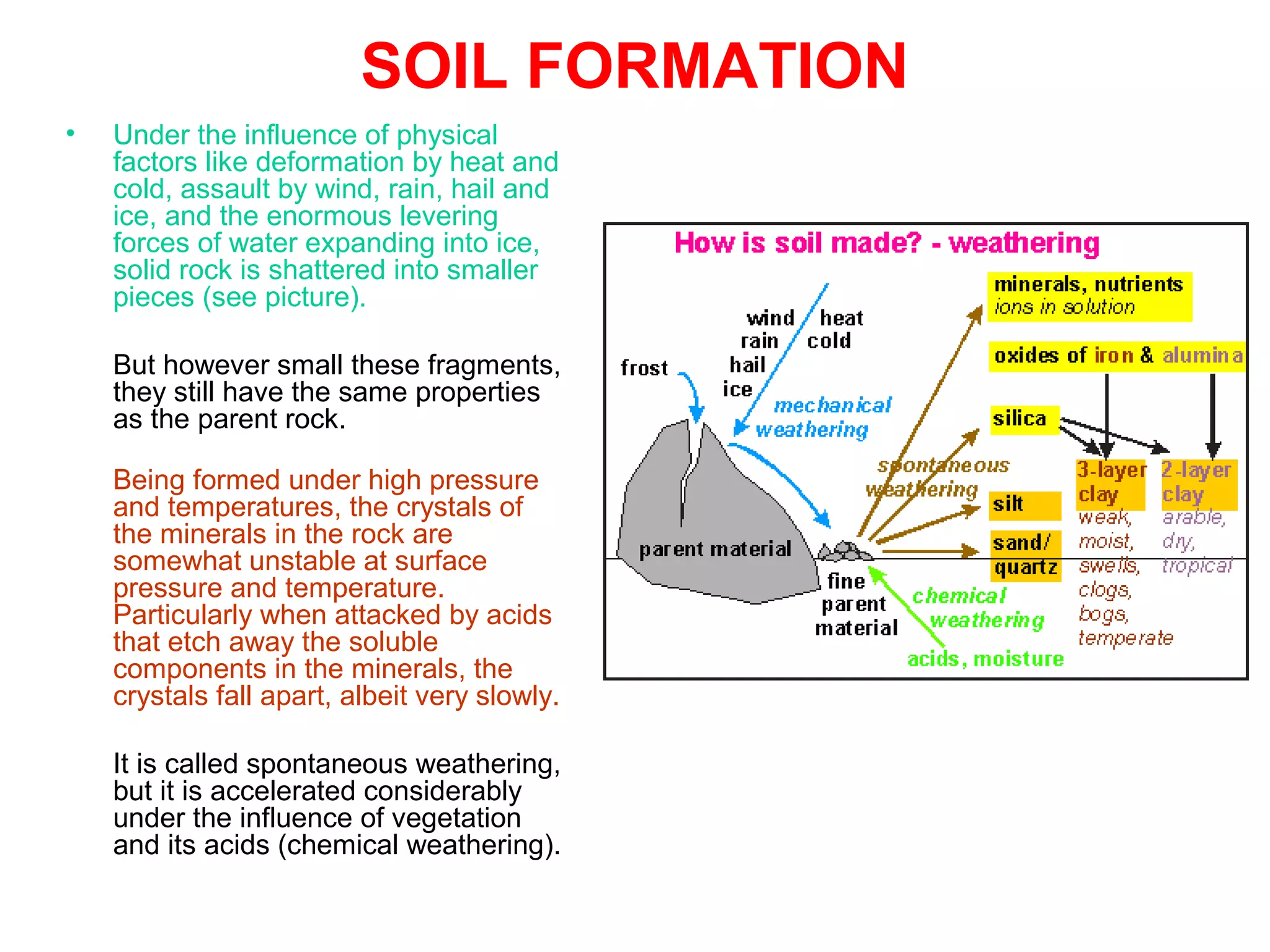
Under the influence of physical
factors like deformation by heat and
cold, assault by wind, rain, hail and
ice, and the enormous levering
forces of water expanding into ice,
solid rock is shattered into smaller
pieces (see picture).
But however small these fragments,
they still have the same properties
as the parent rock.
Being formed under high pressure
and temperatures, the crystals of
the minerals in the rock are
somewhat unstable at surface
pressure and temperature.
Particularly when attacked by acids
that etch away the soluble
components in the minerals, the
crystals fall apart, albeit very slowly.
It is called spontaneous weathering,
but it is accelerated considerably
under the influence of vegetation
and its acids (chemical weathering).
SOIL FORMING PROCESSES
•

There are five key processes by which soil is formed, they are:

•

Leaching - leaching is the removal of soluble components of the soil column. As water
washes down through the soil it can carry away bases such as calcium, held as
exchangeable ions in clay-humus complexes, as well as acidification through the
substitution of hydrogen ions.

•

Eluviation - here soil particles held in suspension, such as clay, are removed (eg.
washed away).

•

Illuviation - here soil particles held in suspension, such as clay, are accumulated (eg.
deposited).

•

Podsolisation - podsolisation occurs when strongly acid soil solutions cause the
breakdown of clay minerals. As a result silica, aluminium and iron form complexes with
organic substances in the soil. These minerals are removed from the surface zone of
the soil and can accumulate in distinct dark sub-surface layers - very evident on
inspection. Upland heaths and moors often contain podsols.

•

Gleying - gleying occurs in waterlogged, anaerobic conditions when iron compounds
are reduced and either removed from the soil, or segregated out as mottles or
concretions in the soil. Marshy wetlands often contain gleyed soils.

•

It is important to realise also that soil types are closely related to the shape of the
landscape - or its 'topography'. Soil scientists use this to help them create soil maps.
An experienced eye can determine changes in underlying soil types when walking
through a landscape and observing changes in topography (and often vegetation too).
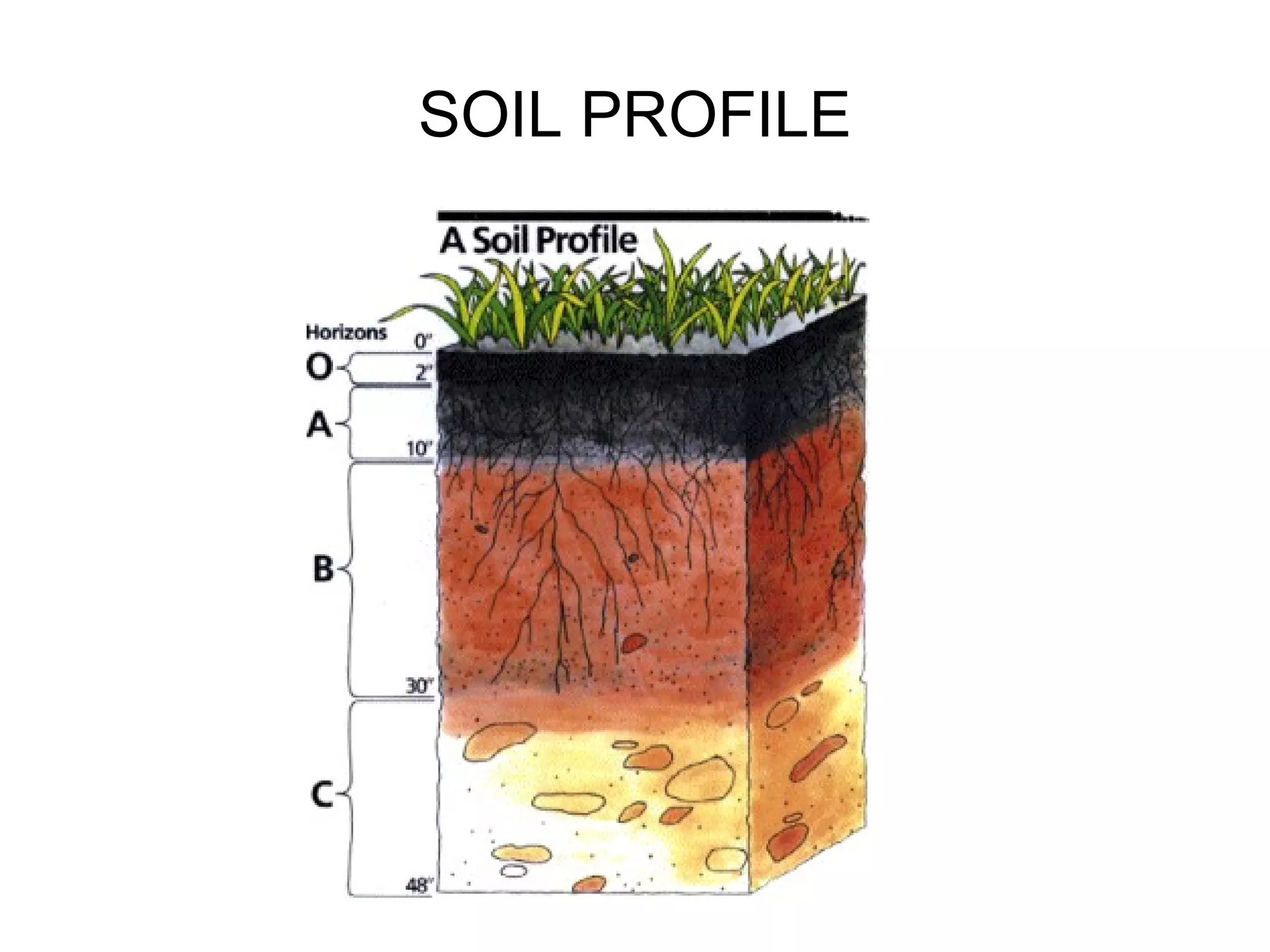
SOIL PROFILE
).
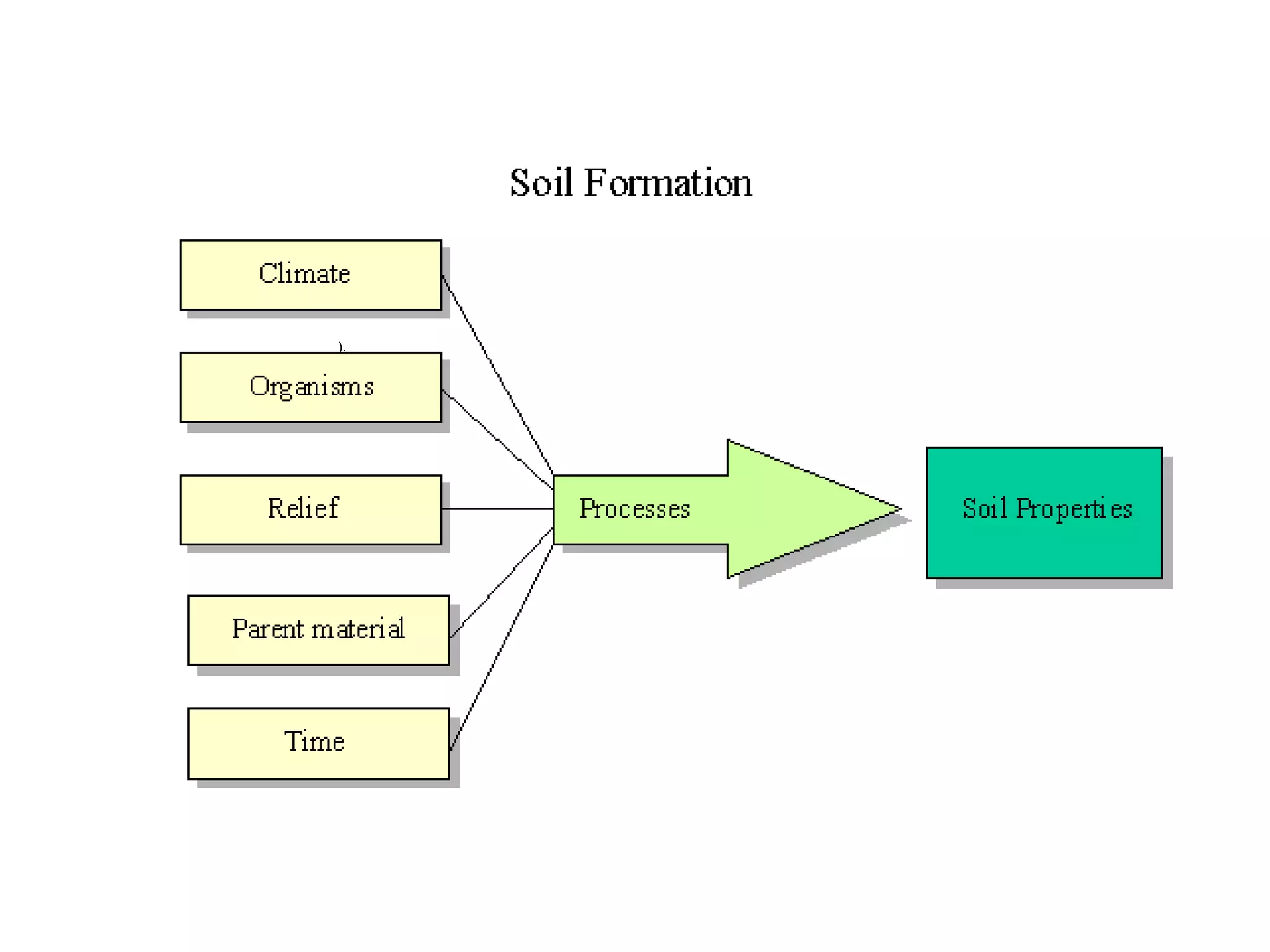
Factors in soil formation:

•
•
•
•
•

Parent material
Climate
Time
Topography
Biological factors
PARENT MATERIAL
•

The material in which soils form is called "parent material." In the lower part of
the soils, these materials may be relatively unchanged from when they were
deposited by moving water, ice, or wind.

•

Few soils weather directly from the underlying rocks. These "residual" soils have
the same general chemistry as the original rocks.

•

More commonly, soils form in materials that have moved in from elsewhere.
Materials may have moved many miles or only a few feet.

•

Glacial till is material ground up and moved by a glacier. Sediments along rivers
have different textures, depending on whether the stream moves quickly or
slowly. Fast-moving water leaves gravel, rocks, and sand. Slow-moving water
and lakes leave fine textured material (clay and silt) when sediments in the water
settle out.

•

Windblown "loess" is common in the Midwest. It buries "glacial till" in many
areas.
CLIMATE
•

Soils vary, depending on the climate.

•

Temperature and moisture amounts cause different patterns of
weathering and leaching.

•

Wind redistributes sand and other particles especially in arid regions.

•

The amount, intensity, timing, and kind of precipitation influence soil
formation.

•

Seasonal and daily changes in temperature affect moisture
effectiveness, biological activity, rates of chemical reactions, and kinds

.

of vegetation
TOPOGRAPHY
•

Slope and aspect affect the moisture and temperature of soil.

•

Steep slopes facing the sun are warmer, just like the south-facing side
of a house. Steep soils may be eroded and lose their topsoil as they
form.

•

Thus, they may be thinner than the more nearly level soils that receive
deposits from areas upslope.

•

Deeper, darker colored soils may be expected on the bottom land.
BIOLOGICAL FACTORS
•
•
•

•

•

•
•
•

Plants, animals, micro-organisms, and humans affect soil formation.
Animals and micro-organisms (such as moles, earthworms, bacteria, fungi and
nematodes) mix soils and form burrows and pores.
Plant roots open channels in the soils. Different types of roots have different
effects on soils. Grass roots are "fibrous" near the soil surface and easily
decompose, adding organic matter. Taproots open pathways through dense
layers.
Micro-organisms affect chemical exchanges between roots and soil. Humans
can mix the soil so extensively that the soil material is again considered parent
material.
The native vegetation depends on climate, topography, and biological factors
plus many soil factors such as soil density, depth, chemistry, temperature, and
moisture.
Leaves from plants fall to the surface and decompose on the soil.
Organisms decompose these leaves and mix them with the upper part of the
soil.
Trees and shrubs have large roots that may grow to considerable depths.
TIME
•

Time for all these factors to interact with the soil is also a factor.

•

Over time, soils exhibit features that reflect the other forming factors. Soil
formation processes are continuous.

•

Recently deposited material, such as the deposition from a flood, exhibits no
features from soil development activities.

•

The previous soil surface and underlying horizons become buried. The time
clock resets for these soils.

•

Terraces above the active floodplain, while genetically similar to the floodplain,
are older land surfaces and exhibit more development features.
SOIL ORDERS
•

Soil taxonomy at the highest hierarchical level identifies 12 soil orders.

•

The names for the orders and taxonomic soil properties relate to Greek,
Latin, or other root words that reveal something about the soil.

•

Sixty-four suborders are recognized at the next level of classification.

•

There are about 300 great groups and more than 2,400 subgroups.

•

Soils within a subgroup that have similar physical and chemical
properties that affect their responses to management and manipulation
are families.

•

The soil series is the lowest category in the soil classification system.
SOIL
During the weathering
process, four
components are
released:
minerals in solution (cations
and anions), the basis of
plant nutrition.
oxides of iron and alumina
(sesquioxides Al2O3,
Fe2O3).
various forms of silica (siliconoxide compounds).
stable wastes as very fine silt
(mostly fine quartz) and
coarser quartz (sand).
These have no nutritious
value for plants.

•

Depending on temperature and rainfall,
new minerals are formed. The oxides
of iron and alumina combine with silica
to form clay. In temperate regions a
three-layer clay is formed, which is
weak, swells under moisture, and
clogs. It is able to absorb large
amounts of water but is rather heavy
on plant roots, blocking the oxygen the
soil organisms need. Because clay has
a charged surface area, it is able to
bind and retain minerals and nutrients
(Cation Exchange Capacity). The
valuable nutrition for plants won't leach
away easily in three-layer clays.
Two-layer clays are formed in hot,
humid tropical regions, producing
arable but easily dried soils. These
clays are not able to hold much water,
or nutrients, but are still very much
better than sand.
Soil

Soil

  • 1.
    SOIL • Soil !!! somecall it dirt. But it is..... Soil !!! • The essence of our being. • The medium in which crops are grown to feed humans, as well as animals. One of our natural resources (soil, water, air, plant, animal). • Soil by volume, on the average consists of 45% mineral, 25% water, 25% air and 5% organic matter (both living and dead organisms). • There are thousands of different soils throughout the world.
  • 2.
    WEATHERING PROCESSES • • • • • • • • • • • • • • • PHYSICAL WEATHERING Freezingand Thawing Heating and Cooling Wetting and Drying Grinding or Rubbing Unloading Organisms CHEMICAL WEATHERING Solution Hydrolysis Carbonation Hydration Oxidation Reduction
  • 3.
    SOIL FORMATION • Under theinfluence of physical factors like deformation by heat and cold, assault by wind, rain, hail and ice, and the enormous levering forces of water expanding into ice, solid rock is shattered into smaller pieces (see picture). But however small these fragments, they still have the same properties as the parent rock. Being formed under high pressure and temperatures, the crystals of the minerals in the rock are somewhat unstable at surface pressure and temperature. Particularly when attacked by acids that etch away the soluble components in the minerals, the crystals fall apart, albeit very slowly. It is called spontaneous weathering, but it is accelerated considerably under the influence of vegetation and its acids (chemical weathering).
  • 4.
    SOIL FORMING PROCESSES • Thereare five key processes by which soil is formed, they are: • Leaching - leaching is the removal of soluble components of the soil column. As water washes down through the soil it can carry away bases such as calcium, held as exchangeable ions in clay-humus complexes, as well as acidification through the substitution of hydrogen ions. • Eluviation - here soil particles held in suspension, such as clay, are removed (eg. washed away). • Illuviation - here soil particles held in suspension, such as clay, are accumulated (eg. deposited). • Podsolisation - podsolisation occurs when strongly acid soil solutions cause the breakdown of clay minerals. As a result silica, aluminium and iron form complexes with organic substances in the soil. These minerals are removed from the surface zone of the soil and can accumulate in distinct dark sub-surface layers - very evident on inspection. Upland heaths and moors often contain podsols. • Gleying - gleying occurs in waterlogged, anaerobic conditions when iron compounds are reduced and either removed from the soil, or segregated out as mottles or concretions in the soil. Marshy wetlands often contain gleyed soils. • It is important to realise also that soil types are closely related to the shape of the landscape - or its 'topography'. Soil scientists use this to help them create soil maps. An experienced eye can determine changes in underlying soil types when walking through a landscape and observing changes in topography (and often vegetation too).
  • 5.
  • 6.
  • 7.
    Factors in soilformation: • • • • • Parent material Climate Time Topography Biological factors
  • 8.
    PARENT MATERIAL • The materialin which soils form is called "parent material." In the lower part of the soils, these materials may be relatively unchanged from when they were deposited by moving water, ice, or wind. • Few soils weather directly from the underlying rocks. These "residual" soils have the same general chemistry as the original rocks. • More commonly, soils form in materials that have moved in from elsewhere. Materials may have moved many miles or only a few feet. • Glacial till is material ground up and moved by a glacier. Sediments along rivers have different textures, depending on whether the stream moves quickly or slowly. Fast-moving water leaves gravel, rocks, and sand. Slow-moving water and lakes leave fine textured material (clay and silt) when sediments in the water settle out. • Windblown "loess" is common in the Midwest. It buries "glacial till" in many areas.
  • 9.
    CLIMATE • Soils vary, dependingon the climate. • Temperature and moisture amounts cause different patterns of weathering and leaching. • Wind redistributes sand and other particles especially in arid regions. • The amount, intensity, timing, and kind of precipitation influence soil formation. • Seasonal and daily changes in temperature affect moisture effectiveness, biological activity, rates of chemical reactions, and kinds . of vegetation
  • 10.
    TOPOGRAPHY • Slope and aspectaffect the moisture and temperature of soil. • Steep slopes facing the sun are warmer, just like the south-facing side of a house. Steep soils may be eroded and lose their topsoil as they form. • Thus, they may be thinner than the more nearly level soils that receive deposits from areas upslope. • Deeper, darker colored soils may be expected on the bottom land.
  • 11.
    BIOLOGICAL FACTORS • • • • • • • • Plants, animals,micro-organisms, and humans affect soil formation. Animals and micro-organisms (such as moles, earthworms, bacteria, fungi and nematodes) mix soils and form burrows and pores. Plant roots open channels in the soils. Different types of roots have different effects on soils. Grass roots are "fibrous" near the soil surface and easily decompose, adding organic matter. Taproots open pathways through dense layers. Micro-organisms affect chemical exchanges between roots and soil. Humans can mix the soil so extensively that the soil material is again considered parent material. The native vegetation depends on climate, topography, and biological factors plus many soil factors such as soil density, depth, chemistry, temperature, and moisture. Leaves from plants fall to the surface and decompose on the soil. Organisms decompose these leaves and mix them with the upper part of the soil. Trees and shrubs have large roots that may grow to considerable depths.
  • 12.
    TIME • Time for allthese factors to interact with the soil is also a factor. • Over time, soils exhibit features that reflect the other forming factors. Soil formation processes are continuous. • Recently deposited material, such as the deposition from a flood, exhibits no features from soil development activities. • The previous soil surface and underlying horizons become buried. The time clock resets for these soils. • Terraces above the active floodplain, while genetically similar to the floodplain, are older land surfaces and exhibit more development features.
  • 13.
    SOIL ORDERS • Soil taxonomyat the highest hierarchical level identifies 12 soil orders. • The names for the orders and taxonomic soil properties relate to Greek, Latin, or other root words that reveal something about the soil. • Sixty-four suborders are recognized at the next level of classification. • There are about 300 great groups and more than 2,400 subgroups. • Soils within a subgroup that have similar physical and chemical properties that affect their responses to management and manipulation are families. • The soil series is the lowest category in the soil classification system.
  • 14.
    SOIL During the weathering process,four components are released: minerals in solution (cations and anions), the basis of plant nutrition. oxides of iron and alumina (sesquioxides Al2O3, Fe2O3). various forms of silica (siliconoxide compounds). stable wastes as very fine silt (mostly fine quartz) and coarser quartz (sand). These have no nutritious value for plants. • Depending on temperature and rainfall, new minerals are formed. The oxides of iron and alumina combine with silica to form clay. In temperate regions a three-layer clay is formed, which is weak, swells under moisture, and clogs. It is able to absorb large amounts of water but is rather heavy on plant roots, blocking the oxygen the soil organisms need. Because clay has a charged surface area, it is able to bind and retain minerals and nutrients (Cation Exchange Capacity). The valuable nutrition for plants won't leach away easily in three-layer clays. Two-layer clays are formed in hot, humid tropical regions, producing arable but easily dried soils. These clays are not able to hold much water, or nutrients, but are still very much better than sand.