COURSE NO- SOILS-501*
COURE TITLE- SOIL PHYSICS
PRESENTATION ON-
SOIL MICROMORPHOLOGY
COURSE INCHARGE-
Dr. G. Jayashree
PRESENTED BY-
PUJA PRIYADARSINI NAIK
RAM/19-97
SOIL MORPHOLOGY
• Soil morphology deals with the form and arrangement of soil features.
• Soil morphology deals with the form, structure, and organization of the
soil material, observed, described, and studied in the field, but
investigation can be continued in the laboratory with optical and
electron microscopes.
• Field observations with the unaided eye or with a hand lens are
considered macro morphology, whereas observations utilizing a
microscope are considered micromorphology.
Soil Macromorphology
• Macromorphology is best evaluated from the in situ
examination of the soil profile.
• A recently dug pit large enough for observation of a pedon is
desirable.
• Old exposures such as road cuts and ditches are acceptable
only for preliminary examination because morphological
features often become altered after prolonged exposure.
• The exposed profile should be probed by hand, with the aid of
a knife or small pick to remove any alterations resulting from
digging equipment and to expose the natural condition of the
soil.
Soil Micromorphology
• Micromorphology is a term used in biology, mineralogy and
soil science.
• The fine-level structures or morphology of an organism,
mineral, or soil component visible through microscopy.
• Micromorphology is the branch of earth science that describes,
interprets, and measures the components, features, and fabrics
of soils, regolith materials, and prehistoric/historic artifacts at
the microscopic and submicroscopic levels (Goldberg, 1983;
Stoops, 2003).
Soil micromorphology owes it popularity to the late Walter Kubiëna who saw
its potential as a tool to investigate some of the properties and processes in soils.
His two books “Micropedology” and “Soils of Europe” are landmarks in the
development of Soil Science.
TECHNIQUES –
• The basic technique in soil microscopy and micromorphology involves the
preparation of thin sections of undisturbed soil materials, the samples being
collected in boxes with double lids to avoid disturbance.
• The outstanding developments include the use of synthetic resins for improved
impregnation and the increase in size of thin sections.
• The introduction of acetone as a diluent of the resins made it possible to
remove water from the samples by acetone exchange thus reducing shrinkage.
• Over 45 ancillary techniques are used, including fluorescence, image analysis
and electron microscope analyses.
• Polished blocks may be adequate if a fluorescent dye is incorporated in the
impregnating resin as the block can then be photographed with fluorescent
light to show the distribution of the pore pattern.
Definitions, Concepts and Features
Fabric, Structure and Assemblage –
• Fabric is the mutual arrangement and relationship between
particles within the soil as a whole and within the various
features, while structure is the type and degree of
aggregation.
• The totality of all features in a specimen is called an
ensemble or assemblage.
• The main fabric relationships seen in thin sections are in
the fine earth, including both mineral and organic
materials. These may be observed in thin sections but in a
number of cases SEM is required.
Fine material –
• This refers to the material with a diameter of less than about
20µm and which is beyond the resolving power of the
optical microscope.
• It may be arranged as granules, masses, and links between
grains or forms a complete matrix.
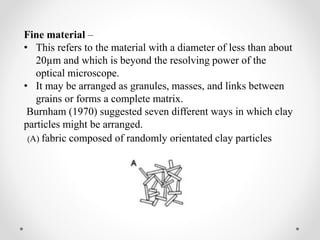
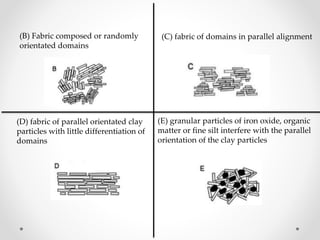
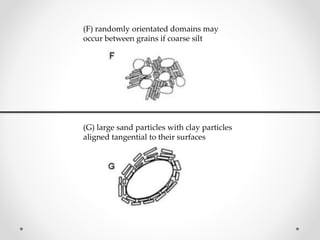
Burnham (1970) suggested seven different ways in which clay
particles might be arranged.
(A) fabric composed of randomly orientated clay particles
(B) Fabric composed or randomly
orientated domains
(C) fabric of domains in parallel alignment
(D) fabric of parallel orientated clay
particles with little differentiation of
domains
(E) granular particles of iron oxide, organic
matter or fine silt interfere with the parallel
orientation of the clay particles
(F) randomly orientated domains may
occur between grains if coarse silt
(G) large sand particles with clay particles
aligned tangential to their surfaces
Matrix - Material of any size forming a continuous phase surrounding and
enclosing coarser particles. Thus, a matrix may be dominantly clay
surrounding sand particles or silt surrounding particles of gravel.
Homogeneity and heterogeneity –
• The concepts of homogeneity and heterogeneity are difficult to apply
since a given volume of soil may at the same time be homogeneous with
regard to one property, for example color, and heterogeneous with
regard to another property such as the sand mineralogy.
• Even the most uniform soils exhibit some degree of heterogeneity
which might be just visible in the field, but conspicuous in thin sections.
• If, for example, a soil composed mainly of clay has a few grains of silt,
and more particularly quartz sand these will appear conspicuous
particularly when examined with circularly polarized light.
Recognition of individual features –
• One of the most difficult tasks in micromorphology is
the recognition of individual features.
• Clay particles are themselves individuals; they cannot be
recognized with the optical microscope but can only be
identified with TEM or SEM techniques.
• Most thick clay coatings are easily recognized, but thin
clay coatings are extremely difficult to identify.
• The frequency of clay coatings in a given soil can vary
widely when estimated by different operators.
Recognition of patterns –
• Probably the most important aspect of
micromorphology is the recognition of patterns, not only
the pattern of single individuals but also the
relationships between the individuals themselves.
• The types of pattern range from the relatively simple
distribution of individual quartz grains to the often
complex distribution pattern of clay coatings.
• Probably the most difficult patterns to recognize are
those of the anisotropism of matrices. It is often difficult
to describe individuals and patterns.
• In many cases a true representation can only be achieved
with good photographs and diagrams.
Quantification of features –
• It has been shown that over 20 cores with two
thin sections from each core are required to
characterize quantitatively coatings, matrices,
pores and concretions in horizons with
translocated clay.
• However, considerable success is being achieved
by the application of many image analysis
techniques to thin sections and polished blocks.
Interpretation of features and patterns-
• This is based on a combination of experience, intuition
and guess-work.
• Most workers agree that the majority of clay coatings
have been formed by the translocation of clay particles
and their deposition on surfaces.
• They also agree that clusters of calcite and gypsum
crystals have been formed by the translocation of calcium
bicarbonate and calcium sulfate and crystals growth.
• However the interpretation of some concretionary
material in very old tropical soils is extremely difficult.
Confirmation of the interpretations
• This will probably require experimentation.
• It may, however, not always be possible to reproduce in the
space of a few weeks or even months, those features that
have taken hundreds or thousands of years to form.
• Some researchers have nevertheless been able to produce
clay coatings similar to those found in natural soils in the
field, while others have demonstrated that certain forms of
matrix anisotropism can be produced by stress and shearing.
Properties of features and minerals –
The main properties are:
 color,
 prominence,
 size,
 Shape,
 roundness,
 sphericity,
 surface characteristics,
 boundaries, distribution pattern,
 relationships between features and
 orientation.
Mineral Soil Material
Primary Minerals and Particle Size Classes
• The mineral material in soils ranges in size from the very smallest
particle, such as single grains of hematite >0.1 µm in highly weathered
tropical soils up to the largest erratic boulders found in glacial drift or
core stone in weathered rocks.
• The shape of the large separates often give a clear indication of the
process which have influenced the formation of the parent material or
soil itself.
e.g.- Sand varies in shape from smooth and rounded to rough and angular.
Smooth and rounded shapes are found in wind-blown materials and beach
sands.
• The particle classes have different degree of mobility within the soil.
• The clay fraction is often considered as being the most mobile and forms
clay coatings, but by far the greatest amount of material is translocated
by the soil fauna including earthworms and termites.
• Therefore, thin sections should always be carefully examined for any
evidence of movement particularly by biological processes.
Secondary minerals and weathering products
• The most frequently encountered secondary minerals in soils include:
Anhydrite, allophane, aluminum hydroxide, barite, bassanite, celestite,
calcite, chalcedony, chlorite, ferrihydrite, gibbsite, geothite, gypsum,
hamatite, halite, halloysite, hydrous mica,iddingsite, imogolite,
jarosite,kaolinite, lepidocrocite, leucoxene, maghemite, manganese dioxide,
opal, pyrite, quartz, smectite,siderite and vermiculite.
• The minerals that occur in amorphous or microcrystalline forms include:
allophane, chlorite, ferrihydrate, gibbsite, geothite, hematite, halloysite,
hydrous mica,
jarosite,immogolite,kaolinite,leucoxene,lepidocrocite,opal,siderite,smectite
and vermiculite
• The secondary minerals can be observed in different positions in soils.
Generally, they are found in matrix, in pores and in plant material. They may
occur as amorphous or microcrystalline material, single grains, aggregates,
clusters or fillings.
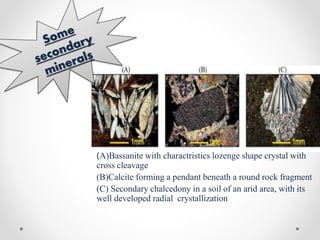
(A)Bassanite with charactristics lozenge shape crystal with
cross cleavage
(B)Calcite forming a pendant beneath a round rock fragment
(C) Secondary chalcedony in a soil of an arid area, with its
well developed radial crystallization
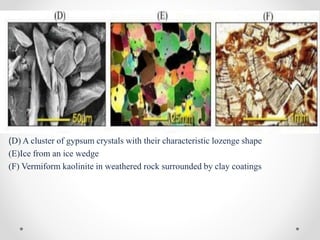
(D) A cluster of gypsum crystals with their characteristic lozenge shape
(E)Ice from an ice wedge
(F) Vermiform kaolinite in weathered rock surrounded by clay coatings
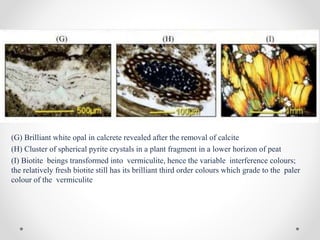
(G) Brilliant white opal in calcrete revealed after the removal of calcite
(H) Cluster of spherical pyrite crystals in a plant fragment in a lower horizon of peat
(I) Biotite beings transformed into vermiculite, hence the variable interference colours;
the relatively fresh biotite still has its brilliant third order colours which grade to the paler
colour of the vermiculite
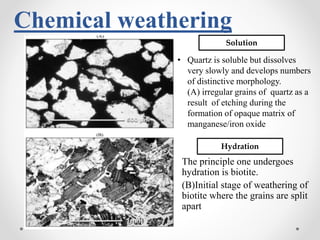
• Quartz is soluble but dissolves
very slowly and develops numbers
of distinctive morphology.
(A) irregular grains of quartz as a
result of etching during the
formation of opaque matrix of
manganese/iron oxide
The principle one undergoes
hydration is biotite.
(B)Initial stage of weathering of
biotite where the grains are split
apart
Chemical weathering
Solution
Hydration
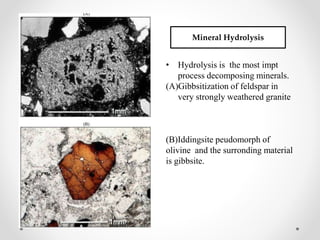
Mineral Hydrolysis
• Hydrolysis is the most impt
process decomposing minerals.
(A)Gibbsitization of feldspar in
very strongly weathered granite
(B)Iddingsite peudomorph of
olivine and the surronding material
is gibbsite.
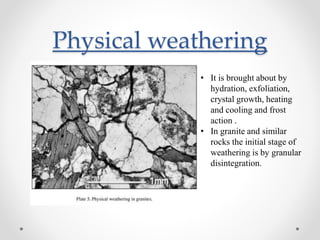
Physical weathering
• It is brought about by
hydration, exfoliation,
crystal growth, heating
and cooling and frost
action .
• In granite and similar
rocks the initial stage of
weathering is by granular
disintegration.
Biological weathering
• Very little work has been conducted at the microscopic
level on biological weathering of minerals except for the
effects of lichens on rock surfaces where hydrolysis is
induced and etching of minerals surfaces through the
secretion of various organic acid especially oxalic acid.
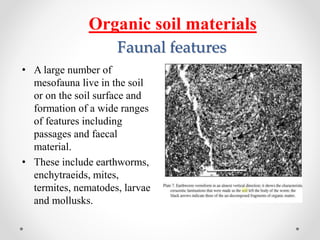
Faunal features
• A large number of
mesofauna live in the soil
or on the soil surface and
formation of a wide ranges
of features including
passages and faecal
material.
• These include earthworms,
enchytraeids, mites,
termites, nematodes, larvae
and mollusks.
Organic soil materials
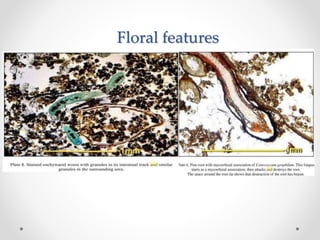
Floral features
Applications
The number of disciplines currently using thin sections on a
regular basis, are –
1. AGRICULTURE
• The main contribution to this discipline is in the study of soil
structure, both natural and in the change that accompany soil
uses.
• The preparation of seed bed prior to the planting, being one of
the most important operation in crop production, was studied
by the use of thin sections.
• Fertilizers can also affect soil micromorphology.
• Irrigation may improve the soil structure in some cases.
2.ARCHAEOLOGY
• Thin sections of pottery can also yield very useful information
about the history of an area and source of material for
manufacturing the pots.
• Ash can be used as an indicator of the type of plant material
that was used for fuel. And Wattez, Courty, MacPhail(1990)
used this for determining the nature of fuel used in prehistoric
caves.
3.ENGINEERING
• At present engineers are in the process of accumulating data
about behavior of fabrics.
4.GEOMORPHOLOGY
• Thin sections are being used to study the erosion and
deposition process as especially differential erosion which
leaves behind an accumulation of course material.
5.PALAEO-CLIMATOLOGY
• Thin sections have been also used to established the presence of
palaeocatenas which are better indicator of palaeo-climate than
indivisual palaesols.
6.PEDOLOGY AND PALAEOPEDOLOGY
Thin sections are particularly valuable in the study of some features
like-
• Clay coatings
• Earthworm faecal material
• Gibbsite concentration
• Fragments of concentration
• Iron/Mn concentration
• Silt coating etc.
• Thanks

Soil micromorphology

  • 1.
    COURSE NO- SOILS-501* COURETITLE- SOIL PHYSICS PRESENTATION ON- SOIL MICROMORPHOLOGY COURSE INCHARGE- Dr. G. Jayashree PRESENTED BY- PUJA PRIYADARSINI NAIK RAM/19-97
  • 2.
    SOIL MORPHOLOGY • Soilmorphology deals with the form and arrangement of soil features. • Soil morphology deals with the form, structure, and organization of the soil material, observed, described, and studied in the field, but investigation can be continued in the laboratory with optical and electron microscopes. • Field observations with the unaided eye or with a hand lens are considered macro morphology, whereas observations utilizing a microscope are considered micromorphology.
  • 3.
    Soil Macromorphology • Macromorphologyis best evaluated from the in situ examination of the soil profile. • A recently dug pit large enough for observation of a pedon is desirable. • Old exposures such as road cuts and ditches are acceptable only for preliminary examination because morphological features often become altered after prolonged exposure. • The exposed profile should be probed by hand, with the aid of a knife or small pick to remove any alterations resulting from digging equipment and to expose the natural condition of the soil.
  • 4.
    Soil Micromorphology • Micromorphologyis a term used in biology, mineralogy and soil science. • The fine-level structures or morphology of an organism, mineral, or soil component visible through microscopy. • Micromorphology is the branch of earth science that describes, interprets, and measures the components, features, and fabrics of soils, regolith materials, and prehistoric/historic artifacts at the microscopic and submicroscopic levels (Goldberg, 1983; Stoops, 2003). Soil micromorphology owes it popularity to the late Walter Kubiëna who saw its potential as a tool to investigate some of the properties and processes in soils. His two books “Micropedology” and “Soils of Europe” are landmarks in the development of Soil Science.
  • 5.
    TECHNIQUES – • Thebasic technique in soil microscopy and micromorphology involves the preparation of thin sections of undisturbed soil materials, the samples being collected in boxes with double lids to avoid disturbance. • The outstanding developments include the use of synthetic resins for improved impregnation and the increase in size of thin sections. • The introduction of acetone as a diluent of the resins made it possible to remove water from the samples by acetone exchange thus reducing shrinkage. • Over 45 ancillary techniques are used, including fluorescence, image analysis and electron microscope analyses. • Polished blocks may be adequate if a fluorescent dye is incorporated in the impregnating resin as the block can then be photographed with fluorescent light to show the distribution of the pore pattern.
  • 6.
    Definitions, Concepts andFeatures Fabric, Structure and Assemblage – • Fabric is the mutual arrangement and relationship between particles within the soil as a whole and within the various features, while structure is the type and degree of aggregation. • The totality of all features in a specimen is called an ensemble or assemblage. • The main fabric relationships seen in thin sections are in the fine earth, including both mineral and organic materials. These may be observed in thin sections but in a number of cases SEM is required.
  • 7.
    Fine material – •This refers to the material with a diameter of less than about 20µm and which is beyond the resolving power of the optical microscope. • It may be arranged as granules, masses, and links between grains or forms a complete matrix. Burnham (1970) suggested seven different ways in which clay particles might be arranged. (A) fabric composed of randomly orientated clay particles
  • 8.
    (B) Fabric composedor randomly orientated domains (C) fabric of domains in parallel alignment (D) fabric of parallel orientated clay particles with little differentiation of domains (E) granular particles of iron oxide, organic matter or fine silt interfere with the parallel orientation of the clay particles
  • 9.
    (F) randomly orientateddomains may occur between grains if coarse silt (G) large sand particles with clay particles aligned tangential to their surfaces
  • 10.
    Matrix - Materialof any size forming a continuous phase surrounding and enclosing coarser particles. Thus, a matrix may be dominantly clay surrounding sand particles or silt surrounding particles of gravel. Homogeneity and heterogeneity – • The concepts of homogeneity and heterogeneity are difficult to apply since a given volume of soil may at the same time be homogeneous with regard to one property, for example color, and heterogeneous with regard to another property such as the sand mineralogy. • Even the most uniform soils exhibit some degree of heterogeneity which might be just visible in the field, but conspicuous in thin sections. • If, for example, a soil composed mainly of clay has a few grains of silt, and more particularly quartz sand these will appear conspicuous particularly when examined with circularly polarized light.
  • 11.
    Recognition of individualfeatures – • One of the most difficult tasks in micromorphology is the recognition of individual features. • Clay particles are themselves individuals; they cannot be recognized with the optical microscope but can only be identified with TEM or SEM techniques. • Most thick clay coatings are easily recognized, but thin clay coatings are extremely difficult to identify. • The frequency of clay coatings in a given soil can vary widely when estimated by different operators.
  • 12.
    Recognition of patterns– • Probably the most important aspect of micromorphology is the recognition of patterns, not only the pattern of single individuals but also the relationships between the individuals themselves. • The types of pattern range from the relatively simple distribution of individual quartz grains to the often complex distribution pattern of clay coatings. • Probably the most difficult patterns to recognize are those of the anisotropism of matrices. It is often difficult to describe individuals and patterns. • In many cases a true representation can only be achieved with good photographs and diagrams.
  • 13.
    Quantification of features– • It has been shown that over 20 cores with two thin sections from each core are required to characterize quantitatively coatings, matrices, pores and concretions in horizons with translocated clay. • However, considerable success is being achieved by the application of many image analysis techniques to thin sections and polished blocks.
  • 14.
    Interpretation of featuresand patterns- • This is based on a combination of experience, intuition and guess-work. • Most workers agree that the majority of clay coatings have been formed by the translocation of clay particles and their deposition on surfaces. • They also agree that clusters of calcite and gypsum crystals have been formed by the translocation of calcium bicarbonate and calcium sulfate and crystals growth. • However the interpretation of some concretionary material in very old tropical soils is extremely difficult.
  • 15.
    Confirmation of theinterpretations • This will probably require experimentation. • It may, however, not always be possible to reproduce in the space of a few weeks or even months, those features that have taken hundreds or thousands of years to form. • Some researchers have nevertheless been able to produce clay coatings similar to those found in natural soils in the field, while others have demonstrated that certain forms of matrix anisotropism can be produced by stress and shearing.
  • 16.
    Properties of featuresand minerals – The main properties are:  color,  prominence,  size,  Shape,  roundness,  sphericity,  surface characteristics,  boundaries, distribution pattern,  relationships between features and  orientation.
  • 17.
    Mineral Soil Material PrimaryMinerals and Particle Size Classes • The mineral material in soils ranges in size from the very smallest particle, such as single grains of hematite >0.1 µm in highly weathered tropical soils up to the largest erratic boulders found in glacial drift or core stone in weathered rocks. • The shape of the large separates often give a clear indication of the process which have influenced the formation of the parent material or soil itself. e.g.- Sand varies in shape from smooth and rounded to rough and angular. Smooth and rounded shapes are found in wind-blown materials and beach sands. • The particle classes have different degree of mobility within the soil. • The clay fraction is often considered as being the most mobile and forms clay coatings, but by far the greatest amount of material is translocated by the soil fauna including earthworms and termites. • Therefore, thin sections should always be carefully examined for any evidence of movement particularly by biological processes.
  • 18.
    Secondary minerals andweathering products • The most frequently encountered secondary minerals in soils include: Anhydrite, allophane, aluminum hydroxide, barite, bassanite, celestite, calcite, chalcedony, chlorite, ferrihydrite, gibbsite, geothite, gypsum, hamatite, halite, halloysite, hydrous mica,iddingsite, imogolite, jarosite,kaolinite, lepidocrocite, leucoxene, maghemite, manganese dioxide, opal, pyrite, quartz, smectite,siderite and vermiculite. • The minerals that occur in amorphous or microcrystalline forms include: allophane, chlorite, ferrihydrate, gibbsite, geothite, hematite, halloysite, hydrous mica, jarosite,immogolite,kaolinite,leucoxene,lepidocrocite,opal,siderite,smectite and vermiculite • The secondary minerals can be observed in different positions in soils. Generally, they are found in matrix, in pores and in plant material. They may occur as amorphous or microcrystalline material, single grains, aggregates, clusters or fillings.
  • 19.
    (A)Bassanite with charactristicslozenge shape crystal with cross cleavage (B)Calcite forming a pendant beneath a round rock fragment (C) Secondary chalcedony in a soil of an arid area, with its well developed radial crystallization
  • 20.
    (D) A clusterof gypsum crystals with their characteristic lozenge shape (E)Ice from an ice wedge (F) Vermiform kaolinite in weathered rock surrounded by clay coatings
  • 21.
    (G) Brilliant whiteopal in calcrete revealed after the removal of calcite (H) Cluster of spherical pyrite crystals in a plant fragment in a lower horizon of peat (I) Biotite beings transformed into vermiculite, hence the variable interference colours; the relatively fresh biotite still has its brilliant third order colours which grade to the paler colour of the vermiculite
  • 22.
    • Quartz issoluble but dissolves very slowly and develops numbers of distinctive morphology. (A) irregular grains of quartz as a result of etching during the formation of opaque matrix of manganese/iron oxide The principle one undergoes hydration is biotite. (B)Initial stage of weathering of biotite where the grains are split apart Chemical weathering Solution Hydration
  • 23.
    Mineral Hydrolysis • Hydrolysisis the most impt process decomposing minerals. (A)Gibbsitization of feldspar in very strongly weathered granite (B)Iddingsite peudomorph of olivine and the surronding material is gibbsite.
  • 24.
    Physical weathering • Itis brought about by hydration, exfoliation, crystal growth, heating and cooling and frost action . • In granite and similar rocks the initial stage of weathering is by granular disintegration.
  • 25.
    Biological weathering • Verylittle work has been conducted at the microscopic level on biological weathering of minerals except for the effects of lichens on rock surfaces where hydrolysis is induced and etching of minerals surfaces through the secretion of various organic acid especially oxalic acid.
  • 26.
    Faunal features • Alarge number of mesofauna live in the soil or on the soil surface and formation of a wide ranges of features including passages and faecal material. • These include earthworms, enchytraeids, mites, termites, nematodes, larvae and mollusks. Organic soil materials
  • 27.
  • 28.
    Applications The number ofdisciplines currently using thin sections on a regular basis, are – 1. AGRICULTURE • The main contribution to this discipline is in the study of soil structure, both natural and in the change that accompany soil uses. • The preparation of seed bed prior to the planting, being one of the most important operation in crop production, was studied by the use of thin sections. • Fertilizers can also affect soil micromorphology. • Irrigation may improve the soil structure in some cases.
  • 29.
    2.ARCHAEOLOGY • Thin sectionsof pottery can also yield very useful information about the history of an area and source of material for manufacturing the pots. • Ash can be used as an indicator of the type of plant material that was used for fuel. And Wattez, Courty, MacPhail(1990) used this for determining the nature of fuel used in prehistoric caves.
  • 30.
    3.ENGINEERING • At presentengineers are in the process of accumulating data about behavior of fabrics. 4.GEOMORPHOLOGY • Thin sections are being used to study the erosion and deposition process as especially differential erosion which leaves behind an accumulation of course material.
  • 31.
    5.PALAEO-CLIMATOLOGY • Thin sectionshave been also used to established the presence of palaeocatenas which are better indicator of palaeo-climate than indivisual palaesols. 6.PEDOLOGY AND PALAEOPEDOLOGY Thin sections are particularly valuable in the study of some features like- • Clay coatings • Earthworm faecal material • Gibbsite concentration • Fragments of concentration • Iron/Mn concentration • Silt coating etc.
  • 32.

Editor's Notes

  • #18 sub-rounded grains occur in alluvium and beach deposits, and angular grains dominate in glacial deposits. The large separates tend to be very mobile under arctic conditions where they are readily heaved by freeze-thaw processes. Silt and clay fractions are easily translocated and are very mobile soil components being readily moved by earthworms, enchytraeid worms, termites, ants, insect larvae and in suspension.
  • #21 (E) The sections is about 500 micrometers thick, hence the strong interference colours
  • #22 (G) The cellular form suggests that it has replaced a root
  • #23 Chemical weathering can be achieved by solution, hydration, hydrolysis. Only a few minerals are soluble including the easily soluble carbonates, chlorides and sulfates. Quartz is soluble but dissolves very slowly and develops numbers of distinctive morphology.
  • #24  Under humid tropical conditions, feldspars weather to kaolinite or gibbsite In ultrabasic rocks, olivine tends to be replaced by brilliantly coloured reddish-brown iddingsite, which is fairly stable and is present in many highly weathered tropical soils.
  • #25 It is brought about by hydration, exfoliation, crystal growth, heating and cooling and frost action In granite and similar rocks the initial stage of weathering is by granular disintegration. Little fracturing of the minerals
  • #26 Very little work has been conducted at the microscopic level on biological weathering of minerals except for the effects of lichens on rock surfaces where hydrolysis is induced and etching of minerals surfaces through the secretion of various organic acid especially oxalic acid.
  • #28 Floral features- Enchytraeids produce a large amount of avery distinctive type of granular structure that is often beaded and composed of both organic and mineral material.
  • #31 As some fabrics will expand with light weight and collapse with a heavy load.