Soil Aggregation and its Associated Carbon
as Affected by Long-term Fertilization
Masters’ Seminar On
Speaker:-
Anand Kumar
M.Sc.(Ag), 2nd Year
Dr.Rajendra Prasad Central Agricultural University
Pusa, Samastipur
Contents
1. Introduction
2. Importance of aggregation
3. Type of aggregates
4. Mechanism of aggregate formation
5. Soil aggregate indices
6. Impact of long-term fertilization on
aggregation status
7. Storage of carbon in aggregates
8. Conclusion
 Aggregates are secondary particles formed through the
combination of mineral particles with organic and inorganic
substances.
 Soil aggregation is the process by which aggregates of
different sizes are joined and held together by different
organic and inorganic materials.
 Aggregation results from the rearrangement of particles,
flocculation and cementation (Duiker et al., 2003).
Introduction
 Application of inorganic fertilizers to crops results in high biomass
production and organic matter returns to soil in the form of
decaying roots, litter and crop residues.
 But, application of inorganic fertilizers alone decreases the stability
of macro-aggregates (Sarkar et al., 2003).
 Organic amendments supply large amount of organic matter that
has hydrophobic properties and strong intermolecular association
with soil particles.
Continued….
So, a judicious combination of organic amendments and inorganic
fertilizers is widely recognized strategy for improving soil
aggregation.
Continued….
Importance of Aggregation
 Air permeability mediated
 Improved water infiltration
 Reduced soil erosion
 Nutrient cycling promoted
Flocculation and aggregate formation
 In a suspension, the primary particles with high zeta potential repel
each other
 The addition of flocculating agent reduces the zeta potential and
forms floccules.
 However, the floccules are stable only as long as the flocculating
agent is present.
Continued….
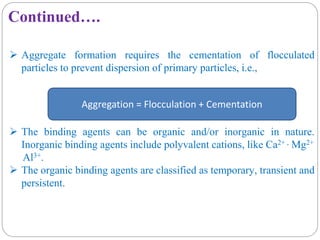
 Aggregate formation requires the cementation of flocculated
particles to prevent dispersion of primary particles, i.e.,
 The binding agents can be organic and/or inorganic in nature.
Inorganic binding agents include polyvalent cations, like Ca2+ , Mg2+
Al3+.
 The organic binding agents are classified as temporary, transient and
persistent.
Aggregation = Flocculation + Cementation
BINDING AGENTS
Organic
Temporary Transient Persistent
Inorganic
 Roots
 Fungal
hyphae
 Microbial by -
products
 Polysacchar -
ides
 Microbial by-
products
 Humic substances
 Organo-mineral
complex
 Humic-sesquioxides
complex
 Polyvalent cations
 Sesquioxides
 Aluminosilicates
 Dehydrated silicates
Two Types of Aggregates
 Microaggregates (<0.25 mm in diameter)
 Macroaggregates (>0.25 mm in diameter)
Mechanism of Aggregation
 There are several different mechanisms of aggregation of
which only a few mechanisms are better recognised by
researchers:
• Microaggregate Theory
• Aggregate Hierarchy Model
• Particulate-organic-matter (POM) Nucleus Model.
Microaggregate Theory
(Edwards and Bremner, 1967)
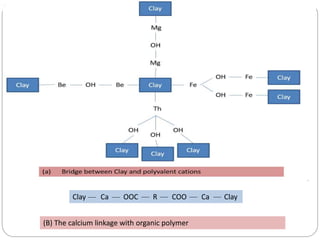
Soil consist of microaggregates bound into
macroaggregates.
Bonds are stronger in micro- than macro- aggregates
Microaggregate = [(Cl-P-OM)x]y
Where,
Cl Clay
P Polyvalent cation (Ca2+,Al3+,Fe2+ )
OM Organometallic Complex
x and y are the finite whole number
Clay Ca OOC R COO Ca Clay
(B) The calcium linkage with organic polymer
Aggregate Hierarchy Model
(Tisdall and Oades, 1982)
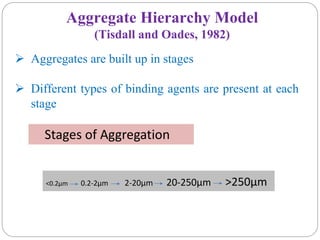
 Aggregates are built up in stages
 Different types of binding agents are present at each
stage
Stages of Aggregation
<0.2µm 0.2-2µm 2-20µm 20-250µm >250µm
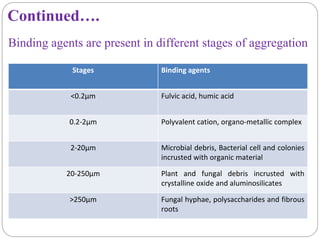
Binding agents are present in different stages of aggregation
Continued….
Stages Binding agents
<0.2µm Fulvic acid, humic acid
0.2-2µm Polyvalent cation, organo-metallic complex
2-20µm Microbial debris, Bacterial cell and colonies
incrusted with organic material
20-250µm Plant and fungal debris incrusted with
crystalline oxide and aluminosilicates
>250µm Fungal hyphae, polysaccharides and fibrous
roots
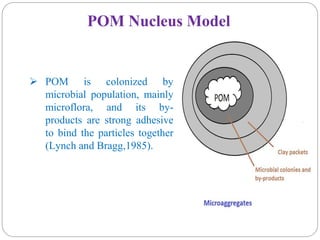
POM Nucleus Model
 POM is colonized by
microbial population, mainly
microflora, and its by-
products are strong adhesive
to bind the particles together
(Lynch and Bragg,1985).
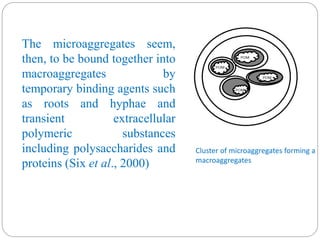
Cluster of microaggregates forming a
macroaggregates
The microaggregates seem,
then, to be bound together into
macroaggregates by
temporary binding agents such
as roots and hyphae and
transient extracellular
polymeric substances
including polysaccharides and
proteins (Six et al., 2000)
Determination of Aggregation Status of Soil
Soil Aggregate Indices:
• Mean weight diameter (MWD),
• Geometric mean weight diameter (GMD),
• Water stable macro-aggregate (WSMA, %),
which are obtained by fractioning the soil aggregate classes by
wet sieving (Kemper and Chepil, 1965).
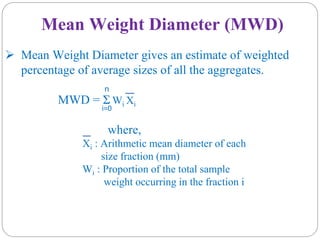
Mean Weight Diameter (MWD)
 Mean Weight Diameter gives an estimate of weighted
percentage of average sizes of all the aggregates.
MWD = Σ Wi Xi
where,
Xi : Arithmetic mean diameter of each
size fraction (mm)
Wi : Proportion of the total sample
weight occurring in the fraction i
n
i=0
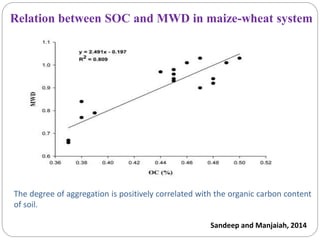
Relation between SOC and MWD in maize-wheat system
The degree of aggregation is positively correlated with the organic carbon content
of soil.
Sandeep and Manjaiah, 2014
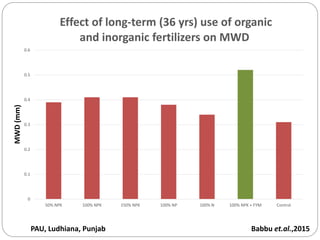
0
0.1
0.2
0.3
0.4
0.5
0.6
50% NPK 100% NPK 150% NPK 100% NP 100% N 100% NPK + FYM Control
Effect of long-term (36 yrs) use of organic
and inorganic fertilizers on MWD
MWD(mm)
Babbu et.al.,2015PAU, Ludhiana, Punjab
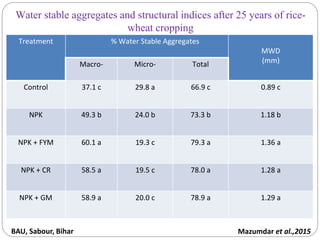
Water stable aggregates and structural indices after 25 years of rice-
wheat cropping
Treatment % Water Stable Aggregates
MWD
(mm)Macro- Micro- Total
Control 37.1 c 29.8 a 66.9 c 0.89 c
NPK 49.3 b 24.0 b 73.3 b 1.18 b
NPK + FYM 60.1 a 19.3 c 79.3 a 1.36 a
NPK + CR 58.5 a 19.5 c 78.0 a 1.28 a
NPK + GM 58.9 a 20.0 c 78.9 a 1.29 a
Mazumdar et al.,2015BAU, Sabour, Bihar
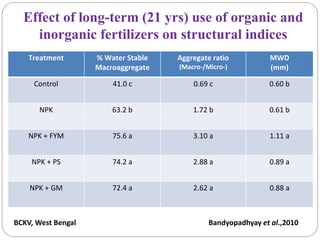
Effect of long-term (21 yrs) use of organic and
inorganic fertilizers on structural indices
Treatment % Water Stable
Macroaggregate
Aggregate ratio
(Macro-/Micro-)
MWD
(mm)
Control 41.0 c 0.69 c 0.60 b
NPK 63.2 b 1.72 b 0.61 b
NPK + FYM 75.6 a 3.10 a 1.11 a
NPK + PS 74.2 a 2.88 a 0.89 a
NPK + GM 72.4 a 2.62 a 0.88 a
Bandyopadhyay et al.,2010BCKV, West Bengal
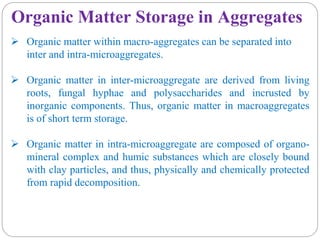
Organic Matter Storage in Aggregates
 Organic matter within macro-aggregates can be separated into
inter and intra-microaggregates.
 Organic matter in inter-microaggregate are derived from living
roots, fungal hyphae and polysaccharides and incrusted by
inorganic components. Thus, organic matter in macroaggregates
is of short term storage.
 Organic matter in intra-microaggregate are composed of organo-
mineral complex and humic substances which are closely bound
with clay particles, and thus, physically and chemically protected
from rapid decomposition.
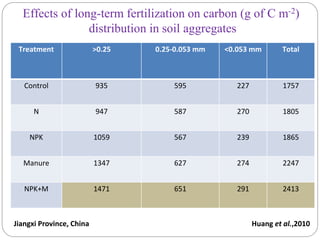
Effects of long-term fertilization on carbon (g of C m-2)
distribution in soil aggregates
Treatment >0.25 0.25-0.053 mm <0.053 mm Total
Control 935 595 227 1757
N 947 587 270 1805
NPK 1059 567 239 1865
Manure 1347 627 274 2247
NPK+M 1471 651 291 2413
Huang et al.,2010Jiangxi Province, China
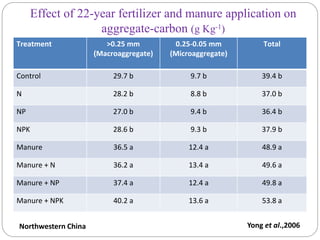
Effect of 22-year fertilizer and manure application on
aggregate-carbon (g Kg-1)
Treatment >0.25 mm
(Macroaggregate)
0.25-0.05 mm
(Microaggregate)
Total
Control 29.7 b 9.7 b 39.4 b
N 28.2 b 8.8 b 37.0 b
NP 27.0 b 9.4 b 36.4 b
NPK 28.6 b 9.3 b 37.9 b
Manure 36.5 a 12.4 a 48.9 a
Manure + N 36.2 a 13.4 a 49.6 a
Manure + NP 37.4 a 12.4 a 49.8 a
Manure + NPK 40.2 a 13.6 a 53.8 a
Yong et al.,2006Northwestern China
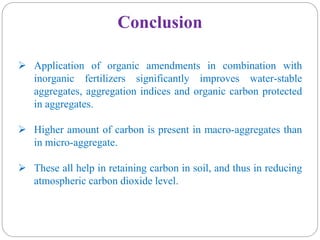
Conclusion
 Application of organic amendments in combination with
inorganic fertilizers significantly improves water-stable
aggregates, aggregation indices and organic carbon protected
in aggregates.
 Higher amount of carbon is present in macro-aggregates than
in micro-aggregate.
 These all help in retaining carbon in soil, and thus in reducing
atmospheric carbon dioxide level.
Thank you!!! 
28

Seminar soil aggregation

  • 1.
    Soil Aggregation andits Associated Carbon as Affected by Long-term Fertilization Masters’ Seminar On Speaker:- Anand Kumar M.Sc.(Ag), 2nd Year Dr.Rajendra Prasad Central Agricultural University Pusa, Samastipur
  • 2.
    Contents 1. Introduction 2. Importanceof aggregation 3. Type of aggregates 4. Mechanism of aggregate formation 5. Soil aggregate indices 6. Impact of long-term fertilization on aggregation status 7. Storage of carbon in aggregates 8. Conclusion
  • 3.
     Aggregates aresecondary particles formed through the combination of mineral particles with organic and inorganic substances.  Soil aggregation is the process by which aggregates of different sizes are joined and held together by different organic and inorganic materials.  Aggregation results from the rearrangement of particles, flocculation and cementation (Duiker et al., 2003). Introduction
  • 4.
     Application ofinorganic fertilizers to crops results in high biomass production and organic matter returns to soil in the form of decaying roots, litter and crop residues.  But, application of inorganic fertilizers alone decreases the stability of macro-aggregates (Sarkar et al., 2003).  Organic amendments supply large amount of organic matter that has hydrophobic properties and strong intermolecular association with soil particles. Continued….
  • 5.
    So, a judiciouscombination of organic amendments and inorganic fertilizers is widely recognized strategy for improving soil aggregation. Continued….
  • 6.
    Importance of Aggregation Air permeability mediated  Improved water infiltration  Reduced soil erosion  Nutrient cycling promoted
  • 7.
    Flocculation and aggregateformation  In a suspension, the primary particles with high zeta potential repel each other  The addition of flocculating agent reduces the zeta potential and forms floccules.  However, the floccules are stable only as long as the flocculating agent is present.
  • 8.
    Continued….  Aggregate formationrequires the cementation of flocculated particles to prevent dispersion of primary particles, i.e.,  The binding agents can be organic and/or inorganic in nature. Inorganic binding agents include polyvalent cations, like Ca2+ , Mg2+ Al3+.  The organic binding agents are classified as temporary, transient and persistent. Aggregation = Flocculation + Cementation
  • 9.
    BINDING AGENTS Organic Temporary TransientPersistent Inorganic  Roots  Fungal hyphae  Microbial by - products  Polysacchar - ides  Microbial by- products  Humic substances  Organo-mineral complex  Humic-sesquioxides complex  Polyvalent cations  Sesquioxides  Aluminosilicates  Dehydrated silicates
  • 10.
    Two Types ofAggregates  Microaggregates (<0.25 mm in diameter)  Macroaggregates (>0.25 mm in diameter)
  • 11.
    Mechanism of Aggregation There are several different mechanisms of aggregation of which only a few mechanisms are better recognised by researchers: • Microaggregate Theory • Aggregate Hierarchy Model • Particulate-organic-matter (POM) Nucleus Model.
  • 12.
    Microaggregate Theory (Edwards andBremner, 1967) Soil consist of microaggregates bound into macroaggregates. Bonds are stronger in micro- than macro- aggregates Microaggregate = [(Cl-P-OM)x]y Where, Cl Clay P Polyvalent cation (Ca2+,Al3+,Fe2+ ) OM Organometallic Complex x and y are the finite whole number
  • 13.
    Clay Ca OOCR COO Ca Clay (B) The calcium linkage with organic polymer
  • 14.
    Aggregate Hierarchy Model (Tisdalland Oades, 1982)  Aggregates are built up in stages  Different types of binding agents are present at each stage Stages of Aggregation <0.2µm 0.2-2µm 2-20µm 20-250µm >250µm
  • 15.
    Binding agents arepresent in different stages of aggregation Continued…. Stages Binding agents <0.2µm Fulvic acid, humic acid 0.2-2µm Polyvalent cation, organo-metallic complex 2-20µm Microbial debris, Bacterial cell and colonies incrusted with organic material 20-250µm Plant and fungal debris incrusted with crystalline oxide and aluminosilicates >250µm Fungal hyphae, polysaccharides and fibrous roots
  • 16.
    POM Nucleus Model POM is colonized by microbial population, mainly microflora, and its by- products are strong adhesive to bind the particles together (Lynch and Bragg,1985).
  • 17.
    Cluster of microaggregatesforming a macroaggregates The microaggregates seem, then, to be bound together into macroaggregates by temporary binding agents such as roots and hyphae and transient extracellular polymeric substances including polysaccharides and proteins (Six et al., 2000)
  • 18.
    Determination of AggregationStatus of Soil Soil Aggregate Indices: • Mean weight diameter (MWD), • Geometric mean weight diameter (GMD), • Water stable macro-aggregate (WSMA, %), which are obtained by fractioning the soil aggregate classes by wet sieving (Kemper and Chepil, 1965).
  • 19.
    Mean Weight Diameter(MWD)  Mean Weight Diameter gives an estimate of weighted percentage of average sizes of all the aggregates. MWD = Σ Wi Xi where, Xi : Arithmetic mean diameter of each size fraction (mm) Wi : Proportion of the total sample weight occurring in the fraction i n i=0
  • 20.
    Relation between SOCand MWD in maize-wheat system The degree of aggregation is positively correlated with the organic carbon content of soil. Sandeep and Manjaiah, 2014
  • 21.
    0 0.1 0.2 0.3 0.4 0.5 0.6 50% NPK 100%NPK 150% NPK 100% NP 100% N 100% NPK + FYM Control Effect of long-term (36 yrs) use of organic and inorganic fertilizers on MWD MWD(mm) Babbu et.al.,2015PAU, Ludhiana, Punjab
  • 22.
    Water stable aggregatesand structural indices after 25 years of rice- wheat cropping Treatment % Water Stable Aggregates MWD (mm)Macro- Micro- Total Control 37.1 c 29.8 a 66.9 c 0.89 c NPK 49.3 b 24.0 b 73.3 b 1.18 b NPK + FYM 60.1 a 19.3 c 79.3 a 1.36 a NPK + CR 58.5 a 19.5 c 78.0 a 1.28 a NPK + GM 58.9 a 20.0 c 78.9 a 1.29 a Mazumdar et al.,2015BAU, Sabour, Bihar
  • 23.
    Effect of long-term(21 yrs) use of organic and inorganic fertilizers on structural indices Treatment % Water Stable Macroaggregate Aggregate ratio (Macro-/Micro-) MWD (mm) Control 41.0 c 0.69 c 0.60 b NPK 63.2 b 1.72 b 0.61 b NPK + FYM 75.6 a 3.10 a 1.11 a NPK + PS 74.2 a 2.88 a 0.89 a NPK + GM 72.4 a 2.62 a 0.88 a Bandyopadhyay et al.,2010BCKV, West Bengal
  • 24.
    Organic Matter Storagein Aggregates  Organic matter within macro-aggregates can be separated into inter and intra-microaggregates.  Organic matter in inter-microaggregate are derived from living roots, fungal hyphae and polysaccharides and incrusted by inorganic components. Thus, organic matter in macroaggregates is of short term storage.  Organic matter in intra-microaggregate are composed of organo- mineral complex and humic substances which are closely bound with clay particles, and thus, physically and chemically protected from rapid decomposition.
  • 25.
    Effects of long-termfertilization on carbon (g of C m-2) distribution in soil aggregates Treatment >0.25 0.25-0.053 mm <0.053 mm Total Control 935 595 227 1757 N 947 587 270 1805 NPK 1059 567 239 1865 Manure 1347 627 274 2247 NPK+M 1471 651 291 2413 Huang et al.,2010Jiangxi Province, China
  • 26.
    Effect of 22-yearfertilizer and manure application on aggregate-carbon (g Kg-1) Treatment >0.25 mm (Macroaggregate) 0.25-0.05 mm (Microaggregate) Total Control 29.7 b 9.7 b 39.4 b N 28.2 b 8.8 b 37.0 b NP 27.0 b 9.4 b 36.4 b NPK 28.6 b 9.3 b 37.9 b Manure 36.5 a 12.4 a 48.9 a Manure + N 36.2 a 13.4 a 49.6 a Manure + NP 37.4 a 12.4 a 49.8 a Manure + NPK 40.2 a 13.6 a 53.8 a Yong et al.,2006Northwestern China
  • 27.
    Conclusion  Application oforganic amendments in combination with inorganic fertilizers significantly improves water-stable aggregates, aggregation indices and organic carbon protected in aggregates.  Higher amount of carbon is present in macro-aggregates than in micro-aggregate.  These all help in retaining carbon in soil, and thus in reducing atmospheric carbon dioxide level.
  • 28.