WEATHERING
SEQUENCE
By- Souvik Sadhu
M.Sc 1st year.
Bihar Agricultural University
What is weathering:
• Weathering is the breaking down of rocks, soils and minerals as well
as wood and artificial materials through contact with water
atmospheric gasses and biological organisms.
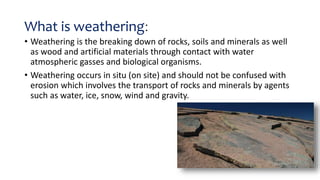
• Weathering occurs in situ (on site) and should not be confused with
erosion which involves the transport of rocks and minerals by agents
such as water, ice, snow, wind and gravity.
Why should we bother about weathering:
• Primary mechanism by which regolith is produced.
• Influences geochemistry of regolith, ground and surface waters.
• Main control over geochemical dispersion- helps exploration and
environmental management.
• Affects salt generation and movement in the regolith.
• Affects acid generation in the regolith.
Why do rocks weather:
• Most rocks (and minerals) form at high temperature and pressure and
therefore are at equilibrium with the high temperature and pressure
environments.
• When rocks are exposed to earth’s surface, their equilibrium is
disturbed and their minerals react and experience transformation so
as to adjust to low temperature and pressure and water conditions.
Types of weathering:
• Three types of weathering
• Physical: Mechanical breakdown of rock and regolith.
• Chemical: Chemical decomposition of rock by solutions (alters
composition and mineralogy of rocks)- sometimes reffered to as low
temperature water-rock interaction.
• Biological: Enhancement of chemical (biochemical) and physical
weathering (biomechanical)- combined under physical and chemical
weathering.
Goldich’s weathering sequence:
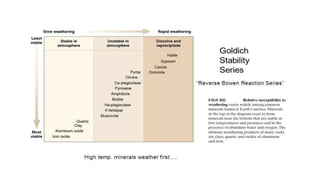
• The Goldich weathering series is a way of predicting the relative
stability or weathering rate of various minerals on earth’s surface.
• S.S Goldich came up with this series in 1938 after studying soil
profiles.
• He found that minerals that form under higher temperature and
pressure are less stable on the earth surface than minerals that are
formed at lower temperature and pressure.
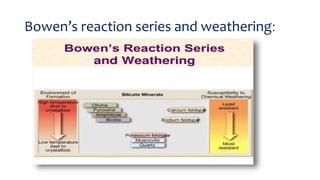
• The pattern follows the same pattern of the Bowen’s reaction series,
with the minerals that are first to crystallize are also the first that
undergo chemical weathering.
Bowen’s reaction series and weathering:
Rate of weathering-Kinetics
• Rate of weathering of minerals depend on
pH
Temperature
Surface area in contact with fluid
Other competing ions in solution
Flow rates of fluids.
Weathering mechanism:
• The general dissolution reaction of silicates in inorganic aqueous
system involves multi step process of initial rapid exchange of cations
for protons at the mineral surface followed by a slow rate
determining hydrolysis. And subsequent detachment of silica and
alumina species from the remaining framework (Aagaard and
Helgeson, 1982)
• Destruction of framework bonds are known to occur through
decomposition of these surface complexes when they are in activated
state.
• Therefore the overall dissolution rate can be expressed as
Rate=k[s]
where ‘s’ is the surface concentration of the reaction precursor
(surface species which is in equilibrium with the activated complex)
and ‘k’ is a constant.
Goldich weathering sequence in terms of
bond strength:
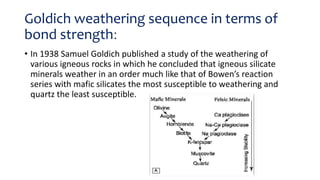
• In 1938 Samuel Goldich published a study of the weathering of
various igneous rocks in which he concluded that igneous silicate
minerals weather in an order much like that of Bowen’s reaction
series with mafic silicates the most susceptible to weathering and
quartz the least susceptible.
• The diagram shows that the order of this weathering series agrees
well with the least bond in each of the minerals involved.
• It is reasonable because weathering or the destruction of minerals
requires breaking of bonds in those minerals.
• The only special provision is to mind that some minerals consist
sufficiently of strongly bonded cations that a weakly bonded cation
can be leached from the surface of a mineral grain without
destruction of the entire mineral grain.
Why some minerals are susceptible and
some are resistant to weathering:
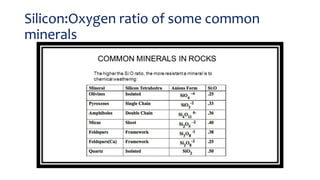
• It has been found that the higher resistance to weathering of certain
minerals are attributed to their high silicon:oxygen ratio.
• So it can be told that higher the silicon:oxygen ratio of the minerals,
higher is its resistance to elements of weathering.
• It may be due to the tendency of oxygen to react with almost all
element due to its higher electronegativity and formation of
respective oxides.
• The combination of water and oxygen is even more corrosive.
Silicon:Oxygen ratio of some common
minerals
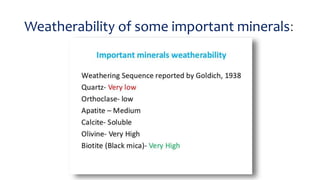
Weatherability of some important minerals:
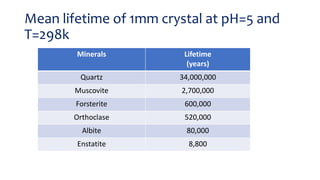
Mean lifetime of 1mm crystal at pH=5 and
T=298k
Minerals Lifetime
(years)
Quartz 34,000,000
Muscovite 2,700,000
Forsterite 600,000
Orthoclase 520,000
Albite 80,000
Enstatite 8,800
Conclusion:
• From this study it can be concluded that oxygen due to its high
reactive nature has the tendency to form oxide compound with
various elements which leads to alteration or break down of
structure.
• So minerals having high silicon:oxygen ratio are more resistant to
weathering and minerals having low silicon:oxygen ratio are
susceptible to weathering.
• One more reason of high weathering rate of some minerals is to be in
equilibrium with the low temperature and pressure environment.
Weathering sequence

Weathering sequence

  • 1.
    WEATHERING SEQUENCE By- Souvik Sadhu M.Sc1st year. Bihar Agricultural University
  • 2.
    What is weathering: •Weathering is the breaking down of rocks, soils and minerals as well as wood and artificial materials through contact with water atmospheric gasses and biological organisms. • Weathering occurs in situ (on site) and should not be confused with erosion which involves the transport of rocks and minerals by agents such as water, ice, snow, wind and gravity.
  • 3.
    Why should webother about weathering: • Primary mechanism by which regolith is produced. • Influences geochemistry of regolith, ground and surface waters. • Main control over geochemical dispersion- helps exploration and environmental management. • Affects salt generation and movement in the regolith. • Affects acid generation in the regolith.
  • 4.
    Why do rocksweather: • Most rocks (and minerals) form at high temperature and pressure and therefore are at equilibrium with the high temperature and pressure environments. • When rocks are exposed to earth’s surface, their equilibrium is disturbed and their minerals react and experience transformation so as to adjust to low temperature and pressure and water conditions.
  • 5.
    Types of weathering: •Three types of weathering • Physical: Mechanical breakdown of rock and regolith. • Chemical: Chemical decomposition of rock by solutions (alters composition and mineralogy of rocks)- sometimes reffered to as low temperature water-rock interaction. • Biological: Enhancement of chemical (biochemical) and physical weathering (biomechanical)- combined under physical and chemical weathering.
  • 6.
    Goldich’s weathering sequence: •The Goldich weathering series is a way of predicting the relative stability or weathering rate of various minerals on earth’s surface. • S.S Goldich came up with this series in 1938 after studying soil profiles. • He found that minerals that form under higher temperature and pressure are less stable on the earth surface than minerals that are formed at lower temperature and pressure. • The pattern follows the same pattern of the Bowen’s reaction series, with the minerals that are first to crystallize are also the first that undergo chemical weathering.
  • 7.
  • 8.
    Rate of weathering-Kinetics •Rate of weathering of minerals depend on pH Temperature Surface area in contact with fluid Other competing ions in solution Flow rates of fluids.
  • 9.
    Weathering mechanism: • Thegeneral dissolution reaction of silicates in inorganic aqueous system involves multi step process of initial rapid exchange of cations for protons at the mineral surface followed by a slow rate determining hydrolysis. And subsequent detachment of silica and alumina species from the remaining framework (Aagaard and Helgeson, 1982) • Destruction of framework bonds are known to occur through decomposition of these surface complexes when they are in activated state. • Therefore the overall dissolution rate can be expressed as Rate=k[s]
  • 10.
    where ‘s’ isthe surface concentration of the reaction precursor (surface species which is in equilibrium with the activated complex) and ‘k’ is a constant.
  • 11.
    Goldich weathering sequencein terms of bond strength: • In 1938 Samuel Goldich published a study of the weathering of various igneous rocks in which he concluded that igneous silicate minerals weather in an order much like that of Bowen’s reaction series with mafic silicates the most susceptible to weathering and quartz the least susceptible.
  • 12.
    • The diagramshows that the order of this weathering series agrees well with the least bond in each of the minerals involved. • It is reasonable because weathering or the destruction of minerals requires breaking of bonds in those minerals. • The only special provision is to mind that some minerals consist sufficiently of strongly bonded cations that a weakly bonded cation can be leached from the surface of a mineral grain without destruction of the entire mineral grain.
  • 14.
    Why some mineralsare susceptible and some are resistant to weathering: • It has been found that the higher resistance to weathering of certain minerals are attributed to their high silicon:oxygen ratio. • So it can be told that higher the silicon:oxygen ratio of the minerals, higher is its resistance to elements of weathering. • It may be due to the tendency of oxygen to react with almost all element due to its higher electronegativity and formation of respective oxides. • The combination of water and oxygen is even more corrosive.
  • 15.
    Silicon:Oxygen ratio ofsome common minerals
  • 16.
    Weatherability of someimportant minerals:
  • 17.
    Mean lifetime of1mm crystal at pH=5 and T=298k Minerals Lifetime (years) Quartz 34,000,000 Muscovite 2,700,000 Forsterite 600,000 Orthoclase 520,000 Albite 80,000 Enstatite 8,800
  • 18.
    Conclusion: • From thisstudy it can be concluded that oxygen due to its high reactive nature has the tendency to form oxide compound with various elements which leads to alteration or break down of structure. • So minerals having high silicon:oxygen ratio are more resistant to weathering and minerals having low silicon:oxygen ratio are susceptible to weathering. • One more reason of high weathering rate of some minerals is to be in equilibrium with the low temperature and pressure environment.