VERMICOMPOSTING
Amandeep Singh
Assistant Professor
Department of Biotechnology
GSSDGS Khalsa College
Patiala
Vermicomposting
2
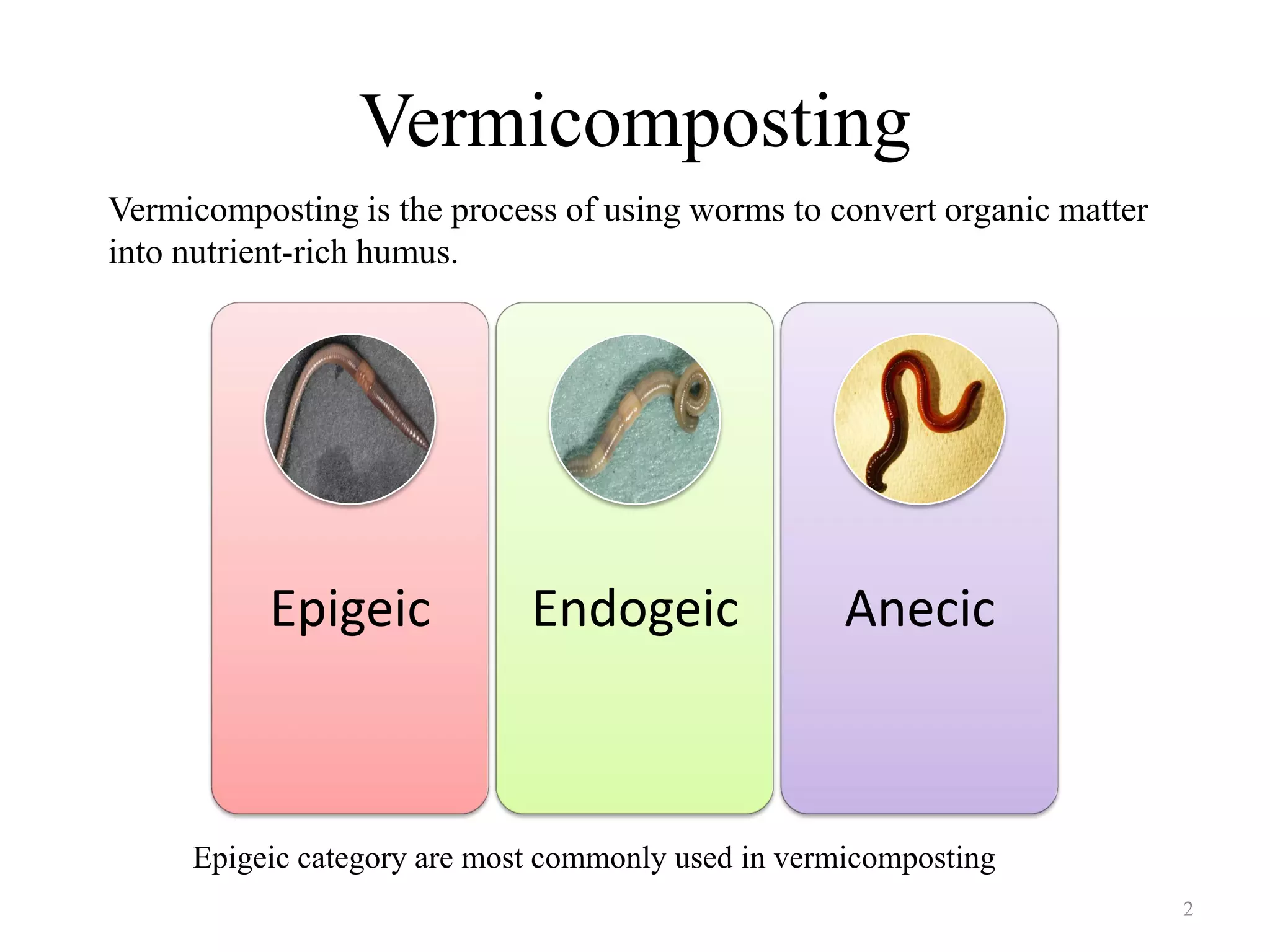
Vermicomposting is the process of using worms to convert organic matter
into nutrient-rich humus.
Epigeic Endogeic Anecic
Epigeic category are most commonly used in vermicomposting
3
Worms: The most important
organisms on Earth?
Cleopatra renamed the worm "a sacred creature",
whose removal from Egypt was punishable by
death. Nile Valley is said to be the most fertile
tract of land on earth and it is literally one vast
bed of earthworm soil.
4
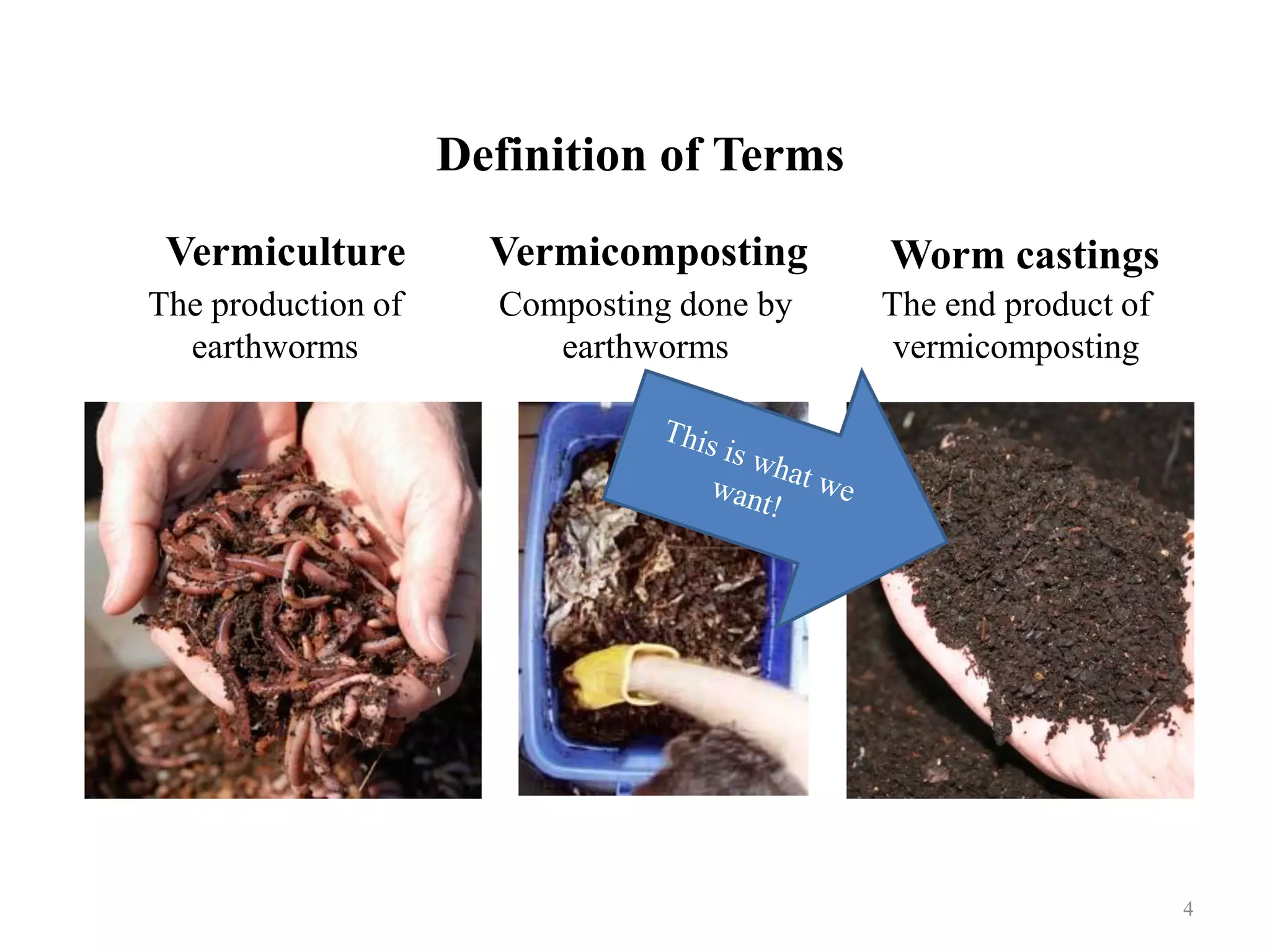
Vermiculture
Definition of Terms
Vermicomposting Worm castings
The production of
earthworms
Composting done by
earthworms
The end product of
vermicomposting
5
Eisenia fetida or Red Wigglers
• Genus Eisenia named for Swedish naturalist
• Specie name fetida (foul-smelling) comes
from pungent liquid exuded when handled
roughly
• More commonly known as Red Wigglers
• Recognizable by yellow stripes between
segments
Gustaf A. Eisen
1847-1940
Introducing the Main Characters:
6
Epigeic
Fascinating Facts about Red Wigglers
Hermaphrodites No Lungs
They naturally feed on
leaf litter on the surface
Have both sexes but
need another to mate
They breathe through
their skin
7
Hearts
Even More Fascinating Facts about Red Wiggle
Headless Wonders Blind sight
Earthworms have 5 hearts
If you cut off a worm’s head
it will grow a new tail if it has
the clitellum and at least 10
more segments. Severed tails
will not grow new heads.
No eyes but above the head
worms have light sensitive tissue
DO NOT TRY THIS AT
HOME
8
Red wigglers average
eating one half of their
body weight per day
No teeth but strong mouth
muscles. They need grit in
their gizzards to help digest
They actually like to eat the tiny
bacteria and mold growing on the
surface of the food source
How Much Can They Eat? How do they Eat? What do they Eat?
Common Questions about Red Wigglers
9
Red Wiggler Life Stages
Red wigglers are mature when they develop their
clitellum where the sex organs are located. When fully
developed the clitellum segment turns orange in color.
Full maturity takes between 40 and 60 days.
Red wigglers mate head to tail, secreting a mucus
that connects them. They exchange sperm which
they store and later lay eggs in cocoons.
10
Red Wiggler Life Stages
Red wigglers lay small lemon shaped cocoons which
start off pale yellow and then turn a dark brown
when the baby worms are ready to hatch (three
weeks to five months depending on conditions).
Each cocoon houses between 2 to 7 baby worms.
Mom/Dad and Dad/Mom wiggler do not care for
their young. As soon as baby worms hatch they start
eating. They darken in color as they mature starting
out nearly clear and maturing to deep burgundy red
with yellow stripes.
11
YES
Most fruits and veggies
Coffee grounds and filters
Tea leaves and bags
Egg shells
Most cereals and grains (oatmeal,
pasta, rice, cornmeal, pancakes,
breads)
NO
Meat, fish, dairy, oil, or bones
Potato chips, candy, oils
Citrus
NO-NO's
Plastic
Rubber bands
Sponges
Aluminum foil
GlassMAYBE
Onions
Garlic
Ginger
Food Waste
12
Process Diagram
13
And the best part of all is what
comes out in the end: the castings!
14
Benefits of Vermicomposting
1. Recycles waste in an environmentally-
friendly way
2. Keeps more garbage out of landfills
3. A sustainable way to produce low-cost
nutritionally-valuable organic fertilizer
4. Very little time or labor is required
5. It can be done indoors odorlessly!
6. Can be done by all ages who will dig in
7. Income generation through sale of worms
and vermicompost or both!
8. Materials available to everyone
9. The system is easily reproducible by others
once you learn how to do it
15
Chemical Comparison Between
Vermicompost and Soil
• Vermicompost has between 5 and 11 times the Nitrogen
(N), Phosphorus (P) and Potassium (K) of regular soil –
essentials for plant growth
• Vermicompost also adds humic acid to soil that helps
bind minerals and nutrients to soil and protect soil from
UV degradation
• Chemical fertilizers will increase plant growth and
production quickly but will not build up the soil
• Studies show best plant growth in a soil mix with
10 to 40% vermicompost content
16
Comparison Between Normal
Compost and Vermicompost
• Heat of regular compost kills many
beneficial microbes
• Vermicompost is aerobic thus may
have up to 1000 times the microbial
activity of normal compost
• Increased microbial activity in the
soil means better disease resistance
• Vermicompost can be generated in
1/3 the time of regular compost
• Trench composting is a good outdoor
compromise
17
Benefits of Vermicompost:
It Feeds the Soil while it Feeds the Plants
Chemicals fertilizers
actually destroy most
life forms in the soil
18
How can I use vermicompost?
1. Add it to your potted plants as top dressing – mix in top layer
2.Make your own potting soil or seedling starter mix
(1 part peat,1 part perlite and 1 part vermicompost)
3. Strain it in water and make compost tea to use on all your plants
4. Add it to your raised planting beds or in your garden
5-6 tablespoons per
gallon of water
19
Compost Tea is a highly concentrated microbial solution
produced by extracting beneficial microbes from Vermicompost
and or compost.
 Liquid produced from vermicomposting
 Protects plants from disease
 Improves nutrient retention
 Decomposes harmful chemicals
 Transforms compacted soil into healthy soil
 Reduces water usage
Compost Tea

Vermicomposting

  • 1.
    VERMICOMPOSTING Amandeep Singh Assistant Professor Departmentof Biotechnology GSSDGS Khalsa College Patiala
  • 2.
    Vermicomposting 2 Vermicomposting is theprocess of using worms to convert organic matter into nutrient-rich humus. Epigeic Endogeic Anecic Epigeic category are most commonly used in vermicomposting
  • 3.
    3 Worms: The mostimportant organisms on Earth? Cleopatra renamed the worm "a sacred creature", whose removal from Egypt was punishable by death. Nile Valley is said to be the most fertile tract of land on earth and it is literally one vast bed of earthworm soil.
  • 4.
    4 Vermiculture Definition of Terms VermicompostingWorm castings The production of earthworms Composting done by earthworms The end product of vermicomposting
  • 5.
    5 Eisenia fetida orRed Wigglers • Genus Eisenia named for Swedish naturalist • Specie name fetida (foul-smelling) comes from pungent liquid exuded when handled roughly • More commonly known as Red Wigglers • Recognizable by yellow stripes between segments Gustaf A. Eisen 1847-1940 Introducing the Main Characters:
  • 6.
    6 Epigeic Fascinating Facts aboutRed Wigglers Hermaphrodites No Lungs They naturally feed on leaf litter on the surface Have both sexes but need another to mate They breathe through their skin
  • 7.
    7 Hearts Even More FascinatingFacts about Red Wiggle Headless Wonders Blind sight Earthworms have 5 hearts If you cut off a worm’s head it will grow a new tail if it has the clitellum and at least 10 more segments. Severed tails will not grow new heads. No eyes but above the head worms have light sensitive tissue DO NOT TRY THIS AT HOME
  • 8.
    8 Red wigglers average eatingone half of their body weight per day No teeth but strong mouth muscles. They need grit in their gizzards to help digest They actually like to eat the tiny bacteria and mold growing on the surface of the food source How Much Can They Eat? How do they Eat? What do they Eat? Common Questions about Red Wigglers
  • 9.
    9 Red Wiggler LifeStages Red wigglers are mature when they develop their clitellum where the sex organs are located. When fully developed the clitellum segment turns orange in color. Full maturity takes between 40 and 60 days. Red wigglers mate head to tail, secreting a mucus that connects them. They exchange sperm which they store and later lay eggs in cocoons.
  • 10.
    10 Red Wiggler LifeStages Red wigglers lay small lemon shaped cocoons which start off pale yellow and then turn a dark brown when the baby worms are ready to hatch (three weeks to five months depending on conditions). Each cocoon houses between 2 to 7 baby worms. Mom/Dad and Dad/Mom wiggler do not care for their young. As soon as baby worms hatch they start eating. They darken in color as they mature starting out nearly clear and maturing to deep burgundy red with yellow stripes.
  • 11.
    11 YES Most fruits andveggies Coffee grounds and filters Tea leaves and bags Egg shells Most cereals and grains (oatmeal, pasta, rice, cornmeal, pancakes, breads) NO Meat, fish, dairy, oil, or bones Potato chips, candy, oils Citrus NO-NO's Plastic Rubber bands Sponges Aluminum foil GlassMAYBE Onions Garlic Ginger Food Waste
  • 12.
  • 13.
    13 And the bestpart of all is what comes out in the end: the castings!
  • 14.
    14 Benefits of Vermicomposting 1.Recycles waste in an environmentally- friendly way 2. Keeps more garbage out of landfills 3. A sustainable way to produce low-cost nutritionally-valuable organic fertilizer 4. Very little time or labor is required 5. It can be done indoors odorlessly! 6. Can be done by all ages who will dig in 7. Income generation through sale of worms and vermicompost or both! 8. Materials available to everyone 9. The system is easily reproducible by others once you learn how to do it
  • 15.
    15 Chemical Comparison Between Vermicompostand Soil • Vermicompost has between 5 and 11 times the Nitrogen (N), Phosphorus (P) and Potassium (K) of regular soil – essentials for plant growth • Vermicompost also adds humic acid to soil that helps bind minerals and nutrients to soil and protect soil from UV degradation • Chemical fertilizers will increase plant growth and production quickly but will not build up the soil • Studies show best plant growth in a soil mix with 10 to 40% vermicompost content
  • 16.
    16 Comparison Between Normal Compostand Vermicompost • Heat of regular compost kills many beneficial microbes • Vermicompost is aerobic thus may have up to 1000 times the microbial activity of normal compost • Increased microbial activity in the soil means better disease resistance • Vermicompost can be generated in 1/3 the time of regular compost • Trench composting is a good outdoor compromise
  • 17.
    17 Benefits of Vermicompost: ItFeeds the Soil while it Feeds the Plants Chemicals fertilizers actually destroy most life forms in the soil
  • 18.
    18 How can Iuse vermicompost? 1. Add it to your potted plants as top dressing – mix in top layer 2.Make your own potting soil or seedling starter mix (1 part peat,1 part perlite and 1 part vermicompost) 3. Strain it in water and make compost tea to use on all your plants 4. Add it to your raised planting beds or in your garden 5-6 tablespoons per gallon of water
  • 19.
    19 Compost Tea isa highly concentrated microbial solution produced by extracting beneficial microbes from Vermicompost and or compost.  Liquid produced from vermicomposting  Protects plants from disease  Improves nutrient retention  Decomposes harmful chemicals  Transforms compacted soil into healthy soil  Reduces water usage Compost Tea